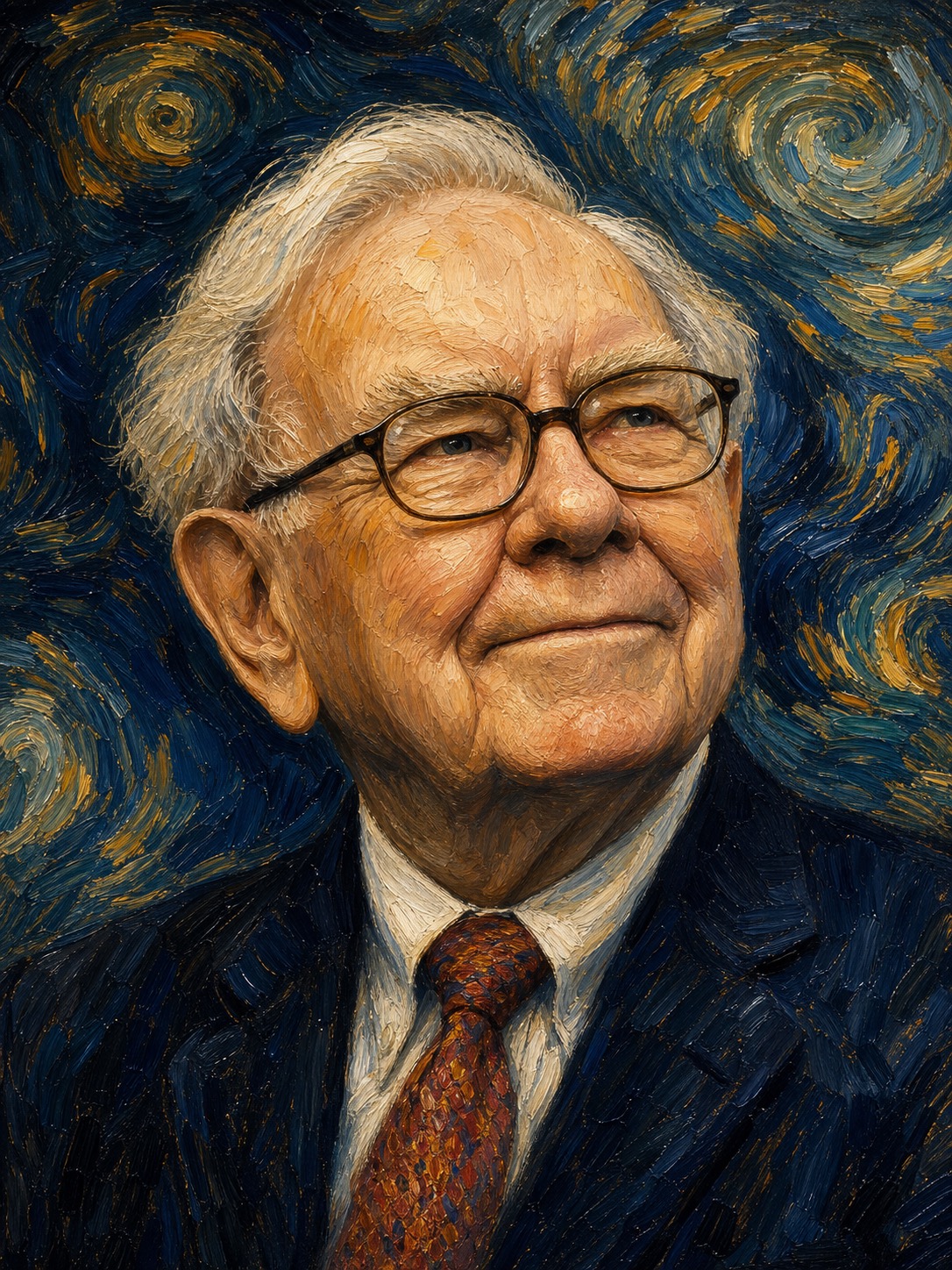
Warren Buffett
Built a permanent-capital compounding machine that turned business-owner discipline, float, reputation, and patience into a multi-decade edge.
As of: 2026-09-07T20:40:09Z
Snapshot
| Field | Detail |
|---|---|
| Full name | Warren Edward Buffett (Encyclopedia of the Great Plains). |
| Born / died | Born August 30, 1930, Omaha, Nebraska (Encyclopedia of the Great Plains). Living, on date-bounded public evidence: a May 2026 CNBC interview with Buffett, a July 15 Schedule 13D/A reporting his July 14 Berkshire-share conversion and gifts, and an August 4 DaVita Form 4 that names Buffett as a joint reporting person and bears his signature on behalf of the reporting persons. The Form 4 reports a Berkshire disposition, not a trade shown as personally placed by Buffett. A June 22 Berkshire Form S-8 post-effective amendment also lists Buffett as Chairman of the Board of Directors, while Gregory E. Abel signed as CEO (SEC Form S-8 POS, 2026). Taken together, these sources document a recent public appearance, filings in his name, and his date-bounded chairman role through their stated dates, not a separate civil-status certification thereafter (CNBC interview, 2026; SEC Schedule 13D/A, 2026; SEC Form 4, 2026). |
| Citizenship | United States (SEC Schedule 13D/A, 2026). |
| Main vehicles | Predecessor private partnerships, beginning in 1956, and Buffett Partnership Ltd. (BPL), into which Berkshire says 12 partnerships were amalgamated in 1962. The familiar "1956-1969" span is a management-period shorthand, not one unchanged legal entity: the 1957-1961 results are combined predecessor-partnership figures, BPL was the consolidated vehicle from 1962, and distributions continued after 1969 (Berkshire 2020 Annual Report; Buffett Partnership Letters). Berkshire Hathaway Inc., 1965-present, including its public-equity portfolio and wholly owned operating businesses (Berkshire 2014 Annual Letter; Berkshire 2025 Annual Report); philanthropic commitments through the Giving Pledge and wealth transfers to charitable foundations (Giving Pledge). |
| Years active | Buffett's own 1984 essay says he worked at Graham-Newman from 1954 through 1956 (Columbia Business School, 1984). He managed predecessor partnerships from 1956; BPL was the 1962 consolidated vehicle and normal investment operations ended in 1969, while wind-up distributions continued later (Berkshire 2020 Annual Report; Buffett Partnership Letters). Berkshire records identify him as a director since 1965, chairman since 1970, and a current controlling shareholder; he served as CEO through December 31, 2025. Greg Abel became President and CEO on January 1, 2026 while Buffett remained chairman (SEC 2026 Proxy Statement). |
| Current ownership / control | In a July 15, 2026 filing reflecting his July 14 gifts, Buffett reported direct ownership of 188,290 Class A and 1,162 Class B Berkshire shares, representing 29.7% of aggregate voting power and 13.2% of aggregate economic interest (SEC Schedule 13D/A, 2026). |
| Asset classes | At Berkshire level: public equities; control investments and operating companies; insurance and reinsurance float; fixed-maturity and short-term investments; and cash and U.S. Treasury bills. This is a company-level classification, not a disclosure of Buffett's personal account (Berkshire 2025 Annual Report; Berkshire 2014 Annual Letter). |
| Style tags | [Canon taxonomy, not issuer-provided labels] Value investing, quality compounders, permanent capital, insurance float, concentrated public equities, owner-operator culture, low leverage, tax-efficient compounding, decentralized conglomerate. |
| Verified track record | Berkshire reports [single-source] a 19.7% compounded annual gain in per-share market value from 1965-2025 versus 10.5% for the S&P 500 with dividends, and a 6,099,294% overall gain from 1964-2025 versus 46,061% for the S&P 500 (Berkshire 2025 Annual Report). See Track Record Detail for the reporting-period reconciliation. Buffett Partnership letters report strong positive results in 1957-1969, but the full net/gross series should be reconstructed in a later task from the original letters (Buffett Partnership Letters). |
| Peak scale | [unverified]. A historical peak AUM cannot be established from a single Form 13F. As a current disclosed reference point, Berkshire's Q2 2026 Form 13F summary reported 89 line entries with $299.3 billion of aggregate value. This is a quarter-end disclosure of certain reportable long holdings, not Berkshire's full portfolio or a measure of Buffett's personal decisions (SEC Form 13F cover page, Q2 2026; SEC Form 13F information table, Q2 2026; SEC Form 13F FAQ). |
Life and Career Timeline
Buffett was born in Omaha in 1930, the son of Howard and Leila Buffett (Encyclopedia of the Great Plains). Institutional sources disagree on his Nebraska undergraduate date: the Encyclopedia of the Great Plains says he graduated in 1950, while UNL identifies his degree as a BSBA 1951; the discrepancy remains unresolved (Encyclopedia of the Great Plains; University of Nebraska). The UNL profile also says he transferred after two years at Wharton and describes accounting as foundational to his later career. Columbia Business School remains the important intellectual hinge: its Heilbrunn Center says Buffett received an A+ from Benjamin Graham at Columbia in 1951 and situates his later practice in the Graham-Dodd value-investing tradition (Columbia Business School).
Buffett's partnership chronology is more complex than the usual shorthand "Buffett Partnership, 1956-1969." Berkshire's 2020 annual report says the first three partnerships were formed in 1956 and 12 were amalgamated into BPL in 1962. The preserved letters likewise label the 1957-1961 performance as combined predecessor-partnership results and identify 1957 as the second annual letter. The 1969 correspondence starts the wind-down; it should not be read as proof that every distribution and residual legal matter ended in that calendar year (Berkshire 2020 Annual Report; Ivey-hosted Buffett Partnership Letters). Buffett nevertheless used the letters to explain categories such as generals, workouts, and control situations and to ask partners to judge his edge over multi-year periods rather than short bursts of performance.
Buffett began buying shares of Berkshire Hathaway, then a declining New England textile company, in December 1962 and took control in May 1965 (Berkshire 2014 Annual Letter). His later description of the purchase is unusually frank: in the 1989 Berkshire letter he called buying control of Berkshire his "first mistake" because the textile business was unpromising even though the stock looked statistically cheap (Berkshire 1989 Letter). That mistake became the shell for a very different institution.
The decisive turn came when Berkshire moved from textile liquidation value toward insurance and high-return businesses. Berkshire's 2014 annual letter traces the insurance engine back to the 1967 purchase of National Indemnity and its sister company, National Fire & Marine, for $8.6 million, emphasizing that float could fund investments while underwriting results remained disciplined (Berkshire 2014 Annual Letter). The 1972 purchase of See's Candies then became the emblem of Buffett's evolution from bargain-bin assets to durable businesses with pricing power. In the 2007 letter, Buffett wrote that Blue Chip Stamps, which he and Munger controlled and later merged into Berkshire, bought See's for $25 million when it earned less than $5 million pretax and required only $8 million of capital; decades later, it still required modest incremental capital while producing much larger earnings (Berkshire 2007 Letter).
In the 1990s, Berkshire completed its major Coca-Cola and American Express purchases (Berkshire 2022 Annual Letter). By the 2000s and 2010s Berkshire had become less like a portfolio and more like a decentralized public holding company, adding whole operating businesses such as BNSF and Berkshire Hathaway Energy while retaining large minority stakes in public companies (Berkshire 2014 Annual Letter). Berkshire's owner manual makes the intended psychology explicit: although Berkshire is corporate in form, Buffett and Charlie Munger wanted shareholders to think like long-term partners rather than renters of a tradable ticker (Berkshire Owner's Manual).
Succession moved from abstraction to fact in the 2020s. Berkshire's 2025 Annual Report states that the board appointed Gregory E. Abel to succeed Buffett as chief executive officer effective January 1, 2026, while Buffett remained chairman; the report assigns major capital-allocation and investment decisions to Abel (Berkshire 2025 Annual Report). AP's May 2026 annual-meeting coverage similarly described Abel leading the meeting as new CEO, while noting that Buffett, age 95, had given up the CEO title in January, remained chairman, and still spoke at the meeting (AP News, May 2026). Abel's signed August 8, 2026 certification for Berkshire's Q2 Form 10-Q supplies the latest primary confirmation reviewed of his president and CEO titles (Abel CEO certification, August 2026).
Vehicles and Structure
The Buffett Partnership was a private, concentrated investment partnership with a general-partner performance allocation above a 6% annual hurdle (Berkshire 2020 Annual Report; Ivey-hosted Buffett Partnership Letters, 1957-1970). It was not a modern mutual fund and should not be compared mechanically with hedge funds without reconstructing partner-level returns, compensation, leverage, and cash balances. The letters are still invaluable because they show Buffett's process in real time: he told partners what kinds of securities he owned, how he thought about relative performance, and why multi-year appraisal mattered more than a single calendar year.
Berkshire is the deeper achievement. It is a public company, but its economic logic resembles permanent capital. Its insurance subsidiaries collect premiums before paying claims, creating float that can be invested as long as underwriting and liquidity remain conservative. Berkshire's own description of the model in 2025 still begins with insurance as the core, substantial investments across sectors, decentralized operating managers, a fortress-like balance sheet, and capital allocation aimed at growth in intrinsic value per share (Berkshire 2025 Annual Report). As a Canon structural inference, this design removes investor-redemption risk and can reduce pressure from short measurement periods, index comparison, and turnover-related tax drag; the annual report documents the structure, not that comparative causal claim.
The structure also creates analytical caveats. Berkshire's reported results combine public-equity selection, whole-business acquisitions, insurance underwriting, the economics of float, deferred taxes, operating earnings from controlled subsidiaries, repurchases, and market re-rating. That is why the headline performance number is real but not cleanly attributable to "stock picking." Berkshire's cited Form 13F information table shows a large public-equity portfolio, with 89 entries and $299.3 billion of reported value. Form 13F is filed up to 45 days after quarter end and reports only Section 13(f) securities and specified holding fields; it does not include cost basis or investment rationale (SEC Form 13F cover page, Q2 2026; SEC Form 13F information table, Q2 2026; SEC Form 13F FAQ, 2026).
The philanthropic structure matters because Buffett has committed more than 99% of his wealth to philanthropy during life or at death, and his Giving Pledge letter frames Berkshire shares as claims on resources that can be redirected after satisfying family needs (Giving Pledge). For investment-history purposes, this creates a strong alignment story: the manager's fortune, reputation, and eventual philanthropy are tied to the same company whose shareholders he addressed for decades.
Track Record Detail and Caveats
Berkshire's long-term record is the most verifiable metric, but its published CAGR must be reconciled using the table's footnoted reporting periods rather than 61 uniform calendar years. The 2025 Annual Report reports [single-source] a 19.7% compounded annual gain in Berkshire per-share market value from 1965-2025 versus 10.5% for the S&P 500 including dividends, and an overall gain of 6,099,294% versus 46,061% for the index (Berkshire 2025 Annual Report). The Annual Report notes that 1965 and 1966 were years ended September 30 and that 1967 covered 15 months; using the resulting 61.25-year span, the overall gains imply approximately 19.709% and 10.535%, which reconcile to the published rounded CAGRs. The spread remains extraordinary not only because of the rate, but because of the duration and the expanding capital base. It is much easier to compound a small partnership than a company with more than $1 trillion in assets (Berkshire 2025 Annual Report).
The partnership record appears even stronger in percentage terms, but it needs more careful treatment. The letters' final table describes the series as results of "Buffett Partnership, Ltd.'s and predecessor partnerships' activities"; its 1957-1961 figures therefore are not the stand-alone record of the consolidated BPL that began in 1962. The table includes partnership and limited-partner results and shows large early outperformance against the Dow in both rising and falling markets (Buffett Partnership Letters). However, the Canon should not treat a single summarized CAGR as fully verified until a later trade/profile task reconstructs the series from primary letters, checks whether figures are before or after the general partner allocation, and clarifies whether the benchmark includes dividends and taxes.
The Berkshire record also has denominator problems. A share bought in 1965 and held until 2025 is not the same experience as a dollar invested by a shareholder in 1998, 2007, 2021, or 2025. Berkshire's own table is a per-share market-value record; it is not a dollar-weighted return for all investors who ever bought Berkshire. Its structure channels shareholder savings through retained earnings and lets Berkshire own controlled businesses as well as public businesses chosen for expected long-term business performance rather than adroit purchases and sales (Berkshire 2022 shareholder letter).
The record includes mistakes and reversals. Buffett has been unusually willing to catalog errors. In the 1989 letter, he framed Berkshire itself as a mistake born from a cheap but mediocre textile business, then moved on to broader errors such as omitted opportunities and the dangers of the institutional imperative (Berkshire 1989 Letter). In 2025, Berkshire recorded a roughly $5.0 billion pretax impairment loss on Kraft Heinz common stock and a roughly $5.7 billion impairment on Occidental common stock [single-source], a reminder that even large, patient positions can disappoint when the underlying economics or valuation shift (Berkshire 2025 Annual Report).
There are also reputational and political caveats. Bethany McLean's 2011 Vanity Fair article captured criticism that Buffett praised rescue actions that benefited Berkshire while also defending controversial investees including Goldman Sachs and Moody's (Vanity Fair, February 2011). That does not negate the investing record, but it belongs in the Canon because Buffett's public role often blended capital allocation, moral suasion, and policy commentary.
Why They Matter
Buffett matters first because he turned value investing from a narrow cheap-asset technique into a broader discipline of business ownership. The early Buffett was recognizably Grahamian: margin of safety, discount to intrinsic value, special situations, and skeptical appraisal. The mature Buffett, influenced heavily by Charlie Munger, emphasized better businesses, durable competitive advantages, management quality, and the power of tax-efficient holding periods. The See's Candies case is the cleanest bridge between those worlds (Berkshire 2007 Letter).
He matters second because Berkshire is an institutional design case. Many investors can describe patience; fewer can build a vehicle that structurally permits it. Berkshire's permanent capital, decentralized subsidiaries, low headquarters count, excess liquidity, and shareholder culture all supported the stated goal of increasing intrinsic value per share rather than maximizing assets under management. The owner's manual is still one of the clearest primary documents for this design (Berkshire Owner's Manual).
He matters third because he made investor education part of the product. The annual letters, annual meeting, public interviews, and plain-language explanations gave multiple generations a shared vocabulary: margin of safety, Mr. Market, circle of competence, float, intrinsic value, owner earnings, and the difference between price volatility and business risk. Columbia's value-investing history places Buffett within the Graham-Dodd lineage while distinguishing his more concentrated, control-oriented practice from their outside-minority-shareholder approach (Columbia Business School).
Finally, Buffett matters because his limits are as instructive as his strengths. Berkshire's size reduced the universe of high-impact opportunities. Some major mistakes came from paying too much for mediocre or changing businesses. Some public positions placed Berkshire near companies whose behavior later created reputational cost. And succession from Buffett and Munger to Abel is now not a theoretical risk but the next live test of whether Berkshire is an institution or primarily the product of two exceptional minds.
Open Questions for Later Tasks
- Reconstruct Buffett Partnership annual returns from 1957-1969 directly from the letters, separating gross partnership results, limited-partner net results, the Dow benchmark, dividends, and fees.
- Disaggregate Berkshire's long-run record into public equities, wholly owned acquisitions, insurance underwriting, float, tax deferral, leverage avoidance, and valuation multiple change.
- Build detailed trade studies for American Express, GEICO, See's Candies, Coca-Cola, BNSF, Apple, Bank of America, Goldman Sachs, Dexter Shoe, Tesco, airlines, Kraft Heinz, and Occidental.
- Investigate missed opportunities and errors using Buffett's own mistake discussions, including the decision to buy Berkshire, omission errors, and the long delay in technology investing.
- Examine controversies and legal/regulatory contexts around Salomon Brothers, Moody's, Wells Fargo, Goldman Sachs during the crisis, Kraft Heinz, and Berkshire Hathaway Energy wildfire and utility matters.
- Track the post-2026 Abel era: capital allocation authority, public-equity changes, acquisition pace, shareholder culture, repurchase policy, and whether the annual-letter candor survives the founder transition.
- Separate lessons that are transferable to ordinary investors from lessons that depend on rare structural advantages such as permanent capital, float, reputation, and the ability to write large checks quickly.
As of: 2026-08-27T19:56:10Z
Core Worldview
Buffett's mature philosophy treats a security as fractional ownership of a business, not as a quotation to be traded. Berkshire's owner manual says the company is corporate in form but partnership-like in attitude, with shareholders viewed as co-owners of operating assets rather than transient holders of paper claims (Berkshire Owner's Manual (1996; updated version)). That framing is not decorative; it changes the whole decision process. The relevant question becomes: would Berkshire want to own this business, with these managers, at this price, for a very long time?
The second pillar is intrinsic value per share. Berkshire's stated objective has long been to maximize per-share intrinsic business value rather than corporate size; its owner manual also cautions that consolidated reported earnings can be a poor measure of economic performance (Berkshire Owner's Manual, updated). In his first CEO letter, Greg Abel describes Berkshire as designed for rational capital allocation, sets a long-term objective of maximizing intrinsic value per share, and says Berkshire's culture and values continue to guide the company. This is evidence of institutional continuity, not proof that future allocation will reproduce Buffett's judgment (Abel FY2025 CEO Letter, 2026).
The third pillar is selectivity. Buffett's 1996 letter argues that investors do not need expertise in every company, or even many; they need the ability to evaluate selected businesses inside a known circle of competence (Berkshire 1996 Letter). For most investors, he says the best common-stock solution is a low-cost index fund, and he repeated that advice in the 2016 letter while criticizing high-fee intermediaries (Berkshire 1996 Letter; Berkshire 2016 Letter). Buffett's own method is therefore not marketed as universally replicable stock-picking magic. It is a demanding business-analysis craft, made easier by Berkshire's unusual structure.
The Edge - What Markets Misprice and Why
Buffett's edge rests on time horizon, temperament, and business quality. The Canon's synthesis is that near-term overreaction, fashionable extrapolation, and short institutional measurement periods can create mispricing before business value reveals itself. Berkshire's owner manual directly supports the narrower time-horizon point: short-term price changes are meaningless except when they create an attractive opportunity to increase ownership in a business with good long-term expectations (Berkshire Owner's Manual, updated).
The edge is also structural. Berkshire has permanent capital, insurance float, a decentralized operating culture, and a shareholder base trained to accept inactivity. Float is not free leverage in all circumstances; it is only valuable if underwriting is disciplined. Buffett described Berkshire's insurance float in 2007 as money temporarily held in insurance operations that could fund investments while underwriting at least breaks even over time (Berkshire 2007 Letter). As a Canon inference, that arrangement can let Berkshire act when markets are stressed while many fund managers face redemptions or career pressure.
Buffett also sees mispricing in accounting presentation. The 2007 See's Candies discussion shows why he prefers economic return on incremental capital over reported growth alone: See's required only $32 million of additional capital after Blue Chip Stamps bought it, while generating $1.35 billion of pre-tax earnings through 2007 [single-source] (Berkshire 2007 Letter). A business with a durable competitive advantage that can grow earnings while requiring little incremental capital and sending excess cash to headquarters is more valuable than a superficially larger business that must continually reinvest at mediocre returns.
Process: Idea Sourcing -> Research -> Valuation and Entry -> Sizing -> Portfolio Construction -> Sell Discipline
Buffett's partnership-era process was broader and more opportunistic than the later Berkshire archetype. The Buffett Partnership letters divided investments into "generals," "workouts," and "controls," with the mix determined by availability rather than market forecasting (Buffett Partnership Letters, 1957-1970). This early toolkit included undervalued public stocks, special situations, and control investments. The later Berkshire process retained opportunism, but as capital grew it shifted toward controlled businesses, insurance, and minority stakes in durable franchises (Berkshire 2014 Letter; Berkshire 2007 Letter).
Idea sourcing at Berkshire is intentionally simple. Buffett's stated equity-selection criteria are an understandable business, favorable long-term prospects, honest and competent people, and an attractive price (Berkshire 1992 Letter). In practice, the Canon uses durable economics, owner-minded management, excess cash generation, and material size as an operational shorthand for testing those criteria; that shorthand is an analytical summary, not a verbatim Berkshire checklist. Abel's FY2025 CEO letter makes the continuity operational: it lists understandable businesses, durable advantages, high-integrity owner-minded leaders, reputation protection, concentrated high-conviction action, and repurchases below conservatively estimated intrinsic value as capital-allocation criteria (Abel FY2025 CEO Letter, 2026).
Research is business-first. Buffett wants to understand how the company makes money, whether its moat is durable, whether management allocates capital rationally, and what future cash can be taken out without impairing the business. He has said that predicting the long-term economics of companies in fast-changing industries lies beyond Berkshire's circle of competence (Berkshire 1999 Annual Report). The 1996 letter compresses the research requirement into two practical disciplines: business valuation and the psychology of market prices (Berkshire 1996 Letter).
Valuation is not a formula fetish. Buffett treats owner earnings, rather than GAAP earnings, as the relevant valuation input after estimating the capital and working-capital investment required to maintain a business's current competitive position (Berkshire 1986 Letter). The maintenance-investment estimate is necessarily a difficult judgment, so owner earnings is not a mechanically precise substitute for GAAP earnings or generic cash flow. Separately, Berkshire's stated selection framework asks whether a business is understandable, has favorable long-term prospects, is run by honest and competent people, and is available at an attractive price (Berkshire 1992 Letter). Documented crisis entries included preferred stock and warrants at Goldman Sachs and GE (Goldman Sachs, 2008; GE, 2008); treating those structures as downside protection is a Canon inference from their senior claims and equity upside. In 2011, Buffett described Berkshire repurchases as attractive only below intrinsic value and refused to buy back shares if cash-equivalents fell below $20 billion, explicitly subordinating opportunism to unquestionable financial strength (Berkshire 2011 Letter).
Sizing follows conviction and availability. Buffett's 1996 letter says that when an investor finds a qualifying business, they should buy a meaningful amount; the Canon reads that alongside its circle-of-competence discussion as a selective, rather than automatic, diversification rule (Berkshire 1996 Letter). Berkshire itself is diversified across many operating businesses, but its public-equity portfolio has often been concentrated in a few large positions (Berkshire 2025 Annual Report). The owner manual makes the alignment explicit: Buffett and Munger were comfortable with large personal Berkshire exposure because Berkshire itself owned a diversified collection of strong businesses (Berkshire Owner's Manual, updated).
Portfolio construction is a capital-allocation problem, not a style-box exercise. As a Canon summary of Berkshire's disclosed toolkit, capital can move among wholly owned businesses, marketable equities, Treasury bills, fixed income, special financings, acquisitions, and repurchases. The owner manual says the price and availability of businesses, plus insurance capital needs, determine any year's allocation (Berkshire Owner's Manual, updated). At December 31, 2025, Berkshire's insurance-and-other segment reported $321.434 billion of short-term investments in U.S. Treasury Bills, a specific balance-sheet category rather than Berkshire's total liquidity (Berkshire 2025 Annual Report and 10-K). The filing establishes the scale, not management's motive for holding that exact amount; interpreting it as optionality when opportunity is thin is a Canon inference.
The sell discipline is asymmetric, and the firm has not published a universal sell checklist. For controlled businesses, Berkshire says it has no interest in selling good businesses regardless of price and is reluctant to sell sub-par businesses that still generate cash and have satisfactory managers and labor relations; the manual expressly limits that discussion to controlled businesses, not marketable securities (Berkshire Owner's Manual, updated). For marketable securities, Buffett says Berkshire buys on expectations of long-term business performance rather than trading skill (Berkshire 2022 Letter). Berkshire has separately said it made no commitment to hold any marketable security forever (Berkshire 2016 Letter). A reason for any specific sale should therefore be established from its transaction record rather than inferred from a generic permanent-ownership slogan.
Risk Management
Buffett has framed investment risk in terms of the probability of a loss of purchasing power over the contemplated holding period, rather than beta or price volatility alone (Berkshire 2011 Letter); the broader list that follows is the Canon's operational synthesis of that framework. The owner manual says a falling stock market can benefit Berkshire because it lowers prices for whole companies, marketable securities, and repurchases by investees (Berkshire Owner's Manual, updated). The 2011 letter adds the practical guardrail: Berkshire will not sacrifice unquestionable financial strength for repurchases, even when its own stock is cheap (Berkshire 2011 Letter).
Insurance is the clearest operational expression of the risk culture. Buffett praises insurers that accept only risks they can evaluate, price for profit rather than market share, and avoid aggregation that could threaten solvency (Berkshire 2001 Letter). That maps to the entire Berkshire philosophy: know the boundaries of competence, price risk conservatively, and stay solvent long enough for rationality to matter.
Reputation is a separate risk category. The Justice Department later announced a $290 million DOJ/SEC settlement resolving government allegations of Treasury-auction and government-securities-trading misconduct; DOJ said the antitrust final judgment was for settlement purposes and did not amount to an admission of guilt (DOJ/SEC Salomon Settlement, 1992). Buffett's 1991 congressional standard, reproduced in Berkshire's 2025 annual report, captures the enduring rule: financial losses may be tolerable, but reputational loss is not (Berkshire 2025 Annual Report). As a Canon inference, that discipline also protects Berkshire's ability to make trust-based acquisitions and crisis investments.
Temperament and Psychology
The Canon's synthesis is that Buffett's temperament is patient, opportunistic, and anti-theatrical. His 1996 letter supports the narrower disciplines of staying inside a circle of competence, refusing complexity that cannot be evaluated, and acting meaningfully only on qualifying businesses (Berkshire 1996 Letter). The partnership letters already show this temperament: Buffett warned partners that annual results could be heavily affected by the availability of workouts, generals, and controls, so single-year performance should not drive judgment (Buffett Partnership Letters, 1957-1970).
He is also unusually willing to frame omissions and errors as process failures. The 1989 letter says Berkshire's management learned to avoid hard business problems rather than solve them, and it names the "institutional imperative" as a force that pushes rational managers into irrational imitation and empire-building (Berkshire 1989 Letter). The Canon's synthesis is a philosophy built around subtraction: avoid bad people, bad businesses, fragile balance sheets, fees, fashion, and unnecessary action.
Evolution Over Career
The early Buffett was a Graham-style investor hunting statistically cheap securities, workouts, and control opportunities. The mature Buffett, strongly influenced by Charlie Munger, moved toward paying fair prices for superior businesses (Berkshire 2014 Letter). See's Candies is the bridge case: Blue Chip Stamps, then controlled by Buffett and Munger and later merged into Berkshire, paid $25 million for a business with modest unit growth, exceptional returns on tangible capital, a durable competitive advantage, and substantial excess cash generation (Berkshire 2007 Letter).
The 2014 retrospective makes the evolution more concrete. Buffett calls the Berkshire textile purchase a mistake and says the 1967 National Indemnity purchase put insurance inside Berkshire when it would have been far more valuable to the Buffett Partnership partners directly (Berkshire 2014 Letter). The irony is important: the final institution grew out of suboptimal early capital allocation. Buffett's philosophy is not a story of immaculate consistency; it is a record of learning from expensive errors.
By the 2010s and 2020s, the philosophy had to adapt to scale. Buffett openly warned in 2007 that Berkshire's past results could not be duplicated because its asset and earnings base had become too large (Berkshire 2007 Letter). In 2016, he quoted his 1966 warning that size would likely harm future partnership results and then generalized the point to the investment-management industry (Berkshire 2016 Letter). Scale converts a high-return craft into a capital-allocation institution.
What They Explicitly Reject
As a Canon synthesis across his letters, Buffett rejects fashionable complexity and the use of financial theory as a substitute for business analysis. The 1996 letter explicitly says investors need not understand beta, efficient markets, modern portfolio theory, option pricing, or emerging markets to invest successfully (Berkshire 1996 Letter). That is not anti-intellectualism; it is a preference for analyzable variables over elegant but brittle abstractions.
He also rejects businesses that require too much capital for too little return. The 2007 letter classifies businesses as great, good, or gruesome, with airlines used as the example of a growth industry that historically consumed capital without durable advantage (Berkshire 2007 Letter). He rejects bad counterparties even more strongly: the 1989 letter says Berkshire does not want to partner with managers who lack admirable qualities, regardless of apparent economics (Berkshire 1989 Letter).
Regimes Where It Thrives vs. Struggles
As a Canon regime synthesis, the philosophy thrives when markets are fearful, liquidity is scarce, credit is mistrusted, and sellers value certainty of closing. It also thrives in stable industries where brand, cost advantage, network, regulation, habit, or distribution create durable economics. A depressed stock market helps Berkshire by lowering acquisition prices, public-equity prices, and repurchase prices for investees (Berkshire Owner's Manual, updated).
It struggles in regimes where high-quality businesses are obvious and expensive, where technological change makes long-term economics hard to underwrite, or where Berkshire's own size limits the universe of meaningful opportunities (Berkshire 1999 Annual Report; Berkshire 2007 Letter; Berkshire 2016 Letter). Berkshire has said that cash-heavy periods reflect a failure to find entire businesses or marketable stocks meeting its long-term-holding criteria, while maintaining a minimum cash buffer for financial resilience (Berkshire 2021 Letter). The 2025 balance sheet's Treasury-bill balance establishes a point-in-time asset category, not management's view of every available opportunity; any opportunity-cost burden in a rising market is a Canon inference (Berkshire 2025 Annual Report).
As a Canon hypothesis, the method can also struggle when old brands lose relevance or when a "good" business turns out to need more reinvention than expected. In 2025, Berkshire recorded [single-source] pre-tax impairment charges of about $5.0 billion on Kraft Heinz common stock and $5.7 billion on Occidental common stock; it judged each unrealized loss other than temporary while stating no present intent to dispose of Occidental (Berkshire 2025 Annual Report and 10-K). The charges show that brand, scale, and patience do not prevent large recorded accounting impairment losses. Changed consumer tastes, commodity exposure, and overpayment are possible failure mechanisms, not causes attributed to these impairments by the cited filing.
Tensions Between Stated Philosophy and Actual Behavior
The first tension is between permanent ownership rhetoric and active portfolio adaptation. Berkshire says it likes to hold good businesses indefinitely, yet public securities are not treated the same as controlled businesses. The owner manual itself clarifies that the reluctance to sell applies to controlled operations, not necessarily marketable securities (Berkshire Owner's Manual, updated). This distinction keeps Buffett's actual behavior more flexible than the simplified slogan.
The second tension is between trust-based decentralization and control risk. Lawrence Cunningham's "Berkshire's Blemishes" argues that Berkshire's admired model also creates costs because the company resembles a massive industrial conglomerate run with the ethos of an old-fashioned investment partnership (Cunningham, 2016). The General Re/AIG matter is a concrete reminder: the Justice Department said General Re, a Berkshire subsidiary, entered a resolution over fraudulent reinsurance transactions and agreed to payments and remediation (DOJ General Re, 2010). Berkshire's culture reduces many agency costs, but it does not eliminate subsidiary-level misconduct risk.
The third tension is public morality versus economic interest. In September and October 2008, Goldman Sachs and GE announced agreements under which Berkshire would invest $5 billion and $3 billion, respectively; the Canon interprets these transactions as a potential overlap between Berkshire's economic interests and the broader crisis-policy debate (Goldman Sachs, 2008; GE, 2008). In the Financial Crisis Inquiry Commission interview, Buffett acknowledged Berkshire's Moody's stake, said his original analysis focused on the business's economics rather than management, and said he recognized the housing bubble "not soon enough" and did not fully realize until September 2008 the degree to which the crisis would stop the financial system and spill into the economy (FCIC Interview, 2010). The record supports a governance and diligence tension, not proof that policy advocacy was motivated by self-dealing. Berkshire's scale and public role can therefore turn capital allocation into reputational politics.
The fourth tension is transferability. As a Canon transferability judgment, ordinary investors can copy the patience, fee aversion, business-owner mindset, and circle-of-competence discipline, but not Berkshire's float, reputation, tax position, deal flow, permanent capital, or ability to write multi-billion-dollar checks in a panic. Buffett's own recommendation of index funds for most investors is the built-in warning label (Berkshire 1996 Letter; Berkshire 2016 Letter).
Research Notes and Open Questions
- The partnership return series remains unreconstructed here; this philosophy file uses the partnership letters for process categories and temperament, not for a verified annual return table.
- Later tasks should test the philosophy against specific trades: See's, American Express, GEICO, Coca-Cola, Apple, Bank of America, Goldman Sachs, Dexter Shoe, Tesco, airlines, Kraft Heinz, Occidental, and Berkshire Energy.
- The post-Buffett CEO era is now live, while Buffett remains chairman. Abel's FY2025 annual-report language tracks the Buffett-Munger philosophy closely, but future tasks should compare actual capital allocation under Abel with the stated framework.
- Form 13F boundary: Berkshire's Q2 2026 filing reports 14 other included managers and splits Coca-Cola across multiple rows. The 400 million-share aggregate is Berkshire's reported Section 13(f) exposure, with Buffett named as an other included manager sharing defined investment discretion; it is not proof of Buffett's personal ownership or of who made each investment decision (SEC Form 13F-HR Cover Page, Q2 2026; SEC Form 13F Information Table, Q2 2026; SEC Form 13F Instructions).
As of: 2026-08-30T00:03:46Z
Ranking Note
Buffett's "greatest trades" are not all clean round-trip trades. Some are controlled acquisitions, some are minority public-equity stakes, and some are crisis financings with preferred stock and warrants. The best way to rank them is therefore by several dimensions: absolute dollars, return on capital, influence on Buffett's method, and strategic value to Berkshire.
By disclosed year-end fair value, Apple is the largest public-equity position documented here: Berkshire's Apple stake had an approximately $174.3 billion fair value at year-end 2023. The exact realized-plus-unrealized gain requires a transaction-level share-count reconstruction because Berkshire later sold large portions of the position, so its ranking as Berkshire's largest absolute-dollar public-stock win remains [unverified] (Berkshire 2023 Annual Report, 2024; Berkshire 2025 Annual Report, 2026). By strategic value, the Canon ranks GEICO as the single best trade: Berkshire's subsidiaries bought about one-third of the company in the 1970s, and GEICO repurchases later increased that stake to roughly half without further Berkshire purchases. After a late-1995 offer, Berkshire completed the acquisition of the shares it did not already own in early January 1996 for aggregate cash consideration of $2.3 billion, making GEICO wholly owned (Berkshire 2018 Letter, 2019; Berkshire 1998 Annual Report). Buffett estimated in 2018 that Tony Nicely's management of GEICO had increased Berkshire intrinsic value by more than $50 billion; he separately praised Nicely as a model manager for GEICO's associates (Berkshire 2018 Letter, 2019).
1. GEICO - The Franchise in Crisis That Became an Insurance Engine
Context and dates. Berkshire bought about one-third of GEICO in the 1970s, and GEICO repurchases then increased that position to roughly half without additional Berkshire purchases. In late 1995, Berkshire offered $2.3 billion for the remaining shares; the merger completed in early January 1996, making GEICO a wholly owned Berkshire subsidiary (Berkshire 2018 Letter, 2019; Berkshire 1998 Annual Report). Buffett's 2014 letter explains the original business attraction: GEICO had a huge cost advantage in an insurance category where price matters intensely to consumers (Berkshire 2014 Letter, 2015).
Thesis and how he found it. This was not a generic "turnaround" bet. Buffett saw a structurally advantaged auto insurer temporarily damaged by underwriting and capital problems. In the 2014 retrospective, he still emphasized the same cost advantage he saw in 1951: a low-cost operation could save customers money and take share from higher-cost competitors (Berkshire 2014 Letter, 2015). The trade also fit Berkshire's larger insurance strategy: disciplined underwriting plus growing float can turn policyholder funds into investment capital when the insurer stays solvent and rational.
Size and structure. Berkshire's first half-interest was common stock. Its stake later grew to roughly half because GEICO repurchased stock, not because Berkshire bought more. At the early-January 1996 merger, each remaining GEICO share was converted into $70 of cash, or an aggregate $2.3 billion [single-source] (Berkshire 1998 Annual Report).
Entry path and drawdown endured. The key drawdown was business risk rather than mark-to-market pain. GEICO had been a distressed insurer; Berkshire had to underwrite whether the customer proposition and expense advantage would survive the financial damage. Once Tony Nicely restored growth, Berkshire paid up for the rest: Buffett later described the second half as costing about 50 times the first half's price [single-source] (Berkshire 2018 Letter, 2019).
Exit and P&L. There was no exit. GEICO became a wholly owned subsidiary. By 2018, Buffett described GEICO's sales as 1,200% greater than the 1995 level, cumulative underwriting profits as $15.5 billion pretax, and float as having grown from $2.5 billion to $22.1 billion [single-source]. He also estimated that Nicely's management had increased Berkshire intrinsic value by more than $50 billion [self-reported] (Berkshire 2018 Letter, 2019). On those documented dimensions, the Canon treats GEICO as the strongest candidate for Buffett's single best strategic trade.
What it teaches. Buy a superior business when the wound is localized and solvable, but avoid true turnarounds where the business model itself is broken. GEICO also shows the Berkshire advantage: permanent capital lets a public stock position become a full operating business when the evidence improves.
2. Apple - A Leading Candidate for the Largest Public-Equity Win
Context and dates. By year-end 2018, Berkshire held 255.3 million Apple shares, representing 5.4% of Apple, with an actual purchase price and tax basis of $36.044 billion and market value of $40.271 billion (Berkshire 2018 Letter, 2019). By year-end 2023, Apple alone accounted for $174.3 billion of Berkshire's equity portfolio fair value (Berkshire 2023 Annual Report, 2024).
Thesis and how he found it. The decision trail has two stages. Berkshire's combined Form 13F first disclosed 9.8 million Apple shares as of March 31, 2016 (Berkshire Q1 2016 Form 13F information table; Berkshire Q1 2016 Form 13F full submission). The filing's Other Manager codes include Warren E. Buffett alongside Berkshire entities, but they do not establish which individual originated or managed the Apple decision; the Canon therefore does not attribute the initial position to Buffett, Todd Combs, or Ted Weschler. Berkshire's primary 2020 chairman's letter documents the later scale-up: general-account purchases began in late 2016, the account reached 5.2% by mid-2018 at a $36 billion cost, and Apple repurchases raised Berkshire's ownership to 5.4% after a partial sale; the letter separately notes a small, separately managed Apple holding that was later sold (Berkshire 2020 Letter, 2021).
Size and structure. The position was common stock. At year-end 2018, Apple was already a $36.0 billion cost-basis commitment, about 35% of Berkshire's disclosed common-stock cost in that table (Berkshire 2018 Letter, 2019). By year-end 2025, after substantial sales, Berkshire still reported an Apple stake with 1.6% ownership, $6.255 billion cost basis, $61.962 billion market value, and $280 million of 2025 dividends (Berkshire 2025 Annual Report, 2026).
Entry path and drawdown endured. Berkshire reported the Apple position at $57.6 billion on September 30, 2018 and $40.3 billion on December 31, 2018, a decline of approximately 30% between reported dates (Berkshire Q3 2018 Form 10-Q; Berkshire 2018 Form 10-K). This is a position-level fair-value change, not necessarily the maximum peak-to-trough drawdown or a price-only return, because Berkshire's share count changed during the period.
Exit and P&L. This is a partial exit, not a completed trade. The cleanest disclosed facts are: $36.0 billion cost and $40.3 billion market value at year-end 2018; $174.3 billion fair value at year-end 2023; and $62.0 billion remaining market value on $6.3 billion remaining cost at year-end 2025 (Berkshire 2018 Letter, 2019; Berkshire 2023 Annual Report, 2024; Berkshire 2025 Annual Report, 2026). Because Berkshire sold much of the stake in 2024-2025, exact total pretax P&L should be reconstructed from 13F changes, annual-report tax-basis disclosures, and realized gains. The disclosed snapshots make Apple a leading candidate for Berkshire's largest absolute-dollar public-stock win, but that ranking remains [unverified] until the reconstruction is complete.
What it teaches. The trade shows that a circle of competence can expand when the relevant business drivers become understandable. Berkshire's primary record also demonstrates the compounding effect of issuer repurchases: Apple repurchases raised Berkshire's ownership after a partial sale (Berkshire 2020 Letter, 2021). "Never sell" is folklore: Berkshire later reduced the position, while the complete motive for the 2024-2025 sales is not established by the annual reports cited above (Berkshire 2025 Annual Report, 2026).
3. See's Candies - The Small Acquisition That Changed the Playbook
Context and dates. Blue Chip Stamps, controlled by Buffett and Charlie Munger, bought See's Candies in 1972 for $25 million. At purchase, See's had $30 million of sales, less than $5 million of pretax earnings, and about $8 million of capital required to run the business (Berkshire 2007 Letter, 2008).
Thesis and how he found it. The thesis was pricing power plus low incremental capital. Buffett later called See's the prototype of a dream business because modest physical volume growth translated into much larger financial growth while little capital had to be reinvested (Berkshire 2007 Letter, 2008). In the Canon's interpretation, the transaction marks a break from pure Graham cheapness toward paying a fair price for a business that can raise prices, retain customers, and send cash upstream; the cited passage documents the economics, not Munger's precise contribution.
Size and structure. It was a control acquisition, not a public-stock trade. The price was tiny relative to later Berkshire, but meaningful in the early 1970s and almost lost: Buffett said in 2007 that he refused to pay more than $25 million even though the seller asked $30 million (Berkshire 2007 Letter, 2008).
Entry path and drawdown endured. The main risk was not financial leverage or a visible drawdown; it was the chance that Buffett's price discipline would make him miss the deal entirely. Operating growth was slow: pounds of candy sold grew only about 2% annually from 1972 to 2007, so the trade required recognizing pricing power and capital-light economics rather than volume growth (Berkshire 2007 Letter, 2008).
Exit and P&L. No exit. By 2007, See's had $383 million of sales and $82 million of pretax profit, required only $40 million of operating capital, and had produced $1.35 billion of cumulative pretax earnings while needing only $32 million of incremental reinvestment since purchase [single-source] (Berkshire 2007 Letter, 2008). That excludes post-2007 cash generation and the value of capital redeployed into other Berkshire assets.
What it teaches. The best business is not necessarily the fastest grower. A slow grower with pricing power and minimal capital needs can be a compounding machine because the excess cash can be redeployed elsewhere.
4. Coca-Cola - The Classic Durable-Brand Compounder
Context and dates. Berkshire completed a seven-year purchase program for 400 million Coca-Cola shares by August 1994 at a total cost of $1.3 billion (Berkshire 2022 Letter, 2023).
Thesis and how he found it. Buffett's contemporaneous account emphasized the product's consumer appeal, Coca-Cola's worldwide reach, accelerating overseas sales, and management's combination of marketing and financial skill (Berkshire 1989 Letter). The broader formulation in this record - durable brand, repeat consumption, distribution, and shareholder cash generation - is a Canon synthesis of those documented qualities.
Size and structure. It was common stock. The $1.3 billion cost was large for Berkshire at the time, and the share count has remained unchanged at 400 million for decades (Berkshire 2022 Letter, 2023; Berkshire Q4 2025 Form 13F information table, 2026).
Entry path and drawdown endured. Berkshire's cited disclosures do not provide trade-level interim drawdown data, so the record does not infer one or claim a counterfactual comparison with technology stocks. The business risk is nevertheless real: Coca-Cola's 2025 Form 10-K identifies obesity and sweetened-beverage concerns, potential taxes and regulation, and evolving consumer preferences as risks to demand and profitability (The Coca-Cola Company 2025 Form 10-K, 2026). The investment case therefore required tolerating business and valuation uncertainty while the franchise executed, not assuming a riskless brand compounder.
Exit and P&L. No exit. Berkshire received $75 million of Coke dividends in 1994 and $704 million in 2022; by 2025 the holding had a $1.299 billion cost basis, $27.964 billion market value, 9.3% ownership, and $816 million of 2025 dividends (Berkshire 2022 Letter, 2023; Berkshire 2025 Annual Report, 2026).
What it teaches. The payoff from a great business can come from doing almost nothing after the purchase. Berkshire's 2022 letter frames public-equity ownership as an expectation about long-term business performance rather than adroit purchases and sales, and uses Coke's dividend progression to illustrate the point (Berkshire 2022 Letter, 2023). The lesson is conditional: dividends and retained earnings matter only while the underlying franchise continues to meet changing consumer demand.
5. American Express - Crisis Franchise, Then Permanent Holding
Context and dates. Buffett wrote in 1994 that, in the mid-1960s after the salad-oil scandal, the partnership put about 40% of its capital into American Express and acquired more than 5% for $13 million (Berkshire 1994 Letter). The partnership letters do not name American Express in those passages, but the 1965 year-end letter sets a 40% single-security concentration limit, and the 1967 year-end letter says one unnamed security hit that limit and accounted for much of 1967's gain (Buffett Partnership Letters, 1957-1970).
Thesis and how he found it. The reconstructed thesis was that the scandal threatened the company but not the core traveler's-cheque and card franchise. In a later account, Buffett described the core observation more cautiously: despite doubts about American Express's survival, customers continued using its card and traveler's checks, which carried a premium price (2018 Berkshire meeting transcript reproduction). Later Berkshire ownership rested on the same idea: American Express had a premium network, affluent cardholders, brand trust, and a closed-loop model that could support high returns.
Size and structure. The mid-1960s trade was a Buffett Partnership common-stock position and must not be combined with Berkshire's later stake. Berkshire's later ownership began with a $300 million American Express PERC preferred investment in 1991 whose terms required conversion after three years, subject to a one-year extension if the common stock was below $24.50. Berkshire held common stock by year-end 1994 and, after further purchases, reported 49.46 million American Express shares at a $1.393 billion cost at year-end 1995 and said it owned about 10% (Berkshire 1991 Letter; Berkshire 1994 Letter; Berkshire 1995 Letter). Berkshire's ownership has later grown partly because American Express repurchased its own shares (Berkshire 2022 Letter, 2023; Berkshire 2018 Letter, 2019).
Entry path and drawdown endured. The salad-oil trade required buying during a public scandal that Buffett later described as raising questions about the company's survival (2018 Berkshire meeting transcript reproduction). The later Berkshire holding endured the financial crisis, competitive card cycles, and consumer-credit risk. The key question in each episode was whether trust and spend volume were permanently impaired.
Exit and P&L. A primary record sufficient to establish the partnership's precise exit date and realized P&L has not been identified; those figures are omitted rather than inferred. The Berkshire stake is still held: at year-end 2025 it had a $1.287 billion cost basis, $56.088 billion market value, 22.1% ownership, and $479 million of 2025 dividends (Berkshire 2025 Annual Report, 2026).
What it teaches. Buffett's best crisis investments separate a temporary, bounded wound from permanent franchise impairment. American Express also shows why concentration can be rational only when the underlying facts are unusually clear.
6. Bank of America - Crisis Terms With Equity Upside
Context and dates. On August 25, 2011, Bank of America announced an agreement under which Berkshire would purchase $5 billion of 6% cumulative perpetual preferred stock and receive warrants to buy 700 million common shares at $7.142857 per share for 10 years. The sale closed on September 1, 2011, when Bank of America issued the 50,000 preferred shares and warrant to Berkshire for $5 billion in cash (Bank of America Exhibit 99.1, 2011; Bank of America Form 8-K, 2011).
Primary-source chronology. The 2011 entry terms were cumulative. Effective May 7, 2014, a stockholder-approved amendment changed the Series T terms so dividends became non-cumulative, the dividend rate was fixed at 6%, and redemption was permitted only after May 7, 2019 (Bank of America Form 8-K, 2014). Thus "cumulative" is historically correct for the 2011 transaction. Berkshire's 2017 report refers to the post-amendment instrument as non-cumulative and should not be read as confirmation of the original 2011 terms (Berkshire 2017 Annual Report, 2018). The investment came when large U.S. banks were still dealing with mortgage, litigation, and capital concerns after the financial crisis.
Thesis and how he found it. The contemporaneous record supports a more bounded thesis than a retrospective deposit-franchise narrative. Buffett called Bank of America "a strong, well-led company," cited the franchise's profit-generating abilities, and said management was acting aggressively to put its challenges behind it; Bank of America's release separately called Berkshire's investment a strong endorsement (Bank of America Exhibit 99.1, 2011). The same release described a broad consumer, small-business, wealth-management, and investment-banking platform, but does not establish a Buffett valuation of a deposit franchise or quantify an endorsement effect on the share price. Contemporaneous filings do document the backdrop: in June 2011, Bank of America announced an $8.5 billion cash settlement subject to court approval and forecast a second-quarter net loss of $8.6-$9.1 billion, citing mortgage-related items and goodwill impairment. Those were management estimates, so they establish contemporaneous uncertainty rather than the cause of Bank of America's valuation (Bank of America Exhibit 99.1, 2011).
Size and structure. The structure was unusually protective. Berkshire received preferred stock carrying a 6% annual dividend rate, a 5% redemption premium right for the issuer, and long-dated warrants on 700 million common shares (Bank of America Exhibit 99.1, 2011; Bank of America Form 8-K, 2011). In 2017, Berkshire exercised all warrants and surrendered substantially all of the preferred stock as payment for the $5 billion exercise cost (Berkshire 2017 Annual Report, 2018).
Entry path and drawdown endured. No primary source located for this record quantifies Berkshire's interim mark-to-market drawdown or a separate "reputational volatility" measure, so neither is inferred. The documented protection was structural: preferred stock with a 6% dividend, a 5% redemption premium, and ten-year warrants on 700 million common shares (Bank of America Exhibit 99.1, 2011). The 2014 amendment materially changed the preferred: dividends became non-cumulative, the rate was fixed at 6%, and redemption was deferred until after May 7, 2019 (Bank of America Form 8-K, 2014).
Exit and P&L. This became common stock, not a completed exit. At year-end 2018, Berkshire disclosed 918.9 million Bank of America shares with $11.650 billion actual purchase price/tax basis and $22.642 billion market value (Berkshire 2018 Letter, 2019). The exact total P&L should include preferred dividends from 2011-2017 and later common-stock dividends and sales; even on the 2018 table alone, the disclosed mark-to-market gain was about $11.0 billion before tax [single-source].
What it teaches. In a crisis, Buffett often prefers structures that pay him to wait and preserve upside. The deal was not just "buy a bank stock"; it was senior income plus a long call option on recovery.
7. BNSF - The All-In Bet on U.S. Freight
Context and dates. On November 3, 2009, Berkshire and Burlington Northern Santa Fe announced a deal for Berkshire to buy the remaining 77.4% of BNSF it did not already own for $100 per share in cash and stock. The release described approximately $44 billion of debt-inclusive headline transaction value, including $10 billion of BNSF debt and Berkshire's pre-existing 22.6% stake; Buffett described Berkshire's total investment in the railroad as $34 billion. The $44 billion headline therefore is not an equity value or incremental consideration paid solely for the remaining 77.4% (BNSF/Berkshire joint release filed with SEC, 2009). The merger closed on February 12, 2010, when BNSF became a wholly owned Berkshire subsidiary (Berkshire Form 8-K, 2010).
Thesis and how he found it. This was not a screen-generated trade. In a CNBC interview filed with the SEC, Buffett said he visited BNSF chief executive Matt Rose and management shortly before making an offer; he described rail as cost-effective and energy-efficient and said he expected the United States to move more goods over coming decades (BNSF Form 425, 2009). Buffett framed the acquisition as an "all-in wager" on the railroad industry and the United States' future prosperity (BNSF/Berkshire joint release filed with SEC, 2009). The Canon's durable-infrastructure reading is an inference from those documented propositions; the primary record does not separately establish an inflation-linked replacement-value thesis.
Size and structure. This was Berkshire's largest acquisition at announcement. Consideration for BNSF shareholders was approximately 60% cash and 40% Berkshire stock, subject to proration and a collar on the Berkshire stock component (BNSF/Berkshire joint release filed with SEC, 2009).
Entry path and drawdown endured. The SEC-filed CNBC transcript records Buffett making the long-term economic case in November 2009, but no primary source located for this record gives an interim mark-to-market drawdown for Berkshire's stake between announcement and closing (BNSF Form 425, 2009). Once acquired, the relevant exposure was operating rather than a quoted holding: BNSF identifies customer-demand, fuel and materials, coal/regulatory, crew-availability, and labor-disruption risks (BNSF 2022 Form 10-K, 2023). Berkshire's 2010 report also records $2.3 billion of BNSF capital expenditures for the post-close period and $3.5 billion forecast for 2011, underscoring the capital intensity (Berkshire 2010 Annual Report, 2011).
Exit and P&L. No exit. BNSF became wholly owned when the merger closed on February 12, 2010 (Berkshire Form 8-K, 2010). Berkshire's 2022 letter said BNSF earned $5.9 billion in 2022 [single-source], large enough that if it were public it would rank among major U.S. companies by earnings (Berkshire 2022 Letter, 2023). The P&L is best evaluated as owned-business earnings plus any change in private-market value, not as a stock sale.
What it teaches. Buffett is willing to own capital-intensive businesses when durability, scale, and reinvestment opportunities are strong enough. BNSF is the opposite of See's in capital needs, but it fits Berkshire because the vehicle can fund decades of maintenance and growth.
8. Goldman Sachs - Bespoke Crisis Financing With Preferred Stock and Warrants
Context and dates. In September 2008, during the financial crisis, Goldman Sachs announced an agreement to sell Berkshire $5 billion of perpetual preferred stock carrying a 10% dividend, callable at a 10% premium, plus warrants to buy $5 billion of common stock at a $115 strike for five years (Goldman Sachs press release, 2008). Berkshire's own 2013 filing records that it acquired the preferred shares and warrants in 2008 for a combined $5 billion cost (Berkshire Form 10-Q, 2013).
Thesis and how he found it. Buffett's stated case combined franchise quality, management confidence, crisis pricing, and a conditional judgment about systemic survival. At announcement he described Goldman as an exceptional institution with an unrivaled global franchise and a proven, deep management team; the next morning he said Goldman had asked what Berkshire would do, he laid out a structure, and Goldman accepted it (Goldman SEC-filed announcement, 2008; CNBC interview transcript, 2008). Buffett's 2008 letter said the high current yields on the Goldman, GE, and Wrigley commitments made them satisfactory even before the equity participation. He later told the FCIC that Goldman did not require firm-specific government aid, but the investment still depended on government acting to prevent systemic collapse (Berkshire 2008 Letter, 2009; FCIC Buffett interview, 2010).
Size and structure. The structure paid Berkshire a 10% dividend on $5 billion while preserving equity upside through warrants. Goldman's release describes the preferred as perpetual and callable at any time at a 10% premium (Goldman Sachs press release, 2008).
Entry path and drawdown endured. No primary filing located for this record quantifies Berkshire's interim mark-to-market drawdown; Berkshire's 2008 disclosures aggregate Goldman with other crisis investments. A stress proxy is Goldman common stock, which traded as low as $47.41 during fiscal fourth-quarter 2008 against the warrant's $115 strike, but that is not the warrant's fair value or Berkshire's combined-position drawdown (Goldman 2008 Form 10-K; Berkshire 2008 Form 10-K). Series G carried cumulative 10% dividends and a $5 billion liquidation preference, ranking ahead of common stock but alongside Goldman's other preferred stock and behind all creditor claims (Goldman Series G Certificate of Designations, 2008). Goldman's separate common offering closed for $5.75 billion before Berkshire's purchase closed, adding junior first-loss capital beneath Series G, but the purchase agreement does not make that offering collateral, a guarantee, or a closing condition for Berkshire (Goldman 2008 Form 10-Q; Goldman-Berkshire purchase agreement, 2008).
Exit and P&L. Goldman fully redeemed the preferred shares on April 18, 2011 (Goldman redemption notice, 2011; Berkshire Form 10-Q, 2013). Berkshire exercised the amended warrant in October 2013; Goldman's October 1 filing said it would deliver 13,062,594 common shares on October 4 (Berkshire Form 10-Q, 2013; Goldman Sachs Form 8-K, 2013). These records establish the preferred exit and warrant exercise, but the sources reviewed do not provide a complete Berkshire cash-flow ledger sufficient to state a standalone realized P&L. The trade is included because the executed entry terms were exceptional and the source of edge was unusually clear.
What it teaches. Goldman's announcement described the investment as validation of its franchise and a boost to capital and liquidity, while Buffett later said Goldman wanted both capital and a public show of confidence (Goldman SEC-filed announcement, 2008; FCIC Buffett testimony, 2010). The Canon's inference is that Berkshire monetized both scarce liquidity and signaling power; the repeatable lesson is to price and structure systemic risk, not merely to buy in a panic.
Cross-Trade Lessons
- The best Buffett trades are usually franchise-plus-crisis trades. American Express, GEICO, Bank of America, and Goldman all involved good or important franchises under temporary stress.
- The biggest economic gains came from holding, not flipping. GEICO, See's, Coca-Cola, American Express, Apple, and BNSF compounded through long holding periods, retained earnings, dividends, or controlled-business cash flows.
- Structure matters as much as selection. Preferred stock, warrants, float, tax basis, and permanent capital often improved Berkshire's odds before business performance did.
- Buffett pays up when the business quality is proven. GEICO's second half cost far more than the first; BNSF was a giant acquisition; Apple was a mega-cap. Cheapness alone was not the edge.
- Exact P&L is harder than folklore implies. Apple, Bank of America, Goldman, and American Express require transaction-level reconstruction to avoid mixing cost basis, market value, realized gains, dividends, taxes, and changing share counts.
Open Questions for Later Tasks
- Reconstruct the 1964-1968 American Express partnership trade from primary partnership records, not later retellings.
- Build a transaction-level Apple ledger using 13F filings, annual-report cost-basis disclosures, split adjustments, and 2024-2025 realized-gain tax disclosures.
- Reconstruct Goldman Sachs preferred, warrant, and common-stock economics from Berkshire annual reports and Goldman redemption records.
- Compare GEICO's cumulative underwriting profits, float growth, and capital value from 1996 through the Abel era.
- Separate Buffett decisions from investment-deputy decisions where responsibility is unclear, especially in Apple and later public-equity activity.
As of: 2026-06-10T09:35:15Z
Research Framing
Buffett's mistake record is unusually useful because he turned errors into public teaching material. The recurring pattern is not that he avoided mistakes, but that he named them, assigned responsibility, and then changed Berkshire's operating rules. This file separates five categories: permanent capital-allocation losses, delayed exits, opportunity-cost errors, reputation/legal crises, and current liabilities that test whether Berkshire's decentralized culture can correct itself quickly enough.
Two caveats matter. First, many Buffett "mistakes" later produced accounting gains, cash interest, or reputational benefits, so the right measure is not always realized P&L. USAir eventually made money, for example, but Buffett still treated the original decision as flawed because the thesis ignored the economics of a deregulated high-cost airline. Second, some errors are impossible to quantify because the missed opportunity was never owned. Buffett and Munger can identify Amazon, Google, and Walmart as omissions, but the relevant lesson is process, not a pretend dollar figure.
Major Losses and Errors of Commission
Berkshire Hathaway Textiles - The Cheap Stock That Became a Bad Vehicle
Buffett's original Berkshire purchase was the root mistake from which the institution grew. In the 1989 letter he described a broader lesson from the first 25 years: Berkshire did better "avoiding dragons" than trying to fix hard businesses, and he connected his textile experience to the "institutional imperative," the tendency for organizations to keep funding existing directions even when rational analysis says stop (Berkshire 1989 Letter). The behavioral root cause was classic cigar-butt investing carried too far: a statistically cheap textile stock looked attractive, but the business consumed attention and capital in an industry with poor structural economics.
The process change was decisive. Berkshire became less willing to rescue difficult commodity businesses and more willing to buy understandable franchises with durable economics. Buffett also tried to design Berkshire so it would not automatically imitate peers, spend cash merely because it was available, or let internal constituencies rationalize bad reinvestment (Berkshire 1989 Letter). In the 2015 letter, he widened the lesson beyond shareholders: the textile operation's decline, like Dexter Shoe's later collapse, also hurt workers whose skills could not easily transfer (Berkshire 2015 Letter).
USAir - Senior Security, Commodity Business
Berkshire bought $358 million of USAir preferred stock in 1989. By 1994 the dividend had been suspended and Berkshire wrote the investment down to $89.5 million, 25 cents on the dollar, while the 1994 Form 10-K recorded a $268.5 million pretax charge for an other-than-temporary decline (Berkshire 1994 10-K). Buffett's own diagnosis was sharper than the accounting. In the 1994 letter excerpted by Yale SOM, he called the purchase "sloppy analysis" and said he missed the basic economics of a high-cost carrier forced into deregulated commodity competition (Yale SOM Berkshire airline excerpts).
The root causes were hubris and false comfort from security seniority. Buffett bought a preferred stock, not common equity, but the senior claim did not solve the underlying industry problem. The process change was a rule about recovery: "You don't have to make it back the way that you lost it" (Yale SOM Berkshire airline excerpts). Ironically, USAir later recovered enough that Berkshire made a profit after dividends and redemption value, but Buffett still treated the underwriting as a bad decision because a favorable outcome did not validate the initial analysis.
Dexter Shoe - Misread Moat, Paid with Berkshire Stock
Dexter Shoe is the cleanest example of a permanent loss. Berkshire bought the company in 1993 for $433 million in Berkshire stock. Buffett later wrote that the competitive advantage he thought was durable vanished within a few years, and in 2007 he estimated that using Berkshire shares turned a roughly $400 million business mistake into a $3.5 billion shareholder cost (Berkshire 2007 Letter). In the 2014 letter, he updated the opportunity-cost figure: the shares issued for Dexter had become worth about $5.7 billion, while Dexter's value went to zero (Berkshire 2014 Letter).
The behavioral root cause was twofold. Buffett overestimated the durability of a domestic shoe brand and underestimated foreign competition. He also treated Berkshire shares as acquisition currency when Berkshire itself was the better business. The process change was severe aversion to issuing stock. In 2016, discussing the later General Re deal, he wrote that he would rather use internally generated cash for acquisitions than dilute Berkshire owners (Berkshire 2016 Letter). The Dexter lesson is not simply "avoid shoes"; it is that a mediocre acquisition paid for with a compounding stock creates a double error.
General Re - A Good Business Bought with Too Much Berkshire
General Re eventually became valuable to Berkshire, but Buffett still classified the 1998 acquisition structure as a mistake. In the 2016 letter he wrote that issuing 272,200 Berkshire shares for General Re increased Berkshire's share count by 21.8% and caused shareholders to give far more than they received (Berkshire 2016 Letter). The early aftermath also exposed Berkshire to a derivatives book Buffett did not fully understand at purchase. In the 2008 letter, he said Berkshire spent five years and more than $400 million in losses largely exiting General Re's 23,218 derivatives contracts with 884 counterparties (Berkshire 2008 Letter).
General Re also became a governance and reputation case. In 2010, the Justice Department said General Re, a Berkshire subsidiary, admitted senior management had participated in sham reinsurance transactions that helped AIG inflate reported loss reserves, and the resolution included payments, remediation, and oversight reforms (DOJ General Re/AIG Resolution). The SEC separately charged General Re over schemes involving AIG and Prudential and said the company agreed to $12.2 million to settle SEC charges, plus related DOJ and class-settlement payments (SEC General Re Release). The process change was not only "avoid stock issuance"; it was stronger oversight of complex financial products and a recognition that decentralized trust must be paired with controls where accounting manipulation is possible.
ConocoPhillips, Irish Banks, Tesco, and Energy Future Holdings - Bad Timing and Slow Action
Buffett's 2008 letter grouped several investment errors. He bought a large amount of ConocoPhillips near peak oil and gas prices, later saying the timing cost Berkshire several billion dollars; he also spent $244 million on two Irish banks that were marked down to $27 million by year-end, an 89% loss (Berkshire 2008 Letter). The root cause was not ignorance of energy or banks, but probability-weighting without enough humility about macro sensitivity and balance-sheet stress.
Energy Future Holdings was a more explicit underwriting failure. Buffett bought about $2 billion of bonds in the leveraged buyout of Texas utility assets. In 2011 he called it a big mistake because the debt's fate depended heavily on natural gas prices; by year-end 2011 Berkshire had written the investment down by $1.39 billion (Berkshire 2011 Letter). By the 2013 letter, Berkshire had sold the bonds for $259 million after receiving $837 million of cash interest, producing an overall pretax loss of $873 million; Buffett added that he made the decision without consulting Charlie Munger (Berkshire 2013 Letter).
Tesco was a delayed-exit error. Buffett wrote in 2014 that he should have sold earlier as market share, margins, and accounting issues worsened; Berkshire's after-tax Tesco loss was $444 million (Berkshire 2014 Letter). The behavioral pattern is what Munger called "thumb-sucking": new facts arrived, but action lagged. The process change is visible in the way Buffett later praised rapid correction of mistakes. In the 2024 annual report he said the cardinal sin is delaying correction, especially when manager fidelity or business economics have been misjudged (Berkshire 2024 Annual Report).
Precision Castparts, Kraft Heinz, Occidental, Airlines, and Paramount - Late-Career Scale Errors
Precision Castparts was a large acquisition overpayment. In the 2020 letter, Buffett wrote that Berkshire bought PCC in 2016 and that he "paid too much"; the pandemic exposed his overly optimistic view of normalized aerospace earnings (Berkshire 2020 Letter). The mistake was not buying a bad business, but paying a price that assumed too much earning power.
Kraft Heinz moved from strategic brand thesis to recurring impairment. Buffett admitted publicly in 2019 that Berkshire paid too much for the Kraft part of Kraft Heinz, and the 2025 annual report recorded a roughly $5.0 billion pretax impairment on Berkshire's Kraft Heinz common stock; Berkshire's representatives resigned from the Kraft Heinz board in May 2025 and the company began recognizing Kraft Heinz results on a one-quarter lag (CNBC Buffett on Kraft Heinz; Berkshire 2025 Annual Report). The same 2025 report recorded an approximately $5.7 billion pretax impairment on Occidental common stock, while stating Berkshire had no current intention to sell (Berkshire 2025 Annual Report). These impairments show that long holding periods do not remove the need to reassess brands, commodity exposure, and price paid.
The airline repeat is especially instructive because Buffett had already learned the USAir lesson. In 2020, after COVID-19 abruptly changed airline demand and balance sheets, Berkshire sold its positions in the four largest U.S. airlines. In the annual-meeting transcript Buffett said the airline position was a mistake and that Berkshire was worth less because he took it (2020 Berkshire Annual Meeting Transcript). The root cause was not forgetting that airlines are hard; it was believing industry consolidation and improved behavior had changed the odds enough. Paramount was a smaller but recent media mistake: at the 2024 meeting, Buffett accepted full responsibility for the Paramount decision and said Berkshire sold it all at a meaningful loss (David Kass 2024 Berkshire Meeting Summary).
Errors of Omission
Buffett has often said Berkshire's worst mistakes are omissions, not commissions. The 2007 letter revisited his failure to buy a television station when Tom Murphy effectively pointed him to the opportunity; by 2006 the station had produced at least $1 billion of cumulative pretax earnings and had a capital value around $800 million (Berkshire 2007 Letter). The important point is that opportunity cost can dwarf reported losses, even though it never appears in GAAP earnings.
Technology and retail omissions are harder to quantify but larger in lesson value. At the 2017 annual meeting, Buffett said he "blew it" on Amazon, and Munger added that Berkshire also blew Walmart; later in the same meeting, Munger identified Google as an easier miss than Amazon because Berkshire's GEICO subsidiary was already paying Google for advertising leads (2017 Berkshire Annual Meeting Transcript). The root cause was a circle of competence that protected Berkshire from many fads but also slowed recognition when a new business became analyzable. The process change was gradual, not absolute: Apple eventually entered the circle because Buffett understood it as a consumer franchise and cash machine rather than as a narrow technology stock.
Near-Death and Reputation Moments
Salomon Brothers was the closest Buffett came to a true institutional crisis. Berkshire held Salomon preferred stock, and Buffett became interim chairman after Treasury auction misconduct emerged. The Justice Department and SEC later announced a $290 million civil settlement: $190 million in fines and forfeitures plus a $100 million victim compensation fund (DOJ/SEC Salomon Settlement). The financial exposure mattered, but the core lesson was reputational. Buffett's crisis conduct became Berkshire doctrine: preserve trust, cooperate, remove bad actors, and make reputational loss less tolerable than financial loss.
The Financial Crisis Inquiry Commission interview is another reputation-adjacent case. Buffett faced questions about Moody's, mortgage risk, and Berkshire's financial-sector holdings; the archived FCIC record confirms the interview as part of the official crisis investigation archive (FRASER FCIC Buffett Interview Record). The issue for the Canon is not that Buffett caused the crisis; it is that Berkshire's scale and public role can create conflicts between capital allocation, policy commentary, and public perception.
PacifiCorp wildfire litigation is the current live test. Berkshire's 2025 annual report describes the James class action over Oregon's 2020 Labor Day wildfires, including a June 2023 jury verdict finding PacifiCorp grossly negligent, reckless, and willful; net damages to the 17 initial plaintiffs were $92 million, and subsequent trial awards through December 31, 2025 totaled about $646 million before appeals and interest (Berkshire 2025 Annual Report). PacifiCorp's own litigation page states that on April 8, 2026, the Oregon Court of Appeals reversed and remanded the James class action back to the trial court, and it also discloses a $575 million settlement of known federal claims related to 2020 and 2022 fires (PacifiCorp Wildfire Litigation). This is not a Buffett stock-picking error, but it is a Berkshire risk-management error category: decentralized operating excellence can still miss low-probability, high-severity physical and legal risks.
Behavioral Root Causes
- Cigar-butt attraction to cheapness. Berkshire textiles showed that a low price cannot compensate forever for a bad industry.
- Misread durability. Dexter, Kraft Heinz, and parts of the airline thesis assumed competitive positions were more durable than they proved.
- False safety from structure. USAir preferred stock, Energy Future Holdings bonds, and crisis-era financial instruments looked safer because of seniority or yield, but structure did not fix weak underlying economics.
- Slow correction. Tesco and some omissions show that Buffett's patience can become inertia when new facts should trigger action.
- Overconfidence in capital allocation at scale. PCC, Kraft Heinz, Occidental, and Paramount show that Berkshire's enormous capital base can turn a good-company thesis into a mediocre investment if the price or industry trajectory is wrong.
- Trust without enough control. Salomon and General Re/AIG show that reputation risk emerges where incentives, complexity, and weak controls meet.
Process Changes Made After
The biggest process changes were structural. Berkshire shifted away from difficult commodity businesses and toward durable franchises, insurance float, and permanent capital. Buffett became far more reluctant to issue Berkshire shares in acquisitions after Dexter and General Re, preferring cash and internally generated capital (Berkshire 2014 Letter; Berkshire 2016 Letter). He also reinforced Berkshire's cash conservatism: in the 2008 letter, even while admitting mistakes, he stressed that Berkshire would not depend on outsiders for tomorrow's obligations (Berkshire 2008 Letter).
The human process also changed. Buffett repeatedly emphasized rapid correction, reputation, and manager quality. The 2024 annual report says Berkshire tries to report bad developments honestly while avoiding public shaming of subsidiary managers, but it also warns that delaying correction is the cardinal sin (Berkshire 2024 Annual Report). After General Re/AIG, formal remediation and oversight requirements reinforced the lesson that Berkshire's culture must be supported by controls in complex businesses (DOJ General Re/AIG Resolution).
The research process became more humble at the edges of the circle of competence. Buffett did not abandon selectivity, but he accepted that a business can become analyzable later than it first appears. Apple is the positive counterexample to the Amazon/Google omissions: the lesson was not to buy every technology winner, but to keep asking whether a formerly opaque business has become understandable as a consumer, platform, or cash-return franchise.
Takeaways for the Canon
Buffett's mistakes are unusually transferable because they are not exotic. They are ordinary investor errors committed with extraordinary capital: buying cheap businesses in bad industries, overestimating moats, using expensive stock as currency, delaying a sale after facts change, extrapolating normalized earnings too generously, and trusting culture where controls are needed. The difference is that Berkshire's structure let Buffett survive these errors, write about them, and redeploy capital into better opportunities. Ordinary investors can copy the candor, the post-mortem habit, the aversion to leverage, and the willingness to change rules. They cannot copy Berkshire's permanent capital, float, tax position, or reputational rescue value.
Open Questions for Later Tasks
- Reconstruct transaction-level realized losses and gains for ConocoPhillips, Tesco, airlines, Paramount, and Occidental from Berkshire filings and 13F history.
- Build a side-by-side table of mistake language by year to quantify how quickly Buffett named each error after the facts changed.
- Track PacifiCorp litigation after the April 8, 2026 remand and the federal settlement to assess whether BHE's utility risk model changes materially.
- Compare Buffett's omission errors with the later Apple success to clarify when a circle-of-competence boundary should move.
As of: 2026-06-10T10:27:06Z
Quote Provenance Note
This file favors primary Buffett venues: Berkshire shareholder letters, the Berkshire Owner's Manual, Buffett Partnership letters, annual-meeting transcripts, and official or transcript-grade interviews. Widely circulated quote-aggregator lines were excluded unless this run could tie them to a specific original venue. Direct quotes are deliberately short; the surrounding annotation carries the interpretation.
Quotes by Theme
Owner Mindset and Alignment
"Although our form is corporate, our attitude is partnership." - Buffett's basic shareholder contract: Berkshire is public in form but partnership-like in norms (Berkshire Owner's Manual, 1996).
"We eat our own cooking." - Alignment is not a slogan; Buffett and Munger expected their own wealth to move with outside shareholders' wealth (Berkshire Owner's Manual, 1996).
"We select our marketable equity securities in much the same way we would evaluate a business." - The 1977 letter is the cleanest early statement that public stocks should be analyzed as businesses, not as price marks (Berkshire 1977 Letter).
"Our favorite holding period is forever." - The famous 1988 line was about high-quality holdings that continue to perform, not a command to keep every mistake (Berkshire 1988 Letter).
"If you aren't willing to own a stock for ten years, don't even think about owning it for ten minutes." - Buffett's time-horizon filter is meant to prevent pretending that trading is business ownership (Berkshire 1996 Letter).
"Charlie and I are not stock-pickers; we are business-pickers." - Late-career Buffett still framed marketable stocks as fractional business ownership (Berkshire 2021 Letter).
"We are understanding about business mistakes; our tolerance for personal misconduct is zero." - Berkshire's decentralized culture tolerates honest operating errors but not trust violations (Berkshire 2022 Letter).
Business Quality, Moats, and Valuation
"A truly great business must have an enduring 'moat'." - The 2007 letter turns the moat metaphor into an operational filter: defend high returns on capital over time (Berkshire 2007 Letter).
"A moat that must be continuously rebuilt will eventually be no moat at all." - Buffett rejects businesses whose advantage depends on constant reinvention rather than durable structure (Berkshire 2007 Letter).
"Growth is always a component in the calculation of value." - Buffett's 1992 letter rejects a false split between value and growth investing (Berkshire 1992 Letter).
"It was far better to buy a wonderful business at a fair price." - Buffett credits Munger with pushing him beyond pure cigar-butt bargain hunting (Berkshire 2012 Letter).
"Monthly or yearly movements of stocks are often erratic." - Buffett's 2014 retrospective distinguishes market marks from intrinsic-value progress (Berkshire 2014 Letter).
"Berkshire's two-pronged approach to capital allocation gives us a real edge." - Buffett links the public-stock portfolio and operating-company earnings into one permanent-capital machine (Berkshire 2016 Letter).
Temperament, Market Prices, and Risk
"Be fearful when others are greedy, and be greedy when others are fearful." - In the 2006 letter this was tied to catastrophe insurance, then generalized to financial markets (Berkshire 2006 Letter).
"Run your business as if it were the only asset your family will own over the next hundred years." - Buffett's instruction to operating managers captures Berkshire's preferred time horizon (Berkshire 2004 Letter).
"What is smart at one price is dumb at another." - The 2011 letter applies this to both acquisitions and repurchases; price changes the decision (Berkshire 2011 Letter).
"Financial strength that is unquestionable takes precedence over all else." - Buffett's buyback rule is subordinate to Berkshire's ability to meet obligations in stress (Berkshire 2011 Letter).
"Games are won by players who focus on the playing field." - The 2013 farm and real-estate essay tells investors to study productive assets rather than scoreboards (Berkshire 2013 Letter).
"Forming macro opinions ... is a waste of time." - Buffett is not saying macro never matters; he is saying most forecasts are not actionable edge (Berkshire 2013 Letter).
"Speculation is most dangerous when it looks easiest." - Written after the internet bubble, this is Buffett's warning against confusing narrative ease with investment edge (Berkshire 2000 Letter).
Candor, Mistakes, and Reporting
"The CEO who misleads others in public may eventually mislead himself in private." - The Owner's Manual makes candor a managerial self-protection device, not just a disclosure virtue (Berkshire Owner's Manual, 1996).
"I believe in establishing yardsticks prior to the act." - Buffett's partnership letters insisted that performance be judged by pre-agreed standards, not after-the-fact stories (Buffett Partnership Letters, 1962).
"I will not abandon a previous approach whose logic I understand." - This early partnership line explains Buffett's resistance to style drift when his method lagged (Buffett Partnership Letters, 1967).
"I would rather prep for a colonoscopy than issue Berkshire shares." - Buffett's post-Dexter and post-General Re aversion to stock issuance became almost absolute (Berkshire 2016 Letter).
"Every up and down movement of the stocks it owns" - Buffett used the 2019 letter to argue that GAAP earnings can become noisy when unrealized equity moves hit net income (Berkshire 2019 Letter).
"Our airline position was a mistake." - The 2020 meeting transcript shows Buffett naming a COVID-era error plainly and promptly (2020 Berkshire Annual Meeting Transcript).
"I make many mistakes." - Buffett's late letters still pair Berkshire's extraordinary record with repeated error admission (Berkshire 2021 Letter).
Berkshire Structure, Scale, and America
"Float is wonderful - if it doesn't come at a high price." - Insurance float is valuable only when underwriting cost stays below alternative funding cost (Berkshire 2003 Letter).
"The babies being born in America today are the luckiest crop in history." - Buffett's optimism is rooted in productivity and compounding, not in a denial of social problems (Berkshire 2015 Letter).
"The American Tailwind." - Buffett's phrase for the broad national backdrop that amplified Berkshire's record (Berkshire 2018 Letter).
"We are lucky - gloriously lucky - to have that force at our back." - The 2018 letter explicitly credits national context alongside investor skill (Berkshire 2018 Letter).
"Berkshire will never prefer ownership of cash-equivalent assets over the ownership of good businesses." - Cash is a reserve and option, not the preferred long-term asset (Berkshire 2024 Letter).
"The problem with the investment business is that things don't come along in an orderly fashion." - At the 2025 meeting, Buffett explained why Berkshire can hold huge cash without abandoning opportunism (2025 Berkshire Annual Meeting Transcript).
Annotated Index of Primary Materials
Core letter collections
- Buffett Partnership Letters, 1957-1970 - Best single source for early Buffett: partnership yardsticks, workouts/generals/controls, bear-market expectations, fee alignment, and the decision to close the partnership when opportunity narrowed.
- Berkshire Shareholder Letters archive - Official index for the public-company corpus. Use this before quote aggregators; many famous Buffett lines are distorted when stripped of year and context.
- Berkshire Owner's Manual - The durable constitution for Berkshire's culture: partnership attitude, owner alignment, conservative leverage, candor, acquisition discipline, and communication norms.
High-value annual letters by year
- 1977 Letter - Early statement that marketable equities should be evaluated like whole-business acquisitions.
- 1988 Letter - Source for the "favorite holding period" line and the permanent-holdings discussion around Coca-Cola, GEICO, and Washington Post.
- 1989 Letter - Essential for mistakes, the institutional imperative, and Munger's influence on buying wonderful companies at fair prices.
- 1992 Letter - Best source for Buffett's argument that value and growth are joined, not opposing schools.
- 1996 Letter - Primary source for circle of competence, ten-year ownership, portfolio concentration, and the two-course investing curriculum.
- 2000 Letter - Post-bubble source on speculation, chain-letter economics, quality control on Wall Street, and why changing technology can defeat valuation certainty.
- 2001 Letter - Useful for property/casualty insurance economics, float cost, and underwriting discipline.
- 2003 Letter - Good float primer and acquisition-culture source, especially around insurance promises and unusual risk capacity.
- 2004 Letter - Index-fund benchmark candor, operating-manager trust, and the instruction to run a business as if it were the family's only asset.
- 2006 Letter - The fear/greed line appears in catastrophe-insurance context, making it more than a stock-market aphorism.
- 2007 Letter - One of the best philosophy letters: great/good/gruesome businesses, See's Candies, moats, low capital needs, and limits of management heroics.
- 2008 Letter - Crisis-year letter covering mark-to-market losses, Graham's price/value lesson, derivatives, and several admitted investment errors.
- 2011 Letter - Repurchase discipline, purchasing-power definition of investing, beta versus real risk, and Berkshire's cash floor.
- 2012 Letter - Munger's fair-price/wonderful-business teaching, Heinz structure, and the dividend-policy essay.
- 2013 Letter - Buffett's farm and New York real-estate essay, especially useful for separating asset productivity from market quotation.
- 2014 Letter - Fifty-year retrospective on Berkshire's market value, intrinsic value, insurance, and institutional evolution.
- 2015 Letter - American productivity optimism, the cost of Berkshire textile/Dexter mistakes to workers, and long-term economic context.
- 2016 Letter - Share issuance aversion, index-fund fee critique, and scale effects.
- 2018 Letter - Marks the shift away from book value as the front-page scorecard and develops the American Tailwind theme.
- 2019 Letter - Useful for GAAP earnings noise after the accounting change requiring unrealized equity gains/losses in net income.
- 2021 Letter - Concise statement of business-picking, Berkshire's infrastructure base, and the four giants.
- 2022 Letter - Strong source for trust and rules, business-pickers, creative destruction, repurchase politics, and the flowers/weeds lesson.
- 2023 Letter - Buffett's Charlie Munger tribute and late-life restatement of Munger's role in moving Berkshire past Graham-only investing.
- 2024 Letter - Late Buffett on cash versus equities, currency stability, controlled-business sale reluctance, and American capitalism's strengths and abuses.
Interviews, speeches, meetings, and regulatory testimony
- 2010 FCIC Interview Transcript - Official crisis-investigation interview; use for Moody's, due diligence, and what Buffett says he personally analyzed.
- 1998 University of Florida Lecture Transcript - Transcript-grade source for Buffett teaching MBAs about circle of competence, careers, internet valuation, and compounding personal habits.
- Warren Buffett Archive - Annual Meetings - CNBC video archive for annual-meeting Q&A; best discovery tool for spoken Buffett, but quote only after checking the video/transcript page.
- 2017 Berkshire Annual Meeting Transcript - Transcript source for Amazon/Google/Walmart omission discussion and late-stage technology-circle-of-competence evolution.
- 2020 Berkshire Annual Meeting Transcript - Primary transcript for COVID-era airline-sale mistake, liquidity caution, and Buffett's explanation of whole-position exits.
- 2025 Berkshire Annual Meeting Transcript - Secondary transcript of Buffett's final CEO-era meeting; useful for cash optionality, Japanese trading companies, succession, and utility-risk reassessment. Prefer an official transcript if one becomes available.
- C-SPAN Salomon hearing clip - Video source for the reputation doctrine around Salomon; use with caution because clips are partial, and prefer full hearing transcripts if located later.
Verification Notes and Dropped/Flagged Lines
- The popular line "price is what you pay; value is what you get" is included in Buffett's 2008 letter, but Buffett attributes it to Ben Graham. This file treats it as a Graham line repeated by Buffett, not a Buffett-origin quote.
- The common reputation line "It takes 20 years to build a reputation and five minutes to ruin it" was not included because this run did not locate a primary venue with sufficient context.
- The Salomon line about losing money versus losing reputation appears in video and press accounts, but this run did not locate a full official hearing transcript. It should be added later only after full-context verification.
- Quote aggregators, Goodreads pages, social posts, and listicles were used only as leads. They are not citation-grade for this file.
Open Questions for Later Tasks
- Locate the full 1991 Salomon congressional hearing transcript and verify the exact reputation-language sequence.
- Build a year-by-year matrix of Buffett's annual-letter themes: valuation, insurance, accounting, mistakes, capital allocation, America, and succession.
- Cross-check whether Berkshire's official site or CNBC has full official transcripts for 2021-2025 meetings, replacing secondary transcript links where possible.
- For the F-key-writings task, distinguish works written by Buffett from compilations edited by third parties, even when the underlying letters are Buffett's own writing.
As of: 2026-06-10T11:43:51Z
Scope and Provenance
Buffett's written canon is unusually strong because his main medium was not a memoir or textbook but recurring owner communication: partnership letters first, then Berkshire Hathaway shareholder letters, then occasional essays and public notes. This file treats a work as "by Buffett" only when Buffett is the author or the relevant document is a Buffett-authored Berkshire communication. Edited books such as Lawrence Cunningham's The Essays of Warren Buffett are extremely useful reading guides, but they are compilations and should be cited as maps to the original letters, not as the original source of the ideas (Berkshire letters archive; Berkshire Owner's Manual; Cunningham, The Essays of Warren Buffett).
The endpoint of the core Buffett letter series is now material. Buffett's 2024 Berkshire letter said Greg Abel would be writing future annual letters, and Buffett's November 10, 2025 Thanksgiving message said he would no longer write Berkshire's annual report or talk at length at the annual meeting, while continuing annual Thanksgiving messages. Berkshire's 2025 annual report then opened with Abel's first annual letter as CEO. Future canon work should therefore separate Buffett-authored annual letters through 2024, Buffett's post-CEO Thanksgiving notes, and Abel-authored Berkshire CEO letters beginning with the 2025 report (2024 Berkshire letter; Buffett Thanksgiving letter, Nov. 10, 2025; 2025 Berkshire annual report).
Works By Buffett
1. Buffett Partnership Letters, 1957-1970
Central thesis: the partnership letters show Buffett before the public-company platform, when he was still primarily a value investor running outside capital under a performance-fee partnership. Their enduring value is that they expose process before Berkshire mythology: benchmark selection, return presentation, opportunity categories, fee alignment, concentration, and the willingness to close the partnership when opportunity and size no longer fit the method (Buffett Partnership Letters, Ivey PDF).
Key ideas:
- Judge results against a relevant market yardstick, especially in weak markets, rather than celebrating absolute gains in favorable years.
- Separate work-outs, generals, and controls so a reader does not confuse risk-arbitrage, undervalued securities, and influence/control situations.
- Accept concentration and illiquidity only when private-owner value, asset value, or special-situation mechanics make the downside intelligible.
- Align fees and communication with partners so the manager's incentives are tied to excess performance, not asset gathering.
- Avoid style drift when the opportunity set changes; the decision to close the partnership is part of the method, not a footnote.
- Treat market level as a constraint on expected return, even when individual security selection remains possible (Buffett Partnership Letters).
Best sections: read the 1957-1961 letters for benchmark discipline and bear-market framing; the 1962-1964 letters for the generals/work-outs/controls taxonomy; the 1965-1967 letters for American Express-era concentration, opportunity narrowing, and market-level skepticism; and the 1969-1970 material for the decision to wind down and for Buffett's bond-oriented guidance to partners receiving cash. Jeremy Miller's Warren Buffett's Ground Rules is the best companion for this period, but the original letters should remain the primary citation layer (HarperCollins, Warren Buffett's Ground Rules).
2. Berkshire Hathaway Shareholder Letters, 1977-2024
Central thesis: the Berkshire letters are the main body of Buffett's mature investing and management writing. They turn a conglomerate annual report into an investing course covering business quality, intrinsic value, float, decentralized management, acquisition discipline, accounting candor, capital allocation, buybacks, institutional incentives, and mistakes. The official Berkshire archive remains the canonical source, even when third-party compilations are easier to navigate (Berkshire letters archive).
Key ideas:
- Treat public equities as fractional ownership interests in businesses, not as ticker symbols to rent.
- Prefer businesses that can reinvest capital at attractive rates, but only when the purchase price preserves future return.
- Value insurance float by its cost, duration, and underwriting discipline; float is an advantage only if it does not invite solvency risk.
- Use intrinsic value as the north star, while admitting that book value became less useful as Berkshire's mix changed.
- Be candid about errors, because mistakes reveal process limits more clearly than victory laps.
- Beware bad incentives: promotional accounting, empire building, fee extraction, compensation envy, and board passivity recur across the letters.
- Let cash and liquidity serve as strategic assets, even when they look inefficient in ordinary markets.
- Separate Berkshire's culture from Buffett personally as succession becomes part of the investment case (1989 Berkshire letter; 2008 Berkshire letter; 2014 Berkshire letter; 2020 Berkshire letter; 2024 Berkshire letter).
Best sections: use the 1977 letter for early "stocks as businesses"; 1983 and the Owner's Manual for Berkshire's owner culture; 1988-1989 for permanent holdings and mistakes; 1992 for growth and value as joined ideas; 1996 and 2007 for circle of competence, index-fund advice, See's, and the high-quality-business migration; 2008-2013 for crisis, derivatives, liquidity, buybacks, and EFH; 2014 for the 50-year retrospective; 2016 for fees and passive investing; 2018-2024 for scale, book-value de-emphasis, American capitalism, cash, succession, and late-career candor (1977 Berkshire letter; 1992 Berkshire letter; 1996 Berkshire letter; 2007 Berkshire letter; 2016 Berkshire letter; 2024 Berkshire letter).
3. Berkshire Hathaway Owner's Manual
Central thesis: the Owner's Manual is Buffett's condensed constitution for Berkshire. It is less a security-analysis document than a statement of how Berkshire wants shareholders, managers, sellers, directors, and headquarters to behave. It gives future researchers the best single-page-to-short-document bridge between Buffett's investment philosophy and the institutional design that allowed Berkshire to operate with unusual decentralization (Berkshire Owner's Manual).
Key ideas:
- Berkshire should be understood as a partnership with permanent capital, not a stock ticker to trade around quarterly news.
- Shareholders should be treated as owner-partners, which means plain reporting, long time horizons, and no promotional tone.
- Managers are trusted and decentralized, while reputational standards are expected to be centralized.
- Acquisitions should be made with a private-owner mentality, not deal fever, accounting optics, or short-term earnings pressure.
- Intrinsic value matters more than book value, but book value historically served as a rough tracking tool before Berkshire's mix changed.
- Conservative financing is not an aesthetic preference; it protects Berkshire's ability to act when opportunity appears (Berkshire Owner's Manual; 2014 Berkshire letter).
Best sections: read the opening ownership principles before any Berkshire financial model; then read the sections on acquisition criteria, shareholder communications, and conservative financing. The Manual should be paired with Cunningham's critical essay "Berkshire's Blemishes," because Buffett's design is powerful but has also created hard oversight questions around decentralization, subsidiary conduct, and succession (Berkshire Owner's Manual; Cunningham, "Berkshire's Blemishes").
4. "The Superinvestors of Graham-and-Doddsville" (1984)
Central thesis: this essay is Buffett's public defense of value investing against a pure luck interpretation of outperformance. His argument is not that every value investor will win, but that a cluster of independently managed investors from the Graham-Dodd intellectual tradition had audited records too strong and too connected by method to dismiss as random coin-flipping (Columbia Business School, "The Superinvestors of Graham-and-Doddsville").
Key ideas:
- Margin of safety reduces risk when it is grounded in value, not merely in low price.
- A shared intellectual tradition can produce independent portfolios; sameness of method does not require sameness of holdings.
- Skill evidence should be evaluated from pre-identified records, not by searching backward for lucky winners.
- Value investing can work across different forms: small-stock portfolios, control situations, concentrated portfolios, and pension mandates.
- Increasing fund size can lower future returns because the pool of meaningfully mispriced opportunities shrinks.
- The essay is a period document; later researchers should update the evidence rather than treating the 1984 case studies as timeless proof by themselves (Columbia Business School; SSRN, A Return to Graham-and-Doddsville).
Best sections: begin with the coin-flipping setup, then read the investor record examples, then the closing comments on margin of safety and why easy principles become hard to practice. For Canon synthesis, this essay belongs with Graham, Schloss, Munger, Ruane, and later value-investing evidence rather than only with Buffett (Columbia Business School).
5. "How Inflation Swindles the Equity Investor" (Fortune, 1977)
Central thesis: Buffett argues that equities are not automatically inflation hedges because aggregate returns on equity can remain sticky while inflation, taxes, replacement costs, and interest rates reduce the investor's real result. The essay is essential because it is one of Buffett's clearest macro-to-micro bridges: inflation matters, but through business economics and starting valuation rather than through headline forecasts alone (Fortune, "How Inflation Swindles the Equity Investor"; EconBiz bibliographic record).
Key ideas:
- Stocks are not automatic inflation hedges when aggregate returns on equity remain sticky.
- High nominal earnings can be poor real earnings if reinvestment merely replaces inflated assets.
- The "equity coupon" analogy forces stock investors to think like owners of capital, not owners of price charts.
- Taxes, leverage costs, and replacement-capital needs can convert attractive corporate returns into mediocre shareholder returns.
- Starting valuation still matters; a good business can be a poor investment at the wrong price.
- Capital-intensive businesses such as utilities and railroads make the replacement-cost problem visible rather than theoretical (Fortune, 1977; 2025 Berkshire annual report).
Best sections: the "equity coupon" discussion, the comparison of book value and market value, and the later arithmetic on taxes and inflation are the key passages. Use the current Fortune page as the preferred citation for the article text and EconBiz as a bibliographic cross-check that the essay also circulated in the 1982 The Stock Market and Inflation collection (Fortune, 1977; EconBiz).
6. "Mr. Buffett on the Stock Market" (Fortune, 1999)
Central thesis: this Fortune essay explains why broad stock-market returns depend on starting valuation, interest rates, and corporate profits relative to the economy. It is one of the best Buffett pieces for separating a good business from a good investment at a given market price (Berkshire-hosted Fortune PDF, 1999).
Key ideas:
- Aggregate equity returns depend heavily on starting valuation, not only on business quality.
- Market capitalization cannot compound indefinitely faster than the underlying economy without valuation risk building.
- Interest rates act like gravity on asset values because they affect discount rates and opportunity costs.
- Corporate profits relative to GDP are a limiting variable for broad-market return expectations.
- Excellent American businesses can still disappoint investors who overpay for them as a group.
- Buffett can use macro data without turning himself into a short-term forecaster; the point is expected-return discipline (Berkshire-hosted Fortune PDF, 1999).
Best sections: read the market-value-to-GNP framing, the interest-rate discussion, and the contrast between business progress and investor return. Then compare it to the 1999-2001 Berkshire letters, where Buffett's caution about equity prices, technology speculation, and expected returns appears in shareholder-letter form (1999 Fortune PDF; 2000 Berkshire letter).
7. Public Policy and Crisis Op-Eds
Central thesis: Buffett's New York Times op-eds, including "Buy American. I Am." in 2008 and "Stop Coddling the Super-Rich" in 2011, are not core security-analysis texts but show how he writes for a general civic audience under stress. They should be used carefully because they mix investment temperament, tax policy, and public persuasion rather than the full owner-oriented detail of the Berkshire letters (Gale record for "Buy American. I Am."; USC Gould PDF citing "Stop Coddling the Super-Rich").
Key ideas:
- Crisis writing shows temperament under stress, but it should not be converted into a universal market-timing rule.
- The 2008 op-ed is useful evidence that Buffett was willing to buy equities for his own account when fear was high.
- General-audience op-eds compress caveats; the Berkshire letters are better for full capital-allocation logic.
- The 2011 tax op-ed belongs to Buffett's civic and policy voice, not his core security-analysis toolkit.
- The public-policy pieces help explain Buffett's reputation and political salience, including the later "Buffett Rule" debate.
- For investor education, these writings belong after the letters, Owner's Manual, and stand-alone investment essays (SEC filing referencing "Buy American. I Am."; SSRN paper discussing the tax op-ed).
Best sections: use them as context around crisis temperament and civic views. Do not over-extract portfolio rules from newspaper op-eds written for broad audiences.
Best Works About Buffett, Ranked
The Essays of Warren Buffett, edited by Lawrence A. Cunningham. Best for disciplined navigation of Buffett's own writing. It organizes the shareholder letters into subject chapters and is the closest thing to a Buffett-approved syllabus, but because it is edited, any precise claim should be traced back to the original Berkshire letter or manual (Carolina Academic Press).
Alice Schroeder, The Snowball. Best full biography and best personal-access source. Penguin Random House describes the book as written with Buffett's cooperation and access to Buffett, family, friends, associates, and files. Its strength is depth of life and context; its weakness for the Canon is that it is biography, not a primary investment record, so deal-level or quote-level claims should still be cross-checked against letters and filings (Penguin Random House, The Snowball).
Roger Lowenstein, Buffett: The Making of an American Capitalist. Best compact biography of the pre-megacap Buffett and early Berkshire era. It is especially useful for the transition from Graham-Newman to Omaha partnership to Berkshire, and for readers who need narrative context before reading hundreds of pages of letters (Penguin Random House, Buffett).
Jeremy C. Miller, Warren Buffett's Ground Rules. Best secondary companion to the partnership letters. Its value is pedagogical: it makes the 1956-1970 material easier to read by isolating Buffett's early rules, but the original Ivey PDF remains the source to cite for the underlying partnership language and return claims (HarperCollins; Buffett Partnership Letters).
Carol J. Loomis, Tap Dancing to Work. Best journalist-curated long-view supplement. Loomis had decades of proximity to Buffett and Fortune's archive, and the book is useful for seeing how Buffett appeared to sophisticated business journalism over time. It should be treated as a mix of reporting, edited material, and perspective rather than as a pure Buffett-authored source (Penguin Random House, Tap Dancing to Work).
Robert G. Hagstrom, The Warren Buffett Way. Best popular process distillation, especially for readers who need an accessible model of business, management, financial, and value tenets. Its risk is over-systematizing a flexible investor and turning examples into a checklist. Use it after primary letters, not instead of them (Wiley page/search record; Google Books bibliographic page).
Lawrence Cunningham, "Berkshire's Blemishes." Best critical correction to admiring Buffett literature. It helps future researchers ask where Berkshire's model can fail: subsidiary misconduct, board oversight, decentralization limits, succession, and the tension between trust and control. It should be read beside the Owner's Manual, Salomon material, General Re/AIG sources, and PacifiCorp wildfire litigation material from the mistakes file (Columbia Business Law Review PDF).
Annual-meeting archives and transcripts. Best primary-spoken supplement, not a writing substitute. The CNBC Warren Buffett Archive is useful for video discovery; transcript-grade sources from prior tasks are useful for quote verification; but the key-writings task should treat annual meetings as complements to the letters rather than as a written canon (CNBC Warren Buffett Archive; 2025 Berkshire meeting secondary transcript).
Recommended Reading Order for Canon Researchers
Start with the Owner's Manual, then read selected Berkshire letters by theme rather than straight through: 1977, 1983, 1988-1989, 1992, 1996, 2007, 2008, 2011, 2014, 2016, 2018, 2020, 2022-2024. Then go backward to the partnership letters to see the original method before Berkshire's permanent-capital structure changed the game. After that, read "Superinvestors," the 1977 inflation essay, and the 1999 stock-market essay for Buffett's stand-alone arguments outside the annual-report format (Berkshire Owner's Manual; Berkshire letters archive; Buffett Partnership Letters; Columbia, "Superinvestors"; Fortune inflation essay; 1999 Fortune PDF).
Use Cunningham's Essays as the organizing map, Schroeder and Lowenstein for biography, Miller for the partnership period, Loomis for journalistic perspective, Hagstrom for popular distillation, and Cunningham's "Berkshire's Blemishes" to resist hagiography. This order keeps the primary voice first and lets the secondary works explain, challenge, or organize it afterward (Cunningham, Essays; Schroeder; Lowenstein; Miller; Loomis; Cunningham blemishes essay).
Open Questions for Later Tasks
- Build a year-by-year matrix of Berkshire letters by topic, so future synthesis tasks can cite the best original year for each Buffett idea instead of citing compilations.
- Reconstruct the partnership-era return series directly from the partnership letters and distinguish gross partnership returns, limited-partner net returns, Dow price returns, and dividend-included benchmarks.
- Locate stable official or archive-grade versions of the New York Times op-eds before using them for quote work; current discovery sources are sufficient for bibliography but not for heavy quotation.
- Track Buffett's post-CEO Thanksgiving messages separately from Greg Abel's annual CEO letters beginning with Berkshire's 2025 annual report.
- Pair this reading list with the mistakes file for Salomon, General Re/AIG, Moody's, PacifiCorp, and other legal or reputational episodes so the Canon's Buffett coverage remains analytical rather than devotional.
As of: 2026-06-10T12:45:16Z
Research Framing
This file reconstructs Buffett's mental models as operating rules. It draws on the completed Buffett profile, philosophy, greatest-trades, mistakes, quotes, and writings files, then cross-checks them against primary Berkshire letters, the Owner's Manual, partnership letters, meeting transcripts, filings, and legal/regulatory records. The goal is not to collect Buffett sayings. It is to identify the repeatable tests he used before committing capital, the risk controls that shaped Berkshire, and the places where the model failed.
Buffett's model must be read in two contexts. First, his process evolved from Graham-style statistical bargains and workouts in the partnership era toward durable franchises, controlled businesses, insurance float, and very large capital allocation at Berkshire (Buffett Partnership Letters, 1957-1970; Berkshire 2007 Letter). Second, as of 2026 Buffett is Berkshire's chairman rather than chief executive; Greg Abel became CEO effective January 1, 2026, while Berkshire continues to describe the company around owner partnership, per-share intrinsic value, and conservative liquidity (Berkshire 2025 Annual Report; Berkshire Q1 2026 Form 10-Q).
Named Heuristics and Frameworks
Business-owner lens. Buffett's first filter is to treat a stock as partial ownership of a business. Berkshire's Owner's Manual tells shareholders to think like co-owners of operating assets, not holders of a fluctuating piece of paper, and says Berkshire itself measures success by the progress of the underlying companies rather than monthly stock quotations (Berkshire Owner's Manual, 1996). This converts security selection into business appraisal: what does the company earn, how durable are those earnings, how much capital must be reinvested, and would a rational owner keep it?
Intrinsic value per share. The central scorecard is growth in per-share intrinsic value, not reported earnings, asset size, or accounting optics. The Owner's Manual defines Berkshire's long-term goal as maximizing average annual gain in intrinsic business value per share and warns that conventional consolidated earnings can obscure economic performance (Berkshire Owner's Manual, 1996). This model explains why Buffett emphasizes look-through earnings, retained earnings, and repurchases by investees.
Circle of competence. Buffett does not try to know everything. The 1996 letter says an investor needs only to evaluate selected companies inside a known competence boundary and wait for a fat pitch; the same letter argues that business valuation and market-price psychology matter more than academic finance jargon (Berkshire 1996 Letter). In his University of Florida talk, Buffett taught the same rule with technology examples: when future economics cannot be appraised with confidence, pass rather than stretch the model (University of Florida Buffett Transcript, 1998).
Margin of safety and Mr. Market. Buffett inherited from Ben Graham the habit of using price volatility as opportunity rather than instruction. "The Superinvestors of Graham-and-Doddsville" frames value investing as buying with a margin between price and conservative value, while rejecting the idea that market efficiency makes such bargains impossible (Buffett, "The Superinvestors of Graham-and-Doddsville"). In Berkshire practice, this model becomes a refusal to buy unless price, quality, and downside protection align.
Moat plus return on incremental capital. Buffett's quality model is not merely "buy famous brands." The 2007 letter defines a great business as one with an enduring moat protecting high returns on invested capital, and it warns that a moat needing constant rebuilding may not be a moat at all (Berkshire 2007 Letter). The same letter's See's Candies analysis shows the accounting translation: modest sales growth can be highly valuable if little incremental capital is required and excess cash can be redeployed elsewhere.
Float as contingent funding. Insurance float is valuable only when underwriting discipline prevents the funding from becoming expensive leverage. The Owner's Manual describes float and deferred taxes as liabilities without the usual covenants or due dates, but the 2001 and 2007 letters repeatedly condition float's value on sound pricing, risk selection, and long-term underwriting economics (Berkshire Owner's Manual, 1996; Berkshire 2001 Letter; Berkshire 2007 Letter).
Cash as option, not cowardice. Buffett's cash model is patience plus survival. In 2011 Berkshire refused to repurchase shares if cash-equivalent holdings would fall below $20 billion, and in 2026 the repurchase floor had moved to $30 billion while insurance and other businesses held $373.5 billion in cash, cash equivalents, and Treasury bills net of unsettled purchases (Berkshire 2011 Letter; Berkshire Q1 2026 Form 10-Q). The model accepts visible cash drag to preserve the ability to act when sellers need certainty.
Reputation as a hard asset. Buffett treats reputation as both moral obligation and economic moat. The Salomon Brothers episode forced him to manage a trust crisis; the Justice Department later described a $290 million Salomon settlement over Treasury-auction and trading misconduct (DOJ/SEC Salomon Settlement, 1992). Berkshire's trust premium in acquisitions and crisis financings depends on counterparties believing that Berkshire will close, behave predictably, and avoid sharp dealing.
Institutional imperative and inversion. Buffett's 1989 letter names the "institutional imperative" as the tendency of managers to imitate peers, expand empires, and justify poor capital allocation (Berkshire 1989 Letter). The 1996 letter's insurance discussion applies inversion: if Berkshire cannot tolerate a possible outcome, it avoids planting its seeds (Berkshire 1996 Letter). Together they become a diagnostic: identify the forces likely to make smart people behave badly, then structure the investment to avoid needing heroics.
Buffett's Decision Checklist
Screens: what must be true before research. The first screen is understandability: can Berkshire describe how the business earns money, why customers keep buying, and how competition might change the economics? The second is durable advantage: brand, low-cost position, network, regulation, habit, distribution, or another moat must protect returns on capital (Berkshire 2007 Letter). The third is management: leaders must be able, trustworthy, and rational capital allocators. The fourth is price: even an outstanding business is not attractive at any price. The fifth is scale and fit: for modern Berkshire, an idea must be large enough to move per-share value without endangering liquidity or reputation.
Research and valuation. Buffett's research asks a small number of demanding questions. What are normalized owner earnings? How much capital must be retained to maintain the moat? Can incremental capital earn high returns, or should cash be distributed? Is growth valuable or value-destructive? Could the business be worth materially more in ten years without relying on a speculative exit multiple? The 1999 Fortune essay hosted by Berkshire extends this to markets: interest rates and aggregate corporate profits constrain long-run equity returns, so expected returns must be evaluated against the alternatives actually available (Buffett, Fortune, 1999).
Entry rules. Buy only when value materially exceeds price and downside is tolerable. In public markets that may mean buying a stock during neglect or panic. In private deals it may mean paying a fair price for a business that can send excess cash to Omaha. In crisis financings it may mean preferred stock, warrants, and reputational certainty, as in the Goldman Sachs and Bank of America deals described in the greatest-trades file. Berkshire repurchases follow the same logic: buy only below conservatively determined intrinsic value and never at the expense of the cash floor (Berkshire 2011 Letter; Berkshire 2025 Annual Report).
Sizing and portfolio construction. Buffett's sizing rule is meaningful concentration when the investor truly understands the business and price. The 1996 letter says broad diversification is not required for someone who can evaluate selected businesses, but Buffett also tells most investors to use low-cost indexing because they cannot or will not do that work (Berkshire 1996 Letter; Berkshire 2016 Letter). At Berkshire, sizing is constrained by liquidity, regulation, reputation, taxes, and the need for any public-equity position or acquisition to matter against a trillion-dollar-plus asset base.
Sell and hold rules. Controlled good businesses are rarely sold; Berkshire's Owner's Manual says that reluctance is part of its identity, while clarifying that the rule does not apply in the same way to marketable securities (Berkshire Owner's Manual, 1996). Public stocks are more flexible. Sell or trim when the thesis breaks, the moat deteriorates, capital allocation worsens, the opportunity cost is high, the position becomes too large for risk or liquidity, or the investment creates unacceptable reputation exposure. Buffett's 2024 letter explicitly notes that marketable equities let Berkshire change course more easily after mistakes, while controlled businesses provide less exit flexibility (Berkshire 2024 Letter).
Risk limits. The model prohibits dependence on favorable capital markets. Berkshire uses debt sparingly, keeps redundant liquidity, limits insurance aggregation, avoids risks it cannot price, and refuses opportunities that threaten survival (Berkshire Owner's Manual, 1996; Berkshire 2001 Letter). It also treats legal and ethical failures as compounding threats. PacifiCorp's wildfire litigation shows the point: as of April 2026 an Oregon appellate court reversed and remanded the James class action, while PacifiCorp had also agreed to a $575 million federal settlement related to six fires (PacifiCorp Wildfire Litigation, 2026; DOJ PacifiCorp Settlement, 2026). Even a decentralized culture needs operating controls where public safety, regulation, and litigation can overwhelm financial elegance.
Failure Modes of the Model
Cheap bad business trap. Buffett's early Berkshire textile investment shows that statistical cheapness can become a trap when a business has poor structural economics. The 2014 letter calls the original Berkshire purchase a mistake and notes that the later insurance purchase inside Berkshire, rather than directly in the partnership, was costly to partners (Berkshire 2014 Letter). The mental-model error is mistaking asset discount for economic resilience.
Moat overconfidence. Dexter Shoe, Kraft Heinz, airlines, and some consumer-brand positions show that a moat can be overestimated or eroded. Dexter exposed both business-quality error and acquisition-currency error because Berkshire paid in stock that later became vastly more valuable (Berkshire 2014 Letter). Kraft Heinz showed that brands and scale do not automatically preserve pricing power when consumer preferences and retailer power shift; Berkshire recorded material Kraft Heinz impairment losses in later filings, including 2025 (Berkshire 2025 Annual Report).
Circle-of-competence rigidity. Staying inside one's competence prevents many losses, but it can also create omission errors. Buffett has repeatedly acknowledged missing large technology winners because he could not confidently underwrite their long-term economics at the time. The University of Florida discussion shows the discipline; later Amazon, Google, and Walmart omissions show the cost of a circle that is too slow to expand (University of Florida Buffett Transcript, 1998; Berkshire 2017 Annual Meeting Transcript).
Slow correction and sunk-cost inertia. Berkshire's culture of patience can shade into delayed action. Tesco and IBM are examples from the mistakes file where Buffett later admitted the thesis had weakened and Berkshire exited or reduced exposure. The sell model works best when the investor distinguishes temporary price declines from evidence that business value was misread.
Structure cannot rescue poor economics. USAir preferred, Energy Future Holdings debt, and the 2020 airline exits show that a security with contractual protections or a respected buyer can still depend on fragile industry economics. At the 2020 meeting, Buffett explained that the pandemic changed airline economics enough for Berkshire to exit the whole position rather than treat the drop as a routine mark-to-market event (Berkshire 2020 Annual Meeting Transcript).
Trust without sufficient controls. Decentralization attracts sellers and preserves entrepreneurial energy, but subsidiary misconduct remains possible. General Re's resolution with the Justice Department over fraudulent reinsurance transactions demonstrates that reputation risk can originate far from Omaha (DOJ General Re, 2010). The model needs both trust and verification in businesses where legal, accounting, safety, or customer-harm risks are severe.
Scale as enemy. Buffett's model compounds best when capital is small enough to move quickly. Berkshire's 2024 letter says its present size reduces flexibility because establishing or divesting a meaningful public-equity position can take a year or more (Berkshire 2024 Letter). Scale also increases political attention, reputational exposure, and the temptation to buy "good enough" assets because truly exceptional ones are too small.
Transferability
What individual investors can copy. Individuals can copy the owner mindset, the circle-of-competence discipline, the margin-of-safety requirement, the habit of writing down a thesis, and the refusal to use survival-threatening leverage. They can ask whether a business could compound value for a decade, whether reinvested capital earns attractive returns, whether management treats shareholders like partners, and whether a lower price would feel like opportunity rather than disaster. They can also copy Buffett's default advice for non-specialists: use low-cost broad indexing rather than pretending to possess an edge (Berkshire 2016 Letter).
What they cannot copy. Individuals cannot copy Berkshire's full structure. They do not have hundreds of billions of low-cost float and deferred taxes, a permanent shareholder base, crisis-era reputation as a lender of certainty, access to private sellers who want a forever home, tax advantages from holding controlled subsidiaries, or the ability to negotiate bespoke preferred-stock and warrant packages. They also cannot copy Berkshire's tolerance for multi-year inactivity if their own temperament, job security, client base, or liquidity needs punish it.
A practical individual checklist. Before buying, a Buffett-style investor should answer these questions in writing: (1) What does the business do in one paragraph? (2) Why will customers still buy in ten years? (3) What protects returns on capital? (4) How much capital must be reinvested just to stand still? (5) Are reported earnings close to owner earnings? (6) Is management rational, candid, and aligned? (7) What could permanently impair value? (8) What is a conservative value range? (9) What margin of safety exists at today's price? (10) What evidence would prove the thesis wrong? (11) How large can the position be without impairing sleep or liquidity? (12) Is the alternative of a low-cost index fund better?
Most important adaptation. The individual investor should copy the discipline, not the surface behavior. Berkshire's concentration is backed by business control, float, taxes, liquidity, and unusual deal flow. An individual who copies concentration without Buffett's analytical depth and financial structure is not applying the model; they are imitating its most visible risk. The transferable core is narrower and more powerful: buy understandable assets at prices that leave room for error, avoid ruin, let time work, and admit quickly when the business facts have changed.
Open Questions for H-Synthesis
- How much of Buffett's model should be attributed to personal judgment versus Berkshire's structural advantages?
- After the 2026 CEO transition, which parts of the model remain institutionalized under Greg Abel and which depended on Buffett's personal capital-allocation authority?
- How should the H-synthesis balance admiration for Berkshire's compounding record against unresolved public-safety, regulatory, and reputation risks at subsidiaries such as PacifiCorp?
As of: 2026-06-10T13:27:16Z
Executive Brief
Warren Buffett is the Canon's baseline case because his record joins investment selection, vehicle design, communication, and survival into one compounding system. The headline result is not folklore: Berkshire reports a 19.7% compounded annual gain in per-share market value from 1965-2025 versus 10.5% for the S&P 500 with dividends, and a 6,099,294% overall gain versus 46,061% for the index (Berkshire 2025 Annual Report). But the cleaner lesson is not "pick stocks like Buffett." It is that Buffett built a structure that let good judgment keep compounding: permanent capital, insurance float, tax deferral, decentralized operating businesses, a reputation that attracted deals, and a shareholder culture trained to think in decades rather than quarters (Berkshire Owner's Manual).
His investing philosophy began in Graham-style value investing, where price below conservative value and workouts mattered most, then evolved toward durable businesses with pricing power and low capital intensity. See's Candies is the bridge: Berkshire paid $25 million in 1972 for a business earning less than $5 million pretax and requiring only about $8 million of capital, then used its cash flows to fund other purchases (Berkshire 2007 Letter). The later portfolio broadened that template into GEICO, Coca-Cola, American Express, Apple, Bank of America, BNSF, and crisis financings, with the largest gains usually coming from holding rather than trading (Berkshire 2018 Letter; Berkshire 2022 Letter).
The counterweight is equally important. Buffett's record includes errors of cheapness, moat assessment, acquisition currency, and slow exits: Berkshire textiles, USAir, Dexter Shoe, Energy Future Holdings, Precision Castparts, Kraft Heinz, airlines, Paramount, and current utility wildfire exposure (Berkshire 1989 Letter; Berkshire 2025 Annual Report; PacifiCorp Wildfire Litigation, 2026). There are also institutional blemishes: Salomon's Treasury-auction scandal, General Re's AIG reinsurance matter, crisis-era conflict criticism around Goldman and Moody's, and the continuing question of whether Berkshire's trust-based decentralization can control a trillion-dollar conglomerate (DOJ/SEC Salomon Settlement, 1992; DOJ General Re, 2010; Vanity Fair, 2011).
As of this synthesis, the live test is succession. Greg Abel became Berkshire CEO on January 1, 2026, while Buffett remains chairman; major capital allocation now belongs to Abel (Berkshire 2025 Annual Report). Buffett's personal edge is therefore no longer identical with Berkshire's future edge. The Canon should treat Buffett as both a model and a warning: copy the discipline, not the mythology; copy the post-mortems, not the aura; copy the aversion to ruin, while remembering that most investors cannot copy float, reputation, tax position, or permanent capital.
10 Transferable Lessons, Ranked
Build the vehicle before worshiping the picks. Buffett's greatest advantage was not a stock screen; it was the conversion of a fund-like skill into a permanent-capital institution with insurance float, retained earnings, and patient shareholders (Berkshire Owner's Manual; Berkshire 2014 Letter).
Think in owner earnings, not ticker motion. Buffett's public-equity analysis treats stocks as fractional businesses, with attention to earning power, capital needs, managers, and price paid (Berkshire 1996 Letter).
Prefer businesses that can grow without swallowing all their cash. See's showed why a small, high-return franchise can matter more than a larger business that must continually reinvest to stand still (Berkshire 2007 Letter).
Use crisis liquidity only when survival is unquestioned. Berkshire's Goldman and Bank of America terms worked because Buffett could write large checks when others needed certainty; that is a structural lesson, not a simple buy-the-dip rule (Goldman Sachs Press Release, 2008; Bank of America Press Release, 2011).
Make the circle of competence a boundary, not a slogan. Buffett's avoidance of many technology businesses protected him from areas he could not value, even though it also created omission errors in Amazon and Google/Alphabet (Berkshire 1996 Letter; 2017 Berkshire Meeting Transcript).
Concentration must be earned by knowledge, structure, and liquidity. Berkshire's Q1 2026 report says its five largest equity holdings represented 61% of aggregate equity fair value, but that concentration sits inside a much broader operating company with large cash and Treasury holdings (Berkshire Q1 2026 Form 10-Q).
A good business at a fair price can beat a fair business at a bargain price. The move from Berkshire textiles to See's, GEICO, Coca-Cola, and American Express is Buffett's career in one sentence (Berkshire 1989 Letter; Berkshire 2022 Letter).
Cash is a position when opportunity is thin. Berkshire's very large Treasury-bill balance in 2025-2026 is both discipline and drag: it protects optionality but can underperform in speculative markets (Berkshire 2025 Annual Report; Berkshire Q1 2026 Form 10-Q).
Post-mortems compound too. Buffett's mistake writing is unusually valuable because he names the error pattern: buying bad economics because they look cheap, overestimating moats, using undervalued Berkshire stock as currency, and delaying action when facts change (Berkshire 1989 Letter; Berkshire 2015 Letter).
Reputation is a capital asset with downside convexity. Salomon, General Re, Moody's, Wells Fargo, Kraft Heinz, and PacifiCorp show that culture and trust are not soft topics; they are balance-sheet and survival topics (DOJ/SEC Salomon Settlement, 1992; SEC General Re Settlement, 2010; PacifiCorp Wildfire Litigation, 2026).
Style Taxonomy Tags
Value investing; quality compounding; business-owner mindset; permanent capital; insurance float; concentrated public equities; opportunistic crisis financing; decentralized conglomerate; low leverage; tax-efficient holding; reputation-first risk management; U.S.-centric capitalism; candid shareholder communication.
Regime Dependence
Buffett's model thrives when fear, illiquidity, or complexity causes sellers to value certainty over price. It also thrives when mature businesses with durable brands, cost advantages, regulation, habit, distribution, or network effects can reinvest modestly and distribute surplus cash. Falling markets help Berkshire because the same dollar buys more whole companies, public stocks, and investee repurchases (Berkshire Owner's Manual).
It struggles when the best businesses are widely recognized and expensive, when technology changes make future earning power hard to underwrite, or when Berkshire's size turns excellent small opportunities into rounding errors. It can also look dull during speculative bull markets because the model refuses to convert uncertainty into action for action's sake. The 2025-2026 cash/Treasury position is the current example: financially conservative, but also evidence that a very large institution may have fewer high-confidence outlets than a smaller one (Berkshire 2025 Annual Report).
The most fragile regime is not merely macroeconomic; it is institutional. A decentralized culture works well when managers are honest, businesses are understandable, and legal liabilities are bounded. It is harder when subsidiaries create public-safety, regulatory, or social costs that compound faster than capital. PacifiCorp's wildfire liabilities are therefore not a footnote; they are a live test of whether the Berkshire model handles modern utility risk as well as it handled old insurance and consumer franchises (PacifiCorp Wildfire Litigation, 2026).
Closest and Most-Opposite Investors Already in Repo
No other investor folder has completed H-synthesis as of this task, so there is not yet a valid completed-peer comparison inside the repo. Provisional future closest matches should include Charlie Munger for quality-over-cheapness and mental models, Benjamin Graham for the original margin-of-safety lineage, Walter Schloss for deep-value contrast within the Graham school, Lou Simpson for concentrated insurance-float investing, and Bill Ruane for the Sequoia/Fund superinvestor lineage. Provisional opposites should include George Soros for reflexive macro trading, Jim Simons for systematic/statistical edge, Paul Tudor Jones for trading/risk stops, and the cautionary leverage cases Victor Niederhoffer, John Meriwether, and Bill Hwang. These should become relative links only after their folders are completed.
Luck, Skill, and Transferability
The skill case is strong because the record is long, internally coherent, and repeatedly documented before outcomes were known. Buffett described the same broad principles across partnership letters, annual letters, the Owner's Manual, essays, annual meetings, and crisis actions: buy understandable assets with a margin of safety, avoid leverage that can force bad decisions, use incentives that align manager and owner, and wait for odds that justify concentration (Buffett Partnership Letters; Berkshire Owner's Manual; Superinvestors, 1984).
The luck case is also real. Buffett was born in the United States, operated through a historic postwar expansion of American corporate earnings, found insurance float before it became widely understood as an investment vehicle, and benefited from public trust that compounded after early success. The succession handoff sharpens the distinction: Berkshire may retain the culture and balance sheet, but Buffett's personal judgment, reputation, and communication are no longer the whole operating system (Berkshire 2025 Annual Report; Buffett Thanksgiving Letter, 2025).
For individual investors, the transferable core is narrower than the legend. The copyable parts are temperament, business analysis, fee minimization, margin of safety, candid post-mortems, and refusal to risk ruin. The non-copyable parts are Berkshire's float, permanent capital, tax deferral, deal access, public reputation, operating subsidiaries, and ability to provide certainty in panics. The correct adaptation is therefore disciplined humility, not imitation of Berkshire's most visible concentration.
Unresolved Questions
- Reconstruct Buffett Partnership returns from primary letters, separating gross partnership returns, limited-partner net returns, the Dow benchmark, dividends, fees, and taxes.
- Build transaction-level ledgers for Apple, American Express, Goldman Sachs, Bank of America, GEICO, and BNSF to separate realized gains, dividends, tax effects, market value, and changing share counts.
- Quantify how much of Berkshire's long-run outperformance came from public security selection, wholly owned acquisitions, insurance underwriting, float, deferred taxes, leverage avoidance, and valuation multiple change.
- Track the Abel era after 2026: capital allocation decisions, letter candor, repurchases, acquisition pace, public-equity turnover, cash levels, and whether Berkshire's shareholder culture survives without Buffett's stage presence.
- Continue monitoring PacifiCorp and other subsidiary liabilities to test whether Berkshire's decentralized trust model needs stronger centralized controls in high-regulation, high-public-risk businesses.
- Compare Buffett's transferability against later completed investors: which lessons are universal discipline, and which require Berkshire-specific float, reputation, tax position, permanent capital, and crisis deal flow?
As of: 2026-08-30T00:03:46Z
Ranked Sources
- Berkshire Hathaway 2025 Annual Report - Primary source for Berkshire's latest performance table, financial scale, balance sheet, succession disclosure, portfolio context, impairment details, and operating structure.
- Berkshire Hathaway Annual and Interim Reports archive - Official index for annual reports and future cross-checking of long-term financial claims.
- Berkshire Hathaway Shareholder Letters archive - Primary archive for Buffett's annual letters, philosophy, mistakes, acquisition rationale, and investor education.
- Buffett Partnership Letters, 1957-1970, Ivey Business School PDF - Best available primary compilation for partnership-era process and performance, pending a later full return reconstruction.
- Berkshire Hathaway Owner's Manual - Primary statement of Berkshire's shareholder culture, capital-allocation principles, and partnership framing.
- Berkshire Hathaway 2014 Annual Letter - Important 50-year retrospective, including the shift from book value to market value and insurance-float discussion.
- Berkshire Hathaway 2007 Annual Letter - Primary discussion of See's Candies economics and Buffett's evolution toward high-quality businesses. The cited 2007 annual report contains the same chairman's letter plus full annual-report materials.
- Berkshire Hathaway 1989 Chairman's Letter - Primary source for Buffett's public discussion of mistakes, including the original Berkshire purchase.
- SEC Form 13F-HR, Berkshire Hathaway, Q1 2026 - Primary regulatory source for current public-equity portfolio scale and 13F limitations.
- AP News, Berkshire Hathaway annual meeting, May 2026 - Reliable current-news source for Abel's first meeting as CEO and Buffett's continuing chairman role.
- University of Nebraska-Lincoln Warren Buffett profile - Useful biographical source for Buffett's Nebraska education, early entrepreneurial habits, and ties to the university.
- Columbia Business School Heilbrunn Center value investing history - Institutional source for Buffett's Columbia/Graham-Dodd lineage and value-investing context.
- Columbia Business School, "As Warren Buffett '51 Steps Down" - Secondary institutional context on succession, Columbia influence, and the Buffett-Munger refinement of Graham's approach.
- The Giving Pledge: Warren Buffett - Primary philanthropic statement and wealth-transfer source.
- Novel Investor: Buffett Partnership Letters - Convenient secondary index to partnership letters; useful for navigation but not a substitute for primary letters.
- Vanity Fair, "Mr. Warren's Confession," February 2011 - Critical external profile for financial-crisis-era reputational and conflict-of-interest questions.
- See's Candies corporate history - Useful company-side confirmation of the Berkshire/Munger/Buffett acquisition context; should be paired with Berkshire letters for economics.
- SEC Berkshire Hathaway company filings landing page - Official filing trail for 10-Ks, 10-Qs, 13Fs, proxies, and future legal/regulatory verification.
Notes for Future Researchers
- Treat Berkshire's performance table as verified, but do not treat it as a pure fund-manager return series. It blends public securities, operating businesses, insurance, tax effects, and market price changes.
- Rebuild Buffett Partnership results from original letters before using a single headline CAGR. Many online summaries mix gross partnership, limited-partner net, Dow price, and Dow-with-dividends figures.
- For any "greatest trades" task, prefer Buffett's own letters first, then company filings, then contemporary press and later biographies.
- For criticism and mistakes, avoid hagiography. Berkshire's own reports disclose impairment losses and business setbacks, while external reporting surfaces reputational controversies that primary corporate documents may not frame aggressively.
T0002 Additions - B-philosophy - 2026-06-10
- Berkshire Hathaway 1996 Chairman's Letter - Primary statement of circle of competence, index-fund advice for most investors, rational-price quality investing, concentration, and ten-year ownership framing.
- Berkshire Hathaway 2001 Chairman's Letter - Primary statement of insurance underwriting discipline: evaluate only knowable risks, price for profit, and avoid aggregation that threatens solvency.
- Berkshire Hathaway 2011 Chairman's Letter - Primary source for repurchase discipline and the rule that financial strength outranks opportunistic buybacks.
- Berkshire Hathaway 2016 Chairman's Letter - Primary source for Buffett's low-cost index fund advice, critique of high-fee managers, and scale-as-enemy discussion using his 1966 partnership warning.
- Berkshire Hathaway 2022 Chairman's Letter - Primary source for the "business-picker" framing across controlled businesses and marketable equities, and for trust versus personal-misconduct boundaries.
- DOJ/SEC Salomon Brothers settlement press release, 1992 - Primary legal/regulatory source for the Salomon misconduct context behind Buffett's reputation doctrine.
- DOJ General Re / AIG resolution press release, 2010 - Primary legal/regulatory source on subsidiary-level misconduct risk under Berkshire's decentralized model.
- FCIC Warren Buffett interview record, 2010 - Primary government interview record for Moody's, crisis-era due diligence, and reputational criticism context.
- AP News Buffett quotes / last CEO day, 2025 - Current reliable secondary source tying Buffett's Salomon reputation standard and core aphorisms to the CEO transition.
- Lawrence A. Cunningham, "Berkshire's Blemishes," Columbia Business Law Review, 2016 - Serious critical analysis of the costs and governance tensions created by Berkshire's unusual conglomerate-as-partnership model. Full text: PDF.
T0002 Re-used Core Sources
- Berkshire Owner's Manual, 2007 letter, 2014 letter, 2025 annual report, Buffett Partnership Letters, and Vanity Fair 2011 were re-used directly for the philosophy file and remain essential primary/critical sources for later B/C/D/G tasks.
T0003 Additions - C-greatest-trades - 2026-06-10
- Berkshire Hathaway 1995 Annual Report - Primary source for GEICO acquisition structure, original GEICO cost basis, and 1995 holdings context.
- Berkshire Hathaway 2018 Chairman's Letter - Primary source for Apple, Bank of America, Coca-Cola, American Express, and GEICO cost/market-value disclosures and GEICO intrinsic-value discussion.
- Berkshire Hathaway 2023 Annual Report - Primary source for Apple year-end 2023 fair value and equity-portfolio concentration.
- Berkshire Hathaway 2017 Annual Report - Primary source for Bank of America preferred/warrant exercise mechanics.
- BNSF/Berkshire joint release filed as BNSF Form 8-K exhibit, 2009 - Primary contemporaneous source for BNSF transaction price, consideration mix, and strategic framing.
- Berkshire Hathaway 2017 Annual Report - Primary source for Bank of America preferred-stock, warrant, and exercise mechanics.
- Goldman Sachs press release, Berkshire investment, 2008 - Contemporaneous source for the Goldman preferred-stock and warrant terms.
- Quartr, "American Express: An Empire of Plastic," 2025 - Secondary source for the reported 1964 American Express partnership position size and sale proceeds; use as a lead until primary transaction evidence is reconstructed.
- Investopedia, "What Buffett's American Express Investment Teaches Us," 2025 - Secondary cross-check on the American Express salad-oil trade, including reported stock-price collapse and partnership concentration.
- Berkshire Hathaway 2022 Chairman's Letter - Primary source for long-duration Coca-Cola and American Express cost basis, dividend growth, and BNSF earnings scale.
T0003 Re-used Core Sources
- The 2007 Berkshire letter, 2014 Berkshire letter, 2025 Berkshire annual report, and Buffett Partnership Letters were re-used directly for See's, GEICO, Apple/current holdings, and partnership-era concentration context.
T0004 Additions - D-mistakes - 2026-06-10
- Berkshire Hathaway 2008 Chairman's Letter - Primary source for ConocoPhillips, Irish banks, General Re derivatives exit, and liquidity-risk lessons.
- Berkshire Hathaway 2011 Chairman's Letter - Primary source for Energy Future Holdings mark-down and natural gas price dependence.
- Berkshire Hathaway 2013 Chairman's Letter - Primary source for final EFH bond sale, cash interest, and $873 million pretax loss.
- Berkshire Hathaway 2015 Chairman's Letter - Primary source for worker-side costs of the textile and Dexter errors.
- Berkshire Hathaway 2016 Chairman's Letter - Primary source for General Re stock issuance mistake and acquisition-currency lessons.
- Berkshire Hathaway 2020 Chairman's Letter - Primary source for Precision Castparts overpayment admission.
- Berkshire Hathaway 2024 Annual Report - Primary source for delayed-correction rule and current manager-correction framing.
- Berkshire Hathaway 2025 Annual Report - Primary source for Kraft Heinz and Occidental impairments and PacifiCorp wildfire disclosures.
- Berkshire Hathaway 1994 Form 10-K - Primary filing source for USAir write-down and pretax charge.
- Yale SOM Berkshire airline excerpts - Teaching compilation of Buffett's USAir mistake commentary; used where official 1994 letter HTML was not reliably accessible.
- 2020 Berkshire Hathaway Annual Meeting Transcript - Transcript source for airline-sale mistake discussion during COVID.
- 2017 Berkshire Hathaway Annual Meeting Transcript - Transcript source for Amazon, Google, and Walmart omission admissions.
- DOJ/SEC Salomon Brothers settlement press release, 1992 - Primary legal/regulatory source for Salomon's $290 million settlement.
- DOJ General Re/AIG resolution press release, 2010 - Primary legal source for General Re fraudulent reinsurance resolution.
- SEC General Re settlement release, 2010 - Primary SEC source for General Re/AIG and Prudential accounting-fraud charges.
- FRASER FCIC Buffett interview record - Official crisis-archive source for Buffett interview record on Moody's and financial-crisis context.
- PacifiCorp wildfire litigation page - Company-side current legal update for James remand and federal settlement.
- CNBC Buffett on Kraft Heinz, 2019 - Buffett interview clip source for Kraft overpayment admission.
- David Kass 2024 Berkshire meeting summary - Secondary transcript-style meeting summary for Paramount sale/loss when no official transcript was available.
T0004 Re-used Core Sources
- The 1989, 2007, and 2014 Berkshire letters were re-used directly for Berkshire textile, Dexter Shoe, Tesco, acquisition-currency, and omission-error context.
T0005 Additions - E-own-words - 2026-06-10
- Berkshire Hathaway 1977 Chairman's Letter - Primary source for Buffett's early public-stock-as-business-acquisition framing.
- Berkshire Hathaway 1988 Chairman's Letter - Primary source for the "favorite holding period" line and permanent-holdings context.
- Berkshire Hathaway 1992 Chairman's Letter - Primary source for growth/value integration.
- Berkshire Hathaway 2000 Chairman's Letter - Primary source for speculation, internet-bubble warnings, and Wall Street quality-control criticism.
- Berkshire Hathaway 2003 Chairman's Letter - Primary source for float cost and reinsurance-risk language.
- Berkshire Hathaway 2004 Chairman's Letter - Primary source for benchmark candor, operating-manager trust, and index-fund comparison.
- Berkshire Hathaway 2006 Chairman's Letter - Primary source for fear/greed in catastrophe-insurance and financial-market context.
- Berkshire Hathaway 2012 Chairman's Letter - Primary source for Munger's wonderful-business/fair-price teaching and Buffett's late-career acquisition framing.
- Berkshire Hathaway 2018 Chairman's Letter - Primary source for book-value de-emphasis and the American Tailwind theme.
- Berkshire Hathaway 2019 Chairman's Letter - Primary source for Buffett's critique of GAAP earnings volatility from unrealized equity marks.
- Berkshire Hathaway 2021 Chairman's Letter - Primary source for business-pickers language and infrastructure ownership context.
- Berkshire Hathaway 2023 Chairman's Letter - Primary source for Buffett's Munger tribute and the architect/general-contractor metaphor.
- Berkshire Hathaway 2024 Chairman's Letter - Primary source for late Buffett on equities, cash, currency, controlled-business mistakes, and American capitalism.
- Warren Buffett Archive - Annual Meetings - CNBC archive for Buffett meeting videos; used as a discovery hub and noted for future transcript verification.
- 1998 University of Florida Buffett lecture transcript - Transcript-grade source for Buffett teaching MBAs about competence, internet valuation, and careers.
- 2025 Berkshire annual meeting transcript, Steady Compounding - Secondary transcript source for Buffett's final CEO-era meeting; replace with official transcript if Berkshire/CNBC publishes one.
- C-SPAN Salomon hearing clip - Partial video source for Salomon reputation doctrine; flagged as insufficient without full transcript.
T0005 Re-used Core Sources
- Buffett Partnership Letters, Berkshire Owner's Manual, 1996 letter, 2007 letter, 2011 letter, 2013 letter, 2016 letter, 2020 meeting transcript, 2022 letter, 2017 meeting transcript, and the FCIC Buffett interview record were re-used directly in the own-words file.
T0006 Additions - F-key-writings - 2026-06-10
- Berkshire Hathaway November 10, 2025 Buffett Thanksgiving/shareholder letter - Primary source for Buffett's statement that he will no longer write Berkshire's annual report and will continue with annual Thanksgiving messages.
- Berkshire Hathaway 2025 Annual Report - Primary source for Greg Abel's first annual letter as CEO and for separating post-2024 Buffett authorship from Abel-authored Berkshire CEO letters.
- Columbia Business School, "The Superinvestors of Graham-and-Doddsville" - Primary/publication source for Buffett's 1984 defense of value investing and Graham-Dodd lineage.
- Fortune, "Buffett: How Inflation Swindles the Equity Investor" - Current article page for Buffett's 1977 inflation essay.
- EconBiz record, "How Inflation Swindles the Equity Investor" - Bibliographic cross-check for the inflation essay and its reprint context.
- Warren Buffett, Fortune, "Mr. Buffett on the Stock Market" (Berkshire-hosted PDF) - Primary/official-hosted market-valuation essay from 1999.
- Lawrence A. Cunningham and Warren E. Buffett, The Essays of Warren Buffett, Fifth Edition - Best edited organization of Buffett's shareholder-letter writing; cite originals for precise claims.
- Alice Schroeder, The Snowball - Publisher page for the major access biography of Buffett.
- Roger Lowenstein, Buffett: The Making of an American Capitalist - Publisher page for the compact biography and early-Berkshire context source.
- Jeremy C. Miller, Warren Buffett's Ground Rules - Publisher page for the best partnership-letter companion.
- Carol J. Loomis, Tap Dancing to Work - Publisher page for Loomis's long-view Fortune/Buffett collection.
- Robert G. Hagstrom, The Warren Buffett Way, 30th Anniversary Edition (Wiley) - Publisher page for the best-known popular process distillation; use after primary letters.
- Google Books bibliographic page, The Warren Buffett Way - Bibliographic fallback when the Wiley page is inaccessible.
- SSRN PDF, A Return to Graham-and-Doddsville - Secondary empirical update for Buffett's 1984 "Superinvestors" claim set.
- Gale record, "Buy American. I Am." - Bibliographic record for Buffett's October 2008 New York Times op-ed.
- SEC filing referencing Buffett's "Buy American. I Am." op-ed - Regulatory-file cross-check for the 2008 op-ed title and crisis-era timing.
- USC Gould PDF citing "Stop Coddling the Super-Rich" - Citation source for Buffett's 2011 New York Times tax-policy op-ed.
- SSRN, "Are We Actually 'Coddling the Super-Rich'?" - Secondary policy-law discussion that contextualizes Buffett's 2011 tax op-ed.
T0006 Re-used Core Sources
- Berkshire Shareholder Letters archive, Berkshire Owner's Manual, Buffett Partnership Letters, 1977 letter, 1989 letter, 1992 letter, 1996 letter, 2000 letter, 2007 letter, 2008 letter, 2011 letter, 2014 letter, 2016 letter, 2020 letter, 2024 letter, CNBC Warren Buffett Archive, 2025 annual meeting secondary transcript, and Cunningham's "Berkshire's Blemishes" were re-used directly in the key-writings file.
T0007 Additions - G-mental-models - 2026-06-10
- Berkshire Hathaway Q1 2026 Form 10-Q - Primary source for post-transition cash, Treasury-bill holdings, repurchase floor, liquidity language, and OxyChem acquisition context used in the mental-models risk-limit discussion.
- Graham and Doddsville PDF, The Superinvestors of Graham-and-Doddsville - Accessible PDF version of Buffett's 1984 margin-of-safety and Graham-Dodd lineage essay, used for the mental model of price versus value.
- DOJ PacifiCorp federal wildfire settlement, 2026 - Primary legal source for the $575 million federal wildfire settlement used as current subsidiary-risk context.
- PacifiCorp wildfire litigation current-status page - Current company/legal source for April 2026 James class-action remand, appeals posture, settlements, and utility-risk context.
T0007 Re-used Core Sources
- Re-used directly in the mental-models file: Berkshire Owner's Manual; Buffett Partnership Letters; 1989, 1996, 2001, 2007, 2011, 2014, 2016, 2024, and 2025 Berkshire letters/reports; 1998 University of Florida transcript; 2017 and 2020 annual meeting transcripts; DOJ/SEC Salomon; DOJ General Re; and the 1999 Fortune market-valuation essay.
T0008 Additions - H-synthesis - 2026-06-10
- Berkshire Hathaway 2025 Annual Report - Re-opened for synthesis to verify the 1965-2025 performance table, Abel succession disclosure, 2025 impairments, and scale/cash context.
- Berkshire Hathaway Q1 2026 Form 10-Q - Re-opened for current top-holdings concentration, American Express ownership, OxyChem/Occidental context, and post-transition cash/portfolio structure.
- PacifiCorp wildfire litigation current-status page - Re-opened for current wildfire litigation and federal settlement status used in the synthesis's institutional-risk section.
- DOJ General Re/AIG resolution press release, archived URL - Re-opened to verify subsidiary misconduct, payment amounts, and remediation language for the reputation-risk lesson.
- Berkshire Hathaway November 10, 2025 Buffett Thanksgiving/shareholder letter - Re-opened for Buffett's post-CEO communication boundary and Abel endorsement.
- Berkshire Hathaway 2007 Chairman's Letter - Re-opened to verify See's purchase economics, capital intensity, and cumulative cash generation.
- Berkshire Hathaway Owner's Manual - Core synthesis source for partnership attitude, intrinsic-value framing, controlled-business sell discipline, and owner-orientation.
- Berkshire Hathaway 1996 Chairman's Letter - Core synthesis source for circle of competence, ten-year ownership framing, and index-fund caution.
- Columbia Business School, "The Superinvestors of Graham-and-Doddsville" - Core synthesis source for Buffett's Graham-Dodd lineage and value-investing defense.
- Vanity Fair, "Mr. Warren's Confession," February 2011 - Re-used critical source for crisis-era conflicts and reputational-politics caveats.
T0008 Re-used Core Sources
- Re-used directly in the synthesis file: Buffett Partnership Letters; Berkshire 1989, 2014, 2015, 2018, 2022, and 2025 letters/reports; Berkshire Owner's Manual; Berkshire Q1 2026 Form 10-Q; DOJ/SEC Salomon; SEC General Re; DOJ General Re; PacifiCorp wildfire litigation page; Goldman Sachs 2008 press release; Bank of America 2011 Berkshire investment press release; 2017 Berkshire meeting transcript; and prior completed A-G Buffett files in this folder.
B0038 primary-source verification (2026-08-04)
- Existing source retained: Berkshire Hathaway 2017 Annual Report is the primary citation already used in
greatest-trades.mdfor the Bank of America preferred-stock and warrant exercise mechanics. - Primary records to re-open: Bank of America's August 25, 2011 transaction announcement; Bank of America's August 25, 2011 Form 8-K and certificate of designations; Berkshire Hathaway's contemporaneous announcement and 2011 Annual Report.
- Access limitation: direct retrieval was blocked by HTTP 401/403 in this scheduled environment. This note does not attach a Series designation or an accession number; copy either only from an opened primary record.
B0100 Citation Correction (2026-08-09)
- Berkshire Hathaway 2025 Annual Report, including Abel CEO Letter - Re-opened primary source for Abel's stated continuity, capital-allocation criteria, Treasury-bill balance-sheet category, and Kraft Heinz/Occidental impairment disclosure.
- Berkshire Hathaway 2025 Form 10-K - Re-opened filing component for the precise Insurance and Other Treasury-bill line item, impairment mechanics, and Abel's allocation responsibility.
- Berkshire Hathaway Owner's Manual - Re-opened primary source for intrinsic-value, ownership, leverage, and controlled-business principles retained in the philosophy analysis.
- Berkshire Hathaway 1996 Chairman's Letter - Re-opened primary source for circle of competence, index-fund advice, ten-year ownership, and competitive-advantage claims.
- Berkshire Hathaway 2007 Chairman's Letter - Re-opened primary source for See's Candies economics, capital intensity, and business-quality distinctions.
- Berkshire Hathaway 2011 Chairman's Letter - Re-opened primary source for the historical $20 billion repurchase liquidity floor and price-versus-intrinsic-value discipline.
- Berkshire Hathaway 2022 Chairman's Letter - Re-opened primary source for long-term public-equity ownership and the distinction between public holdings and controlled businesses.
- Berkshire Hathaway 2008 Chairman's Letter - Re-opened primary source for Berkshire's crisis-period capital deployment context.
- Financial Crisis Inquiry Commission interview of Warren Buffett - Live primary transcript replacing an inaccessible Yale download; supports the refined Moody's diligence and crisis-policy tension.
- Goldman Sachs, Berkshire investment history - Company primary record for Berkshire's September 2008 $5 billion Goldman preferred-plus-warrant investment.
- GE, Berkshire investment announcement - Company primary record for Berkshire's October 2008 $3 billion GE preferred-plus-warrant investment.
- U.S. Department of Justice, General Re agreement - Re-opened primary enforcement record for the subsidiary-level misconduct and remediation discussion.
- Cunningham, "Berkshire's Blemishes" - Re-opened scholarly criticism framing the governance trade-offs of decentralization.
- McLean, "Mr. Warren's Confession" - Re-opened strong secondary critique; retained as context but not used as proof of policy motive.
B0574 Citation Alignment (2026-08-26)
- Berkshire Hathaway 1986 Chairman's Letter - Re-opened primary source for Buffett's owner-earnings definition, its maintenance-capital and working-capital caveat, and his statement that owner earnings rather than GAAP earnings are relevant to valuation.
B0583 Profile Freshness and Citation Alignment (2026-08-26)
- SEC Form 4, August 4, 2026 - Latest direct regulatory activity reviewed for Buffett's living-status qualifier; its scope is activity through the filing date, not a general status assertion after that date.
- Berkshire Hathaway 2026 Proxy Statement - Primary source for Buffett's director, chairman, and former-CEO timeline and for Abel's January 2026 CEO succession.
- SEC Schedule 13D/A, July 15, 2026 - Primary point-in-time record for Buffett's post-gift Class A/Class B ownership and voting/economic interest.
- SEC Form 13F-HR Cover Page, Q2 2026 - Primary confirmation of the 89-entry, $299.2536 billion reportable-holdings snapshot; not AUM or a full Berkshire portfolio measure.
- Berkshire Hathaway 2025 Annual Report - Re-opened primary source for Berkshire-level asset categories, insurance float, public-equity concentration, and the 1965-2025 performance table.
- Berkshire Hathaway 2014 Annual Letter - Re-opened primary source for the historical operating-business, insurance-float, and public-equity structure used to qualify the Snapshot asset-class taxonomy.
- University of Nebraska-Lincoln, Encyclopedia of the Great Plains, "Buffett, Warren" - Strong secondary source for Buffett's expanded name and birth details.
B0595 Citation Alignment (2026-08-26)
- Berkshire Hathaway 1986 Chairman's Letter - Re-opened primary source for the owner-earnings definition, the maintenance-capital and working-capital adjustment, and the uncertainty of that estimate.
- Berkshire Hathaway 1992 Chairman's Letter - Re-opened primary source for the four stated equity-selection criteria and the value/growth framework.
- Berkshire Hathaway Owner's Manual - Re-opened primary source for controlled-business sell discipline and its explicit limitation to controlled businesses rather than marketable securities.
- Berkshire Hathaway 1999 Annual Report - Re-opened primary source for the circle-of-competence boundary around fast-changing industries.
- Berkshire Hathaway 2007 Chairman's Letter - Re-opened primary source for See's Candies' capital-intensity example and the distinction between attractive and capital-hungry business economics.
- Berkshire Hathaway 2011 Chairman's Letter - Re-opened primary source for the purchasing-power risk framing and the historical repurchase liquidity constraint.
- Berkshire Hathaway 2021 Chairman's Letter - Re-opened primary source for cash/Treasury-bill policy, financial resilience, and the stated reason for a cash-heavy period.
- Berkshire Hathaway 2022 Chairman's Letter - Re-opened primary source for public-stock ownership based on long-term business performance rather than trading.
- Berkshire Hathaway 2025 Annual Report - Re-opened primary source for the point-in-time Treasury-bill balance-sheet category and impairment disclosures.
- SEC Form 13F-HR Cover Page, Q2 2026 - Primary filing source for the June 30, 2026 reporting date, 14 other included managers, and Form 13F scope.
- SEC Form 13F Information Table, Q2 2026 - Primary filing source for the multiple Coca-Cola rows and shared-defined investment-discretion manager entries.
- SEC Form 13F Instructions - Primary regulatory instructions for the Form 13F "DFND" investment-discretion code and reporting conventions.
B0608 Link Maintenance (2026-08-26)
- Berkshire Hathaway Annual Meeting 2018 - Charlie Munger brk-transcript - Full meeting transcript used to replace a retired CNBC afternoon-session URL; it records Buffett's description of survival concerns during the Salad Oil Scandal and continued card and traveller's-cheque use.
B0612 Profile Citation Alignment (2026-08-26)
- Berkshire Hathaway 2020 Annual Report - First-party retrospective reconciling the three 1956 partnerships, 1962 amalgamation of 12 partnerships into BPL, the 1969 decision to dissolve BPL, and subsequent distributions; used to prevent entity and endpoint conflation.
- Buffett Partnership Letters, 1957-1970 (Ivey-hosted PDF) - Primary letter collection used for the 1957 "Second Annual Letter," combined predecessor/BPL performance-table scope, and the 1969-70 liquidation correspondence.
- Berkshire Hathaway May 5, 2025 succession release - Primary succession announcement: Abel becomes President and CEO on January 1, 2026 and Buffett remains chairman.
- Berkshire Hathaway 2025 Annual Report - Primary annual-report source for the post-succession allocation structure and the distinction between Buffett's chairmanship and Abel's chief-executive responsibility.
- SEC 2026 Berkshire Proxy Statement - Primary source for Buffett's director/control-holder and chairman chronology, his CEO endpoint, and Abel's January 2026 appointment.
- SEC Berkshire Form 8-K, May 2026 - Primary shareholder-meeting filing that reports votes to elect Buffett a director after the CEO transition.
- SEC Berkshire Form 10-Q, June 30, 2026 - Primary current corporate filing; its CEO/chairman consultation language is consistent with separate roles after succession.
- SEC Schedule 13D/A, July 15, 2026 - Point-in-time primary source for Buffett's July 14 share conversion, gifts, and post-gift voting/economic interests; date-bounded evidence of current public activity.
- SEC Form 4, August 4, 2026 - Latest direct filing reviewed that bears a signature in Buffett's name; used only as date-bounded activity evidence, not a civil-status certificate.
- CNBC interview with Berkshire Chairman Warren Buffett, May 2, 2026 - Contemporaneous direct interview, supporting the limited living-status and current-chairmanship treatment.
- Columbia Business School, "The Superinvestors of Graham-and-Doddsville" - Buffett-authored 1984 account of his 1954-56 Graham-Newman work; useful for the early-career boundary but not decisive on BPL's legal formation.
- Buffett Associates 1956 certificate reproduction - Nonofficial reproduction of the 1956 certificate; corroborates entity naming and a 1956 start, but editorial annotations and document provenance mean it was not used as the sole basis for the chronology.
- Buffett 1957 partnership letter reproduction - Nonofficial reproduction of the "Second Annual Letter" that describes the three 1956 partnerships; used as a cross-check against the Ivey PDF.
- Buffett 1961 mid-year letter reproduction - Nonofficial reproduction of Buffett's planned merger communication; used only as a chronology cross-check.
- Buffett 1969 dissolution announcement reproduction - Nonofficial reproduction of the wind-down announcement; used as a cross-check against the Ivey collection.
- University of Nebraska-Lincoln, Encyclopedia of the Great Plains profile - Institutional secondary biography used only for stable birth and early-career background; its retirement-era title is not used for current role.
- U.S. District Court dismissal order, Flaherty et al. v. Berkshire Hathaway et al. - Primary court record: the 2024 shareholder-meeting civil action naming Buffett and Berkshire was dismissed at district court; no assertion about the unverified later appellate disposition.
- DOJ General Re agreement - Primary enforcement record for a Berkshire subsidiary; confirms that the matter concerns General Re and is not an enforcement finding against Buffett personally.
B0613 Greatest-Trades Citation Alignment (2026-08-26)
- Berkshire Hathaway 1991 Chairman's Letter - Re-opened primary record for Berkshire's $300 million American Express PERC preferred investment and conversion mechanics.
- Berkshire Hathaway 1994 Chairman's Letter - Re-opened primary retrospective that separates the Buffett Partnership American Express position from Berkshire's later ownership.
- Berkshire Hathaway 1995 Chairman's Letter - Re-opened primary source for the year-end American Express share count, cost, ownership description, and the later Berkshire position's separation from the partnership episode.
- Berkshire Hathaway 1998 Annual Report - Re-opened primary audited record for GEICO's January 2, 1996 merger completion, $70-per-share consideration, aggregate $2.3 billion cash consideration, and wholly owned status.
- Bank of America August 25, 2011 Form 8-K - Primary announcement and terms source for the planned Series T preferred-stock and warrant transaction; used only for entry terms.
- Bank of America September 1, 2011 Form 8-K - Primary closing record: 50,000 preferred shares and a 700 million-share warrant sold to Berkshire for $5 billion cash.
- Berkshire Hathaway Form 8-K, February 2010 - Primary BNSF merger-closing record: the merger completed on February 12, 2010 and the surviving entity became a wholly owned Berkshire subsidiary.
- Berkshire Hathaway 2009 Form 10-K - Primary source for BNSF's completed acquisition consideration and its distinction from the announcement's debt-inclusive headline value.
- Goldman Sachs September 2008 transaction announcement - Primary agreement and entry-terms source; not used alone to establish issuance, redemption, or total return.
- Berkshire Hathaway Form 10-Q, June 2013 - Primary source for Berkshire's 2008 Goldman acquisition record, the April 2011 preferred redemption, and the cashless-warrant context.
- Goldman Sachs third-quarter 2013 release - Primary issuer confirmation that Berkshire exercised the Goldman warrant on October 1, 2013 and received 13.1 million shares on October 4.
- Goldman Sachs 2011 Form 10-Q - Primary issuer record for the April 18, 2011 preferred redemption and the separation between stated redemption terms and a complete Berkshire return calculation.
B0648 Source-Map Citation Alignment (2026-08-27)
- SEC, Frequently Asked Questions About Form 13F - SEC staff guidance, updated March 6, 2026, defining the Form 13F threshold, reported fields, scope, and filing deadlines. Use it to qualify holdings snapshots; it is not evidence of Berkshire's complete portfolio or of Buffett's individual decisions.
- Berkshire Hathaway Q2 2026 Form 10-Q Exhibit 32.1 - Primary August 8, 2026 Section 906 certification signed by Gregory E. Abel as Berkshire's President and Chief Executive Officer. It is date-bounded role evidence, not a historical succession narrative.
- Berkshire Hathaway 2001 Annual Report - Primary annual-report record containing Buffett's February 28, 2002 chairman's letter, insurance-underwriting principles, Owner's Manual, and audited disclosures. Use historical performance figures only with the report's stated metric and period.
- Berkshire Hathaway Form 13F Information Table, Q4 2025 - SEC-hosted filing table reporting issuer, security class, value, share count, and investment-discretion fields for reportable Section 13(f) holdings. A point-in-time disclosure snapshot, not a complete Berkshire economic portfolio, cost basis, or trade record.
- Bank of America Exhibit 99.1, August 25, 2011 - Primary contemporaneous announcement of Berkshire's planned $5 billion Series T preferred-stock investment, 6% cumulative dividend, and ten-year warrant for 700 million common shares at $7.142857. It announces the agreement and does not establish closing, exercise, or total return.
- Bank of America Form 8-K, May 7, 2014 - Primary filing recording the Series T amendment: dividends became non-cumulative at 6% and redemption was permitted only after May 7, 2019. Use only for the amended preferred-stock terms.
- Goldman Sachs Form 8-K, October 1, 2013 - Primary issuer confirmation that Berkshire exercised its warrant in full and would receive 13,062,594 Goldman common shares on October 4, 2013. It does not by itself establish entry terms or total realized P&L.
B0648 Citation-Target Normalization
- The cited non-www Berkshire 2018 letter is the same 14-page resource as the existing www source-map URL, so it remains one source rather than a duplicate.
B0672 Greatest-Trades Citation Alignment (2026-08-28)
- BNSF/Berkshire joint release filed as BNSF Form 8-K exhibit, 2009 - Re-opened primary announcement for the 77.4% remaining-share offer, debt-inclusive $44 billion headline value, $34 billion investment framing, consideration mix, and Buffett's explicit U.S.-economy wager.
- BNSF Form 425, CNBC interview transcript, 2009 - Newly mapped SEC-filed transcript: Buffett says he visited BNSF management before making the offer and explains rail efficiency and the long-term freight-demand thesis. It does not supply a trade-level drawdown.
- Berkshire Hathaway 2010 Annual Report - Newly mapped audited record for BNSF's completion, aggregate consideration for the remaining shares, purchase-accounting total, and early capital-expenditure needs.
- BNSF 2022 Form 10-K - Newly mapped primary risk disclosure for demand, commodity, regulatory, crew-availability, and labor exposures of the wholly owned railroad; not evidence of a pre-close stock-price drawdown.
- Bank of America Exhibit 99.1, August 25, 2011 - Re-opened contemporaneous announcement for the $5 billion Series T preferred-plus-warrant structure and Buffett's stated franchise/challenge rationale. It is a statement of rationale, not independent proof of valuation or market impact.
- Bank of America Exhibit 99.4, June 29, 2011 - Newly mapped primary presentation documenting pre-investment mortgage-related uncertainty, including the then-pending $8.5 billion settlement and preliminary second-quarter loss estimate. Use as contemporaneous context, not a final loss measure.
- Bank of America Form 8-K, May 7, 2014 - Re-opened primary filing for the Series T amendment: non-cumulative dividends, fixed 6% rate, and the May 2019 redemption boundary.
- Bank of America Q3 2017 Form 10-Q - Newly mapped issuer record for the August 2017 exercise of the 700 million-share warrant using Series T preferred stock as consideration; it distinguishes exercise mechanics from a complete Berkshire total-return calculation.
- Berkshire Hathaway 2017 Annual Report - Re-opened primary confirmation of the $5.007 billion reported Bank of America common-stock cost and $20.664 billion year-end 2017 market value after warrant exercise.
- Berkshire Hathaway 1989 Chairman's Letter - Re-opened contemporaneous Coca-Cola rationale: product appeal, global expansion, and the marketing/financial execution under Goizueta and Keough.
- Berkshire Hathaway 2022 Chairman's Letter - Re-opened primary retrospective for the seven-year, $1.3 billion Coca-Cola accumulation, dividend progression, and business-owner rather than trading framing.
- The Coca-Cola Company 2025 Form 10-K - Newly mapped primary record identifying obesity and sweetened-beverage concerns, taxes and regulation, and evolving preferences as material business risks. It does not provide a historical Berkshire trade drawdown.
- Berkshire Hathaway 2025 Annual Report - Re-opened primary point-in-time table for Berkshire's 2025 Coca-Cola ownership, cost basis, market value, and dividends; not a realized-return statement.
B0722 Apple and Goldman Attribution Alignment (2026-08-30)
- Berkshire Hathaway Form 13F information table, Q1 2016 - Primary point-in-time disclosure of the initial 9,811,747-share Apple position; it identifies Berkshire reporting managers, not the individual decision-maker.
- CNBC interview transcript reproduction, February 27, 2017 - Accessible contemporaneous reproduction, explicitly labeled as CNBC excerpts; used narrowly for Buffett's stated 10 million/123 million Apple allocation, product stickiness, and capital-allocation comments. It is not an independent source and is paired with Berkshire filings where possible.
- 2017 Berkshire meeting transcript reproduction - Accessible independently hosted transcript reproduction used for Buffett's consumer-products and consumer-behavior framing of Apple. Its non-official hosting is a provenance limitation.
- Berkshire Hathaway 2020 Chairman's Letter - Primary retrospective source replacing reliance on the inaccessible 2018 CNBC archive page for the late-2016 to mid-2018 accumulation, $36 billion cost, and Apple-repurchase ownership mechanics; it does not claim to be a transcript of the 2018 oral discussion.
- CNBC Buffett interview transcript mirror, September 24, 2008 - Full contemporaneous transcript used for Goldman deal origination and Buffett's price/terms/people rationale; hosted outside CNBC because the official archived PDF returned a browser-access error during this run.
- FCIC public hearing transcript, June 2, 2010 - Primary government testimony for the conditional survival thesis, relative confidence in Goldman risk management, and Goldman's desire for both money and a public show of confidence.
- Goldman Sachs 2008 Form 10-K - Primary source for severe 2008 market conditions and Goldman's fiscal fourth-quarter common-stock low; the common price is only a stress proxy, not Berkshire's position drawdown.
- Berkshire Hathaway 2008 Form 10-K - Primary disclosure aggregating Goldman with other fixed-maturity crisis investments, preventing an isolated Goldman mark-to-market drawdown calculation.
- Goldman Series G Certificate of Designations, 2008 - Primary contract for dividend, liquidation-preference, ranking, and consent terms; establishes preferred-equity priority without turning Series G into senior debt.
- Goldman-Berkshire securities purchase agreement, 2008 - Primary transaction contract used to test and reject characterizations of the separate public common offering as Berkshire collateral, guarantee, or closing condition.
- Goldman Form 8-K, April 18, 2011 - Primary issuer record for the Series G redemption date and $5.5 billion aggregate redemption price.
- Berkshire Hathaway Q3 2018 Form 10-Q - Primary point-in-time disclosure of Apple's $57.6 billion September 30, 2018 fair value; used with the year-end filing to measure a reported-date position-value decline, not a maximum drawdown.
- Berkshire Hathaway 2018 Form 10-K - Primary point-in-time disclosure of Apple's $40.3 billion December 31, 2018 fair value and the 2018 share count; used to qualify the position-value comparison for changing shares.
- Goldman Sachs Q3 2008 Form 10-Q - Primary closing-period record for Series G terms and Goldman's $5.75 billion common offering; the common issuance added junior equity capital but was not Berkshire collateral.
B0966 Maintenance Audit (2026-09-07)
- Berkshire Hathaway Form S-8 POS, June 2026 - Primary June 22, 2026 filing listing Buffett as Chairman of the Board of Directors and Abel as CEO. Used only as date-bounded role evidence; it is not a civil-status certification.