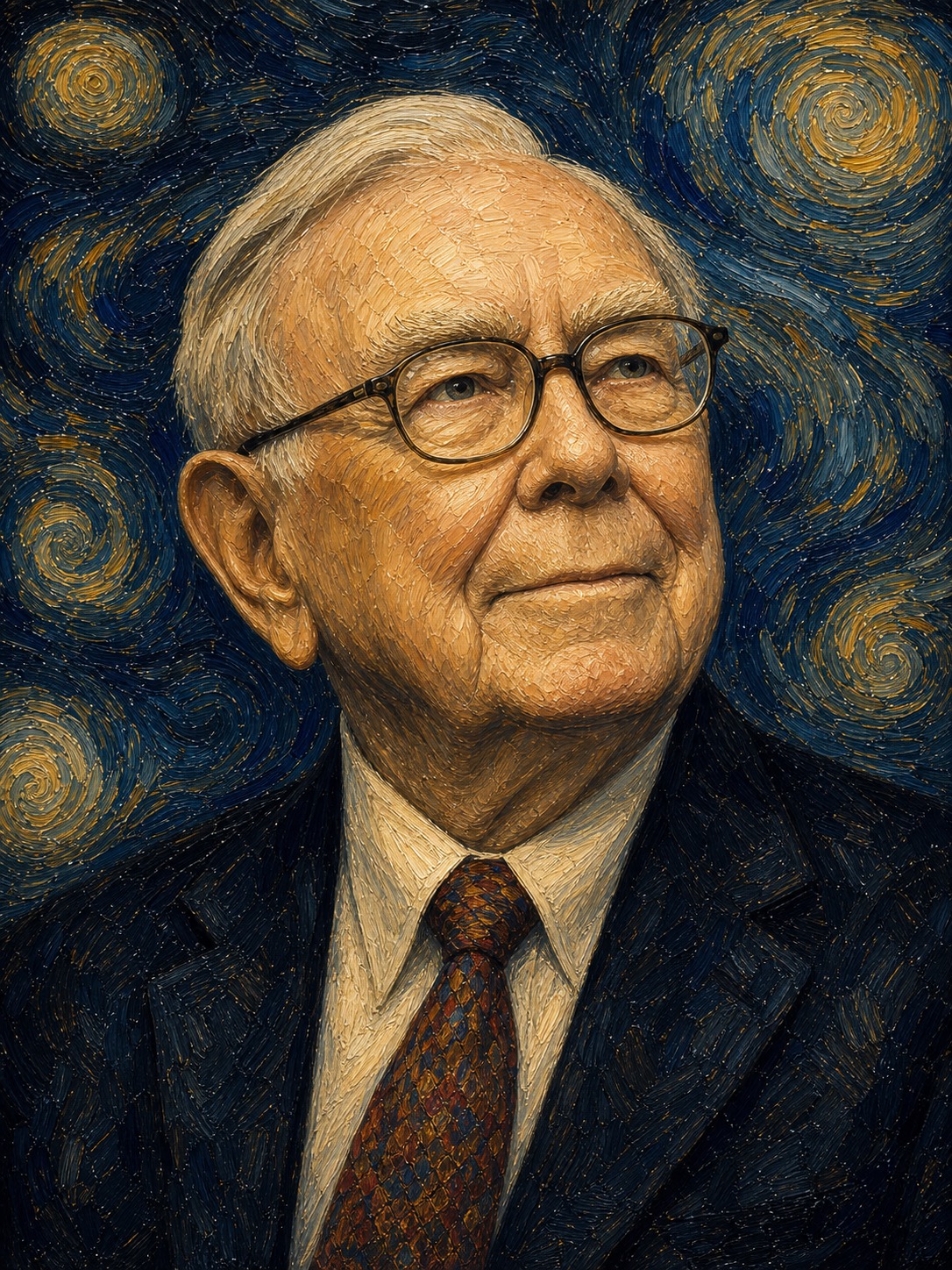
Charlie Munger
Rebuilt value investing around multidisciplinary judgment, business quality, incentives, and anti-ruin discipline, then embedded it in Berkshire and Daily Journal structures.
As of: 2026-06-10T14:33:05Z
Snapshot
| Field | Details |
|---|---|
| Full name | Charles Thomas Munger |
| Born / died | Born January 1, 1924, in Omaha, Nebraska (Daily Journal obituary, 2023); died November 28, 2023, in California at age 99 (Berkshire Hathaway news release, 2023; Michigan Law, 2024) |
| Nationality | American |
| Primary vehicles | Wheeler, Munger & Co.; Blue Chip Stamps; Wesco Financial; Berkshire Hathaway; Daily Journal Corporation |
| Years active | Law practice after Harvard Law; money management from 1962; Berkshire vice chairman and director from 1978 until death in 2023 (Michigan Law, 2024; Berkshire 2023 annual report; Berkshire 2023 proxy) |
| Asset classes | Public equities, control investments, operating businesses, real estate, newspapers/legal publishing, court-software operating business, cash/securities portfolio |
| Style tags | Quality value; concentrated investing; mental models; long-term compounding; business-owner mindset; anti-leverage temperament; blunt governance culture |
| Verified track record + period | Munger's standalone partnership is reported by Buffett as compounding at 19.8% annually during 1962-1975 versus 5.0% for the Dow; this is a Buffett-reported figure, not independently reconstructed from partnership statements in this run (Superinvestors, 1984). Berkshire's Munger-era result is jointly attributable with Buffett and the Berkshire structure, not a clean personal record. |
| Peak AUM / capital base | No single clean AUM figure found for Munger personally. Observable capital bases include Berkshire, Wesco, and Daily Journal. Daily Journal reported about $493.0 million of corporate marketable securities at September 30, 2025. Its 2026 proxy credits Munger's capital-allocation philosophy, a company characterization rather than independent evidence of personal performance (Daily Journal 2025 annual report; Daily Journal 2026 proxy materials). |
| Current legal / status check | Munger is deceased. This run found no posthumous personal legal or regulatory development changing the profile. Daily Journal, a Munger-associated vehicle, was in a 2026 proxy dispute with Buxton Helmsley; that dispute concerns the company after Munger, not an enforcement action against him (Daily Journal 2026 proxy materials). |
Life & Career Timeline
Munger's biography begins in the same Omaha business culture that formed Warren Buffett but took a different route. He studied mathematics at the University of Michigan, left to serve in the U.S. Army, studied meteorology at Caltech, and then used the G.I. Bill route into Harvard Law despite not having completed an undergraduate degree (Michigan Law, 2024; Life Stories interview page). After Harvard, he moved to California and practiced real-estate law. In 1962, he became one of the founders of the law firm now known as Munger, Tolles & Olson (Munger Tolles memorial, 2023).
The pivotal personal link was Buffett. Munger and Buffett met in Omaha in 1959, became investment confidants, and then slowly merged intellectual systems before they merged business lives. Michigan Law summarizes the common account: Munger was already investing alongside Buffett in vehicles such as Wesco and See's before formally becoming Berkshire Hathaway vice chairman (Michigan Law, 2024). Munger's own money-management period began in 1962 and ended in 1975. Buffett later used Munger's record as one of the examples in "The Superinvestors of Graham-and-Doddsville," reporting a 19.8% annual compound rate for Munger's partnership over 1962-1975, against 5.0% for the Dow (Superinvestors, 1984).
At Berkshire, Munger's official tenure is easier to verify. Berkshire's 2023 proxy says he had been a director and vice chairman since 1978; it also records that he chaired and served as CEO of Wesco Financial from 1984 to 2011, when Wesco was approximately 80% owned by Berkshire, and that he was also a director of Daily Journal and Costco (Berkshire 2023 proxy). Berkshire's own account after his death made the role larger than the title: Buffett wrote in the 2023 annual report that Munger was the "architect" of the present Berkshire while Buffett was the "general contractor" (Berkshire 2023 annual report).
Munger also had a long public role as a teacher of judgment. His 1995 "Psychology of Human Misjudgment" talk and 2007 USC Law commencement address are two of the core public artifacts of his worldview: multidisciplinary models, incentives, inversion, avoiding standard routes to failure, and lifelong learning (Psychology of Human Misjudgment transcript; USC Law commencement transcript, 2007). That public teaching role sits beside institutional service: Stanford credited him with longtime law-school service and major graduate-housing philanthropy, while Costco publicly marked his death as the loss of a board member whose wisdom had served the company for more than a quarter-century (Stanford, 2023; Costco, 2023).
Munger died on November 28, 2023. Berkshire's same-day release said the company had been told by his family that he died peacefully that morning at a California hospital; Buffett's release sentence credited Munger's "inspiration, wisdom and participation" in building Berkshire (Berkshire Hathaway news release, 2023).
Vehicles & Structure
Munger's career is best understood as a chain of vehicles rather than a single fund. First came the law firm and real-estate partnerships. The law practice gave him deal exposure and a network; real-estate projects gave him early capital. A formerly cited secondary review of Janet Lowe's biography no longer resolves, so the claim that late-1960s real-estate work and the investment partnership made Munger wealthy enough to leave law practice is retained only as [unverified] pending replacement with an accessible primary or reliable secondary source.
The purest investment vehicle was Wheeler, Munger & Co., later cited by Buffett in "Superinvestors." It is also the least transparent in primary materials available online. The headline 19.8% compound result is central but should be treated as [single-source: Buffett/Columbia reproduction] until a later task reconstructs annual partner statements or audited records (Superinvestors, 1984).
The next stage was not clean fund management; it was control and quasi-control. Blue Chip Stamps, Wesco Financial, and See's Candies tied Munger to Buffett's transition away from bargain liquidation logic and toward high-quality businesses bought at fair prices. The Worldly Partners archive is useful as a map to Blue Chip and Wesco letters by Munger, but original letter-level verification remains a later task because Berkshire's official Wesco page was JavaScript-blocked in this environment (Worldly Partners Munger archive).
At Berkshire, Munger's structure was vice-chairman influence rather than a separately auditable sleeve. Berkshire's proxy establishes the role and duration, but the performance belongs to Berkshire as a corporation: insurance float, retained earnings, tax deferral, Buffett's capital allocation, operating-company managers, and the shareholder culture all matter (Berkshire 2023 proxy; Berkshire 2023 annual report).
Daily Journal was Munger's late-career mini-laboratory. Daily Journal's 2013 SEC response, submitted by Munger, Tolles & Olson counsel, explains that the board decided in 2009 to shift excess cash into marketable securities chosen by Munger and J.P. Guerin after foreclosure-notice revenue had created surplus cash; it also insisted Daily Journal was an operating publishing and software company, not an investment company (Daily Journal SEC response, 2013). The 2021 13F shows the U.S.-listed side of the concentrated portfolio: Alibaba ADS, Bank of America, Posco ADR, U.S. Bancorp, and Wells Fargo (Daily Journal 13F information table, 2021). The 2025 annual report and 2026 proxy materials show the post-Munger portfolio still anchoring the company, at roughly $493 million in marketable securities at September 30, 2025 (Daily Journal 2025 annual report; Daily Journal 2026 proxy materials).
Track Record Detail With Caveats
There are three track records, and confusing them would poison the file.
First, Munger's standalone partnership record is the cleanest personal number but still only partly verified in this run. Buffett's "Superinvestors" essay reports that Munger's partnership compounded at 19.8% over 1962-1975 while the Dow compounded at 5.0% (Superinvestors, 1984). The figure is famous, plausible, and comes from a high-quality source, but this run did not locate original partnership statements. Mark it [single-source] pending reconstruction.
Second, Berkshire's Munger-era record is extraordinary but not individually attributable. Munger was a vice chairman and board member from 1978 through 2023, and Buffett's own tribute credits him with the intellectual architecture of Berkshire's shift toward wonderful businesses at fair prices (Berkshire 2023 proxy; Berkshire 2023 annual report). But Berkshire is a joint outcome. A rigorous later synthesis should separate Buffett, Munger, insurance float, tax structure, operating businesses, public-equity selection, and U.S. economic tailwinds.
Third, Daily Journal's securities portfolio is observable but belongs to an operating company. Daily Journal's 2013 SEC response, submitted by Munger, Tolles & Olson counsel, says the company bought marketable securities selected by Munger and Guerin in 2009, and that their time commitment was limited because there were only purchases and no sales at that time (Daily Journal SEC response, 2013). By 2025, Daily Journal's annual report showed marketable securities of $493.0 million against an adjusted cost basis of about $139.1 million and pre-tax unrealized gains of about $353.9 million (Daily Journal 2025 annual report). The caveat: the visible portfolio also carried concentration, bank cyclicality, margin debt, and an Alibaba error. Business Insider, citing regulatory filings, reported that Daily Journal halved its Alibaba stake in early 2022 after building it aggressively in 2021 while Alibaba had already fallen sharply (Business Insider, 2022).
Why They Matter
Munger matters because he changed the language of value investing. Graham supplied margin of safety; Buffett supplied the Berkshire canvas; Munger supplied the multidisciplinary, quality-biased correction that let the system move from "cheap enough" to "good enough to own for a long time." The claim is not just fan lore: Buffett's own 2023 annual report explicitly frames Munger as the architect of modern Berkshire (Berkshire 2023 annual report).
He also matters because his public teaching is unusually operational. "Psychology of Human Misjudgment" made incentives, social proof, consistency, authority, envy, and other behavioral forces part of the investor's tool kit before behavioral finance became everyday practitioner language (Psychology of Human Misjudgment transcript). The USC commencement address turns the same worldview into career advice: build a lattice of big ideas, keep learning, and avoid obvious routes to misery (USC Law commencement transcript, 2007).
The counter-narrative matters too. Munger's confidence could become overconfidence. Daily Journal's Alibaba move is a visible late-career error; its bank-heavy portfolio and margin loan show a structure that was more concentrated and levered than the simple "avoid stupidity" slogan suggests (Daily Journal 2021 13F; Business Insider, 2022). His philanthropic architecture also created a public controversy: UCSB's proposed Munger Hall would have housed up to 4,500 students in a mostly windowless building; architect Dennis McFadden resigned from a review committee in protest, and by 2023 UCSB was soliciting architects for an alternative housing project at the same site (Santa Barbara Independent, 2021; Santa Barbara Independent, 2023).
For the Canon, Munger is therefore both model and warning: a rationalist who often improved decisions by stripping away sentiment, and a forceful personality whose certainty sometimes needed the same inversion he taught others.
Open Questions for Later Tasks
- Reconstruct Wheeler, Munger & Co. annual returns from primary partnership documents if obtainable; separate gross, net, fees, taxes, leverage, drawdowns, and partner redemptions.
- Trace Munger's role in Blue Chip Stamps, See's Candies, Wesco, and early Berkshire decisions from original letters and annual reports rather than later retellings.
- Build a Daily Journal portfolio ledger from 2009 onward: purchases, sales, margin borrowing, taxes, unrealized gains, realized gains, and Munger/Guerin attribution.
- Quantify the Alibaba mistake against Daily Journal's cost basis, sale prices, remaining holdings, tax effects, and opportunity cost.
- Verify which famous Munger quotes are primary and which are attribution-laundered through quote sites.
- Compare Munger's stated aversion to leverage and stupidity with actual use of concentration, margin debt, and China exposure at Daily Journal.
- Separate Munger's investment insight from Berkshire's structural advantages: permanent capital, insurance float, tax deferral, Buffett's reputation, and manager network.
- Revisit the Munger Hall controversy with primary UCSB documents, McFadden's resignation letter, and Munger's own defense of the design.
As of: 2026-06-11T02:03:49Z
Core Worldview
Charlie Munger's investing philosophy was not a stock-picking formula. It was a discipline for avoiding avoidable stupidity, recognizing a small number of unusually favorable business situations, and then allowing time, compounding, tax deferral, and managerial quality to do most of the work. Berkshire Hathaway's 2023 annual report makes the point in Buffett's language: Munger was the "architect" of modern Berkshire, the partner who pushed Buffett away from pure Graham-style bargain hunting toward ownership of superior businesses bought at reasonable prices (Berkshire Hathaway 2023 annual report).
The center of the worldview was multidisciplinary judgment. In his 1994 USC talk, Munger framed stock picking as a subdivision of worldly wisdom and argued that facts become usable only when arranged on a "latticework of models" across disciplines such as mathematics, psychology, accounting, microeconomics, and engineering (Munger, 1994 USC talk). In his 1995 psychology talk, he made the defensive half explicit: intelligent people repeatedly make bad decisions because incentives, social proof, denial, overconfidence, envy, and authority distort cognition (Munger, Psychology of Human Misjudgment).
Munger therefore treated investing as applied rationality under uncertainty. The desired result was not cleverness, activity, or macro forecasting, but a durable match between business economics, price, incentives, and temperament. Berkshire's posthumous release on November 28, 2023 verifies his death and Buffett's assessment that Berkshire could not have reached its status without Munger's inspiration, wisdom, and participation (Berkshire news release). As of this run, Munger is a deceased investor whose philosophy must be reconstructed from speeches, Berkshire/Daily Journal records, and the behavior of the vehicles he influenced.
The Edge: What Markets Misprice and Why
Munger believed public markets are partly efficient and partly prone to repeated human error. His edge was not secret information. It was the ability to wait until market prices, business quality, and one's own competence lined up. The 1994 USC talk uses the pari-mutuel racetrack as a model: the crowd usually sets reasonable odds, but occasional mispricings remain available to the prepared and selective bettor (Munger, 1994 USC talk).
The mispricing he cared about most was the underappreciation of long-duration quality. Accounting book value may omit a brand, culture, network, cost advantage, or customer habit that allows a company to raise prices or reinvest at high returns. Buffett's 2014 Berkshire retrospective credits Munger with the simple but consequential shift from buying fair businesses at wonderful prices to buying wonderful businesses at fair prices; See's Candies is the canonical case, with modest tangible capital, durable pricing power, and decades of cash generation after purchase through Blue Chip Stamps (Berkshire 2014 annual report).
Munger also thought markets misprice incentives and agency costs. He had little patience for managers, bankers, or investment advisers whose compensation encouraged action rather than owner-like judgment. In the 2023 Daily Journal meeting, he argued that most investment managers cannot consistently beat indexes after costs and that the industry often lives in denial about this economic reality (Daily Journal 2023 meeting transcript). The edge, then, was partly moral and structural: avoid being forced to act, avoid paying unnecessary intermediaries, and avoid letting social pressures define the opportunity set.
Process: Idea Sourcing to Sell Discipline
Idea sourcing began with a narrow circle of competence. Munger was willing to read broadly, but he did not believe every investor should chase every field. In the 1994 USC talk, he argued that each person must discover where he or she has an edge and play within that circle (Munger, 1994 USC talk). This produced a highly selective process: many years of reading and thinking, few actual decisions, and a preference for businesses whose economics could be understood without heroic forecasts.
Research centered on business quality before spreadsheet precision. The key questions were: Does the business have a durable competitive position? Can it reinvest incremental capital at attractive rates? Are managers able, honest, and owner-oriented? Are the accounting numbers describing economic reality or hiding it? The 2023 Berkshire report's current formulation is consistent with this: Berkshire seeks wholly owned or partial ownership of businesses with fundamental and enduring good economics, able and trustworthy managers, and a low risk of permanent capital loss (Berkshire Hathaway 2023 annual report).
Valuation was necessary but secondary to the quality judgment. Munger did not abandon margin of safety; he changed where it was located. For Graham, it often sat in asset value or a low multiple. For Munger, it often sat in the persistence of a moat, the cash-generating ability of the business, the conservatism of the balance sheet, and the probability that management would not squander the surplus. See's Candies taught the positive version: a high-quality business could be worth many times tangible book value if it required little incremental capital and had pricing power (Berkshire 2014 annual report). Dexter Shoe, by contrast, taught that an apparently good business can lose its economics when the moat erodes.
Sizing followed selectivity. Munger favored concentration when the odds were unusually favorable and the investor understood the business. He opposed the appearance of professionalism that comes from owning too many mediocre ideas. In the USC talk, he argued that investors are much more likely to do well by using the few insights in which they have real confidence than by pretending to know everything (Munger, 1994 USC talk). Daily Journal became the late-career case study: after a foreclosure-notice boom created excess cash, the board put surplus capital into a small number of securities selected by Munger and J.P. Guerin, explicitly to support the operating business and preserve capital in an inflationary world (Daily Journal 2013 SEC correspondence).
Sell discipline was therefore sparse but not absent. A truly great business could be held through long periods of quotation noise, taxes, and market fashion. But the sell triggers were real: thesis impairment, better use of capital, a tax-adjusted opportunity cost, deteriorating business quality, or recognition that the original judgment was wrong. In Daily Journal's 2023 meeting, Munger called Alibaba one of his worst mistakes because he focused too much on its Chinese internet position and not enough on retail competition (Daily Journal 2023 meeting transcript). That admission is important because it shows the doctrine was not "never sell"; it was "sell only when the business reality or opportunity cost justifies the friction."
Risk Management
Munger's first risk control was avoiding ruin. He disliked leverage, short selling, complex derivatives, dishonest counterparties, weak incentives, and businesses that required constant capital just to stay in place. His 1995 psychology talk can be read as a risk manual: incentives, denial, authority, social proof, and overoptimism create predictable failure modes, so the investor must design defenses before the heat of decision (Munger, Psychology of Human Misjudgment).
Berkshire's risk philosophy also reflected Munger's influence. The 2023 annual report states an investment rule that will not change: do not risk permanent loss of capital. Berkshire also emphasizes cash, Treasury bills, low reliance on short-term funding, and the ability to respond when markets seize up (Berkshire Hathaway 2023 annual report). This is not volatility avoidance. It is survival-first investing: a quote can fall; a permanent impairment or forced sale can end the compounding machine.
Daily Journal complicates the clean version. The company's 2025 annual report shows a highly concentrated securities portfolio: about $493.0 million of marketable securities at September 30, 2025, all common stocks, concentrated in six companies, with about $353.9 million of pretax unrealized gains and a remaining $22.0 million margin-loan balance (Daily Journal 2025 annual report). Post-Munger management said in 2026 that it intended to remain patient, pay down moderate leverage, and use the portfolio mainly to support the operating business (Daily Journal 2026 proxy materials). The record therefore supports both parts of the risk doctrine: avoid ordinary leverage, but be willing to use exceptions when the perceived odds are unusually favorable. That exception is also where the philosophy is most vulnerable.
Temperament and Psychology
Munger treated temperament as an investment asset. The investor must be patient enough to do nothing, objective enough to abandon favorite ideas, and tough enough to look foolish while waiting. His 2007 USC Law commencement address was not mainly about stocks; it was about building a life through learning, reliability, delayed gratification, and avoidance of self-pity and envy (Munger, 2007 USC Law address).
Psychology supplied the checklist. Munger's misjudgment framework forces an investor to ask: What incentive is operating? What social proof am I copying? What unpleasant truth am I denying? What authority am I overweighting? What comparison is distorting my perception? The point is not to become emotionless. It is to install habits that make emotional distortion less likely at the moment of commitment (Munger, Psychology of Human Misjudgment).
Late in life, he still described his edge as integration across fields. In a 2023 CNBC interview transcript published by Kingswell, Munger said he intentionally drew from different disciplines because he could see their power (Kingswell transcript of CNBC interview). That is consistent with the entire record: his best ideas were usually hybrids of business economics, psychology, incentives, and character judgment.
Evolution Over Career
Munger began far from the image of a passive long-only compounder. He trained as a lawyer, built real-estate projects, ran a private investment partnership, invested through Blue Chip/Wesco/Berkshire structures, and eventually influenced Daily Journal's unusual securities portfolio. The partnership record remains incompletely sourced in this repository; the prior profile flags Buffett's 1984 Columbia-published return figure as [single-source] pending original Wheeler, Munger statements. For philosophy, the better-supported evolution is qualitative.
The first shift was away from cigar-butt value. Buffett's 2014 and 2023 reports both credit Munger with redirecting Berkshire toward quality businesses at fair prices (Berkshire 2014 annual report; Berkshire Hathaway 2023 annual report). The second shift was toward structural patience: Berkshire's permanent capital, decentralized operating model, and tax-efficient redeployment of cash made Munger's doctrine more powerful than it would be inside a conventional fund measured quarterly. The third shift was the Daily Journal experiment, where a declining legal-newspaper business was paired with a software subsidiary and a concentrated equity portfolio selected by Munger/Guerin after the financial crisis (Daily Journal 2013 SEC correspondence).
What He Explicitly Rejects
Munger rejected overactivity. He regarded much of professional investment management as economically unhelpful after costs and socially distorted by fees, benchmarking, and salesmanship (Daily Journal 2023 meeting transcript). He rejected narrow expertise without synthesis; in the 1994 talk, he warned that one or two models distort reality rather than explain it (Munger, 1994 USC talk).
He rejected weak accounting substitutes for economic thought. Berkshire's 2023 annual report says EBITDA is a banned measurement at Berkshire and criticizes mandated net-income volatility from unrealized equity gains as worse than useless for judging operating performance (Berkshire Hathaway 2023 annual report). He rejected cryptocurrencies with unusual vehemence at the 2023 Daily Journal meeting, using China’s ban as his preferred policy example (Daily Journal 2023 meeting transcript).
He also rejected blind diversification. This does not mean he thought concentration was safe for everyone. It means he thought diversification is often a substitute for knowledge, and that a few deeply understood, superior businesses can be better than a portfolio engineered to look conventionally prudent.
Regimes Where It Thrives vs. Struggles
Munger's philosophy thrives when a patient investor has permanent or long-duration capital, access to a few businesses with durable competitive advantages, and enough psychological independence to buy or hold through market discomfort. It is especially strong in regimes where intangible business quality compounds for years, taxes and friction matter, and the crowd temporarily misprices durable cash generation. Berkshire's operating history and See's Candies example are the cleanest demonstrations (Berkshire 2014 annual report).
It struggles when the investor overestimates the durability of a moat, when technology or regulation changes the competitive field, when geopolitical risk becomes inseparable from business risk, or when starting valuations are so high that even a great business produces mediocre forward returns. Munger himself acknowledged in 2023 that the investment world was getting harder because valuations were higher and political hostility toward business was rising (Daily Journal 2023 meeting transcript). The philosophy also struggles for investors without Berkshire-like structure. A concentrated, low-turnover approach can look irrational for years, can create career risk for outside managers, and can become dangerous if concentration is confused with conviction rather than earned by analysis.
Tensions Between Stated Philosophy and Actual Behavior
The first tension is leverage. Munger repeatedly warned against leverage as a cause of ruin, yet Daily Journal used margin borrowing in its securities portfolio. In 2023 he defended the exception by arguing that the opportunities had been unusually good; in company filings, the margin loan later reached $75 million during fiscal 2023 and was reduced to $22.0 million by September 30, 2025 (Daily Journal 2023 meeting transcript; Daily Journal 2025 annual report). A fair reading is that Munger's doctrine allowed expert exceptions. A skeptical reading is that the exceptions are exactly where overconfidence enters.
The second tension is China. Munger prized foolproof businesses and avoidance of unknowable risk, yet he endorsed BYD and Alibaba exposure in a jurisdiction with large political and regulatory variables. He acknowledged Alibaba as a major mistake in 2023, while still arguing that some Chinese businesses offered better quality at cheaper prices than U.S. alternatives (Daily Journal 2023 meeting transcript). This is a genuine philosophical conflict: extra value may compensate for extra risk, but political risk can be hard to handicap with the same confidence as business economics.
The third tension is humility versus design certainty. Munger's mental-model teaching emphasized inversion, error recognition, and respect for reality. The Munger Hall controversy at UCSB cut against that image for critics: architect Dennis McFadden resigned from a design review committee in protest over a large dormitory concept associated with Munger, objecting to windowless bedrooms and the donor-driven design process (Santa Barbara Independent, 2021). This is not an investing loss, but it matters for philosophy because it tests whether a person famous for avoiding cognitive bias could also become too attached to an idiosyncratic model outside his strongest domain.
The fourth tension is transferability. Munger's public advice often sounds simple: wait, learn, buy great businesses, avoid stupidity. But the full system depended on rare traits and structures: Buffett as partner, Berkshire's permanent capital, reputation as a home for sellers, tax-efficient internal capital allocation, and decades of compounding. The practical lesson is not to copy every position or concentration level. It is to copy the discipline: stay inside competence, be brutally honest about incentives and psychology, demand business quality, avoid ruin, and let a few genuine insights do the heavy lifting.
As of: 2026-06-11T02:16:14Z
Scope and Ranking Caveats
Munger's "trades" do not fit neatly into one audited fund ledger. Some were personal or partnership trades, some were made through Blue Chip Stamps, Wesco Financial, Berkshire Hathaway Energy, or Daily Journal, and some were joint Buffett-Munger decisions. This file ranks trades by a combination of attributable Munger influence, source quality, dollar impact, multiple on capital, and teaching value.
The single best trade, judged by strategic value rather than just multiple, was See's Candies. BYD probably produced the largest fully observable public-equity dollar profit tied to Munger's advocacy, while Daily Journal's bank-stock basket is the cleanest Munger-controlled public-company portfolio example. Several numbers remain caveated: the Wheeler, Munger partnership record is Buffett-reported rather than reconstructed from original statements; the Tenneco trade is self-reported by Munger and the Tenneco identification is secondary; Costco personal cost basis is not public in the sources found this run.
1. See's Candies Through Blue Chip Stamps - The Strategic Best Trade
Context and dates. In January 1972, Blue Chip Stamps acquired See's Candy Shops, the California candy business that became Berkshire's teaching case for paying up for quality. Blue Chip's 1973 10-K says it owned 99% of See's Candy Shops, which in turn owned 100% of See's Candies, and consolidated See's from the January 1972 acquisition date (Blue Chip Stamps 1973 10-K, 1973). Buffett later wrote that the sellers accepted a $25 million bid, even though the price was about three times net tangible assets and made him uncomfortable (Berkshire Hathaway 2014 annual report, 2015).
Thesis and how they found it. The deal mattered because Munger pushed Buffett away from pure cigar-butt value. Buffett's 2014 anniversary letter credits Munger with the Berkshire "blueprint": buy wonderful businesses at fair prices instead of fair businesses at wonderful prices (Berkshire Hathaway 2014 annual report, 2015). See's was the lived example. The business had a strong local brand, seasonal cash economics, pricing power, and low incremental capital needs. It was not statistically cheap by old Graham standards; it was cheap relative to the durability of its cash generation.
Size and structure. Blue Chip paid $25 million for See's. The exact percent of Munger's personal net worth or partnership capital exposed to Blue Chip/See's was not found in primary sources during this run. Structurally, the trade sat in Blue Chip, a vehicle connected to Buffett, Munger, Berkshire, and Diversified Retailing, so attribution should be "Munger-influenced, Buffett-Munger controlled," not "Munger-only."
Entry path and drawdown endured. The main drawdown was not a market quotation; it was conceptual risk. Buffett almost let the deal fail over price discipline. Munger's contribution was to recognize that a business earning high returns on modest tangible capital could be worth far more than book value. Blue Chip itself carried legal and antitrust context; the 1973 10-K discusses pending United States v. Blue Chip Stamp Company litigation, a reminder that the platform was not frictionless (Blue Chip Stamps 1973 10-K, 1973).
Exit and P&L. There was no ordinary exit. See's became a permanent cash generator. Buffett wrote in 2007 that See's had produced $1.35 billion of pre-tax earnings, with only $32 million retained in the business, and the rest sent to Berkshire or Blue Chip (Berkshire Hathaway 2007 shareholder letter, 2008). By the 2014 annual report, Buffett updated the cumulative pre-tax earnings to $1.9 billion and added that the growth had required only $40 million of additional investment (Berkshire Hathaway 2014 annual report, 2015). On purchase price alone, the cumulative pre-tax earnings were roughly 76x the original $25 million price by 2014, before tax and ignoring the value of the still-owned business.
What it teaches. See's is the canonical Munger trade because it changed the opportunity set. The lesson is not "pay any price for quality." It is that a durable, high-return business can be cheaper than it looks if it throws off cash for decades and needs little reinvestment. It also shows why Munger's biggest impact can be strategic: a single deal educated Berkshire into Coca-Cola, American Express, and other intangible-quality investments, even if those later trades are more Buffett-attributable than Munger-attributable.
2. BYD Through Berkshire Hathaway Energy - The High-Multiple Public-Equity Winner
Context and dates. In September 2008, MidAmerican Energy Holdings, Berkshire's energy subsidiary, agreed to buy 225 million newly issued BYD H-shares at HK$8 per share for HK$1.8 billion, about $230 million, or roughly 10% of the Chinese battery and auto company (FinanceAsia, 2008). Munger is widely credited with the push, with Li Lu as the China/BYD bridge, but the executed holder was a Berkshire subsidiary, not Munger personally.
Thesis and how they found it. The thesis was that BYD had unusually strong technical capability and a founder-led manufacturing culture in batteries and electric vehicles, at a time when the global auto industry was under stress and Chinese industrial champions were outside Berkshire's normal comfort zone. This was precisely the kind of "fish where the fish are" extension Munger later defended in discussions of China.
Size and structure. The initial position was 225 million H-shares at HK$8, about $230 million. It was a minority public-equity stake through MidAmerican/Berkshire Hathaway Energy. It was small for Berkshire but huge in eventual outcome and unusually foreign-growth-oriented for Berkshire's traditional circle of competence.
Entry path and drawdown endured. Entry came during the 2008 financial crisis. The risk was not only market volatility but technology, corporate-governance, China policy, and currency risk. Berkshire held the stake for more than a decade before trimming. Public reporting in 2022 said Berkshire's first disclosed sale reduced the position from roughly 220 million shares to 218.7 million shares and realized about $47 million on that small slice (Business Insider / Markets Insider, 2022).
Exit and P&L. Berkshire gradually reduced the stake beginning in 2022. CNBC's Warren Buffett Watch reported in September 2025 that Berkshire had fully exited BYD (CNBC, 2025). Exact realized proceeds across all sales were not found in a single primary filing in this run, so the final P&L should be flagged [multi-source estimate]. Public reporting commonly describes the outcome as tens of times the original investment; the mechanically certain fact is that a $230 million stake became a multi-billion-dollar position before the sell-down.
What it teaches. BYD shows Munger's willingness to break category boundaries when he believed the people, technology, and valuation made the odds extraordinary. The trade also shows a tension: the same China exposure that made BYD exceptional later contributed to Munger's Alibaba error. BYD was not a generic "buy China" success; it was a company-specific bet whose outcome depended on founder execution, battery economics, and holding through long policy and market uncertainty.
3. Daily Journal's Post-Crisis Bank and Industrial Basket - The Cleanest Munger-Controlled Portfolio Trade
Context and dates. Daily Journal accumulated cash from a legal-notice boom before and during the financial crisis. In 2009, its board began shifting cash and equivalents into marketable securities selected by Charles Munger and J.P. Guerin, explicitly rejecting near-zero-yield government bonds as the only safe capital-preservation choice (Daily Journal SEC correspondence, 2013).
Thesis and how they found it. Munger and Guerin were buying high-quality financials and a foreign industrial company when fear around banks and cyclicals was still intense. The thesis was classic crisis value: permanent capital at an operating company could buy sound franchises at distressed prices, hold them, and let the portfolio support the software business. Daily Journal told the SEC the securities were chosen by Munger and Guerin, required little trading time, and had only purchases with no sales by the 2013 correspondence date (Daily Journal SEC correspondence, 2013).
Size and structure. The 2013 10-K reported marketable securities with cost of about $47.976 million and market value of about $136.994 million at September 30, 2013, producing about $89.018 million of pre-tax unrealized gains (Daily Journal 2013 10-K, 2014). Daily Journal's first visible 13F table showed Bank of America, Posco ADR, U.S. Bancorp, and Wells Fargo holdings; a contemporary Rational Walk review of that filing named the same four disclosed securities and noted that Daily Journal's broader disclosure also referred to a second foreign company not visible in the U.S. 13F (Daily Journal 13F information table, 2014; Rational Walk, 2014). A later 2021 SEC 13F table makes the concentrated structure explicit: Alibaba, Bank of America, Posco, U.S. Bancorp, and Wells Fargo were the listed securities (Daily Journal 13F information table, 2021).
Entry path and drawdown endured. The initial purchases were made after the crisis, but the portfolio later endured bank scandals, rate cycles, China exposure through later Alibaba purchases, and margin-loan risk. Munger said in the 2023 Daily Journal meeting that the bank stocks were bought near the bottom of the foreclosure crisis; that statement is a transcript source, not an official company filing, so the precise "bottom tick" characterization should be treated as Munger's retrospective framing (Kingswell Daily Journal transcript, 2023).
Exit and P&L. The bank basket was mostly held. Daily Journal's 2025 10-K reported marketable securities of about $493.0 million, adjusted cost basis of about $139.1 million, and cumulative pre-tax unrealized gains of about $353.9 million at September 30, 2025. It also disclosed concentration in six companies and a remaining $22.0 million margin-loan balance (Daily Journal 2025 10-K, 2025). The P&L is therefore partly realized, mostly unrealized, and partly mixed with later Alibaba activity; the original 2009-2012 basket cannot be perfectly isolated from later filings without a full transaction ledger.
What it teaches. This is Munger's crisis-concentration doctrine in public view. He avoided many ordinary trades, then used a small newspaper/software company's surplus capital to buy a handful of securities when risk premiums were high. The uncomfortable lesson is that concentration works in both directions: the same structure that created large gains also made Daily Journal unusually exposed to banks, China, mark-to-market accounting, and margin borrowing.
4. Wesco's Gillette Convertible Preferred - A High-Quality Security With Contractual Protection
Context and dates. Wesco Financial, chaired by Munger and controlled through Blue Chip/Berkshire, bought Gillette convertible preferred stock in 1989 at a cost of $40 million and converted it into Gillette common stock in 1991. Berkshire's Wesco archive identifies the annual letters as Munger's letters, and the 1997 letter provides the clearest located economics (Berkshire Wesco archive, 1997 letter index; Wesco 1997 shareholder letter, 1998).
Thesis and how they found it. Gillette fit the Munger/Buffett quality framework: a dominant consumer franchise with global brand strength and repeat-purchase economics. The preferred structure added downside protection and income while preserving equity upside through conversion. It was a better-shaped risk than buying common stock alone at a stretched price.
Size and structure. Wesco's cost was $40 million in convertible preferred, converted into common in 1991. Because Wesco was 80% Berkshire/Blue Chip controlled and Munger was chairman, the trade is attributable to Munger's vehicle but was still part of the broader Buffett-Munger capital-allocation ecosystem.
Entry path and drawdown endured. The preferred structure reduced drawdown risk relative to common equity. The main risk was business-quality disappointment or consumer-brand impairment, not immediate forced sale. The located letters do not provide a full mark-to-market path from 1989 through 1991, so interim drawdown is [not reconstructed].
Exit and P&L. By year-end 1997, Wesco carried the Gillette common at $321.4 million, or $281.4 million above the original $40 million cost (Wesco 1997 shareholder letter, 1998). That is about an 8.0x market value on original cost before dividends and tax effects. The source does not state final sale proceeds in this run.
What it teaches. The trade shows a classic Munger pattern: use a security form that protects against being wrong, but point the upside at a very high-quality business. It sits between Graham and Munger - contractually protected on the downside, quality-compounding on the upside.
5. Costco - The Long-Duration Personal/Board-Owner Hold
Context and dates. Munger joined Costco's board in 1997 and served until his death in 2023, according to Costco's proxy materials (Costco 2023 proxy statement, 2023). He was not merely an outside admirer; he studied the company from inside the boardroom for more than a quarter century.
Thesis and how they found it. Costco fit Munger's most durable template: extreme customer trust, low markups, scale economies shared with members, honest culture, and a management system that resisted the temptation to harvest short-term margin. In the 2023 Daily Journal meeting transcript, he called Costco a nearly perfect company except for valuation and said he would not sell his shares (Kingswell Daily Journal transcript, 2023).
Size and structure. The exact entry date, purchase price, and full personal share ledger were not located in primary sources during this run. Therefore this entry is ranked for quality of judgment and holding behavior, not audited P&L. Berkshire itself also owned Costco and sold it in 2020, but this file treats Berkshire's sale as a Buffett/Berkshire portfolio decision rather than a Munger greatest trade.
Entry path and drawdown endured. Costco endured retail cycles, e-commerce fears, recessions, and repeated valuation concerns. Munger's main "drawdown" was opportunity-cost and valuation discomfort rather than a known catastrophic price decline in his personal basis. The 2023 transcript captures the tension: he loved the business and culture, while openly acknowledging a high earnings multiple (Kingswell Daily Journal transcript, 2023).
Exit and P&L. No full exit is documented. Munger died still associated with the company as a long-serving director; public sources found this run do not permit a precise personal realized P&L. Mark the P&L [unverified / not reconstructed].
What it teaches. Costco is a pure example of Munger's "few obvious ideas" discipline. The lesson is to recognize a rare culture-and-business model combination and resist selling merely because it looks statistically expensive. The caveat is that this is hard to replicate without Munger's board access, business understanding, and personal capital horizon.
6. Tenneco and the Li Lu Follow-On Allocation - The Self-Reported Cigar-Butt Exception
Context and dates. At the 2017 Daily Journal meeting and related investor discussion, Munger described reading Barron's for decades and acting on one idea that made about $80 million; the trade is widely identified by secondary sources as Tenneco, an auto-parts company bought in distress around 2001-2002 (Llama Capital transcript/report, 2021; MOI Global / Mohnish Pabrai talk, 2017). Because the primary video/transcript source found this run is not an official Daily Journal filing and the company identification is secondary, this entire trade is [self-reported / secondary identification].
Thesis and how they found it. The trade was the opposite of See's. It was a distressed, cheap, limited-size situation where Munger believed the downside was protected enough and the upside was severalfold. MOI Global's transcript of Mohnish Pabrai's talk identifies the stock as Tenneco, says it was distressed, went to about $1.60, and later recovered dramatically (MOI Global / Mohnish Pabrai talk, 2017).
Size and structure. Munger's own reported profit was about $80 million. The initial capital committed, exact instruments, and percent of personal capital were not verified. Some secondary accounts say he used both debt-like and equity exposure, but this run did not locate primary trade tickets or account statements.
Entry path and drawdown endured. The path likely included serious business and balance-sheet risk; the "almost no risk" phrasing in transcript sources should be interpreted as Munger's retrospective risk assessment, not as an objective statement. Auto suppliers in distress can fail; position size and structure probably mattered.
Exit and P&L. Munger said the Barron's idea made about $80 million and that he then allocated the proceeds to Li Lu, which reportedly grew to roughly $400-$500 million (Llama Capital transcript/report, 2021). The Tenneco leg is therefore a major personal trade if accepted, and the Li Lu allocation may be an even more important capital-allocation decision. Both should remain caveated until a later E/F task verifies the original video, transcript, and any available Li Lu/Himalaya documentation.
What it teaches. Tenneco prevents over-simplifying Munger into "only quality at any price." He could still do old-fashioned bargain hunting when the asymmetry was exceptional. But the rarity is the point: one idea out of decades of reading was enough. This is a discipline lesson, not an invitation to make every cheap stock look like Tenneco.
Near Misses, Exclusions, and Controversy Checks
The Wheeler, Munger partnership as a whole was not treated as one trade because the task requires trade-level entries and no original position ledger was located. Buffett's Columbia-published "Superinvestors" essay reports that Munger's partnership compounded at 19.8% annually from 1962 to 1975 and also shows severe 1973 and 1974 losses of 31.9% and 31.5%, respectively (Columbia Business School / Buffett, 1984). A Rational Walk review of Janet Lowe's Damn Right! reports a different gross/partnership framing of 24.3% versus 6.4% for the Dow and the same brutal 1973-1974 drawdown pattern, so the partnership record should be handled carefully in later tasks (Rational Walk, 2022).
Wesco itself was also not ranked as a trade because the early control acquisition, Blue Chip's ownership, Berkshire's later 2011 acquisition of the minority, and Munger's operating role are too intertwined for a single clean entry. The 2011 Berkshire/Wesco release valued the 19.9% of Wesco not already owned by Berkshire at about $547.6 million, and the final proxy disclosed shareholder lawsuits challenging the transaction (Berkshire/Wesco news release, 2011; Berkshire/Wesco final proxy prospectus, 2011).
Alibaba is excluded from "greatest trades" because it is more naturally a mistakes-and-losses topic. It is still relevant as a boundary condition on BYD and Daily Journal: China exposure produced both one of Munger's best attributable wins and one of his most visible late-career errors. The later D-mistakes task should reconstruct Alibaba using 13F filings, Daily Journal annual reports, sale records, and Munger's 2023 admission.
Non-investment controversies were checked but not treated as trades. The Munger Hall controversy, for example, is important for judgment and overconfidence analysis but not for a public-markets greatest-trades file. Architectural Record's 2021 interview records Munger's own defense of the dorm design and belongs in philosophy/mistakes context rather than this trade ranking (Architectural Record, 2021).
Cross-Trade Lessons
- The best Munger trade may be an idea that changes the future opportunity set. See's was not just a candy acquisition; it rewired Berkshire's standards.
- Concentration needs real asymmetry. Daily Journal's bank basket and BYD were concentrated because Munger believed the odds were unusual, not because concentration itself was virtuous.
- Structure matters. Gillette preferred, Blue Chip's platform, Berkshire Energy's ownership, and Daily Journal's permanent corporate capital all shaped the risk.
- Patience is not passivity. Munger could wait years and then act hard when the price, business, and structure lined up.
- Every great trade carries a shadow. See's came through a legally complicated Blue Chip ecosystem; BYD and Alibaba show China risk in both directions; Daily Journal's gains came with concentration and margin debt; Tenneco is compelling but self-reported.
Open Questions for Later Tasks
- Reconstruct exact Blue Chip/Munger/Berkshire/Diversified Retailing ownership percentages around See's and Wesco from original filings.
- Build a BYD sale ledger from Hong Kong Stock Exchange disclosures and Berkshire Hathaway Energy filings to estimate realized profit precisely.
- Reconstruct Daily Journal's full transaction ledger from 2009 onward: purchase dates, cost basis by security, margin debt, realized sales, taxes, and Munger/Guerin attribution.
- Verify the Tenneco trade from original 2017 Daily Journal video or transcript and identify whether the position included bonds, common stock, or both.
- Locate primary evidence for Munger's personal Costco share purchases and any foundation holdings before treating Costco as a fully auditable trade.
As of: 2026-06-11T03:47:37Z
Scope and Caveats
Charlie Munger's mistakes do not sit in one clean audited ledger. Some belong to Wheeler, Munger & Co., some to Berkshire Hathaway decisions he influenced with Warren Buffett, some to Daily Journal Corporation's securities portfolio, and one important controversy sits outside public-market investing altogether. This file therefore separates Munger-only evidence from shared Berkshire/Daily Journal vehicle evidence and marks figures that cannot be reconstructed from primary trade records.
Munger died on November 28, 2023, according to Berkshire Hathaway's same-day release (Berkshire Hathaway news release, 2023). No new personal legal or regulatory action against Munger was found in this run. The current post-Munger legal/governance context is company-level: Daily Journal's 2026 proxy materials describe a contested shareholder campaign by Buxton Helmsley and management's plan to keep the company's concentrated securities portfolio while paying down moderate leverage (Daily Journal 2026 definitive additional proxy materials, 2026).
The largest lesson across the mistakes is not that Munger's method failed. It is that the same strengths that made the method powerful - concentration, independence, blunt pattern recognition, and willingness to ignore conventional opinion - could also become failure modes when the business was outside his best-understood terrain or when the price of being wrong was underestimated.
Major Losses, Errors of Omission, and Near-Death Moments
1. Wheeler, Munger & Co. in 1973-1974: the halving drawdown behind the famous record
Buffett's "Superinvestors of Graham-and-Doddsville" table is the best located source for Munger's standalone investment record. It reports Charles Munger Ltd. compounding at 19.8% annually during 1962-1975 versus 5.0% for the Dow, but it also shows brutal losses of 31.9% in 1973 and 31.5% in 1974 (Columbia Business School / Buffett, 1984). Mechanically, losing 31.9% and then 31.5% leaves roughly 46.6 cents of every starting dollar before any subsequent recovery; that is a peak-to-trough experience of about 53% for those two years alone. The table is high-quality but still [single-source] because original Wheeler, Munger partnership statements were not located in this run.
This was not a career-ending failure in the final arithmetic. The same table shows a 73.2% rebound in 1975 and the full 1962-1975 record remained excellent (Columbia Business School / Buffett, 1984). But it was a near-death moment for a concentrated partnership. It also explains why Munger's later public philosophy put so much weight on avoiding ruin, using permanent capital when possible, and not letting a severe mark-to-market decline become a forced sale. A Rational Walk review of Janet Lowe's biography likewise highlights the 1973-1974 drawdown as the dark side of Munger's early record, while cautioning that different presentations use different gross/net framing (Rational Walk, 2022).
The process change was structural. Munger closed the partnership era in the mid-1970s and shifted toward Blue Chip, Wesco, Berkshire, and later Daily Journal-style corporate capital. That move did not make volatility disappear, but it changed the investor's problem from "can partners endure this?" to "can permanent capital and an operating company carry this?" The lesson is direct: concentration plus client capital can break even a superior investor if the drawdown arrives before the thesis matures.
2. Alibaba and Daily Journal: the late-career mistake Munger named himself
Daily Journal's Alibaba position is the most visible late-career investment error associated with Munger. The company's March 2021 13F showed 302,060 Alibaba ADS with reported value of $44.720 million (Daily Journal 13F information table, Q1 2021). By year-end 2021, the 13F showed 602,060 Alibaba ADS valued at $71.519 million, indicating the company had roughly doubled the share count while the stock was under pressure (Daily Journal 13F information table, Q4 2021). The next quarter's 13F showed 300,000 ADS valued at $32.640 million, meaning Daily Journal had cut the position roughly in half (Daily Journal 13F information table, Q1 2022).
The exact realized Alibaba P&L is not reconstructed here because 13F filings show quarter-end positions and values, not the full purchase/sale ledger, tax effect, or any position held outside the U.S.-listed ADS disclosure. Business Insider/Markets Insider reported contemporaneously that Daily Journal halved the stake in early 2022 after aggressively building it in 2021, but the primary filings are the stronger evidence for share-count movement (Business Insider / Markets Insider, 2022).
Munger's own diagnosis was unusually clear. In the 2023 Daily Journal annual meeting transcript, he called Alibaba "one of the worst mistakes" he had made and said he had been too charmed by its Chinese internet position while underweighting the fact that it remained a competitive retail business (Steady Compounding transcript, 2023; Kingswell transcript, 2023). That admission matters because it identifies the behavioral root cause: a high-level model - dominant Chinese internet platform - overrode the lower-level business reality of retail competition, regulation, and jurisdictional risk.
The process change was partial and corporate rather than personal. Daily Journal did sell down the Alibaba position in 2022, and after Munger's death the company sold part of its marketable securities in March 2024 and used the proceeds to reduce its margin loan from $75.0 million at September 30, 2023 to $29.421 million at March 31, 2024 (Daily Journal 2024 Q1 10-Q, 2024). By September 30, 2025 the margin balance was $22.0 million and management said it intended to steadily pay down moderate leverage (Daily Journal 2025 10-K, 2025; Daily Journal 2026 definitive additional proxy materials, 2026). What did not change is equally important: Daily Journal still presented the portfolio as a concentrated long-term Munger-designed asset base.
3. Daily Journal concentration and margin debt: a tension with the anti-leverage doctrine
The Daily Journal portfolio was not an accident. In a 2013 SEC correspondence letter, the company explained that after foreclosure-notice revenue created excess cash, its board shifted cash into marketable securities selected by Munger and J.P. Guerin rather than holding near-zero-yield government bonds. The same response acknowledged that marketable securities exceeded 40% of assets, while arguing Daily Journal was still an operating publishing/software company, not an investment company (Daily Journal SEC correspondence, 2013).
The portfolio worked extraordinarily well in aggregate. Daily Journal's 2025 10-K showed marketable securities of about $493.0 million, adjusted cost of about $139.1 million, and pre-tax unrealized gains of about $353.9 million at September 30, 2025 (Daily Journal 2025 10-K, 2025). But the same filing warned that the holdings were concentrated in only six companies and that a significant decline in one or more holdings might not be offset by gains elsewhere (Daily Journal 2025 10-K, 2025).
The uncomfortable issue is not whether the portfolio made money. It did. The issue is whether the structure was consistent with Munger's public warnings about leverage and ruin. At March 31, 2024, Daily Journal disclosed that it had used securities sales and cash to reduce a margin loan and described Munger as the manager of the securities portfolio from the original 2009 purchases until his death (Daily Journal 2024 Q1 10-Q, 2024). The behavioral root cause is an expert-exception problem: Munger's rules warned ordinary investors against leverage, but his confidence in a small set of securities created an exception inside a public company.
The process change after Munger was to de-risk incrementally without repudiating the system. Daily Journal's 2026 materials say the company does not envision significant near-term changes to the portfolio, but also says it aims to pay down leverage, stay patient, and be selective on larger uses of capital (Daily Journal 2026 definitive additional proxy materials, 2026). That is a useful compromise but not a full answer. It preserves the Munger architecture while admitting that the balance-sheet risk needed management.
4. Berkshire quality mistakes: Dexter Shoe and the moat that disappeared
Dexter Shoe is primarily Buffett's mistake, but it belongs in a Munger mistake file because Berkshire's quality-over-cheapness architecture was a Buffett-Munger system. In the 2014 Berkshire annual report, Buffett described Dexter as a business whose competitive advantage vanished and emphasized the cost of paying with Berkshire stock (Berkshire Hathaway 2014 annual report, 2015). The mistake was not merely price. It was misjudging durability: a business that appeared to have a defensible niche could be structurally impaired by global competition.
For Munger, Dexter is the shadow side of "wonderful business at a fair price." If the moat is misread, paying up for quality becomes worse than buying a cheap mediocre asset, because the investor may both overpay and hold too long. The process change at Berkshire was not one formal rule but a repeated cultural lesson: business quality must be tested against change, not assumed from historical profitability. Berkshire's later letters retell See's and Dexter together because the contrast is the lesson - one brand had enduring pricing power and low capital needs, the other did not (Berkshire Hathaway 2014 annual report, 2015).
This was a shared-system error rather than a Munger-only loss. That caveat is important. Munger's role was not to make every Berkshire purchase, but his intellectual influence helped define the standard by which Berkshire judged such purchases. Dexter shows that the standard itself can fail when the durability estimate is wrong.
5. Google, Amazon, and other omissions: the cost of a narrow circle of competence
Munger's method intentionally excluded many things. That was a strength, but errors of omission are the natural price of selectivity. Berkshire's 2019 annual-meeting coverage from CNBC framed Buffett and Munger's comments around buying Amazon and "atoning" for missing Google, and noted Munger's suggestion that Buffett's Apple purchase may have been partial atonement for not buying Google earlier (CNBC Warren Buffett Watch, 2019). In the 2017 Berkshire meeting transcript, Buffett and Munger also discussed Google in the context of Berkshire's own direct evidence from GEICO's advertising experience, making the omission more painful because the business signal was inside Berkshire's circle of observation even if not inside its traditional stock-picking comfort zone (Berkshire 2017 annual meeting transcript, 2017).
Amazon is less straightforward. Munger often described Jeff Bezos with admiration, but Berkshire historically avoided situations it did not feel able to value with confidence. Missing Amazon may be less a mistake of analysis than a limitation of process: the system was designed to avoid unknowns, and some unknowns later became enormous winners. Google is the cleaner omission because Berkshire had first-hand evidence that search advertising was changing customer acquisition economics through GEICO.
The process change was slow. Berkshire eventually bought Apple, a technology-enabled consumer ecosystem that Buffett and Munger could frame through brand, habit, customer value, and capital return rather than pure technology forecasting. But the omission lesson remains unresolved for ordinary investors: expanding the circle of competence can create new opportunity, while pretending it has expanded can create Alibaba-like overreach.
6. Wells Fargo and incentive blindness: a portfolio-company governance lesson
Wells Fargo was not a Munger trade in the clean sense, but it was a Berkshire portfolio holding and a vivid example of the incentive failures Munger spent decades warning about. In the 2017 Berkshire annual meeting transcript, Buffett discussed Wells Fargo's sales-practices scandal and emphasized that incentive systems can reward the wrong behavior; he also said Berkshire itself could make similar system-design mistakes (Berkshire 2017 annual meeting transcript, 2017). Munger's psychology framework had long treated incentives as a first-order source of misjudgment, not a footnote (Munger, Psychology of Human Misjudgment).
The root cause here is not that Munger failed to know incentives matter. It is subtler: knowing a model does not automatically make it operational in portfolio monitoring. A decentralized culture, trust in management, and admiration for a bank's franchise can delay recognition that internal metrics have become toxic. The process lesson is to audit incentives before they produce public scandal, not after.
7. Munger Hall: non-investment overconfidence outside the circle
Munger Hall is not a public-markets loss, but it belongs in this mistakes file because it is a concentrated judgment controversy involving the same intellectual habits Munger advocated in investing. The proposed UCSB dormitory drew international criticism after architect Dennis McFadden resigned from a review committee. The Santa Barbara Independent reported that the design called for an 11-story, 1.68-million-square-foot structure housing up to 4,500 students, with 94% lacking windows in small single-occupancy bedrooms (Santa Barbara Independent, 2021).
Munger defended the design forcefully. In Architectural Record's 2021 interview, he described architecture as a long-running hobby, said he had experience from apartment-house projects, and argued the project would be copied elsewhere; he also acknowledged that universities generally should not let donors choose architects, while calling his case special because he believed he knew more about it (Architectural Record, 2021). Critics saw the opposite lesson: donor control, disdain for professional objections, and a design concept that underweighted lived human experience.
By July 2023, the Santa Barbara Independent reported that UCSB had issued a request for qualifications for alternative designs at the same site, appearing to substantiate reports that the Munger Hall proposal had been scrapped or materially displaced (Santa Barbara Independent, 2023). The process change here was external, not Munger-driven: institutional review and public criticism forced reconsideration. The behavioral root cause was model certainty outside the strongest domain. Munger's investing success came partly from crossing disciplines; Munger Hall shows the danger of crossing disciplines without enough deference to domain-specific constraints.
What Munger Said About the Mistakes
Munger was unusually willing to name error, but not always to concede the full critique. On Alibaba, he gave the cleanest admission: he had overfocused on the Chinese internet platform and underweighted retail competition (Steady Compounding transcript, 2023; Kingswell transcript, 2023). On Daily Journal leverage, he treated the portfolio as an unusual opportunity created by the financial crisis rather than a general prescription; filings show the later corporate response was gradual deleveraging, not liquidation (Daily Journal 2024 Q1 10-Q, 2024; Daily Journal 2026 definitive additional proxy materials, 2026).
On Berkshire omissions, Munger and Buffett tended to explain mistakes as failures to extend competence or to act on evidence already available to them. The Google omission is painful precisely because GEICO gave Berkshire a window into search advertising economics (Berkshire 2017 annual meeting transcript, 2017). On Munger Hall, by contrast, Munger defended the design and the process more than he conceded error (Architectural Record, 2021).
That asymmetry is revealing. Munger was best at admitting mistakes when the feedback loop was financial and the analytical error could be named. He was less concessive when the criticism challenged his confidence in a personal design model or his right to impose an unconventional solution.
Behavioral Root Causes
The first root cause is overconfidence born from real competence. Munger was not casually confident; he had decades of evidence that independent judgment, concentration, and multidisciplinary thinking worked. That makes the bias harder to detect. Alibaba shows how a correct high-level model - China has valuable businesses and the market may overdiscount them - can overwhelm a more specific risk model about competition, governance, and political authority.
The second root cause is concentration drift. Munger believed concentration should follow only from rare insight. Daily Journal's 2013 SEC correspondence shows a deliberate move from cash into a few securities selected by Munger and Guerin (Daily Journal SEC correspondence, 2013). By 2025 the portfolio was still concentrated in six companies (Daily Journal 2025 10-K, 2025). Concentration magnified the good bank-stock outcome, but also magnified the Alibaba and margin-risk questions.
The third root cause is omission by design. Munger's circle-of-competence rule intentionally avoids many unclear situations. That protected him from most speculative manias, but it also made Google/Amazon-style omissions more likely. The psychological challenge is updating the circle without letting "new competence" become a rationalization for excitement.
The fourth root cause is insufficient inversion of one's own exception. Munger's psychology talk is a catalog of predictable misjudgment: incentives, denial, social proof, authority, consistency, overinfluence by vivid evidence, and lollapalooza effects (Munger, Psychology of Human Misjudgment). His mistakes often came when he could explain why the ordinary rule did not apply: Daily Journal could use margin because the opportunity was exceptional; Alibaba could be owned because the platform was dominant and cheap; Munger Hall could ignore normal dorm design objections because the design allegedly solved a bigger problem. The danger was not ignorance of bias, but exemption from the bias checklist.
Process Changes Made After
The post-1974 change was the most important: Munger moved away from the private partnership model and into more permanent, corporate, and partner-aligned vehicles. That did not eliminate volatility, but it made forced redemptions less central and helped make the Berkshire/Blue Chip/Wesco architecture possible (Columbia Business School / Buffett, 1984; Berkshire Hathaway 2014 annual report, 2015).
The post-Dexter change was intellectual: Berkshire's quality filter became more explicit about durable competitive advantage rather than superficial business quality. See's and Dexter became paired teaching cases - one durable, one fragile - in Berkshire's own retrospectives (Berkshire Hathaway 2014 annual report, 2015).
The post-Alibaba/Daily Journal change was partial deleveraging and greater board-level articulation. Daily Journal sold part of the securities portfolio in 2024 and used proceeds to reduce the margin loan, then continued reducing leverage to $22.0 million by September 30, 2025 (Daily Journal 2024 Q1 10-Q, 2024; Daily Journal 2026 definitive additional proxy materials, 2026). But the company did not abandon Munger's concentrated portfolio architecture.
The post-omission change was selective adaptation, not wholesale expansion. Berkshire eventually accepted Apple and later, after Munger's death, other technology-adjacent opportunities may be judged by future tasks, but Munger's live record mainly shows a willingness to stretch when a business could be reframed in owner-economics terms. The risk is that the same reframing can become a false bridge, as Alibaba showed.
The Munger Hall process change was imposed by institutional resistance: UCSB moved toward alternative designs after criticism and faculty review, rather than Munger publicly revising the design himself (Santa Barbara Independent, 2023). That makes it the least satisfying process change but one of the most useful cautionary examples.
Open Questions for Later Tasks
- Locate original Wheeler, Munger & Co. annual statements to verify gross/net returns, fees, drawdown, leverage, and partner redemption experience.
- Reconstruct Daily Journal's Alibaba ledger from purchase dates, sale dates, prices, taxes, and any remaining non-13F exposure; exact realized P&L remains [not reconstructed].
- Separate Munger's personal/family Alibaba exposure from Daily Journal's corporate exposure; public comments suggest both, but this run did not locate a primary family-account ledger.
- Build a full Daily Journal margin-loan timeline from 2012 onward, including interest rates, collateral, purchases funded, and forced-sale risk under stress.
- Revisit Berkshire's Google/Amazon/Walmart omissions with official Berkshire Archive transcripts where available, rather than secondary transcripts and CNBC summaries.
- Compare Munger Hall claims against primary UCSB design documents, faculty reports, California Coastal Commission materials, and final project disposition.
As of: 2026-06-11T04:31:09Z
Research frame
This file treats Charlie Munger as a deceased, transcript-rich investor whose own words are scattered across speeches, Berkshire and Wesco materials, Daily Journal annual meetings, and late-life interviews. I used quote aggregators only as leads and did not cite them. Exact wording below comes from opened transcripts or primary/near-primary published materials. Several Daily Journal and interview transcripts are unofficial, so the annotated index flags where a later task should prefer official audio/video if exact wording matters.
Guiding questions: Which short lines are traceable to a specific venue? Which phrases capture Munger's actual operating doctrine rather than internet folklore? Which speeches and annual meetings should later researchers start with? Where are the gaps between Munger's admired maxims and his late-career mistakes? Which materials are primary, transcript-derived, or merely finding aids?
How To Read Munger In His Own Words
Munger's best lines are usually compression, not standalone doctrine. The 1994 USC talk is the best example: short phrases about models, circles of competence, and rare bets only make sense inside a longer argument that stock picking is a subdivision of worldly wisdom, not a game of isolated security facts (Farnam Street transcript, 1994). The 1995 psychology material works the same way. It is tempting to quote the tendency names as slogans, but the real method is checklist discipline: identify the incentives, social proof, denial, consistency pressures, and other forces before they combine into a lollapalooza outcome (Farnam Street transcript, 1995/expanded).
Three reading cautions matter. First, Munger's style is deliberately aphoristic, so unattributed quote lists often detach the punch line from the reasoning. Second, several of the richest late-life sources are unofficial transcripts; they are good enough for orientation, but exact-quote work should triangulate transcript, video, and audio. Third, his own words do not remove the need for criticism. The same speaker who warned against leverage, overconfidence, and mental rigidity also presided over Daily Journal concentration, defended Alibaba before calling it a mistake, and gave categorical answers on China and crypto that later researchers should test rather than merely admire (Kingswell transcript, 2023).
The through-line is still clear: Munger wanted investors to become less stupid by building multidisciplinary models, arranging incentives correctly, behaving with reliability, and waiting for rare odds. His most transferable habit is not any single sentence below; it is the practice of reducing complex situations to a short checklist while still respecting the complexity behind it.
Quote Index By Theme
Worldly Wisdom And Models
- "models in your head" - Munger's shorthand for making knowledge usable through a latticework, from his 1994 USC talk (Farnam Street transcript, 1994).
- "bet very seldom" - the pari-mutuel analogy in its most compact form: wait for rare odds, then act (Farnam Street transcript, 1994).
- "load up" - his concentration rule when a real mispricing appears, not a license for constant boldness (Farnam Street transcript, 1994).
- "full kit of tools" - his antidote to single-discipline blindness in economics and practical life (Farnam Street transcript, 2003).
- "too little synthesis" - the academic failure he thought investors must personally correct (Farnam Street transcript, 2003).
Psychology And Misjudgment
- "standard thinking errors" - the premise of the psychology checklist: misjudgment is patterned, not random (Farnam Street transcript, 1995/expanded).
- "Incentives are superpowers" - his repeated warning that incentives alter cognition before people notice (Farnam Street transcript, 1995/expanded).
- "Doubt Avoidance Tendency" - a named tendency behind premature closure under uncertainty (Farnam Street transcript, 1995/expanded).
- "Lollapalooza Tendency" - his name for multiple psychological forces compounding in one direction (Farnam Street transcript, 1995/expanded).
- "Repeat behavior that works" - the Skinner-derived habit rule Munger used to explain both useful and destructive reinforcement (Farnam Street transcript, 1995/expanded).
Character, Reliability, And Learning
- "deserve what you want" - his golden-rule version of reputation building (James Clear transcript, 2007).
- "Wisdom acquisition is a moral duty" - the clearest statement that learning was ethical, not merely instrumental (James Clear transcript, 2007).
- "avoid sloth and unreliability" - the inversion lesson for what causes failure (James Clear transcript, 2007).
- "Planck knowledge" - the distinction between real mastery and fluent performance (James Clear transcript, 2007).
- "seamless web of deserved trust" - his ideal of high-trust civilization with minimal procedural drag (James Clear transcript, 2007).
Berkshire, Business Quality, And Systems
- "the Berkshire system" - Munger's label for Buffett's unusual decentralization, trust, and capital-allocation model (Berkshire Hathaway annual report, 2014).
- "constructive peculiarities" - his explanation for why Berkshire's success was not a generic conglomerate template (Berkshire Hathaway annual report, 2014).
- "Good luck" - a deliberately non-heroic factor in his 50-year Berkshire attribution (Berkshire Hathaway annual report, 2014).
- "virtuous circle" - his description of how autonomy, reputation, and better managers reinforced each other (Berkshire Hathaway annual report, 2014).
- "cancers" - the metaphor he used for bureaucracy's worst attributes (Berkshire Hathaway annual report, 2014).
Mistakes, Exceptions, And Late-Career Candor
- "worst mistakes I ever made" - his 2023 admission on Alibaba, important because it violates the caricature of Munger as always certain (Kingswell transcript, 2023).
- "crypto crappo" - blunt language from a late-career critique of crypto speculation (Kingswell transcript, 2023).
- "totally avoid it" - his categorical answer on cryptocurrency exposure (Kingswell transcript, 2023).
- "just be a little more cautious" - late-life advice framed through physical frailty and risk control (Kingswell transcript, 2023).
- "greatness is good" - his comic compression of the shift from cigar-butts to quality businesses (Kingswell transcript, 2023).
Annotated Index Of Primary And High-Value Materials
- Poor Charlie's Almanack online edition, Stripe Press - Best single hub for Munger's 11 major talks, including Harvard School, USC, Stanford, practical thought, philanthropy, accounting, economics, and psychology; useful as a table of contents and as a primary compilation, but avoid over-quoting the book.
- A Lesson on Elementary Worldly Wisdom, USC Business School, 1994 - Core investing speech for latticework of models, circle of competence, pari-mutuel selectivity, quality businesses, and the limits of efficient-market theory.
- The Psychology of Human Misjudgment, Harvard / Poor Charlie's expanded version - Core behavioral-finance source; use it for Munger's 25 tendencies, incentives, denial, authority, social proof, and lollapalooza effects.
- Academic Economics, UCSB Herb Kay Memorial Lecture, 2003 - Best source for his critique of siloed economics, "physics envy," overcounting measurable data, and checklist-style synthesis across disciplines.
- USC Gould School of Law commencement, 2007 - Best compact life-advice source: deserve trust, keep learning, invert, avoid ideology, use checklists, and distinguish Planck from chauffeur knowledge.
- Berkshire Hathaway 2014 annual report, "Vice Chairman's Thoughts - Past and Future" - Primary Munger-authored retrospective on why Berkshire worked, including luck, system design, autonomy, low bureaucracy, and post-Buffett durability.
- Berkshire Hathaway Wesco archive - Primary archive of Munger's Wesco shareholder letters, especially valuable for operating-company tone and understated capital-allocation reporting.
- Worldly Partners Charlie Munger Archive - Best finding aid for speeches, Wesco/Daily Journal meeting transcripts, long-form media, Blue Chip/Wesco letters, and Munger writings. Use it to locate originals, not as a substitute for them.
- Daily Journal 2023 annual meeting transcript, Kingswell - Rich final annual-meeting source for Alibaba, BYD, crypto, buybacks, fiduciary duty, age, China, and Daily Journal governance. Transcript is unofficial but detailed.
- Daily Journal 2023 annual meeting transcript, Steady Compounding - Independent transcript of the same event; useful for cross-checking phrasing against Kingswell where exact wording matters.
- Daily Journal 2022 annual meeting excerpt, David Kass / University of Maryland - Narrow but useful transcript excerpt on antitrust, large technology companies, and congressional stock-trading ethics.
- A Conversation with Charlie Munger at University of Michigan Ross, 2017 transcript - Late-career autobiographical interview covering Omaha, the Depression, law, independence, Buffett, Berkshire's shift, and rationality as a duty.
- Acquired interview with Charlie Munger, October 2023 - Only dedicated long-form podcast interview late in life; especially useful for Costco, partnership with Buffett, gambling versus investing, and scarcity of great opportunities.
- CNBC / Warren Buffett Archive, final Munger interview page - Official video home for Becky Quick's November 14, 2023 interview; use with a transcript source if exact text is needed because the archive video page was not extractable in this environment.
- Charlie Munger's Closing Act, Kingswell partial transcript, 2023 - Partial transcript/finding aid for the final CNBC interview; useful for life advice and late-career reflection, but check against CNBC video before exact quotation.
- Charlie Munger, Unplugged, Jason Zweig / WSJ, 2019 - Open lead page for a six-hour WSJ interview; the full transcript is paywalled, so cite only the accessible portion unless the WSJ text is available through institutional access.
- CNBC Warren Buffett Watch archive excerpt, 2025 newsletter - Useful official CNBC archive excerpt of Munger at a 2017 Berkshire meeting on See's, learning, and fishing where the fish are; newsletter context is secondary but points back to archive video.
Attribution And Use Notes
- The most reliable quote sources in this file are Munger-authored or full-transcript materials: Berkshire 2014 annual report, Stripe's online Poor Charlie's Almanack, Farnam Street transcript pages, James Clear's USC Law transcript, and the Daily Journal transcript pair.
- The least reliable material is any standalone "Munger quote" without venue, date, and transcript context. I omitted common aggregator lines that could not be tied to a primary or transcript source during this run.
- Daily Journal transcripts after 2016 are invaluable but mostly unofficial. For future exact-quote work, cross-check Kingswell, Steady Compounding, Worldly Partners links, and video/audio before treating punctuation or phrasing as canonical.
- Munger's own words also show the tension noted in the D-task: he preached caution, no leverage, objectivity, and knowing the other side, yet he later defended limited Daily Journal leverage, made the Alibaba mistake, and could be absolutist on crypto.
As of: 2026-06-11T05:27:00Z
Scope and Provenance
Charlie Munger is deceased; Berkshire Hathaway announced that his family reported his death at a California hospital on November 28, 2023 (Berkshire Hathaway news release, 2023). No new personal enforcement action or legal development against Munger was found in this run. The current live legal/governance context remains Daily Journal Corporation, where 2026 proxy materials describe a Buxton Helmsley campaign and state that post-Munger management is preserving the concentrated securities portfolio while reducing moderate leverage (Daily Journal 2026 proxy materials, 2026).
For this F-task, "works by Munger" means Munger-authored letters, signed annual-report essays, delivered speeches, and long-form transcripts. Poor Charlie's Almanack is the central hub, but it is an edited compilation by Peter D. Kaufman rather than a conventional book Munger sat down and wrote front-to-back (Stripe Press, 2023). Wesco letters are primary but operational and terse; transcripts are rich but sometimes unofficial; Daily Journal and CNBC interview transcripts should be treated as near-primary unless checked against audio or video.
Guiding questions used in this run: Which materials are genuinely Munger's own words? Which writings best transmit his investable doctrine rather than his internet persona? Which sections should a serious reader start with? Which works about him add context that the speeches cannot? Where do the sources become edited, unofficial, paywalled, or dated? How do the writings expose tensions around Alibaba, leverage, and Munger Hall rather than merely repeating slogans?
Works By Munger
1. Poor Charlie's Almanack: The Essential Wit and Wisdom of Charles T. Munger
Central thesis. The book is the canonical reader because it collects Munger's major talks and frames them as a system of rationality, ethics, multidisciplinary learning, and investing judgment. Stripe Press describes the 2023 edition as an abridged edition of the 2005 compilation of 11 talks, edited by Peter D. Kaufman, and emphasizes the mental-model lattice behind Munger's approach to business and life (Stripe Press, 2023). Barnes & Noble's product page likewise presents the book as a compendium of lessons in investment strategy, philanthropy, and rational living (Barnes & Noble, 2023).
Key ideas. First, Munger's method is not a stock formula but a way to reduce avoidable error. Second, the most important knowledge is cross-disciplinary and must become usable, not merely remembered. Third, incentives, social proof, denial, and overconfidence are not side issues; they are central to investment outcomes. Fourth, ethical reliability and deserved trust are economic assets. Fifth, rare opportunities justify concentration only after patience and preparation. Sixth, good decision-making begins with inversion: identify what would kill the outcome and avoid it. Seventh, the book's format can mislead casual readers because quotable lines are embedded in long arguments.
Best sections. Read it as a map, then go directly to the 1994 worldly-wisdom talk, Practical Thought About Practical Thought?, The Psychology of Human Misjudgment, the 2003 academic-economics lecture, and the 2007 USC Law commencement. Treat the biographical and quote material as context; the speeches are the durable core.
2. A Lesson on Elementary Worldly Wisdom as It Relates to Investment Management and Business (USC, 1994)
Central thesis. This is the single best investing speech. Munger explicitly frames stock picking as a subdivision of worldly wisdom, then argues that facts are useless unless arranged on a lattice of models drawn from multiple disciplines (Farnam Street transcript, 1994).
Key ideas. The speech teaches that investors need multiple models, not one favorite hammer; that the circle of competence is a boundary condition, not a slogan; that markets are usually efficient but sometimes misprice odds; that investors should wait for rare favorable bets; that accounting, incentives, psychology, and microeconomics belong in the same mental file; and that technology fields can be rational opportunities for people whose competence genuinely covers them, even if Berkshire/Munger stayed away (Farnam Street transcript, 1994).
Best sections. The opening worldly-wisdom section is the essential Munger primer. The later stock-picking section is best for investors because it connects efficient-market theory, pari-mutuel odds, circle of competence, and the discipline of few decisions.
3. The Psychology of Human Misjudgment (Harvard version / 2005 revision)
Central thesis. This is Munger's behavioral-risk manual. Farnam Street states that the published version is the fully revised talk written for Poor Charlie's Almanack, with permission from Peter Kaufman and Munger, and that it includes Munger's checklist of 25 standard causes of human misjudgment (Farnam Street transcript, 2005).
Key ideas. The work treats incentives as cognition-shaping forces, not merely compensation details. It emphasizes that psychological tendencies combine into lollapalooza outcomes, so analyzing one bias at a time is inadequate. It stresses that systems should make bad behavior hard, as in Munger's cash-register example. It also makes a practical argument against narrow academic psychology: if a model cannot help prevent real-world stupidity, it is incomplete (Farnam Street transcript, 2005).
Best sections. Start with the preface because it explains why Munger rewrote the talk late in life. Then read the incentive-caused bias sections, social proof, authority, consistency, denial, and the ending synthesis on combined tendencies. For this repository, this is the key source behind the B-philosophy and G-mental-models files.
4. Practical Thought About Practical Thought? (1996)
Central thesis. This talk turns the mental-model doctrine into a worked problem-solving method. The best accessible version in this run was Fermat's Library, which summarizes the five practical notions as simplification, numerical fluency, inversion, multidisciplinary thinking, and combined-factor effects, then applies them to a Coca-Cola thought experiment (Fermat's Library, 1996/annotated).
Key ideas. The talk's value is operational. Munger begins with no-brainer decisions instead of theatrical complexity; insists on arithmetic fluency; uses inversion before forward planning; imports models from psychology, branding, distribution, and scale economics; and looks for systems where several reinforcing forces multiply rather than add. The Coca-Cola case is not a stock pitch; it is a demonstration of how to build from elementary truths toward a business model.
Best sections. The five-notion framework is the checklist. The Coca-Cola construction is the best chapter-equivalent because it shows how Munger connected trademark, habit, distribution, cost advantage, social proof, and global reinvestment.
5. Academic Economics: Strengths and Weaknesses, After Considering Interdisciplinary Needs (UCSB, 2003)
Central thesis. This is Munger's critique of economics as a partially successful but still too siloed soft science. Farnam Street identifies it as the full text of Munger's 2003 Herb Kay Memorial Lecture at UC Santa Barbara (Farnam Street transcript, 2003).
Key ideas. Munger praises economics for being more multidisciplinary than many soft sciences, then attacks its remaining weaknesses: physics envy, overreliance on tidy models, insufficient synthesis, underuse of psychology, and failure to teach the most important real-world interactions. For investors, the lecture is a warning against false precision. The right answer often depends on institutional incentives, psychology, feedback loops, and accounting reality, not just supply-demand diagrams (Farnam Street transcript, 2003).
Best sections. Read the opening statement on economics and soft-science failure, then the sections on multidisciplinary synthesis and lollapalooza effects. Pair it with the psychology talk; together they explain why Munger distrusted elegant but underpowered models.
6. USC Gould School of Law Commencement Address (2007)
Central thesis. This is Munger's best life-and-character speech. USC Gould's own report confirms that Munger spoke at the May 13, 2007 commencement and framed lifelong learning and wisdom acquisition as central duties (USC Gould, 2007). James Clear hosts an accessible transcript of the address (James Clear transcript, 2007).
Key ideas. The speech distills Munger's non-portfolio edge: deserve trust, keep learning after formal education, avoid ideology, invert problems, distinguish real knowledge from performance, and design a life that reduces predictable misery. Its investing value is indirect but deep: most permanent capital loss begins with character, incentives, or ego before it appears in a spreadsheet.
Best sections. The deserved-trust passage, the continuous-learning section, the Planck/chauffeur-knowledge story, and the inversion advice are the most transferable. This is also the best source to give non-investors who want the Munger method without finance jargon.
7. Wesco Financial Shareholder Letters (1997-2009 archive)
Central thesis. The Wesco letters are Munger's operational reporting corpus. Berkshire's archive identifies them as letters to shareholders from Charles T. Munger, chairman, for 1997 through 2009 (Berkshire Hathaway Wesco archive). They are not aphoristic lectures; they are annual reports about insurance, float, acquisitions, subsidiaries, accounting, and business disappointment.
Key ideas. The letters show Munger as an owner-operator. The 1997 letter is useful for investment accounting and the Gillette preferred/common outcome (Wesco 1997 letter). The 2003 letter is useful for seeing the mature Wesco format around insurance and operating subsidiaries (Wesco 2003 letter). The 2009 letter is especially candid about recession damage, CORT's operating loss, Precision Steel's difficulties, underwriting uncertainty, and the mechanics of insurance float (Wesco 2009 letter).
Best sections. Read 1997 for marketable securities and Gillette, 2003 for a normal-year operating snapshot, and 2009 for stress reporting. The letters are less quotable than the talks, but they are better evidence of how Munger wrote to owners when business facts were messy.
8. Vice Chairman's Thoughts - Past and Future (Berkshire Hathaway 2014 annual report)
Central thesis. This is Munger's signed retrospective on the Berkshire system. Berkshire's 2014 report explains that Buffett's 50-year review and Munger's note were written independently and that Munger's commentary begins late in the report (Berkshire Hathaway 2014 annual report, 2015). The standalone special-letter PDF preserves the same essay (Berkshire Hathaway special letter, 2015).
Key ideas. Munger identifies Berkshire as a deliberately unusual system: decentralized subsidiaries, extreme autonomy for CEOs, a tiny headquarters, long-term owner culture, insurance float, reputation, tax-efficient reinvestment, and a board/shareholder base aligned with no-dividend compounding. He also explicitly includes luck and a huge U.S. equity tailwind rather than pretending the outcome was pure design (Berkshire Hathaway 2014 annual report, 2015).
Best sections. The opening list of what he intends to explain is the table of contents. The best investor section is the Berkshire-system description, followed by the explanation of insurance subsidiaries, float, reputational advantage, and why the model was difficult to copy.
9. Late Daily Journal and Interview Transcripts
Central thesis. These are not "writings" in the strict sense, but they are primary material for late Munger because the annual meetings and interviews contain his final public reasoning. The 2023 Daily Journal transcript is especially important for Alibaba, leverage exceptions, China, BYD, crypto, and portfolio concentration (Steady Compounding transcript, 2023).
Key ideas. The late transcripts are where admiration must be tempered. Munger admits Alibaba was a major mistake, defends expert exceptions to leverage, stays bullish on selected China exposure, and speaks bluntly about crypto. The same materials reveal the limits of turning Munger into a tidy checklist: his doctrines sometimes collided with his own exceptions.
Best sections. For F-task readers, use the 2023 Daily Journal transcript as a corrective after reading the speeches. It shows how Munger's public models behaved under late-career pressure.
Best Works About Munger, Ranked
1. Janet Lowe, Damn Right!: Behind the Scenes with Berkshire Hathaway Billionaire Charlie Munger
This remains the best traditional biography, especially for early life, law practice, family context, the Buffett meeting, Blue Chip/Wesco history, and the personality behind the public aphorisms. Rational Walk notes that the book is now dated because it was written before Munger's long late career at Daily Journal, Berkshire, philanthropy, and public interviews, but still treats it as the natural biography starting point (Rational Walk, 2022). The publisher material emphasizes Lowe's access and biographical scope, but those blurbs should not substitute for reading the book critically (Wiley/Amazon page).
Why it ranks first. It supplies narrative context the talks do not: Munger's losses, family tragedies, legal career, real-estate capital formation, and early partnership environment. Main caveat: it needs a modern supplement for Daily Journal, Alibaba, Munger Hall, and the final Berkshire years.
2. Tren Griffin, Charlie Munger: The Complete Investor
Griffin's book is the best compact investing-system distillation. The Amazon/Columbia product description says it condenses Munger's strategy from interviews, speeches, writings, and shareholder letters, while JSTOR's table of contents shows the structure: Graham basics, worldly wisdom, psychology, the right business, Berkshire math, moats, and factor-investing comparison (Amazon/Columbia page, 2015; JSTOR table of contents). Aleph Blog's review is useful because it identifies both the book's strength - systematic introduction - and its limitation: some non-psychology mental models are less concrete than the behavioral ones (Aleph Blog, 2015).
Why it ranks second. It is easier to use than Poor Charlie's Almanack when the task is reconstructing an investing process. Main caveat: it is derivative; always trace important claims back to Munger speeches, letters, filings, or Berkshire materials.
3. Peter Bevelin, Seeking Wisdom: From Darwin to Munger
Bevelin is not writing a Munger biography. He is building a mental-model and human-misjudgment manual inspired by Munger. In an interview with Farnam Street, Bevelin says the project began after reading Munger's worldly-wisdom talk and became a personal memorandum on human behavior, judgment, and avoiding fatal mistakes (Farnam Street interview, 2016). This makes it one of the best "about the method" books rather than "about the man" books.
Why it ranks third. It expands Munger's intellectual raw material into a broader reading and decision framework. Main caveat: it can blur Bevelin's synthesis with Munger's own doctrine, so cite it as interpretation, not as Munger primary text.
4. Daniel Pecaut and Corey Wrenn, University of Berkshire Hathaway
This is useful for the Buffett-Munger annual-meeting classroom. Amazon describes it as a 30-year retelling of lessons from Berkshire annual meetings, and Goodreads/library metadata identify Daniel Pecaut and Corey Wrenn as the authors and Pecaut & Company as publisher (Amazon page; Goodreads editions page). It is not Munger-only, but it helps place Munger's one-liners inside live shareholder Q&A with Buffett.
Why it ranks fourth. It captures recurring annual-meeting themes and audience questions. Main caveat: meeting-note books are secondary reconstructions; prefer official Berkshire video/transcripts when exact phrasing matters.
5. David Clark, The Tao of Charlie Munger
This is a quote-and-commentary book, not a research foundation. Amazon identifies it as a compilation of Munger quotes with commentary by David Clark, published in 2017 (Amazon page, 2017). It can be a useful finding aid for themes but should not be used for exact quote attribution unless the original venue is separately found.
Why it ranks fifth. It is accessible and theme-organized. Main caveat: quote compilations are where attribution laundering often begins; do not cite it for Munger's exact words without tracing the source.
Reading Order for a Serious Investor
- Start with the 1994 USC worldly-wisdom talk to understand the architecture.
- Read the psychology talk next; it is the risk-control engine.
- Read
Practical Thought About Practical Thought?for the operating checklist. - Read the 2014 Berkshire vice-chairman note to see how the system became an institution.
- Read selected Wesco letters, especially 1997 and 2009, to see Munger writing as an owner under accounting and operating constraints.
- Read the 2007 USC Law address for the character layer.
- Read
Damn Right!for biography andThe Complete Investorfor a compact process map. - Finish with Daily Journal 2023 and the Munger Hall/Alibaba materials to keep the canon non-hagiographic.
Open Questions for Later Tasks
- Build a year-by-year bibliography of all Wesco letters from 1978-2009, including letters not present in Berkshire's 1997-2009 archive.
- Verify the full table of contents of the 2023 Stripe edition against the 2005/2008 editions, because chapter numbering and abridgment may differ.
- Locate official audio/video for the 1996 practical-thought talk and late Daily Journal meetings to validate transcript phrasing.
- Find or rule out original Wheeler, Munger partnership letters, which would be the most important missing primary writings.
- Add a source-quality tag to every Munger transcript in
sources.md: official, permissioned transcript, unofficial transcript, edited compilation, or secondary commentary.
As of: 2026-06-11T07:27:17Z
Research Frame
Charlie Munger's mental models were not a poster of clever phrases. They were a decision system: understand a business through multiple disciplines, stay inside a real circle of competence, invert the problem, wait for rare odds, size only when the evidence is exceptional, and design life and capital structure so a bad interval does not force a stupid action. Berkshire's 2023 annual report is the right starting point because Buffett framed Munger as the architect of the modern Berkshire shift from cigar-butt bargains to "wonderful businesses" bought at fair prices (Berkshire Hathaway 2023 annual report, 2024). Munger died on November 28, 2023; no personal posthumous enforcement action was found in this run. The live Munger-related governance context is now Daily Journal's post-Munger portfolio and operating transition: after a Buxton Helmsley challenge, shareholders elected Daily Journal's four board nominees at the February 24, 2026 annual meeting, and the company reported on May 14, 2026 that marketable securities had fallen to $430.1 million with $20.0 million of investment margin borrowings at March 31, 2026 (Berkshire Hathaway news release, 2023; Daily Journal 2026 annual meeting 8-K, 2026; Daily Journal Q2 fiscal 2026 results, 2026).
This file reconstructs Munger's operating rules from his speeches, Berkshire/Wesco/Daily Journal behavior, and the earlier B/C/D/E/F files in this folder. The important distinction is between principle and privilege. Munger's principles are highly transferable; his structure - Berkshire float, Buffett partnership, board seats, reputation, tax-efficient permanent capital, and Daily Journal's corporate balance sheet - is not.
Named Heuristics & Frameworks
Latticework of models
Munger's base model was the "latticework" idea: facts are not useful if they sit as isolated trivia; they become useful when hung on models from mathematics, psychology, microeconomics, accounting, engineering, biology, and law. In the 1994 USC talk, he argued that one or two models distort reality because people bend evidence to fit the tool they already hold (Munger 1994 USC talk, 1994). In the 2003 economics lecture, he sharpened the same idea into a checklist method: a serious thinker needs a full kit of tools and must actively run through them rather than wait for the right model to appear unaided (Munger 2003 academic-economics lecture, 2003).
Operationally, this means an investment memo should not begin and end with a valuation multiple. It should ask: What is the customer habit? What are the incentives? What is the accounting telling or hiding? What is the competitive ecosystem? What is the base rate? What would kill the business? Munger's mental-model method is therefore broad reading disciplined into a narrow underwriting decision, not broad reading as a substitute for judgment.
Circle of competence
The circle of competence is a boundary rule, not a motivational phrase. Munger's 1994 talk says each person has a circle and that pushing it outward is hard; the practical task is to know where the perimeter is (Munger 1994 USC talk, 1994). The Daily Journal Alibaba mistake shows why the boundary matters. Daily Journal's 13F filings show Alibaba ADS rising from 302,060 shares in Q1 2021 to 602,060 shares by Q4 2021, then falling to 300,000 shares in Q1 2022 (Daily Journal Q1 2021 13F, 2021; Daily Journal Q4 2021 13F, 2022; Daily Journal Q1 2022 13F, 2022). Munger later said the error was focusing on Alibaba's Chinese internet position while underweighting retail competition (Daily Journal 2023 transcript, 2023).
The rule that follows: a business can be famous, cheap, and high-quality in some dimensions while still outside the investor's real competence if regulation, jurisdiction, competitive behavior, or customer economics are not understood deeply enough.
Inversion
Inversion was Munger's preferred anti-stupidity tool. His 1996 "Practical Thought About Practical Thought?" talk reduces problem-solving to several simple notions, including deciding big no-brainer questions first, becoming numerically fluent, and thinking backward from failure (Munger practical-thought talk, 1996). For investing, inversion turns "How do I make money?" into "How can this position permanently impair capital?" It also turns "What could go right?" into "What would I need to believe that is false?"
In the Munger system, inversion should be run before admiration. Before buying the admired compounder, ask how the moat decays, how management squanders cash, how accounting overstates economics, how regulation changes the game, how leverage creates a forced sale, and how the investor's own incentives create a blind spot.
Pari-mutuel selectivity and the punch-card rule
Munger did not think markets were perfectly efficient. He thought they were usually hard to beat and occasionally mispriced in ways that rewarded preparation. In 1994, he compared stock picking to a pari-mutuel market: odds usually adjust, but the selective bettor sometimes finds a mispriced proposition. His conclusion was not to bet more often; it was to bet rarely and heavily only when the odds are exceptional (Munger 1994 USC talk, 1994).
That is the real meaning of the famous punch-card discipline. Munger was not recommending concentration as a personality style. He was using scarcity to force thought. If an investor had only a small number of lifetime investment decisions, most mediocre ideas would disappear before they reached the portfolio.
Quality compounding over cheapness
Munger's most investable model was that long-term returns tend to converge toward the economics of the underlying business. The 1994 USC talk states the idea directly: a low-return business held for decades will not produce a great result just because it was bought cheap, while a business earning high returns on capital can produce a fine result even at an expensive-looking price (Munger 1994 USC talk, 1994). Buffett's 2014 annual report credits Munger with the Berkshire blueprint: move away from fair businesses at wonderful prices and toward wonderful businesses at fair prices (Berkshire Hathaway 2014 annual report, 2015).
The operative model is not "pay up." It is "locate the margin of safety in business durability." See's Candies, Costco, and the broader Berkshire structure fit because customer habit, pricing power, culture, and low incremental capital needs made the future cash flows more resilient than a simple tangible-book analysis would suggest. Costco's own posthumous statement said Munger served the company for more than a quarter-century and that the company benefited from his wisdom (Costco statement, 2023); the older Costco proxy verifies he had been a director since January 1997 (Costco proxy, 2010).
Incentives, authority, and lollapalooza effects
Munger's psychology model is best read as a checklist for error. The 2005 revised "Psychology of Human Misjudgment" presents 25 tendencies, including social proof, authority, consistency, denial, and lollapalooza effects - extreme outcomes caused by several tendencies reinforcing one another (Munger psychology talk, 2005). The same talk treats incentives as cognition-shaping forces. For an investor, this means a management team, board, banker, promoter, consultant, fund manager, or analyst cannot be evaluated separately from the incentives under which that person operates.
Munger's useful twist was to apply this to himself. The checklist should ask: Am I following an admired authority? Am I protecting a prior public statement? Am I overweighting vivid evidence? Am I excusing leverage because the opportunity is "special"? Am I too old or too successful to notice that the world changed?
Owner-operator system design
Munger's Berkshire model was not just a portfolio. In his 2014 Berkshire special letter, he described a system of autonomous subsidiaries, tiny headquarters, insurance float, reputation, shareholder alignment, tax-efficient reinvestment, and a culture that attracted better businesses and managers over time (Munger Berkshire special letter, 2015). This is a mental model because it reframes investing from "pick securities" to "design a compounding institution."
Daily Journal was a smaller and less perfect version of that owner-operator model. In 2013, the company told the SEC that excess cash had been invested in securities selected by Munger and J.P. Guerin to support the operating businesses and future acquisition capacity, while insisting Daily Journal remained an operating company rather than an investment company (Daily Journal SEC correspondence, 2013). By 2025, Daily Journal still described the Munger-designed portfolio as supporting Journal Technologies, but also warned that Munger was irreplaceable and that future portfolio returns should not be expected to rival the past; by March 31, 2026, the same portfolio was still material at $430.1 million and had produced large mark-to-market losses in the first half of fiscal 2026 (Daily Journal 2025 annual report, 2026; Daily Journal Q2 fiscal 2026 results, 2026).
Munger's Decision Checklist Reconstructed
1. Screen the opportunity before valuing it
The first screen is competence: can the investor explain the business in plain language, including customers, suppliers, competitors, regulation, accounting, capital intensity, and likely failure modes? The second screen is business quality: does the company have durable advantages, pricing power, low incremental capital needs, or a culture that compounds rather than consumes capital? The third screen is incentives: are managers, board members, controlling shareholders, and compensation systems aligned with owners? The fourth screen is survivability: can the owner endure a bad market without forced selling?
This screen rejects most opportunities. That is intentional. Munger's process assumed that most activity is not harmless; it creates transaction cost, tax cost, attention cost, and ego commitment.
2. Research the business, not just the stock
The research sequence should move from business reality to valuation, not the reverse. Start with unit economics, competitive position, reinvestment runway, management quality, accounting quality, and customer behavior. Use arithmetic, but do not worship measurable data. Munger's 2003 economics lecture warned that business people often overweight what can be counted and underweight what matters but cannot be precisely numbered (Munger 2003 academic-economics lecture, 2003).
The model also requires multiple disconfirming reads. For a bank, ask about credit cycle, incentives, funding, and regulatory capital. For a retailer or internet platform, ask whether the economics are really network-like or merely competitive retail with a better interface. For a China exposure, ask what property rights, political incentives, capital controls, and geopolitical risks do to the base rate.
3. Value with margin of safety located in durability
Munger did not abolish valuation; he moved the center of gravity. A Munger valuation should estimate whether the current price is reasonable relative to durable earning power, reinvestment opportunity, and downside protection. A low multiple is not enough if the moat is melting. A high multiple is not fatal if the business can compound capital at high rates for a long time. The test is whether a conservative range of outcomes still leaves attractive return after taxes, dilution, competition, and the chance of being wrong.
The model especially favors businesses where the investor can underwrite enduring customer behavior: See's brand habit, Costco membership trust, or Berkshire's reputation with sellers and subsidiary managers. It is weaker where the variables are technology displacement, political discretion, commodity cycles, or fashion.
4. Enter only when price, quality, structure, and temperament align
Entry is not triggered by excitement. The Munger-style trigger is an unusual overlap: business quality is high, price is sensible, risks are understood, incentives are sound, and the investor has the temperament and capital structure to hold through ugliness. This explains both the long inactivity and the occasional aggressive move. The 2013 Daily Journal correspondence shows that Munger and Guerin used a corporate balance sheet to buy a few securities after the financial crisis because government-bond returns were low and the operating company had excess cash plus long-term needs (Daily Journal SEC correspondence, 2013).
5. Size by earned confidence, not by enthusiasm
The sizing rule is: concentrate only where competence, asymmetry, and survivability are unusually strong. Munger's partnership record, cited by Buffett in "Superinvestors," included a 19.8% reported annual compound rate for 1962-1975, but also severe 1973 and 1974 losses; that history makes concentration a two-sided model, not a slogan (Buffett, "Superinvestors," 1984). Daily Journal's 2025 10-K gives the modern caution: its marketable securities were concentrated in six companies, so a significant decline in one or more holdings could have a pronounced effect on shareholders' equity and net income (Daily Journal 2025 10-K, 2025).
For an individual investor, the practical translation is not "own six stocks." It is: if you do not have a demonstrable edge, diversify or index; if you do have an edge, size only after writing the inversion case and proving you can hold without leverage or career pressure.
6. Build risk limits around ruin, not volatility
Munger's risk model was anti-ruin. Avoid debt that can force sales, avoid shorting where losses are uncapped, avoid opaque derivatives unless structure is fully understood, avoid dishonest or promotional people, avoid businesses that need repeated capital infusions, and avoid systems where incentives invite fraud. Berkshire's own system used insurance float, cash, reputation, and shareholder patience; Daily Journal used a much smaller balance sheet and therefore carried more visible concentration and margin risk.
The Daily Journal exception is the live warning. In 2023, Munger defended "a little leverage" at Daily Journal as an old person's exception to a general rule, while saying most people should avoid it (Daily Journal 2023 transcript, 2023). After Munger's death, Daily Journal sold about $40.6 million of securities in March 2024 and used proceeds to reduce margin debt from $75.0 million at September 30, 2023 to about $29.4 million at March 31, 2024; at March 31, 2026, reported investment margin borrowings were down to $20.0 million (Daily Journal 2024 Q1 10-Q, 2024; Daily Journal Q2 fiscal 2026 results, 2026).
7. Sell rarely, but admit thesis failure
The sell rule is sparse but real. Sell or reduce when the business thesis is impaired, when the original competence claim is disproved, when leverage or liquidity changes the risk of forced action, when management incentives deteriorate, or when opportunity cost clearly dominates tax and friction. Alibaba is the cleanest mental-model sell case: Munger identified a conceptual error, Daily Journal halved the disclosed ADS position in early 2022, and post-Munger management later reduced portfolio leverage. That is not a complete realized-P&L ledger, but it is enough to show that "never sell" is not the Munger rule.
Failure Modes of the Model
Overconfidence from genuine competence
Munger's confidence was earned, which made it dangerous. A person who has repeatedly been right by ignoring consensus can become too willing to ignore disconfirming domain expertise. Munger Hall is the clearest non-investment example. Architectural Record reported that Munger defended an 11-story, 1.68-million-square-foot UCSB dorm design with thousands of windowless bedrooms and dismissed critics sharply (Architectural Record, 2021). By 2023, the Santa Barbara Independent reported that UCSB had requested alternative designs at the same site, appearing to substantiate reports that the Munger Hall proposal had been scrapped (Santa Barbara Independent, 2023).
The investing lesson is not about dorms. It is that model-crossing has limits. Multidisciplinary thinking works only when it respects domain evidence; otherwise it becomes model imperialism.
Exception creep
Munger's best rules came with exceptions: concentrate when the odds are extraordinary; use leverage only when structure and survival are unusually favorable; stretch the circle of competence when evidence is strong. The danger is that every tempting idea can be narrated as an exception. Daily Journal's leverage and Alibaba exposure show this failure mode. A disciplined Munger checklist therefore needs an "exception memo": why exactly is this rule being broken, what would prove the exception wrong, and who has veto power?
Under-diversification without Munger's structure
Berkshire could concentrate because it had permanent capital, float, tax advantages, decentralized operating earnings, and unusually patient shareholders. Daily Journal could concentrate because it was an operating company with a board that accepted Munger's capital allocation. Most investors have neither structure. The psychological model is transferable; the balance-sheet permission is not.
Omission by discipline
The circle of competence protects against nonsense but creates missed opportunities. Munger's framework is likely to miss businesses whose economics are real but initially unfamiliar, especially in technology and platform transitions. The right correction is slow competence expansion, not impulsive circle-breaking. Apple-like consumer habit may become understandable; Alibaba-like jurisdiction and competitive ambiguity may remain outside the circle even if the headline valuation looks attractive.
Authority laundering
Munger himself became an authority figure, which creates the exact authority-misinfluence risk he warned about. Copying Munger's Daily Journal position, China view, Costco love, or crypto hostility without reconstructing the logic is anti-Munger behavior. His model demands first-principles review, not guru replication.
Transferability: What To Copy and What Not To Copy
The most transferable pieces are process habits: use a checklist across disciplines; invert before committing; write down incentives; define the circle of competence; demand business quality; compare price to durable economics; avoid leverage that can force action; and reserve concentration for rare cases where the downside has been attacked from multiple angles. These are valuable for an individual investor, a fund manager, or an operating executive.
The partly transferable pieces require adaptation. Concentration can work, but only if the investor has stable capital, emotional durability, and enough evidence to deserve the size. Long holding periods can work, but only when the business remains high quality; tax deferral is not a reason to hold a broken thesis. Board-level business insight can be useful, but most investors do not have Munger's access at Costco, Berkshire, Wesco, or Daily Journal.
The least transferable pieces are structural. Berkshire's insurance float, seller reputation, tax-efficient internal redeployment, shareholder culture, and Buffett-Munger partnership cannot be copied by reading Munger quotes. Daily Journal's public-company portfolio and margin borrowing should not be copied by ordinary investors; post-Munger disclosures emphasize deleveraging, patience, selective capital use, and the reality that reported net results remain materially affected by market swings in the portfolio (Daily Journal 2026 proxy materials, 2026; Daily Journal Q2 fiscal 2026 results, 2026).
The practical Munger checklist for a non-Berkshire investor is therefore:
- If you cannot explain the business, incentives, accounting, and failure modes, pass.
- If the thesis depends on heroic forecasts or political outcomes, reduce size or pass.
- If leverage can force a sale, remove the leverage before admiring the opportunity.
- If the idea came from an admired investor, rebuild it from primary evidence before acting.
- If the business is great but the price assumes perfection, wait.
- If a rare, well-understood, durable opportunity arrives at a fair price, size meaningfully but within survival limits.
- If new evidence disproves the business-quality or competence claim, sell or reduce without protecting ego.
Munger's durable lesson is not that smart people should be bolder. It is that boldness is earned by a long chain of prior refusals. Most of the system is subtraction: fewer models used badly, fewer trades, fewer incentives to act, fewer opportunities to ruin yourself. The addition comes only at the end - when the right business, price, structure, and temperament finally line up.
As of: 2026-06-11T08:55:00Z
Executive Brief
Charlie Munger belongs in the Canon less as a standalone stock picker than as the architect of a better decision system. His cleanest personal return record remains the Buffett/Columbia table for Charles Munger Ltd.: 19.8% annualized partnership returns during 1962-1975 versus 5.0% for the Dow, with the severe warning that the same record included -31.9% in 1973 and -31.5% in 1974, and that original Wheeler, Munger partnership statements remain unfound (Columbia Business School / Buffett, 1984). The more durable Munger record is institutional: he helped redirect Berkshire from cigar-butt bargain hunting toward high-quality businesses, and Buffett later described him as the "architect" of modern Berkshire while Buffett acted as general contractor (Berkshire 2023 annual report).
Munger's edge was synthesis. The 1994 USC talk framed stock picking as a subdivision of worldly wisdom: markets are often efficient enough to punish casual effort, but occasionally misprice odds for the prepared, selective investor (Munger 1994 USC talk). His psychology work supplied the defensive half: incentives, authority, social proof, consistency, denial, and other biases combine into lollapalooza errors unless a decision process explicitly hunts for them (Munger psychology talk). His signed 2014 Berkshire retrospective then showed how the ideas became an institution: decentralized operating businesses, a tiny headquarters, insurance float, reputation, owner-minded managers, tax-efficient reinvestment, and unusually patient shareholders (Munger 2014 Berkshire special letter).
The highest-return Munger lesson is quality compounding with restraint. See's Candies taught Berkshire that a business with brand habit, pricing power, and low incremental capital needs could be worth far more than tangible book value; Buffett's 2014 report says See's had earned $1.9 billion pre-tax by then after only $40 million of additional investment (Berkshire 2014 annual report). Wesco's Gillette preferred/common outcome and Munger's long Costco board association point in the same direction: pay attention to durable consumer trust, not just low accounting multiples (Wesco 1997 annual report; Costco statement on Munger).
The counterweight is equally important. Munger's worst errors came when a genuine strength became a self-exemption. Daily Journal's corporate portfolio was intentionally concentrated after the Great Recession in securities selected by Munger and J.P. Guerin (Daily Journal SEC correspondence, 2013). It created enormous unrealized gains, but also concentration, margin debt, and the Alibaba mistake. Munger later called Alibaba one of his worst mistakes because he overfocused on its Chinese internet position and underweighted competitive retail reality (Daily Journal 2023 transcript). Post-Munger Daily Journal still says it intends to keep the core capital-allocation approach while steadily paying down moderate leverage; as of March 31, 2026, marketable securities were $430.1 million and investment margin borrowings were $20.0 million (Daily Journal 2026 proxy letter; Daily Journal Q2 fiscal 2026 results).
Munger therefore transfers best as a process, not as a portfolio. Copy the latticework, inversion, incentive audit, business-quality filter, and anti-ruin discipline. Do not copy Berkshire's float, Daily Journal's margin-enabled concentration, Munger's authority, or his late-life certainty on every subject. The right memorial is not reverence; it is better judgment.
10 Transferable Lessons, Ranked
Avoiding stupidity is an edge. Munger's deepest contribution is a prevention system: invert, identify incentives, distrust authority, and ask how an idea can permanently impair capital before asking how much it can make (Munger psychology talk).
A few big ideas beat constant activity. The pari-mutuel model says most odds are roughly fair, so the prepared investor should wait for rare mispricings and then act with earned conviction (Munger 1994 USC talk).
Business quality can be the margin of safety. See's showed that a durable, capital-light franchise can be cheaper than it appears at several times tangible book value if it produces cash for decades (Berkshire 2014 annual report).
Concentration is a result, not a style. Munger's own partnership record and Daily Journal both show the two-sided reality: concentration can drive superior compounding, but it also creates brutal drawdowns and visible balance-sheet risk (Columbia Business School / Buffett, 1984; Daily Journal 2025 annual report).
Structure determines whether patience is possible. Berkshire's permanent capital, float, tax deferral, reputation, and shareholder culture made Munger's philosophy more powerful than it would be inside a redemption-prone fund (Munger 2014 Berkshire special letter).
Do not confuse a model with competence. Alibaba is the warning: a top-level model about Chinese internet dominance did not substitute for understanding retail competition, regulation, and jurisdictional risk (Daily Journal 2023 transcript).
Use checklists to defeat charisma, including Munger's. Munger became exactly the kind of authority figure his psychology checklist tells investors to distrust. His ideas must be rebuilt from primary evidence, not copied as guru trades.
The best institutions reduce decision load. Munger admired systems with few rules, high trust, and good people in power; Berkshire's tiny headquarters and decentralized subsidiaries were an operating model, not just a portfolio wrapper (Munger 2014 Berkshire special letter).
Errors of omission are the price of discipline. A narrow circle of competence avoids nonsense but misses Google/Amazon-style change. The correction is slow competence expansion, not impulsive reach.
Multidisciplinary thinking needs humility. Munger Hall shows the failure mode of model-crossing: confidence from one domain can become overreach in another. UCSB moved toward alternative housing strategy after the controversy, making it a live caution about respecting domain evidence (Archinect, 2023).
Style Taxonomy Tags
Quality value; concentrated investing; mental models; behavioral risk control; owner-operator systems; long-duration compounding; permanent capital; Berkshire ecosystem; Daily Journal case study; anti-ruin discipline; blunt rationalist culture.
Regime Dependence
Munger's method thrives when capital is patient, taxes and transaction costs matter, intangible business quality is underappreciated, and the investor can wait through years of inactivity. It is especially strong in businesses with durable customer habits, pricing power, low incremental capital needs, trustworthy management, and enough reinvestment runway to let time do the heavy lifting.
It struggles when durability is misread. Technology, regulation, geopolitics, platform competition, commodity exposure, and capital intensity can turn a great-looking business into a value trap. It also struggles when the investor lacks Munger's structure. A private investor using leverage to copy Daily Journal's concentration is not practicing Mungerism; that investor is importing the most dangerous exception without the supporting balance sheet, board knowledge, reputation, and time horizon.
The 2026 Daily Journal evidence keeps the regime point honest. The operating technology business is growing, but reported results are still heavily affected by mark-to-market swings in the securities portfolio; first-half fiscal 2026 net loss was driven by unrealized losses even while Journal Technologies revenue grew (Daily Journal Q2 fiscal 2026 results). Munger's architecture can create a strong balance sheet, but it also makes accounting and shareholder experience more volatile.
Closest and Most-Opposite Completed Investors
Closest completed investor: Warren Buffett. This is not merely biographical proximity. Buffett supplied the operating canvas and much of the capital-allocation execution; Munger supplied the quality-value correction, mental-model language, and system-design lens. Berkshire's own posthumous framing makes them inseparable for Canon purposes (Berkshire 2023 annual report).
Most-opposite completed investor: Warren Buffett is also the only completed peer so far, so this is an imperfect comparison rather than a true opposite. The useful contrast is role and communication style: Buffett is the public allocator-storyteller and operating general contractor; Munger is the sharper-edged architect, filter, and teacher of anti-stupidity. Once Benjamin Graham, Peter Lynch, George Soros, and later macro/quant investors are completed, this section should be refreshed with a real opposite.
Luck vs. Skill
The skill component is large and observable: Munger changed Buffett's opportunity set, articulated a superior decision process, helped build Berkshire's culture, and repeatedly identified businesses where quality and structure mattered more than headline cheapness. The Columbia table, See's, Gillette, BYD, Costco, and Daily Journal all point to genuine pattern recognition, not only inherited tailwind.
The luck and structure components must stay visible. Munger met Buffett early, operated in a long U.S. equity and business tailwind, benefited from Berkshire's rare permanent-capital machine, and could use reputation and board access unavailable to ordinary investors. He also said luck mattered in Berkshire's history in his own 2014 retrospective (Munger 2014 Berkshire special letter). A fair synthesis is: exceptional skill amplified by exceptional structure, with enough luck and U.S. capitalism at his back that copycat arithmetic will overstate transferability.
Unresolved Questions
- Locate original Wheeler, Munger & Co. partnership statements to verify gross/net returns, fees, leverage, taxes, partner redemptions, and the full 1973-1974 drawdown path.
- Build a full Daily Journal securities ledger from 2009 onward: purchase dates, sale dates, cost basis, taxes, margin debt, and Munger/Guerin attribution.
- Reconstruct Alibaba realized and unrealized P&L, including any family-account exposure separate from Daily Journal.
- Build a BYD sale ledger from Hong Kong and Berkshire Hathaway Energy records to replace multi-source estimates with realized proceeds.
- Verify Tenneco from original 2017 Daily Journal audio/video and identify the exact security structure.
- Determine Munger's personal Costco cost basis and whether any family or foundation holdings are publicly traceable.
- Add source-quality tags to late Daily Journal and CNBC transcripts: official video, permissioned transcript, unofficial transcript, edited compilation, or secondary summary.
- Revisit Munger Hall from primary UCSB, California Coastal Commission, faculty review, and final project-disposition documents.
- Refresh the closest/opposite investor comparison after at least Graham, Lynch, Soros, Druckenmiller, Simons, Marks, and Klarman are complete.
As of: 2026-06-11T03:47:37Z
Ranked Sources
- Berkshire Hathaway news release on Munger's death, November 28, 2023 - Primary death/status source; verifies date, hospital death, and Buffett's immediate statement.
- Berkshire Hathaway 2023 Annual Report / Buffett letter - Primary Berkshire source for the "architect" framing and Munger's role in changing Berkshire's investment direction.
- Berkshire Hathaway 2023 proxy statement - Primary SEC source for Munger's Berkshire director/vice-chairman tenure, Wesco leadership dates, and board roles.
- Daily Journal 2022 proxy statement for 2023 annual meeting - Primary source for the final Munger-era Daily Journal meeting structure and annual-meeting context.
- Daily Journal 2023 proxy statement for 2024 annual meeting - Primary source for Munger's donated Daily Journal shares for the equity incentive plan after his resignation as chair.
- Daily Journal 2025 annual report - Primary current source for the post-Munger securities portfolio, adjusted cost basis, unrealized gains, margin debt, and operating-company context.
- Daily Journal 2026 definitive additional proxy materials - Primary current-status source for post-Munger strategy, proxy dispute, portfolio size, and management's claim to continue Munger's capital allocation approach.
- Daily Journal 2013 SEC correspondence on marketable securities - Primary source explaining why Daily Journal shifted cash into securities and how Munger/Guerin selected them.
- Daily Journal 2021 13F information table - Primary source for visible U.S.-listed Daily Journal holdings after the Alibaba purchase.
- Columbia Business School, "The Superinvestors of Graham-and-Doddsville," Buffett, 1984 - Best located source for Munger's 1962-1975 partnership return; still flagged as single-source until original statements are found.
- Worldly Partners Charlie Munger Archive - Source map to Munger speeches, Blue Chip letters, Wesco letters, and Daily Journal transcripts; use as a finding aid and verify underlying documents individually.
- Steady Compounding 2023 Daily Journal annual meeting transcript - Transcript source for Munger's final Daily Journal meeting; useful for late-career comments on Daily Journal, leverage, and China/BYD/Alibaba.
- Kingswell 2023 Daily Journal annual meeting transcript - Independent transcript of the same meeting; useful for cross-checking phrasing and meeting context.
- James Clear transcript, "The Psychology of Human Misjudgment" - Accessible transcript of Munger's 1995 behavioral-judgment talk; primary-ish speech transcript, not official Munger archive.
- James Clear transcript, 2007 USC Law School commencement address - Accessible transcript of Munger's multidisciplinary learning and career advice.
- Munger, Tolles & Olson in memoriam - Firm source for Munger as founder and for the law-firm side of his career.
- University of Michigan Law, "Charles T. Munger" in memoriam - Strong institutional biography for education, Army, Harvard Law, legal practice, Buffett meeting, and Berkshire role.
- Life Stories interview page for Charles Munger - Concise biographical source tied to the "Becoming Warren Buffett" interview archive; useful for early life and education.
- Stanford Report on Munger, 2023 - Institutional source for Stanford philanthropy and service.
- Costco statement on Munger's death, 2023 - Company source for Munger's long Costco board role and posthumous statement.
- Rational Walk review of Janet Lowe's Damn Right! - Strong secondary source for biography leads, personal adversity, early wealth-building, and Munger-Buffett meeting context.
- Business Insider / Markets Insider on Daily Journal's Alibaba stake reduction, 2022 - Useful secondary source for the Alibaba mistake and related regulatory-filing pointers.
- Santa Barbara Independent, architect resignation over Munger Hall, 2021 - Strong local source for the dorm controversy, McFadden resignation, design dimensions, and donor conditions.
- Santa Barbara Independent, "The Death Knell for Dormzilla?", 2023 - Strong local source for UCSB shifting toward an alternative housing project at the same site.
- Inside Philanthropy overview of Munger giving, 2023 - Secondary overview of philanthropy scale and themes; useful but should be triangulated with institution-specific sources for dollar claims.
- Farnam Street transcript, "A Lesson on Elementary Worldly Wisdom as It Relates to Investment Management & Business" - Accessible transcript of Munger's 1994 USC Business School talk; core source for latticework, circle of competence, pari-mutuel market analogy, selectivity, and high-quality-business doctrine.
- Farnam Street transcript, "The Psychology of Human Misjudgment" - Permissioned transcript of the expanded psychology talk; useful for incentives, denial, social proof, authority, and lollapalooza effects.
- Berkshire Hathaway 2014 annual report - Primary Berkshire anniversary source for the shift away from cigar-butt investing, Berkshire architecture, See's Candies, and Munger's own 50-year retrospective.
- Kingswell transcript, "Charlie Munger's Closing Act" / CNBC 2023 interview - Partial/free-access transcript of Munger's final CNBC interview; useful for late-life remarks on multidisciplinary learning, but avoid relying on paywalled portions without independent confirmation.
T0009 Research Notes
- Guiding questions used: What is the cleanest verified Munger-only track record? Which vehicles were personal versus Berkshire/Daily Journal corporate structures? What did Buffett and Berkshire say in primary sources after Munger's death? How large and concentrated was the Daily Journal portfolio? What controversies complicate the usual hagiography?
- Investor classification: deceased; very transparent in speeches/meetings but less transparent in early partnership records; vehicles include public company roles and an old private partnership; controversies include Daily Journal concentration/Alibaba, Munger Hall, and blunt public opinions rather than major personal enforcement actions found in this run.
- Source limitations: original Wheeler, Munger & Co. partnership statements were not located. The 19.8% CAGR is cited from Buffett's 1984 Columbia-published essay and should be reconstructed later from primary partnership materials if available.
- Source limitations: Berkshire's official Wesco page was JavaScript-blocked in this environment; Worldly Partners provides a useful archive index to the letters, but later tasks should verify specific Blue Chip and Wesco letters one by one.
T0010 Research Notes
- Guiding questions used: What is Munger's operating doctrine beyond slogans? What did he believe markets misprice? How did the process move from idea sourcing to sell discipline? How did his mental-model psychology translate into risk control? Where did Daily Journal, China/Alibaba, leverage, and Munger Hall create tension with the stated philosophy?
- Investor classification: deceased; speech/transcript-rich; primary vehicles for this task were Berkshire Hathaway, Daily Journal, and Munger's public talks. Current legal/governance developments checked as of 2026-06-10 include post-Munger Daily Journal proxy materials; no new personal enforcement action against Munger was found in this run.
- Source limitations: exact-word citations from annual-meeting transcripts should remain conservative because Steady Compounding/Kingswell are transcript sources, not official Daily Journal releases. The philosophy file therefore paraphrases most meeting content and cites filings where figures matter.
- Source limitations: Stripe Press hosts an official-looking Poor Charlie's Almanack page, but it rendered without extractable lines in this environment; Farnam Street was used for accessible transcript text for the 1994 and 1995 talks.
T0011 Research Notes
- Guiding questions used: Which trades can be tied to Munger rather than generic Buffett/Berkshire attribution? Which deal was strategically most important versus highest multiple or largest dollar P&L? What public filings verify entry size, structure, drawdown, exit, and P&L? Where do self-reported or secondary-only claims need caveats? Which controversies or losses complicate the trade narrative?
- Investor classification: deceased; transparent in letters, speeches, and Daily Journal meetings, but early personal/partnership trade records remain thin; vehicles include Blue Chip Stamps, Wesco, Berkshire Hathaway Energy, Daily Journal, personal holdings, and Wheeler/Munger-era capital. This C-task used the "letter-writer" and "self-reported trader" playbooks, with caution around unaudited Tenneco and partnership claims.
- Additional sources used: Blue Chip Stamps 1973 10-K for See's ownership and Blue Chip legal context; Berkshire 2007 shareholder letter and Berkshire 2014 annual report for See's purchase price, cumulative earnings, capital needs, and Munger's strategic influence; FinanceAsia 2008 BYD deal report, Business Insider / Markets Insider 2022 BYD sale report, and CNBC 2025 BYD exit note for BYD entry/sell-down/exit evidence.
- Additional sources used: Daily Journal 2013 SEC correspondence, Daily Journal 2013 10-K, Daily Journal 2014 13F table, Rational Walk 2014 Daily Journal holdings review, Daily Journal 2021 13F table, and Daily Journal 2025 10-K for the bank/industrial basket and current portfolio economics.
- Additional sources used: Berkshire Wesco archive and Wesco 1997 shareholder letter for the Gillette preferred trade; Costco 2023 proxy plus Kingswell 2023 Daily Journal transcript for Costco holding logic; Llama Capital 2017 meeting report and MOI Global / Mohnish Pabrai 2017 talk for the Tenneco/Li Lu sequence, explicitly flagged self-reported/secondary.
- Source limitations: BYD final realized P&L was not reconstructed from a complete HKEX/Berkshire Hathaway Energy sale ledger; final multiple remains [multi-source estimate]. Tenneco should stay [self-reported / secondary identification] until original 2017 Daily Journal audio/video and any corroborating trade data are verified. Costco personal cost basis and exact share ledger were not found in primary sources.
T0012 Research Notes
- Guiding questions used: What were Munger's largest observable losses or drawdowns? Which mistakes are Munger-only versus shared Berkshire/Daily Journal vehicle outcomes? What did Munger admit versus defend? Which figures can be verified from filings rather than transcript lore? What behavioral roots recur, and what process changes followed?
- Investor classification: deceased; mistakes file required a split between personal partnership history, Berkshire-shared judgments, Daily Journal corporate portfolio decisions, and non-investment judgment controversy. Current legal/governance check as of 2026-06-11 found no new personal enforcement action against Munger; Daily Journal's 2026 Buxton Helmsley dispute remains company-level context.
- Additional sources used: Daily Journal Q4 2021 13F table and Daily Journal Q1 2022 13F table for Alibaba share-count changes; Daily Journal 2024 Q1 10-Q for securities sales and margin-loan paydown after Munger's death; Daily Journal 2025 10-K for current portfolio concentration, adjusted cost basis, unrealized gains, and remaining margin debt.
- Additional sources used: Berkshire 2017 annual meeting transcript for Google/Wells Fargo/incentive discussion; CNBC Warren Buffett Watch 2019 annual meeting summary for Amazon/Google omission framing; Architectural Record 2021 Munger Hall interview for Munger's own dorm-design defense.
- Source limitations: exact Alibaba realized P&L is [not reconstructed] because 13F filings provide quarter-end holdings and market values, not purchase/sale prices, taxes, or any family-account exposure. Wheeler, Munger original statements remain unavailable, so 1973-1974 drawdown and 19.8% CAGR continue to rely on Buffett/Columbia's table.
- Source limitations: Google/Amazon omission evidence in this run relies on CNBC meeting coverage plus a secondary Berkshire transcript; later E/F/G tasks should prefer official Berkshire Archive transcript/video if accessible. Munger Hall treatment used press sources and Munger's interview; later work should add UCSB faculty reports, California Coastal Commission records, and final project disposition if needed.
T0013 Research Notes
- Guiding questions used: Which Munger quotes can be tied to a specific venue and year? Which short lines represent his operating doctrine rather than internet folklore? Which speeches, letters, annual meetings, and interviews should later researchers start with? Where do the own-words sources show tension with the mistakes file? Which materials are primary versus transcript-derived finding aids?
- Investor classification: deceased; unusually speech/transcript-rich; vehicles include Berkshire, Wesco, Daily Journal, and personal interviews. This E-task used the letter-writer/transcript playbook and avoided quote aggregators except as search leads.
- Additional sources used: Stripe Press online Poor Charlie's Almanack, Farnam Street 1994 USC worldly wisdom transcript, Farnam Street Psychology of Human Misjudgment transcript, Farnam Street Academic Economics transcript, and James Clear 2007 USC Law transcript.
- Additional sources used: Berkshire Hathaway 2014 annual report, Berkshire Hathaway Wesco archive, Worldly Partners Munger archive, Kingswell 2023 Daily Journal transcript, Steady Compounding 2023 Daily Journal transcript, and David Kass / University of Maryland 2022 Daily Journal excerpt.
- Additional sources used: Canadian Value Investors 2017 Ross transcript, Acquired Charlie Munger episode, CNBC / Warren Buffett Archive final Munger interview page, Kingswell final CNBC partial transcript, Jason Zweig / WSJ open lead for Charlie Munger Unplugged, and CNBC Warren Buffett Watch archive excerpt.
- Source limitations: exact wording from Daily Journal and CNBC materials remains transcript-dependent unless checked against official audio/video. The WSJ 2019 interview is mostly paywalled, so the E-file uses it as a source-map item only, not as a quote source beyond accessible text. Quote-aggregator favorites were omitted when a source venue could not be verified.
T0014 Research Notes
- Guiding questions used: Which materials are genuinely Munger's own words versus edited or secondary? Which writings best transmit his investable doctrine? Which sections should a serious reader start with? Which works about him add biography or process context that the speeches cannot? Where do sources become edited, unofficial, paywalled, or dated? How do the writings reveal tensions around Alibaba, leverage, and Munger Hall?
- Investor classification: deceased; speech/transcript-rich; letter-writer and public-company operator; vehicles include Berkshire, Wesco, Daily Journal, and public interviews. This F-task used the letter-writer/transcript playbook plus mandatory criticism/legal checks for Alibaba, Munger Hall, and the current Daily Journal proxy dispute.
- Additional sources used: Berkshire Hathaway death news release, Daily Journal 2026 proxy materials, Stripe Press Poor Charlie's Almanack page, Barnes & Noble Poor Charlie's Almanack page, Farnam Street 1994 worldly wisdom transcript, Farnam Street Psychology of Human Misjudgment transcript, Fermat's Library Practical Thought page, Farnam Street Academic Economics transcript, USC Gould 2007 commencement report, and James Clear 2007 USC Law transcript.
- Additional sources used: Berkshire Wesco letter archive, Wesco 1997 letter, Wesco 2003 letter, Wesco 2009 letter, Berkshire 2014 annual report, Berkshire 2014 standalone Munger special letter, Steady Compounding 2023 Daily Journal transcript, Santa Barbara Independent Munger Hall report, and Architectural Record Munger Hall interview.
- Additional sources used: Rational Walk review of Damn Right!, Wiley/Amazon page for Damn Right!, Amazon/Columbia page for Charlie Munger: The Complete Investor, JSTOR table of contents for The Complete Investor, Aleph Blog review of The Complete Investor, Farnam Street interview with Peter Bevelin, Amazon page for University of Berkshire Hathaway, Goodreads editions page for University of Berkshire Hathaway, and Amazon page for The Tao of Charlie Munger.
- Source limitations: Stripe Press chapter pages rendered with no extractable text in this environment, so the output cites the Stripe product page and independently accessible transcript mirrors for detailed claims. Fermat's Library was used as the best opened practical-thought finding aid, not as an official transcript. Late Daily Journal transcripts remain unofficial unless checked against video/audio.
The Tao of Charlie Mungeris treated only as a quote-finding aid; exact quotes still require origin tracing. A full edition-by-edition table of contents for Poor Charlie's Almanack remains open.
T0015 Research Notes
- Guiding questions used: What are Munger's named heuristics and which are actually operational? How do the B/C/D files translate into a decision checklist? Which screens, sizing rules, sell rules, and risk limits can be reconstructed from speeches and vehicle behavior? Where did the model fail in Daily Journal, Alibaba, leverage, and Munger Hall? What can an individual investor copy without copying Berkshire's or Daily Journal's structure?
- Investor classification: deceased; unusually transparent through speeches, Berkshire materials, Daily Journal meetings, and public-company filings; vehicles include Berkshire, Wesco, Daily Journal, Costco board role, and old Wheeler/Munger partnership capital. This G-task used the letter-writer/transcript playbook plus mandatory criticism/legal checks around Daily Journal's current proxy dispute and Munger Hall.
- Additional sources used: Berkshire Hathaway 2023 annual report, Berkshire Hathaway Munger death news release, Farnam Street 1994 worldly wisdom transcript, Farnam Street Psychology of Human Misjudgment transcript, Worldly Partners / csinvesting Practical Thought PDF, Farnam Street Academic Economics transcript, Berkshire 2014 annual report, and Munger 2014 Berkshire special letter.
- Additional sources used: Daily Journal 2013 SEC correspondence, Daily Journal Q1 2021 13F, Daily Journal Q4 2021 13F, Daily Journal Q1 2022 13F, Kingswell 2023 Daily Journal transcript, Daily Journal 2024 Q1 10-Q, Daily Journal 2025 annual report, Daily Journal 2025 10-K, and Daily Journal 2026 proxy materials.
- Additional sources used: Columbia Business School / Buffett, Superinvestors, Costco statement on Munger's death, Costco 2010 proxy, Architectural Record Munger Hall interview, and Santa Barbara Independent Munger Hall alternative-design report.
- Additional current-status sources used: Daily Journal 2026 annual meeting 8-K for the post-proxy-vote board result, and Daily Journal Q2 fiscal 2026 results for the latest opened portfolio value, mark-to-market effect, operating revenue, and margin-borrowing balance.
- Source limitations: late Daily Journal transcripts remain unofficial for exact wording, so the G-file paraphrases most transcript material. The T0015 file reconstructs operating rules from public documents; it does not pretend Munger published a formal checklist. Alibaba realized P&L, Wheeler/Munger original partnership statements, and personal Costco purchase records remain unresolved from prior tasks.
T0016 Research Notes
- Guiding questions used: What is the most compact synthesis of Munger's edge after A-G? Which lessons transfer without Berkshire, Wesco, or Daily Journal structure? Where does the model fail or become non-transferable? Which unresolved numbers should stay caveated? What current Daily Journal disclosures change the synthesis as of 2026-06-11? How should Munger be compared with the only completed peer, Buffett?
- Investor classification: deceased; letter/speech/transcript-rich; H-synthesis leaned on the completed Munger folder plus reopened primary and current sources. This task did not attempt to reconstruct missing ledgers; it consolidated the existing caveats around Wheeler, Munger, BYD, Alibaba, Tenneco, Costco, and Daily Journal margin exposure.
- Sources reopened/used for synthesis: Berkshire Hathaway 2023 annual report, Berkshire Hathaway Munger death news release, Munger 2014 Berkshire special letter, Berkshire 2014 annual report, Columbia Business School / Buffett, Superinvestors, Farnam Street 1994 worldly wisdom transcript, Farnam Street Psychology of Human Misjudgment transcript, and Stripe Press Poor Charlie's Almanack.
- Additional sources reopened/used: Daily Journal 2013 SEC correspondence, Daily Journal 2025 annual report, Daily Journal 2026 proxy letter, Daily Journal Q2 fiscal 2026 results, Daily Journal 2024 Q1 10-Q, Daily Journal 2023 annual meeting transcript, Wesco 1997 annual report, Costco statement on Munger, and Archinect Munger Hall update.
- Source limitations: only Buffett is completed in the repo, so the closest/opposite comparison is necessarily provisional. The synthesis keeps Wheeler, Munger partnership returns [single-source] from Buffett/Columbia; exact Daily Journal Alibaba realized P&L, BYD realized proceeds, Tenneco structure, and personal Costco basis remain unresolved.