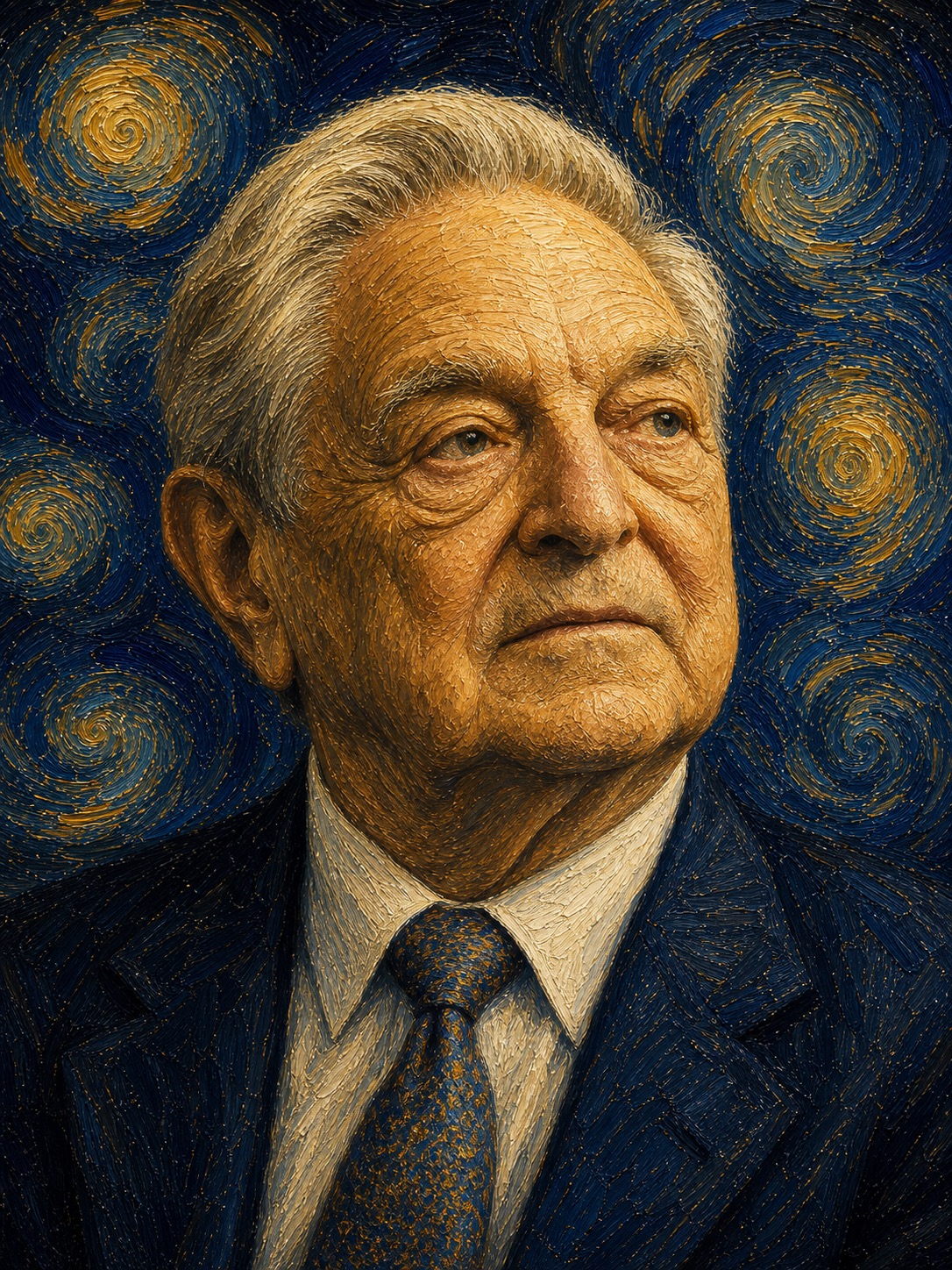
George Soros
Turned fallibility and reflexivity into a global macro method for trading brittle policy regimes and feedback loops, while exposing the limits of opacity, leverage, and public influence.
As of 2026-06-12T09:39:30Z, George Soros is living. This profile verifies identity, vehicle structure, current Soros Fund Management status, major track-record claims, and legal/criticism context from opened sources available during T0033.
Snapshot
| Field | Detail |
|---|---|
| Born / died | Born August 12, 1930, Budapest, Hungary; living as of this run. Sources: Open Society Foundations, Britannica Money. |
| Nationality / identity | Hungarian-born American financier, investor, author, philanthropist, and political donor; became a U.S. citizen in 1961 per Britannica. Source: Britannica Money. |
| Primary vehicles | Soros Fund Management; Quantum Fund and related Quantum vehicles; Open Society Foundations as major philanthropic beneficiary and capital owner. Sources: SFM official site, Open Society Foundations, Guardian 2011. |
| Years active | Finance career began in the 1950s; own hedge-fund platform from roughly 1970; Quantum Fund commonly dated to 1973; philanthropy from 1979 onward. Sources: Open Society Foundations, Guardian 2011. |
| Asset classes | Global macro across currencies, bonds, equities, commodities, and political/economic regime trades; recent public filings show a U.S.-listed equity and options disclosure footprint, not total portfolio exposure. Sources: SEC 13F primary document, 13F.info Q1 2026 table. |
| Style tags | Global macro; reflexivity; event/regime analysis; concentrated directional trading; risk-budget flexibility; political economy; family-office capital. Sources: The Alchemy of Finance official page, OSF reflexivity lecture transcript. |
| Verified track record | The strongest opened track-record figure is secondary: the Los Angeles Times reported in 2000 that Quantum had returned almost 32% annually through 1999 over nearly 30 years. This remains unaudited in this file and should be treated as a press-reported fund-level figure, not a reconstructed investor-return series. Source: Los Angeles Times 2000. |
| Peak / current AUM | SFM's official site currently describes the firm as a $28 billion asset manager. The 2026 Q1 13F reports about $9.12 billion of reportable U.S. long 13F holdings, which is not total AUM. Sources: SFM official site, SEC 13F primary document. |
| Current structure | SFM says it no longer accepts outside capital except from Soros family clients and is the principal asset manager for Open Society Foundations. Dawn Fitzpatrick is CEO/CIO as of January 1, 2023; Alex Soros became SFM president in June 2023. Sources: SFM official site, SFM leadership. |
| Legal / controversy status | Major historical items verified in this run: a 1979 SEC News Digest records an SEC complaint involving Soros Fund Management; Soros was convicted in France over 1988 Societe Generale share purchases, with the European Court of Human Rights rejecting his appeal in 2011; Asian-crisis allegations are contested by academic work; conspiracy theories around Soros often overlap with antisemitism. Sources: SEC News Digest 1979 PDF, Courthouse News 2011, Monash abstract of Brown-Goetzmann-Park, ADL. |
Life & career timeline
George Soros was born in Budapest in 1930 into a Jewish family. His official Open Society Foundations biography emphasizes two formative political experiences: surviving Nazi occupation in 1944-1945 and leaving postwar, Communist-dominated Hungary for England in 1947. Both OSF and the British Academy describe his London years as financially precarious, including work as a railway porter and waiter while studying at the London School of Economics, where Karl Popper's philosophy of the open society became a durable intellectual influence. Sources: Open Society Foundations, British Academy profile.
Soros moved to the United States in 1956 and built his early Wall Street career before launching his own hedge-fund platform around 1970. OSF's official biography says he opened his own hedge fund in 1970; The Guardian, in its 2011 account of the fund's family-office transition, dates the Quantum Fund launch to 1973. That distinction matters for later performance reconstruction: "Soros platform," "Double Eagle," "Quantum," and later Quantum-family vehicles are often compressed into one legend but may not map one-to-one onto investor-accessible returns. Sources: Open Society Foundations, Guardian 2011.
By the 1980s and 1990s Soros had become the public face of discretionary global macro investing. His own official book page for The Alchemy of Finance frames the book as the public introduction of his theory of reflexivity: market participants do not merely observe economic reality, they help change it through feedback between perception, prices, credit, politics, and fundamentals. The concept is the bridge between his investing career and his political/philanthropic worldview, not a standalone trading formula. Sources: The Alchemy of Finance official page, OSF reflexivity lecture transcript.
The public peak of the Soros trading legend came with the 1992 sterling crisis. Press accounts consistently describe Soros as having made an enormous profit by shorting sterling as the United Kingdom exited the European Exchange Rate Mechanism, but the exact personal/fund profit varies by source. The Guardian's 2011 article uses a $1 billion figure; The New Yorker in 1995 says Soros netted about $2 billion and places the U.K. government's cost near $6 billion. For Canon purposes, the trade should be treated as a landmark directional macro success, while the exact P&L remains a later C-task reconstruction item. Sources: Guardian 2011, New Yorker 1995.
Soros's philanthropic arc began before the Black Wednesday fame. OSF says he started philanthropy in 1979, initially funding scholarships for Black South Africans under apartheid and supporting dissidents in Communist Eastern Europe in the 1980s. His foundation network later became one of the world's largest private philanthropic operations: OSF says he has given more than $32 billion of personal wealth to the foundations, and its work has supported organizations and individuals in more than 120 countries. Sources: Open Society Foundations, GeorgeSoros.com biography.
The investment business changed materially after 2000. The Los Angeles Times reported that Quantum lost 22% in 1999 and another 21% year-to-date in early 2000, after which Soros Fund Management planned to lower expected returns and change how aggressively it pursued macro opportunities. In 2011 Soros told outside investors that outside money would be returned and the hedge-fund business would become a family-office-style operation, partly because of regulatory changes. Sources: Los Angeles Times 2000, Guardian 2011.
Leadership has also shifted. SFM's own leadership page says Dawn Fitzpatrick became CEO and CIO on January 1, 2023, and that Alex Soros became president of SFM LLC in June 2023. The Guardian reported in 2023 that Alex Soros had been given control of Open Society Foundations, with the foundation directing roughly $1.5 billion annually to civil-society groups, and that the OSF investment committee oversees SFM assets. Sources: SFM leadership, Guardian 2023.
Vehicles & structure
The central vehicle is Soros Fund Management. The firm's current official site describes SFM as a global investment firm founded by George Soros more than 50 years ago, with $28 billion in assets under management. It also states two structural facts that are critical for interpreting modern filings: SFM does not accept outside capital except from Soros family clients, and it is the principal asset manager for Open Society Foundations. Source: SFM official site.
That means current public evidence does not resemble a normal public mutual-fund or hedge-fund investor record. The SEC Form 13F for the quarter ended March 31, 2026 identifies Soros Fund Management LLC as the filing manager, reports 263 information-table entries, and lists a total 13F information-table value of $9,119,078,018. This is useful for seeing reportable U.S.-listed long positions and certain options, but it excludes many things that matter for a global macro family office: non-U.S. securities, cash, sovereign debt, currencies, commodities, derivatives that are not 13F-reportable, shorts, financing, and internal capital allocations. Sources: SEC 13F primary document, SEC 13F information table.
The historic return engine was the Quantum Fund complex, often used as shorthand for the Soros-run macro record. However, opened sources do not yet provide a clean audited series that separates gross fund returns, net limited-partner returns, manager economics, and Soros personal capital. Later C and D tasks should distinguish vehicle inception dates, fee structures, co-managers, leverage, withdrawals, and survival bias.
The philanthropic capital pool is not just a reputational footnote. Soros's investment record funded OSF, and OSF's capital now helps define SFM's purpose. The official OSF page says Soros gave more than $32 billion to the foundations; SFM's official site says it is OSF's principal asset manager. This makes Soros one of the rare Canon investors whose investment vehicle, political philosophy, and institutional legacy are tightly intertwined. Sources: Open Society Foundations, SFM official site.
Track record detail and caveats
The Soros record is extraordinary, but the exact numbers need more caution than the legend usually gets. The strongest opened long-horizon figure for this profile is the Los Angeles Times' 2000 report that Quantum had returned almost 32% annually through 1999 from almost 30 years earlier, while Soros Fund Management had $14.4 billion under management. In the same article, however, the reported 1999 and early-2000 losses are severe: Quantum lost 22% in 1999 and 21% year-to-date in 2000. Sources: Los Angeles Times 2000.
The New Yorker profile from 1995 gives an even more dramatic contemporary press number, describing Quantum as having a roughly 40% annual growth rate over 25 years. This file does not promote that as the verified canonical return because the opened source is a magazine profile, not a fund statement, and because "growth rate" may not match audited net returns to outside investors. Source: New Yorker 1995.
Black Wednesday is similarly real but numerically messy. It is safe to say Soros became famous for a successful short position against sterling in 1992, and that the trade occurred as the United Kingdom left the European Exchange Rate Mechanism. It is not safe yet to state a single exact profit. The opened sources cite $1 billion and about $2 billion figures; later task C should reconstruct the position size, profit attribution among Soros, Quantum, Stanley Druckenmiller, and the broader firm, and whether reported profits are gross, net, or press-estimated. Sources: Guardian 2011, New Yorker 1995.
The record after the 1990s looks less like a continuous public macro-fund compounding machine and more like a changing institutional capital pool. The 2011 decision to return outside capital means the later SFM record is not comparable to the original outside-investor Quantum narrative. Current SFM AUM of $28 billion is official, but it is not a performance statistic. The 2026 Q1 13F value of $9.12 billion is a holdings disclosure subset, not a full balance sheet. Sources: SFM official site, SEC 13F primary document.
Legal, regulatory, and criticism context
Soros's profile requires a non-hagiographic legal and criticism check. A 1979 SEC News Digest records that the SEC filed a complaint seeking injunctions involving Soros Fund Management and others. This run did not reconstruct the complaint's full procedural history or outcome, so later legal/source work should pull the underlying complaint and settlement or dismissal record before drawing conclusions beyond the existence of the enforcement action. Source: SEC News Digest 1979 PDF.
The best-documented personal legal issue in opened sources is the French insider-trading case. Courthouse News reported in 2011 that the European Court of Human Rights rejected Soros's appeal over a French conviction tied to 1988 purchases of Societe Generale shares. The report says he was convicted in France in 2002, originally fined 2.2 million euros, and later had the fine reduced to 940,500 euros. For Canon purposes, this is a real legal blemish and should be carried into later D-task work. Source: Courthouse News 2011.
Asian financial crisis allegations need a different treatment. Soros was publicly blamed by some Asian political leaders for currency pressure in 1997, but academic work by Brown, Goetzmann, and Park found a more limited and nuanced picture. The Monash abstract says their estimates show some evidence of large hedge-fund positions in the Thai baht and Malaysian ringgit before July 1997, but no evidence that hedge funds used positive-feedback strategies, and by late summer 1997 sizable short positions were absent. This does not exonerate or convict Soros on every claim; it warns against using political blame as a substitute for position-level evidence. Source: Monash abstract of Brown-Goetzmann-Park.
Finally, criticism of Soros often mixes legitimate scrutiny of wealth, politics, philanthropy, tax, regulation, and markets with conspiracy theories. The Anti-Defamation League warns that Soros conspiracy theories frequently carry antisemitic themes and have been amplified internationally. Canon files should not treat bigoted claims as evidence, but they also should not use that fact to skip legitimate, sourced criticism of investment conduct, political power, regulatory history, or philanthropic influence. Source: ADL.
Why Soros matters
Soros matters first because he made global macro investing intellectually and institutionally visible. He is not merely a currency trader with one famous win. The broader record links philosophy, macro history, institutional structure, and aggressive risk-taking: a framework about feedback loops, a willingness to express views through liquid global instruments, and a capacity to change exposure quickly when facts or market prices changed.
Second, Soros is a central case study in the limits of track-record storytelling. The headline returns appear spectacular, yet the cleanest opened figures are secondary, vehicle definitions blur across decades, the best-known trade has disputed P&L numbers, and the business later changed from outside-investor hedge fund to family office. A serious Canon treatment must preserve both truths: Soros belongs near the top of public-markets macro history, and much of the popular numerical legend still needs primary-ledger reconstruction.
Third, Soros is one of the strongest examples of capital converted into institutional influence outside markets. The same reflexivity concept that underpinned his investing also sits behind his public philosophy: institutions, narratives, and expectations can change outcomes. His philanthropy has been large enough to become part of geopolitical debate, which means future Canon tasks should separate investing skill, philosophical coherence, political power, and public backlash rather than collapsing them into a single moral judgment.
Fourth, he is a useful contrast case for other Canon investors. Compared with Warren Buffett or Benjamin Graham, Soros is less about business ownership and more about unstable systems, leverage, liquidity, and policy constraints. Compared with Peter Lynch, he is less about bottom-up company discovery and more about top-down regime pressure. Compared with later macro investors such as Stanley Druckenmiller, he raises an attribution problem: where does Soros's edge end and the institution's co-manager talent begin?
Open questions for later tasks
- Reconstruct the exact Quantum/Double Eagle/Soros Fund vehicle timeline, including inception dates, name changes, investor terms, fee structures, and capital base.
- Build a primary-source return table for Quantum and related vehicles, separating gross fund returns, net investor returns, Soros personal capital, and manager economics.
- Reconstruct Black Wednesday with position size, timing, financing, Druckenmiller attribution, gross/net P&L, and source hierarchy.
- Separate Soros's own investment philosophy from later SFM practice under successor CIOs.
- Pull original materials for the 1979 SEC complaint and the French insider-trading case, including underlying filings and final procedural status.
- Verify the Asian crisis claims with position-level evidence where possible rather than relying on political statements or later summaries.
- Map the philanthropy/investment feedback loop: how much of Soros's wealth moved into OSF, how SFM manages that capital, and how OSF governance changed under Alex Soros.
- Compile Soros's own writings and speeches into a provenance-ranked reading list, especially The Alchemy of Finance, Soros on Soros, and the 2009 reflexivity lectures.
As of 2026-06-12T10:45:35Z, this file covers George Soros's own investing philosophy and the Soros/Quantum style he made famous. It should not be read as a current portfolio memo for Soros Fund Management under later CIOs. Current SFM is a family office and global asset manager with $28 billion of AUM, no outside investors other than eligible Soros family clients, and a much broader institutional team mandate than Soros's personal investing record SFM.
Core worldview
Soros's investing worldview begins with fallibility. He argues that participants in social and financial systems do not merely observe reality; they act on partial, biased interpretations of it. Those actions can then alter the reality they are trying to understand. In his 2009 Central European University lecture, he reduces the framework to two principles: human views are always partial and distorted, and distorted views can influence the situation to which they relate OSF reflexivity transcript. Applied to markets, this means prices are not passive thermometers. Prices, credit availability, collateral values, regulation, investor confidence, and political choices can interact until the market itself becomes part of the fundamental story.
This worldview owes as much to philosophy as to trading. Soros has repeatedly linked his framework to Karl Popper, imperfect knowledge, and the open society idea OSF biography. In a Cato Institute speech, he says Popper's claim that perfect knowledge is unattainable exposed a contradiction with economic models built on perfect competition and perfect knowledge Cato excerpt. The investment implication is humility about theory, not passivity. Soros looks for situations where the dominant model is not merely wrong in a spreadsheet, but wrong in a way that causes investors, lenders, companies, and governments to behave in self-reinforcing ways.
His official page for The Alchemy of Finance frames the book as both a practical account of financial trends and a new paradigm centered on reflexivity GeorgeSoros.com. That is the core: markets are historical processes with feedback loops, not equilibrium machines whose future can be solved from timeless formulas.
The edge - what they believe(d) markets misprice and why
Soros's edge is not simple contrarianism. It is diagnosing when the market's prevailing bias and an underlying trend are reinforcing each other, and when that reinforcement is likely to break. In his later summary of boom-bust processes, he describes bubbles as having two components: a real trend and a misconception about that trend Fallibility/reflexivity essay. This is a subtle but important distinction. A bubble is not merely "price up too much." It often begins with a legitimate change: deregulation, a credit innovation, the Internet, oil scarcity, a currency peg, financial globalization, or a new technology. The mispricing occurs when investors overextend a partly true idea into a false certainty.
He believes markets misprice because market prices can change the fundamentals they supposedly discount. In the financial-markets lecture, Soros states that market prices distort fundamentals and can also affect those fundamentals, especially through leverage Financial Markets transcript. Easy credit can raise collateral values; rising collateral values can justify more credit; more credit can validate the initial optimism. The same logic works in reverse when margin calls, forced liquidation, or policy exhaustion turn a slow boom into a fast bust.
This gives Soros a different definition of "edge" from a classic security analyst. The target is not only a gap between price and intrinsic value. It is a gap between the market's story and the set of constraints that will eventually force the story to change. His 2008 oil testimony is a clean example: he treated the oil move as partly grounded in real supply-demand pressure, but also as a reflexive process amplified by institutional commodity-index buying, speculation, and political producer incentives oil testimony. The opportunity comes from seeing both halves, not from dismissing the trend as "irrational."
The edge persists because the actors in the loop have incentives to keep playing. Lenders, rating agencies, politicians, hedge funds, bank executives, and end investors can all be rewarded by the boom before they are punished by the bust. Soros's 2008 crisis writings identify market fundamentalism, deregulation, and repeated official rescues as forces that turned earlier crises into apparent tests that validated a false belief Worst Market Crisis INET remarks. That makes his edge temporal: recognizing a false equilibrium is not enough; the investor must also survive until the feedback loop turns.
Process: idea sourcing -> research -> valuation & entry -> sizing -> portfolio construction -> sell discipline
Soros's idea sourcing starts with macro dislocations, not screens. The best candidates are historical situations where policy commitments, credit structures, exchange-rate regimes, capital flows, or speculative narratives appear inconsistent with one another. His own writing treats financial markets as "a form of history" rather than a physics laboratory INET remarks. That points the researcher toward institutions, incentives, and path dependence: Who is forced to defend a price? Who benefits from the prevailing misconception? Who is using leverage? Which authorities have promised more than their balance sheets or politics can sustain?
Research is hypothesis-driven. A Soros-style thesis has to name the underlying trend, the market's misconception, the feedback mechanism, and the likely test. In the housing super-bubble, the trend was credit expansion and leverage; the misconception was that markets would correct their own excesses INET remarks. In oil, the trend was tight supply-demand conditions and producer behavior; the misconception was that commodity-index buying was a durable productive asset class rather than a flow that could destabilize futures markets oil testimony. The research standard is not merely "what is the right estimate?" but "what feedback loop would make this estimate self-confirming, and what would break it?"
Valuation and entry are therefore less spreadsheet-centered than in Graham-style investing. Entry is attractive when a reflexive process creates asymmetry: a defended exchange rate that cannot be defended indefinitely, a leveraged boom whose collateral logic is weakening, or a market narrative that has entered Soros's "twilight" period, where many participants doubt the premise but the trend still carries them forward Fallibility/reflexivity essay. This does not mean valuation is irrelevant. It means valuation is embedded in a path: the price matters because it shows where the feedback loop sits and how painful reversal may be.
Sizing is central. Stanley Druckenmiller, who worked with Soros at Quantum, later said the biggest lesson he learned from Soros was sizing rather than currency forecasting: what matters is not just being right, but how much is made when right and lost when wrong Morgan Stanley interview. This aligns with Soros's public record: the style is willing to be large and concentrated when the payoff distribution is unusually asymmetric. SFM's own current language still echoes that heritage, saying the firm can take large, concentrated positions when opportunities arise, though that is a current institutional statement rather than proof of Soros's personal process SFM.
Portfolio construction was global macro before that phrase became a marketing category: currencies, bonds, equities, commodities, derivatives, and country exposures expressed through liquid instruments. The current 2026 13F shows $9.119 billion of reportable U.S. long securities across 263 entries, but that filing is only a partial U.S. long-equity snapshot and not a full view of macro exposures, shorts, derivatives, foreign securities, or total AUM SEC 13F.
Sell discipline follows thesis discipline. A reflexive process is expected to reverse eventually, but the exact timing is unknowable. Soros has explicitly said reflexivity can explain better than it predicts and cannot determine the duration or extent of a boom Crisis: What To Do. Therefore the sell decision must respond to feedback: the trend has exhausted, the misconception is now recognized, policy capacity has changed, or the trade no longer has the originally perceived asymmetry.
Risk management
Risk management begins with the admission that the thesis may be wrong. Soros's fallibility principle is not decorative; it is the operating constraint. Because market participants and policymakers are themselves fallible, the investor has to treat every model as provisional and watch for feedback that falsifies it OSF reflexivity transcript.
The style is not low-risk in the conventional volatility sense. It seeks large mispricings, accepts concentration, and often operates where leverage and politics create discontinuities. The risk control is supposed to be liquidity, sizing relative to conviction, rapid reassessment, and willingness to change course. The 2000 Quantum episode is the clearest warning. Press reports at the time described major 1999-2000 losses, a scaling back of risk, and a reduced return target after a period when technology-market volatility and internal portfolio changes damaged performance Los Angeles Times. That episode shows the philosophy's built-in limit: reflexive markets can move against a skeptical macro investor for longer and more violently than the risk budget allows.
The 2011 family-office transition also matters. By returning outside capital and completing a transition that had begun years earlier, SFM reduced the external-investor and regulatory constraints that come with managing client money Guardian. That does not make the strategy safer in market terms, but it changes survival risk. Permanent or family capital can tolerate opacity, volatility, and long horizons better than redeemable hedge-fund capital.
Temperament & psychology
Soros combines intellectual humility with trading aggression. The humility comes from fallibility: no theory is final, no market participant has perfect knowledge, and even correct analysis may fail on timing. The aggression comes from recognizing that most investors under-exploit rare asymmetry. Druckenmiller's recollection that Soros taught him sizing captures this psychological combination: be skeptical of your own certainty, but press hard when the evidence and payoff justify it Morgan Stanley interview.
He is not a pure "against the crowd" investor. Druckenmiller recalled Soros saying the crowd is right much of the time; the danger is being caught in the minority of cases where the crowd is catastrophically wrong Morgan Stanley interview. That temperament differs from reflexive contrarianism. Soros can ride a bubble if he thinks the feedback loop still has force, yet also look for the moment when the same loop becomes unstable. In the financial-markets lecture, he even describes buying into a forming bubble as rational from a participant's perspective, which is why he argues regulators cannot rely on market participants to restrain bubbles Financial Markets transcript.
The psychological burden is that there is no formulaic refuge. A Soros-style investor must be comfortable being early, wrong, right for the wrong reason, or right but unable to hold the position. That demands self-doubt without paralysis.
Evolution over career
Soros began as a security analyst and hedge-fund manager, but his public identity evolved into philosopher-speculator and then philanthropist-founder. OSF's biography traces his move from Budapest to London, LSE studies, U.S. finance career, 1970 hedge-fund launch, and later philanthropy OSF biography. The investment philosophy matured in public through The Alchemy of Finance, the Quantum years, the 1992 sterling trade, and later books and lectures that tried to generalize the method.
The 1990s made him the emblem of global macro. The 2000 period forced a reset. The Los Angeles Times reported that Quantum and related funds suffered sharp losses and that SFM would scale back risk and target lower returns Los Angeles Times. By 2011, the firm had mostly overseen family assets since 2000 and moved fully away from outside investors under new regulatory conditions Guardian. In the 2020s, SFM remains influential, but its team, leadership, private/public allocation mix, and OSF-linked mandate mean that its present-day activity should not be casually attributed to Soros's personal hand SFM.
What they explicitly reject
Soros rejects the efficient-market idea that prices accurately reflect all available information and deviations are random external shocks. In the 2009 financial-markets lecture, he frames his theory as directly contradicting the efficient market hypothesis Financial Markets transcript. He also rejects the broader political-economic ideology he calls market fundamentalism: the belief that markets naturally tend toward equilibrium and that self-interest alone best serves the common interest Worst Market Crisis.
He rejects mechanical prediction. Reflexivity is not a deterministic model; it can identify instability and boom-bust potential, but not the exact turning point Crisis: What To Do. He also rejects reducing society to market values. In "Toward a Global Open Society," he argues that markets can organize exchange but cannot supply political freedom, social justice, or shared values Global Open Society. That moral view is not separate from the investing worldview; both rest on the claim that human systems are fallible, reflexive, and institution-dependent.
Regimes where it thrives vs. struggles
The Soros approach thrives in regimes with liquid macro instruments, unstable policy commitments, leverage, and visible institutional feedback. Currency pegs, credit booms, commodity spikes, deregulation waves, and political-financial crises are natural habitats. These environments give the investor enough liquidity to express a view and enough feedback for prices to affect fundamentals.
It struggles when feedback loops are weak, opaque, or too slow for the capital base. A false belief can survive for years if policy support, liquidity, and investor incentives keep reinforcing it. Soros himself acknowledged that people who identified the housing bubble expected it to burst much earlier Crisis: What To Do. The style can also struggle in broad speculative markets where being skeptical creates opportunity cost before it creates profit. The 1999-2000 Quantum losses are a practical example of that timing risk Los Angeles Times.
It also struggles where the public narrative overwhelms the evidence. Soros's role in currency markets has often been politicized. Academic work on the Asian currency crisis found evidence of some hedge-fund positions in early 1997 but did not support broad claims that hedge funds pursued positive-feedback strategies or held sizable late-summer shorts NBER Monash summary. For a research canon, that means every spectacular macro claim needs position-level and timing-level evidence.
Tensions between stated philosophy and actual behavior
The first tension is humility versus scale. Soros preaches fallibility, yet his best-known trades involved large, market-moving positions. The reconciliation is that fallibility governs revision, not initial boldness. Still, the combination can look contradictory from outside: a trader says knowledge is imperfect, then acts with overwhelming force.
The second tension is open-society morality versus profiting from financial stress. Soros argues that markets need institutions, regulation, and non-market values Global Open Society, but his fortune was built partly by exploiting policy failures and market breaks. That is not necessarily hypocrisy; it is his own distinction between participant behavior and regulator responsibility. But it creates a permanent reputational tension.
The third tension is legal and regulatory. A 1979 SEC News Digest records an enforcement complaint involving Soros Fund Management and others SEC News Digest. In France, Soros was convicted over 1988 Societe Generale trading, and the European Court of Human Rights rejected his challenge by a 4-3 decision, according to contemporary legal reporting Courthouse News and HUDOC case metadata Soros v. France. These episodes should be treated neither as the whole story nor as irrelevant; they are part of assessing a philosophy that emphasizes fallibility, prudence, and institutional rules.
The fourth tension is attribution. Quantum's record was produced by Soros, partners, and successors, including Stanley Druckenmiller. Later SFM activity is even more team-driven. Any claim that "Soros believes" based on a current SFM position or a later CIO allocation should be downgraded unless tied to Soros's own writing, speech, or direct decision.
Finally, reflexivity can become too elastic if used after the fact. Because it can explain why markets overshoot in both directions, the framework needs timestamped theses, position records, and falsifiable predictions to avoid becoming narrative decoration. Used rigorously, it is a powerful theory of market feedback. Used lazily, it can justify almost any outcome after it happens.
As of 2026-06-12T11:46:35Z. Scope: this file ranks the most important public-markets trades associated with George Soros, Quantum, or Soros Fund Management where there is enough public evidence to reconstruct context, thesis, structure, payoff, and caveats. Because Quantum and SFM were private partnerships/family-office vehicles, the evidence is uneven. I use the strongest available sourcing, flag press-only numbers, and avoid treating a press nickname as an audited trade record.
Source And Attribution Caveats
Soros is the right file subject, but not every trade below was a solo Soros trade. By the early 1990s, Stanley Druckenmiller was running day-to-day Quantum money, and Scott Bessent was a key SFM London investor. The sterling trade is especially a team case: contemporary and retrospective sources assign idea generation and execution across Druckenmiller, Bessent, and Soros, with Soros's distinctive contribution often described as pushing size. The Guardian's 2010 Druckenmiller profile quotes Bessent saying the short-pound idea was Druckenmiller's and that Soros pushed the position to a much larger scale (Guardian, 2010). Later SFM trades, including the 2012-13 yen trade, were also institution-level trades, not necessarily personal Soros decisions.
Profit figures are likewise not fully audited. The best-known sterling number ranges from about $1 billion or GBP1 billion to about $2 billion, depending on the source and whether the count includes Quantum offshoots and related currency bets. Connie Bruck's 1995 New Yorker profile reports that Soros told Anatole Kaletsky that Quantum and offshoots had roughly $10 billion against the pound and earned about $2 billion, mainly from the pound (New Yorker, 1995). Other credible press accounts use $1 billion or GBP1 billion (Guardian, 2011, Guardian, 2013). Those conflicts are kept visible rather than averaged away.
Ranked Trade Table
| Rank | Trade | Main dates | Structure | Best available P&L | Confidence |
|---|---|---|---|---|---|
| 1 | Short sterling / Black Wednesday | Built before Sept. 16, 1992; crystallized after UK left ERM | Short GBP versus Deutsche mark and probably other hard currencies, with leverage | About $1 billion to about $2 billion [disputed] |
High on win, medium on exact P&L |
| 2 | Post-Plaza dollar/yen and equity-futures macro book | Sept. 1985 through 1987 | Shift from dollar assets into yen; leveraged stock-index/currency futures and equities | About $150 million on yen switch; $1.5 billion over two years for Quantum group [mixed-scope] |
Medium |
| 3 | 2007 credit-crisis comeback | 2007 into 2008 | Active Quantum/SFM macro positioning during subprime crisis; exact instruments undisclosed | $2.9 billion personal/manager earnings estimate; fund return >30% [press/Alpha estimate] |
Medium-low on trade structure |
| 4 | Abenomics yen short | Late 2012 to early 2013 | Short yen, long Japanese equities under Scott Bessent at SFM | More than $1.2 billion reported for SFM [single-source press] |
Medium on direction and team, low on book detail |
| 5 | Asian currency shorts | Early 1997; profits realized before/around crisis | Short Asian-currency exposure around Thai baht/ringgit pressure; exact Soros/SFM instrument detail not public in opened sources | Profitable but exact P&L not public | Medium on existence, low on P&L |
1. Short Sterling / Black Wednesday - Single Best Trade
Context And Dates
The United Kingdom joined the European Exchange Rate Mechanism in 1990 at a central parity of 2.95 Deutsche marks per pound, while its economy was already vulnerable to recession and high interest rates. Germany's post-reunification inflation pressure kept Bundesbank policy tight, and the UK had to keep rates high to defend sterling inside the ERM band. A short excerpt from Inside the House of Money summarizes the mechanism: the pound approached the lower end of its band in September 1992, traders sold pounds against Deutsche marks, and the Bank of England had to buy pounds to defend the regime (Inside the House of Money excerpt). The UK withdrew sterling from the ERM on the evening of September 16, 1992.
Thesis And How Found
The thesis was a classic Soros-reflexivity setup: a policy price was inconsistent with economic pressure, and the act of defending it made the fundamentals worse. Britain needed lower rates to ease recession and housing stress, but the ERM required high rates to keep sterling inside the band. Bessent later emphasized that SFM did bottom-up work on UK housing and property before the trade, while Druckenmiller understood the risk/reward and Soros pushed for scale (Guardian, 2010). The trade therefore combined macro policy logic with micro evidence that the UK economy could not endure the required rate regime.
Size And Structure
The most specific size disclosure remains Soros's reported post-crisis interview with Anatole Kaletsky, recounted in the New Yorker: Quantum and related offshoots had roughly $10 billion against the pound, about $9 billion of it borrowed, and the combined speculation made about $2 billion, mainly on sterling (New Yorker, 1995). The Guardian's 2013 yen article repeats the $10 billion position but states profit as $1 billion (Guardian, 2013). The instrument mix is not fully public. The economic exposure was short GBP and long stronger currencies, above all the Deutsche mark; the book likely used spot/forward currency positions, bank financing, and related macro instruments, but the precise internal mix should be treated as not disclosed.
Entry And Path, Including Drawdown
SFM was short before the actual break. The public record supports a staged build rather than a one-day trade: Bessent was already in the London office, had analyzed UK property pressure, and the fund increased conviction as the ERM defense became less credible. The House of Money excerpt says the UK raised rates from 10% to 12% and threatened 15% on Black Wednesday, which emboldened traders because the policy looked politically and economically unsustainable (Inside the House of Money excerpt). Public sources do not provide a verified interim drawdown on Quantum's sterling book. The relevant endured risk was not a quoted mark-to-market loss but a regime risk: if UK/German policy cooperation had held longer, a levered short could have suffered financing pressure, squeeze risk, and adverse policy headlines.
Exit And P&L
The exit was not a single printed trade but a monetization after the UK abandoned ERM defense. The pound fell about 15% against the Deutsche mark over the following weeks in the House of Money excerpt; The Guardian's 2012 retrospective states sterling dropped 15% against the Deutsche mark and 25% against the dollar over the next five weeks (Guardian, 2012). UK public-cost estimates also differ by framing: later Treasury documents put the final bill at GBP3.3 billion (Guardian, 2005), while the New Yorker reported a roughly $6 billion government defense cost in its 1995 profile (New Yorker, 1995). For the fund, the best defensible P&L range is "about $1 billion to about $2 billion" [disputed].
What It Teaches
This is Soros's canonical trade because it shows position sizing against a brittle policy regime. The setup did not require forecasting a normal business cycle; it required identifying a constraint that had become self-defeating, then sizing when the asymmetry was extreme. It also teaches humility about attribution. The public myth is "Soros broke the Bank of England," but the execution history is team-based: Druckenmiller, Bessent, and Soros each appear in credible accounts. Soros's edge was not just seeing devaluation risk. It was allowing the book to be large enough that being right mattered.
2. Post-Plaza Dollar/Yen And Equity-Futures Macro Book
Context And Dates
By early 1985, the dollar had risen sharply. Jeffrey Frankel's Plaza Accord paper says the dollar had climbed 44% against major currencies in the five years leading up to 1985, and that the Group of Five agreed at the Plaza Hotel on September 22, 1985 to bring the dollar down, backed by selling dollars for other currencies (Frankel, Baker Institute, 2015). Soros later framed the Plaza Agreement as a decisive abandonment of pure free-floating orthodoxy in a 1987 essay on global monetary cooperation (GeorgeSoros.com, 1987).
Thesis And How Found
The trade was a policy-inflection bet: if the world's major monetary authorities had shifted from benign neglect of a strong dollar to coordinated pressure against it, a speculator could ride the realignment rather than fight central banks. Time's 1987 profile reports that Soros learned of the Plaza meeting and inferred that the five nations would lower the dollar's value against major currencies (Time, 1987). This was not pure chart-following. It was a political-economy reading of the trade deficit, protectionist pressure, and a changed Treasury posture.
Size And Structure
Time reported that Soros made what he called a "killing of a lifetime" - about $150 million - by switching from dollar investments into Japanese yen in September 1985 (Time, 1987). The same profile says Quantum's gains over the next two years came from heavy investment in US stocks as well as volatile stock-index and currency futures. That means this "trade" is best viewed as a macro book anchored by dollar depreciation and asset reflation rather than a single ticket. Exact gross exposure, leverage, and cross-currency split are not public.
Entry And Path, Including Drawdown
The strongest dated entry clue is September 1985. Soros switched from dollar investments into yen after the Plaza meeting, then benefited as the dollar fell and the equity bull market extended. Frankel's paper supplies the macro path: in 1985-87 the dollar came back down by about 40% (Frankel, Baker Institute, 2015). Public sources do not quantify the drawdowns inside Quantum's book. The major risk was reversal or official second thoughts: by the Louvre Accord in 1987, officials were already trying to prevent too much additional dollar weakness, which would have narrowed the payoff window.
Exit And P&L
Time gives two useful but mixed-scope figures: about $150 million on the yen switch and $1.5 billion in Quantum profits over two years for Soros and investors (Time, 1987). The $1.5 billion figure should not be attributed entirely to the yen trade; it included equities, stock-index futures, and currency futures. A conservative P&L statement is therefore: about $150 million specifically linked to the yen switch, plus a broader two-year Quantum boom of about $1.5 billion [mixed-scope].
What It Teaches
This trade shows Soros's skill at converting policy regime change into portfolio expression. The best version of the trade was not just "short dollar." It was "the policy regime now wants a weaker dollar, and the same global liquidity backdrop can support equities and futures positioning." It also shows a recurring Soros pattern: he did not need markets to be efficient or inefficient in the abstract. He needed a dominant misconception or policy commitment to shift, then a book that could express the shift across currencies and equity markets.
3. 2007 Credit-Crisis Comeback
Context And Dates
After large losses around the technology bubble era and a move toward family-office style management, Soros returned more actively to investing during the subprime crisis. The Los Angeles Times, citing John Cassidy's New York Review of Books discussion, says Soros returned at age 77 to directing Quantum's investments after the subprime crisis erupted (Los Angeles Times, 2008). Soros's own January 2008 essay argued that subprime had spread into CDOs, mortgage insurers, credit default swaps, asset-backed commercial paper, and interbank lending, and described the crisis as the most severe since World War II (GeorgeSoros.com, 2008).
Thesis And How Found
The thesis was that the credit expansion of the prior decades had become a "super-boom" dependent on moral hazard, structured-credit opacity, and repeated official rescues. This is unusually close to Soros's written theory of reflexivity: credit-market prices and institutional behavior had reinforced each other until the system itself became unstable. The exact research path inside Quantum is not public. The evidence we have supports a high-level macro-credit call and Soros's active re-engagement, not a fully reconstructed subprime short like John Paulson's ABX/CDS trade.
Size And Structure
The public sources do not disclose the instrument book. It may have included credit, rates, currencies, equities, commodities, or hedges, but that cannot be asserted from the available evidence. The Guardian, reporting Alpha magazine's hedge-fund pay list, says Soros returned to the helm of Quantum after spotting turmoil and made returns of more than 30% in 2007 (Guardian, 2008). The LA Times gives the same Alpha estimate that Soros made $2.9 billion in 2007, second to John Paulson's $3.7 billion (Los Angeles Times, 2008).
Entry And Path, Including Drawdown
Entry is best dated to 2007 as the subprime crisis moved from isolated mortgage credit into broader funding markets. Drawdown and gross exposure are not public. The risk was unusually high because the crisis path was policy-dependent. Central banks injected liquidity and governments were already intervening. A bearish credit book could be right about systemic fragility and still lose money if the timing, instrument basis, or official response moved against the portfolio.
Exit And P&L
The reported payoff is manager/fund-level rather than trade-level: Alpha estimated Soros made $2.9 billion in 2007, and the Guardian reported Quantum returns of more than 30% (Guardian, 2008). This earns a place on the greatest-trades list because it was a late-career, crisis-regime comeback at large scale. It should not be described as an audited "subprime short" unless future work finds internal letters, position-level disclosures, or a more precise primary account.
What It Teaches
The 2007 trade teaches that Soros's edge was not only currency crisis speculation. His broader method was to identify unstable feedback loops in credit and policy. It also teaches source discipline: the payoff is large and credible enough to include, but the instrument-level opacity is too high for false precision. The right lesson is "macro diagnosis plus active risk-taking in a systemic break," not "he duplicated Paulson's trade."
4. Abenomics Yen Short
Context And Dates
In late 2012, Japan was preparing aggressive monetary and fiscal reflation under Shinzo Abe, and the yen began falling. The Guardian's February 2013 report says the yen had lost 17% of its value against major currencies since it became clear in November 2012 that Japan planned aggressive stimulus (Guardian, 2013). Frankel's Plaza retrospective separately notes that Abenomics produced a strong yen depreciation in 2013 (Frankel, Baker Institute, 2015).
Thesis And How Found
The trade thesis was a mirror image of Soros's 1985 yen strength trade: when policy turns decisively toward monetary stimulus and currency weakness, a macro book can align with the authorities rather than fight them. The Guardian reports that Scott Bessent, then CIO at Soros Fund Management, bet that the yen would fall while Japanese shares would rise (Guardian, 2013). The opportunity came from a policy regime change and the market's rapid repricing of Japan's inflation and currency path.
Size And Structure
The Guardian says Soros's $24 billion family investment fund made more than $1.2 billion from bets against the yen and that Bessent paired yen weakness with Japanese equity upside; the Nikkei 225 had risen 28% since the end of September (Guardian, 2013). This is one of the few post-Quantum Soros/SFM trades where public reporting gives both direction and a dollar payoff. Still, position size, leverage, option use, hedge ratios, and realized-vs-unrealized mix are not public.
Entry And Path, Including Drawdown
The reported window is the three months before February 15, 2013, effectively after the November 2012 political signal. The path was favorable: the yen fell sharply and Japanese shares rose. Public sources do not describe interim drawdowns. The key risk was policy disappointment or a disorderly yen reversal. Because this was a family-office/SFM trade, investor-liquidity pressure was likely lower than in the outside-capital Quantum era, but market liquidity and leverage risk remained.
Exit And P&L
The Guardian's figure is "more than $1.2 billion" from yen-related bets, based on Wall Street Journal sourcing (Guardian, 2013). I treat that as [single-source press] and assign the trade to SFM/Bessent under Soros's platform rather than to Soros personally. The trade is ranked below 2007 because the window and attribution are narrower, but it is a clean example of SFM still executing large global macro in the family-office era.
What It Teaches
The trade shows that Soros-style macro did not disappear after the firm stopped managing outside capital. It also shows pattern recognition across decades: Plaza rewarded long yen, Abenomics rewarded short yen. The transferable lesson is not a directional yen rule; it is to identify when authorities have both the desire and room to change a currency regime, then express the view across currency and equity channels.
5. Asian Currency Shorts - Thai Baht And Malaysian Ringgit
Context And Dates
The Asian currency crisis is the most politically charged item on this list. Soros was publicly accused by Malaysian Prime Minister Mahathir Mohamad of helping cause the crisis, while Soros later said the accusation was unfounded. The NBER working paper by Brown, Goetzmann, and Park concludes that it found no empirical evidence that Soros or any other hedge fund manager was responsible for the crisis (NBER Working Paper 6427). Fung, Hsieh, and Tsatsaronis similarly found hedge funds' footprints but not enough evidence to blame them as the decisive disruptive cause (Fung, Hsieh, Tsatsaronis, Brookings-Wharton draft).
Thesis And How Found
The Soros-specific trail is partly self-descriptive and partly academic. In a 2006 Malaysiakini email interview, Soros said he was not selling the ringgit during or several months before the crisis and was instead buying as currencies declined, which he framed as realizing earlier speculation (Malaysiakini, 2006). NBER's Brown, Goetzmann, and Park study tested whether large currency funds, including the public focus on Soros, were responsible for the crash and found no empirical evidence for that claim (NBER, 1998). The trade thesis was still recognizable: pegged currencies with external-account and capital-flow pressure could break when confidence shifted.
Size And Structure
The best independent empirical paper does not isolate Quantum's exact book, but it estimates that 12 large hedge funds together had a net short Thai baht position just under $5 billion at the end of June 1997, falling below $3 billion by July 8 and below $2 billion by July 30 (Fung, Hsieh, Tsatsaronis, Brookings-Wharton draft). For four Asian currencies together, aggregate short positions of the 12 large hedge funds never exceeded $6 billion, versus estimated AUM of about $30 billion for those funds. The paper also notes only modest, short-period positions in the Malaysian ringgit. That makes this a documented category of trade but not a position-size disclosure for Soros alone.
Entry And Path, Including Drawdown
The entry was early 1997, before the most visible crisis period. Soros later said SFM was buying back ringgit as currencies fell to realize profits, and that it exited too soon because of fear of capital controls. Public academic work is consistent with hedge funds reducing baht shorts during July rather than adding aggressively after the break (Fung, Hsieh, Tsatsaronis, Brookings-Wharton draft). Drawdown is not disclosed. The policy risk was extreme: capital controls, official intervention, counterparty withdrawal, and political backlash could all affect monetization.
Exit And P&L
The trade was profitable, but no reliable P&L figure for Soros/Quantum has surfaced in the sources opened for this task. Because the crisis became a political symbol, the absence of a clean P&L is important. This ranks fifth because it fits the Soros pattern and is supported by Soros's own account plus academic footprint studies, but it should not be packaged as a clean "$X billion" win.
What It Teaches
The Asian currency shorts teach the moral and analytical tension in global macro. A fund can identify an unsustainable peg and still become the public face of social pain caused by a broader financial crisis. The best evidence does not show Soros as the sole or decisive cause, but neither does it make the trade socially neutral. For the Canon, the lesson is to separate three questions: whether the imbalance was real, whether the trade made money, and whether the speculator's activity caused or amplified systemic damage.
Trades Considered But Not Promoted
Several famous Soros stories were not strong enough for the top five. Reported Argentina defaulted-bond holdings, 2016 gold/SPY put headlines, and assorted equity-position snapshots lack enough public evidence to reconstruct thesis, sizing, entry, exit, and P&L. The 1994 yen/dollar loss and 1998 Russia/LTCM-era issues belong more naturally in the mistakes-and-losses task than in this file. Public 13F snapshots can show holdings, but they do not prove trade thesis or realized outcome.
Cross-Trade Lessons
First, Soros's best trades cluster around regime breaks. The strongest examples are not cheap stocks or ordinary trend following; they are constraints that stop fitting reality: ERM sterling, overvalued dollar policy before Plaza, a credit system built on moral hazard, Japan's pre-Abenomics deflation regime, and Asian currency pegs under capital-flow stress.
Second, sizing is part of the edge. The sterling trade is famous because the position was large relative to both Quantum and the public drama. Soros's philosophy file already captures the lesson from Druckenmiller: being right in small size does not create historic results. The risk is that the same sizing impulse creates career-threatening losses when the regime break is delayed.
Third, attribution matters. Soros was the owner, public face, and philosophical architect, but several trades relied on other investors' work. The cleanest institutional phrasing is "Soros/Quantum" for the early era and "SFM/team" for later family-office trades unless sources specifically identify Soros as the decision-maker.
Fourth, the best Soros trades are easier to source than to quantify. We can verify the direction, regime context, and broad payoff for Black Wednesday, Plaza, 2007, Abenomics, and Asian-currency shorts. We cannot audit the internal ledgers from public sources. The honest conclusion is that Soros's greatest-trades record is real, but the popular numbers should carry brackets: [disputed], [single-source], or [mixed-scope] whenever the evidence demands it.
As of 2026-06-12T12:33:38Z, George Soros is living and Soros Fund Management is a family office / global asset manager, not an outside-capital hedge fund open to normal investors (Open Society Foundations, 2026; SFM, 2025). This file covers the main market losses, legal/regulatory blemishes, and reputational failures associated with Soros, Quantum, and Soros Fund Management. Because Quantum was private and often offshore, loss figures are usually press-reported or participant-reported rather than audited fund statements.
Executive Pattern
Soros's mistakes are not the opposite of his strengths; they are his strengths in excess. The same willingness to size aggressively made the 1992 sterling trade historic, but it also made British gilts in 1981, U.S. futures in 1987, yen in 1994, Russian debt in 1998, and technology stocks in 2000 painful. The same reflexivity lens that let him see unstable feedback loops sometimes left a gap between analysis and portfolio: in Russia he publicly argued that the crisis had reached a terminal phase shortly before funds tied to Soros admitted losses of up to $2 billion (Soros, 1998; Irish Times, 1998). The same appetite for public influence that amplified Open Society later produced criticism about power, disclosure, and accountability (New Yorker, 1995).
The best non-hagiographic reading is therefore neither "reckless speculator exposed" nor "temporary volatility on the way to greatness." Soros repeatedly recovered from large drawdowns, but the recoveries do not erase the process lessons: leverage creates timing fragility; policy insight does not immunize against policy timing; public celebrity can become a risk factor; and a private, founder-dominated institution needs governance disciplines that do not depend on one person's ability to "turn on a dime."
Major Market Losses And Near-Death Moments
1. 1981 British Gilts - Averaging Up Into A Reversal
The earliest near-death episode surfaced in Connie Bruck's 1995 profile. Soros had built a large position in British long-term government bonds, or gilts, and was reportedly adding as prices rose. When the move turned, he bought even bigger rather than immediately accepting that the thesis had broken. The New Yorker reports that Quantum was down 22.9% in 1981, then the only negative year in the fund's record to that point; the episode came amid redemptions, Jim Rogers's departure, a marriage breakdown, and Soros's own doubts about whether he should still manage client money (New Yorker, 1995).
The behavioral root cause was averaging up with excessive self-belief. The trade was not simply wrong; it became existential because Soros pressed the position after the market had started to disagree. His later "best loss taker" reputation should be read against this scar. The process change was both personal and institutional: he hired new traders, ultimately leaned more on delegated portfolio talent, and began building a life outside the fund through philanthropy. This matters for later Soros work because it shows that the famous philosophy of fallibility was not a tidy doctrine first and a trading practice second. It was also an adaptation to being hurt by conviction.
2. 1987 Crash - Right Macro Story, Wrong Execution Window
Soros's own 1988 essay on Black Monday is useful because it shows his post-mortem of the crash as a sequence beginning in Japanese bond speculation, then spreading through U.S. bonds, equities, and the dollar (Soros, 1988). The portfolio pain, however, came from execution. Later academic work by Kyle and Obizhaeva says the costly transaction after the crash involved large S&P 500 futures sales when prices had already spiked down, an episode serious enough to make Soros think about withdrawing from active management (Kyle and Obizhaeva, 2013). RFE/RL later summarized Quantum's 1987 crash hit as a roughly 30% tumble (RFE/RL, 1997). A secondary company history says the fund still finished 1987 positive, but lost at least $350 million after selling futures into a rebound (Encyclopedia.com).
The root cause was timing reflexivity without enough microstructure humility. Soros understood that markets were unstable; he was less protected against the practical cost of forced or poorly timed futures execution in a broken market. The lesson is not "never sell after a crash." It is that macro correctness and execution liquidity are separate risks. The crash also highlighted succession risk: Soros was increasingly absorbed by Eastern Europe and philanthropy, while the fund still needed day-to-day crisis execution.
3. 1994 Yen Shock - Currency Conviction Hit By Diplomatic Surprise
In February 1994, Quantum made a large bet that the yen would continue falling against the dollar. Instead, the yen surged about 5% in one day after U.S.-Japan trade talks broke down. The Los Angeles Times reported an approximately $600 million one-day loss, spread across Quantum funds, while a spokesman said earlier gains left the funds down only about 2.7% for the year at that point (Los Angeles Times, 1994). The New Yorker adds an important reputational detail: Soros chose to publicize the loss as a way to reduce his aura of invincibility after the 1992 sterling celebrity moment (New Yorker, 1995).
This was a policy-event mistake. The thesis may have been plausible, but the portfolio was exposed to a binary diplomatic catalyst and a crowded macro environment. Encyclopedia.com's Soros Fund Management history attributes the position to Stanley Druckenmiller's mistaken yen forecast and says the broader book also involved Japanese equities and Japanese bonds, with one-day loss estimates ranging from $350 million to $800 million (Encyclopedia.com). The exact figure should remain a range, but the process lesson is clear: a top-down currency thesis can be abruptly repriced by political process, and diversification across related Japanese assets may not diversify if all legs depend on the same policy assumption.
4. 1997 Asian-Market Shock - Profits In Bonds, Losses Elsewhere
The Asian financial crisis created both trading opportunity and reputational backlash. During the October 1997 global market shock, RFE/RL reported that a Quantum spokesperson said the fund lost more than $2 billion: the group had made money in bonds but lost more in stocks and currencies (RFE/RL, 1997). Soros himself, in a BBC interview quoted by RFE/RL, joked that the loss might be comparable to what he had made in the 1992 sterling episode. The report should be treated as a mark-to-market shock rather than a fully audited annual result, but it is too large and too directly sourced to ignore.
The root cause was cross-asset correlation under crisis stress. A trade that was right in one leg - buying Treasuries before risk assets fell - did not protect the total book because stock and currency losses dominated. This is a recurring global-macro failure mode: the portfolio may contain several "different" assets that all respond to the same liquidity event. It also fed the public narrative that Soros was both a cause and casualty of emerging-market volatility.
5. 1998 Russia - Seeing The Crisis But Still Owning The Risk
Russia is the cleanest example of analysis outrunning portfolio protection. On August 13, 1998, Soros wrote that the Russian crisis had reached a "terminal phase" and proposed a currency board after a 15% to 25% devaluation, noting that much domestic debt was held on margin and that credit lines could not be renewed (Soros, 1998). Less than two weeks later, the Irish Times reported that Soros's investment funds had admitted losses of up to $2 billion from the Russian crisis, and quoted Stanley Druckenmiller calling it the largest loss suffered by Quantum Group (Irish Times, 1998). The same article quotes Druckenmiller's plain-language post-mortem: they took a risk and were wrong.
The mistake was not ignorance. It was exposure persistence in a collapsing financing structure. Soros understood that a margin-funded debt market could not roll itself indefinitely, yet the funds still had enough Russia risk for the default/devaluation to create a massive hit. A second layer was reputational: Soros was not only an investor but also a public commentator and philanthropist in post-Soviet Russia, so the loss sat inside a wider question about whether his influence, investments, and policy prescriptions were separable.
Process change is harder to document from opened sources. Russia did not immediately end Soros's macro style, but it contributed to the late-1990s evidence that huge global macro books could be too large and too visible for the post-LTCM environment. It also strengthens the later 2000 lesson: when the market structure changes, a fund built for sweeping macro opportunity may need to shrink, specialize, or accept lower target returns.
6. 1999-2000 Technology And Euro Losses - FOMO At Scale
The 2000 restructuring is the most explicit documented process change. The Los Angeles Times reported that the flagship $8.2 billion Quantum fund was down 22% in 2000 after technology-stock losses; the same article said Soros announced the departures of Stanley Druckenmiller and Nicholas Roditi and would scale back to a more conservative approach (Los Angeles Times, 2000). It also reported that Quantum had returned about 32% annually through 1999, but that Soros funds had grown so large they were less nimble. Wired's contemporaneous account says Quantum had dropped about 20% in 2000 after big bets on technology shares and the euro went wrong, and framed Soros's change as part of a broader retreat by large global macro funds in a more volatile, transparent market (Wired, 2000).
The behavioral root cause was envy and mandate drift. The public record says the funds moved aggressively into technology stocks in mid-1999 after earlier poor performance, and later accounts from Druckenmiller describe buying tech near the top despite knowing better [single-source secondary transcript caveat]. In Canon terms the safer claim is this: the organization that had made its reputation in macro dislocations chased a narrow equity bubble because scale, relative performance pressure, and client expectations had changed the opportunity set.
The process change was material. Soros moved toward lower risk, a more conservative return target, and ultimately a family-office structure. In 2011, the Guardian reported that Soros Fund Management would return outside money and complete a family-office transition it had begun years earlier, citing SEC registration and disclosure rules (Guardian, 2011). WealthBriefing similarly reported that the firm had effectively operated as a family office since 2000 and would return less than $1 billion of external money before the SEC deadline (WealthBriefing, 2011). This is the deepest institutional response in the Soros record: lower outside-capital pressure, more permanent capital, and less need to preserve the old "world's largest hedge fund" identity.
Legal, Regulatory, And Reputational Failures
1979 SEC Complaint And 1986 CFTC Fine
The SEC's May 22, 1979 News Digest says the Commission filed a complaint in the Southern District of New York against Soros Fund Management and George Soros alleging antifraud and anti-manipulative violations tied to Computer Sciences Corporation stock. The SEC alleged that Soros and SFM sold CSC stock shortly before a public offering, helped push the offering price lower, bought shares at the allegedly artificial lower price, and then bought more to help lift the market price (SEC News Digest, 1979). The New Yorker reports that Soros signed a consent decree in the case without admitting or denying guilt and separately says the CFTC fined him $75,000 in 1986 for exceeding speculative limits through positions distributed among private accounts (New Yorker, 1995).
These are not market losses, but they belong in a mistakes file because they show the governance risk of aggressive trading in lightly regulated venues. They also complicate the popular idea that Soros's only regulatory controversy was the later French case. Later Canon work should retrieve the underlying 1979 consent decree and CFTC record before drawing stronger conclusions.
French Societe Generale Insider-Trading Conviction
The French case is the most durable personal legal blemish. Courthouse News summarizes the record: after being approached in 1988 about a Societe Generale takeover, Quantum bought 160,000 shares, later sold them for a $2.28 million gain, and French courts ultimately convicted Soros of insider trading in 2002; later appeals reduced the fine to the French-market gain and the European Court of Human Rights rejected his challenge by a 4-3 vote (Courthouse News, 2011). The Guardian similarly reported that the ECHR rejected his argument that French insider-trading law had been too unclear (Guardian, 2011).
The behavioral lesson is prudence around informational edge. A macro investor can be right that laws are ambiguous and still be wrong to trade when the fact pattern creates obvious legal risk. The case also cuts against an overly romantic reading of "fallibility": recognizing imperfect knowledge does not substitute for compliance discipline.
Asian-Crisis Blame: Reputational Failure, Not Proven Causation
Soros was publicly blamed by Malaysian Prime Minister Mahathir Mohamad during the 1997 Asian crisis, but the best opened academic evidence does not support the claim that Soros or hedge funds caused the crisis. Brown, Goetzmann, and Park's Monash abstract says global hedge-fund profits were not generally positive during the crisis, estimated currency exposures were not unusual, and the authors found no empirical evidence that Soros or any hedge-fund manager was responsible (Monash, 2000). The NBER digest adds an important caveat: the authors had to estimate positions because hedge funds did not disclose holdings, so the estimates could misrepresent true exposures (NBER Digest, 1998).
The mistake here is reputational architecture. Soros had become the public symbol of currency speculation, so he was easy to blame even where evidence was weak. The lesson is that opaque success creates political tail risk. If a strategy profits from sovereign stress, even careful empirical defenses may arrive too late to control the narrative.
BSG Resources / Guinea Litigation
The BSG Resources dispute belongs in this file as a current-status legal/reputational item, not as a finding of wrongdoing by Soros. BSG Resources sued Soros and Open Society entities in 2017, alleging a campaign that helped Guinea revoke Simandou mining rights. A 2017 SDNY order stayed the case pending arbitration because the key issue in both proceedings was whether BSGR's mining rights had been procured through corruption (Justia / SDNY, 2017). A 2021 SDNY order later treated a motion to dismiss as one for summary judgment and allowed limited discovery on whether plaintiffs bribed Mamadie Toure and whether that bribery was connected to the mining rights (Justia / SDNY, 2021). The docket then records an October 27, 2021 stipulation dismissing all plaintiffs' claims with prejudice, with each side bearing its own costs (Justia docket, 2021).
The arbitration record moved in a direction unfavorable to BSGR. IISD's 2024 summary of the ICSID award says the tribunal was reasonably certain the mining rights central to BSG's claim were secured through corrupt practices and declared BSG's claims inadmissible (IISD, 2024). For Soros, the mistake is less legal exposure than influence-risk: when philanthropy, political reform, and investment-adjacent disputes overlap, even dismissed claims can become part of a durable public narrative about unelected power.
Errors Of Omission And Attribution
The largest omission is not a single missed stock. It is the failure to publish or preserve a clean, primary Quantum return and risk record. The Canon can verify many headline losses from credible press and court sources, but it cannot yet reconcile gross exposure, net investor returns, manager economics, and Soros personal capital. That opacity is understandable for a private fund, but it weakens every later claim about skill, luck, and drawdown control.
The second omission is attribution clarity. Sterling, 1994 yen, Russia, and 2000 technology losses all involve Stanley Druckenmiller or other SFM managers. Soros was founder, owner, capital allocator, and public face; he was not necessarily the direct originator of every position. A fair mistake file should therefore assign responsibility to the institution while being explicit when the public sources name another portfolio manager.
The third omission is that Soros's public philosophy can become too elastic. Reflexivity is powerful when it produces timestamped hypotheses and falsifiable trade plans. It is less useful when used after the fact to explain any boom or bust. The repeated losses above suggest a practical checklist for future G-mental-models work: identify the feedback loop, identify the policy catalyst, size for a wrong-timing interval, predefine what evidence invalidates the thesis, and separate public advocacy from portfolio exposure.
Process Changes Made After
- After the 1981 gilt loss, Soros reduced sole-manager dependence, hired new traders, and began moving toward a broader life mission through philanthropy (New Yorker, 1995).
- After the 1987 crash, Soros's own writing emphasized the cross-market chain linking Japanese bonds, U.S. bonds, equities, and the dollar; the practical lesson was to distinguish macro diagnosis from execution in illiquid crash conditions (Soros, 1988; Kyle and Obizhaeva, 2013).
- After the 1994 yen hit, Soros used the loss publicly to reduce his invincibility aura, which was a reputational risk-control move as much as an investment process change (New Yorker, 1995).
- After the 1998-2000 sequence of Russia and technology/euro losses, SFM moved to lower-risk positioning, accepted lower return ambitions, changed leadership, and eventually completed the family-office transition that reduced outside-client and disclosure pressures (Los Angeles Times, 2000; Guardian, 2011).
- Modern SFM's public values now explicitly include smart risk-taking, humility, integrity, teamwork, and an owner's mindset, and the firm says it does not accept investors other than eligible family clients (SFM, 2025). That language should not be projected backward onto Quantum, but it is a visible institutional response to operating permanent capital after decades of high-profile volatility.
Open Questions For Later Tasks
- Retrieve the 1979 SEC consent decree and any CFTC documentation for the 1986 speculative-limit fine.
- Build a year-by-year Quantum return and drawdown table from primary fund reports, not press summaries.
- Reconcile the 1987 loss estimates: 30%, $350 million, $800 million, and whether the full-year result was positive after recovery.
- Separate Soros personal decisions from Druckenmiller/Roditi/Bessent decisions for 1994 yen, Russia, 2000 technology, and 2012-13 yen.
- Locate SFM investor letters around April 2000 to verify exact restructuring language, target returns, fund mergers, and risk limits.
- Map whether the 2011 family-office transition materially reduced future drawdowns or simply reduced public disclosure.
- Reconstruct the 1997 Asian-crisis book: which trades made money, which lost, and whether the reported more-than-$2 billion shock was temporary or final.
As of 2026-06-12T13:35:12Z, this file indexes short, source-verified excerpts from George Soros's own books, essays, speeches, lecture transcripts, testimony, and interviews. Each direct quote below is 25 words or fewer. To avoid quote laundering and over-excerpting, the quote set uses no more than one short excerpt from any single opened source.
Quote Provenance Notes
Soros is unusually quotable, which creates a misattribution trap. This file does not use quote-aggregator pages. It relies on official GeorgeSoros.com reposts, Open Society Foundations transcripts of the 2009 Central European University lectures, an official excerpt from Soros on Soros, and interviews republished on Soros's official site. The result is weighted toward Soros's public philosophy rather than private trading-room language, because internal Quantum memos and investor letters were not located in this run.
Fallibility, Reflexivity, And How Markets Work
- "History is made by the participant's errors, biases, and misconceptions." (Soros on Soros excerpt, 1995). A compact statement of why Soros treats markets and politics as historical processes rather than mechanical systems.
- "Scientific laws are always hypothetical in character." (Journal of Economic Methodology essay, 2014). He imported Popper's provisional view of knowledge directly into his critique of economics.
- "Market prices always distort the underlying fundamentals." (CEU Financial Markets transcript, 2009). This is the cleanest one-line contrast with efficient-market doctrine.
- "It is built on the twin pillars of fallibility and reflexivity." (Cato Institute remarks, 2011). Soros repeatedly returned to this pair as the backbone of his investing and social philosophy.
- "Financial markets should not be treated as a physics laboratory but as a form of history." (INET King's College remarks, 2010). This is his methodological objection to timeless equilibrium models.
- "Behind the invisible hand of the market lies the visible hand of politics." (Festival of Economics remarks, 2012). Even when markets look autonomous, their rules and rescue mechanisms are political.
- "Markets do not operate in a vacuum and do not tend toward equilibrium." (Toward a Global Open Society, 1997). This is the bridge between his investment theory and his criticism of laissez-faire ideology.
Bubbles, Crises, And Risk
- "Only now did the wolf arrive." (The Crisis & What To Do About It, 2008). Soros used the 2008 crisis to argue that warnings he had issued in earlier books had finally met the event.
- "The current crisis is the culmination of a super-boom." (The Worst Market Crisis in 60 Years, 2008). His 2008 framing was not just subprime; it was decades of credit expansion and moral hazard.
- "The bust tends to be shorter and sharper than the boom that preceded it." (The Perilous Price of Oil, 2008). This is why his bubble model focuses on asymmetry and leverage.
- "I was as badly caught as the next person." (After Black Monday, 1988). The admission matters: Soros's own crash analysis includes being wrong about where the crash would begin.
- "Protectionism through tariffs, quotas, and other barriers to the entry of foreign products is the counsel of despair." (A Global New Deal, 1987). He saw trade restriction as a symptom of policy failure, not a durable solution.
- "The alternatives are default or hyper-inflation." (The Only Way for Russia to End Its Crisis, 1998). His Russia essay shows the same crisis language later used in portfolio-loss post-mortems.
- "It was an asymmetric bet in my favour." (La Repubblica interview, 2020). Soros's retrospective defense of Black Wednesday stresses payoff asymmetry, not merely boldness.
- "Understand that you may be wrong." (CNN Money interview, 2008). The practical temperament behind reflexivity is error correction, especially when conviction feels strongest.
Open Society, Politics, And Philanthropy
- "I found the idea of an open society immensely attractive." (CEU General Theory transcript, 2009). He linked this attraction to his experience of Nazi and Communist occupation in Hungary.
- "This gave me a leg up as a market participant." (CEU Open Society transcript, 2009). Soros explicitly says Popper and open-society thinking sharpened his market understanding.
- "By claiming to be value free, market fundamentalism has actually undermined moral values." (CEU Capitalism Versus Open Society transcript, 2009). This captures his argument that market logic cannot substitute for social ethics.
- "I relish confronting harsh reality." (My Philanthropy, 2011). Soros presents risk appetite as a life pattern formed before finance.
- "I have faith in critical thinking." (Harvey Blume interview, 2006). This is the softer counterpart to his fallibility doctrine: not faith in perfect reason, but in correction.
- "The innocent, frustrated, and angry victims of austerity provide fertile ground for hate speech." (Europe's Crisis of Values, 2012). His euro-crisis writing links macro policy to political extremism.
- "My goal is to revive the idea of the EU as an instrument of solidarity." (A Europe of Solidarity, Not Only Discipline, 2012). This is philanthropy as intervention in political feedback loops.
- "I want to arrest the process of disintegration, not accelerate it." (Future of Europe interview, 2014). Even while criticizing Germany's euro order, he framed his goal as preserving Europe.
- "The European Union badly needs fixing." (EU Verge of Collapse interview, 2016). Soros's open-society commitment did not imply complacency about EU institutions.
- "I prided myself on being the best paid critic in the world." (World Economic Forum remarks, 2019). He turns the hedge-fund career into a philosophical identity: paid by markets to find flaws.
- "Quite simply, many people felt that the elites had stolen their democracy." (Open Society Needs Defending, 2016). This is a rare concise diagnosis of populist backlash from Soros himself.
- "AI creates its own reality." (Can Democracy Survive the Polycrisis?, 2023). His late-career AI warning extends the old observer/participant distinction into synthetic media and control systems.
Annotated Index Of Primary Materials
Books and book excerpts
- The Alchemy of Finance official page, 1987 - The canonical investing text for Soros's reflexivity framework; later tasks should use the book itself for chapter-level analysis rather than relying only on this page.
- Soros on Soros official chapter excerpt, 1995 - Valuable interview-format primary material for family background, Popper, early Wall Street career, and the self-image of "failed philosopher" turned investor.
- The Soros Lectures at the Central European University official book page, 2011 - Useful index page pointing to the five CEU lectures; the transcript PDFs are better for exact citation.
- In Defense of Open Society official page, 2019 - Late-career collection of Soros's writings on open society, AI, philanthropy, CEU, and boom-bust theory.
Letters and investor communications
- No first-party Quantum Fund investor letters, internal trading memos, or Soros-authored shareholder-style letters were located in opened sources during this run. Future work should prioritize archival fund communications or legal exhibits if public copies surface; this file therefore avoids secondhand letter snippets.
Lecture transcripts and speeches
- CEU General Theory of Reflexivity transcript, October 26, 2009 - Best source for the intellectual origin story: Popper, fallibility, open society, and reflexivity.
- CEU Financial Markets transcript, October 27, 2009 - Best primary source for the market version of reflexivity, bubbles, positive feedback, leverage, and regulation.
- CEU Open Society transcript, October 28, 2009 - Connects the open-society idea to market fallibility and Soros's post-hedge-fund philanthropy.
- CEU Capitalism Versus Open Society transcript, October 29, 2009 - Primary source for agency problems, market values versus social values, and Soros's critique of market fundamentalism.
- INET King's College remarks, April 9, 2010 - Concise crisis-era speech arguing that economics should study finance as history, not physics.
- Cato Institute remarks, April 28, 2011 - Useful because Soros engages Hayek sympathetically while explaining why he rejects efficient-market and rational-expectations conclusions.
- Festival of Economics remarks, June 2, 2012 - Strong one-stop statement on social science, reflexivity, euro-crisis diagnosis, and "political bubble" language.
- World Economic Forum remarks, January 24, 2019 - Late-career primary source on AI, authoritarian control, and the autobiographical link between trading and "political philanthropy."
Essays, testimony, and policy interventions
- A Global New Deal, 1987 - Early macro-policy essay written before the 1987 crash; useful for dollar, Japan, protectionism, and world-order thinking.
- After Black Monday, 1988 - Primary post-crash essay with rare self-criticism about being caught wrong-footed in 1987.
- Toward a Global Open Society, 1997 - Core bridge text between global capitalism, financial instability, and the open-society project.
- The Only Way for Russia to End Its Crisis, 1998 - Timestamped Russia-crisis policy prescription shortly before Quantum-related Russia losses became public.
- The Worst Market Crisis in 60 Years, 2008 - Soros's early 2008 articulation of the "super-boom" thesis.
- The Perilous Price of Oil, 2008 - Senate-testimony-derived source applying bubble theory to oil and commodities.
- The Crisis & What To Do About It, 2008 - Broad post-Lehman statement on reflexivity, regulation, CDS, leverage, and why models missed uncertainty.
- My Philanthropy, 2011 - Best first-person essay on why he turned financial independence into political philanthropy and how he thought OSF should survive him.
- Europe's Crisis of Values, 2012 - Useful for linking austerity, center-periphery politics, and the rise of xenophobia.
- Can Democracy Survive the Polycrisis?, 2023 - Late public statement on AI, climate, Ukraine, and the open/closed society distinction.
Major interviews
- Harvey Blume interview, Boston Globe, 2006 - Accessible interview on reason, critical thinking, globalization, international law, and pessimism versus agency.
- CNN Money interview, 2008 - Practical crisis-era investor interview: housing, super-boom, personal hedging, nimbleness, and safe assets.
- Future of Europe interview, New York Review of Books, 2014 - Long-form interview on Germany, banking union, refugees, Roma, and EU disintegration risk.
- EU Verge of Collapse interview, New York Review of Books, 2016 - Follow-up interview tying migration, Merkel, Russia, nationalism, and open society.
- The Great Anticipator, La Repubblica, 2020 - Late-life interview with unusually direct comments on conspiracy attacks, Black Wednesday, family survival, and asymmetric risk.
Podcasts and audio/video
- First-party podcast transcripts by Soros were not located in this run. The podcast search surfaced third-party discussion of The Alchemy of Finance and Financial Times video references, but no opened source provided a new Soros interview transcript that met the primary-source bar. Future work should search archived conference videos and full transcripts for Davos, CEU, INET, and OSF events.
What The Quotes Reveal
The through-line is not "be contrarian." Soros's own words are more specific: people misread reality, prices express and intensify those misreadings, and institutions often respond too late because they are part of the same feedback loop. That is why his market comments and political comments rhyme. In markets, the mistaken belief may be that collateral values are independent of credit. In politics, the mistaken belief may be that austerity, nationalism, or surveillance can preserve an open society. In both domains, the danger comes from a self-reinforcing misconception that works for a while.
The second pattern is humility with teeth. Soros does not present fallibility as a reason to be timid. He uses it as a reason to test, size asymmetrically, reverse when wrong, and build institutions that can correct themselves. His best own-words sources should therefore be read alongside the mistakes file: the rhetoric of error correction is compelling, but Quantum-era losses show that recognizing fallibility does not automatically prevent overreach, timing errors, or institution-level opacity.
As of 2026-06-12T14:34:51Z, this file ranks George Soros's own writings and the best works about him for investors studying reflexivity, global macro, boom-bust processes, and the open-society/philanthropy link. It uses public official pages, book excerpts, lecture transcripts, essays, and serious secondary profiles opened during T0038. Because full page scans of several books were not available from authorized sources in this run, chapter recommendations are sometimes section-level and flagged where page-level verification remains open.
Source And Access Notes
Soros is unusually well documented in public speeches, essays, and official book pages, but poorly documented in the material that would be most valuable to an investment historian: Quantum Fund investor letters, internal trading memos, risk reports, and audited position books. The official Soros book index says he has authored 15 books spanning investing, business, politics, economics, globalization, philanthropy, and open societies (GeorgeSoros.com books, 2026). That makes the public corpus broad, but not equivalent to a fund archive.
The best primary investment sequence is: The Alchemy of Finance for the original trading framework, Soros on Soros for autobiographical and process context, The Crisis of Global Capitalism and Open Society for the macro-political extension, The New Paradigm for Financial Markets and the 2008-2012 essays for credit-crisis application, and The Soros Lectures for the mature lecture version of fallibility/reflexivity. The best secondary sequence is Connie Bruck's 1995 profile, Michael T. Kaufman's biography, Sebastian Mallaby's hedge-fund history, and Steven Drobny's Scott Bessent interview chapter. Read them together: Soros's own texts explain how he wants the framework understood; the secondary works stress leverage, team attribution, public influence, and governance risk.
Works By George Soros
1. The Alchemy of Finance (1987)
Central thesis. This is the canonical investing text. The official page describes it as a theoretical and practical account of financial trends and the public statement of Soros's "theory of reflexivity," including an expanded introduction on his investment practices and worldview (GeorgeSoros.com, 1987). For the Canon, it is the closest public substitute for a Quantum investment manual.
Key ideas.
- Markets are not passive discounting machines; participant views can change the fundamentals they claim to observe.
- The useful unit of analysis is a feedback loop: a real trend plus a misconception that initially reinforces that trend.
- Reflexivity makes social and financial events historical, time-bound, and path-dependent rather than timelessly solvable.
- A good macro thesis is falsifiable in practice even when it cannot be reduced to an equilibrium formula.
- The investor's edge is partly diagnostic and partly temperamental: identify the unstable loop, then size when the payoff is asymmetric.
- Soros's own public framing is philosophical, but the book matters because it ties that philosophy to real-time portfolio thinking.
- The book should be read with the mistakes file: reflexivity can explain instability, but it does not remove timing, leverage, or execution risk.
Best chapters / sections. Prioritize the expanded introduction, the theoretical chapters on reflexivity, the applied financial-market/currency/credit-cycle sections, and the real-time investment experiment/diary. Page-level chapter verification remains open because this run used the official book page and related essays rather than an authorized full-text scan.
2. Soros on Soros: Staying Ahead of the Curve (1995)
Central thesis. This interview book is the best first-person bridge between Soros the trader, failed-philosopher self-image, wartime survivor, and political philanthropist. The official book index describes it as an intimate look into the life and mind of the financier BusinessWeek called "The Man Who Moves Markets" (GeorgeSoros.com books, 2026). The official chapter excerpt, "The Guru in Training," is especially useful because it shows how family tension, Popper, LSE, and early Wall Street formed the worldview (Soros on Soros excerpt, 1995).
Key ideas.
- Soros explains himself less as a pure financier than as a philosopher who discovered markets were a useful testing ground.
- The Popper/open-society influence is not decorative; it is the intellectual root of his skepticism toward closed systems.
- The interview format exposes contradictions better than polished essays: insecurity and aggression, self-criticism and enormous ambition, skepticism and public moral certainty.
- It is useful for attribution discipline because it separates Soros's self-understanding from outside mythology.
- For investors, the most important takeaway is his habit of treating ideas as provisional working hypotheses, not final truths.
Best chapters / sections. Start with "The Guru in Training" for formation, then use the investing and politics sections to connect reflexivity with Soros's public-policy role. Later work should page-check the full book for chapters on Quantum's organization and the sterling aftermath.
3. The Crisis of Global Capitalism: Open Society Endangered (1998)
Central thesis. Written during the Asian/Russian crisis period, this book moves Soros from market participant to critic of "market fundamentalism." The official page says Soros argues that faulty theoretical assumptions and human behavior helped produce global financial instability, and it provides excerpts from "Fallibility and Reflexivity" and "Open Society" (GeorgeSoros.com, 1998).
Key ideas.
- Market instability is not an exception to capitalism; it can be endogenous to credit, leverage, and ideology.
- Market fundamentalism is the policy version of efficient-market overconfidence.
- Global capital moves faster than political institutions can adapt, creating recurring center/periphery stress.
- Open society is a governance answer to fallibility: because no one owns final truth, institutions must allow correction.
- The book is valuable precisely because Soros was writing near the Russian crisis that hurt Quantum; read it alongside the Russia loss.
- Its weakness is breadth: it is stronger as a macro-political diagnosis than as a position-level trading record.
Best chapters / sections. Read "Fallibility and Reflexivity" first, then "Open Society," then the crisis-policy sections around Asia/Russia/global capitalism. Use it to understand Soros's worldview, not to reconstruct Quantum P&L.
4. Open Society: Reforming Global Capitalism (2000)
Central thesis. Open Society revisits The Crisis of Global Capitalism after further turmoil and proposes institutional reform. Hachette/PublicAffairs says the book argues that economic and political arrangements are "out of sync" and proposes an "open society alliance" to foster open societies and support global institutional reform (Hachette/PublicAffairs, 2000).
Key ideas.
- Global markets require global or transnational institutional responses; sovereign-state institutions alone are too narrow.
- Soros's philanthropy is not separate from his investment theory: both arise from fallibility and institutional feedback.
- Market efficiency is a poor moral/political doctrine because markets allocate resources, not rights, legitimacy, or truth.
- The book shows Soros shifting from trader-commentator to institutional reformer.
- For investors, it helps explain why Soros often analyzed currencies and credit through political capacity and legitimacy, not just valuation.
Best chapters / sections. Prioritize the institutional-reform chapters, the "open society alliance" proposal, and the sections that update Crisis of Global Capitalism. Use it after Crisis, not before.
5. The New Paradigm for Financial Markets: The Credit Crisis of 2008 and What It Means (2008)
Central thesis. This is Soros's crisis-time restatement of reflexivity for the 2008 credit collapse. Hachette/PublicAffairs describes it as an analysis of the origins and implications of the most serious financial upheaval since the Great Depression, rooted in Soros's long study of boom-bust cycles (Hachette/PublicAffairs, 2008).
Key ideas.
- The 2008 crisis was not just a subprime accident; Soros treated it as the end of a multi-decade credit "super-boom."
- The relevant misconception was market fundamentalism: the belief that markets correct their own excesses.
- Complex credit instruments, ratings, and internal bank models amplified rather than diversified systemic risk.
- Reflexivity in credit works through collateral: rising prices increase borrowing capacity, which helps justify rising prices.
- The book is best read with contemporaneous essays, especially "The Worst Market Crisis in 60 Years" and "The Perilous Price of Oil," because those essays show Soros applying the same framework in real time (Soros, 2008; Soros, 2008).
Best chapters / sections. Prioritize the credit-crisis diagnosis, the "new paradigm" argument, and the boom-bust/super-bubble sections. Pair with the January 2008 Financial Times essay for timing and with the oil testimony for a commodity-market application.
6. The Soros Lectures at the Central European University (2011)
Central thesis. This is the cleanest mature summary of Soros's philosophy. The official page says the five CEU lectures distill a lifetime of thinking on finance, capitalism, and open society; lectures one and two cover reflexivity and financial markets, lectures three and four cover open society and capitalism, and the last lecture looks ahead to China and the world order (GeorgeSoros.com, 2011).
Key ideas.
- The "general theory" lecture gives the conceptual spine: fallibility, reflexivity, the cognitive/manipulative functions, and the human uncertainty principle (OSF transcript, 2009).
- The financial-markets lecture translates the philosophy into bubbles, leverage, market prices, fundamentals, and regulation (OSF transcript, 2009).
- The lectures are more systematic than Alchemy, but less close to actual trading decisions.
- They are ideal for mental-model extraction because the concepts are explicit and organized.
- They should not be used alone to infer how Quantum sized positions; for that, use Bessent/Druckenmiller secondary evidence.
Best chapters / lectures. Lecture 1, "General Theory of Reflexivity," and Lecture 2, "Financial Markets," are mandatory. Lecture 3, "Open Society," and Lecture 4, "Capitalism Versus Open Society," explain why Soros's political writings belong in the same intellectual system. Lecture 5 is useful for China/world-order context but less central for public-market investors.
7. Crisis Essays And Speeches (1987-2014)
Central thesis. Soros's essays are valuable because they timestamp his framework near events. The best investment essays are "A Global New Deal" (Plaza/dollar regime context), "After Black Monday" (1987 crash post-mortem), "The Worst Market Crisis in 60 Years" (early 2008 credit-super-boom thesis), "The Perilous Price of Oil" (commodity reflexivity), "The Crisis & What To Do About It" (post-Lehman response), "Anatomy of a Crisis" (2010 methodology), and the 2011 Cato/Hayek remarks (Soros, 1988; Soros, 2010; Soros, 2011).
Key ideas.
- Essays show reflexivity operating before hindsight has fully hardened the story.
- "After Black Monday" is unusually valuable because Soros admits he expected the crash to begin in Japan and was caught wrong-footed (Soros, 1988).
- The 2008 essays are the best place to see his credit-bubble model at work while the crisis was unfolding.
- The oil testimony is a practical example of separating a real fundamental trend from a speculative overlay.
- The Cato/Hayek speech clarifies that Soros is not merely anti-market; he accepts Hayek's uncertainty insight while rejecting laissez-faire market fundamentalism.
Best chapters / sections. For investors, read the market essays chronologically around actual crises: 1987/1988, 1997/1998, 2008, 2010/2011. Treat them as timestamped memos, not as audited proof that the portfolio matched the prose.
8. Political And Open-Society Books
Central thesis. These works are less directly useful for trade reconstruction, but essential for understanding Soros's definition of open society, institutional fallibility, and political feedback. Opening the Soviet System compares open and closed societies and offers solutions for the crumbling Soviet empire (GeorgeSoros.com, 1990). Underwriting Democracy describes his Eastern European foundation-building; the official chapter excerpt shows the practical negotiation and governance problems of running a foundation under a communist state (Underwriting Democracy excerpt, 1991). The Age of Fallibility applies his framework to post-9/11 America (Hachette/PublicAffairs, 2006). In Defense of Open Society collects late writings on AI, academic freedom, political philanthropy, boom/bust theory, and the European Union (Hachette/PublicAffairs, 2019).
Key ideas.
- Soros treats closed societies, market fundamentalism, and authoritarian politics as related failures of false certainty.
- His philanthropy is an institutional experiment: build pluralistic mechanisms where governments or markets alone are inadequate.
- These works help explain his political risk-taking and controversy, but they do not by themselves prove investment skill.
- The late works show the same observer/participant logic applied to AI, information control, and democratic backsliding.
Best chapters / sections. Read Opening the Soviet System and Underwriting Democracy for the origin of OSF practice; The Age of Fallibility for U.S. political philosophy; The Tragedy of the European Union and In Defense of Open Society for late-career Europe/AI/open-society arguments.
Best Works About Soros, Ranked
Connie Bruck, "The World According to George Soros" (The New Yorker, 1995). Best single critical profile. It captures the 1992 sterling publicity decision, the leverage and secrecy of hedge funds, the shift to Druckenmiller day-to-day management, Soros's use of celebrity as policy capital, and serious concerns about unchecked philanthropic/political influence (Bruck, 1995). Read it before any hagiographic biography because it supplies the best early warning against the "lonely genius" myth.
Michael T. Kaufman, Soros: The Life and Times of a Messianic Billionaire. Best full-life biography located in this run. Penguin Random House says the book was written with Soros's cooperation and covers his childhood in occupied Budapest, Wall Street career, and Open Society foundations (Penguin Random House, 2003). Use it for life chronology and psychology, but cross-check trading claims against market-source material.
Sebastian Mallaby, More Money Than God. Best hedge-fund-industry context. CFR's page describes Mallaby's book as an inside history of hedge funds and highlights its profiles of major hedge-fund figures, including Soros, Robertson, Steinhardt, and LTCM (CFR, 2010). Use it to place Quantum inside hedge-fund evolution and to compare Soros with other risk-taking institutions.
Steven Drobny, Inside the House of Money, Scott Bessent chapter. Best practitioner lens on Soros-trained macro culture. The O'Reilly preview identifies Bessent's training under Soros, Druckenmiller, Roditi, Rogers, and Chanos and frames the transition from mega-funds to smaller global-macro managers (O'Reilly, 2013). Use it for process, sizing, hot-money pressure, and sterling-trade attribution. The full chapter should be checked through a licensed copy for exact quotes.
Chuck Sudetic, The Philanthropy of George Soros. Best specialized philanthropy study on the official Soros "books about" list. The official index says Sudetic, a former New York Times journalist, explores Soros's philanthropic strategies and commitment to open societies (GeorgeSoros.com books, 2026). Use it when connecting investment wealth to OSF institution-building.
Robert Slater, Soros: The Life, Ideas, and Impact of the World's Most Influential Investor. Useful compact secondary account, especially for readers needing a shorter biography. The official Soros book index frames it around Soros as investor, philanthropist, political activist, and unusually influential market participant (GeorgeSoros.com books, 2026). Treat it as a synthesis, not as a primary source.
Charles R. Morris, The Sages: Warren Buffett, George Soros, Paul Volcker, and the Maelstrom of Markets. Useful comparative crisis reading. The official index describes it as contrasting Buffett, Soros, and Volcker through violent financial disruptions (GeorgeSoros.com books, 2026). It is valuable less for Soros biography than for regime comparison: business ownership, global macro, and central banking.
How To Read Soros Without Being Misled
First, keep the writings and the portfolio record separate. Soros's theory of reflexivity is powerful, but a coherent theory does not prove that every Quantum trade expressed it cleanly. The mistakes file shows repeated gaps between diagnosis and execution: 1981 gilts, 1987 crash futures, 1994 yen, 1998 Russia, and 1999-2000 technology/euro losses.
Second, track attribution. The public corpus is George Soros's; the trading record was George Soros plus Quantum/SFM colleagues. Bruck shows Soros had turned day-to-day management over to Druckenmiller by the early 1990s (Bruck, 1995). Drobny/Bessent material is therefore not optional: it is how the public Soros theory met operating macro practice.
Third, use criticism and legal context as guardrails. The SEC's 1979 News Digest records an antifraud/anti-manipulation complaint involving Soros Fund Management and George Soros (SEC News Digest, 1979). Soros's French insider-trading conviction and unsuccessful ECHR appeal remain a real legal blemish (Courthouse News, 2011). At the same time, the ADL warns that many Soros conspiracy claims carry antisemitic themes and should not be treated as evidence (ADL, 2018). The reading discipline is to separate sourced criticism from bigoted myth.
Fourth, privilege timestamped documents. The 1988 Black Monday essay, 1998 Russia article, 2008 credit-crisis essays, and 2009 lectures are more useful than retrospective aphorisms because they show Soros thinking near the event. The single best investor reading path is:
- The Alchemy of Finance.
- Soros on Soros.
- "After Black Monday."
- The Crisis of Global Capitalism.
- The New Paradigm for Financial Markets plus "The Worst Market Crisis in 60 Years."
- The Soros Lectures, lectures 1 and 2.
- Bruck, Kaufman, Mallaby, and Drobny/Bessent.
Open Questions For Later Tasks
- Locate authorized full-text or print copies of The Alchemy of Finance, Soros on Soros, The Crisis of Global Capitalism, and The New Paradigm for Financial Markets for page-level chapter recommendations.
- Find any public Quantum Fund letters, investor updates, or legal exhibits that include Soros/SFM internal writing.
- Page-check Kaufman, Mallaby, Drobny, Sudetic, Slater, and Morris for exact chapter titles, claims, and quote provenance.
- Compare Soros's public essays with contemporaneous Quantum exposure where dates overlap, especially 1987, 1998, and 2008.
- For G-mental-models, convert the primary readings into an operational checklist while flagging which rules come from Soros himself and which are reconstructed from associates.
As of 2026-06-12T15:29:48Z, George Soros is living, Open Society Foundations identifies him as its founder and chair, and Soros Fund Management is a family office / global asset manager with $28 billion of AUM rather than the outside-capital Quantum Fund of Soros's peak trading years (Open Society Foundations, 2026; SFM, 2026). This file reconstructs the mental models that can be sourced from Soros's public writings, lectures, interviews, and the Soros/Quantum trading record already covered in A-F. It is not an internal Quantum risk manual, and it separates Soros's own framework from later SFM team activity where the public record requires that distinction.
Named Heuristics & Frameworks
1. Fallibility first
Soros's first model is that every market view is provisional. In the 2009 CEU general-theory lecture, he frames social understanding around fallibility: participants have imperfect knowledge and distorted interpretations, and their interpretations can influence the events they try to understand (OSF General Theory transcript, 2009). The investing use is practical. A position is not a proof of intelligence; it is a hypothesis exposed to history. The investor must ask what evidence would show that the hypothesis is wrong, and must keep enough liquidity and emotional freedom to act on that evidence.
The same idea also guards against model worship. Soros's Cato remarks connect Popper, Hayek, and imperfect knowledge, but he rejects the leap from uncertainty to laissez-faire efficient-market confidence (Cato remarks, 2011). The model is: be humble about knowledge, but not passive about opportunity.
2. Reflexivity: prices as participants
The second model is reflexivity. In the CEU financial-markets lecture, Soros argues that market prices can affect fundamentals, especially through credit, collateral, leverage, and expectations (OSF Financial Markets transcript, 2009). A rising share price can lower a company's cost of capital. Rising house prices can increase borrowing capacity. A defended exchange rate can force interest-rate policy that weakens the domestic economy. Prices are therefore not just outputs; in some regimes they become inputs.
This is the central Soros mental model because it changes the unit of analysis. The question is not simply "what is fair value?" It is "what feedback process is the price helping create, and when will that process become unstable?"
3. Trend plus misconception
Soros's most useful bubble heuristic is that a reflexive boom usually contains both a real trend and a misconception about that trend. His 2014 essay describes boom-bust sequences this way: an underlying trend is reinforced by a prevailing bias until the two diverge, enter a twilight period, and eventually reverse (Fallibility/reflexivity essay, 2014). This keeps the analyst from making a lazy "bubble" call. The trend often begins as something valid: deregulation, lower inflation, technology adoption, global capital mobility, housing credit, commodity scarcity, or a policy regime change. The mistake is the market's extension of that truth into a false certainty.
In the oil testimony, for example, Soros treated the oil boom as partly grounded in supply-demand realities and partly amplified by institutional commodity-index flows and speculative behavior (Oil testimony, 2008). The checklist is not "fundamental or speculative?" It is "which part is real, which part is extrapolation, and how do they reinforce each other?"
4. Historical, not mechanical, markets
Soros repeatedly argues that financial markets should be studied as history rather than physics. His INET King's College remarks use the crisis to criticize equilibrium models that abstract away from time, uncertainty, and self-reinforcing behavior (INET remarks, 2010). The practical model is path dependence. A policy regime, balance sheet, or investor belief can be sustainable at one point and unsustainable later because previous market moves have changed the system.
This explains why Soros-style research is event-and-institution heavy. It studies central banks, exchange-rate regimes, bank funding, collateral rules, political incentives, and the sequence of prior interventions. The "why now" matters as much as the "what."
5. Market fundamentalism as a shortable belief system
Soros's term "market fundamentalism" is more than political rhetoric. It is an investable error when regulators, lenders, investors, and companies all act as if markets naturally correct their own excesses. In "The Worst Market Crisis in 60 Years," he argued that the 2008 crisis was the culmination of a long credit super-boom built partly on moral hazard and repeated official rescues (Worst Market Crisis, 2008). The misconception was not a single wrong mortgage model; it was an ideology that treated leverage, ratings, structured credit, and liquidity as safer than they were.
The model helps identify where a belief is embedded in institutions. A trade is stronger when the error is not just in prices but in rules, incentive systems, and official doctrine.
6. Asymmetry, then size
Soros's mental model of sizing is inseparable from his public record. Stanley Druckenmiller, who ran Quantum day to day in the early 1990s, later described Soros's great lesson as sizing when the payoff distribution is exceptional, not merely having a good forecast (Morgan Stanley interview, 2023). The 1992 sterling trade is the cleanest example. The public record suggests Druckenmiller and Bessent were central to the idea and analysis, while Soros pushed the position size higher; profit estimates remain disputed but large (Guardian, 2010; New Yorker, 1995).
The model is not "bet big." It is "bet big only when the downside is bounded by policy/economic constraints and the upside is created by a forced regime break." The difficult part is that the same rule can produce severe losses when the constraint survives longer than the investor's risk budget.
7. Participant versus regulator
Soros often distinguishes what is rational for a market participant from what is safe for the system. In the financial-markets lecture, he treats buying into a bubble as potentially rational for a participant even while arguing that regulators must not rely on participants to restrain bubbles (OSF Financial Markets transcript, 2009). This model is ethically uncomfortable but analytically important. A Soros-style investor can ride a reflexive trend and still believe the trend is socially dangerous.
That split also explains the reputational tension in Soros's career: the investor profits from policy failure, while the philanthropist advocates institutional repair. The model should be used with legal and moral caution, not as a license to confuse market opportunity with public good.
Reconstructed Decision Checklist
1. Screens: where to look
Start with situations where price, policy, leverage, and belief are entangled. The best screens are not ordinary value screens. They are unstable currency pegs, credit booms, asset classes financed by rising collateral, markets dependent on official support, commodity moves with both real scarcity and financial flows, and crowded narratives that have become embedded in policy or balance sheets.
Examples from the Soros record include sterling inside the ERM, where UK domestic weakness conflicted with the interest rates needed to defend the exchange-rate band (Guardian, 2012); the 2008 credit super-boom, where structured credit and moral hazard reinforced leverage (Worst Market Crisis, 2008); oil in 2008, where commodity-index flows overlaid real supply constraints (Oil testimony, 2008); and Japan in 2012-13, where SFM under Scott Bessent reportedly paired a short yen view with Japanese equity exposure under Abenomics (Guardian, 2013).
2. Thesis construction: name the loop
Every candidate should be written as a loop:
- Underlying trend: what real force started the move?
- Prevailing bias: what misconception is the market adding?
- Feedback channel: how do prices affect fundamentals?
- Institutional constraint: who must keep defending the system?
- Catalyst: what could force recognition?
- Falsifier: what would prove the loop is not operating or has changed?
For a currency peg, the loop might run from overvalued currency to high interest rates to domestic weakness to declining confidence to heavier reserve defense. For credit, it might run from rising asset prices to more collateral to more lending to still higher prices. For commodities, it might run from rising spot/futures prices to producer behavior, inventory decisions, index flows, and political responses. The key is that the thesis must specify both the market story and the mechanism by which the market story alters reality.
3. Evidence gathering: triangulate public story, balance sheet, and incentives
Soros-style research needs three evidence buckets. First, the public story: what investors and policymakers believe. Second, the balance sheet: where leverage, funding, margin, reserves, collateral, or external financing create fragility. Third, the incentives: who is rewarded for keeping the boom alive and who has authority to stop it.
The mistakes file shows why this matters. In Russia in 1998, Soros publicly recognized that the crisis had reached an extreme phase, but funds tied to Soros still reportedly faced up to $2 billion of losses on Russian bonds shortly afterward (Soros Russia essay, 1998; Irish Times, 1998). Analysis was not enough. The portfolio also had to survive the financing structure and timing.
4. Entry: wait for asymmetry, not comfort
The reconstructed entry rule is to act when the feedback loop has become unstable but before the break is fully priced. Soros's own framework admits that reflexivity is better at explaining instability than predicting exact turning points (Crisis: What To Do, 2008). Therefore the entry test cannot be "certainty." It is asymmetry: what can be lost if the regime persists, what can be made if the regime breaks, and whether the investor can hold through the interval between insight and recognition.
The "twilight" phase from Soros's bubble model is useful here. A boom often becomes vulnerable after doubts have appeared but the trend still carries participants forward (Fallibility/reflexivity essay, 2014). Entry during that phase requires discipline because both sides have evidence: skeptics can see fragility, but trend followers still have price action.
5. Sizing rules: press only when the loss budget is explicit
The practical sizing rule is:
- Small size for hypotheses.
- Medium size when the loop is visible but timing is uncertain.
- Large size only when there is a clear catalyst, favorable liquidity, and a definable wrong-way loss.
The 1992 sterling trade illustrates the upside of pressing size into a brittle policy regime. The 1981 gilt loss, 1987 crash execution, 1994 yen loss, 1998 Russia loss, and 2000 technology/euro losses illustrate the other side: even a strong macro mind can overstay, mistime, or over-concentrate (New Yorker, 1995; After Black Monday, 1988; Los Angeles Times, 1994; Los Angeles Times, 2000).
Current SFM's public values still include smart risk-taking and large concentrated positions when opportunities arise, but present-day SFM statements should not be retrofitted into Quantum-era rules under Soros unless corroborated by historical sources (SFM, 2026).
6. Sell rules: exit when the loop changes
The sell rule is not just price target or valuation. Exit when one of four things happens:
- The misconception has been recognized and the forced move has occurred.
- Policy capacity changes in a way that rescues the regime.
- The feedback channel stops working.
- The position can no longer be held at acceptable risk if timing slips.
For a bubble, this may mean selling into the bust rather than waiting for theoretical fair value. Soros's own writings emphasize that busts can be sharper than booms and that reflexivity does not specify duration precisely (Oil testimony, 2008; Crisis: What To Do, 2008). For a policy trade, the exit often comes when authorities abandon the defense or credibly change the rules.
7. Risk limits: liquidity, attribution, and public-policy risk
The main risk limits are liquidity, wrong-timing tolerance, correlation under stress, and institutional attribution. Global macro positions can look diversified across currencies, bonds, equities, and commodities while still depending on the same policy or liquidity assumption. The 1997 Asian-market shock reportedly left Quantum with bond gains but larger stock and currency losses, a reminder that cross-asset books can converge in crisis (RFE/RL, 1997).
There is also legal and reputational risk. Soros's 1979 SEC complaint, French insider-trading conviction and failed ECHR challenge, and BSG Resources litigation history should not be inflated beyond the sourced record, but they do show that information, influence, and aggressive trading require compliance discipline (SEC News Digest, 1979; Guardian, 2011; Justia docket, 2021). The risk limit is: do not treat informational edge as usable edge until legal provenance is clean.
Failure Modes Of The Model
1. Reflexivity becomes after-the-fact storytelling
Because reflexivity can explain self-reinforcing booms and busts in many settings, it can become too elastic. The antidote is timestamped theses, falsifiers, and position-level evidence. Without those, "trend plus misconception" can be attached to an outcome after the fact. The Canon should therefore treat Soros's public theory as a framework, not proof that each Quantum position embodied it.
2. Correct diagnosis, wrong holding period
Soros's model often identifies unstable systems before they break. That is useful only if the fund can survive the interval. The 1998 Russia episode is the clean warning: Soros's public diagnosis of crisis conditions did not prevent reported fund losses from Russian exposure (Soros Russia essay, 1998; Irish Times, 1998). Reflexivity may explain why the system is unstable; it does not guarantee when financing stress hits your book.
3. Size turns edge into fragility
The Soros/Druckenmiller lesson on sizing is powerful but dangerous. Large size creates payoff when the thesis is right, but it also creates exposure to gaps, squeezes, forced liquidation, and public visibility. The 1981 gilt and 1994 yen episodes show that a macro thesis can become damaging when position size exceeds the tolerance for reversal (New Yorker, 1995; Los Angeles Times, 1994).
4. Team attribution gets laundered into founder mythology
Soros's best-known method was institutional, not solitary. Druckenmiller, Bessent, Roditi, Rogers, and other SFM/Quantum colleagues mattered. The Guardian's 2010 Black Wednesday account is explicit that the sterling idea and execution involved the team, with Soros pushing scale (Guardian, 2010). A mental model becomes misleading if it attributes every win to Soros's mind and every loss to someone else's execution.
5. Political insight can become political exposure
Soros's edge often came from reading policy regimes, but public visibility can change the game. The Asian-crisis blame episode shows that even where academic evidence does not support the strongest accusations against hedge funds, the public narrative can still attach to the most famous speculator (NBER working paper, 1998; Monash record, 2000). For large macro investors, reputation is not a soft variable. It can affect counterparties, regulators, and public legitimacy.
6. The model struggles in slow, policy-suppressed regimes
Reflexivity works best when feedback is visible and liquidity permits expression. It struggles when governments can postpone recognition, central banks can absorb losses, or investor incentives keep a false belief alive for years. Soros has acknowledged that people saw the housing bubble too early before the actual break (Crisis: What To Do, 2008). The failure mode is not being wrong in direction; it is being unable to finance the wait.
Transferability
What an individual investor can replicate
An individual can replicate the intellectual discipline. The most transferable habit is to write every thesis as a feedback loop: real trend, misconception, reinforcement channel, catalyst, and falsifier. This is useful for common stocks, sectors, credit cycles, housing, commodities, and currencies. A retail investor can also replicate Soros's distrust of single-point valuation. If price changes the future, the analyst should study financing, incentives, and second-order behavior rather than only current multiples.
Individuals can also adopt the fallibility practice. Write down what would disprove the thesis before entering. Scale positions in stages. Keep enough cash and emotional distance to change your mind. Avoid claims that cannot be sourced. Treat popular stories, even stories you like, as hypotheses rather than identity.
The best individual-investor adaptation is smaller and less leveraged than Quantum. Use the framework to avoid fragile consensus, identify crowded assumptions, and understand why a trend may continue before it reverses. In equities, this might mean asking whether a high-multiple company is using its valuation to lower capital costs and reinforce dominance, or whether a credit-sensitive business is using rising asset prices to borrow into apparent strength. In macro ETFs or listed securities, it might mean sizing only to a level that can survive policy delays.
What an individual cannot replicate cleanly
An individual cannot replicate Quantum's access, leverage, instruments, team, or counterparty network. The classic Soros trades used global currencies, bonds, derivatives, financing relationships, and rapid cross-asset execution. A modern 13F, including SFM's 2026 filing, only shows reportable U.S. long securities and omits much of what matters in macro trading: shorts, derivatives, foreign positions, rates, currencies, and private exposure (SEC 13F, 2026). Copying visible holdings is therefore not copying the strategy.
An individual also cannot replicate the liquidity advantage of permanent family capital. After 2011, SFM returned outside money and completed its family-office transition, reducing the redemption and disclosure pressures attached to outside hedge-fund capital (Guardian, 2011). That structure can tolerate opacity and time in ways normal investors cannot.
Finally, an individual should not replicate the legal/reputational frontier. Soros's record includes real legal controversies and public backlash as well as antisemitic conspiracy claims that must be separated from legitimate criticism (SEC News Digest, 1979; Guardian, 2011; ADL, 2018). The transferable lesson is not to trade near nonpublic information or political influence. It is to recognize that markets are embedded in institutions and that institutional risk has to be part of the investment case.
Practical Summary
The Soros mental model is a four-part operating system:
- Assume fallibility: the thesis is a working hypothesis.
- Find reflexivity: prices and beliefs must be changing the fundamentals.
- Isolate trend plus misconception: separate the real force from the false extrapolation.
- Size only for asymmetry: press when a forced regime break offers unusual payoff, but define the loss budget before doing so.
Its great strength is that it sees markets as living systems of feedback, not spreadsheets waiting for fair value. Its great weakness is that it can rationalize too much unless the investor writes down falsifiers, respects timing risk, controls size, and distinguishes Soros's own writings from the team-driven Quantum/SFM record.
As of 2026-06-12T16:32:00Z, George Soros is living, Open Society Foundations continues to identify him as founder, and Soros Fund Management is a family-office asset manager rather than the outside-capital Quantum Fund of his peak trading years (Open Society Foundations, 2026; Soros Fund Management, 2025). This synthesis closes T0040 by integrating the completed Soros A-G files with fresh source checks.
Executive Brief
George Soros belongs in the first tier of the investing canon because he made discretionary global macro both intellectually legible and institutionally formidable. His edge was not a single forecasting trick, nor simply being contrarian. It was a disciplined habit of looking for reflexive systems: situations where prices, beliefs, leverage, policy commitments, and fundamentals were feeding back on one another. His public framework begins with fallibility: market participants see reality through partial and distorted interpretations, and those interpretations can alter the reality they are trying to price (OSF Financial Markets transcript, 2009; The Alchemy of Finance official page, 1987). That gave Soros a different hunting ground from Graham-style valuation or Buffett-style business ownership: unstable exchange-rate regimes, credit super-booms, policy constraints, and narrative-driven bubbles.
The investment record is extraordinary but must be handled with source discipline. The Los Angeles Times reported in 2000 that Quantum had returned about 32% annually from inception through 1999, while also noting severe 1999-2000 losses and a Soros decision to scale back risk (Los Angeles Times, 2000). Black Wednesday remains the emblematic trade, but the file's safest framing is Soros/Quantum rather than Soros alone: Scott Bessent later credited Stanley Druckenmiller with the short-pound idea and Soros with pressing size (Guardian, 2010). Exact sterling P&L remains disputed across credible sources, so the lesson is clearer than the ledger: when a brittle policy regime creates asymmetric payoff, position size becomes part of the edge.
Soros also matters because his weaknesses are the shadow of his strengths. The same willingness to size and act in public systems produced large losses in British gilts, 1987 crash execution, 1994 yen, Russia, and the 1999-2000 technology/euro period; it also created legal and reputational risk, including the French insider-trading conviction whose ECHR challenge failed in 2011 (Courthouse News, 2011) and the need to distinguish sourced criticism from antisemitic conspiracy claims (ADL, 2018). The honest synthesis is therefore dual: Soros is one of history's great macro investors, and he is also a warning that reflexive brilliance without position-level transparency, legal caution, and timing humility can become mythology.
10 Transferable Lessons, Ranked
Write every thesis as a feedback loop. The Soros question is: what real trend, misconception, price move, leverage channel, and institutional constraint reinforce each other? This is the most transferable part of reflexivity (OSF Financial Markets transcript, 2009).
Separate the real trend from the false extrapolation. A bubble is rarely pure fiction; it often starts with a legitimate change that markets overextend. Soros's public oil and credit-crisis writings are useful because they treat fundamentals and speculative flows together, not as mutually exclusive stories (Soros, 2008; Soros, 2008).
Size is a skill, not an afterthought. Soros's best-known contribution to the sterling trade was not merely insight but willingness to press the book when payoff was asymmetric (Guardian, 2010).
Fallibility must be operational. Saying "I may be wrong" is not enough. The position needs falsifiers, liquidity, and a loss budget before entry.
Policy constraints can create better setups than valuation gaps. Sterling inside the ERM, the Plaza dollar regime, the 2008 credit super-boom, and Abenomics all show that markets can break where institutions are forced to defend an unsustainable rule.
Do not confuse public holdings with the real book. SFM's Q1 2026 13F reports 263 entries and about $9.12 billion of reportable U.S. long value, but it omits much of what matters in macro: shorts, non-U.S. instruments, currencies, sovereign debt, swaps, and cash (SEC 13F, 2026).
Attribution matters. Quantum was an institution. Soros, Druckenmiller, Bessent, Roditi, Rogers, and others all appear in the record. Founder mythology is not a substitute for decision ownership.
Reputational risk is real risk. Currency speculation, philanthropy, politics, and legal history made Soros unusually exposed to public backlash; legitimate criticism must be separated from bigoted conspiracy claims (ADL, 2018).
Permanent capital changes survival odds. SFM's current family-office structure removes outside-client redemption pressure, but also makes the modern record less comparable to Quantum's outside-investor era (SFM, 2025).
A great theory still needs a trade log. Reflexivity can explain too much after the fact unless paired with timestamped theses, position sizes, exits, and post-mortems.
Style Taxonomy Tags
Global macro; reflexivity; fallibility; policy-regime arbitrage; currency speculation; credit-cycle analysis; concentrated sizing; liquid cross-asset trading; family-office capital; political economy; philanthropic institution-building; legal/reputational risk; team-attribution caveat.
Regime Dependence
Soros's style thrives when liquid markets meet unstable institutions: currency pegs, rate regimes, credit bubbles, commodity squeezes, and political commitments that force participants to defend prices that no longer fit economic reality. It needs leverage and liquidity, but not necessarily a long time horizon. The best setups offer a visible constraint and a catalyst.
The style struggles when the feedback loop is real but slow, when policymakers can postpone recognition, or when the investor's capital cannot finance the waiting period. Russia in 1998 and technology/euro losses in 1999-2000 show that a correct or sophisticated worldview can still fail if exposure, timing, or organizational incentives are wrong (Irish Times, 1998; Los Angeles Times, 2000). The modern SFM regime is also different: family capital and OSF-linked stewardship reduce client pressure but limit what outside observers can infer from public filings (SFM, 2025; SEC 13F, 2026).
Closest And Most-Opposite Completed Investors
Closest completed investor: Peter Lynch. This is not a style match; it is a temperament match. Both converted observation into hypotheses and cared less about elegant theory than about whether the market's story was wrong in practice. Lynch did it bottom-up through companies, categories, and consumer evidence; Soros did it top-down through systems, policy, leverage, and narrative feedback.
Closest intellectual peer among completed investors: Charlie Munger. Munger and Soros both begin with human fallibility and the limits of single-model thinking. Munger's answer is multidisciplinary judgment and avoidance of stupidity; Soros's answer is to trade the feedback loops that fallibility creates.
Most opposite completed investor: Benjamin Graham. Graham seeks margin of safety from asset value, diversification, and rules that reduce the analyst's dependence on macro foresight. Soros seeks payoff from unstable historical processes where the market price itself changes the facts.
Structural opposite: Warren Buffett. Buffett's canonical edge is permanent capital, business quality, float, and patience. Soros's canonical edge is liquidity, leverage, regime breaks, and willingness to reverse. Both built durable institutions, but the investment engines are almost mirror images.
What Not To Copy
The dangerous mistake is to treat Soros as a permission slip for large macro bets. Most investors cannot borrow, short, finance, and exit like Quantum, and they cannot see the full SFM book from public filings. The practical copy is the worksheet, not the weapon: define the feedback loop, specify the misconception, name the policy or balance-sheet constraint, identify the catalyst, and pre-commit to what would prove the thesis wrong.
A second non-copyable element is public influence. Soros could shape debate through writing, philanthropy, and reputation, but that influence also created political and legal exposure. The Canon should therefore read his philanthropy and political economy as part of the system he inhabited, not as a simple investing edge available to ordinary allocators.
A third non-copyable element is team infrastructure. The public Soros story is often narrated as individual genius, yet the strongest trade-history sources repeatedly point to Quantum/SFM colleagues. A serious student should copy the institutional lesson: pair philosophical diagnosis with operators who understand instruments, financing, execution, and drawdown control.
Luck Vs. Skill Assessment
The skill is real: Soros repeatedly identified regimes where market structure and policy commitments created asymmetric payoff, and Quantum's press-reported long-term return record is too strong to dismiss (Los Angeles Times, 2000). But the luck and survivorship components are also real. The clean audited return series is not yet reconstructed; team attribution is unresolved for several famous trades; and the most celebrated sterling P&L is disputed. Soros's durable lesson is less "copy the trade" than "learn to see when markets are participants in their own fundamentals."
Unresolved Questions
- Reconstruct Quantum/Double Eagle/SFM returns from primary fund documents, separating gross, net, outside-investor, manager, and Soros personal-capital returns.
- Rebuild Black Wednesday from original position records or first-order accounts: timing, instruments, financing, gross/net P&L, and Soros/Druckenmiller/Bessent attribution.
- Retrieve the underlying 1979 SEC complaint/consent materials and CFTC speculative-limit record.
- Page-check The Alchemy of Finance, Soros on Soros, Kaufman, Mallaby, and Drobny/Bessent before treating book-level claims as exact.
- Separate later SFM team trades from George Soros's personal decisions, especially after the 2011 family-office transition.
- Map OSF/SFM governance after Alex Soros's succession and Dawn Fitzpatrick's CIO/CEO tenure without projecting those structures backward onto Quantum.
- Continue distinguishing evidence-based criticism from conspiracy narratives; the BSG Resources case was dismissed with prejudice in 2021, while separate Guinea arbitration findings concern BSG's mining-rights procurement rather than a finding against Soros (Justia, 2021).
As of 2026-06-12T09:39:30Z. This source map was created for T0033 A-profile and should be appended by later Soros tasks rather than replaced.
Ranked source map
- Open Society Foundations - George Soros - Best official source for birth, survival of Nazi occupation, London/LSE move, U.S. move, hedge-fund launch, philanthropy start, OSF scale, and more than $32 billion transferred to OSF.
- Soros Fund Management official site - Best official current source for SFM structure: founded by Soros more than 50 years ago, $28 billion AUM, no outside capital except Soros family clients, and principal asset manager for Open Society Foundations.
- Soros Fund Management leadership - Best official current source for Dawn Fitzpatrick as CEO/CIO from January 1, 2023 and Alex Soros as SFM president from June 2023.
- SEC Form 13F-HR primary document, Soros Fund Management, period ended 2026-03-31 - Primary current regulatory source for 263 13F entries and $9,119,078,018 reportable U.S. long information-table value.
- SEC Form 13F-HR information table, Soros Fund Management, period ended 2026-03-31 - Primary holdings table for current U.S.-listed reportable positions; useful for later portfolio-mapping but not total AUM.
- GeorgeSoros.com - The Life of George Soros - Official personal-site biography confirming core life chronology and the public framing of Soros as investor, philanthropist, and open-society advocate.
- Britannica Money - George Soros - Reliable secondary biography for birth date/place, Hungarian-born American identity, U.S. citizenship in 1961, Popper influence, and early finance career.
- British Academy honorary fellow profile - Useful institutional biography emphasizing wartime survival, 1947 move to England, LSE, and Popper/open-society influence.
- GeorgeSoros.com - The Alchemy of Finance - Official book page for the investing framework most associated with Soros; important for later B-philosophy and F-key-writings tasks.
- Open Society Foundations PDF - General Theory of Reflexivity transcript - Primary/near-primary transcript of Soros's 2009 Central European University lectures; important for reflexivity and worldview.
- GeorgeSoros.com - Soros on Soros - Official page for the Byron Wien/Krisztina Koenen interview book; useful for later own-words and philosophy tasks.
- Los Angeles Times, 2000 - Soros fund losses and restructuring - Key secondary source for Quantum's press-reported almost 32% annualized return through 1999, 1999/2000 drawdowns, $14.4 billion SFM AUM, and reduced future-return target.
- Guardian, 2011 - Soros to close hedge fund to outside investors - Key source for 2011 family-office transition, outside-capital return, Quantum launch date, and commonly cited sterling profit figure.
- New Yorker, 1995 - The World According to Soros - Contemporary profile useful for sterling-crisis narrative, alternative profit estimate, and high-return press claims; requires caveats.
- SEC News Digest, 1979-05-22 PDF - Primary SEC source recording an enforcement complaint involving Soros Fund Management and others; later tasks should retrieve underlying complaint and outcome.
- Courthouse News, 2011 - Soros loses fight over inside-trading record - Useful legal-status source for French insider-trading conviction over 1988 Societe Generale shares, fine history, and ECHR appeal rejection.
- NBER working paper - Hedge Funds and the Asian Currency Crisis of 1997 - Academic source for testing claims about hedge funds and Asian-currency pressure; useful for later criticism and mistake work.
- Monash record - Brown, Goetzmann, Park, Hedge Funds and the Asian Currency Crisis of 1997 - Abstract-level source summarizing evidence: early 1997 baht/ringgit positions but no positive-feedback strategy evidence and no sizable late-summer shorts.
- Anti-Defamation League - Antisemitism behind George Soros conspiracy theories - Context source for distinguishing legitimate criticism from conspiracy claims with antisemitic themes.
- Guardian, 2023 - Alexander Soros given control of Open Society Foundations - Current governance-transition source for Alex Soros, OSF grantmaking scale, and public reporting on SFM/OSF asset oversight.
- 13F.info - Soros Fund Management Q1 2026 13F summary - Convenient secondary rendering of the Q1 2026 13F showing $9.12 billion of 13F holdings; use only alongside SEC primary filings.
- Courthouse News, 2017 - BSG Resources lawsuit against George Soros - Source for a civil allegation by BSG Resources over Guinea mining rights; outcome was not reconstructed in T0033 and should not be treated as resolved without follow-up.
Search coverage notes
Queries in this run covered: official Soros biography; Open Society Foundations biography; Soros Fund Management current structure; SFM leadership; SEC 13F current filing; Quantum Fund long-run returns; Black Wednesday sterling trade; Quantum 1999/2000 losses; family-office transition; Soros writings; reflexivity lecture; French insider-trading case; 1979 SEC complaint; Asian financial crisis allegations; antisemitism/conspiracy-theory context; BSG Resources lawsuit; OSF/Alex Soros succession; and current legal/status checks.
Source limitations to carry forward
- The canonical Quantum return series has not yet been rebuilt from audited fund documents or investor letters.
- Black Wednesday profit estimates conflict across opened press sources; do not use a single exact P&L without further reconstruction.
- Current SFM 13F value is not total AUM and should not be used as a performance proxy.
- The 1979 SEC complaint needs the underlying filing and final outcome.
- The BSG Resources civil litigation source was opened only for allegation context; final disposition was not verified in this task.
- Soros's later investment record under successor CIOs should be separated from Soros's own investment decisions.
T0034 B-philosophy additions - 2026-06-12T10:45:35Z
- GeorgeSoros.com - Fallibility, Reflexivity, and the Human Uncertainty Principle - Primary Soros essay restating the fallibility/reflexivity framework and boom-bust sequence in compact form.
- Open Society Foundations PDF - Financial Markets transcript - Primary/near-primary 2009 lecture applying reflexivity to financial markets, efficient-market rejection, leverage, bubbles, and regulation.
- GeorgeSoros.com - Remarks delivered at the INET Conference at King's College - Primary Soros remarks on financial markets as history, feedback loops, credit/leverage, and market fundamentalism.
- GeorgeSoros.com - Remarks delivered at the Cato Institute - Primary source linking Popper, Hayek, imperfect knowledge, fallibility, reflexivity, and Soros's rejection of efficient-market/rational-expectations framing.
- GeorgeSoros.com - The Crisis & What To Do About It - Primary source for the limits of reflexivity as prediction, market fundamentalism, and regulatory/risk implications after 2008.
- GeorgeSoros.com - The Worst Market Crisis in 60 Years - Primary source for Soros's credit-super-boom interpretation and critique of market fundamentalism.
- GeorgeSoros.com - The Perilous Price of Oil - Primary source for applying reflexivity to commodity markets, institutional flows, index buying, and bubble mechanics.
- GeorgeSoros.com - Toward a Global Open Society - Primary source for Soros's distinction between market values and social/political values, and for linking fallibility to open-society institutions.
- Morgan Stanley - Stan Druckenmiller: Hard Lessons - Direct modern interview source for Druckenmiller's recollection that Soros's key lesson was sizing and payoff asymmetry, plus caveat against simple contrarianism.
- HUDOC - Soros v. France, application no. 50425/06 - Primary case metadata for the European Court of Human Rights decision used alongside legal reporting on the insider-trading conviction challenge.
T0034 query coverage notes
Additional queries covered: Soros reflexivity transcripts and essays; efficient-market critique; market fundamentalism; boom-bust process mechanics; oil/commodity reflexivity; INET/Cato speeches; Druckenmiller/Soros sizing references; 1999-2000 Quantum risk reduction; family-office transition; current SFM mandate; SEC 13F caveats; Asian-crisis hedge-fund evidence; and Soros v. France legal status.
T0034 limitations to carry forward
- The B-philosophy file reconstructs Soros's process mostly from public essays, lectures, interviews, and secondary reports. It does not include internal Quantum memos or audited position books.
- Druckenmiller evidence is valuable for process and sizing but also creates attribution risk: some Quantum-era decisions were team decisions, not Soros-only decisions.
- Reflexivity examples can become after-the-fact narratives. Later C/D/G tasks should seek timestamped trades, position sizes, and contemporaneous documents when judging implementation.
- Current SFM language is useful continuity evidence but should not be over-read as Soros's personal doctrine under successor CIOs.
T0035 C-greatest-trades additions - 2026-06-12T11:46:35Z
- Bank of England Quarterly Bulletin, 1992 Q4 - Operation of monetary policy - Official central-bank context for 1992 UK monetary operations and ERM stress; useful as primary background even though the HTML page is light and the PDF needs separate retrieval if later tasks need line-by-line official detail.
- Guardian, 2005 - Black Wednesday pulled apart - Source for post-FOI UK Treasury estimate that Black Wednesday's final bill was GBP3.3 billion.
- Guardian, 2012 - Black Wednesday: how the Bank of England lost GBP3.3bn - Retrospective source for sterling's post-ERM falls against the Deutsche mark and dollar, plus UK cost context.
- Inside the House of Money excerpt - Black Wednesday 1992 - Excerpted source for ERM mechanics, UK rate moves, Bessent context, SFM profit range, and post-break sterling path.
- Guardian, 2010 - Black Wednesday victor Stanley Druckenmiller quits hedge fund - Source for attribution split among Druckenmiller, Bessent, and Soros, including Bessent's statement that Druckenmiller originated the short-pound idea and Soros pressed size.
- Time, 1987 - George Soros: World's Champion Bull Rider - Near-contemporary source for the post-Plaza yen switch, about $150 million profit, and broader two-year Quantum profit context.
- GeorgeSoros.com, 1987 - A Global New Deal - Primary Soros essay framing the Plaza Agreement as a break from pure floating-currency orthodoxy.
- Jeffrey Frankel / Baker Institute, 2015 - The Plaza Accord, 30 years later - Academic/policy source for dollar appreciation before Plaza, G-5 intent to bring down the dollar, and subsequent 1985-87 dollar decline.
- Los Angeles Times, 2008 - George Soros' sleeper hit: the credit crisis of 2008 - Source for Soros's 2007 return to directing Quantum investments after subprime erupted and Alpha's $2.9 billion earnings estimate.
- Guardian, 2008 - Hedge fund managers reap billions amid slump - Independent press source for Alpha's 2007 $2.9 billion Soros estimate and more-than-30% Quantum return claim.
- GeorgeSoros.com, 2008 - The Worst Market Crisis in 60 Years - Primary Soros essay on the credit super-boom, subprime spread, CDOs/CDS/ABCP stress, and market-fundamentalism critique.
- Guardian, 2013 - George Soros makes more than $1.2bn betting against yen - Source for Abenomics yen-short payoff, Bessent attribution, short-yen/long-Japanese-equity framing, and SFM family-fund size.
- Fung, Hsieh, Tsatsaronis - Do Hedge Funds Disrupt Emerging Markets? - Academic source for large-hedge-fund Asian-currency exposures, aggregate baht/ringgit evidence, and caveats against blaming hedge funds as sole/decisive crisis cause.
- NBER Working Paper 6427 - Hedge Funds and the Asian Currency Crisis of 1997 - Academic source for the finding that no empirical evidence supported the claim that Soros or other hedge-fund managers were responsible for the Asian crisis.
- Malaysiakini, 2006 - Q&A: I did not short-sell the ringgit - Soros email-interview source for his claim that he was buying, not selling, as currencies began to decline; full text is partly gated, so use cautiously and alongside academic papers.
T0035 query coverage notes
Additional searches covered: Black Wednesday position size, profit estimates, Bank of England/UK Treasury official cost context, Druckenmiller and Bessent attribution, House of Money sterling excerpts, 1985 Plaza Accord yen/dollar trade, Time 1987 Quantum profit coverage, Soros Plaza essays, Frankel/Baker Institute Plaza research, 2007 subprime/credit-crisis Soros comeback, Alpha hedge-fund earnings estimates, Soros 2008 credit-crisis writings, 2012-13 Abenomics yen trade, Bessent/SFM yen attribution, Asian currency crisis hedge-fund papers, Thai baht/ringgit short evidence, Malaysiakini's Soros ringgit Q&A, and Soros/Mahathir controversy context.
T0035 limitations to carry forward
- Black Wednesday remains the best-evidenced Soros trade, but the exact P&L is disputed across reputable press sources and should remain a range unless internal Quantum records or the original Kaletsky interview text is retrieved.
- The 1985-87 Plaza-era trade has a clear yen-switch profit figure in Time, but the larger two-year Quantum profit number is a portfolio-level figure and should not be attributed solely to the yen trade.
- The 2007 credit-crisis comeback is backed by Alpha/press earnings and return estimates, but public sources opened here do not reveal the underlying instruments.
- The 2012-13 yen trade belongs to Soros Fund Management/Scott Bessent under Soros's platform; do not present it as a solo George Soros decision.
- Asian-currency shorts are supported by Soros's later account and academic footprint evidence, but no reliable Soros-specific P&L was found in this run.
T0036 D-mistakes additions - 2026-06-12T12:33:38Z
- GeorgeSoros.com, 1988 - After Black Monday - Primary Soros post-crash essay analyzing the 1987 sequence from Japanese bonds through U.S. bonds, equities, and the dollar; useful for his own post-mortem language.
- Los Angeles Times, 1994 - Soros weathers $600-million blow - Near-contemporaneous source for the February 1994 yen-related one-day loss, 5% yen move, and contemporaneous assets/context.
- RFE/RL, 1997 - George Soros: The Man Who Broke The Bank Of England - Contemporary source for the October 1997 Asian-market-shock loss estimate, bond profits offset by equity/currency losses, and Soros BBC remark.
- Irish Times, 1998 - Soros funds face $2bn loss on Russian bonds - Contemporary source for admitted up-to-$2bn Russia crisis losses and Druckenmiller's "took a risk" framing.
- GeorgeSoros.com, 1998 - The Only Way for Russia to End Its Crisis - Primary Soros article just before the Russian default/devaluation, documenting his diagnosis and proposed currency-board solution.
- Kyle and Obizhaeva, 2013 - Large Bets and Stock Market Crashes - Academic source tying Soros's costly 1987 S&P futures execution to later thinking about withdrawing from active management.
- Encyclopedia.com - Soros Fund Management LLC - Secondary company-history source for 1987, 1994, and 1996 context; useful but should be checked against primary fund documents where possible.
- Wired, 2000 - Hedge Funds on the Decline - Contemporary source for the 2000 Quantum decline, technology/euro mistake framing, and macro-fund industry context.
- WealthBriefing, 2011 - George Soros Converts Hedge Fund To Family Office - Source for family-office conversion details, outside-money return, and regulatory framing; overlaps with Guardian but adds letter excerpts.
- Guardian, 2011 - Soros fails to reverse insider dealing conviction - Legal reporting source for the ECHR rejection of Soros's challenge to the French insider-dealing conviction.
- Justia / SDNY, 2017 - BSG Resources v. Soros stay order - Court source explaining why the Soros/OSF litigation was stayed pending the Guinea arbitration and what issues overlapped.
- Justia / SDNY, 2021 - BSG Resources v. Soros Document 193 - Court source converting dismissal motion to summary judgment and allowing limited discovery on bribery-related questions.
- Justia docket, 2021 - BSG Resources v. Soros - Docket source for October 27, 2021 dismissal with prejudice of all plaintiffs' claims, each side bearing its own costs.
- IISD, 2024 - BSG Resources v. Guinea ICSID award summary - Current legal-context source for the arbitration conclusion that BSG mining rights were secured through corrupt practices.
- NBER Digest, 1998 - Did Foreign Investors Cause Asian Market Problem? - Useful caveat source explaining limitations of hedge-fund exposure estimates in Brown/Goetzmann/Park.
T0036 query coverage notes
Additional searches covered: Soros 1981 British gilt loss; 1987 crash / S&P futures execution; 1994 yen loss; October 1997 Asian-market shock; 1998 Russian default losses and Soros's own Russia article; 1999-2000 Quantum technology/euro losses and restructuring; Druckenmiller dot-com mistake accounts; 1979 SEC complaint and 1986 CFTC fine; French insider-trading conviction and ECHR appeal; Asian-crisis empirical evidence; BSG Resources / Guinea litigation status through dismissal and ICSID award; current SFM family-office structure and OSF/Soros living-status check.
T0036 limitations to carry forward
- The D-mistakes file still lacks primary Quantum investor letters for 1981, 1987, 1994, 1997, 1998, and 2000; figures remain press/participant reported unless otherwise noted.
- The 1987 drawdown has conflicting reported framings: roughly 30%, at least $350 million, and up to $800 million appear across secondary sources. A primary fund report is needed.
- The 1994 yen loss is well-supported as a large one-day hit, but sources differ from $350 million to $800 million; I used the LA Times $600 million as the central contemporary figure and flagged the range.
- The 1997 more-than-$2bn Asian-market-shock figure is direct from RFE/RL's report of a Quantum spokesperson, but final annual impact was not reconstructed.
- The 2000 dot-com details are partly public and partly later Druckenmiller recollection; exact SFM investor-letter language and fund-merger mechanics still need primary verification.
- BSG Resources claims against Soros were dismissed with prejudice in 2021, but the file should continue to distinguish that dismissal from the separate ICSID corruption findings involving BSG and Guinea.
T0037 E-own-words additions - 2026-06-12T13:35:12Z
- GeorgeSoros.com - The Alchemy of Finance - Official page for Soros's canonical investing book; useful as an index pointer, though later F work should cite the book directly.
- Soros on Soros official chapter excerpt PDF - Primary interview-format excerpt for family influence, Popper, early finance career, and the "errors, biases, and misconceptions" formulation.
- GeorgeSoros.com, 2014 - Fallibility, Reflexivity, and the Human Uncertainty Principle - Primary late-career essay distilling fallibility/reflexivity and Soros's relationship with academic economics.
- Open Society Foundations PDF - General Theory of Reflexivity transcript - Primary CEU lecture transcript for the conceptual origin story and open-society link.
- Open Society Foundations PDF - Financial Markets transcript - Primary CEU lecture transcript for market prices, fundamentals, positive feedback, bubbles, and regulators.
- Open Society Foundations PDF - Open Society transcript - Primary lecture transcript connecting Popper, open society, and Soros's market edge.
- Open Society Foundations PDF - Capitalism Versus Open Society transcript - Primary lecture transcript on agency problems, market values, and moral values.
- GeorgeSoros.com, 2011 - Remarks delivered at the Cato Institute - Primary speech excerpt for Hayek, Popper, fallibility, reflexivity, and market fundamentalism.
- GeorgeSoros.com, 2010 - Remarks delivered at the INET Conference at King's College - Primary speech on economics as history, not physics, and the failure of crisis-era theory.
- GeorgeSoros.com, 2012 - Remarks delivered at the Festival of Economics - Primary speech on reflexivity, political bubbles, and euro-crisis dynamics.
- GeorgeSoros.com, 1997 - Toward a Global Open Society - Primary essay linking global capitalism, financial instability, and open-society institutions.
- GeorgeSoros.com, 2008 - The Crisis & What To Do About It - Primary post-Lehman essay on reflexivity, super-bubbles, CDS, leverage, and regulation.
- GeorgeSoros.com, 2008 - The Worst Market Crisis in 60 Years - Primary essay with Soros's early 2008 super-boom and market-fundamentalism framing.
- GeorgeSoros.com, 2008 - The Perilous Price of Oil - Primary/testimony-derived source applying bubble theory to oil and commodity markets.
- GeorgeSoros.com, 1988 - After Black Monday - Primary post-crash essay with rare self-criticism about the 1987 crash.
- GeorgeSoros.com, 1987 - A Global New Deal - Primary macro-policy essay on dollar hegemony, Japan, trade imbalance, and protectionism.
- GeorgeSoros.com, 1998 - The Only Way for Russia to End Its Crisis - Primary timestamped Russia-crisis essay shortly before the Russian default/devaluation and related Quantum losses.
- GeorgeSoros.com, 2011 - My Philanthropy - Primary essay on wartime formation, risk appetite, public interest, OSF governance, and political philanthropy.
- GeorgeSoros.com, 2008 - Soros: Global Investing's Godfather - Officially republished CNN Money interview covering the 2008 crisis, personal hedging, fallibility, and investor advice.
- GeorgeSoros.com, 2006 - Interview with Harvey Blume - Officially republished Boston Globe interview on philosophy, critical thinking, globalization, and international law.
- GeorgeSoros.com, 2020 - The Great Anticipator - Late-life interview with first-person comments on conspiracies, family survival, Black Wednesday, and asymmetric risk.
- GeorgeSoros.com, 2012 - Europe's Crisis of Values - Primary essay linking austerity, extremism, and the EU's open-society claims.
- GeorgeSoros.com, 2012 - A Europe of Solidarity, Not Only Discipline - Primary essay explaining Solidarity Now and Soros's EU philanthropy as an anti-disintegration intervention.
- GeorgeSoros.com, 2014 - The Future of Europe interview - Officially republished NYRB interview on Germany, banking union, refugees, Roma, and EU disintegration.
- GeorgeSoros.com, 2016 - The EU is on the Verge of Collapse interview - Officially republished NYRB interview on migration, Merkel, nationalism, Russia, and open society.
- GeorgeSoros.com, 2019 - Remarks delivered at the World Economic Forum - Primary late-career speech on AI, authoritarian control, open society, and political philanthropy.
- GeorgeSoros.com, 2016 - Open Society Needs Defending - Primary essay on post-2016 democratic crisis, globalization, inequality, and open/closed societies.
- GeorgeSoros.com, 2023 - Can Democracy Survive the Polycrisis? - Primary late statement on AI, climate, Ukraine, and the open/closed society distinction.
T0037 query coverage notes
Additional searches covered: Soros own quotes; reflexivity lecture transcripts; official Soros essays; Soros on Soros excerpts; CEU lecture PDFs; Cato/INET/Festival speeches; Soros interviews; Soros podcast transcripts; Soros criticism; Soros lawsuit/current legal status; French insider-trading appeal; and 1979 SEC complaint context.
T0037 limitations to carry forward
- No first-party Soros podcast transcript was found; podcast results were third-party discussions of Soros's work rather than direct own-words sources.
- The quote set deliberately avoids quote aggregators and famous orphan quotes; this leaves out some popular Soros aphorisms that could not be tied to an opened original venue.
- Internal Quantum letters, investor updates, and trading-room memos remain missing; public essays and speeches dominate the own-words corpus.
- Several book pages are useful indexes but not substitutes for page-level book verification in the later F-key-writings task.
T0038 F-key-writings additions - 2026-06-12T14:34:51Z
- GeorgeSoros.com - Books - Official index of Soros's own books and selected books about him; useful for publication dates, corpus scope, and ranked reading map.
- Hachette/PublicAffairs - Open Society: Reforming Global Capitalism Reconsidered - Publisher page for Soros's 2000 institutional-reform sequel to The Crisis of Global Capitalism.
- Hachette/PublicAffairs - The New Paradigm for Financial Markets - Publisher page for the 2008 credit-crisis book; useful for scope, dates, and official subtitle.
- Hachette/PublicAffairs - In Defense of Open Society - Publisher page for late-career collection covering AI, political philanthropy, CEU, boom/bust theory, and open society.
- GeorgeSoros.com - Opening the Soviet System - Official page for Soros's early post-Soviet/open-society book.
- GeorgeSoros.com PDF - Underwriting Democracy chapter excerpt - Official excerpt for Soros's practical foundation-building in Eastern Europe.
- Hachette/PublicAffairs - The Age of Fallibility - Publisher page for Soros's post-9/11 fallibility/political philosophy book.
- Penguin Random House - Michael T. Kaufman, Soros - Publisher page for the best full-life biography located in this run; notes Soros's cooperation and scope.
- Council on Foreign Relations - Sebastian Mallaby, More Money Than God - Publisher/author-institution page for hedge-fund industry history that includes Soros in the broader hedge-fund lineage.
- O'Reilly - Inside the House of Money, Scott Bessent chapter preview - Practitioner source for Bessent/Soros/Druckenmiller macro culture and outside-capital pressure caveats.
- GeorgeSoros.com - The Worst Market Crisis in 60 Years - Primary timestamped 2008 essay on housing, credit, moral hazard, and market fundamentalism.
- GeorgeSoros.com - The Perilous Price of Oil - Primary/testimony-derived essay applying reflexivity to oil, commodity-index buying, and bubbles.
- GeorgeSoros.com - Remarks delivered at the INET Conference at King's College - Primary speech on economics as history, not physics; useful for mature methodology.
- GeorgeSoros.com - Remarks delivered at the Cato Institute - Primary speech clarifying Soros's relationship to Hayek, Popper, market fundamentalism, and regulation.
- GeorgeSoros.com - Can Democracy Survive the Polycrisis? - Late public statement extending open/closed society framing to AI, climate, Ukraine, and democracy.
T0038 query coverage notes
Additional searches covered: Soros official book index; The Alchemy of Finance; Soros on Soros official excerpt; The Crisis of Global Capitalism; Open Society; The New Paradigm for Financial Markets; Financial Turmoil in Europe and the United States; The Soros Lectures; In Defense of Open Society; Opening the Soviet System; Underwriting Democracy; The Age of Fallibility; The Tragedy of the European Union; Soros biographies; Connie Bruck's New Yorker profile; Sebastian Mallaby's More Money Than God; Steven Drobny / Scott Bessent material; Soros criticism; SEC complaint; French insider-trading conviction; BSG Resources litigation; and antisemitic conspiracy-theory context.
T0038 limitations to carry forward
- Full authorized page-level text was not retrieved for several Soros books; chapter recommendations in key-writings.md are therefore section-level and explicitly flagged.
- No Quantum investor letters, internal trading memos, or risk reports were located; public essays and speeches remain the core primary corpus.
- Secondary works about Soros should be page-checked before later files quote or rely on exact chapter claims.
- The Drobny/Bessent source opened here is a preview; use a licensed full copy before extracting detailed quotations or full sterling-trade passages.
T0039 G-mental-models additions - 2026-06-12T15:32:21Z
- Open Society Foundations - George Soros - Current official source for Soros's living status, OSF founder/chair role, biography, and philanthropy context.
- Soros Fund Management official site - Current official source for SFM as a $28 billion family office / global asset manager and principal asset manager for OSF.
- SEC Form 13F-HR primary document, Soros Fund Management, period ended 2026-03-31 - Primary current filing used to warn that visible U.S. long holdings are not a full macro book.
- Open Society Foundations PDF - General Theory of Reflexivity transcript - Primary transcript for fallibility, reflexivity, open society, and the participant-observer frame behind the mental models.
- Open Society Foundations PDF - Financial Markets transcript - Primary transcript for market prices as inputs, leverage, bubbles, positive feedback, and participant-versus-regulator distinctions.
- GeorgeSoros.com - Fallibility, Reflexivity, and the Human Uncertainty Principle - Primary late essay for the "trend plus misconception" bubble heuristic and twilight-period framing.
- GeorgeSoros.com - Remarks delivered at the Cato Institute - Primary source connecting Popper/Hayek, imperfect knowledge, fallibility, reflexivity, and rejection of efficient-market conclusions.
- GeorgeSoros.com - Remarks delivered at the INET Conference at King's College - Primary speech supporting the "markets as history, not physics" model.
- GeorgeSoros.com - The Worst Market Crisis in 60 Years - Primary crisis essay for market fundamentalism, moral hazard, credit super-boom, and institutionalized misconception.
- GeorgeSoros.com - The Crisis & What To Do About It - Primary source for the limits of reflexivity as precise prediction and for risk/regulatory implications.
- GeorgeSoros.com - The Perilous Price of Oil - Primary testimony-derived source for applying trend-plus-misconception logic to commodities and index flows.
- Morgan Stanley - Stan Druckenmiller: Hard Lessons - Direct interview source for the sizing/asymmetry lesson attributed by Druckenmiller to Soros.
- Guardian, 2010 - Black Wednesday victor Stanley Druckenmiller quits hedge fund - Key attribution source for the sterling trade and Soros's role in pressing size.
- GeorgeSoros.com, 1988 - After Black Monday - Primary Soros post-mortem showing model humility after being caught wrong-footed in the 1987 crash.
- Los Angeles Times, 1994 - Soros weathers $600-million blow - Contemporary source for yen-loss timing and policy-event risk.
- Irish Times, 1998 - Soros funds face $2bn loss on Russian bonds - Contemporary source for Russia-loss evidence and the danger of correct diagnosis with persistent exposure.
- Los Angeles Times, 2000 - Soros fund losses and restructuring - Contemporary source for technology/euro losses, reduced risk posture, and organizational change.
- NBER Working Paper 6427 - Hedge Funds and the Asian Currency Crisis of 1997 - Academic source used to separate Asian-crisis evidence from public blame narratives.
- ADL - Antisemitism behind George Soros conspiracy theories - Context source for distinguishing legitimate criticism and legal/reputational risk from antisemitic conspiracy claims.
T0039 query coverage notes
Additional searches covered: Soros reflexivity and fallibility transcripts; The Alchemy of Finance and boom-bust heuristics; trend-plus-misconception language; INET/Cato methodology speeches; commodity/oil reflexivity; Druckenmiller and Bessent sizing/sterling attribution; current SFM family-office structure and 2026 13F status; Soros living-status check; 1981 gilt, 1987 crash, 1994 yen, 1998 Russia, and 1999-2000 tech/euro loss evidence; SEC/French legal context; BSG Resources current disposition; Asian-crisis hedge-fund evidence; and current legal/status checks. This run met the 15+ search expectation before writing the G-mental-models output.
T0039 limitations to carry forward
- No internal Quantum Fund risk manual, investor letters, position books, or trade-level attribution records were located; the checklist is reconstructed from Soros's public writings, public lectures, press accounts, academic work, and associate interviews.
- The mental-models file distinguishes Soros's own framework from Druckenmiller/Bessent/SFM team evidence, but exact decision ownership remains unresolved for several trades.
- Current SFM statements and 2026 13F filings are useful for present status but should not be projected backward onto Soros's personal Quantum-era process.
- Several book-level claims still need authorized page-level verification, especially The Alchemy of Finance, Soros on Soros, Drobny/Bessent, Mallaby, and Kaufman.
- Transferability is intentionally constrained: individuals can replicate feedback-loop thinking and fallibility discipline, but not Quantum/SFM leverage, derivatives access, counterparty network, team infrastructure, permanent capital, or political visibility.