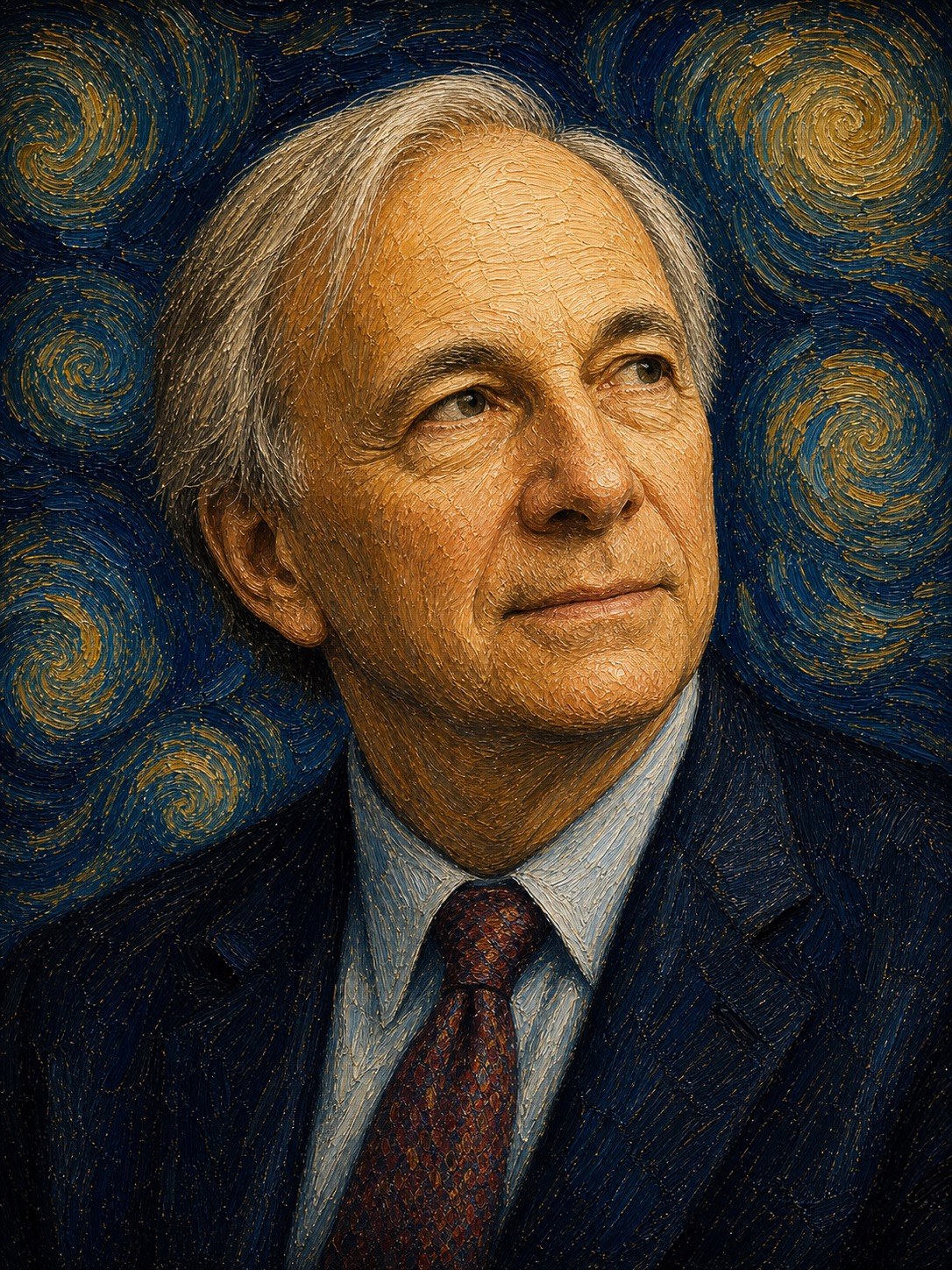
Ray Dalio
Built Bridgewater into a cause-and-effect macro research machine that separated alpha from beta and popularized risk-balanced portfolios, while exposing limits around opacity, culture, and founder dependence.
As of 2026-06-22, Ray Dalio is living and is no longer an owner, board member, CEO, CIO, or chairman of Bridgewater Associates. He remains publicly described as Bridgewater's founder and mentor, and press reports say he remains a significant client/investor in Bridgewater strategies after selling his final equity stake and leaving the board in 2025 (Bridgewater, Our Founder; Markets Group, 2025; Investopedia, 2025).
Snapshot
| Field | Detail |
|---|---|
| Born / died | Born in 1949 in Jackson Heights, Queens, New York; living as of 2026-06-22. Public sources disagree on the exact August birth date, so this profile uses the year and birthplace unless a later primary source resolves the day (Academy of Achievement). |
| Nationality | American. |
| Main vehicles | Bridgewater Associates; Pure Alpha; Pure Alpha Major Markets; All Weather; Daily Observations; later public education and book platforms under Principles/Economic Principles. |
| Years active | Public-markets investor for more than 50 years; founded Bridgewater in 1975; formal Bridgewater leadership transition ran from CEO exit in 2017 through final ownership/board exit reported in 2025 (Bridgewater, Our Founder; Investopedia, 2025). |
| Asset classes | Global macro across interest rates, bonds, currencies, commodities, equity indexes, inflation-linked bonds, and related liquid instruments. Bridgewater says its global macro work spans more than 150 markets; SEC 13F filings disclose only a U.S.-listed securities slice, not the full hedge fund book (State Street, 2025; SEC 13F, 2026 Q1). |
| Style tags | Systematic global macro; cause-and-effect economic modeling; debt-cycle history; alpha/beta separation; risk parity / All Weather; institutional research; radical transparency / idea meritocracy. |
| Verified track record | No complete audited public return series found. Strongest public anchors are: Bridgewater's Q1 2026 13F listed 993 entries worth $22.4 billion, a partial disclosure; LCH/press rankings report Bridgewater as one of history's largest dollar-gain hedge fund managers; New Yorker reported Pure Alpha gained 9.5% net in 2008 and 45% in 2010 [single-source for those annual returns] (SEC 13F, 2026 Q1; New Yorker, 2011; Observer/LCH, 2024). |
| Peak / current AUM | Publicly reported AUM depends on definition. World Economic Forum listed about $154 billion as of December 2020, and Academy of Achievement used $160 billion in a historical profile. Press around Dalio's final exit reported $92.1 billion in 2025, while Form ADV aggregators and other datasets may include broader regulatory assets. Treat all AUM numbers as definition-sensitive (World Economic Forum; Academy of Achievement; Investopedia, 2025). |
Life & Career Timeline
Ray Dalio's origin story is unusually well documented because he has repeated it in Bridgewater materials, speeches, books, and interviews. He grew up in a middle-class family in Queens and then Manhasset, Long Island. His father was a jazz musician and his mother a homemaker. His first investing exposure came from caddying as a child, listening to market talk from golfers, and buying Northeast Airlines stock with caddying savings. The investment tripled after a takeover, a lucky outcome that nonetheless fixed markets as his central obsession (Bridgewater, Our Founder; Academy of Achievement).
Dalio studied finance at C.W. Post College, graduated in 1971, worked on the New York Stock Exchange floor in the summer when the Nixon administration severed the dollar's convertibility into gold, and earned an MBA from Harvard Business School in 1973. Those years matter because his later macro framework drew heavily from the idea that apparently surprising market events often reflect repeatable cause-and-effect relationships. Bridgewater's own founder page emphasizes his early exposure to commodities, currency, and inflation shocks rather than a conventional equity-stock-picking apprenticeship (Bridgewater, Our Founder; Academy of Achievement).
After short stints at Wall Street firms, Dalio started Bridgewater Associates in 1975 from a two-bedroom New York apartment. The original business was not a hedge fund in the modern sense. It combined commodity and currency advice, risk consulting, and written research for corporate and institutional clients. Bridgewater later moved to Connecticut, and the firm's Daily Observations commentary became a major product. Bridgewater says the World Bank retirement fund gave it a $5 million account in 1985, followed by other institutional clients such as Kodak's retirement system (Bridgewater, Our Founder; New Yorker, 2011).
Pure Alpha, Bridgewater's flagship active macro strategy, emerged from this research-and-trading culture. The best concise outside description comes from John Cassidy's 2011 New Yorker profile: Dalio was a macro investor trading more than 100 instruments globally, trying to translate economic relationships into portfolio positions while avoiding excessive concentration. The article describes Pure Alpha as usually holding dozens of trades and using spread trades to reduce dependence on broad market direction (New Yorker, 2011).
The other major Bridgewater invention was All Weather, the firm's risk-parity framework. Bridgewater's own history says the strategy was launched in 1996 after Dalio, Bob Prince, Greg Jensen, Dan Bernstein, and others formalized a portfolio meant to perform acceptably across growth and inflation environments. It began as a solution for Dalio's family trust and later helped popularize risk parity among large institutions. The strategy's significance is not just its fund returns but its influence on institutional asset allocation: it made "risk-balanced" exposure a mainstream language for pensions, endowments, and sovereign investors (Bridgewater, All Weather Story; State Street, 2025).
Dalio's public reputation broadened after the global financial crisis. Bridgewater had warned clients and policymakers about excessive leverage before the crisis, and Pure Alpha reportedly made money in 2008 while many risk assets and hedge funds struggled. New Yorker reported Pure Alpha gained 9.5% after fees in 2008 and 45% in 2010; Academy of Achievement repeats similar crisis-era performance figures and says Pure Alpha made $15 billion in 2010. These figures are important but should be treated as reported fund-level figures, not a complete audited history (New Yorker, 2011; Academy of Achievement).
In parallel, Dalio turned his internal management manual into the public brand "Principles." The message was that rigorous truth-seeking, explicit principles, recorded disagreements, and systematic decision rules could improve both organizations and investing. Bridgewater and Principles.com frame the culture as an "idea meritocracy" built on radical transparency; critics have argued that the same culture could become intrusive, founder-centric, or coercive (Principles.com; Bridgewater, Our Founder; New Yorker, 2011).
Dalio's formal exit from Bridgewater took years. Bridgewater says he stepped down as CEO in 2017, as CIO in summer 2020, and as chairman at the end of 2021. In 2022, Bridgewater completed a larger control transition. In 2025, press reports said he sold his remaining ownership stake and left the board, ending a 50-year ownership and governance role while remaining connected as founder, mentor, and client (Bridgewater, Our Founder; Markets Group, 2025; Investopedia, 2025).
Vehicles & Structure
Bridgewater Associates is the central vehicle. It began as a research and advisory business, became an institutional macro manager, and remains focused on sophisticated institutional investors rather than ordinary retail clients. Bridgewater's website expressly states that investments managed by the firm are not available to the general public and that the public website is informational, not offering material (Bridgewater home/disclaimer; State Street, 2025).
The main strategy families are Pure Alpha and All Weather. Pure Alpha is the active global macro engine: it attempts to create a diversified set of uncorrelated alpha streams across liquid markets. Bridgewater's founder page attributes to Dalio and the firm innovations including separating alpha and beta, Pure Alpha, currency overlay, active inflation-linked bond management, and All Weather/risk parity (Bridgewater, Our Founder).
All Weather is the asset-allocation engine. Bridgewater describes it as a portfolio built around how asset classes respond to growth and inflation surprises. State Street's 2025 launch of the State Street Bridgewater All Weather ETF made a version of that model accessible through a public ETF, with Bridgewater as sub-adviser and State Street implementing the daily model portfolio. The ETF page reports that ALLW may hold domestic and international equities, nominal and inflation-linked bonds, and commodity exposures, and that it seeks resilience across economic environments (State Street press release, 2025; ALLW fund page).
Daily Observations is the research vehicle. It began as Dalio's daily written market commentary and became one of Bridgewater's signature institutional products. This matters because Bridgewater's model is not simply "trading genius"; it is an institutional machine for converting macro research, historical analogies, and internal debate into portfolios (Bridgewater, Our Founder; Bridgewater, What Is Our Edge?).
As of 2026-06-22, Bridgewater's operating leadership is post-Dalio. Bridgewater lists Nir Bar Dea as CEO and Bob Prince, Greg Jensen, and Karen Karniol-Tambour as co-chief investment officers. That structure matters for later tasks: any current Bridgewater performance since 2022 should not automatically be attributed to Dalio's direct portfolio decisions, even when the strategies descend from his architecture (Bridgewater, People).
Track Record Detail With Caveats
The headline claim is that Dalio built one of the most profitable hedge fund organizations in history. That claim is broadly supported by repeated LCH/industry rankings and by Bridgewater's own institutional stature, but the exact return stream is not publicly audit-ready. Hedge fund returns are private, strategy-specific, fee-specific, and capacity-dependent; Bridgewater has multiple funds with different risk targets and investor terms.
Publicly verifiable anchors:
- Bridgewater's Q1 2026 SEC Form 13F listed 993 information-table entries with a total reported value of $22.4 billion. This is official but incomplete: 13F covers certain U.S.-listed long positions and does not capture the full global macro book, derivatives, shorts, currencies, commodities, or private fund capital (SEC 13F, 2026 Q1).
- World Economic Forum listed Bridgewater at approximately $154 billion AUM as of December 2020, split across Pure Alpha, All Weather, and Optimal Portfolio categories. Academy of Achievement uses $160 billion in a historical profile, while 2025 press around Dalio's final exit reported $92.1 billion. These numbers are not directly comparable unless the definition of assets, date, and strategy inclusion are specified (World Economic Forum; Academy of Achievement; Investopedia, 2025).
- New Yorker reported Pure Alpha gained 9.5% net in 2008 and 45% in 2010. These are highly material crisis-era claims but remain [single-source] within the documents reviewed here, though Academy repeats similar figures (New Yorker, 2011; Academy of Achievement).
- LCH/press rankings reported Bridgewater among the all-time leaders by net client gains. Observer's 2024 summary of the LCH ranking reported Bridgewater at $55.8 billion of net client gains since founding through 2023, after a reported $2.6 billion loss in 2023. Treat this as [single-source from LCH via press] until the original LCH table is archived in the repo (Observer/LCH, 2024).
- Reuters-syndicated and business press reports said Bridgewater's Pure Alpha had a very strong 2025, with reports around 33% to 34% for flagship Pure Alpha and more than 20% for All Weather. These figures belong mainly to post-Dalio operating leadership, so they are relevant to the durability of the institution but should not be credited as Dalio's personal 2025 trading record (Business Insider, 2026; Institutional Investor, 2026).
The fairest track-record characterization is therefore: Dalio founded and led an institutional macro platform that compounded reputation, assets, client relationships, and absolute dollar gains over decades; its best-known public successes were crisis anticipation, diversified global macro trading, and All Weather/risk parity; but a precise net annualized investor return for "Dalio" is not public enough to state without caveat.
Why They Matter
Dalio matters first because he institutionalized global macro. Earlier macro stars often looked like discretionary traders or thematic speculators. Bridgewater presented macro as a repeatable research process: collect data across countries and eras, map cause-and-effect relationships, translate them into decision rules, debate those rules internally, and express them across many liquid markets. Even critics accept that Bridgewater forced institutional investors to think about macro exposures more systematically (Bridgewater, What Is Our Edge?; New Yorker, 2011).
Second, Dalio popularized the separation of alpha and beta. The phrase is common now, but Bridgewater built a large business around the idea that active skill and passive/risk-premia exposure should be engineered separately and then recombined to meet client objectives. That architecture influenced how pensions and endowments discuss portable alpha, risk budgeting, overlays, and return streams (Bridgewater, Our Founder; World Economic Forum).
Third, All Weather changed the asset-allocation conversation. It reframed diversification around balanced risk to growth and inflation environments rather than dollar weights in stocks and bonds. The 2025 State Street/Bridgewater ETF partnership shows that a strategy born for Dalio's own trust and institutional clients has entered the public ETF market as a named product concept (Bridgewater, All Weather Story; State Street press release, 2025).
Fourth, Dalio turned an investment firm into a management philosophy laboratory. His "principles" brand created a rare case where a hedge fund's culture became nearly as famous as its returns. Supporters describe it as a truth-seeking idea meritocracy; critics describe it as a demanding and sometimes unsettling system built around the founder's worldview. That debate is central, not incidental, to understanding Bridgewater. The culture was part of the product sold to institutions and part of the risk critics flagged (Principles.com; Bridgewater, Our Founder; New Yorker, 2011).
Finally, Dalio matters because his later writing became a public macro framework. Principles for Navigating Big Debt Crises, Principles for Dealing with the Changing World Order, and How Countries Go Broke extend the same historical-cycle method beyond portfolio management into public policy, debt, currency, and geopolitical analysis. Whether one agrees with his conclusions or not, he has become one of the few hedge fund founders whose analytic framework is a public intellectual product (Principles, Big Debt Crises; Simon & Schuster, How Countries Go Broke).
The caution is that Dalio's story is vulnerable to founder myth. Bridgewater itself now emphasizes that the firm is run by the next generation, and serious criticism has challenged both the culture and the degree to which Bridgewater's "machine" was separable from Dalio's personal judgment. Later tasks should keep both truths alive: Dalio built a genuinely important investing institution, and the institution's own succession was a multi-decade problem because the founder was so central. Axios described the 2022 handoff as the final step in Dalio relinquishing control of the firm; Institutional Investor later attributed Bridgewater's 2025 rebound partly to management and process changes after Dalio left investment decision-making (Bridgewater, People; Axios, 2022; Institutional Investor, 2026).
Criticisms, Disputes, and Legal / Regulatory Context
The main criticisms fall into three groups.
First is culture. New Yorker documented both admiration for Bridgewater's directness and outsider/employee criticism that the culture could feel cult-like, abrasive, or overly centered on Dalio. Rob Copeland's The Fund sharpened this critique, arguing that radical transparency could become surveillance, intimidation, and founder mythology. Bridgewater publicly rejected Copeland's portrayal as false and misleading, so the responsible treatment is to record both the critique and the company's denial rather than treat either as settled fact (New Yorker, 2011; Macmillan, The Fund; Bridgewater statement, 2023).
Second is legal and employment practice scrutiny. In 2016, the NLRB filed an administrative complaint challenging Bridgewater employment-agreement language after a closed sexual-harassment-related matter; the University of Chicago Legal Forum notes the dispute settled and that the redacted agreement did not reveal all policy changes. This is not an investment-fraud allegation, but it is relevant to assessing Bridgewater's culture and confidentiality practices (University of Chicago Legal Forum, 2017).
Third is performance attribution and post-founder durability. The 2025 performance rebound under Nir Bar Dea's leadership is relevant evidence for durability, but it also weakens any attempt to attribute all Bridgewater performance mechanically to Dalio. Institutional Investor reported that Dalio moved out of the investment decision-making role in 2020 and that the post-Dalio firm capped AUM, restructured CIO accountability, and built AI-related research capabilities before the 2025 surge (Institutional Investor, 2026; Business Insider, 2026).
Public searches during this run did not surface a current 2025-2026 SEC, DOJ, or criminal action against Ray Dalio personally. That absence is not proof none exists; it is a scope-limited finding from this run's searches.
Open Questions
- What is the best original source for Bridgewater's complete LCH net-gains ranking history, including methodology and whether figures are net of all fees?
- Can a later task obtain or archive Bridgewater Form ADV filings directly, including regulatory AUM definitions, without relying on aggregator summaries?
- What is the cleanest return series for Pure Alpha, Pure Alpha Major Markets, and All Weather by vintage and risk target?
- How much of the Pure Alpha process was discretionary founder judgment versus codified rules, and how did that balance change after 2017, 2020, 2022, and 2025?
- Which specific trades or macro calls generated the 2008, 2010, 2022, and 2025 gains, and what drawdowns preceded them?
- Which criticisms in The Fund are corroborated by documents or multiple named sources, and which remain disputed by Bridgewater?
- How should the Canon separate "Dalio the investor," "Bridgewater the institution," and "Dalio the public macro author" when scoring lessons for other investors?
Core Worldview
Dalio's investing philosophy starts with a claim that markets and economies are understandable as recurring cause-and-effect systems rather than as one-off news events. Bridgewater's current description of its own mission still uses that language: develop a fundamental, cause-and-effect understanding of markets and economies, codify it into a systematic process, and keep improving it as reality changes (Bridgewater, 2026). Bridgewater's founder page says Dalio built the firm around "timeless and universal" principles by studying many historical cases because the same kinds of things recur for similar reasons (Bridgewater, Our Founder). In practice, this means he treats a 1971 currency break, a 2008 bank crisis, a 2025 debt warning, or an AI capital-spending boom as cases in a larger machine, not as isolated anecdotes.
The machine has three recurring drivers in Dalio's public macro teaching: productivity growth, the short-term debt cycle, and the long-term debt cycle. In How the Economic Machine Works, he presents credit creation as the force that amplifies spending, expansions, recessions, and deleveragings, with central banks influencing the shorter cycle and cumulative debt burdens shaping the longer one (Singju Post transcript, 2013). The 2025 How Countries Go Broke materials update the same model: when debt-service burdens and debt supply overwhelm income and demand for bonds, a country faces either higher rates and economic weakness or central-bank money creation and currency/inflation risk (Economic Principles, 2025; Economic Principles, 2025).
This worldview produces a humility rule. Dalio's formative error in 1971 was hearing Nixon end gold convertibility, expecting stocks to fall, and watching the Dow rally almost 4%. Bridgewater's All Weather history says that episode taught him not to trust the narrow sample of one person's lifetime and to search for repeated historical analogues instead (Bridgewater, All Weather Story). The same humility appears in the portfolio design: because the future cannot be predicted with confidence, the investor should build portfolios that are balanced to multiple possible environments, not portfolios that need one forecast to be right (Bridgewater, All Weather Story).
The Edge - What Markets Misprice and Why
Dalio's edge is not a single stock-selection edge. It is a macro systems edge: identify relationships that markets, policymakers, or traditional allocators underweight because those relationships are slow-moving, global, cross-asset, or outside recent experience. Bridgewater's public materials describe the firm as a global macro investor across many markets, while the New Yorker profile described Dalio trading more than a hundred instruments, including currencies, rates, commodities, and sovereign bonds (Bridgewater, 2026; New Yorker, 2011). In that setup, the opportunity is often in the relationship between markets, not in an isolated security.
The first mispricing category is cycle blindness. Investors extrapolate the recent past, while Dalio tries to map the current case to long histories of debt, inflation, currency, and political cycles. The New Yorker reported that Bridgewater studied prior credit crises back to Weimar Germany and estimated major financial-institution losses before the 2008 crisis; the article also says Dalio and a co-author warned in July 2007 about extreme lending and leverage (New Yorker, 2011). Dalio's later debt-cycle books and 2025 public materials extend this same diagnostic process to sovereign debt and reserve-currency risk (Principles, Big Debt Crises; Economic Principles, 2025).
The second mispricing category is bad diversification. Traditional portfolios often diversify capital but not economic risk: a 60/40 portfolio can still be dominated by equity-like growth risk, and stock/bond correlations can fail when inflation shocks both assets. All Weather was designed to balance exposure to rising growth, falling growth, rising inflation, and falling inflation, with asset classes mapped to the environments in which they should tend to perform (Bridgewater, All Weather Story; State Street, 2026). The mispricing is partly behavioral: most investors dislike tracking-error and peer risk, so they avoid portfolios that look strange even if their risk balance is better (Bridgewater, All Weather Story).
The third mispricing category is overconfidence. Dalio's public "15 uncorrelated return streams" mantra is a compact version of the risk-control edge: the investor should assume any one idea can be wrong and combine independent bets so returns are averaged while risk is reduced. In a 2026 LinkedIn post, he wrote that 15 good, risk-balanced, uncorrelated return streams can lower risk "by up to 80%" without lowering expected return if the investments are genuinely good and uncorrelated (Dalio LinkedIn, 2026). That 80% figure should be treated as a rule-of-thumb from Dalio rather than audited performance math, but it captures the core premise.
Process: Idea Sourcing -> Research -> Valuation & Entry -> Sizing -> Portfolio Construction -> Sell Discipline
Idea sourcing begins with a daily macro research machine rather than a screen of securities. Bridgewater says its Daily Observations, or "the wire," has been the firm's real-time view of how it is processing the world for clients and policymakers; the research library shows the range of topics now feeding the process, from inflation and modern mercantilism to AI capex and geopolitical fragmentation (Bridgewater Research & Insights, 2026). This is consistent with Dalio's older public profile: he spends most of his time fitting economic and financial events into a coherent framework rather than watching screens for price ticks (New Yorker, 2011).
Research is historical and mechanistic. The firm tries to state a cause-and-effect rule, test it across countries and time, then translate it into a market expression. The 2008 crisis work described by the New Yorker is a good example: Bridgewater did not just say "housing is weak"; it examined lending practices, bank balance sheets, prior credit crises, and loss estimates, then used that map to position Pure Alpha (New Yorker, 2011). In the public debt-cycle framework, Dalio says one can monitor debt-service burdens, debt supply versus demand, interest rates, currency moves, and central-bank money creation to diagnose the late stage of a debt cycle (Economic Principles, 2025).
Valuation and entry are relative to the macro cause, not intrinsic-value appraisal in the Graham-Buffett sense. Pure Alpha seeks liquid, global macro expressions: rates, currencies, commodities, equity indexes, inflation-linked bonds, and spreads between related instruments. The New Yorker described Bridgewater's use of spread bets, such as buying one security viewed as undervalued while shorting another viewed as overvalued, as a way to reduce broad market exposure (New Yorker, 2011). A 2019 Lyxor/Bridgewater presentation describes Pure Alpha Major Markets as drawing from the liquid components of Pure Alpha, encompassing about two-thirds of the Pure Alpha risk budget and emphasizing markets that are not capacity constrained; that presentation is marketing material and includes heavy hypothetical-performance caveats, but it is useful for understanding the liquidity and capacity logic (Lyxor/Bridgewater, 2019).
Sizing is risk-budget driven. The Pure Alpha side tries to avoid one big expression dominating the book. In 2011, Dalio told the New Yorker that he is never sure and does not want concentrated bets; the profile reported that Pure Alpha typically held about thirty or forty trades (New Yorker, 2011). The All Weather side goes further: it deliberately allocates risk, not capital, because equal dollars in stocks and bonds can still mean equity dominates the portfolio's volatility. State Street's 2026 All Weather explainer describes this as assigning risk to asset classes and then using portfolio engineering to get the desired exposures (State Street, 2026).
Portfolio construction has two major pillars. Pure Alpha is the active alpha engine: a portfolio of many liquid macro views intended to be low-beta to traditional markets. All Weather is the strategic beta engine: a balanced portfolio that harvests risk premiums across economic environments. Bridgewater's All Weather history says one large institutional client ended with roughly a 70/30 split between beta and alpha, using All Weather and Pure Alpha together according to confidence in each stream (Bridgewater, All Weather Story). This alpha/beta separation is one of Dalio's most transferable conceptual contributions, even if most investors cannot replicate Bridgewater's institutional execution.
Sell discipline is less publicly documented than research and sizing, but the available evidence points to three exit triggers. First, close or reverse when the cause-and-effect thesis changes. The New Yorker noted that Bridgewater had built and later reversed a short U.S. bond position in 2011 after it paid off, implying active updating rather than permanent thematic attachment (New Yorker, 2011). Second, rebalance when risk allocations drift, especially in All Weather, where the whole point is to keep the portfolio balanced to growth and inflation environments (Bridgewater, All Weather Story). Third, reduce or avoid positions when liquidity/capacity constraints distort implementation; the Lyxor/Bridgewater description of Pure Alpha Major Markets explicitly removes capacity-constrained markets from the broader Pure Alpha strategy (Lyxor/Bridgewater, 2019).
Risk Management
Dalio's risk management is built around humility, diversification, liquidity, and stress-testing. The philosophical rule is that being wrong is normal; survival comes from designing around wrongness. This appears in the culture, where Bridgewater says truth and transparent debate are intended to expose gaps between perception and reality (Bridgewater Culture, 2026; Principles.com, Radical Truth). It also appears in the portfolio: do not depend on one forecast, one asset class, or one recent historical correlation.
The main portfolio risk control is true diversification. All Weather tries to balance risk to the four growth/inflation environments. Bridgewater says it accepts that it does not know the future and therefore invests in long-run balance rather than over-optimizing a forecast (Bridgewater, All Weather Story). State Street's public ALLW materials emphasize that the approach can still underperform in equity bull markets, can lose when cash is king, and uses derivatives and global assets that add complexity (State Street, 2026). Those caveats matter: Dalio's risk system reduces some risks by taking others, especially leverage, model, liquidity, and implementation risk.
Pure Alpha's risk control is many independent liquid bets plus human review of systematic indicators. The New Yorker reported that Bridgewater might have a dozen indicators in a market, but that Dalio, Greg Jensen, and Bob Prince still had to agree that a trade made sense; the framework was rules-based, not purely mechanical (New Yorker, 2011). That hybrid model reduces blind algorithm risk but preserves key-person and committee-judgment risk.
Temperament & Psychology
Dalio's temperament is best described as aggressive intellectual humility. The aggressive part is visible in Bridgewater's willingness to build non-consensus macro positions and unorthodox portfolios. The humility part is visible in his repeated insistence that experience is too narrow, that errors must be studied, and that people should stress-test their own views. The New Yorker captured both sides: Dalio could sharply challenge junior employees in public, yet he framed the practice as a way to overcome ego sensitivity and learn faster (New Yorker, 2011).
The psychological formula is "pain + reflection = progress," a short quote reported by the New Yorker from Principles (New Yorker, 2011). For investing, that means mistakes are data. For management, it means radical truth and radical transparency. Dalio's own principles page says radical transparency makes hidden issues apparent and lets people assess the merits of logic openly; Bridgewater's current culture page says the firm re-underwrote and evolved some founder principles after the 2022 transition (Principles.com, Radical Truth; Bridgewater Culture, 2026).
Evolution Over Career
Dalio began as a commodities, currency, and corporate-risk adviser, not as a hedge-fund brand. His early work on chicken-cost hedging for McDonald's, inflation-linked bonds, currency shifts, and corporate exposures became a training ground for cross-asset cause-and-effect analysis (Bridgewater, All Weather Story; Bridgewater, Our Founder). Pure Alpha grew from active macro trading and research. All Weather emerged in 1996 from a family-trust problem: how to hold a portfolio that could work decades later without knowing the future environment (Bridgewater, All Weather Story).
After the financial crisis, the philosophy became more public. Principles turned the firm's decision culture into a management brand; Big Debt Crises, Changing World Order, and How Countries Go Broke turned the macro framework into public education and policy warning. The 2024 "five big forces" framing adds internal order, external geopolitical order, acts of nature, and technology to the debt/money/economic force, showing the model broadening from macro markets into a general theory of historical change (Bridgewater, Five Big Forces, 2024; Economic Principles, 2025).
The post-Dalio evolution is also important. As of 2026, Bridgewater's own site describes a process that integrates human judgment with machine intelligence and emphasizes AI as a next-stage investment-process tool (Bridgewater, 2026). Institutional Investor reported that Pure Alpha 18 gained 34% in 2025 under the current leadership structure and attributed the rebound to management and process changes over the prior five years (Institutional Investor, 2026). That does not prove the post-Dalio machine is better, but it suggests the philosophy is no longer only a founder persona.
What They Explicitly Reject
Dalio rejects the idea that recent personal experience is sufficient. The 1971 Nixon shock is the canonical lesson: what seemed unprecedented to him was not unprecedented in history (Bridgewater, All Weather Story). He also rejects conventional capital-weighted diversification when it hides risk concentration. All Weather was built because a simple stock/bond mix can fail in inflationary shocks and because equal dollar allocations can still be dominated by the riskier asset (State Street, 2026).
He rejects concentrated conviction as a default virtue. This is a major difference from Buffett, Soros, and Druckenmiller. Dalio may take strong macro views, but the public philosophy prizes many uncorrelated return streams and risk balance over a few giant bets (Dalio LinkedIn, 2026; New Yorker, 2011). Finally, he rejects hidden disagreement inside organizations. The culture may be controversial, but the stated philosophy is that disagreement must be surfaced, weighted by believability, and tested against reality (Bridgewater Culture, 2026; Principles.com, Radical Truth).
Regimes Where It Thrives vs. Struggles
The philosophy thrives when macro relationships are misunderstood, when debt and currency cycles dominate company-specific micro stories, and when global markets diverge. Bridgewater's 2008 and 2010 reported Pure Alpha gains are the historical examples in the profile file, and the 2025 Pure Alpha rebound suggests the strategy can also work in a post-Dalio period of large macro and technological transitions (New Yorker, 2011; Institutional Investor, 2026). It also thrives for institutions that can tolerate tracking error, derivatives, leverage, shorting, and complex implementation.
It struggles when the model's assumed diversification does not show up, when rates and inflation shocks hit multiple assets together, when clients compare it to simple equity benchmarks during bull markets, or when liquidity and capacity constrain the best expressions. State Street explicitly warns that All Weather can lag in equity-friendly environments and can underperform cash during sharp rate rises or risk-off periods (State Street, 2026). Pure Alpha can struggle if alpha is really dynamic beta in disguise; Markov Processes International attempted to explain part of Bridgewater's flagship returns using dynamic market exposures, a reminder that "uncorrelated alpha" claims require scrutiny (MPI, 2011).
Tensions Between Stated Philosophy and Actual Behavior
The first tension is machine versus person. Bridgewater presents a codified investment process, but the New Yorker reported former-employee claims that the biggest money-making decisions were still heavily tied to Dalio, especially in bonds and currencies; Dalio disputed that characterization and emphasized the team and rules-based process (New Yorker, 2011). The post-2025 firm results partly soften this critique, but they do not erase the historical question of how much of the record was a machine and how much was founder judgment (Institutional Investor, 2026).
The second tension is radical transparency versus psychological safety. Dalio and Bridgewater argue that transparency speeds learning and improves decisions; critics argue it can become surveillance, public pressure, and founder-centric control. The New Yorker documented both admiration and "cult" criticism in 2011; the 2016 NLRB matter challenged restrictive employment-agreement provisions after a former employee's complaint; and Bridgewater has denied wrongdoing or rejected critical portrayals as false or misleading (New Yorker, 2011; Akin Gump, 2016; Bridgewater Statement, 2023). The honest conclusion is not that the culture was purely good or bad; it is that the investment philosophy and the management philosophy are inseparable enough that cultural failure is a real investment-process risk.
The third tension is accessibility. All Weather is the part of Dalio's philosophy most individuals can understand, but Bridgewater's own site says its managed investments are not available to the general public and that public materials are not offering documents (Bridgewater, 2026; Bridgewater, All Weather Story). The 2025 State Street ETF partnership makes a public All Weather implementation available, but it also introduces retail product constraints, fees, ETF implementation details, and disclosure limits that are not the same as Bridgewater's private institutional accounts (State Street, 2026).
The fourth tension is that macro history can become overconfident storytelling. Dalio's books and public frameworks are useful precisely because they simplify complex cycles into operable templates, but the same simplification can tempt investors to treat a historical analogy as destiny. The best version of Dalio's philosophy is not "predict the future from history"; it is "use history to define possible paths, size humbly, diversify truly, and update when reality disagrees." That is the transferable core.
As of 2026-06-22, the hard limit on any Ray Dalio "greatest trades" file is that Bridgewater's actual position ledgers, client letters, sizing, and net investor account statements are private. The best public record supports a set of trade episodes and strategy launches rather than a clean Soros-style single-currency bet. This file therefore separates (1) documented fund-level returns, (2) disclosed or reported position themes, and (3) strategic product decisions such as All Weather that became enormous institutional winners but were not one discrete trade.
Ranking and Caveats
Best documented trade episode: the 2007-2008 credit-crisis / deleveraging positioning. It is not the highest reported percentage return, but it is the best-supported episode because Bridgewater later published a crisis timeline from its own research, the New Yorker independently described the warnings and 2008 Pure Alpha return, and the 2020 postmortem confirms that Bridgewater regarded 2008 as a year when it should have made money while others lost (Bridgewater, 2008 review; New Yorker, 2011; Business Insider/FT summary, 2020).
Largest reported annual fund gain: 2010 Pure Alpha, reported by the New Yorker at 45% after fees and described as the highest return among large hedge funds that year. The exact position-level P&L is not public, but the New Yorker identified major 2010 themes as long Treasury bonds, the Japanese yen, and gold, and short the euro and European sovereign debt (New Yorker, 2011).
Attribution rule: results after Dalio left day-to-day investment decision-making in 2020, transferred control in 2022, and completed his board/ownership exit in 2025 are treated as Bridgewater-institution results, not automatically as Dalio personal trades (Bridgewater, Our Founder; Axios, 2022; Investopedia, 2025).
1. 2007-2008 Credit-Crisis / Deleveraging Positioning - Best Documented
Context and dates. The trade began as a research conclusion during 2006-2007 and paid off through the 2008 financial crisis. Bridgewater's own 10-year review says it identified a "bubble of leverage" in 2006, warned in January 2007 that the popping of the housing bubble would spill into the financial system, warned in June 2007 that excessive subprime lending could push the system to its brink, and argued in January 2008 that the economy was in recession and headed for a long deleveraging (Bridgewater, 2008 review).
Thesis and discovery. Dalio's team treated the housing and credit boom as a classic debt-cycle case. The New Yorker reported that Bridgewater studied past credit crises, estimated major financial-institution losses, and circulated a July 2007 warning titled "Financial Market Time Bombs" before the worst of the crisis hit (New Yorker, 2011). The edge was not a single short security; it was a cross-asset diagnosis that falling collateral values, excessive leverage, and forced deleveraging would hit banks, credit, equities, and growth-sensitive assets.
Size and structure. Public sources do not disclose position sizes, gross exposure, or instrument-level P&L. The structure was almost certainly a diversified Pure Alpha macro book across rates, currencies, equity indexes, commodities, and spreads, consistent with the New Yorker's description of Pure Alpha trading more than 100 instruments and often expressing views through spreads (New Yorker, 2011). Any attempt to state that Bridgewater was simply "short subprime" or "long Treasuries" would overstate the public record.
Entry, path, and drawdown endured. The path mattered because Bridgewater was early. By March 2007, markets had "had barely a blip," while Bridgewater was already warning of a serious financial-sector problem; being early on a credit crisis means paying carry, managing client skepticism, and surviving false dawns (Bridgewater, 2008 review). Bridgewater's own review also notes that in July 2008 it expected inflation and the dollar to continue to dominate until banks collapsed into a more deflationary wave, which shows that the trade was not a one-step forecast but a constantly updated regime map (Bridgewater, 2008 review).
Exit and P&L. The New Yorker reported Pure Alpha gained 9.5% after fees in 2008 while the S&P 500 fell sharply and many hedge funds lost money; Bridgewater's later profile also records the crisis-year success but does not publish audited ledgers (New Yorker, 2011; Bridgewater, Our Founder). Treat the 9.5% figure as [single-source public return reporting] until a Bridgewater client letter or audited return table is found.
What it teaches. The best Dalio trade was a process trade: diagnose the debt machine, prepare before the visible break, keep updating the path, and avoid betting the whole firm on one expression. The caveat is equally important: public sources show the thesis and reported fund return, not the exact position ledger.
2. 2010 Post-Crisis Macro Basket - Largest Reported Annual Return
Context and dates. After the acute financial crisis, governments and central banks were fighting a weak recovery, sovereign stress in Europe, and large-scale monetary easing. This environment suited Bridgewater's historical-debt-cycle lens: deleveraging was not a one-year event; it would keep creating policy reactions, currency pressure, bond rallies, and safe-haven flows.
Thesis and discovery. The New Yorker reported that Dalio's 2010 bets included owning Treasury bonds, the yen, and gold, while shorting the euro and European sovereign debt. Those themes all fit the same post-crisis map: deleveraging and policy easing would support high-quality bonds and stores of value, while the euro area would face sovereign-credit pressure (New Yorker, 2011).
Size and structure. Position sizes are not public. The fund-level structure was Pure Alpha, which the New Yorker described as a portfolio of roughly 30 to 40 trades rather than one large concentrated bet (New Yorker, 2011). The best public description is therefore "diversified macro basket," not a single trade.
Entry, path, and drawdown endured. Bridgewater had just navigated 2008 well but still had to avoid a common crisis winner's trap: clinging to one apocalyptic view after policymakers changed the price of money. The 2010 book reportedly combined deflationary and currency-debasement expressions: long bonds and long gold can coexist when the investor expects weak growth plus aggressive monetary response. The drawdown path is not disclosed.
Exit and P&L. The New Yorker reported Pure Alpha gained 45% after fees in 2010 and said the fund made about $15 billion for investors that year, using the article's reported figures. It also reported the firm had about $86 billion under management at the time (New Yorker, 2011). These are material but remain [single-source public reporting] for this task.
What it teaches. Dalio's edge was not "bearishness"; it was matching multiple instruments to multiple parts of the same debt-cycle state. The danger for imitators is that the public knows the broad themes only after the fact, not the entry levels, risk budgets, hedges, or exit triggers.
3. All Weather / Risk-Parity Architecture - Strategic Trade, Not One Position
Context and dates. All Weather began in the mid-1990s as a portfolio problem for Dalio's family trust and became a major Bridgewater institutional strategy. Bridgewater says the approach was launched in 1996 after Dalio, Bob Prince, Greg Jensen, Dan Bernstein, and others formalized a portfolio meant to perform across growth and inflation environments (Bridgewater, All Weather Story).
Thesis and discovery. The thesis was that most portfolios diversify dollars, not economic risk. A stock/bond portfolio can still be dominated by equity-like growth risk, while bonds and equities can both suffer when inflation and rates rise. All Weather tried to balance risk across four environments: rising growth, falling growth, rising inflation, and falling inflation (Bridgewater, All Weather Story; State Street, 2026).
Size and structure. The strategy is a risk-balanced allocation across equities, nominal bonds, inflation-linked bonds, commodities, and related exposures. Public State Street materials for the 2025 ETF partnership show a retail implementation can hold domestic and international equities, Treasury and global bonds, TIPS, commodities, and derivatives, but that ETF is a public adaptation, not the original private fund ledger (State Street press release, 2025; State Street, 2026).
Entry, path, and drawdown endured. The entry was conceptual rather than a price tick. Bridgewater's own history links All Weather to Dalio's experience with historical surprises such as the 1971 dollar/gold break and to the idea that a family-trust portfolio should not need a heroic forecast (Bridgewater, All Weather Story). The later drawdown evidence is crucial: All Weather reportedly lost about 12% to 14% in early 2020 and, according to MPI, the 10% volatility target fund lost about 22% in 2022 [single-source for 2022] (Dalio LinkedIn, 2020; MPI, 2023).
Exit and P&L. There is no public all-in P&L figure. The "win" is institutional adoption and product longevity. WEF listed Bridgewater at about $154 billion AUM in December 2020, including Pure Alpha, All Weather, and Optimal Portfolio categories, and the 2025 State Street ETF partnership shows the model still had commercial value three decades after launch (World Economic Forum; State Street press release, 2025).
What it teaches. Some of the greatest investing "trades" are architecture choices: reframe the objective, change the unit of risk, and build a repeatable product around it. The failure mode is also architectural: risk parity can disappoint exactly when bonds and equities stop diversifying each other.
4. Inflation-Linked Bond and Institutional Risk-Overlay Work - Early Edge Creation
Context and dates. Before Bridgewater was known mainly as a hedge fund, it was a research and advisory firm working on commodity, currency, inflation, and institutional portfolio problems. Bridgewater's founder page credits Dalio with pioneering currency overlay, active management of inflation-linked bonds, separating alpha and beta, and All Weather (Bridgewater, Our Founder).
Thesis and discovery. The early edge was that institutions and corporations had real liabilities and currency/inflation exposures that traditional portfolios did not hedge well. Bridgewater's All Weather history describes a 1980s client problem involving World Bank pension assets and the challenge of creating a portfolio of foreign inflation-indexed bonds hedged back to dollars before the United States had a deep TIPS market (Bridgewater, All Weather Story).
Size and structure. The first World Bank account was reportedly $5 million, a tiny amount relative to later Bridgewater AUM but strategically decisive because it helped convert Bridgewater's research into institutional asset management (Bridgewater, Our Founder; New Yorker, 2011).
Entry, path, and drawdown endured. The path was a business-development and implementation grind, not a mark-to-market home run. Bridgewater had to build exposures in markets that were less standardized than today's ETF and derivatives ecosystem. The real drawdown was opportunity and credibility risk: a small research firm had to persuade large institutions that macro overlays and inflation-linked bond management were legitimate investment tools.
Exit and P&L. No position-level P&L is public. The payoff was franchise compounding: those early mandates led to larger institutional accounts, the Daily Observations client network, and the eventual Pure Alpha / All Weather platform (Bridgewater, Our Founder; New Yorker, 2011).
What it teaches. Dalio's early "trade" was to turn macro advice into institutional portfolio engineering. The monetary payoff came through decades of fees, assets, and credibility rather than one disclosed security sale.
5. 2018 Late-Cycle Macro Alpha - A Smaller but Clean Reported Win
Context and dates. 2018 was a difficult year for conventional portfolios: rate increases, a late-cycle U.S. expansion, trade-war risk, and a fourth-quarter equity selloff created stress across assets. Multiple reports said Pure Alpha performed strongly while many markets lost money.
Thesis and discovery. The public record is thin on exact positions. Institutional Investor reported Pure Alpha gained 14.6% in 2018, when most asset markets finished negative and many hedge fund managers were flat or down. The same article says Pure Alpha had positive net returns in all but three years since its December 1991 inception and traded more than 150 liquid markets (Institutional Investor, 2020).
Size and structure. Position sizes are not public. The trade should be treated as a diversified Pure Alpha year, not as a single disclosed bet. Institutional Investor's later 2019 performance report is useful for contrast: it said Pure Alpha 18 Percent fell 0.5% in 2019 while All Weather gained 16%, showing that strategy-level performance can diverge sharply year to year (Institutional Investor, 2020).
Entry, path, and drawdown endured. The year likely required staying with uncorrelated macro exposures while equities and bonds moved through several sharp reversals. The larger drawdown was reputational: Pure Alpha's later 2019 flat result showed why the 2018 win mattered as evidence that the macro engine could still produce crisis alpha after quieter years (Institutional Investor, 2020).
Exit and P&L. Public reporting gives a percentage return but not dollar P&L or trade-level exits. Treat the 14.6% figure as [single-source via Bloomberg summary] unless a Bridgewater client letter is found.
What it teaches. This was a reminder that a global macro platform can look mediocre in calm, liquidity-driven years and then earn its keep when cross-asset relationships start moving. It also shows why return attribution should be strategy-specific: All Weather, Pure Alpha 12, Pure Alpha 18, and Pure Alpha Major Markets can all tell different stories.
6. 2022 Inflation / Rates Shock - Bridgewater Legacy, Not Pure Dalio Attribution
Context and dates. 2022 was the cleanest macro regime in years: inflation surprised, central banks tightened, bonds and equities sold off together, commodities and currencies moved hard, and risk-parity portfolios suffered. It was exactly the kind of environment that a liquid global macro platform should be able to exploit if it got the direction and timing right.
Thesis and discovery. Bridgewater's own repost of an Institutional Investor article says Pure Alpha 18% volatility was up 16.3% net in the first quarter and 24.8% year-to-date through April 15, 2022. The article attributed the resurgence to structural management/process changes and a macro view that inflation, shortages, and tightening would dominate the post-pandemic landscape (Bridgewater, 2022).
Size and structure. Exact position sizes are not public. The best public description is Bridgewater's own summary of investor communications: gains from interest rates, especially shorts in the U.S., Europe, and the U.K., followed by commodities and developed-country currencies, including a yen short, offset losses in equities, emerging-market currencies, and inflation-linked bonds (Bridgewater, 2022). All Weather was hurt by the same inflation shock that damaged conventional stock/bond diversification (MPI, 2023).
Entry, path, and drawdown endured. The path was volatile. By design, Pure Alpha could gain from directional and relative macro moves, but All Weather showed that inflation shock was not universally good for Bridgewater products. The same regime that generated alpha also exposed the limits of risk parity.
Exit and P&L. The opened Bridgewater-hosted source gives quarter-to-date and year-to-date April 2022 figures, not a full-year audited ledger; full-year, fund-class, fee-basis, and investor-level returns need a client letter before being treated as definitive. Attribution is also limited: Bridgewater says Dalio left the CIO role in summer 2020 and was out of investment decision-making before the 2022 control transition (Bridgewater, Our Founder; Axios, 2022).
What it teaches. The 2022 episode belongs in a Dalio file because it stress-tested the institution he built and the All Weather/Pure Alpha split he popularized. It should not be scored as a personal Dalio trade.
7. 2025 Post-Dalio Pure Alpha Surge - Evidence of Institutional Durability
Context and dates. By 2025, Dalio had reportedly sold his final ownership stake and left Bridgewater's board, while remaining a founder/mentor/client figure. Bridgewater was run by Nir Bar Dea as CEO with Bob Prince, Greg Jensen, and Karen Karniol-Tambour as co-CIOs (Investopedia, 2025; Bridgewater, People).
Thesis and discovery. Institutional Investor reported that Bridgewater's 2025 rebound followed several post-founder changes: investment-committee governance, clearer CIO accountabilities, an AUM cap, employee ownership expansion, and AI/machine-learning work. Business Insider reported Pure Alpha gained about 33% and All Weather more than 20% in 2025 (Institutional Investor, 2026; Business Insider, 2026).
Size and structure. The public sources report strategy returns but not positions. Institutional Investor also reported a capacity decision: Bridgewater capped AUM around $92 billion and returned capital, which is an investment-process choice because macro alpha can decay when too much capital chases the same liquid expressions (Institutional Investor, 2026).
Entry, path, and drawdown endured. The drawdown was organizational rather than one position: years of succession difficulty, 2020 losses, 2023 LCH-reported net client losses, culture criticism, and the need to prove the machine worked without Dalio. Observer's LCH summary reported Bridgewater had a $2.6 billion net client loss in 2023 but still had $55.8 billion cumulative net gains through 2023 (Observer/LCH, 2024).
Exit and P&L. The 2025 returns are press-reported and post-Dalio. They are not ranked as a Dalio personal trade. They are included as evidence that one of his greatest "trades" may have been institutionalization itself: building a research machine that could rebound after the founder left.
What it teaches. A founder's best trade can be creating a system that survives him. The skepticism remains fair: without public ledgers, no one outside Bridgewater can fully separate alpha, beta, risk target, fees, and selection bias.
Cross-Trade Lessons
- The best public Dalio wins were macro regime trades, not security selections. Debt-cycle diagnosis, policy reaction, currency pressure, inflation, and diversification architecture mattered more than a single ticker.
- Bridgewater's strongest wins usually came when conventional diversification failed. 2008, 2010, 2018, and 2022 all rewarded cross-asset thinking more than static stock/bond exposure.
- Position-level opacity is the central evidence problem. Reported fund returns can be real while the underlying "trade" remains unreconstructable.
- All Weather and Pure Alpha can tell opposite stories in the same regime. 2022 was good for Pure Alpha reporting and bad for risk parity; 2019 was weak for Pure Alpha and strong for All Weather.
- Attribution decays after 2020. Post-Dalio Bridgewater results matter for the Canon, but they should be treated as institutional legacy evidence rather than personal trading evidence.
- The main transferability is process, not replication. An individual investor can study debt cycles, diversify by risk, and cut risk when there is no edge. They cannot cheaply copy Bridgewater's institutional research network, client structure, derivatives implementation, or position-level risk system.
Open Questions
- Obtain Bridgewater client letters or audited fund statements for 2008, 2010, 2018, 2022, and 2025 before converting reported strategy returns into definitive return tables.
- Reconstruct whether 2010's reported $15 billion gain was net of all fees and how it was split across Pure Alpha vehicles, risk targets, and investor share classes.
- Find primary detail on the 2018 and 2022 position themes; current public evidence gives percentage returns but not enough position-level mechanics.
- Separate Dalio, Prince, Jensen, and current-CIO attribution for each episode, especially after Dalio stepped down as CIO in 2020.
- Locate the original LCH tables behind the $46.5 billion 2020 and $55.8 billion 2023 cumulative net-gain figures.
As of 2026-06-22, no complete audited Bridgewater return ledger was found in public sources. The loss figures below therefore distinguish primary/self-reported data from press-reported fund performance, LCH net-client-gain estimates, and culture/legal disputes where Bridgewater or Dalio contested the framing.
Major losses, errors of omission, and near-death moments
1. The 1981-1982 depression call: right diagnosis, wrong market path
Dalio's canonical mistake came before Bridgewater became the institutional giant later studied by clients and journalists. In 1981-1982 he concluded that the Federal Reserve's tight money policy, high debt loads, and emerging-market debt stresses would produce a depression. He publicly pressed that view in newspaper columns, on television, and in congressional testimony. Mexico's August 1982 default seemed to confirm the debt-default part of the thesis, but the market response moved against him: Paul Volcker eased, credit conditions improved, equities began a long bull market, and the U.S. economy entered a powerful noninflationary expansion (Institutional Investor, 2014).
The episode was a near-death moment for the young firm. Dalio has described losing money for himself and clients and becoming broke enough to borrow $4,000 from his father; the exact Bridgewater P&L is not publicly documented, so the safest characterization is qualitative: a founder-level survival crisis, not a quantified fund drawdown. His own diagnosis is unusually useful: the research was not entirely wrong about debt stress; the error was overconfidence about the policy/market transmission and failure to price the possibility that easing would overwhelm the default shock (Business Insider, 2017; Institutional Investor, 2014).
What he said afterward matters because it became the seed of the Bridgewater operating system. Dalio wrote that the mistake taught him to fear being wrong no matter how confident he felt, and to seek out the smartest people who disagreed with him before deciding whether to reject or accept their reasoning (Institutional Investor, 2014). The behavioral root cause was not laziness or lack of analysis; it was the more dangerous macro-investor error of being correct about a stress but wrong about sequencing, policy reaction, and market discounting.
2. The rebound problem: 2009 and 2019 showed how Bridgewater can miss equity-led recoveries
Bridgewater's 2008 crisis success is central to the Dalio legend, but the follow-through exposed a recurring weakness: when policy support and liquidity trigger fast risk-asset recoveries, a macro framework trained to detect debt stress can stay too defensive or express the wrong rate view. The New Yorker reported that after Pure Alpha's strong 2008, 2009 was less bright: the Dow rose 19%, while Pure Alpha reportedly gained only about 2% to 4% as economic growth responded faster than expected (New Yorker, 2011). That is not a loss in absolute terms, but it is an error of omission and a missed-rebound problem.
A similar pattern showed up in 2019. Institutional Investor reported that Pure Alpha 18 Percent fell 0.5% in 2019 while Pure Alpha 12 Percent gained 0.5%, after the S&P 500 returned 31.5% including dividends. The same article said Pure Alpha had produced positive net returns in each of the previous 18 years through 2018, while All Weather gained 16% in 2019 after losing 5.1% in 2018 (Institutional Investor, 2020). The drawdown was modest, but the lesson is important: an uncorrelated macro engine can look broken during equity melt-ups if its bearish rate, growth, or policy expressions are mistimed.
The root cause is structural. Dalio's system is designed to avoid equity beta and to make money from many independent macro views, not to maximize participation in a liquidity-driven stock rally. That is a strength when the system is right, but a client-perception weakness when simple beta works. It also raises the bar for evidence: if Pure Alpha claims to be alpha rather than dynamic beta, flat or losing years in strong markets need to be evaluated against the strategy's own benchmark and risk target, not against the S&P 500 alone.
3. The 2020 pandemic drawdown: no edge, but too much residual risk
The clearest modern investment loss was 2020. In March 2020, Business Insider, summarizing Financial Times reporting, said Bridgewater's flagship Pure Alpha Fund II was down about 13% for the month and about 20% for the year after entering the month with positions that benefited from rising equities and Treasury yields. Dalio told the FT that Bridgewater did not know how to navigate the virus, did not think it had an edge, stayed in its positions, and in retrospect should have cut all risk (Business Insider/FT summary, 2020).
Dalio's own LinkedIn performance note is the best primary-adjacent source for the contemporaneous Bridgewater numbers. He listed All Weather 10% vol down about 12%, All Weather 12% vol down about 14%, Pure Alpha 12% vol down about 14%, Pure Alpha 18% vol down about 21%, Pure Alpha Major Markets 14% vol down about 7%, Pure Alpha Major Markets 21% vol down about 11%, and Optimal Portfolio 10% vol down about 18%, while warning that the numbers were approximate in a volatile environment (Dalio LinkedIn, 2020). LCH later estimated Bridgewater lost $12.1 billion for investors in 2020, even while Dalio remained the all-time leader by cumulative net gains at $46.5 billion since inception (Business Insider/LCH, 2021).
This was not just a bad forecast. It exposed a decision-process tension. Dalio said the firm tracked the virus in January and discussed whether to override stress-tested systems, but decided not to because it lacked an edge trading the virus and saw a huge range of outcomes (Dalio LinkedIn, 2020). That reasoning is defensible ex ante; the mistake was that "no edge" did not translate into low enough gross risk. If a shock is outside the model and the portfolio has a long tilt, humility argues for shrinking risk first and analyzing second. Dalio's own quoted postmortem was blunt enough: they stayed in positions and should have cut risk (Business Insider/FT summary, 2020).
4. All Weather and risk parity stress: diversification can fail when inflation hits bonds and stocks together
All Weather is built on the premise that a portfolio balanced to growth and inflation environments should be more resilient than a conventional equity-heavy allocation. Bridgewater's official history frames the strategy as a response to environmental bias: stocks, bonds, cash, and inflation-sensitive assets each perform differently under different growth/inflation regimes, so the investor should balance risk rather than dollars (Bridgewater, 2012).
The weakness is that a balanced-risk portfolio still depends on implementation assumptions: leverage, correlations, liquidity, and the ability of the chosen assets to offset each other when inflation and rates shock the system. Markov Processes International reported that Bridgewater's All Weather 10% volatility target fund lost about 22% in 2022, two percentage points worse than its roughly 20% loss during 2008, and that the broader risk-parity category badly underperformed a global 60/40 benchmark in 2022 (MPI, 2023). Treat the precise All Weather figure as [single-source] unless later agents obtain Bridgewater client letters, but the regime lesson is robust: when bonds and equities both reprice from inflation and tightening, risk parity can deliver exactly the drawdown it was supposed to soften.
This is not a refutation of All Weather; it is a boundary condition. The strategy can reduce dependence on one growth forecast, but it cannot repeal duration risk, commodity implementation risk, or leverage mechanics. The process lesson is to define what the strategy is not designed to survive, not merely what it has historically balanced.
5. Post-founder losses and the need to rewire the machine
The succession problem itself became a risk. Bridgewater says Dalio stepped down as CEO in 2017, CIO in summer 2020, chairman at the end of 2021, and shifted into founder/mentor status (Bridgewater, Our Founder). Press reports in 2025 said he sold his remaining ownership stake and left the board, completing the control transition (Investopedia, 2025). The investment question is whether the Bridgewater machine could work without the founder whose worldview and culture shaped it.
The answer was not immediately obvious. Observer's summary of the LCH ranking said Bridgewater recorded a $2.6 billion loss in 2023, falling from second to fourth on the all-time net-gains list, though still reporting $55.8 billion of cumulative net gains since founding (Observer/LCH, 2024). Institutional Investor later reported that Bridgewater's 2025 rebound followed management and process changes: Dalio moved out of investment decision-making in 2020, an investment committee was created, Nir Bar Dea led a 2023 restructuring, the firm assigned CIOs to distinct areas in 2024, capped assets at about $92 billion by September 2025, returned assets to clients, expanded employee ownership, and invested in AI/machine-learning work (Institutional Investor, 2026).
The process change is the lesson. A founder-built investment system needs governance, accountability, capacity limits, and ownership breadth after the founder exits. The 2025 performance rebound should not be credited to Dalio as a personal trade, but it does show that Bridgewater's answer to the post-founder mistake was institutional: clearer CIO ownership, smaller asset base, more employee ownership, and investment-process modernization (Institutional Investor, 2026).
6. China exposure and public worldview risk
Dalio's long public engagement with China is part macro thesis, part personal worldview, and part Bridgewater business strategy. That makes attribution tricky: by 2025, Bridgewater was no longer Dalio-controlled, and a U.S. 13F shows only one slice of global exposure. Still, the China reversal belongs in the mistakes file as a live example of worldview risk. SCMP reported that in Q2 2025 Bridgewater exited all U.S.-listed Chinese-company holdings, 16 stocks worth about $1.41 billion, including Alibaba, JD.com, PDD, Baidu, Nio, Trip.com, and Yum China; the article also noted that the firm had sharply increased Alibaba in Q1 before reversing (SCMP, 2025).
The mistake is not simply "China was bad." Bridgewater's China funds reportedly had strong periods, and 13F equity holdings do not capture onshore or non-U.S. exposures. The lesson is narrower: when an investor's public macro narrative is strongly associated with a country, followers may confuse a diversified strategic thesis with a tactical equity bet. Future Canon work should separate Dalio's China-as-big-cycle analysis from Bridgewater's actual risk-managed exposures.
7. Culture, confidentiality, and litigation as investment-process losses
Dalio's management philosophy is inseparable from Bridgewater's investment process. The culture promised truth-seeking, public disagreement, and rapid learning; critics argued it could become surveillance, intimidation, and founder-centric control. The New Yorker review of Rob Copeland's The Fund describes allegations that Bridgewater's issue logs, recorded meetings, public trials, ratings tools, and Principles software efforts consumed enormous organizational energy; it also notes Dalio and Bridgewater disputed key claims and called some allegations false (New Yorker, 2023). Bridgewater's own statement called the book's portrayal false and misleading, while saying the firm acknowledges mistakes and evolved after the 2022 transition (Bridgewater, 2023).
There were also concrete legal and people-process costs. A University of Chicago Legal Forum article describes the NLRB's 2016 administrative complaint alleging that Bridgewater form employment agreements infringed Section 7 rights; the matter settled, and the redacted agreement did not disclose all policy changes (University of Chicago Legal Forum, 2018). In 2020, former co-CEO Eileen Murray sued Bridgewater over deferred compensation after disclosing a gender-discrimination, unequal-pay, and breach-of-contract dispute to FINRA; Bridgewater said it would resolve the matter through the agreed path rather than in the media (Institutional Investor, 2020). Business Insider also reported that Bridgewater lost a trade-secrets arbitration against former analysts who founded Tekmerion and was ordered to pay $2 million in legal fees; Bridgewater disputed the completeness of the arbitrators' summary and said it was appealing (Business Insider, 2020).
These are not portfolio losses in the narrow sense, but they are losses to the operating system: distraction, legal cost, reputational drag, and evidence that radical transparency can collide with employee rights, confidentiality, and psychological safety. Bridgewater's current culture page says that after the 2022 founder transition the firm "re-underwrote" several founder principles and evolved others, especially around meritocracy (Bridgewater Culture, 2026). That is a process change, and an implicit admission that even a successful culture needs revision when its costs become visible.
Behavioral root causes
The recurring root cause is not insufficient intelligence; it is over-systematization under uncertainty. In 1982, Dalio converted a correct debt-stress diagnosis into an overconfident depression-and-market forecast. In 2020, Bridgewater recognized it lacked an edge on the pandemic but left too much risk on. In All Weather, the framework correctly warned against equity-only risk but still depended on bonds and other diversifiers behaving as expected. In culture, a truth-seeking system sometimes generated the very fear, gaming, and legal friction it aimed to eliminate.
A second root cause is founder narrative risk. Dalio's edge came partly from turning pain into rules, then rules into an institution. The danger is that every new problem looks like something that can be solved by more principles, more measurement, more transparency, or more historical analogy. The better lesson is more modest: models are useful only when paired with explicit humility about their failure modes.
Process changes made after
The most durable post-1982 change was adversarial truth-seeking: seek out smart disagreement, understand it fully, and reduce confidence when the other side has merit (Institutional Investor, 2014). The post-2020 and post-founder changes were more institutional: Dalio left investment decision-making, Bridgewater created an investment committee, reorganized CIO accountability, capped assets, returned client capital for flexibility, broadened employee ownership, and pushed AI-assisted research and decision systems (Institutional Investor, 2026). The culture changes are less transparent but directionally clear: Bridgewater says it updated its philosophy statement after the 2022 transition and continues to evolve how the culture works in practice (Bridgewater Culture, 2026; Bridgewater, 2023).
The investor takeaway is strict: Dalio's mistakes were often failures of calibration rather than failures of insight. The transferable rule is not "copy Bridgewater." It is: when a model says you have no edge, cut risk; when a culture claims truth-seeking, test whether people can safely tell truth upward; when a portfolio claims diversification, specify the regime where diversification fails; and when a founder builds a machine, measure whether it still works after the founder steps away.
Open questions and caveats for later tasks
- Obtain Bridgewater client letters or audited fund statements for 2020, 2022, and 2023 before treating press-reported fund returns as definitive.
- Reconcile LCH net-client-gain rankings with strategy-level returns; dollar-gain rankings are scale-weighted and can hide weak percentage returns.
- Separate Ray Dalio's personal decisions from Bridgewater post-2020 institutional results, especially China and 2025 performance.
- Revisit the legal docket history for Eileen Murray, Tekmerion, and the NLRB matter if primary court/arbitration documents become accessible.
As of 2026-06-22, Ray Dalio's public voice is unusually broad for a hedge fund founder: books, official Principles pages, Bridgewater pages, videos, interviews, podcasts, LinkedIn posts, and transcript mirrors. This file privileges sources controlled by Dalio or Bridgewater, then uses interview transcripts and serious profiles where they preserve direct wording. Quote aggregators are intentionally avoided.
Quote Index by Theme
Reality, Mistakes, and Learning
- "Truth... is the essential foundation" - from the Principles web index on embracing reality (Principles, 2026).
- "Pain + Reflection = Progress." - the compact learning formula repeated across Principles pages (Principles, 2026).
- "Go to the pain rather than avoid it." - paired with the pain/reflection principle (Principles, 2026).
- "Own your outcomes." - a short accountability principle in the same decision system (Principles, 2026).
- "How do I know I'm right?" - Dalio's post-1982 humility question in the Tim Ferriss interview (Tim Ferriss transcript, 2018).
- "Difficulties and failures are great teachers." - Dalio's 2025 LinkedIn retelling of the 1981-82 mistake (Dalio LinkedIn, 2025).
- "We'll go wherever truth leads us." - Academy of Achievement transcript on idea meritocracy (Academy of Achievement, 2012).
Machines, Cycles, and Macro History
- "The economy works like a simple machine." - opening sentence of the Economic Machine transcript (Singju Post transcript, 2014).
- "Productivity growth" - one of the three core forces in the Economic Machine model (Singju Post transcript, 2014).
- "Short term debt cycle" - second core force in the same framework (Singju Post transcript, 2014).
- "Long term debt cycle" - third core force in the same framework (Singju Post transcript, 2014).
- "the economic machine" - Bridgewater's All Weather history uses this phrase for Dalio's repeatable-cause model (Bridgewater, 2012).
- "return = cash + beta + alpha" - Bridgewater's stripped-down return decomposition (Bridgewater, 2012).
- "don't blindly follow the data" - Bridgewater's lesson from All Weather's development (Bridgewater, 2012).
- "study the last 500 years of history" - Dalio's Changing World Order method (Singju Post transcript, 2022).
- "debt-induced economic heart attack" - Dalio's current debt-cycle metaphor (Economic Principles, 2025).
Risk, Diversification, and Decision Process
- "15 good uncorrelated return streams risk balanced" - Dalio's social-media shorthand for diversification (Dalio LinkedIn, 2025).
- "up to 80%" - his stated risk-reduction rule of thumb for those streams (Dalio LinkedIn, 2025).
- "don't get knocked out of the game" - Tim Ferriss transcript on risk and learning (Tim Ferriss transcript, 2018).
- "quality triangulation" - the interview's compact phrase for seeking better disagreement and input (Tim Ferriss transcript, 2018).
- "I don't want to have any concentrated bets." - Dalio in the New Yorker profile on Pure Alpha's diversification (New Yorker, 2011).
- "my probability of knowing" - Dalio's phrase for confidence calibration (New Yorker, 2011).
- "earn more than you spend" - personal and national balance-sheet rule in a 2025 discussion (Singju Post transcript, 2025).
Culture, Meritocracy, and Bridgewater
- "an idea meritocracy" - Dalio's term for the Bridgewater decision culture, repeated on official Principles pages (Principles, 2026).
- "radical truth and transparency" - Bridgewater's current public description of the culture's learning mechanism (Bridgewater, 2026).
- "meaningful work and meaningful relationships" - the Principles goal tied to radical transparency (Principles, 2026).
- "culture shock" - a phrase from Dalio's Principles excerpted by the New Yorker (New Yorker, 2011).
- "We know that we don't know" - Dalio's defense of Bridgewater's crisis-era learning posture (New Yorker, 2011).
- "They get to see all of my mistakes." - Dalio on recorded meetings as training material (New Yorker, 2011).
- "Trust in Radical Truth and Radical Transparency." - Bridgewater's 2023 idea-meritocracy restatement quoting Ray's principles (Bridgewater, 2023).
Public Teaching, Warnings, and Later-Life Voice
- "if you worry, you don't have to worry" - Dalio's 2025 warning principle on sovereign debt (Singju Post transcript, 2025).
- "pass along what I've learned" - Dalio on his later-life writing phase (Singju Post transcript, 2025).
- "make your work and your passion the same thing" - advice to young adults in the same conversation (Singju Post transcript, 2025).
- "I still love the game" - Dalio on the post-Bridgewater stage of life (Ritholtz transcript, 2022).
- "the times ahead will be radically different" - opening warning in the Changing World Order talk (Singju Post transcript, 2022).
Annotated Index of Primary and Near-Primary Materials
Official Dalio / Principles Materials
- Principles.com - Dalio-controlled hub for books, videos, tools, and official social links. Best starting point for separating Dalio's authorized corpus from quote aggregators and unauthorized excerpts. It frames Principles as a way of seeing "the past, present, and future better" and describes the culture as an idea meritocracy seeking meaningful work and relationships through radical transparency (Principles, 2026).
- Principles web: Embrace Reality and Deal with It - Official short-principle index. Use for compact, source-visible versions of "truth," "own your outcomes," and "look at the machine" ideas without relying on book scans (Principles, 2026).
- Principles web: Pain + Reflection = Progress - Official source for Dalio's most famous learning formula and adjacent open-mindedness principles. Good for E-own-words; later F-key-writings should still page-check the book edition (Principles, 2026).
- Principles web: Radical Truth and Radical Transparency - Official work-principles page useful for believability weighting, humility, and disagreement norms. It is a concise replacement for quote sites that often strip context (Principles, 2026).
- Principles for Navigating Big Debt Crises - Official page for the 2018 debt-crisis book. Useful for provenance, endorsements, and Dalio's claim that the crisis template helped Bridgewater navigate 2008, but the full book/PDF is needed for chapter-level quote verification (Principles, 2018).
Official Bridgewater Materials
- Bridgewater - Our Founder - Official chronology and controlled institutional summary. Best source for Dalio's Bridgewater role transitions and for the firm-attributed list of innovations: Pure Alpha, All Weather, alpha/beta separation, inflation-linked bonds, currency overlay, and Bridgewater's culture (Bridgewater, 2026).
- Bridgewater - The All Weather Story - The richest official Bridgewater narrative for Dalio's markets voice. It provides the 1971 Nixon-shock lesson, economic-machine framing, return decomposition, risk balancing, and All Weather origin story (Bridgewater, 2012).
- Bridgewater - Home / What We Do - Current firm statement of mission: cause-and-effect understanding, systematic process, human judgment plus machine intelligence, and continuous learning. Important because it shows which Dalio principles survived into post-founder Bridgewater language (Bridgewater, 2026).
- Bridgewater - Culture - Current post-2022 statement that Bridgewater re-underwrote several founder principles and evolved others. Use this to avoid freezing Dalio's 1990s/2010s culture as current Bridgewater doctrine (Bridgewater, 2026).
- Bridgewater - Original Philosophy and Idea Meritocracy - Primary institutional context for how Ray's philosophy statement became the company's constitution, and how Bridgewater later restated meritocracy, honesty, directness, and outcome measurement (Bridgewater, 2023; Bridgewater, 2023).
- Bridgewater - Statement on The Fund - Necessary paired source when discussing Rob Copeland's critical book. It is not a quote source for Dalio's investment philosophy, but it is required context for culture claims (Bridgewater, 2023).
Economic Principles / Public Macro Corpus
- Economic Principles - How Does the Economy Really Work? - Official landing page for the Economic Machine video. Use with the opened transcript mirror for exact wording; the official page is better provenance, while the transcript is easier for quote checking (Economic Principles, 2026; Singju Post transcript, 2014).
- Economic Principles - How Countries Go Broke: 5-Minute Read - Dalio's current debt-cycle summary, including the circulatory-system/plaque analogy, long-term debt-cycle mechanics, and why he believes the process is under-studied. Strong source for the post-Bridgewater public macro voice (Economic Principles, 2025).
- Economic Principles - How Countries Go Broke - Official book page, bibliography links, and endorsement context for the 2025 book. Use for current publication provenance, not as a substitute for reading the book/PDF in F-key-writings (Economic Principles, 2025).
- Ray Dalio with David Rubenstein: How Countries Go Broke - Useful 2025 transcript for Dalio's late-career purpose, worry principle, U.S. debt mechanics, AI/productivity view, and advice to young adults. Transcript mirror; future agents should seek a 92nd Street Y official transcript if available (Singju Post transcript, 2025).
- Principles for Dealing with the Changing World Order transcript - Transcript mirror for the public talk version of the 2021 book. Useful for concise wording about 500-year history and reserve-currency cycles; later tasks should cross-check against the book and official video (Singju Post transcript, 2022).
Interviews, Speeches, and Profiles
- TED 2017 - How to build a company where the best ideas win - Official TED page and public speech provenance for the idea-meritocracy pitch. The page summarizes radical transparency and algorithmic decision-making; the transcript link is present but not fully rendered in the opened page, so exact quotes were taken from other opened transcripts instead (TED, 2017).
- Academy of Achievement interview and Part 36 transcript - Near-primary interview source for Dalio's language around reality, mistakes, weaknesses, and truth-led idea meritocracy. The full-interview page is poor for text extraction; the segmented transcript pages are better for quote verification (Academy of Achievement, 2012).
- Tim Ferriss Show transcript #264 - Long-form transcript with practical language on humility, decision quality, risk, diversification, and triangulation. Strong quote source, but it is a podcast transcript rather than an official Dalio publication (Tim Ferriss transcript, 2018).
- Ritholtz Masters in Business transcript - Useful for Dalio's stage-of-life framing, reserve-currency history, and why he published the changing-world-order study. Good companion to the book pages (Ritholtz transcript, 2022).
- New Yorker - Mastering the Machine - Best long-form outside profile for direct Dalio quotes, Pure Alpha context, culture descriptions, and criticisms. It should be used as near-primary for quotes Dalio gave to John Cassidy and as secondary for reported returns and employee criticism (New Yorker, 2011).
- Dalio LinkedIn: 15 uncorrelated return streams and Dalio LinkedIn: China/risk sizing - Current social posts are useful for contemporary phrasing, but use sparingly: they are clipped social/video transcripts, not carefully edited books (Dalio LinkedIn, 2025; Dalio LinkedIn, 2025).
Attribution Watchlist
- Avoid Goodreads, AZQuotes, image quote cards, and unattributed social reposts. Many quote sites reproduce Dalio phrases without venue, date, or surrounding context.
- The famous "Pain + Reflection = Progress" line is easy to verify on official Principles pages; use those instead of aggregator pages.
- Book-origin quotes from Principles: Life & Work, Big Debt Crises, Changing World Order, and How Countries Go Broke still need page-level verification in T0095 F-key-writings. This file uses official pages and transcripts where possible rather than unauthorized book copies.
- Singju Post and HappyScribe transcript mirrors are useful but not primary. Treat them as transcript aids and prefer official pages, videos, or publisher materials when exact wording matters.
- Separate Dalio's personal words from Bridgewater's institutional voice. Bridgewater's 2026 website reflects a post-Dalio operating company, not necessarily Dalio's direct current investment views.
- Separate Dalio's old Bridgewater doctrine from current Bridgewater culture. Bridgewater says it re-underwrote and evolved several founder principles after the 2022 transition.
As of 2026-06-22, Ray Dalio's public written corpus is unusually large for a hedge-fund founder, but it is not the same thing as Bridgewater's full research archive. The works below separate Dalio-controlled books, essays, videos, and public teaching platforms from Bridgewater institutional research and from outside accounts. Private client letters, many Daily Observations, and internal Bridgewater decision logs remain inaccessible, so this guide emphasizes source provenance rather than treating the public canon as complete.
Works by Ray Dalio
1. Principles: Life & Work / Principles.com
Central thesis: Dalio's core management and life book argues that good outcomes come from facing reality, recording decision rules, stress-testing them against other believable people, and turning repeated lessons into explicit principles. The official Principles platform presents the book and related materials as Dalio's organized life/work operating system rather than a pure investing manual (Principles.com).
Key ideas:
- Reality is the base layer. Dalio's first move is not optimism or pessimism, but an insistence that decision-makers study what is actually happening, including painful evidence that they are wrong (Principles.com - Embrace Reality).
- Pain is treated as information. Repeated setbacks, especially Dalio's 1981-1982 depression call, are converted into an explicit loop: mistake, reflection, principle, test.
- An "idea meritocracy" is Dalio's answer to both hierarchy and consensus. The best idea should win, but only after disagreement is made visible and weighted by believability (TED).
- Believability weighting is a governance mechanism. It gives more weight to people with relevant records and reasoning quality, while still forcing dissent to be heard.
- People are treated as different kinds of decision machines. The book's personnel philosophy emphasizes strengths, weaknesses, role fit, and explicit feedback.
- Radical truth and radical transparency are positioned as tools for better decisions, not as niceness or workplace therapy (Principles.com - Radical Truth and Transparency).
- Repetition matters. Dalio wants readers to write down rules so judgment can compound rather than remain a set of moods.
- The book is also a founder's narrative and should be read with outside accounts of Bridgewater culture, because Dalio's own framing is necessarily self-explanatory.
Best chapters / sections: read the early biographical section around the 1981-1982 error first, then "Embrace Reality and Deal with It," "Pain + Reflection = Progress," the work-principles sections on radical transparency, and the idea-meritocracy chapters. For a shorter first pass, use the TED talk as a public summary of the work-culture argument, then read the book sections that operationalize it (TED).
2. Principles for Navigating Big Debt Crises
Central thesis: Dalio's 2018 debt-crisis book turns Bridgewater's crisis research into an archetype. It argues that large debt booms and busts recur because credit growth, asset prices, income, monetary policy, and politics interact in patterned ways. The official site frames the work as a practical guide to identifying the stages and policy choices of big debt crises (Principles - Big Debt Crises).
Key ideas:
- Debt cycles are not one-off surprises. Dalio treats them as recurring sequences in which rising leverage first feels productive, then fragile.
- The key distinction is between deflationary debt crises and inflationary/debt-currency crises. The former often appear where debt is denominated in a currency the borrower can print; the latter appear when debt, currency confidence, and external funding break together.
- Debt service is the pressure point. The crisis becomes dangerous when income growth and asset values can no longer support the debt stock.
- Policy makers have levers: austerity, restructuring/default, wealth transfers, money printing, and guarantees. Dalio's "beautiful deleveraging" idea is a balanced use of these tools, not a claim that deleveraging is painless.
- The case-study method is central. Dalio uses historical episodes to build an archetype rather than relying only on abstract macro theory.
- Investors should watch the sequence of credit expansion, asset bubbles, tightening, liquidity gaps, policy response, and currency effects.
- The book is most useful as a diagnostic checklist; it is less useful as a precise timing model without live market and policy data.
Best chapters / sections: start with the archetypal big debt cycle, then the split between deflationary and inflationary cases. The U.S. 2008 case is the most important for Bridgewater's record; the 1930s case matters for policy comparison; the Weimar/emerging-market material matters for debt-currency dynamics. Pair the book with Bridgewater's 2008 crisis review and the earlier Ray Dalio tasks on greatest trades/mistakes when using it to interpret Pure Alpha attribution (Principles - Big Debt Crises).
3. Principles for Dealing with the Changing World Order
Central thesis: Dalio's 2021 book extends the debt-cycle framework into a long-cycle theory of empires, reserve currencies, internal order, external order, and great-power competition. The publisher describes the book as a study of why nations succeed and fail over repeated historical cycles (Simon & Schuster).
Key ideas:
- The unit of analysis is the "big cycle": education, competitiveness, innovation, trade, military strength, debt, reserve-currency status, inequality, and internal conflict moving together over long periods.
- Reserve-currency status is both privilege and trap. It lets a country borrow and spend more easily, but can enable excess debt and financialization.
- Internal disorder and external rivalry are linked. Dalio treats domestic polarization, inequality, and fiscal stress as part of the same strategic picture as rising rival powers.
- History is used as a template, especially Dutch, British, American, and Chinese cycles.
- The book is warning-oriented: Dalio asks readers to track indicators and probabilities rather than assume U.S. dominance is permanent.
- China is central to the book's practical relevance, but also to its controversy, because the framework can sound more deterministic than the messy facts allow.
- The work should be read as macro scenario construction, not as an all-purpose political history.
Best chapters / sections: read the introductory framework, the reserve-currency chapters, the Dutch/British/American sequence, and the China/U.S. sections. Then read at least one skeptical review, because critics have argued that the book's sweeping cycle model can flatten institutional and policy differences. The AEI review is a useful counterweight because it challenges the book's recurring-crisis style rather than merely summarizing it (AEI review).
4. How Countries Go Broke
Central thesis: Dalio's 2025 book and Economic Principles material focus on sovereign-debt breakdowns: countries get into trouble when debt claims, debt service, and bond supply grow faster than the income and demand needed to support them. The official site offers a five-minute summary and the book page, while Simon & Schuster lists the book as a 2025 release (Economic Principles - five-minute read; Economic Principles - book page; Simon & Schuster).
Key ideas:
- Government debt is a claim on future income. The problem is not merely the level of debt, but whether debt service, refinancing needs, and investor demand remain compatible.
- The bond market is the transmission mechanism. If more bonds must be sold than buyers want at acceptable real returns, pressure shifts to interest rates, central-bank balance sheets, currencies, taxes, or austerity.
- Reserve-currency countries have more room, but not infinite room. Dalio treats U.S. privilege as a delay mechanism rather than immunity.
- Monetary and fiscal choices become distributional choices. Inflation, taxation, spending cuts, and restructuring all shift losses across groups.
- Productivity and political cohesion matter because they determine whether a debt burden is outgrown or fought over.
- The work is practical for investors because it gives watchpoints: debt service, real rates, bond demand, central-bank buying, currency weakness, political conflict, and productivity.
- The book is still part of Dalio's grand-cycle worldview; it should be tested against fiscal-policy specialists and country-specific evidence.
Best chapters / sections: start with the five-minute read, then the mechanism chapters on debt service and bond supply/demand, then the U.S. case, policy-choice sections, and investor-implication material. The Independent Institute review is useful as a critique because it argues that Dalio may misdiagnose the root cause of sovereign-debt breakdowns and underplay institutional fiscal rules (Independent Institute review).
5. How the Economic Machine Works
Central thesis: Dalio's economic-machine video/essay is the shortest useful entry point into his macro worldview. It explains the economy as a system of transactions in which one person's spending is another person's income, credit creates purchasing power, and short-term plus long-term debt cycles shape booms and busts (Economic Principles).
Key ideas:
- Transactions, not equations, are the basic building block. Buyers use money and credit; sellers receive income.
- Credit is powerful because it lets spending rise before income rises, but that makes future debt service matter.
- Short-term debt cycles are managed mainly through interest rates and credit conditions.
- Long-term debt cycles end when debt burdens become too large to roll forward smoothly.
- Productivity growth is the non-financial anchor. Debt can move spending around; productivity determines long-term living standards.
- Deleveraging can be ugly or managed depending on policy mix, timing, and currency credibility.
- This is the most accessible introduction to Dalio's mental model, but it compresses many contested macro assumptions into a teaching story.
Best chapters / sections: use the whole video/essay before reading Big Debt Crises. It is especially valuable for understanding Dalio's repeated phrase "economic machine" and the mechanics behind his later country-debt writing. For exact wording, use transcript sources cautiously as transcript aids, not as official authored publications.
6. Bridgewater research attributed to Dalio's framework: All Weather and Daily Observations
Central thesis: Bridgewater's official "All Weather Story" and the firm's 50-year Daily Observations history show how Dalio's ideas became an institutional research process. They are not personal books, but they are essential to understanding the investment architecture behind his reputation (Bridgewater - The All Weather Story; Bridgewater - 50 Years of Daily Observations).
Key ideas:
- All Weather shifts the portfolio-design question from "which asset class has the highest expected return?" to "which environments does each asset class need to survive?"
- Risk, not capital dollars, is the sizing unit. The strategy attempts to balance exposure across growth and inflation regimes.
- The 1971 dollar/gold break is part of Bridgewater's origin story because it taught Dalio to study money and credit regimes rather than assume financial arrangements are permanent.
- Bridgewater separates beta, alpha, and cash in its public description of returns; this matters when attributing results to All Weather versus Pure Alpha.
- The Daily Observations were the firm's feedback engine, turning market events into research notes for clients and internal process.
- These sources are firm-authored and promotional, so they should be paired with outside performance and culture accounts.
- Post-2020 and especially post-2022 Bridgewater research should not automatically be treated as Dalio personal authorship, because Dalio stepped back from CEO/CIO/chairman/control roles over time (Bridgewater - Our Founder).
Best chapters / sections: read "The All Weather Story" for the 1971 lesson, the growth/inflation environment framework, and the risk-balancing mechanics. Use the Daily Observations anniversary page for provenance and process history, but do not infer that public excerpts equal the full client archive.
Best Works About Dalio and Bridgewater
John Cassidy, "Mastering the Machine" (The New Yorker, 2011). This is the best single outside profile for understanding Dalio as an investor, manager, and system-builder. It is close enough to the Bridgewater growth period to capture Pure Alpha, All Weather, culture, and 2008/2010 performance context, while remaining independent of Dalio's own book-length self-explanation (New Yorker).
Rob Copeland, The Fund. This is the most important critical book about Dalio-era Bridgewater culture. The publisher frames it as an inside account of the world's largest hedge fund and Dalio's management system; Bridgewater publicly rejects the portrayal, so the book should always be paired with the firm's response rather than treated as settled fact (Macmillan; Bridgewater statement).
Academy of Achievement interview/profile. This is the best accessible long biographical interview archive for Dalio's early life, first market experiences, Harvard/commodities background, founding years, and self-understanding. It is not an audited investment record, but it is strong for chronology and personal motivation (Academy of Achievement).
Tim Ferriss Show transcript #264. This is one of the best process interviews: Dalio explains humility, decision quality, triangulation, risk, and uncorrelated return streams in a conversational format. It is more useful for mental models than for verifying returns (Tim Ferriss transcript).
TED talk, "How to build a company where the best ideas win." This is the most compact public statement of Dalio's culture thesis. Its limitation is also its value: it is the clean, public version of the idea-meritocracy pitch, so it should be contrasted with The Fund, the New Yorker profile, and Bridgewater's own culture pages (TED).
Critical reviews of the macro books. The AEI review of Changing World Order and the Independent Institute review of How Countries Go Broke are useful because they test Dalio's big-cycle claims from outside the Bridgewater/Dalio narrative. They do not replace the books, but they help keep the Canon file from turning a grand historical template into an unchallenged law (AEI review; Independent Institute review).
Practical Reading Order
- Start with How the Economic Machine Works to learn Dalio's vocabulary: transactions, credit, productivity, short-term debt cycle, long-term debt cycle, and deleveraging.
- Read Bridgewater's "All Weather Story" next, because it shows how the macro worldview becomes portfolio construction.
- Read selected sections of Principles: Life & Work: the 1981-1982 mistake, reality/pain/reflection, radical transparency, believability, and idea meritocracy.
- Read Principles for Navigating Big Debt Crises for the best investment-relevant primary framework.
- Read Changing World Order for the long-cycle geopolitical version, but keep a skeptical review nearby.
- Read How Countries Go Broke for Dalio's latest public sovereign-debt work and current post-Bridgewater public macro agenda.
- Then read Cassidy's New Yorker profile, Copeland's The Fund, and Bridgewater's response to Copeland to triangulate culture and process.
- Use the Academy of Achievement, Tim Ferriss, TED, and later interviews as interpretive aids rather than as replacements for primary written work.
Caveats and Open Questions
- Page-level verification remains needed for the copyrighted books. This file relies on official publisher/author pages, source-visible web material, and public transcripts rather than unauthorized scans.
- Bridgewater's public research is not identical to Dalio personal authorship. Treat post-Dalio CIO work and post-2022 institutional research as Bridgewater evidence unless a source directly attributes the work to Dalio.
- The Daily Observations archive is historically central but largely private. Future runs should preserve any legitimately accessible historical notes, especially around 1981-1982, 2006-2008, 2010, 2020, and the post-2022 transition.
- Dalio's own writings are systematizing and explanatory; they can understate ambiguity, team contribution, implementation difficulty, and cultural costs. For that reason, every reading path should pair Dalio-authored work with at least one outside profile and one serious critique.
- The latest book, How Countries Go Broke, is still being absorbed by reviewers and policy economists as of 2026-06-22. Its practical investor value is likely in watchpoints and scenario structure, not in a complete fiscal-policy theory.
As of 2026-06-22, Ray Dalio's mental models should be read as the architecture of a founder-built system, not as a current description of every Bridgewater trade. Bridgewater says Dalio stepped down as CEO in 2017, CIO in summer 2020, and chairman at the end of 2021; later press reported that he sold his remaining stake and left the board in 2025, while remaining a founder/mentor figure (Bridgewater, Our Founder; Investopedia, 2025). The models below therefore separate Dalio's transferable decision logic from Bridgewater's post-Dalio institutional process.
Named Heuristics & Frameworks
1. The economic machine
Dalio's base model is that economies and markets are machines: spending is another party's income, credit expands and contracts spending power, and recurring debt cycles produce repeatable pressures across rates, currencies, assets, and politics. The New Yorker profile captured the operating habit: Dalio spent much of his time fitting events into a coherent framework rather than reacting to price ticks, and Bridgewater's 2008 crisis review describes the same cause-and-effect method applied to debt, interest rates, money printing, and policy response (New Yorker, 2011; Bridgewater, 2008 review).
Operationally, this means the first question is not "what is the trade?" but "what machine is this case part of?" The 2025 debt-cycle summary gives the current public version: monitor debt service relative to revenue, government-bond supply relative to demand, and central-bank money creation when bond demand is insufficient (Economic Principles, 2025). This model is useful because it forces a causal map. It is dangerous when the map becomes too tidy for messy politics, institutional choices, and reflexive markets.
2. Historical templates over recent memory
Dalio's 1971 Nixon shock and 1981-1982 depression-call error both produced the same habit: do not assume your lifetime sample is enough. Bridgewater's All Weather history presents the 1971 dollar/gold break as a lesson in using long history rather than personal intuition, while the 2008 review says Bridgewater used a debt-crisis template built from prior episodes to navigate the crisis path (Bridgewater, All Weather Story; Bridgewater, 2008 review). The heuristic is: before forecasting a market, find prior cases that rhyme, identify the causal ingredients, and ask where the present case differs.
3. Alpha, beta, and cash are different jobs
Dalio's portfolio architecture separates market exposure, active skill, and cash rather than bundling them inside one conventional portfolio. Bridgewater's 2011 "Engineering Targeted Returns and Risks" paper describes client beta and benchmark choices as separable from an overlaid alpha portfolio with a specified tracking-error target (Bridgewater, 2011). This is one of the most transferable models: decide which risks you are being paid to own passively, then separately decide where you have an active edge.
The non-transferable part is implementation. Bridgewater can use derivatives, swaps, futures, overlays, financing, and institutional risk systems; the public All Weather explainer explicitly discusses futures, swaps, and capital-efficient portfolio engineering, while the alpha-overlay paper describes institutional tracking-error targets (State Street, 2026; Bridgewater, 2011). An individual can learn the separation, but cannot assume that a public 13F or ETF mix reveals the underlying alpha engine.
4. All Weather / environmental balance
All Weather is the most famous Dalio-derived portfolio model. It asks which assets should perform when growth or inflation comes in higher or lower than expected, then balances risk to those environments rather than balancing dollars across asset classes. Bridgewater's All Weather history says the strategy was designed for a future no one could forecast, while State Street's public All Weather explainer lists the four environments and shows the current public implementation language around global equities, nominal and inflation-linked bonds, gold, and broad commodities (Bridgewater, All Weather Story; State Street, 2026).
The heuristic is "allocate risk, not capital." State Street's explanation is useful because it states the mechanics plainly: All Weather relies on environmental sensitivities rather than unstable correlations, and it may use futures, swaps, or other derivatives for capital-efficient exposure (State Street, 2026). The model's boundary condition is equally important: if stocks, bonds, and inflation hedges all fail together, balance can disappoint.
5. Fifteen good uncorrelated return streams
Dalio's compact risk model is that a portfolio should combine many genuinely good and genuinely uncorrelated bets, not one heroic view. In a 2026 LinkedIn post, he restated the mantra as 15 risk-balanced uncorrelated return streams and said that such a portfolio can reduce risk dramatically without lowering expected return if the streams are truly good and uncorrelated (Dalio LinkedIn, 2026). The New Yorker profile supplies the operating analogue: Pure Alpha typically held about 30 or 40 trades because Dalio said he was never sure and did not want concentrated bets (New Yorker, 2011).
The hard part is the word "good." Diversifying 15 weak ideas is not a Dalio portfolio; it is a closet index with extra complexity. The test is whether each stream has a positive edge, independent drivers, adequate liquidity, and a risk budget small enough that one error cannot dominate the account.
6. Decision rules plus human believability
Dalio's mental model is not purely discretionary and not purely mechanical. The New Yorker reported that Bridgewater encoded hundreds of decision rules in computers, with a dozen or more indicators in a given market, but that Dalio, Greg Jensen, and Bob Prince still had to agree that a trade made sense (New Yorker, 2011). Principles.com adds the management side: use radical truth, radical transparency, and believability-weighted decision-making to expose mistakes and weight the views of people with relevant records (Principles, 2026; Principles, 2026).
The operable rule is: write the criteria before you decide, test them against history, run them through disconfirming experts, and keep a record of where the rule failed. HBR's 2026 interview with Dalio shows the same habit in current form: he says he began writing down decision criteria decades ago so he could understand how things worked mechanistically (HBR IdeaCast, 2026).
7. No-edge means cut risk, not stay brave
The 2020 pandemic loss sharpened a model that should have already been explicit. In Dalio's March 2020 LinkedIn note, he listed large approximate losses across All Weather, Pure Alpha, Pure Alpha Major Markets, and Optimal Portfolio funds, and said Bridgewater had a long tilt when the coronavirus shock hit (Dalio LinkedIn, 2020). Business Insider, summarizing Financial Times reporting, quoted Dalio saying Bridgewater did not know how to navigate the virus, did not think it had an edge, stayed in positions, and should have cut risk (Business Insider/FT, 2020).
This may be the most practical risk rule in the whole file: when a shock is outside the model, "no edge" should mechanically lower gross exposure. It is not enough to say "we do not know"; the portfolio must look like the investor does not know.
8. The research wire as a learning loop
Bridgewater's Daily Observations are part of the model because they institutionalize daily map-updating. Bridgewater's 50-year Daily Observations page describes the BDO, or "the wire," as the firm's way of showing clients and readers how it processes the world; it also says the BDO highlights the firm's approach to understanding economies and markets (Bridgewater, 2025). A public investor cannot recreate the full wire, but can copy the habit: maintain a dated research log that records the causal thesis, evidence, dissent, trade expression, and what would change the view.
Reconstructed Decision Checklist
Screens and idea sourcing
- Define the machine. Classify the opportunity as a debt-cycle, inflation, growth, liquidity, currency, commodity, geopolitical, technology, or policy-reaction case. Use long histories before recent analogies, especially when the event feels unprecedented (Bridgewater, 2008 review; Economic Principles, 2025).
- Separate alpha from beta. Decide whether the position is intended to harvest broad risk premia, express active skill, hedge an existing exposure, or provide cash/liquidity. Do not let a beta allocation masquerade as alpha (Bridgewater, 2011; MPI, 2011).
- Measure the pressure points. For debt-cycle cases, look at debt service, debt supply, demand for bonds, real rates, central-bank buying, currency pressure, and political willingness to absorb losses (Economic Principles, 2025; Principles, Big Debt Crises).
- Ask what the market expects. All Weather logic is built around growth and inflation relative to expectations, not absolute growth or inflation. A good macro view must specify what is already in the price (State Street, 2026).
- Look for independent expressions. Prefer liquid rates, currencies, commodities, equity indexes, inflation-linked bonds, and spreads where the same causal thesis can be expressed without one instrument carrying all the risk (New Yorker, 2011).
Research and validation
- Write the decision rule. Convert the idea into if/then logic: if debt supply overwhelms demand and the central bank resists monetization, rates rise and risk assets are vulnerable; if the central bank monetizes, currency/inflation risk rises. A vague story is not yet a Dalio-style trade (HBR IdeaCast, 2026).
- Back-map the rule. Test the rule against prior cases and identify false positives. Bridgewater's 2008 review explicitly credits prior debt-crisis templates with helping the firm process the crisis path (Bridgewater, 2008 review).
- Triangulate with disagreement. Seek knowledgeable dissent and weight it by relevant record. Dalio's Principles pages describe radical truth/transparency and believability weighting as decision tools, not merely culture slogans (Principles, 2026).
- Check for model domain. If the event is too novel for the rule, reduce risk first. The 2020 pandemic lesson is that "no edge" and meaningful exposure cannot comfortably coexist (Business Insider/FT, 2020).
Sizing rules
- Size by risk contribution, not dollars. All Weather and Pure Alpha both point to risk as the unit of construction; traditional dollar weights can hide concentration in equities, duration, inflation, or liquidity (Bridgewater, All Weather Story; State Street, 2026).
- Use many independent streams. A good Pure Alpha-style book should not need one prediction to be right. The public evidence is a rough guide: about 30 to 40 Pure Alpha trades in the 2011 profile, and Dalio's current simplified mantra of 15 good uncorrelated streams (New Yorker, 2011; Dalio LinkedIn, 2026).
- Adjust for liquidity and capacity. A strategy that works at small size can degrade when too much capital chases the same markets. Bridgewater's post-2022 comeback source emphasizes Pure Alpha returns by volatility target and includes performance disclaimers; later reporting in the existing Dalio folder also flagged AUM caps and returned capital as part of the post-founder process (Bridgewater, 2022).
Sell and de-risk rules
- Exit when the causal path changes. If the policy response, debt path, or market expectation changes enough to break the original map, the trade should shrink or reverse. The New Yorker noted Bridgewater reversed a U.S. bond short after it paid off, illustrating active updating rather than thematic attachment (New Yorker, 2011).
- Rebalance when risk drifts. All Weather requires risk contributions to stay aligned with environmental balance; otherwise the portfolio becomes a hidden bet on one macro regime (State Street, 2026).
- Cut gross risk when edge disappears. This is the 2020 rule. Do not merely debate whether the shock is tradable; make the portfolio robust to the fact that it may not be tradable (Dalio LinkedIn, 2020; Business Insider/FT, 2020).
- Record the miss. Pain plus reflection is useful only if it changes the rule, the risk budget, or the operating process. Bridgewater's current culture page says the firm re-underwrote several founder principles after the 2022 transition, showing that even principles themselves require revision (Principles, 2026; Bridgewater Culture, 2026).
Failure Modes of the Model
Correct diagnosis, wrong timing. Dalio's 1981-1982 depression call is the archetype: the debt stress was real, but the market path and policy response were wrong. In his own 2015 Institutional Investor essay, Dalio wrote that Volcker's easing and the ensuing bull market proved his depression forecast wrong; Business Insider's interview account adds the personal loss and $4,000 loan from his father (Institutional Investor, 2015; Business Insider, 2017). The broader lesson is that a causal map needs probability, timing, and policy-reaction branches; otherwise a correct macro diagnosis can still lose money.
Diversification that vanishes. All Weather balances environmental exposures, but it cannot guarantee protection when the chosen assets all face the same inflation/rate shock. MPI's 2023 risk-parity critique argued that 2022 left such strategies with nowhere to hide as inflation and rate hikes hurt levered fixed income and TIPS-heavy implementations (MPI, 2023).
Alpha that is really dynamic beta. MPI's 2011 analysis attempted to reproduce aspects of Pure Alpha's returns using dynamic beta exposures, not the private position book (MPI, 2011). That does not disprove Bridgewater's skill, but it is a necessary warning: any macro system can accidentally sell packaged beta as alpha if the source of return is not decomposed honestly.
The no-edge trap. The 2020 pandemic loss showed that acknowledging uncertainty is not the same as de-risking. If the system says "unknown unknown," the position book must be made smaller, more liquid, or more convex; otherwise humility is rhetorical (Dalio LinkedIn, 2020; Business Insider/FT, 2020).
Culture as both edge and cost. The same radical-transparency model that Dalio describes as an edge can become an operating risk. The 2011 New Yorker profile documents both the open-debate logic and criticism that Bridgewater could feel cult-like; the 2023 New Yorker review of Rob Copeland's The Fund describes a more severe critique of public trials, scorecards, and founder control, while Bridgewater's own statement calls the book false and misleading (New Yorker, 2011; New Yorker, 2023; Bridgewater, 2023). The NLRB complaint over employment-agreement language adds a legal/process version of the same boundary: confidentiality and transparency systems can collide with employee rights and regulatory expectations (Akin Gump, 2016; University of Chicago Legal Forum, 2018).
Founder-dependence disguised as system. The New Yorker reported former-employee claims that Bridgewater's key decisions depended heavily on Dalio, while Dalio disputed that and emphasized rules plus team process (New Yorker, 2011). The post-2022 Bridgewater transition and 2025 final founder exit are therefore not footnotes; they are a test of whether the machine can survive without its designer (Bridgewater, Our Founder; Investopedia, 2025).
Codification hubris. Bridgewater's AIA Labs page shows the current institutional evolution of Dalio's expert-system idea: Bridgewater says it has long used human-generated causal understanding in expert systems and now aims to build AI tools that can perform explainable fundamental research at scale (Bridgewater AIA Labs, 2026). This may strengthen the process, but it also raises a classic Dalio risk: treating an incomplete model of changing markets as more complete than it is. Business Insider's 2026 report on Dalio's AI-stock warning is a useful parallel: he argued that transformational technology can still produce bad investment returns if valuations and forced-selling dynamics are wrong (Business Insider, 2026).
Transferability: What an Individual Investor Can and Cannot Replicate
Transferable
Build a personal economic-machine dashboard. Track debt service, bond supply/demand, real rates, inflation surprises, growth surprises, currency pressure, fiscal deficits, and central-bank balance-sheet behavior. The goal is not to predict every move; it is to know which machine is operating before you risk capital (Economic Principles, 2025).
Separate the portfolio into jobs. Label each holding as beta, alpha attempt, hedge, cash/liquidity, or inflation protection. This alone prevents a lot of self-deception. Bridgewater's alpha/beta separation is institution-scale, but the classification discipline is available to anyone (Bridgewater, 2011).
Balance risks instead of narratives. A retail investor can ask whether the portfolio is secretly one large bet on U.S. equities, falling inflation, declining rates, or a single currency. The precise All Weather implementation is complex, but the environmental-balance question is simple and powerful (State Street, 2026).
Write decision rules and review them. Dalio's most replicable habit is not a specific macro trade; it is writing down the criteria used for decisions and later comparing outcomes with goals. That habit appears in Principles, the HBR interview, and Bridgewater's Daily Observations process (Principles, 2026; HBR IdeaCast, 2026; Bridgewater, 2025).
Seek disconfirming views before sizing up. Believability weighting is hard outside an institution, but the core behavior is accessible: find someone with domain expertise who disagrees, write down their strongest argument, and lower size if you cannot answer it fairly (Principles, 2026).
Make "no edge" a sell rule. If a shock is outside your model, reduce risk instead of narrating. The 2020 Bridgewater loss is valuable precisely because it converts a famous manager's miss into a plain rule for smaller investors (Business Insider/FT, 2020).
Not transferable, or only partially transferable
Bridgewater's data and execution stack. The firm has decades of cleaned macro data, internal research, derivative execution, counterparty access, and client-specific risk systems. Bridgewater's AIA Labs page says its systems inherited 50 years of systematic research, clean macro/market data, proprietary causal reasoning, and investor feedback; the Daily Observations page describes a half-century research loop for processing markets (Bridgewater AIA Labs, 2026; Bridgewater, 2025). A public investor should not infer that owning a few ETFs reproduces Pure Alpha or institutional All Weather.
Leverage and derivatives discipline. Risk parity often needs leverage or derivatives to equalize asset-class risks. State Street's All Weather explainer explicitly discusses capital-efficient engineering through futures, swaps, or other derivatives; that is not a casual retail tool (State Street, 2026).
True alpha diversification. Dalio's 15-return-stream rule requires actual independent edges, and the public Pure Alpha profile suggests Bridgewater paired many trade expressions with a large research machine, not casual diversification (Dalio LinkedIn, 2026; New Yorker, 2011). Most individuals do not have 15 independent positive-expectancy macro strategies, so the safer adaptation is diversified beta plus a small, explicit active-risk budget.
Client structure and patience. Bridgewater's approach was built for large institutions that could tolerate tracking error, complexity, and opaque private-fund reporting. The public website states Bridgewater advises private funds and institutional clients and is not available to most investors (Bridgewater Research & Insights, 2026).
Radical-transparency culture. A family, partnership, or small research group can practice direct disagreement, but trying to copy Bridgewater's full culture without legal, psychological, and governance safeguards is dangerous. The New Yorker and legal sources show that culture is part of the investment process's risk, not a free add-on (New Yorker, 2023; Akin Gump, 2016).
Individual-Investor Checklist
- What economic machine am I betting on: growth, inflation, debt, liquidity, currency, politics, technology, or forced selling?
- What does the market already expect, and what evidence says expectations are wrong?
- Is this beta, alpha, hedge, or liquidity?
- What would make me wrong, and who credible already disagrees with me?
- How much can this position lose if correlations go to one?
- Does the position survive a liquidity shock without forced selling?
- Am I using risk balance or just spreading dollars across assets with the same driver?
- If I admit I have no edge, what exact trade or exposure do I cut today?
- What is the sell rule: thesis break, valuation, risk drift, capacity/liquidity, or better alternative?
- After the outcome, what rule changes, and what rule stays unchanged?
The distilled Dalio model is not "predict macro." It is: identify the machine, write the rule, test it against history and dissent, size by risk, diversify across independent return streams, and cut exposure when the model no longer deserves trust. The failure mode is the mirror image: a beautiful model that remains too exposed when reality refuses to fit it.
As of 2026-06-22T18:35:03Z, Ray Dalio is living and is no longer Bridgewater's CEO, CIO, chairman, owner, or board controller. Bridgewater's own founder page says he stepped down as CEO in 2017, CIO in 2020, chairman at the end of 2021, and is now primarily a mentor; Bridgewater's current leadership page lists Nir Bar Dea as CEO and Bob Prince, Greg Jensen, and Karen Karniol-Tambour as co-CIOs (Bridgewater - Our Founder; Bridgewater - People). That boundary matters: this synthesis covers Dalio's method and legacy, but post-2020 and especially post-2025 Bridgewater results are evidence about institutional durability, not clean personal attribution.
500-Word Executive Brief
Dalio's enduring contribution is not one trade, one forecast, or one public book. It is the attempt to turn global macro investing into a repeatable, evidence-seeking machine: describe how economies work, translate that description into rules, diversify across many liquid expressions, separate alpha from beta, and then force the people around the machine to argue with it and with each other. Bridgewater describes its mission as building a fundamental, cause-and-effect understanding of markets and economies, and the Dalio-era documents make clear that this was both an investment process and an organizational philosophy (Bridgewater home; Bridgewater - Our Founder).
The best concise version of his worldview is the economic machine: productivity, credit, debt service, money creation, policy, politics, and external order interact in recurring patterns. Dalio's later books and public explainers, from Principles for Navigating Big Debt Crises to How Countries Go Broke, extend that same template into sovereign debt, reserve currencies, political conflict, and technology cycles (Principles - Big Debt Crises; Economic Principles - Five Minute Read; HBR IdeaCast). The strength of the framework is that it pushes investors away from story-of-the-week forecasting and toward measurable pressure points: debt service versus income, supply of debt versus demand, central bank balance sheets, currency pressure, inflation surprises, and growth surprises.
The most valuable investment innovations were portfolio innovations. Pure Alpha tried to build many independent macro bets rather than one heroic macro call; The New Yorker reported that the fund typically held roughly 30 to 40 trades and used spread positions to reduce market correlation (The New Yorker - Mastering the Machine). All Weather translated the same humility into strategic asset allocation: if the future is hard to predict, balance risks across environments that favor rising growth, falling growth, rising inflation, and falling inflation (Bridgewater - The All Weather Story; State Street - All Weather Portfolio). The formula became one of the most influential institutional allocation ideas of the last half-century.
The caveat is that Dalio's record remains unusually opaque for a canon investor. Bridgewater's audited fund-by-fund ledgers are private; public return figures are usually press-reported, source-dependent, and often strategy-specific. The 2008 and 2010 Pure Alpha results, for example, are best treated as reported fund outcomes rather than independently audited public facts (The New Yorker - Mastering the Machine). SEC 13F filings are official but only partial public-equity snapshots, not a view of the macro book, derivatives, currencies, commodities, or private client mandates (SEC Form 13F-HR, Q1 2026).
The deepest lesson is therefore two-sided. Dalio shows how much edge can come from explicit models, systematic research, risk-balanced sizing, and institutionalized disagreement. He also shows the risks of believing too much in one's machine. The 1981-82 depression call, 2009 recovery miss, 2020 pandemic drawdown, 2022 risk-parity stress, dynamic-beta critiques, China exposure reversal, culture disputes, and post-founder rewiring all point to the same boundary: a model can be disciplined and still be incomplete. Bridgewater's own rebuttal to The Fund and legal commentary around the 2016 NLRB confidentiality dispute mean the culture should be studied as operating infrastructure, not repeated as folklore (Bridgewater statement on The Fund; University of Chicago Legal Forum).
Dalio belongs in the Canon because he made public-markets investing more institutional, more global, more risk-aware, and more explicit about causal models. The transferable edge is not to copy his macro calls. It is to build a decision system that knows what it is trying to measure, what would falsify it, how much risk it is taking, and when humility requires getting smaller.
10 Transferable Lessons, Ranked
Build a cause-and-effect map before you build a trade. Dalio's best work begins with a model of how credit, income, policy, prices, and incentives feed back on each other. Without that map, a macro view is usually just a narrative with leverage attached (Economic Principles - Five Minute Read; Bridgewater - 2008 Crisis Review).
Separate alpha, beta, and cash. Dalio's most durable portfolio lesson is to stop confusing market exposure with skill. Decide which returns come from broad asset risks, which come from active views, and what role liquidity plays; then engineer them separately rather than letting one position do three jobs (Bridgewater - Our Founder; State Street - All Weather Portfolio).
Size by risk contribution, not dollar amount. All Weather's basic insight is that a portfolio that looks balanced by capital can be dominated by one economic exposure. The transferable move is to ask which environment can kill the portfolio, not which line item looks largest (Bridgewater - The All Weather Story).
Diversify across independent return drivers, not labels. Stocks, bonds, gold, commodities, currencies, and spreads are not automatically diversifiers. They diversify only if their causal sensitivities differ under the relevant regime. Dalio's 30-to-40-trade Pure Alpha model and All Weather's growth/inflation grid are two expressions of the same discipline (The New Yorker - Mastering the Machine; State Street - All Weather Portfolio).
Use history broadly, then write down what would make this case different. Dalio's strength is searching across many historical cases; his weakness appears when historical templates become overconfident scripts. A good template should produce indicators and falsifiers, not inevitability (Bridgewater - 2008 Crisis Review; HBR IdeaCast).
When you have no edge, reduce risk. Dalio's 2020 pandemic postmortem is important because it turns humility into an action rule. If the system cannot plausibly know, the right answer is often smaller exposure rather than louder conviction (Business Insider / FT summary on 2020 loss; Ray Dalio LinkedIn - Our Performance).
Treat liquidity, capacity, and client structure as strategy variables. Bridgewater's reported AUM cap, returned assets, and post-Dalio responsibility split show that even a strong process can become less nimble at scale (Institutional Investor - Behind Bridgewater's Surge).
Operationalize disagreement. The useful version of radical transparency is not performative bluntness; it is a way to expose assumptions before markets do. The culture can also create cost, fear, and legal risk, so the practice must be adapted carefully (Bridgewater - Our Founder; Bridgewater statement on The Fund; University of Chicago Legal Forum).
Separate founder, firm, and public author. Dalio the founder, Bridgewater the institution, and Dalio the public macro writer are related but not interchangeable. This is especially important after Dalio's 2020 CIO exit, 2022 transition, and 2025 final ownership/board exit (Bridgewater - Our Founder; Institutional Investor - Behind Bridgewater's Surge).
Never mistake a correct technology thesis for a good investment. Dalio's 2026 AI comments are a modern restatement of his bubble framework: a technology can transform the world while many related stocks disappoint if valuations, financing, and forced-selling dynamics are wrong (Business Insider - AI stock bets; HBR IdeaCast).
Style Taxonomy Tags
- Systematic global macro; discretionary-plus-rules macro; debt-cycle analysis; sovereign balance-sheet analysis; alpha-beta separation; portable alpha; Pure Alpha; All Weather; risk parity; risk-budgeting; liquid global markets; cross-asset spreads; historical template matching; expert systems; idea meritocracy; radical transparency; founder-built research institution; private-ledger opacity; model-risk and culture-risk case study.
Regime Dependence
Dalio's approach is strongest when macro pressure points are large, measurable, and slow enough for a diversified liquid book to express them: debt booms and busts, inflation surprises, policy shifts, currency regimes, changing reserve-currency confidence, global growth divergences, and liquidity cycles. The 2008 crisis episode fits this profile because leverage, housing stress, bank balance sheets, and policy responses could be mapped as a deleveraging sequence; Bridgewater's own 2008 review and outside reporting both frame the episode in those terms (Bridgewater - 2008 Crisis Review; The New Yorker - Mastering the Machine).
The approach is weaker when the right diagnosis has the wrong timing, when policy responses change the path, when correlations converge, or when the model class misses a shock. Dalio's 1981-82 error was a timing and policy-response mistake; the 2009 recovery miss shows the same pattern in milder form. The 2020 pandemic loss is the clearest no-edge failure: the shock was not a normal macro template, yet portfolios retained exposures that were not robust to the event. Risk parity's 2022 stress adds another boundary condition: a design balanced across growth and inflation environments can still struggle if stocks and bonds fall together and leveraged fixed income loses its diversifying role. Markov Processes International's critique estimated Bridgewater All Weather lost about 22% in 2022, a figure kept source-labeled because the private fund record is not public (Markov Processes International).
All Weather remains valuable as a thinking tool, but it is not literally all weather. It works best when the asset classes assigned to each environment keep their expected sensitivities and when financing, liquidity, and implementation costs remain manageable. Pure Alpha works best when the research engine can find enough independent, liquid, mispriced spreads. The more crowded, faster, policy-distorted, or capital-heavy the regime becomes, the more the edge depends on Bridgewater's institutional machinery rather than the public principles.
Closest and Most-Opposite Investors Already in Repo
Closest completed investors are Stanley Druckenmiller, George Soros, and Jim Simons. Druckenmiller is closest in cross-asset global macro and policy/liquidity sensitivity, but he is more concentrated, discretionary, and trader-driven. Soros is closest in macro regime thinking and policy fragility, but Soros frames markets through reflexivity and feedback while Dalio frames them through cause-and-effect machines and diversified return streams. Simons is not a macro peer, but he is the closest institutional-process cousin: both built research organizations that tried to convert judgment into repeatable systems. The difference is that Simons's engine was statistical and data-mining intensive, while Dalio's was fundamental, historical, and macro-causal.
Most-opposite completed investors are Warren Buffett, Philip Fisher, and Benjamin Graham. Buffett's edge is business ownership, permanent capital, manager trust, and long holding periods; Dalio's is liquid cross-asset macro, risk engineering, and adaptive exposure. Fisher's edge is company-level scuttlebutt and product/management judgment; Dalio's is top-down causal mapping. Graham's edge is security-level margin of safety and statistical mispricing; Dalio's is macro systems and portfolio construction. The contrast is useful: Dalio is the anti-stock-picker among the early Canon investors.
Luck, Skill, and Transferability
The skill is real but highly institutional. Dalio's transferable skill is not a list of predictions. It is the discipline of explicit models, diversified expression, risk budgets, disagreement, and postmortems. His less transferable advantages include Bridgewater's data infrastructure, client base, talent density, private research loop, derivatives access, financing, and decades of accumulated institutional memory. Even the public 13F is more misleading than helpful for imitators because it excludes much of the actual macro book (SEC Form 13F-HR, Q1 2026).
Luck appears in timing, institutional survival, and the way a private firm could compound process without daily public scrutiny. Skill appears in the architecture: separating portfolio jobs, making uncertainty explicit, and treating markets as interacting systems. The fair conclusion is neither hero worship nor dismissal. Dalio is one of the great investors because he built a machine that changed how large allocators think. The machine is valuable precisely because its limits are visible.
Unresolved Questions
- A clean audited return history by fund, volatility target, fee basis, and date range remains unavailable in public sources.
- Original LCH net-client-gain tables should be archived rather than relying on press summaries.
- Form ADV access and official regulatory AUM definitions should be rechecked in a later profile refresh.
- The exact trade-level mechanics behind 2008, 2010, 2018, 2022, and 2025 remain mostly private.
- The boundary between Dalio personal contribution and Bridgewater team/institution contribution needs continual updating after the 2020 CIO exit, 2022 transition, and 2025 final stake/board exit.
- Culture claims around The Fund, Bridgewater's rebuttal, NLRB confidentiality history, and employee experience need continued paired-source treatment rather than one-sided retelling.
- The public State Street All Weather ETF should not be assumed equivalent to private Bridgewater All Weather implementations without mandate-level documentation.
- AIA Labs and AI-assisted research may be a genuine continuation of Dalio's expert-system idea, but it also introduces new model-risk, hallucination-risk, and attribution questions.
As of 2026-06-22. Source map created for T0090 A-profile. Sources are grouped by usefulness for later Ray Dalio tasks; annotations note where a source is primary, secondary, disputed, or only a lead.
Official / Primary and Primary-Adjacent Sources
- Bridgewater - Our Founder - Official Bridgewater founder biography. Best source for Dalio's Bridgewater role chronology: founder in 1975, CEO exit in 2017, CIO exit in 2020, chairman exit in 2021, and current founder/mentor framing. Also gives Bridgewater's own account of Pure Alpha, All Weather, culture, and investment process.
- Bridgewater - People - Official current leadership page. Confirms post-Dalio operating structure: Nir Bar Dea as CEO and Bob Prince, Greg Jensen, and Karen Karniol-Tambour as co-CIOs.
- Bridgewater - The All Weather Story - Official long-form history of All Weather/risk parity. Essential for task B philosophy and task C greatest-trades/strategy mechanics. Use with caution because it is firm-authored.
- Bridgewater - What Is Our Edge? - CEO Nir Bar Dea's official statement of Bridgewater's edge: independent thinking, macro understanding, systematic decision-making, and connection across markets. Useful for separating the post-Dalio institution from Dalio himself.
- Bridgewater home / public disclaimer - Useful for accurately describing Bridgewater's client base and the limits of public website materials. The site states that Bridgewater-managed investments are not available to the general public and that the website is not offering material.
- SEC Form 13F-HR, Bridgewater Associates, Q1 2026 - Official filing. Shows 993 information-table entries and $22.4 billion listed value for 2026-03-31. Important caveat: 13F is not a full macro book or full AUM figure.
- State Street press release on SPDR Bridgewater All Weather ETF - Primary-adjacent source for the 2025 public ETF partnership, Bridgewater as sub-adviser, and All Weather model implementation.
- State Street ALLW fund page - Current ETF facts, AUM, inception, asset classes, fees, and implementation disclosures. Useful for seeing how All Weather is described to public ETF investors.
- Principles.com - Dalio-controlled official platform for Principles, management philosophy, courses, and tools. Useful but promotional.
- Principles for Navigating Big Debt Crises - Official page for Dalio's 2018 debt-cycle book and related downloadable material. Primary for Dalio's public macro framework.
- Simon & Schuster - How Countries Go Broke - Publisher page for Dalio's 2025 book. Useful for later writings task and for current post-Bridgewater public macro positioning.
Biographical and Institutional Secondary Sources
- Academy of Achievement - Ray Dalio - Rich biographical profile and interview archive. Good for early life, education, first stock, Harvard, founding years, World Bank/Kodak accounts, and historical AUM claims. Some performance and AUM details are dated or single-source, so cross-check before using as final authority.
- New Yorker - 'Mastering the Machine' (2011) - Best long-form outside profile found. Strong on process, culture, 2008/2010 performance claims, credit-crisis analysis, and criticism. Treat return figures as reported but not audited.
- World Economic Forum - Bridgewater Associates - Concise institutional profile with December 2020 AUM split: about $154 billion total, including Pure Alpha, All Weather, and Optimal Portfolio categories.
- Markets Group - Dalio sells remaining Bridgewater shares - Reports 2025 final equity sale and board exit, based on CNBC/client-letter reporting. Useful for current status and transition chronology.
- Investopedia - final stake sale / board exit - Accessible report on Dalio's final Bridgewater exit, $92.1 billion AUM figure, and post-exit mentor status. Secondary; cites Reuters, Hedgeweek, and LinkedIn.
- Observer - LCH hedge fund manager ranking summary - Reports LCH-style net client-gain ranking and says Bridgewater had $55.8 billion net gains through 2023 after a $2.6 billion 2023 loss. Need original LCH ranking if available.
- Business Insider - macro hedge fund 2025 performance context - Reports Bridgewater Pure Alpha up 33% and All Weather up more than 20% in 2025 while comparing macro peers. Good current performance context; use as post-Dalio institutional evidence.
- Institutional Investor - Behind Bridgewater's Surge - Accessible 2026 source on post-Dalio management changes, 2025 Pure Alpha/All Weather reported performance, AUM cap, and responsibility split among the current CIOs.
- Axios - Bridgewater Associates founder surrenders control - Accessible source for the 2022 voting-control handoff, co-CIO exit, $150 billion transition context, and Dalio's then-planned mentor/investor/board role.
Criticism, Legal, and Dispute Sources
- Macmillan - The Fund by Rob Copeland - Publisher page for the major critical book on Dalio and Bridgewater culture. Useful as a map to the critique, not a neutral adjudication of claims.
- Bridgewater statement on The Fund - Official Bridgewater response calling Copeland's portrayal false/misleading. Must be paired with the book/criticism in any balanced discussion.
- University of Chicago Legal Forum - Confidentiality Agreements in the Administrative State - Legal analysis describing the 2016 NLRB administrative complaint involving Bridgewater employment-agreement language and later settlement. Best accessible legal-context source found in this run.
Known Gaps for Future Runs
- Original LCH annual hedge fund manager ranking tables should be archived if available. Current profile relies on press summaries for net client-gain figures.
- Direct Form ADV PDF access was blocked during this run; future agents should try IAPD/SEC access again or another official archive before finalizing regulatory AUM.
- Need a clean Pure Alpha and All Weather return history by strategy vintage, volatility target, and fee basis.
- Need primary sources for the 2025 Pure Alpha and All Weather return reports, if Bridgewater client letters or Reuters text can be accessed and archived.
T0091 B-philosophy additions (2026-06-22T08:34:03Z)
- Singju Post transcript, 'How the Economic Machine Works by Ray Dalio' (transcript of Dalio explainer): https://singjupost.com/economy-really-work-ray-dalio-transcript/ — Used for Dalio's credit-cycle framing and machine metaphor; transcript source, not a primary Bridgewater publication.
- EconomicPrinciples.org, 'How Countries Go Broke: The Big Cycle' five-minute read: https://economicprinciples.org/five-minute-read — Used for Dalio's 2025 articulation of the five interacting forces and debt-cycle worldview.
- EconomicPrinciples.org, 'How Countries Go Broke' official book page: https://economicprinciples.org/how-countries-go-broke — Used to connect the current book project to the continuing debt-cycle framework.
- State Street Investment Management, 'The All Weather portfolio: Built for any forecast' (2026): https://www.ssga.com/us/en/intermediary/insights/the-all-weather-portfolio-built-for-any-forecast — Used for current institutional presentation of All Weather's growth/inflation environments, risk balancing, and derivatives-enabled portfolio engineering.
- Ray Dalio LinkedIn post on uncorrelated return streams (2026): https://www.linkedin.com/posts/raydalio_my-mantra-of-investing-is-fifteen-good-uncorrelated-activity-7415437374295310336-X_v_ — Used for the current statement of his diversification mantra; social-media source.
- Bridgewater Research & Insights library: https://www.bridgewater.com/research-and-insights — Used for current Bridgewater description of the firm as idea meritocracy, global macro, and research-driven investment manager.
- Lyxor/Bridgewater, 'Bridgewater Core Global Macro' presentation (2019 PDF): https://hjco.nl/wp-content/uploads/2019/12/Lyxor-Bridgewater-Core-Global-Macro_presentation.pdf — Used for Bridgewater's marketing description of its systematic macro research process and Pure Alpha/Core Global Macro framing; secondary hosted PDF.
- Bridgewater Culture page: https://www.bridgewater.com/culture — Used for current firm-stated radical transparency / meaningful work culture.
- Principles.com, Principles page on radical truth and transparency: https://www.principles.com/principles/f6412dca-b3f9-4dd0-bb65-274869dd21ed — Used for Dalio's stated operating psychology and 'pain + reflection' process.
- Bridgewater, 'Ray Dalio Shares His Latest on the Five Big Forces from the OceanXplorer' (2024): https://www.bridgewater.com/research-and-insights/ray-dalio-shares-his-latest-on-the-five-big-forces-from-the-oceanxplorer — Used for post-Bridgewater articulation of five-force macro lens.
- Markov Processes International, 'Bridgewater Pure Alpha: How much is explained by Dynamic Beta?' (2011): https://www.markovprocesses.com/blog/bridgewater-pure-alpha-how-much-is-explained-by-dynamic-beta/ — Used for outside critique that some Pure Alpha results may be replicable through dynamic beta exposures; indirect because full position-level data are private.
- Akin Gump, 'Special Report: The NLRB's Complaint Against Bridgewater and What It Means for Investment Managers' (2016): https://www.akingump.com/en/insights/alerts/special-report-the-nlrb-s-complaint-against-bridgewater-and-what — Used for legal context on employee-agreement challenges around confidentiality/non-disparagement provisions.
T0093 D-mistakes additions (2026-06-22T10:31:00Z)
- Institutional Investor, 'Bridgewater's Ray Dalio Explains the Power of Not Knowing' (2014): https://www.institutionalinvestor.com/article/2bsvfc90d97dc5ytw1am8/portfolio/bridgewaters-ray-dalio-explains-the-power-of-not-knowing — Primary-adjacent Dalio essay on the 1981-1982 depression call, overconfidence, and seeking disconfirming views.
- Business Insider / Financial Times summary, 'Ray Dalio Blindsided by Coronavirus, Bridgewater Main Fund Down 20%' (2020): https://markets.businessinsider.com/news/stocks/ray-dalio-blindsided-coronavirus-bridgewater-main-fund-down-20-percent-2020-3-1029000096 — Used for March 2020 Pure Alpha II drawdown reporting and Dalio's retrospective comment that risk should have been cut.
- Ray Dalio LinkedIn, 'Our Performance' (2020): https://www.linkedin.com/pulse/our-performance-ray-dalio — Best opened primary-adjacent source for approximate March 2020 performance across All Weather, Pure Alpha, Pure Alpha Major Markets, and Optimal Portfolio.
- Business Insider / LCH, 'Ray Dalio's Bridgewater lost $12.1 billion in 2020' (2021): https://markets.businessinsider.com/news/stocks/ray-dalio-bridgewater-hedge-fund-lost-12-billion-2020-2021-1-1029998262 — Used for LCH-reported net client loss and cumulative net-gain caveat.
- Institutional Investor, 'In Disappointing Year, Bridgewater's Flagship Fund Returns 0.5%' (2020): https://www.institutionalinvestor.com/article/2bsxa6cu6tic60cizc8ao/portfolio/in-disappointing-year-bridgewaters-flagship-fund-returns-0-5 — Used for 2019 Pure Alpha 12/18 and All Weather performance context, plus strategy description.
- Markov Processes International, 'Risk Parity Not Performing? Blame The Weather' (2023): https://www.markovprocesses.com/blog/risk-parity-not-performing-blame-the-weather/ — Used for outside estimate of Bridgewater All Weather's 2022 drawdown and category-level risk-parity stress; figures flagged [single-source].
- Observer / LCH, 'World's Top 20 Hedge Fund Billionaires After a Profitable 2023' (2024): https://observer.com/2024/01/hedge-fund-billionaire-2023-profit/ — Used for LCH-style cumulative net-gain ranking and 2023 $2.6 billion Bridgewater loss estimate.
- Institutional Investor, 'Behind Bridgewater's Surge' (2026): https://www.institutionalinvestor.com/article/behind-bridgewaters-surge — Used for post-Dalio process changes, CIO accountability, AUM cap, employee ownership, AI/AIA Labs, and 2025 rebound attribution.
- South China Morning Post, 'World's top hedge fund Bridgewater dumps all China stocks' (2025): https://www.scmp.com/business/china-business/article/3321860/bridgewater-dumps-all-china-stocks-hedge-fund-retreats-market — Used for Q2 2025 U.S.-listed China equity exit and attribution caveats.
- New Yorker, 'A Hedge-Fund Founder's Obsessive Storytelling' (2023): https://www.newyorker.com/books/under-review/a-hedge-fund-founders-obsessive-storytelling — Used for review-level summary of Rob Copeland's culture critique and Bridgewater/Dalio denials; paired with Bridgewater's statement.
- Bridgewater, 'Our Statement on a Recent Book About Ray Dalio and Bridgewater' (2023): https://www.bridgewater.com/our-statement-on-a-recent-book-about-bridgewater — Used for official denial/rebuttal and post-2022 evolution language.
- University of Chicago Legal Forum, 'Confidentiality Agreements in the Administrative State' (2018): https://legal-forum.uchicago.edu/print-archive/confidentiality-agreements-administrative-state — Used for NLRB complaint and settlement context on Bridgewater employment-agreement language.
- Institutional Investor, 'Brazen Hypocrisy: Eileen Murray's Lawsuit Against Bridgewater Heats Up' (2020): https://www.institutionalinvestor.com/article/2bsxabrnayd009kg74000/culture/brazen-hypocrisy-eileen-murrays-lawsuit-against-bridgewater-heats-up — Used for Eileen Murray deferred-compensation/gender-discrimination dispute allegations and Bridgewater response.
- Business Insider, 'Ray Dalio's Bridgewater Associates Has Had a Difficult 2020' (2020): https://www.businessinsider.com/ray-dalio-bridgewater-associates-poor-performance-murray-lawsuits-layoffs-2020-7 — Used for Tekmerion arbitration/legal-fee dispute summary and broader 2020 operating-stress context.
- Bridgewater Culture page: https://www.bridgewater.com/culture — Used for current statement that Bridgewater re-underwrote and evolved several founder principles after the 2022 transition.
- Business Insider, 'Bridgewater's Ray Dalio Shares the Lesson He Learned From Going Broke in 1982' (2017): https://www.businessinsider.com/bridgewater-ray-dalio-lesson-from-going-broke-2017-4 — Used to support Dalio's retrospective claim that he lost money for himself and clients and borrowed $4,000 from his father after the 1982 error.
T0092 C-greatest-trades additions (2026-06-22T12:23:20Z)
- Bridgewater, 'The Financial Crisis, 10 Years Later' / 2008 crisis review: https://www.bridgewater.com/%20debt-crisis — Primary Bridgewater timeline for 2006-2008 leverage, housing, subprime, recession, and deleveraging warnings; used for the best-documented 2008 trade episode.
- New Yorker, 'Mastering the Machine' (2011): https://www.newyorker.com/magazine/2011/07/25/mastering-the-machine — Best single outside source for Pure Alpha's reported 2008 and 2010 returns, 2010 position themes, and Pure Alpha structure; figures remain press-reported.
- Bridgewater, 'The All Weather Story': https://www.bridgewater.com/research-and-insights/the-all-weather-story — Primary Bridgewater history for All Weather's 1996 launch, inflation/growth environment framework, World Bank/inflation-linked bond background, and risk-parity logic.
- State Street, 'The All Weather portfolio: Built for any forecast' (2026): https://www.ssga.com/us/en/intermediary/insights/the-all-weather-portfolio-built-for-any-forecast — Current public implementation description for All Weather exposures, risk balancing, derivatives, and limitations.
- State Street press release on SPDR Bridgewater All Weather ETF (2025): https://investors.statestreet.com/investor-news-events/press-releases/news-details/2025/State-Street-Global-Advisors-Expands-Access-to-Bridgewater-Associates-All-Weather-Asset-Allocation-Approach/default.aspx — Primary-adjacent source for public ETF partnership and Bridgewater as sub-adviser.
- Bridgewater, 'Our Founder': https://www.bridgewater.com/our-founder — Used for Dalio's role chronology, post-2020/2025 attribution boundaries, and Bridgewater's own list of Dalio-linked innovations.
- World Economic Forum, Bridgewater Associates profile: https://www.weforum.org/organizations/bridgewater-associates-lp/ — Used for strategy-family and AUM context around Pure Alpha, All Weather, and Optimal Portfolio; secondary institutional profile.
- Institutional Investor, 'In Disappointing Year, Bridgewater's Flagship Fund Returns 0.5%' (2020): https://www.institutionalinvestor.com/article/2bsxa6cu6tic60cizc8ao/portfolio/in-disappointing-year-bridgewaters-flagship-fund-returns-0-5 — Used for 2019 Pure Alpha and All Weather contrast after the 2018 win.
- Bridgewater, 'Institutional Investor on Bridgewater's Comeback and Successful Transition' (2022): https://www.bridgewater.com/in-the-news/institutional-investor-on-bridgewaters-comeback-and-successful-transition — Bridgewater-hosted summary of 2022 Pure Alpha return, interest-rate/commodity/currency contributors, and investment-committee/process changes; used with attribution caveat because Dalio was no longer CIO.
- Markov Processes International, 'Risk Parity Not Performing? Blame The Weather' (2023): https://www.markovprocesses.com/blog/risk-parity-not-performing-blame-the-weather/ — Used for outside estimate of All Weather's 2022 drawdown and risk-parity failure mode; figure flagged single-source.
- Axios, 'Bridgewater Associates founder Ray Dalio surrenders control' (2022): https://www.axios.com/2022/10/04/ray-dalio-bridgewater-associates-control-quit — Used for 2022 control-transition attribution boundary.
- Investopedia, 'Ray Dalio Just Sold the Last Stake...' (2025): https://www.investopedia.com/ray-dalio-just-sold-the-last-stake-in-the-massive-hedge-fund-he-founded-here-is-why-he-calls-it-a-dream-come-true-11783500 — Used for 2025 final ownership/board exit and post-Dalio attribution boundary.
- Institutional Investor, 'Behind Bridgewater's Surge' (2026): https://www.institutionalinvestor.com/article/behind-bridgewaters-surge — Used for 2025 post-Dalio rebound, CIO/accountability changes, AUM cap, employee ownership, and AI-process context.
- Business Insider, 'Brevan Howard's biggest funds trail other macro players...' (2026): https://www.businessinsider.com/brevan-howard-performance-biggest-funds-trail-other-macro-players-2026-1 — Used for reported 2025 Pure Alpha and All Weather performance; treated as Bridgewater institutional, not Dalio personal, evidence.
- Observer / LCH ranking summary (2024): https://observer.com/2024/01/hedge-funds-top-managers-list-2023/ — Used for cumulative net-client-gain and 2023 net-loss context; original LCH table still needed.
- Business Insider / LCH, 'Ray Dalio's Bridgewater lost $12.1 billion in 2020' (2021): https://markets.businessinsider.com/news/stocks/ray-dalio-bridgewater-hedge-fund-lost-12-billion-2020-2021-1-1029998262 — Used as a cautionary contrast to 2008/2010 wins and for cumulative LCH net-gain context.
- Business Insider / FT summary, 'Ray Dalio Blindsided by Coronavirus...' (2020): https://markets.businessinsider.com/news/stocks/ray-dalio-blindsided-coronavirus-bridgewater-main-fund-down-20-percent-2020-3-1029000096 — Used for 2020 loss contrast and Dalio's no-edge/cut-risk postmortem.
T0094 E-own-words additions (2026-06-22T15:30:00Z)
- Principles.com home: https://www.principles.com/ — Used for official corpus map, book/video/tool provenance, and current authorized social links.
- Principles.com, 'Embrace Reality and Deal with It': https://www.principles.com/principles/8b086563-5bb4-4741-8713-c62bd1a0d749/ — Used for short verified Principles snippets on truth, outcomes, and machine thinking.
- Principles.com, 'Pain + Reflection = Progress': https://www.principles.com/principles/4a903526-2db6-4a0a-9b71-889868f0f475/ — Used for verified pain/reflection/open-mindedness wording without quote aggregators.
- Principles.com, 'Radical Truth and Radical Transparency': https://www.principles.com/principles/f6412dca-b3f9-4dd0-bb65-274869dd21ed — Used for work-principles phrasing on humility, disagreement, and believability.
- Bridgewater, 'Our Founder': https://www.bridgewater.com/our-founder — Used for official Dalio role chronology and current founder/mentor framing.
- Bridgewater, 'The All Weather Story': https://www.bridgewater.com/research-and-insights/the-all-weather-story — Used for direct/near-direct Dalio wording on the 1971 lesson, economic machine, return decomposition, and All Weather origins.
- Bridgewater home: https://www.bridgewater.com/ — Used for current Bridgewater mission language and post-Dalio institutional voice.
- Bridgewater, 'Culture': https://www.bridgewater.com/culture — Used for current statement that the firm re-underwrote and evolved several founder principles after 2022.
- Bridgewater, 'Bridgewater's Original Philosophy': https://www.bridgewater.com/culture/bridgewaters-original-philosophy — Used for provenance of Ray's philosophy statement as the firm's constitution.
- Bridgewater, 'Bridgewater's Idea Meritocracy': https://www.bridgewater.com/culture/bridgewaters-idea-meritocracy — Used for current Bridgewater restatement of Ray's meritocracy principles.
- Bridgewater, 'Our Statement on a Recent Book About Ray Dalio and Bridgewater': https://www.bridgewater.com/our-statement-on-a-recent-book-about-bridgewater — Used as required context for culture critiques and Bridgewater's denial.
- Economic Principles, 'How Does the Economy Really Work?': https://economicprinciples.org/how-the-economic-machine-works — Official landing page for the Economic Machine video.
- Singju Post transcript, 'How Does the Economy Really Work by Ray Dalio': https://singjupost.com/economy-really-work-ray-dalio-transcript/ — Transcript aid for exact short economic-machine snippets.
- Economic Principles, 'How Countries Go Broke: In a 5-Minute Read': https://economicprinciples.org/five-minute-read — Used for current debt-cycle wording and the debt/credit metaphors.
- Economic Principles, 'How Countries Go Broke': https://economicprinciples.org/how-countries-go-broke — Official 2025 book page and citation/bibliography hub.
- Singju Post transcript, 'Principles for Dealing with the Changing World Order': https://singjupost.com/principles-for-dealing-with-the-changing-world-order-ray-dalio-transcript/ — Transcript aid for 500-year history and changing-world-order snippets.
- Singju Post transcript, 'Ray Dalio with David Rubenstein: How Countries Go Broke': https://singjupost.com/ray-dalio-with-david-rubenstein-how-countries-go-broke-transcript/ — 2025 transcript for Dalio's later-life teaching, worry principle, U.S. debt discussion, and advice to young adults.
- TED, 'How to build a company where the best ideas win': https://www.ted.com/talks/ray_dalio_how_to_build_a_company_where_the_best_ideas_win — Official TED page for idea-meritocracy speech provenance.
- Academy of Achievement, Ray Dalio Part 36: https://achievement.org/video/ray-dalio-36/ — Segment transcript for reality, mistakes, weaknesses, and truth-led idea meritocracy.
- Tim Ferriss Show transcript #264: https://tim.blog/2018/02/01/the-tim-ferriss-show-transcripts-ray-dalio/ — Long-form transcript for humility, risk, uncorrelated bets, and quality triangulation.
- Ritholtz, 'Transcript: Ray Dalio': https://ritholtz.com/2022/01/transcript-ray-dalio-2/ — Transcript for later-life stage framing and reserve-currency cycles.
- New Yorker, 'Mastering the Machine': https://www.newyorker.com/magazine/2011/07/25/mastering-the-machine — Near-primary long-form source for direct Dalio quotes, culture context, and criticism.
- Dalio LinkedIn post on uncorrelated return streams: https://www.linkedin.com/posts/raydalio_principles-raydalio-mentor-activity-7292261108667609088-gSH- — Current social/video transcript for the 15-return-streams mantra.
- Dalio LinkedIn post on China/risk sizing: https://www.linkedin.com/posts/raydalio_principles-activity-7357060277458063361-XrZ9 — Current social/video transcript for diversification and exposure-sizing language.
- Dalio LinkedIn post on pain/reflection: https://www.linkedin.com/posts/raydalio_one-principle-that-ive-really-learned-is-activity-7363958247931691009-sEpp — Current retelling of the 1981-82 mistake and pain/reflection formula.
T0095 F-key-writings additions (2026-06-22T16:39:27Z)
- Principles.com home: https://www.principles.com/ — Used for Dalio-controlled corpus map and provenance for Principles materials.
- Principles.com, 'Embrace Reality and Deal with It': https://www.principles.com/principles/8b086563-5bb4-4741-8713-c62bd1a0d749/ — Used for the official reality/truth framing in Principles.
- Principles.com, 'Radical Truth and Radical Transparency': https://www.principles.com/principles/f6412dca-b3f9-4dd0-bb65-274869dd21ed — Used for the work-principles culture section.
- Principles for Navigating Big Debt Crises official page: https://www.principles.com/big-debt-crises — Primary Dalio-controlled source for the 2018 debt-cycle book.
- Simon & Schuster, 'Principles for Dealing with the Changing World Order': https://www.simonandschuster.com/books/Principles-for-Dealing-with-the-Changing-World-Order/Ray-Dalio/9781982160272 — Publisher provenance for the 2021 book.
- AEI review of 'Principles for Dealing with the Changing World Order': https://www.aei.org/articles/principles-for-dealing-with-the-changing-world-order-review-trouble-ahead-as-usual/ — Used as a skeptical outside check on Dalio's big-cycle macro history.
- Economic Principles, 'How Countries Go Broke: In a 5-Minute Read': https://economicprinciples.org/five-minute-read — Used for Dalio's concise current sovereign-debt-cycle framing.
- Economic Principles, 'How Countries Go Broke' official book page: https://economicprinciples.org/how-countries-go-broke — Used for the 2025 book's official project page and bibliography hub.
- Simon & Schuster, 'How Countries Go Broke': https://www.simonandschuster.com/books/How-Countries-Go-Broke/Ray-Dalio/9781501124068 — Publisher provenance for the 2025 book.
- Independent Institute review of 'How Countries Go Broke': https://www.independent.org/tir/2026-spring/how-countries-go-broke/ — Used for criticism of Dalio's sovereign-debt diagnosis.
- Economic Principles, 'How Does the Economy Really Work?': https://economicprinciples.org/how-the-economic-machine-works — Official source for the Economic Machine explainer.
- Bridgewater, 'The All Weather Story': https://www.bridgewater.com/research-and-insights/the-all-weather-story — Primary Bridgewater source for All Weather/risk-parity origins and framework.
- Bridgewater, '50 Years of the Daily Observations': https://www.bridgewater.com/50-years-of-the-bridgewater-daily-observations — Used for Daily Observations provenance and institutional research-process history.
- Bridgewater, 'Our Founder': https://www.bridgewater.com/our-founder — Used for Dalio role chronology and post-Dalio authorship boundary.
- New Yorker, 'Mastering the Machine': https://www.newyorker.com/magazine/2011/07/25/mastering-the-machine — Ranked as the best outside profile of Dalio/Bridgewater process.
- Macmillan, 'The Fund' by Rob Copeland: https://us.macmillan.com/books/9781250276933/thefund/ — Used as publisher provenance for the major critical book on Dalio-era Bridgewater.
- Bridgewater statement on 'The Fund': https://www.bridgewater.com/our-statement-on-a-recent-book-about-bridgewater — Used as the required paired response to Copeland's critique.
- Academy of Achievement, Ray Dalio profile/interview archive: https://achievement.org/achiever/ray-dalio/ — Used as the best accessible biographical interview archive.
- Tim Ferriss Show transcript #264: https://tim.blog/2018/02/01/the-tim-ferriss-show-transcripts-ray-dalio/ — Used for process/decision-quality interview context.
- TED, 'How to build a company where the best ideas win': https://www.ted.com/talks/ray_dalio_how_to_build_a_company_where_the_best_ideas_win — Used for the compact public idea-meritocracy presentation.
T0096 G-mental-models additions (2026-06-22T17:20:07Z)
- Bridgewater, 'The All Weather Story': https://www.bridgewater.com/research-and-insights/the-all-weather-story — Re-used and spot-checked for the All Weather origin story, 1971 lesson, risk balance, environmental bias, and the warning against overconfident portfolio tinkering.
- State Street, 'The All Weather portfolio: Built for any forecast' (2026): https://www.ssga.com/us/en/intermediary/insights/the-all-weather-portfolio-built-for-any-forecast — Used for current public All Weather mechanics: growth/inflation environments, risk-not-capital allocation, asset-class exposures, and derivatives/capital-efficient engineering caveats.
- Bridgewater, 'Understanding History: A Review of the 2008 Financial Crisis': https://www.bridgewater.com/%20debt-crisis — Used for the crisis-template model, debt/income/interest-rate/money-printing signals, and Bridgewater's own account of mapping 2008 through prior debt crises.
- New Yorker, 'Mastering the Machine' (2011): https://www.newyorker.com/magazine/2011/07/25/mastering-the-machine — Core outside source for Pure Alpha's 30-40 trade diversification, decision rules, human-plus-system process, culture, 2008/2010 returns, and founder-dependence criticism.
- Bridgewater, 'Engineering Targeted Returns and Risks' (2011 PDF): https://bridgewater.brightspotcdn.com/fa/e3/d09e72bd401a8414c5c0bdaf88bb/bridgewater-associates-engineering-targeted-returns-and-risks-aug-2011.pdf — Used for the alpha/beta/cash separation model, alpha overlay, and client-selected risk/tracking-error framing.
- Principles.com, 'Radical Truth and Radical Transparency': https://www.principles.com/principles/f6412dca-b3f9-4dd0-bb65-274869dd21ed — Used for believability-weighted decision-making, radical transparency, and disagreement as a decision tool.
- Principles.com, 'Pain + Reflection = Progress': https://www.principles.com/principles/4a903526-2db6-4a0a-9b71-889868f0f475/ — Used for the mistake-review loop and the idea that principles themselves should be revised after painful evidence.
- Ray Dalio LinkedIn, 15 uncorrelated return streams post (2026): https://www.linkedin.com/posts/raydalio_my-mantra-of-investing-is-fifteen-good-uncorrelated-activity-7415437374295310336-X_v_ — Used for the current compact version of the risk-balanced uncorrelated return-stream mantra; social-media source, so treated as a live-current wording aid rather than audited math.
- Ray Dalio LinkedIn, 'Our Performance' (2020): https://www.linkedin.com/pulse/our-performance-ray-dalio — Used for Dalio's own March 2020 approximate fund performance figures and explanation of long tilt/no-edge conditions during the pandemic shock.
- Business Insider / Financial Times summary, 'Ray Dalio Blindsided by Coronavirus...' (2020): https://markets.businessinsider.com/news/stocks/ray-dalio-blindsided-coronavirus-bridgewater-main-fund-down-20-percent-2020-3-1029000096 — Used for the 2020 no-edge/cut-risk postmortem and Pure Alpha II reported drawdown context.
- Markov Processes International, 'Bridgewater Pure Alpha: How Much is Explained by Dynamic Beta?' (2011): https://www.markovprocesses.com/blog/bridgewater-pure-alpha-how-much-is-explained-by-dynamic-beta/ — Used for the failure-mode warning that some apparent alpha may be decomposable into dynamic beta exposures.
- Markov Processes International, 'Risk Parity Not Performing? Blame The Weather' (2023): https://www.markovprocesses.com/blog/risk-parity-not-performing-blame-the-weather/ — Used for outside critique of 2022 risk-parity failure conditions; precise All Weather drawdown figures remain source-dependent.
- Bridgewater, 'Institutional Investor on Bridgewater's Comeback and Successful Transition' (2022): https://www.bridgewater.com/in-the-news/institutional-investor-on-bridgewaters-comeback-and-successful-transition — Used for Pure Alpha volatility-target return context, post-2020 rebound framing, and Bridgewater's performance disclaimers.
- Bridgewater, 'Our Founder': https://www.bridgewater.com/our-founder — Used for current Dalio role chronology and post-2020/post-2025 attribution boundaries.
- Investopedia, 'Ray Dalio Just Sold the Last Stake...' (2025): https://www.investopedia.com/ray-dalio-just-sold-the-last-stake-in-the-massive-hedge-fund-he-founded-here-is-why-he-calls-it-a-dream-come-true-11783500 — Used for final stake sale/board-exit reporting and employee-control transition context; secondary source.
- Bridgewater, '50 Years of the Bridgewater Daily Observations' (2025): https://www.bridgewater.com/50-years-of-the-bridgewater-daily-observations — Used for the Daily Observations as a dated research and learning loop.
- Bridgewater, 'AIA Labs: The Future of Investment Intelligence' (2026): https://www.bridgewater.com/aia-labs — Used for post-Dalio evolution of Bridgewater's expert-system/AI investment-research model and codification-hubris caveats.
- Harvard Business Review IdeaCast, 'Ray Dalio on Economic Trends, Investing, and Making Decisions Amid Uncertainty' (2026): https://hbr.org/podcast/2026/01/ray-dalio-on-economic-trends-investing-and-making-decisions-amid-uncertainty — Used for current Dalio comments on writing decision criteria, five big forces, debt cycles, and AI.
- Business Insider, 'Ray Dalio says you can be right about AI and still lose money' (2026): https://www.businessinsider.com/ray-dalio-ai-boom-stock-bets-key-mistake-2026-6 — Used for current bubble/technology-versus-stock-return caveat and wealth-to-money forced-selling model.
- Bridgewater, 'Culture' (2026): https://www.bridgewater.com/culture — Used for the post-2022 statement that Bridgewater re-underwrote some founder principles and evolved others.
- New Yorker, 'A Hedge-Fund Founder's Obsessive Storytelling' (2023): https://www.newyorker.com/books/under-review/a-hedge-fund-founders-obsessive-storytelling — Used for the critical account of culture, public trials, scorecards, and codification efforts around The Fund; paired with Bridgewater's response.
- Bridgewater, 'Our Statement on a Recent Book About Ray Dalio and Bridgewater' (2023): https://www.bridgewater.com/our-statement-on-a-recent-book-about-bridgewater — Used as the firm's rebuttal to The Fund and its statement of post-transition cultural evolution.
- Akin Gump, 'The NLRB's Complaint Against Bridgewater...' (2016): https://www.akingump.com/en/insights/alerts/special-report-the-nlrb-s-complaint-against-bridgewater-and-what — Used for legal-process risk around confidentiality, employment terms, and Section 7 concerns.
- University of Chicago Legal Forum, 'Confidentiality Agreements in the Administrative State' (2018): https://legal-forum.uchicago.edu/print-archive/confidentiality-agreements-administrative-state — Used for broader legal/regulatory context on confidentiality agreements and the Bridgewater NLRB settlement.
- Institutional Investor, 'Bridgewater's Ray Dalio Explains the Power of Not Knowing' (2015): https://www.institutionalinvestor.com/article/2bsvfc90d97dc5ytw1am8/portfolio/bridgewaters-ray-dalio-explains-the-power-of-not-knowing — Used for Dalio's first-person 1981-1982 error, Volcker easing, bull market, and disagreement-seeking lesson.
- Business Insider, 'Bridgewater's Ray Dalio Shares the Lesson He Learned From Going Broke in 1982' (2017): https://www.businessinsider.com/bridgewater-ray-dalio-lesson-from-going-broke-2017-4 — Used for Dalio's retrospective on losing money and borrowing $4,000 from his father after the 1982 error.
T0097 H-synthesis additions (2026-06-22T18:35:03Z)
- Bridgewater, 'Our Founder': https://www.bridgewater.com/our-founder — Rechecked for Dalio's current founder/mentor status, CEO/CIO/chairman exit chronology, and post-2020 attribution boundary.
- Bridgewater, 'People': https://www.bridgewater.com/people — Rechecked for current CEO/CIO structure and post-Dalio leadership attribution.
- Bridgewater home / public disclaimer: https://www.bridgewater.com/ — Used for current firm mission language and public-material limitations.
- Bridgewater, 'The All Weather Story': https://www.bridgewater.com/research-and-insights/the-all-weather-story — Used for All Weather/risk-parity origin, growth/inflation environment framework, and risk-budgeting lesson.
- Bridgewater, 'Understanding History: A Review of the 2008 Financial Crisis': https://www.bridgewater.com/%20debt-crisis — Used for the debt-crisis template and 2008 regime-dependence discussion.
- Bridgewater, 'AIA Labs: The Future of Investment Intelligence': https://www.bridgewater.com/aia-labs — Used for post-Dalio expert-system/AI continuity and model-risk caveats.
- Principles.com, 'Principles for Navigating Big Debt Crises': https://www.principles.com/big-debt-crises — Used for Dalio's public debt-cycle framework and writings continuity.
- Economic Principles, 'How Countries Go Broke: In a 5-Minute Read': https://economicprinciples.org/five-minute-read — Used for current sovereign debt-cycle framing and transferable cause-and-effect map.
- New Yorker, 'Mastering the Machine': https://www.newyorker.com/magazine/2011/07/25/mastering-the-machine — Used for reported 2008/2010 Pure Alpha outcomes, diversified trade/process description, and culture/process caveats; return figures kept press-reported.
- SEC Form 13F-HR, Bridgewater Associates, Q1 2026: https://www.sec.gov/Archives/edgar/data/1350694/000135069426000002/xslForm13F_X02/primary_doc.xml — Used for public-disclosure boundary: 13F is official but incomplete for macro books.
- State Street, 'The All Weather portfolio: Built for any forecast' (2026): https://www.ssga.com/us/en/intermediary/insights/the-all-weather-portfolio-built-for-any-forecast — Used for current public presentation of All Weather mechanics, exposures, and implementation limits.
- Markov Processes International, 'Risk Parity Not Performing? Blame The Weather' (2023): https://www.markovprocesses.com/blog/risk-parity-not-performing-blame-the-weather/ — Used for outside risk-parity/2022 stress critique; figures remain source-labeled.
- Institutional Investor, 'Behind Bridgewater's Surge' (2026): https://www.institutionalinvestor.com/article/behind-bridgewaters-surge — Used for post-Dalio management changes, AUM-cap/context, CIO responsibility split, and 2025 institutional rebound attribution.
- Harvard Business Review IdeaCast, 'Ray Dalio on Economic Trends, Investing, and Making Decisions Amid Uncertainty' (2026): https://hbr.org/podcast/2026/01/ray-dalio-on-economic-trends-investing-and-making-decisions-amid-uncertainty — Used for current decision-rule, five-forces, debt-cycle, and AI comments.
- Business Insider, 'Ray Dalio says you can be right about AI and still lose money' (2026): https://www.businessinsider.com/ray-dalio-ai-boom-stock-bets-key-mistake-2026-6 — Used for current AI/bubble distinction and technology-versus-investment-return lesson.
- Bridgewater, 'Our Statement on a Recent Book About Ray Dalio and Bridgewater': https://www.bridgewater.com/our-statement-on-a-recent-book-about-bridgewater — Paired with culture criticism and used for Bridgewater's rebuttal/post-transition culture framing.
- University of Chicago Legal Forum, 'Confidentiality Agreements in the Administrative State': https://legal-forum.uchicago.edu/print-archive/confidentiality-agreements-administrative-state — Used for NLRB confidentiality-agreement legal context.