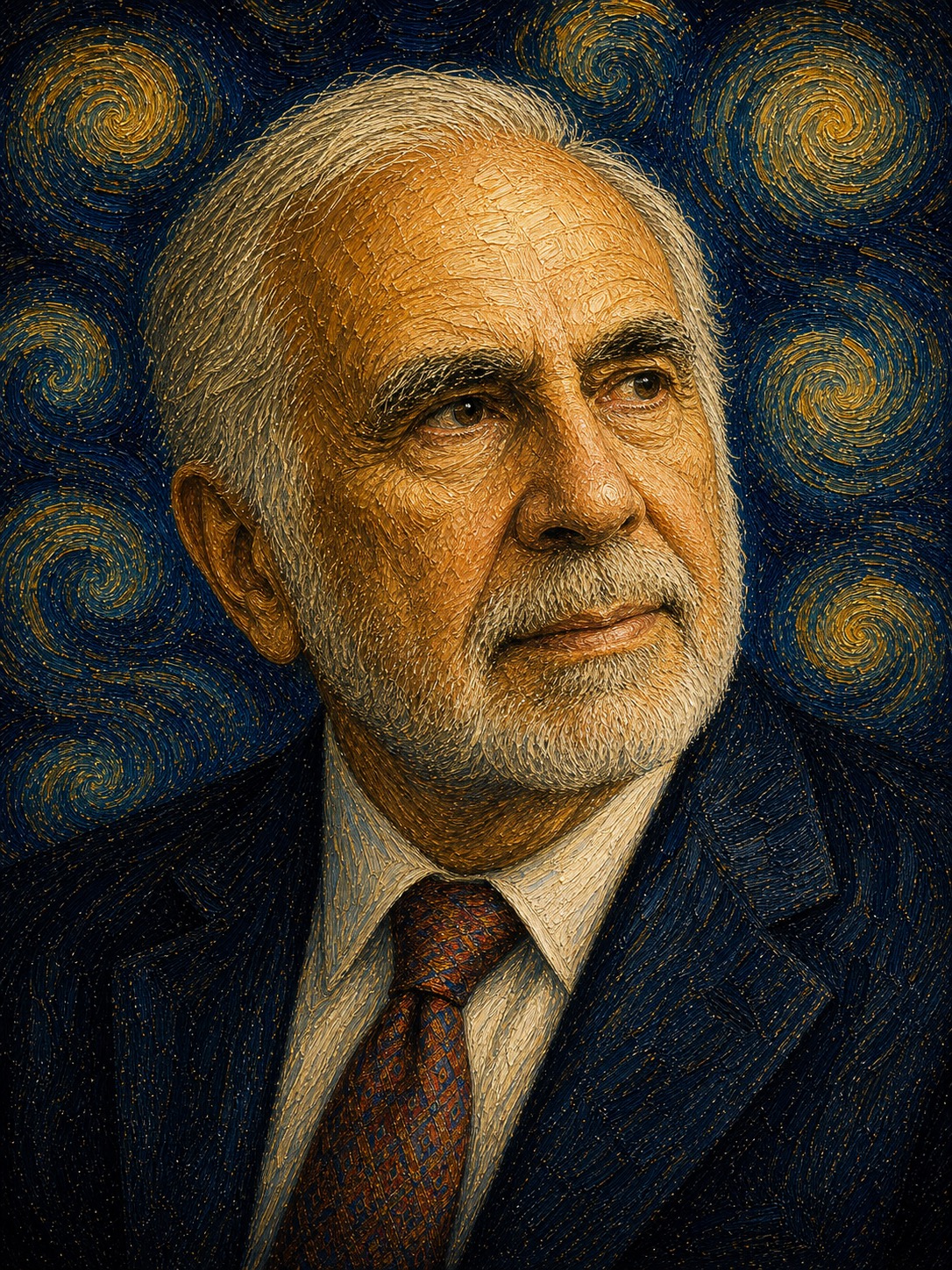
Carl Icahn
Made governance optionality investable by turning ownership rights into pressure, votes, tenders, and control outcomes, while exposing the risks of leverage, disclosure gaps, and activist agency problems.
As of 2026-06-26, Carl C. Icahn is living and remains chairman of the board of Icahn Enterprises L.P. ("IEP"), while day-to-day public-company management shifted in May 2026 to Ted Papapostolou as president and CEO (IEP board biography, 2026; IEP management changes, 2026).
Snapshot
| Field | Notes |
|---|---|
| Born / died | Born February 16, 1936, Queens, New York; living as of 2026-06-26 (Britannica, 2026; IEP board biography, 2026). |
| Nationality | American. |
| Main vehicles | Icahn & Co. (formed 1968); High River / Icahn Partners private funds; Icahn Capital LP; Icahn Enterprises L.P., a Delaware master limited partnership formed in 1987 and headquartered in Sunny Isles Beach, Florida (Icahn official bio; IEP 2025 Form 10-K, 2026). |
| Years active | Wall Street career began in 1961; activist/control investing began in 1978; active public-company chair through 2026 (Icahn official bio; IEP board biography, 2026). |
| Asset classes | Public equities, options/risk arbitrage, activist blocks, control stakes, distressed and special situations, swaps/options/short hedges, and operating-company subsidiaries within IEP (IEP 2025 Form 10-K, 2026; Q1 2026 investor presentation). |
| Style tags | Shareholder activism; corporate control; hostile bids; special situations; concentrated ownership; governance pressure; "corporate raider" to activist evolution; public holding-company structure. |
| Verified track record + period | Best primary-ish public series found this run: IEP states that a January 2000 purchase with distributions reinvested through July 31, 2023 produced a 1,623% cumulative gain, or 12.8%-13.0% annualized (Icahn unitholder letter, 2023). Longer 1968-2011 31% annualized figure appears in secondary sources and is marked [single-source / not audited from primary records] (Kiplinger, 2013). |
| Peak scale / AUM caveat | Observable scale depends on definition: outside-client hedge fund firm was reported at about $7 billion when Icahn returned outside capital in 2011 (Business Insider, 2011); 13F.info shows reported 13F values of $22.0 billion in Q1 2023 before the Hindenburg-era IEP drawdown and higher historical 13F values, including $38.5 billion in Q2 2014 (13F.info, 2026); Hindenburg described IEP as roughly an $18 billion market-cap vehicle at April 2023 prices (Hindenburg, 2023). These are not interchangeable with audited AUM. |
Life & Career Timeline
Icahn grew up in Far Rockaway, Queens, graduated from Princeton in 1957 with a philosophy degree, briefly attended NYU medical school, served in the Army, and entered Wall Street in 1961 (Britannica, 2026; Icahn official bio). His early professional identity was not "activist" but trader: in 1968 he formed Icahn & Co., a securities firm focused on arbitrage and options trading (Icahn official bio).
The activist/control template began in 1978, when Icahn started taking "very substantial and sometimes controlling positions" in individual companies (Icahn official bio). The roster on his own site reads like a compressed history of late-20th and early-21st-century public-market activism: RJR Nabisco, Texaco, Phillips Petroleum, Western Union, Gulf & Western, USX, Marvel, Revlon, Time Warner, Yahoo!, Lions Gate, Motorola, Genzyme, Dell, Herbalife, Netflix, Apple, eBay, and many others (Icahn official bio).
By the 1980s, Icahn had become one of the emblematic "corporate raiders." Britannica describes the later rebranding arc plainly: in the 1980s he was called a corporate raider; later he was more often labeled an activist investor (Britannica, 2026). The Time Warner fight profiled by The New Yorker shows both sides of that reputation. Icahn argued for breakups, buybacks, and accountability; Richard Parsons and other critics saw greenmail-like pressure and excessive short-termism (The New Yorker, 2006).
In the 2000s Icahn institutionalized the strategy through private funds and, increasingly, through IEP. IEP's public filings state that Carl Icahn indirectly controls the general partner and, with affiliates, owned about 86% of the outstanding depositary units as of December 31, 2025 (IEP 2025 Form 10-K, 2026). In 2011, Icahn returned outside client capital from a reported $7 billion hedge-fund firm, saying he did not want the responsibility of losing outside investors' money in another crisis; Business Insider reported that the funds had gained 33.3% in 2009, 15.2% in 2010, and 8.7% in the first two months of 2011 before the return of capital (Business Insider, 2011).
The post-2011 vehicle became more personal and public at the same time: IEP let public unitholders invest alongside an Icahn-controlled holding company while Icahn retained overwhelming control. That structure created alignment, but also concentration, governance, leverage, distribution, and margin-loan disclosure risks that became central after Hindenburg Research's 2023 short report and the SEC's 2024 settled disclosure charges (Hindenburg, 2023; SEC press release, 2024).
Vehicles & Structure
Icahn's historical vehicle stack has three layers. First was the trading firm, Icahn & Co., created in 1968 for arbitrage and options (Icahn official bio). Second were the activist private funds, including High River, Icahn Partners, and related master funds; IEP's board biography still describes Icahn's principal occupation since 2007 as managing private investment funds including Icahn Partners LP and Icahn Partners Master Fund LP through Icahn Capital LP and related entities (IEP board biography, 2026). Third is IEP, the listed master limited partnership that owns operating subsidiaries and invests in the IEP funds (IEP 2025 Form 10-K, 2026).
IEP is not a clean hedge-fund wrapper. It is a public holding company with seven operating segments: Investment, Energy, Automotive, Food Packaging, Real Estate, Home Fashion, and Pharma (IEP overview, 2026; IEP Q1 2026 results, 2026). The 2025 10-K says IEP is a Delaware master limited partnership, owns 99% of Icahn Enterprises Holdings, and is controlled through Icahn Enterprises GP, which is indirectly owned and controlled by Icahn (IEP 2025 Form 10-K, 2026).
The observable public securities portfolio is concentrated and only partially informative. The March 31, 2026 Form 13F for Carl C. Icahn reports a manager based at Icahn Enterprises' Sunny Isles Beach address and a Q1 2026 reporting period (SEC Form 13F-HR, 2026). 13F data aggregators show 12 reported holdings worth about $8.55 billion at Q1 2026, dominated by IEP, CVR Energy, CVR Partners, Centuri, and IFF (13F.info, 2026; Holdings Channel, 2026). This excludes shorts, derivatives not captured by 13F, private subsidiaries, debt, and intra-IEP operating-company economics.
IEP's 2026 investor presentation frames the company as majority owned and controlled by Icahn, notes that he and affiliates owned about 86% of units at March 31, 2026, and shows Investment Funds interests of about $2.2 billion inside IEP at that date (Q1 2026 investor presentation). The same presentation and filings are useful for structure, but they are company advocacy materials and should be read alongside the 10-K risk factors and third-party criticism.
Track Record Detail With Caveats
Icahn's record is real, long, and hard to reduce to one number. The strongest public, primary-ish performance statement this run found is the August 2023 IEP letter signed by Icahn. It says a January 2000 purchase of IEP units at $7.63, with all distributions reinvested and sale on July 31, 2023, would have produced a 1,623% cumulative increase, equal to roughly 13% annualized; the table gives 12.8% for IEP versus 6.9% for the S&P 500 and 10.0% for Berkshire Hathaway A over the same period (Icahn unitholder letter, 2023).
That claim has two major caveats. First, it ends on July 31, 2023, after Hindenburg's report but before the full 2023-2025 IEP repricing had played out. It is not a current through-2026 total-return number. Second, it is a public-unit total return, not the same thing as Icahn's personal private-fund or partnership return. IEP's own 10-K warns that its investment-fund history is not necessarily indicative of future performance and lists risks from concentration, leverage, hedging, short-selling pressure, debt, and the controlling unitholder's pledged units (IEP 2025 Form 10-K, 2026).
The famous longer number is weaker. Kiplinger reported in 2013 that from 1968 through 2011 Icahn compounded his initial $100,000 investment in his Wall Street firm at 31% annually (Kiplinger, 2013). I did not find an audited primary ledger for that full 1968-2011 calculation in this run, so it belongs in the canon as [single-source / secondary-reported] until later tasks trace the underlying return series.
The modern record also contains a clear drawdown and governance-risk chapter. Hindenburg's May 2023 report argued that IEP's dividend was unsupported by cash flow and investment performance, that the investment portfolio had suffered large losses since 2014, and that Icahn had taken too much leverage against IEP units (Hindenburg, 2023). IEP rejected the report as misleading, said activism had generated "hundreds of billions" of value at target companies, and acknowledged that recent investment-segment performance had been lower than historical averages because an overly bearish hedge book overwhelmed long activism gains (IEP response, 2023; Icahn unitholder letter, 2023).
The SEC settlement in August 2024 is a legal caveat, not a return figure, but it materially affects how the track record should be interpreted. The SEC charged Icahn and IEP with failures to disclose Icahn's pledges of IEP securities as collateral for billions in personal margin loans. The SEC said IEP and Icahn agreed to pay $1.5 million and $500,000 civil penalties, respectively, without admitting or denying the findings (SEC press release, 2024). The administrative order provides concrete scale: as of December 31, 2018, 2019, and 2020, Icahn's loans totaled about $4.6 billion, $5.0 billion, and $5.1 billion, with 51%-65% of outstanding IEP units pledged at those dates (SEC administrative order, 2024). IEP later announced that a proposed class action based on Hindenburg's claims had been dismissed without prejudice and characterized the SEC matter as a technical disclosure violation, while also acknowledging appeal/refiling risk in its cautionary language (IEP lawsuit-dismissal release, 2024).
The practical track-record conclusion is therefore split: Icahn is one of the defining winners of activist investing, with a long record of value-unlocking campaigns and a large personal fortune; the exact private compounding number remains insufficiently primary-sourced; the public IEP series was impressive through mid-2023 but is stale after the Hindenburg/SEC/drawdown period; and any current investor must separate target-company activism alpha from IEP's holding-company leverage, distributions, subsidiaries, and controlling-unitholder risks.
Why They Matter
Icahn matters because he made adversarial ownership a repeatable public-market business model. Before "shareholder activism" became a polished institutional category, Icahn demonstrated the raw version: buy a meaningful stake, expose underperformance or hidden assets, demand board seats, force sales/spinoffs/buybacks, and use public pressure as a financing and governance tool. His own 2023 letter frames activism as a solution to weak accountability in corporate America; the rhetoric is self-interested, but it accurately captures why boards took him seriously (Icahn unitholder letter, 2023).
His campaigns also forced the market to price the mere arrival of a credible activist. "Icahn lift" became shorthand for the stock-price reaction to his stake disclosures; Investopedia and other finance references treat the term as part of the public investing vocabulary (Investopedia, 2024). The academic literature on activism is broader than Icahn, but Harvard Law School's corporate-governance forum summarized research finding positive abnormal returns around Schedule 13D activist filings, placing Icahn and Bill Ackman in the broader debate over whether activists create value or extract short-term gains (Harvard Law School Forum, 2014).
The non-hagiographic lesson is equally important. Icahn's career shows that concentrated governance power can unlock value and also create externalities: TWA became the emblematic "raider" controversy; Time Warner executives saw him as short-term; IEP unitholders later bore holding-company, distribution, leverage, and disclosure risks (The New Yorker, 2006; Hindenburg, 2023; SEC press release, 2024). That tension is precisely why Icahn belongs in the Canon. His methods changed corporate governance, but they are not automatically transferable, and their morality depends heavily on time horizon, capital structure, disclosure quality, and who bears the downside.
Open Questions For Later Tasks
- Reconstruct the 1968-2011 31% annualized figure from primary records if possible; until then, keep it labeled [single-source / secondary-reported].
- Build a campaign-by-campaign ledger for Tappan, Texaco, TWA, RJR Nabisco, Time Warner, Netflix, Apple, eBay/PayPal, Herbalife, Cheniere, CVR Energy, Occidental, Illumina, Southwest Gas, and JetBlue, separating Icahn's P&L from target-company shareholder outcomes.
- Update IEP total return through current prices and distributions, not just the January 2000-July 2023 period in Icahn's letter.
- Trace the post-Hindenburg unit-pledge and margin-loan disclosures in Schedule 13D amendments and IEP filings through 2026.
- Determine how much of the current 13F portfolio is economically borne by Icahn personally versus IEP and affiliated entities; 13F data alone is inadequate.
- For later philosophy/mental-model tasks, distinguish Icahn's stated governance worldview from the control-company governance structure at IEP.
Core Worldview
Carl Icahn's philosophy begins with a hostile premise about public-company governance: dispersed owners are weak, boards become self-protective, and value is often trapped not because the asset is bad but because the people controlling it are insulated from economic consequences. In his 2008 Yale lecture, Robert Shiller framed Icahn's career as an attack on Berle-and-Means-style separation of ownership and control, and the course summary records Icahn's own diagnosis that weak management is the central problem in corporate America (Yale Open Courses, 2008).
That worldview makes Icahn less a pure stock picker than a control-rights investor. He looks for assets where a different capital-allocation, governance, or ownership structure could change the outcome. IEP's 2025 Form 10-K describes the approach in unusually plain language: returns may come from promoting change through minority positions or from acquiring control of companies Icahn believes his organization can run more profitably itself (IEP 2025 Form 10-K, 2026). The core idea is therefore not merely "buy cheap." It is "buy cheap where ownership pressure can make cheapness matter."
Icahn's own later language is more sweeping. In his August 2023 IEP letter, he wrote that IEP had reset its focus on core activism and that activism was the best investment paradigm (Icahn unitholder letter, 2023). The 2021 Bloomberg interview excerpt carried by The Acquirer's Multiple makes the same claim operational: successful activism requires patience, permanent capital, negotiation skill, a thick skin, and the ability to choose better management when control is gained (Bloomberg interview excerpt via The Acquirer's Multiple, 2021).
The Edge - What Markets Misprice And Why
Icahn's edge is the belief that markets underprice governance optionality. A company may screen as low multiple, asset-rich, or strategically mismanaged, but the hidden asset is often a credible forcing mechanism: a board fight, tender offer, litigation threat, breakup proposal, sale process, buyback demand, or management change. The Conference Board's review of Icahn and Bill Ackman identifies four governance failures that attract activists: unclear strategy, failure to replace an underperforming CEO, failure to use or divest valuable noncore assets, and inadequate cash return through dividends or repurchases (Conference Board / Director Notes, 2014). Those are close to an Icahn screen.
Public filings and letters show the pattern. At Apple, Icahn did not attack the product or CEO; he argued that the company was undervalued and that the buyback should be larger and faster (Icahn letter to Tim Cook, 2013; Apple proxy material, 2014). At eBay, the pressure was separation: he argued that management incompetence and conflicts around Skype and PayPal had cost shareholders billions (eBay proxy material, 2014). At HP/Xerox, the thesis was industrial logic and cost synergies, with Icahn disclosing large stakes in both companies and asking why HP would not engage in diligence on a combination (Icahn HP letter, 2019). At Illumina, the thesis was governance failure around GRAIL: overpaying, closing despite European regulatory objections, and risking fines, taxes, and forced divestiture (Icahn Illumina letter, 2023).
Why does the mispricing persist? Icahn's answer is structural. Boards are often chosen by incumbent boards, executives enjoy status quo economics, index owners may be passive or conflicted, and ordinary shareholders are too dispersed to coordinate. In the SandRidge letter, Icahn attacked a poison pill not merely as a deal tactic but as a device that impeded shareholder communication and choice (Icahn SandRidge letter, 2018). In the Southwest Gas campaign, he combined a tender offer with a full-board proxy contest so that owners could either sell at a fixed price or replace directors blocking the offer (Southwest Gas SEC exhibit, 2021).
Process: Idea Sourcing To Sell Discipline
Idea sourcing. Icahn's funnel starts with public companies where assets, governance, and incentives appear misaligned. The public trail suggests four recurring entry points: obvious valuation gaps, strategic separation opportunities, empire-building acquisitions, and board entrenchment. IEP's 10-K says the firm may buy target stock, seek to remove obstacles to a friendly purchase offer from a strong buyer, or become the buyer itself in appropriate circumstances (IEP 2025 Form 10-K, 2026).
Research. The research is forensic and adversarial. Icahn letters typically reconstruct a board's capital-allocation decisions, compare transaction prices, cite filings, question conflicts, and ask why shareholders were not given a choice. The eBay letter used public statements and transaction history to argue that Skype had been sold too cheaply and that PayPal deserved independence (eBay proxy material, 2014). The Illumina letters built a causal chain from the GRAIL acquisition to regulatory conflict, annual funding obligations, potential fines, and shareholder value destruction (Icahn Illumina letter, 2023).
Valuation and entry. Icahn prefers situations where an alternative action makes the valuation argument legible. Apple was framed as undervalued against the S&P 500 multiple and capable of immediate share repurchases (Apple proxy material, 2014). HP/Xerox was framed around more than $2 billion of potential cost synergies (Icahn HP letter, 2019). Southwest Gas used a cash tender offer to turn the valuation debate into a shareholder-choice mechanism (Southwest Gas SEC exhibit, 2021).
Sizing and influence. The position must be large enough to be credible. Sometimes that is a minority stake plus publicity; sometimes it is board representation; sometimes it becomes control. Cheniere's 2015 settlement shows a cooperative end-state: two Icahn Capital executives joined the board, and Icahn said they hoped to enhance shareholder value as directors (Cheniere release, 2015). IEP's 10-K formalizes the same continuum from minority activism to control acquisition (IEP 2025 Form 10-K, 2026).
Portfolio construction. The portfolio is concentrated and catalyst-driven, but it is not a pure long-only activist book. IEP's 10-K warns that the Investment Funds use options, swaps, shorts, forwards, distressed securities, leverage, and hedges, and that results can swing with long and short exposure (IEP 2025 Form 10-K, 2026). That makes Icahn's public 13F only a partial map; the real portfolio includes derivatives, shorts, control stakes, subsidiaries, and private fund interests.
Sell discipline. Icahn sells when the catalyst is realized, a settlement changes the board/strategy, a buyer emerges, or the market reprices the governance option. The discipline is pragmatic rather than doctrinal. Cheniere later repurchased about $350 million of shares from Icahn affiliates at the market closing price, showing willingness to exit after years of board influence and value realization (Cheniere repurchase release, 2022). The risk is that exit discipline can be less clear in IEP itself, where Icahn is both controller and largest economic owner.
Risk Management
Icahn's risk management starts with influence. A passive value investor is exposed to time and management indifference; an activist tries to reduce that risk by gaining voice, publicity, votes, board seats, or control. The method also uses legal process as a risk tool: proxy statements, 13D amendments, tender-offer documents, public letters, and settlement agreements define the battlefield.
But the same filings show serious residual risks. IEP's 10-K lists concentration, undervalued securities, illiquidity, leverage, derivatives, short selling, regulatory limits, and inability to implement the investment approach where control is shared or resisted (IEP 2025 Form 10-K, 2026). The document also discloses recent Investment Funds returns of 0.4% in 2025, -3.5% in 2024, and -16.9% in 2023, including losses from broad-market hedges and long positions in some years (IEP 2025 Form 10-K, 2026).
The post-2023 controversy is the hardest risk-management evidence. Hindenburg argued that IEP's distribution, valuation, and margin-loan structure created fragility, especially because Icahn had pledged a large share of his units as collateral (Hindenburg Research, 2023). IEP rejected the report, highlighted cash and liquidity, emphasized Icahn's roughly 84% ownership at the time, and argued that unitholders could invest alongside him without his receiving fees or salary from IEP (IEP response, 2023). The SEC later settled disclosure charges over pledged IEP securities and personal margin loans; the SEC said IEP and Icahn paid $1.5 million and $500,000, respectively, without admitting or denying findings (SEC press release, 2024).
The risk lesson is not that activism failed as a strategy. It is that activism plus public holding-company leverage, concentrated control, derivatives, and personal margin borrowing can create risks that target-company analysis does not capture.
Temperament & Psychology
Icahn's temperament is combative, suspicious of incumbent power, and willing to use ridicule as a weapon. That is part of the edge. A conventional investor may identify the same undervaluation but lack the stomach to fight directors, lawyers, proxy solicitors, and management. In 2021, Icahn said there were not many true activists and emphasized the patience and thick skin needed to win campaigns (Bloomberg interview excerpt via The Acquirer's Multiple, 2021).
The psychological pattern has two sides. The constructive side is persistence: he often begins privately, escalates publicly, nominates directors, and keeps returning to the central accountability claim. The destructive side is overconfidence and personalizing the fight. The New Yorker profile of the Time Warner campaign shows why critics saw him as short-term and greenmail-like, while Icahn saw entrenched management and conglomerate inefficiency (The New Yorker, 2006).
Evolution Over Career
The arc runs from options/arbitrage trader to corporate raider, then to institutionalized activist and public holding-company controller. The official profile says Icahn & Co. began in 1968 as an arbitrage/options operation and that he began taking substantial and sometimes controlling positions in 1978 (Icahn official biography). The later IEP model broadened the toolkit: public units, operating subsidiaries, investment funds, board seats, controlled companies, and large personal co-investment.
The rhetoric also evolved. In the 1980s, Icahn was identified with hostile control. In the 2010s, he increasingly framed activism as corporate democracy and shareholder rights. The McDonald's campaign added ESG and animal-welfare claims to the older governance template, arguing that board accountability and stakeholder harm were connected (Icahn McDonald's letter, 2022). The Southwest Gas and Illumina campaigns show a mature version of the style: formal proxy/tender mechanics, public letters, board-slate pressure, and direct appeal to shareholder choice (Southwest Gas SEC exhibit, 2021; Icahn Illumina letter, 2023).
What Icahn Explicitly Rejects
Icahn rejects managerial entitlement, poison pills that silence owners, empire-building acquisitions, lazy conglomerate structures, underused balance sheets, excessive executive pay disconnected from results, and passive ownership that lets boards avoid accountability. His letters repeatedly portray directors as agents, not monarchs. SandRidge is the cleanest statement of that principle: he argued that the board's pill stripped shareholders of the right to communicate and campaign against a transaction (Icahn SandRidge letter, 2018).
He also rejects purely polite activism. He says friendly cooperation is preferred when it works, but HP/Xerox shows the escalation rule: if directors refuse to evaluate an obvious value-enhancing transaction, he moves from private logic to public pressure (Icahn HP letter, 2019).
Regimes Where It Thrives Vs. Struggles
The model thrives when governance failures are visible, ownership can be accumulated, legal rights are enforceable, financing markets are open, and the remedy is understandable: split the company, sell an asset, increase a buyback, replace directors, stop a bad deal, or accept a higher bid. It works best where other shareholders can be persuaded that the activist's proposal is not merely self-serving but economically obvious. The academic evidence is mixed but supportive around announcement effects: the Harvard Law School Forum summarizes research finding roughly 7% abnormal returns around 13D activist filings (Harvard Law School Forum, 2014).
It struggles where regulation blocks the remedy, where the activist cannot build enough votes, where financing becomes expensive, where the target is complex or politically sensitive, and where index owners or large institutions decline to fight. It also struggles when the activist vehicle itself becomes the story. IEP's controlled-company structure, limited-partner voting limits, pledged-unit risk, derivative hedging, and post-Hindenburg volatility are precisely the sort of governance and capital-structure complications Icahn criticizes in targets (IEP 2025 Form 10-K, 2026; SEC press release, 2024).
Tensions Between Stated Philosophy And Actual Behavior
The central tension is corporate democracy versus control. Icahn argues for shareholder rights and accountability at target companies, but IEP is a controlled limited partnership where Icahn and affiliates own the overwhelming majority of units and public holders have limited voting rights. The 2025 10-K explicitly says IEP is a controlled company and that holders of depositary units have limited rights to participate in management (IEP 2025 Form 10-K, 2026).
The second tension is transparency. Icahn's campaigns demand disclosure and accountability from boards, yet the SEC found that Icahn and IEP failed to disclose important information about pledges of IEP securities for personal margin loans until years after the relevant agreements and amendments (SEC press release, 2024; IEP Schedule 13D/A, 2024).
The third tension is long-term value versus extraction. Icahn argues that activism enhances value for all shareholders, and there are campaigns where that is plausible or demonstrable. But critics from TWA through Time Warner to Hindenburg argue that the strategy can prioritize near-term cash, leverage, or control pressure over long-term operating resilience (Princeton Alumni Weekly, 1985; The New Yorker, 2006; Hindenburg Research, 2023).
The fairest synthesis is that Icahn's philosophy is powerful but not clean. He identified a real market failure: public companies often underprice the value of accountable ownership. He built a repeatable method for forcing change. But the method's transferability depends on capital, legal skill, reputation, and tolerance for conflict; its social value depends on whether the proposed change improves the business or merely reallocates value; and IEP's own governance and leverage history show that the activist lens must also be turned back on the activist.
As of: 2026-06-26
Selection standard
This file ranks Icahn trades by a mix of observable profit, repeatability of the underlying method, strategic importance to Icahn's career, and quality of source evidence. Icahn is hard to reduce to a clean trade ledger: many wins were run through partnerships, public funds, Icahn Enterprises L.P. (IEP), affiliates, or tender-offer vehicles; some were never fully exited; and many press reports blend Icahn's own P&L, his affiliates' P&L, and target-company shareholder outcomes. Where a campaign lacks a full position ledger, the file says so rather than pretending precision.
The single best trade by durable public evidence is CVR Energy: it combined a control acquisition, long-lived cash generation, and an IEP-stated 807% gain with more than $3.2 billion of dividends by 2023. The cleanest realized trade is Netflix, where IEP itself disclosed approximately $2.0 billion of total gain and a 457% return in under three years.
1. CVR Energy, 2012 to present - best control trade
Context and dates
CVR Energy was a refining and nitrogen-fertilizer business whose equity traded through a volatile post-crisis energy cycle. Icahn moved from a public-market activist posture into effective control in 2012. CVR's 2012 Form 10-K says an Icahn tender offer closed on May 7, 2012, acquiring about 69% of the outstanding shares at $30 per share, followed by a second tender offer that closed on July 24, 2012 and added about 14% more at the same price (CVR 2012 Form 10-K).
Thesis and how found
The thesis was classic Icahn: a publicly traded company with valuable assets, a capital structure and governance path that allowed pressure, and a realistic route from minority ownership to control. Unlike many Icahn trades, CVR was not merely a board-seat or buyback campaign. It became an operating-company compounder inside IEP, and therefore a test of whether activism could graduate into ownership.
Size and structure
This was a tender-offer control position, not a small minority campaign. By early 2025, CVR still disclosed that IEP owned about 66% of the company and that CVR was controlled by IEP, which is indirectly controlled by Carl Icahn (CVR 2024 Form 10-K).
Entry and path, including drawdown endured
The entry price was $30 per share in the tender offers. The position then moved through commodity, crack-spread, refining-margin, and fertilizer cycles. CVR also paid large early dividends: in October 2012 the company announced a $5.50 special dividend and said 2012 dividends would total $6.50 per share when combined with an earlier special dividend (CVR Q3 2012 release). The long path mattered because CVR's value was not just mark-to-market appreciation; it was cash extraction plus continuing control economics.
Exit and P&L
There has been no full exit as of the latest sources reviewed. IEP's August 2023 letter said CVR was "up 807% since acquisition" and had produced more than $3.2 billion in dividends (IEP 2023 letter). Treat that as first-party but not independent: it is the best available summary of IEP's economics, while the exact calculation, tax treatment, distributions to IEP unitholders, and mark-to-market timing are not independently reconstructed here.
What it teaches
CVR is Icahn's model in its most complete form: buy a security with governance optionality, pressure the system, convert a mispriced minority stake into control, then let cash flows and capital allocation do the compounding. The caveat is equally important. This required permanent capital, legal firepower, tender-offer capability, and tolerance for commodity volatility. It is not transferable to ordinary investors except as a pattern of looking for control optionality hidden inside public securities.
Sources
Primary: CVR 2012 Form 10-K, CVR dividend release, CVR 2024 Form 10-K, IEP 2023 letter. Secondary/interpretive: none needed for the core facts.
2. Netflix, 2012-2015 - cleanest realized multibagger
Context and dates
Netflix entered 2012 wounded by the Qwikster reversal, pricing backlash, heavy content spending, and skepticism about streaming economics. Icahn disclosed a major position in October 2012. The Schedule 13D reported beneficial ownership of 5,541,066 shares, or 9.98%, including 4,435,772 shares underlying American-style call options, with an aggregate purchase price of about $168.9 million for the reporting persons (Netflix Schedule 13D).
Thesis and how found
The filing said Icahn believed Netflix shares were undervalued and that the company was an attractive takeover candidate. That framing was not a full fundamental streaming manifesto; it was a security-level diagnosis. The stock had collapsed, sentiment was poor, strategic buyers could plausibly value Netflix differently from public markets, and options gave Icahn asymmetric exposure.
Size and structure
The structure blended common stock and call options. The options mattered because they allowed a larger economic interest than a plain cash equity stake at the same capital outlay. Later reporting put the original investment cost at about $321 million, while the SEC filing's reporting-person purchase price was about $168.9 million; the difference likely reflects vehicle and basis definitions, so both figures should be kept as source-specific rather than merged (Business Insider).
Entry and path, including drawdown endured
Icahn entered when the market was still debating whether Netflix's streaming pivot would justify its spending and subscriber-reset pain. No source reviewed for this task provided a precise maximum drawdown from Icahn's entry price. The important path feature was not a long drawdown but a rapid rerating as Netflix execution, subscriber growth, and strategic scarcity returned to the center of the story.
Exit and P&L
IEP sold roughly half the position in October 2013 and the remainder on June 24, 2015. IEP's own release said the final sale generated gross proceeds of $1.306 billion and, when combined with the earlier sale, represented a total gain of approximately $2.0 billion, a 457% return in less than three years (IEP Netflix sale release). This is the strongest closed-trade P&L evidence found for Icahn in this task.
What it teaches
Netflix shows Icahn at his best as a buyer of public-market panic where strategic value, optionality, and capital-market mechanics intersect. Unlike a pure activism win, the boardroom campaign was not the core source of alpha. The edge was recognizing that public pessimism had overshot the private-market value of a scarce media platform and using options to magnify the payoff.
Sources
Primary: Netflix Schedule 13D, IEP Netflix sale release. Secondary: Business Insider basis and cost discussion.
3. Apple, 2013-2016 - mega-cap buyback activism
Context and dates
Icahn bought Apple in 2013, after the stock had derated despite enormous cash balances, dominant iPhone economics, and a fast-growing capital-return capacity. In his October 2013 letter to Tim Cook, Icahn disclosed that he had bought about 3.9 million shares at an average price of $468 and had not sold despite the stock reaching $525 (Icahn letter to Tim Cook).
Thesis and how found
The thesis was unusually friendly for Icahn. He was not attacking management; he praised Apple while arguing that the stock was dramatically undervalued and that a larger buyback would transfer value to remaining owners. The letter proposed a $150 billion tender offer financed with debt and cash, and argued that the program could be highly accretive to earnings per share.
Size and structure
Apple became a multi-billion-dollar common-stock position. When Icahn disclosed in April 2016 that he had exited, Business Insider reported that he had owned 45.8 million shares, or about 0.82% of Apple, worth roughly $4.8 billion before the sale (Business Insider Apple exit). The position was not a control stake; it was voice, public persuasion, and alignment with a management team already inclined toward repurchases.
Entry and path, including drawdown endured
The public pressure campaign peaked in 2013-2014. In January 2014, Icahn withdrew his shareholder proposal after Apple increased its buyback pace, saying the company was already buying back stock aggressively and that Apple would not be ignored by investors forever (SEC-filed Apple material). The trade still required tolerance for mega-cap volatility and political risk, especially China exposure.
Exit and P&L
Icahn exited in 2016, citing concern about China's stance toward Apple. Business Insider wrote that he "likely made a few billion dollars" and cited a Fortune estimate of about $2 billion of profit. That figure is useful but secondary; without the full trade ledger and split-adjusted transactions, it should be treated as an estimate rather than a verified P&L.
What it teaches
Apple shows Icahn's method adapting to mega-cap quality. Instead of threatening a takeover, he framed himself as a capital-allocation catalyst in a great business. It also shows the limit of public activism: Apple's intrinsic business performance and management's own buyback decisions mattered more than Icahn's stake alone.
Sources
Primary: Icahn's Apple letter, SEC-filed Apple material. Secondary: Business Insider/Fortune exit and P&L estimate.
4. Herbalife, 2013-2021 - contrarian combat against a famous short
Context and dates
Herbalife was already the center of a public battle when Icahn entered: Bill Ackman had announced a large short position and alleged that the company was a pyramid scheme. Icahn disclosed his long position in February 2013. The Schedule 13D reported beneficial ownership of 14,015,151 shares, or 12.98%, with an aggregate purchase price of approximately $214.3 million (Herbalife Schedule 13D).
Thesis and how found
The filing said Icahn believed Herbalife was undervalued and referred to the company's January 2013 management presentation and response to Federal Trade Commission-related claims. The trade was partly value investing, partly governance, and partly a direct bet that a high-profile short thesis had overreached.
Size and structure
Icahn built a large minority position with board influence and eventually multiple board designees. The position was large enough to shape both the shareholder base and the public narrative, but not to eliminate the legal, regulatory, and reputational risk inherent in the business model debate.
Entry and path, including drawdown endured
The trade required unusually high headline-risk tolerance. Herbalife shares were repeatedly affected by regulatory news, short-seller claims, company rebuttals, and the Ackman-Icahn media fight. The exact maximum drawdown from Icahn's basis was not reconstructed in the sources reviewed, but this was not a quiet compounder; it was an eight-year public brawl.
Exit and P&L
In January 2021, Herbalife announced it would repurchase about $600 million of shares from Icahn at $48.05, that Icahn would tender the remaining shares into the self-tender, and that after the tender he would own no Herbalife shares (Herbalife 2021 repurchase release). IEP's 2023 letter later listed Herbalife as a 181% return (IEP 2023 letter). The exact realized dollar profit was not fully reconstructed here because buybacks, partial sales, tender participation, and vehicle-level costs require a position ledger.
What it teaches
Herbalife demonstrates Icahn's appetite for adversarial situations where the market may have become reflexively one-sided. It is not a clean moral or regulatory template. The lesson is narrower: in a crowded short controversy, a long investor with capital, patience, board influence, and reputational willingness can create a powerful squeeze on pessimism.
Sources
Primary: Herbalife Schedule 13D, Herbalife 2021 repurchase release, IEP 2023 letter.
5. Cheniere Energy, 2015-2022 - board influence plus LNG cycle
Context and dates
Icahn entered Cheniere in 2015, as the company was developing into a central U.S. LNG export platform. The Schedule 13D reported beneficial ownership of 19,353,530 shares, or 8.18%, with an aggregate purchase price of approximately $1.286 billion (Cheniere Schedule 13D).
Thesis and how found
The filing said Icahn believed the shares were undervalued and expected to discuss operations, governance, capitalization, executive compensation, and board composition. That was a broad activist mandate, but the underlying asset was very specific: a scarce LNG infrastructure platform exposed to global gas demand and long-cycle energy infrastructure value.
Size and structure
This was a large minority stake with board-seat leverage. In August 2015, Cheniere announced that two Icahn Capital executives would join the board and that Icahn owned about 19.4 million shares, or 8.2% (Cheniere settlement release).
Entry and path, including drawdown endured
The implied average cost from the Schedule 13D's aggregate purchase price and share count is about $66.45 per share, before transaction-cost and vehicle nuances. Cheniere shares endured energy-cycle volatility after Icahn entered; the eventual payoff depended on both governance changes and the maturation of the LNG export business.
Exit and P&L
Cheniere repurchased 2,435,569 shares from Icahn affiliates in June 2022 at $143.50 per share, for about $350 million, leaving Icahn with 4.4 million shares or about 1.8% (Cheniere 2022 repurchase release). Cheniere's 2022 Form 10-K later said the Icahn Group had sold all remaining holdings through company repurchases and open-market sales and no longer beneficially owned shares as of January 31, 2023 (Cheniere 2022 Form 10-K). IEP has cited Cheniere as a value-creating activist investment, but no source reviewed gave a single official lifetime P&L number.
What it teaches
Cheniere is a reminder that activism can amplify a cyclical infrastructure thesis rather than replace it. Icahn's board pressure mattered, but the payoff also depended on LNG fundamentals, execution, and timing. The transferable lesson is to pair governance leverage with a real asset-value catalyst.
Sources
Primary: Cheniere Schedule 13D, Cheniere board-settlement release, Cheniere 2022 repurchase release, Cheniere 2022 Form 10-K.
6. Texaco, 1987-1988 - bankruptcy-exit pressure and preferred-stock monetization
Context and dates
Texaco had just emerged from bankruptcy when Icahn's group pressured the company. The New York Times reported that Texaco bought 74 million preferred shares from an Icahn-led group for $16.50 per share, ending an attempt to force a breakup (New York Times, March 1988).
Thesis and how found
The thesis was that Texaco's post-bankruptcy securities and asset base could support a more aggressive value-unlocking transaction. Icahn used a large preferred-stock stake and takeover pressure to force a negotiated repurchase.
Size and structure
The position was held by an Icahn-led group, not solely by Icahn personally. That distinction matters. The reported transaction involved 74 million preferred shares and a separate agreement to pay accrued dividends.
Entry and path, including drawdown endured
The New York Times said Icahn's group had paid about $14.50 per preferred share in December 1987 and sold at $16.50 about three months later. This was a compressed campaign, with the main risk being legal, financing, and negotiation risk rather than years of market drawdown.
Exit and P&L
The Times reported an apparent profit of $148 million on the share price spread plus $338 million of accrued dividends, or $486 million of visible economics to the group. Because this was a group transaction, the figure should not be quoted as Icahn's personal profit.
What it teaches
Texaco is a high-octane version of Icahn's early method: buy a security with blocking or pressure value, threaten a more disruptive transaction, and accept a negotiated premium. It also shows why the "greenmail" criticism attached to his name: target shareholders may get a catalyst, but the activist's negotiated exit can become the center of the value transfer.
Sources
Secondary contemporaneous: New York Times. Primary company filings were not reconstructed in this task.
7. Forest Laboratories, 2011-2014 - management pressure into strategic sale
Context and dates
Icahn began pressing Forest Laboratories after concluding that the company had valuable products but weak governance, excessive spending, and succession problems. In a 2014 statement after Actavis agreed to buy Forest, Icahn said he first bought Forest stock "in the low 30s" and viewed it as a good company with a great asset but underperforming management (Icahn statement via BusinessWire).
Thesis and how found
Icahn's own 2013 letter to Forest shareholders laid out the operating thesis: reduce excessive spending, improve capital allocation, address management succession, consider licensing and acquisitions, and refresh the board (Icahn Forest letter).
Size and structure
The precise position ledger was not reconstructed here. The structure was a public activist equity position with board pressure, not a control acquisition. Icahn's influence came from public pressure, shareholder support, and a multi-year campaign.
Entry and path, including drawdown endured
Icahn's reported low-$30s entry gave him a large margin if the operating and governance thesis proved right. The path required a multi-year fight over board composition and strategy, followed by a strategic acquirer willing to pay for Forest's assets and cost-synergy potential.
Exit and P&L
Actavis agreed in February 2014 to acquire Forest for cash and stock valued at about $25 billion, or $89.48 per Forest share, a 25% premium to the prior close (Actavis-Forest deal release). Icahn said the stock had returned 209% from the first year he invested through the Actavis purchase price. Dollar P&L is not calculated because the full share count, trades, and derivative exposure were not found in the sources reviewed.
What it teaches
Forest is the clean activist archetype: identify an underperforming company with real assets, turn governance pressure into operational change, and eventually monetize through a strategic transaction. It also highlights a limit: without the acquirer's willingness to pay a control premium, the activist campaign might have looked far less spectacular.
Sources
Primary/first-party: Icahn Forest letter, Icahn BusinessWire statement. Company transaction source: Actavis-Forest deal release.
8. eBay and PayPal, 2014-2015 - separation thesis
Context and dates
In 2014, Icahn pushed eBay to separate PayPal, arguing that governance conflicts and strategic mismatch were suppressing value. His SEC-filed letter attacked board conflicts and argued that PayPal should be separated from the marketplace business (eBay SEC-filed Icahn letter).
Thesis and how found
The thesis was simple and powerful: PayPal was a high-quality payments platform whose value and strategic freedom were obscured inside eBay. Icahn's campaign combined governance criticism with a structural remedy that other shareholders could understand.
Size and structure
TheStreet reported that Icahn held 46.3 million eBay shares in the first quarter of 2014, though that figure is a secondary source and should be checked against filings before being used as a definitive position ledger (TheStreet).
Entry and path, including drawdown endured
The campaign moved quickly relative to older Icahn fights. eBay initially resisted, but the separation logic gained shareholder and strategic momentum. The primary risk was that eBay could maintain the status quo or that the separated companies would not receive the hoped-for market valuation.
Exit and P&L
eBay completed the PayPal separation in July 2015, distributing one PayPal share for each eBay share held as of the record date (eBay separation release). IEP's 2023 letter listed eBay/PayPal as a 136% return. TheStreet estimated that Icahn's post-split holdings were worth roughly $1.89 billion in PayPal stock plus $1.22 billion in eBay stock shortly after the split, but exact profit depends on basis and sales.
What it teaches
This was a governance campaign where the demanded action was easily legible: split the company. Icahn did not need control; he needed a clear structural argument and enough pressure to make the board accept that PayPal's standalone value was too visible to ignore.
Sources
Primary: eBay SEC-filed Icahn letter, eBay separation release, IEP 2023 letter. Secondary: TheStreet value estimate.
9. Tappan, 1978-1979 - foundational proof of concept
Context and dates
Tappan was not Icahn's largest dollar win, but it belongs in a greatest-trades file because it was an early proof of the method. Fortune's 2007 profile reported that Icahn bought Tappan at $7.50 in 1978, started a proxy fight, and saw the company sold to Electrolux for $18 per share in 1979 (Fortune archive).
Thesis and how found
The thesis was that a neglected public company could be pressured into a sale at a value much higher than the market price. It was the small-cap ancestor of Icahn's later, much larger campaigns.
Size and structure
The exact stake size and dollar P&L were not reconstructed. The important structure was a public-equity stake plus proxy pressure, not a passive value investment.
Entry and path, including drawdown endured
The reported entry at $7.50 and sale at $18 imply a 140% gross price increase before expenses and position-size effects. The campaign moved within about a year, so the main risk was campaign failure rather than a long earnings cycle.
Exit and P&L
Electrolux acquired Tappan in 1979. The OTA/Princeton acquisition review confirms the Tappan/Electrolux transaction in the broader context of horizontal appliance-industry expansion, though it does not reconstruct Icahn's economics (OTA/Princeton PDF). Exact Icahn profit is therefore [unverified].
What it teaches
Tappan is the seed crystal. It shows that the later Icahn pattern - buy an underpriced company, pressure governance, force strategic alternatives - was present before the billion-dollar era. The trade is included for method importance, not absolute dollar size.
Sources
Secondary: Fortune profile. Transaction context: OTA/Princeton acquisition review.
Honorable mention: RJR Nabisco, 1990-1991
The New York Times reported that an Icahn group made roughly $300 million when RJR Nabisco bought back shares and bonds at negotiated prices in 1991, after the group disclosed a 10.8% stock position (New York Times, January 1991). It is omitted from the top nine because the available source is a contemporary press account rather than a full position ledger, and because it looks more like a negotiated securities exit than a durable company-level transformation. It still reinforces the early Icahn pattern: acquire leverage in a stressed or controversial security, create strategic pressure, and monetize through a negotiated exit.
Cross-trade lessons
- Governance is an option. In CVR, Forest, eBay, Cheniere, and Tappan, the stock was only one instrument. The more important instrument was the right to pressure boards, run proxy fights, demand transactions, or seek control.
- The best Icahn trades had multiple exits. Netflix could be sold to a strategic buyer, rerate as a public company, or recover through execution. CVR could be a sale candidate, dividend machine, or controlled operating company. Apple could rerate, buy back stock, or both.
- Position structure mattered. Netflix used options. CVR used tender offers. Cheniere and Forest used minority activism. Apple used public persuasion without control. The trade design matched the catalyst.
- P&L and social value are different questions. Texaco, Herbalife, and early greenmail-style wins can be excellent trades for the activist while remaining controversial for other stakeholders. The canon should not confuse profit evidence with a blanket endorsement of method.
- Source humility is mandatory. The strongest disclosed P&L is Netflix. CVR's economics are first-party and ongoing. Apple, eBay/PayPal, Cheniere, Forest, and early trades require basis assumptions or partial ledgers. Future work should improve these with original 13D amendments, 13F filings, tender documents, and contemporaneous annual reports.
Open questions for later tasks
- Reconstruct a campaign-by-campaign Icahn position ledger from 13D/13F amendments for Apple, eBay, Forest, Cheniere, and Herbalife.
- Separate Icahn personal/fund/IEP economics from target-company shareholder returns in every campaign.
- For early trades such as Tappan, Texaco, RJR Nabisco, and TWA, find primary filings or court/bankruptcy records before upgrading press-reported P&L to verified status.
- For CVR, reconcile IEP's stated 807% gain and $3.2 billion dividends with public CVR distributions, IEP ownership percentages, and retained mark-to-market value.
As of: 2026-06-26
Summary
Icahn's mistakes are unusually revealing because his edge is itself a risk system: concentration, public pressure, control rights, litigation, leverage, and a willingness to be disliked. The same toolkit that produced CVR Energy, Netflix, Apple, Cheniere, and eBay/PayPal also produced two categories of failure. First are ordinary investment losses where the business or cycle overwhelmed the activist: Hertz, Blockbuster, the 2014-2016 energy complex, Auto Plus, and several low-support or low-payoff proxy fights. Second are governance and structure failures where Icahn's own vehicle or controlled-company behavior created the kind of agency problem he criticizes elsewhere: TWA/Karabu, XO minority-shareholder litigation, IEP's oversized hedge book, personal margin loans secured by IEP units, and the 2024 SEC disclosure settlement.
The central lesson is not that activism failed. It is that activism is a high-variance strategy whose operating advantages can become blind spots. Icahn is excellent when the problem is an accountable board and a visible corporate action. He has been weaker when the problem is secular technology change, an exogenous liquidity shock, or a capital structure where his own control and leverage become the market's main risk.
Major Losses, Errors, and Near-Death Moments
1. IEP's oversized hedge book and post-Hindenburg repricing
The most important modern error is Icahn's own description of IEP drifting away from its core activism playbook into an oversized bearish hedge book. In the August 2023 IEP letter, he wrote that IEP's January 2000-July 2023 total return would have been stronger if the firm had not overused shorts and hedges; he said long-side activism gains had been overwhelmed by an overly bearish market view and oversized short positions, and that IEP had significantly reduced hedges over the preceding six months (IEP letter, 2023). IEP's May 2023 rebuttal to Hindenburg similarly acknowledged that the investment segment had lagged historical averages because a large net short position detracted from results, while saying the firm had reduced short positions and refocused on activism (IEP response, 2023).
Hindenburg's short report was self-interested and adversarial, but it correctly forced the key questions into the open: whether IEP's distribution was supported by cash flow and investment performance, how much value had been lost in the investment portfolio, and how much fragility was created by Icahn pledging IEP units for personal loans (Hindenburg Research, 2023). IEP rejected Hindenburg's claims, later announced that a proposed class action based on the report was dismissed without prejudice, and said the court found the complaint failed to plead material misrepresentations or scienter (IEP lawsuit-dismissal release, 2024). Still, the episode exposed a real process error: a vehicle famous for activism had become vulnerable to a macro hedge, a distribution debate, and unit-pledge concerns.
The numbers remained weak after the controversy. IEP's 2025 Form 10-K reported Investment Funds returns of 0.4% in 2025, -3.5% in 2024, and -16.9% in 2023, including losses from broad-market hedges and long positions in some years (IEP 2025 Form 10-K, 2026). IEP's Q2 2023 release also disclosed a $539 million net loss attributable to IEP for the first half of 2023 and said the quarter reflected both short-selling pressure on controlled/investee companies and the size of the hedge book relative to the activist strategy (IEP Q2 results, 2023).
Root cause. A successful activist can mistake a hard-earned contrarian temperament for a durable macro edge. Icahn's anti-consensus instinct worked in company-specific fights; applied to broad-market hedging, it became an expensive view about the market level. The structural error was compounding that view inside a public holding company with distributions, subsidiaries, and pledged-controller-unit risk.
Process change. Icahn said IEP reduced hedges and refocused on activism (IEP letter, 2023). The 2025 10-K also made pledged-unit risk explicit, warning that forced sales by the controlling unitholder could pressure IEP's unit price, asset values, and liquidity (IEP 2025 Form 10-K, 2026).
2. Margin-loan disclosure failure: the activist's transparency problem
The SEC's 2024 settled orders are the cleanest legal failure in the modern Icahn record. The SEC found that IEP failed to disclose Icahn's pledges of IEP securities in Forms 10-K for at least fiscal years 2018-2020, depriving investors of required information; IEP agreed to a cease-and-desist order and a $1.5 million civil penalty without admitting or denying the findings (SEC IEP order, 2024). A companion order found that Icahn failed to amend Schedule 13D to describe personal margin-loan agreements and amendments; the order reported principal amounts of about $4.6-$5.1 billion at year-end 2018-2022 and a July 2023 amended loan agreement of about $3.7 billion secured by roughly 320 million IEP units and $2 billion of Investment Fund interests (SEC Icahn order, 2024).
The SEC press release framed the issue simply: both IEP and Icahn had independent disclosure obligations; IEP and Icahn agreed to civil penalties of $1.5 million and $500,000, respectively (SEC press release, 2024). IEP's defense was that the settlement did not find NAV inflation or dividend fraud and that the class action had been dismissed (IEP lawsuit-dismissal release, 2024). That defense matters, but it does not erase the governance contradiction.
Root cause. Icahn's public campaigns demand that target boards give owners full information and genuine choice. At IEP, the controller's personal borrowing against the public vehicle's units was material to public unitholders because a margin call or forced sale could affect unit price and liquidity. The failure was not a bad stock pick; it was an accountability miss inside the activist's own house.
Process change. The amended 13D filings and IEP's subsequent 10-K risk-factor disclosures moved the risk into public view. The lasting lesson is that a controlled investment vehicle must disclose controller leverage with the same rigor an activist would demand from a target.
3. Hertz: nearly $2 billion lost to leverage, cyclicality, and an exogenous shock
Hertz is the largest clean single-name loss in the public record. Icahn had supported Hertz since 2014, held a very large stake, and sold the entire position days after the company filed for bankruptcy in May 2020. His Schedule 13D/A states that the reporting persons no longer beneficially owned any Hertz shares and records sales on May 26, 2020, including 32.3 million shares and 23.0 million shares at $0.72 per share by the two main Icahn funds (Hertz Schedule 13D/A, 2020). In the same filing, Icahn said he sold at a "significant loss" while continuing to believe Hertz could be a great company after reorganization (Hertz Schedule 13D/A, 2020).
Business Insider, citing the filing, reported that Icahn sold 55.3 million shares for less than $40 million and suffered an almost $2 billion loss on a 39% stake (Business Insider, 2020). The COVID travel collapse was extraordinary, but Hertz was already a levered, operationally sensitive business. Activism and board influence did not remove fleet financing, residual-value, travel-demand, and bankruptcy risk.
Root cause. Icahn's method can change boards and capital allocation, but it cannot make a highly levered cyclical business immune to a demand stop. The mistake was not failing to predict COVID; it was sizing and staying with a business where exogenous shocks could wipe out the equity before the activist could repair the operating model.
Process change. Icahn exited common equity quickly after bankruptcy and left the reorganization to new capital. The explicit discipline was admitting the equity loss instead of averaging down through Chapter 11.
4. Blockbuster: underestimating secular disruption
Icahn has called Blockbuster his worst investment. Fast Company reproduced his diagnosis that the company failed from too much debt, too many stores, Netflix's better model, Redbox kiosks, and digital substitution; he also questioned whether the board erred by choosing Jim Keyes, a retailer rather than a digital leader, as John Antioco's successor (Fast Company, 2011). TheStreet summarized the governance path: Icahn won a 2005 proxy fight, put himself and two others on the board, fought over Antioco's compensation, and Antioco eventually left; Icahn stepped down in January 2010 before the September 2010 bankruptcy filing (TheStreet, 2011).
The opposing management-side narrative is also important. Former CEO John Antioco wrote in Harvard Business Review that Icahn told him in 2005 he had bought nearly 10 million Blockbuster shares; Antioco argued that Blockbuster needed expensive digital and no-late-fee investments precisely as Icahn was pressing on governance and compensation (Harvard Business Review, 2011). This is not proof Antioco was right on every decision, but it shows why activist cost discipline can clash with a business-model transition.
Root cause. Icahn's historical edge is forcing lazy assets to produce cash or accept a transaction. Blockbuster needed a reinvention whose payoff was uncertain and whose near-term economics looked ugly. The activist's bias toward accountability and cost discipline did not solve the more basic question: the video-rental store model was being structurally displaced.
Process change. Icahn's own post-mortem moved beyond blaming management compensation; he acknowledged debt, stores, Netflix, kiosks, and digital change as the causes. The process lesson is to separate fixable governance waste from terminal business-model decay.
5. TWA and Karabu: a profitable campaign that became a reputation loss
TWA is a reminder that an investment can work for Icahn and still become a case study in stakeholder and reputational damage. The Delaware bankruptcy court's TWA/Karabu opinion states that TWA filed its first Chapter 11 case in January 1992, that the disputed agreement arose from TWA's second bankruptcy in 1995, and that it restructured arrangements with Karabu, Icahn, Icahn affiliates, and the Pension Benefit Guaranty Corporation (TWA bankruptcy opinion). A later PBGC decision describes Icahn as TWA's former controlling shareholder and identifies the pension-plan underfunding and Icahn liability issues as part of the bankruptcy background (PBGC TWA decision, 2003).
The specific economic history is complex and earlier tasks should reconstruct it from bankruptcy records before stating a final Icahn P&L. For the mistakes file, the lesson is simpler: the TWA chapter attached Icahn's name to asset sales, pension disputes, bankruptcies, and the Karabu ticket agreement. It became the canonical "corporate raider" criticism: the activist can extract value while leaving a company fragile.
Root cause. The early-raider model emphasized transaction control and monetization more than durable operating resilience. TWA showed the social and reputational cost of that model when applied to a highly levered, labor-intensive airline.
Process change. Icahn's later language shifted from "raider" to "shareholder activist," and later campaigns emphasized governance accountability rather than pure takeover pressure. The TWA record is why that rebranding needs skepticism rather than automatic acceptance.
6. Failed or low-return campaigns: when pressure is not enough
Not every public fight creates value. The Conference Board's Icahn/Ackman review lists Yahoo as a 2008-2010 campaign with a reported $320 million loss in two years despite Icahn and two directors joining the board; it also discusses Motorola as a proxy-contest case where Icahn pushed for strategic change and patent monetization but did not obtain the clean control result he sought (Conference Board / Director Notes, 2014). The New Yorker profile of the Time Warner fight shows another failure mode: Icahn's pressure helped win a larger buyback and cost cuts, but large institutional owners doubted his media-business understanding, and he ultimately abandoned the proxy fight (The New Yorker, 2006).
The 2022 McDonald's proxy fight was a different kind of mismatch. Icahn owned only a small stake and nominated two directors over pork-supply animal welfare. Axios reported that all 12 company nominees were re-elected and Icahn's two nominees received about 1% of shareholder votes (Axios, 2022). The campaign may have raised awareness, but as a shareholder-vote campaign it showed that reputation alone cannot overcome stake size, business relevance, and institutional-holder priorities.
Southwest Gas sits between failure and partial victory. Icahn began with a $75 tender offer and full-board proxy threat (Icahn/Southwest Gas SEC exhibit, 2021); Southwest rejected the later $82.50 offer as inadequate and structurally coercive, noting Icahn himself had said the company could be worth $110-$150 per share (Southwest Gas rejection, 2022). The eventual settlement capped his ownership at 24.9% and ended the indefinite bid escalation (Southwest Gas settlement, 2022). The open question is final P&L, but the process risk is clear: an activist can become vulnerable when the bid mechanics undercut the valuation argument.
Root cause. Icahn's best campaigns combine a simple value gap with a remedy other shareholders can endorse. These weaker campaigns either lacked a sufficiently persuasive operating plan, had a small stake relative to the ask, or created questions about whether the offer truly captured the upside.
Process change. The later Illumina campaign shows a more focused version of modern Icahn activism: a clear target error, a regulatory overhang, and a board-accountability vote. Icahn won one board seat and helped replace the chair rather than demanding full control (Harvard Law School Forum, 2023; MedTech Dive, 2023).
7. Auto Plus and energy-cycle losses: control does not equal operating mastery
IEP's operating subsidiaries created another failure channel. Auto Plus, an aftermarket-parts distributor in IEP's Automotive segment, filed Chapter 11 on January 31, 2023. IEP said the business had been hurt by lower demand, supply-chain disruption, inflation, and COVID effects, and acknowledged it had invested significantly and loaned significant amounts but was "disappointed" with continued losses (IEP Auto Plus statement, 2023). IEP's later investor presentation said the Auto Plus bankruptcy led IEP to deconsolidate Auto Plus and write its remaining equity interest to zero, offset by a related-party note receivable (IEP Q4 2023 presentation, 2024).
The 2014 oil crash showed a similar limitation in public securities. Business Insider reported that Icahn's energy holdings, including Talisman, Chesapeake, CVR Energy, Transocean, and Seventy Seven Energy, were hurt by falling oil prices; Talisman had fallen more than 60% over the prior year, and Transocean had dropped sharply over a few trading days (Business Insider, 2014). Some energy positions later recovered or became strong control assets, especially CVR, so this should not be overstated as a permanent loss ledger. The mistake is that commodity beta can swamp governance skill for long periods.
Root cause. Icahn's ownership model is strongest when the bottleneck is governance, not industry economics. In operating subsidiaries and commodity-exposed names, control can improve decisions but cannot eliminate demand cycles, inventory problems, input-cost shocks, or secular pressure.
Process change. Auto Plus was pushed into a restructuring/sale process instead of receiving unlimited additional support. In energy, the more durable lesson is to treat commodity exposure as a separate risk factor from activist influence.
Behavioral Root Causes
Control bias. Icahn often assumes that enough pressure or control can change an outcome. That is often true in governance failures, but Hertz, Blockbuster, Auto Plus, and energy cyclicals show limits when the business model or macro cycle is the actual problem.
Adversarial escalation. Public combat is part of the Icahn edge, but it can narrow the coalition. Time Warner, McDonald's, and Southwest Gas show that other shareholders will not automatically follow if they believe the plan is underdeveloped, under-owned, or structurally self-serving.
Leverage tolerance. Icahn's career rewarded debt, options, tender offers, and concentrated stakes. The IEP margin-loan episode shows the danger of letting personal leverage sit on top of a public vehicle whose unitholders need transparent risk information.
Contrarian overreach. The same temperament that finds mispriced governance optionality can become expensive when transformed into a broad bearish market hedge. Icahn's own 2023 letter is the strongest evidence of that self-diagnosis.
Governance asymmetry. Icahn demands accountability from target boards, but IEP and XO show the reverse lens: when Icahn is the controller, minority holders face controlled-company and related-party risks that look familiar to anyone studying the companies he attacks.
Process Changes Made After
- Refocus on activism. IEP's public response after Hindenburg and Icahn's August 2023 letter both describe reducing hedge exposure and returning to core activism (IEP response, 2023; IEP letter, 2023).
- More explicit pledged-unit disclosure. The SEC orders and subsequent 13D/10-K disclosures made the personal margin-loan collateral visible to public investors (SEC Icahn order, 2024; IEP 2025 Form 10-K, 2026).
- Exit rather than defend bankrupt common equity. In Hertz, Icahn sold the common after bankruptcy rather than insisting that old equity would recover (Hertz Schedule 13D/A, 2020).
- Public post-mortem on secular disruption. In Blockbuster, Icahn explicitly identified debt, stores, Netflix, kiosks, and digital substitution as the failure drivers rather than treating the loss as mere bad management (Fast Company, 2011).
- Restructure operating failures. Auto Plus was moved into Chapter 11 and asset sales rather than continuing to absorb open-ended IEP funding (IEP Auto Plus statement, 2023).
Open Questions for Later Tasks
- Reconstruct a full dollar ledger for Blockbuster, TWA, Yahoo, Motorola, Southwest Gas, Auto Plus, and the 2014-2016 energy book; this file uses the best available public evidence but does not claim audited position-level P&L.
- Update IEP's total-return and distribution record through 2026 market prices, including the effect of the post-Hindenburg distribution reductions and unit issuance.
- Trace all IEP pledged-unit disclosures after the July 2023 and July 2024 amendments and reconcile them with later 10-K risk-factor language.
- Reconcile Hindenburg's portfolio-loss claims with IEP filings and independent market data before treating the short-seller calculations as definitive.
- For TWA and XO, separate legal outcomes from reputational judgment: some claims were dismissed or resolved favorably to Icahn, but the governance optics remain important to the Canon.
As of: 2026-06-26
Quote Selection Notes
This file uses short, source-visible excerpts from Icahn's own letters, SEC-filed campaign materials, IEP releases, and full or near-full interview transcripts. Icahn's public record is unusually rich but also unusually promotional: many statements are solicitation materials, campaign rhetoric, or company responses to critics. The quotes below are therefore treated as evidence of how Icahn framed his method, not as independent proof that the claim was correct.
Accountability And Corporate Democracy
- "there's no accountability; there's no corporate democracy" - Yale guest lecture, 2008 (Yale Open Courses).
- "I haven't changed at all" - Yale guest lecture, 2008, responding to "raider" versus "activist" labels (Yale Open Courses).
- "activism is the best investment paradigm" - Icahn letter to IEP unitholders, 2023 (IEP release).
- "the deck is stacked against the shareholder and the activist" - Icahn letter to IEP unitholders, 2023 (IEP release).
- "direct attack on shareholder democracy" - SandRidge board letter, 2017 (CarlIcahn.com).
- "The stockholders have spoken" - Dell letter, July 2013 (SEC exhibit).
- "mockery of what little is left of corporate democracy" - Dell letter, July 2013 (SEC exhibit).
- "The tender offer is a choice" - Southwest Gas letter, 2022 (CarlIcahn.com).
Mispricing, Value And Catalysts
- "no brainers" - Apple shareholder letter, 2014 (SEC filing).
- "dramatic valuation disconnect" - Apple shareholder letter, 2014 (SEC filing).
- "There is nothing short term about my intentions here." - Apple letter to Tim Cook, 2013 (CarlIcahn.com).
- "significant strategic value" - Netflix Schedule 13D, 2012 (SEC filing).
- "we studied the business and assessed the risks" - Herbalife statement, 2018 (CarlIcahn.com).
- "contribute meaningfully as Board members" - Cheniere settlement release, 2015 (SEC exhibit).
- "friendly, cooperative manner" - HP/Xerox letter, 2019 (CarlIcahn.com).
- "obvious no-brainers" - HP/Xerox letter, 2019 (CarlIcahn.com).
Process, Patience And Conflict
- "patience, permanent capital and negotiating skill" - Bloomberg interview excerpt, 2021 (The Acquirer's Multiple carrier).
- "a very thick skin" - Bloomberg interview excerpt, 2021 (The Acquirer's Multiple carrier).
- "the more people that think you're wrong, the better" - Yale guest lecture, 2008 (Yale Open Courses).
- "The value destruction must stop." - Southwest Gas letter, 2021 (CarlIcahn.com).
- "a daily trip to the casino" - Southwest Gas letter, 2021, criticizing Questar Pipelines (CarlIcahn.com).
- "badly needed dose of sanity" - Illumina letter, 2023 (CarlIcahn.com).
- "fired immediately" - Illumina letter, 2023, on the board and management he blamed for GRAIL (CarlIcahn.com).
- "VOTE AGAINST THE PROPOSED DVMT MERGER!" - Dell DVMT letter, 2018 (CarlIcahn.com).
- "a good fight for the right reasons" - Dell DVMT letter, 2018 (CarlIcahn.com).
Boardroom Criticism And Governance Combat
- "new low in corporate governance" - SandRidge board letter, 2017 (CarlIcahn.com).
- "The choice is yours" - SandRidge stockholder letter, 2018 (SEC exhibit).
- "vote for change" - SandRidge stockholder letter, 2018 (SEC exhibit).
- "lack of checks and balances" - Occidental letter, 2019 (CarlIcahn.com).
- "grossly negligent" - Occidental letter, 2019, on the Anadarko acquisition decision (CarlIcahn.com).
- "Board change, accountability and oversight" - Occidental letter, 2019 (CarlIcahn.com).
- "failed commitment" - McDonald's proxy-fight material carried in SEC filing, 2022 (SEC filing).
Self-Critique, Defense And Current Controversy
- "stick to our knitting" - Icahn letter to IEP unitholders, 2023, after acknowledging oversized hedges (IEP release).
- "we will not stand by idly" - IEP response to Hindenburg, 2023 (IEP release).
- "fight back" - IEP response to Hindenburg, 2023 (IEP release).
- "short and distort" - IEP lawsuit-dismissal release, 2024 (IEP release).
- "absolutely not selling" - IEP lawsuit-dismissal release, 2024, on IEP units (IEP release).
Annotated Index Of Primary And Near-Primary Materials
- Yale Open Courses, ECON 252 guest lecture, 2008 - Full transcript and audio of Icahn speaking with Robert Shiller's class. Best source for his formative 1962 wipeout story, governance worldview, "raider" versus "activist" framing, and attitude toward contrarian investing (Yale Open Courses).
- Netflix Schedule 13D, 2012 - Primary filing for the initial Netflix stake, call-option structure, undervaluation thesis, strategic-value language, purchase price, and ownership mechanics (SEC filing).
- Dell letters and SEC exhibits, 2013 - Useful for Icahn's corporate-democracy rhetoric in a failed going-private fight; later historians should pair these letters with Dell/Silver Lake materials and court or transaction records (July 2013 SEC exhibit; September 2013 SEC exhibit).
- Apple letters and solicitation materials, 2013-2015 - Core friendly-activism corpus: Icahn praises Tim Cook while arguing for larger buybacks, framing Apple as a "no brainer" and making capital-allocation arguments through public letters and tweets (2013 letter; 2014 SEC filing).
- eBay/PayPal solicitation material, 2014 - SEC-filed letter showing Icahn's adversarial forensic style: transaction history, conflict claims, board criticism, and separation logic (SEC filing).
- Cheniere settlement exhibit, 2015 - Clean example of the cooperative end-state after pressure: Icahn representatives joined the board, and Icahn framed the role as value enhancement from inside the boardroom (SEC exhibit).
- Herbalife statement, 2018 - First-party retrospective on a highly controversial long position against Ackman's short thesis; useful for risk/reward language and for how Icahn frames board involvement after a regulatory overhang (CarlIcahn.com).
- SandRidge letters, 2017-2018 - One of the sharpest anti-poison-pill and anti-entrenchment corpora; useful for studying Icahn's legal-threat language and willingness to replace an entire board (2017 letter; 2018 SEC exhibit).
- Dell DVMT letter, 2018 - Modern version of the Dell fight, this time around tracking-stock governance, minority-holder rights, litigation threats, and the line between peace and conflict (CarlIcahn.com).
- Occidental letters, 2019 - Primary campaign record for Icahn's criticism of the Anadarko acquisition, board oversight, Berkshire financing, and stockholder-vote bypass (July 2019 letter; August 2019 letter).
- HP/Xerox letter, 2019 - Shows Icahn's preferred "friendly first" framing and his escalation rule when boards reject what he sees as an obvious merger opportunity (CarlIcahn.com).
- Southwest Gas letters and tender/proxy materials, 2021-2022 - Rich late-career utility activism record: tender offer plus full slate, Questar critique, regulatory-compact language, and shareholder-choice framing (2021 letter; 2022 letter).
- McDonald's proxy materials, 2022 - Unusual values-based campaign over animal welfare and supplier commitments. The SEC-filed material is a carrier for Wall Street Journal reporting and Icahn-side statements; treat it as near-primary unless the original Icahn letter is separately located (SEC filing).
- Bloomberg interview excerpt, 2021 - Useful but not ideal carrier for Icahn's "true activist" comments on patience, permanent capital, negotiation, thick skin, and management selection. Later tasks should replace it with the full Bloomberg transcript/video if accessible (The Acquirer's Multiple).
- Icahn letter to IEP unitholders, 2023 - Best first-party statement of late-career self-assessment: activism record, IEP total-return framing, admission that oversized hedges hurt returns, and recommitment to activism (IEP release).
- IEP response to Hindenburg, 2023 - Essential source for Icahn's rebuttal to the short report and his framing of short sellers, liquidity, activism, and IEP's structure. Use alongside Hindenburg, SEC, court, and 10-K materials rather than alone (IEP release).
- SEC margin-loan settlement materials, 2024 - Not Icahn's own words, but required context for any current Icahn quote file. The SEC charged Icahn and IEP over disclosure failures related to personal margin loans and pledged IEP units; the parties settled without admitting or denying findings (SEC press release; SEC administrative order).
- IEP lawsuit-dismissal release, 2024 - First-party response after dismissal without prejudice of the Hindenburg-linked class action; useful for Icahn's "short and distort" framing, but it is advocacy and includes caution that the dismissal could be appealed or refiled (IEP release).
- IEP 2025 Form 10-K, filed 2026 - Current public-company anchor for IEP control, business segments, legal proceedings, risk factors, pledged-unit and controlling-unitholder risks, and the investment segment's recent performance. It is the current-status source, not an own-words quote source (IEP 2025 Form 10-K).
Attribution Watchlist
- "If you want a friend, get a dog." Widely attributed to Icahn, especially around the Ackman/Herbalife feud, but this run did not locate an original transcript or recording from an authoritative venue. Do not use as verified until the original source is opened.
- "Some people get rich studying artificial intelligence. Me, I make money studying natural stupidity." Often appears in quote lists. No primary source was found in this run; leave as [attribution unverified].
- CNBC/YouTube interview clips. Several strong Icahn interviews appear only as video results or media snippets. Use them as leads, but do not quote unless the video is reviewed or a reliable transcript is found.
- Bloomberg 2021 interview. The Acquirer's Multiple carries a useful excerpt, but the linked Bloomberg original was not opened here. Treat the excerpt as a carrier until the original can be accessed.
- Campaign letters hosted on CarlIcahn.com. These are first-party but advocacy-heavy and carry explicit disclaimers that holdings and views may change without notice. Quote them for Icahn's stated framework; do not treat them as neutral evidence of campaign merits.
- IEP/Hindenburg materials. Hindenburg is an adversarial short-seller source, and IEP is an interested rebuttal source. Legal and financial claims should be triangulated with SEC orders, court rulings, 10-Ks, and contemporaneous market data.
How To Read Icahn's Language
Icahn's recurring vocabulary is revealing: "accountability," "corporate democracy," "no brainer," "choice," "entrenchment," "value destruction," "shareholder rights," and "hidden jewels." Those words are not decorative. They form the operating frame of his activism: find a mispriced company where management or board behavior is the catalyst, then convert passive ownership into an explicit vote, tender, board contest, settlement, or public referendum.
The same language also exposes the tension. Icahn speaks like a democratic reformer at target companies, while IEP itself is a controlled public partnership with Icahn and affiliates holding overwhelming voting and economic influence. The quote file therefore should be read in stereo: as a manual for activist pressure and as a record of a powerful controller whose own vehicle later drew short-seller criticism, SEC disclosure charges, and holding-company governance scrutiny.
As of: 2026-06-26
Corpus note
Carl Icahn does not have the Buffett/Munger/Marks-style corpus of annual letters, books, and polished essays. His written record is instead a working activist archive: open letters, SEC-filed proxy materials, Schedule 13D filings, tender-offer exhibits, public-company releases, interview transcripts, and defensive statements from Icahn Enterprises L.P. (IEP). That is not a lesser corpus; it is simply a different genre. The writings are battle documents designed to move votes, capital, boards, and public opinion.
That makes provenance unusually important. A campaign letter from CarlIcahn.com or an SEC exhibit is primary for Icahn's stated thesis, but it is also advocacy. It should be read alongside target-company responses, transaction records, court and SEC documents, and later outcomes. The CarlIcahn.com letters index itself describes the archive as open letters to shareholders and CEOs addressing corporate governance and shareholder activism (CarlIcahn.com letters index). The site's own disclaimer warns that the views are based on public information and assumptions Icahn believes reasonable, with no assurance that the information is complete or the assumptions correct (CarlIcahn.com front-page disclaimer). That disclaimer is not boilerplate noise; it is the correct reading rule for the whole archive.
Works by Icahn
1. CarlIcahn.com open-letter archive
Central thesis. The archive is Icahn's operating manual in public form: boards and managers often underperform because owners are fragmented, and a sufficiently prepared shareholder can force accountability through letters, proxy contests, tender offers, settlements, and board replacement (CarlIcahn.com letters index).
Key ideas.
- The recurring problem is agency: directors and managers can become insulated from the capital they control.
- The recurring remedy is owner pressure: make a value gap legible, then convert the argument into a vote, tender, board seat, sale process, spin, buyback, or public embarrassment.
- Icahn's letters are strongest when the requested action is simple enough for other shareholders to underwrite: split PayPal, buy back Apple stock, stop SandRidge's acquisition, unwind Illumina's GRAIL mistake, or let Southwest Gas holders choose a tender.
- The letters rely heavily on public evidence and rhetorical compression. They are useful for process reconstruction, but factual claims need triangulation.
- The archive shows how activism changed from 1980s raiding into a repeatable public-communications strategy: searchable letters, SEC exhibits, media hooks, and direct appeals to institutional holders.
Best entry points. Start with the letters index for chronology and breadth; then read Apple, eBay, SandRidge, Occidental, Southwest Gas, Illumina, Dell DVMT, and the 2023 IEP letter as the representative set.
2. Yale Open Courses guest lecture, 2008
Central thesis. Icahn's clearest spoken philosophy is the 2008 Yale lecture: corporate America suffers from weak accountability, and activist shareholders can restore a form of corporate democracy by challenging managements that are not acting like owners (Yale Open Courses, 2008).
Key ideas.
- Icahn frames activism as a response to the separation of ownership and control, not merely a trading style.
- Weak management is the central opportunity set; cheapness matters most when a governance remedy exists.
- Contrarianism is behavioral as much as analytical: he likes situations where many people disagree with him, because conflict can mean mispricing.
- The lecture connects early personal reversals to later risk tolerance, especially the willingness to be publicly disliked.
- It is also useful because Robert Shiller's lecture framing places Icahn inside a broader finance-and-corporate-democracy curriculum, not only inside deal folklore.
Best chapters. The Yale page's chapters on "An Anti-Darwinian Corporate America," activist investing in the real world, and sensing potential in poorly managed companies are the highest-yield sections (Yale Open Courses, 2008).
3. Apple letters and solicitation materials, 2013-2014
Central thesis. Apple was a friendly capital-allocation campaign: Icahn argued that a great operating company was materially undervalued because its cash and buyback capacity were not being used aggressively enough (Icahn letter to Tim Cook, 2013; Apple SEC-filed material, 2014).
Key ideas.
- Icahn separated operational admiration from capital-allocation criticism, praising Tim Cook while pressing for a larger and faster buyback.
- The valuation argument was explicit: after adjusting for cash, Apple traded at a lower multiple than Icahn believed its growth and franchise deserved.
- The campaign treated buybacks as a catalyst, not merely a payout: shrinking the share count would make undervaluation self-correcting.
- The letters show Icahn's non-control toolkit. He did not need a board slate if he could make a large owner, a public argument, and management's existing buyback instinct reinforce one another.
- They also show a limitation: the thesis depended on Apple's actual business quality and future execution more than on Icahn's pressure alone.
Best chapters. Read the October 2013 Tim Cook letter for the full valuation and buyback case, then the January 2014 SEC-filed material for the public-proxy/tweet-era campaign mechanics (Icahn letter to Tim Cook, 2013; Apple SEC-filed material, 2014).
4. eBay / PayPal proxy letters, 2014
Central thesis. eBay was Icahn's separation thesis in its sharpest public form: PayPal was strategically constrained and undervalued inside eBay, and the board's conflicts and past capital-allocation decisions showed why a split was necessary (eBay SEC-filed Icahn letter, 2014).
Key ideas.
- The writing style is forensic and prosecutorial: Icahn builds the case from eBay's own statements, Skype history, director conflicts, and competitive pressures.
- The best activist letters combine a governance attack with a simple structural remedy. Here the remedy was PayPal independence.
- Icahn's public aggression raised the temperature, but it also gave eBay a strong counterframe. eBay accused him of cherry-picking and mudslinging while arguing PayPal and eBay were better together (eBay response, 2014).
- The later PayPal separation makes the corpus important, but not a pure proof of causality; market, competitive, and board dynamics also changed.
- The campaign is a model for reading activist writing: separate the claim that management erred from the separate claim that the activist's proposed remedy is best.
Best chapters. Read the March 2014 SEC-filed letter and eBay's response together. The value comes from the argument-counterargument pair, not from Icahn's letter alone (eBay SEC-filed Icahn letter, 2014; eBay response, 2014).
5. Dell letters, 2013 and 2018
Central thesis. The Dell corpus is Icahn's minority-holder-rights writing: he opposed transactions that he believed transferred value from public holders to insiders or controllers, first in the 2013 buyout battle and later in the DVMT tracking-stock transaction (Dell SEC exhibit, 2013; Dell DVMT letter, 2018).
Key ideas.
- Icahn treats transaction structure as governance. Price, timing, voting rules, appraisal, and controller incentives are part of the investment thesis.
- The 2013 fight shows the limits of activism against a determined buyer group and a negotiated board process.
- The DVMT letter is more technical: it focuses on tracking-stock value, VMware look-through economics, and the risk that financial engineering can obscure value transfer.
- Dell is a useful contrast with Apple: Apple was friendly and cash-rich; Dell was adversarial and transaction-structure heavy.
- The corpus should be read with skepticism about both sides because Icahn's incentive was to raise the transaction price and Dell's incentive was to defend the deal.
Best chapters. Read the July 2013 SEC exhibit for corporate-democracy rhetoric, then the October 2018 DVMT letter for a later, more technical minority-rights argument (Dell SEC exhibit, 2013; Dell DVMT letter, 2018).
6. SandRidge letters, 2017-2018
Central thesis. SandRidge is the cleanest poison-pill and shareholder-rights text in the Icahn archive: a board should not use a rights plan to prevent shareholders from coordinating against a value-destructive transaction (SandRidge SEC exhibit, 2017; SandRidge shareholder letter, 2018).
Key ideas.
- Icahn's strongest governance writing appears when the board's process itself is the target.
- The SandRidge letter attacks ambiguity: if a rights plan can be triggered by shareholders merely talking or organizing, it chills legitimate ownership rights.
- The campaign shows how legal design becomes economic design; the pill affects who can block or reverse a bad acquisition.
- The rhetoric is extreme, but the underlying question is serious: what defensive tools are valid against activists who are not trying to acquire control?
- Later academic work on anti-activist poison pills makes SandRidge a good case example for the boundary between board protection and board entrenchment (Kahan & Rock, 2019).
Best chapters. Read the 2017 SEC exhibit first for the direct pill critique; use the 2018 stockholder letter to see how Icahn turns legal process into a vote-for-change campaign (SandRidge SEC exhibit, 2017; SandRidge shareholder letter, 2018).
7. Illumina / GRAIL letters, 2023
Central thesis. Illumina is Icahn's late-career regulatory-risk and board-accountability case: the board closed GRAIL despite antitrust objections, destroyed value, and needed shareholder representatives to force accountability (Illumina open letter, 2023).
Key ideas.
- The campaign blends financial value destruction, regulatory process, board incentives, and capital-allocation failure.
- Icahn argues that a board can be wrong not only on price but on procedure: closing a contested deal before clearances can create forced-seller and fine risk.
- The letters are a live example of serial public pressure. Icahn issued repeated updates as proxy advisers, regulators, and Illumina's own responses changed the battlefield (CarlIcahn.com letters index).
- Illumina's response is essential context: the company said Icahn's nominees and plan were weak and urged shareholders to vote against them (Illumina response, 2023).
- As writing, Illumina is less about valuation multiples and more about fiduciary process, risk control, and accountability after a failed acquisition.
Best chapters. Start with the March 2023 launch letter for the thesis, then read the December 2023 divestiture letter for the post-campaign accountability extension (Illumina open letter, 2023; Illumina December letter, 2023).
8. Occidental and Southwest Gas letters, 2019-2022
Central thesis. These letters show Icahn attacking boards for transaction judgment: Occidental for bypassing shareholders and accepting expensive Berkshire financing in the Anadarko deal, Southwest Gas for buying Questar and rejecting a tender/proxy alternative (Occidental letter, 2019; Southwest Gas SEC exhibit, 2021).
Key ideas.
- Icahn is at his clearest when a board has made a large acquisition. He attacks price, process, financing, incentives, and whether shareholders were allowed to vote.
- Occidental shows the compensation-and-accountability style: Icahn contrasts shareholder losses with executive pay and deal incentives.
- Southwest Gas shows the tender-offer version of activism: offer shareholders cash, threaten a full slate, and force the board to defend why holders should stay.
- The Southwest Gas counterargument matters because the company said Icahn's offer undervalued the upside he himself claimed existed (Southwest Gas rejection, 2022).
- Both campaigns are useful for studying the risk that the activist's bid or proposed remedy can become self-serving even when the board has made real mistakes.
Best chapters. Pair the Occidental letter with the SEC-filed transaction context on Berkshire financing, then pair the Southwest Gas tender letter with Southwest's rejection (Occidental SEC filing, 2019; Southwest Gas SEC exhibit, 2021; Southwest Gas rejection, 2022).
9. IEP unitholder letter and Hindenburg response, 2023
Central thesis. The 2023 IEP materials are Icahn's self-defense and late-career self-critique: activism remains the core strategy, but IEP had let oversized hedges overwhelm long-side activism, and the Hindenburg report required a public rebuttal (Icahn unitholder letter, 2023; IEP response to Hindenburg, 2023).
Key ideas.
- The unitholder letter is the best first-party source for Icahn's claim that activism is the central engine of IEP's long-term return.
- It is also the best first-party admission that a large bearish hedge book damaged recent performance.
- The Hindenburg response is not neutral evidence; it is a controlled company's answer to a short seller. But it is still primary for IEP's explanation of liquidity, distributions, portfolio changes, and reduced short exposure.
- Hindenburg's report should be read as an adversarial source that forced hard questions about valuation, distributions, leverage, and pledged units (Hindenburg Research, 2023).
- The 2024 SEC orders then become the legal coda: Icahn and IEP settled disclosure charges around pledged IEP units and margin loans (SEC press release, 2024; SEC Icahn order, 2024).
Best chapters. Read the August 2023 IEP letter for self-critique, Hindenburg for the outsider attack, the IEP response for rebuttal, and the SEC orders for what the legal record did and did not establish.
10. Schedule 13D and proxy filings as writing
Central thesis. Icahn's filings are not just compliance artifacts; they are often compact investment memos. The Netflix Schedule 13D disclosed a nearly 10% economic position, heavy use of call options, and the thesis that Netflix was undervalued and strategically attractive (Netflix Schedule 13D, 2012). The eBay, Apple, SandRidge, Southwest Gas, McDonald's, and Cheniere filings show the same pattern: SEC documents carry the campaign, not merely summarize it.
Key ideas.
- A 13D's Item 4 is often the first public version of the thesis.
- Exhibits are where the real writing sits: letters, presentations, settlement agreements, tender terms, and proxy materials.
- The best filings reveal instrument design. Netflix used options; Southwest Gas used tender-plus-proxy; Cheniere used board-settlement mechanics; McDonald's used proxy solicitation around ESG/animal-welfare commitments (Cheniere settlement exhibit, 2015; McDonald's proxy material, 2022).
- Filings are safer than media summaries for dates, position sizes, participants, disclaimers, and legal status.
- They also expose Icahn's own constraints: disclosure obligations, conflicts, litigation risk, and later the margin-loan disclosure failures.
Best chapters. Start with the initial 13D, then read every exhibit before reading media coverage. For Icahn, the exhibit often is the investment memo.
Best works about Icahn, ranked
1. Mark Stevens, King Icahn: The Biography of a Renegade Capitalist
This remains the main book-length biography dedicated to Icahn. Google Books describes it as a deal-by-deal portrait that follows Icahn through major U.S. deals and behind-the-scenes battles (Google Books). Its main value is historical: early arbitrage, Phillips Petroleum, TWA, Texaco, and the 1980s raider era. Its limitation is age. It cannot cover modern IEP, Apple, Netflix, Herbalife, Hindenburg, or the SEC margin-loan settlement.
2. Patrick Radden Keefe, "The Raid," The New Yorker, 2006
This is the best long-form profile for seeing Icahn in a live campaign, not just in retrospective myth. The Time Warner fight shows Icahn's thesis, Richard Parsons's counterargument, greenmail criticism, institutional-holder skepticism, and the practical limits of public pressure when the activist does not fully understand the operating business (The New Yorker, 2006). It is especially valuable because it includes serious criticism rather than merely repeating the "Icahn lift" legend.
3. Jeff Gramm, Dear Chairman
Gramm's book is not an Icahn biography, but it is one of the best contexts for understanding Icahn's letters as part of a century-long genre of shareholder activism. The book's own site says it uses shareholder letters from figures including Carl Icahn to explain conflicts among directors, managers, and shareholders (Dear Chairman site). The New Yorker review highlights Icahn's Phillips Petroleum battle as part of the move from early proxy fights to the corporate-raider era (The New Yorker review, 2016).
4. Lee and Schloetzer, "The Activism of Carl Icahn and Bill Ackman," The Conference Board / Director Notes
This is the strongest compact analytical source for comparing Icahn's tactics with another major activist and extracting process patterns. It summarizes governance failures that attract activists, reviews target-company cases, and gives a framework for thinking about whether activism produces value or simply reallocates it (Conference Board / Director Notes, 2014).
5. Hindenburg report plus IEP response plus SEC orders
For the modern Icahn, the essential "about" material is adversarial and legal rather than biographical. Hindenburg's 2023 report is an interested short-seller document, but it forced the current debate around IEP's distribution, valuation, investment losses, and pledged-unit leverage (Hindenburg Research, 2023). IEP's response and Icahn's unitholder letter provide the rebuttal and self-critique (IEP response, 2023; Icahn unitholder letter, 2023). The SEC orders establish the legal floor: disclosure failures were charged and settled, but broader fraud claims about NAV and distributions were not established by those orders (SEC press release, 2024; SEC Icahn order, 2024).
6. IEP Form 10-Ks and investor materials
IEP's filings are not about Icahn in the literary sense, but they are indispensable for current structure, risk, control, pledged-unit disclosure, investment-fund returns, and segment exposure. The 2025 Form 10-K filed in 2026 and IEP's SEC-filings page are the current anchors (IEP SEC filings page, 2026; IEP 2025 Form 10-K, 2026). Use them before relying on media summaries.
7. Counterparty responses: eBay, Illumina, Southwest Gas, Xerox, McDonald's
Target-company responses are not neutral either, but they are the best antidote to activist self-certainty. eBay accused Icahn of cherry-picking; Illumina said his plan and nominees were weak; Southwest Gas argued his tender undervalued the company; Xerox defended its transaction and management; McDonald's framed his animal-welfare campaign as narrow relative to its broader ESG work (eBay response, 2014; Illumina response, 2023; Southwest Gas rejection, 2022; Xerox response, 2018; McDonald's proxy material, 2022).
How to read Icahn efficiently
Read Icahn's writings in pairs. For each campaign, pair the Icahn letter with the target response; pair a public letter with the SEC filing that carried it; pair IEP's first-party claims with 10-K risk factors; pair Hindenburg with IEP and the SEC; pair historical biography with current filings. The value of the corpus is not that Icahn was always right. The value is that his letters make the activist checklist visible: valuation gap, governance failure, shareholder remedy, pressure mechanism, legal path, and exit.
The biggest transferability lesson is also a warning. Icahn's writing can teach how to think like an owner, how to read proxy mechanics, and how to identify agency costs. It cannot give an individual investor Icahn's legal budget, reputation, boardroom threat value, financing access, or ability to turn a thesis into a vote. The archive is therefore best read as a set of case notes on power in public markets: how it is accumulated, how it is justified, and how it can fail.
Open research notes
- Replace the 2021 Bloomberg excerpt with the full Bloomberg transcript or video if accessible.
- Page-check King Icahn and Dear Chairman before using exact chapter claims or quotations.
- Build a campaign-by-campaign reading packet with the initial 13D, every major letter/exhibit, target response, settlement or transaction document, and final P&L reconstruction.
- For modern IEP, keep the Hindenburg/IEP/SEC triangle together; none of the three is sufficient alone.
As of: 2026-06-26
Task note: key-writings.md was still freshly claimed by another run when this file was written, so this reconstruction relies on the completed Icahn profile, philosophy, trade, mistakes, and own-words files, plus fresh source checks against primary filings, Icahn letters, company releases, SEC orders, and current IEP materials.
Named Heuristics & Frameworks
1. Governance optionality
Icahn's central mental model is that a share of stock is not only a claim on cash flows. In the right company it is also a legal claim on governance. That claim can be used to demand board seats, force a vote, solicit proxies, run a tender offer, challenge a transaction, litigate, or make a sale process more likely. The 2025 IEP 10-K describes the strategy as investing in undervalued companies and either seeking change from minority positions or acquiring control where Icahn believes his organization can improve profitability (IEP 2025 Form 10-K).
The practical implication is that Icahn does not merely ask, "Is this stock cheap?" He asks, "What right do I own with this stock, and what can that right force others to do?" CVR Energy is the fullest example: a minority activist position became a tender-offer control position, then a long-lived IEP-controlled operating company. CVR's 2012 10-K records Icahn tender offers that acquired roughly 69% and then about 14% more of the outstanding shares at $30 per share (CVR 2012 Form 10-K).
2. The control-rights ladder
Icahn's campaigns move along a ladder rather than a single tactic. At the bottom is a public security with a mispriced asset or strategy. Next come a Schedule 13D, public letters, settlement talks, board nominations, litigation, a proxy fight, or a tender offer. At the top is board influence, sale, separation, buyback, or outright control. The ladder matters because it gives the investor multiple ways to be right: public rerating, negotiated settlement, corporate action, or control economics.
Netflix shows a lighter version of the ladder. The initial 13D disclosed 9.98% beneficial ownership, including shares underlying call options, and argued that Netflix was undervalued and strategically attractive (Netflix Schedule 13D). Icahn did not need to win control for the trade to work. The model was to buy a security where public pessimism, strategic value, and capital-market optionality converged.
3. Shareholder-choice forcing function
Icahn often converts an abstract valuation dispute into a concrete shareholder-choice problem. In Southwest Gas, the campaign paired a tender offer with a full-board proxy contest, turning the question from "What is the right standalone value?" into "Should owners accept cash, change the board, or back management?" (Southwest Gas SEC-filed tender/proxy exhibit). In SandRidge and Dell, the same template appears as a challenge to board entrenchment and transaction control.
This model is powerful because it shifts the burden of proof. Management must defend both the plan and the board's refusal to let owners choose. That is why Icahn's rhetoric repeatedly uses corporate-democracy language, including in his Yale lecture and campaign letters (Yale Open Courses lecture).
4. Catalyst must be legible
Icahn's best trades had catalysts that a public shareholder could understand. Apple was framed around buybacks and valuation. Netflix was framed around strategic scarcity. eBay/PayPal was framed around separation. Cheniere was framed around board representation and capital-allocation oversight. CVR was framed around control and cash generation. The common trait is not industry expertise; it is the presence of a corporate action that can make cheapness visible.
The Cheniere settlement is a good clean example. Two Icahn Capital executives joined the board, and the company described the settlement as a cooperative step after Icahn became a large shareholder (Cheniere release). The catalyst did not have to be immediate sale of the company. Board seats were enough to create an observable change in control rights.
5. Size for influence, structure for asymmetry
Icahn tends to size positions so that the campaign is credible. Sometimes that means enough common stock to be taken seriously by other holders. Sometimes it means options, as in Netflix. Sometimes it means tender-offer mechanics, as in CVR and Southwest Gas. Sometimes it means board seats and a settlement, as in Cheniere. The position is designed around the intended pressure point.
This is not the same as simply taking large concentrated bets. The structure has to match the campaign path. A 1% position may be enough for a symbolic proxy fight, but not for a control campaign. Options may magnify a rerating but do not create the same board leverage as voting stock. A tender offer creates a price anchor and a public choice, but it also introduces financing, legal, and reputational risk.
6. Adversarial due diligence
Icahn's research posture is adversarial. He looks for a weak board, poor capital allocation, conflicted advisers, empire-building acquisitions, underused assets, unnecessary conglomerate structure, or a transaction that insiders want more than owners do. In Occidental, he attacked the Anadarko acquisition and related Berkshire financing as a governance failure, not merely as a bad oil-and-gas forecast (Icahn Occidental letter).
The model assumes that the public narrative is incomplete because incumbent boards and executives are rationalizing their own decisions. The research question is therefore, "What would this company do if the board were forced to act like an owner?" That makes proxies, compensation tables, transaction agreements, board biographies, debt terms, and related-party relationships core research materials, not footnotes.
7. Public pressure as coalition building
Icahn uses publicity as an operating tool. A letter, CNBC appearance, 13D exhibit, or public offer is not just communication; it is a way to recruit other shareholders, raise the reputational cost of board resistance, and make private negotiations happen under public scrutiny. The Conference Board's review of Icahn and Ackman activism describes activist tactics around perceived governance failures and director-facing pressure, which fits Icahn's playbook even if each campaign has its own economics (Conference Board).
This model also explains why Icahn can be effective without always owning control. The public campaign itself changes the payoff matrix for directors, advisers, potential buyers, and other holders.
8. Permanent capital and thick skin
Icahn's edge depends partly on capital that can withstand hostility, public criticism, litigation, and mark-to-market volatility. IEP gives him a permanent-capital vehicle, operating subsidiaries, investment funds, and control economics that ordinary investors cannot replicate (IEP 2025 Form 10-K). His own language in prior materials emphasizes patience and the ability to tolerate being disliked.
This is a mental model because it affects which opportunities are available. If a campaign requires years of pressure, litigation risk, or public attacks, the investor's funding base is part of the thesis.
9. The activist lens turned inward
The most important modern caveat is that Icahn's own vehicle now has to be analyzed with the same skepticism he applies to targets. IEP is controlled by Icahn and affiliates, public unitholders have limited governance rights, and the 2025 10-K lists risks from concentration, leverage, derivatives, short sales, liquidity, and pledged units (IEP 2025 Form 10-K). The SEC's 2024 orders found disclosure failures around Icahn's pledges of IEP securities as collateral for personal margin loans; the SEC said Icahn and IEP settled without admitting or denying the findings and paid civil penalties (SEC Icahn order; SEC IEP order).
That creates the core lesson: the model is strongest when it diagnoses other people's agency problems; it is weakest when the activist's own control, leverage, or disclosure creates agency problems for outside holders.
Reconstructed Decision Checklist
Screens
- Agency gap. Is there evidence that management or the board is acting for itself rather than for owners? Look for entrenchment, failed acquisitions, poor capital allocation, anti-takeover defenses, weak insider ownership, compensation misalignment, or refusal to consider credible alternatives.
- Value gap. Is the company cheap enough that governance change can matter? Cheapness alone is insufficient. The valuation gap must be tied to a remedy such as a sale, spin, buyback, tender offer, cost reset, board replacement, or control acquisition.
- Actionability. Can a shareholder actually force or pressure change through securities law, proxy rules, voting power, board nominations, tender offers, litigation, or coalition building?
- Multiple exits. Can the position work through more than one path? Netflix could rerate, attract strategic interest, or benefit from execution. CVR could sell, dividend cash, or remain controlled. Apple could rerate and buy back stock.
- Opposition map. Who will resist and why? Directors, management, advisers, regulators, index funds, unions, lenders, customers, suppliers, and politicians can all change the expected value.
Research questions
The Icahn checklist starts with filings, not stories. Read the 10-K, proxy statement, 13D history, debt documents, transaction agreements, board biographies, compensation tables, activist letters, and company responses. The questions are:
- What exactly is mispriced?
- What exact corporate action would close the gap?
- Who has legal authority to approve or block it?
- Which shareholders are likely allies?
- Which facts can management not easily refute?
- What is the downside if the company refuses to change?
This is why primary sources dominate the Icahn folder. A campaign letter can state the thesis, but SEC filings and company documents show whether the pressure point is real.
Valuation and entry
Entry requires a valuation case plus a governance remedy. The investor should be able to write the thesis in one operational sentence: "Buy X because Y board action can unlock Z value." If the sentence ends after "X is cheap," it is not an Icahn-style setup.
The entry also has to consider timing. Activism can make a catalyst more likely, but it can also take years. If the downside is a melting business, heavy debt, commodity exposure, or secular disruption, governance pressure may arrive too late. Blockbuster and Hertz show the danger of owning a security where the corporate lever cannot outrun business deterioration or balance-sheet stress (Hertz Schedule 13D/A; Fast Company on Blockbuster post-mortem).
Sizing and structure
The position should be large enough to make the chosen tactic credible and structured to fit the expected payoff:
- Use common stock when voting power and alignment with other holders matter.
- Use options when the primary thesis is rerating or strategic scarcity rather than control.
- Use a tender offer when a cash price can become the campaign's forcing mechanism.
- Seek board seats when influence is more valuable than immediate exit.
- Seek control only when there is operating capacity, financing, and tolerance for a long holding period.
The checklist also asks whether the investor can survive being wrong in public. Icahn's public style can escalate quickly; that creates pressure but reduces room for quiet course correction.
Escalation
The operating sequence is usually:
- Build the position.
- File or amend a Schedule 13D when required.
- Approach management or the board.
- Publish the thesis if private engagement fails or publicity improves the odds.
- Nominate directors, solicit proxies, litigate, or launch a tender offer.
- Negotiate a settlement, board seat, transaction, sale, spin, buyback, or control path.
The key discipline is that escalation must improve expected value. A fight is not a virtue by itself. McDonald's is a warning: Icahn's 2022 animal-welfare proxy campaign won little shareholder support and showed that moral or reputational arguments do not automatically create an investable governance catalyst (McDonald's proxy material; Axios).
Sell rules
An Icahn-style sell rule is tied to catalyst maturity, not to a generic price target alone:
- Sell or trim when the market prices in the catalyst, as IEP did in Netflix after a large rerating and later final exit (IEP Netflix sale release).
- Exit when the thesis is broken by bankruptcy, as in Hertz common equity.
- Reduce when the public fight becomes unwinnable or when the remedy is blocked.
- Hold when control economics, dividends, and operating influence remain superior to a sale, as with CVR.
- Reassess when the activist vehicle's own leverage, hedges, or liquidity become the dominant risk.
Risk limits
The risk limit is not "avoid volatility." Icahn's model accepts volatility. The risk limit is "do not mistake a governance lever for protection against every other risk." Governance optionality does not solve a secular decline, pandemic shock, commodity cycle, fraud, excessive leverage, forced selling, or a bad industry structure.
IEP's post-2023 controversy adds a second limit: do not analyze the target only. Analyze the activist's funding vehicle, collateral, derivatives, and disclosure incentives. Hindenburg's 2023 report was adversarial and self-interested, but it correctly pushed public scrutiny toward distribution support, investment losses, and pledged-unit risk (Hindenburg Research). IEP rejected the claims and later highlighted dismissal of a related lawsuit, but the SEC settlement means the disclosure issue cannot be ignored (IEP lawsuit-dismissal release; SEC press release).
Failure Modes Of The Model
Control bias
Icahn's strength is believing that control rights can change outcomes. The failure mode is believing that control rights can change more than they really can. Blockbuster's decline, Hertz's bankruptcy, and Auto Plus show that board pressure or ownership involvement cannot reverse every operating, technological, or balance-sheet problem (IEP Auto Plus statement).
Adversarial overreach
Public pressure can recruit allies, but it can also harden opposition and make compromise more expensive. A campaign can become about winning the argument rather than maximizing expected value. Low-support campaigns, including McDonald's, show that shareholders may reject even a high-profile Icahn fight when the thesis is not clearly tied to owner returns.
Leverage and collateral opacity
The 2024 SEC orders make this the clearest modern risk. When a controlling investor pledges a large ownership stake as loan collateral, outside holders need to understand forced-sale and incentive risks. The fact that Icahn's method often uses pressure, concentration, and permanent capital makes disclosure around leverage especially important (SEC Icahn order).
Macro and hedge drift
IEP's own 2023 letter and later filings show that the investment operation drifted into broad bearish hedges that offset or overwhelmed long-side activism gains. That is a category error: the activist edge is company-specific governance pressure, while macro hedging requires a different edge. IEP's 2025 10-K discloses recent Investment Funds returns of 0.4% in 2025, -3.5% in 2024, and -16.9% in 2023, underscoring how volatile the vehicle can be even when the long-term activism record is impressive (IEP 2025 Form 10-K).
Stakeholder externalities and reputation
Icahn's model optimizes shareholder rights and capital allocation, but critics argue that it can transfer costs to employees, creditors, suppliers, pension beneficiaries, or long-term operating capacity. TWA is the historical emblem of this criticism; Hindenburg/IEP is the modern holder-level version. The model's moral and economic quality depends on who captures the upside and who bears the downside.
Source and ledger opacity
Campaign-level P&L is often hard to reconstruct. IEP provides selected first-party return figures for Netflix, CVR, eBay/PayPal, Herbalife, and others, but not always a full outside-verifiable ledger. A serious investor should separate target-company shareholder returns, Icahn's realized P&L, IEP unitholder returns, and social or creditor outcomes.
Transferability: What Individual Investors Can And Cannot Replicate
Replicable
Individual investors can replicate the mental screen, not the power.
- Read proxy statements as incentive maps, not compliance documents.
- Ask whether cheapness has an actionable corporate remedy.
- Favor situations with multiple exits rather than a single heroic forecast.
- Separate public narrative from legal rights: voting power, debt terms, board composition, poison pills, and transaction approvals.
- Watch for management actions that make a valuation dispute easier to prove, such as empire-building acquisitions or refusal to consider alternatives.
- Track the activist's own incentives, including fees, financing, collateral, derivatives, and liquidity.
- Treat activist letters as thesis documents, then verify the facts in filings.
- Avoid businesses where secular decline or debt maturity can outrun any governance fix.
The ordinary investor can also use activism as a source of questions. A 13D is not a buy signal by itself. It is a prompt to ask: What is the proposed remedy? Who can block it? Is the activist's position aligned with mine? What happens if nothing changes?
Not replicable
Most of Icahn's actual edge is not transferable.
An individual investor cannot credibly threaten a proxy contest, negotiate board seats, run a tender offer, absorb major legal costs, move a stock through public pressure, or acquire control of an operating company. They also cannot replicate IEP's permanent-capital structure, access to private negotiations, derivatives book, operating subsidiaries, reputation, or tolerance for multi-year public conflict. Copying the 13F misses shorts, options, private entities, pledged collateral, operating-company economics, and the campaign process itself.
The biggest mistake for an individual investor is to copy the aggression without copying the rights. Icahn can turn ownership into pressure. A small outside holder usually owns only the public security. That means the transferable lesson is not "be an activist." It is "price governance optionality, but only count the optionality you actually control."
Practical Investor Takeaway
Icahn's mental model is a ruthless test of whether ownership has teeth. He looks for cheap securities where a specific governance action can close the gap, then designs the position and public campaign around that action. The model has produced extraordinary wins, especially where value, control rights, and visible catalysts overlap.
But the same model fails when the business deteriorates faster than governance can help, when leverage or collateral risk migrates into the activist vehicle, when public pressure substitutes for disconfirming evidence, or when the investor's own governance becomes the agency problem. The right lesson is not to imitate Icahn's volume or combativeness. It is to read every public company as a bundle of cash flows, incentives, legal rights, and possible forcing mechanisms, then stay honest about which of those rights you personally have.
Open Questions
- Complete this analysis again after
key-writings.mdis finished; the current task could not use that still-fresh claimed file. - Build a position-level Icahn ledger that separates target-company shareholder return, Icahn realized P&L, IEP unitholder return, and stakeholder outcomes.
- Recompute IEP public-unit total return through the current market date rather than relying on IEP's first-party July 31, 2023 endpoint.
- Trace post-2024 pledged-unit and margin-loan disclosures through later Schedule 13D amendments and IEP filings.
- Compare campaign outcomes where Icahn won board seats or settlements with those where he lost or exited quietly, so the model's base rates are visible rather than anecdotal.
As of: 2026-06-26
Executive Brief
Carl Icahn's enduring edge is not simply buying cheap stocks. It is converting a share certificate into a control instrument. His best investments begin with a valuation gap, but the real underwriting question is whether ownership can force a board, buyer, lender, regulator, or shareholder vote to close that gap. The pattern runs from early takeover-era campaigns through modern activist letters: acquire enough economic exposure to matter, make the governance failure legible, turn passive value into a concrete choice, and then monetize through a sale, spin, board change, buyback, tender offer, or control position. Icahn's 2008 Yale lecture framed the problem as weak corporate accountability and separation of ownership from control (Yale Open Courses, 2008); his 2023 IEP letter restated the same worldview, calling activism the core strategy while claiming a 1,623% cumulative IEP total return from January 2000 through July 31, 2023 with distributions reinvested (IEP letter, 2023).
The record justifies Icahn's place in the Canon, but it must be read with hard boundaries. The strongest closed-trade evidence is Netflix: IEP disclosed a final sale in 2015 and a 457% gain from the original investment (IEP Netflix sale release, 2015). The strongest long-lived control case is CVR Energy, where 2012 tender offers moved Icahn from activist pressure to control and IEP later treated CVR as a central operating asset (CVR 2012 Form 10-K; IEP Q1 2026 presentation, 2026). Apple, eBay/PayPal, Cheniere, Forest Labs, and Herbalife show variants of the same model: sometimes the catalyst is capital return, sometimes separation, sometimes board influence, sometimes a controversial squeeze of a crowded short.
The central caveat is that Icahn's own vehicle became a case study in the agency problems he attacks. Icahn and affiliates owned about 86% of IEP as of early 2026, IEP is a controlled limited partnership, and outside unitholders have limited voting rights (IEP 2025 Form 10-K, 2026). The 2024 SEC settlement found disclosure failures around Icahn's pledges of IEP securities for personal margin loans; IEP and Icahn paid $1.5 million and $500,000, respectively, without admitting or denying the findings (SEC press release, 2024). The Hindenburg episode also exposed the fragility of IEP's distribution, hedge book, leverage optics, and public-unit structure, even though IEP later announced dismissal without prejudice of the related proposed class action (Hindenburg Research, 2023; IEP lawsuit dismissal release, 2024).
The fairest synthesis is therefore double-edged. Icahn is one of the great public-market investors because he made governance optionality investable and forced corporate boards to account for passive owner capital. He is also a warning that power, concentration, leverage, and public combat can become their own blind spots. The method transfers best as a way of reading incentives and rights; it transfers poorly as a style of aggression without capital, votes, legal process, and staying power.
10 Transferable Lessons, Ranked
Price governance optionality separately from operating value. A cheap company is not an Icahn setup unless a shareholder action can change the outcome. Use 10-Ks, proxies, 13Ds, debt terms, and transaction documents to identify the actual lever (IEP 2025 Form 10-K, 2026).
Turn a thesis into a shareholder choice. Icahn's best campaigns convert abstraction into an action: tender, vote, split, sale, buyback, board seat, or control. Southwest Gas and SandRidge show the forcing-function version; Apple shows the capital-return version (Southwest Gas tender/proxy exhibit, 2021; Apple letter, 2013).
A catalyst must be legible to other owners. The cleaner the remedy, the easier the coalition. eBay/PayPal worked as a simple separation story; Time Warner was harder because other large holders doubted both the math and Icahn's media understanding (eBay Icahn letter, 2014; The New Yorker, 2006).
Structure the position around the lever. Common stock buys votes, options buy convexity, tender offers create price anchors, and control stakes buy operating authority. Netflix's option-heavy 13D was a different instrument from CVR's tender path (Netflix Schedule 13D, 2012; CVR 2012 Form 10-K).
Read activist letters in pairs. Icahn's letters are primary for his thesis, not neutral proof. Pair every letter with the target response, the SEC exhibit, the settlement, and the eventual outcome.
Do not confuse target-company alpha with vehicle return. IEP's first-party 2000-2023 return series, campaign examples, distributions, subsidiaries, debt, and hedges are different economic layers; none should be collapsed into a single "Icahn return" without caveats (IEP letter, 2023; IEP 2025 Form 10-K, 2026).
Governance power does not fix secular decay. Blockbuster, Hertz, Auto Plus, and parts of the energy book show that control rights cannot outrun a bad balance sheet, technological displacement, or exogenous demand shock (Hertz 13D/A, 2020; IEP Auto Plus statement, 2023).
A public fight is a cost, not a badge. Icahn's combativeness can recruit shareholders and pressure boards, but McDonald's and Time Warner show that other owners will reject a campaign if the ask is too small, under-owned, under-explained, or too self-serving.
Analyze the activist's own incentives. Fees, financing, collateral, derivatives, pledged shares, liquidity needs, and control rights matter as much as the target thesis. The 2024 SEC orders make this a permanent Icahn lesson (SEC press release, 2024).
Copy the questions, not the posture. Ordinary investors can ask Icahn-style questions about incentives, capital allocation, and actionability. They cannot copy his legal budget, 13D threat value, board access, reputation, or permanent capital.
Style Taxonomy Tags
- Shareholder activism
- Corporate control
- Special situations
- Proxy contests and tender offers
- Governance optionality
- Concentrated ownership
- Public letters and SEC exhibits
- Event-driven equity
- Controlled public holding company
- Leverage and disclosure-risk case study
Regime Dependence
Icahn's model thrives in markets where public companies have dispersed ownership, weak boards, excess cash, noncore assets, undervalued subsidiaries, poor transaction discipline, or credible buyers. It also needs enforceable shareholder rights, liquid securities, a media environment that rewards public pressure, and enough institutional-holder attention to build a coalition. The broader academic evidence supports the existence of announcement effects around hedge-fund activism: Brav, Jiang, Partnoy, and Thomas found about 7% abnormal stock returns around activism announcements in their 2001-2006 data set, with success or partial success in roughly two-thirds of cases (Brav et al., 2008).
It struggles when the problem is not governance but business mortality, regulation, commodity exposure, balance-sheet fragility, or an activist's own financing. The 2025 IEP 10-K shows this with unusual clarity: Investment Funds returns were 0.4% in 2025, -3.5% in 2024, and -16.9% in 2023, with short positions and broad-market hedges weighing on results (IEP 2025 Form 10-K, 2026). The 2026 IEP presentation still framed IEP as majority owned and controlled by Icahn, with about $2.2 billion of investment-fund interests and a $2.00 annualized distribution as of May 7, 2026, but those numbers sit inside a public vehicle whose unit price, indicative NAV, and collateral structure require separate analysis (IEP Q1 2026 presentation, 2026).
Luck, Structure, And Skill
Icahn's skill is clearest where the record shows a repeatable bridge from undervaluation to enforceable action: Netflix's disclosed 457% gain, CVR's tender-control path, Apple and eBay/PayPal's capital-return and separation campaigns, and the recurring use of 13D exhibits, proxy pressure, and board settlements. The structure matters just as much as the stock picking. Icahn can buy enough exposure to matter, hire specialized counsel and proxy solicitors, withstand public conflict, and threaten credible alternatives that ordinary minority investors cannot. Luck enters through timing and path dependence: bull markets magnified some wins, commodity cycles shaped CVR and energy outcomes, and the COVID shock turned Hertz from a control-influence investment into a nearly total equity loss. The best reading is therefore skill expressed through unusually powerful structure, not a portable stock-screening formula.
Closest And Most-Opposite Investors Already In Repo
Closest: Joel Greenblatt - Greenblatt and Icahn both search where security price, legal structure, and corporate action intersect. Greenblatt is more analytical and education-oriented; Icahn is more coercive and control-oriented. Both teach that the instrument and catalyst can matter as much as business quality.
Closest: Michael Steinhardt - Steinhardt shares Icahn's aggression, concentration, variant perception, and tolerance for conflict. The difference is venue: Steinhardt expresses edge mainly through trading and consensus reversal, Icahn through governance pressure and control rights.
Closest: David Tepper - Tepper and Icahn both exploit distress, capital-structure pressure, and policy or legal optionality. Tepper is more credit-trained and crisis/liquidity focused; Icahn is more boardroom and ownership-rights focused.
Most opposite: Jack Bogle - Bogle's edge is low-cost market participation, fiduciary simplicity, and investor behavior. Icahn's edge is concentrated power, conflict, and intervention. Bogle wants investors to stop trying to beat the market; Icahn wants owners to stop accepting weak governance.
Most opposite: Warren Buffett - Buffett prefers friendly, permanent, reputation-protecting ownership of great businesses. Icahn is willing to be adversarial, transactional, and publicly coercive. Both are owner-minded, but Buffett's highest form is trust and patience; Icahn's is pressure and choice.
Unresolved Questions
- Reconstruct a campaign-level ledger that separates Icahn personal/fund/IEP P&L, target-company shareholder return, creditor/stakeholder outcomes, and public-unit IEP return.
- Recompute IEP total return through 2026 rather than relying on the July 31, 2023 endpoint in Icahn's first-party letter.
- Resolve the 1968-2011 31% annualized figure from primary records or keep it permanently labeled [single-source / secondary-reported].
- Trace all post-2024 pledged-unit and margin-loan disclosures through later Schedule 13D amendments, including the 2025 loan amendment and the shift to indicative-NAV collateral calculations.
- Build primary packets for early Tappan, Texaco, TWA, and RJR Nabisco campaigns from filings, court records, and contemporaneous company documents rather than recycled press summaries.
- Quantify base rates by campaign type: board seat, tender, full control, separation, buyback, proxy loss, bankruptcy exit, and quiet exit.
- Reconcile the queue state for
T0168:key-writings.mdand Task F source additions existed on main during thisT0170closeout, but the task line remained freshly claimed and was intentionally left untouched.
Source Map
- Icahn Enterprises 2025 Form 10-K - Primary public-company filing for IEP structure, segments, control, risk factors, unit count, legal proceedings, and Icahn ownership. Core anchor for all later tasks.
- SEC administrative order, Release No. 34-100755 - Primary legal source for the 2024 margin-loan disclosure settlement; includes loan amounts and pledged-unit percentages for 2018-2020.
- SEC press release 2024-99 - Official SEC summary of charges, settlement amounts, and disclosure-failure theory.
- Icahn Enterprises Q1 2026 investor presentation - Current IEP management presentation for March 31, 2026 segment assets, ownership, investment-fund exposure, liquidity, and distribution framing. Use with caution because it is company-authored.
- Icahn Enterprises Q1 2026 results release - Current 2026 operating and financial context, including seven-segment business description and Q1 loss figures.
- Icahn Enterprises management changes release - Primary current-status source for Ted Papapostolou becoming president and CEO and Andrew Teno's departure in May 2026.
- Icahn Enterprises board biography: Carl C. Icahn - Primary company biography for current chairman role, Icahn Capital position, private-fund role, board history, and Princeton degree.
- Carl Icahn official biography - First-party career chronology: Far Rockaway, Princeton, NYU/Army, 1961 Wall Street start, Icahn & Co. in 1968, 1978 activist-control pivot, and campaign roster.
- Carl Icahn, August 4, 2023 letter to IEP unitholders - First-party source for IEP's claimed January 2000-July 31, 2023 total return, activism worldview, campaign examples, and admission that oversized hedges hurt recent results.
- SEC Form 13F-HR, Q1 2026, Carl C. Icahn - Primary EDGAR filing for current public 13F manager identity and reporting period. Pair with the information table or data aggregators for holdings.
- 13F.info manager page: Carl C. Icahn - Useful secondary/structured view of 13F filing history, including Q1 2026 value, Q1 2023 pre-Hindenburg scale, and older higher reported portfolio values. Use as a map back to EDGAR, not as a substitute for primary filings.
- Holdings Channel Icahn 13F summary - Secondary structured source for Q1 2026 holding values and top positions. Use for quick table reconstruction, then verify with SEC where figures are central.
- Hindenburg Research report on Icahn Enterprises - Adversarial short-seller report that triggered/accelerated the modern controversy; useful for the criticism narrative and claims to test, not a neutral source.
- IEP response to Hindenburg - First-party rebuttal and source for Icahn's own defense of activism, IEP liquidity, distribution policy, and reduced hedge positioning.
- IEP lawsuit-dismissal release - First-party source on September 2024 dismissal without prejudice of the proposed class action and IEP's framing of the SEC settlement.
- Business Insider: Icahn Capital returning all investor funds - Secondary source citing Icahn's 2011 client letter and reported $7 billion outside-client fund scale; useful for vehicle history and outside-capital exit.
- Kiplinger: Carl Icahn, Better Investor Than Buffett? - Secondary source for the 1968-2011 31% annualized claim. Treat as [single-source] unless later tasks find the underlying primary calculation.
- Britannica Money: Carl Icahn - Reliable summary for birth date, education, early Wall Street career, and "corporate raider" to activist framing.
- The New Yorker: "The Raid" - Long-form profile of the Time Warner campaign; valuable for criticism, greenmail/short-termism debate, and Icahn's own language around conflict.
- Harvard Law School Forum: The Activism of Carl Icahn and Bill Ackman - Secondary legal/academic context on activism effects and 13D abnormal returns; useful for "why they matter" and broader debate.
- Yale Open Courses ECON 252 guest lecture by Carl Icahn - First-person lecture/interview lead for later own-words and philosophy tasks.
- Carl Icahn open letter to Illumina shareholders - Example of modern campaign rhetoric and public-letter method; useful for later campaign and philosophy files.
- Icahn Enterprises overview homepage - Current company overview, segment summary, 2026 news-feed context, transfer-agent details, and links to primary filings.
Source Quality Notes
- Primary sources are unusually rich for Icahn because activism leaves 13D, 13F, proxy, litigation, and company-release trails. Later tasks should prioritize campaign-specific SEC exhibits over press summaries.
- The 1968-2011 31% annualized return is not yet primary-verified. Do not upgrade it without finding the source calculation.
- IEP total return through July 31, 2023 is first-party and arithmetic-specific, but it is stale after the post-Hindenburg repricing. Later tasks should recompute through current date if they use it as a headline result.
- Hindenburg and IEP are both interested parties. Treat Hindenburg as the key criticism source and IEP as the key rebuttal source, then reconcile with SEC orders, court opinions, and market data.
Task B source additions - 2026-06-26
- The Acquirer's Multiple: Bloomberg interview excerpt on successful activism - Useful carrier for Icahn's 2021 comments on true activism, undervalued companies, hidden assets, patience, permanent capital, negotiating skill, and management selection. Later E-own-words should seek the original Bloomberg transcript/video if available.
- Conference Board / Director Notes: The Activism of Carl Icahn and Bill Ackman - Strong secondary/academic-style source summarizing activist tactics, 13D announcement effects, and governance failure categories that map closely to Icahn's process.
- Icahn letter to Tim Cook / Apple, October 2013 - Primary campaign source showing friendly activism, valuation plus buyback logic, position disclosure, and explicit support for existing management.
- Apple proxy material with Icahn shareholder letter, January 2014 - Primary SEC-filed campaign material for the Apple "no brainer" thesis, buyback proposal, and Twitter/public-pressure method.
- eBay proxy material with Icahn open letter, March 2014 - Primary SEC-filed campaign material for governance/conflict claims, Skype/PayPal separation logic, and public adversarial rhetoric.
- Icahn HP shareholder letter, December 2019 - Primary campaign source for merger-synergy thesis, dual ownership disclosure, preference for friendly engagement, and escalation when a board refuses diligence.
- Icahn Illumina shareholder letter, March 2023 - Primary campaign source for acquisition/regulatory-risk critique, board accountability theory, and proxy-contest escalation.
- Icahn Illumina shareholder letter, May 2023 - Primary source for employee-sourced governance complaints and the limits Icahn himself acknowledged around public corroboration.
- Icahn SandRidge board letter, December 2017 - Primary source for poison-pill, shareholder-rights, and anti-entrenchment arguments.
- McDonald's definitive proxy/open letter, April 2022 - Primary source showing Icahn's late-career ESG/animal-welfare activism and claim that governance failure can create stakeholder harm.
- Southwest Gas SEC-filed tender/proxy exhibit, October 2021 - Primary source for tender offer plus full-slate proxy-contest mechanics and shareholder-choice framing.
- Cheniere settlement release, August 2015 - Primary company release showing cooperative board-seat outcome after Icahn activism.
- Cheniere share repurchase from Icahn affiliates, June 2022 - Primary source for exit/monetization example after a long campaign.
- Princeton Alumni Weekly: Portrait of a Takeover Artist - Contemporary secondary profile useful for TWA-era criticism and the corporate-raider frame. Use carefully and pair with later primary/legal records.
Task B open research notes
- The 2021 Bloomberg interview should be replaced with a primary Bloomberg transcript or video if one is accessible.
- Later C/D tasks should separate Icahn's P&L from target-company shareholder outcomes; B-philosophy only uses campaigns to infer process.
- The TWA criticism needs primary bankruptcy/legal records or high-quality long-form history before being used for precise dollar claims.
- For current IEP risk framing, use the 2025 10-K and 2024 SEC order before relying on Hindenburg or IEP advocacy alone.
Task C source additions - 2026-06-26
- IEP 2023 letter from Carl Icahn - First-party source for IEP-stated campaign returns, including Netflix, eBay/PayPal, Herbalife, CVR Energy, and the admission that hedges hurt recent IEP performance.
- IEP response to Hindenburg - First-party rebuttal and summary list of campaigns IEP presented as activism value creators.
- IEP Netflix final sale release, 2015 - Primary IEP source for the remaining Netflix sale, $1.306 billion gross proceeds, approximately $2.0 billion total gain, and 457% return.
- Netflix Schedule 13D, October 2012 - Primary SEC source for Icahn's initial Netflix stake, call-option structure, beneficial ownership, purchase price, and takeover-candidate thesis.
- Business Insider: Icahn sells Netflix shares, 2015 - Secondary source for the Netflix original-investment cost discussion; use only alongside IEP and SEC filings.
- Icahn letter to Tim Cook, October 2013 - Primary campaign source for Apple basis disclosure, buyback thesis, and friendly activism framing.
- Apple SEC-filed Icahn material, January 2014 - Primary SEC-filed source for Icahn withdrawing the Apple proposal after buyback acceleration and keeping the undervaluation thesis.
- Business Insider: Icahn exits Apple, 2016 - Secondary source for reported Apple position size, exit rationale, and estimated profit; needs filing-level reconstruction before final P&L is upgraded.
- CVR Energy 2012 Form 10-K - Primary SEC source for Icahn's 2012 tender offers, acquisition of about 69% and later about 14% of CVR, and $30 offer price.
- CVR Energy Q3 2012 dividend release - Primary company source for 2012 special dividend details and early post-control cash extraction.
- CVR Energy 2024 Form 10-K - Primary SEC source for IEP's continuing approximately 66% ownership and control status.
- Cheniere Schedule 13D, August 2015 - Primary SEC source for Icahn's Cheniere stake size, purchase price, undervaluation thesis, and board-engagement plans.
- Cheniere agreement with Icahn, August 2015 - Primary company source for board seats and reported 8.2% ownership.
- Cheniere share repurchase from Icahn affiliates, June 2022 - Primary company source for partial exit economics, repurchase price, and remaining stake.
- Cheniere 2022 Form 10-K - Primary SEC source confirming Icahn Group no longer beneficially owned Cheniere shares as of January 31, 2023.
- Herbalife Schedule 13D, February 2013 - Primary SEC source for Icahn's Herbalife stake size, purchase price, and undervaluation thesis.
- Herbalife 2021 repurchase and board exit release - Primary company source for Icahn's $600 million repurchase, tender of remaining shares, board-seat resignations, and full exit.
- eBay SEC-filed Icahn letter, March 2014 - Primary SEC-filed source for eBay governance/conflict allegations and PayPal separation thesis.
- eBay completes PayPal separation, July 2015 - Primary company source for PayPal spin mechanics and separation completion.
- TheStreet: Icahn, eBay, and PayPal, 2015 - Secondary source for estimated eBay/PayPal position value after the split; needs filing-level verification before use as a P&L ledger.
- Icahn letter to Forest Laboratories shareholders, 2013 - First-party campaign source for Icahn's Forest governance, spending, board-refreshment, and strategic-change thesis.
- Actavis to acquire Forest Laboratories, 2014 - Company transaction source for the $25 billion deal value, $89.48 per-share consideration, and 25% premium.
- BusinessWire: Icahn statement on Actavis-Forest deal, 2014 - First-party statement carried by BusinessWire for Icahn's low-$30s entry claim and 209% return framing.
- New York Times: Icahn stake in Texaco is sold, 1988 - Contemporaneous secondary source for Texaco preferred-stock sale, apparent profit, and dividend economics.
- New York Times: Icahn group sells RJR stake, 1991 - Contemporaneous secondary source for RJR Nabisco honorable-mention economics.
- Fortune archive: The Icahn Manifesto, 2007 - Secondary source for the Tappan foundational trade and early Icahn chronology.
- OTA/Princeton acquisition review PDF, 1985 - Historical acquisition-context source confirming the Tappan/Electrolux transaction, not Icahn's exact P&L.
Task C open research notes
- Reconstruct exact Apple, eBay/PayPal, Cheniere, Forest, and Herbalife P&L from 13D amendments, 13F filings, tender documents, and company repurchase records.
- Reconcile IEP's CVR Energy 807% return and more than $3.2 billion dividend claim with CVR's full public dividend ledger and IEP's changing ownership percentage.
- For early trades, especially Texaco, Tappan, RJR Nabisco, and TWA, prefer primary filings, bankruptcy records, and contemporaneous company documents before upgrading press figures to verified P&L.
Task D source additions - 2026-06-26
- IEP 2025 Form 10-K - Reused as the current primary anchor for Investment Funds returns, distribution-risk language, pledged-unit disclosure, and controlled-company risk factors.
- Carl Icahn August 2023 IEP letter - Primary self-diagnosis that oversized short/hedge positions overwhelmed long-side activism and that IEP had reduced hedges.
- IEP response to Hindenburg - First-party rebuttal to the short report; useful because it admits the large net short position had detracted from investment segment results.
- Hindenburg Research report on Icahn Enterprises - Adversarial short-seller source for claims about IEP distribution support, investment losses, leverage, and pledged-unit risk; treat as interested and reconcile with filings.
- IEP Q2 2023 results release - Primary source for first-half 2023 IEP losses, hedge-book commentary, distribution cut context, and post-Hindenburg response.
- IEP lawsuit-dismissal release - First-party source for the September 2024 dismissal without prejudice of the Hindenburg-based class action and Icahn's rebuttal framing.
- SEC administrative order against IEP, Release No. 34-100755 - Primary legal source for IEP's 2018-2020 pledged-unit disclosure failure and $1.5 million civil penalty.
- SEC administrative order against Carl Icahn, Release No. 34-100756 - Primary legal source for Icahn's Schedule 13D failures, personal margin-loan amounts, pledged-unit percentages, and $500,000 civil penalty.
- SEC press release 2024-99 - Official summary of SEC charges against Icahn and IEP; useful for concise legal status and settlement amounts.
- Hertz Schedule 13D/A, May 2020 - Primary filing for Icahn's Hertz exit, no remaining beneficial ownership, sale prices, and Icahn's "significant loss" statement.
- Business Insider: Icahn sells Hertz stake at almost $2B loss - Secondary source quantifying the Hertz loss and share count; use with the SEC filing.
- Harvard Business Review: Blockbuster's former CEO on Icahn - Management-side account of Icahn's Blockbuster entry and the strategic conflict around digital investment and compensation.
- Fast Company: Icahn calls Blockbuster worst investment - Useful carrier for Icahn's Blockbuster post-mortem on debt, stores, Netflix, Redbox, and digital disruption.
- TheStreet: Icahn and Blockbuster board history - Secondary chronology for the 2005 proxy fight, board seats, Antioco conflict, 2010 board exit, and bankruptcy setup.
- TWA/Karabu bankruptcy opinion - Primary court source for TWA's bankruptcy background and Karabu/Icahn/PBGC arrangements.
- PBGC TWA decision letter - Primary pension source identifying TWA's underfunded pension issue and Icahn's former controlling-shareholder role.
- The New Yorker: The Raid - Long-form source for Time Warner fight, institutional resistance, greenmail criticism, and Icahn's own combative language.
- Conference Board / Director Notes: The Activism of Carl Icahn and Bill Ackman - Secondary source for failed/low-return campaigns, including Yahoo loss and Motorola context.
- Icahn/Southwest Gas SEC-filed tender letter - Primary source for Icahn's initial Southwest Gas tender/proxy mechanics.
- Southwest Gas rejection of revised Icahn offer - Company-side source for the critique that Icahn's offer was inadequate and structurally coercive.
- Southwest Gas settlement with Icahn - Company/PRNewswire source for settlement terms and 24.9% ownership cap.
- Axios: Icahn loses McDonald's proxy battle - Secondary source for the low-support 2022 McDonald's animal-welfare proxy fight.
- Harvard Law School Forum: Icahn-Illumina contest - Governance analysis of the Illumina campaign and universal proxy mechanics; useful contrast to failed campaigns.
- MedTech Dive: Illumina chair loses to Icahn pick - Secondary source for the Illumina proxy result and Andrew Teno board seat.
- IEP Auto Plus Chapter 11 statement - Primary IEP source for Auto Plus bankruptcy, continued losses, and IEP's disappointment in the investment.
- IEP Q4 2023 investor presentation - First-party presentation source for Auto Plus deconsolidation and write-down to zero.
- Business Insider: oil crash hurting Icahn portfolio - Secondary source for 2014 energy/commodity losses across Talisman, Chesapeake, CVR, Transocean, and Seventy Seven Energy.
- Youlu Zheng v. Icahn, 2013 - Court decision preserving XO minority-shareholder claims past summary judgment; useful for governance-risk narrative.
- R2 Investments LDC v. Icahn, 2018 - Appellate decision affirming that the challenged XO transactions were entirely fair and that no fiduciary breach was proven.
Task D open research notes
- Reconstruct position-level P&L for Blockbuster, Yahoo, Motorola, Talisman, Transocean, and Southwest Gas from filings rather than relying on secondary loss estimates.
- For TWA, build a primary bankruptcy-record chronology separating Icahn's personal economics, TWA stakeholder outcomes, PBGC claims, and the Karabu ticket agreement.
- Update IEP's pledged-unit and margin-loan disclosures after the 2025 10-K and compare them with post-2023 13D amendments.
- Reconcile Hindenburg's investment-portfolio loss claims with IEP annual reports and independent market data before upgrading those figures from adversarial-source status.
Task E source additions - 2026-06-26
- Yale Open Courses ECON 252 guest lecture by Carl Icahn - Full first-person lecture transcript used for Icahn's governance, accountability, contrarianism, and 1962-wipeout language.
- Dell Schedule 13D/A exhibit, July 2013 - Primary SEC-carried letter for Icahn's Dell corporate-democracy rhetoric during the going-private fight.
- Dell Schedule 13D/A exhibit, September 2013 - Additional primary Dell exhibit for campaign chronology and later reconstruction of the fight.
- Icahn letter to Dell DVMT tracking-stock holders, 2018 - First-party source for modern Dell minority-holder-rights rhetoric and litigation/escalation language.
- Netflix Schedule 13D, October 2012 - Primary SEC filing used for Icahn's Netflix undervaluation and strategic-value language.
- Icahn Herbalife statement, March 2018 - First-party retrospective on the Herbalife long position, board involvement, and Ackman short-seller dispute.
- Cheniere settlement exhibit, August 2015 - SEC exhibit carrying the Cheniere-Icahn board-seat settlement and cooperative value-enhancement language.
- SandRidge Schedule 13D/A exhibit, June 2018 - Primary stockholder letter for Icahn's board-replacement and shareholder-choice language.
- Icahn letter to Occidental stockholders, July 2019 - First-party campaign letter for Anadarko-acquisition criticism, Berkshire-financing critique, and checks-and-balances language.
- Icahn letter to Occidental stockholders, August 2019 - Follow-on first-party letter for board-change, accountability, and oversight framing.
- McDonald's proxy material, April 2022 - SEC-filed carrier for Icahn's animal-welfare proxy fight and "failed commitment" language.
- Icahn letter to Southwest Gas stockholders, October 2021 - First-party tender/proxy campaign letter for value-destruction and Questar-risk language.
- Icahn letter to Southwest Gas stockholders, 2022 - First-party letter for tender-offer choice language and late-campaign stockholder framing.
- IEP lawsuit-dismissal release, September 2024 - First-party current-controversy source for Icahn's Hindenburg and SEC-settlement rebuttal rhetoric; use alongside court and SEC records.
- The Acquirer's Multiple excerpt of Bloomberg interview, 2021 - Near-primary carrier for the Bloomberg "true activist" interview; useful lead, but replace with Bloomberg original if available.
Task E open research notes
- Replace the 2021 Bloomberg excerpt with the original Bloomberg transcript or video if accessible.
- Continue excluding aggregator-only Icahn quotes unless the original interview, letter, filing, or recording can be opened.
- For campaign letters on CarlIcahn.com, preserve the source as first-party advocacy and triangulate factual claims with SEC filings, company releases, court records, or market data.
Task F source additions - 2026-06-26
- CarlIcahn.com letters index - Primary landing page for Icahn's campaign-letter corpus and chronology.
- CarlIcahn.com front-page disclaimer - First-party disclaimer for interpreting Icahn letters as public-information-based advocacy.
- eBay response to Icahn, February 2014 - Counterparty response that should be paired with Icahn's eBay/PayPal letters.
- SandRidge SEC-filed Icahn exhibit, November 2017 - Primary poison-pill/shareholder-rights letter.
- SandRidge stockholder letter, 2018 - Campaign escalation from legal process to stockholder vote.
- Kahan & Rock, Anti-Activist Poison Pills, 2019 - Academic context on poison pills that helps interpret SandRidge.
- Illumina response to Icahn, 2023 - Counterparty response for the GRAIL campaign.
- Icahn December 2023 Illumina letter - Later campaign/accountability extension after the announced GRAIL divestiture.
- Occidental SEC filing, 2019 - Transaction/proxy context for Icahn's Occidental critique.
- Southwest Gas rejection of Icahn offer, 2022 - Counterparty response for tender/proxy campaign.
- Google Books: King Icahn - Book-level source for the principal Icahn biography; page-check before quoting.
- Dear Chairman official site - Context for shareholder letters as a genre including Icahn.
- New Yorker review of Dear Chairman - Secondary context on Icahn's Phillips Petroleum battle and activism history.
- IEP SEC filings page - Current primary filing gateway for IEP structure and risk.
- IEP 2025 Form 10-K, SEC archive - Current filing anchor for IEP control, risk, pledged units, and segment exposure.
- Xerox response to Icahn/Deason, 2018 - Counterparty response example for reading activist letters in pairs.
Task F open research notes
- Page-check King Icahn and Dear Chairman before using exact chapter claims or quotations.
- Replace the Bloomberg excerpt with the original Bloomberg transcript/video if available.
- Build campaign packets from initial 13D, exhibits, target responses, settlements/transactions, and final P&L reconstruction.
Task G source additions - 2026-06-26
- IEP 2025 Form 10-K - Reused as the current primary anchor for IEP's investment strategy, controlled-company structure, public-unitholder limitations, leverage/derivative risks, pledged-unit risk, and Investment Funds return disclosures.
- SEC administrative order against Carl Icahn, Release No. 34-100756 - Primary legal source for Icahn's personal Schedule 13D pledged-unit/margin-loan disclosure settlement.
- SEC administrative order against IEP, Release No. 34-100755 - Primary legal source for IEP's public-company disclosure settlement around Icahn pledged units and margin loans.
- Yale Open Courses ECON 252 guest lecture by Carl Icahn - First-person source for Icahn's corporate-democracy, accountability, contrarianism, and thick-skin framing.
- Netflix Schedule 13D, October 2012 - Primary SEC source for the Netflix stake, call-option structure, strategic-value thesis, and security-design example.
- IEP Netflix final sale release, 2015 - Primary IEP source for the Netflix exit, gross proceeds, total gain, and realized-return framing.
- CVR Energy 2012 Form 10-K - Primary SEC source for Icahn's tender-offer path from minority activism toward control.
- Southwest Gas SEC-filed tender/proxy exhibit - Primary source for the tender-offer plus proxy-contest shareholder-choice model.
- Cheniere board-seat settlement release - Primary company source for cooperative settlement and board-representation mechanics.
- Icahn Occidental letter, July 2019 - First-party campaign letter used for the adversarial-diligence model around the Anadarko acquisition and Berkshire financing.
- Hertz Schedule 13D/A, May 2020 - Primary filing for the bankruptcy-era exit and "significant loss" source anchor.
- McDonald's proxy material, April 2022 - Primary SEC-carried source for the animal-welfare proxy fight and a low-transferability/low-support failure mode.
- Axios: Icahn loses McDonald's proxy battle - Secondary source for shareholder-vote context in the McDonald's campaign.
- Fast Company: Icahn calls Blockbuster worst investment - Secondary source for Icahn's Blockbuster post-mortem and secular-disruption failure mode.
- IEP Auto Plus Chapter 11 statement - Primary IEP source for the Auto Plus bankruptcy and continued-loss failure mode.
- Hindenburg Research report on Icahn Enterprises - Adversarial short-seller source used only as an interested criticism source for distribution, leverage, collateral, and investment-loss questions.
- IEP lawsuit-dismissal release, September 2024 - First-party IEP source for the post-Hindenburg class-action dismissal framing; use with SEC orders and court records.
- SEC press release on Icahn/IEP settlements, August 2024 - SEC summary source for penalties and no-admit/no-deny settlement framing.
- Conference Board: The Activism of Carl Icahn and Bill Ackman - Secondary governance-context source for activist tactics and perceived governance failures across Icahn/Ackman campaigns.
- Brav, Jiang, Partnoy, and Thomas, The Returns to Hedge Fund Activism - Academic context source for hedge-fund activism returns and outcomes; used as background, not as Icahn-specific proof.
Task G open research notes
- Revisit the mental-model reconstruction after Task F creates
key-writings.md. - Reconstruct base rates for Icahn campaigns by outcome type: control, settlement, board seat, sale/separation, low-support proxy loss, bankruptcy exit, and quiet exit.
- Build a current IEP risk appendix that reconciles 2025 10-K disclosures, 2026 investor presentation figures, 13D amendments, market unit-price returns, and the 2024 SEC orders.
Task H source additions - 2026-06-26
- Yale Open Courses ECON 252 guest lecture by Carl Icahn - First-person anchor for the synthesis's governance-accountability worldview.
- IEP August 2023 Carl C. Icahn unitholder letter - First-party source for the 1,623% cumulative / 12.8%-13% annualized IEP return claim through July 31, 2023; used with caveats.
- IEP Netflix sale release, 2015 - Primary source for the disclosed Netflix exit and 457% gain.
- Netflix Schedule 13D, October 2012 - Primary source for original Netflix stake, option structure, and strategic-value thesis.
- CVR Energy 2012 Form 10-K - Primary source for the CVR tender/control path.
- IEP Q1 2026 presentation - Current IEP presentation used for distribution, investment-fund interest, and CVR/vehicle framing.
- IEP 2025 Form 10-K - Current primary filing for controlled-company structure, IEP risk factors, pledged-unit risk, and 2023-2025 Investment Funds returns.
- SEC press release on Icahn/IEP settlements, 2024 - Primary regulator summary for pledged-unit and margin-loan disclosure failures and civil penalties.
- Hindenburg Research report on Icahn Enterprises, 2023 - Adversarial short-seller critique used only as an interested-source risk frame.
- IEP lawsuit-dismissal release, 2024 - First-party current-status source for the post-Hindenburg class-action dismissal framing.
- Southwest Gas tender/proxy exhibit, 2021 - Primary source for the shareholder-choice tender/proxy model.
- Icahn letter to Tim Cook, 2013 - First-party Apple capital-return campaign source.
- eBay Schedule 14A / Icahn letter, March 2014 - SEC-filed source for the eBay/PayPal separation campaign.
- The New Yorker, "The Raid," 2006 - Serious secondary source for Time Warner campaign context and counterparty skepticism.
- Hertz Schedule 13D/A, May 2020 - Primary source for Icahn's Hertz exit and disclosed significant loss.
- IEP Auto Plus Chapter 11 statement, 2023 - Primary source for Auto Plus bankruptcy and continued-loss failure mode.
- Brav, Jiang, Partnoy, and Thomas, The Returns to Hedge Fund Activism - Academic base-rate source for activism announcement returns and success/partial-success frequency.
Task H open research notes
- Keep the early campaign ledger caveat open until Tappan, Texaco, TWA, and RJR Nabisco can be rebuilt from primary filings and contemporaneous documents.
- Recompute IEP total return through a post-2023 endpoint before using any current-return claim; the August 2023 Icahn letter stops at July 31, 2023.
- Reconcile the queue state for
T0168: the key-writings file and source map existed during this run, but the task itself remained freshly claimed and was not closed here.
Task F stale retry QA - 2026-06-26
- Verified the already-present
key-writings.mdagainst the Task F template and spot-checked the CarlIcahn.com letters index, Yale transcript, eBay counterletter, and SEC Icahn order. - No new source items added; prior Task F source additions 109-124 remain the source map for this file.