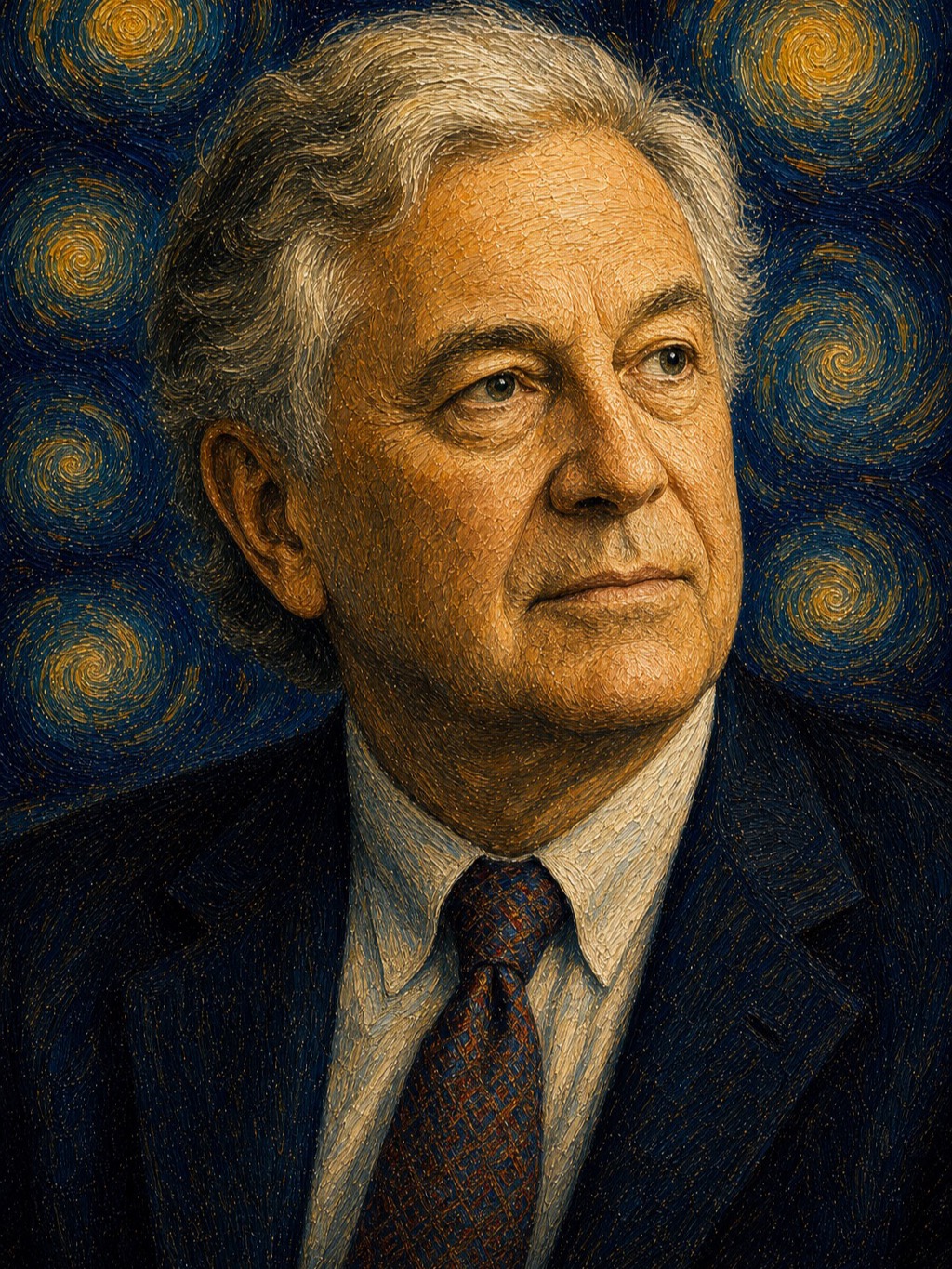
Bruce Kovner
Turned regime-change imagination, price confirmation, and risk-defined sizing into Caxton's macro engine, while showing that capacity, legal boundaries, and platform design are part of the edge.
As of 2026-06-29T22:19:53Z, Bruce Kovner is living, retired from day-to-day leadership of Caxton Associates, and chairman of CAM Capital and the Kovner Foundation (BruceKovner.com, 2026; Kovner Foundation, 2026). This profile treats his public investing record as a three-part story: founder-era Caxton macro trading, post-2011 private capital at CAM, and a broader civic/philanthropic footprint that also drew political criticism.
Snapshot
| Field | Detail |
|---|---|
| Born / died | Born in Brooklyn, New York, in 1945; living as of this research date (BruceKovner.com, 2026). |
| Nationality | United States; SEC beneficial-ownership filing lists "Bruce S. Kovner - United States citizen" (SEC Schedule 13G/A, 2021). |
| Main vehicles | Caxton Associates / Caxton Associates LP, founder and CEO/chairman from 1983-2011; CAM Capital, founded in 2012 as a private investment office; Kovner Foundation for philanthropy (BruceKovner.com, 2026; CAM Capital, 2026; Kovner Foundation, 2026). |
| Years active | Futures trading began in 1977; Caxton founder/CEO era 1983-2011; CAM private-capital era from 2012 onward (BruceKovner.com, 2026; AI-CIO, 2011). |
| Asset classes | Currencies, interest rates, commodities, equities, financial futures, derivatives, and later public/private capital-structure investments (Institute for Advanced Study, 2010; CAM Capital FAQ, 2026). |
| Style tags | Global macro; discretionary trading; regime-change analysis; risk-first sizing; multi-strategy platform building; private family-office special situations. |
| Verified track record | Caxton official biography says the firm reached $12 billion in assets and produced average net annual returns above 21%; AI-CIO, summarizing Kovner's 2011 retirement communications, says Caxton compounded at more than 21% and returned more than $12 billion to investors. These are firm/founder-reported public figures, not a reconstructed audited return series (BruceKovner.com, 2026; AI-CIO, 2011). |
| Peak AUM | At least $12 billion by official biography; Institutional Investor reported $10 billion in Caxton assets in 2002. Larger unsourced internet figures are not used here (BruceKovner.com, 2026; Institutional Investor, 2003). |
Life & Career Timeline
1945-1960s - Brooklyn, Los Angeles, and Harvard. Kovner was born in Brooklyn in 1945 to parents descended from Eastern European immigrants. The family moved to suburban Los Angeles in 1953; his official biography says he attended public schools, became a National Merit Scholar, played varsity basketball, and was elected both class president and student-body president at Van Nuys High School (BruceKovner.com, 2026). He then attended Harvard on scholarship, studied government and economics, and was influenced by Henry Kissinger, Edward Banfield, and James Q. Wilson; he enrolled at Harvard's Kennedy School for doctoral work but left after coursework and exams rather than pursue an academic career (BruceKovner.com, 2026). The Institute for Advanced Study separately confirms his Harvard B.A. in 1966 (IAS, 2010).
1970s - Policy, self-study, and the first futures trade. After leaving academia, Kovner moved through policy and other work before teaching himself currency, commodity, and debt markets. His Market Wizards interview, cited in later source maps, treats the 1977 soybean-futures episode as formative: early leverage produced a large paper gain and a sharp reversal, teaching him that survival depends on sizing and pre-planned exits (Jack Schwager, 1989/1993; Business Insider/Mercenary Trader, 2011). That episode is self-reported/interview-derived, but it is consistent with the risk-control doctrine he later articulated publicly.
Late 1970s-1983 - Commodities Corporation apprenticeship. IAS says Kovner had an early trading career at Commodities Corporation in Princeton before founding Caxton (IAS, 2010). The importance of this period is not just employer pedigree; Commodities Corporation was a training ground for discretionary and systematic macro traders, and Kovner's later process combines Michael Marcus-style tolerance for being wrong with unusually strict loss control.
1983-1993 - Caxton's founder-led macro decade. Kovner founded Caxton in 1983. In his 2003 20th anniversary speech, he said Caxton began with about $10 million of capital, including $7 million from investors and $5 million of his own, and in its first decade earned roughly $3 billion of profits with a 55.6% gross annual trading return and 1.68 Sharpe ratio (Kovner, 2003). These are founder-reported figures and should be treated as internal public disclosure rather than independently audited data. The qualitative setup is well supported: floating exchange rates, futures-market growth, inflation, oil shocks, Plaza Accord-era currency shifts, and weak macro infrastructure at traditional institutions gave early global macro specialists an unusually rich opportunity set (Kovner, 2003).
1994-2003 - Shrinking, rebuilding, and institutionalizing. Caxton's 1994 result was only a 2.4% loss by Kovner's account, but he regarded it as evidence that the original edge had decayed. He returned 60% of investor capital, cut assets to about $650 million, and rebuilt the firm into roughly 50 trading centers across macro, equities, quantitative systems, and fixed-income strategies (Kovner, 2003). By 2003 he said his own trading represented only about 10-15% of firm risk. That matters for attribution: later Caxton profits are partly Kovner the allocator and institution-builder, not simply Kovner the trader.
2002-2011 - Late Caxton scale and succession. Institutional Investor reported that Caxton Global Investments gained 26.45% net in 2002, with Caxton running $10 billion; it also said Kovner had not had a down year since 1994, when the fund lost 3% in a bond-bear-market year (Institutional Investor, 2003). In 2011, Kovner retired after 28 years running Caxton, with Andrew Law becoming CEO; AI-CIO summarized the fund's public retirement-era record as more than 21% compound returns and more than $12 billion returned to investors, explicitly attributing the number to Kovner's communications (AI-CIO, 2011).
2012-present - CAM Capital and philanthropy. CAM Capital says it was established in 2012 after Kovner's Caxton retirement and manages assets exclusively for entities related to Kovner and senior employees (CAM Capital, 2026). Its FAQ states that CAM is independent from Caxton's day-to-day business, although CAM affiliates retain an ownership interest in Caxton; it invests across public and private markets, the corporate capital structure, and external-manager partnerships, with Kovner holding ultimate discretion over CAM decisions (CAM Capital FAQ, 2026). Current SEC/issuer filings still show Kovner-linked CDK/CAM structures in public-company ownership disclosures, including a 2026 Longevity Health prospectus stating that Kovner has voting and dispositive power over CDK holdings (Longevity Health 424B3, 2026).
Vehicles & Structure
Caxton Associates. Caxton was the core public-markets vehicle for Kovner's investing reputation. Current Caxton materials describe the firm as a global macro hedge fund founded in 1983, active across liquid asset classes and combining macroeconomics, market technicals, politics, policy, and company analysis (Caxton, 2026). During Kovner's founder era, the structure evolved from a top-down macro shop into a multi-center trading platform. The key structural distinction is that Caxton was an external-capital hedge-fund manager with client relationships, fee structures, leverage, derivatives infrastructure, risk management systems, and multi-manager capacity.
CAM Capital. CAM is not just "Caxton after Kovner." CAM says it is a private investment company for Kovner-related entities and senior employees, and its terms state that the site is not an offer to provide investment advisory services and that CAM is not a registered investment adviser (CAM Capital FAQ, 2026). The strategy is more patient and fundamentally driven than the public image of Caxton's liquid macro trading: special situations, public and private markets, corporate capital structure, and manager partnerships (CAM Capital, 2026; CAM Capital FAQ, 2026).
Kovner Foundation and civic boards. The Kovner Foundation manages Kovner family philanthropy; its site says Kovner served as Juilliard board chair from 2001 through 2022 and currently serves on Lincoln Center, Metropolitan Opera, and American Enterprise Institute boards (Kovner Foundation, 2026). Juilliard says the Kovner Fellowship covers full estimated cost of attendance and was established in 2014 through Bruce and Suzie Kovner's support (Juilliard, 2026).
Track Record Detail With Caveats
Kovner's headline Caxton record is extraordinary but still private-fund evidence. The clean public anchors are: official biography claims $12 billion in assets and average net annual returns over 21%; AI-CIO says, from Kovner's retirement-era communications, that Caxton compounded at more than 21% and returned more than $12 billion to investors; the 2003 speech reports first-decade profits of about $3 billion from about $10 million of starting capital, a 55.6% gross annual trading return, a 1.68 Sharpe ratio, a 1994 loss of 2.4%, and post-1995 trading profits of $8.5 billion through the speech date (BruceKovner.com, 2026; AI-CIO, 2011; Kovner, 2003).
The caveat is that these are not a year-by-year audited public record. Caxton was private; publicly available SEC filings show reporting structures and certain holdings, not full macro books, leverage, short positions, or derivatives P&L. A 2022 SCYNEXIS 13G/A, for example, shows Caxton Corporation/CDK/Kovner beneficial-ownership structure and shared voting/dispositive power in a public equity position, but that kind of filing is not enough to reconstruct total portfolio returns (SCYNEXIS 13G/A, 2022).
Kovner also has a clean-money-management caveat and a controversy caveat. The legal record most relevant to the investing file is Three Crown Ltd. Partnership v. Caxton Corp., a 1993 SDNY decision preserving allegations that Kovner convened a meeting around two-year Treasury notes and that Caxton and others built very large positions. The decision is a motion-stage legal record: many claims were dismissed or narrowed, and the allegations should not be written as findings of wrongdoing (Justia, 1993). Still, it belongs in the profile because it shows the market-impact and legal-boundary risk of very large macro positions.
The public criticism caveat is political/philanthropic rather than directly trading-related. New York Magazine profiled Kovner as a powerful, private conservative donor and arts patron in 2005, and SourceWatch criticizes his AEI/Manhattan Institute/New York Sun-linked giving from an advocacy perspective (New York Magazine, 2005; SourceWatch, 2026). The investor-relevant point is not partisan labeling; it is that Kovner studies policy as market input while also funding policy institutions, creating reputational context that should not be confused with Caxton return evidence.
Why They Matter
Kovner matters because he represents the institutionalization of discretionary global macro. Soros and Druckenmiller are better known as public characters; Kovner is more useful for the Canon as a system-builder. He combined scenario imagination, policy analysis, technical confirmation, ruthless sizing, and a willingness to return capital when the opportunity set no longer matched the asset base. The 1994 capital return is one of the clearest public examples of capacity discipline in hedge-fund history: a small loss led not to marketing spin but to shrinking the capital base and rebuilding the process (Kovner, 2003).
His record also shows the limits of simple emulation. Individual investors can copy pre-trade loss definition, correlation awareness, humility after confusion, and the habit of studying regimes. They cannot copy Caxton's liquidity, derivatives access, global staffing, prime-broker relationships, client tolerance, legal/compliance apparatus, or ability to return billions of capital and still attract elite talent. CAM's current structure pushes the lesson even further: Kovner's own post-Caxton capital is private, patient, and opportunistic, not a public macro signal service (CAM Capital FAQ, 2026).
Finally, Kovner matters because his career forces a non-hagiographic definition of "great investor." The Caxton record is exceptional, but much of it remains founder/firm-reported and unreconstructed. The Treasury-note litigation is not a proven stain, but it is a necessary boundary marker. The political/philanthropic footprint is large and contested. The disciplined reading is that Kovner was a world-class macro risk allocator whose evidence base is strongest at the firm/program level, thinner at the trade-ticket level, and entangled with public-power questions outside the P&L.
Open Questions For Later Tasks
- Reconstruct a year-by-year Caxton net return series from investor letters, databases, contemporaneous press, or institutional allocators rather than relying on average-return summaries.
- Locate the original 2011 Kovner retirement letter and Andrew Law transition letter, not just AI-CIO/Bloomberg summaries.
- Page-check the Market Wizards chapter in a licensed copy before using exact quotations in Task E.
- Trace the final procedural history of the Three Crown litigation after the 1993 motion decision.
- Verify the exact birth date from a primary or high-quality biographical source; this profile uses "born 1945" because that is the official biography's public level of precision.
- Separate founder-era Caxton P&L from platform/team P&L after Kovner's own trading fell to roughly 10-15% of firm risk.
As of 2026-06-29, Bruce Kovner is not running Caxton day to day: his official biography says he retired from Caxton in 2011 and now chairs CAM Capital, his private investment office (BruceKovner.com, 2026; CAM Capital, 2026). This file therefore treats "Kovner's philosophy" mainly as the philosophy he articulated and practiced while building Caxton from 1983 through 2011, with a short note on the post-Caxton family-office evolution.
Core worldview
Kovner's worldview starts with regime change. In his 2003 Caxton 20th anniversary speech, he framed the firm's origins around the breakdown of Bretton Woods, inflation, floating exchange rates, new financial futures, oil shocks, and the failure of long-only stock/bond methods to capture the opportunities created by the 1970s (Kovner, 2003). The central maxim was simple: "The World Changes. Nothing is Permanent." That is not just a philosophical line; it is the operating premise of a global macro trader who expects institutions, policies, market structures, and crowd beliefs to mutate.
The practical consequence is that Kovner did not see markets as static discounting machines. He saw them as adaptive social systems periodically disturbed by policy mistakes, changing liquidity structures, technology, wars, commodity shocks, and the birth of new instruments. In the same speech he credited Caxton's early opportunity set to falling barriers to financial markets, poor systematic macro analysis at incumbent institutions, underdeveloped derivatives skill, and the cultural constraints of long-only managers (Kovner, 2003). Caxton's current public description still echoes that mix: macroeconomics, market technicals, politics, policy, and company analysis across liquid asset classes (Caxton, 2026).
His worldview is also anti-dogmatic. Kovner's Market Wizards interview, as summarized and excerpted by later sources, emphasizes imagining alternative states of the world and waiting for the market to confirm or deny them (Schwager, 1993; Macro Ops, 2016). That makes the philosophy different from both value-investing intrinsic-value patience and pure trend-following. It is a scenario process: build competing pictures, listen to price, and keep the one that starts matching reality.
The edge - what markets misprice and why
Kovner's edge was not one permanent anomaly. It was the capacity to exploit temporary disequilibria created by change. In 1983, Caxton's edge came from new liquid markets, unsystematic macro analysis by large institutions, and the ability to use long, short, relative-value, trend-following, mean-reversion, and derivative structures where traditional managers had institutional limits (Kovner, 2003).
The mispricing claim has three layers. First, policy regimes matter and are often misunderstood. Kovner explicitly told colleagues that politics and policy changes must be studied because policy makers often get things wrong, and those mistakes themselves can move markets (Kovner, 2003). Second, market prices contain information that macro narratives alone miss. His Market Wizards-derived framework treats technical analysis less as prediction than as a "thermometer" for where the market is and whether a fundamental story is being confirmed (Business Insider/Mercenary Trader, 2011; Macro Ops, 2021). Third, crowd observation can destroy edge. The more widely a pattern is watched by speculators, the more vulnerable it becomes to false signals; less-observed markets driven by non-speculative flows can offer better signal quality (Business Insider/Mercenary Trader, 2011).
Caxton's institutional edge evolved from founder insight into organizational learning. In the first decade, Kovner described Caxton as largely top-down macro. After the 1994 loss, he concluded that one style would not work forever and built a broader platform of roughly 50 trading centers spanning macro, equity, quantitative systems, and fixed income strategies (Kovner, 2003). In other words, the durable edge was not "being right on macro"; it was the discipline to retire decaying techniques, reallocate risk, and keep searching for fresh, low-correlation return streams.
Process: idea sourcing -> research -> valuation and entry -> sizing -> portfolio construction -> sell discipline
Idea sourcing. Kovner sourced ideas from macro transitions, policy choices, market structure, price behavior, and exogenous shocks. His 2003 list includes exchange-rate regime change, oil shocks, the Plaza accord, the 1987 crash, wars, currency unions, China's commodity demand, Japan's long deflation, mortgage-market growth, technology, and terrorism risk (Kovner, 2003). Caxton's current website describes a similar research mix: macroeconomics, technicals, politics plus policy, and company-level analysis (Caxton, 2026).
Research. Kovner's research process was explicitly multi-disciplinary. His official biography says he studied the history and nature of currency, commodity, and debt markets before trading futures, and later concentrated at Caxton on financial and commodity markets based on views of macroeconomic conditions (BruceKovner.com, 2026). The Market Wizards-derived material adds the mental practice: hold several alternative scenarios, wait for enough elements to "click," and keep price action as confirmation rather than decoration (Macro Ops, 2016).
Valuation and entry. Kovner did not describe entry in discounted-cash-flow terms. Entry was a fusion of fundamental cause and technical confirmation. He would not hold a position without a fundamental reason for why a market should move, but he also used price action to clarify whether the market was validating that reason (Business Insider/Mercenary Trader, 2011; Macro Ops, 2021). In macro, the "valuation" is often the mismatch between the current price and a plausible regime path, with entry triggered only when market behavior stops contradicting the thesis.
Sizing. Kovner sized by risk, not notional dollars. In the 2003 speech, he said Caxton targeted risk levels rather than nominal dollar levels, allowing leverage and portfolio theory to optimize the risk profile (Kovner, 2003). The Market Wizards-derived risk rules are stricter at the trade level: predetermine the stop before entry, set position size from the distance to that stop, and avoid novice-size risk of 5-10% per trade; Kovner's cited range was closer to 1-2% (Business Insider/Mercenary Trader, 2011; Macro Ops, 2016).
Portfolio construction. Caxton was built to avoid fixed allocation. Kovner's 2003 breakdown had about 35% of firm risk in macro-oriented centers, 25% in equity-oriented centers, 25% in quantitative systems, and 15% in fixed income strategies; he also said his own trading had fallen to roughly 10-15% of company risk as the firm moved toward a more robust platform (Kovner, 2003). The philosophy was not "diversify names"; it was diversify independent sources of risk and return.
Sell discipline. There are three sell disciplines. The first is the pre-set trade stop: know where the thesis fails before entry (Business Insider/Mercenary Trader, 2011). The second is emotional-equilibrium discipline: if an event disrupts the trader's understanding of the world, close positions related to that event rather than hoping through confusion (Macro Ops, 2016). The third is capital-allocation discipline: when returns on a strategy or on total Caxton capital fall, retire the technique or send capital back to investors (Kovner, 2003).
Risk management
Risk control is the spine of the philosophy. Kovner made this explicit in 2003 with the line "risk control, risk control, risk control" (Kovner, 2003). The phrase is easy to turn into folklore, but the underlying controls were concrete: target risk rather than dollars, keep correlation in view, use technical stops, size from loss point rather than conviction, cut exposure after confusion, and allocate capital dynamically.
Correlation risk may be the most important non-obvious element. In the Market Wizards-derived material, Kovner warns that eight highly correlated positions are economically one oversized position (Business Insider/Mercenary Trader, 2011; Macro Ops, 2016). This matters for global macro because many trades that look different - currencies, commodities, bonds, equity indexes - can all be expressions of the same dollar, inflation, liquidity, or policy factor.
The strongest evidence that risk discipline was institutional, not rhetorical, is Kovner's 1994 reaction. Caxton was down only 2.4% in a year Kovner regarded as awful; the firm then returned 60% of investor funds, cut capital to $650 million, and rebuilt the strategy set (Kovner, 2003). That is unusual because most asset managers preserve fee base after a small loss. Kovner's response implies that perceived strategy decay, not just actual drawdown, was enough to trigger capital reduction.
There is still leverage and tail-risk tension. Caxton used derivatives, shorts, and leverage by design, and a 1993 federal decision shows Caxton/Kovner were defendants in Treasury-note squeeze litigation arising from large positions in 1991 two-year notes; many claims were dismissed or narrowed, but the case is a reminder that sophisticated macro trading can create market-impact and legal-risk questions, not just price risk (Justia, 1993). This does not negate Kovner's risk-control philosophy; it defines its hard edge.
Temperament and psychology
Kovner's temperament model is rational, independent, and willing to be wrong often. The Market Wizards-derived material credits Michael Marcus with teaching Kovner that repeated mistakes are normal if they are kept small and followed by the next best judgment (Macro Ops, 2016). Kovner also separates loss from identity: if a trader personalizes losses, the diagnostic process breaks down (Business Insider/Mercenary Trader, 2011).
His psychological edge was the ability to imagine alternative worlds seriously. That is not generic open-mindedness; it requires enough conviction to act before consensus shifts, and enough humility to abandon the picture when the market refuses to confirm it. The temperament is therefore contrary but not stubborn. He wanted to know when many people were likely wrong, but he also insisted that the market's vote mattered (Macro Ops, 2016; Business Insider/Mercenary Trader, 2011).
Evolution over career
Kovner's first evolution was from political economy into markets. His official biography says he studied government and economics at Harvard, worked in politics and academia, then began self-study of currency, commodity, and debt markets before trading futures in 1977 (BruceKovner.com, 2026). Commodities Corporation gave him a trading apprenticeship before he founded Caxton in 1983 with $7 million from investors and $5 million of his own money (Kovner, 2003).
The second evolution was from founder-led macro to institutional multi-strategy macro. The early Caxton model exploited the post-1970s opportunity set; by the mid-1990s, Kovner believed early-entry advantages had narrowed, macro analysis had become routine, and Caxton's size was too large for some quick trades (Kovner, 2003). The response was not to abandon macro but to broaden the firm across liquid markets, trading styles, research and development, and risk-control technology.
The third evolution is post-Caxton. Kovner handed leadership to Andrew Law and retired from Caxton after 28 years as CEO (AI-CIO/Bloomberg, 2011). CAM Capital, established in 2012, is a private office investing Kovner-related and senior-employee assets, with a fundamentally driven, opportunistic, long-duration approach across public and private markets and the corporate capital structure (CAM Capital, 2026; CAM Capital FAQ, 2026). That shift matters: Kovner's current capital is patient and private, so it should not be evaluated like the old external-capital Caxton macro fund.
What they explicitly reject
Kovner rejects static allocation. Caxton would not be stuck in a fixed mix of stocks, bonds, currencies, or commodities; capital allocation was meant to change with conditions (Kovner, 2003).
He rejects asset gathering. In 2003 he said Caxton wanted only the capital it could deploy successfully and would return money when expected returns declined (Kovner, 2003).
He rejects one-style permanence. Trading techniques have finite lives because capital and knowledge compress returns; techniques must be retired when high risk-adjusted returns disappear (Kovner, 2003).
He rejects price-blind fundamentals. Macro views need market confirmation; charts are a diagnostic instrument, not an embarrassment (Business Insider/Mercenary Trader, 2011).
He rejects oversized conviction. The novice error is not being wrong; it is being too large, too correlated, and too emotionally attached when wrong (Macro Ops, 2016).
Regimes where it thrives vs. struggles
The Kovner model thrives in regimes with macro discontinuity, policy mistakes, high dispersion across countries and asset classes, liquid derivatives, and crowded consensus that price action does not confirm. The 1970s and 1980s were ideal because floating exchange rates, high inflation, commodity shocks, financial futures, and institutional rigidities created repeated cross-asset dislocations (Kovner, 2003). Caxton's ability to make money in 2002 while equities were down also fits the model's absolute-return, low-correlation promise (Institutional Investor, 2003).
It struggles when macro opportunity becomes crowded, volatility compresses, liquidity disappears, or all trades share one hidden factor. Kovner's own 2003 speech identifies the mid-1990s problem: more hedge funds, prop desks, and speculators entered; macro analysis became routine; Caxton's asset base limited small-market agility; and the firm had to rebuild after a 1994 loss (Kovner, 2003). The 2010 Institutional Investor article also shows how later Caxton leadership still had to reduce risk quickly during turbulent European-market conditions, reinforcing that the process depends on fast risk reduction, not prophetic certainty (Institutional Investor, 2010).
Tensions between stated philosophy and actual behavior
Self-reported track record. Kovner's official biography states Caxton became a $12 billion macro hedge fund with average net annual returns above 21%, and the 2003 speech gives first-decade and post-1995 profit/Sharpe figures (BruceKovner.com, 2026; Kovner, 2003). These numbers are central to the philosophy because they validate risk-adjusted macro compounding, but they remain largely private-fund figures rather than a fully public audited return series. Treat them as founder/firm-reported unless later profile work reconstructs primary fund documents.
Founder genius vs. platform repeatability. Kovner's early record is tied to his personal scenario imagination and risk discipline. By 2003, however, his own accounts were only 10-15% of firm risk, and he described his role as strategic development rather than tactical control (Kovner, 2003). That evolution strengthens the institutional case but weakens any simple "copy Kovner's trades" lesson.
Risk control vs. market impact. The 1993 Treasury-note litigation alleged squeeze/manipulation theories against Caxton, Kovner, and others; the court granted some motions to dismiss and denied others in part, including allowing certain antitrust/common-law theories to proceed or be amended (Justia, 1993). This is a process caveat: risk control for the fund is not the same as absence of market-structure controversy.
Politics as research vs. politics as identity. Kovner's investment philosophy says politics and policy matter analytically; his public philanthropy and political giving also made him a visible conservative donor and target of criticism from groups such as SourceWatch (Kovner Foundation, 2026; SourceWatch, 2017). For investing purposes, the tension is not partisan; it is that a trader who studies policy also operates inside political networks and beliefs that may shape which risks feel salient.
Transferability. Individual investors can copy the discipline of risk-first sizing, pre-set exits, scenario thinking, and skepticism toward static allocation. They cannot copy Caxton's data, trading talent, prime-broker access, derivatives infrastructure, multi-manager platform, ability to return billions of capital, or legal/compliance apparatus. CAM Capital's current FAQ underscores that Kovner's post-Caxton vehicle is a private office with patient capital and external-manager partnerships, not a public model portfolio (CAM Capital FAQ, 2026).
As of 2026-06-29T19:57:25Z, Bruce Kovner is living, retired from day-to-day leadership of Caxton Associates, and chairing CAM Capital, his private investment office. His official biography says he founded Caxton in 1983, served as CEO for 28 years until 2011, and built the firm into a macro hedge fund with about $12 billion in assets and average net annual returns above 21% Bruce Kovner official biography. Because Caxton was a private fund and Kovner kept a deliberately low profile, this file ranks the best publicly reconstructable trades and trade programs, not a complete trade blotter.
Evidence stance and ranking method
Kovner's record has three different evidence grades:
- Firm/founder-reported program numbers. Kovner's 2003 Caxton anniversary speech gives the clearest first-party return history: roughly $3 billion in profits during the first decade from about $10 million of starting capital, a 55.6% gross annual trading return, a -2.4% year in 1994, a 60% investor capital return, and then $8.5 billion in trading profits from January 1995 to the speech date Caxton 20th Anniversary speech. These are valuable but are not an audited public ledger.
- Interview and press numbers. Jack Schwager's Market Wizards interview supplies Kovner's most detailed self-narrative and says he made profits above $300 million in 1987, but many individual trades are described without complete entry/exit data Schwager, Market Wizards PDF. A republished Forbes account says Caxton made about $300 million around the September 1992 ERM break Forbes/Compliance Alert mirror. Treat these as serious but source-limited.
- Legal records and filings. The 1993 Three Crown v. Caxton decision preserves allegations about a 1991 Treasury-note squeeze. It is a primary legal record of claims and motion rulings, not a finding that Kovner or Caxton manipulated the market Justia.
I rank "greatest" by a blend of absolute profit, clarity of attribution to Kovner/Caxton, impact on his investing method, and durability of lesson. Where a figure depends on a single source, the file says so.
1. The ERM / Black Wednesday currency break, 1992 - best identifiable single trade
Context and dates. In September 1992, the European Exchange Rate Mechanism came under pressure as the British pound and other currencies were held at levels that speculators judged inconsistent with German monetary policy and domestic political constraints. The famous protagonist was George Soros, but the Forbes account also identifies Kovner's Caxton as a major winner in the same cluster of trades Forbes/Compliance Alert mirror.
Thesis and how found. The trade fit Kovner's core macro habit: treat currencies as expressions of policy, politics, liquidity, and central-bank credibility. Kovner's official biography describes him as trading financial and commodity markets from macroeconomic views Bruce Kovner official biography. Caxton's own current description still frames the firm around global macro analysis across commodities, currencies, fixed income, equities, and related derivatives Caxton Associates. The ERM setup was a classic Kovner environment: an apparently rigid policy arrangement whose defense required sustained political and monetary coordination.
Size and structure. Public sources do not disclose Caxton's exact instruments or position size. The likely implementation was short overvalued ERM currencies against the deutsche mark and/or dollar through liquid foreign-exchange forwards, futures, options, or interbank positions, but the exact mix is not public. Fund percentage is unknown.
Entry, path, and drawdown. The exact entry date and path are not public. The trade likely required tolerating central-bank intervention risk and the possibility of abrupt squeezes against speculators. Kovner's earlier Schwager interview shows he was acutely aware that currencies could move violently when central banks attempted to punish leveraged traders Schwager, Market Wizards PDF.
Exit and P&L. The Forbes account, republished by Compliance Alert, reports Caxton made about $300 million as the group of macro funds profited from the ERM break Forbes/Compliance Alert mirror. This is the best candidate for Kovner's single greatest publicly identifiable trade, but the figure is [single-source] and not split by currency, instrument, or investor vehicle.
What it teaches. Kovner's edge was not simply being bearish on sterling. The transferable lesson is that fixed or semi-fixed exchange-rate regimes can become trades when the political promise, central-bank balance sheet, domestic economy, and market positioning diverge. The non-transferable part is Caxton's liquidity, balance sheet, and 24-hour execution infrastructure.
Sources. Forbes/Compliance Alert; Kovner official biography; Caxton website; Schwager.
2. The 1987 crash survival and dollar-decline reset
Context and dates. Schwager's chapter introduces Kovner as one of the world's largest interbank currency and futures traders and says that in 1987 he earned profits above $300 million for himself and his investors Schwager, Market Wizards PDF. The most instructive episode inside that year was the October 1987 stock-market crash.
Thesis and how found. Kovner's first reaction was not prediction but risk control. In the Schwager interview, he says he closed positions on October 19 and 20 because something was happening that he did not understand. He then reassessed the macro implications. His broader method, as restated in the 2003 Caxton speech, was to distinguish real regime change from noise and redirect risk when the environment changed Caxton 20th Anniversary speech.
Size and structure. Public sources do not disclose the exact trade book. Given Kovner's specialization at the time, the relevant exposures were likely foreign exchange, interest-rate futures, and related liquid macro instruments. Schwager characterizes him as trading positions with face value in the billions, but not the exact October 1987 risk.
Entry, path, and drawdown. The notable action was getting out first. He reduced positions when his explanatory model broke, then looked for a new post-crash scenario. That discipline is consistent with the later Caxton emphasis on daily risk measurement, low correlation, and avoiding positions whose loss mechanism is not understood Schwager, Market Wizards PDF; Caxton 20th Anniversary speech.
Exit and P&L. Schwager reports 1987 profits above $300 million, but that is a full-year Kovner/Caxton figure, not a verified P&L for one post-crash dollar trade. Treat it as [single-source; period-level, not ticket-level].
What it teaches. The best macro traders can be aggressive only because they know when to get flat. The crash episode shows Kovner's deepest rule: when the causal map fails, preserving optionality is itself the trade.
Sources. Schwager; Caxton 20th Anniversary speech.
3. Caxton's first-decade macro program, 1983-1993
Context and dates. Kovner founded Caxton in 1983 after his Commodities Corporation years. His official biography says he founded the firm in 1983 and concentrated on financial and commodity markets through macroeconomic views Bruce Kovner official biography. In the 2003 anniversary speech, he described the first decade as a period of unusually rich opportunity in floating currencies, futures markets, global rates, commodities, and policy volatility Caxton 20th Anniversary speech.
Thesis and how found. The great trade was not one instrument. It was the recognition that the newly globalizing macro market structure offered recurring mispricings for a small, analytically intense, fast-moving fund. Kovner argued in the speech that early entrants benefited from fewer competitors, less routine macro analysis at banks, and the ability to exploit smaller or less trafficked opportunities.
Size and structure. Kovner says Caxton began with about $10 million of capital and made about $3 billion in profits over its first ten years. He also reports a 55.6% gross annual trading return and a Sharpe ratio of 1.68 Caxton 20th Anniversary speech. This is best treated as a multi-year macro program across currencies, rates, commodities, and financial futures, not a single trade.
Entry, path, and drawdown. The path was volatile. Kovner compared the experience to a roller coaster and later judged the first-decade process as too dependent on top-down macro, his own tactical responsibility, and an opportunity set that would not last forever Caxton 20th Anniversary speech.
Exit and P&L. There was no single exit. The program's edge decayed as assets and competition grew. The reported $3 billion profit figure is [founder-reported] and not independently reconciled to audited financial statements.
What it teaches. The first-decade Caxton story is a lesson in matching strategy to market ecology. Kovner's great insight was to exploit a young, under-institutionalized macro market before it became crowded, then acknowledge when that ecology changed.
Sources. Kovner official biography; Caxton 20th Anniversary speech; Institute for Advanced Study biography IAS.
4. The 1994 capital return and 1995-2003 multi-strategy rebuild
Context and dates. Caxton lost 2.4% in 1994. For most funds that would be a mild year; for Kovner it was a warning that the old model had gone stale. By his 2003 account, Caxton returned 60% of investor capital, cut capital to about $650 million, and rebuilt the firm around roughly 50 trading centers across macro, equities, quant, and fixed income Caxton 20th Anniversary speech.
Thesis and how found. Kovner concluded that the original top-down macro opportunity set had narrowed as hedge funds, prop desks, and banks became better competitors. The "trade" was to shrink assets, reduce the old risk engine, and buy/build a portfolio of less correlated strategies. This was a capital-allocation trade rather than a market-direction trade.
Size and structure. The structure was an internal reallocation of Caxton's risk budget. Kovner reports macro centers at about 35% of firm risk, equities at 25%, quantitative systems at 25%, and fixed income at 15% at the time of the speech. He also says his own trading had fallen to roughly 10-15% of company risk Caxton 20th Anniversary speech.
Entry, path, and drawdown. The entry point was the 1994 disappointment and the choice to reduce capital when asset-gathering might have been easier. The path required finding new strategies, hiring or developing managers, and accepting that not every new trading center would work.
Exit and P&L. Kovner reports that from January 1995 through the speech date, Caxton earned $8.5 billion in trading profits and generated a 33.1% average annual return. These figures are [founder-reported]. They are also platform-level numbers, not solely Kovner's personal trading P&L.
What it teaches. One of Kovner's best trades was selling his own capacity. He recognized that a once-great edge can decay under asset growth and imitation. Returning capital was an investment decision, not humility theater.
Sources. Caxton 20th Anniversary speech; Kovner official biography; AI-CIO retirement/succession account AI-CIO.
5. The first soybean futures trade and near-failure, 1977
Context and dates. Kovner's first major trade, before Caxton, was in soybean futures. In Market Wizards, he describes an early account that grew dramatically through a leveraged soybean position and then nearly turned into his psychological "going bust" experience when the market reversed Schwager, Market Wizards PDF.
Thesis and how found. The thesis came from commodity study and technical/market observation, not from a mature institutional process. This matters because the trade contains both the origin of Kovner's confidence and the origin of his fear of uncontrolled leverage.
Size and structure. The account was tiny by later standards. Public retellings of the Schwager interview commonly summarize the beginning as a roughly $3,000 account that produced about $22,000 in profits before the reversal. The exact contract path and margin use should be treated as [interview-derived] rather than independently audited Schwager, Market Wizards PDF; Business Insider/Mercenary Trader.
Entry, path, and drawdown. Kovner pyramided aggressively and then faced a limit-down shock. He survived by exiting, but the episode left him with a durable rule: emotional disturbance or a broken model means flattening the related risk.
Exit and P&L. The trade ended profitable in dollar terms, but he gave back a large portion of the gains. It is not a greatest trade by absolute dollars. It belongs here because it created the risk-control reflex that made the later Caxton trades possible.
What it teaches. An early win can be dangerous because it teaches the wrong lesson about leverage. Kovner's genius was that he converted a near-miss into a lifelong operating rule.
Sources. Schwager; Business Insider/Mercenary Trader.
6. The 1991 two-year Treasury-note long - contested and legally sensitive
Context and dates. In 1991, Caxton and other major macro players were accused in civil litigation of participating in a squeeze in the April and May 1993 two-year Treasury notes. The 1993 Southern District of New York decision in Three Crown v. Caxton is a primary record of the allegations and motion rulings Justia.
Thesis and how found. The alleged trade was a rates/liquidity trade around Treasury issuance, scarcity, and financing-market pressure. The public record does not show Kovner's internal thesis. The court record says plaintiffs alleged a meeting involving Kovner and others and alleged large positions in the relevant notes. Those are allegations, not adjudicated findings.
Size and structure. Plaintiffs alleged that Steinhardt Partners and Caxton each acquired $2.5 billion in when-issued April 1993 two-year notes, and that by the early secondary-market stage each had positions equivalent to $8 billion, or 133% of the issue Justia. This must be labeled [disputed/legal allegation].
Entry, path, and drawdown. The public record does not provide Caxton's entry prices, financing terms, risk limits, or internal drawdowns. It does show how a large, successful-looking rates trade can become entangled with market-structure and manipulation allegations.
Exit and P&L. No reliable public P&L for Caxton is available. This is not ranked as a clean "great trade"; it is included because any institutional account of Kovner's largest trades must not sanitize the legal/market-impact risk around large Treasury positions.
What it teaches. Liquidity is not just a trading input; it is a legal and reputational boundary. The bigger a macro fund becomes, the more a profitable squeeze-like setup can become a governance problem.
Sources. Justia; SEC 13G record for Caxton/Kovner structure SEC Butler 13G.
7. Crisis-era preservation and succession discipline, 2008-2011
Context and dates. Kovner remained Caxton's CEO through the global financial crisis and retired in 2011. The official biography gives the 1983-2011 CEO period, and AI-CIO reported the 2011 succession to Andrew Law Bruce Kovner official biography; AI-CIO.
Thesis and how found. The trade here is partly negative: do not let a macro hedge fund's identity depend on heroic personal trading when the market structure and the founder's role have changed. Kovner's 2003 speech already shows the transition: his own accounts represented a minority of risk, while the firm invested heavily in research, technology, risk control, and multiple trading centers Caxton 20th Anniversary speech.
Size and structure. Public sources do not disclose the 2008 Caxton book. Institutional Investor coverage of Caxton after Kovner's transition emphasizes the firm's continued macro and risk-control culture, but attribution shifts increasingly to Law and the broader platform Institutional Investor, "Caxton Makes Money In May".
Entry, path, and drawdown. The relevant path is organizational. Caxton had to preserve capital and process through 2008-2011 while Kovner prepared succession. Current CAM materials then separate Kovner's later private family-office activity from Caxton's external hedge-fund platform CAM Capital About; CAM Capital FAQ.
Exit and P&L. No trade-level P&L is public. The official biography's $12 billion asset and over-21% average net return claims are career-level Caxton claims, not 2008-2011 trade figures Bruce Kovner official biography. Treat this episode as a platform-preservation trade, not a personal directional trade.
What it teaches. A great investor eventually has to trade away from himself. Kovner's later Caxton period shows the value of building a process that can survive the founder's reduced trading footprint and eventual retirement.
Sources. Kovner official biography; Caxton 20th Anniversary speech; AI-CIO; Institutional Investor; CAM Capital.
Excluded or not rankable
- Post-2011 public-equity and private investments. SEC and issuer filings show later CDK/CAM-related holdings and Kovner voting/dispositive power in some public companies, but these belong mainly to CAM Capital or CDK after his Caxton CEO era and do not provide complete entry/exit/P&L evidence SCYNEXIS 13G/A; Longevity Health 2026 424B3.
- Caxton after Andrew Law became the clear successor. Later Caxton wins are relevant to Kovner's institution-building but should not be attributed to Kovner personally without specific evidence AI-CIO.
- Unsourced internet lists of Kovner trades. Many repeat the same Schwager and Forbes figures without adding primary documents. I used them only as signposts, not as standalone evidence.
Transferable lessons
- Policy regimes create asymmetric trades when credibility breaks. The ERM trade worked because market price, political promise, and central-bank capacity diverged.
- Getting flat can be the highest-return action. The 1987 crash episode and the early soybean near-miss show that Kovner treated confusion as a risk signal.
- Capacity is part of alpha. The 1994 capital return is one of the cleanest examples of a manager shrinking assets because the opportunity set no longer matched the capital base.
- The best macro trade may be a portfolio architecture. Caxton's 1995-2003 rebuild turned a founder-led macro shop into a diversified trading platform.
- Market-impact risk compounds with success. The Treasury-note litigation shows how large macro positions can become legally and reputationally fragile even when the public record does not establish wrongdoing.
Open questions for future work
- Locate a contemporaneous audited or investor-letter return series for Caxton by year, rather than relying on founder and press summaries.
- Find the original Forbes November 1992 issue or a licensed archive scan for page-level verification of the $300 million Black Wednesday figure.
- Trace the final procedural history, settlement, or dismissal record of the Three Crown Treasury-note litigation beyond the 1993 motion decision.
- Recover the original 2011 Kovner retirement letter, not only AI-CIO/Bloomberg summaries.
As of 2026-06-29T23:35:43Z, Bruce Kovner is living, retired from day-to-day leadership of Caxton Associates, and chairing CAM Capital, his private investment office (BruceKovner.com, 2026; CAM Capital, 2026). Kovner does not have a public trail of catastrophic hedge-fund blowups. His mistakes file is therefore about a different pattern: early near-failure, a documented 1981 trading loss, a small 1994 fund loss that revealed capacity decay, a Treasury-note legal/regulatory failure at the firm level, and the evidence gaps created by private-fund opacity.
Evidence stance
The strongest primary sources are Jack Schwager's Market Wizards interview, Kovner's 2003 Caxton anniversary speech, SEC/DOJ/Tunney Act materials on the Treasury-note settlement, and federal court opinions in the Three Crown litigation. Those sources have different reliability. Schwager is a direct interview but still self-reported; Kovner's speech is first-party but celebratory; DOJ/SEC records report allegations, settlements, injunctions, and payments, not a full public trade blotter; Justia preserves court reasoning, but not Caxton's internal ledger. Where a figure is not independently auditable, this file labels it [self-reported], [founder-reported], [settlement record], or [legal allegation].
Major losses, errors, and near-death moments
1. The 1977 soybean spread: the profitable trade that felt like going bust
Kovner's formative mistake was not an absolute-dollar disaster. It was an early soybean-spread trade in 1977 that turned a borrowed $3,000 stake into a much larger account, then exposed how quickly leverage and a spur-of-the-moment decision could reverse apparent genius. In Schwager's interview, Kovner described building a July/November soybean spread to about fifteen contracts, switching brokers after a margin challenge, and then impulsively covering the short leg as the market was in a panic-like move. Within the same day, the account fell from a peak around $45,000 to about $22,000; it was still profitable versus the original stake, but Kovner called it the closest he came psychologically to going bust (Schwager, 1989).
What he said about it later is unusually direct. He did not frame the episode as bad luck. He framed it as a process failure: he had misunderstood the spread's true outright-like risk, let a broker's excitement interrupt his plan, and lost the rationality he thought he possessed. The behavioral root cause was leverage plus emotional contamination. The process change was immediate and durable: when an event breaks his mental model, he closes related positions rather than trying to reason while emotionally unstable (Schwager, 1989; Business Insider/Mercenary Trader, 2011).
The transferable lesson is not "use stops" in a mechanical sense. It is that a trade can be profitable and still be a mistake if the profit came with unrecognized ruin risk. Kovner's later insistence on predefining exits and sizing from the loss point is best read as scar tissue from this episode, not as an abstract trading maxim.
2. The 1981 losing year: bear-market structure and correlated risk
Kovner's clearest reported losing year before Caxton's 1994 loss was 1981, when he told Schwager he lost about 16% [self-reported]. His explanation is more useful than the number. He attributed the loss to a combination of mistakes and market regime: it was his first major bear market in commodities, and he was repeatedly too late selling weakness, then stopped out in countertrend rallies. He also said his money management was poor because he had too many correlated trades (Schwager, 1989).
That is a classic global macro trap. A book can look diversified by instrument - currencies, commodities, rates - while being one hidden bet on the same macro factor. Kovner's post-1981 process change was explicit: he designed risk-management systems, monitored correlations across positions, and measured total market risk daily (Schwager, 1989). This is the bridge between Kovner the talented discretionary trader and Kovner the institution-builder. The loss did not change his belief that macro could be traded; it changed the unit of risk from single trade to portfolio.
3. October 1987: confusion as a risk signal
The 1987 crash is often filed under Kovner's wins because Schwager reports that he made more than $300 million for himself and investors that year [single-source; period-level] (Schwager, 1989). For a mistakes file, the useful part is the moment before the win. Kovner said the week of the October 19 crash left him struggling to understand how the events would affect the dollar. His response was to close positions on October 19 and 20 because the world had moved outside his working scenario (Schwager, 1989).
This was not a realized permanent loss, but it was a near-miss in process terms: a macro trader with billions in face-value exposure can lose heavily for reasons he does not understand. The process change was really a process confirmation. The soybean lesson had taught him to flatten related risk when emotional equilibrium breaks; 1987 showed the same rule at institutional scale. In the later Caxton speech, Kovner framed the 1987 crash as one of the macro shocks that tested the firm's adaptive model, not as a proof that any one forecast was reliable (Kovner, 2003).
4. The 1994 Caxton loss: small drawdown, major diagnosis
Caxton's most important public drawdown under Kovner was 1994. Kovner's 2003 speech says Caxton was down 2.4% that year; Institutional Investor later rounded the loss to about 3% and noted that it came in a bond-bear-market year when many macro investors did far worse (Kovner, 2003; Institutional Investor, 2003). On the surface, a loss of roughly 2-3% after a decade of extraordinary gains is not a disaster. Kovner treated it as a warning light because the opportunity ecology had changed.
His diagnosis was that Caxton had outgrown some of the early macro setup. New hedge funds, bank proprietary desks, and better macro analysis had reduced the early-entrant advantage. Caxton had about $1.6 billion of assets and was no longer small enough for the quick trades that had once driven the returns. Kovner said the firm felt stale, returned 60% of investor capital, cut the capital base to about $650 million, and rebuilt around roughly 50 trading centers across macro, equities, quantitative systems, and fixed income (Kovner, 2003).
The behavioral root cause was not recklessness; it was success. A strategy that works at small scale attracts capital and imitators, and the manager can confuse a decaying edge for a temporary bad patch. Kovner's process change was unusually concrete: return capital, diversify independent trading centers, measure risk by strategy and correlation, and reduce dependence on his own trading. By 2003, he said his personal accounts represented only about 10-15% of company risk, with his role shifting toward strategic development (Kovner, 2003).
5. Treasury-note settlement and Three Crown litigation: market-impact risk
The hardest non-hagiographic item is the 1991 two-year Treasury-note episode. In December 1994, DOJ and SEC announced that Steinhardt Management and Caxton would pay $76 million to settle antitrust and securities charges. The DOJ said the complaint charged that the firms conspired to limit the supply of the April 1991 two-year Treasury note, and the announcement stated that Caxton agreed to pay $36 million: $12.5 million forfeiture, $9.5 million securities-law penalty, and $14 million into a disgorgement fund (DOJ, 1994). SEC's News Digest likewise reported final judgments of permanent injunction, with Caxton consenting without admitting or denying allegations (SEC News Digest, 1994).
The Federal Register's Tunney Act materials are important because they show both severity and legal posture. The proposed final judgment was entered without trial or adjudication and without constituting evidence or admission, while the competitive impact statement says DOJ and SEC resolved liability under antitrust and securities laws and that the injunctive provisions were designed to prevent recurrence in Treasury securities markets (Federal Register, 1995). This should not be written as a personal finding against Kovner. It should be written as a firm-level legal and market-structure failure.
The private Three Crown litigation adds detail and caution. A 1993 SDNY opinion preserved allegations against Caxton, Kovner, and others while dismissing or narrowing some claims; a 1995 opinion describes the alleged injury to Three Crown and limits certain damage theories, including the court's finding that there was no evidence defendants intended to run Three Crown out of business (Justia, 1993; Justia, 1995). The root cause is the dark side of size: when a macro fund can accumulate very large positions in a financing-sensitive market, a profitable liquidity thesis can become a regulatory and reputational problem.
The process lesson is that internal risk controls are not enough. A fund can control price loss and still fail on market-impact, concentration, and legal-boundary risk. Caxton's later 13G filings show the firm could still appear in public ownership structures, but those filings do not reconstruct derivatives books or internal financing practices; they mainly remind future researchers that public filings give entity structure, not full risk (SEC Butler 13G, 2002).
6. Founder dependence and succession risk
Kovner recognized that a founder-led macro shop can become fragile if the founder remains the only center of judgment. His own 2003 speech says that by then he was doing less tactical trading and that a robust process was more important than one dependent on one person (Kovner, 2003). AI-CIO's 2011 retirement article makes the same issue explicit by describing Kovner's handoff to Andrew Law and raising key-man risk as an institutional concern (AI-CIO, 2011).
This was an error avoided rather than a loss suffered. The evidence suggests Kovner reduced the risk before retirement. Institutional Investor reported in 2010 that Law had directed Caxton's day-to-day risk for more than two years, pulled in risk during European turmoil, and was credited with helping the fund earn about 13% in 2008 while broader markets were under severe pressure (Institutional Investor, 2010). The mistake for followers would be to attribute all later platform results to Kovner personally. The process change was succession and platformization.
7. Political and philanthropic reputational risk
Kovner's political and philanthropic activity is not an investing loss, but it matters to a complete mistakes file because global macro trading treats policy as an input. Kovner's official biography says his philanthropy includes the American Enterprise Institute, school choice, charter schools, Juilliard, Lincoln Center, and the Metropolitan Opera (BruceKovner.com, 2026). New York Magazine profiled him in 2005 as an influential, private conservative donor and arts patron, while SourceWatch criticizes his policy-network giving from an advocacy perspective (New York Magazine, 2005; SourceWatch, 2026).
The risk is not that a trader has political views. It is that the same mind that studies policy as market input also operates inside policy networks and donor identities. That can sharpen analysis, but it can also create reputational controversy and possible blind spots. The right process response is separation: use politics as data, not self-confirmation. The available public record does not show a trading loss caused by political belief, so this remains a reputational and analytical caveat, not a documented P&L mistake.
Behavioral root causes
Kovner's mistakes cluster around four root causes.
First is leverage hidden inside structures. The soybean spread looked less risky because it was a spread, but in a shortage it behaved more like an outright long. The Treasury-note issue similarly shows that financing and scarcity can turn a position into a market-structure event.
Second is correlation. The 1981 loss taught that many positions can be one trade if they share a macro driver. This became a permanent risk-system lesson.
Third is capacity. Caxton's 1994 loss showed that asset size and competition can make yesterday's edge too slow, crowded, or small to matter.
Fourth is identity. Founder genius, political worldview, and trading confidence all become dangerous when they harden into self-confirming narratives. Kovner's best process changes were anti-identity moves: get flat when confused, send capital back when stale, and build a platform that can outlive the founder.
Process changes made after
The post-mistake changes are unusually visible:
After the soybean near-bust, Kovner made emotional equilibrium a trading signal. If a position depends on a world model that has broken, exit first and think afterward (Schwager, 1989).
After the 1981 loss, he designed risk-management systems, monitored correlations, and measured total market risk daily rather than viewing positions independently (Schwager, 1989).
After 1994, Caxton returned 60% of investor capital, reduced assets to about $650 million, expanded beyond top-down macro, and built a low-correlation multi-center platform (Kovner, 2003).
After the Treasury-note settlement, the public record shows injunctions, penalties, disgorgement, forfeiture, and the need to treat market-impact/legal risk as distinct from ordinary trading loss (DOJ, 1994; SEC News Digest, 1994; Federal Register, 1995).
Before retirement, Kovner reduced key-person dependence by shifting day-to-day trading responsibility and ultimately handing leadership to Andrew Law; post-Caxton, CAM Capital is explicitly a private, patient-capital vehicle rather than the same external macro fund model (AI-CIO, 2011; CAM Capital, 2026).
Open questions
- Locate original Caxton investor letters for 1981, 1994, 2008, and 2010 to separate Kovner-personal, Caxton Global, and broader platform drawdowns.
- Trace the complete final docket history of the Three Crown civil litigation after the 1995 damages opinion.
- Find the original SEC litigation release or final judgment PDF for SEC v. Steinhardt Management Company and Caxton Corporation, No. 94-civ-9040, beyond the SEC News Digest summary.
- Reconstruct whether the 1994 loss was concentrated in rates, currencies, commodities, or strategy-level basis trades; public sources give the diagnosis but not the trade ledger.
- Verify whether any post-2011 CAM/CDK public holdings produced material realized losses; current public filings show holdings/control, not complete performance.
As of 2026-06-30T03:45:12Z, Bruce Kovner is living and remains publicly associated with CAM Capital and the Kovner Foundation. This file uses short verified excerpts from primary or near-primary materials; where the original is not available, the entry is labeled as a secondary carrier rather than treated as definitive. Quote aggregators were not used as citation authority.
Quote Index By Theme
Risk, Survival, and Position Sizing
- "my 'going bust' trade" - Kovner's description of the soybean-futures episode that taught him that a position can be right directionally and still dangerous if sized badly (Schwager, 1989/1993).
- "stupid mistake" - Kovner's blunt label for letting an early profitable trade reverse hard because he had not respected risk (Schwager, 1989/1993).
- "close out all positions" - His rule when an event disturbs his emotional equilibrium and the world no longer fits his mental model (Schwager, 1989/1993).
- "reasons you don't understand" - The danger zone he tells traders to avoid: losing large amounts in situations they cannot explain (Schwager, 1989/1993).
- "willing to make mistakes regularly" - Kovner's Marcus-derived lesson that a trader survives by making successive best judgments, not by demanding infallibility (Schwager, 1989/1993).
- "rational and disciplined under pressure" - His own capsule description of one requirement for successful trading (Schwager, 1989/1993).
Markets, Regimes, and Adaptation
- "The World changes." - The opening premise of Kovner's 20th anniversary account of Caxton: macro trading exists because environments mutate (Kovner, 2003).
- "dynamic risk allocation" - The phrase he used for varying capital at risk when market or macro conditions offered possible excess return (Kovner, 2003).
- "Listen to the market." - The first of three trading maxims he chose to pass on to Caxton's next generation (Kovner, 2003).
- "Policy matters. Politics matter." - The second maxim: macro traders must study political and policy shifts as market inputs (Kovner, 2003).
- "risk control, risk control, risk control" - His leveraged-trading equivalent of real estate's location mantra (Kovner, 2003).
- "not asset gatherers" - Kovner's capacity-discipline statement after explaining why Caxton would return capital when opportunity did not fit scale (Kovner, 2003).
Institutions, Alpha, and Humility
- "support and loyalty and intelligence" - His acknowledgement that Caxton's success was institutionally produced, not a lone-trader legend (Kovner, 2011).
- "luck and good fortune" - Kovner's first caveat when asked to explain longevity and success in hedge funds (Kovner, 2011).
- "money with brains" - His warning about traders who mistake financial success for intellectual superiority (Kovner, 2011).
- "hubris precedes" - The compressed moral of his warning that overconfidence often arrives just before market punishment (Kovner, 2011).
- "alpha generators" - Kovner's shorthand for hedge-fund managers who lead price discovery before excess returns are competed away (Kovner, 2011).
- "price discovery business" - His description of the hedge-fund role as studying shifting forces before equilibrium settles (Kovner, 2011).
- "multi-dimension chess" - Kovner's phrase for the intellectual pleasure and burden of markets (Kovner, 2011).
Policy, Liberty, and Philanthropy
- "chilling effect" - Kovner's phrase for how campaign-finance regulation can alter speech behavior before anyone is prosecuted (Kovner, 2011).
- "free speech and personal liberty" - The values he said were narrowly protected in Citizens United and SpeechNow (Kovner, 2011).
- "American political experiment" - His framing of U.S. constitutional liberty as an ongoing institutional test, not a settled inheritance (Kovner, 2011).
- "not a sure thing" - Kovner's warning that even a longstanding liberty tradition can erode (Kovner, 2011).
- "sliced and diced away" - His image for liberties traded away in pursuit of other policy goals (Kovner, 2011).
- "preventing the encroachments" - His description of the work required to resist coercive state power (Kovner, 2011).
Judgment, Giving, and Personal Operating Style
- "good intentions are not enough" - The policy lesson Kovner says he learned after moving away from youthful faith in federal anti-poverty programs (Philanthropy Roundtable, 2015).
- "Education was an essential part" - The family-value root of his later school-choice and charter-school giving (Philanthropy Roundtable, 2015).
- "independent thinkers" - What Kovner said he looks for in think tanks and journals outside university orthodoxy (Philanthropy Roundtable, 2015).
- "Music increases empathy." - The non-financial through-line in his arts philanthropy and lifelong engagement with classical music (Philanthropy Roundtable, 2015).
- "moral obligation" - His explanation for political participation tied to ideas and practical policy action (Philanthropy Roundtable, 2015).
- "self-congratulation" - The organizational danger he calls the biggest threat to excellence: loss of critical defenses after success (Philanthropy Roundtable, 2015).
- "mission drift" - The reason he gave for resisting a larger philanthropic bureaucracy (Philanthropy Roundtable, 2015).
- "free-market economy" - The system he says creates mobility and opportunity and therefore deserves institutional support (Philanthropy Roundtable, 2015).
Annotated Index Of Primary And Near-Primary Materials
Core trading and investment materials
Jack Schwager, Market Wizards: "Bruce Kovner - The World Trader" (1989; 1993 HarperBusiness edition). This is the indispensable trading interview. It covers the first soybean trade, Michael Marcus, currency/interbank mechanics, fundamental-versus-technical synthesis, stops, position sizing, correlation risk, emotional equilibrium, and the ability to imagine alternative scenarios. The Internet Archive record confirms the book edition and chapter title, while the opened PDF mirror was used only to verify short phrases and should still be page-checked in a lawful print or licensed electronic copy before heavy quotation (Internet Archive, 1993; PDF mirror, 1989/1993).
Caxton 20th Anniversary speech (September 23, 2003). Kovner's richest first-party explanation of Caxton as an institution. The speech gives his account of the firm's founding capital, early structural edge, macro flexibility, derivatives skill, dynamic risk allocation, the 1994 capital return, the shift from founder trading to roughly 50 trading centers, and the cultural maxims of listening to markets, taking policy seriously, and preserving risk control (Kovner, 2003).
Institutional Investor Awards speech (June 20, 2011). A compact late-career statement of humility and market theory. Kovner credits colleagues, emphasizes luck, warns against confusing money with brains, and frames hedge funds as "alpha generators" in a moving price-discovery process rather than as owners of permanent formulas (Kovner, 2011).
Retirement letter to investors (September 2011; original not directly recovered). The letter is quoted by AI-CIO and Business Insider/GuruFocus via Bloomberg. It is usable as a secondary-carrier source for Kovner's handoff language, but the original Scribd-linked document should be recovered before treating the full letter as primary. The verified carrier language says he was handing Caxton to "a new generation" and expected to miss daily market confrontation while pursuing philanthropy, family, and medical-technology interests (AI-CIO, 2011; Business Insider, 2011; GuruFocus, 2011).
BruceKovner.com biography (current first-party biography). Useful for current status, personal background, Caxton tenure, official $12 billion AUM and over-21% average net annual-return claim, CAM/Kovner Foundation roles, and philanthropic board work. It is first-party and therefore valuable, but performance claims remain founder/firm-reported rather than a reconstructed audited series (BruceKovner.com, 2026).
CAM Capital website and FAQ (current firm materials). These pages show how Kovner's post-Caxton capital is described today: private, opportunistic, long-duration, fundamentally driven, and separate from Caxton's day-to-day management. The FAQ also states that Kovner has ultimate discretion over CAM decisions. These are firm-voice materials, not personal interviews, but they are primary for current structure (CAM Capital About, 2026; CAM Capital FAQ, 2026).
Policy, philanthropy, and public-life materials
Institute for Justice 20th Anniversary speech (September 17, 2011). A first-party statement of Kovner's political philosophy around free speech, campaign-finance regulation, personal liberty, government coercion, and the fragility of institutions. It is relevant because Kovner's macro worldview treats policy as market input, and because his philanthropy/political giving is a major part of his public footprint (Kovner, 2011).
Philanthropy Roundtable interview with Arthur Brooks (Fall 2015). The best long interview after Caxton. Kovner discusses family background, ideological evolution, think tanks, music, education reform, political giving, measuring philanthropic success, self-congratulation, and mission drift. It is not a trading interview, but it reveals the same operating traits seen in his investing: skepticism of intent without results, governance proximity, limited priorities, and fear of complacency (Philanthropy Roundtable, 2015).
Kovner Foundation profile (current foundation material). First-party institutional source for current co-chair role, CAM chairmanship, Caxton founding/tenure, board commitments, and philanthropic priorities. It helps verify living/current status and separates philanthropy from investment record (Kovner Foundation, 2026).
Legal, criticism, and cautionary context
DOJ and SEC Treasury-note settlement materials (1994). These are primary legal sources for the Caxton/Steinhardt settlement over the April 1991 two-year Treasury note. DOJ announced $76 million of combined settlement payments, including $36 million from Caxton, and the SEC News Digest records that Caxton consented without admitting or denying the allegations. These sources should sit next to the quote file because they are the main corrective against a purely heroic reading of Kovner's market-impact language (DOJ, 1994; SEC News Digest, 1994).
Federal Register Tunney Act notice (1995). Primary procedural source for the proposed final judgment and competitive-impact statement in the Treasury-note matter. It is useful for legal-status nuance: the case involved civil settlement and injunction terms, not a public trial finding in the excerpted materials (Federal Register, 1995).
Three Crown Ltd. Partnership v. Caxton Corp. (S.D.N.Y. 1993). Primary court opinion for private litigation allegations arising out of the Treasury-note episode. Use carefully: it records allegations and motion-stage rulings, not final adjudicated facts against Kovner personally (Justia, 1993).
Institutional Investor Caxton retirement and risk-culture coverage (2010-2011). Institutional Investor's paywalled retirement article only exposes limited text, but the available portion confirms Andrew Law succession framing; the 2010 article gives useful secondary context on Law's day-to-day risk role, 2008 performance, and Caxton's one-down-year narrative (Institutional Investor, 2011; Institutional Investor, 2010).
Attribution Watchlist
- Quote aggregators: A-Z Quotes and similar pages reproduce familiar Kovner lines but were not used as authority. The same lines should be traced to Market Wizards or an official speech before inclusion.
- Market Wizards mirrors: The opened PDF mirror provides searchable text, but the source of record is Schwager's book. Future quote-heavy work should page-check a lawful copy and cite edition/page numbers.
- 2011 retirement letter: AI-CIO and Business Insider quote the investor letter, and GuruFocus links to a Scribd copy, but the original letter was not directly opened in this run. Treat it as secondary-carrier evidence until recovered.
- Corporate voice versus Kovner voice: CAM Capital pages are primary for current structure and investment philosophy, but most wording is firm voice rather than direct Kovner interview language.
- Legal materials: DOJ/SEC/Federal Register/Justia documents are primary context for controversy, not Kovner "own words." They are included to keep the quote file from becoming hagiography.
Reading Kovner Through His Own Words
Kovner's language is unusually consistent across trading, institutional design, and philanthropy. In markets, he distrusts stasis: prices are provisional, regimes change, policies shift, and successful techniques decay once capital and knowledge chase them. That is why the 2003 Caxton speech matters so much. It converts the Market Wizards interview from a trader's discipline into an institution's operating system: study price behavior, study politics, keep risk control central, retire decayed techniques, and return capital when the opportunity set cannot support it.
The same pattern appears in his public-policy and philanthropic comments. He is skeptical of intention without outcome, suspicious of complacent institutions, and biased toward governance proximity so he can see whether an organization is drifting. The 2015 Philanthropy Roundtable interview is therefore not a side channel; it is a second domain test of the same temperament. Kovner wants independent thinkers, limited priorities, continuous questions, and the humility to assume that success can weaken judgment.
The danger in reading Kovner is over-cleaning the story. He has one of the great publicly discussed macro records, but much of the performance record remains founder- or firm-reported. His best trading quotes come through a copyrighted interview that is often laundered through excerpt sites. His policy worldview is inseparable from political giving that critics have contested. And the Treasury-note settlement shows that "market impact" is not merely a portfolio-management issue; it can become a legal and public-trust issue. The best use of Kovner's own words is therefore operational, not devotional: define the scenario, size for being wrong, listen when the market invalidates the view, and never let success anesthetize judgment.
As of 2026-06-30T07:18:21Z, Bruce Kovner is living and remains publicly associated with CAM Capital and the Kovner Foundation. Kovner did not leave a Buffett-style letter archive or an investor-authored book. His best primary corpus is narrower: one canonical trading interview, three public speeches on his own site, a philanthropy interview, current first-party biography/CAM materials, and a secondary-carried 2011 retirement letter. This file treats those materials as the working Kovner reading list and keeps legal/criticism sources next to the primary texts so the reading order does not become hagiography.
Works By Bruce Kovner Or In His Own Voice
1. Jack Schwager, Market Wizards: "Bruce Kovner - The World Trader" (1989; 1993 HarperBusiness edition)
Central thesis. The Kovner chapter is the closest thing to an operating manual for his trading mind. It presents trading as disciplined imagination: form a market view, respect technical evidence, size so a mistake cannot end the game, and flatten risk when emotional equilibrium or explanatory confidence disappears. The Internet Archive record confirms the chapter and edition context, while the opened PDF mirror was used only as a searchable carrier for short phrases and should be page-checked in a lawful copy for future quote-heavy work (Internet Archive, 1993; PDF mirror, 1989/1993).
Key ideas. First, Kovner's earliest painful futures experience is not a colorful origin story; it is the source of his survival doctrine. Second, a view can be directionally right and still be bad if position size or timing can force liquidation. Third, his process combines fundamentals with technical confirmation rather than treating charts as magic. Fourth, he respects alternative scenarios: a trader must be able to imagine states of the world far from the present. Fifth, emotional disturbance is a risk signal, not a private weakness to hide. Sixth, great traders can be wrong often if losses stay contained and the next judgment is rational. Seventh, correlation matters: positions that appear separate can become one trade under stress. Eighth, skill in markets is partly temperament - independence, pressure discipline, and willingness to stand away from consensus.
Best chapter/sections. Read the Kovner chapter's opening biography only after reading the sections on the first soybean trade, Michael Marcus, position sizing, technical confirmation, and trader training. Those sections are the core. The printed chapter should be the source of record for future exact quotation; web mirrors are convenience copies, not archival authority.
2. Caxton 20th Anniversary speech (September 23, 2003)
Central thesis. This is Kovner's richest first-party statement about Caxton as an institution. The speech explains why macro trading was possible after the collapse of fixed exchange rates, why early liquidity providers and derivatives users had an edge, and why Caxton had to reinvent itself once that edge decayed (Kovner, 2003).
Key ideas. First, macro opportunity came from structural change: inflation, floating currencies, new futures markets, oil shocks, and policy instability. Second, Caxton's initial edge was not a stock-picking trick but flexibility across currencies, rates, commodities, equities, derivatives, long/short direction, and trading styles. Third, Kovner explicitly framed sizing as target-risk sizing rather than nominal-dollar sizing. Fourth, dynamic risk allocation meant increasing capital only when market or macro evidence justified the expected excess return. Fifth, the first-decade return figures are founder-reported, not an audited public series, and must be carried with that caveat. Sixth, the 1994 capital return is a key reading moment: Kovner treated a small loss as evidence of strategy decay and capacity pressure. Seventh, the post-1995 firm became a portfolio of roughly 50 trading centers, so later Caxton results are not simply one trader's ticket-level skill. Eighth, his three explicit cultural maxims are market listening, policy seriousness, and risk control.
Best sections. Start with the founding environment, then the first-decade performance discussion, the 1994 shrink-and-rebuild section, and the closing maxims. The final paragraphs on adaptation are the cleanest statement of Kovner's regime-change worldview.
3. Institutional Investor Awards speech (June 20, 2011)
Central thesis. This late-career speech is Kovner's humility document. It argues that hedge-fund success depends on support systems, luck, and price discovery in changing markets, not on a secret formula owned forever by the manager (Kovner, 2011).
Key ideas. First, Kovner credits colleagues and operations, which is important evidence against a lone-genius reading of Caxton. Second, he explicitly includes luck in longevity. Third, he warns that money can masquerade as intelligence, a useful corrective for interpreting founder wealth. Fourth, he describes hedge funds as price-discovery leaders whose edge decays as learning spreads. Fifth, market equilibrium is provisional because central banks, politicians, business cycles, executives, courts, wars, and natural events keep changing asset prices. Sixth, the speech reinforces the platform transition: Andrew Law and Peter D'Angelo appear as part of the story, not footnotes.
Best sections. The Samuelson/efficient-markets passage is the core because it explains how Kovner reconciled market learning with temporary alpha. The paragraphs on hubris and price discovery should be read beside the 2003 speech's capacity discipline.
4. Institute for Justice 20th Anniversary speech (September 17, 2011)
Central thesis. This is a political speech, not an investing memo, but it matters because Kovner's macro investing treats policy and institutions as market inputs. The speech lays out his liberty, campaign-finance, and government-power worldview (Kovner, 2011).
Key ideas. First, Kovner thinks institutions can erode even when they appear stable. Second, he sees legal rules and incentives as behavior-shaping systems. Third, his political giving and public-policy work are not detached hobbies; they come from the same policy-seriousness that appears in his macro process. Fourth, the speech also creates reputational context: his philanthropy and ideology are part of his public footprint, and later readers should distinguish policy views from investment evidence.
Best sections. Read it for worldview, not trade instruction. The most relevant passages are those on free speech, government coercion, and the fragility of constitutional habits, because they show why politics and policy sat inside Kovner's market map.
5. Philanthropy Roundtable interview with Arthur Brooks (Fall 2015)
Central thesis. The interview translates Kovner's investment temperament into philanthropy: intention is not enough, governance proximity matters, institutions drift, and success can lower critical defenses (Philanthropy Roundtable, 2015).
Key ideas. First, Kovner's giving is selective and governance-heavy, which resembles his concentrated, high-touch approach to capital. Second, he prefers independent thinkers and institutions that produce measurable or inspectable outcomes. Third, he worries about complacency after success. Fourth, he resists building a larger foundation bureaucracy because bureaucracy can generate its own agenda. Fifth, the interview is useful for reading his arts, education, and political giving without reducing him to a trading record.
Best sections. The school-choice and philanthropy-measurement sections are the most transferable. The paragraphs on self-congratulation and mission drift should be paired with the 2003 Caxton passage on retiring decayed techniques.
6. 2011 retirement letter to investors (secondary-carried; original not recovered)
Central thesis. The retirement letter, as quoted by AI-CIO from Bloomberg, frames Kovner's exit as a generational handoff rather than a liquidation of the Caxton way of operating. Because the original linked Scribd copy was not opened, use AI-CIO and Business Insider/GuruFocus only as carrier sources, not as primary archival proof (AI-CIO, 2011; Business Insider, 2011; GuruFocus, 2011).
Key ideas. First, Kovner had spent 34 years in trading and 28 years leading Caxton. Second, Andrew Law's succession confirms that by 2011 Caxton was meant to be an institution rather than a founder's personal account. Third, the carrier reports repeat the more-than-21% compound-return and more-than-$12-billion-returned claims, but those remain Kovner/firm-reported unless original investor materials or audited summaries are recovered. Fourth, the letter points to philanthropy, family foundation work, and medical-technology interests as his post-Caxton priorities.
Best sections. Until the original is recovered, do not treat this as a full primary source. Use it mainly for succession, key-man risk, and attribution boundaries.
7. Current first-party institutional materials: BruceKovner.com, CAM Capital, and Kovner Foundation
Central thesis. These pages define the current public perimeter: Kovner is no longer running public outside-capital Caxton day to day; he chairs CAM Capital and the Kovner Foundation, and CAM invests private assets across public and private markets (BruceKovner.com, 2026; CAM Capital About, 2026; CAM Capital FAQ, 2026; Kovner Foundation, 2026).
Key ideas. First, the official biography is a useful status and career chronology source, but performance claims are first-party. Second, CAM is a private investment company, not a public hedge-fund signal service. Third, the FAQ says Kovner has ultimate discretion over CAM decisions, but the site does not reveal enough to reconstruct returns. Fourth, Foundation materials help separate public philanthropy from investment proof.
Best sections. Read official biography lines on Caxton's return/AUM claims with the same skepticism applied to all first-party performance records. Read CAM FAQ for current-structure boundaries.
Best Works About Kovner, Ranked
1. Jack Schwager, Market Wizards - highest-value interpretive source
Schwager is the best work about Kovner because it gives direct interview texture on process and temperament, not just billionaire biography. It is still an edited, copyrighted book and should be page-checked, but it is the single best source for the early soybean lesson, Michael Marcus influence, stops, correlation risk, and emotional discipline (Internet Archive, 1993; PDF mirror, 1989/1993).
2. DOJ, SEC, Federal Register, and Three Crown legal materials - necessary anti-hagiography
The 1994 DOJ release, SEC News Digest, Federal Register Tunney Act notice, and 1993 Three Crown opinion are not biographical works, but they are essential reading about Kovner's market-impact boundary. DOJ said Steinhardt and Caxton agreed to pay $76 million to settle antitrust and securities charges, with Caxton's portion at $36 million; SEC materials say Caxton consented without admitting or denying allegations; the Federal Register notice states the final judgment entered without trial or adjudication; Justia preserves motion-stage private-litigation allegations and dismissals/narrowing (DOJ, 1994; SEC News Digest, 1994; Federal Register, 1995; Justia, 1993). These sources keep the reader from confusing macro boldness with legal immunity.
3. AI-CIO, "Caxton Founders Retire, Tap CIO as Successor" - best accessible succession source
AI-CIO gives the cleanest accessible summary of the 2011 handoff to Andrew Law, the $10 billion firm context, and the Kovner-reported return/returned-profit claims (AI-CIO, 2011). It is especially useful for understanding key-man risk and why later Caxton results should not be assigned mechanically to Kovner personally.
4. Institutional Investor archive pieces - strong but access-limited industry context
Institutional Investor pieces are useful for Caxton's 2002 return/AUM context, hedge-fund pay, and Andrew Law-era risk culture, but access limits mean only visible text should be used unless an archive copy is recovered (Institutional Investor, 2003; Institutional Investor, 2010; Institutional Investor, 2011). Treat them as strong secondary sources when opened text supports the claim, not as a substitute for investor letters.
5. New York Magazine, "George Soros's Right-Wing Twin" - best critical public-life profile
Philip Weiss's 2005 New York Magazine profile is the best accessible critical profile of Kovner's privacy, political giving, intellectual background, and influence networks (New York Magazine, 2005). It is weaker for investment mechanics than Schwager or Kovner's own speeches, but stronger for public accountability and reputational context.
6. CAM/Caxton/Kovner Foundation institutional pages - current status and structure
These pages are not independent criticism, but they are the best current-status sources. Caxton's website describes the current global macro scope and risk culture; CAM explains the private post-Caxton vehicle; the Kovner Foundation maps the philanthropic role (Caxton, 2026; CAM Capital About, 2026; Kovner Foundation, 2026). They should be used for structure and current roles, not uncaveated performance proof.
Reading Order
- Read the Market Wizards Kovner chapter for the trader's operating psychology.
- Read the 2003 Caxton speech for the institutional version of that psychology.
- Read the 2011 Institutional Investor Awards speech for humility, luck, and alpha-decay framing.
- Read the AI-CIO retirement summary for succession and key-man risk.
- Read DOJ/SEC/Federal Register/Three Crown together before writing any heroic macro-risk passage.
- Read the 2015 Philanthropy Roundtable interview and New York Magazine profile for public-life transfer and controversy.
- Finish with CAM/Caxton/Foundation pages to separate current private capital from founder-era Caxton.
Source Gaps And Caveats
- The original 2011 retirement letter remains unrecovered; current use depends on AI-CIO/Bloomberg, Business Insider, and GuruFocus carrier evidence.
- No public Kovner-authored book, annual letter archive, or audited Caxton return series was recovered.
- The Market Wizards chapter should be verified against a lawful print or licensed electronic edition before page-level quotation.
- Institutional Investor archive materials are valuable but partially access-limited; do not infer beyond visible text.
- Legal materials must be described precisely: settlements, consent language, allegations, motion-stage rulings, and no-trial/no-adjudication caveats are different categories of evidence.
As of 2026-06-30T01:26:54Z, Bruce Kovner is living, retired from day-to-day Caxton leadership, and chairing CAM Capital and the Kovner Foundation (BruceKovner.com, 2026; Kovner Foundation, 2026). Task E and Task F were freshly claimed and not present on main during this run, so this reconstruction uses the completed profile, philosophy, greatest-trades, mistakes/losses files, Kovner's 2003 Caxton speech, Schwager's interview, current Caxton/CAM materials, and fresh legal/current-status checks.
Evidence stance
Kovner is a high-conviction subject with a low-disclosure record. The best direct source is his 2003 Caxton 20th anniversary speech: it explains Caxton's founding environment, dynamic risk allocation, first-decade profit claims, 1994 capital return, strategy rebuild, and his reduced personal trading role by 2003 (Kovner, 2003). Schwager's Market Wizards interview is the best source for trade-level psychology and risk mechanics, but the figures remain interview-derived and should be page-checked before exact quote work (Schwager, 1989). Current Caxton, CAM, and SEC/issuer filings help separate founder-era Caxton from post-2011 private capital activity (Caxton, 2026; CAM Capital FAQ, 2026; Longevity Health 424B3, 2026).
The legal caveat is equally important. DOJ and SEC records show Caxton paid $36 million as part of a 1994 Treasury-note antitrust/securities settlement, while the SEC and Federal Register materials state the consent posture did not admit or adjudicate the allegations (DOJ, 1994; SEC News Digest, 1994; Federal Register, 1995). The right mental-model lesson is not "Kovner was reckless"; it is that large macro positions create legal, market-impact, financing, and reputational risks that ordinary P&L risk systems may miss.
Named heuristics and frameworks
1. "The World Changes" as the master frame
Kovner's master model is regime impermanence. In the 2003 speech, he traced Caxton's origin to the end of fixed exchange rates, inflation, new futures markets, oil shocks, and the failure of old long-only stock/bond methods to absorb the 1970s opportunity set (Kovner, 2003). The heuristic: markets are not static games; they are institutional arrangements under stress. A good macro trader asks which political, monetary, market-structure, or technological arrangement is losing durability.
Operationally, this turns history into a live input. Kovner's official biography says he studied the history and nature of currency, commodity, and debt markets before trading futures, then built Caxton around macro views in financial and commodity markets (BruceKovner.com, 2026). The model is not "forecast GDP." It is "find the regime whose rules are changing faster than consensus understands."
2. Early-provider advantage
Kovner argued that Caxton's first structural advantage came from falling barriers to financial futures, poor systematic macro analysis at large institutions, frequent exogenous shocks, long-only constraints, and limited derivatives skill among traditional managers (Kovner, 2003). This is an ecology model of alpha. The edge is largest when a new market structure exists before institutional routines, risk systems, and copycat capital have fully adapted.
That model also explains decay. By 1994, Kovner concluded Caxton needed more tools because top-down macro alone no longer fit the crowded, larger-capital environment; he returned 60% of investor capital and rebuilt around broader liquid-market strategies (Kovner, 2003). Early-provider advantage must therefore be paired with a "sell the edge when it becomes common" rule.
3. Fundamental thesis plus market thermometer
Kovner's process is neither pure story nor pure chart. In Schwager-derived material, he says every position needs a fundamental reason, while technical analysis clarifies whether the market is confirming the picture (Schwager, 1989; Macro Ops, 2022). Caxton's current website still describes a blend of macroeconomics, market technicals, politics and policy, and company analysis across liquid asset classes (Caxton, 2026).
The reconstructed rule: do not enter simply because the narrative is elegant. Wait for price behavior, liquidity, positioning, or cross-market confirmation to show that the narrative is becoming tradable. Conversely, do not treat a breakout as meaningful unless a plausible economic cause exists.
4. Risk-defined sizing
Kovner's risk model starts with the loss point, not the gross exposure. In the Schwager interview, he emphasizes predetermined stops, sizing from the stop distance, and not letting novice-sized 5-10% trade risks into the book; secondary excerpt carriers preserve the same 1-2% risk concept (Schwager, 1989; Macro Ops, 2022). In the 2003 speech, Caxton's institutional version targeted risk levels rather than nominal dollar levels, allowing leverage and portfolio theory to shape exposure (Kovner, 2003).
This is the bridge between small risk and large notional positions. A macro book can look huge in currency, rate, or commodity notional terms while actual planned loss is small. But that only works if stops, liquidity, correlation, and slippage behave as assumed.
5. Correlation compression
Kovner's 1981 loss taught him that many positions can be one position when they share a macro driver. The completed mistakes file records his own explanation: commodity bear-market structure, late selling, rallies that stopped him out, and too many correlated trades (Schwager, 1989). The heuristic: count factor risk, not tickets. Eight positions across currencies, commodities, and bonds may all be a single dollar/liquidity/inflation bet.
At the firm level, the 2003 Caxton risk breakdown shows the same idea institutionalized: macro centers, equity centers, quantitative systems, and fixed-income strategies carried different portions of firm risk, and Kovner's own accounts represented only about 10-15% of company risk by then (Kovner, 2003).
6. Confusion kill-switch
Kovner's soybean near-bust and 1987 crash response form a simple model: when the causal map breaks, flatten related risk before explaining it. The soybean episode was profitable against the original stake but felt psychologically like going bust because leverage and an impulsive broker-influenced decision overwhelmed the plan (Schwager, 1989). In 1987, he closed positions when he could not understand how the crash would affect the dollar, then reassessed from cash rather than forcing the old model onto a new world (Schwager, 1989).
The model is not emotional fragility. It is epistemic hygiene. If the position depends on an explanation that no longer works, the position is no longer sized to a known risk.
7. Capacity is an investment variable
Kovner's 1994 response is one of the cleanest public examples of capacity discipline. A 2.4% founder-reported loss triggered a diagnosis that the old edge had become stale, Caxton was too large for some trades, and competitor skill had risen; the response was to return 60% of investor capital, cut the base to roughly $650 million, and rebuild (Kovner, 2003). Institutional Investor separately reported that 1994 was Kovner's only down year in that period, rounded at about 3% (Institutional Investor, 2003).
For Kovner, capacity is not an afterthought. A trade or strategy must be judged by expected risk-adjusted return after assets, crowding, liquidity, fees, and execution drag.
8. Platform beats founder dependence
Kovner's later model is anti-heroic. By 2003, he said tactical responsibility had shifted away from him and that strategic development, research, technology, and risk-control techniques mattered more than dependence on one person (Kovner, 2003). AI-CIO's 2011 succession article explicitly framed his retirement as a key-man-risk event, while noting Caxton's more-than-21% compound record and more than $12 billion returned to investors according to Kovner (AI-CIO, 2011).
The model is that durable alpha migrates from insight to process: research, risk systems, allocation discipline, talent selection, legal/compliance controls, and succession.
Their decision checklist, reconstructed
1. Screen for regime stress
- Is a fixed policy, exchange-rate, inflation, credit, commodity, or political arrangement under pressure?
- Is the stress large enough to affect liquid markets rather than only make a good essay?
- Are old institutions constrained by mandate, culture, or legal limits from trading both sides?
This screen comes from Kovner's 1970s/1980s opportunity map: floating currencies, financial futures, oil shocks, and long-only constraints created tradable macro disequilibria (Kovner, 2003).
2. Build multiple scenarios
- What are the two or three plausible paths, not just the preferred one?
- Which observable variables would confirm or falsify each path?
- What would make the thesis wrong quickly?
The Market Wizards-derived process is to hold alternative pictures and wait for enough elements to click, rather than pretending the first theory is reality (Schwager, 1989; Macro Ops, 2022).
3. Demand market confirmation
- Does price action confirm the fundamental thesis?
- Are technicals, volatility, liquidity, and cross-market behavior acting like a thermometer that supports the diagnosis?
- Is the market being driven by real end-user flow or only by speculators watching the same signal?
Caxton's current public process still blends macroeconomics, technicals, politics/policy, and company analysis, which is consistent with Kovner's older fundamental-plus-technical method (Caxton, 2026).
4. Define the loss before the trade
- Where is the stop or thesis-failure point?
- How bad can execution be in the relevant market?
- If the stop is hit, will the loss still leave emotional and financial capacity to trade well?
Kovner's trade-level model sizes from stop distance and avoids oversized risk; Caxton's firm-level model targeted risk rather than nominal dollars (Schwager, 1989; Kovner, 2003).
5. Compress the book into factor bets
- If every position is translated into dollar, rates, inflation, liquidity, risk-appetite, commodity, and country-policy factors, how many bets are really present?
- What happens if volatility rises, financing terms change, or all correlated trades gap together?
- Is the book diversified by labels or by actual loss drivers?
The 1981 loss and post-1994 platform rebuild both point to the same answer: economic correlation matters more than instrument count (Schwager, 1989; Kovner, 2003).
6. Allocate dynamically, then review capacity
- Does the current opportunity set justify more risk, less risk, or returned capital?
- Is the edge still scarce, or has the market learned it?
- Would the same trade work if the fund were half the size or twice the size?
The 1994 capital return makes this a real rule rather than a slogan (Kovner, 2003).
7. Apply the confusion kill-switch
- Has something happened that invalidates the trader's mental model?
- Is emotional equilibrium broken?
- Are explanations being invented after the fact to avoid realizing a loss?
If yes, reduce or close the related risk and rebuild the scenario from a cleaner state (Schwager, 1989).
8. Check legal, market-impact, and reputational boundaries
- Could the position become large relative to the market's float, financing, or delivery mechanics?
- Could counterparties, regulators, or litigants interpret the trade as supply restriction, squeeze, manipulation, or coordination?
- Is politics being used as data or as identity confirmation?
The Treasury-note settlement and Three Crown opinions make this a necessary part of the Kovner checklist, even though the settlement posture was no-admission/no-adjudication (DOJ, 1994; Federal Register, 1995; Three Crown, 1993).
Failure modes of the model
Narrative overreach. A macro trader can become attached to a sweeping story. Kovner's defense was technical confirmation and stops, but the model fails when a trader treats price as noise because the story feels historically profound (Schwager, 1989).
Hidden leverage and spread risk. The soybean near-bust showed that a spread can behave like an outright when scarcity or panic changes the relationship. The Treasury-note episode showed that financing-market mechanics can matter as much as price direction (Schwager, 1989; Three Crown, 1993).
Correlation masquerading as diversification. The 1981 loss is the warning label: many instruments can be one macro bet. This failure mode worsens when a manager wants the emotional comfort of many line items while actually carrying one factor exposure (Schwager, 1989).
Capacity decay. A profitable early macro ecology attracts banks, prop desks, hedge funds, and investor capital. Kovner's 1994 response was strong because he recognized that even a small loss could reveal a declining opportunity set (Kovner, 2003).
Market-impact and legal boundary risk. Caxton's Treasury-note settlement is the main public caution. DOJ said Caxton paid $36 million and accepted an injunction; SEC and Federal Register materials preserve the no-admission/no-adjudication posture (DOJ, 1994; SEC News Digest, 1994; Federal Register, 1995). The model fails if "risk" is defined only as mark-to-market drawdown.
Founder myth. By 2003, Kovner's own trading was only a minority of firm risk; later results increasingly reflected platform design and Andrew Law-era risk leadership (Kovner, 2003; Institutional Investor, 2010). The model fails when observers attribute institution-level returns to a single person without tracing who controlled the book.
Private-office opacity. Post-2011 CAM is a private, patient-capital investment office, not a public Caxton macro fund. CAM says it invests across public and private markets and has Kovner's ultimate discretion, while a 2026 SEC prospectus still shows Kovner voting/dispositive power over CDK holdings (CAM Capital FAQ, 2026; Longevity Health 424B3, 2026). The failure mode for researchers is treating visible holdings as a complete performance record.
Transferability
What an individual investor can replicate
Individuals can replicate the epistemic discipline. Study market history, policy regimes, and institutional constraints; build multiple scenarios; use market behavior as confirmation; define the loss point before entry; size from loss rather than conviction; compress positions into factor bets; and treat confusion as a signal to reduce exposure. These are process behaviors, not infrastructure advantages.
Individuals can also replicate capacity humility. Kovner's 1994 lesson applies to small investors as much as hedge funds: if a strategy's edge is crowded, too illiquid, or no longer psychologically manageable, reduce capital rather than defend the identity attached to it (Kovner, 2003).
What an individual investor cannot replicate
Individuals cannot replicate Caxton's 24-hour execution, derivatives access, financing relationships, global research network, multi-manager talent, risk systems, legal/compliance apparatus, or ability to return billions while still attracting elite people. They also cannot infer Kovner's current portfolio from partial public filings because CAM is private and invests across structures not visible in 13F-style snapshots (CAM Capital About, 2026; CAM Capital FAQ, 2026).
The practical translation is therefore modest: use Kovner to improve risk definition and scenario discipline, not to imitate global macro scale. For most investors, the Kovner checklist is most valuable as a veto system: avoid trades whose thesis cannot be falsified, whose loss point cannot be defined, whose correlations are hidden, whose liquidity is untested, or whose legal/market-impact boundary is unclear.
Open questions
- Recover original Caxton investor letters to verify the year-by-year return path behind the over-21% public compound-return claim.
- Page-check the Kovner chapter in a licensed Market Wizards copy before Task E uses exact wording.
- Trace the final procedural history of Three Crown after the 1995 opinion and any related settlement or dismissal records.
- Reconstruct post-2011 CAM/CDK holdings only where filings reveal enough basis, exit, and P&L data to avoid treating ownership disclosures as performance evidence.
- Refresh this file after T0231 and T0232 land, because own-words and key-writings tasks may recover better primary wording and source provenance.
As of 2026-06-30T02:35:33Z, Bruce Kovner is living, retired from day-to-day Caxton leadership, and active through CAM Capital and the Kovner Foundation (Bruce Kovner official biography; CAM Capital About; Kovner Foundation profile). Task E and Task F were freshly claimed and not present on main during this run, so this synthesis integrates completed Tasks A-D and G plus fresh source checks. It should be refreshed when the own-words and key-writings files land.
Executive Brief
Bruce Kovner's canonical edge is the institutionalization of discretionary global macro. The compact version is: look for a world that is changing, build multiple causal scenarios, let markets confirm or reject the story, size from loss tolerance rather than conviction theater, and cut risk aggressively when the picture becomes confused. That edge began with Commodities Corporation apprenticeship and cross-asset trading, but its durable form was Caxton Associates, the firm Kovner founded in 1983 and led until his 2011 retirement from day-to-day management (Bruce Kovner official biography; Institute for Advanced Study; AI-CIO).
The record is extraordinary but must be handled with source discipline. Kovner's official biography says Caxton reached $12 billion in assets and had average net annual returns above 21% during his tenure (Bruce Kovner official biography). The 20th Anniversary speech is the most important first-party return source: Kovner said the firm began with about $10 million, made $3 billion in its first decade, produced a 55.6% gross annual trading return over that first decade, returned 60% of investor capital after the 1994 loss, and rebuilt from a $650 million capital base into a broader platform that earned $8.5 billion from January 1995 through the 2003 speech date (Caxton 20th Anniversary speech). AI-CIO, citing the 2011 succession, repeats the broader claim that Caxton had returned more than $12 billion to investors and compounded at more than 21% (AI-CIO). These are founder, firm, or press-summarized figures, not an audited public return series. The synthesis should preserve both halves: the record appears elite; the ledger remains private.
The core method was not one magic indicator. It was an operating system for unstable environments. Kovner's completed philosophy and mental-model files show a recurring pattern: macro change creates temporary disequilibria; less-observed markets and institutional flows can misprice that change; technical behavior is a market thermometer; and risk is allocated dynamically as evidence changes. Caxton's current public description still echoes that mix of macroeconomics, technicals, politics, policy, company analysis, liquid asset classes, and disciplined risk management (Caxton Associates). CAM Capital extends the same broad capital-structure mindset into a private-office setting: patient, opportunistic, public and private investments under Kovner's ultimate discretion, independent from Caxton's day-to-day management (CAM Capital About; CAM Capital FAQ).
The best-known trades illustrate the pattern but also the evidence limits. Caxton's alleged roughly $300 million gain around the 1992 ERM crisis is powerful single-trade evidence, but the surviving accessible source is a secondary mirror of a Forbes article, so it remains single-source (Compliance Alert mirror). Schwager's Market Wizards interview supports the 1987 crash survival narrative, the soybean near-bust, the 1981 correlated-loss lesson, scenario thinking, stops, and Kovner's psychology of risk, but the project should page-check a licensed copy before relying on exact quotes (Market Wizards PDF mirror). The 1994 capital return is more robust because Kovner himself made it a lesson in the anniversary speech: when strategy capacity and risk-reward changed, the firm gave money back rather than pretending scale was harmless (Caxton 20th Anniversary speech).
The caution side is just as important. The Treasury-note matter shows that market-impact and legal risk are not footnotes to macro trading; they are part of the risk book. DOJ described a $76 million total settlement with Steinhardt Management and Caxton, including $36 million from Caxton across forfeiture, penalty, and disgorgement-related components (DOJ). The SEC News Digest described consent judgments without admitting or denying the allegations, and the Federal Register/Tunney Act materials preserve the civil-settlement posture and final-judgment framework (SEC News Digest; Federal Register). Three Crown litigation records are allegations and procedural rulings, not findings of ultimate liability, but they make the same lesson unavoidable: when a fund is large enough to move or corner a market, trading skill must include legal boundary design (Three Crown v. Caxton; Three Crown v. Salomon).
Kovner therefore belongs in the Canon as a macro trader, risk architect, and platform builder. What is transferable is the discipline: scenario construction, price confirmation, pre-defined loss, correlation awareness, confusion-based risk reduction, capacity restraint, and source humility. What is not transferable is the exact Caxton infrastructure, counterparty network, data access, financing, talent bench, and founder-era risk mandate. Copy the questions, not the leverage.
10 Transferable Lessons, Ranked
Begin with regime change, not a ticker. Kovner's strongest evidence points to a world-changing lens: currencies, rates, commodities, policy, and institutional flows become interesting when old rules stop working. The Caxton speech makes change the central premise, and Caxton's current description still emphasizes macro, policy, politics, and liquid cross-asset opportunity sets (Caxton 20th Anniversary speech; Caxton Associates).
Pair causal conviction with market confirmation. A macro story can be elegant and still wrong. Kovner's process, as carried through Schwager-derived materials and later Caxton framing, uses price action as confirmation or warning rather than decoration (Market Wizards PDF mirror; Caxton Associates).
Size from the loss first. The portable Kovner rule is not to ask how much can be made, but how much can be lost before the thesis or the trader is impaired. The soybean near-bust and 1981 correlated-loss episode make risk-defined sizing the center of the lesson, not a trading afterthought (Market Wizards PDF mirror).
Map positions into factor bets. A book can look diversified by instrument and still be one trade. Kovner's 1981 loss matters because several apparently different trades were functionally correlated. Translate every portfolio into currencies, duration, inflation, liquidity, credit, commodity, equity-beta, and policy exposures before trusting the risk budget (Market Wizards PDF mirror).
When confused, reduce risk. Kovner's 1987 behavior and later mental models make confusion itself a signal. If the reason for owning the position is no longer legible, getting smaller is an information-gathering tool, not a confession of defeat (Market Wizards PDF mirror).
Capacity is an investment variable. The 1994 capital return is one of Kovner's most teachable institutional decisions. Returning 60% of capital after a loss and rebuilding from $650 million treated scale as part of expected return, not an ego scorecard (Caxton 20th Anniversary speech; Institutional Investor).
Build a platform that can outlive the founder. Kovner's declining personal trading share, the Andrew Law succession, and Caxton's later platform framing all point to a second edge: turning judgment into a multi-manager, risk-allocated institution (Caxton 20th Anniversary speech; AI-CIO; Institutional Investor).
Treat legal and market-impact boundaries as portfolio constraints. Treasury-note records do not need to prove every allegation to matter. A macro fund large enough to shape price must design around squeezes, reporting, counterparties, and enforcement optics (DOJ; SEC News Digest; Federal Register).
Do not confuse visible filings with the real book. Current SEC-visible CDK/Third Street/Longevity Health ownership shows Kovner's post-Caxton control or voting power in specific entities, but it does not reveal the full CAM book or Caxton founder-era macro P&L (Longevity Health 2026 424B3; CAM Capital FAQ).
Cite the evidence class, not just the number. Kovner's record contains official biography claims, founder-speech claims, press reports, court allegations, consent settlements, and public filings. Each is useful; none should be smuggled into a cleaner category than it deserves.
Style Taxonomy Tags
- Global macro
- Discretionary cross-asset trading
- Currency, rate, commodity, and equity-index speculation
- Regime-change analysis
- Fundamental thesis plus technical confirmation
- Risk-first sizing
- Correlation compression
- Capacity discipline
- Multi-strategy platform building
- Founder-to-platform succession
- Private-office capital allocation
- Legal and market-impact risk case study
- Political and philanthropic public-accountability context
Regime Dependence
Kovner's style works best when major prices are being reset by policy, inflation, currency arrangements, institutional constraints, or underappreciated cross-border capital flows. Floating exchange rates, rates volatility, commodity shocks, central-bank transitions, and political regime changes are fertile because the world is actually changing and because large non-speculative actors often transact for reasons other than expected return. Less-observed markets are especially attractive when commercial hedgers, central banks, governments, importers, exporters, or banks create flows that discretionary macro can interpret before consensus narratives harden.
It works poorly when volatility is suppressed, policy regimes are credible for longer than expected, financing is tight, counterparties withdraw liquidity, or too much capital chases the same macro narrative. It also decays when the asset base outgrows the opportunity set. Kovner's 1994 capital return is the canonical proof that capacity discipline is not optional. The post-1995 rebuild also shows the favorable version of the same idea: after shrinking the capital base, Caxton could diversify into a broader multi-strategy platform and re-allocate risk more dynamically (Caxton 20th Anniversary speech).
The method is most transferable to investors with flexible mandates, liquid instruments, pre-committed loss limits, and enough psychological freedom to be wrong quickly. It is least transferable to investors with slow governance, benchmark anchoring, client pressure for smooth marks, high leverage without stop discipline, or legal/compliance infrastructure too thin for market-impact-sensitive trades.
Closest and Most-Opposite Investors Already in the Repo
Closest: George Soros is the natural closest peer: both are global macro investors who attack brittle policy regimes, currencies, and reflexive market structures. The difference is emphasis. Soros foregrounds reflexivity and philosophical fallibility; Kovner foregrounds scenario discipline, price confirmation, risk systems, capacity, and institution-building. Stanley Druckenmiller is another close peer on liquid macro, policy inflection, concentration, and fast risk reduction, though Druckenmiller's public legend is more concentrated around liquidity and earnings-momentum intuition while Kovner's is more platform and capacity centered. Paul Tudor Jones is close on futures, technical confirmation, asymmetry, and loss-first trading, but Jones is more visibly event/convexity oriented while Kovner's record is more regime-change and multi-strategy institutionalization.
Most opposite: Jack Bogle is the clearest opposite. Bogle's edge is low-cost beta, humility about forecasting, and minimizing turnover; Kovner's edge is expensive judgment, cross-asset forecast, tactical risk, and private-fund infrastructure. Walter Schloss is another sharp contrast: Schloss avoided macro stories and bought many balance-sheet bargains with low leverage, while Kovner traded the story of the world itself. Warren Buffett is not a pure opposite because both respect vehicle design and reputation, but the instrument set is opposite: Buffett prefers long-duration business ownership and permanent capital; Kovner's main engine was liquid, mark-to-market macro risk.
Luck, Skill, and Attribution
The skill is visible in repeated process evidence: survival after early mistakes, strong founder-reported Caxton performance, a willingness to return capital after 1994, a platform that could transition day-to-day control to Andrew Law, and a later private-office structure that still reflects capital-structure flexibility (Caxton 20th Anniversary speech; AI-CIO; CAM Capital About). Kovner was not merely lucky to be in macro markets. He built a risk culture around the possibility that any view could be wrong.
Luck and regime still matter. The 1970s through early 2000s offered enormous currency, rate, and commodity dislocations; the hedge-fund industry was less crowded; and a talented macro founder could command unusual capital and counterparty access. The best Caxton numbers are not public audited files, and many single-trade stories are either private, interview-based, or single-source. Post-2011 CAM activity is even less visible, and SEC ownership filings show only fragments of controlled entities, not full economics (Longevity Health 2026 424B3; CAM Capital FAQ).
The right attribution posture is therefore high respect, low gullibility. Kovner's system belongs in the Canon because it made discretionary macro more institutional, more risk-aware, and more capacity-aware. The reader should copy the questions, controls, and humility, not the mystique of an unaudited private ledger.
Unresolved Questions
- Can a public, year-by-year Caxton return series be reconstructed from investor letters, databases, or contemporaneous press rather than firm/founder averages?
- Where is the original 2011 Kovner retirement letter, and does it add detail beyond Bloomberg/AI-CIO summaries?
- Can Task E page-check Schwager's Kovner interview in a licensed copy and replace excerpt-carrier confidence with page-level quote provenance?
- Can Task F distinguish Kovner-authored materials from interview transcripts, speech texts, and secondhand quote carriers?
- What is the final procedural history or settlement record, if any, for the Three Crown litigation after the opinions already sourced?
- Can the original Forbes 1992 Black Wednesday article be located in a licensed database to verify Caxton's reported roughly $300 million gain?
- How much of Caxton's post-1995 performance came from Kovner-personal risk versus platform managers, and how did that mix change before Andrew Law's succession?
- Which CAM/CDK public filings are economically meaningful investments rather than partial windows into a much broader private office?
- Did fresh legal or regulatory developments after the known Treasury-note matters materially affect Kovner, Caxton, CAM, or CDK? This run's source sweep did not surface a newer direct personal legal development, but the question should remain open for later refreshes.
Task A source map (created 2026-06-29)
- Bruce Kovner official biography - First-party biography for current status, Brooklyn/Los Angeles/Harvard background, Caxton founding, 1983-2011 CEO tenure, $12 billion AUM claim, and average net annual return claim.
- Caxton 20th Anniversary speech - Core primary source for founder-reported Caxton returns, first-decade profits, 1994 capital return, platform rebuild, risk allocation, and regime-change philosophy.
- Caxton Associates official website - Current firm source for global macro positioning, liquid asset classes, research inputs, risk discipline, and current office footprint.
- CAM Capital About - First-party source for post-Caxton family-office structure, 2012 founding, private-asset focus, long-duration opportunistic strategy, and scope across public/private capital structures.
- CAM Capital FAQ - First-party detail on CAM's independence from Caxton, asset source, Kovner's ultimate discretion, non-registered-adviser caveat, and investment scope.
- The Kovner Foundation profile - Current status, philanthropy, board roles, Harvard B.A., residence, and Kovner Foundation structure.
- Institute for Advanced Study press release - Institutional biography confirming Harvard B.A. in 1966, Commodities Corporation background, Caxton founding, and cross-asset hedge-fund activity.
- AI-CIO, "Caxton Founders Retire, Tap CIO as Successor" - Retirement/succession source summarizing Andrew Law transition and Kovner-reported Caxton compounding/returned-profit figures.
- Institutional Investor, "Manna from hedging" - Strong secondary source for 2002 Caxton Global Investments return, $10 billion asset context, fee structure, and Kovner compensation estimate.
- SEC Sunesis Schedule 13G/A - Primary filing for Kovner's U.S. citizenship, Caxton/CAM/CDK reporting structure, power-of-attorney structure, and exit from a public-equity holding.
- SEC/issuer-hosted SCYNEXIS Schedule 13G/A - Primary filing showing CDK/Caxton/Kovner beneficial-ownership structure and shared voting/dispositive power.
- Longevity Health 2026 424B3 - Current primary filing confirming 2026 CDK/Third Street ownership, address, and Kovner voting/dispositive power over CDK holdings.
- Three Crown Ltd. Partnership v. Caxton Corp., 817 F. Supp. 1033 - Primary legal source for Treasury-note squeeze allegations, procedural posture, partial dismissals, and legal-risk caveats.
- Juilliard Kovner Fellowship page - Institutional source for Kovner Fellowship structure and philanthropic impact.
- American Academy of Arts and Sciences profile - Current institutional listing for CAM Capital chair role and arts-board leadership.
- Thomas B. Fordham Institute biography - Institutional biography for Caxton Alternative Management role, former Caxton chairmanship, cross-asset hedge-fund description, board roles, and Harvard degree.
- New York Magazine, "George Soros's Right-Wing Twin" - Long-form critical profile on Kovner's political influence, privacy, arts patronage, and public-accountability questions.
- SourceWatch profile - Advocacy/criticism source for AEI, Manhattan Institute, New York Sun, and policy-network criticisms; use cautiously and triangulate.
- New Yorker, "A Fight at the Opera" - Strong secondary source for Kovner's role in Metropolitan Opera governance and fiscal/labor-risk debates.
- Jack Schwager, Market Wizards PDF mirror - Main source for Kovner's interview-derived early trading narrative and risk-control psychology; should be page-checked in a licensed copy for Task E quotes.
Task B source map (created 2026-06-29)
- Bruce Kovner official biography - First-party biography for Caxton founding, 1983-2011 CEO tenure, $12 billion AUM / 21% average return claim, and current CAM/Kovner Foundation role.
- Caxton 20th Anniversary speech - Core primary source for Kovner's philosophy: regime change, dynamic risk allocation, risk targeting, policy, market listening, asset-gathering restraint, and strategy decay.
- Caxton official website - Current firm description of global macro process, liquid asset classes, risk management, macro/technical/policy/company analysis, and culture.
- CAM Capital About - First-party source for post-Caxton evolution: family-office structure, 2012 founding, private assets, long-duration opportunistic investment approach.
- CAM Capital FAQ - First-party detail on CAM's independence from Caxton, Kovner's ultimate discretion, asset sources, public/private strategy, and external-manager partnerships.
- Kovner Foundation profile - Current philanthropic/biographical source and board-role context; useful for status and political/philanthropic caveats.
- AI-CIO, "Caxton Founders Retire, Tap CIO as Successor" - Secondary source summarizing 2011 retirement letter and Andrew Law succession.
- Institutional Investor, "Manna from hedging" - Strong secondary source for 2002 Caxton return/AUM context and absolute-return framing.
- Institutional Investor, "The bucks stop here" - Strong secondary source for 2003 hedge-fund-pay context and Kovner/Caxton performance-pay ranking.
- Institutional Investor, "Caxton Makes Money In May" - Strong secondary source for post-Kovner-risk-culture continuity under Andrew Law and 2008/2010 drawdown context.
- Internet Archive record for Jack Schwager, Market Wizards - Bibliographic support for the original Kovner interview chapter, "Bruce Kovner: the world trader"; access is restricted, so use with excerpt carriers.
- Macro Ops, "Lessons from a Trading Great: Bruce Kovner" - Secondary/excerpt carrier for Market Wizards-derived quotes on scenarios, risk, stops, correlation, technicals, and psychology.
- Macro Ops, "Bruce Kovner's Trading Strategy Explained" - Secondary/excerpt carrier for the fundamental-plus-technical process and position-sizing interpretation.
- Business Insider / Mercenary Trader, "Trading Wisdom From Retiring Legend Bruce Kovner" - Secondary/excerpt carrier for Market Wizards material and Bloomberg-derived retirement/performance figures.
- SEC Schedule 13G, Butler International / Caxton - Primary filing showing Caxton/Kovner structure, business description, activist posture, and historical legal-status representations.
- SEC/issuer-hosted SCYNEXIS Schedule 13G/A - Primary ownership filing showing later Caxton Corporation / CDK / Kovner beneficial ownership structure.
- Spyre Therapeutics 2024 S-3 - Primary filing showing CDK/CAM Capital address and Kovner voting/dispositive power over CDK holdings.
- Longevity Health 2026 424B3 - Current primary filing confirming 2026 CDK/Third Street ownership and Kovner voting/dispositive power over CDK.
- Three Crown Ltd. Partnership v. Caxton Corp., 817 F. Supp. 1033 - Primary legal source for Treasury-note squeeze allegations, dismissals, and surviving/narrowed claims.
- Institute for Advanced Study press release - Institutional biography confirming Commodities Corporation background and hedge-fund activity in currencies, rates, commodities, and equities.
- Thomas B. Fordham Institute biography - Institutional biography for Caxton Alternative Management role and cross-asset hedge-fund description.
- American Academy of Arts and Sciences profile - Current institutional listing showing Kovner with CAM Capital and 2012 Academy election.
- SourceWatch profile - Advocacy/criticism source for political-donor and policy-network controversy; use cautiously and triangulate if the claim becomes central.
- Forward, 2016 donor article - Secondary source for Kovner's political donor visibility and anti-Trump stance; useful for separating policy analysis from political identity.
Task C source map (created 2026-06-29)
- Bruce Kovner official biography - First-party support for current status, Caxton founding, 1983-2011 CEO tenure, $12 billion AUM claim, average net annual return claim, and post-Caxton CAM Capital role.
- Caxton 20th Anniversary speech - Core first-party evidence for first-decade Caxton profits/returns, 1994 loss and 60% capital return, 1995-2003 rebuild, risk-budget allocation, and Kovner's declining personal trading share.
- Jack Schwager, Market Wizards PDF - Main interview source for the 1987 profit claim, October 1987 risk-control episode, early soybean trade, leverage lessons, and currency-trading process.
- Compliance Alert mirror of Forbes 1992 Black Wednesday article - Secondary/mirror source for Caxton's estimated $300 million ERM/Black Wednesday gain; figure retained as single-source.
- Three Crown Ltd. Partnership v. Caxton Corp., 817 F. Supp. 1033 - Primary legal record for 1991 Treasury-note squeeze allegations, alleged position sizes, and motion-to-dismiss posture; used only with legal-allegation caveats.
- Caxton Associates official website - Current firm source for the global macro scope and cross-asset liquid-market process used to frame Caxton's strategy, while avoiding post-Kovner over-attribution.
- AI-CIO, "Caxton Founders Retire, Tap CIO as Successor" - Secondary source for Kovner's 2011 retirement/succession context and separation between founder-era and Andrew Law-era attribution.
- Institutional Investor, "Caxton Makes Money In May" - Secondary source for later Caxton risk-culture context under Law, used cautiously for platform continuity rather than Kovner-personal trade P&L.
- Business Insider / Mercenary Trader, "Trading Wisdom From Retiring Legend Bruce Kovner" - Excerpt carrier for Schwager-derived early-trading and risk-control material; used as secondary support, not primary quote authority.
- SEC Schedule 13G, Butler International / Caxton - Primary filing support for Caxton/Kovner reporting structure and later public-equity ownership caution.
- SEC/issuer-hosted SCYNEXIS Schedule 13G/A - Primary filing used to exclude or caveat post-Caxton public-equity holdings as incomplete trade evidence.
- Longevity Health 2026 424B3 - Current primary filing confirming CDK/Third Street/Kovner control context for post-Caxton holdings, not treated as a greatest-trade record.
- Institute for Advanced Study press release - Institutional biography triangulating Kovner's Commodities Corporation background and cross-asset hedge-fund activity.
- CAM Capital About - First-party context for post-2011 private-office structure and why later CAM/CDK trades are not automatically Caxton/Kovner hedge-fund trades.
- CAM Capital FAQ - First-party context on CAM's independence from Caxton, asset sources, and investment discretion.
Open questions for later tasks
- Reconstruct a public, year-by-year Caxton return series from investor letters, databases, or contemporaneous press rather than relying on firm/founder-reported averages.
- Locate the original 2011 Kovner retirement letter rather than relying on Bloomberg/AI-CIO quotations.
- Page-check the full Market Wizards interview in a lawful copy for quote provenance before Task E.
- Trace the final procedural history or settlement, if any, of the Three Crown / Treasury-note litigation beyond the 1993 motion decision.
- Locate a licensed or library copy of the November 1992 Forbes Black Wednesday story for page-level verification of Caxton's reported $300 million gain.
Task D source map (created 2026-06-29)
- Jack Schwager, Market Wizards PDF mirror - Direct interview source for the soybean near-bust, 1981 loss, correlation lesson, October 1987 confusion rule, position sizing, and risk-control psychology; page-check in a licensed copy before Task E quotes.
- Caxton 20th Anniversary speech - Core first-party source for 1994 loss, 60% capital return, $650 million capital base, multi-strategy rebuild, risk-control ethos, capacity discipline, and founder-to-platform evolution.
- Bruce Kovner official biography - First-party status and career source for current CAM/Kovner Foundation role, Caxton founding/CEO tenure, and official long-run return/AUM claims.
- Institutional Investor, "Manna from hedging" - Secondary source for 2002 performance, $10 billion AUM context, 1994 down-year context, and fee/scale backdrop.
- Institutional Investor, "Caxton Makes Money In May" - Secondary source for Andrew Law-era risk reduction, 2008/2010 context, and key-person/process continuity.
- AI-CIO, "Caxton Founders Retire, Tap CIO as Successor" - Retirement/succession source for Kovner's 2011 handoff to Andrew Law and key-man risk framing.
- DOJ 1994 Steinhardt/Caxton settlement press release - Primary government source for Treasury-note antitrust/securities settlement, $76 million total, Caxton's $36 million payment components, and injunction summary.
- SEC News Digest, December 19, 1994 - Primary SEC summary of complaint, consent without admitting/denying allegations, permanent injunction, penalties, disgorgement, and asset forfeiture.
- Federal Register Tunney Act notice, United States v. Steinhardt Management Co. and Caxton Corp. - Primary record for proposed final judgment, competitive impact statement, settlement posture, injunctive provisions, and civil-vs-criminal enforcement framing.
- Three Crown Ltd. Partnership v. Caxton Corp., 817 F. Supp. 1033 - Primary court source for Treasury-note squeeze allegations and early motion rulings; use with allegation caveats.
- Three Crown Ltd. Partnership v. Salomon Bros., 906 F. Supp. 876 - Later SDNY opinion describing Three Crown's claimed losses, damages limits, and lack of evidence that defendants intended to run Three Crown out of business.
- SEC Schedule 13G, Butler International / Caxton - Primary filing support for Caxton/Kovner reporting structure and the limits of public filings as return/risk evidence.
- CAM Capital About - Current first-party source for CAM's post-2012 private-office structure, patient-capital objective, and separation from founder-era Caxton.
- New York Magazine, "George Soros's Right-Wing Twin" - Long-form critical profile for political/philanthropic reputational context.
- SourceWatch Bruce Kovner profile - Advocacy/criticism source for policy-network giving; use cautiously and only as reputational context.
Task G source map (created 2026-06-30)
- Bruce Kovner official biography - First-party source for current living/status framing, Caxton CEO tenure, current CAM/Kovner Foundation chair roles, and official career-level return/AUM claims.
- Caxton 20th Anniversary speech - Core primary source for Kovner's mental models: regime change, early-provider edge, target-risk sizing, dynamic risk allocation, 1994 capital return, strategy decay, 50 trading centers, and founder-to-platform evolution.
- Jack Schwager, Market Wizards PDF mirror - Interview source for soybean near-bust, 1981 loss, stop/sizing discipline, correlation risk, alternative scenarios, technical confirmation, and confusion kill-switch; page-check before Task E exact quotes.
- Caxton Associates official website - Current firm source for global macro process across macroeconomics, technicals, politics/policy, company analysis, liquid asset classes, and disciplined risk management.
- CAM Capital About - First-party source for post-Caxton private-office history, patient long-duration capital, and public/private capital-structure strategy.
- CAM Capital FAQ - First-party source for CAM independence from Caxton, Kovner's ultimate discretion, private asset source, external partnerships, and current transferability limits.
- Kovner Foundation profile - Current source for Kovner Foundation role, CAM chair role, board roles, residence, and philanthropic/political context.
- Institute for Advanced Study press release - Institutional biography confirming Commodities Corporation background, Harvard degree, and Caxton's cross-asset hedge-fund activity.
- Institutional Investor, "Manna from hedging" - Secondary source for 2002 Caxton return/AUM context, 1994 down-year comparison, and capacity/fee backdrop.
- Institutional Investor, "Caxton Makes Money In May" - Secondary source for Andrew Law-era day-to-day risk leadership, 2008/2010 risk reduction, and founder-vs-platform attribution caveat.
- AI-CIO, "Caxton Founders Retire, Tap CIO as Successor" - Secondary source for 2011 succession, key-man-risk framing, and Kovner-reported compound-return/returned-profit figures.
- DOJ 1994 Steinhardt/Caxton settlement press release - Primary government source for Treasury-note settlement payment components and injunction, used for market-impact/legal-risk failure modes.
- SEC News Digest, December 19, 1994 - Primary SEC source for complaint, consent without admitting/denying allegations, permanent injunction, civil penalty, disgorgement, and settlement posture.
- Federal Register Tunney Act notice - Primary legal source for no-trial/no-adjudication language and antitrust final-judgment terms in the Treasury-note matter.
- Three Crown Ltd. Partnership v. Caxton Corp., 817 F. Supp. 1033 - Primary court opinion for allegations, motion posture, alleged position size, and the legal-boundary checklist.
- Three Crown Ltd. Partnership v. Salomon Bros., 906 F. Supp. 876 - Later court opinion for damages/procedural context and limits on the Three Crown allegations.
- Longevity Health 2026 424B3 - Current primary SEC filing showing CDK/Third Street holdings and Kovner voting/dispositive power, used to separate current CAM/CDK ownership from Caxton-era performance.
- Macro Ops, "Bruce Kovner's Trading Strategy Explained" - Secondary/excerpt carrier for Schwager-derived risk, sizing, and fundamental-plus-technical process; useful cross-check but not primary quote authority.
Task H source map (created 2026-06-30)
- Bruce Kovner official biography - First-party biography for current living/status framing, CAM/Kovner Foundation role, Caxton founding/tenure, $12 billion AUM claim, and average net annual return claim.
- Caxton 20th Anniversary speech - Core primary source for the synthesis: regime-change philosophy, first-decade profits/returns, 1994 loss and capital return, dynamic risk allocation, platform rebuild, trading-center mix, and capacity discipline.
- Caxton Associates official website - Current firm source for global macro scope, liquid asset classes, macro/technical/policy/company inputs, and disciplined risk-management culture.
- CAM Capital About - First-party source for post-Caxton private-office structure, 2012 founding, long-duration opportunistic investing, and public/private capital-structure scope.
- CAM Capital FAQ - First-party source for CAM independence from Caxton, Kovner's ultimate discretion, asset source, adviser-registration caveat, and limits of public visibility.
- Kovner Foundation profile - Current status and philanthropic-board context for the as-of line and non-investment public footprint.
- Institute for Advanced Study press release - Institutional biography for Harvard, Commodities Corporation, Caxton founding, and cross-asset hedge-fund activity.
- AI-CIO, Caxton Founders Retire, Tap CIO as Successor - Secondary source for 2011 Andrew Law succession and Kovner/Caxton returned-profit and compound-return claims.
- Institutional Investor, Manna from hedging - Secondary source for 2002 Caxton return/AUM context, 1994 down-year comparison, and capacity/fee backdrop.
- Institutional Investor, Caxton Makes Money In May - Secondary source for Andrew Law-era risk culture and founder-versus-platform attribution caveat.
- Jack Schwager, Market Wizards PDF mirror - Interview source for soybean near-bust, 1981 correlated-loss lesson, 1987 risk reduction, stops, scenario thinking, and price-confirmation discipline; page-check before exact quotation use.
- Compliance Alert mirror of Forbes 1992 Black Wednesday article - Secondary/mirror source for the reported Caxton ERM gain; retained in synthesis as single-source trade evidence.
- DOJ 1994 Steinhardt/Caxton settlement press release - Primary government source for Treasury-note settlement amounts, including Caxton's $36 million payment components, and legal/market-impact risk framing.
- SEC News Digest, December 19, 1994 - Primary SEC source for complaint summary, consent-without-admission posture, penalties, disgorgement, and injunction framing.
- Federal Register Tunney Act notice - Primary legal source for the civil final-judgment process, competitive-impact framing, and no-trial/no-adjudication caveat.
- Three Crown Ltd. Partnership v. Caxton Corp., 817 F. Supp. 1033 - Primary court opinion for Treasury-note squeeze allegations and motion posture; used only with allegation caveats.
- Three Crown Ltd. Partnership v. Salomon Bros., 906 F. Supp. 876 - Later court opinion for damages/procedural context and limits on Three Crown allegations.
- Longevity Health 2026 424B3 - Current primary SEC filing showing CDK/Third Street holdings and Kovner voting/dispositive power; used to separate visible holdings from a full CAM/Caxton performance record.
- New York Magazine, George Soros's Right-Wing Twin - Long-form critical profile for political/philanthropic public-accountability context, used as reputational background rather than investment proof.
- SourceWatch Bruce Kovner profile - Advocacy/criticism source for political-network giving; use cautiously and triangulate before central claims.
Task E source map (created 2026-06-30)
- Jack Schwager, Market Wizards Internet Archive record - Bibliographic support for the Kovner chapter and edition context; useful as the source-of-record pointer for the interview.
- Jack Schwager, Market Wizards PDF mirror - Searchable carrier used to verify short Kovner phrases on risk, mistakes, sizing, emotion, and discipline; still requires lawful page-checking before heavier quotation.
- Caxton 20th Anniversary speech - Primary Kovner speech for regime-change, dynamic risk allocation, policy, market-listening, capital-return, and risk-control language.
- Institutional Investor Awards speech - Primary Kovner speech for humility, luck, money-versus-brains, hubris, alpha generation, price discovery, and multi-dimensional chess language.
- Institute for Justice 20th Anniversary speech - Primary Kovner speech for public-policy, liberty, free-speech, campaign-finance, and coercive-state language.
- Philanthropy Roundtable interview - Long interview for philanthropy, political philosophy, arts, education reform, independent thinkers, mission drift, and self-congratulation language.
- Bruce Kovner official biography - Current first-party status and career context for the as-of line, Caxton tenure, CAM/Kovner Foundation roles, and official performance claims.
- CAM Capital About - Current firm source for post-Caxton private-office structure, opportunistic long-duration investing, and separation from Caxton-era trading.
- CAM Capital FAQ - Current firm source for CAM independence, Kovner ultimate discretion, asset source, and current structure caveats.
- Kovner Foundation profile - Current foundation source for living/status verification, co-chair role, CAM chairmanship, board commitments, and philanthropic context.
- AI-CIO, Caxton Founders Retire, Tap CIO as Successor - Secondary carrier for 2011 retirement-letter language and Andrew Law succession; original investor letter remains unrecovered.
- Business Insider, Trading Wisdom From Retiring Legend Bruce Kovner - Secondary carrier for retirement-letter and Market Wizards-derived material; useful only with provenance caveats.
- GuruFocus, Guru Bruce Kovner Retires - Secondary carrier that points toward a Scribd copy of the retirement letter; use as a recovery lead, not primary authority.
- DOJ 1994 Steinhardt/Caxton settlement press release - Primary legal source for the Treasury-note settlement and Caxton payment components, used as cautionary context against hagiography.
- SEC News Digest, December 19, 1994 - Primary SEC source for complaint summary, consent-without-admission posture, penalties, disgorgement, and injunction framing.
- Federal Register Tunney Act notice - Primary procedural source for the Treasury-note final-judgment process and no-trial/no-adjudication caveat.
- Three Crown Ltd. Partnership v. Caxton Corp. - Primary court opinion for Treasury-note private-litigation allegations and motion posture; use with allegation caveats.
- Institutional Investor, Kovner Retires as Caxton Faces an Uncertain Future - Limited-access secondary source confirming Andrew Law succession framing; use only for visible text.
- Institutional Investor, Caxton Makes Money In May - Secondary source for Andrew Law-era risk role, 2008/2010 performance context, and platform-continuity caveats.
Task F source map (created 2026-06-30)
- Jack Schwager, Market Wizards Internet Archive record - Bibliographic source for the Kovner chapter and edition context; source-of-record pointer for the interview even where full text access is restricted.
- Jack Schwager, Market Wizards PDF mirror - Searchable carrier for Task F's paraphrased Kovner interview themes; use only as a convenience copy and page-check in a lawful edition before any quote-heavy reuse.
- Caxton 20th Anniversary speech - Core first-party writing for Caxton's founding conditions, macro edge, target-risk sizing, dynamic risk allocation, 1994 capital return, trading-center rebuild, and strategy-decay worldview.
- Institutional Investor Awards speech - First-party late-career speech on support systems, luck, hubris, alpha decay, price discovery, and changing equilibria.
- Institute for Justice 20th Anniversary speech - First-party political speech used to map Kovner's institutional and policy worldview, not as trade proof.
- Philanthropy Roundtable interview - Long interview on philanthropy, governance, mission drift, education reform, and independent thinkers; useful for temperament transfer beyond trading.
- Bruce Kovner official biography - Current first-party source for living/status verification, Caxton chronology, CAM/Kovner Foundation roles, and official performance claims.
- CAM Capital About - First-party current-vehicle source for post-Caxton family-office history, objective, and investment philosophy.
- CAM Capital FAQ - First-party current-structure source for CAM independence, Kovner discretion, private asset source, and adviser-registration caveats.
- Kovner Foundation profile - Current philanthropic/source-status context for separating public foundation roles from investment evidence.
- AI-CIO, Caxton Founders Retire, Tap CIO as Successor - Best accessible carrier for the 2011 retirement letter, Andrew Law succession, and firm-reported return/returned-profit claims; original investor letter remains unrecovered.
- Business Insider, Trading Wisdom From Retiring Legend Bruce Kovner - Secondary carrier for retirement-letter and Schwager-derived material; useful for recovery leads, not primary authority.
- GuruFocus, Guru Bruce Kovner Retires - Secondary carrier pointing toward the missing Scribd retirement letter; use only as a lead.
- DOJ 1994 Steinhardt/Caxton settlement press release - Primary legal source for the Treasury-note settlement, $76 million total settlement, Caxton's $36 million payment, and injunction context.
- SEC News Digest, December 19, 1994 - Primary SEC source for complaint summary, consent-without-admission posture, penalties, disgorgement, and injunction framing.
- Federal Register Tunney Act notice - Primary procedural source for the final-judgment/no-trial/no-adjudication caveat in the Treasury-note matter.
- Three Crown Ltd. Partnership v. Caxton Corp. - Primary court opinion for Treasury-note private-litigation allegations and motion posture; use with allegation caveats.
- Institutional Investor, Kovner Retires as Caxton Faces an Uncertain Future - Access-limited secondary source confirming the succession framing; use only visible text.
- Institutional Investor, Caxton Makes Money In May - Secondary source for Andrew Law-era risk role and platform-continuity caveats.
- New York Magazine, George Soros's Right-Wing Twin - Long-form critical profile for public-life, political-giving, privacy, and reputational context.
- Caxton Associates official website - Current firm source for present-day global macro scope and risk culture; useful to distinguish current Caxton from founder-era writings.
Task F caveat: no public Kovner-authored book, investor-letter archive, audited Caxton return series, or original 2011 retirement-letter copy was recovered. The Task F document therefore treats speeches/interviews and secondary-carried retirement material as the best available corpus, with explicit provenance limits.