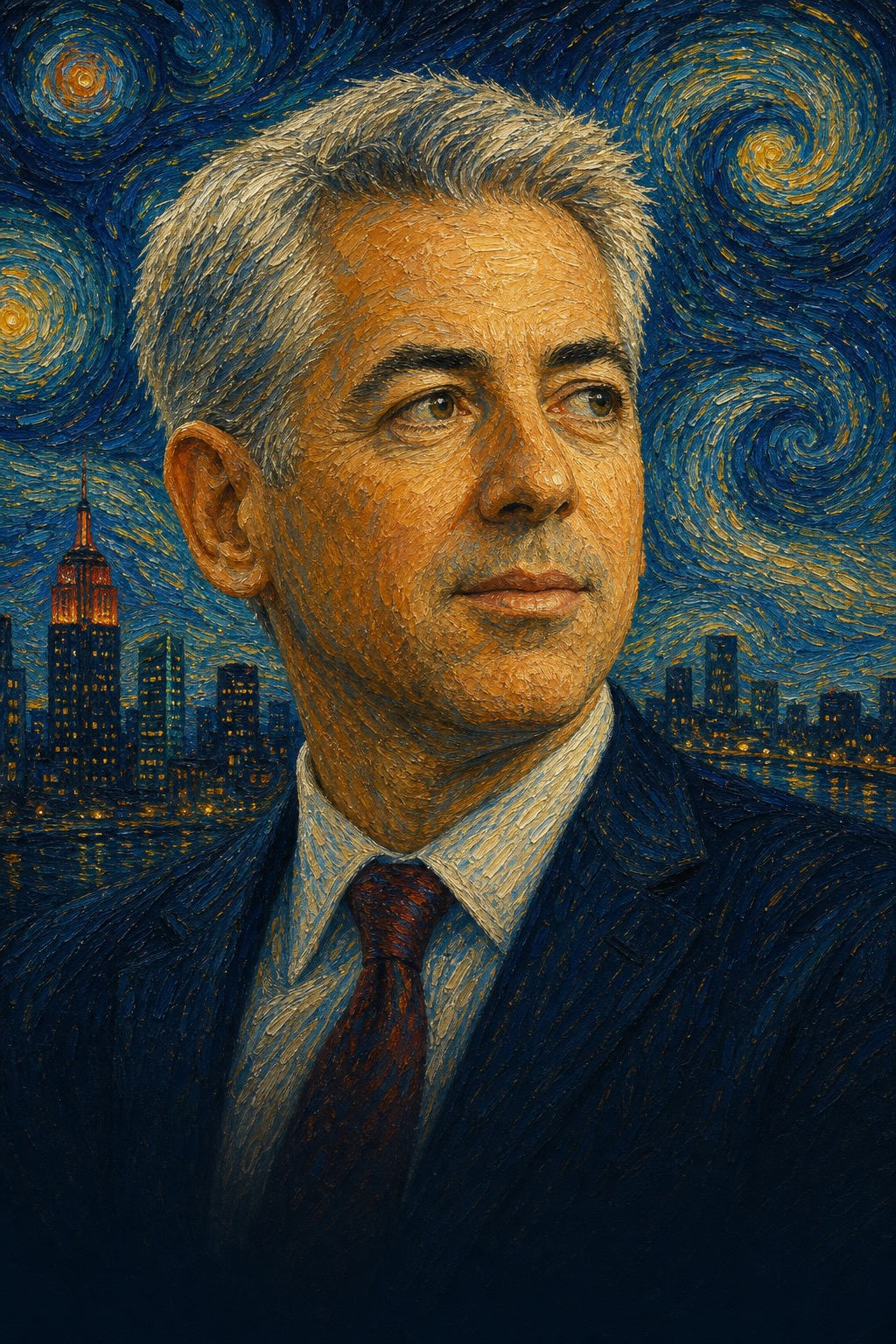
Bill Ackman
Turned ownership, public argument, and vehicle design into a concentrated activist edge, while showing how complexity, mission-lock, legal process, and closed-end discounts can become the thesis risk.
As of 2026-07-01, William A. Ackman is living and remains the founder, chief executive officer, and sole portfolio manager with ultimate decision authority at Pershing Square Capital Management, L.P. ("PSCM") (PSUS N-2, 2026; PSCM Form ADV brochure, 2026).
Snapshot
| Field | Detail |
|---|---|
| Full name | William A. Ackman. SEC and Pershing materials consistently use "William A. Ackman"; the middle name Albert is widely reported but was not primary-verified in this run. |
| Born / died | Born 1966; living as of 2026-07-01. The opened primary sources verify the birth year through Pershing's Form ADV supplement, but not the exact date (PSCM Form ADV brochure, 2026). |
| Nationality / base | U.S.-based investor; Pershing Square's principal office is New York City (PSUS N-2, 2026). |
| Education | Harvard College, B.A. magna cum laude; Harvard Business School, M.B.A. (Pershing Square SPARC bio, 2026). |
| Core vehicles | Gotham Partners Management Co. (1992-2003); Pershing Square Capital Management (founded 2003 / investing from Jan. 1, 2004); Pershing Square, L.P.; Pershing Square International, Ltd.; Pershing Square Holdings, Ltd. ("PSH"); Pershing Square USA, Ltd. ("PSUS"); Pershing Square Inc. / Holdco; Pershing Square SPARC; Howard Hughes Holdings ("HHH") service relationship (Pershing Square Philanthropies bio, 2026; PSUS N-2, 2026; PSH May 2026 fact sheet). |
| Years active | Real-estate finance before 1992; hedge-fund manager and activist from 1992 to present; Pershing Square era from 2003/2004 to present (Pershing Square SPARC bio, 2026). |
| Asset classes | Concentrated public equities, activist stakes, occasional shorts, credit-default-swap and other asymmetric hedges, special-purpose acquisition rights, and control-adjacent operating-company exposure through HHH (PSH May 2026 fact sheet; PSUS N-2, 2026). |
| Style tags | Activist equity, concentrated long/short, public thesis campaigns, quality growth at value-sensitive prices, permanent capital, asymmetric hedging. |
| Verified track record | Pershing's own presentation reports a 15.9% compound annual net return for a PSLP-to-PSH investor path from Jan. 1, 2004 to Feb. 9, 2026, versus 10.7% for the S&P 500. Caveat: this is not one legal fund's audited life-to-date record; Pershing says it assumes investment in PSLP at inception and conversion to PSH at launch (PSCM Annual Investor Presentation, 2026). PSH alone reports a 12.7% annualized NAV return from Dec. 31, 2012 to May 31, 2026, versus 15.3% for the S&P 500 (PSH May 2026 fact sheet). |
| Peak AUM observed in opened sources | $33.016 billion total "PS Core Funds & HHH" as of April 30, 2026 in a Pershing Square Inc. SEC exhibit; core funds alone were $24.193 billion. PSCM's March 2026 ADV reported $19.766 billion regulatory AUM and $28.353 billion total AUM including non-discretionary HHH exposure (Pershing Square Inc. EX-99.1, 2026; PSCM Form ADV brochure, 2026). |
Life & Career Timeline
Ackman came out of a real-estate finance environment rather than a traditional mutual-fund or sell-side equity-research path. Before Gotham, he worked at Ackman Brothers & Singer, now Ackman Ziff Real Estate Group, arranging and structuring equity and debt financing for real-estate investors and developers (Pershing Square SPARC bio, 2026). That background helps explain two recurring traits in his later public-markets career: comfort with legal structure, and a willingness to treat governance, financing, and control rights as part of the investment thesis rather than as afterthoughts.
In 1992, Ackman co-founded Gotham Partners with David Berkowitz. Pershing's official biography describes Gotham as a research-driven, value-oriented firm managing public and private equity investments; the SPARC bio says Ackman co-managed Gotham until 2003 (Pershing Square Philanthropies bio, 2026; Pershing Square SPARC bio, 2026). Gotham's best-known public template was the MBIA short campaign, a long-form forensic thesis against a bond insurer that later became part of Ackman's reputation for exhaustive, public-facing short work. The opened sources confirm the reputation but do not reconstruct Gotham's audited returns or the MBIA trade ledger; those should remain open questions for later trade and mistake tasks (Vanity Fair, 2016).
Ackman founded PSCM in 2003, with the investment record presented by Pershing beginning on Jan. 1, 2004 (Pershing Square SPARC bio, 2026; PSH May 2026 fact sheet). The early Pershing Square era established the pattern that made him famous: large positions, board pressure, detailed public presentations, and a readiness to litigate or campaign when management resisted. Examples named in the opened secondary record include General Growth Properties, Canadian Pacific, McDonald's, Burger King, Fortune Brands, MBIA, Target, J.C. Penney, Herbalife, Allergan/Valeant, and Chipotle, though the exact trade-by-trade P&L should be reconstructed in task C rather than imported wholesale from press narratives (Vanity Fair, 2016).
The 2012 Herbalife campaign marked the most visible short-selling episode of Ackman's Pershing career. The New Yorker reconstructs the campaign as a public war: Pershing hired dedicated researchers, built a lengthy December 2012 presentation, shorted Herbalife, and pressed regulators to act (New Yorker, 2017). The FTC ultimately charged Herbalife with deceptive practices and required a $200 million consumer-redress payment plus business-model changes, but the agency did not give Ackman the clean market outcome he wanted; Herbalife's shares rose around the settlement narrative, and the short became a costly example of being partly right on facts and still wrong on path, timing, and market response (FTC press release, 2016; New Yorker, 2017).
In 2014, Pershing Square helped Valeant pursue Allergan while buying a large Allergan stake through PS Fund 1. Allergan sued Valeant, Pershing Square, and Ackman, alleging violations of federal securities laws including insider-trading and disclosure rules; the allegations were later settled, with Pershing and Valeant agreeing to a $290 million total settlement, split $193.75 million by Pershing and $96.25 million by Valeant. Pershing continued to deny merit in the case, so the profile should treat this as settled litigation rather than adjudicated liability (Allergan SEC exhibit, 2014; Pershing Square settlement announcement, 2017; Ohio Attorney General, 2017).
PSH became the flagship public permanent-capital vehicle. Its fact sheet describes PSH as a closed-ended investment holding company managed by PSCM, with the portfolio typically allocated to 8 to 12 core listed North American companies and occasional opportunistic hedges (PSH May 2026 fact sheet). PSH's public listing and bond issuance gave Ackman a capital base less vulnerable to redemptions than private hedge-fund capital; this mattered during the 2015-2017 Valeant/Herbalife drawdown, when critical profiles reported AUM shrinkage and investor doubts (Vanity Fair, 2016).
The 2020-2023 special-purpose-vehicle episode is another major structural chapter. Pershing Square Tontine Holdings ("PSTH") was formed as a large SPAC; after the Universal Music Group transaction ran into regulatory and structural issues, PSTH did not proceed with the transaction and later returned its $4 billion trust capital to shareholders (PSTH SEC exhibit, 2021; Pershing Square letter, 2022). Ackman then moved to the SPARC structure; in September 2023, Pershing Square SPARC announced that the SEC had declared its registration statement effective and that it would distribute special purpose acquisition rights to former PSTH securityholders (SPARC SEC exhibit, 2023).
In 2025 and 2026, Ackman pushed Pershing further toward a public, permanent-capital, holding-company model. HHH announced on May 5, 2025 that Pershing Square Holdco would invest $900 million for 9 million newly issued HHH shares at $100 per share, raising Pershing's stake to 46.9% with voting power capped at 40%; Ackman returned as HHH executive chairman and Ryan Israel joined HHH as chief investment officer (HHH press release, 2025). HHH's 2025 10-K warned that Pershing Square's influence may not always align with other stockholders' interests, a useful non-hagiographic counterweight to the "modern Berkshire" narrative (HHH 2025 Form 10-K, 2026). In June 2026, PSH also completed a $1 billion preferred-stock subscription tied to HHH's acquisition of Vantage Group (PSH press release, 2026).
By early 2026, Pershing also brought PSUS and Pershing Square Inc. into the public markets. SEC filings say PSCM manages PSUS and, before the offering, served three primary "core funds": PSH, Pershing Square, L.P., and Pershing Square International, Ltd. (PSUS N-2, 2026). A June 2026 SEC exhibit reports PSUS AUM of $4.931 billion as of April 30, 2026 and total PS Core Funds plus HHH AUM of $33.016 billion (Pershing Square Inc. EX-99.1, 2026).
Vehicles & Structure
Ackman's investing platform is no longer just a hedge fund. The core is PSCM, an SEC-registered adviser and CFTC-registered commodity-pool operator headquartered in New York (PSUS N-2, 2026). PSCM's March 2026 brochure reports $19.766 billion of regulatory AUM managed on a discretionary basis and a broader $28.353 billion total-AUM figure that includes HHH as a non-discretionary account; the distinction is important because HHH is not managed like a normal securities portfolio under the ADV definition (PSCM Form ADV brochure, 2026).
The main investment funds are PSH, PSLP, and PSIL. PSH is a Guernsey closed-ended public investment holding company, listed in London under PSH/PSHD, with inception on Dec. 31, 2012 and IPO date Oct. 13, 2014 (PSH May 2026 fact sheet). PSH charges a 1.5% management fee and a 16% variable performance fee, subject to reductions and high-water-mark mechanics; PSLP and PSIL private-fund arrangements differ, with older private-fund performance allocations historically higher than PSH's public-fund fee (PSCM Form ADV brochure, 2026). PSUS adds a U.S.-listed closed-end fund wrapper, while Pershing Square Inc. / PS Holdco adds a public management-company layer (PSUS N-2, 2026).
The HHH relationship is a separate hybrid: Pershing is an investor, Ackman is executive chairman, and PSCM provides advisory and other services. HHH gives Pershing influence and potential fee streams, but also introduces control, conflicts, and minority-shareholder questions. Shareholders filed a Delaware suit in February 2026 challenging the HHH deal; the opened reports state the plaintiffs alleged Pershing gained control without a proper premium, while Pershing called the suit meritless (AIC / Bloomberg summary, 2026; Propmodo, 2026). Because only secondary reports were opened for that lawsuit, the docket should be rechecked in later tasks.
Track Record Detail With Caveats
The headline Pershing record is strong but needs precise labeling. Pershing's 2026 Annual Investor Presentation reports a 15.9% annualized net return from Jan. 1, 2004 through Feb. 9, 2026 versus 10.7% for the S&P 500. The same source provides annual net returns showing large wins in 2004-2007, a 13.0% loss in 2008 versus the S&P's 37.0% decline, major compounding in 2019-2021, a 8.8% loss in 2022, 26.7% in 2023, 10.2% in 2024, 20.9% in 2025, and a 5.4% decline year-to-date as of Feb. 9, 2026 (PSCM Annual Investor Presentation, 2026).
That is not identical to "PSH returned 15.9% since 2004." Pershing's note says the series assumes an investor bought PSLP at its Jan. 1, 2004 inception and converted to PSH at PSH's Dec. 31, 2012 launch; no single fund actually earned the exact composite path as a standalone legal vehicle (PSCM Annual Investor Presentation, 2026). PSH's own public record is lower: as of May 31, 2026, PSH reported a 12.7% annualized NAV return since its Dec. 31, 2012 inception, compared with 15.3% for the S&P 500, while its 10-year annualized NAV return was 17.4% versus 15.6% for the S&P 500 (PSH May 2026 fact sheet).
The return path also matters more than the average. Ackman produced some exceptional trades and structural successes, but the 2015-2017 period exposed the cost of concentration, public self-confidence, and crowded narrative trades. A critical 2016 profile reported that Pershing had nearly $20 billion under management in March 2015 and about $11.4 billion after 18 months of losses centered on Valeant, with critics questioning risk management and fee-adjusted value creation (Vanity Fair, 2016). The profile should therefore carry two truths at once: Pershing's long-run official net return is impressive, and the path includes severe drawdowns, reputational damage, and legal costs that later tasks must map with trade-level evidence.
Why They Matter
Ackman belongs in the Canon because he is one of the clearest modern examples of investing as public argument. His edge is not just security selection; it is thesis production, coalition building, legal and regulatory pressure, board influence, media strategy, and capital-structure design. In wins such as MBIA, General Growth, Canadian Pacific, and Chipotle, the pattern is a concentrated stake plus an explicit value-creation script. In losses such as Target, J.C. Penney, Valeant, and Herbalife, the same pattern reveals the model's vulnerabilities: thesis lock-in, reputational escalation, crowded opposition, and business-model complexity that does not yield on the investor's timetable (Vanity Fair, 2016; New Yorker, 2017).
He also matters because he kept redesigning the wrapper. Gotham was the apprenticeship, Pershing Square private funds were the activist hedge-fund engine, PSH created public permanent capital, PSTH/SPARC tested acquisition-rights innovation, and PS/PSUS/HHH point toward a public management company plus holding-company architecture. The current version of Ackman's career is as much about capital permanence and public accessibility as about a single investment style (PSUS N-2, 2026; Pershing Square Inc. EX-99.1, 2026).
The caution is equally important. Ackman's public moral framing can strengthen a campaign when regulators, customers, and minority shareholders agree with him, but it can become expensive when markets price survival differently from moral culpability. Herbalife is the canonical example: the FTC found deception and ordered redress, yet the short did not produce the zero outcome Ackman wanted (FTC press release, 2016; New Yorker, 2017). Allergan/Valeant is the legal-process example: Pershing captured a profitable event-driven trade, but the case generated a large settlement and a durable governance scar (Pershing Square settlement announcement, 2017).
Open Questions For Later Tasks
- Reconstruct Gotham Partners' audited or investor-reported return record, capital base, and wind-down mechanics from primary documents rather than biographies or press memory.
- Build a trade-level ledger for MBIA, General Growth Properties, Canadian Pacific, Allergan, Valeant, Herbalife, Target, J.C. Penney, Chipotle, the 2020 credit hedge, Universal Music Group, HHH, and PSUS/PS Inc.
- Separate Pershing Square private-fund returns, PSH NAV returns, PSH shareholder returns, PSUS returns, and Pershing Square Inc. management-company economics; do not combine them casually.
- Verify exact birth date and early-career chronology from a primary biographical source.
- Pull the Howard Hughes Delaware Chancery docket directly and update the legal-status note; current opened sources for the 2026 HHH lawsuit were secondary.
- Reconcile AUM definitions: regulatory AUM, fee-paying AUM, core-fund AUM, PSH AUM including debt, PSUS AUM, and HHH non-discretionary exposure.
- For later quote tasks, use Ackman's letters, Senate testimony, shareholder reports, and official presentations; avoid quote aggregators and social-media snippets unless directly archived.
As of 2026-07-01, William A. Ackman's stated investment philosophy is best described as concentrated quality activism: own a small number of simple, durable, free-cash-generative businesses at prices materially below intrinsic value, then use research, governance pressure, public persuasion, capital, and sometimes transaction design to close the gap. The philosophy has changed meaningfully since the Gotham and early Pershing years. The modern version is more long-biased, more permanent-capital-oriented, more explicit about business quality, and more cautious about public short campaigns and complex businesses than the Ackman model of the MBIA, Herbalife, Valeant, and Allergan years (PSH strategy page, 2026; PSCM Annual Investor Presentation, 2026; PSCM Form ADV brochure, 2026).
Core worldview
Ackman's worldview starts with business quality, not factor exposure or near-term earnings revisions. Pershing Square says it seeks simple, predictable, free-cash-generative, dominant companies with barriers to entry, low capital intensity, attractive long-term growth, limited exposure to uncontrollable external risks, strong balance sheets, and capable management and governance (PSH strategy page, 2026; PSCM Annual Investor Presentation, 2026). In interview form, Ackman has described the first screen similarly: a business should be understandable, durable, and cash generative before price becomes interesting (Knowledge Project transcript, 2020).
The second premise is that public markets often misprice high-quality businesses when the current narrative is ugly, the governance is stale, or the business is undergoing temporary disruption. Pershing's 2026 materials describe opportunities created by rapidly shifting investor narratives around AI, tariffs, and misunderstood situations, while the PSUS registration statement frames the strategy as buying large minority stakes when market expectations understate intrinsic value (PSCM Annual Investor Presentation, 2026; PSUS N-2, 2026). Ackman's value-investing lens is therefore not cheapness alone. The preferred setup is a high-quality business, a price/value gap, and a believable route to value recognition.
The third premise is that governance is part of the asset. Ackman does not treat a board, CEO, incentive plan, listing venue, capital structure, or acquisition currency as passive background. His campaigns at Canadian Pacific, ADP, Chipotle, Universal Music Group, and Howard Hughes all show the same core instinct: if management, governance, structure, or public-market presentation is suppressing value, it can become the work of the investment rather than merely a risk factor (Canadian Pacific presentation, 2012; Chipotle Schedule 13D, 2016; HHH transaction release, 2025).
The edge - what they believe markets misprice and why
Ackman's claimed edge has four layers. First is analytical depth. Pershing campaigns typically involve long presentations, public filings, expert calls, unit-economics work, legal analysis, and a simplified board-level value-creation plan. The ADP campaign presentation, for example, said Pershing's work included extensive public research and more than 85 consultations with former executives, competitors, customers, and consultants; ADP disputed Pershing's conclusions, but the presentation illustrates the research style (ADP presentation, 2017).
Second is public thesis construction. Ackman translates research into a narrative that other shareholders, directors, journalists, regulators, or courts can understand. The Canadian Pacific campaign made the issue legible as a question of operating performance, leadership, and whether Hunter Harrison could close the gap to best-in-class railroads; CP's own proxy materials resisted Pershing's slate, but the framing helped turn a technical operating-ratio debate into a shareholder vote (Canadian Pacific presentation, 2012; Canadian Pacific proxy circular, 2012).
Third is governance mechanics. Pershing can buy a large enough position to matter, seek board seats, negotiate cooperation agreements, pressure management, or help recruit leaders. At Chipotle, Pershing disclosed a 9.9% stake and said it expected to discuss governance, board composition, cost structure, operations, management, and strategy; the later cooperation agreement added directors and set standstill and confidentiality terms (Chipotle Schedule 13D, 2016; Chipotle cooperation agreement, 2016).
Fourth is structural creativity. Ackman often looks for a legal, capital-structure, or wrapper advantage: equity advocacy in General Growth's bankruptcy, a merger/arbitrage structure in Allergan/Valeant, SPARC after PSTH, PSUS as a U.S. closed-end fund, and HHH as a quasi-control holding-company platform (GGP Pershing letter exhibit, 2012; PSTH UMG termination letter, 2021; SPARC launch SEC exhibit, 2023; HHH transaction release, 2025).
Process: idea sourcing -> research -> valuation & entry -> sizing -> portfolio construction -> sell discipline
Idea sourcing begins with a narrow universe. Pershing's current public materials emphasize large-cap, usually North American, liquid listed companies that can absorb a meaningful minority stake and have both business quality and a value-realization catalyst (PSH strategy page, 2026; PSH March fact sheet, 2026). The ADV broadens the taxonomy: great businesses at fair prices, good assets at undervalued prices with catalysts, and occasional mispriced probabilistic investments where expected value is attractive (PSCM Form ADV brochure, 2026).
Research is unusually public when Pershing goes activist. The process can include primary-source document work, former-employee and industry calls, legal and regulatory analysis, customer economics, and explicit rebuttal of management's claims. The MBIA and Herbalife campaigns were forensic and adversarial; MBIA began with Gotham's public accounting and insurance critique, while Herbalife paired a short thesis with regulator-facing consumer-harm arguments (Gotham MBIA report, 2002; FTC Herbalife settlement release, 2016; New Yorker, 2017). The current philosophy tries to keep the depth of research while avoiding the worst path dependence of public short wars.
Valuation and entry revolve around intrinsic value, downside protection, and catalysts. The PSUS filing says position size depends on Pershing's assessment of downside risk versus upside opportunity, and the ADV stresses purchase price discipline and margin of safety (PSUS N-2, 2026; PSCM Form ADV brochure, 2026). In practice, Ackman prefers to enter when a known quality business is temporarily impaired, as with Chipotle after food-safety damage, or when a business's operating performance or governance can be benchmarked against a visible peer set, as at Canadian Pacific and ADP (Pershing 3Q 2016 letter; ADP presentation, 2017).
Sizing is concentrated by design. PSH says it ordinarily makes 8 to 12 core investments, while PSUS describes a portfolio of roughly 12 to 15 high-quality large-cap growth companies; both formulations are consistent with a manager who wants enough exposure for research and influence to matter (PSH strategy page, 2026; PSUS N-2, 2026). The concentration is not incidental. Ackman has said in interviews that a 20% position requires unusually deep knowledge, and Pershing's filings explicitly connect concentration to research depth, monitoring, and potential outperformance when exceptional ideas are scarce (Lex Fridman transcript, 2024; PSUS N-2, 2026).
Portfolio construction is now dominated by long equity exposure, permanent capital, and occasional asymmetric hedges rather than a standing long/short book. PSH is a closed-end public company whose strategy permits long and short positions, debt instruments, derivatives, credit-default swaps, and put options, but Pershing's current materials do not describe routine public short selling as the core engine (PSH strategy page, 2026; PSH Annual Report, 2025). Permanent capital is central because it allows Pershing to hold through volatility, avoid forced sales, and use market dislocations as entry points rather than redemption events (PSUS free-writing prospectus letter, 2026).
Sell discipline has two modes. In successful or maturing positions, Pershing can sell or trim when a position becomes too large, when the valuation gap closes, or when capital is needed for a superior opportunity; Pershing described selling Canadian Pacific and Zoetis in 2016 partly to free capital for new commitments, and later said it would sell some ADP exposure as the position grew too large while remaining engaged (Pershing 3Q 2016 letter; ADP investor letter, 2018). In failed positions, the post-2017 lesson is more direct: do not require a losing investment to be the source of recovery. Pershing's later annual-report reflections emphasize exiting troubled situations and redeploying into higher-quality opportunities (PSH Annual Report, 2021).
Risk management
Ackman's first risk control is business selection. Simple, predictable, durable, cash-generative companies reduce the number of things that must go right. The explicit rejection of excessive complexity is partly a response to Valeant, where Pershing needed to trust management, acquisition accounting, drug-pricing politics, and capital allocation all at once; Ackman defended Valeant publicly in 2016, but later Pershing materials treated it as a lesson in violating core principles (Ackman Senate testimony, 2016; PSH Annual Report, 2016; PSH Annual Report, 2021).
The second control is structure. Permanent capital reduces the risk that investors force sales at the worst time, but public closed-end vehicles introduce their own discount risk. As of May 31, 2026, PSH reported a 31.2% discount to NAV, and PSUS risk factors warn that closed-end funds may trade below NAV, especially after offerings or when sentiment turns (PSH May fact sheet, 2026; PSUS prospectus, 2026).
The third control is bounded downside in special situations. After Herbalife became a multi-year public short war, Pershing changed the exposure to put options, limiting future losses to premium while eliminating borrow exposure; the FTC settlement supported parts of the consumer-harm thesis but did not make the trade a clean investment win (Pershing 3Q 2017 letter; FTC Herbalife settlement release, 2016).
The fourth control is episodic hedging. In March 2020, Pershing said it bought investment-grade and high-yield credit protection to avoid forced sales of long holdings during the COVID shock, then monetized the hedge for about $2.6 billion on roughly $27 million of premiums and commissions and redeployed into equities (Pershing letter, March 2020). This is the positive version of Ackman's asymmetric-risk doctrine: buy cheap protection against an extraordinary regime break, then use the liquidity to be a buyer when others are constrained.
Temperament & psychology
Ackman's temperament is unusually public. He is willing to be visible, controversial, and adversarial for years if he believes the facts support him. That is an asset in activism because boards, regulators, and other shareholders often need pressure before they act. It is also a liability because public certainty raises the reputational cost of changing one's mind. The Herbalife and Valeant episodes show how a thesis can become a campaign identity, while the post-2017 reset shows a later attempt to separate conviction from inflexibility (New Yorker, 2017; Vanity Fair, 2016; PSH Annual Report, 2021).
He also shows a builder's psychology. He does not merely select securities; he designs campaigns, vehicles, rights, and public-company structures. That tendency produced genuine innovations, but it can overrun simplicity. PSTH's UMG transaction failed because a desirable asset was wrapped in a structure that could not get through the SPAC constraints as designed; SPARC was the repair attempt, shifting toward rights that raise capital only after a transaction is identified (PSTH UMG termination letter, 2021; PSTH liquidation letter, 2022; SPARC launch SEC exhibit, 2023).
Evolution over career
The Gotham phase was forensic, adversarial, and willing to use short exposure against perceived accounting or business-model weaknesses. MBIA is the template: a long public critique, years of pressure, and partial later regulatory validation through the SEC's MBIA action, but also an enormous consumption of time, reputation, and attention (Gotham MBIA report, 2002; SEC MBIA action, 2007; FCIC Ackman interview memo, 2010).
The early Pershing phase broadened into activist long investing, bankruptcy and capital-structure opportunities, and public campaigns. General Growth, Canadian Pacific, Target, J.C. Penney, Herbalife, Allergan, Valeant, and Chipotle all belong to this wider toolkit, though the outcomes diverged sharply. The Canadian Pacific and GGP cases showed how governance and capital structure could unlock value; Target and J.C. Penney showed that operational reinvention is harder than identifying a value gap (GGP Pershing letter exhibit, 2012; Target proxy filing, 2009; J.C. Penney Schedule 13D, 2010; New Yorker J.C. Penney critique, 2013).
The post-2017 phase is a deliberate simplification. Pershing reduced distraction, leaned into PSH and other permanent capital, focused on higher-quality businesses, and treated Valeant/Herbalife as process scars. The 2020 hedge then added a macro-insurance layer without changing the long-equity core (PSH Annual Report, 2021; Pershing letter, March 2020).
The 2025-2026 phase adds public asset-manager and holding-company ambition. Pershing Square Inc., PSUS, SPARC, and HHH all point to a model where Ackman is not only a fund manager but also a capital allocator across permanent public vehicles. HHH is the sharpest example: Pershing invested $900 million, Ackman became executive chairman, Ryan Israel became CIO, and HHH disclosed both the strategic vision and the conflicts that can arise from Pershing's influence (HHH transaction release, 2025; HHH 2025 Form 10-K, 2026; PSCM Form ADV brochure, 2026).
What they explicitly reject
Ackman's modern materials reject complexity as an underwriting virtue. The business should be understandable, the cash generation visible, and the principal risks limited enough that Pershing can size the position with conviction (PSH strategy page, 2026; PSCM Annual Investor Presentation, 2026). He also rejects routine public short selling as a core activity after the experience of Herbalife; Pershing's 2017 letter said the Herbalife position had been converted to puts and that the firm did not intend to pursue activist short campaigns in the future (Pershing 3Q 2017 letter).
He rejects capital structures that force action at the wrong time. Permanent capital is repeatedly framed as an advantage because Pershing does not have to meet investor redemptions by selling long-duration positions into dislocation (PSUS free-writing prospectus letter, 2026). After PSTH, he also rejected the standard SPAC problem of trapping public capital before a transaction is known; SPARC was designed so holders receive rights and capital is raised only after a deal is identified (PSTH liquidation letter, 2022; SPARC launch SEC exhibit, 2023).
Regimes where it thrives vs. struggles
The model thrives when there is a high-quality business with temporary controversy, fixable governance, visible peer underperformance, a receptive or pressure-sensitive shareholder base, and enough liquidity for Pershing to build an influential stake. It also thrives in dislocations where permanent capital and hedging liquidity let Ackman buy rather than sell, as in March 2020 (Pershing letter, March 2020; PSUS free-writing prospectus letter, 2026).
It struggles when the thesis depends on a regulator or market recognizing wrongdoing on Ackman's timetable, when the business is too complex for a simple quality-underwriting model, when a turnaround requires operating execution beyond governance pressure, or when structural cleverness creates legal or consent risk. Herbalife, Valeant, J.C. Penney, Allergan/Valeant, and PSTH/UMG are different versions of that weakness (FTC Herbalife settlement release, 2016; PSH Annual Report, 2016; Pershing Allergan settlement announcement, 2017; PSTH UMG termination letter, 2021).
The public-fund era adds another regime risk: Ackman may be right about underlying NAV and still trade at a persistent discount. PSH's 31.2% discount as of May 31, 2026 and PSUS's closed-end-fund risk factors show that permanent capital solves redemption pressure while creating a different shareholder-return problem (PSH May fact sheet, 2026; PSUS prospectus, 2026).
Tensions between stated philosophy and actual behavior
The central tension is simplicity versus structural ambition. Ackman says he wants simple, predictable businesses, yet some of the most important Pershing episodes involved complex legal, regulatory, pharmaceutical, SPAC, or holding-company structures. Valeant violated the later quality screen; PSTH/UMG turned a high-quality asset into an over-engineered transaction; HHH is a long-duration holding-company bet with related-party and control risks disclosed by the company itself (Ackman Senate testimony, 2016; PSTH UMG termination letter, 2021; HHH 2025 Form 10-K, 2026).
The second tension is public conviction versus adaptability. Ackman's willingness to make a thesis public is one of his edge sources; it recruits allies and forces boards to respond. But public conviction can harden into mission-lock. Herbalife is the clearest example: the FTC action supported the consumer-harm critique, but the short did not reward Pershing the way a conventional investment thesis would require (FTC Herbalife settlement release, 2016; New Yorker, 2017).
The third tension is permanent capital versus public-market discount. Ackman wants capital that lets him think and act long term. Investors in public vehicles, however, still experience trading discounts, fees, and sentiment cycles. That does not invalidate the model, but it means vehicle design is part of the investment result, not merely plumbing (PSH May fact sheet, 2026; PSUS prospectus, 2026).
The fairest synthesis is that Ackman's philosophy is both powerful and dangerous for the same reason: it concentrates capital, attention, and identity around a small number of high-conviction public arguments. When the business is durable, the governance problem is fixable, and the structure is clean, that concentration can compound. When the facts require humility, the business is messier than it looks, or the structure becomes the thesis, the same model can magnify error.
As of: 2026-07-01T14:29:22Z
This file treats "trade" broadly: completed public-equity investments, activist campaigns, event-driven positions, and convex hedges managed by Ackman or Pershing Square. Figures are tagged where useful: verified when anchored in primary Pershing/SEC/regulatory sources, single-source when dependent on one source, and disputed where sources use different scopes.
Ranking Summary
| Rank | Trade | Dates | Why it belongs | Economics and caveat |
|---|---|---|---|---|
| 1 | COVID-19 credit hedge | Feb-Mar 2020 | Best documented risk/reward trade in Ackman's career | About $27 million of cost/carry for about $2.6 billion of proceeds across Pershing Square funds, including about $2.1 billion for PSH (Pershing March 25 2020 letter, Pershing 2021 presentation). |
| 2 | Canadian Pacific Railway | 2011-2016 | Cleanest repeatable operational-activism template | Initial 13D: 20.659 million shares/options, 12.2%, $1.065 billion consideration; Pershing later reported 318.9% CP TSR during ownership; $2.6 billion profit estimate is strong secondary, not primary-verified (SEC 13D, Pershing 2016 letter, IGOPP/Harvard case). |
| 3 | General Growth Properties | 2008-2014 | Career-defining distressed-equity reorganization | Earliest purchases near $0.34-$0.35; Pershing later said the GGP/HHC/Rouse basket traded at over 100x the initial price; exact dollar P&L is disputed (Pershing 2010 letter, Pershing 2014 update). |
| 4 | Interest-rate swaptions | 2020-2023 | Second major convex macro hedge | Pershing reported $384 million of premium and $2.728 billion of proceeds on monetized hedges; use proceeds, not profit, language (Pershing 2023 presentation). |
| 5 | MBIA / bond-insurer short | 2002-2009 | Forensic-credit trade that established the playbook | Thesis and instruments are primary-documented; Pershing's later hedge table reports $64 million cost and $1.2 billion proceeds/market value on bond-insurer CDS, primarily MBIA (Gotham MBIA report, Pershing 2022 presentation). |
| 6 | Chipotle Mexican Grill | 2016-2025 | Quality-business activism after crisis | 2016 13D disclosed 9.9%; Pershing reported final exit in November 2025 with 634% gross and 429% net return (SEC Chipotle 13D, Pershing 2026 presentation). |
| 7 | Allergan / Valeant | 2014-2015 | Huge event-trade economics, but legally contested | 13D disclosed 28.879 million beneficial shares, 9.7%, and $3.218 billion consideration; final all-fund net P&L after settlement is not fully disclosed (SEC Allergan 13D, Pershing settlement). |
| 8 | Lowe's | 2018-2024 | Friendly activism around CEO quality and margin gap closure | Pershing reported $1.8 billion gross profit, $1.3 billion net profit, and 175% share-price return from average cost to average sale price (Pershing 2024 presentation). |
| 9 | Hilton | 2018-2026 | Capital-light compounder sized through crisis | Pershing reported February 2026 exit and 492% gross / 341% net return (Pershing 2026 presentation). |
| 10 | Burger King / Restaurant Brands | 2012-present | Operator-partner bet on franchising and platform M&A | Pershing funds were expected to own about 10% of Burger King through Justice; QSR remained current in 2026, with 782% gross / 445% net return to date (Burger King release, Pershing 2026 presentation). |
1. COVID-19 Credit Hedge - Single Best Trade
Context and Dates
Pershing bought index credit-default-swap protection in late February and early March 2020 as COVID-19 threatened a sudden economic shutdown. The hedge was disclosed March 3, became material by March 9, began to be unwound March 12, and was fully exited by March 23 (Pershing March 25 2020 letter, Pershing March 26 2020 letter).
Thesis and How Found
The thesis was that credit spreads were too tight for pandemic shutdown risk. Pershing cited investment-grade spreads near 50 basis points and high-yield spreads near historic lows, making convex protection cheap relative to the possible shock (Pershing March 26 2020 letter).
Size and Structure
The hedge used CDX investment grade, CDX high yield, and iTraxx Main. Pershing's 2021 presentation gives about $70.664 billion notional: $44.5 billion CDX IG, $23.089 billion iTraxx Main, and $3.075 billion CDX HY (Pershing 2021 presentation).
Entry and Path, Including Drawdown Endured
The mark moved fast: about $1.8 billion value by March 9 and about $2.75 billion by March 12, when the hedge approached 40% of capital as equities fell (Pershing March 26 2020 letter). PSH's peak March 2020 loss was 11.2% versus 30.4% for the S&P 500 (Pershing 2021 presentation).
Exit and P&L
Pershing reported roughly $27 million of premiums/carrying costs against about $2.6 billion of proceeds, including $2.1 billion for PSH (Pershing March 25 2020 letter, PSH 2019 annual report). Proceeds were redeployed into Agilent, Berkshire Hathaway, Hilton, Howard Hughes, Lowe's, Restaurant Brands, and Starbucks (PSH 2019 annual report).
What It Teaches
This is the cleanest Ackman asymmetry case: define a catalyst, spend a small premium, monetize when the hedge becomes too large, and recycle gains into known long-term holdings. Permanent capital made the redeployment possible.
Sources
Key sources: Pershing's March 25 and March 26, 2020 investor letters, PSH's 2019 annual report, and Pershing's 2021 annual investor presentation.
2. Canadian Pacific Railway
Context and Dates
Pershing began buying CP on September 23, 2011, filed its initial 13D on October 28, 2011, fought a public proxy contest in 2012, and exited its remaining common shares in 2016 (SEC CP 13D, Pershing CP sale).
Thesis and How Found
Pershing saw a high-quality railroad with a poor operating ratio, weak asset utilization, and a credible fix in Hunter Harrison's precision-railroading model (Pershing CP presentation). CP disputed the plan and warned shareholders about execution risk (CP response filing).
Size and Structure
Initial 13D exposure was 20.659 million shares, including 2.65 million option shares, equal to 12.2%, for about $1.065 billion consideration (SEC CP 13D). Pershing later described the stake as more than 14% and about $1.4 billion (Pershing CP letter).
Entry and Path, Including Drawdown Endured
The trade required a proxy fight, board change, management change, and patience. CP's NYSE stock ranged from $198.44 to $122.27 in 2015, while Pershing marked CP as a negative contributor that year despite operating progress (CP 2015 annual report, PSH 2015 annual report).
Exit and P&L
Pershing sold its remaining 9.84089 million shares in August 2016 (Pershing CP sale). Pershing reported 318.9% CP TSR during ownership; IGOPP/Harvard estimates $2.6 billion of Pershing profit, a strong secondary figure (Pershing 2016 letter, IGOPP/Harvard case).
What It Teaches
CP is Ackman's best repeatable activism template: a measurable operating gap, a proven operator, governance access, and a thesis that did not require financial engineering to work.
Sources
Key sources: the initial CP Schedule 13D, Pershing's CP campaign materials, CP's response materials, PSH's 2015/2016 reporting, Pershing's 2016 sale announcement, and the IGOPP/Harvard case study.
3. General Growth Properties
Context and Dates
GGP filed for bankruptcy in April 2009 after credit-market stress blocked refinancing, even though the mall portfolio retained value. Pershing had been buying in November 2008 and helped shape the 2010 recapitalization and Howard Hughes distribution (Pershing GGP presentation, Pershing 2010 letter).
Thesis and How Found
Pershing argued GGP was a liquidity/maturity-wall problem, not a worthless-equity case. Its May 2009 deck valued GGP's REIT equity at roughly $9-$22 per share using mall-quality and Simon Property comparisons (Pershing GGP presentation).
Size and Structure
Pershing used common stock, total-return swaps, warrants, and unsecured debt. As of December 8, 2008, Pershing disclosed 20.08069 million common shares, 7.5% beneficial ownership, plus swaps referencing 48.5 million more shares, for 68.58069 million shares of total economic exposure, or about 25.6% (GGP Schedule 13D/A). By August 2012, it reported 72.2 million common shares, 18.2 million warrants, and swaps, together a stated 10.2% stake (GGP SEC exhibit).
Entry and Path, Including Drawdown Endured
Pershing's 2010 letter says earliest stock purchases were at $0.34 and average cost below $1.00; by November 2010, original GGP plus Howard Hughes value exceeded $18 per original share (Pershing 2010 letter). The drawdown was process risk: GGP's Chapter 11 case involved hundreds of debtor entities, creditor negotiations, new-money terms, and potential common-equity wipeout (Bankruptcy court opinion). A precise Pershing mark-to-market drawdown from the first purchases to the bankruptcy low was not reconstructed from primary fund records.
Exit and P&L
GGP repurchased 27.624 million Pershing shares at $20.12, about $556 million, in February 2014 (GGP release). Pershing later said the GGP/HHC/Rouse basket was over 100x the initial accumulation price; Bloomberg-syndicated reporting says Ackman described the investment as approaching $1.6 billion, but exact P&L is disputed because sources define the basket differently (Pershing 2014 update, Finance & Commerce/Bloomberg).
What It Teaches
GGP shows Ackman's full capital-structure edge: buy when equity screens as terminal, underwrite asset value, influence process, and pair valuation work with recapitalization design.
Sources
Key sources: Pershing's May 2009 GGP presentation, the 2008 GGP Schedule 13D/A, Pershing's 2010 investor letter, the bankruptcy court opinion, the 2012 GGP SEC exhibit, the 2014 GGP repurchase release, Pershing's 2014 annual update, and Bloomberg-syndicated sale coverage.
4. Interest-Rate Swaptions
Context and Dates
Pershing initiated rate hedges in late 2020 and early 2021 as fiscal/monetary stimulus, vaccines, and reopening made inflation and Fed hikes more likely than markets priced (Pershing 2022 presentation).
Thesis and How Found
Pershing believed market-implied rates were too low. Its 2022 presentation notes that December 2020 futures implied no 2022 Fed hikes, while by February 2022 roughly five hikes were implied (Pershing 2022 presentation).
Size and Structure
The hedge used U.S. Treasury payer swaptions. PSH's 2021 report listed $3.658 billion notional 10-year payer swaptions and $88.654 billion notional 2-year payer swaptions; year-end 2021 cost was $156.649 million and fair value $840.101 million (PSH 2021 annual report).
Entry and Path, Including Drawdown Endured
Pershing sold more than 90% of market value for $1.25 billion in January 2022 and another $195 million later, then rolled part of the exposure into longer-dated swaptions that later suffered from rate moves and time decay (PSH 2021 annual report, PSH June 2023 interim).
Exit and P&L
Pershing's 2023 presentation reports $384 million premium and $2.728 billion proceeds on monetized rate hedges, plus broader value/proceeds of $3.095 billion including retained hedges (Pershing 2023 presentation). Because retained and monetized positions are mixed, this is hedge-program economics, not one clean realized P&L line.
What It Teaches
The swaptions repeat the COVID structure but with harder timing: small premium, convex payoff, monetization discipline, and then the risk that remaining option exposure decays.
Sources
Key sources: Pershing's 2022 and 2023 annual investor presentations, PSH's 2021 annual report, and PSH's June 2023 interim report.
5. MBIA / Bond-Insurer Short
Context and Dates
Gotham released Is MBIA Triple A? on December 9, 2002, disclosing bearish MBIA positions through CDS, puts, and short common stock. Pershing refreshed the thesis in May 2007 with a bond-insurer presentation before the crisis intensified; Pershing's later hedge table frames the bond-insurer CDS program as a 2005-2009 hedge (Gotham MBIA report, Pershing 2007 presentation, Pershing 2022 presentation).
Thesis and How Found
The thesis was that MBIA's AAA rating understated leverage, structured-finance exposure, accounting/reserving issues, liquidity risk, and off-balance-sheet obligations. Gotham said the report used SEC filings, public documents, and a management meeting (Gotham MBIA report).
Size and Structure
The primary report verifies CDS, equity puts, and short stock, but not exact notional. A Christine Richard excerpt reports protection on $2 billion of MBIA debt, a strong secondary figure (Wiley excerpt). In 2008 testimony, Ackman said Pershing managed about $6 billion and held shorts in MBIA and Ambac holding companies (House hearing).
Entry and Path, Including Drawdown Endured
The trade took years and included legal/reputational pressure. Fortune reported that MBIA rebounded after the initial short and that MBIA pushed regulators to investigate Gotham; those details are secondary (Fortune/Guy Spier archive). SEC materials later validated some accounting concerns: MBIA settled without admitting or denying allegations and paid a $50 million SEC penalty (SEC MBIA release).
Exit and P&L
Pershing's later hedge table reports $64 million of carrying costs and $1.2 billion of proceeds and market value on bond-insurer CDS, primarily MBIA, with an 18.5x multiple of capital (Pershing 2022 presentation). Exact MBIA-only realized P&L and cover dates were not reconstructed from primary sources; the table is a retrospective Pershing hedge-program summary rather than an audited MBIA-only trade ledger.
What It Teaches
MBIA is the forensic-research trade: public filings, rating-agency skepticism, regulatory engagement, and a structure where CDS convexity made a multi-year short survivable.
Sources
Key sources: Gotham's 2002 MBIA report, Pershing's 2007 bond-insurer presentation, Christine Richard's Confidence Game excerpt, 2008 House hearing materials, the SEC MBIA release, and Fortune archive coverage.
6. Chipotle Mexican Grill
Context and Dates
Pershing filed a 13D after market close on September 6, 2016, after food-safety incidents damaged Chipotle's brand and stock. Chipotle and Pershing entered a cooperation agreement in December 2016 (SEC Chipotle 13D, Chipotle cooperation agreement).
Thesis and How Found
The thesis was that a strong restaurant concept could recover through governance change, operational discipline, digital access, and stronger management. Pershing later highlighted board refresh, Brian Niccol's 2018 recruitment as CEO, and multi-year sales, margin, and EPS growth (PSH 2020 annual report, Pershing 2026 presentation).
Size and Structure
The 13D disclosed 2.882463 million shares, or 9.9%, consisting of 554,000 common shares and 2.328463 million shares underlying forward purchase contracts (SEC Chipotle 13D).
Entry and Path, Including Drawdown Endured
The path was operational, not a quick catalyst. Board refresh came in 2016, Niccol arrived in 2018, and the COVID period tested restaurant execution; Pershing credited digital access and management execution for strong 2020 performance (PSH 2020 annual report).
Exit and P&L
Pershing's 2026 presentation reports a final exit in November 2025 and 634% gross / 429% net return from August 4, 2016 to November 12, 2025 (Pershing 2026 presentation). Exact dollar P&L was not disclosed in the opened primary sources.
What It Teaches
Chipotle shows quality activism: refresh governance, recruit better operators, and let unit economics compound. It also shows attribution limits because the operational team created the enduring value.
Sources
Key sources: the Chipotle Schedule 13D, the Chipotle/Pershing cooperation agreement, PSH's 2020 annual report, and Pershing's 2026 annual investor presentation.
7. Allergan / Valeant Event Trade
Context and Dates
Valeant and Pershing entered a confidentiality agreement on February 9, 2014, formed PS Fund 1 on February 11, and signed a letter agreement February 25. PS Fund 1 began buying Allergan securities February 25, crossed 5% April 11, filed a 13D April 21, and Valeant publicly bid April 22. Allergan later sold to Actavis, closing in March 2015 (Valeant/Pershing filing, Allergan proxy filing, PSH 2014 annual report).
Thesis and How Found
Pershing viewed Allergan as a high-quality specialty-pharma business with Botox-led growth, inefficient costs, and takeover optionality. It later said the 9.7% stake was bought around $128 per share and represented fair value even without a transaction (PSH 2014 annual report, Pershing 2014 letter).
Size and Structure
The 13D disclosed 28.878538 million beneficial shares, 9.7%, including 24.831107 million call-option shares and 3.45 million forward-contract shares; total consideration was $3.217819947 billion (SEC Allergan 13D).
Entry and Path, Including Drawdown Endured
The main drawdown was legal/regulatory risk. Valeant's initial bid was $48.30 cash plus 0.83 Valeant share per Allergan share, a claimed 38% premium, but plaintiffs later alleged the accumulation violated tender-offer insider-trading rules (Allergan proxy filing, Allergan litigation order).
Exit and P&L
Actavis paid $129.22 cash plus 0.3683 Actavis shares per Allergan share; PSH reported Allergan contributed 19.1% to 2014 gross performance (PSH 2014 annual report, PSH 2015 annual report). Pershing/Valeant later settled related lawsuits for $290 million, with Pershing paying $193.75 million while saying the case had no merit (Pershing settlement).
What It Teaches
Allergan shows that legal structure can create or destroy value. The trade was economically powerful, but its settlement must be attached to any fair study of the result.
Sources
Key sources: Valeant/Pershing SEC filings, Allergan proxy materials, the Allergan Schedule 13D, PSH's 2014/2015 annual reports, the litigation order, and Pershing's settlement announcement.
8. Lowe's
Context and Dates
Pershing initiated Lowe's after the company announced a CEO search in 2018 and exited by early 2024 (Pershing 2018 interim letter, Pershing 2024 presentation).
Thesis and How Found
Pershing believed Lowe's could close part of its Home Depot operating gap through better merchandising, supply chain, omnichannel execution, professional-customer penetration, cost discipline, and CEO quality (Pershing 2018 annual report release).
Size and Structure
This run did not reconstruct initial share count from primary filings. Pershing's completed-trade presentation gives the relevant economics and methodology caveat (Pershing 2024 presentation).
Entry and Path, Including Drawdown Endured
The path was friendly: Lowe's already had a CEO transition underway. The drawdown risk was housing/repair-remodel cyclicality before margin initiatives could show through. Pershing exited when near-term industry uncertainty widened and easy margin levers were less available (Pershing 2024 presentation).
Exit and P&L
Pershing reports $1.8 billion gross profit, $1.3 billion net profit, and 175% share-price return from average cost to average sale price (Pershing 2024 presentation).
What It Teaches
Lowe's is friendly activism: identify a high-quality business with a fixable execution gap, back the right operator, and exit when risk/reward normalizes.
Sources
Key sources: Pershing's 2018 interim materials, Pershing's 2018 annual-report release, and Pershing's 2024 annual investor presentation.
9. Hilton
Context and Dates
Pershing reports Hilton ownership from October 8, 2018 to February 2, 2026, with COVID as the defining stress period (Pershing 2026 presentation).
Thesis and How Found
The thesis was a high-quality, capital-light lodging compounder with strong brands, fee growth, and share-repurchase capacity. Pershing says EPS rose 2.5x, fee revenue grew 70%, adjusted EBITDA grew more than 80%, and Hilton retired more than 20% of shares during ownership (Pershing 2026 presentation).
Size and Structure
Pershing announced an initial 10.9 million-share Hilton position, equal to 3.7% of Hilton and 13.9% of PSH NAV, in October 2018 (Pershing Hilton announcement). The COVID hedge documents show that Pershing redeployed hedge proceeds into Hilton in March 2020, increasing a favored quality position during crisis (PSH 2019 annual report).
Entry and Path, Including Drawdown Endured
COVID directly impaired lodging demand, but Pershing treated the collapse as a sizing opportunity rather than a reason to abandon the franchise (PSH 2019 annual report).
Exit and P&L
Pershing reports a February 2026 exit with 492% gross return and 341% net return from October 8, 2018 to February 2, 2026 (Pershing 2026 presentation). Exact dollar P&L was not disclosed in the opened primary sources.
What It Teaches
Hilton shows Ackman using crisis liquidity to own more of an asset-light franchise whose normalized earnings could recover faster than market fear implied.
Sources
Key sources: Pershing's 2018 Hilton position announcement, PSH's 2019 annual report, and Pershing's 2026 annual investor presentation.
10. Burger King / Restaurant Brands International
Context and Dates
In 2012, Justice Holdings combined with Burger King Worldwide. Pershing later described Justice as raising about $1.5 billion, including $458 million from Pershing, before Burger King later combined with Tim Hortons to form Restaurant Brands (Burger King release, PSTH prospectus).
Thesis and How Found
The thesis was to partner with 3G behind an asset-light franchising platform with global growth, margin opportunity, and platform M&A potential (PSTH prospectus).
Size and Structure
An SEC-filed press release said Pershing-managed funds were expected to own about 10% of Burger King through Justice; the PSTH prospectus later confirms Pershing's $458 million Justice investment (Burger King release, PSTH prospectus).
Entry and Path, Including Drawdown Endured
This was not hostile activism. It was a sponsor/operator-partner investment in 3G's operating approach, franchising economics, and multi-brand platform strategy. The path risk was restaurant traffic, franchisee health, and execution across brands; a precise Pershing mark-to-market drawdown was not reconstructed from primary fund records.
Exit and P&L
Restaurant Brands remained a current holding in the 2026 materials reviewed. Pershing reports 782% gross and 445% net return from June 19, 2012 to February 9, 2026 (Pershing 2026 presentation). Exact realized dollar P&L was not disclosed because the position was still current in the reviewed 2026 materials.
What It Teaches
Restaurant Brands shows Ackman as long-duration partner: back an aligned operator and let asset-light franchising plus platform M&A compound.
Sources
Key sources: the SEC-filed Burger King/Justice release, the PSTH prospectus discussion of Justice, and Pershing's 2026 annual investor presentation.
Honorable Mentions and Exclusions
Wendy's/Tim Hortons, ADP, Starbucks, Universal Music Group, Howard Hughes, and Fannie Mae/Freddie Mac belong in the broader Ackman ledger but are not ranked above these 10 because the reviewed evidence was less complete, the case fits another task file better, or the position remains unresolved. Wendy's/Tim Hortons was an early restaurant-activism template: Pershing's 2005 Wendy's letter disclosed 9.9% ownership and proposed a Tim Hortons separation, refranchising, and buybacks (Wendy's SEC exhibit). ADP also deserves a future ledger entry: the 2017 13D disclosed 36.8 million shares or 8.3% beneficial ownership, and PSH exited in 2019 after ADP contributed 4.4% to 2019 gross performance, but total trade P&L was not reconstructed (ADP 13D, PSH 2019 annual report).
Evidence Gaps and Figure Discipline
- COVID hedge economics are best verified: cost, proceeds, instruments, notional table, and redeployment are all in Pershing materials.
- Canadian Pacific mechanics, ownership, and exit are primary-verified; $2.6 billion profit is a strong secondary estimate.
- General Growth share-price multiple and final sale are primary-verified; exact dollar P&L varies with inclusion of HHC/Rouse/spinoffs.
- MBIA thesis and instruments are primary-verified; MBIA-only realized P&L is less clean than Pershing's later bond-insurer hedge table.
- Chipotle's final percentage returns are Pershing-reported; exact dollar P&L was not found.
- Allergan's entry structure and settlement are primary-verified; final all-fund net P&L after Valeant profit share, Actavis sale, hedging, fees, and settlement was not fully disclosed.
- Lowe's completed dollar profit and Hilton/Restaurant Brands percentage returns are sourced to Pershing presentations; this run did not independently reconstruct every trade ledger from filings.
As of 2026-07-01, Bill Ackman's error record is best understood as the cost side of the same model that produced Pershing Square's best wins: concentrated capital, public conviction, legal and structural creativity, and a willingness to turn an investment thesis into a campaign. The largest mistakes were not random bad stock picks. They were cases where Pershing either underwrote too much complexity, let public advocacy harden into path dependence, or built a structure whose legal and market mechanics became the thesis.
Major losses, errors of omission, and near-death moments
Target / Pershing Square IV: right asset, wrong wrapper, bad timing
The Target campaign was an early warning that structure can turn a defensible value idea into a near-death experience. Pershing's August 2008 SEC filing showed economic exposure to roughly 100.6 million Target shares, or 12.93% of shares outstanding, built through common stock and cash-settled call options, with total consideration since July 2007 of about $2.46 billion (Target Schedule 13D/A, 2008). By May 2009, after the credit crisis and position reduction, Pershing's own proxy materials still described about $1.0 billion of Target common stock plus about $280 million of call options and a slate of five board nominees (Pershing Target proxy, 2009).
The board's rebuttal focused less on whether Target owned valuable real estate than on execution risk: valuation assumptions, credit-rating and liquidity effects, taxes, operational friction, and management distraction in a difficult retail environment (Target board proxy materials, 2009). Pershing also spent real money on the fight, estimating proxy-solicitation expenses at $9.0 million, with $1.85 million already incurred at the time of the filing (Pershing Target proxy, 2009). A later Twin Cities Business account, citing Wall Street Journal and LionShares reporting, put Pershing's Target loss at about $1.8 billion and said Ackman apologized to clients; that exact P&L remains a [single-source secondary] figure in the opened record (Twin Cities Business, 2011).
The error was not simply "retail is hard." It was the combination of a levered/derivative expression, a real-estate restructuring thesis, a severe credit-market shock, and a public proxy fight that could not compel shareholders to accept Pershing's plan.
J.C. Penney and Borders: activist analysis crossed into operating reinvention
J.C. Penney was the cleaner example of activist overreach into retail operations. Pershing's initial 2010 Schedule 13D disclosed 39.1 million shares and options, 16.5% beneficial ownership, 16.8% economic exposure, and total consideration of $903.1 million (J.C. Penney Schedule 13D, 2010). By 2011, Pershing had board-designation rights and Ackman was the designated director (J.C. Penney Schedule 13D/A, 2011).
The turnaround, associated with Ron Johnson's attempt to remake the retailer, became operationally fragile and publicly contentious. Ackman resigned from the board in August 2013 after a dispute over board and leadership changes; press coverage quoted him calling his resignation and board refresh "the most constructive way forward" (ABC News, 2013). Forbes reported Pershing sold 39.1 million J.C. Penney shares at $12.90, for about $504 million; against the $903.1 million SEC-disclosed consideration, that implies roughly $399 million of common-share loss before derivatives, fees, and all-in fund accounting, while most press accounts rounded the damage to about $500 million (Forbes, 2013).
The New Yorker framed the lesson sharply: activism can surface value, but trying to become a retail visionary from the boardroom is a different game (New Yorker, 2013). Borders belongs in the same family as a smaller, earlier value-trap warning. AnnArbor.com, citing Bloomberg Businessweek, reported Ackman acknowledged a $125 million Borders loss by early 2011 after previously downplaying bankruptcy risk (AnnArbor.com, 2011).
Valeant: the largest process failure
Valeant was the central Pershing Square mistake because it violated the later Ackman quality screen on several dimensions at once. In January 2016, Pershing said it had bought Valeant at an average cost of $196 and had valued the company not only on its existing portfolio, but also on its acquisition platform, tax structure, operating model, and future dealmaking; the same letter conceded that assigning too much value to "platform value" and not selling in the mid-$200s had been a costly error (Pershing 2015 annual letter, 2016).
The exposure was large enough to dominate results. PSH's 2015 annual report showed 8.78 million Valeant shares at year-end, fair value $892.5 million and 17.11% of net assets, plus Valeant call options worth $105.8 million, another 2.03% of net assets (PSH 2015 annual report). PSH's NAV fell 20.5% in 2015, with more than half the decline attributed to Valeant, and the 2016 letter-only annual report said Valeant detracted another 19.2 percentage points from PSH's 2016 gross performance (PSH 2015 annual report; PSH 2016 letter-only annual report).
Pershing tried to repair the situation by joining the board and supporting management change, covenant work, asset sales, and transparency improvements, but sold in March 2017 after concluding that the position had shrunk to 1.5% to 3% of various funds while consuming disproportionate time and resources (Pershing Valeant sale statement, 2017). The Wall Street Journal reported an all-funds Valeant loss of roughly $4 billion; Pershing's primary materials support the severe portfolio impact, but the all-funds realized loss figure remains press-reported rather than reconstructed from a fund ledger in the opened record (WSJ, 2017).
Later SEC action against Bausch Health/Valeant and former executives over revenue recognition and disclosure failures strengthened the case that Valeant carried real accounting and governance risk, but it did not make Pershing's underwriting good. The investment required too many hard things to keep working: drug-pricing politics, acquisition accounting, debt market access, management trust, and public confidence (SEC, 2020; SEC order, 2020).
Herbalife: a partly right thesis with the wrong path
Herbalife was not a simple case of "wrong facts." The FTC did require Herbalife to restructure U.S. operations and pay $200 million in consumer redress after alleging deceptive earnings claims and compensation practices tied too heavily to recruiting rather than verified retail demand (FTC Herbalife settlement, 2016). The mistake was that regulatory validation of parts of the consumer-harm thesis did not equal an investable path to zero.
Pershing's own conduct after the settlement shows the trap. In late 2016, Pershing still expected the FTC order to hurt Herbalife and still believed intrinsic value was zero (Pershing 3Q 2016 letter). By late 2017, however, Pershing had converted the short into put options because the effective free float had shrunk through Icahn purchases, company buybacks, financing, and other trading dynamics; the put structure capped loss and reduced squeeze exposure (Pershing 3Q 2017 letter). Institutional Investor and the Wall Street Journal reported in 2018 that Ackman was unwinding or had exited the position; the Journal described it as a five-year, roughly $1 billion bet, but a clean Pershing-provided realized P&L was not found in the opened record (Institutional Investor, 2018; WSJ, 2018).
The behavioral failure was mission-lock. The public moral frame made the campaign powerful, but it also increased the reputational and psychological cost of admitting that a regulator could punish Herbalife without killing the equity.
Allergan / Valeant litigation: profitable event thinking, costly legal scar
The Allergan/Valeant episode belongs in mistakes-and-losses because it imposed a large legal cost and a governance scar even though the event-driven trade itself was not reconstructed here as a pure investment loss. Allergan's SEC-filed announcement said it sued Valeant, Pershing Square, and Ackman in federal court, alleging insider-trading, disclosure, and Rule 14e-3 violations tied to Pershing's pre-announcement Allergan stake (Allergan SEC exhibit, 2014). Pershing later announced an agreement in principle to settle related suits for $290 million total, with Pershing paying $193.75 million and Valeant $96.25 million, while denying the claims had merit (Pershing Allergan settlement announcement, 2017; Ohio Attorney General, 2017).
This is a settled allegation, not adjudicated liability. The lesson is still real: transaction creativity can create a legal tail that outlives the investment thesis.
PSTH / Universal Music Group: a good asset inside a structure the market could not use
The PSTH/UMG failure was not that Universal Music was a bad business. It was that Pershing tried to route a desirable asset through a structure that regulators, exchanges, and some shareholders could not absorb. In July 2021, Ackman's SEC-filed letter said PSTH would not proceed with the UMG transaction after the SEC raised issues, especially whether the structure qualified under NYSE rules, and acknowledged that Pershing had underestimated shareholder reaction to complexity and the effect on holders unable to own foreign securities, margin users, and call-option holders (PSTH UMG termination letter, 2021).
The vehicle then faced an Investment Company Act lawsuit, which Pershing said impaired PSTH's ability to complete a deal (PSTH shareholder letter, 2021). In July 2022, PSTH told shareholders it was returning $4 billion of trust capital because it could not consummate a transaction that met both investment criteria and executability requirements (PSTH liquidation letter, 2022). SPARC was the repair attempt: raise capital only after a transaction is found, rather than trap capital in a blank-check structure (SPARC prospectus, 2023).
Netflix and the 2022 fast exit: a small scar that showed the process had changed
Netflix was a loss, but also evidence of a different failure mode. Pershing bought a large position in early 2022, then sold after Netflix's first-quarter report changed Pershing's confidence in predicting the company's future. Pershing's April 20, 2022 letter said the loss reduced the Pershing Square Funds' year-to-date returns by four percentage points (Pershing Netflix sale letter, 2022). The 2022 annual report said the board was pleased that the investment manager acted decisively when facts changed, despite the loss (PSH 2022 annual report). The Guardian reported the loss at about $400 million, while other press accounts used roughly $430 million; those dollar figures are secondary, while the four-percentage-point return impact is Pershing's own statement (Guardian, 2022).
Current structural risks: PSH/PSUS discounts and HHH conflicts
The public-vehicle era has its own mistakes-to-watch. PSH solves redemption pressure, but it does not guarantee shareholder return equals NAV return. Pershing's May 2026 fact sheet showed NAV per share of $81.12, share price of $55.80, and a 31.2% discount to NAV (PSH May 2026 fact sheet). PSUS's 2026 prospectus warned that closed-end funds frequently trade below NAV and that short-term IPO buyers face loss if a discount emerges (PSUS prospectus, 2026).
HHH is a second current watch item. Howard Hughes announced that Pershing invested $900 million for 9 million newly issued shares at $100, raising Pershing ownership to 46.9%, with Ackman as executive chairman and Ryan Israel as chief investment officer (HHH transaction release, 2025). HHH's own filings disclosed related agreements and risk that Pershing's interests may not always align with other shareholders (HHH 8-K, 2025; HHH 2025 Form 10-K). Pershing Square Inc.'s 2026 10-Q disclosed a Delaware Chancery suit alleging Pershing obtained control-related benefits through the HHH transaction; Pershing defendants had moved to dismiss by May 1, 2026 and no loss accrual was recorded in the opened source (Pershing Square Inc. 10-Q excerpt). These are unresolved risks, not completed losses.
What Ackman and Pershing said about the mistakes
Pershing's own words became more useful after the drawdown than during it. In late 2015, Pershing still argued that Valeant's intrinsic value had increased despite Philidor, drug-pricing controversy, subpoenas, and reputation damage (PSH Q3 2015 letter). By the 2016 annual-report letter, Ackman had shifted to postmortem language, calling Valeant a "huge mistake," admitting overreliance on management and acquisition execution, and explaining that the company had consumed attention disproportionate to its remaining portfolio weight (PSH 2016 letter-only annual report; Pershing Valeant sale statement, 2017).
Herbalife shows the same time lag. Pershing remained publicly convinced after the FTC settlement that the business was worth zero, then later changed the instrument to puts and ultimately exited (Pershing 3Q 2016 letter; Pershing 3Q 2017 letter). By 2021, Pershing's official framing was broader: the firm said it exited problematic investments, became smaller and more investment-centric, stabilized capital through PSH, and reinforced core investment principles. It explicitly named Valeant and Herbalife as bad investments whose capital and time were better redeployed (PSH 2021 annual report).
PSTH is the rare case where Ackman's self-critique was immediate and structural. The 2021 UMG letter conceded that Pershing underestimated complexity and stakeholder constraints, and the 2022 liquidation letter admitted the vehicle could not find a deal that was both high-quality and executable (PSTH UMG termination letter, 2021; PSTH liquidation letter, 2022).
Behavioral root causes
The first root cause is complexity disguised as edge. Ackman's public materials now emphasize simple, predictable, free-cash-generative businesses, but Valeant required underwriting acquisition accounting, tax strategy, debt markets, drug pricing, political backlash, specialty pharmacy relationships, and management trust at the same time (Pershing 2015 annual letter, 2016; New Yorker, 2016). PSTH repeated the structural version of the same error: a good target was wrapped in an over-engineered public-company transaction.
The second root cause is public identity. Ackman's edge often comes from making a thesis legible to other shareholders, regulators, media, and boards. But once the thesis is public, the cost of changing one's mind rises. Herbalife became a moral and regulatory campaign, not just a short; Valeant became a public defense of a controversial platform company; J.C. Penney became an operating narrative rather than a passive investment.
The third root cause is concentration without enough humility about path. Concentration is central to Pershing's best returns, but in Target, Valeant, and Herbalife, the position and the public campaign left little room for slow regulatory timetables, capital-market freezes, or a counterparty with enough buyback capacity and aligned shareholders to squeeze the short (Target Schedule 13D/A, 2008; Pershing 3Q 2017 letter).
The fourth root cause is founder-led structural ambition. Ackman is unusually good at designing campaigns and vehicles. The danger is that the wrapper can become part of the gamble: Pershing Square IV at Target, Allergan/Valeant's event structure, PSTH/UMG, SPARC, PSUS, and HHH all show the same strength and vulnerability.
Process changes made after
The biggest process change came after 2017. Pershing's 2021 annual report described a four-part reset: exit problem investments, shrink and refocus the organization around investing, stabilize capital through PSH and related permanent-capital choices, and reinforce core principles (PSH 2021 annual report). That reset was not cosmetic. Pershing stopped presenting activist shorts as a repeatable core strategy; the 2017 Herbalife put conversion explicitly capped further loss and removed borrow/squeeze exposure, and later Pershing materials say the firm permanently retired from activist short selling (Pershing 3Q 2017 letter; PSH 2021 annual report).
Business selection also narrowed. The modern screen is simple, durable, free-cash-generative companies with barriers to entry, capable management, low capital intensity, and limited exposure to uncontrollable external risks (PSH strategy page; PSCM annual investor presentation, 2026). That does not prevent every mistake, as Netflix showed, but the Netflix exit suggests a more disciplined thesis-break rule: sell quickly when predictability disappears, even if the loss is embarrassing (Pershing Netflix sale letter, 2022).
The capital base changed too. PSH and later PSUS/PS Inc. reflect a preference for permanent public capital rather than redemption-prone private funds, which helps Pershing avoid forced selling during drawdowns (PSUS free-writing prospectus letter, 2026). But this cure has a side effect: public-fund discounts become part of investor experience, not merely a market annoyance. The May 2026 PSH discount and PSUS risk factors show that vehicle design remains an open process risk (PSH May 2026 fact sheet; PSUS prospectus, 2026).
The final change is organizational humility, though it remains incomplete. Ackman has moved from public-war shorts and highly complex pharma/platform bets toward fewer, higher-quality long positions, occasional asymmetric hedges, and public permanent-capital architecture. Yet HHH, PSUS, and Pershing Square Inc. show that the structural-builder instinct is still present. For future Canon tasks, the right watch question is not whether Ackman learned from Valeant and Herbalife; he clearly did. The harder question is whether the next major mistake will come from the same impulse in a newer wrapper: a complex structure attached to a confident public narrative.
Evidence gaps and caveats
- Trade-level P&L remains incomplete for Target, Herbalife, Borders, and all-funds Valeant. The document uses primary sources for position size and fund impact where available, and labels secondary dollar figures when Pershing's own ledger was not found.
- HHH litigation is current and unresolved as of 2026-07-01 in the opened sources. Allegations are treated as allegations, not findings.
- PSH and PSUS discount data are vehicle-risk evidence, not proof of permanent impairment. Later tasks should update these figures with current NAV, market price, and shareholder-return data.
- PSTH/UMG should not be treated as an error in buying Universal Music Group itself. The documented mistake was transaction and vehicle design.
As of: 2026-07-01T17:23:55Z
Task: T0264 | 033-bill-ackman | E-own-words
Attribution Notes
This file privileges source-visible Ackman language from signed letters, SEC-filed exhibits, official Pershing Square / PSH materials, prepared testimony, and long-form transcript carriers. I avoided quote aggregators. A large share of the cleanest material is Pershing Square "we" language rather than Bill Ackman speaking as a private individual; those entries are still useful for method, but should be attributed to the relevant filing, shareholder letter, presentation, or issuer release.
The snippets are intentionally short. They are signposts into the sources, not stand-alone proof of an investment outcome. Campaign materials on Herbalife, ADP, Target, GGP, Allergan, Valeant, and HHH are advocacy or transaction documents. Interview transcripts from Knowledge Project, Lex Fridman, Boyar, and Interactive Investor are carrier sources and should be checked against audio/video before publication-grade quotation. PSH/PSCM/PSUS fact sheets, presentations, and prospectus materials are institutional language, not always personal Ackman speech.
Current-status note: PSUS and Pershing Square Inc. are live 2026 public-market vehicles, not merely the withdrawn 2024 PSUS proposal. Pershing Square announced that PSUS shares and Pershing Square Inc. shares began NYSE trading on April 29, 2026 under PSUS and PS, respectively (Pershing Square / Business Wire, 2026). HHH is also live and contested: PSH completed a $1 billion HHH preferred-stock subscription tied to the Vantage acquisition in June 2026, while the 2025 Pershing/HHH control and services transaction remains subject to shareholder litigation allegations that Pershing disputes (PSH HHH preferred-stock release, 2026; AIC / Bloomberg summary, 2026). The quote map still labels 2024 offering-material language where that is the specific source of a quoted phrase.
Quotes By Theme
Concentration, Business Quality, And Time
- "highly concentrated investor" (Senate prepared testimony, 2016).
- "target holding period of about four to six years" (Senate prepared testimony, 2016).
- "simple, predictable, free-cash-flow, generative businesses" (Valeant/Allergan filed transcript, 2014).
- "business quality's extremely important" (Valeant/Allergan filed transcript, 2014).
- "8 to 12 core holdings" (PSH May 2026 fact sheet).
- "predictable, recurring cash flows" (PSH May 2026 fact sheet).
- "time is the friend of the great business" (Interactive Investor interview, 2021).
- "a good time to buy a great business is when it is in temporary trouble" (PSH 3Q 2016 investor letter).
Reading note: The cleanest Ackman self-description is not "activist" alone. It is concentration plus business quality plus time. He wants the position big enough to matter, the business durable enough to underwrite, and the holding period long enough for governance or operating change to compound.
Activism, Governance, And Public Argument
- "thoughtful, engaged investors are good" (Senate prepared testimony, 2016).
- "underperformed its potential" (ADP SEC-filed proxy material, 2017).
- "stronger, more profitable, and more valuable" (Target proxy filing, 2009).
- "most successful bankruptcy restructuring" (GGP board letter exhibit, 2012).
- "undervalued and is an attractive investment" (Allergan Schedule 13D, 2014).
- "creating long-term value" (HHH transaction release, 2025).
- "path to control" (Boyar Value Group transcript, 2025).
- "the essence of our strategy" (Interactive Investor interview, 2021).
Reading note: Ackman's repeated public grammar is gap, cause, remedy. A company is under-earning, undervalued, or misgoverned; Pershing can document the gap; then board composition, incentives, capital allocation, leadership, or structure can close it. The same public argument is powerful in Canadian Pacific, GGP, ADP, Target, HHH, and Chipotle, but it can become a liability when the facts are complex or the remedy depends on regulators, courts, or counterparties.
Mistakes, Recovery, And Adaptation
- "success is not a straight line up" (Knowledge Project transcript carrier, 2020).
- "experience is making mistakes and learning from them" (Knowledge Project transcript carrier, 2020).
- "make a little progress every day" (Knowledge Project transcript carrier, 2020).
- "we underestimated the reaction" (PSTH UMG withdrawal letter, 2021).
- "transaction's complexity and structure" (PSTH UMG withdrawal letter, 2021).
- "none of them met our investment criteria" (PSTH liquidation letter, 2022).
- "returning our $4 billion of capital" (PSTH liquidation letter, 2022).
- "Our company is not a SPAC" (SPARC prospectus, 2023).
Reading note: Ackman's own postmortem language is unusually explicit around PSTH. The lesson is not that Universal Music was unattractive; it is that a good asset can be made unworkable by structure, investor base, SEC/NYSE rule treatment, margin-account holders, option holders, and transaction complexity. SPARC is the repair language: capital is not trapped before a target is known.
Shorts, Hedges, And Downside Shape
- "short selling is just inherently treacherous" (Lex Fridman transcript, 2024).
- "Stocks can trade at any price in the short term" (Lex Fridman transcript, 2024).
- "A trade is something you buy and you flip" (Lex Fridman transcript, 2024).
- "our exposure is now represented entirely by put options" (PSH 3Q 2017 investor letter).
- "we cannot be squeezed" (PSH 3Q 2017 investor letter).
- "superior alternative to holding a large cash position" (PSUS free writing prospectus, 2024).
- "No margin leverage" (PSCM Annual Investor Presentation, 2026).
- "No mark-to-market covenants" (PSCM Annual Investor Presentation, 2026).
Reading note: The post-Herbalife Ackman vocabulary is less attracted to open-ended short exposure and more attracted to asymmetric instruments, permanent capital, and capital structures that avoid forced selling. The distinction matters: his best hedge stories are not a standing macro book, but occasional protection that can become liquidity when long-term assets are cheap.
Market Structure, Temperament, And Capital Wrappers
- "the biggest investor in the world is retail" (Interactive Investor interview, 2021).
- "investment holding company" (Interactive Investor interview, 2021).
- "black swan type risks" (Interactive Investor interview, 2021).
- "dispassion is where you want to be" (Boyar Value Group transcript, 2025).
- "faster-growing, high-returning holding company" (HHH transaction release, 2025).
- "preserve capital" (PSH May 2026 fact sheet).
- "maximum, long-term capital appreciation" (PSH May 2026 fact sheet).
- "Herbalife is a fraud" (Pershing Herbalife Q2 2016 presentation).
Reading note: The modern capital-wrapper vocabulary - PSH, PSUS, SPARC, HHH, and Pershing Square Inc. - is part of the investing method, not back-office detail. Ackman keeps trying to convert a concentrated activist process into permanent, public, less redemption-sensitive capital. That creates advantages, but also public discount, fee, related-party, and control questions that later tasks should keep visible.
Annotated Primary And Near-Primary Materials Index
- Pershing Square Holdings materials archive - Best official shelf for PSH annual reports, interim reports, investor letters, presentations, monthly reports, and public disclaimers.
- Ackman Senate Special Committee on Aging testimony, 2016 - Primary prepared own-words source on concentration, activism, Valeant, Herbalife, and the defense of engaged shareholders.
- PSH May 2026 fact sheet - Compact current source for PSH objective, portfolio concentration, holdings, NAV, discount, debt, AUM, fees, and strategy language.
- PSCM Annual Investor Presentation, 2026 - Current official deck for performance, portfolio standards, no-margin-leverage framing, debt management, PSUS, and HHH context.
- PSH 2021 Annual Report - Key source for post-2017 reset, PSH objective, permanent capital, hedging, and process language after Valeant/Herbalife.
- Pershing March 2020 investor letter - Primary source for the COVID credit hedge, redeployment logic, and the difference between public warning and portfolio protection.
- PSH 3Q 2016 investor letter - Primary source for Chipotle entry language, Valeant drawdown context, and Pershing's still-strong Herbalife view after the FTC settlement.
- PSH 3Q 2017 investor letter - Primary source for Herbalife put-option restructuring, squeeze-risk language, and activist-short restraint.
- Target proxy filing, 2009 - Signed proxy letter and solicitation materials showing Ackman's board-governance framing and Target-specific operational thesis.
- GGP board letter exhibit, 2012 - SEC-filed Pershing advocacy letter showing capital-structure activism and post-bankruptcy value-creation argument.
- Allergan Schedule 13D, 2014 - Primary ownership and purpose-of-transaction filing for Pershing's Allergan stake; concise governance/strategic-engagement language.
- Valeant/Allergan filed transcript, 2014 - Long source-visible transcript for Ackman's then-favorable Valeant underwriting, quality criteria, and platform-value reasoning.
- ADP SEC-filed proxy material, 2017 - Official campaign deck for Pershing's underperformance, margin, technology, governance, and board-refresh thesis.
- Pershing Herbalife Q2 2016 presentation - Official Pershing-hosted advocacy material after the FTC settlement; use with regulator-context caveat.
- PSTH UMG withdrawal letter, 2021 - SEC-filed letter explaining the UMG transaction withdrawal and Ackman's admission about complexity and shareholder reaction.
- PSTH liquidation letter, 2022 - SEC-filed liquidation letter explaining return of trust capital, investment criteria, SPAC market deterioration, and SPARC rationale.
- SPARC prospectus, 2023 - Primary legal source for SPARC's not-a-SPAC structure and future-capital-raise mechanics.
- PSUS free writing prospectus, 2024 - Offering-material source for asymmetric hedging and PSUS strategy framing; treat as marketing/compliance material and pair with 2026 live-vehicle disclosures.
- Ackman free-writing prospectus letter, March 2026 - Current SEC-filed letter-style source for PSI/PSUS framing, quality-business criteria, and permanent-capital logic.
- Pershing Square combined IPO closing release, 2026 - Current source for PSUS and Pershing Square Inc. beginning NYSE trading on April 29, 2026 under PSUS and PS.
- HHH transaction release, 2025 - Primary issuer source for Ackman quote on HHH as a holding-company platform and his executive-chair return.
- Knowledge Project transcript carrier, 2020 - Useful long-form interview on failure, resilience, research workflow, and post-drawdown recovery; carrier transcript, not official Pershing text.
- Lex Fridman transcript, 2024 - Useful long-form transcript for investment-vs-trade framing, GGP, Herbalife, short-selling risk, and temperament; transcript carries its own error warning.
- Interactive Investor GameStop / activism interview, 2021 - Interview carrier for retail-flow, short-selling, PSH-as-holding-company, hedging, and ESG comments.
- Interactive Investor PSH / SPAC interview, 2021 - Interview carrier for PSH discount, great-business duration, and portfolio construction comments.
- Boyar Value Group transcript, 2025 - Current long-form transcript for HHH, Berkshire ambition, control path, economic rationality, and dispassion language; rough-transcript caveats apply, especially before using exact wording.
- Columbia Business School Graham & Doddsville Issue 23, 2014 - Institutional interview source on early influences, CEO traits, Pershing culture, Herbalife, Allergan, and Zoetis.
- Big Think finance and investing lecture, 2012/2021 archive page - Widely cited plain-English Ackman teaching source using a lemonade stand to explain business economics and investing basics.
- FCIC Ackman interview memo, 2010 - Government interview memo for MBIA and crisis context; useful as near-primary but not a verbatim transcript.
- FTC Herbalife settlement release, 2016 - Required regulator context for Herbalife; prevents overstating Pershing's campaign label as the FTC's own legal wording.
How To Use This Quote Map
The portable Ackman vocabulary is concentrated quality activism. He repeatedly returns to a small number of ideas: high-quality cash-generative businesses, a price below intrinsic value, a governance or structural lever, permanent capital, and enough concentration to make the work matter. In later synthesis, these snippets should be read as a map of the model's operating language rather than a clean list of timeless aphorisms.
The second pattern is the tension between simplicity and engineering. Ackman says he wants simple, predictable businesses; the career record includes Valeant, Allergan/Valeant, PSTH/UMG, SPARC, PSUS, and HHH. The quotes show both sides. "Simple" is the underwriting ideal. Structural creativity is the tool he reaches for when the wrapper, board, legal form, or capital base is part of the opportunity.
The third pattern is post-loss adaptation. The Knowledge Project language about failure is personal, while the PSTH letters are institutional. Together they show how Ackman narrates error: acknowledge the point of failure, preserve the underlying principle where he still believes it, and redesign the process or vehicle. This can be healthy learning, but it can also preserve too much conviction when the original thesis should simply be retired.
Finally, the quote corpus has to be separated by posture. Senate testimony, shareholder letters, issuer releases, campaign decks, and prospectuses are not casual reflections; they are advocacy, compliance, investor relations, or transaction documents. Interviews reveal more texture but need transcript caution. The best later work should pair each quote with the surrounding trade outcome, legal context, and source incentives.
Attribution Watchlist
- Do not use quote aggregators for Ackman. His most repeated lines are often detached from date, venue, and whether he was quoting Graham, Buffett, or Pershing materials.
- Attribute Pershing "we" language to the exact filing, presentation, or letter. Do not automatically turn every campaign-deck sentence into a personal Ackman quote.
- Treat Herbalife materials as Pershing advocacy. The FTC required restructuring and $200 million redress, alleged unfair and deceptive practices, and imposed injunctive relief, but the FTC release does not itself use Pershing's "fraud" or "pyramid scheme" label.
- Treat GGP board letters, HHH issuer releases, and PSH/PSCM/PSUS materials as interested-party or institutional sources. They are useful for operating language, not neutral proof of outcome.
- Treat the Valeant/Allergan filed transcript as contemporaneous deal advocacy. It is especially valuable because it preserves the underwriting language before the later Valeant loss.
- Treat Knowledge Project, Lex, Interactive Investor, and Boyar as transcript carriers. They are useful and source-visible, but exact wording should be checked against audio/video for publication use; the Boyar "dispassion" line is especially rough-transcript material.
- Avoid social-media snippets unless directly archived and necessary. This file deliberately excludes volatile X/Twitter material, even though Ackman's 2024-2026 public persona is heavily shaped there.
- Current HHH, PSUS, Pershing Square Inc., and related public-vehicle developments should be dated carefully. Use official filings, prospectuses, and issuer releases before secondary commentary.
As of 2026-07-01T11:29:05Z.
Corpus note
Ackman's useful public corpus is not a single book. It is a sequence of letters, annual reports, SEC-filed campaign documents, testimony, investor presentations, interviews, and offering materials. The official Pershing Square Holdings archive is the best starting shelf because it preserves annual reports, letters, fact sheets, and presentations from 2014 through 2026, including the latest 2025 annual report and February 2026 investor presentation (Pershing Square Holdings materials, 2026). The reader should treat these documents as advocacy documents with disclosures, incentives, and live portfolio exposure, not as neutral history. SEC prospectuses and regulator records are often more useful for structure and risk than for philosophy because they are constrained by securities-law disclosure (PSUS prospectus, 2026).
Works by Ackman / Pershing Square
1. Pershing Square Holdings materials archive and annual-letter corpus
Central thesis: Ackman writes as an activist owner whose public letters are meant to explain holdings, defend controversial actions, reinforce a concentrated quality-investing philosophy, and turn mistakes into process rules. The archive is therefore the canonical map, while individual annual reports should be read as dated case studies rather than timeless statements (Pershing Square Holdings materials, 2026).
Key ideas: First, the letters show a migration from high-stakes activist and short campaigns toward a more permanent-capital, high-quality-long portfolio. Second, the annual reports combine portfolio commentary with lessons about organizational design, capital stability, buybacks, discount-to-NAV management, and hedging. Third, they expose a tension that runs through Ackman's record: persuasive public argument can catalyze change, but it can also harden commitment to a thesis. Fourth, the 2020-2022 letters are especially important because they explain the post-Valeant/Herbalife reset rather than merely celebrating wins. Fifth, the newer 2025-2026 materials show the center of gravity shifting from a fund-manager corpus to public-company architecture: PSH, PSUS, Pershing Square Inc., and HHH (2026 annual investor presentation, 2026).
Best sections: Start with the annual-report letters from 2016, 2017, 2020, 2021, and 2025, then use monthly fact sheets only for current holdings, NAV, and discount data. Do not quote fact sheets for philosophy unless the language is also supported in a letter or prospectus.
2. "Dear Pershing Square Inc. Investor" and the PSUS / PSI offering documents
Central thesis: The March 2026 free-writing prospectus letter is Ackman's most current compact statement of what he believes a great business and a great investment-management company look like. It describes best businesses as simple, predictable, free-cash-flow-generative, protected by barriers to entry, asset-light where possible, not highly levered, and insulated from major extrinsic threats (Ackman FWP letter, 2026).
Key ideas: First, PSUS is framed as Pershing Square's U.S.-listed permanent-capital vehicle, investing side by side with the core funds without performance fees (Ackman FWP letter, 2026). Second, the letter argues permanent capital is a competitive advantage because the manager can ignore redemption pressure and act during dislocations. Third, the letter treats Pershing Square Inc. as an asset-light "meta" company whose economics compound from management and performance fees on permanent vehicles. Fourth, the governance argument is deliberately anti-complexity: Ackman criticizes Up-C/TRA structures and claims the C-corporation form better aligns management and public shareholders. Fifth, the final PSUS prospectus turns the philosophy into legal terms: capital preservation plus long-term intrinsic-value growth, risk defined as permanent loss rather than volatility, a concentrated portfolio, and possible use of asymmetric hedges (PSUS prospectus, 2026).
Best sections: Read the free-writing letter first for voice, then the PSUS prospectus sections on investment objective, strategy, fees, closed-end-fund discount risk, conflicts, and dependence on Ackman. These documents are indispensable but incentive-laden because they are offering materials.
3. 2026 Annual Investor Presentation
Central thesis: The February 2026 investor presentation is the current dashboard for Pershing Square's self-narrative: performance, permanent capital, discount-to-NAV actions, public-company structure, and HHH's strategic role. It reports 2025 PSH NAV growth of 20.9%, 2025 total shareholder return of 33.9%, and a year-end discount-to-NAV narrowing to 24.1% (2026 annual investor presentation, 2026).
Key ideas: First, the deck makes the closed-end discount a board-level issue and lists buybacks, dividends, insider ownership, index inclusion, and marketing as levers. Second, it shows the portfolio through Pershing's core lens: business quality, durable growth, cash generation, and identifiable catalysts. Third, it treats HHH as a strategic transaction rather than a normal portfolio holding. Fourth, it is the best current source for how Pershing wants public investors to understand the business after PSUS/PSI/HHH. Fifth, it also carries the right caution: the deck disclaims investment recommendations, future updates, and guaranteed profitability (2026 annual investor presentation, 2026).
Best sections: Read the performance overview, discount-to-NAV section, business and organizational update, HHH slides, and additional disclaimers. Treat portfolio-company slides as thesis snapshots, not final judgments.
4. PSH 2021 Annual Report
Central thesis: This is the essential reset document. Ackman describes Pershing Square's post-2017 turnaround as built on exiting problematic investments, shrinking into a smaller investment-centric organization, stabilizing the capital base, and recommitting to core principles (PSH 2021 annual report, 2022).
Key ideas: First, it converts the Valeant/Herbalife drawdown into process doctrine. Second, it argues that permanent capital reduces forced-selling and redemption pressure. Third, it codifies the modern quality checklist: simple, predictable, durable, cash-generative businesses with pricing power and manageable threats. Fourth, it explains asymmetric hedging as episodic portfolio insurance, not as a standing macro-trading book. Fifth, it admits that trying to "make it back" in impaired names can create opportunity cost, an important corrective to the public-commitment pattern visible in Valeant and Herbalife (PSH 2021 annual report, 2022).
Best sections: Read the shareholder letter before the financial statements, especially the discussion of the four-pillar turnaround, hedging, and permanent capital.
5. March 2020 COVID hedge letter and 2020 annual report
Central thesis: The March 2020 letter is the clearest case study of Ackman's asymmetric hedge doctrine under stress. Pershing says it chose credit hedges over selling long-term holdings, generated $2.6 billion of hedge proceeds, and redeployed the substantial majority into new and existing investments as markets sold off (COVID hedge letter, 2020).
Key ideas: First, hedging is framed as protecting capital while preserving ownership of preferred companies. Second, the letter doubles as a public defense against criticism that Ackman's CNBC appearance worsened market panic. Third, the 2020 annual report connects the hedge to the year in which PSH's NAV rose 70.2% and TSR rose 84.8%, showing why Pershing views episodic macro hedges as central even though the portfolio is mostly long public equities (PSH 2020 annual report, 2021). Fourth, the documents show a repeatable pattern: Ackman prefers to buy insurance when it is cheap, then convert it into liquidity for concentrated buying. Fifth, the reader should separate the trade record from the rhetoric of vindication, because the 2020 letter was also a reputation-management document.
Best sections: Read the timeline of hedge purchases and sales in the March 2020 letter, then the 2020 annual-report discussion of portfolio replication and interest-rate swaptions.
6. "Is MBIA Triple A?" and the Gotham / MBIA materials
Central thesis: The 2002 Gotham report is Ackman's original public-short template: a dense forensic critique of leverage, SPVs, CDO/CDS exposure, reserving, transparency, and ratings fragility at MBIA (Gotham MBIA report, 2002).
Key ideas: First, it discloses Gotham's bearish position, including credit-default swaps, puts, and short sales. Second, it shows Ackman's early method: read filings harder than the market, publish a long adversarial report, invite public response, and pressure gatekeepers. Third, the report argues that a downgrade could create circular liquidity and valuation problems for a supposedly AAA insurer. Fourth, it foreshadows later campaign documents in its combination of accounting analysis, regulator-facing detail, and moral confidence. Fifth, the provenance caveat matters: this pass found an accessible third-party mirror, not an official Gotham archive, so later runs should replace it if a primary-hosted copy appears.
Best sections: Read the overview, SPV, CDO/CDS, accounting, and conclusion sections. Pair with Christine Richard's book and FCIC interview materials rather than reading the report in isolation (Confidence Game, 2010).
7. Activist campaign filings: Target, GGP, Allergan/Valeant, ADP, and Chipotle
Central thesis: Ackman's SEC-filed campaign materials show activism as a writing form: build a board-ready diagnosis, name operational or governance gaps, propose credible people, and force public comparison between management's story and Pershing's story. The Target proxy solicitation argued for board change through nominees with retail, credit-card, real-estate, and governance expertise (Target proxy filing, 2009); the GGP letter warned that Brookfield's influence could transfer control without a proper premium (GGP board letter, 2012); and the ADP materials argued that ADP was under-earning relative to peers and scale (ADP proxy material, 2017).
Key ideas: First, the filings turn private engagement into public litigation-by-slide. Second, the campaigns differ in quality: GGP and Canadian Pacific are generally treated as stronger examples than Target and J.C. Penney. Third, Allergan/Valeant is the legal caution because the Pershing/Valeant structure later settled for $290 million, with Pershing's share $193.75 million, while Pershing denied the claims' merit (Pershing Allergan settlement announcement, 2017; Harvard Law Forum, 2018). Fourth, Chipotle's 13D and cooperation agreement show a softer version of the same template: broad operational/governance engagement converted into board representation (Chipotle 13D, 2016; Chipotle cooperation agreement, 2016).
Best sections: Read Target for overreach risk, GGP for capital-structure activism, ADP for operating benchmarking, Allergan for legal structure risk, and Chipotle for cooperative activism.
8. Valeant testimony and Valeant-era letters
Central thesis: The Valeant materials are the best evidence of Ackman's underwriting failure under public pressure. His Senate testimony defended the original Valeant investment logic and acknowledged criticism of certain off-patent drug-price increases, while the 2015-2016 PSH letters show Pershing trying to re-underwrite the position as facts deteriorated (Ackman Senate testimony, 2016; PSH 2016 annual report letter, 2017).
Key ideas: First, the documents show the danger of backing a roll-up whose accounting, pricing, leverage, and political exposure are hard to simplify. Second, they show Ackman's activist instinct moving from shareholder to board-level rescue mode. Third, the New Yorker and Vanity Fair critiques make clear why outside readers saw Valeant as not merely a mistake but a contradiction of Pershing's "good for society" self-conception (New Yorker Valeant analysis, 2016; Vanity Fair, 2016). Fourth, the reader should use these materials as a failure file, not only as biography.
Best sections: Read the Senate statement with the hearing context, then the 2015 and 2016 letters, then independent Valeant accounts.
9. Herbalife letters, presentations, and FTC record
Central thesis: Herbalife is the clearest example of Ackman's public short selling as moral argument, regulatory campaign, and portfolio risk. The Pershing materials should be read next to the FTC settlement, which required Herbalife to pay $200 million in consumer redress and change compensation practices tied to recruiting versus retail demand (FTC Herbalife settlement, 2016).
Key ideas: First, Pershing's public presentation style can amplify a thesis but also invite adversaries, short squeezes, and reputational cost. Second, the 3Q 2017 letter's put conversion is a practical lesson in technical risk: even if the fundamental thesis has evidence, float, buybacks, debt capacity, and opposing holders can dominate timing (PSH 3Q 2017 investor letter, 2017). Third, Sheelah Kolhatkar's New Yorker profile is the best narrative of how the campaign became both a social mission and a trade (New Yorker Herbalife profile, 2017). Fourth, future users should avoid saying Ackman was fully vindicated or fully wrong: the FTC record supports parts of the critique, while the trade outcome and international business resilience undermined the investment expectation.
Best sections: Read the Pershing Herbalife decks and 2017 letter with the FTC settlement and Kolhatkar profile open beside them.
10. PSTH / UMG / SPARC letters and prospectuses
Central thesis: The PSTH documents are Ackman's structural-engineering case file. The July 2021 shareholder letter says PSTH withdrew from the UMG transaction because the SEC raised issues with the proposed structure, and it admits Pershing underestimated shareholder reaction to the transaction's complexity (PSTH UMG withdrawal letter, 2021).
Key ideas: First, the 2021 UMG structure attempted to split value among UMG shares, RemainCo, and SPARC warrants. Second, the July 2022 liquidation letter says PSTH returned its $4 billion trust after failing to complete an executable transaction meeting Pershing's criteria (PSTH liquidation letter, 2022). Third, the 2023 SPARC prospectus reworks the acquisition-vehicle idea into an opt-in structure where capital is committed after a target is disclosed and SPARs are not tradable or exercisable until later disclosure steps (SPARC prospectus, 2023). Fourth, this corpus belongs in key writings because it reveals Ackman's tendency to solve investor-alignment problems through novel structures, sometimes beyond what markets or regulators will readily accept.
Best sections: Read the July 2021 letter for failure diagnosis, July 2022 for capital-return discipline, and the SPARC prospectus for the redesign.
11. HHH transaction materials
Central thesis: HHH is the live 2025-2026 extension of Ackman's permanent-capital architecture: a public operating company repositioned toward a diversified holding-company model with Pershing influence, service arrangements, and fee economics. The May 2025 transaction release says Pershing agreed to invest $900 million for nine million newly issued HHH shares at $100 per share, with Ackman becoming executive chairman and Ryan Israel becoming CIO (HHH transaction release, 2025).
Key ideas: First, HHH connects Ackman's activist ownership style to a quasi-Berkshire holding-company ambition. Second, it blurs lines among portfolio company, fee-paying client, control influence, and public-company governance. Third, the 2026 Pershing/PSUS materials make HHH one of the three main fee vehicles in the new Pershing Square Inc. story (Ackman FWP letter, 2026). Fourth, as of this file's timestamp, the thesis is live and contested: prior Ackman files flagged pending shareholder litigation over the transaction and services agreement, so do not present the structure as legally or economically vindicated without fresh docket work.
Best sections: Read the January proposal if available, the May 2025 transaction release, the HHH 10-K risk factors, and the 2026 Pershing offering documents together.
Best works about Ackman / Pershing Square
Christine S. Richard, Confidence Game (2010). Best single work on Ackman's MBIA campaign and the formation of his public-short method. Google Books lists it as a 352-page John Wiley & Sons book and describes the six-year campaign around the bond-insurance business and credit-crisis warning (Confidence Game, 2010). Read it with the Gotham report because Richard's access makes it Ackman-centered.
Sheelah Kolhatkar, "Financiers Fight Over the American Dream" (2017). Best long-form Herbalife account. It reconstructs the research handoff from Christine Richard, Pershing's apparatus, Ackman's moral/profit framing, Icahn opposition, and the gap between regulatory outcome and short-sale result (New Yorker Herbalife profile, 2017).
Scott Wapner, When the Wolves Bite (2018). Best book-length account of the Ackman-Icahn-Herbalife fight. The publisher frames it as the clash between Ackman and Icahn over Herbalife, with the company in the middle and TV/public conflict central to the story (Hachette/PublicAffairs, 2018). Use it for personality, incentives, and adversary dynamics, not as a substitute for FTC and company filings.
Bethany McLean / Vanity Fair and the New Yorker Valeant coverage. These are the best readable critiques of the Valeant mistake. The New Yorker explains the roll-up, price-hike, low-R&D, tax, and Philidor concerns that made Valeant politically and financially fragile (New Yorker Valeant analysis, 2016); Vanity Fair captures the contemporaneous reputation and AUM pressure on Pershing during the Valeant/Herbalife drawdown (Vanity Fair, 2016).
Harvard Business School, "General Growth Properties and Pershing Square Capital Management" (2012, revised 2015). Best classroom case for the GGP bankruptcy and capital-structure win. HBS identifies it as a 40-page case by Arthur Segel, Stuart Gilson, and coauthors (HBS GGP case, 2015). Use it for institutional teaching structure, not for live market data.
Yvan Allaire and Francois Dauphin, "Pershing Square, Ackman and CP Rail" (2016). Best governance analysis of Canadian Pacific. The SSRN abstract says Pershing began hostile maneuvers in 2011, ended the association in 2016, and netted a $2.6 billion profit, while the paper analyzes why the intervention succeeded (Allaire and Dauphin, 2016).
David A. Katz and William Savitt, "Activist-Driven Dealmaking Falls Flat" (2018). Best concise legal critique of the Allergan/Valeant/Pershing structure. The Harvard Law Forum post says stockholder plaintiffs entered into a $290 million settlement and that Pershing agreed to pay $193.75 million (Harvard Law Forum, 2018). It is Wachtell-authored and anti-activist-dealmaking in posture, so pair it with Pershing's own settlement announcement.
Maneet Ahuja, The Alpha Masters (2012), plus Wharton interview. Useful as a pre-Valeant profile of Ackman among hedge-fund peers. O'Reilly's table of contents shows an Ackman chapter called "The Activist Answer" with topics including Gotham, McDonald's, Borders, Target, MBIA, J.C. Penney, and Canadian Pacific (O'Reilly, 2012); Wharton's interview captures Ahuja's view of Ackman as a high-conviction, high-pressure manager who starts each year from zero (Knowledge at Wharton, 2012). Use it as a period piece.
James Surowiecki, "When Shareholder Activism Goes Too Far" (2013). Best short critical treatment of the J.C. Penney lesson. It argues Ackman's effort went beyond typical activism into a full retail reinvention for which he lacked operating experience (New Yorker J.C. Penney critique, 2013).
A&O Shearman SPAC / Investment Company Act litigation note (2021). Best concise legal background for the litigation cloud around PSTH and similar SPACs. It summarizes derivative lawsuits alleging that certain SPACs were investment companies and notes Ackman's plan to return trust assets and pursue SPARC-style rights (A&O Shearman, 2021).
Reading order for future runs
Read Ackman in this order: (1) PSH 2021 annual report for the mature philosophy; (2) March 2026 Ackman FWP letter and PSUS prospectus for the current architecture; (3) MBIA report plus Confidence Game for the original method; (4) GGP/CP/ADP campaign documents for successful activism mechanics; (5) Target, J.C. Penney, Valeant, Herbalife, and PSTH documents for overreach and complexity; (6) HHH materials last because the thesis is current, legally contested, and execution-dependent.
The most important interpretive caution is that Ackman's writing is often most persuasive exactly when it is most economically interested. The corpus is valuable because it is unusually transparent about the argument, but every major document should be read with the position, legal wrapper, adversary response, and eventual outcome beside it.
As of: 2026-07-01T17:30:05Z
This reconstruction uses the completed Ackman profile, investment-philosophy, greatest-trades, mistakes, in-their-own-words, and key-writings files already on main, plus a primary-source pass through Pershing Square Holdings, Pershing Square USA, SEC filings, issuer filings, campaign materials, regulator records, and current litigation / vehicle documents.
Named heuristics & frameworks
1. Concentrated quality activism
Ackman's central unit of analysis is not simply a cheap stock. It is a large, deeply researched position in a high-quality business where Pershing can explain the value gap and, where useful, help close it. The current PSH materials describe the fund as owning a concentrated portfolio, generally 8 to 12 core holdings, selected for durability, predictable cash flow, limited downside, and long-term compounding potential (PSH May 2026 fact sheet). PSUS codifies a similar model for 12 to 15 companies, with an explicit preference for large-cap North American businesses that are understandable, durable, free-cash-flow generative, and available below intrinsic value (PSUS N-2; PSUS 424B4).
The mental model is "quality first, activism second." Pershing's completed philosophy and key-writings files show the post-2017 simplification: fewer situations, fewer complex shorts, more long-duration ownership in simple businesses, and a stronger preference for vehicles that can hold through volatility (PSH 2021 annual report; Ackman FWP letter). The operational rule is that activism should implement the investment case; it should not substitute for business quality. That rule explains why Canadian Pacific, Chipotle, and ADP fit Ackman's modern model better than J.C. Penney or Borders. In the better cases, Pershing thought it had a durable business with fixable governance, operating, or capital-allocation problems. In the worse cases, the intervention had to create too much of the value itself.
The key-writings pass adds a meta-rule: Ackman documents are usually advocacy plus disclosure, not neutral memoir. Read each letter, deck, filing, and offering document with position size, legal wrapper, adversary response, incentives, and outcome beside it. This is especially important for campaign decks, Pershing offering materials, and related-party structures such as HHH, where the document is both a source and part of the persuasion machine (PSCM 2026 annual investor presentation; PSUS 424B4; HHH 2025 10-K).
2. Gap-cause-remedy
Ackman's strongest public campaigns follow a three-part grammar: define the value gap, diagnose the cause, and specify a remedy that owners can understand. In Canadian Pacific, Pershing reduced a complicated railroad debate to operating ratio, peer underperformance, board accountability, and a named operator, Hunter Harrison (Pershing Canadian Pacific presentation). In ADP, Pershing built a public data room around margins, productivity, bookings, product investment, and management's metric reconciliation (ADP proxy materials). In Chipotle, the Schedule 13D preserved optionality across governance, board composition, operations, capital structure, and strategic plans; the later agreement converted that pressure into board refresh without a full proxy vote (Chipotle Schedule 13D; Chipotle cooperation agreement).
The checklist version is simple: if the gap cannot be explained in a few falsifiable metrics, the campaign will probably become a story contest. If the remedy depends on vague "better management" rather than a board change, capital plan, operator, transaction, or measurable operating target, the thesis is not ready. Company rebuttals are part of the work. CP's 2012 proxy circular attacked Pershing's plan as disruptive and insufficiently detailed, which is exactly the kind of counterargument a public activist has to pre-answer before escalating (CP proxy circular).
3. Influence-sized position, downside-sized exposure
Ackman often seeks stakes large enough to matter, but the position should still be sized by downside, liquidity, and thesis confidence. PSUS says the strategy may seek to become one of a company's largest active shareholders, while also emphasizing permanent capital loss as the relevant risk, not quotation volatility (PSUS N-2). Pershing's public campaigns show the power and danger of this model. GGP involved a meaningful economic exposure in a bankruptcy that Pershing framed as a real-estate value and capital-structure problem rather than a worthless-asset case (GGP Schedule 13D/A; GGP presentation; GGP board letter exhibit). J.C. Penney, by contrast, shows the inferred exit-flexibility risk of a large public activist stake once board process, strategy, and market evidence turn against the thesis (J.C. Penney Schedule 13D; ABC News, 2013; Forbes, 2013).
A useful rule is: own enough to be relevant only after proving the base case does not require control. The Target proxy fight is the cautionary version. Pershing disclosed common stock plus call-option exposure and ran a board campaign around retail, credit-card, and real-estate expertise, but the economics behaved like a levered catalyst trade when the real-estate and credit-cycle backdrop deteriorated (Target proxy filing).
4. Permanent-capital endurance
Ackman's vehicle design is a mental model in its own right. The basic premise is that concentrated, activist, and sometimes illiquid investing needs capital that will not force sales at the wrong time. PSH is a closed-ended investment holding company, and Pershing repeatedly argues that permanent capital lets it tolerate volatility, avoid redemption pressure, and buy during dislocations (PSH May 2026 fact sheet; PSH 2025 annual report). The PSUS / Pershing Square Inc. combined IPO closed on April 30, 2026 with an aggregate PSUS offering size of $5 billion, extending the public closed-end version to U.S. investors while adding the important caveat that closed-end shares can trade away from NAV and are not daily redeemable at NAV (PSH PSUS closing release; PSUS 424B4).
The model also creates new risks. PSH's discount to NAV is not a footnote; it is an investor-return problem that can persist despite good underlying holdings. PSUS adds fee, discount, and public-market psychology questions. Pershing Square Inc. and the 2026 PSUS / management-company architecture further separate fund-return exposure from manager-economic exposure (Pershing Square Inc. EX-99.1). The principle is transferable: match asset duration with capital duration. The vehicle-specific economics mostly are not.
5. Convex insurance, not constant hedging
Ackman is not a routine market-neutral hedger. The best example is the 2020 credit hedge: Pershing used a small, finite-premium outlay to buy protection against a credit-market shock, monetized the hedge for about $2.6 billion, and redeployed proceeds into equities during the panic (Pershing March 2020 letter). PSH and PSUS materials describe hedging as opportunistic and asymmetric rather than a permanent overlay (PSH May 2026 fact sheet; PSUS official site).
The same finite-loss idea appears in the post-Herbalife reset. Pershing converted the Herbalife short exposure into put options, reducing squeeze and unlimited-loss risk before eventually exiting (Pershing 3Q 2017 letter). The mental model is not "hedge everything." It is: when an identifiable macro or market-structure risk is cheaply insurable and would otherwise impair the portfolio, buy convex protection with a known maximum loss.
6. Thesis-violation exit rule
The Netflix sale is the cleanest modern sell-rule example. Pershing bought Netflix as a long-duration quality business after a major drawdown, but sold quickly after subscriber results widened the range of outcomes and reduced confidence in the predictability of the business. Pershing said the position cost about four percentage points of returns in 2022 (Netflix sale letter; PSH 2022 annual report). That sale rule echoes the older PSH guidance that exits usually occur when value is reflected in price or when more compelling opportunities exist (PSH 2019 annual report).
For a concentrated investor, the sell rule has to be stronger than discomfort. Ackman's better formulation is: sell when the facts break the feature that justified concentration. A temporary price decline is not enough; a wider outcome range, a broken governance path, a regulatory/legal surprise, a position size that has become the dominant portfolio risk, or a superior opportunity can be. The ADP investor letter shows resizing while remaining engaged; the Valeant exit shows opportunity cost becoming the deciding fact once the thesis was impaired (ADP investor letter; Valeant sale statement).
7. Structure is an investment variable
Ackman repeatedly tries to design structures that solve capital-duration or incentive problems: PSH, PSTH, SPARC, PSUS, Pershing Square Inc., and the Howard Hughes / Vantage architecture. This is both a strength and a failure mode. PSTH's UMG transaction was abandoned after SEC concerns; PSTH later returned trust capital, and SPARC was designed as a less blind-pool structure where public capital is committed after a transaction is known (PSTH UMG termination letter; PSTH liquidation letter; SPARC prospectus).
Howard Hughes shows the current version. Pershing invested $900 million, reached roughly 46.7%-46.9% ownership depending on measurement date/source, agreed to a 40% voting cap, and shifted HHH toward a diversified holding-company model with Ackman as executive chairman (HHH transaction release; HHH 2026 10-Q). On June 4, 2026, HHH closed its Vantage acquisition for about $2.1 billion, with PSH subscribing for $1 billion of non-voting exchangeable perpetual preferred stock (HHH Vantage 8-K; PSH Vantage completion release). The model may create a Berkshire-like public platform; it also creates related-party, control, fee, and minority-shareholder issues that must be underwritten as part of the thesis.
Their decision checklist
Screen
- Is the business understandable enough to underwrite without heroic forecasting? Pershing's current filter emphasizes simple, predictable, cash-generative businesses with durable advantages (PSH May 2026 fact sheet; PSUS N-2).
- Does it generate free cash flow through cycles, or is the thesis really about financing, accounting, commodity prices, or capital markets? Pershing's current public screens put predictable cash generation and limited extrinsic threats near the front of the funnel (PSH May 2026 fact sheet; PSUS N-2).
- Is leverage tolerable at both the company and portfolio level? PSH's modern materials emphasize long-term debt, no margin leverage, and no mark-to-market covenants at the investment-vehicle level (PSCM 2026 annual investor presentation).
- Is there an identifiable value gap with a fixable cause: governance, management, capital allocation, underappreciated assets, temporary controversy, or market dislocation? CP, ADP, and Chipotle show the preferred pattern: measurable gap, named cause, and implementable remedy (Pershing Canadian Pacific presentation; ADP proxy materials; Chipotle Schedule 13D).
- Is the social, regulatory, or political bargain durable? Valeant is the warning that legal pricing power can still be economically fragile when policy backlash and reputational damage alter the range of outcomes (Senate Valeant hearing; SEC Valeant/Bausch order).
Research and entry
- Build the case from primary filings, company disclosures, peer data, customer / industry checks, and adversarial sources. The FCIC memo on Ackman's MBIA work shows the early version: follow incentives, opacity, ratings dependence, and risk transfer until the weak point appears (FCIC Ackman memo; MBIA/Ambac presentation).
- Ask whether the market is pricing a temporary problem as a permanent impairment. GGP was underwritten as a strong-mall / bad-maturity-wall situation rather than a terminal asset problem (GGP presentation).
- Before buying, write the conservative intrinsic value, downside value, expected return, and proof-point timeline that justify owning it now. PSUS frames the strategy as buying high-quality companies below intrinsic value while defining risk around permanent loss, not day-to-day marks (PSUS N-2; PSUS 424B4).
- Decide before entry whether the position requires private engagement, public persuasion, board seats, a transaction, or merely patience. Activism should be a preplanned implementation path, not a reaction to a falling price, as the CP, ADP, and Chipotle records illustrate (Pershing Canadian Pacific presentation; ADP proxy materials; Chipotle cooperation agreement).
- Write the thesis in a way a skeptical board, regulator, or court could read. If the case cannot survive adversarial reading, it is not ready for a public campaign; CP's management rebuttal is a useful template for the counter-memo (CP proxy circular).
Position sizing
- Use concentration only when predictability and downside work justify it. PSH targets 8 to 12 core holdings; PSUS targets 12 to 15 (PSH May 2026 fact sheet; PSUS 424B4).
- Size influence separately from economics. A stake large enough to matter can still be too large if exit liquidity, litigation tail risk, or derivative exposure dominates the upside; GGP worked because Pershing could survive the process, while J.C. Penney shows how board influence can still trap capital in an operating miss (GGP Schedule 13D/A; J.C. Penney Schedule 13D).
- Treat economic ownership, voting ownership, swaps, options, and forwards as separate variables. GGP, Target, Chipotle, and J.C. Penney all show why optics and voting rights matter as much as exposure (GGP Schedule 13D/A; Target proxy filing; Chipotle Schedule 13D; J.C. Penney Schedule 13D).
- Limit structures where the downside is open-ended. After Herbalife, the put-option conversion became part of the mental model for shorts (Pershing 3Q 2017 letter).
Activist implementation
- Start with engagement if the board is responsive; escalate only when the remedy requires it. Chipotle's 13D-to-cooperation-agreement path is the cleaner version; CP required a proxy contest because management resisted (Chipotle Schedule 13D; Chipotle cooperation agreement; CP proxy circular).
- If going public, reduce the campaign to a few KPIs, named remedies, and a credible board or operator path. CP had the operator; ADP had the public metric challenge; Chipotle had a negotiated board settlement (Pershing Canadian Pacific presentation; ADP proxy materials; Chipotle cooperation agreement).
- Use legal and procedural tools deliberately: nomination deadlines, record dates, books-and-records demands, proxy cards, 13D filings, standstills, and cooperation agreements (Target proxy filing; GGP board letter exhibit; Chipotle cooperation agreement).
- Do not confuse publicity with power. The transferable part is not volume; it is making the board debate public, numeric, and answerable, while recognizing that the board can still win the procedural and factual debate (CP proxy circular; ADP proxy materials).
Sell rules
- Sell when value is recognized or a superior opportunity exists (PSH 2019 annual report).
- Sell when new facts materially widen the range of outcomes, as with Netflix (Netflix sale letter).
- Sell or resize when the fix becomes too dependent on legal/regulatory timing, public identity, board conflict, or management trust; Herbalife, Target, and Valeant show three different ways path dependence can overwhelm a partially correct thesis (FTC Herbalife settlement; Target proxy filing; Valeant sale statement).
- Sell or trim when position size itself has become the problem, even if the engagement remains alive (ADP investor letter).
- Stop trying to earn it back in an impaired name when opportunity cost exceeds residual upside (Valeant sale statement).
- Exit structures that become more complicated than the underlying investment merit, as PSTH / UMG illustrated (PSTH UMG termination letter; PSTH liquidation letter).
Risk limits
- Define risk primarily as permanent capital loss, not mark-to-market volatility (PSUS N-2).
- Avoid forced-selling mechanisms: margin debt, mark-to-market covenants, short-squeeze exposure, and redemption mismatches. Pershing now emphasizes no margin leverage / no mark-to-market covenants at the vehicle level, while the Herbalife put conversion shows the same bounded-loss lesson in short exposure (PSCM 2026 annual investor presentation; Pershing 3Q 2017 letter).
- Make legal, regulatory, and conflict risk an explicit line item, not a footnote. Allergan/Valeant produced a large settlement even though Pershing denied the allegations' merit (Allergan complaint exhibit; Pershing Allergan settlement).
- For influence-heavy or related-party platforms such as HHH, underwrite governance process, minority protections, fee fairness, voting caps, services agreements, and conflict disclosure as part of value (HHH transaction release; HHH 2025 10-K; HHH 2026 10-Q).
Failure modes of the model
The first failure mode is complexity masquerading as edge. Valeant looked like a platform with tax, deal, and pricing advantages, but the model depended on aggressive acquisition accounting, drug pricing, distribution relationships, and management credibility. Later SEC and Senate materials show why those were not peripheral issues; they were core business risks (SEC Valeant/Bausch order; Senate Valeant hearing). PSTH / UMG was a different version of the same failure: the asset may have been attractive, but the structure became the problem (PSTH UMG termination letter).
The second failure mode is activist overreach into operating reinvention. Target, J.C. Penney, and Borders each show a way the model can outrun its edge. Retail turnarounds require customer behavior, merchandising, vendor confidence, employee morale, and execution details that are hard to command from a board seat or public deck. Pershing's J.C. Penney stake and Borders exposure were both large enough to matter, but the businesses were not sufficiently predictable (J.C. Penney Schedule 13D; Borders Schedule 13D/A).
The third failure mode is public mission-lock. Herbalife demonstrated that even if an activist short identifies real regulatory or consumer-protection issues, the equity outcome depends on remedy, timing, squeeze mechanics, borrow, counter-campaigns, and market psychology. The FTC settlement imposed $200 million of redress and business changes, but it did not produce the zero-equity outcome Pershing sought (FTC Herbalife settlement; Pershing 3Q 2017 letter).
The fourth failure mode is path humility: being partly right on facts is not enough if the remedy, timing, financing path, squeeze mechanics, board route, or legal structure is wrong. Herbalife, Target, and PSTH / UMG each show a different path error: regulatory victory without short-equity payoff, board campaign without cycle support, and desirable asset trapped inside an unacceptable structure (FTC Herbalife settlement; Target proxy filing; PSTH UMG termination letter).
The fifth failure mode is legal or conflict tail risk. Allergan/Valeant shows how a clever relationship with a strategic acquirer can create securities-law exposure that changes the economics of the trade (C.D. Cal. Allergan order; Pershing Allergan settlement). HHH's current related-party architecture creates a live version of this risk. Public reports identify a Delaware Chancery case, Charter Township of Shelby Fire & Police Retirement System v. Pershing Square Capital Management, L.P., C.A. No. 2026-0184-BWD, while HHH and Pershing disclosures flag the services agreement, Pershing influence, voting/ownership limits, and preferred financing as underwriting issues (Hedgeweek HHH lawsuit report; HHH 2025 10-K; HHH 2026 10-Q; PSH Vantage completion release). Pershing may be right about the holding-company opportunity, but outside shareholders still have to underwrite fees, board influence, voting caps, preferred-stock economics, and litigation / minority-protection questions.
The sixth failure mode is vehicle discount. Permanent capital solves redemption pressure, but not necessarily investor return. A closed-end vehicle can own good assets and still trade at a discount, while a management-company structure can add fee-stream economics and conflict complexity. PSH and PSUS therefore require a second underwriting layer: not just "are the holdings good?" but "will the vehicle convert NAV compounding into shareholder return after fees, leverage, discounts, and governance?" (PSH May 2026 fact sheet; PSUS 424B4).
Transferability: what an individual investor can and cannot replicate
Individual investors can replicate the quality screen. They can ask whether a business is understandable, cash-generative, durable, lightly dependent on macro variables, and available at a discount to a conservative estimate of intrinsic value. They can require a written gap-cause-remedy memo before buying. They can separate a business thesis from a catalyst thesis. They can watch for social-license risk, accounting opacity, leverage, and dependence on management credibility. They can copy the Netflix lesson by selling when the original reason for concentration breaks rather than trying to recover losses in the same name.
Individuals can also replicate the capital-duration lesson. They should not fund long-duration, volatile, illiquid, or activist-adjacent ideas with money they may need soon. They can avoid margin, avoid open-ended shorts, and treat options as finite-premium tools rather than disguised leverage. They can learn from PSH and PSUS to underwrite the vehicle itself: discount to NAV, fees, liquidity, leverage, tax complexity, and whether the investor owns fund NAV, manager economics, or both.
The public-activism tools are only partly transferable. An individual cannot usually get board seats, hire proxy solicitors, run a global media campaign, obtain books and records, negotiate a standstill, finance a control transaction, or design SPARC / PSUS / HHH-like public vehicles. Nor can an individual easily reproduce Pershing's access to management teams, legal counsel, research vendors, experts, large trading lines, and public attention. Trying to copy the campaign posture without the capital, law, and process behind it is likely to create noise rather than edge.
The practical translation is smaller and more useful: make the board-level debate in your own memo. What would management say against you? What would the short seller say? What KPI would prove you wrong? What must happen without your influence for the investment to work? What remedy is plausible without assuming you control the company? If those answers are weak, do not borrow Ackman's concentration.
For most individual investors, the best Ackman-inspired checklist is: buy fewer things only when the business is simpler; make the thesis falsifiable; size by downside, not excitement; avoid open-ended losses; predefine sell rules; treat regulatory and legal facts as economics; and remember that structure can be either a moat or the mistake.
Evidence gaps and caveats
This file relies on public documents, filed campaign materials, company reports, regulator materials, and interview transcripts. It does not have Ackman's private investment memos, internal risk committee records, full private-fund ledgers, or real-time position-sizing decisions. Public 13F filings omit shorts, derivatives, cash, non-U.S. positions, and intra-quarter activity (PSCM 13F-HR index). Interview transcripts are useful for language and mental models but should be treated as carriers, not audited records (Knowledge Project transcript; Lex Fridman transcript). Some historical campaign decks and Gotham/MBIA files remain available only through third-party mirrors or carrier archives, so they should be upgraded if original Pershing/Gotham-hosted files are later found. Current HHH-related legal and governance issues remain developing as of this timestamp, so conclusions about that platform should be updated as filings and docket materials mature.
As of: 2026-07-01T22:33:10Z
Task: T0267 | 033-bill-ackman | H-synthesis
Executive Brief
Bill Ackman is best understood as a concentrated public-argument investor: he finds situations where a large ownership stake, a clear value gap, and a public remedy can change how boards, regulators, counterparties, and shareholders behave. The mature Pershing Square model is not generic activism and not generic quality investing. It is concentrated quality activism, financed increasingly through permanent public vehicles, with occasional finite-loss hedges and a continuing appetite for structural design (PSH May 2026 report; PSUS prospectus, 2026).
The best Ackman wins show how powerful that model can be. Canadian Pacific translated an operating-ratio gap and a named operator into governance change and a major shareholder outcome. General Growth Properties showed capital-structure imagination in a bankruptcy where equity looked doomed but asset value survived. The 2020 COVID credit hedge showed the cleanest form of Pershing asymmetry: spend a small known amount on protection, monetize when the hedge becomes large, and redeploy into favored long-term holdings (Pershing March 2020 letter; greatest-trades.md).
The failures reveal the same engine in reverse. Valeant violated Ackman's later simplicity screen by requiring confidence in acquisition accounting, leverage, drug pricing, specialty-pharmacy relationships, political tolerance, and management credibility at once. Herbalife showed that regulatory validation of part of a moral thesis is not the same as a profitable short path; the FTC required restructuring and $200 million of consumer redress, but the trade did not deliver the zero-equity result Pershing sought (FTC, 2016; mistakes-and-losses.md). Target, J.C. Penney, Allergan/Valeant, and PSTH/UMG each warn that structure, public conviction, and boardroom pressure can outrun the actual investment edge.
Ackman's current chapter is about turning the Pershing method into public permanent-capital architecture. PSH remains the listed closed-end flagship; PSUS and Pershing Square Inc. began NYSE trading in April 2026 after a $5 billion PSUS offering; and Howard Hughes Holdings is being repositioned as a diversified holding-company platform with Ackman as executive chairman (Business Wire, 2026; HHH release, 2025). That architecture is also the live risk. Closed-end discounts, fee offsets, related-party arrangements, voting caps, and HHH litigation are not administrative footnotes; they are part of the investment result (PSUS prospectus, 2026; PSH HHH preferred-stock release, 2026).
The transferable Ackman lesson is not to be loud, concentrated, or adversarial. It is to write a board-quality investment memo before buying: what is the gap, what causes it, what remedy is plausible, what would prove the thesis wrong, and what must be true without your influence? Ackman's genius is making that memo public and actionable. His danger is believing the memo so hard that the structure, campaign, or identity becomes the investment.
10 Transferable Lessons, Ranked
Write the gap-cause-remedy memo. Ackman's best campaigns identify a measurable value gap, a causal diagnosis, and a concrete remedy. Canadian Pacific had operating-ratio and leadership levers; ADP had margin and productivity benchmarks; Chipotle had governance and management-change levers (investment-philosophy.md; mental-models.md).
Quality must precede activism. Activism can accelerate value recognition, but it cannot reliably manufacture a good business. Chipotle, CP, Hilton, Lowe's, and Restaurant Brands fit the modern quality screen better than J.C. Penney, Borders, or Valeant (PSCM annual presentation, 2026; greatest-trades.md).
Match capital duration to thesis duration. Pershing's move toward PSH, PSUS, and HHH reflects the view that long-duration, concentrated, sometimes activist investments need capital that will not redeem at the worst moment. Individuals can copy the principle by avoiding leverage and short-term funding for long-horizon positions (PSUS prospectus, 2026).
Use convex hedges as insurance, not as an identity. The 2020 credit hedge worked because the loss was bounded and the payoff was redeployed into equities. Pershing reported about $2.6 billion of proceeds, with the hedge value already realized or marked before Ackman's CNBC appearance, and used the proceeds to buy long-term holdings (Pershing March 2020 letter).
Separate being right from getting paid. Herbalife is the canonical warning. The FTC settlement supported parts of the consumer-harm critique, but the equity did not behave like a zero and the short became a path problem (FTC, 2016; mistakes-and-losses.md).
Make complexity pay rent. Allergan/Valeant, PSTH/UMG, HHH, PSUS, and SPARC show that Ackman is unusually good at structural thinking. The lesson is not to avoid structure, but to ask whether the wrapper improves economics or has become the thesis itself (PSTH UMG letter, 2021; key-writings.md).
Know when public conviction becomes mission-lock. A public campaign can recruit allies and force a board debate, but it also raises the cost of changing your mind. Valeant and Herbalife became identity-heavy positions before they became clean exits (in-their-own-words.md).
Treat legal and regulatory process as economics. The Allergan/Valeant litigation settled for $290 million, with Pershing paying $193.75 million while denying merit; that cost belongs in the investment history, not in a footnote (Pershing settlement release, 2017).
Underwrite the vehicle, not just the holdings. PSH can compound NAV and still trade at a discount. PSUS explicitly warns that closed-end funds frequently trade below NAV, and PSUS's own performance page showed a June 30, 2026 NAV/share of $45.93 versus a $37.38 NYSE price soon after its IPO; vehicle fees, discounts, liquidity, and governance affect the investor's realized result (PSH May 2026 report; PSUS prospectus, 2026; PSUS performance page, 2026).
Exit when the feature that justified concentration breaks. Netflix was painful but cleaner than Valeant: Pershing sold after the range of outcomes widened and reported a four-percentage-point hit to 2022 returns. The rule is not "never lose"; it is "do not require the broken position to make you whole" (Netflix sale letter, 2022).
Style Taxonomy Tags
- Concentrated quality activism
- Public thesis advocacy
- Governance optionality
- Special situations and capital-structure activism
- Permanent-capital vehicle design
- Asymmetric hedging
- Founder-led public investing
- Legal / regulatory process risk
- Closed-end-fund discount risk
- Structure-as-edge / structure-as-risk
Regime Dependence
Ackman's model thrives when a high-quality business is temporarily impaired, when the value gap can be shown through a few public metrics, when a board or shareholder base can be persuaded, and when Pershing's capital is patient enough to endure a messy path. CP, GGP, Chipotle, Lowe's, Hilton, and the 2020 hedge each fit some version of this regime: clear mispricing, visible remedy, enough time, and a payoff path that did not depend on markets accepting a moral claim alone (greatest-trades.md).
It struggles when the thesis requires too many hard things at once: a regulator must kill an equity, a consumer business must be reinvented from the boardroom, a drug-pricing model must survive political scrutiny, or a transaction wrapper must satisfy shareholders, exchanges, margin rules, tax rules, and regulators simultaneously. Herbalife, J.C. Penney, Valeant, Target, and PSTH/UMG each failed through path dependence rather than only bad starting analysis (mistakes-and-losses.md).
The current PSH/PSUS/HHH era adds a new regime question. Permanent capital helps Ackman act when others are forced sellers, but public vehicles introduce market discounts and related-party scrutiny. HHH's 2025 common-stock transaction gave Pershing roughly 46.9% ownership with voting power generally capped at 40%; HHH's Q1 2026 filing later reported Pershing beneficial ownership of approximately 46.7%. In 2026 PSH also subscribed for $1 billion of non-voting exchangeable perpetual preferred stock tied to HHH's Vantage acquisition, a related-party transaction approved under UK Listing Rules (HHH release, 2025; HHH Q1 2026 10-Q; PSH HHH preferred-stock release, 2026). Future results will test whether Ackman can turn structure into compounding without repeating the over-engineering pattern that hurt PSTH.
Closest And Most-Opposite Investors Already In Repo
Closest: Carl Icahn is the closest match on governance optionality, ownership rights, proxy pressure, and control-adjacent investing. Ackman is less tender-offer/control-oriented and more public-thesis / quality-compounder-oriented, but the family resemblance is clear.
David Einhorn is close on public forensic thesis work, long/short value, and the danger of public contrarian identity. Einhorn is less boardroom-heavy; Ackman is more willing to make governance and structure the remedy.
Michael Burry is close on document-driven contrarianism, asymmetric instruments, and "being early while public" risk. Burry's process is more solitary and security-specific; Ackman builds campaigns and vehicles.
Joel Greenblatt is close on special situations, quality-plus-value, and forced-seller/catalyst thinking. Greenblatt systematized and taught the edge more quietly; Ackman uses ownership and public persuasion.
Warren Buffett is close to modern Ackman on quality, concentration, permanent capital, and the holding-company ambition visible in HHH. The contrast is equally important: Buffett's edge is patient reputation, float, decentralization, and private negotiation rather than adversarial public campaigns.
Most opposite: Jack Bogle is the strongest opposite: broad passive beta, low cost, anti-star-manager structure, anti-concentration, no public thesis campaigns, and no activist control edge.
Jim Simons is opposite by method: systematic, secretive, statistical, market-neutral, and capacity-capped, while Ackman is discretionary, narrative-heavy, public, concentrated, and governance-facing.
Walter Schloss is the temperamental opposite: diversified Graham bargains, low leverage, little story, and no public persuasion. Ackman concentrates around named remedies and public board-level debate.
David Swensen is opposite in implementation layer: asset allocation, external-manager selection, illiquidity premia, and institutional governance rather than direct security control and public campaigns.
Peter Lynch is opposite in portfolio construction: broad active mutual-fund ownership, consumer scuttlebutt, many positions, and little activism or hedging, versus Ackman's few large positions, formal public theses, and occasional convex hedges.
Luck-Vs-Skill Assessment
The skill is real and repeatable in three areas: identifying value gaps where public evidence can support a board-level argument, sizing into high-conviction situations with enough capital permanence to survive volatility, and designing instruments or vehicles that change the payoff shape. CP, GGP, Chipotle, the 2020 hedge, and the post-2017 quality reset are not accidents.
The luck and non-transferable advantages are also real. Ackman's public profile can move conversations that a normal investor cannot enter. Pershing has access to counsel, proxy infrastructure, former executives, financing channels, media attention, and boardroom leverage. The COVID hedge also benefited from extraordinary speed and market conditions; it is a great trade, not a recurring quarterly playbook. Finally, much of the official performance record is Pershing-reported and vehicle-specific: Pershing's 2026 presentation reports a 15.9% annualized net PSLP-to-PSH path from Jan. 1, 2004 to Feb. 9, 2026 versus 10.7% for the S&P 500, while PSH's own public-vehicle record differs and must be tracked separately (PSCM annual presentation, 2026; profile.md).
The fair conclusion is that Ackman's edge is skillful but expensive to carry. It produces unusual upside when the business, remedy, structure, and public path align. It produces unusually visible mistakes when those variables diverge.
Unresolved Questions
- Reconstruct Gotham Partners' audited or investor-reported record and wind-down from primary documents.
- Build a full all-funds trade ledger for Target, Herbalife, Valeant, Borders, Allergan, and HHH, separating realized P&L from secondary press estimates.
- Track PSUS and Pershing Square Inc. post-IPO trading, fees, discount/premium behavior, and shareholder returns as distinct from PSH NAV.
- Pull direct Delaware Chancery docket materials for the HHH shareholder litigation and update allegations, motions, rulings, and any settlement or dismissal.
- Monitor whether HHH's Vantage preferred-stock structure and services agreement create durable value or become another case of structure outrunning simplicity.
- Separate PSH's NAV compounding, PSH public-shareholder returns, private-fund returns, PSUS returns, HHH economics, and Pershing Square Inc. management-company economics.
- Upgrade third-party-hosted historical campaign materials, especially Gotham/MBIA and older Pershing decks, if original official archives are later found.
Task A profile source map. Sources are ranked by usefulness for building the first-pass biography, vehicle map, track record, and legal/criticism context.
Tier 1 - Primary and issuer / regulator sources
- Pershing Square Holdings May 2026 fact sheet - Best compact current snapshot of PSH structure, inception date, portfolio policy, May 31 2026 NAV/AUM, holdings, fee terms, and PSH standalone performance.
- PSCM Annual Investor Presentation, February 2026 - Main source for Pershing's long-run composite PSLP-to-PSH return series, annual returns, 2025 portfolio review, and the "permanent capital era" framing. Important caveat: the long-run return assumes PSLP investment converted into PSH, not one continuous public vehicle.
- PSCM Form ADV Part 2A/2B, March 2026 - Primary regulatory brochure for PSCM fees, regulatory AUM, total AUM including HHH, adviser structure, personnel, and conflicts.
- Pershing Square USA N-2 registration statement, 2026 - Primary SEC source for PSUS, the three core funds, employee/affiliate alignment, management-company structure, and Ackman's role as sole portfolio manager with ultimate decision authority.
- Pershing Square Inc. S-1, 2026 - Primary source for the management-company IPO architecture, PS Inc. / Holdco conversion, and public management-company risk factors.
- Pershing Square Inc. EX-99.1, June 2026 - Useful AUM roll-forward and April 30 2026 AUM source, including PSUS and HHH treatment.
- Pershing Square Holdings website - Current PSH public-company homepage with listing, strategy, live NAV/date context, materials index, and press releases.
- Pershing Square Philanthropies - Bill Ackman biography - Official biography for Pershing founding, Gotham background, philanthropic commitments, and style summary.
- Pershing Square SPARC - William Ackman bio - Official biography for education, Gotham, Ackman Brothers & Singer, HHH executive chairman status, and SPARC/PSTH roles.
- HHH May 5 2025 Pershing Square transaction release - Primary issuer source for the $900 million HHH investment, 46.9% ownership, voting cap, and strategic transformation plan.
- HHH 2025 Form 10-K - Primary HHH risk-factor source on Pershing's influence, Ackman as executive chairman, Ryan Israel as CIO, and potential misalignment with other shareholders.
- PSH June 4 2026 HHH preferred-stock completion release - Primary PSH source for the $1 billion HHH preferred-stock subscription tied to Vantage.
- FTC Herbalife settlement press release, 2016 - Primary regulator source for Herbalife's $200 million judgment and business-model restructuring.
- FTC Herbalife refunds page - Regulator summary of the consumer-redress program and allegations that Herbalife deceived consumers about earnings potential.
- Allergan SEC exhibit: complaint announcement, 2014 - Primary contemporaneous source for Allergan's federal-law allegations against Valeant, Pershing Square, and Ackman.
- Pershing Square Allergan settlement announcement, 2017 - Primary Pershing-side settlement source, including the $290 million total, Pershing's $193.75 million share, and Ackman's denial of merit.
- Ohio Attorney General Allergan settlement release, 2017 - Public-plaintiff source for the settlement and allegations in the Allergan insider-trading litigation.
- Ackman Senate Special Committee on Aging testimony, 2016 - Primary own-words source on Valeant, Pershing's role, and 2016 capital under management; useful for later own-words and mistakes tasks.
- PSTH SEC exhibit on terminating UMG transaction, 2021 - Primary source for why PSTH did not proceed with the UMG transaction.
- Pershing Square Tontine July 2022 shareholder letter - Primary source for the return of $4 billion of PSTH trust capital.
- SPARC SEC exhibit, September 2023 - Primary source for SPARC effectiveness and SPAR distribution to former PSTH holders.
Tier 2 - Strong secondary / criticism / legal context
- The New Yorker - "Financiers Fight Over the American Dream," 2017 - Deep narrative reconstruction of the Herbalife campaign, including Pershing's research apparatus, public presentation, lobbying, Icahn/Loeb counter-pressure, and the FTC outcome.
- Vanity Fair - "Is Bill Ackman Toast?", 2016 - Critical profile of the Valeant/Herbalife drawdown, concentration risk, AUM shrinkage, and opposing hedge-fund views. Use carefully as a narrative source, not as audited data.
- AIC / Bloomberg summary of HHH lawsuit, 2026 - Secondary current legal context for the February 2026 HHH shareholder lawsuit; should be replaced or supplemented with docket materials later.
- Propmodo summary of HHH lawsuit, 2026 - Secondary explainer on the HHH control-deal lawsuit and minority-shareholder control-premium allegations; useful lead, not a substitute for court filings.
Source gaps / next retrieval targets
- Direct Delaware Chancery docket materials for the 2026 HHH shareholder case.
- Original Gotham Partners investor materials and MBIA thesis documents.
- Audited or investor-letter return series for Gotham, PSCM private funds, PSH, PSUS, and Pershing Square Inc. by vehicle.
- Original Pershing Square presentations for Target, J.C. Penney, Canadian Pacific, Allergan, Herbalife, Chipotle, and the 2020 credit hedge.
- Court records for the PSTH derivative / Investment Company Act litigation and final disposition.
Task B - Investment philosophy sources (2026-07-01)
- Pershing Square Holdings strategy page - Current official statement of Pershing's quality screen, concentration, activist orientation, use of derivatives/hedges, and permanent-capital rationale.
- PSCM Annual Investor Presentation, February 2026 - Best current official philosophy deck for simple/predictable/free-cash-flow criteria, modern permanent-capital framing, and narrative-dislocation opportunity set.
- PSCM Form ADV Part 2A/2B, March 2026 - Regulatory source for purchase-price discipline, position-sizing logic, conflicts, HHH treatment, and current manager status.
- Pershing Square USA N-2 registration statement, 2026 - Primary source for PSUS strategy, 12-15 holding target, sizing philosophy, sell discipline, and permanent-capital arguments.
- Pershing Square USA prospectus, 2026 - Primary source for PSUS closed-end-fund risk factors, discount risk, and fee structure.
- Pershing Square / PSUS free writing prospectus letter, 2026 - Official letter framing permanent capital as an advantage and explaining long-term public-fund logic.
- PSH May 2026 fact sheet - Compact source for current PSH discount-to-NAV, AUM, fees, and concentrated holdings snapshot.
- PSH 2025 Annual Report - Supports current hedging policy and the distinction between permitted hedges and routine hedge-book dependence.
- PSH 2021 Annual Report - Key postmortem source for post-Valeant/Herbalife process reset, permanent-capital emphasis, and episodic hedging philosophy.
- Pershing Square March 2020 investor letter - Primary source for the COVID credit hedge, $2.6 billion proceeds, roughly $27 million premium/commission cost, and redeployment logic.
- Canadian Pacific Pershing presentation, 2012 - Useful campaign deck for public thesis construction, benchmarking, operator-change logic, and activist mechanics; hosted by a third-party archive.
- Canadian Pacific proxy circular, 2012 - Counterparty source showing management's resistance and the contested nature of Pershing's activist thesis.
- ADP Pershing presentation, 2017 - Campaign source for Pershing's research depth and operating-benchmarking style; hosted by a third-party archive.
- Chipotle Schedule 13D, 2016 - Primary SEC source for Pershing's stake, engagement agenda, and softer board/management activism.
- Chipotle cooperation agreement, 2016 - Primary source for board additions, standstill, registration-rights, and confidentiality mechanics.
- Gotham MBIA report, 2002 - Early forensic-short template; third-party hosted but useful for MBIA thesis mechanics and disclosed bearish instruments.
- SEC MBIA action, 2007 - Regulator source validating part of the MBIA accounting concern without treating the whole trade as proven.
- FTC Herbalife settlement press release, 2016 - Primary source for Herbalife's $200 million consumer redress and restructuring requirement.
- Pershing Square 3Q 2017 letter - Primary source for the Herbalife position being converted to puts and Pershing's move away from activist short campaigns.
- Ackman Senate testimony on Valeant, 2016 - Own-words source for the Valeant defense and later contrast with the simplified quality philosophy.
- PSH 2016 Annual Report - Primary Pershing source for Valeant/Herbalife-era drawdown context and process lessons.
- Pershing Square Allergan settlement announcement, 2017 - Pershing-side primary source for the $290 million Allergan/Valeant settlement and Pershing's $193.75 million share.
- PSTH UMG termination letter, 2021 - Primary SEC exhibit for why the UMG transaction did not proceed through PSTH.
- PSTH July 2022 shareholder letter - Primary source for the return of $4 billion of PSTH trust capital and the SPARC rationale.
- SPARC SEC exhibit, 2023 - Primary source for SPARC effectiveness and rights-distribution design.
- HHH Pershing transaction release, 2025 - Primary issuer source for the $900 million HHH investment, 46.9% ownership, voting cap, Ackman executive-chair role, and strategic pivot.
- HHH 2025 Form 10-K - Primary source for HHH's Pershing influence/conflict risk factors and control-adjacent governance caveats.
- New Yorker Herbalife profile, 2017 - Strong secondary source for the Herbalife campaign's research apparatus, public-war dynamics, and criticism.
- Vanity Fair Valeant/Herbalife profile, 2016 - Critical secondary source for concentration risk, drawdown narrative, and contemporary investor skepticism.
- Knowledge Project transcript, 2020 - Interview transcript for Ackman's own simplified explanation of business-quality criteria and the pain of public shorts; carrier transcript, use cautiously.
- Lex Fridman transcript, 2024 - Interview transcript for value-vs-price framing and concentration comments; carrier transcript, use cautiously.
- GGP Pershing SEC exhibit letter, 2012 - Primary exhibit for Pershing's General Growth Properties capital-structure and bankruptcy-value-creation role.
- Pershing Square 3Q 2016 letter - Primary source for Chipotle entry framing and CP/Zoetis exit-capital redeployment discipline.
- Pershing Square ADP investor letter, 2018 - Primary source for resizing/sell-discipline comments while remaining an engaged shareholder.
- FCIC Ackman interview memo, 2010 - Government interview memo useful for MBIA campaign reconstruction and forensic-short context.
- Target proxy filing, 2009 - Primary source for Target proxy-fight context and operational-limit comparison.
- J.C. Penney Schedule 13D, 2010 - Primary SEC source for Pershing's J.C. Penney activist stake.
- New Yorker J.C. Penney critique, 2013 - Critical secondary source on shareholder activism crossing into retail operating reinvention.
Task C - Greatest trades sources (2026-07-01)
- Pershing Square March 25, 2020 investor letter - Primary source for the COVID hedge exit, $2.6 billion proceeds, $2.1 billion PSH share, $27 million premiums/commissions, credit-index instruments, and redeployment list.
- Pershing Square March 26, 2020 investor letter - Primary source for hedge timing, spread-tightness thesis, March 9/March 12 hedge marks, and the unwind path.
- PSH 2019 annual report - Primary source tying COVID hedge proceeds to added and new holdings, including Hilton, Lowe's, Restaurant Brands, Starbucks, Berkshire, Agilent, and Howard Hughes.
- Pershing Square 2021 annual investor presentation - Primary source for the COVID hedge notional table and PSH drawdown comparison during March 2020.
- Pershing Square 2022 annual investor presentation - Primary source for the inflation/rate-hedge thesis, market-implied Fed-hike context, and early monetization of swaptions.
- PSH 2021 annual report - Primary source for 2-year and 10-year payer-swaption notional, cost, fair value, and January 2022 monetization language.
- Pershing Square 2023 annual investor presentation - Primary source for the later rate-hedge premium/proceeds table and the bond-insurer CDS proceeds table.
- PSH June 2023 interim report - Primary source for later retained/rolled rate-hedge exposure and time-decay/rate-move caveats.
- Canadian Pacific Schedule 13D, 2011 - Primary source for Pershing's initial CP beneficial ownership, option shares, percentage ownership, and consideration.
- Pershing Square Canadian Pacific presentation, 2012 - Campaign source for operating-ratio thesis, Hunter Harrison logic, and the public proxy-fight case; third-party archive provenance.
- Canadian Pacific response filing, 2012 - Counterparty filing for CP's critique of Pershing's plan and execution-risk claims.
- CP 2015 annual report - Issuer source for the 2015 share-price range used to frame path risk during Pershing's holding period.
- PSH 2015 annual report - Primary Pershing source for CP as a 2015 negative contributor and for Allergan/Valeant period portfolio attribution.
- Pershing Square CP sale announcement, 2016 - Primary source for Pershing's sale of remaining CP shares in 2016.
- Pershing Square 2016 annual report letter-only PDF - Primary Pershing source for reported CP total shareholder return during ownership and related long-trade context.
- Allaire and Dauphin, Pershing Square, Ackman and CP Rail - Strong secondary governance case study and source for the $2.6 billion CP profit estimate; not primary-verified P&L.
- GGP Schedule 13D/A, 2008 - Primary source for early GGP common ownership, total-return swaps, total economic exposure, reference-price range, and debt-security note.
- Pershing Square GGP presentation, 2009 - Campaign deck for the distressed-equity thesis, mall-value framework, and $9-$22 per-share valuation range; third-party archive provenance.
- General Growth bankruptcy court opinion, 2009 - Court source for Chapter 11 process context and bankruptcy path risk; use for process risk, not Pershing economics.
- Pershing Square 3Q 2010 investor letter - Primary/near-primary carrier for GGP earliest purchase prices, average cost below $1, and initial post-reorganization value.
- GGP SEC exhibit letter, 2012 - Primary SEC-filed source for GGP shares, warrants, swaps, and stated 10.2% exposure.
- General Growth Properties repurchase release, 2014 - Company source for the 27.624 million share repurchase from Pershing at $20.12.
- Pershing Square 2014 annual update presentation - Pershing presentation carrier for the GGP/HHC/Rouse over-100x statement and other completed-trade context; third-party archive provenance.
- Gotham MBIA report, 2002 - Primary thesis carrier for the MBIA short, disclosed CDS/puts/short-stock instruments, and forensic accounting claims; third-party mirror caveat.
- Pershing Square bond-insurer presentation, 2007 - Pershing-hosted campaign presentation for the refreshed bond-insurer short thesis before the credit crisis.
- Wiley excerpt from Christine Richard, Confidence Game - Strong secondary source for the $2 billion MBIA CDS-notional account and campaign history; use as secondary, not audited trade ledger.
- House hearing transcript, 2008 - Government hearing source for Ackman's statement that Pershing managed about $6 billion and held MBIA/Ambac shorts.
- SEC MBIA litigation release, 2007 - Regulator source for MBIA's accounting-related settlement and $50 million penalty; useful validation but not a complete trade source.
- Chipotle Schedule 13D, 2016 - Primary source for Pershing's Chipotle ownership, 9.9% stake, common shares, forward purchase contracts, and engagement agenda.
- Chipotle cooperation agreement, 2016 - Primary source for the board and standstill mechanics after Pershing's Chipotle campaign began.
- PSH 2020 annual report - Primary source for COVID hedge performance attribution, reinvestment context, early interest-rate swaption disclosure, and Chipotle operating recovery during the pandemic period.
- Pershing Square 2026 annual investor presentation - Primary source for Chipotle, Hilton, Restaurant Brands, and other completed/current trade return figures through February 2026.
- Valeant/Pershing Allergan filing, 2014 - Primary SEC source for the Allergan/Valeant transaction chronology, confidentiality agreement, PS Fund 1 formation, and accumulation dates.
- Allergan proxy filing, 2014 - Primary counterparty source for the Valeant bid terms, process chronology, and Allergan's view of the proposal.
- Allergan Schedule 13D, 2014 - Primary source for 28.878538 million beneficial shares, option/forward structure, 9.7% ownership, and $3.218 billion consideration.
- PSH 2014 annual report - Primary Pershing source for Allergan entry framing, 2014 gross contribution, and event-trade economics.
- Pershing Square 2014 annual report letter-only PDF - Primary Pershing source for Allergan purchase-price and valuation framing.
- Allergan litigation order, 2014 - Court-order source for tender-offer insider-trading allegations surviving dismissal motion; legal risk context, not final merits.
- Pershing Square Allergan settlement announcement, 2017 - Primary Pershing-side source for $290 million total settlement, $193.75 million Pershing share, and Ackman's no-merit framing.
- Pershing Square 2018 interim letter - Primary source for Lowe's initiation context and CEO-change thesis.
- Pershing Square 2018 annual report release - Primary Pershing source for Lowe's operating-gap thesis.
- Pershing Square 2024 annual investor presentation - Primary source for Lowe's completed-trade gross profit, net profit, and share-price return.
- Pershing Square Hilton announcement, 2018 - Primary source for Hilton initial position size, 10.9 million shares, 3.7% stake, and 13.9% of PSH NAV.
- Burger King SEC-filed release, 2012 - Primary source for Pershing funds' expected Burger King ownership through Justice and transaction structure.
- PSTH prospectus, 2020 - Primary source for Pershing's $458 million Justice investment and later description of the Burger King/RBI playbook.
- Pershing Square Q1 2026 Form 13F information table - Current-position cross-check showing QSR as present while Chipotle, Lowe's, and Hilton no longer appear in the 13F table; caveat: 13F excludes shorts, derivatives, and some non-U.S. exposure.
- Wendy's SEC exhibit, 2005 - Primary source for the Wendy's/Tim Hortons honorable mention and Pershing's 9.9% ownership plus separation/refranchising proposal.
- ADP Schedule 13D, 2017 - Primary source for the ADP honorable mention, including 36.8 million shares and 8.3% beneficial ownership.
Task D - Mistakes and losses sources (2026-07-01)
- Target Schedule 13D/A, August 2008 - Primary filing for Pershing's large Target economic exposure, common stock/options structure, and total consideration.
- Pershing Target proxy filing, May 2009 - Primary Pershing-side source for reduced Target exposure, proxy slate, and estimated solicitation costs.
- Target board proxy materials, April 2009 - Primary counterparty source for Target's objections to Pershing's real-estate/REIT restructuring thesis.
- Twin Cities Business on Target exit, 2011 - Secondary source for the reported Target loss and Ackman apology; used with a single-source caveat.
- J.C. Penney Schedule 13D, October 2010 - Primary filing for Pershing's J.C. Penney share/options exposure and cost basis proxy.
- J.C. Penney Schedule 13D/A, August 2011 - Primary filing for board-designation rights and Ackman board role.
- ABC News on Ackman J.C. Penney resignation, 2013 - Secondary source for the board resignation and contemporaneous comments.
- Forbes on Pershing's J.C. Penney sale, 2013 - Secondary sale-price source used to estimate common-share loss range against SEC-disclosed consideration.
- New Yorker J.C. Penney critique, 2013 - Independent analysis of activist overreach into retail operating reinvention.
- AnnArbor.com on Borders loss, 2011 - Secondary source for Ackman's reported Borders loss and bankruptcy-risk misread.
- Pershing Square 2015 annual letter, January 2016 - Primary Pershing source for Valeant purchase price, platform-value assumptions, and early admission of valuation/sell-discipline mistakes.
- PSH 2015 annual report - Primary source for PSH's 2015 NAV decline, Valeant position size, option exposure, and portfolio impact.
- PSH 2016 letter-only annual report - Primary Pershing postmortem for Valeant's 2016 gross-performance drag and process lessons.
- Pershing Valeant sale statement, March 2017 - Primary Pershing source for Valeant exit rationale and opportunity-cost framing.
- Wall Street Journal on Valeant exit, 2017 - Secondary source for the reported roughly $4 billion all-funds Valeant loss; used with primary fund-impact caveats.
- SEC Bausch/Valeant enforcement release, 2020 - Regulator source for later Valeant/Bausch disclosure and revenue-recognition charges.
- SEC Bausch/Valeant order, 2020 - Regulator order supporting the accounting/disclosure-risk context around Valeant.
- FTC Herbalife settlement press release, 2016 - Primary regulator source for the $200 million redress payment and U.S. business restructuring.
- Pershing 3Q 2016 letter - Primary source for Pershing's post-FTC Herbalife stance and zero-value view.
- Pershing 3Q 2017 letter - Primary source for Herbalife conversion to puts, squeeze-risk mitigation, and future activist-short restraint.
- Institutional Investor on Herbalife exit, 2018 - Secondary source for Ackman saying he was unwinding the Herbalife put position.
- Wall Street Journal on Herbalife exit, 2018 - Secondary source for the reported five-year, roughly $1 billion Herbalife bet; used with P&L caveat.
- Allergan SEC exhibit announcing lawsuit, 2014 - Primary source for Allergan's allegations against Valeant, Pershing, and Ackman.
- Pershing Allergan settlement announcement, 2017 - Primary Pershing source for the $290 million settlement allocation and denial of merit.
- Ohio Attorney General Allergan settlement release, 2017 - Public-plaintiff source for settlement context and allegations.
- PSTH UMG termination letter, July 2021 - Primary SEC exhibit for the failed UMG/PSTH structure and Ackman's complexity admission.
- PSTH shareholder letter on Investment Company Act litigation, August 2021 - Primary Pershing-side public letter on the litigation risk affecting PSTH.
- PSTH liquidation letter, July 2022 - Primary source for returning $4 billion of trust capital after no executable transaction.
- SPARC prospectus, September 2023 - Primary source for SPARC as the successor repair structure after PSTH.
- Pershing Netflix sale letter, April 2022 - Primary source for Netflix exit rationale and four-percentage-point return impact.
- PSH 2022 annual report - Primary annual-report source for Netflix postmortem framing and PSTH liquidation context.
- Guardian on Netflix loss, 2022 - Secondary source for the reported approximately $400 million Netflix loss.
- PSH 2021 annual report - Primary postmortem source for Pershing's post-2017 reset, activist-short retirement, and process changes.
- PSH May 2026 fact sheet - Current official source for PSH NAV/share, share price, and discount-to-NAV risk.
- PSUS prospectus, 2026 - Primary source for closed-end-fund discount risk factors and public-vehicle caveats.
- HHH Pershing transaction release, 2025 - Primary issuer source for Pershing's $900 million HHH investment, ownership percentage, and Ackman executive-chair role.
- HHH 8-K on Pershing transaction agreements, 2025 - Primary SEC source for services, shareholder, standstill, registration-rights, and related-party mechanics.
- HHH 2025 Form 10-K - Primary HHH source for Pershing influence and potential shareholder-conflict risk factors.
- Pershing Square Inc. 2026 10-Q excerpt - Current opened source for the February 2026 HHH lawsuit disclosure and Pershing motion-to-dismiss status.
- New Yorker Valeant analysis, 2016 - Independent secondary analysis of Valeant's roll-up model, price-hike controversy, accounting opacity, and political risk.
Task E - Own-words sources (2026-07-01)
- Pershing Square Holdings materials archive - Official shelf for PSH annual reports, interim reports, investor letters, monthly reports, presentations, notices, and document disclaimers.
- Ackman Senate Special Committee on Aging testimony, 2016 - Primary prepared own-words source for concentration, holding period, Valeant, Herbalife, and activist-investor defense.
- PSH May 2026 fact sheet - Current official wording for PSH objective, 8-12 core holdings, predictable cash flows, downside, NAV, discount, and portfolio snapshot.
- PSCM Annual Investor Presentation, 2026 - Current slide-source language for investment principles, debt, leverage controls, PSUS, HHH, and long-run return framing.
- PSH 2021 Annual Report - Primary post-2017 reset and permanent-capital source; also useful for PSH objective language and hedging discussion.
- Pershing March 2020 investor letter - Primary COVID hedge and redeployment letter; useful for asymmetric-hedge and crisis-buying language.
- PSH 3Q 2016 investor letter - Primary source for Chipotle temporary-trouble quote and late-2016 Pershing campaign posture.
- PSH 3Q 2017 investor letter - Primary source for Herbalife put-option restructuring, squeeze-risk language, and activist-short restraint.
- Target proxy filing, 2009 - Signed proxy materials with Ackman's Target board, governance, retail, credit-card, and real-estate arguments.
- GGP board letter exhibit, 2012 - SEC-filed Pershing letter for GGP bankruptcy and capital-structure activism language.
- Allergan Schedule 13D, 2014 - Primary ownership filing with concise undervaluation and governance-engagement language.
- Valeant/Allergan filed transcript, 2014 - Long source-visible transcript for Ackman's pre-loss Valeant underwriting, quality criteria, and platform-value reasoning.
- ADP SEC-filed proxy material, 2017 - Primary campaign deck for ADP underperformance, margin opportunity, governance, and nominee framing.
- Pershing Herbalife Q2 2016 presentation - Official Pershing-hosted advocacy source after FTC settlement; must be paired with FTC context.
- PSTH UMG withdrawal letter, 2021 - SEC-filed letter explaining UMG withdrawal, SEC objections, complexity, and shareholder reaction.
- PSTH liquidation letter, 2022 - SEC-filed own-words source for returning trust capital, investment criteria, SPAC market deterioration, and SPARC rationale.
- SPARC prospectus, 2023 - Primary legal source for SPARC mechanics and the not-a-SPAC distinction.
- PSUS free writing prospectus, 2024 - Offering-material source for asymmetric hedging and PSUS strategy language; treat as marketing/compliance material.
- Ackman free-writing prospectus letter, March 2026 - Current SEC-filed letter-style source for PSI/PSUS framing, quality-business criteria, and permanent-capital logic.
- Pershing Square combined IPO closing release, 2026 - Current source for live PSUS/PS trading status after the combined 2026 IPO.
- HHH transaction release, 2025 - Primary issuer source for Ackman quote on HHH as a holding-company platform and his executive-chair return.
- PSH HHH preferred-stock completion release, 2026 - Primary PSH update for the $1 billion HHH preferred-stock subscription tied to Vantage.
- Knowledge Project transcript carrier, 2020 - Long-form interview carrier for failure, learning, resilience, and research-process language; verify audio for exact publication use.
- Lex Fridman transcript, 2024 - Long-form transcript for investment-vs-trade framing, short-selling risk, GGP, Herbalife, and temperament; transcript includes error caveat.
- Interactive Investor GameStop / activism interview, 2021 - Interview carrier for retail-market power, short-selling risk, PSH as an investment holding company, and hedging comments.
- Interactive Investor PSH / SPAC interview, 2021 - Interview carrier for PSH discount, great-business duration, and time-as-friend language.
- Boyar Value Group transcript, 2025 - Current transcript for HHH/Berkshire ambition, path-to-control, and dispassion language; rough-transcript caveats apply, especially before exact quotation.
- Columbia Business School Graham & Doddsville Issue 23, 2014 - Institutional interview source on early influences, CEO traits, Pershing culture, Herbalife, Allergan, and Zoetis.
- Big Think finance and investing lecture, 2012/2021 archive page - Widely cited plain-English Ackman teaching source using a lemonade stand to explain business economics and investing basics.
- FCIC Ackman interview memo, 2010 - Government near-primary source for MBIA and crisis context; useful lead, but not a verbatim transcript.
- FTC Herbalife settlement release, 2016 - Required regulator context for Herbalife quotes; prevents confusing Pershing's label with the FTC's settlement wording.
Task F - Key writings sources (2026-07-01)
- Pershing Square Holdings materials archive - Official index for annual reports, shareholder letters, fact sheets, and investor presentations; best starting shelf for Ackman's public corpus.
- PSCM Annual Investor Presentation, February 2026 - Current investor-deck summary of PSH performance, discount-to-NAV actions, HHH, PSUS, and permanent-capital framing.
- Ackman free-writing prospectus letter, March 2026 - Most current compact Ackman-authored investment/business-model letter; key source for quality-business criteria, permanent capital, PSI, PSUS, and governance.
- PSUS final prospectus, 2026 - Primary legal source for PSUS objective, strategy, fee terms, concentration, hedging, discount risk, and dependence-on-Ackman risk.
- PSH 2021 Annual Report - Essential reset document after Valeant/Herbalife; primary source for four-pillar turnaround, permanent capital, and asymmetric hedging.
- Pershing March 2020 COVID hedge letter - Primary case study for the COVID credit hedge, $2.6 billion proceeds, and redeployment logic.
- PSH 2020 Annual Report - Complements the hedge letter with 2020 performance, replication discussion, and swaptions context.
- Gotham MBIA report, 2002 - Early forensic-short template; third-party hosted primary material with provenance caveat.
- Christine S. Richard, Confidence Game, Google Books listing - Best book-length work on Ackman's MBIA campaign and the credit-crisis short.
- Target proxy filing, 2009 - Primary proxy fight source for Target board slate, credit-card, real-estate, and governance arguments.
- GGP board letter exhibit, 2012 - Primary Pershing letter on Brookfield control concerns, GGP value, and special-committee request.
- ADP proxy material, 2017 - Primary operating-benchmarking campaign source for labor productivity, margin opportunity, and governance critique.
- Chipotle Schedule 13D, 2016 - Primary source for initial Chipotle thesis and engagement agenda.
- Chipotle cooperation agreement, 2016 - Primary agreement source for activist-to-board-representation mechanics.
- Ackman Senate Valeant testimony, 2016 - Primary own-words source for Valeant defense, pricing criticism, and board-level rescue role.
- PSH 2016 annual report letter-only PDF - Primary Valeant/Herbalife-era postmortem and process-lesson source.
- FTC Herbalife settlement press release, 2016 - Primary regulator counterweight for Herbalife campaign claims.
- PSH 3Q 2017 investor letter - Primary source for Herbalife put conversion, squeeze-risk discussion, and activist-short retreat.
- PSTH UMG withdrawal letter, 2021 - Primary postmortem source for the failed PSTH/UMG structure and shareholder complexity reaction.
- PSTH liquidation letter, 2022 - Primary source for returning $4 billion of trust capital and SPARC rationale.
- SPARC prospectus, 2023 - Primary source for SPARC design, opt-in mechanics, and not-a-SPAC claim.
- HHH Pershing transaction release, 2025 - Primary issuer source for Pershing's $900 million investment, ownership/voting caps, Ackman executive-chair role, and holding-company thesis.
- New Yorker Herbalife profile, 2017 - Best long-form secondary account of the Herbalife campaign, including research origins, moral/profit framing, opposition, and FTC aftermath.
- New Yorker Valeant analysis, 2016 - Strong secondary critique of Valeant's roll-up, price-hike, tax, accounting, and Philidor risks.
- Vanity Fair, Is Bill Ackman Toast?, 2016 - Critical contemporaneous profile of the Valeant/Herbalife drawdown, AUM pressure, and reputational stress.
- HBS General Growth Properties and Pershing Square case - Institutional case source for GGP bankruptcy/capital-structure activism; paywalled teaching case.
- Allaire and Dauphin, Pershing Square, Ackman and CP Rail, 2016 - Governance analysis of the Canadian Pacific campaign and reported $2.6 billion profit.
- Harvard Law Forum, Activist-Driven Dealmaking Falls Flat, 2018 - Legal critique of the Pershing/Valeant/Allergan structure and $290 million settlement; Wachtell-authored bias noted.
- O'Reilly listing for Maneet Ahuja, The Alpha Masters - Pre-Valeant Ackman chapter/source-map lead for activist style, Gotham, Target, MBIA, J.C. Penney, and Canadian Pacific.
- Knowledge at Wharton interview with Maneet Ahuja, 2012 - Contextual interview on Ahuja's view of Ackman, competition, concentration, and hedge-fund pressure.
- New Yorker J.C. Penney critique, 2013 - Short secondary critique of activist overreach in retail operating reinvention.
- A&O Shearman SPAC/Investment Company Act litigation note, 2021 - Legal background on PSTH-related Investment Company Act litigation and Ackman's SPARC response.
- Hachette/PublicAffairs listing for Scott Wapner, When the Wolves Bite - Book-length secondary account of the Ackman/Icahn/Herbalife fight and TV/public-conflict dynamics.
Task F caveats: original Gotham-hosted MBIA materials were not found on an official Gotham/Pershing domain in this pass; the accessible report is a third-party mirror. HHH should be treated as live and contested as of July 1, 2026, because prior profile/philosophy/mistakes files flagged pending shareholder litigation and execution risk. Several transcript/interview sources were reviewed as leads but not treated as core writings because the F task prioritized authored or filed documents.
Task G - Mental models sources (2026-07-01)
- PSH May 2026 fact sheet - Compact current source for PSH concentration, 8-12 core holdings, portfolio objective, NAV/share, market discount, AUM, fees, debt, and current portfolio shape.
- PSUS N-2 registration statement, 2026 - Primary source for Ackman as sole portfolio manager with ultimate decision authority, PSUS concentration, permanent-capital framing, position-sizing philosophy, and permanent-loss risk language.
- PSUS final prospectus, 2026 - Primary legal source for closed-end-fund discount risk, non-redeemability, concentration, hedging authority, fees, conflicts, and dependence-on-Ackman risk.
- Ackman free-writing prospectus letter, March 2026 - Current letter-style source for quality-business criteria, permanent-capital logic, PSUS/PSI architecture, and Ackman's C-corporation alignment argument.
- PSCM Annual Investor Presentation, February 2026 - Current deck for no-margin-leverage / no-mark-to-market-covenant framing, long-run returns, HHH context, current holdings, and Pershing's post-reset self-description.
- PSH 2021 Annual Report - Best post-Valeant/Herbalife reset source for exited problem investments, smaller investment-centric organization, permanent capital, asymmetric hedging, and opportunity-cost lessons.
- Pershing Square March 2020 investor letter - Primary source for the COVID credit hedge, cheap insurance logic, monetization path, and redeployment into long-term holdings.
- Pershing Square 3Q 2017 letter - Primary source for Herbalife put conversion, squeeze-risk reduction, and the retreat from open-ended activist short exposure.
- Pershing Canadian Pacific presentation, 2012 - Campaign source for the gap-cause-remedy framework: operating ratio, leadership change, peer benchmarking, and proxy-fight persuasion; third-party archive provenance.
- Canadian Pacific proxy circular, 2012 - Counterparty source for testing activist claims against management's resistance and execution-risk arguments.
- ADP SEC-filed proxy material, 2017 - Primary campaign source for Ackman's public metric challenge, productivity/margin benchmarking, and board-accountability framing.
- Chipotle Schedule 13D, 2016 - Primary source for Pershing's ownership disclosure and broad engagement agenda after a temporary brand crisis.
- Chipotle cooperation agreement, 2016 - Primary source for cooperative activism mechanics: board additions, standstill, registration rights, and confidentiality.
- GGP Schedule 13D/A, 2008 - Primary source for GGP economic exposure through shares and swaps, useful for sizing, voting-vs-economic ownership, and distressed-equity process risk.
- GGP board letter exhibit, 2012 - SEC-filed source for GGP capital-structure activism, Brookfield control concerns, warrants/swaps exposure, and special-committee remedy language.
- Target proxy filing, 2009 - Primary source for Target board campaign, derivative exposure, board-slate argument, and the risk of structure-heavy activism in a bad cycle.
- J.C. Penney Schedule 13D, 2010 - Primary source for Pershing's J.C. Penney position size and options exposure, used as an overreach and exit-flexibility warning.
- Netflix sale letter, April 2022 - Primary source for the thesis-violation exit rule and the four-percentage-point return impact of selling quickly after predictability broke.
- PSTH UMG termination letter, 2021 - Primary postmortem source for transaction complexity, SEC/NYSE issues, margin/option-holder constraints, and underestimated shareholder reaction.
- PSTH liquidation letter, 2022 - Primary source for returning $4 billion of trust capital and for the distinction between a good asset and an executable structure.
- SPARC prospectus, 2023 - Primary source for SPARC as the redesign after PSTH, shifting from trapped blank-check capital to opt-in acquisition rights.
- HHH transaction release, 2025 - Primary issuer source for Pershing's $900 million HHH investment, voting cap, Ackman executive-chair role, and holding-company ambition.
- HHH 2025 Form 10-K - Primary HHH source for related-party, Pershing influence, and shareholder-conflict risk factors.
- HHH 2026 10-Q - Current primary issuer filing for Pershing ownership/influence context and post-transaction operating-company risk disclosures.
- PSH Vantage preferred-stock completion release, 2026 - Primary PSH source for the $1 billion HHH preferred-stock subscription tied to Vantage, highlighting the ongoing structure-as-variable theme.
Task G caveats: mental-model reconstruction is based on public letters, filings, campaign decks, issuer reports, regulator materials, and carrier transcripts, not Ackman's private memos or full private-fund ledgers. 13F records omit shorts, derivatives, cash, non-U.S. holdings, and intra-quarter activity. CP, GGP, Target, ADP, and some Gotham/MBIA materials rely partly on third-party archives where official Pershing/Gotham copies were not available. HHH litigation and public-vehicle architecture remain live as of July 1, 2026 and require future docket/current-filing refreshes.
Task H - Synthesis sources (2026-07-01)
- PSH May 2026 monthly NAV and performance report - Current PSH source for May 31 2026 NAV/share, performance, 13 disclosed positions, PSH AUM, total core strategy AUM, and total firm AUM including HHH.
- PSUS final prospectus, 2026 - Primary legal source for PSUS objective, risk definition, concentration, closed-end-fund discount warnings, and dependence-on-Ackman / vehicle-risk framing.
- Pershing Square combined IPO closing release, 2026 - Current source for PSUS and Pershing Square Inc. beginning NYSE trading on April 29, 2026 under PSUS and PS, and for the $5 billion PSUS gross proceeds figure.
- PSCM Annual Investor Presentation, February 2026 - Primary Pershing source for long-run Pershing composite performance, PSH 2025/2026 performance, HHH strategic transaction summary, exited-position returns, and no-margin-leverage / no-mark-to-market-covenant framing.
- Pershing Square March 2020 COVID hedge letter - Primary source for the COVID credit hedge, $2.6 billion proceeds, hedge monetization timing, and redeployment into equities.
- FTC Herbalife settlement release, 2016 - Primary regulator source for the $200 million redress, required business restructuring, and the distinction between FTC allegations/remedies and Pershing's short-to-zero investment outcome.
- Pershing Allergan settlement announcement, 2017 - Primary Pershing-side source for the $290 million Allergan/Valeant litigation settlement, Pershing's $193.75 million share, Ackman's denial of merit, and NAV impact.
- HHH Pershing transaction release, 2025 - Primary issuer source for Pershing's $900 million purchase of nine million newly issued HHH shares at $100, 46.9% ownership, 40% voting cap, services arrangement, and Ackman/Ryan Israel roles.
- PSH HHH preferred-stock completion release, 2026 - Primary source for PSH's $1 billion non-voting exchangeable perpetual preferred-stock subscription tied to HHH's Vantage acquisition, related-party treatment, and Pershing's aggregate HHH ownership/voting cap.
- PSTH UMG termination letter, 2021 - Primary postmortem source for the failed PSTH/UMG structure, SEC/NYSE concerns, shareholder reaction to complexity, and why structure belongs in the Ackman synthesis.
- Netflix sale letter, 2022 - Primary source for the thesis-violation exit rule and the four-percentage-point 2022 return impact from the Netflix loss.
- Canadian Pacific Schedule 13D, 2011 - Primary source for Pershing's initial CP ownership and consideration, supporting the synthesis claim that CP was an influence-sized, measurable operating-gap campaign.
- Chipotle Schedule 13D, 2016 - Primary source for Pershing's 9.9% Chipotle stake and engagement agenda; used to support quality activism and board-level remedy framing.
- GGP Schedule 13D/A, 2008 - Primary source for GGP share/swap exposure and capital-structure expression, supporting the synthesis of GGP as structure used to express asset-value insight.
- Target Schedule 13D/A, 2008 - Primary source for Target exposure and derivative-heavy campaign risk, used as a cautionary contrast to cleaner quality activism.
- J.C. Penney Schedule 13D, 2010 - Primary source for Pershing's J.C. Penney stake and options exposure, supporting the operating-turnaround overreach lesson.
- HHH 2025 Form 10-K - Primary issuer source for Pershing influence and conflict-risk disclosures around HHH; supports the warning that HHH governance is part of the investment case.
- Hedgeweek HHH lawsuit report, 2026 - Secondary current lead on the Delaware shareholder litigation and Pershing's motion to dismiss; use only as a docket lead until primary court materials are fetched.
- Ackman free-writing prospectus letter, March 2026 - Current letter-style source for Ackman's quality-business criteria, permanent-capital argument, and PSUS/PSI architecture.
- PSH 2021 Annual Report - Primary source for the post-2017 reset after Valeant/Herbalife, including simplification, permanent capital, hedging, and redeployment discipline.
- PSUS performance page - Current PSUS NAV/market-price page; as of June 30, 2026 it showed NAV/share of $45.93 and NYSE price/share of $37.38, demonstrating live closed-end discount risk soon after IPO.
- HHH Q1 2026 Form 10-Q - Primary issuer filing for Pershing's approximately 46.7% beneficial ownership, HHH services-agreement terms, advisory-fee expense, and related-party/governance context.
- HHH Vantage acquisition 8-K, June 2026 - Primary source for the Vantage acquisition closing, approximately $2.1 billion cash purchase price, and $1 billion Series A non-voting exchangeable perpetual preferred stock issued to PSH.
- HHH Vantage transaction press release exhibit, 2026 - Primary issuer exhibit explaining that PSCM will manage Vantage assets fee-free while the HHH services agreement remains in effect.
Task H caveats: the synthesis relies heavily on already-completed Ackman A-G files plus current public documents. It still lacks private Pershing/Gotham ledgers, direct HHH Chancery docket documents, and full realized all-funds P&L for several losing trades. HHH litigation is treated as allegation/status evidence, not as a finding of liability. AUM definitions differ materially across regulatory AUM, fee-paying AUM, core-fund AUM, PSH AUM including debt proceeds, and Total Firm AUM including HHH; do not interchange them.