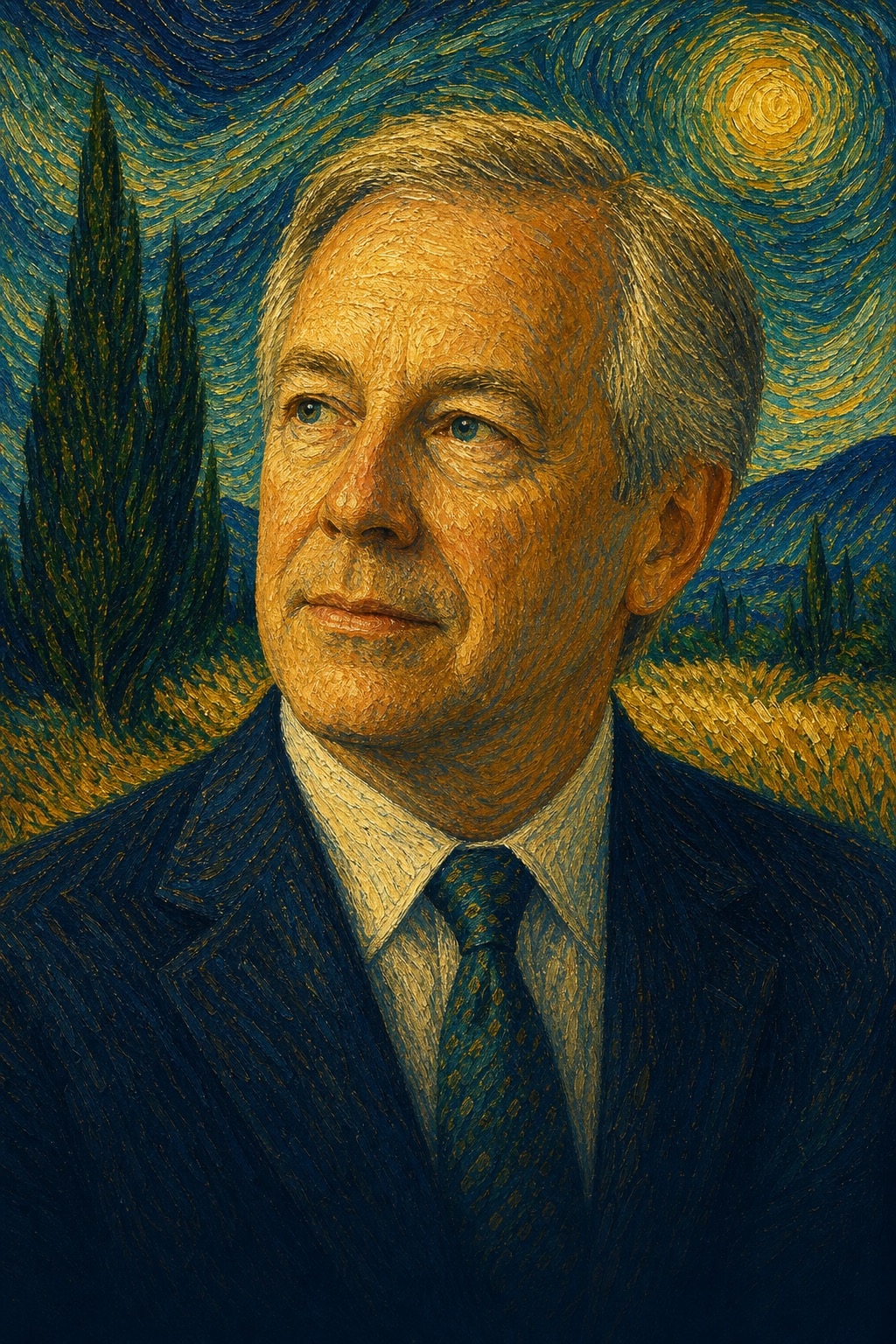
Chuck Akre
Turned business quality, management quality, and reinvestment runway into a concentrated compounding-machine discipline, while showing how valuation duration, correlated theses, succession, and wrapper mechanics can punish even admired quality portfolios.
As of: 2026-07-04T11:26:49Z
Snapshot Table
| Field | Summary |
|---|---|
| Full name | Charles T. "Chuck" Akre, Jr. |
| Status | Living as of this run: Akre Capital's current official team pages list him as Chairman, and no credible obituary or contrary current-source evidence was found in this run. |
| Born | Likely 1942 or 1943. SEC proxy filings list him as 66 in 2009 and 70 in 2013, while a 2021 local profile described him as 78; no primary exact birth date was found. Enstar 2009 proxy, Enstar 2013 proxy, Foothills Forum |
| Base | Middleburg, Virginia; Akre Capital Management, LLC is headquartered there. Akre Capital - About |
| Education | Blair Academy affiliation/class marker '62 appears in Blair materials; a Talks at Google/MOI profile says he earned a B.A. in English Literature from American University. Blair Academy annual report, MOI Global 2017 |
| Main vehicles | Akre Capital Management, LLC; Akre Focus Fund, launched 2009 and reorganized into Akre Focus ETF (ticker AKRE) in 2025; private onshore/offshore long/short equity partnerships; separately managed accounts; earlier FBR Focus Fund while Akre was manager/sub-adviser. Akre bio, Akre Focus ETF, Private funds page, SEC N-14 reorganization filing |
| Years active | Securities business since 1968; Akre Capital founded 1989; public Akre Focus record starts 2009-08-31; Akre stepped back from direct day-to-day portfolio management around end-2020 but remains Chairman/control person. Enstar 2013 proxy, Akre bio, Foothills Forum, SEC N-14 |
| Style tags | Quality compounder; "three-legged stool"; concentrated public equities; high-return-on-capital businesses; management quality; reinvestment runway; low turnover; private-owner mindset; willingness to hold cash when opportunities do not qualify. Investment approach, Our Investment Philosophy, 1988 shareholder letter |
| Current public-fund assets | Akre Focus ETF reported about $5.2 billion in net assets as of 2026-06-30; Akre Capital's official about page reported about $6.6 billion across ETF, private partnership, and SMA assets as of the same date. These are not the same as Form ADV RAUM or 13F value. Akre Focus ETF, Akre Capital - About |
| Track-record headline | The current fund/ETF legal track record starts 2009-08-31. Official Akre Focus ETF data showed 12.61% annualized NAV since inception through 2026-05-31 versus 14.69% for the S&P 500 Total Return Index; SEC N-14 data through 2024-12-31 had shown Institutional class since-inception return of 15.39% versus 14.27% for the S&P 500. Akre Focus ETF, SEC N-14 |
| Key caveat | Do not blend current ETF assets, firm assets, private-fund assets, ADV RAUM, and 13F value. Do not treat the pre-2009 FBR Focus record as legally continuous Akre Focus Fund/ETF performance. |
Life & Career Timeline
Chuck Akre's background is one of the cleaner examples in this canon of a non-finance academic start becoming an unusually durable investment identity. The exact birth date remains unverified from public primary sources found in this run, but SEC and local-reporting evidence triangulate his birth year to about 1942 or 1943. SEC proxy materials for Enstar Group list Charles T. Akre, Jr. as 66 in 2009 and 70 in 2013, while a 2021 Foothills Forum profile called him 78. That is enough to avoid guessing a date and to mark him living/current as of this run because Akre Capital still presents him as Chairman. Enstar 2009 proxy, Enstar 2013 proxy, Foothills Forum, Akre Capital - About
Akre's educational path matters because it shaped his self-description. Blair Academy materials identify "Charles T. Akre, Jr. '62," and a MOI Global / Talks at Google profile says he earned a B.A. in English Literature from American University. In a 2012 interview with The Manual of Ideas, Akre recalled moving from a pre-med direction into literature, returning to Washington, D.C., and starting as a rookie stockbroker in the summer of 1968. He did not present himself as arriving with a formal quant or accounting pedigree; the career story is closer to a field apprenticeship in business analysis. Blair Academy annual report, MOI Global 2017, MOI Global 2012 interview
The first long professional base was Johnston, Lemon & Co., where Akre spent roughly 21 years. The official Akre Capital bio states that he founded Akre Capital Management in 1989 after that period. SEC proxy language adds texture: by the time Enstar described him in 2009 and 2013, Akre had been in the securities business since 1968 and had held Johnston, Lemon roles across brokerage, research, asset management, and management. Akre bio, Enstar 2013 proxy
Akre Capital's first era as an independent firm began in 1989. From 1993 to 2000, the firm operated under the Friedman, Billings, Ramsey & Co. / FBR umbrella, then returned to private independence in 2000. The firm later established its Middleburg, Virginia base, with official biographical sources and profiles giving slightly different wording around whether the move should be dated to 2000 or 2002. The safer statement is that Akre Capital became independent again in 2000 and is now Middleburg-based. Akre bio, MOI Global 2017, Akre Capital - About
The FBR Focus Fund period is a central but easily mishandled part of the record. Kiplinger reported in 2012 that FBR Focus, run by Akre from the start of 1997 through August 2009, compounded at 12.3% annualized, in the top 1% among mid-cap growth funds, versus 4.4% for the S&P 500 and 4.9% for the average midsize growth fund. Kiplinger also reported that during the 2007-2009 bear market FBR Focus fell 51.0%, slightly less than the S&P 500's 55.3% decline. That record is highly relevant to Akre's investor biography, but it is not the legal performance history of today's Akre Focus ETF. Kiplinger 2012
In August 2009, Akre left the FBR Focus arrangement and launched the Akre Focus Fund. Contemporary reporting described the departure as a major manager change for FBR Focus and the launch of a new Akre-managed public fund. Akre Focus commenced operations on 2009-08-31; its first SEC annual report covered the period through 2010-07-31 and reported $207.96 million in net assets at that date. Kiplinger 2009, MarketWatch 2009, SEC 2010 annual report
The succession process was gradual rather than a single clean handoff. A 2014 SEC supplement named John Neff and Thomas Saberhagen co-portfolio managers effective August 1, 2014. A 2019 SEC supplement added Chris Cerrone as a portfolio manager effective January 1, 2020. The 2021 Foothills Forum profile says Akre stepped back from direct portfolio-management responsibility at the end of 2020. In current Akre materials, Chuck is Chairman, John Neff is CEO/CIO, and the 2025 ETF reorganization filing identifies Neff as the day-to-day portfolio manager while also naming Akre as a control person/largest voting-interest owner of the adviser. SEC 2014 supplement, SEC 2019 supplement, Foothills Forum, SEC N-14, Akre Capital - About
The latest structural change is the 2025 conversion from mutual fund to ETF. The SEC N-14 filing for the reorganization described an expected shareholder meeting on 2025-09-19, an expected last mutual-fund purchase/redemption date around 2025-10-20, and the reorganization after trading on 2025-10-24, with ETF trading expected on 2025-10-27. The official Akre Focus ETF site now states that AKRE began trading on NYSE Arca on 2025-10-27 and that the predecessor mutual fund commenced on 2009-08-31. SEC N-14, Akre Focus ETF
Vehicles & Structure
Akre Capital Management, LLC is the central management company. Its official about page says it was founded in 1989, is based in Middleburg, Virginia, and manages the Akre Focus ETF, private partnerships, and separately managed accounts. As of 2026-06-30, the official page reported approximately $6.6 billion in assets across those channels. That figure should be treated as a firm-presented asset snapshot, not automatically as SEC Form ADV regulatory assets under management. Akre Capital - About
The current public product is Akre Focus ETF, ticker AKRE. The ETF is a successor to the Akre Focus mutual fund and uses the predecessor Institutional class history for pre-conversion performance presentation. Its official page reports a 0.98% gross expense ratio and about $5.2 billion in net assets as of 2026-06-30. A separate official fund-summary page and third-party data feeds may show slightly different asset figures because they are date-sensitive. Akre Focus ETF, Akre Focus ETF fund summary
The private-fund side is also material. Akre Capital's private-investment-funds page says it manages long/short equity private investment funds, with an onshore partnership started in October 1993 and an offshore fund launched in January 2004. The same page reported approximately $1.1 billion in private investment fund assets as of 2026-04-30. Private-fund returns and holdings are not public enough from the sources reviewed to build an audited performance series. Private funds page
Separately managed accounts appear in the Akre Capital service set and Form CRS. The March 30, 2026 Form CRS describes Akre Capital as an SEC-registered investment adviser providing portfolio management services to retail investors through separate accounts, private funds, and a registered investment company. It states a $1 million minimum account size for SMAs and a standard SMA fee schedule of 1.50%. Form CRS also states that the firm and financial professionals have no legal or disciplinary history as defined by that document. Form CRS
Public 13F filings give a partial look at U.S.-listed long exposure, but not the complete portfolio. The Q1 2026 13F cover for Akre Capital Management listed 20 information-table entries and total information-table value of $6.1345 billion for the period ended 2026-03-31, filed 2026-05-14. The corresponding information table showed large positions in Mastercard, Brookfield, KKR, Moody's, and Visa, and included a Salesforce call line. This is useful evidence of concentration and current exposures, but 13F excludes cash, shorts, many foreign securities, many derivatives, private positions, and any trading after quarter end. SEC 13F cover, SEC 13F information table
The governance point for future tasks is that "Akre" now means both a founder's philosophy and an institution with a successor portfolio team. As of the 2025 ETF reorganization documents, John Neff is the day-to-day manager; Chuck Akre remains Chairman and a control person/largest voting-interest owner of the adviser. Future performance attribution should distinguish Akre-as-founder, Akre-as-adviser, Neff/Cerrone as current portfolio team, and historical FBR-era Akre personal attribution. SEC N-14
Track Record Detail With Caveats
The best way to handle Akre's record is in three lanes: the Akre-managed FBR Focus period, the Akre Focus mutual fund/ETF legal track record from 2009 onward, and the current adviser/portfolio footprint. Combining them into a single number would make the profile cleaner but less true.
The FBR Focus lane is impressive but secondary-source-heavy in this run. Kiplinger reported that from the start of 1997 through August 2009, FBR Focus under Akre earned 12.3% annualized, placing in the top 1% of mid-cap growth funds, compared with 4.4% for the S&P 500 and 4.9% for the average midsize growth fund. A 2009 Kiplinger transition piece described the FBR Focus 10-year annualized return through 2009-07-31 as 11%, roughly 10 percentage points ahead of Morningstar's mid-growth benchmark, and said Akre was leaving to launch Akre Focus. This is credible contemporaneous/near-contemporaneous evidence for Akre's pre-2009 public mutual-fund reputation, but it is not the same as audited Akre Focus Fund history. Kiplinger 2012, Kiplinger 2009
The Akre Focus legal track record begins on 2009-08-31. The first annual report shows a young fund with $207.96 million in net assets by 2010-07-31 and an initial period return of 5.20% for Institutional shares versus 9.87% for the S&P 500 over that short first period. The early lag is not especially diagnostic, but it establishes the public fund's starting point. SEC 2010 annual report
By 2020, the Akre Focus record looked very strong. The SEC-filed 2020 annual report showed Institutional shares compounding at 17.44% since inception through 2020-07-31, versus 13.59% for the S&P 500. The same report showed 10-year Institutional annualized returns of 18.58% versus 13.84% for the S&P 500. This is the strongest primary-source performance anchor for the high-conviction Akre reputation: a concentrated quality-compounding fund materially ahead of the index through a decade that rewarded exactly that style. SEC 2020 annual report
The record changed meaningfully after that. The 2025 SEC N-14 filing, using periods ended 2024-12-31, still showed Institutional class since-inception before-tax return of 15.39% versus 14.27% for the S&P 500. It also showed 10-year return of 13.95% versus 13.10% for the S&P 500, 5-year return of 12.08% versus 14.53%, and 1-year return of 18.27% versus 25.02%. In other words, by the end of 2024 the since-inception record still beat the benchmark, but shorter periods were already showing pressure. SEC N-14
By mid-2026, official current performance had moved into outright benchmark lag since inception. The Akre Focus ETF page reported, as of 2026-05-31, NAV annualized returns of 12.61% since inception versus 14.69% for the S&P 500 Total Return Index. It also showed 15-year return of 12.37%, 10-year return of 11.07%, 5-year return of 1.06%, and 1-year return of -24.01%. The same page showed the S&P 500 up strongly over the recent periods. This is essential to include because it prevents the profile from freezing Akre's reputation at the 2020 high-water mark. Akre Focus ETF
Third-party coverage captured the asset and performance pressure after the ETF conversion. ETF.com reported in April 2026 that the converted ETF had launched in late October 2025 with just under $11 billion in assets and had fallen to roughly $6.7 billion by April 2026, while also noting severe underperformance since conversion and over five years. The exact figures are secondary and date-specific, but they align directionally with the official current page showing $5.2 billion in net assets by 2026-06-30 and material recent losses. ETF.com 2026, Akre Focus ETF
Risk and criticism are less about scandal than about concentration, style exposure, and shareholder experience. The fund is a focused, non-diversified product. A Schwab ETF report generated around this run showed 20 holdings, top-10 exposure above 80%, and very heavy financials and information-technology exposure. Those exposures are consistent with the Akre method, not a deviation from it, but they amplify underperformance when the favored compounders lag. Schwab AKRE report
The 2025 mutual-fund-to-ETF conversion also created operational friction for some shareholders. The SEC N-14 filing warned that shareholders needed appropriate brokerage arrangements and that certain direct or retirement-account holders who did not act could face liquidation, tax consequences, withholding, or penalties. The filing also estimated reorganization costs at $840,000, split 50/50 between Akre and the mutual fund. This is not an indictment of the conversion; it is a cost and investor-experience caveat. SEC N-14
Regulatory/legal review found one adverse individual disclosure and no public enforcement action in the sources checked. Akre Capital's 2026 Form CRS says the firm and financial professionals have no legal or disciplinary history for CRS purposes. Separately, Charles Akre's IAPD individual report includes one customer-dispute disclosure: a customer alleged investment losses as a limited partner of a former limited partnership where Akre was general partner/portfolio manager; alleged damages were $28,000; the complaint was received 1994-04-01 and settled 1995-12-12 for $20,000. This should be described carefully as an old settled customer dispute, not as a finding of regulatory wrongdoing. No SEC enforcement action, FINRA disciplinary action, or obvious court-litigation red flag against Akre Capital or Chuck Akre surfaced in the targeted searches performed for this task. Form CRS, Charles Akre IAPD report
Why They Matter
Akre matters because he turned a simple quality-investing metaphor into a durable operating discipline. The "three-legged stool" asks whether a company has an extraordinary business, able and shareholder-oriented management, and opportunities to reinvest excess capital at high rates. Akre Capital's official philosophy page uses that structure today, and the 1988 shareholder letter shows an earlier version of the same search for a superior business, exceptional management, and reinvestment of excess capital. The metaphor is teachable, memorable, and operational enough to survive succession. Our Investment Philosophy, 1988 shareholder letter
He also matters because the style is a clean public case study of compounding as both philosophy and portfolio construction. Akre rejects the simple value-versus-growth label in favor of being a compounding investor. The firm emphasizes business quality, per-share growth in economic value, management capital allocation, and reinvestment runways. The key is not merely finding a good business; it is finding one whose excess capital can keep compounding internally or through disciplined allocation. The Power of Compounding, The Bottom Line of All Investing Is Rate of Return, What Do We Mean By Reinvestment?
The Akre corpus is unusually practical for future canon tasks because the stated process maps directly to research checklists: analyze business economics, test management behavior, underwrite reinvestment, avoid false precision in sell targets, and hold only a limited number of companies that meet the bar. The official "Discerning Opportunities" page emphasizes that true compounding-machine businesses are rare, while Akre's talks and interviews show the intellectual path from Thomas Phelps's 100 to 1 and Buffett/Munger-style owner thinking into a concentrated public-equity process. Discerning Opportunities, GeoInvesting / Talks at Google transcript, Talks at Google video, Colossus 2019
The non-hagiographic lesson is equally important. Akre's public record demonstrates that quality compounding can work spectacularly for long stretches and still suffer painful multi-year relative and absolute drawdowns. A concentrated portfolio of admired compounders can become a high-expectations portfolio; if starting valuations, sector leadership, or a new market regime shift, the very businesses that once embodied durability can lag. The 2020-to-2026 arc makes Akre a better canon subject, not a worse one, because it turns the profile from a slogan into a full cycle: philosophy, proof, succession, conversion, underperformance, and the test of whether process still deserves trust when results are poor. SEC 2020 annual report, Akre Focus ETF, ETF.com 2026
Open Questions
Exact birth date and full education record: public SEC/proxy/local evidence supports a 1942/1943 birth-year range, and Blair/American University references are credible, but this profile did not find a primary birth record or registrar-level education source.
Audited pre-2009 performance: the FBR Focus record under Akre is well supported by contemporary financial media, but the underlying primary fund reports and complete manager-attribution records still need reconstruction.
Peak assets under management: this run found official current firm assets of about $6.6 billion as of 2026-06-30, official ETF assets of about $5.2 billion as of 2026-06-30, private-fund assets of about $1.1 billion as of 2026-04-30, and secondary reporting of just under $11 billion at the 2025 ETF conversion. A primary date-by-date AUM series remains open.
Form ADV details: the official IAPD/ADV source was identified, and search-index evidence surfaced a much higher discretionary RAUM figure, but direct PDF extraction was limited in this run. Future work should download the full ADV Part 1 and Part 2A and reconcile RAUM, private-fund gross assets, SMA assets, and product-level assets.
Private-fund record: Akre's onshore and offshore long/short equity partnerships are important to the vehicle history, but public sources reviewed here do not provide a complete net-return series or holdings history.
Succession attribution after 2020: current public documents identify John Neff as day-to-day portfolio manager and Chuck Akre as Chairman/control person. Future performance and philosophy tasks should be careful when attributing 2021-2026 results to Chuck personally versus the successor team and institution.
Concentration risk through cycles: the public fund's 2025-2026 underperformance should be connected in later tasks to holdings, valuation, sector exposures, sell discipline, and whether the three-legged-stool process missed a broken leg or simply endured an unfavorable regime.
Legal/court search depth: this task checked SEC/IAPD, Form CRS, individual IAPD reports, targeted enforcement/litigation searches, and fund filings. A future legal deep dive could still search full court dockets and archived arbitration databases beyond what was surfaced here.
As of: 2026-07-04T15:18:22Z
Core Worldview
Chuck Akre's investing worldview starts with a deceptively simple premise: common stocks are fractional ownership interests in businesses, and long-term shareholder returns tend to follow the rate at which a business compounds per-share economic value. The firm says the U.S. equity market's long-run 9%-10% return has broadly correlated with the rate of return on owner capital and book value growth for the average U.S. company; Akre's search is for businesses that can compound owner capital at materially better rates for a long time (Akre Capital, Our Investment Philosophy; MOI Global interview, 2012).
That is why Akre dislikes the simple "value" versus "growth" box. He describes the firm instead as a compounding investor: the goal is to own a limited number of businesses whose economics, managers, and reinvestment opportunities let intrinsic value rise for years, preferably without forcing the investor to trade often or forecast near-term market moods (Akre Capital, The Power of Compounding; Akre Capital, Investment Approach).
The framework predates the current branding. Akre's 1988 shareholder letter already emphasized superior businesses, exceptional management, and reinvestment of excess capital. The later "three-legged stool" simply made that older instinct vivid: an extraordinary business, talented management, and a long runway to reinvest free cash flow at high rates. When all three legs are present, Akre Capital calls the company a "compounding machine" (Akre 1988 shareholder letter; Akre Capital, Investment Approach).
The Edge - What Markets Misprice And Why
Akre's edge is not access to better quarterly forecasts. It is the belief that markets systematically underprice long-duration compounding because many investors overreact to quarterly misses, accounting noise, macro scares, temporary multiple compression, and the discomfort of owning concentrated positions through drawdowns. The firm explicitly says it does not use preset sell-price targets; instead, it underwrites the rate of growth in economic value per share over five-to-ten-year periods and treats short-term disappointment as possible opportunity when the stool remains intact (Akre Capital, Our Investment Philosophy; Akre Capital, Discerning Opportunities; Akre Capital, The Bottom Line of All Investing Is Rate of Return).
The business-quality edge is the ability to identify companies whose economics are better than ordinary accounting labels suggest. Akre looks for sustainable competitive advantages, high and predictable returns on invested capital, pricing power, understandable models, and strong balance sheets. His "bottleneck businesses" essay sharpens this idea: the best businesses can sit at a scarce control point in a large secular growth market and earn economics disproportionate to the industry's volume growth (Akre Capital, Investment Approach; Akre Capital, Bottleneck Businesses).
The management edge is behavioral. Akre wants managers with skill, integrity, passion, shareholder alignment, rational compensation, and indifference to Wall Street's short-term scoreboard. In interviews he repeatedly emphasizes capital allocation behavior over promotional language: managers should think about per-share value, free-cash-flow deployment, leverage, and minority-owner treatment, not simply the stock quote (Akre Capital, Investment Approach; Colossus / Invest Like the Best, 2019).
The reinvestment edge is the most distinctive leg. Akre argues that a good business that pays out all of its cash may still produce mediocre returns for a shareholder who paid a high price. A true compounding machine must have opportunities to reinvest retained cash at attractive rates, either internally, through network expansion, by acquisition, or by disciplined repurchase. That is why the third leg is not "growth" in the abstract; it is growth funded and governed in a way that increases per-share value (Akre Capital, What Do We Mean By Reinvestment?; MOI Global interview, 2012).
Process: Idea Sourcing To Sell Discipline
Idea Sourcing
Akre does not present the process as a screen-driven factory. The official "Discerning Opportunities" page says there is no standard path to ideas; they come from reading, business observation, conversations, industry work, and curiosity. Interview sources echo this: ideas can "bubble up" from accumulated pattern recognition rather than from a single quantitative screen. Screens may be useful to the team, but Akre's own stated method is closer to qualitative business forensics filtered by long experience (Akre Capital, Discerning Opportunities; Colossus / Invest Like the Best, 2019).
Research
The research process asks three questions in sequence. First, is the business extraordinary enough to compound free cash flow per share at high rates? Second, is management talented and aligned enough not to squander the opportunity? Third, can the business reinvest excess capital for long enough that the investor benefits from time rather than merely from a one-time re-rating? The current ETF prospectus uses the same triad and says Akre Focus seeks companies with high returns on equity, shareholder-oriented managers, and reinvestment opportunity, purchased at "modest-to-reasonable" valuation relative to expected growth in economic value per share (SEC Akre Focus ETF summary prospectus, 2025; Akre Capital, Investment Approach).
Valuation And Entry
Akre is quality-first but not price-indifferent. The firm says it aims to purchase compounding machines at a reasonable valuation upon entry or addition. Its rate-of-return essay frames valuation as a question of expected shareholder return: if business value per share can compound at attractive rates and the entry price is not excessive, the investor can participate in that compounding; if the entry price is too high, even a fine business can disappoint. In the 2020 Value Investor Insight transition interview, Akre made the asymmetry explicit: the team has buy targets, but avoids sell targets because selling a still-compounding winner can interrupt the very math it is trying to own (Akre Capital, Investment Approach; Akre Capital, The Bottom Line of All Investing Is Rate of Return; Value Investor Insight, 2020).
In practice, this produces a willingness to pay for durability but a reluctance to chase every admired company. The firm emphasizes rarity twice: genuine compounding machines are rare, and attractive prices for them are also rare. That rarity explains the willingness to hold cash and to let the portfolio stay concentrated rather than fill every slot with a merely acceptable business (Akre Capital, Discerning Opportunities; Akre Capital, How We Think About Cash).
Sizing And Portfolio Construction
The portfolio is deliberately focused. The official strategy language says shareholder capital is concentrated in a limited number of extraordinary businesses; current AKRE materials describe a focused, non-diversified ETF. The Q1 2026 13F reported 20 entries and about $6.13 billion of U.S.-reportable long value, with Mastercard, Brookfield, KKR, Moody's, Visa, Roper, CoStar, and Fair Isaac among the largest disclosed lines. That filing is not a complete portfolio record, but it is consistent with the concentrated philosophy (Akre Capital, Investment Approach; SEC Akre Capital 13F cover, 2026; SEC Akre Capital 13F table, 2026).
The legal wrapper matters. The 2025 ETF prospectus states that AKRE is non-diversified and may invest a larger percentage of assets in fewer issuers, which can increase volatility. It also permits significant cash, up to 35% foreign issuers, securities lending up to one-third of assets, and sector exposure that can exceed 25% in some circumstances. Those are not departures from the philosophy; they are the regulatory disclosure of the risks embedded in a concentrated compounding strategy (SEC Akre Focus ETF summary prospectus, 2025).
Sell Discipline
Akre's sell discipline is intentionally different from a price-target process. The official philosophy page says discussion begins when a leg of the stool is broken or injured; the "Discerning Opportunities" page says preset exit targets are "antithetical to compounding." In regulatory language, sale can follow deterioration in the issuer's business, management, reinvestment opportunity, market view, issuer change, or a better alternative. The practical rule is stool-based reassessment, not a spreadsheet-triggered trim (Akre Capital, Our Investment Philosophy; Akre Capital, Discerning Opportunities; SEC Akre Focus ETF summary prospectus, 2025).
The discipline is asymmetric: sell only when the thesis is worse, not merely when the stock is higher. That asymmetry is central to Akre's philosophy because the biggest compounding mistakes often come from selling winners too early. It is also a source of current tension, because a process built to avoid premature selling can look stubborn when the market is questioning whether a stool leg has actually weakened or whether the investor simply paid too much for intact quality (Akre Capital, Our Investment Philosophy; Value Investor Insight, 2020).
Risk Management
Akre's first risk-control tool is business selection. He defines risk less as share-price volatility and more as the chance of permanent capital impairment through weak economics, poor management, fragile balance sheets, overpayment, or broken reinvestment opportunity. The official process page therefore embeds risk controls in the business leg: sustainable advantages, predictable high ROIC, pricing power, comprehensibility, and strong balance sheets. The firm is explicit that volatility, beta, and tracking error are not its core risk vocabulary (Akre Capital, Investment Approach; Akre Capital, Discerning Opportunities).
The second tool is valuation discipline and cash. Akre Capital's cash essay explicitly resists the pressure to be fully invested just because a fund has received capital. It frames cash as dry powder and behavioral protection when opportunity is scarce. In the firm's words, cash "does not burn a hole in our pocket" (Akre Capital, How We Think About Cash).
The third tool is partner and product honesty. AKRE's current official materials disclose concentration, ETF trading risks, foreign and sector exposure, securities lending, and the possibility that the strategy underperforms. Form CRS also discloses ordinary adviser conflicts: proprietary products, performance-fee private funds, broker selection, and personal trading can create incentives that clients should understand. These caveats are not scandal evidence; they are part of the operating environment for a focused investment adviser (SEC Akre Focus ETF summary prospectus, 2025; Akre Capital Form CRS, 2026).
The fourth tool is refusing false diversification. Akre's philosophy accepts that owning many mediocre businesses can reduce measured volatility while increasing analytical mediocrity. The risk is that concentration creates headline pain when the selected companies lag together, as the post-2021 record shows. This is the trade: the method reduces business-quality risk by narrowing the portfolio, but increases style, valuation, and tracking-error risk (Akre Capital, Investment Approach; Schwab AKRE ETF report, 2026).
Temperament And Psychology
Akre treats patience as a skill, not a slogan. The firm's 2022 essay on why compounding is difficult argues that the compounding engine often survives recessions, wars, inflation, pandemics, and political stress, but investors fail because they respond to price declines emotionally. The required psychological move is to separate business progress from stock-price movement and to re-underwrite the stool rather than the ticker tape (Akre Capital, Why Compounding Is So Difficult).
The Middleburg, Virginia setting is part of the self-image. In interviews, Akre presents distance from Wall Street as an advantage: fewer distractions, less pressure to transact, and more room for curiosity, reading, and pattern recognition. Whether or not geography is causal, it matches the philosophy's psychological demand: the investor must be willing to look inactive while compounding does the work (Colossus / Invest Like the Best, 2019; GeoInvesting / Talks at Google transcript, 2017).
The temperament also includes moral pattern recognition. Akre's management test is not simply "smart people." He prefers managers who act like owner-partners and rejects those whose behavior suggests minority owners are not safe. That makes governance a core psychological and analytical filter, not a separate ESG overlay (Akre Capital, Investment Approach; Latticework / MOI Global interview, 2021).
Evolution Over Career
Akre's career evolution can be summarized as a move from general value investing toward high-quality compounding. The 1988 letter already searched for superior businesses and management, but later interviews describe the deepening influence of Thomas Phelps's 100 to 1 in the Stock Market, Buffett, and Munger. The change was not from value to growth; it was from asset cheapness and earnings opportunity toward the durability of the compounding mechanism itself (Akre 1988 shareholder letter; GeoInvesting / Talks at Google transcript, 2017).
The product evolution also matters. Akre managed FBR Focus from the late 1990s through August 2009, launched Akre Focus Fund on 2009-08-31, gradually added John Neff, Thomas Saberhagen, and Chris Cerrone as portfolio managers, then reorganized the mutual fund into Akre Focus ETF in 2025. Current fund documents identify John H. Neff as CEO/CIO and the day-to-day portfolio manager, while Chuck Akre remains Chairman and a control person. Future performance should therefore distinguish founder philosophy from current team execution (SEC Akre Focus Fund supplement, 2014; SEC Akre Focus Fund supplement, 2019; SEC N-14, 2025).
The performance evolution is equally important. The Akre Focus Fund looked outstanding by 2020, when the SEC-filed annual report showed Institutional shares compounding at 17.44% since inception through 2020-07-31 versus 13.59% for the S&P 500. By the 2025 reorganization filing, the since-inception record through 2024 still led the S&P 500. But by 2026, official AKRE data showed since-inception NAV returns below the S&P 500 and sharply negative recent results. The philosophy has therefore moved from proof phase to stress-test phase (SEC Akre Focus Fund annual report, 2020; SEC N-14, 2025; Akre Focus ETF, 2026).
What They Explicitly Reject
Akre explicitly rejects category labels that replace analysis. The firm does not want to be understood as simply value or growth; it wants to be judged by whether it owns businesses that can compound per-share value at above-average rates for long periods (Akre Capital, The Power of Compounding).
He rejects quarter-to-quarter earnings games. Talks and official materials criticize the obsession with whether a company beats or misses by a penny when the real question is whether economic value per share is rising over many years. That stance underpins both the willingness to buy temporary disappointments and the refusal to sell just because a stock has reached a mechanically calculated target (GeoInvesting / Talks at Google transcript, 2017; Akre Capital, Our Investment Philosophy).
He rejects weak management and misaligned incentives. The official screen requires integrity, shareholder partnership, rational compensation, and indifference to short-term Wall Street focus. Interview evidence adds a sharper behavioral rule: management that has once acted against minority owners should not be assumed to change character merely because the stock is cheap (Akre Capital, Investment Approach; Latticework / MOI Global interview, 2021).
He rejects activity for its own sake. Cash may sit idle, positions may be held for years, and the portfolio may look strange versus the index. In Akre's frame, the investor's job is not to appear busy; it is to avoid interrupting a compounding engine unless the engine is actually damaged (Akre Capital, How We Think About Cash; Akre Capital, Why Compounding Is So Difficult).
Regimes Where It Thrives Versus Struggles
The philosophy thrives when several conditions coincide: durable competitive advantages are recognized slowly, high-quality companies can reinvest free cash flow at attractive rates, valuation multiples are not already too stretched, and investors are rewarded for looking through temporary earnings or macro noise. The 2009-2020 Akre Focus record is the cleanest public evidence: the fund's Institutional class beat the S&P 500 over the since-inception and 10-year periods through 2020-07-31, a decade that rewarded quality compounders, low rates, asset-light economics, and patient ownership (SEC Akre Focus Fund annual report, 2020).
It struggles when the market rapidly re-prices long-duration cash flows, when concentrated holdings share common factor exposure, when index returns are driven by companies Akre does not own, or when investors question whether high-quality companies face new technological or credit-cycle threats. Akre's Q1 2022 commentary described a period when rising rates, inflation, fuel prices, war, and geopolitical stress hit the fund harder than the S&P 500; the team did little repositioning because it believed the businesses remained sound (Akre Q1 2022 commentary PDF).
The current regime is the sharpest test. As of 2026-05-31, the official AKRE page reported NAV down 24.01% over one year versus the S&P 500 Total Return Index up 22.32%, five-year annualized NAV return of 1.06% versus 13.41% for the index, and since-inception NAV return of 12.61% versus 14.69% for the index. ETF.com framed the 2026 pressure around fears that AI could disrupt software/data names and that private-credit concerns could weigh on Brookfield and KKR. Those criticisms go directly to Akre's first two stool legs: business durability and management/capital allocation through changing conditions (Akre Focus ETF, 2026; ETF.com, 2026).
The ETF wrapper adds a regime issue of its own. Akre argued the conversion provided broader access, daily transparency, tax-management advantages, and a lower-cost structure for many shareholders, but SEC materials also warn about ETF-specific frictions such as bid-ask spreads, premium/discount risk, AP/market-maker concentration, and cash redemption costs. The wrapper may improve tax and access mechanics while making daily market judgment of the strategy even more visible (SEC N-14, 2025; SEC Akre Focus ETF summary prospectus, 2025).
Tensions Between Stated Philosophy And Actual Behavior
The first tension is valuation. Akre's philosophy says entry valuation matters, but the post-2021 record suggests that some excellent businesses were owned at prices or factor exposures that left shareholders vulnerable to multiple compression. That does not refute the philosophy; it shows that "reasonable valuation" is the hardest phrase in the whole method. A business can remain extraordinary while the shareholder return disappoints for years if the entry or holding valuation embeds too much admiration (Akre Capital, The Bottom Line of All Investing Is Rate of Return; Akre Focus ETF, 2026).
The second tension is sell discipline. Refusing price targets protects against the classic mistake of selling great compounders early, but it can blur the line between patience and thesis inertia. When Constellation Software, Brookfield, KKR, Moody's, Mastercard, Visa, or other core compounder-style holdings face market-specific pressure, the hard question is whether a leg of the stool is actually broken or merely repriced. The philosophy supplies the right question, but not an externally visible, mechanical answer (SEC Akre Capital 13F table, 2026; Akre Capital, Our Investment Philosophy).
The third tension is concentration. Akre criticizes false diversification, yet the concentrated portfolio has produced severe recent benchmark and absolute underperformance. Schwab's July 2026 report showed 20 holdings and top-10 exposure above 80%, while official AKRE data showed deep recent losses. The philosophy knowingly accepts this risk; the investor experience still hurts when the chosen names lag together (Schwab AKRE ETF report, 2026; Akre Focus ETF, 2026).
The fourth tension is attribution. Chuck Akre built and articulated the philosophy, but current fund documents name John Neff as day-to-day portfolio manager. That makes post-2020 results a test of the institution and philosophy as much as of Akre personally. A fair Canon treatment should not erase Akre's influence, but it should not pretend that every current portfolio decision is personally made by the founder (SEC N-14, 2025; Akre Capital - About).
The fifth tension is legal and conflict framing. Akre Capital's 2026 Form CRS reports no legal or disciplinary history for CRS purposes, but Chuck Akre's individual IAPD record includes one settled customer-dispute disclosure from the 1990s involving alleged losses in a former limited partnership; it was settled for $20,000 and should not be described as an SEC or FINRA enforcement finding. The same CRS also discloses ordinary adviser conflicts around proprietary products, performance-fee private funds, broker selection, and personal trading. The correct reading is neither scandal nor sainthood: Akre's public record is mostly clean, but the source record still requires precise caveats (Akre Capital Form CRS, 2026; Charles Akre IAPD report).
The final tension is transferability. The three-legged stool is easy to remember, which makes it easy to imitate badly. Individual investors can copy the questions, but they cannot copy Akre's experience, team, access to management, psychological environment, private-fund flexibility, or tolerance for multi-year public underperformance. The philosophy is useful precisely because it is simple; it is dangerous when simplicity becomes an excuse to skip valuation, governance, or position-size discipline (Akre Capital, Discerning Opportunities; Akre Capital, Why Compounding Is So Difficult).
As of: 2026-07-04T13:52:02Z
Evidence Standard And Caveats
This file treats "greatest trades" as documented public-market investments, not as a perfect audited trade blotter. Akre Capital's public 13F filings are useful, but they report quarter-end U.S.-listed long positions after a delay and omit cash, most shorts, many foreign securities, private holdings, many derivatives, and intra-quarter trading. The SEC also warns that Form 13F information should not be assumed complete or SEC-reviewed for accuracy; filings are generally due within 45 days after quarter-end. SEC Form 13F FAQ, SEC Form 13F data sets
The central attribution problem is succession. Chuck Akre founded the firm and built the three-legged-stool process, but John Neff became a co-portfolio manager in 2014, Chris Cerrone became a portfolio manager in 2020, and current ETF reorganization filings identify Neff as day-to-day portfolio manager while Akre remains Chairman/control person. Trades initiated after that handoff, especially the 2020 cash deployment into KKR and Brookfield-type names, are best described as Akre Capital trades rather than Chuck-only trades. SEC 2014 supplement, SEC 2019 supplement, SEC N-14
Guiding Questions
- Which trades have Akre's own words or contemporaneous evidence behind them, not just later portfolio databases?
- Which holdings were large enough in 13F or fund reports to matter to fund-level outcomes?
- Which candidate is the single best trade by a combination of return multiple, dollars, drawdown endured, and process lesson?
- Where can entry price, exit price, and position size be triangulated, and where must the file flag [single-source] or [not publicly disclosed]?
- Which winners are founder-era Akre trades, and which are later Akre Capital team trades?
- What do the winners hide about concentration risk, recent underperformance, and sell discipline?
Ranking Summary
| Rank | Trade | Best evidence | Main caveat |
|---|---|---|---|
| 1 | American Tower | Akre discussed the 2002 crisis entry and American Tower remained a top holding for years; 13F/fund reports show very large size. | Exact all-in cost basis and realized P&L are not public. |
| 2 | Mastercard | 2010 13F initiation, 2012/2017 Akre discussion, current largest 13F position. | Return multiple depends on split-adjusted entry assumptions and ignores all trims/dividends. |
| 3 | Moody's | Akre discussed a 2012 purchase around $39; 2020 and 2026 filings show it as a large long-term holding. | Exact additions/trims and fund-level profit are not public. |
| 4 | O'Reilly Automotive | Large 2008 13F holding, long hold, still disclosed in 2026 after a 2025 split. | Initial acquisition partly predates the visible public record; 2025 split complicates simple share comparisons. |
| 5 | Visa | Same payments thesis as Mastercard; 2010 and 2026 filings show material exposure. | 13F history suggests possible sale/rebuild, so treat as a companion trade, not a clean continuous position. |
| 6 | Markel | Akre explained the Markel thesis in 2010; 13F filings show meaningful size through at least 2020. | No longer disclosed by Q1 2026; realized exit economics are not public. |
| 7 | Enstar | Visible in 2008 13F, discussed in Akre's 2017 Google talk, and later taken private at $338. | Holding-period continuity to takeout is not proven from public filings opened in this run. |
| 8 | KKR / March 2020 deployment | 2020 annual report says Akre Focus deployed more than $1.1 billion in March; KKR became a large 13F holding. | Successor-team attribution and shorter holding period. |
1. American Tower - The Single Best Documented Trade
Context & dates. Akre bought American Tower during the post-telecom-bubble collapse, when tower companies were associated with leverage, carrier distress, and the wreckage of the 2000-2002 technology bust. A 2011 account of an Akre dinner says he had accumulated about 500,000 American Tower shares by June 2002 at an average price around $5, after the stock had been above $50 two years earlier and before it later fell to $0.71 in October 2002. That entry detail is [single-source] in this run, but the later public portfolio evidence is strong: Akre Capital's Q4 2008 13F showed 5,021,013 American Tower shares worth $147.216 million, and its Q1 2020 13F showed 7,186,212 shares worth $1.652 billion. Investing Daily, 2011, SEC Q4 2008 13F, SEC Q1 2020 13F
Thesis & how they found it. The Akre thesis was classic three-legged stool under stress: the business looked financially fragile, but tower economics had a powerful incremental-margin structure. The same Investing Daily account says Akre relied heavily on CEO Steven Dodge's plan to handle the debt with operating cash flow rather than destructive equity issuance. Later Akre Capital writing describes American Tower as a "bottleneck business": towers sit in the path of secular mobile-data growth, benefit from carrier co-location, and turn additional tenants into high-margin revenue. Investing Daily, 2011, Akre Capital - Bottleneck Businesses, 2021
Size & structure. This was plain common equity. In Q4 2008, the disclosed American Tower position was 16.3% of Akre Capital's $905.862 million 13F value. In the Akre Focus Fund's 2020 annual report, American Tower was the largest reported holding at 10.9% of net assets and one of the top five contributors to the prior year. SEC Q4 2008 13F, SEC 2020 Akre Focus annual report
Entry and path, including drawdown. The brutal part of the trade is the path from an alleged $5 average by June 2002 to a $0.71 closing low in early October. That is an approximate 86% drawdown from the reported average cost. The later public numbers show the reward for sitting through the debt panic: the Q4 2008 13F implied about $29.32 per share, while the Q1 2020 13F implied about $229.82 per share. American Tower later converted into a REIT, paid material dividends, and was eventually reduced sharply; Q1 2026 13F showed only 50,772 shares worth $8.762 million. Investing Daily, 2011, SEC Q4 2008 13F, SEC Q1 2020 13F, SEC Q1 2026 13F
Exit & P&L. Exact realized dollars are not public. The position was still huge in 2020 and almost gone by Q1 2026. A rough price-only bridge from the reported $5 average to the Q1 2020 implied price is about 46x before dividends and before any interim additions or trims; from the October 2002 low to Q1 2020 it is over 300x. Because the entry source is single-source and the 13F values are quarter-end marks, not trade tickets, these figures should be treated as order-of-magnitude evidence rather than audited P&L. Investing Daily, 2011, SEC Q1 2020 13F
What it teaches. American Tower is the purest Akre trade because it tested all three legs under maximum pressure: business economics, management credibility, and reinvestment runway. It also shows that a compounder can be born inside a balance-sheet panic, not only inside a pristine quality screen.
Sources. Investing Daily 2011; SEC Q4 2008 13F; SEC Q1 2020 13F; SEC Q1 2026 13F; Akre Capital 2021 Bottleneck Businesses; Akre Focus 2020 annual report.
2. Mastercard - The Payments Toll Road
Context & dates. Mastercard entered the visible public record in Akre Capital's Q2 2010 13F: 30,000 shares worth $5.986 million. The timing matters. The Durbin Amendment and post-crisis regulation made investors worry that card-network economics would be politically capped. Akre later described the original Mastercard purchase as 2010 and tied the opportunity to regulatory worries; MarketFolly's 2017 notes from Akre's Google talk summarize an entry around $22 split-adjusted, while the Q2 2010 13F implies about $199.53 pre-split, or $19.95 after Mastercard's later 10-for-1 split. SEC Q2 2010 13F, MarketFolly - Google talk notes, 2017, Mastercard stock split history
Thesis & how they found it. The thesis was that Mastercard was a capital-light global payments network, not a lender. Akre's 2012 Value Investing Congress notes framed it as a small royalty on global consumer spending, with high free-cash-flow margins, very modest capital needs, and a long conversion runway as cash transactions migrated to electronic payments. Akre Capital's 2021 bottleneck essay later used Mastercard as an example of a network whose economics are fed by secular electronic-payment growth and protected by two-sided network effects. MarketFolly - Mastercard presentation notes, 2012, Akre Capital - Bottleneck Businesses, 2021
Size & structure. This was common equity. The Q2 2010 position was small relative to the $350.787 million 13F value, about 1.7%. The position was allowed to become much larger: by Q1 2026, Mastercard was Akre Capital's largest disclosed 13F holding at $1.140 billion, or 18.6% of the $6.135 billion information-table value. SEC Q2 2010 13F, SEC Q1 2026 13F
Entry and path, including drawdown. The path included legal and regulatory pressure around debit interchange, merchant litigation, and periodic fears of payment-network disruption. The psychological drawdown was as important as the price drawdown: the market was asking whether the business model's economics were too good to survive politics. In Akre's language, the question was whether the first leg - the business model - was permanently impaired or just temporarily unpopular. MarketFolly - Mastercard presentation notes, 2012, GeoInvesting / Google transcript
Exit & P&L. The trade has not fully exited. Q1 2026 13F still showed 2,281,106 Mastercard shares worth $1.140 billion. The Q2 2010 13F implied a split-adjusted price of about $19.95; Q1 2026 13F implied $499.66. That is roughly a 25.0x price multiple before dividends, taxes, fees, additions, and trims. The exact fund-level P&L is not public, but the combination of long duration, still-large size, and a 25x public price bridge makes Mastercard one of the two strongest candidates for Akre's greatest trade by dollars. SEC Q2 2010 13F, Mastercard stock split history, SEC Q1 2026 13F
What it teaches. Mastercard shows Akre's version of "quality at a reasonable price": the market can temporarily treat a great business like a regulatory target, but if the economics are structurally resilient, time shifts the conversation from multiple compression to compounding.
Sources. SEC Q2 2010 13F; SEC Q1 2026 13F; Mastercard stock split history; MarketFolly 2012 Value Investing Congress notes; MarketFolly 2017 Google talk notes; GeoInvesting Google transcript; Akre Capital 2021 Bottleneck Businesses.
3. Moody's - Oligopoly Economics After The Crisis
Context & dates. Moody's is the best post-crisis information-services trade in the Akre set. MarketFolly's notes from Akre's 2017 Google talk say Akre bought Moody's in January 2012 at about $39 and framed the business as part of a ratings oligopoly. The 13F history opened in this run shows how large the position later became: Q1 2020 disclosed 5,681,643 shares worth $1.349 billion, and Q1 2026 still disclosed 1,246,114 shares worth $543.617 million after years of reductions. MarketFolly - Google talk notes, 2017, SEC Q1 2020 13F, SEC Q1 2026 13F
Thesis & how they found it. The thesis was that bond markets repeatedly need ratings, issuers need access to capital, and the ratings market is concentrated among Moody's, S&P, and Fitch. That made Moody's a high-return, asset-light, recurring-demand business despite the reputational damage of the financial crisis. Akre's Google-talk examples repeatedly use Mastercard and Moody's as businesses where the "essence" of high returns matters more than a spreadsheet's first-year output. MarketFolly - Google talk notes, 2017, GeoInvesting / Google transcript
Size & structure. This was common equity. In Q1 2020, Moody's represented about 10.2% of Akre Capital's 13F value. In the Akre Focus 2020 annual report, Moody's was the third-largest holding at 9.9% of net assets and one of the top five contributors for the prior year. By Q1 2026 it was still a top-five disclosed 13F position. SEC Q1 2020 13F, SEC 2020 Akre Focus annual report, SEC Q1 2026 13F
Entry and path, including drawdown. The drawdown endured was more reputational and legal-regime risk than a single visible collapse after Akre's reported entry. Moody's was still carrying the shadow of structured-finance failures, rating-agency conflicts, and post-crisis regulation. The test was whether the market had permanently impaired the franchise or merely repriced scandal and litigation risk. MarketFolly - Google talk notes, 2017
Exit & P&L. Moody's was heavily trimmed but still owned in Q1 2026. A rough price bridge from the reported $39 entry to the Q1 2026 implied 13F price of $436.25 is about 11.2x before dividends. From Q1 2020's implied $237.41 to Q1 2026's implied $436.25, the remaining public holding still nearly doubled in price while shares were reduced. Exact realized dollars are not public. MarketFolly - Google talk notes, 2017, SEC Q1 2020 13F, SEC Q1 2026 13F
What it teaches. Moody's shows Akre buying a business model with ugly headlines but durable customer dependence. It is also a reminder that reputational risk is not the same as destroyed economics, though distinguishing them in real time is hard.
Sources. MarketFolly 2017 Google talk notes; GeoInvesting Google transcript; SEC Q1 2020 13F; SEC 2020 annual report; SEC Q1 2026 13F.
4. O'Reilly Automotive - Durable Retail Compounding
Context & dates. O'Reilly was already a major Akre holding in the Q4 2008 13F: 3,179,123 shares worth $97.726 million. The position persisted through multiple market cycles. The Q1 2020 13F showed 1,886,926 shares worth $826.964 million; the Akre Focus 2020 annual report listed O'Reilly as 5.0% of net assets. After a June 2025 15-for-1 split, Q1 2026 13F still showed 3,885,813 shares worth $358.699 million. SEC Q4 2008 13F, SEC Q1 2020 13F, SEC 2020 Akre Focus annual report, O'Reilly stock split history, SEC Q1 2026 13F
Thesis & how they found it. The business fit Akre's preference for companies that can reinvest internally at high returns. Auto-parts retail has recurring nondiscretionary demand, dense distribution advantages, working-capital discipline, and a long runway for store growth and buybacks. Akre also discussed owning O'Reilly in a 2019 interview, tying it to the earlier CSK Auto transaction and continuing ownership. Colossus / Invest Like the Best show notes, 2019, SEC 2020 Akre Focus annual report
Size & structure. This was common equity. In Q4 2008, O'Reilly was about 10.8% of Akre Capital's 13F value, making it one of the firm's largest disclosed positions. It remained a top-ten public-fund holding in 2020 and a visible 13F holding in 2026. SEC Q4 2008 13F, SEC 2020 Akre Focus annual report, SEC Q1 2026 13F
Entry and path, including drawdown. The visible Q4 2008 quarter-end implied price was about $30.74 before the 2025 split, or about $2.05 adjusted for that 15-for-1 split. The path included the 2008-2009 recession and later concerns about ecommerce disintermediation, electric vehicles, and mature-store growth. O'Reilly's business quality and capital allocation offset those worries for a very long period. SEC Q4 2008 13F, O'Reilly stock split history
Exit & P&L. The position has been reduced but not exited. Q1 2026 implied $92.31 per share after the 2025 split. Compared with the split-adjusted Q4 2008 implied price of about $2.05, that is about 45x price-only. Because Q4 2008 was not the original purchase ticket, this is a public-holding mark-to-mark estimate, not an actual return figure. SEC Q4 2008 13F, O'Reilly stock split history, SEC Q1 2026 13F
What it teaches. O'Reilly is the quieter version of American Tower and Mastercard. It does not require a heroic regulatory call. It shows that a retailer with great unit economics, a long store runway, and disciplined buybacks can compound at rates that look implausible only in hindsight.
Sources. SEC Q4 2008 13F; SEC Q1 2020 13F; Akre Focus 2020 annual report; O'Reilly stock split history; SEC Q1 2026 13F; Colossus 2019 show notes.
5. Visa - The Companion Payments Trade
Context & dates. Visa appeared beside Mastercard in the Q2 2010 13F: 50,000 shares worth $3.537 million. The same regulatory overhang that made Mastercard cheap applied to Visa, though Visa had more U.S. debit exposure and therefore a different Durbin-risk profile. Akre Capital still disclosed 1,638,798 Visa shares worth $495.310 million in Q1 2026. SEC Q2 2010 13F, MarketFolly - Mastercard presentation notes, 2012, SEC Q1 2026 13F
Thesis & how they found it. Visa shared the core network thesis: global payments moving from cash to electronic rails, high operating margins, very little incremental capital, and long-duration transaction growth. The difference is that Akre's public comments in this run are more detailed for Mastercard than Visa, and a 2012 presentation note explicitly says Mastercard was preferred because Visa had higher U.S. debit exposure. MarketFolly - Mastercard presentation notes, 2012, GeoInvesting / Google transcript
Size & structure. This was common equity. The initial visible Q2 2010 Visa line was about 1.0% of the 13F value. By the 2020 annual report, Visa was 6.7% of Akre Focus net assets. By Q1 2026, it was still a top-five disclosed 13F position at 8.1% of information-table value. SEC Q2 2010 13F, SEC 2020 Akre Focus annual report, SEC Q1 2026 13F
Entry and path, including drawdown. Q2 2010 13F implied $70.74 per share before Visa's 4-for-1 split, or $17.69 split-adjusted. Visa announced the 4-for-1 split in January 2015, with split-adjusted trading beginning March 19, 2015. The trade endured the same recurring regulatory and litigation pressure as Mastercard, plus Visa-specific debit exposure. SEC Q2 2010 13F, Visa 2015 stock split announcement
Exit & P&L. Visa was still held in Q1 2026. The Q1 2026 13F implied $302.24 per share, roughly 17.1x the split-adjusted Q2 2010 implied price, before dividends, additions, and trims. The caveat is continuity: public 13F databases and summaries suggest Akre's Visa position may have been sold down and rebuilt at points, so this file treats Visa as a successful franchise-theme trade rather than a perfectly continuous position from 2010 to 2026. SEC Q2 2010 13F, Visa 2015 stock split announcement, SEC Q1 2026 13F
What it teaches. Visa shows Akre's willingness to own a theme through multiple winners while still differentiating exposure. Mastercard appears to have been the preferred version, but Visa still delivered a powerful long-term outcome.
Sources. SEC Q2 2010 13F; MarketFolly 2012 notes; GeoInvesting Google transcript; Visa 2015 split announcement; Akre Focus 2020 annual report; SEC Q1 2026 13F.
6. Markel - Insurance As A Compounding Machine
Context & dates. Markel was a large disclosed holding in Q4 2008: 387,887 shares worth $115.978 million. Akre discussed the thesis in a February 2010 Advisor Perspectives interview republished by GuruFocus, and the holding remained substantial in later filings. Q1 2020 13F disclosed 512,764 shares worth $586.176 million. Markel was not in the Q1 2026 disclosed 13F table opened in this run, implying the public 13F position had been exited or reduced below reportable/disclosed levels by then. SEC Q4 2008 13F, GuruFocus / Advisor Perspectives interview, 2010, SEC Q1 2020 13F, SEC Q1 2026 13F
Thesis & how they found it. Markel fit Akre's owner-capital lens: underwriting discipline could create low-cost or negative-cost capital, while the investment portfolio could compound book value per share. In the 2010 interview, Akre emphasized reserve development, honest underwriting, investment leverage, and management's shareholder communication. This is a Buffett-influenced insurance thesis adapted to Akre's own rate-of-return framework. GuruFocus / Advisor Perspectives interview, 2010, Akre Capital - The Bottom Line of All Investing Is Rate of Return
Size & structure. This was common equity. In Q4 2008, Markel was about 12.8% of the 13F value. In Q1 2020, it was about 3.6% of the 13F value and one of the bottom five contributors to Akre Focus's prior-year performance, according to the 2020 annual report. SEC Q4 2008 13F, SEC Q1 2020 13F, SEC 2020 Akre Focus annual report
Entry and path, including drawdown. Q4 2008 implied about $299 per Markel share. Q1 2020 implied about $1,143 per share. The ride included the financial crisis, repeated insurance-cycle worries, low-rate pressure on investment income, and the 2020 pandemic crash. The 2020 annual report's bottom-five-detractor note is useful because it shows Markel was not a smooth compounding line even inside Akre's quality universe. SEC Q4 2008 13F, SEC Q1 2020 13F, SEC 2020 Akre Focus annual report
Exit & P&L. Exact exit date and realized P&L are not public from the sources opened here. A rough Q4 2008-to-Q1 2020 mark-to-mark price multiple is about 3.8x before any additions, trims, and tax effects. That is not as spectacular as Mastercard or O'Reilly, but Markel was large and long-held enough to belong in the trade file. SEC Q4 2008 13F, SEC Q1 2020 13F
What it teaches. Markel shows Akre using book-value compounding and capital allocation as the business model. It also shows a hidden difficulty: insurance compounders can look cheap on book value while underwriting cycles, rates, and equity-market exposure muddy near-term results.
Sources. SEC Q4 2008 13F; GuruFocus / Advisor Perspectives 2010 interview; SEC Q1 2020 13F; Akre Focus 2020 annual report; SEC Q1 2026 13F.
7. Enstar - Runoff Insurance And A Less Visible Winner
Context & dates. Enstar appeared in the Q4 2008 13F with 581,535 shares worth $34.392 million. Akre later discussed Enstar in his Google talk; MarketFolly's notes say he had been involved for roughly 10 years and described the business as buying insurance in runoff. Enstar was acquired by Sixth Street-affiliated investment vehicles on July 2, 2025 for $338 cash per ordinary share. SEC Q4 2008 13F, MarketFolly - Google talk notes, 2017, Sixth Street / Enstar acquisition close, 2025
Thesis & how they found it. Enstar was a more specialized version of Akre's insurance-capital-allocation work. The company acquired legacy insurance and reinsurance liabilities, then attempted to manage claims, reserves, and capital release better than sellers could. It was less obviously a mass-market "quality compounder" than Mastercard, but it fit an owner-operator framework where management skill and capital allocation mattered heavily. MarketFolly - Google talk notes, 2017, Sixth Street / Enstar acquisition close, 2025
Size & structure. This was common equity. In Q4 2008, the Enstar position was about 3.8% of Akre Capital's 13F value. That is below the American Tower/O'Reilly/Markel tier, but still meaningful. SEC Q4 2008 13F
Entry and path, including drawdown. The Q4 2008 13F implied about $59.14 per share. The path was illiquid, financials-linked, and exposed to reserve-estimate error. Enstar's runoff model can compound if reserves are conservative and claims are well managed, but can disappoint badly if loss estimates prove too optimistic. SEC Q4 2008 13F, Sixth Street / Enstar acquisition close, 2025
Exit & P&L. Public sources opened here do not prove Akre held Enstar continuously to the 2025 takeout. If one simply compares the Q4 2008 implied price of $59.14 to the $338 cash takeout, the stock price increased about 5.7x. That is a useful upper-bound style marker, not an audited Akre P&L. SEC Q4 2008 13F, Sixth Street / Enstar acquisition close, 2025
What it teaches. Enstar is a reminder that Akre's process was not just "buy famous compounders." He also backed obscure insurance and capital-allocation businesses where management's reserve judgment and reinvestment skill were the asset.
Sources. SEC Q4 2008 13F; MarketFolly 2017 Google talk notes; Sixth Street / Enstar 2025 acquisition close.
8. KKR And The March 2020 Cash Deployment - A Team-Era Stress Test
Context & dates. This is included with an attribution warning. It belongs to Akre Capital's greatest-trades file, but not cleanly to Chuck Akre personally as sole decision maker. The Akre Focus 2020 annual report, signed "Chuck, John, & Chris," says the fund deployed more than $1.7 billion from February through May 2020, with more than $1.1 billion, or 65%, during March. The Q1 2020 13F showed KKR at 12,754,820 shares worth $372.058 million; Q1 2026 showed 6,718,078 shares worth $621.422 million after reductions. SEC 2020 Akre Focus annual report, SEC Q1 2020 13F, SEC Q1 2026 13F
Thesis & how they found it. KKR fits the later Akre Capital expansion from classic operating companies into capital-market compounders: fee-related earnings, balance-sheet investing, asset-management scale, and private-markets growth. The March 2020 buying was less about a single company being misunderstood for years and more about having cash, buy-price targets, and the willingness to act when the market briefly repriced everything. SEC 2020 Akre Focus annual report
Size & structure. This was common equity. In Q1 2020, KKR represented about 2.8% of Akre Capital's 13F value. By Q1 2026, it was about 10.1% of disclosed 13F value. SEC Q1 2020 13F, SEC Q1 2026 13F
Entry and path, including drawdown. The Q1 2020 13F implied $29.17 per share. The COVID drawdown was fast rather than prolonged: the S&P 500 fell 34% from February 19 to March 23, 2020, according to Akre's 2020 annual report. The process lesson was pre-committed target prices and cash held as an accelerant, not market-timing bravado. SEC 2020 Akre Focus annual report, SEC Q1 2020 13F
Exit & P&L. KKR was still held in Q1 2026. Q1 2026 implied $92.50 per share, roughly 3.2x the Q1 2020 implied mark before dividends/distributions and before accounting for additions/trims. Exact Akre Focus fund-level P&L is not public. SEC Q1 2020 13F, SEC Q1 2026 13F
What it teaches. KKR shows the institutionalized version of Akre's process: hold cash when bargains are scarce, know the desired businesses before the panic, and deploy hard when expected returns finally cross the threshold. It also sharpens the attribution boundary: by 2020, this was a Chuck/John/Chris institutional decision, not a pure founder-era solo trade.
Sources. SEC 2020 Akre Focus annual report; SEC Q1 2020 13F; SEC Q1 2026 13F; SEC 2014 and 2019 portfolio-manager supplements; SEC 2025 N-14.
Near Misses And Exclusions
Brookfield. Brookfield is a major current Akre Capital holding, and it may ultimately deserve a full case study. Q1 2026 13F showed Brookfield at $689.086 million, second only to Mastercard. It was excluded from the main list because Brookfield's 2020-2026 return calculation is distorted by reorganizations, spin-offs, ticker changes, and the 2022 asset-management distribution; a clean security-history model is needed before assigning P&L. SEC Q1 2026 13F, Brookfield 2022 distribution announcement
Roper Technologies. Roper is a large current holding and fits Akre's asset-light recurring-revenue framework. Q1 2026 13F showed 1,257,232 shares worth $444.884 million, but public evidence opened in this run is thinner on original Akre thesis and entry details than for American Tower, Mastercard, Moody's, O'Reilly, Visa, Markel, or Enstar. SEC Q1 2026 13F
CarMax, Dollar Tree, Ross Stores, and Danaher. All appear in Akre history as significant holdings or likely strong contributors at different times. They are excluded here because the task required 5-10 trades, and the opened source set offered stronger thesis-and-sizing evidence for the eight main cases above.
What The Winners Do Not Prove
Akre's best trades can make the method look cleaner than it is. The same concentration and patience that let American Tower, Mastercard, Moody's, and O'Reilly compound also created a painful recent shareholder experience. The 2020 annual report showed Akre Focus Institutional compounding at 17.44% since inception through 2020-07-31 versus 13.59% for the S&P 500. By 2026, the official fund site showed the ETF/fund record had fallen behind the S&P 500 since inception and had suffered severe 1-year and 5-year underperformance. SEC 2020 Akre Focus annual report, Akre Focus ETF, Akre Focus ETF documents hub
The trade lesson is therefore two-sided. Akre's greatest winners show how extraordinary business economics, management quality, and reinvestment runways can turn a few long holds into the bulk of lifetime results. They also show why the discipline is hard to copy: the investor must endure deep drawdowns, accept sparse feedback, avoid selling too early, and keep enough skepticism to recognize when a once-great stool leg has actually broken.
As of: 2026-07-04T14:31:31Z
Evidence Standard And Caveats
This file is not a complete loss ledger. Akre Capital's public evidence is uneven: mutual-fund reports show fund-level results and selected contributors/detractors; Form 13F shows delayed quarter-end U.S.-listed long positions but excludes cash, most shorts, many foreign securities, private holdings, many derivatives, and intra-quarter trades; private-fund losses are not public enough to reconstruct. The SEC itself cautions that 13F information is not a complete portfolio and should not be treated as SEC-verified for accuracy or completeness. SEC Form 13F FAQ, Akre Capital Q1 2026 13F
Attribution also needs care. Chuck Akre founded the firm and shaped its three-legged-stool method, but John Neff became a co-portfolio manager in 2014, Chris Cerrone became a portfolio manager in 2020, and current ETF reorganization filings identify Neff as day-to-day portfolio manager while Akre remains Chairman/control person. Recent 2021-2026 outcomes therefore belong to Akre Capital and the successor team unless a source specifically ties a decision to Chuck. SEC 2014 supplement, SEC 2019 supplement, SEC N-14
There is one more continuity caveat. The FBR Focus record that made Akre famous is biographically relevant, but it is not the legal current-fund record of Akre Focus ETF. The public Akre Focus record begins with the Akre Focus Fund on 2009-08-31 and continues through the 2025 ETF wrapper, while the ETF itself began trading on 2025-10-27. Kiplinger 2012, Akre Focus ETF, SEC N-14
Guiding Questions
- Where did the Akre method lose money or trail badly despite apparently good business quality?
- Which losses were thesis errors, which were valuation errors, and which were ordinary drawdowns in long-duration compounders?
- What did Akre or the team say about those episodes contemporaneously?
- Did the process change afterward, or did the firm mostly hold to the same discipline?
- What should future canon readers not copy from Akre without also copying the risk controls?
1. 2007-2009: Quality Did Not Prevent A 51% Drawdown
The first major public loss episode is the financial-crisis drawdown at FBR Focus, the predecessor-era vehicle Akre managed before launching Akre Focus Fund. Kiplinger reported that FBR Focus, run by Akre from the start of 1997 through August 2009, compounded at 12.3% annualized versus 4.4% for the S&P 500 and 4.9% for the average midsize-growth fund. The same article reported that during the 2007-2009 bear market FBR Focus fell 51.0%, only modestly better than the S&P 500's 55.3% decline. Kiplinger 2012
That drawdown is important because it punctures the easy version of the quality-compounder story. Akre's process was already focused on business quality, management quality, and reinvestment runway, yet the portfolio still behaved like a high-equity-risk vehicle in a systemic panic. The lesson is not that the process failed in the long run; the FBR Focus long-term record remained strong. The lesson is that an investor can own superior businesses and still suffer near-market drawdowns when liquidity, credit, and forced selling dominate. Kiplinger 2012, Akre Capital - Our Investment Philosophy
The process response was not a wholesale abandonment of concentration. Akre later continued to emphasize owning a small number of exceptional businesses rather than building a broad defensive index substitute. The later Akre Focus Fund documents and current ETF materials still present a focused, non-diversified strategy, meaning the firm accepted the possibility of large tracking error and sharp drawdowns as part of the method. SEC N-14, Akre Focus ETF
2. 2021-2026: The Great Relative Reversal
The most important modern mistake or loss is not one stock. It is the public fund's collapse from clear long-term outperformance through 2020 into severe relative underperformance by 2026. The 2020 Akre Focus annual report showed Institutional shares compounding at 17.44% since inception through 2020-07-31 versus 13.59% for the S&P 500. By the official Akre Focus ETF page as of 2026-05-31, NAV annualized since-inception return was 12.61% versus 14.69% for the S&P 500 Total Return Index; five-year annualized return was only 1.06% versus 13.41% for the index; one-year NAV return was -24.01% versus +22.32% for the index. SEC 2020 annual report, Akre Focus ETF
The 2022 fund year already showed the problem. The SEC-filed 2022 annual report reported Institutional class total return of -11.03% for the year ended 2022-07-31 versus -4.64% for the S&P 500. The managers identified Moody's, Adobe, CarMax, CoStar, and Salesforce as the largest detractors, and disclosed 4.0% cash while saying they wanted more cash than they had. That is a revealing combination: a quality portfolio had too much exposure to expensive long-duration businesses and not enough dry powder at the moment valuations started to reset. SEC 2022 annual report
By Q1 2026 the relative damage was sharper. Akre's Q1 2026 commentary reported NAV return of -19.40% for the quarter versus -4.33% for the S&P 500 Total Return Index, and trailing-12-month return of -19.63% versus +17.80% for the index. The same commentary said the portfolio's price-to-next-twelve-months free-cash-flow-per-share multiple compressed from 37x in July 2025 to 19x at 2026-03-31. This is the cleanest evidence that the error was at least partly valuation and duration exposure, not just deteriorating business fundamentals. Akre Q1 2026 commentary
ETF.com described the market narrative against the portfolio in April 2026 as a bet that the market was wrong on artificial intelligence. The article reported that the ETF had converted with just under $11 billion, had roughly $6.7 billion six months later, was down about 18.2% since conversion while the S&P 500 was up about 4.3%, and had materially lagged over five years. Those figures are secondary and date-sensitive, but they align with the official fund page's later $5.2 billion net-asset figure as of 2026-06-30 and weak recent performance. ETF.com 2026, Akre Focus ETF
The behavioral root cause was style conviction hardening into style exposure. Akre Capital did not merely own good businesses; it owned a concentrated set of businesses whose valuations depended on durability, high margins, and long reinvestment runways being capitalized at premium multiples. When investor attention shifted toward AI infrastructure winners and away from some of Akre's favored compounders, the portfolio's virtues did not protect the mark-to-market results. Akre Q1 2026 commentary, ETF.com 2026
3. Stock-Specific Pain: CarMax, KKR, Roper, Constellation, CoStar, And Others
CarMax is a useful case because Akre Capital itself framed the drawdown as price/fundamental divergence. In May 2022, John Neff wrote that CarMax's stock was down nearly 30% year to date through May 13 even though the company had reported strong unit growth and free-cash-flow-per-share progress over the relevant fiscal period. In the same piece, KKR was down nearly 31% year to date despite large growth in assets under management, fee-related earnings, distributable earnings, capital raised, and dry powder. Akre Capital - Why Compounding Is So Difficult
That defense may be right, but it does not eliminate the investment lesson. A business can continue to compound value while a stock was bought at a price that leaves little room for multiple compression. The same 2022 annual report that cited CarMax among the largest detractors also showed the fund lagging a falling benchmark, which means Akre shareholders experienced the drawdown as real opportunity cost, not just a temporary quotation. SEC 2022 annual report, Akre Capital - Why Compounding Is So Difficult
The pain continued in 2025. Akre's Q4 2025 commentary reported a 2025 fund return of +1.23% versus +17.88% for the S&P 500 Total Return Index, and listed drawdowns in holdings including Constellation, Roper, CCC Intelligent Solutions, and CoStar. The Q3 2025 commentary listed Constellation, Topicus, Roper, Moody's, and Visa as top detractors for that quarter. These are not all permanent mistakes, but they show that the concentrated portfolio had several simultaneous sources of negative relative contribution. Akre Q4 2025 commentary, Akre Q3 2025 commentary
There were also earlier stock-level disappointments inside the quality universe. A Q2 2021 commentary mirror identified Dollar Tree, CarMax, Live Nation, Verisk Analytics, and Alarm.com as top detractors, while the 2020 annual report identified Markel among bottom contributors in a year when the fund otherwise had strong long-term numbers. The key point is not that all these holdings were bad businesses. The key point is that the Akre process can produce a clustered set of disappointments when several high-expectation compounders derate at once. Akre Q2 2021 commentary mirror, SEC 2020 annual report
What Akre Capital Said About The Losses
Akre Capital's own explanations mostly defend process rather than confess stock-picking error. The 2022 compounding essay argued that CarMax and KKR were examples of stock prices falling hard while business indicators remained strong. That is an important primary-source clue: the team viewed at least some losses as market-price volatility around continuing business value, not as broken theses. Akre Capital - Why Compounding Is So Difficult
The 2022 annual report used a similar frame, describing a difficult year as part of the cost of long-term compounding while listing major detractors and acknowledging that the fund wanted more cash. The Q1 2026 commentary again emphasized multiple compression and market narratives rather than a wholesale failure of portfolio-company fundamentals. Together, these comments show a team trying to separate business quality from shareholder return, which is analytically sound but can understate the client-experience cost of multi-year relative losses. SEC 2022 annual report, Akre Q1 2026 commentary
The firm's most explicit process reflection is the cash essay. It says cash can be an opportunity-cost drag, but it also preserves valuation discipline and the ability to act when buy prices arrive. Read against the 2022 and 2026 drawdowns, that essay is less a departure from the Akre philosophy than a reminder of the part of the philosophy that is easiest to relax late in a long bull market. Akre Capital - How We Think About Cash
4. Sell Discipline: The Strength That Becomes A Weakness
Akre's sell discipline is deliberately reluctant. In a 2011 Value Investor Insight interview, Akre explained that selling purely on valuation is rarely the preferred move, because the investor who sells a great business to buy it back lower may simply watch the stock keep compounding without them. That logic helped preserve long winners such as American Tower, Mastercard, Moody's, and O'Reilly. Value Investor Insight 2011, Akre Greatest Trades file context
The same discipline can become a weakness when valuation becomes the main risk. Akre's official philosophy says sell discussions begin when one of the stool legs is broken or injured: business quality, management, or reinvestment opportunity. That standard is powerful if the market is merely impatient. It is dangerous if the business remains excellent but the starting price embeds too much perfection. In that case, no leg has to break for investor returns to disappoint. Akre Capital - Our Investment Philosophy, Akre Q1 2026 commentary
This is why the Q1 2026 multiple compression matters so much. A fall from 37x to 19x next-twelve-months free cash flow per share can swamp several years of underlying business progress. The portfolio may still own companies that clear the three-legged-stool test, yet shareholders can lose money if the valuation leg was never formalized as a separate sell trigger. Akre Q1 2026 commentary
The process change, to the extent public sources show one, was not a philosophical reversal but a greater emphasis on cash and buy-price discipline. Akre Capital's 2021 essay on cash described the tension clearly: holding cash can drag on results, but minimizing cash can suspend valuation discipline and leave the investor exposed to a 20% drawdown before the desired buy price appears. That essay reads, in hindsight, like a warning the portfolio only partly followed. Akre Capital - How We Think About Cash
5. ETF Conversion: Better Wrapper, Real Friction
The 2025 mutual-fund-to-ETF conversion should not be labeled a mistake by itself. The SEC N-14 described rational benefits: potential growth opportunity, tax efficiency, intraday liquidity, and a lower expense ratio for some shareholders. It also lowered the current public-product expense ratio to 0.98%, compared with higher expenses for some mutual-fund share classes. SEC N-14, Barron's reprint
But it created investor-experience friction at a bad moment. The N-14 warned that shareholders needed suitable brokerage arrangements and that some direct-account or retirement-account holders who did not act could face liquidation, tax consequences, withholding, or penalties. It estimated reorganization costs of about $840,000, split equally between the adviser and the fund. It also introduced ETF-specific risks: premiums and discounts, authorized participant and market-maker dependence, cash-redemption risk, possible delisting, brokerage commissions, and trading spreads. SEC N-14
The conversion also made the franchise stress more visible. Bloomberg and Barron's reprints described an approximately $11.8 billion mutual fund moving into the ETF wrapper in 2025, while ETF.com reported just under $11 billion at conversion and about $6.7 billion roughly six months later. The official fund site later showed about $5.2 billion in ETF net assets as of 2026-06-30. Some of that decline may reflect market losses, some may reflect redemptions or distributions, and the public sources do not cleanly separate them. Still, the direction is clear: the firm converted the flagship product into a modern wrapper just as the strategy was suffering a severe performance and asset-pressure episode. Bloomberg reprint via Akre, ETF.com 2026, Akre Focus ETF
6. Legal And Regulatory Review
This run found no public SEC enforcement action, FINRA disciplinary action, or clear litigation red flag against Chuck Akre or Akre Capital in the targeted sources reviewed. Akre Capital's March 30, 2026 Form CRS says the firm is SEC-registered, offers advisory services through separately managed accounts, private funds, and a registered investment company, typically requires a $1 million SMA minimum subject to waiver, charges a standard retail SMA fee of 1.50% annually, and answers "No" to the Form CRS legal/disciplinary-history question. Form CRS
There is, however, one old adverse disclosure in Charles Akre's individual IAPD report. The report lists one customer-dispute disclosure involving alleged investment losses by a limited partner of a former limited partnership where Akre was general partner/portfolio manager. The alleged damages were $28,000; the complaint was received on 1994-04-01; the matter was settled on 1995-12-12 for $20,000. This should be stated carefully as a historical settled customer dispute, not as an adjudicated regulatory finding or proof of fraud. Charles Akre IAPD report, Form CRS
The legal/regulatory lesson is therefore mostly negative evidence. Akre's public mistakes are investment-process and shareholder-experience issues, not a scandal record based on the sources opened for this task. Future legal work could still search state dockets and arbitration archives more deeply, but the primary adviser-disclosure sources do not show a modern enforcement narrative. Form CRS, Charles Akre IAPD report
Behavioral Root Causes
The first root cause is concentration. Akre's concentrated portfolio construction is central to the upside, but it also means several wrong or mistimed judgments can dominate the shareholder experience. Schwab/Morningstar data around 2026 showed top-10 exposure above 80%, while SEC filings and fund reports repeatedly show a small number of holdings driving results. Schwab AKRE report, Akre Capital Q1 2026 13F
The second root cause is trust in business fundamentals over market narratives. This is usually a virtue. It allowed Akre to hold and add to durable compounders during panics. But in 2021-2026, the market's narrative shift toward AI beneficiaries, private-credit concerns, and valuation compression mattered because it changed the discount rates and opportunity costs applied to Akre's holdings. Akre Q1 2026 commentary, ETF.com 2026
The third root cause is a sell rule centered on business impairment rather than expected return from today's price. Akre's best trades argue for patience, but the recent record argues that patience without a sharper valuation-release valve can trap shareholders in excellent businesses at poor forward returns. Akre Capital - Our Investment Philosophy, Value Investor Insight 2011
Process Changes Made After And Lessons
The clearest public process lesson is cash discipline. Akre Capital's own cash essay says cash drag is the price of preserving valuation discipline and that being fully invested can mean accepting lower forward returns. The 2022 annual report's note that the team wanted more cash after a hard year shows how quickly the absence of cash becomes visible only after prices fall. Akre Capital - How We Think About Cash, SEC 2022 annual report
The second lesson is to separate business impairment, valuation impairment, and portfolio-franchise impairment. CarMax or KKR may have had improving fundamentals while their stocks fell. That distinction is analytically correct, but it is incomplete for clients who experience multi-year index lag, tax friction, and asset shrinkage. Akre Capital - Why Compounding Is So Difficult, ETF.com 2026
The third lesson is to treat wrapper changes as operational events, not just tax or distribution improvements. The ETF conversion may prove sensible over time, but the N-14 shows real brokerage, tax, expense, and trading-structure issues that shareholders had to navigate. SEC N-14
The final canon lesson is that Akre is most useful when studied full-cycle. The same method produced American Tower, Mastercard, Moody's, and O'Reilly, then later produced an ugly stretch of concentration-driven underperformance. A faithful reading should copy the patience, business analysis, and willingness to be different, while also adding explicit valuation tripwires, liquidity planning, and client-experience discipline that the public record shows were tested hard after 2020. Akre Greatest Trades file context, Akre Focus ETF
Open Items For Future Runs
- Reconstruct pre-2009 FBR Focus annual reports and audited holdings to separate Akre's personal attribution from FBR analyst/team attribution.
- Download and parse the full Akre Capital ADV Part 1 and Part 2A to reconcile RAUM, private-fund assets, SMA assets, ETF assets, and conflicts.
- Build a security-level model for 2021-2026 realized and unrealized losses using shareholder reports, 13F filings, and price histories, with explicit 13F limitations.
- Retrieve original official Akre commentary PDFs where this file used accessible mirrors.
- Search arbitration and state-court records beyond IAPD/Form CRS for any additional legal-disclosure context.
As of: 2026-07-04T19:42:55Z
Task: T0320 | Investor: 040-chuck-akre | Code: E-own-words
This file collects short, source-linked quotes from Chuck Akre and closely related Akre Capital materials. It separates three attribution tiers:
- Chuck Akre / founder voice means the cited page identifies Akre as speaker or author.
- Co-authored Akre team means the quote is from a fund letter or source signed by Akre with John Neff and/or Chris Cerrone.
- Successor-team voice means the quote is useful for the living Akre Capital method, but belongs to John Neff, Akre Capital, or the later team rather than Chuck alone.
Transcript caveat: the 2017 Talks at Google transcript hosted by GeoInvesting and the 2019 Invest Like the Best transcript mirror contain transcription artifacts. Quotes from those mirrors are marked [transcript mirror - wording unverified]; use the original video/audio before reprinting them in polished external work.
Reading Notes By Theme
Akre's own words are unusually consistent across almost four decades. The 1988 letter already contains the basic pattern: find a superior business, understand why its economics are durable, judge whether management will handle excess capital well, then reduce the number of decisions that can turn into errors. Later official pages and interviews update the vocabulary into the "three-legged stool," but the ingredients are already visible in the early letter: business quality, management quality, and reinvestment quality. That is why the letter is the anchor source for this file rather than a piece of biographical color.
The second cluster is measurement. Akre repeatedly tries to move the investor away from stock-price-only thinking and toward growth in economic value per unit of ownership. The 2021 rate-of-return essay is the cleanest primary source for this idea, while the 2017 Talks at Google transcript shows him working the same logic aloud for an audience: public stocks, private businesses, art, real estate, bonds, and other assets ultimately have to be compared by rate of return. The key Akre distinction is not "value" versus "growth"; it is whether a business can compound owner value at an attractive rate for a long time.
The third cluster is temperament and environment. Akre's Middleburg remarks, his repeated praise of curiosity, and his warning about commotion all point to a process designed to protect judgment from market theater. The quotes are not just lifestyle notes. They explain why a concentrated, low-turnover strategy requires a working environment in which reading, reflection, and slow pattern recognition can beat constant reaction. The "slow learners" quote belongs here: it is self-deprecating, but it also captures how Akre describes cumulative judgment.
The fourth cluster is sell discipline. Akre's best-verified language does not say "never sell." Instead, it says that selling simply because a good business is no longer cheap can interrupt compounding. The official philosophy page and 2019-2020 shareholder letters make this boundary clear: they begin sell discussions when a stool leg is impaired, not merely because valuation has moved from attractive to full. This is one of the most important distinctions for later synthesis work because it prevents caricaturing Akre as a passive buy-and-hold investor.
The final cluster is attribution. Chuck Akre's personal quote corpus is strongest through the 1988 letter, 2010 interview, 2012 MOI interview, 2017 Google talk, 2019 podcast, and 2021 essay. John Neff's later writings preserve and extend the same method but should remain Neff/team material. That is especially important after the Akre Focus ETF conversion and the handoff of day-to-day portfolio-management authority. The quote bank therefore keeps founder and co-authored material first, then labels successor-team material separately.
Quote Bank - Founder And Co-Authored Voice
Formation, Temperament, And Learning
"I started in the industry as a rookie stockbroker in the summer of 1968." - Chuck Akre, MOI Global interview (2012). Source
"I had the advantage of clean canvas." - Chuck Akre, Talks at Google transcript hosted by GeoInvesting (2017) [transcript mirror - wording unverified]. Source
"I happen to be a person who works well without a lot of commotion around." - Chuck Akre, Invest Like the Best / Colossus (2019). Source
"Imagination and curiosity are what's hugely important." - Chuck Akre, Invest Like the Best transcript mirror (2019) [transcript mirror - wording unverified]. Source
"They're about collecting data points and forming judgments around them." - Chuck Akre, Invest Like the Best transcript mirror (2019) [transcript mirror - wording unverified]. Source
"Follow your passion." - Chuck Akre, Invest Like the Best transcript mirror (2019) [transcript mirror - wording unverified]. Source
"read like crazy and be curious about everything." - Chuck Akre, Invest Like the Best transcript mirror (2019) [transcript mirror - wording unverified]. Source
The Three-Legged Stool
"happiness comes from small improvements." - Chuck Akre, 1988 shareholder letter (1988). Source
"The fewer investment decisions we make, the less exposure we have to making mistakes." - Chuck Akre, 1988 shareholder letter (1988). Source
"Some things are timeless and meant to be!" - Chuck Akre, later epilogue to the republished 1988 shareholder letter. Source
"superior business" - Chuck Akre, 1988 shareholder letter (1988). Context: Akre uses this as the first screen in the early version of the stool. Source
"exceptionally well-managed" - Chuck Akre, 1988 shareholder letter (1988). Context: the phrase anchors the management-quality leg. Source
"(1) extraordinary business, (2) talented management and (3) great reinvestment opportunities and histories." - Chuck Akre / Akre Capital philosophy page (accessed 2026-07-04). Source
"We identify these firms using our three-legged stool model." - Chuck Akre, MOI Global interview (2012). Source
"We try to get in the managers' minds" - Chuck Akre, MOI Global interview (2012). Source
"treat shareholders like partners." - Chuck Akre, MOI Global interview (2012). Source
"we like to fish in the pond of high return businesses." - Chuck Akre, Talks at Google transcript hosted by GeoInvesting (2017) [transcript mirror - wording unverified]. Source
"we have discovered compounding machines." - Chuck Akre, MOI Global interview (2012). Source
Compounding And Rate Of Return
"we are a compounding investor." - Akre Capital, The Power of Compounding (accessed 2026-07-04). Source
"life gets in the way" - Akre Capital, The Power of Compounding (accessed 2026-07-04). Context: the phrase explains why investors interrupt compounding. Source
"tune out the short-term noise." - Akre Capital, The Power of Compounding (accessed 2026-07-04). Source
"Rate of return, we say in our firm, is the bottom line of all investing" - Chuck Akre, Talks at Google transcript hosted by GeoInvesting (2017) [transcript mirror - wording unverified]. Source
"It all comes down to rate of return." - Chuck Akre, The Bottom Line of All Investing Is Rate of Return (2021). Source
"the bottom line of all investing is rate of return." - Chuck Akre, The Bottom Line of All Investing Is Rate of Return (2021). Source
"growth in real economic value per unit of ownership." - Chuck Akre, The Bottom Line of All Investing Is Rate of Return (2021). Source
"It is the only standard by which all can be measured!" - Chuck Akre, The Bottom Line of All Investing Is Rate of Return (2021). Source
"Rate of return is what drives us." - Chuck Akre, Invest Like the Best transcript mirror (2019) [transcript mirror - wording unverified]. Source
"I'm a charter member of the slow learners." - Chuck Akre, Invest Like the Best transcript mirror (2019) [transcript mirror - wording unverified]. Source
"You only need to be right in your investment decisions once or twice in a career." - Chuck Akre, Invest Like the Best transcript mirror (2019) [transcript mirror - wording unverified]. Source
Reinvestment, Valuation, And Cash
"The ability to earn earnings upon earnings is essentially the definition of compounding." - Akre investment team, What Do We Mean By Reinvestment? (2014). Source
"reinvestment is so critical." - Akre investment team, What Do We Mean By Reinvestment? (2014). Source
"dividends are the route to average returns" - Akre investment team, What Do We Mean By Reinvestment? (2014). Source
"Excellence in reinvestment is the route to such returns." - Akre investment team, What Do We Mean By Reinvestment? (2014). Source
"We are not constrained in a style box." - Chuck Akre, Advisor Perspectives interview (2010). Source
"Everything is not as rosy as the market projects." - Chuck Akre, Advisor Perspectives interview (2010). Source
"We have always rejected that thinking as a false dichotomy." - Chuck and John, Akre Focus Fund annual report (2019). Source
"As unmoored as these times are, we steer by the same stars." - Chuck, John, and Chris, Akre Focus Fund annual report (2020). Source
"we do not look at cash to determine whether to buy stocks" - Chuck, John, and Chris, Akre Focus Fund annual report (2020). Source
"we look at stocks to determine whether to deploy cash." - Chuck, John, and Chris, Akre Focus Fund annual report (2020). Source
Risk, Selling, And Staying Put
"not looking for the exit on the way in" - Chuck Akre / Akre Capital philosophy page (accessed 2026-07-04). Source
"our discipline does not include the setting and use of sell-price targets" - Chuck, John, and Chris, Akre Focus Fund annual report (2020). Source
"we're just human and we're fallible" - Chuck Akre, Invest Like the Best transcript mirror (2019) [transcript mirror - wording unverified]. Source
"Pricing power is key." - Chuck Akre, Invest Like the Best transcript mirror (2019) [transcript mirror - wording unverified]. Context: Akre names pricing power as a key business-quality trait. Source
Supplemental Successor-Team Voice
These quotes document the living Akre Capital method after day-to-day portfolio-management responsibility shifted toward John Neff and the later team. They are included for continuity, but they should not be quoted as Chuck Akre.
"the investment value of cash is fortitude." - John Neff, How We Think About Cash (2021). Source
"cash does not burn a hole in our pocket" - John Neff, How We Think About Cash (2021). Source
"True compounding machine businesses are extremely rare." - John Neff, Discerning Opportunities (accessed 2026-07-04). Source
"it's antithetical to compounding." - John Neff, Discerning Opportunities (accessed 2026-07-04). Source
"volatility becomes far more synonymous with opportunity than risk." - John Neff, Discerning Opportunities (accessed 2026-07-04). Source
"investor behavior derails compounding." - John Neff, Why Compounding Is So Difficult (2022). Source
Annotated Index Of Primary And Near-Primary Materials
Primary - founder-authored. 1988 Shareholder Letter - Chuck Akre, July 19, 1988, with later epilogue on the republished page. Early first-person statement of the Buffett influence, superior-business focus, management/reinvestment criteria, and the "small improvements" motto.
Primary/official - founder or firm voice. Our Investment Philosophy - Chuck Akre/Akre Capital, undated official page, accessed 2026-07-04. Compact expression of the three-legged stool, buy/sell symmetry, and "not looking for the exit" discipline.
Official firm voice. The Power of Compounding - Akre Capital, undated official page, accessed 2026-07-04. Firm-level explanation of the "compounding investor" label and why interruption, tax, and trading erode outcomes.
Primary/ambiguous byline. What Do We Mean By Reinvestment? - Akre investment team / Chuck Akre page header, October 20, 2014. Official treatment of the third stool leg, retained earnings, dividend tradeoffs, and reinvestment runway.
Primary - founder-authored. The Bottom Line of All Investing Is Rate of Return - Chuck Akre, April 6, 2021. Primary Akre essay on measuring success through growth in real economic value per ownership unit.
Successor-team primary. How We Think About Cash - John Neff, September 30, 2021. Successor-team essay on cash, fortitude, valuation discipline, and opportunity cost; useful but not Chuck-authored.
Successor-team primary. Why Compounding Is So Difficult - John Neff, May 19, 2022. Successor-team essay on behavior as the obstacle to compounding and the difference between business fundamentals and share prices. Note: Neff quotes a Buffett maxim in this essay; that line was excluded from the quote bank.
Successor-team primary. Bottleneck Businesses - John Neff, April 5, 2021. Official Akre source expanding the business-model leg through American Tower and Mastercard examples.
Successor-team / official process page. Discerning Opportunities - John Neff/Akre Capital, undated official page, accessed 2026-07-04. Q&A-style statement of idea sourcing, rarity, sell discipline, risk, and cash accumulation.
Near-primary edited transcript. MOI Global 2012 interview - Chuck Akre, August 1, 2012. Edited transcript covering career origins, high-quality businesses, the three-legged stool, and the compounding-machine definition.
Transcript mirror with primary video counterpart. Talks at Google transcript hosted by GeoInvesting - Chuck Akre, 2017. Long public-talk transcript on rate of return, high-return businesses, Phelps/Buffett/Munger influences, and investor temperament; visible transcript artifacts require caution.
Primary video. Talks at Google video - Chuck Akre, 2017. Primary video counterpart for the GeoInvesting transcript; use it to verify important wording before external quotation.
Near-primary official podcast page. Invest Like the Best: The Three Legged Stool - Chuck Akre with Patrick O'Shaughnessy, June 18, 2019. Official podcast page with show notes and a public opening transcript; useful map of topics and timestamps.
Transcript mirror. PodScripts mirror of the Invest Like the Best replay - Chuck Akre with Patrick O'Shaughnessy, 2019 interview replayed in 2024. Accessible transcript mirror used only with caveat because it is not the official full transcript.
Near-primary interview. Advisor Perspectives interview - Chuck Akre, February 2, 2010. Early Akre Focus Fund interview covering style-box flexibility, macro caution, Markel, and financial-services holdings.
Co-authored primary fund report. Akre Focus Fund 2019 annual report - Chuck & John, filed with SEC for period ended July 31, 2019. Co-authored shareholder letter with cash, buy/sell asymmetry, and false-dichotomy language.
Co-authored primary fund report. Akre Focus Fund 2020 annual report - Chuck, John, & Chris, filed with SEC for period ended July 31, 2020. Co-authored shareholder letter with cash, shock absorber, buy-price target, and sell-price target language.
Disclosure/context only. SEC N-14 ETF reorganization filing - Akre Focus Fund/ETF, 2025. Primary regulatory source for current strategy, ETF conversion, non-diversification, cash-position risk, predecessor-performance treatment, and portfolio-management attribution.
Disclosure/context only. Akre Capital Form CRS - Akre Capital Management, March 30, 2026. Current relationship-summary disclosure for services, fees, conflicts, compensation, and CRS disciplinary-history answer.
Current-role context. Chuck Akre official biography - Akre Capital, accessed 2026-07-04. Current official role source: Chairman, founder, and over-50-year investment-management background.
Current-role context. John Neff official biography - Akre Capital, accessed 2026-07-04. Current role source: CEO/CIO; Neff managed the predecessor Akre Focus Fund since 2014 and continues as AKRE portfolio manager after the 2025 ETF conversion.
Current-role context. Akre Focus ETF team page - Akre Focus ETF, accessed 2026-07-04. Lists John Neff as current Portfolio Manager/CEO/CIO; does not list Chuck Akre or Chris Cerrone as current AKRE portfolio managers.
Attribution And Verification Notes
- The safest Akre-authored quote sources are the 1988 letter, 2021 rate-of-return essay, MOI interview, Advisor Perspectives interview, and accessible parts of the 2019 Colossus material.
- The official investment-process pages are valuable but sometimes use a firm-level "we." They should be cited as Akre Capital unless the page clearly identifies Chuck as author.
- John Neff's 2021-2022 essays are central to the living Akre Capital process, but they should not be quoted as Chuck Akre.
- The 2020 annual-report shareholder letter is signed "Chuck, John, & Chris"; use "Akre team" or the three names, not Chuck alone.
- The 2025 ETF conversion filing and 2026 Form CRS are disclosure sources, not quote sources for philosophy. They belong in the annotated index for authorship, current-role, and risk context.
- Current official pages as of this run list Chuck Akre as Chairman and John Neff as CEO/CIO; Neff managed the predecessor Akre Focus Fund since 2014 and continues as portfolio manager of AKRE after conversion.
- Chris Cerrone appears in older co-authored fund materials, but current Akre/fund pages reviewed in this run do not list him as a current portfolio manager as of 2026-07-04.
- Current/legal status check as of 2026-07-04: Akre Capital's March 30, 2026 Form CRS answers "No" to legal/disciplinary history for the firm or financial professionals, but Charles T. Akre Jr.'s IAPD individual report discloses one historical customer dispute: a 1994 claim over investment losses in a former limited partnership, settled in 1995 for $20,000. Treat this as legal/current-context disclosure, not quote attribution; no obvious SEC enforcement action, current disciplinary proceeding, or material litigation hit was found in targeted searches. Form CRS, IAPD individual report
- 2025-2026 Akre Focus ETF commentaries should be attributed to Akre Capital, the fund, or John Neff where specifically bylined, not to Chuck Akre personally.
Dropped Or Unsafe Quote Leads
- "One of our greatest assets is our ability to not sell" appears in secondary/aggregator contexts but was not promoted to the quote bank without a primary transcript or video check.
- "We own businesses, not stocks" is compatible with the Akre method but was not found in a reliable Akre source during this run.
- "the stock market exists to serve investors, not instruct them" was dropped from the Akre/Neff quote bank because John Neff presents it as a Buffett maxim in the official Akre article.
- WealthTrack/GuruFocus quote leads were treated as useful orientation only; the accessible GuruFocus page is a notes-style summary and the official WealthTrack transcript is not freely accessible.
- Several quote-aggregator lines around "compounding machines" and "quality businesses" were omitted unless they could be tied to an official Akre page or accessible interview transcript.
As of: 2026-07-04T16:28:51Z Task: T0321 | Investor: 040-chuck-akre | Code: F-key-writings
Evidence Standard And Attribution Boundaries
Chuck Akre's public written corpus is smaller than his reputation. The strongest primary material is a cluster of short official essays hosted by Akre Capital, several long-form interviews or speech transcripts, and Akre Focus Fund/ETF filings. This file therefore treats "key writings" broadly: authored essays, shareholder letters, speeches, edited interviews, official firm process pages, and fund documents that show the investment method in use.
The most important boundary is authorship. Founder-era materials can usually be attributed to Chuck Akre personally, especially the 1988 shareholder letter, the reinvestment essay, the rate-of-return essay, and long interviews/speeches in which he is the named speaker or interviewee. Current Akre Capital process pages and 2024-2026 ETF/fund commentaries are valuable, but they are increasingly firm or John Neff-era materials. The Akre site currently lists Chuck Akre as Chairman and John H. Neff as CEO/CIO, while current fund filings and the ETF site identify Neff as the current portfolio manager or central investment leader (Akre bio, Akre about/team, John Neff bio, Akre Focus ETF, SEC N-14 conversion filing).
Works By Chuck Akre And Akre Capital
1. 1988 Shareholder Letter
Central thesis. The 1988 shareholder letter is the best starting point because it shows the three-legged-stool logic before it became a branded phrase. Akre argues that outstanding investing comes from owning a small number of superior businesses run by exceptional people who can reinvest excess capital at high rates, while avoiding unnecessary decisions and activity (1988 Shareholder Letter).
Key ideas. First, the underlying business matters more than the stock-market label attached to it. Second, management quality is not ornamental; capital allocation and integrity determine whether the business's economics reach the owner. Third, reinvestment opportunity is the compounding accelerant, because dividends alone cannot usually create extraordinary long-run outcomes. Fourth, low turnover is an analytical commitment, not a marketing posture: fewer decisions can mean fewer self-inflicted mistakes. Fifth, the letter already shows Akre's preference for economic-value growth over accounting optics or quoted-price movement. Sixth, the method is selective by design; most businesses do not qualify.
Best sections. Read the full letter. It is short, and the important point is not any single sentence but the way business quality, management, reinvestment, and behavior appear as one system.
2. "What Do We Mean By Reinvestment?"
Central thesis. This 2014 Akre essay is the cleanest treatment of the third stool leg. Akre's point is that a great business can still be a merely good investment if it cannot redeploy retained capital at attractive rates; the rare prize is a business that can earn high returns on incremental capital for a long runway (What Do We Mean By Reinvestment?).
Key ideas. First, reinvestment is not the same as growth; growth only helps owners if incremental capital earns attractive returns. Second, dividends and buybacks may be rational, but they are not substitutes for a long internal runway. Third, management's capital-allocation skill turns business economics into owner returns. Fourth, the reinvestment leg forces investors to estimate future opportunity, not simply admire current margins. Fifth, acquisitions can be a reinvestment channel, but only when they preserve the economics and culture that made the acquirer attractive. Sixth, the essay explains why Akre often preferred businesses with recurring demand, pricing power, and many small reinvestment opportunities.
Best sections. Read the conceptual opening, then the examples of ways excess capital can be redeployed. The essay is especially useful for later mental-model work because it separates high return on existing capital from high return on future capital.
3. "The Bottom Line of All Investing Is Rate of Return"
Central thesis. This 2021 essay is Akre's most explicit measurement piece. He frames investing as a rate-of-return problem across asset classes: the investor estimates how fast owner value can compound over a five-to-ten-year horizon and compares that expected return with price and opportunity cost (The Bottom Line of All Investing Is Rate of Return).
Key ideas. First, Akre's preferred denominator is owner capital or economic value per share, not headline revenue growth. Second, valuation is not ignored; the purchase price sets the starting yield on future compounding. Third, all assets compete on expected return, so labels like growth and value are less important than the economic outcome. Fourth, the five-to-ten-year lens keeps the analysis away from quarterly noise while still requiring a concrete underwriting horizon. Fifth, the essay ties business analysis to portfolio discipline: a holding remains attractive only if expected future compounding justifies the capital tied up. Sixth, the rate-of-return frame helps explain why Akre can admire a business but wait years for a buyable price.
Best sections. The most useful portions are the opening rate-of-return framing and the passages connecting business-value growth to per-share owner outcomes.
4. Official Akre Capital Process Pages
Central thesis. The current official process pages are the canonical modern summary of the Akre method: identify compounding machines through business quality, management quality, and reinvestment opportunity, then hold them with a private-owner mindset when valuation and thesis quality remain satisfactory (Investment Approach, Our Investment Philosophy, The Power of Compounding, Discerning Opportunities).
Key ideas. First, Akre's core identity is "compounding investor," not simply value investor or growth investor. Second, the three-legged stool is both a buy checklist and a sell checklist; a damaged business, management, or reinvestment leg reopens the case. Third, the firm looks for a small number of exceptional businesses rather than broad diversification. Fourth, risk is framed as permanent impairment or analytical error, not ordinary price volatility. Fifth, cash and patience are allowed outcomes when the opportunity set is thin. Sixth, the pages make explicit that sell discipline is not built around preset target prices alone. Seventh, independent thinking and a Middleburg-based culture are part of the firm's self-conception, though culture claims should be checked against performance and succession evidence.
Best sections. Start with "Our Investment Philosophy" for the stool, then "The Power of Compounding" for label/identity, and "Discerning Opportunities" for process Q&A on risk, sell discipline, and cash.
5. "An Investor's Odyssey: The Search for Outstanding Investments"
Central thesis. The 2011 Value Investor Conference transcript is probably the best long-form speech source for Akre's intellectual biography. It traces how an English-major stockbroker moved toward a concentrated compounding-machine framework, with visible influence from Thomas Phelps, Buffett, Munger, and practical experience (Investor's Odyssey transcript).
Key ideas. First, Akre presents investing as a lifelong search process rather than a formula. Second, the speech explains the importance of reading, pattern recognition, and intellectual curiosity in building the method. Third, the Phelps/100-to-1 lineage helps explain why Akre became obsessed with long runways and business durability. Fourth, Buffett and Munger appear less as heroes to imitate mechanically than as proof that business ownership and temperament can compound together. Fifth, the speech reinforces the stool as an integrated filter: business, people, and reinvestment must all work. Sixth, Akre's self-description makes clear that temperament and learning style are part of the edge.
Best sections. Read the opening autobiography, the Phelps/Buffett/Munger influence passages, and the parts where Akre connects those influences to the search for outstanding businesses.
6. MOI, Advisor Perspectives, Google, WealthTrack, And Colossus Interviews
Central thesis. Akre's interviews are not merely promotional; they are where the method becomes operational. The strongest cluster includes Advisor Perspectives in 2010, MOI Global in 2012, the 2017 Talks at Google transcript/video, WealthTrack in 2014, and Invest Like the Best/Colossus in 2019 (Advisor Perspectives 2010, MOI 2012, GeoInvesting Google transcript, YouTube Google talk, WealthTrack 2014, Colossus 2019).
Key ideas. First, the interviews show how Akre evaluates management as capital allocators, not just operators. Second, they connect the stool to concrete examples such as payment networks, towers, insurance/financial businesses, and high-return information services. Third, they make clear that Akre is willing to look inactive for long stretches if prices are unattractive. Fourth, they show his discomfort with benchmark-relative thinking and excessive activity. Fifth, they reveal the practical difficulty of selling: valuation alone is not always enough if the business and reinvestment runway remain extraordinary. Sixth, they surface mistakes and temperament issues more directly than the polished official pages. Seventh, the Google talk is particularly useful for the learning journey and for checking the difference between exact quotations and later paraphrases.
Best sections. For operating detail, read Advisor Perspectives 2010 and MOI 2012 first. For intellectual biography and source influences, use the Google talk. For modern sell-discipline and stool discussion, use Colossus 2019, with the caveat that full transcript access may require secondary carriers.
7. Value Investor Insight Interviews
Central thesis. The Value Investor Insight materials are among the best near-primary interview sources for Akre because they combine manager voice with portfolio examples and skeptical follow-up. Key issues include the 2006 excerpt, the 2017 interview, the April 2020 crisis-era interview, and the December 2020 "Return on Investment" interview hosted by the Akre Focus ETF site (VII 2006 excerpt, VII 2017 PDF, VII April 2020 PDF, VII Return on Investment).
Key ideas. First, these interviews show Akre applying the stool to named companies rather than abstract categories. Second, they are useful for understanding why he can hold through apparently high valuations. Third, they show the continuity and transition from Akre alone to Akre/Neff/Cerrone team discussion. Fourth, the 2020 material is important because it tests cash, valuation, and drawdown discipline in a crisis. Fifth, the December 2020 interview is central to succession because Akre had stepped back from day-to-day fund management. Sixth, these sources are also useful because they expose the risk of hagiography: good questions force the method to confront price, concentration, and succession.
Best sections. Read the older interviews for original process language, the April 2020 issue for crisis behavior, and the December 2020 interview for transition and attribution boundaries.
8. Akre Focus Fund Reports And Current Team Commentaries
Central thesis. Akre Focus Fund/ETF documents show the philosophy under institutional pressure: concentration, low turnover, cash discipline, drawdowns, succession, and the 2025 conversion from mutual fund to ETF. The 2019 and 2020 SEC annual reports are especially useful founder/transition-era documents, while 2024-2026 commentaries and ETF filings belong primarily to the John Neff/Akre Capital team era (2019 annual report, 2020 annual report, 2022 amended annual report, 2024 annual report, Jan. 2025 semiannual report, Q1 2026 commentary mirror).
Key ideas. First, shareholder reports reveal the difference between philosophy and implementation: the same framework can outperform spectacularly through 2020 and then face severe post-2021 pressure. Second, the fund documents make cash discipline visible, especially when the team has buy targets but no automatic sell-price targets. Third, the 2022 and 2026 materials are essential antidotes to a triumphalist reading of Akre; concentration and multiple compression can hurt badly. Fourth, the 2025 ETF conversion documents show that vehicle design matters for fees, taxes, transparency, and shareholder experience (SEC N-14 conversion filing, Akre ETF press release). Fifth, current materials should not be attributed to Chuck personally unless the document does so; they are evidence of institutional continuity and stress-testing.
Best sections. Read the manager commentary in the 2019/2020 annual reports, then the 2022 report for the early reversal, then the 2025 conversion filings and 2026 commentary for the current Neff-era test.
Best Works About Chuck Akre, Ranked
Kiplinger, "Future of Top Fund Suddenly Out of Focus" (2009). This is the best contemporaneous source on Akre leaving FBR Focus and launching Akre Focus. It is valuable because it captures key-person risk while the transition was happening, not after the story had been smoothed into a founder narrative (Kiplinger 2009).
Kiplinger, "Should You Invest in Akre Focus?" (2012). This piece asks a fair question: whether Akre's record could travel into the new fund after the FBR period. It is useful precisely because it is respectful but not automatic praise (Kiplinger 2012).
ETF.com, "Akre ETF Is Betting the Market Is Wrong on AI" (2026). This is the most important current critical source. It puts the Akre method against post-conversion underperformance, AI-led market leadership, asset pressure, and the Neff-era portfolio debate (ETF.com 2026).
Kiplinger, "New ETFs on the Market" (2026). Useful for contextualizing the Akre mutual-fund-to-ETF conversion inside a broader boutique-manager ETF trend. It should be read with the SEC filing because the article is broad and market-sensitive (Kiplinger 2026, SEC N-14).
Bloomberg/Chicago Tribune reprint, "Riskless Return shows Chuck Akre on top after leaving FBR" (2014). Helpful as an independent performance profile after the Akre Focus launch, especially for risk-adjusted framing and the market's view of Akre after the FBR transition. Because the accessible copy is a reprint, treat it as secondary and verify any numbers elsewhere before using them as hard facts (Bloomberg reprint).
Barron's profiles (2007 and 2021). Barron's is useful for outside framing of Akre's early small-company edge and later succession/continuity story. Access is limited in the opened pages, so these should support orientation rather than carry a factual claim that cannot be seen in full (Barron's 2007, Barron's 2021).
Wall Street Journal active-share discussion (2010 mirror). This is not really a Chuck Akre biography, but it helps place Akre Focus among concentrated, benchmark-agnostic active funds. Use it for context, not as an Akre-specific authority (WSJ PDF mirror).
Business Insider summary of Akre's pricing-power lens (2019). Accessible and useful for a quick bridge from the podcast/interview corpus to a general audience, but it is derivative and should not substitute for the original interview or Akre materials (Business Insider 2019).
GuruFocus, "The Guru Who Hunts for Compounding Machines" (2017). Useful as a compact practitioner overview that connects Akre to Phelps, Buffett letters, and the compounding-machine label. It is a secondary summary, not the evidence base (GuruFocus 2017).
100 Baggers / Thomas Phelps lineage materials. Christopher Mayer's 100 Baggers and related reviews are about the intellectual family tree more than Akre himself, but they matter because Akre repeatedly points to the Phelps-style search for 100-to-1 outcomes. Use the lineage to understand the mental model, not to prove Akre's own returns (River Road review, Porter PDF mirror).
Recommended Reading Order
- Start with the 1988 Shareholder Letter to see the original logic before the modern brand language.
- Read What Do We Mean By Reinvestment? and The Bottom Line of All Investing Is Rate of Return for the two most important Akre-authored concept essays.
- Read Our Investment Philosophy and Discerning Opportunities to understand the current official process language.
- Use An Investor's Odyssey, MOI 2012, and the Google transcript for intellectual biography and operating color.
- Read the 2019, 2020, 2022, and current ETF/fund filings to see the method under market stress.
- Finish with the skeptical/independent sources, especially Kiplinger 2009, Kiplinger 2012, and ETF.com 2026.
Source Gaps And Caveats
- Akre has no single canonical book comparable to Buffett's shareholder-letter archive or Marks's memo archive. The corpus is a mosaic of short essays, interviews, fund letters, and filings.
- Some excellent interview sources are mirrors, excerpts, gated pages, or automated transcripts. Exact quotations should be rechecked against original audio/video or page images before use in quote-heavy work.
- Value Investor Insight PDFs were often accessed through third-party hosts. They are useful but should be replaced by original publisher copies if the repository later gains access.
- Current 2024-2026 commentaries are important, but they are primarily Akre Capital/John Neff-era evidence. They should not be collapsed into Chuck Akre's personal words.
- Recent underperformance, ETF conversion, asset movement, and AI/private-credit debates are not side notes; they are the live test of whether the stool framework survives a changed market regime. Use official fund pages, SEC filings, and independent criticism together rather than treating any one of them as sufficient (Akre Focus ETF, SEC N-14, ETF.com 2026).
- Legal/regulatory searches in the supporting task files found no public modern SEC/FINRA enforcement order against Chuck Akre or Akre Capital. The known adverse item is an old Charles Akre IAPD customer-dispute disclosure that settled in 1995; it should be described as a disclosure, not a finding of wrongdoing (Charles Akre IAPD, Form CRS).
As of: 2026-07-04T20:53:41Z
Task: T0322 | 040-chuck-akre | G-mental-models
Note on attribution: this file reconstructs the mental models behind Chuck Akre's founder-shaped investment approach, but current public fund execution belongs to Akre Capital Management under John Neff as CEO/CIO and portfolio manager. Chuck Akre is Chairman; Neff has served as portfolio manager of the Akre Focus strategy since 2014, and the 2025 ETF reorganization filing identifies him as responsible for day-to-day fund management (Chuck Akre bio; John Neff bio; SEC N-14). Post-2020 examples and 2025-2026 commentary are therefore treated as evidence about the Akre institution and its living process, not as clean personal Chuck Akre decisions.
Named heuristics and frameworks
1. The three-legged stool
Akre's core model is a conjunctive test: a candidate must be an extraordinary business, run by talented and aligned management, with large opportunities to reinvest free cash flow at high returns. The official investment-process page describes the three components as business, management, and reinvestment, and says the firm aims to concentrate capital in a limited number of businesses that excel across those dimensions (Akre Capital investment approach). The philosophy page gives the founder-language version: the stool captures the essence of what Akre wants in an investment, namely business quality, management quality, and reinvestment opportunity/history (Our Investment Philosophy).
The model predates the web branding. In Akre's 1988 shareholder letter, he described the desired investment as a superior business, exceptionally well managed, whose managers reinvest excess capital well; the later epilogue identifies those same elements as the approach later called the three-legged stool (1988 Shareholder Letter). The mental model is simple but unforgiving: one weak leg can collapse the whole thesis.
2. The compounding machine
A company that passes all three stool tests becomes what Akre Capital calls a compounding machine: a business able to grow per-share value for years without requiring constant trading decisions (Akre Capital investment approach). This is not just a growth-stock label. A fast-growing company that consumes capital badly, dilutes owners, or lacks durable economics does not qualify. The compounding machine is a business-owner construct: free cash flow, reinvestment rate, incremental return, management behavior, share count, and durability have to work together.
American Tower and Mastercard are the firm's clearest public illustrations. John Neff's bottleneck-business essay frames American Tower as scarce wireless infrastructure benefiting from mobile-data demand and carrier co-location, while Mastercard is a global payments network with strong network effects and high free-cash-flow economics (Bottleneck Businesses). Those examples show the intended pattern: an advantaged business receives a long stream of demand, converts it into free cash flow, and has room to redeploy or compound the result.
3. Rate of return as the universal comparison engine
Akre's 2021 essay, "The Bottom Line of All Investing Is Rate of Return," is the cleanest statement of his measurement model. He argues that the right way to judge an investment is the growth in real economic value per unit of ownership, then to compare opportunities by expected rate of return (The Bottom Line of All Investing Is Rate of Return). This converts the stool from a qualitative slogan into a valuation discipline.
The operative question is: what is the likely five-to-ten-year growth in per-share economic value, and what return does today's price imply if that estimate is roughly right? The model deliberately pushes against Wall Street's quarterly earnings frame. It asks whether a business is becoming more valuable per share, not whether the stock has recently behaved well.
4. Reinvestment runway as the scarce third leg
The most distinctive Akre leg is reinvestment. In the reinvestment essay, the firm explains that compounding requires retained cash to earn attractive returns again; a high-return business that pays out everything can still produce ordinary shareholder returns if the entry price is high (What Do We Mean By Reinvestment?).
The model therefore separates current quality from future compounding capacity. A business can have excellent margins, a beloved brand, and honest managers, yet still fail the Akre test if it lacks places to deploy incremental capital. Conversely, a capital allocator with a broad menu of high-return opportunities can turn an initially ordinary or lumpy business into a powerful compounder. The practical question is not merely "is this a good business?" but "how many future dollars can it reinvest, at what incremental rate, and for how long?"
5. Bottleneck businesses
"Bottleneck business" is best attributed to Akre Capital / John Neff rather than to Chuck alone. Neff defines it as a business sitting atop large secular growth opportunities where durable advantages funnel disproportionate economics to the company (Bottleneck Businesses). The mental image is useful because it focuses on industry structure, not product admiration. American Tower is not attractive merely because mobile data grows; it is attractive if tower locations, radio-frequency physics, co-location economics, leases, and low maintenance capital turn that growth into owner economics. Mastercard is not attractive merely because card payments grow; it is attractive if network effects, merchant acceptance, consumer usage, standards, and transaction-linked revenue let it capture a small toll from a vast flow.
This model generalizes beyond those two names. Moody's is a ratings and data toll bridge between issuers and capital markets; O'Reilly Automotive is a local service and inventory network; KKR and Brookfield are capital-allocation platforms. Each case asks whether the company occupies a position through which economic activity must pass.
6. Essence by subtraction
Akre's independent-thinking page says many investors gather facts quickly, but the firm tries to identify the essence of each business and ignore nonessential noise (Independent Thinking). Operationally, this means reducing a company to the few variables that truly drive long-term per-share value. For Mastercard, the essential question is why the network can sustain very high after-tax margins; for an acquirer like Danaher or Roper-type businesses, it is why management repeatedly buys and improves assets; for American Tower, it is why incremental tenants can carry high marginal profitability.
The model is a guardrail against spreadsheet false precision. A discounted-cash-flow model can change daily; the essence of a business should change slowly. The investor should be able to state the thesis in owner language before accepting a complex valuation model.
7. Buy targets, not sell targets
The Akre process has a clear asymmetry. The team sets buy-price targets, but the philosophy page says it does not set preset sell-price targets because the goal is compounding rather than trading price movement; sell discussions begin when a stool leg is broken or injured (Our Investment Philosophy). The 2020 annual report gives the operational version: Akre held cash when buy targets were not met, then deployed more than $1.7 billion from February through May 2020 as prices reached targets during the COVID panic, while keeping the no-sell-target discipline (2020 annual report).
This is one of the strongest and riskiest models in the system. It prevents the classic mistake of selling a great compounder after a quick double. It also creates a failure mode when valuation becomes high enough to damage prospective return before any stool leg is visibly broken.
8. Cash as fortitude and optionality
Cash is not a macro forecast in the Akre model. It is the residue of valuation discipline. Neff's cash essay argues that cash's investment value lies in the behavior it permits: not being forced to sell in a drawdown and being able to buy when risk/reward improves (How We Think About Cash). The same page says Akre looks at stocks to decide whether to deploy cash, not at cash balances to decide whether to buy stocks.
The 2020 annual report is the proof case. Cash was 16.8% of assets at January 31, 2020, then became fuel for systematic buying when prices disconnected from long-term value (2020 annual report). The mental model is that cash is costly in calm markets but valuable when it protects behavior and buys optionality.
9. Market as servant, not instructor
Neff's 2022 essay repeats the Buffett maxim that markets should serve investors rather than instruct them, using CarMax and KKR as examples where stock prices fell sharply despite business metrics that Akre regarded as improving (Why Compounding Is So Difficult). For Akre Capital, price movement is evidence to investigate, not a verdict to obey. The model asks whether fundamentals and price have diverged in a way that creates opportunity, or whether price is correctly warning that a stool leg is impaired.
The distinction is subtle and central. Blindly ignoring market prices becomes stubbornness. Blindly obeying them becomes momentum-chasing. The Akre discipline tries to put the burden of proof on business evidence.
Their decision checklist reconstructed in operational terms
1. Define the attribution boundary before copying the idea
Before analyzing a current holding, identify whether the evidence belongs to Chuck Akre personally, Akre Capital's founder-era process, the Neff-led current team, the public ETF, a private partnership, an SMA, or a 13F report. Current official pages show Chuck as Chairman and Neff as CEO/CIO; the N-14 says Neff is responsible for day-to-day management (Chuck Akre bio; John Neff bio; SEC N-14).
This is not clerical. A 2026 KKR or Constellation Software decision is evidence about institutionalized Akre Capital, not necessarily about Chuck's personal judgment. A 1988 letter is founder voice. A Neff essay is successor-team process continuity. A 13F table is a partial disclosed holdings snapshot, not a portfolio ledger.
2. Source ideas through curiosity, not screens alone
Akre Capital says it has no standard way of identifying prospective ideas; the common factor is curiosity expressed through reading, management engagement, expert conversations, and following leads (Discerning Opportunities). That implies a research workflow:
- Build a watchlist from durable-business clues, not just low multiples.
- Read annual reports, shareholder letters, regulatory filings, industry material, and competitor disclosures.
- Attend or study industry conferences when possible.
- Interview management, suppliers, customers, competitors, or experts where access permits.
- Keep a standing list of businesses admired but not yet cheap enough.
The goal is not to find many names. The independent-thinking page says the concentrated, low-turnover culture would be in good shape uncovering only a new idea or two each year (Independent Thinking).
3. Business screen
A candidate must show evidence of sustainable competitive advantage, predictable high return on invested capital, pricing power, understandability, and balance-sheet strength. These are the official business-leg criteria (Akre Capital investment approach).
The operational questions:
- What customer problem does the company solve, and why is the solution hard to replace?
- Does the business produce cash rather than accounting appearance?
- Are margins and returns high because of structure, or merely because of a favorable cycle?
- Is pricing power visible during inflation, recession, or customer stress?
- Is the balance sheet strong enough to let the company play offense in bad markets?
- What would have to be true for the moat to break?
The bottleneck variant adds: does a growing demand stream have to pass through this company's scarce asset, network, data set, credential, or local infrastructure?
4. Management screen
The management leg is not charisma. The official criteria are skill, integrity, passion, shareholder-partner treatment, indifference to Wall Street short-termism, and rational compensation (Akre Capital investment approach). The reconstructed checklist:
- Does management allocate capital as if it owns the business on behalf of long-term partners?
- Has it built per-share value, not merely aggregate size?
- Does compensation reward the right long-term metrics?
- Does management communicate trade-offs clearly in bad periods?
- Are acquisitions priced and integrated with discipline?
- Does the team resist short-term earnings theater?
- Would an owner trust these people with retained cash?
Akre's model is especially sensitive to this leg because reinvestment requires trust in management's future decisions. The more cash a company can redeploy, the more expensive a bad allocator becomes.
5. Reinvestment screen
The reinvestment leg asks whether free cash flow can be redeployed at high incremental returns for many years. The official process page asks for a pattern of disciplined reinvestment and extensive opportunities to reinvest free cash flow organically or through acquisitions (Akre Capital investment approach). The reinvestment essay explains why the shareholder return from a high-return business can be average if earnings are paid out instead of reinvested at attractive rates (What Do We Mean By Reinvestment?).
Operational questions:
- How much free cash flow can be retained without destroying returns?
- What are the specific reinvestment channels: organic expansion, network density, new geographies, acquisitions, buybacks, data/product extension, or underwriting capital?
- What has incremental capital earned historically?
- Is the runway large enough to matter for 5-10 years?
- Are the best opportunities inside the company, or should cash be returned?
- Does reinvestment increase per-share value after dilution and acquisition premiums?
This leg is where many high-quality businesses fail the Akre test. A great company with no runway may be a good bond-like equity, but not a compounding machine.
6. Valuation and entry discipline
Akre does not buy quality at any price. The rate-of-return essay says the investor should estimate future growth in real economic value per share and evaluate each opportunity by expected return (The Bottom Line of All Investing Is Rate of Return). The official process says shares should be bought at reasonable valuation upon entry or addition (Akre Capital investment approach).
A reconstructed entry rule:
- Estimate five-to-ten-year per-share economic value growth.
- Identify the valuation multiple or owner-earnings yield implied by the current price.
- Compare the expected annualized return with alternative uses of capital.
- Require a margin between the expected return and the risk of being wrong.
- Maintain pre-underwritten buy-price targets for existing and desired holdings.
- Let cash accumulate when targets are not met.
The 2020 annual report is the cleanest process example: Akre had buy targets before the COVID decline, built cash when valuations were unattractive, and deployed systematically when prices reached the desired range (2020 annual report).
7. Sizing and portfolio construction
Akre's sizing logic is confidence-weighted concentration. The ETF is non-diversified, and the official fund page warns that it may focus assets in fewer holdings than a diversified fund, increasing exposure to individual-stock volatility (Akre Focus ETF). Q1 2026 public 13F data showed only 20 reportable entries with more than $6.13 billion of information-table value; Mastercard, Brookfield, KKR, Moody's, Visa, Roper, CoStar, FICO, and O'Reilly were among the large disclosed holdings (Q1 2026 13F cover; Q1 2026 13F table).
The rule is not "own few stocks" as a badge of courage. It is: true compounding machines are rare; if research confidence is high and entry price is adequate, diversification into inferior alternatives can dilute the edge. But this only works if the investor can tolerate tracking error, single-name mistakes, and multi-year underperformance.
8. Sell rules
The philosophy page says Akre begins sell discussions when one or more stool legs are broken or injured (Our Investment Philosophy). SEC fund materials add legal-operational triggers: a security may be sold if it no longer meets original criteria, if issuer-specific facts change, if better opportunities appear, or if views on the business, management, governance, or reinvestment opportunity deteriorate (SEC N-14).
The reconstructed sell checklist:
- Has the business model become less durable?
- Has management damaged trust, incentives, or capital allocation?
- Has the reinvestment runway shortened or shifted to lower-return channels?
- Has leverage, regulation, disruption, or customer behavior changed the downside?
- Is expected five-to-ten-year return now poor even if the company remains excellent?
- Is there a clearly superior use of capital?
- Is a tax or vehicle constraint distorting the decision?
Akre's no-sell-target rule should not be confused with never selling. It means sell decisions should be anchored to thesis quality and expected return, not to an arbitrary price chart.
9. Risk limits
Akre's first risk control is the stool filter itself. The discerning-opportunities page rejects volatility, beta, and tracking error as the primary definition of risk, and says the stool filter, valuation discipline, and willingness to let cash accumulate are the layers of risk management (Discerning Opportunities).
Formal fund documents add the practical risks a reader must not ignore: non-diversification, small/mid-cap exposure, active-management risk, ETF premium/discount and trading-spread risk, cash-position risk, sector emphasis, and the possibility that portfolio-manager judgments are wrong (Akre Focus ETF; Fund Summary; SEC N-14).
The model's risk rule is therefore: own businesses that are lower-risk as businesses, buy them at prices that reduce permanent-capital-loss risk, hold cash when discipline demands it, and accept that quoted volatility may be high.
Failure modes of the model
1. Paying too much for duration
The biggest live failure mode is valuation duration. Akre's process is not price-blind, but high-quality compounders can trade at valuations that require many years of perfect execution. When discount rates rise or market narratives change, a business can keep compounding while the stock performs poorly.
The 2026 stress test is severe. The official AKRE page showed, as of May 31, 2026, NAV returns of -24.01% for one year and 1.06% annualized for five years, versus S&P 500 total returns of +22.32% and +13.41% over the same periods (Akre Focus ETF). The Q1 2026 commentary mirror reported that NAV fell -19.40% in the quarter versus -4.33% for the S&P 500, and that the portfolio's price-to-next-twelve-month free-cash-flow-per-share multiple compressed from 37x in July 2025 to 19x at March 31, 2026 (Q1 2026 commentary mirror).
The mental-model failure is believing that business quality alone solves valuation. It does not. Quality can delay the reckoning; price determines the return from here.
2. Sell-discipline inertia
Akre's no-sell-target discipline is designed to avoid premature exits. The danger is that it can become thesis inertia. If a company remains admirable but expected return is low, the investor can keep saying no leg is broken while forward returns quietly deteriorate. The Q1 2026 commentary explicitly recognizes that elevated valuations had been a fair question and says the ETF wrapper may allow more tax-efficient trimming or exits than the mutual-fund wrapper did (Q1 2026 commentary mirror).
This is the hardest internal contradiction in the model: the same patience that creates 10- and 20-year winners can preserve overvaluation and slow recognition of impairment.
3. Concentration magnifies correlated theses
Akre's concentration is intentional, but its holdings can share hidden factor exposures. Mastercard and Visa share payments and regulation. KKR and Brookfield share alternative-asset and private-credit sentiment. Constellation, Topicus, Roper, ServiceNow, Salesforce, CoStar, and FICO share software/data/AI narrative exposure. ETF.com argued in April 2026 that the fund's post-conversion pain was tied to AI and private-credit narratives, with AKRE down about 18.2% since conversion while the S&P 500 gained 4.3% over the same stretch (ETF.com).
The failure mode is mistaking a list of great individual businesses for diversified economic exposure. Concentration works only if the investor understands both single-name risk and shared narrative risk.
4. Business quality can mask balance-sheet and rate sensitivity
American Tower is a model bottleneck business, but tower economics also involve leverage, interest rates, and capital-market conditions. Moody's is a credential toll bridge, but debt-issuance cycles and regulatory/reputational risks matter. O'Reilly is a superb operator, but retail margins and valuation can still compress. KKR and Brookfield may have powerful reinvestment platforms, but credit cycles, fundraising, marks, and opacity can dominate perception.
The 2022 Q3 commentary listed American Tower, CarMax, Mastercard, Moody's, and Adobe among the largest detractors, tying several pressures to rising rates, vehicle affordability, debt issuance, regulatory scrutiny, and software-architecture concerns (Q3 2022 commentary PDF). The lesson is that quality is not immunity. Each stool leg must be retested under stress.
5. Management and reinvestment are judgment calls
The management and reinvestment legs are harder to verify than current margins. A manager can appear rational during favorable conditions but overpay for acquisitions, dilute owners, misjudge technology change, or chase empire-building. Adobe's 2022 Figma deal concerns, referenced in the Q3 2022 commentary, are a reminder that even high-quality software companies can face acquisition-price and architecture questions (Q3 2022 commentary PDF).
Because Akre's model often trusts retained cash to management, a reinvestment misread has compounding damage. The investor is not just buying today's business; the investor is hiring management to allocate tomorrow's cash.
6. Market-as-servant can become market-denial
The model rightly rejects the idea that price is always truth. But price can contain information about disruption, regulation, rates, customer behavior, or capital availability. The 2026 debate around AI and private credit shows the tension. Akre Capital argued that software incumbents and alternative-asset managers were being punished by overblown narratives; ETF.com framed the portfolio as a concentrated bet against the market's current AI/private-credit judgment (Q1 2026 commentary mirror; ETF.com).
The failure mode is not disagreement with the market. It is failing to specify what evidence would prove the market right.
7. Public wrapper and client-behavior risk
A concentrated compounding strategy is easier to describe than to own. Public funds and ETFs offer daily liquidity, public rankings, and visible drawdowns. The 2025 N-14 warned that shareholders needed qualifying brokerage accounts before the ETF conversion and described ETF-specific mechanics such as premiums/discounts, spreads, and trading through brokers (SEC N-14). The official ETF page also warns that shares trade at market price and may be worth more or less than original cost (Akre Focus ETF).
The model depends on client patience. If shareholders redeem near troughs or managers become defensive because of outflows, the business-owner time horizon can be shortened by the vehicle.
8. Succession and institution drift
Akre's founder language is consistent, but the current portfolio is run by the successor team. That is normal institutional evolution, yet it complicates attribution. The 2020 annual report was signed by Chuck, John, and Chris; later materials increasingly reflect Neff/team voice (2020 annual report; John Neff bio).
The failure mode is assuming a founder's mental model automatically transfers unchanged through time, personnel, product wrapper, asset base, tax constraints, and new opportunity sets.
9. 13F cloning can invert the edge
Akre's disclosed 13F holdings are useful evidence, but SEC guidance makes clear that 13F covers only reportable Section 13(f) securities and excludes many items such as securities not on the official list; it is not a complete, current portfolio ledger (SEC Form 13F FAQ). A copycat sees a delayed list without the research, buy-price targets, cash, private holdings, foreign exposure, intra-quarter trades, tax considerations, or sell discipline.
The Akre edge, if any, is the underwriting and behavior behind the holdings. Copying the output without the process turns a mental model into a stale shopping list.
10. Legal and reputation hygiene must stay narrow
No modern SEC/FINRA enforcement red flag surfaced in the prior folder work, but Akre's individual IAPD report includes one old customer dispute received in 1994 and settled in 1995 for $20,000; it should be described narrowly as a disclosure, not as a finding of wrongdoing (Charles Akre IAPD report). The mental-model lesson is procedural: even admired investors require source discipline, legal checks, and non-hagiographic framing.
Transferability: what an individual investor can and cannot replicate
What individuals can replicate
The questions. The stool is highly transferable as an underwriting checklist. An individual can ask whether a company has durable economics, trustworthy management, and a reinvestment runway. The official pages state the criteria clearly enough to use as a research template (Akre Capital investment approach; Our Investment Philosophy).
The owner arithmetic. Individual investors can estimate per-share economic value growth, incremental returns, share count effects, and entry-price-implied returns. The rate-of-return essay is especially useful because it gives a common standard for comparing public stocks, private businesses, real estate, cash, and other assets (The Bottom Line of All Investing Is Rate of Return).
The reinvestment lens. Many investors stop at high margins or brand quality. Akre's reinvestment leg is transferable because it asks where future cash goes and what it earns (What Do We Mean By Reinvestment?). This is a practical advantage for long-term investors willing to read history, acquisition records, unit economics, and management letters.
The patience rules. Individual investors can adopt buy-price discipline, low turnover, and a willingness to hold cash when opportunities are not good enough. Neff's cash essay is directly useful for personal portfolios because it reframes cash as behavior support rather than a return asset (How We Think About Cash).
The market-behavior distinction. Individuals can train themselves to separate business evidence from price movement. Neff's compounding essay argues that investor behavior, more than macro shocks themselves, often interrupts compounding (Why Compounding Is So Difficult). That lesson is especially transferable because individuals often have no mandate to trade.
The evidence hygiene. Individuals can avoid 13F overreach, separate founder voice from current team voice, and distinguish official fund data from media interpretation. That alone would improve most copycat attempts.
What individuals cannot fully replicate
Institutional access. Akre Capital's process includes management engagement, expert conversations, industry conferences, and long-built relationships (Discerning Opportunities). Individuals can read filings and calls, but usually cannot reproduce the same information network.
Pattern recognition built over decades. Chuck Akre's current biography cites more than 50 years of experience managing private funds, mutual funds, and SMAs (Chuck Akre bio). The checklist is simple; the judgment behind it is not.
Vehicle mechanics. The ETF conversion may give Akre Capital more flexibility to trim or exit appreciated positions without distributing taxable gains, according to the Q1 2026 commentary mirror (Q1 2026 commentary mirror). A taxable individual account has different constraints.
Client and capital structure. A professional firm has research staff, compliance infrastructure, trading systems, and product structures. It also has client-pressure risks individuals may not have. The point is not that institutions always have an advantage, but that the context is different.
Concentration tolerance. A 10-20 stock portfolio that trails for five years is psychologically different in a personal account than in a case study. AKRE's 2021-2026 lag is a live reminder that even a refined compounder process can produce long, visible underperformance (Akre Focus ETF).
Complete portfolio visibility. No individual can clone Akre Capital from public filings alone. 13F data omit too much and arrive too late for that purpose (SEC Form 13F FAQ).
A practical individual-investor version
A disciplined individual version of Akre's model would look like this:
- Maintain a watchlist of businesses that may pass all three stool legs.
- Write a one-page thesis that identifies the business essence, management evidence, reinvestment runway, and expected per-share economic-value growth.
- Set a buy range based on expected five-to-ten-year annualized return.
- Hold cash when no candidate clears the return hurdle.
- Size positions only after writing down the ways each stool leg could fail.
- Re-underwrite at least annually and after major price moves, but do not confuse price movement with proof.
- Sell or trim when a stool leg breaks, expected return becomes poor, or a superior opportunity is clear.
- Keep a separate log of what would prove the market right against the thesis.
- Treat 13F filings and fund holdings as idea sources, not instructions.
- Expect multi-year discomfort if concentration is real.
The essence of Akre's mental model is not "buy great companies and hold forever." It is more demanding: identify rare businesses where economics, managers, and reinvestment can compound per-share value at attractive rates; buy only when the expected return justifies the price; keep behavior stable through volatility; and keep retesting whether the stool still stands.
Open questions and evidence boundaries
- The public record still lacks a complete audited bridge from Akre's pre-2009 FBR/private partnership record to the current Akre Focus ETF record. FBR Focus belongs in the biography, not as legal predecessor performance.
- Trade-level P&L remains incomplete. 13F filings show quarter-end disclosed reportable holdings, not exact cost basis, cash, private funds, SMAs, non-U.S. holdings, or intra-quarter trading.
- T0323 H-synthesis has since been refreshed to integrate this completed G file; future updates should preserve that dependency chain rather than reintroducing the stale missing-file caveat.
- Current 2026 underperformance is a live test, not a resolved verdict. The model may be facing temporary valuation compression, real thesis impairment, or both.
As of: 2026-07-04T21:17:20Z
Task: T0323 | 040-chuck-akre | H-synthesis
Note: This synthesis integrates the completed A-G files, including the now-present mental-models.md. Post-2020 examples and 2025-2026 commentary are treated as evidence about Akre Capital's institutionalized process under John Neff, not as clean personal Chuck Akre decisions.
Executive Brief
Chuck Akre belongs in the Canon as one of the clearest public-markets translators of Buffett-Munger quality investing into a concentrated, institutional public-equity process. The shorthand is the "three-legged stool," but the power of the model is that it is not merely a slogan. Akre asks whether a company is an extraordinary business, run by talented and aligned management, with a long runway to reinvest free cash flow at high rates. The current Akre Capital page states the three legs as business, management, and reinvestment, and the official philosophy page says the desired investments combine an extraordinary business, talented management, and great reinvestment opportunities and histories (Akre Capital investment approach; Our Investment Philosophy).
The framework predates the branding. In Akre's 1988 shareholder letter, he was already seeking superior businesses, exceptional management, and managers who reinvest excess capital well; the later epilogue identifies that same structure as the seed of the stool framework (1988 Shareholder Letter). His later essays sharpened the measurement standard: investment success should be judged by growth in real economic value per ownership unit and by expected rate of return, not merely by dividends, accounting categories, or near-term share-price changes (The Bottom Line of All Investing Is Rate of Return). Reinvestment is the distinctive third leg. A high-return business that pays out all earnings can still deliver only average shareholder returns if the entry price is high; the compounding prize is retained cash redeployed at high incremental returns for many years (What Do We Mean By Reinvestment?).
The record has two truths that must be held together. The public Akre Focus record had an exceptional first decade: the 2020 annual report showed Institutional shares compounding at 17.44% since inception versus 13.59% for the S&P 500 through July 31, 2020, and the same report describes cash being built before COVID and then more than $1.7 billion being deployed from February through May 2020 (2020 annual report). But the recent public record is a serious stress test, not a footnote. The Akre Focus ETF inherited the predecessor mutual fund's Institutional share class history, began ETF trading on October 27, 2025, and as of May 31, 2026 showed NAV returns of -24.01% for one year, 1.06% annualized for five years, and 12.61% since inception, versus S&P 500 total returns of 22.32%, 13.41%, and 14.69% over the same periods (Akre Focus ETF). The firm itself was about $6.6 billion in ETF, private partnership, and SMA assets as of June 30, 2026, while Chuck Akre is Chairman and John Neff is CEO/CIO (Akre Capital about page; Chuck Akre bio).
The lesson is not that quality compounding always wins. The lesson is that Akre's method can identify remarkable long-duration businesses, but the owner must survive valuation compression, concentration, client impatience, succession, wrapper changes, and the possibility that a once-exceptional company no longer has the same reinvestment runway. Akre is canonically valuable because his system is simple enough to teach, hard enough to practice, and visibly imperfect enough to keep investors honest.
Ten Transferable Lessons, Ranked
Underwrite compounding as business economics, not as a stock story. Akre's core question is whether per-share economic value can grow at a high rate for a long time. This pushes the investor away from label debates over value versus growth and toward owner-level arithmetic: returns on capital, incremental reinvestment, share count, and the durability of value per unit of ownership (rate-of-return essay).
Require all three stool legs. A great product without reinvestment runway, a reinvestment runway without honest capital allocation, or capable management inside a mediocre business is not enough. Akre's discipline is valuable because it is conjunctive: business quality, management quality, and reinvestment quality must all clear the bar (Our Investment Philosophy).
Treat reinvestment runway as the rare asset. Many investors can identify high returns on capital after the fact. Akre's harder question is whether the business can put future cash to work at similarly attractive rates. The 2014 reinvestment essay is the cleanest statement of this idea: compounding requires earning on retained earnings, not just owning a good current franchise (What Do We Mean By Reinvestment?).
Favor bottleneck economics, but do not reduce the method to a single industry. Mastercard, Visa, Moody's, American Tower, O'Reilly, and KKR-style capital-allocation platforms show different routes to per-share compounding: network effects, data/ratings oligopoly, scarce infrastructure, disciplined retail execution, and capital-market reinvestment. The Q1 2026 13F still showed large disclosed positions in Mastercard, Brookfield, KKR, Moody's, Visa, Roper, CoStar, FICO, and O'Reilly, while 13F limits mean this is not the full portfolio (Q1 2026 13F table; SEC 13F FAQ).
Management quality means capital allocation, not charisma. Akre's management leg is about honesty, ability, shareholder partnership, and the use of free cash flow. The public method can be copied only weakly if the investor lacks the judgment to distinguish true reinvestors from promotional narrators.
Concentration is a reward for rarity, not a badge of courage. Akre's process says true compounding machines are rare and attractive entry prices rarer still (Discerning Opportunities). That justifies focus when the work is right, but the ETF's non-diversified disclosure is a reminder that concentration raises single-company volatility and client-experience risk (fund summary).
Set buy discipline before the storm. The 2020 annual report is an important proof case because the team did not merely say it liked quality; it had buy-price targets ready, held cash, and deployed more than $1.7 billion during the pandemic selloff (2020 annual report).
Avoid sell targets, but police thesis inertia. Akre's official philosophy says the firm does not set sell-price targets and begins sell discussions when one or more stool legs is broken or injured (Our Investment Philosophy). This protects against selling great businesses too early. It also creates the central failure mode: an investor can mistake valuation compression, competitive change, or decaying reinvestment prospects for temporary market noise.
Cash is an output of valuation discipline. The Akre process does not need a macro forecast to hold cash; cash accumulates when existing and prospective names are not attractive enough. The discipline is useful only if the investor is willing to deploy when prices become attractive, as in 2020 (Discerning Opportunities; 2020 annual report).
Separate founder philosophy, institution, and wrapper. Chuck Akre is now Chairman; John Neff is CEO/CIO, and the 2025 N-14 identifies Neff as responsible for day-to-day fund management (N-14 reorganization filing). Post-2020 results should be treated as a test of Akre Capital's institutionalized method, not as a clean personal Chuck Akre track record.
The transferable core is the questioning system, not the portfolio list. Individuals can replicate the stool checklist, owner-level rate-of-return arithmetic, reinvestment-runway analysis, cash discipline, and the habit of separating business evidence from price movement. They cannot fully replicate Akre Capital's management access, expert network, decades of pattern recognition, ETF tax mechanics, complete portfolio visibility, or tolerance for a concentrated strategy that can trail for years (Discerning Opportunities; SEC 13F FAQ).
Style Taxonomy Tags
- Quality compounding
- Buffett-Munger lineage
- Concentrated long-only public equities
- Three-legged-stool underwriting
- Essence-by-subtraction business analysis
- Reinvestment-runway investing
- Management-quality and capital-allocation judgment
- Low-turnover active management
- Buy-price discipline without preset sell-price targets
- Cash as valuation optionality
- ETF and public-fund wrapper risk
- Succession and team-attribution risk
- 13F-copycat caution
Regime Dependence
Akre's approach is best suited to regimes where durable businesses can reinvest for years and the market is willing, eventually, to capitalize that compounding. It did especially well when high-quality compounders, asset-light franchises, payments networks, software/data businesses, specialty retailers, and alternative-asset managers could translate free cash flow growth into rising per-share value. The 2020 annual report captures the favorable phase: high long-term fund returns, large winners in Moody's, American Tower, Mastercard, CoStar, and SBA Communications, and a successful deployment of cash during a panic (2020 annual report).
The weak regime is not simply "value beats growth." It is more specific: rising discount rates, multiple compression, AI disruption fears around incumbent software/data franchises, private-credit worries around alternative-asset managers, narrow index leadership, and client intolerance for concentrated drawdowns. Akre's Q1 2026 commentary, as mirrored by Seeking Alpha, attributed a -19.40% NAV quarter versus -4.33% for the S&P 500 to severe multiple compression, including a reported decline in the portfolio's next-twelve-month free-cash-flow-per-share multiple from 37x in July 2025 to 19x at March 31, 2026 (Q1 2026 commentary mirror). ETF.com framed the same period as a live dispute over AI, private credit, and the market's view of AKRE's holdings after the ETF conversion (ETF.com).
The strategy also depends on client structure. A concentrated public fund or ETF offers daily prices and easy exits, which can make long-duration compounding emotionally harder for investors than it is in a private partnership. The 2025 conversion created a tax-efficient, transparent ETF wrapper, but the N-14 also warned about ETF-specific mechanics, brokerage-account requirements, premiums/discounts, bid-ask spreads, and liquidation/friction risks for some shareholders (N-14 reorganization filing).
Closest And Most-Opposite Investors In The Canon
Closest analogue: Terry Smith. Smith and Akre both run concentrated, low-turnover public quality-compounder playbooks; Smith is more rules/accounting/ROCE-led, while Akre is more explicitly organized around the three-legged stool, reinvestment runway, and stool-break sell discipline.
Second closest: Nick Sleep. Sleep is closest in temperament: patient ownership, inactivity as edge, and long business runways. Sleep's master model is scale economies shared and customer reciprocity, while Akre's is business-management-reinvestment plus expected rate-of-return underwriting.
Lineage ancestors: Warren Buffett and Charlie Munger. Akre is plainly in the Buffett-Munger quality-value family: owner mindset, business quality, management/incentive judgment, patience, and compounding. But Berkshire's permanent capital, insurance float, tax structure, and control optionality make Buffett/Munger structurally different from Akre's public fund and ETF setting.
Near miss / cousin: Peter Lynch. Lynch shares bottom-up business observation and public mutual-fund context, but Magellan was broader, faster-moving, and category-flexible; Akre is narrower, lower-turnover, and built around rare three-legged compounders.
Philosophical foil: Jack Bogle. Bogle and Akre both prize patience and low activity, but Bogle converts humility into broad low-cost beta while Akre converts selectivity into concentrated active ownership of rare compounding machines.
Active fundamental mirror image: Jim Chanos. Both are document-heavy business analysts, but Chanos searches for broken economics, accounting contradictions, and negative optionality, while Akre searches for durable economics, aligned reinvestment, and positive compounding.
Luck, Skill, And Attribution
The skill component is visible in the consistency of the framework. The 1988 letter, modern philosophy pages, reinvestment essay, rate-of-return essay, and public-fund reports all point to the same operating logic over decades. The proof cases are also not random glamour stocks. Mastercard and Visa are payments toll roads; Moody's is a data/ratings franchise; American Tower was a scarce-infrastructure compounding case before the later sell-down; O'Reilly shows operator and buyback compounding; KKR/Brookfield show reinvestment platforms with different risks.
The luck and regime component is also real. Quality-duration stocks benefited from a long period of low rates and rich multiples. Public filings cannot prove exact Akre P&L by security, and 13F data cannot show cost basis, intraperiod trading, cash, shorts, many foreign securities, private funds, or SMA exposures (SEC 13F FAQ). Recent underperformance makes the attribution harder, not easier: some of the lag may be temporary multiple compression, some may be the cost of concentration, and some may reveal that parts of the portfolio's reinvestment or competitive assumptions are being challenged.
A fair synthesis is that Akre's method is a high-skill framework that was helped by an excellent quality-compounder regime and is now being stress-tested by a much harsher one.
Failure Modes And Limits
The first failure mode is paying too much for quality. Akre's process is not price-indifferent, but long-duration quality is highly sensitive to discount rates and terminal assumptions. A business can remain excellent while the stock performs poorly for years.
The second failure mode is confusing patience with inertia. The no-sell-target rule prevents premature exits, but it can also let an investor keep saying no leg is broken while the forward return has quietly become unattractive. The 2026 Q1 commentary acknowledges this tension by noting that the ETF wrapper gives more flexibility to trim or exit appreciated positions with less tax-distribution friction (Q1 2026 commentary mirror).
The third is concentration plus public liquidity. The fund's own disclosures warn that a focused, non-diversified portfolio is more exposed to individual stock volatility than a diversified fund (fund summary). That is not a side effect; it is part of the method. The subtler concentration risk is correlated thesis exposure: a portfolio of individually excellent businesses can still cluster around shared narratives such as software/data exposure to AI disruption, alternative-asset managers to private-credit fear, payments networks to regulation, and long-duration quality to discount-rate pressure (Q1 2026 13F table; ETF.com).
The fourth is market-as-servant becoming market-denial. Akre's method rightly refuses to take price as instruction, but price can contain information about disruption, regulation, rates, customer behavior, or capital availability. A robust Akre-style thesis should state what evidence would prove the market right.
The fifth is succession attribution. Chuck Akre founded the firm and shaped the philosophy, but current public results belong to Akre Capital and the Neff-led team. A canon reader should not collapse every current holding or result into Chuck personally (Chuck Akre bio; Akre Capital about page; John Neff bio).
The sixth is regulatory and reputational hygiene. No modern SEC/FINRA enforcement red flag surfaced in the reviewed sources, but the IAPD individual report shows one old customer dispute received in 1994 and settled in 1995 for $20,000; it should be described narrowly as a disclosure, not as a finding of wrongdoing (Charles Akre IAPD report).
Unresolved Questions
What is the best audited or primary-source reconstruction of Akre's pre-2009 FBR Focus, Braddock, and private partnership records, net of fees and with drawdowns?
How much of the 2021-2026 AKRE underperformance is pure multiple compression versus business-model impairment, portfolio construction, or missed market leadership?
Which holdings still meet the reinvestment leg under an AI-native disruption scenario, especially software/data-service names such as Constellation, Topicus, CoStar, and related platform businesses?
Are KKR and Brookfield temporary victims of private-credit fear, or do they embed a more structural credit-cycle and opacity risk than Akre's older compounder examples?
Will the ETF wrapper improve after-tax accessibility and transparency enough to offset the behavioral pressure of daily tradability and public performance comparison?
Which mental-model checks should be promoted into the Canon-wide synthesis template: attribution boundary, expected-return sell discipline, correlated-thesis mapping, and "what would prove the market right" logs?
H-Synthesis Source Notes
This synthesis relies most heavily on Akre's official philosophy pages and essays, the 1988 shareholder letter, the completed A-G Akre files, the 2020 Akre Focus Fund annual report, the 2025 ETF conversion N-14, the current Akre Focus ETF performance page, the Q1 2026 13F, ETF.com's April 2026 critique, the Q1 2026 commentary mirror, current Akre/Neff role pages, the IAPD report, and comparison work against existing Canon syntheses for Buffett, Munger, Bogle, Chanos, Terry Smith, Nick Sleep, and Peter Lynch.
Started for Task A-profile on 2026-07-04T11:26:49Z.
This source map was created with the profile. Later tasks should append task-specific sources below rather than replacing this map.
Ranked Source Map
Akre Capital - About - Official current firm page. Supports firm name, Middleburg base, 1989 founding, current team roles, and about $6.6 billion in ETF/private partnership/SMA assets as of 2026-06-30. Use for current firm facts, but do not treat the asset figure as ADV RAUM without checking the ADV.
Chuck Akre official biography - Official biography for Charles T. "Chuck" Akre, Jr. Supports Chairman role, founding Akre Capital in 1989, 21 years at Johnston, Lemon, FBR umbrella period from 1993 to 2000, private again in 2000, and long history managing private funds, mutual funds, and SMAs.
Akre Capital - Investment Approach - Official investment-process overview. Supports the three-legged stool frame, concentrated ownership of a limited number of businesses, and the "compounding machines" language used by the firm.
Akre Capital - Our Investment Philosophy - Best compact official description of the three-legged stool: business quality, management quality, and reinvestment runway. Also supports sell-discipline language around a stool leg being broken or injured.
Akre Capital - The Power of Compounding - Official explanation of Akre's preference for the "compounding investor" label over simple value/growth categorization. Useful for long holding periods and private-owner mindset.
Chuck Akre - 1988 Shareholder Letter - Republished original letter that predates the current web pages. Shows early formulation around superior businesses, exceptional management, and reinvestment of excess capital. Distinguish the original 1988 text from later site framing.
Chuck Akre - What Do We Mean By Reinvestment? - Official 2014 essay on the reinvestment leg. Important for later philosophy and mental-model tasks because it explains why dividends alone are not enough for Akre's desired compounding.
Chuck Akre - The Bottom Line of All Investing Is Rate of Return - Official 2021 essay. Supports Akre's measurement worldview around rate of return, growth in economic value per share, and five-to-ten-year estimation.
Akre Capital - Discerning Opportunities - Official Q&A-style page on rarity, process, sell discipline, cash discipline, and risk. Useful for later mental-model work.
Akre Capital - Private Investment Funds - Official private-funds page. Supports onshore partnership launch in October 1993, offshore fund launch in January 2004, long/short equity strategy, and about $1.1 billion in private investment fund assets as of 2026-04-30.
Akre Focus ETF official page - Official current fund page. Supports ticker AKRE, ETF trading start on 2025-10-27, predecessor mutual fund inception on 2009-08-31, expense ratio, net assets, and current performance. Critical but date-sensitive.
Akre Focus ETF fund summary - Official fund summary page. Useful for inception date, benchmark, non-diversified/focused strategy, holdings count, and asset snapshots. Use with accessed/as-of dates because figures change.
Akre Focus ETF document hub - Official repository for prospectus, SAI, factsheet, commentary, holdings, shareholder reports, and annual/semiannual financials. PDF extraction was limited in this run; future agents should download the PDFs directly.
SEC N-14 proxy/prospectus for mutual-fund-to-ETF reorganization - Primary regulatory filing for the 2025 conversion. Supports reorganization timeline, performance history adoption, day-to-day PM/control-person facts, conversion risks, cost estimates, and period-ended 2024-12-31 returns.
SEC Akre Focus ETF advisory agreement exhibit - Primary filing exhibit for the ETF adviser contract. Useful for vehicle/legal structure, though some fee-schedule rendering is not reliable in the opened exhibit.
SEC 2010 Akre Focus Fund annual report - First annual report after launch. Supports commencement on 2009-08-31, first-period performance, and $207.96 million net assets at 2010-07-31.
SEC 2020 Akre Focus Fund annual report - Strong primary performance anchor. Supports Institutional since-inception return of 17.44% versus 13.59% for S&P 500 as of 2020-07-31, 10-year returns, cash commentary, and co-authored Chuck/John/Chris letter context.
SEC 2014 Akre Focus Fund supplement - Primary source for John Neff and Thomas Saberhagen becoming co-portfolio managers effective 2014-08-01. Also supports FBR Focus/Akre Focus manager-history context.
SEC 2019 Akre Focus Fund supplement - Primary source for Chris Cerrone becoming a portfolio manager effective 2020-01-01.
SEC/IAPD Form CRS, dated 2026-03-30 - Regulatory source for adviser services, SMA minimum, standard SMA fee, conflicts, and CRS legal/disciplinary answer. Use alongside individual IAPD reports because disclosure categories differ.
SEC/IAPD Charles Akre individual report - Regulatory source for the old customer-dispute disclosure: $28,000 alleged damages, complaint received 1994-04-01, settled 1995-12-12 for $20,000. Treat carefully as a disclosure, not a finding of wrongdoing.
SEC/IAPD Akre Capital ADV Part 1 PDF - Official ADV location for CRD 109242 / SEC 801-57156. Direct extraction was limited in this run; future agents should download and reconcile RAUM, account count, and private-fund details against firm/product assets.
SEC Q1 2026 13F cover - Primary source for latest opened 13F summary: period 2026-03-31, filed 2026-05-14, 20 entries, information-table value of $6.1345 billion, and included manager Braddock Partners Offshore, LP.
SEC Q1 2026 13F information table - Primary source for disclosed U.S. long/call holdings. Useful for current holdings and concentration, but not a full portfolio record.
Enstar Group 2009 proxy - Primary SEC proxy for Akre age 66 in 2009, founding Akre Capital in 1989, and Johnston, Lemon background. Useful for birth-year triangulation and career timeline.
Enstar Group 2013 proxy - Primary SEC proxy for age 70 in 2013, securities business since 1968, CEO/Managing Member of Akre Capital, and launch of Akre Focus Fund in August 2009.
MOI Global 2012 Chuck Akre interview - Strong self-reported career source: pre-med/literature path, summer 1968 rookie stockbroker start, early research orientation, and philosophical development. Edited transcript/interview; do not overquote without checking original context.
MOI Global / Talks at Google profile - Useful for education, 1989 founding, FBR period, independence in 2000, Middleburg move, and summary of the Google talk. Secondary summary; use for orientation and pair with primary/official pages.
GeoInvesting transcript of 2017 Talks at Google - Long third-party transcript of Akre's own talk. Supports first-person history, Phelps/Buffett/Munger influences, high-return-business thinking, and anti-trading worldview. Transcript has artifacts, so validate important quotes against video.
YouTube - Talks at Google with Chuck Akre - Primary video counterpart for the 2017 talk. Use for tone and quote validation in future own-words work.
Colossus / Invest Like the Best 2019 episode - Interview/show-notes source for the three-legged stool, diversification, sell discipline, and advice. Full transcript access may be limited; use accessible show notes/timestamps unless transcript is retrieved.
Blair Academy annual report - Supports Blair affiliation/class marker "Charles T. Akre, Jr. '62." Useful but not a full education record.
Foothills Forum 2021 profile - Local profile useful for age 78 in 2021, stepping back at end-2020, and post-PM philanthropic/conservation activity. Treat as strong local secondary, not regulatory.
Kiplinger 2012 Akre Focus profile - Secondary but important track-record source for Akre-managed FBR Focus from 1997 to August 2009, including 12.3% annualized return and 2007-2009 drawdown. Do not treat as current-fund legal performance.
Kiplinger 2009 FBR Focus transition article - Contemporaneous source on Akre leaving FBR Focus and launching Akre Focus Fund; supports 10-year FBR Focus context through 2009-07-31.
MarketWatch 2009 manager-exit article - Contemporaneous media context for the FBR Focus exit and Akre Focus launch. Use cautiously for qualitative manager reputation; return details are better supported by Kiplinger and fund filings.
PLANSPONSOR Akre Focus launch item - Secondary launch-period source. Useful as corroborating context for launch and manager transition.
ETF.com 2026 AKRE article - Secondary source for post-conversion asset decline and recent underperformance context. Date-sensitive and vendor-fed; pair with official fund performance and assets.
Schwab AKRE ETF report - Third-party/broker report for category, assets, holdings count, top-10 concentration, sector concentration, and Morningstar-style performance context. Use for risk/color, not as the highest authority when official fund/SEC data exists.
Value Investor Insight excerpt PDF - Secondary/interview source on Akre's compounding-machine thinking. Extraction is messy and excerpted; verify page images or original issue before relying on quotes or figures.
Research Limitations And Negative Search Notes
- No public SEC enforcement action, FINRA disciplinary action, or obvious court-litigation red flag against Akre Capital Management or Chuck Akre surfaced in the targeted searches for this task.
- The only adverse/disclosure item found was the old Charles Akre IAPD customer dispute: alleged $28,000 damages, settled for $20,000 in 1995. It should not be inflated into a regulatory finding.
- Form CRS says the firm/professionals have no legal or disciplinary history for CRS purposes. This sits alongside, rather than necessarily contradicting, the individual IAPD customer-dispute disclosure.
- Do not conflate firm assets, ETF net assets, private-fund assets, Form ADV RAUM, and 13F value. They are different scopes on different dates.
- Akre Focus ETF inherited the mutual fund Institutional class performance history for pre-conversion periods, but ETF wrapper trading began only on 2025-10-27.
- The pre-2009 FBR Focus record belongs in Akre's biography but should not be presented as legally continuous current-fund performance.
- ADV Part 1/2A, Akre prospectus/SAI, and shareholder-report PDFs should be downloaded directly in future tasks because browser/tool extraction was incomplete in this run.
Task C - Greatest Trades Sources (2026-07-04T13:52:02Z)
SEC Form 13F FAQ - Primary SEC guidance for what 13F filings are and when they are due. Used to frame the limits of using 13F data as a trade ledger.
SEC Form 13F data sets - SEC page for Form 13F data access and context. Used with the FAQ to avoid overclaiming completeness.
Akre Capital Q4 2008 13F - Primary filing for the early visible positions in American Tower, O'Reilly Automotive, Markel, Enstar, CarMax, and other pre-Akre-Focus holdings.
Akre Capital Q2 2010 13F - Primary filing for the first opened 2010 public evidence of Mastercard and Visa positions.
Akre Capital Q1 2020 13F - Primary filing for large 2020 American Tower, Mastercard, Moody's, Visa, O'Reilly, Markel, Roper, KKR, and Brookfield position sizes.
Akre Capital Q1 2026 13F information table - Primary latest opened filing for Q1 2026 holdings and values, including Mastercard, Brookfield, KKR, Moody's, Visa, Roper, O'Reilly, and the much-reduced American Tower position.
Akre Focus Fund 2020 annual report - Primary fund report for 2020 performance, top holdings, top contributors, cash deployment, and March 2020 buying discipline.
SEC 2014 Akre Focus supplement - Primary source for John Neff and Thomas Saberhagen becoming co-portfolio managers, important for attribution boundaries.
SEC 2019 Akre Focus supplement - Primary source for Chris Cerrone becoming a portfolio manager effective 2020-01-01.
SEC N-14 ETF reorganization filing - Primary source for current day-to-day manager/control-person attribution and ETF conversion context.
Investing Daily - My Evening With Chuck Akre, Part 2 - Secondary account of Akre discussing American Tower, including the reported 2002 average cost, drawdown to $0.71, CEO Steven Dodge assessment, and tower economics. Entry facts are treated as [single-source].
Akre Capital - Bottleneck Businesses - Official Akre Capital essay by John Neff applying the bottleneck-business concept to American Tower and Mastercard.
MarketFolly - Chuck Akre's Mastercard presentation notes - Notes from Akre's 2012 Value Investing Congress Mastercard presentation; useful for payments thesis, Durbin context, free-cash-flow margin, and Mastercard-versus-Visa preference.
MarketFolly - Chuck Akre Google talk notes - Secondary notes from the Talks at Google presentation; used for Mastercard entry, Moody's entry, Enstar discussion, and Akre's claim that Berkshire/American Tower were two of his best investments.
GeoInvesting - Chuck Akre Talks at Google transcript - Long third-party transcript of Akre's Google talk. Used for three-legged-stool framing, Mastercard/Moody's business-model discussion, and source triangulation. Transcript quality has artifacts.
Colossus / Invest Like the Best - The Three Legged Stool - Podcast page and show notes for Akre's 2019 interview. Useful for topics and timestamp map; full transcript requires login, so the trade file relied on accessible show-note details only.
Mastercard stock split history - Official 10-for-1 split source for converting pre-2014 Mastercard entry prices.
Visa 2015 stock split announcement - Official source for Visa's 4-for-1 split and split-adjusted trading date.
O'Reilly Automotive stock split history - Official source for O'Reilly's June 2025 15-for-1 split and earlier split history.
GuruFocus / Advisor Perspectives 2010 Akre interview - Republished Advisor Perspectives interview with Akre on Markel, insurance underwriting, reserves, investment leverage, and return on owner capital.
Akre Capital - The Bottom Line of All Investing Is Rate of Return - Official Chuck Akre essay used for the rate-of-return and economic-value-per-share lens behind insurance and compounder analysis.
Sixth Street / Enstar acquisition closing - Official closing announcement for Enstar's July 2, 2025 take-private at $338 cash per ordinary share.
Brookfield 2022 asset-management distribution announcement - Official source for Brookfield's 25% asset-management distribution and BN/BAM restructuring, used to explain why Brookfield was excluded from a clean P&L ranking.
Akre Focus ETF official page - Official current fund page used for current performance and recent underperformance context.
Akre Focus ETF document hub - Official document hub used for ETF conversion, successor-fund, trading-start, and risk/disclosure context.
Task C Limitations
- The task file uses 13F values as quarter-end disclosed marks, not as purchase or sale tickets.
- American Tower entry details are compelling but single-source in this run; public filings strongly confirm later large size, not exact 2002 cost basis.
- Enstar's public price bridge to the 2025 takeout is not proof that Akre held continuously to the takeout.
- KKR/March 2020 is included as an Akre Capital team-era trade; attribution should not be collapsed into Chuck Akre alone.
- Brookfield likely merits later work, but restructuring/spin-off math needs a dedicated security-history model before trade-level P&L should be stated.
Task D - Mistakes And Losses Sources (2026-07-04T14:31:31Z)
Kiplinger 2012 Akre Focus profile - Key secondary source for FBR Focus under Akre from 1997 through August 2009, including 12.3% annualized return and a 51.0% 2007-2009 bear-market drawdown versus the S&P 500's 55.3% decline. Treat as biographical/predecessor-era evidence, not current-fund legal performance.
Akre Focus ETF official page - Official current fund page for AKRE trading start, successor-fund status, performance as of 2026-05-31, and net assets of about $5.2 billion as of 2026-06-30. Core source for recent underperformance.
Akre Focus ETF documents hub - Official locator for current prospectus, commentary, reports, holdings, ETF guide, and risk language. Useful for future runs replacing mirrors with direct official PDFs.
SEC N-14 ETF reorganization filing - Primary source for mutual-fund-to-ETF conversion mechanics, shareholder brokerage/tax/liquidation warnings, estimated reorganization costs, ETF risks, expense-ratio comparison, sector exposure, and Neff/day-to-day manager attribution.
SEC Akre Focus Fund 2022 amended annual report - Primary source for the 2022 bad-year discussion: Institutional class -11.03% versus S&P 500 -4.64%, listed detractors Moody's, Adobe, CarMax, CoStar, and Salesforce, plus 4.0% cash and desire for more cash.
Akre Capital - Why Compounding Is So Difficult - Official 2022 John Neff essay defending CarMax and KKR through large stock drawdowns despite business-fundamental progress. Useful for distinguishing thesis impairment from valuation/price impairment.
Akre Capital - How We Think About Cash - Official 2021 process essay on cash drag, valuation discipline, and the risk that being fully invested suspends buy-price discipline.
Akre Capital - Our Investment Philosophy - Official source for the three-legged-stool process and sell-discussion framing when a stool leg is broken or injured.
Akre Q1 2026 commentary mirror - Accessible mirror of Akre's Q1 2026 commentary; used for Q1 2026 NAV -19.40% versus S&P 500 -4.33%, trailing-12-month -19.63% versus +17.80%, and portfolio multiple compression from 37x to 19x next-twelve-month free cash flow per share.
ETF.com 2026 AKRE article - Secondary source for post-conversion underperformance, asset decline, AI/private-credit narrative risk, and ETF-era franchise pressure. Pair with official fund data.
Akre Q4 2025 commentary mirror - Accessible mirror used for 2025 performance versus the S&P 500 and stock-specific drawdown context including Constellation, Roper, CCC Intelligent Solutions, and CoStar.
Akre Q3 2025 commentary mirror - Accessible mirror used for Q3 2025 top contributors/detractors, including Constellation, Topicus, Roper, Moody's, and Visa as detractors, and cash at 6.2%.
Akre Q2 2021 commentary mirror - Secondary mirror used for earlier stock-specific detractors: Dollar Tree, CarMax, Live Nation, Verisk Analytics, and Alarm.com. Prefer locating original Akre PDF in future runs.
SEC Akre Focus Fund 2020 annual report - Primary source for strong 2020 long-term track record, top holdings/contributors, March 2020 cash deployment, and bottom-contributor context before the later reversal.
SEC Akre Capital Q1 2026 13F information table - Primary source for latest opened public 13F holdings, values, and concentration context; used with explicit 13F limitations.
SEC Akre Capital Q1 2026 13F cover - Primary cover-file source for filing date, period, 20 entries, and total information-table value of about $6.1345 billion.
SEC Akre Capital Q4 2025 13F index - Primary filing index used as context for the Q4 2025 13F value comparison before Q1 2026.
SEC Form 13F FAQ - Primary SEC guidance for why 13F data should not be treated as a complete trade ledger.
Schwab AKRE ETF report - Third-party broker/Morningstar-style report for top-10 concentration, asset figure, expense ratio, and category comparisons. Used for risk/color only.
Form CRS for Akre Capital Management - Primary adviser disclosure dated 2026-03-30; used for firm services, SMA minimum/fee, conflicts, and the Form CRS legal/disciplinary-history response.
Charles Akre IAPD individual report - Primary source for the old settled customer-dispute disclosure: alleged damages $28,000, complaint received 1994-04-01, settled 1995-12-12 for $20,000.
SEC Akre Focus ETF registration/prospectus filing - Primary source for active ETF and strategy risks, including focused equity strategy, foreign issuer allowance, securities lending, borrowing/leverage risks, and John Neff as portfolio manager.
Barron's reprint - mutual fund becoming an ETF - Secondary source for mutual-fund-to-ETF industry context, Akre's planned $11.8 billion conversion, tax-basis/unrealized-gain framing, and expense-ratio reduction.
Bloomberg reprint via Akre - Secondary/press source hosted by Akre for ETF conversion scale, approximately $11.8 billion ETF-bound assets, and firm assets across Focus, partnerships, and SMAs as of 2025-05-31.
Kiplinger 2026 new-ETF article - Secondary source for ETF-launch/conversion context, expense reduction, and reported asset exits/ranking pressure. Useful but not central where SEC/official sources are available.
Value Investor Insight 2011 PDF - Interview source for Akre's reluctance to sell purely on valuation and owner-operator compounding examples. Use for process framing, not as audited performance evidence.
Akre Capital - Chuck Akre bio - Official current biographical source confirming Chuck Akre's Chairman role and FBR/independent-firm timeline.
Akre Capital - John Neff bio - Official current biographical source for Neff's CEO/CIO role and PM responsibility; useful for successor-team attribution.
Akre Capital - About Akre - Official current firm source for Middleburg base, firm assets, current role framing, and institutional context.
SEC 2014 Akre Focus supplement - Primary source for John Neff and Thomas Saberhagen becoming co-portfolio managers effective 2014-08-01.
SEC 2019 Akre Focus supplement - Primary source for Chris Cerrone becoming a portfolio manager effective 2020-01-01.
Task D Limitations
- The file does not reconstruct a complete realized-loss ledger; most exact buy/sell tickets, tax lots, private-fund results, and intra-quarter trades are unavailable from public sources.
- Recent 2021-2026 outcomes are attributed to Akre Capital/the successor team unless a source specifically attributes a decision to Chuck Akre personally.
- FBR Focus evidence remains biographically important but legally separate from Akre Focus Fund/ETF performance.
- Q1/Q3/Q4 Akre commentary items were sometimes accessed through mirrors; future runs should replace them with original official Akre PDFs where retrievable.
- The IAPD disclosure is an old settled customer dispute, not a regulatory finding; no modern SEC/FINRA enforcement red flag surfaced in this run's targeted checks.
- ETF asset decline after conversion mixes market losses, possible redemptions, and timing differences; public sources do not fully separate those components.
Task B - Investment Philosophy Sources (2026-07-04T15:18:22Z)
Akre Capital - Investment Approach - Official current summary of the three-legged stool, concentration in extraordinary businesses, compounding machines, and reasonable entry/addition valuation.
Akre Capital - Our Investment Philosophy - Official source for the stool's three legs, owner-capital return worldview, five-to-ten-year return horizon, and sell-discussion trigger when a leg is broken or injured.
Akre Capital - The Power of Compounding - Official explanation of why Akre rejects simple value/growth labels and prefers the "compounding investor" frame.
Chuck Akre - 1988 Shareholder Letter - Early first-party evidence that the later stool framework predates current branding: superior business, exceptional management, and reinvestment of excess capital.
Chuck Akre - What Do We Mean By Reinvestment? - Official essay explaining the reinvestment leg and why retained cash deployed at high rates can matter more than dividend payout.
Chuck Akre - The Bottom Line of All Investing Is Rate of Return - Official essay for the per-share economic-value and rate-of-return measurement lens behind valuation and expected shareholder return.
Akre Capital - Discerning Opportunities - Official Q&A source for rarity of true compounding machines, idea/process discipline, no preset sell-price targets, and Akre's risk definition.
Akre Capital - How We Think About Cash - Official source for cash as fortitude, behavioral discipline, valuation patience, and dry powder rather than a return asset.
Akre Capital - Why Compounding Is So Difficult - Official psychology source for why long-term compounding demands counterintuitive behavior through macro shocks and price drawdowns.
Akre Capital - Bottleneck Businesses - Official elaboration of the business-quality leg through American Tower and Mastercard examples, secular growth, pricing power, and bottleneck economics.
Akre Focus ETF official page - Official current public-fund page for AKRE successor status, assets, focused/non-diversified warning, and performance data as of 2026-05-31 and assets as of 2026-06-30.
Akre Capital - ETF page - Official Akre Capital product page for AKRE assets, conversion framing, and public access to the Akre Focus strategy.
SEC Akre Focus ETF summary prospectus - Primary regulatory source for strategy language, sell factors, focused/non-diversified risk, fees, ETF risks, and portfolio manager.
SEC N-14 proxy/prospectus for mutual-fund-to-ETF reorganization - Primary source for ETF conversion mechanics, predecessor performance presentation, expense changes, shareholder-friction caveats, and John Neff day-to-day manager language.
SEC Akre Focus Fund 2020 annual report - Primary performance anchor for the philosophy's strong public-fund phase through 2020, including since-inception and 10-year benchmark comparisons.
SEC Akre Focus Fund 2022 amended annual report - Primary source for the early post-2021 stress period, detractors, cash level, and management's drawdown framing.
SEC 2014 Akre Focus Fund supplement - Primary source for John Neff and Thomas Saberhagen becoming co-portfolio managers, important for founder-versus-team attribution.
SEC 2019 Akre Focus Fund supplement - Primary source for Chris Cerrone becoming a portfolio manager effective 2020-01-01.
Akre Capital Form CRS, 2026-03-30 - Regulatory source for services, SMA minimum/fees, ordinary conflicts, and the CRS legal/disciplinary-history answer.
Charles Akre IAPD individual report - Regulatory source for the old settled customer-dispute disclosure and IAPD caveat that allegations/settlements are not necessarily findings.
SEC Akre Capital Q1 2026 13F cover - Primary current-public-holdings proxy for filing date, 20 entries, and about $6.13 billion of disclosed 13F value.
SEC Akre Capital Q1 2026 13F information table - Primary issuer-level 13F table for current disclosed concentration in Mastercard, Brookfield, KKR, Moody's, Visa, Roper, CoStar, and Fair Isaac.
SEC Form 13F FAQ - Official limitation source for why 13F data should not be treated as full portfolio, AUM, real-time exposure, cash, shorts, or foreign holdings.
MOI Global - Chuck Akre on Value Investing in High-Quality Businesses - Interview transcript for philosophy origins, business/management/reinvestment process, owner-capital return framing, and free-cash-flow valuation.
GeoInvesting - Talks at Google transcript - Long own-voice transcript for influences, curiosity, Thomas Phelps/Buffett/Munger, anti-quarterly thinking, and volatility-versus-risk framing.
Colossus / Invest Like the Best - The Three-Legged Stool - Official episode page and show-note source for idea sourcing, Middleburg temperament, management assessment, and sell discipline.
Invest Like the Best transcript mirror - Transcript carrier for the 2019 interview; useful for wording around ideas bubbling up, management assessment, and sell errors, but secondary to the official episode page where possible.
Value Investor Insight - Return on Investment, hosted by Akre Focus ETF - Strong interview source for transition to Neff/Cerrone, buy targets versus no sell targets, long holding periods, and philosophy continuity.
Akre Q1 2026 commentary mirror - Accessible mirror of Akre's Q1 2026 commentary; used for Q1 and trailing-12-month underperformance and portfolio multiple-compression framing.
ETF.com - Akre ETF Is Betting the Market Is Wrong on AI - Third-party criticism source for AI/private-credit narrative risk, post-conversion asset decline, and recent benchmark lag; use as secondary, date-sensitive context.
Schwab AKRE ETF report - Third-party/broker report for holdings count, top-10 concentration, turnover, sector/category comparison, and current underperformance context. Use for risk/color, not as the highest authority where official fund or SEC data exist.
Task B caveats
- The philosophy is founder-shaped, but current fund documents name John H. Neff as day-to-day portfolio manager. Post-2020 performance should be treated as a test of the Akre institution and philosophy, not solely Chuck Akre's personal decisions.
- Akre Focus ETF inherited the predecessor mutual fund's Institutional class performance history, but ETF trading began only on 2025-10-27; pre-2009 FBR Focus remains biographical context rather than legal predecessor performance.
- 13F data are incomplete by design and should not be conflated with ETF holdings, full firm AUM, private-fund holdings, SMA holdings, cash, shorts, foreign securities, or current exposure.
- Recent underperformance is source-backed and material. It should be treated as a live test of valuation, concentration, and sell-discipline judgments rather than as proof that the three-legged-stool framework is invalid.
- Public legal/regulatory checks found no SEC/FINRA enforcement order in this pass. The old IAPD item is a settled customer dispute, not an adjudicated regulator finding of wrongdoing.
Task E - Own Words Sources (2026-07-04T19:42:55Z)
Chuck Akre - 1988 Shareholder Letter - Primary founder-authored source for early superior-business, management-quality, reinvestment, low-decision-count, and later epilogue language.
Akre Capital - Our Investment Philosophy - Official firm/founder-process page for the three-legged stool, owner-capital-return framing, and "not looking for the exit" sell-discipline language.
Akre Capital - The Power of Compounding - Official firm source for the "compounding investor" label, short-term-noise caveat, and investor-behavior interruption risk.
Chuck Akre / Akre Capital - What Do We Mean By Reinvestment? - Official 2014 reinvestment essay used for earnings-upon-earnings, dividend, and excellence-in-reinvestment quote snippets; byline attribution should be kept as Akre investment team/official Akre material unless externally page-verified to Chuck alone.
Chuck Akre - The Bottom Line of All Investing Is Rate of Return - Primary 2021 founder-authored essay for rate-of-return measurement and growth in real economic value per ownership unit.
John Neff - How We Think About Cash - Successor-team primary source for cash-as-fortitude and valuation-discipline language. Useful for living-process continuity, not Chuck-only quotation.
John Neff - Why Compounding Is So Difficult - Successor-team primary source on investor behavior, business fundamentals versus price, and compounding difficulty; Buffett-derived maxims from this page were excluded from the Akre quote bank.
John Neff - Bottleneck Businesses - Successor-team official essay extending the business-quality leg through American Tower and Mastercard examples.
Akre Capital - Discerning Opportunities - Official Q&A/process source for rarity, sell discipline, volatility/opportunity framing, and successor-team voice.
MOI Global 2012 Chuck Akre interview - Near-primary edited interview for rookie-stockbroker origins, three-legged-stool language, management-assessment phrasing, shareholder-partner treatment, and compounding-machine wording.
GeoInvesting transcript of 2017 Talks at Google - Transcript mirror for Akre's Google talk. Used with
[transcript mirror - wording unverified]caveats because the transcript has visible artifacts.YouTube - Talks at Google with Chuck Akre - Primary video counterpart for the 2017 talk; important quotes from the GeoInvesting transcript should be checked against this before external reuse.
Colossus / Invest Like the Best - The Three Legged Stool - Official podcast page and show notes for the 2019 Akre interview, including Middleburg/commotion context and topic map.
PodScripts mirror of Invest Like the Best replay - Accessible transcript mirror for the 2019 interview. Used only with transcript-mirror wording caveats and should be replaced by audio/full official transcript if available.
Advisor Perspectives - Chuck Akre on the Akre Focus Fund - Near-primary 2010 interview for style-box rejection, market caution, and early Akre Focus framing.
SEC Akre Focus Fund 2019 annual report - Co-authored primary fund report signed Chuck and John; used for false-dichotomy language and buy/sell asymmetry. Cite as co-authored team voice.
SEC Akre Focus Fund 2020 annual report - Co-authored primary fund report signed Chuck, John, and Chris; used for cash-deployment and no-sell-price-target language. Cite as team voice.
SEC N-14 ETF reorganization filing - Primary disclosure/context source for ETF conversion, current strategy/risk language, predecessor-performance treatment, and current portfolio-manager attribution.
Akre Capital Form CRS, dated 2026-03-30 - Current regulatory disclosure source for services, fees, conflicts, and CRS legal/disciplinary-history answer; context source, not quote-source for philosophy.
SEC/IAPD Charles Akre individual report - Regulatory source for the old 1994 customer-dispute disclosure settled in 1995. Treat as disclosure context, not a finding of wrongdoing.
Chuck Akre official biography - Official current role and biography source: Chairman, founder, and long investment-management background.
John Neff official biography - Official current role source for CEO/CIO and Akre Focus predecessor/AKRE portfolio-manager continuity; supports successor-team attribution boundary.
Akre Focus ETF team page - Official current fund-team page listing John Neff as Portfolio Manager/CEO/CIO and supporting the current-role boundary for Chuck Akre and Chris Cerrone.
Task E caveats
- The cleanest Chuck Akre founder-voice sources for quotation are the 1988 letter, 2010 Advisor Perspectives interview, 2012 MOI interview, 2021 rate-of-return essay, and official Colossus page/audio context.
- GeoInvesting and PodScripts are useful transcript mirrors, but their wording should be audio/video checked before polished external quotation.
- Official Akre pages often speak in firm-level "we" language; cite those as Akre Capital or Akre team unless the page clearly identifies Chuck as author.
- John Neff's 2021-2022 essays are included for living Akre Capital method continuity but should not be attributed to Chuck Akre personally.
- The SEC N-14, Form CRS, official biographies, and fund-team page are current-role/risk/context sources rather than quote-bank sources.
- The Form CRS legal/disciplinary answer and the individual IAPD customer-dispute disclosure should be read together: the IAPD item is an old settled customer dispute, not a regulator finding, and no modern SEC/FINRA enforcement red flag surfaced in the targeted checks for this task.
Task F - Key Writings Sources (2026-07-04T20:02:05Z)
Chuck Akre - 1988 Shareholder Letter - Primary founder-authored letter and later epilogue. Best source for the early superior-business, management, reinvestment, and low-decision-count logic behind the later three-legged stool.
Chuck Akre - The Bottom Line of All Investing Is Rate of Return - Primary 2021 essay for Akre's rate-of-return measurement lens, economic value per share, valuation, and five-to-ten-year underwriting horizon.
Akre Capital - What Do We Mean By Reinvestment? - Official 2014 reinvestment essay. Core source for the third stool leg, with attribution kept to official Akre material unless page authorship is externally verified.
Akre Capital - Our Investment Philosophy - Official process page for the modern statement of the three-legged stool and sell-discussion trigger when a leg is injured or broken.
Akre Capital - The Power of Compounding - Official firm source for the compounding-investor identity and why short-term price volatility can interrupt long-duration business compounding.
Akre Capital - Discerning Opportunities - Official Q&A-style source for rarity of true compounders, risk framing, cash patience, and no preset sell-price-target discipline.
Akre Capital - Independent Thinking - Official process/culture page for benchmark independence and Middleburg-style distance from market noise. Attribute to the firm, not Chuck alone.
John Neff - Bottleneck Businesses - Successor-team official essay extending Akre's business-quality leg through bottleneck economics, American Tower, and Mastercard examples.
John Neff - How We Think About Cash - Successor-team official essay on cash as fortitude, valuation discipline, and dry powder. Useful for institutional continuity, not Chuck-only authorship.
John Neff - Why Compounding Is So Difficult - Successor-team official essay on investor behavior, price drawdowns versus business fundamentals, and the psychological difficulty of compounding.
Akre Focus - Abstraction: Good for Art, Bad for Compounding - Recent official Akre-team essay. Useful for current method continuity and attribution-boundary caveats because it is not Chuck-only material.
MOI Global - Chuck Akre Interview 2012 - Near-primary edited interview/audio for Akre's process origins, owner-capital return logic, three-legged stool, and management-assessment framing.
YouTube - Talks at Google with Chuck Akre - Primary video source for the 2017 Google talk, intellectual biography, Phelps/Buffett/Munger influences, and quote verification.
GeoInvesting - Talks at Google transcript - Transcript mirror for the 2017 Google talk. Useful for navigation and paraphrase, but exact wording should be checked against the video.
Colossus - The Three Legged Stool - Official podcast page/show notes for the 2019 Invest Like the Best interview, with timestamps for stool origins, management, reinvestment, and sell discipline.
Advisor Perspectives - Chuck Akre on the Akre Focus Fund - Near-primary 2010 interview on the newly launched Akre Focus Fund, return expectations, Markel, electronic/royalty-like businesses, cash, and valuation risk.
WealthTrack - Chuck Akre: Compounding Machine - Official 2014 video/audio interview page. Useful for compounding-machine framing and patience; exact quotes require audio/video verification.
WealthTrack - Finding Compounding Machines with Chuck Akre and John Neff - Official 2019 interview page for succession, team continuity, concentrated active management, and the Akre/Neff transition.
Focused Compounding - Value Investing Conference transcript - Mirror transcript of Akre's 2011 value-investing conference talk. Valuable for American Tower and intellectual biography, but mirror/OCR provenance should be labeled.
Holland Advisors - Investor's Odyssey transcript - Alternative transcript mirror for the 2011 talk, used to locate the Investor's Odyssey material and intellectual-history sections.
Value Investor Insight - 2006 Akre excerpt - Interview excerpt for early moats, concentration, valuation, and sell-discipline discussion. Strong content but third-party/excerpted provenance.
Value Investor Insight - 2011 issue mirror - Interview issue mirror with three-legged stool discussion and portfolio examples. Use for process research; replace with official VII copy if available.
Value Investor Insight - 2017 PDF mirror - Interview mirror used for applying the stool to named companies and understanding later-period process continuity. Verify against publisher copy where possible.
Value Investor Insight - April 2020 issue mirror - Crisis-era interview source for drawdown, cash, valuation, and concentration stress-testing. Mirror provenance should be labeled.
Value Investor Insight - Return on Investment - Akre-hosted December 2020 VII interview. Strong source for succession, stepping back from day-to-day management, buy targets, no sell targets, and firm culture.
SEC - Akre Focus Fund 2010 annual report - Primary first-year fund report for Akre Focus launch-era commentary and early implementation context.
SEC - Akre Focus Fund 2019 annual report - Primary founder/Neff-era annual report signed by Chuck and John. Useful for fund-letter voice, buy/sell asymmetry, and team attribution.
SEC - Akre Focus Fund 2020 annual report - Primary transition-era annual report signed by Chuck, John, and Chris. Key source for strong 2020 record, cash deployment, and team-authored commentary.
SEC - Akre Focus Fund 2022 amended annual report - Primary successor-team source for early post-2021 underperformance, detractors, cash, and drawdown framing.
SEC - Akre Focus ETF N-14 conversion filing - Primary filing for 2025 mutual-fund-to-ETF reorganization, same-strategy representation, ETF-specific risks, fee table, and current manager attribution.
SEC - Akre Focus ETF 2025 summary prospectus - Primary current strategy/risk disclosure for the ETF wrapper, non-diversified/focused risk, fees, and portfolio-manager attribution.
Akre Focus Fund Q1 2021 commentary - Official fund commentary PDF for successor-team continuity after Chuck stepped back. Attribute to Akre team rather than Chuck personally.
Akre Focus Fund Q3 2022 commentary - Official commentary PDF for 2022 drawdown context, thesis stress, and team-era process under pressure.
Akre Focus ETF document hub - Official commentary hub for current ETF materials. Use to locate original PDFs before relying on mirrors.
Seeking Alpha - Akre Focus ETF Q1 2026 commentary mirror - Accessible mirror of Q1 2026 commentary. Use as a fallback when official PDF extraction fails, and label as mirror.
Kiplinger - Future of Top Fund Suddenly Out of Focus - Best contemporaneous secondary source on Akre leaving FBR Focus and launching Akre Focus, useful for key-person risk and transition context.
Kiplinger - Should You Invest in Akre Focus? - Respectful but skeptical 2012 profile testing whether Akre's prior record could travel to the new fund. Useful ranked work about Akre.
ETF.com - Akre ETF Is Betting the Market Is Wrong on AI - Best current independent critique of post-conversion underperformance, AI disruption risk, private-credit narrative pressure, and asset decline.
Bloomberg reprint - Riskless Return shows Chuck Akre on top after leaving FBR - Secondary performance/profile source after the Akre Focus launch. Use as context and verify figures elsewhere before treating as hard data.
Barron's reprint hosted by Akre - This Fund Delivers Big Gains Without Big Tech - Akre-hosted secondary profile on later fund performance and portfolio framing. Helpful but promotional hosting should be noted.
GuruFocus - The Guru Who Hunts for Compounding Machines - Derivative practitioner overview connecting Akre to Phelps, Buffett letters, and the compounding-machine label. Use only as secondary orientation.
Business Insider - Chuck Akre stock-market investing strategy - Accessible secondary summary of Akre's pricing-power lens. Useful bridge source, not a substitute for original interviews.
Akre Capital Form CRS - Current regulatory disclosure source for services, fees, conflicts, and CRS legal/disciplinary-history answer; context source for anti-hagiography.
SEC/IAPD Charles Akre individual report - Regulatory source for the old 1994 customer-dispute disclosure settled in 1995. Treat as disclosure, not a finding of wrongdoing.
Task F caveats
- Akre has no single Chuck-authored book-length canon comparable to Buffett letters or Marks memos; the key-writings corpus is a mosaic of essays, interviews, speeches, fund reports, and regulatory filings.
- Official Akre pages after 2020 often speak in firm or John Neff-era voice. Attribute current fund decisions and 2025-2026 commentaries to Akre Capital/the successor team unless a source specifically names Chuck.
- Transcript mirrors and third-party PDFs were useful for discovery, but exact quotations should be checked against official audio/video, Akre-hosted PDFs, SEC filings, or publisher originals before external reuse.
- Current underperformance, ETF conversion, AI/software disruption risk, private-credit concerns, fees/conflicts, and the old settled IAPD customer-dispute disclosure are material context for non-hagiographic use of Akre's writings.
Task G - Mental Models Sources (2026-07-04T20:53:41Z)
Akre Capital - Investment Approach - Official source for the business/management/reinvestment stool, compounding-machine language, concentrated capital, and reasonable entry/addition valuation.
Akre Capital - Our Investment Philosophy - Official founder/process page for the three-legged stool, owner-capital return framing, five-to-ten-year horizon, no preset sell-price targets, and sell discussions when a stool leg is injured or broken.
Chuck Akre - 1988 Shareholder Letter - Primary founder-authored early formulation of superior business, exceptional management, and reinvestment of excess capital, plus the later epilogue tying the letter to the stool framework.
Chuck Akre - The Bottom Line of All Investing Is Rate of Return - Primary founder-authored rate-of-return essay used for economic value per ownership unit, per-share value growth, and five-to-ten-year valuation logic.
Akre Capital - What Do We Mean By Reinvestment? - Official reinvestment essay used for the third stool leg, retained cash, returns on reinvested earnings, and why dividends alone are not the Akre compounding target.
Akre Capital - Discerning Opportunities - Official process/risk page for idea sourcing through curiosity, management/expert contact, rarity of true compounders, sell discipline, valuation risk control, and cash accumulation.
Akre Capital - Independent Thinking - Official firm page for essence-by-subtraction, low-turnover culture, concentrated portfolio, and quality-over-quantity research posture.
John Neff - Bottleneck Businesses - Official successor-team essay used for the bottleneck-business model, American Tower/Mastercard examples, secular growth funnels, network effects, and high free-cash-flow economics.
John Neff - How We Think About Cash - Official successor-team essay for cash as behavioral fortitude, opportunity cost framing, valuation discipline, and opportunistic rather than routine deployment.
John Neff - Why Compounding Is So Difficult - Official successor-team essay for market-as-servant framing, investor behavior as compounding risk, and CarMax/KKR examples of price/fundamental divergence.
Akre Focus ETF official page - Official current ETF page for successor-fund status, ETF launch date, performance as of 2026-05-31, non-diversified risk language, ETF net assets, and current stress-test evidence.
Akre Focus ETF fund summary - Official fund-risk page for non-diversification, active-management risk, ETF trading risk, and portfolio-manager judgment risk.
Akre Focus ETF documents hub - Official document locator for prospectus, SAI, commentary, factsheet, complete holdings, and shareholder reports; used to anchor current fund document references.
SEC N-14 ETF reorganization filing - Primary filing for ETF conversion, John Neff day-to-day management, strategy continuity, sell factors, shareholder-friction caveats, and ETF-specific risks.
SEC Akre Focus Fund 2020 annual report - Primary fund report for strong 2020 record, cash build-up, more than $1.7 billion cash deployment, buy-price target process, no-sell-target language, and 2020 top holdings.
SEC Akre Capital Q1 2026 13F cover - Primary source for Q1 2026 13F filing date, entry count, included manager, and information-table value.
SEC Akre Capital Q1 2026 13F information table - Primary source for disclosed 2026 holdings and concentration examples including Mastercard, Brookfield, KKR, Moody's, Visa, Roper, CoStar, FICO, O'Reilly, and the much-reduced American Tower position.
SEC Form 13F FAQ - Official SEC source for 13F scope and limitations; used to warn against treating 13F data as a full, current portfolio or trade ledger.
Seeking Alpha mirror - Akre Focus ETF Q1 2026 commentary - Accessible mirror of Akre's Q1 2026 commentary; used for NAV -19.40% versus S&P 500 -4.33%, trailing-12-month underperformance, multiple compression from 37x to 19x, AI/private-credit rebuttal, and ETF trimming flexibility. Replace with official PDF if retrievable.
ETF.com - Akre ETF Is Betting the Market Is Wrong on AI - Independent current critique for AI/private-credit narrative risk, post-conversion drawdown and asset pressure, and concentration of the contrary bet. Secondary and date-sensitive.
Akre Focus Fund Q3 2022 commentary PDF mirror - Accessible commentary used for 2022 detractors, rising-rate/regulatory/software-architecture stress, three-legged-stool reaffirmation, and cash at 4.1%. Prefer official Akre PDF when available.
Chuck Akre official biography - Official current role source for Chuck as Chairman, founder, and long-term investment manager; used for founder-versus-current-team attribution.
John Neff official biography - Official current role source for Neff as CEO/CIO and Akre Focus ETF portfolio manager since 2014; used for current-process attribution.
Akre Capital - About Akre - Official current firm page for firm assets, Middleburg base, founding date, and team role context.
SEC/IAPD Charles Akre individual report - Regulatory source for the old settled customer-dispute disclosure. Used narrowly as disclosure context, not as a finding of wrongdoing.
MOI Global - Chuck Akre interview 2012 - Near-primary edited interview source for Chuck's own explanation of the stool, return-on-owner-capital logic, manager assessment, and long runway framing.
GeoInvesting - Talks at Google transcript - Transcript mirror for Akre's 2017 Google talk and intellectual-history material. Useful for orientation but exact quotation should be checked against the primary video.
Colossus - The Three Legged Stool - Official episode/show-note page for Akre's 2019 Invest Like the Best interview, used only for accessible metadata and topic map because the full transcript is not openly available.
Kiplinger - Should You Invest in Akre Focus? - Secondary source for FBR Focus-era drawdown and transferability caution; use only as biographical/predecessor-era evidence, not current-fund performance.
Task G caveats
- Founder-era language is strongest in the 1988 letter, the rate-of-return essay, the reinvestment essay, and Akre's interviews. Current process extensions such as cash, bottleneck businesses, and 2026 commentary are mostly John Neff/Akre Capital team voice.
- The mental-model reconstruction does not refresh the already-present T0323 synthesis, which noted this file was missing at the time it was written.
- Public 13F holdings are incomplete, delayed, and not a trade ledger. They should be used as idea and concentration evidence, not as proof of exact ETF holdings, cost basis, cash, private-fund exposure, foreign securities, or intra-quarter trades.
- Recent 2021-2026 underperformance is material and unresolved. It is treated as a live stress test of valuation, concentration, sell discipline, succession, and wrapper effects rather than as definitive proof that the framework has failed.
- No new legal/regulatory red flag was surfaced in this task beyond the already documented old IAPD customer-dispute disclosure; that item remains a disclosure, not an adjudicated finding.
Task H - Synthesis Sources (2026-07-04T21:17:20Z)
Akre Focus ETF official page - Current wrapper, performance, net assets, successor-fund status, risk language, and ETF trading-start source. Caveat: figures are date-sensitive; pre-October 2025 returns are predecessor mutual fund history.
Akre Focus ETF documents hub - Official locator for prospectus, SAI, commentary, shareholder reports, factsheets, and holdings. Use to replace mirrors when official PDFs are retrievable.
SEC N-14 ETF reorganization filing - Primary source for the mutual-fund-to-ETF conversion, shareholder mechanics, tax/reorganization framing, risks, and day-to-day manager attribution.
SEC 2025 Akre Focus ETF summary prospectus - Current legal source for strategy, fees, non-diversification, active-management, ETF, cash, and sell-factor disclosures. Disclosure language is broad and should not be treated as proof of actual discipline.
Akre Capital - About Akre - Official current firm page for Middleburg base, 1989 founding, team roles, and approximately $6.6 billion in ETF/private partnership/SMA assets as of 2026-06-30. Use this page rather than older footer snippets for the $6.6 billion figure.
Chuck Akre official biography - Official source for founder/Chairman attribution boundary and more than 50 years managing private funds, mutual funds, and SMAs. Caveat: official firm biography; do not infer day-to-day current ETF decisions from this page.
John Neff official biography - Official current role source for Neff as CEO/CIO and Akre Focus ETF portfolio manager since 2014. Core attribution-control source for post-2020 examples.
Chuck Akre - 1988 Shareholder Letter - Earliest compact founder statement of the superior-business, management, and reinvestment triad. Caveat: republished page with later epilogue, not an original scan.
Akre Capital - Our Investment Philosophy - Core source for the three-legged stool, no preset sell-price targets, and sell discussions when a stool leg is injured or broken.
Chuck Akre - The Bottom Line of All Investing Is Rate of Return - Primary founder-authored essay for economic value per ownership unit, expected return, and five-to-ten-year underwriting.
Akre Capital - What Do We Mean By Reinvestment? - Core source for the reinvestment leg and the distinction between high current returns and future compounding runway.
Akre Capital - Independent Thinking - Official source for the essence-by-subtraction mental model, concentrated culture, low turnover, and quality-over-quantity research posture.
SEC Akre Focus Fund 2020 annual report - Primary proof-period anchor for 17.44% Institutional since-inception return through 2020-07-31, 2020 holdings/contributors, cash build-up, and more than $1.7 billion deployed during the COVID selloff. Caveat: team-signed and backward-looking.
SEC Akre Capital Q1 2026 13F information table and SEC Form 13F FAQ - Current disclosed U.S. long-holdings evidence plus the official warning that 13F is limited and lagged. Do not use as a full portfolio, AUM, cash, private-fund, foreign-holding, or trade-ledger source.
Seeking Alpha mirror - Akre Focus ETF Q1 2026 commentary - Accessible text for the current drawdown explanation, valuation-compression math, AI/private-credit rebuttal, and ETF trimming-flexibility argument. Caveat: mirror; replace with official Akre PDF if direct access is available.
ETF.com - Akre ETF Is Betting the Market Is Wrong on AI - Independent stress-test source on post-conversion underperformance, outflows/assets, AI disruption fears, private-credit concerns, and John Neff's contrarian stance. Caveat: news/vendor source; update figures before later reuse.
Akre Form CRS and Charles Akre IAPD report - Current conflicts/legal boundary sources. Read CRS legal/disciplinary answers alongside the IAPD customer-dispute disclosure; do not inflate the old settled dispute into a regulator finding.
Task H caveats
- T0323 was a recovery-style refresh: the synthesis already existed, but it still treated the T0322 mental-models file as not yet landed. This pass integrated the completed mental-models file and removed that stale dependency.
- Official Akre pages are date-sensitive. The current firm-assets figure should cite the About page at $6.6 billion as of 2026-06-30; some footer snippets still show older May 2026 figures.
- Recent AKRE underperformance remains unresolved. The synthesis treats it as a live stress test of valuation duration, correlated thesis exposure, sell discipline, succession, wrapper mechanics, and client behavior rather than as final proof that the framework has failed.
- Post-2020 portfolio decisions should be attributed to Akre Capital/John Neff unless a source specifically identifies Chuck Akre's personal decision.