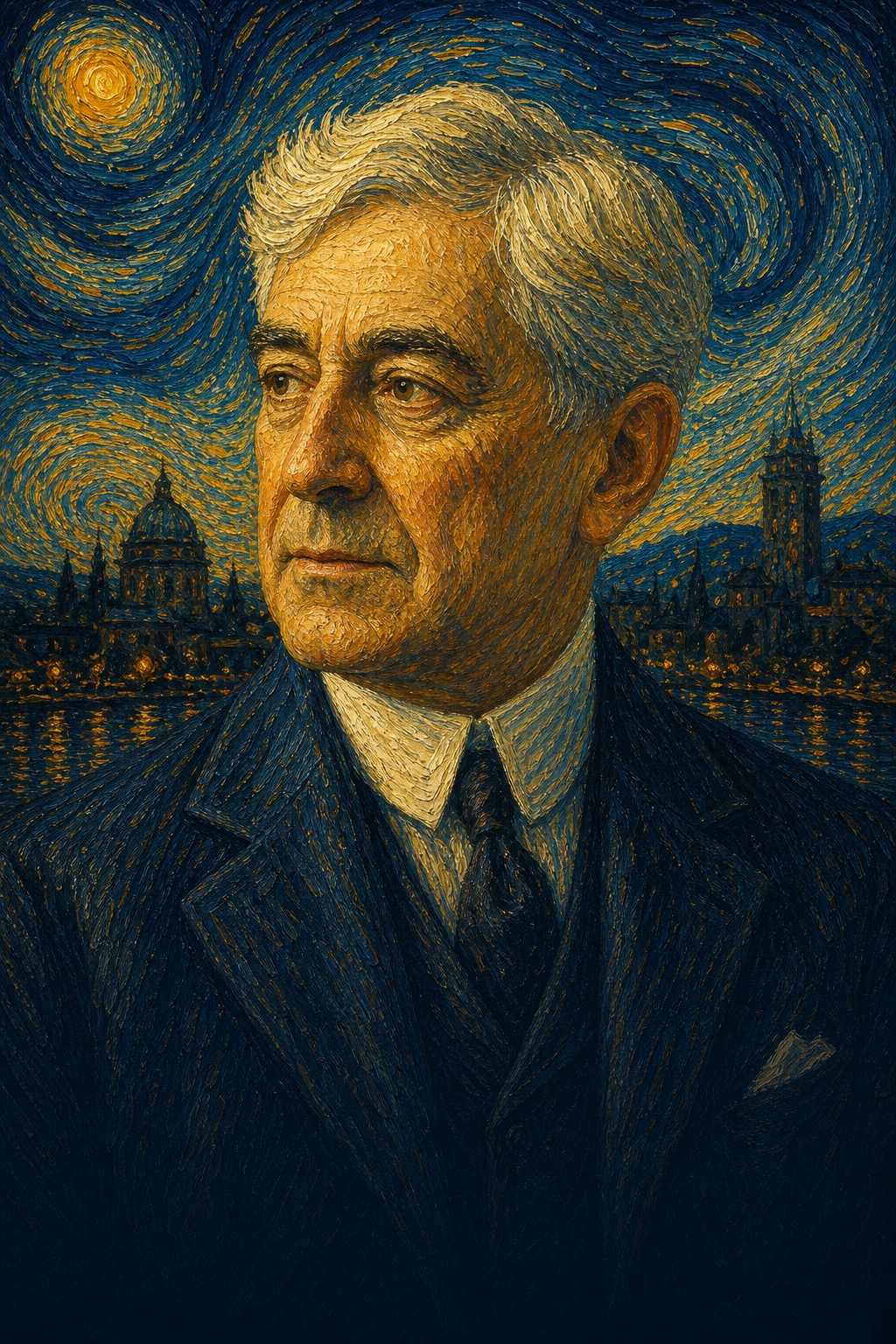
Bernard Baruch
Turned fact-pattern speculation and bottleneck reasoning into a personal fortune and public-allocation doctrine, while showing why legend, private access, and pre-SEC market plumbing must stay labeled.
As of: 2026-07-09T11:17:29Z
Task: T0373 | 047-bernard-baruch | A-profile
Research posture and evidence caveats
Bernard Mannes Baruch belongs in the Canon, but he does not fit the modern hedge-fund or mutual-fund template. The investable record is a personal-account record built through brokerage partnerships, family-controlled vehicles, exchange seats, industrial financings, resource companies, short sales, bonds, cash, and later public-policy assignments. There is no audited fund return stream, no public partnership capital account, and no reliable peak-AUM disclosure comparable to a 1940 Act fund, hedge fund, CTA, or public investment company. The most defensible approach is to treat him as a principal speculator whose track record is reconstructed from memoir, near-contemporaneous profiles, biographies, contemporaneous financial press, and archive leads rather than from full ledgers.
Current-status check: Baruch is deceased. Multiple institutional and obituary sources identify him as an American financier and government adviser born in Camden, South Carolina, in 1870 and dead in New York in 1965; a JTA obituary reports that he died at his New York home at age 94, while the National Museum of Nuclear Science & History gives June 20, 1965 as the date (JTA, Atomic Heritage Foundation, HBS). A 1914-1918 Online profile is valuable for World War I context but appears to carry a death-date typo, so death-date claims here are anchored to obituary/institutional sources instead (1914-1918 Online).
Legal/regulatory caveat: Baruch's classic Wall Street period mostly predates the 1934 Securities Exchange Act and the SEC's exchange-market authority. The SEC's own statutes page dates the Exchange Act and SEC creation to 1934, after the American Sugar, Amalgamated Copper, Louisville & Nashville, Texas Gulf, and 1916 peace-note episodes (SEC). The profile therefore avoids anachronistic labels such as "insider trading" unless tied to the later legal regime, and instead separates contemporaneous ethics, public controversy, and modern transferability risk.
Snapshot table
| Field | Best-supported answer | Evidence and caveats |
|---|---|---|
| Full name | Bernard Mannes Baruch | Institutional profiles and archive records use this form (HBS, Princeton finding aid). |
| Born / died | Born August 19, 1870, Camden, South Carolina; died June 20, 1965, New York, age 94 | Birth and death details are corroborated by institutional profiles and obituary sources; one WWI encyclopedia death-date field appears unreliable (Atomic Heritage Foundation, JTA, 1914-1918 Online). |
| Nationality | American | Born in South Carolina; later New York financier and adviser to U.S. presidents (HBS). |
| Education | College of the City of New York, class of 1889 | Baruch College archives identify him as an 1889 graduate and later benefactor/namesake (Baruch College Archives). |
| Main vehicles | Personal trading account; A.A. Housman & Co.; Baruch Brothers; H. Hentz/commodity-brokerage links; industrial/resource holdings; Liberty Bonds and public-service assignments | HBS lists Baruch Brothers, 1903-1916, and major industrial financings; archive and firm-history leads require further reconciliation for exact Hentz/Baruch Brothers chronology (HBS, Commercial & Financial Chronicle). |
| Years active | Wall Street c. 1891-1916/1917; public adviser and policy figure 1916-1965; intermittent capital allocation after public-service pivot | Early Wall Street start and Baruch Brothers dates from HBS/archive leads; public roles from Wilson, FRUS, and State Department records (HBS, American Presidency Project, State Department). |
| Asset classes | Listed equities, short sales, margin positions, railroads, industrial trusts, mining/metals, sulphur, rubber, commodities-linked equities, bonds, cash, gold, Liberty Bonds, real estate | Asset-class list is inferred from the trade record, Hersey's New Yorker profile, HBS industrial-financing summary, and later task files; exact portfolio weights remain unavailable (New Yorker, HBS). |
| Style tags | Personal-account speculator; political-economy investor; industrial/control financier; concentrated discretionary trader; cash-and-liquidity risk manager; public-policy allocator | Style tags synthesize the completed B-G Baruch files and the profile sources; they are descriptive, not a formal strategy label. |
| Verified track record | No audited fund record found. Best evidence is episode-level: American Sugar, Amalgamated Copper, Louisville & Nashville, Texas Gulf/Gulf Sulphur, 1916 peace-note shorts, 1929 de-risking, and large self-reported losses such as coffee | Figures are reconstructed from memoir/biography/profile/press evidence and are not a continuous return series (New Yorker, Commercial & Financial Chronicle, TIME). |
| Peak AUM | Not applicable / not found | Baruch managed and speculated with personal and family-associated capital, not a reported pooled fund. Wealth estimates exist, but they are not AUM. |
Life and career timeline
1870-1889 - Southern birth, New York education. Baruch was born in Camden, South Carolina, to Simon Baruch and Belle Wolfe Baruch, then moved with his family to New York as a child. Baruch College archive material identifies him as a College of the City of New York graduate in the class of 1889 (Atomic Heritage Foundation, Baruch College Archives).
1891-1903 - Broker apprenticeship to independent speculator. Biographical sources place Baruch's early Wall Street apprenticeship at A.A. Housman & Co., where he learned the brokerage business before buying exchange access and moving toward principal speculation. The precise sequence of messenger, broker, partner, and exchange-seat transactions should be page-checked in My Own Story and the Princeton papers, but the broad arc is corroborated by HBS and contemporary-profile evidence (HBS, New Yorker, Princeton finding aid).
1903-1916 - Baruch Brothers and industrial speculation. HBS lists "Baruch Brothers, 1903-1916" and credits Baruch with helping finance or develop Texas Gulf Sulphur, Utah Copper, and Intercontinental Rubber (HBS). This is the period in which the public legend of Baruch as a "lone wolf" speculator took shape, but the better frame is a networked principal investor operating through brokerage, family, exchange, and industrial channels.
1901-1909 - Major campaign era. The trade files for this Canon folder identify American Sugar, Brooklyn Rapid Transit, Amalgamated Copper, Louisville & Nashville, and Texas Gulf/Gulf Sulphur as the most important early wealth-building episodes. Near-contemporaneous and later profiles agree that Baruch made large money in industrial and resource securities, but exact P&L usually rests on memoir or secondary reconstruction rather than account statements (New Yorker, TIME, TSHA).
1916-1918 - National-defense adviser and War Industries Board chairman. In 1916, Wilson-era mobilization brought Baruch into the Council of National Defense orbit. Wilson's March 4, 1918 letter asked Baruch to accept the War Industries Board chairmanship and described a role centered on supply conflicts, contract allocation, materials access, and priorities (American Presidency Project). 1914-1918 Online says Baruch divested most of his stock portfolio to avoid conflicts and put a large share of an approximately $10 million fortune into Liberty Bonds before serving; treat the exact amount as strong secondary evidence, not a ledger (1914-1918 Online).
1919-1930s - Public-policy investor and elder operator. FRUS records place Baruch in the U.S. reparations work at the Paris Peace Conference (FRUS 1919). In the 1920s and 1930s he wrote and spoke on war profits, farm economics, neutrality, and preparedness, extending his market-bottleneck style into public policy (Atlantic, Baruch College speeches).
1942-1946 - Rubber, reconversion, and atomic control. Franklin Roosevelt asked Baruch to survey the rubber situation during the wartime tire and synthetic-rubber crisis; the Rubber Survey Committee report is a primary source for Baruch's bottleneck method applied outside securities markets (FDR letter, Rubber Survey Committee). Truman then appointed him U.S. representative to the UN Atomic Energy Commission, where he presented the Baruch Plan on June 14, 1946 (State Department, FRUS 1946).
1947-1965 - Public symbol and death. Baruch's late-career persona as park-bench adviser and public kibitzer is documented in Hersey's three-part New Yorker profile and later institutional summaries (New Yorker I, New Yorker III). He remained publicly associated with preparedness, atomic control, and presidential counsel until his death in 1965 (JTA).
Vehicles and structure
Baruch's structure matters because the wrong frame distorts the track record. He was not running a disclosed open-end fund, a hedge fund with published capital, or a modern investment adviser with audited client composites. His main economic engine was principal speculation, supported by brokerage access and family/partner infrastructure.
The first layer was brokerage apprenticeship and exchange access. A.A. Housman & Co. gave him the market plumbing: order flow, client behavior, exchange mechanics, margin practice, and the discipline of watching tape and news full time. The second layer was Baruch Brothers and related family/brokerage infrastructure. HBS's 1903-1916 Baruch Brothers date range gives the cleanest institutional anchor, while firm-history evidence around H. Hentz points to commodity and exchange-market connectivity that should be reconciled in future archival work (HBS, Commercial & Financial Chronicle).
The third layer was industrial and resource investment. Texas Gulf/Gulf Sulphur, Utah Copper, Intercontinental Rubber, and similar episodes were not just ticker trades. They involved resource assessment, capitalization, control or influence, and a view of physical bottlenecks. That style later made his War Industries Board role plausible: the same mind that looked for sulphur, copper, rubber, shipping, and credit constraints in securities could map bottlenecks in a wartime economy (HBS, TSHA, American Industry in the War).
The fourth layer was public-service divestiture and reputation management. 1914-1918 Online reports that Baruch sold down most of his portfolio and put much of his wealth in Liberty Bonds before public service, a claim that fits the conflict-of-interest problem but still needs ledger-level verification (1914-1918 Online). From that point forward, "vehicle" becomes partly metaphorical: he was allocating public priorities, industrial capacity, and diplomatic proposals rather than only private capital.
Track record detail with caveats
The record is best understood as a mosaic of large named wins, large named errors, and a wealth trajectory that cannot be converted into a clean CAGR. A modern allocator would reject it as an audited performance record; a historian of markets can still learn from the repeated pattern: large gains from concentrated, information-rich, policy-sensitive situations, offset by blowups when tips, leverage, pride, or public-role conflict overwhelmed process.
| Episode | Approximate result | Confidence | Comment |
|---|---|---|---|
| American Sugar, c. 1897 | About $60,000 profit in common retellings | Medium-low | Important as an early capital-formation episode, but the figure is largely memoir/secondary-derived and needs page-level verification. |
| Brooklyn Rapid Transit, c. 1899 | About $60,000 profit in secondary accounts | Low-medium | Useful as part of the early trading arc; not a top-ranked Canon trade without ledgers. |
| Amalgamated Copper, 1901 | About $700,000 profit in Baruch-admitted/secondary accounts | Medium | Repeated in profile and biography sources; still not an audited account statement (New Yorker, TIME). |
| Louisville & Nashville, 1901-1902 | About $1 million to $1.5 million in secondary accounts | Low-medium | Economically important but less cleanly documented than the peace-note profit or Amalgamated; likely control/campaign economics rather than simple trade P&L. |
| Coffee speculation, mid-1900s | Loss often reported around $700,000-$800,000 | Medium | Crucial because Baruch himself and later profiles use it as a lesson in overconfidence, tips, and loss control (New Yorker). |
| Texas Gulf/Gulf Sulphur, 1909 onward | Large multi-million-dollar wealth creator; exact realized P&L unresolved | Medium for importance, low for exact P&L | Likely the largest franchise-building investment, but exact basis, sale dates, dividends, and opportunity-cost math remain unresolved (TSHA, HBS). |
| 1916 peace-note shorts | About $476,000 profit in contemporaneous hearing/press summaries | High for approximate disclosed profit, lower for ethics interpretation | The profit is better documented than most early trades; the leak allegation is not the same thing as a proven illegal modern insider-trading violation (Commercial & Financial Chronicle, House report). |
| 1929 de-risking | Preserved large capital, but exact P&L and peak wealth are disputed | Medium for de-risking, low for exact wealth | The durable fact is not the folklore version of perfect crash timing; it is that Baruch reduced exposure and remained liquid, while wealth estimates vary (TIME, Encyclopedia.com). |
The peace-note episode deserves separate handling. A congressional investigation centered on whether advance word of Wilson's December 1916 peace note had reached market participants. The House report found evidence of leakage through press/broker channels but did not prove the specific Baruch-Tumulty allegation; it treated one accusatory "A. Curtis" letter as unsupported and cleared Baruch of the precise charge that he had received official advance information from Tumulty (House report). That does not make the episode clean by modern norms. It makes it a period-specific case study in how elite information networks, short selling, press leaks, and public trust collided before modern federal securities law.
Wealth estimates are also not AUM. Secondary sources often cite a roughly $10 million fortune around the World War I transition and later much higher estimates, but those figures mix securities, cash, bonds, real estate, family wealth, philanthropic giving, and market-value estimates. The profile therefore records "peak AUM: not applicable / not found" rather than converting wealth into managed capital (1914-1918 Online, TIME).
Why they matter
Baruch matters because he sits at the hinge between nineteenth-century stock-operator capitalism and twentieth-century public economic management. He began as a market professional in a world of tips, pools, margin, exchange seats, and industrial combinations; he ended as a presidential adviser shaping war production, reconversion, atomic-control diplomacy, and preparedness debates. Few investors in the Canon make the transition from personal speculation to national allocation so explicitly.
His durable investing lesson is not "copy Baruch's information network." Much of that network would be legally, ethically, or practically unavailable to a modern investor. The transferable lesson is the architecture underneath it: know the facts behind the ticker, focus on bottlenecks, stay liquid, size only what you can watch, revise when facts change, cut losses before pride takes over, and ask whether the role you occupy gives you conflicts a future newspaper could expose. Those lessons are visible across the completed B-G files and are independently supported by Hersey's profile, Baruch's public writings, and the public-policy record (New Yorker, American Industry in the War, Atlantic).
He also matters as a caution against hagiography. The "park bench statesman" image can make Baruch look wiser and cleaner than the evidence allows. The real record includes tip-driven losses, public controversy, self-mythologizing memoir risk, incomplete ledgers, and a public-service career in which Wall Street skill and conflict optics were never fully separable. That makes him more useful, not less: a study of Baruch is a study of edge, judgment, liquidity, and reputation under changing legal regimes.
Open questions for later tasks
- Reconstruct Baruch's account-level ledgers, if any survive, through the Princeton Bernard M. Baruch Papers, Baruch College holdings, NYPL writings/speeches volumes, American Jewish Archives MS-559, and related family/business papers (Princeton finding aid, Baruch College Archives, AJA MS-559).
- Page-check Baruch: My Own Story and Baruch: The Public Years for exact early-career chronology, trade P&L, exchange-seat transactions, and Baruch Brothers/H. Hentz sequence (Internet Archive - My Own Story, Internet Archive - Public Years).
- Obtain full-text James Grant, Jordan Schwarz, Margaret Coit, and Robert Cuff materials to upgrade from source leads to page-specific claims (Axios Press Grant page, Open Library Schwarz record, Cuff metadata).
- Reconcile Texas Gulf/Gulf Sulphur economics: purchase price, share count, dividends, partial sales, final disposition, and opportunity-cost claims (TSHA).
- Rebuild the 1916 peace-note record from the full House report, FRUS note text, contemporaneous press, and later legal history; separate fact of profit, fact of leak, and unproved Baruch-specific accusation (FRUS 1916, House report, Perino).
- Convert wealth estimates into a dated evidence table rather than repeating folklore: c. 1902, c. 1917, c. 1926, c. 1929, c. 1931, and estate-at-death estimates should each be sourced separately.
- For the eventual H-synthesis, reconcile this profile with already-completed Baruch B-G files and decide whether Baruch's closest Canon comparators are Jesse Livermore, Michael Marcus, George Soros, John Maynard Keynes, or public-policy allocators such as Keynes in his institutional role.
As of: 2026-07-09T05:08:44Z
Research posture and evidence caveats
Bernard Baruch is a pre-SEC market operator whose public philosophy is clearer than his account ledgers. The strongest direct source is Baruch: My Own Story, but open access is mainly through Internet Archive metadata and excerpted access copies; the book itself is a memoir written decades after the trades, so its rules are treated as first-person philosophy rather than audited performance evidence (Baruch/Internet Archive, 1957; Capital Ideas excerpt, n.d.). The completed Task C file already found that many exact trade figures - American Sugar, Amalgamated Copper, L&N, Texas Gulf, and the 1916 peace-note shorts - remain self-reported, secondary, or single-source unless a contemporaneous record exists.
For a philosophy file, that evidence problem is productive. Baruch's durable doctrine was not a formula for calculating intrinsic value; it was an operating discipline for acting under uncertainty. He repeatedly framed speculation as risk-taking that could be made rational only by fact-gathering, emotional control, limited diversification, cash reserves, and constant reappraisal (Capital Ideas excerpt, n.d.). The tension is that his actual early edge often included information networks, pools, options, and pre-1934 market practices that a modern investor cannot and should not replicate (Perino, 2019; SEC, 2013).
Core worldview
Baruch's worldview starts with uncertainty. He rejected the comforting distinction between "investment" and "gamble" when it is used to pretend risk does not exist. In the memoir excerpts, he says no investment is free of risk and argues that the real problem is how to remain venturesome without becoming foolish (Capital Ideas excerpt, n.d.). That puts him closer to a risk manager than to a promoter of certainty: markets are a place to price incomplete futures, not a machine for producing sure things.
His definition of the speculator was forward-looking. The "true speculator" observes the future and acts before it occurs, but only after sorting through conflicting details to find significant facts (Capital Ideas excerpt, n.d.). This sentence explains why Baruch could treat an 1897 tariff debate, a 1901 copper-glut thesis, a 1909 sulphur development project, and 1929 market leverage as versions of the same problem: infer the future consequence before the crowd reprices it.
Human nature was the permanent substrate. Baruch described Wall Street as a course in human nature; the stock market presented facts filtered through fear, greed, rumor, status, and the analyst's own self-deception (Novel Investor notes on My Own Story, 2022; Capital Ideas excerpt, n.d.). That made his process partly empirical and partly psychological. The task was to separate "cold, hard economic facts" from both crowd emotion and one's own need to be right.
Politically, Baruch's worldview was also shaped by hard-money, free-trade, and anti-waste instincts, even though his fortune was made partly by reading political incentives. A review of James Grant's biography describes Baruch as distrustful of state power, a believer in free markets, hard money, and work-and-save discipline (FEE review, n.d.). The irony is central: he distrusted government distortion, but one of his earliest fortunes came from correctly judging how tariff politics would protect Sugar when Wall Street expected the opposite (TIME, 1957; FEE review, n.d.).
The edge - what markets misprice and why
Baruch believed markets misprice the gap between facts and reactions. Prices move not only because events change, but because human beings overreact, underreact, chase tips, misread partial information, or trust prestige when the underlying facts have changed (Capital Ideas excerpt, n.d.). That view is visible in Amalgamated Copper: the public saw sponsorship and promotion, while Baruch focused on copper supply-demand and the fragility of support for an overpromoted stock (TIME, 1957; Hersey/New Yorker, 1948).
He also looked for political and structural mispricing. American Sugar was a political-economy trade: the market feared tariff damage, while Baruch judged that regional interests would protect the tariff enough to support Sugar's economics (TIME, 1957; FEE review, n.d.). Louisville & Nashville and other control situations were mispriced because control value and the identity of the natural buyer were not yet fully reflected in the quoted price. Texas Gulf was mispriced, or at least underappreciated, because the market had to underwrite geological, technological, and strategic uncertainty before the sulphur reserve was proven and in production (Hersey/New Yorker, 1948; TSHA, n.d.).
The edge persisted because most investors wanted tips, not work. Baruch explicitly warned against tips and "inside" information, but the historical record shows both why he warned against them and why early Wall Street rewarded them. Perino's legal history argues that turn-of-the-century professional traders treated inside information as a tradable commodity, and specifically uses Baruch as an example of a market operator whose career involved such information flows (Perino, 2019). Baruch's mature rule - beware tips - reads partly like repentance after he was hurt by rumor-driven trades, not a description of a market that had become clean.
Process: idea sourcing -> research -> valuation & entry -> sizing -> portfolio construction -> sell discipline
Idea sourcing. Baruch sourced ideas from the whole operating environment: congressional debates, commodity supply, corporate-control situations, geological development projects, war-production needs, brokerage-floor information, and personal networks. The HBS profile lists Texas Gulf Sulphur, Utah Copper, and Intercontinental Rubber among the industrial firms he helped finance, which underscores that his hunting ground was not just listed securities but the industrial economy behind them (HBS Leadership, n.d.). Hersey's 1948 profile similarly shows post-WWI Baruch shifting from exchange speculation toward industrial and mining companies, especially Texas Gulf (Hersey/New Yorker, 1948).
Research. Baruch's rule was to learn the company, management, competitors, earnings, and growth possibilities before buying (Capital Ideas excerpt, n.d.). His own framework named three company-level tests: real assets after debt, the franchise or usefulness of what the company does, and, most important, the character and brains of management (Capital Ideas excerpt, n.d.). This is an early version of fundamental due diligence, but with less emphasis on a formal discounted cash-flow model and more on business reality, supply-demand change, and managerial adaptability.
Valuation and entry. Baruch's entry discipline was opportunistic rather than formulaic. He preferred situations where the quoted price did not reflect a concrete future change: tariff protection, commodity oversupply, control premium, production breakthrough, or crash risk. He warned that no one can reliably buy the bottom or sell the top, which made valuation a range judgment rather than a heroic tick call (Capital Ideas excerpt, n.d.). In practice, he entered when he believed facts were converging before price, then used market action and new information to decide whether to add, hold, or leave.
Sizing. The mature Baruch rulebook is conservative about sizing: keep a meaningful cash reserve, do not invest all funds, and avoid owning too many securities to watch (Capital Ideas excerpt, n.d.). The early Baruch often violated that conservatism. American Sugar was highly levered; American Spirits became a painful example of betting too much on a tip and being forced to liquidate other positions to meet margin pressure (Novel Investor, 2021). The later rule is therefore a scar-tissue rule: concentrate only when you can know and monitor the position, but preserve enough liquidity to survive being wrong.
Portfolio construction. His preferred portfolio was concentrated, watched, and liquid enough to change. He explicitly argued that one can know a few issues far better than many issues, because competitive conditions, technology, supply, and habits constantly change (Capital Ideas excerpt, n.d.). That makes him closer to a concentrated opportunist than a Graham-style diversified bargain basket investor. But he also kept cash and bonds when he could not find a favorable edge; Hersey's 1948 profile recounts Baruch telling eager friends near the 1929 top that he would put money in 4 percent bonds (Hersey/New Yorker, 1948).
Sell discipline. Baruch sold when the facts changed, when worry revealed excess exposure, when a mistake had to be recognized, or when the price approached enough of the thesis to make the remaining risk unattractive. He emphasized cutting losses quickly and cleanly, periodic reappraisal, tax awareness, and not trying to capture the exact top (Capital Ideas excerpt, n.d.). Texas Gulf shows both wisdom and regret: he sold before the crash and made millions, but later acknowledged he had not waited long enough for the full compounding of the sulphur franchise (Hersey/New Yorker, 1948).
Risk management
Baruch's risk management has five layers.
First, he treated cash as a strategic asset. The cash reserve rule is not just conservatism; it preserves optionality, emotional steadiness, and the ability to buy when others must sell (Capital Ideas excerpt, n.d.). Hersey's profile says that after his WWI service, Baruch still had a large holding in war bonds, three major investments, and cash in the bank, which indicates that liquidity remained part of his personal balance-sheet design even after he had become wealthy (Hersey/New Yorker, 1948).
Second, he used reappraisal as a risk control. A security's value could be transformed by new supply, technology, habit change, regulation, or management quality. Baruch's example of once-secure European government bonds losing much of their value after geopolitical change is a warning against static "safe" labels (Capital Ideas excerpt, n.d.).
Third, he limited breadth. Owning too many securities was risky because the investor could not keep up with changing facts. This is an unusually modern point: diversification can reduce idiosyncratic price volatility, but it can increase ignorance if it outruns the investor's capacity to monitor the positions (Capital Ideas excerpt, n.d.).
Fourth, he cut losses rather than defending ego. The American Spirits mistake is the clearest behavioral root: he acted on a reported tip, overcommitted, kept no reserves, and then had to liquidate other holdings (Novel Investor, 2021). His later rules are built to prevent precisely that cascade.
Fifth, he de-risked when market structure became speculative. The strongest support is Hersey's 1948 account of Baruch resisting tip-seekers and recommending bonds near the late-1929 boom, plus later accounts that his fortune was protected partly by cash, bonds, gold, and reduced equities before the crash (Hersey/New Yorker, 1948; TIME, 1934). The caveat is that exact net-worth math remains muddy, so "called the crash perfectly" should be treated as legend unless tied to a specific trade ledger.
Temperament and psychology
Baruch's temperament combined curiosity, independence, ego, and learned humility. His best cases required acting before consensus: Sugar before the tariff fear cleared, Amalgamated before the copper promotion broke, Texas Gulf before production, and 1929 de-risking before the crowd stopped believing (TIME, 1957; Hersey/New Yorker, 1948). But he was not immune to the oldest speculative trap: wanting to "beat the game." His own excerpted memoir says that other people's mistakes often tempt us to repeat them ourselves before their lesson sinks in (Capital Ideas excerpt, n.d.).
The most transferable psychological rule is self-separation. Baruch believed the hardest facts to disentangle were not the facts outside, but the emotions inside the analyst. This explains his dislike of public tips. Advice changes the recipient's psychology: a partial overheard phone call, a famous name in a prospectus, or a friend's confidence can become a substituted thesis. Hersey's Alaska Juneau and Consolidated Gas anecdotes show why Baruch avoided giving amateurs stock advice: people acted on fragments and then blamed the source when the fragment was misunderstood (Hersey/New Yorker, 1948).
He also had a high tolerance for being temporarily out of step. The Atlantic review of his memoir describes him as a skilled Wall Street speculator whose first volume contains many reflections on speculation and investment, but not a confessionally introspective book (The Atlantic, 1958). That fits the public Baruch: he was reflective about rules, less transparent about account-level details, and comfortable preserving mystique.
Evolution over career
Baruch's philosophy evolved through four phases.
Broker and tape-era learner. As a young Wall Street operator, he learned through brokerage work, floor information, pools, control campaigns, and painful mistakes. This phase produced the fact-versus-emotion doctrine and the anti-tip rule, but it also depended on a market environment where privileged information and informal pools were normal (Perino, 2019).
Independent speculator and control investor. By the early 1900s he was the "Lone Wolf" figure: independent, willing to short promotions, use options, or finance industrial assets. HBS identifies Baruch Brothers from 1903 to 1916 and lists his financing role in Texas Gulf Sulphur, Utah Copper, and Intercontinental Rubber (HBS Leadership, n.d.).
Public-service allocator. During WWI, Baruch largely left Wall Street, divested much of his stock portfolio to avoid conflicts, and invested a large portion of his fortune in Liberty Bonds before chairing the War Industries Board (1914-1918 Online, 2015). The War Industries Board experience converted his market philosophy into a national allocation philosophy: priorities, bottlenecks, raw materials, price constraints, and industrial coordination. The board had real influence but was not omnipotent; the 1914-1918 War Industries Board entry stresses that even under Baruch it often negotiated with industry rather than ruling as an industrial czar (1914-1918 Online - War Industries Board, 2014).
Postwar industrial financier and statesman. After WWI he did not return to the exchange as the same kind of day-to-day speculator. Hersey says his fortune tripled between wars mostly through Texas Gulf, and that he preferred developing industrial and mining companies rather than stock-market speculation (Hersey/New Yorker, 1948). By the 1930s, TIME framed his move uptown as the end of a unique business career and a shift toward writing and public affairs (TIME, 1934).
What he explicitly rejected
Baruch explicitly rejected casual speculation. His rule that speculation must be full-time implies that part-time trading against professionals is structurally disadvantaged (Capital Ideas excerpt, n.d.).
He rejected tips, especially tips passed through social status, servants, friends, or supposed insiders. The mature rule is clear, but the historical context is uncomfortable: tips were precisely one of the informational currencies of early Wall Street. The right reading is not that Baruch never used privileged information, but that he came to see second-hand tips as poison unless converted into verifiable facts (Perino, 2019; Novel Investor, 2021).
He rejected over-diversification, static safety, exact bottom/top timing, and the idea that a famous financier's presence substitutes for business analysis (Capital Ideas excerpt, n.d.). Alaska Juneau is the warning: even his name in a prospectus could not protect buyers from bad ore and a collapsing stock price (Hersey/New Yorker, 1948).
Regimes where it thrives vs. struggles
Baruch's model thrives in regimes with large factual lags: commodity-cycle turning points, political-policy mispricings, distressed liquidity, industrial bottlenecks, and control-value situations. It also thrives when the investor has time, access, and temperament to do primary research before the crowd digests the information. American Sugar, Amalgamated Copper, Texas Gulf, and 1929 de-risking all fit this pattern (TIME, 1957; Hersey/New Yorker, 1948; TSHA, n.d.).
It struggles in regimes where the investor's facts are actually rumors, where leverage removes time, where political information crosses an ethical line, or where technological/competitive change outruns reappraisal. It also becomes less transferable after the securities-law regime changed. The SEC describes the 1934 Act as creating the Commission and giving it broad authority over exchanges, brokers, and prohibited market conduct, including modern insider-trading enforcement (SEC, 2013). That means Baruch's discipline remains useful, but much of the pre-SEC information edge is obsolete or illegal.
The model also struggles with illiquidity and development assets. Texas Gulf may have been Baruch's greatest long-term wealth creator, but he sold before the full upside; development risk and personal liquidity needs made the optimal hold unknowable in real time (Hersey/New Yorker, 1948; TSHA, n.d.).
Tensions between stated philosophy and actual behavior
The first tension is tips versus privileged access. Baruch's rulebook warns against inside tips, but serious legal history treats inside information as a recurring feature of his early market environment and sometimes his own activity (Perino, 2019). The most charitable reading is that he learned to distinguish verifiable primary facts from rumor; the least charitable reading is that he criticized a game he had once benefited from.
The second tension is risk control versus leverage. He taught cash reserves, few watched positions, and fast loss-cutting; his early career included highly levered trades, margin pressure, and painful overcommitment (Capital Ideas excerpt, n.d.; Novel Investor, 2021). The mature rules are credible precisely because they are contradicted by some early behavior.
The third tension is free-market belief versus political edge. Baruch believed in markets and distrusted excessive government power, yet some of his best investments came from anticipating government action or using political access: Sugar tariffs, war-stock sensitivity, wartime raw-material control, and later public advisory roles (FEE review, n.d.; 1914-1918 Online, 2015). This is not hypocrisy by itself; it is a reminder that political economy was part of his analytical field.
The fourth tension is ethics and reputation. The 1916 peace-note short was profitable and investigated in the context of alleged leaks. The better framing is not that Baruch was proved to have traded on White House leakage; the opened evidence is thinner than that. It is that the inquiry exposed a market information ecosystem - reporters, private wires, brokerage relationships, rumors, and political access - that later securities law would treat far more skeptically. The existing Task C source map cites Commercial & Financial Chronicle coverage of roughly $476,000 of reported profits for the relevant window, but the episode remains ethically loaded and should not be converted into a clean "macro catalyst" case without that caveat (FRASER/Commercial & Financial Chronicle, 1917). The later Churchill/BMT episode likewise shows Baruch still adjacent to private pools and political-financial networks in the 1930s (TIME/Maier, 2014).
The final tension is legend versus ledger. Baruch's reputation for having sold before 1929 is deserved in broad outline but over-mythologized in precise P&L terms. Hersey's bond anecdote and later profiles support his skepticism before the crash, but the exact portfolio path and net-worth drawdown still need archival reconstruction (Hersey/New Yorker, 1948; TIME, 1934).
Transferable summary
Baruch's transferable philosophy is: treat all investment as uncertain speculation; specialize; gather primary facts; understand the industry behind the ticker; judge management; keep enough cash to stay rational; own only what can be watched; reappraise constantly; cut losses before ego takes over; and distrust tips unless they can be converted into verified facts.
What is not transferable is equally important: the pre-SEC information environment, control pools, political whisper networks, and the personal access that made some Baruch trades possible. A modern investor can copy the discipline, not the plumbing.
Open questions for later tasks
- Page-level verification from Baruch: My Own Story is still needed for the rules chapter; this file used Internet Archive metadata and excerpted access copies, not a fresh page-by-page scan.
- The Princeton Baruch papers and NYPL writings/speeches collection remain the best archival routes for checking whether Baruch stated additional investment principles outside the memoir.
- T0373 A-profile remains freshly claimed and missing on main as of this run; future Baruch synthesis should reconcile this philosophy file with the completed profile once it lands.
- Peace-note and 1929 portfolio evidence still need full primary reconstruction from House inquiry records, correspondence, and account-level material if available.
As of: 2026-07-06T21:09:00Z
Research posture and evidence caveats
Bernard M. Baruch's greatest-trades record is unusually rich for a pre-SEC speculator, but it is not ledger-rich by modern standards. The core trade chronology comes from Baruch's own memoir, the 1948 New Yorker profile by John Hersey, later biographies and retrospective business profiles, and a few contemporaneous or near-contemporaneous public records. Exact position sizes, portfolio percentages, borrow costs, margin terms, and tax-adjusted realized P&L are usually unavailable. Where a number comes from Baruch or a profile that appears to rely on Baruch, it is treated as self-reported or single-source unless independently triangulated.
The "single best" answer depends on definition. Amalgamated Copper, 1901 is the best documented pure public-market trade: identifiable instrument, thesis, timing, price path, and reported profit of about $700,000. Texas Gulf Sulphur/Gulf Sulphur, 1909-late 1920s was probably the largest long-term wealth creator, but it was a venture/control investment and Baruch's exact realized profit is not disclosed. Louisville & Nashville, 1901-1902 was one of the most important control campaigns, but Baruch's personal P&L is less clean than the deal economics. This file ranks Amalgamated first on evidence quality, while flagging Texas Gulf as the larger economic opportunity.
Regulatory context matters. Baruch's major early trades predated the Securities Exchange Act of 1934 and the SEC's modern authority over exchanges, brokers, manipulation, and insider trading. That does not sanitize the information advantages, pools, options, and market operations he used; it means the file describes them in period context rather than applying today's legal categories mechanically. The SEC's own statutes page identifies the 1934 Act as the law that created the Commission and its broad exchange-market authority.[^sec-statutes]
Ranking table
| Rank | Episode | Dates | Structure | Reported economics | Confidence |
|---|---|---|---|---|---|
| 1 | Amalgamated Copper short | Sept.-Dec. 1901 | Short common stock | About $700,000 profit; stock fell from the promoted 120s/130 area toward 60 | High for direction/path; P&L self-reported but widely repeated |
| 2 | Texas Gulf Sulphur / Gulf Sulphur | 1909-late 1920s | Founder/control equity, later public-company interest | Put up about one-fifth of capital, around $1.225 million; $10 shares later reached $320-$340; sold for "a few million" | High on opportunity; low on exact realized P&L |
| 3 | Louisville & Nashville control campaign | 1901-1902 | Accumulation plus options/control sale to J.P. Morgan interests | Deal involved 306,000 shares, with one-third at 130 and balance optioned at 150; some secondary accounts report $1.5 million profit | High on mechanics; medium on Baruch-specific P&L |
| 4 | American Sugar Refining tariff trade | 1897 | Levered long equity, pyramided | About $60,000 profit from a few hundred dollars of margin capital | Medium-high; mostly memoir/profile evidence |
| 5 | Peace-note / war-stock shorts | Dec. 1916 | Short U.S. Steel and other war-linked stocks after selling longs | Contemporary hearing coverage reported about $476,168 profit for Dec. 10-23; later profiles round to nearly $500,000 | Medium; strong controversy overlay |
| 6 | Selby/Tacoma smelters and American Smelting | 1904-1905 | Options/control acquisition work, not a clean exchange trade | $1 million gross fee; materially lower net after expenses and payments | High on fee; lower as "trade" |
| 7 | Brooklyn Rapid Transit | 1899 | Exit/short-side operation around a promoted traction stock | About $60,000 profit after selling into support before a collapse toward the 60s | Medium; mechanics less complete |
| 8 | Northern Pacific panic side-short | May 1901 | Shorted other leading stocks rather than the cornered Northern Pacific | "A great deal" in a few days; no exact P&L | Low-medium; useful process case, not fully quantified |
| 9 | 1928-1929 liquidation and crash avoidance | 1928-Sept. 1929 | Portfolio de-risking, bonds/cash/gold, some shorting reported | Capital preservation; no clean profit figure; later myth exceeds evidence | Medium on risk reduction, low on P&L |
| 10 | Liggett & Myers / Tobacco Trust campaign | 1898-1899 | Control deal and market operation for Thomas F. Ryan | Housman commission $150,000; Baruch share about $50,000 | Medium; agency/deal profit, not own-capital trade |
1. Amalgamated Copper short, 1901 - best documented pure trade
Context and dates. Amalgamated Copper was one of the great promoted industrial stocks of the early 1900s. Baruch's own account and later profiles place the trade in 1901, after the stock had been pushed from around par into the 120s/130 area despite weakening copper fundamentals. The September 1901 dividend cut from $8 to $6 catalyzed the break; the stock fell sharply afterward and later touched the 60 area.[^baruch-my-own-story][^newyorker-money][^time-grant]
Thesis and how he found it. Baruch framed the trade as a fact-gathering exercise against market prestige. The visible market story was that powerful operators and copper interests could support Amalgamated. His contrary research was that high copper prices were choking demand, exports were deteriorating, and the underlying metal market was glutted. The important process point is not that he guessed a top, but that he compared commodity supply-demand data with the equity promotion and concluded the stock price depended on support rather than earnings power.[^baruch-my-own-story][^newyorker-money]
Size and structure. The trade was a short sale of common stock. Baruch said he used his own money rather than customer accounts. Exact shares, borrow terms, and portfolio percentage are not disclosed. Because he was still building his fortune, the exposure was large enough to matter personally but cannot be reconstructed as a percentage of capital from the available record.[^baruch-my-own-story]
Entry, path, drawdown. The reported entry zone was around the promoted high level, with the stock near 130 before the dividend cut. The stock closed just above 100 after the cut, fell to the low 90s on the next business day, and later touched the 60 area in December. The sources do not preserve a clean mark-to-market drawdown during the short. The risk was not just price volatility; it was the possibility that a support pool could keep the stock elevated long enough to exhaust short sellers.[^baruch-my-own-story][^newyorker-money]
Exit and P&L. Baruch reported a profit of about $700,000. Later accounts repeat that this trade made him a millionaire or marked his largest single operation to that point. Exact cover price is not disclosed; the best available narrative puts the final collapse near 60.[^newyorker-money][^time-grant]
What it teaches. This is Baruch's canonical "facts over sponsorship" trade. The edge was not a secret formula: it was commodity research, skepticism toward a famous promotion, and willingness to hold a short through a support campaign. It also shows the limits of the evidence base: the central P&L number is plausible and repeated, but not backed here by account statements.
2. Texas Gulf Sulphur / Gulf Sulphur, 1909-late 1920s - biggest wealth-creation investment
Context and dates. In 1909, Baruch investigated a Texas sulphur opportunity after J.P. Morgan & Co. passed on it. The industrial backdrop was attractive: sulphur demand was tied to chemicals, fertilizers, munitions, paper, and refining, while domestic supply promised strategic value against imported Sicilian sulphur. Texasgulf's later corporate history traces the company to Gulf Sulphur and the Bryan Mound discovery and development arc in Texas.[^newyorker-money][^tsha-texasgulf][^hbs-baruch]
Thesis and how he found it. Baruch's thesis was geological and industrial rather than tape-reading. He believed the Frasch-process opportunity and Texas deposits could create a durable domestic source of sulphur. The risk was that the property was not yet a cash-flowing security and required patient capital before production and market acceptance could turn the asset into a financial return.[^newyorker-money][^tsha-texasgulf]
Size and structure. The best open secondary account says Baruch put up about one-fifth of the capital, around $1.225 million. He later held a substantial block, described in memoir-based accounts as 121,000 shares. This was not a liquid long/short trade in the modern fund sense; it was a founder/control equity commitment with eventual public-market liquidity. Percentage of Baruch's total fortune at commitment is not fully reconstructable, but it was plainly material.[^newyorker-money][^time-old-man]
Entry, path, drawdown. Original shares are described around $10. Development was slow, and the investment carried operating, reserve, extraction, and commodity-price risk. The upside was enormous: accounts say those $10 shares later reached about $320-$340. A full-hold calculation would imply tens of millions of dollars of foregone value, but that is not Baruch's actual realized result because he sold before the top.[^newyorker-money][^time-old-man]
Exit and P&L. Baruch sold in the late 1920s, ahead of the crash, and is reported to have made "a few million." That phrase is too imprecise to rank it by verified P&L. Economically, it may have been the greatest wealth creator of his career; evidentially, it is weaker than Amalgamated because the exact sale dates, proceeds, dividends, and tax effects are not disclosed.[^newyorker-money]
What it teaches. Baruch was not only a short-term speculator. His best long-term investment combined an industrial supply thesis, control-oriented financing, and willingness to own illiquid development risk. The weakness was sell discipline in the opposite direction: he preserved capital before 1929, but probably sold far short of the ultimate intrinsic value.
3. Louisville & Nashville control campaign, 1901-1902
Context and dates. Louisville & Nashville was a railroad control campaign in the Morgan-Harriman era. Baruch, John W. Gates, and associates saw L&N as underpriced relative to other railroads and strategically valuable. The campaign culminated in a J.P. Morgan settlement structure involving a large block and an option on the remaining shares.[^baruch-my-own-story][^newyorker-money][^schwarz-speculator]
Thesis and how he found it. The thesis was classic control-value arbitrage: a railroad with valuable routes, expansion potential, and absentee or vulnerable ownership could command a control premium. Baruch's role combined security analysis, market accumulation, and negotiation. This was not merely "buy cheap railroad"; it was "buy enough of the railroad to force strategic buyers to act."[^baruch-my-own-story][^schwarz-speculator]
Size and structure. The memoir-based accounts identify a London option on 20,000 shares costing about $70,000, with Baruch taking half. The final Morgan arrangement reportedly covered 306,000 shares, with one-third bought at 130 and the balance optioned at 150. Baruch kept a residual stake for a time, but sold most of his shares.[^baruch-my-own-story]
Entry, path, drawdown. The stock was accumulated below the final control prices, with the strategic contest lifting the price as control pressure became visible. Exact entry average, margin terms, and mark-to-market drawdown are unavailable. The main risk was that the group would fail to assemble enough stock or that a stronger operator would break the campaign before the control premium was realized.[^baruch-my-own-story][^newyorker-money]
Exit and P&L. Some secondary accounts report Baruch's profit at roughly $1.5 million, while Baruch's own retelling is less precise and emphasizes that the campaign made him a rich man. Because the exact personal ledger is not in hand, this file treats the $1.5 million as a strong but single-source secondary figure rather than audited fact.[^newyorker-money][^schwarz-speculator]
What it teaches. L&N shows Baruch's transition from price speculation to control economics. His edge came from understanding who the natural buyer was, how control premiums worked, and how options could lever a campaign. The trade also reveals a recurring limitation: the best economics may belong to a syndicate, while the surviving narrative does not always isolate Baruch's own account.
4. American Sugar Refining tariff trade, 1897
Context and dates. American Sugar Refining, the Sugar Trust, dominated U.S. refining in the 1890s. In 1897, the market was worried that tariff legislation would damage Sugar's profits. Baruch studied the political incentives and concluded tariff protection would largely survive.[^newyorker-money][^time-grant][^fee-grant-review]
Thesis and how he found it. The edge was research into law and industry structure. The stock was depressed because investors feared the House tariff bill; Baruch believed the Senate would preserve enough protection for the trust. That gave him a political-economy thesis before he had the capital base of his later years.[^newyorker-money]
Size and structure. Accounts vary between about $200 and $300 of initial cash. The common thread is that Baruch bought 100 shares around 109 on margin and pyramided as the stock moved in his favor. Because the trade was highly margined, the percentage return on cash was spectacular but not comparable to an unlevered return.[^newyorker-money][^fee-grant-review]
Entry, path, drawdown. Entry was near 109. The stock rose toward 159 by early September as the tariff fear cleared. No reliable interim drawdown was found in the open record. The real risk was legislative surprise plus margin-call risk: a few hundred dollars of equity against 100 shares could have been wiped out by a modest adverse move.[^newyorker-money][^time-grant]
Exit and P&L. Baruch's profit is reported around $60,000, enough to buy a NYSE seat for $19,000. The transformation was career-changing: small capital became exchange membership and social proof.[^newyorker-money][^time-grant]
What it teaches. Sugar was the prototype of Baruch's method: gather facts, understand political incentives, use leverage only when the edge seems unusually strong, and pyramid a winner. It also illustrates survivorship bias. The same leverage that made the result famous could have made the young Baruch disappear from the record.
5. Peace-note / war-stock shorts, December 1916
Context and dates. In late 1916, war-linked stocks were vulnerable to any hint that President Woodrow Wilson might push for peace. Baruch sold longs and built short positions in names linked to the war boom, including U.S. Steel. The episode later became politically explosive because of accusations that someone had profited from advance knowledge of Wilson's peace note.[^cfc-1917][^time-old-man][^tumulty]
Thesis and how he found it. The investment thesis was straightforward: if peace looked more likely, war-profit stocks would fall. The evidentiary and ethical problem is the information channel. Contemporary investigations focused on whether traders had improper advance notice. A Wilson-era secondary source says Baruch's books showed he began covering before the worst break and that the leak was attributed to reporters rather than officials, but the episode must remain caveated.[^tumulty][^perino]
Size and structure. Hearing coverage summarized in Commercial & Financial Chronicle described Baruch selling roughly 30,000 long shares and being short roughly 25,000-26,000 shares, including a large U.S. Steel short. These figures are more concrete than many early-career trades, though they are still mediated through OCR and hearing reporting rather than Baruch's account statements.[^cfc-1917]
Entry, path, drawdown. The best available detail puts U.S. Steel short sales around the 118 area and covering around 106, with the market break arriving as the peace-note news hit. Drawdown is not stated. The chief risk was not just price movement; it was political investigation and reputational damage.[^cfc-1917][^time-old-man]
Exit and P&L. Contemporary coverage reported profit of about $476,168 for Dec. 10-23, while later profiles round the figure to nearly $500,000. Treat the exact number as historically reported, not independently audited.[^cfc-1917][^time-old-man]
What it teaches. This is a trade where process, ethics, and reputation cannot be separated. Baruch identified a real macro catalyst and was right about war-stock sensitivity, but the episode also shows why modern securities law treats material nonpublic information as central. It belongs in the greatest-trades file only with the controversy visible.
6. Selby/Tacoma smelters and American Smelting, 1904-1905
Context and dates. Around 1904-1905, Baruch worked with Guggenheim interests around American Smelting and the Selby/Tacoma smelter properties. The trade sits between speculation and merchant banking: he was not just buying a stock; he was arranging control assets around a consolidating industrial company.[^baruch-my-own-story][^time-old-man][^newyorker-money]
Thesis and how he found it. The thesis was that smelting capacity and control of key properties would matter to American Smelting's strategic position. Baruch reportedly studied American Smelting with Guggenheim connections, bought shares, recommended them, and later secured acquisition options.[^baruch-my-own-story][^newyorker-money]
Size and structure. Structure was options and deal work. One account gives a $1 million gross fee. Baruch's net was much lower after expenses and payments to associates. The public-market component in American Smelting common is less fully quantified than the fee transaction.[^baruch-my-own-story][^time-old-man]
Entry, path, drawdown. American Smelting common is described as rising from the 30s to around 80 over an extended period before the speculative wave. The Selby/Tacoma economics were realized through negotiated options and a fee, not simply an exchange exit. Drawdown is not available.[^baruch-my-own-story]
Exit and P&L. The best figure is the $1 million gross fee, with materially lower net proceeds. Later controversy matters: the Guggenheims reportedly accused Baruch of shorting American Smelting after the fee; he denied it and later received an apology. That accusation does not disprove the economics, but it belongs next to the trade.[^newyorker-money]
What it teaches. Baruch could monetize information and relationships through options, not just market orders. It also shows why classifying his "trades" is hard: some of the best economics came from arranging control transactions and fees rather than from clean marked-to-market positions.
7. Brooklyn Rapid Transit, 1899
Context and dates. Brooklyn Rapid Transit was a promoted traction story associated with Roswell Flower. The stock had risen dramatically, reportedly from around 20 to 137, before Flower's illness and death changed the market's confidence in the support operation.[^baruch-my-own-story][^newyorker-money]
Thesis and how he found it. Baruch became skeptical because the company's statements were unclear and valuation appeared disconnected from operating reality. He treated the support pool as a temporary market force rather than a source of lasting value.[^baruch-my-own-story]
Size and structure. The exact position is not fully clear in the surviving open accounts. Baruch appears to have used a sale or short-side operation around the stock as support bids lifted the price back toward par. No percentage of capital is available.[^baruch-my-own-story]
Entry, path, drawdown. The market operation reportedly lifted the stock from around 100 to 115 before the break. Baruch sold into a par bid, before the stock later fell into the 60s. Drawdown on his specific position is not stated.[^baruch-my-own-story]
Exit and P&L. Reported profit was about $60,000, similar in nominal size to the American Sugar score. Because the mechanics are less complete than Sugar or Amalgamated, this file ranks BRT lower despite its importance in Baruch's early capital formation.[^baruch-my-own-story][^newyorker-money]
What it teaches. BRT is a market-structure lesson: a support pool can make a price look stronger than the business. Baruch's edge was recognizing that a promoted stock's support could be sold into rather than believed.
8. Northern Pacific panic side-short, May 1901
Context and dates. The Northern Pacific corner of May 1901 was a market-structure crisis created by the Morgan-Harriman fight for control. The corner squeezed shorts in Northern Pacific itself and created forced selling elsewhere.[^newyorker-money][^baruch-my-own-story]
Thesis and how he found it. Baruch's reported insight was second-order. Rather than shorting the cornered security, he shorted other leading stocks that would be sold to raise cash by traders trapped in Northern Pacific. This is a cleaner piece of market-structure reasoning than a direct attempt to fight a corner.[^baruch-my-own-story][^newyorker-money]
Size and structure. The position was a basket of shorts in other leading stocks. Exact names, shares, borrow terms, and capital percentage are not disclosed.[^baruch-my-own-story]
Entry, path, drawdown. The path was compressed into days. Baruch is said to have made money as the corner distorted the whole market. No reliable entry or exit prices were found, so this cannot be ranked by P&L.[^newyorker-money]
Exit and P&L. The open accounts say he made "a great deal" or otherwise profited materially, but no exact dollar amount is available. That makes it a strong process case and a weak quantified trade.[^newyorker-money]
What it teaches. The Northern Pacific episode shows Baruch looking for the tradable consequence rather than the headline stock. The transferable rule is to identify who is forced to do what next. The non-transferable part is the old market's lax information environment and the opacity of short interest, borrowing, and pools.
9. 1928-1929 liquidation and crash avoidance
Context and dates. Baruch became uneasy during the late-1920s bull market and reduced risk before the October 1929 crash. His own memoir and later biographies describe repeated early selling, a Scotland trip cut short in August 1929, and further liquidation before the crash.[^baruch-my-own-story][^schwarz-speculator][^encyclopedia-baruch]
Thesis and how he found it. The thesis was not a single security call. It was an overall judgment that speculation, leverage, and investment-trust enthusiasm had outrun fundamentals. Accounts of his reaction to Shenandoah/Blue Ridge-style investment-trust promotion reinforce that he saw the boom's structure as fragile.[^schwarz-speculator][^newyorker-money]
Size and structure. Structure was portfolio de-risking: selling equities, increasing cash/bonds/gold, and possibly using shorts at times. No verified schedule of positions was found. Because Baruch's wealth was personal rather than a fund, the right metric would be change in net worth, but sources differ and are not ledger-level.[^encyclopedia-baruch][^jvl-baruch]
Entry, path, drawdown. De-risking began too early and likely left upside on the table before September 1929. Some secondary sources say his financial assets still declined from more than $22 million to about $16 million, which makes the popular "perfect crash winner" story too clean. That still represents a major capital-preservation success relative to many levered contemporaries.[^encyclopedia-baruch][^schwarz-speculator]
Exit and P&L. There is no clean profit figure. This is included because it may have preserved more lifetime wealth than many positive-P&L trades created, but it is not ranked higher because the P&L cannot be isolated.[^encyclopedia-baruch]
What it teaches. The lesson is risk control, not prophecy. Baruch sold early, looked foolish for a while, and still avoided the worst of the crash. The caveat is equally important: later retellings can turn prudent de-risking into legend.
10. Liggett & Myers / Tobacco Trust campaign, 1898-1899
Context and dates. Thomas F. Ryan was trying to use Union Tobacco and Liggett & Myers in the tobacco consolidation fight with James B. Duke's American Tobacco. Baruch and A.A. Housman helped arrange the acquisition of a majority of Liggett & Myers and worked around Continental Tobacco's stock.[^baruch-my-own-story][^newyorker-money]
Thesis and how he found it. The thesis was strategic-control pressure inside a consolidating industry. Baruch's role was to translate that corporate campaign into market operations, including pressing Continental Tobacco while the larger deal unfolded.[^baruch-my-own-story]
Size and structure. The deal involved more than half of Liggett & Myers' capital stock at a little over $6 million. Ryan reportedly allowed Baruch a $200,000 loss limit for the Continental operation. These numbers describe the campaign; Baruch's own capital at risk is less clear.[^baruch-my-own-story][^newyorker-money]
Entry, path, drawdown. Baruch reportedly pressed Continental from around 45 to 30 over about six weeks while the merger/control transaction developed. No position-level drawdown is disclosed.[^baruch-my-own-story]
Exit and P&L. Housman's commission was $150,000, with Baruch's share about $50,000. Because that is an agency/deal profit and not a clean own-capital exchange trade, it ranks below the public-market positions despite being important to his development.[^newyorker-money]
What it teaches. The episode foreshadows Baruch's later ability to use options, information, and corporate-control pressure. It also warns the reader not to force all early-1900s market operations into modern "stock pick" categories.
Cross-trade lessons
Baruch's edge was often structural, not predictive. Sugar was about tariff incentives, Amalgamated about commodity supply-demand versus promotion, L&N about control premium, Northern Pacific about forced selling, and Texas Gulf about industrial scarcity.
He used leverage and options aggressively, but selectively. The most dramatic percentage return was American Sugar, where a few hundred dollars of margin equity became roughly $60,000. The more sophisticated later campaigns used options or control blocks rather than simple margin.
His best trades often began as research into the thing behind the stock. Copper, sulphur, rail control, tariff law, and smelter assets mattered more than chart patterns. This is the part most transferable to modern investors.
Information advantages were central and sometimes uncomfortable. The peace-note episode, Northern Pacific "whispers," and control campaigns all sit in a pre-SEC world where information, pools, and personal networks shaped results. The right lesson is not to romanticize those advantages, but to identify which parts were skill and which parts were period-specific.
Capital preservation was as important as profit maximization. Texas Gulf shows that selling before a peak can still be a great decision if it preserves lifetime capital before a crash. The 1929 episode shows the same principle at portfolio level.
Open evidence gaps
- Account-level ledgers for Baruch's major trades were not found in open sources during this pass.
- Exact share counts, borrow terms, and margin terms are missing for Amalgamated Copper, American Sugar after pyramiding, BRT, Northern Pacific, and the 1929 de-risking.
- Texas Gulf's exact realized proceeds, dividend receipts, and tax-adjusted P&L are not disclosed in the open sources used here.
- The $1.5 million Louisville & Nashville profit figure should be treated as secondary and single-source until corroborated from Baruch's papers, Grant's biography, or contemporaneous press.
- Peace-note trading details deserve a future primary-source pass through the full House leak-hearing record and Commercial & Financial Chronicle scans/OCR.
Cited source map
[^baruch-my-own-story]: Bernard M. Baruch, Baruch: My Own Story (1957), Internet Archive metadata and access record: https://archive.org/details/baruchmyownstory00baru
[^newyorker-money]: John Hersey, "The Old Man-II: Money," The New Yorker, Jan. 10, 1948: https://www.newyorker.com/magazine/1948/01/10/the-old-man-ii-money
[^time-grant]: TIME, "Books: The Speculator" / review context for James Grant's Baruch biography: https://content.time.com/time/subscriber/article/0,33009,809777-2,00.html
[^time-old-man]: TIME, "The Old Man," profile/retrospective on Baruch's fortune and trades: https://content.time.com/time/subscriber/article/0,33009,754351-1,00.html
[^time-santiago]: TIME, Santiago/Spanish-American War market episode profile context: https://content.time.com/time/subscriber/article/0,33009,837295,00.html
[^tsha-texasgulf]: Texas State Historical Association, "Texasgulf": https://www.tshaonline.org/handbook/entries/texasgulf
[^hbs-baruch]: Harvard Business School, "20th Century Great American Business Leaders: Bernard M. Baruch": https://www.hbs.edu/leadership/20th-century-leaders/details?profile=bernard_m_baruch
[^cfc-1917]: Commercial & Financial Chronicle, Feb. 3, 1917 issue on FRASER, used for peace-note hearing coverage and transaction figures: https://fraser.stlouisfed.org/title/commercial-financial-chronicle-1339/february-3-1917-497393/fulltext
[^tumulty]: Joe Tumulty and the Wilson Era, access copy used for peace-note leak narrative and clearance context: https://dokumen.pub/joe-tumulty-and-the-wilson-era.html
[^perino]: Michael A. Perino, "The Lost History of Insider Trading," Illinois Law Review PDF, used for early-20th-century insider-trading/legal context: https://illinoislawrev.web.illinois.edu/wp-content/uploads/2019/08/Perino.pdf
[^sec-statutes]: U.S. Securities and Exchange Commission, "Statutes and Regulations": https://www.sec.gov/rules-regulations/statutes-regulations
[^schwarz-speculator]: Jordan A. Schwarz, The Speculator: Bernard M. Baruch in Washington, 1917-1965, access copy used for Baruch public-office and myth/caveat context: https://dokumen.pub/the-speculator-bernard-m-baruch-in-washington-1917-1965-hardcovernbsped-0807813966-9780807813966.html
[^encyclopedia-baruch]: Encyclopedia.com, "Bernard Mannes Baruch": https://www.encyclopedia.com/people/history/us-history-biographies/bernard-mannes-baruch
[^jvl-baruch]: Jewish Virtual Library, "Bernard Baruch": https://www.jewishvirtuallibrary.org/bernard-baruch
[^fee-grant-review]: FEE, "A Reviewer's Notebook: Bernard Baruch," review of James Grant's biography: https://fee.org/articles/a-reviewers-notebook-bernard-baruch/
As of: 2026-07-09T05:55:39Z
Research posture and evidence caveats
Bernard M. Baruch's mistakes are not preserved in the clean form a modern allocator would want. There are no public brokerage statements in this run, and many numbers come from Baruch's own memoir, John Hersey's 1948 profile, later biography, congressional summaries, and retrospective encyclopedic sketches. That means this file separates realized losses, opportunity-cost mistakes, and reputational/legal-risk mistakes rather than forcing every episode into a single P&L table.
The strongest self-reported trading mistakes are the early margin wipeouts, the American Spirits episode, and the 1905-1906 coffee loss. The strongest reputational mistakes are the Alaska Juneau advice episode, the 1916 peace-note short-sale controversy, and the World War I conflict-of-interest optics around moving from private speculation into public power. The 1929 crash is a mixed case: Baruch reduced risk before the crash and preserved much of his capital, but later legend sometimes overstated the precision of his exit and underplayed the drawdown he still suffered.
Baruch was not a living subject at this review date; biographical sources place his death in 1965 (Harvard Business School profile; Jewish Virtual Library). Most of his classic market operations also predated the federal securities-law regime created after 1933-1934. The SEC's own statutes page dates the Securities Exchange Act of 1934 as the law that created the Commission and gave it broad exchange-market authority (SEC statutes and regulations). That legal fact does not make every pre-SEC practice admirable; it means this file avoids anachronistic labels unless the source record supports them. As of this run, no source-backed SEC enforcement case or criminal securities conviction against Bernard M. Baruch was found; the main legal item located was a later shareholder-liability dispute, Nettles v. Rhett, discussed below (Justia, Nettles v. Rhett, 94 F.2d 42).
Major losses, errors of omission, and near-death moments
1. Early margin wipeouts and the Put-in-Bay promoter loss
Baruch's first market education was not the calm compounding story attached to some later "Wall Street sage" portraits. The memoir trail says he repeatedly overtraded on thin margin and was "cleaned out" more than once before he became rich. The accessible book record confirms Baruch: My Own Story as the primary memoir to consult, but exact page-level verification remains limited in open access (Internet Archive record). A readable access copy carries the early-career loss narrative and should be treated as a carrier of Baruch's own story, not an audited account statement (Baruch memoir access copy).
The clearest early non-market loss was his father's participation in the Put-in-Bay trolley promotion associated with John P. Carrothers. Baruch's account says his father invested $8,000 and lost it. For a young family, that was a serious capital impairment and an even larger lesson in promoter risk. It was not an exchange-traded stock mistake in the later Baruch style; it was a due-diligence failure around character, incentives, and capital structure. Its importance is behavioral: Baruch saw that a plausible story, a socially persuasive promoter, and a thin fact base could destroy savings.
The lesson did not immediately cure him. Baruch's early brokerage years were full of the same structure: little equity, large exposure, borrowed money, and a hunger to prove himself quickly. Margin made every thesis binary. A small adverse move could wipe out the account before the facts had time to work. This is the first root of his later obsession with liquidity, cash reserves, and the ability to survive being early.
2. American Spirits: a secondhand tip plus no cash reserve
The American Spirits episode is the cleanest "bad process" mistake from Baruch's speculative apprenticeship. The basic story, preserved in the memoir/excerpt tradition and repeated in later summaries, is that Baruch acted on a secondhand tip linked to Thomas Fortune Ryan, put too much of his capital into the idea, and expected a consolidation outcome that did not arrive on his timetable (Novel Investor, "Bernard Baruch's Biggest Mistake"; Baruch memoir access copy). The exact dollar loss is not reliably pinned down in the open sources, but Baruch treated it as a severe relative loss because it hit when he had little surplus capital.
Contemporaneous financial press gives the period context. American Spirits and related distilling-security combinations were active, confusing, and tied to reorganization expectations rather than simple operating earnings. The Commercial & Financial Chronicle was covering distilling securities and American Spirits-related developments in 1899, which helps explain why a young operator could believe a consolidation catalyst mattered (CFC, July 29, 1899; CFC, Oct. 14, 1899).
The mistake was not that Baruch listened to information. His whole career depended on gathering information from companies, lawyers, politicians, traders, and operators. The mistake was that the information was not converted into independent evidence before the position was sized. He had a borrowed conviction, a large position, and insufficient cash. When the expected corporate event disappointed, the loss was not just financial; it exposed that a tip is not a thesis and that concentration without verification is just leverage wearing a better suit.
3. Coffee, 1905-1906: the largest self-reported realized loss
The 1905-1906 coffee speculation is Baruch's major realized loss. Hersey's profile says Baruch lost roughly $800,000, while other summaries and memoir-derived accounts often use a figure closer to $700,000 (John Hersey, "The Old Man-II: Money"; Novel Investor, "Biggest Mistake"). The spread between the figures should stay visible. The safe formulation is about $700,000 to $800,000, self-reported or profile-carried rather than ledger-proved.
The thesis was macro and supply-driven. Baruch expected Brazilian supply controls and coffee-market structure to support prices. The position was heavily margined. As the trade went against him, he did not cut it early. He sold stronger holdings, including Canadian Pacific in the retellings, to meet margin calls and keep the losing coffee position alive (Hersey; Baruch memoir access copy).
This was the opposite of his later rule set. The losing position received more loyalty than the winning positions. Liquidity was used defensively to preserve the thesis rather than offensively to preserve optionality. The behavioral root was ego plus averaging-down logic: once the idea had been researched, the market's disagreement became something to withstand instead of something to reappraise.
The loss matters because it converted an abstract rule into a scar. Baruch's later sayings about cutting losses, selling when facts change, and keeping cash read differently after coffee. They were not slogans from a man who had never been hurt. They were post-trauma operating procedures.
4. Alaska Juneau: an advice and reputation loss
Alaska Juneau was not necessarily a large realized loss for Baruch's own account, but it was a mistake in judgment, sponsorship, and advice. Hersey describes Baruch promoting or recommending Alaska Juneau shares and then suffering reputational damage when the recommendation disappointed (Hersey). The Juneau-Douglas City Museum's Alaska Juneau Mine record provides company and mining context, but not Baruch's account-level P&L (Juneau-Douglas City Museum, AJ Mine exhibit). The Commercial & Financial Chronicle also gives period market context for Alaska Juneau securities, though the open search did not produce a clean ledger of Baruch's trades (CFC, March 15, 1919).
The error category is important. A powerful investor can lose money directly, but he can also lose credibility by letting his name become part of another person's risk decision. Alaska Juneau belongs in the mistakes file because it tests Baruch's later public image as a fact-first operator. Mining securities are particularly prone to reserve, engineering, promotional, and financing uncertainty. The open record does not prove that Baruch behaved fraudulently. It does show the danger of translating private conviction into public recommendation before the facts have enough margin of safety.
5. The 1916 peace-note shorts: profit that became a reputational liability
The peace-note episode is economically a winning trade and ethically a mistake. In December 1916, President Woodrow Wilson's administration sent a note asking belligerents to state their peace terms. The official diplomatic record emphasizes that the note was not an offer of mediation or a peace proposal, but markets treated any peace signal as a threat to war-profit stocks (U.S. Office of the Historian, FRUS 1916 Supplement, Dec. 18 circular telegram). Contemporary financial press recorded the sharp break in stocks around the note (CFC, Dec. 23, 1916).
Baruch had sold longs and was short war-linked shares, including U.S. Steel. Congressional and newspaper coverage put his profit for the period at roughly $476,100, with small source discrepancies around the last digits (CFC, Jan. 13, 1917; Augusta Chronicle, Jan. 30, 1917; Douglas Enterprise, Feb. 10, 1917 OCR). Later summaries of the House inquiry found evidence of a real leak through newspaper correspondents and brokers, but did not establish that Baruch had advance official information or that he met presidential secretary Joseph Tumulty at the Biltmore in the way rumor alleged (CFC Financial Review, 1917 leak-investigation summary).
The mistake was positioning himself where a brilliant macro call could look indistinguishable from privileged access. Michael Perino's legal history of insider trading helps frame the period: the modern statutory and enforcement regime came later, and older norms did not map neatly onto post-1934 doctrine (Perino, "The Lost History of Insider Trading"). Still, reputation is not only a legal question. Baruch had built an edge on information networks. In the peace-note case, the same networked style made his legitimate defense harder to separate from public suspicion.
6. Public-service conflict optics in World War I
Baruch's transition from speculator to public official created another non-P&L mistake: conflict-management optics. During World War I he became central to industrial mobilization and then chaired the War Industries Board. Historical summaries note that he divested most holdings and put capital into Liberty Bonds, a major mitigating fact (1914-1918 Online, "Baruch, Bernard Mannes"; Harvard Business School profile). Harvard Business School research on the War Industries Board underscores the board's unusual administrative and business-coordination power (HBS Sawyer paper on the WIB).
The residual problem was that Baruch's market past and remaining interests made him an easy target for war-profiteering criticism. Later accounts mention continued exposure or associations around assets such as Atolia and other commodity-linked interests; Hersey says some wartime dividends were donated, which is a mitigation but not a full erasure of the optics (Hersey). TIME's coverage of later war-profit debates shows that Baruch remained a symbolic figure in arguments over whether industrial mobilization had enriched insiders (TIME, "Peace: Personal Matters").
This was not a trading loss. It was a governance lesson: once an investor accepts public power, disclosure and divestiture have to be designed not only to satisfy a technical standard but to survive hostile interpretation. Baruch did more conflict mitigation than many speculators of his era, yet the controversy persisted because the role itself placed a former operator inside the machinery that moved industrial fortunes.
7. Texas Gulf: a successful investment that became an opportunity-cost regret
Texas Gulf Sulphur was one of Baruch's great wins, but it also contains his clearest omission regret. Hersey says Baruch made a few million dollars but later believed the holding could have been worth more than $30 million, plus about $8 million of dividends, had he held on (Hersey). The Texas State Historical Association provides company-history context for Texasgulf's development and later importance (TSHA, "Texasgulf").
Jordan Schwarz's biography access copy adds an important counterweight: Baruch began selling in 1927 because the stock looked far above his estimate of fair value (Schwarz, The Speculator access copy). That makes Texas Gulf a true investor's regret rather than a simple blunder. Selling expensive stock before the late-1920s speculative peak was consistent with his discipline. The mistake, if any, was that the same discipline that protected him from overvaluation also capped his participation in a rare franchise asset.
For process, this is the other side of loss-cutting. Baruch learned not to marry losers, but Texas Gulf shows the cost of not distinguishing a cyclical speculation from a compounding control asset. A rule that says "sell when price exceeds value" needs a second question: how fast is intrinsic value itself changing, and how long can the business reinvest?
8. The 1929 crash: good risk reduction, imperfect myth
Baruch is often attached to market-top lore, including variations of the shoeshine, beggar, or cleaner anecdote. The best open-access Hersey version involves a cleaner giving market advice, after which Baruch reduced exposure; later retellings mutate the story (Hersey; Novel Investor notes on Baruch). The mistake is not that Baruch missed the crash. He did better than most. The mistake is allowing legend to flatten a more useful lesson.
The ledger-like point is that he was not untouched. Encyclopedia.com says his wealth fell from more than $22 million to about $16 million during the Depression period (Encyclopedia.com, "Bernard Mannes Baruch"). A FEE review of James Grant's biography gives a similar range, from roughly $22 million to $25 million down to about $16 million (FEE, review of Grant biography). These are secondary figures, not audited statements, but they warn against the myth of perfect foresight.
The better lesson is that Baruch treated mass public speculation as a risk signal and raised liquidity before a regime break. The worse lesson is the heroic anecdote: it tempts later investors to think tops can be identified by one colorful social cue. Baruch's actual edge was broader: years of tape-reading, credit awareness, political reading, and a willingness to become less invested when the facts and psychology no longer aligned.
9. Nettles v. Rhett: a late legal caveat, not securities fraud
The main legal case found in this run was Nettles v. Rhett, a 1938 Fourth Circuit case involving shareholder liability tied to a bank holding-company structure. The court record says Baruch was aware of the holding company's nature and treated him as a real party in interest for 750 shares (Justia, Nettles v. Rhett). This is not a modern insider-trading or securities-fraud case. It is still relevant because it shows legal exposure around financial structures and beneficial ownership.
The mistake category is documentation and control. Baruch's career involved syndicates, nominees, pools, control campaigns, and public roles. Those structures can create economic flexibility, but they also create later disputes over who really owns what and who bears liability. Nettles should not be inflated into a moral verdict. It should be kept as a reminder that sophisticated structure can leave long legal shadows.
What Baruch said or implied about these mistakes
Baruch's post-loss language is unusually consistent. The first theme is distrust of tips. American Spirits taught him that a borrowed idea, even from a powerful operator's orbit, was not enough. The second is the necessity of taking losses before they become identity. Coffee taught him that a well-researched thesis can still become wrong, early, or too levered to survive. The third is liquidity. Early margin wipeouts and coffee both made cash more than an idle asset; it became the oxygen that lets judgment continue.
He also implied a distinction between being right and being cleanly right. The peace-note trade may have been analytically sound, but the public inquiry showed that a profitable trade around political information could damage reputation even without a finding that he received an official leak. His later public-service posture, including divestiture and Liberty Bond purchases, looks partly like a response to that kind of reputational problem (1914-1918 Online; Jewish Virtual Library).
Finally, Texas Gulf shows that Baruch knew victory could contain regret. A sale can be rational at the time and still become a massive opportunity cost. That does not make the sale stupid. It makes the mistake more subtle: process quality and outcome quality can diverge for years.
Behavioral root causes
Leverage before evidence. Early Baruch often used margin as if conviction itself were collateral. Put-in-Bay and American Spirits exposed the danger of weak facts. Coffee exposed the danger of strong facts attached to excessive leverage.
Borrowed conviction. American Spirits was the archetype. Baruch was excellent at information gathering, but the failure mode of an information network is deference to the perceived source. A tip from a powerful circle can feel like due diligence until the market asks who did the actual work.
Ego in a losing position. Coffee shows the classic speculator's trap: the more money and identity committed to a thesis, the harder it is to accept disconfirming price action. Selling winners to finance a loser compounds the error because it transfers capital from evidence of correctness to evidence of wrongness.
Reputation-blind optimization. The peace-note short was profitable, but it sat inside an information environment where private edge and public suspicion could not be separated. The same is true, in a different way, of public-service conflict optics. Baruch understood market perception; at times he underestimated civic perception.
Rule overgeneralization. Texas Gulf is the benign version. A loss-control rule that says "sell when value is exceeded" can be right for a promotion and wrong for a scarce asset with decades of compounding ahead.
Process changes made after
From tips to verification. After American Spirits and the early wipeouts, Baruch's better trades show more independent checking: commodity supply-demand in Amalgamated Copper, political-economy analysis in American Sugar, control economics in Louisville & Nashville, and industrial/geological work in Texas Gulf. The lesson was not to stop gathering information. It was to stop outsourcing judgment.
From full exposure to cash as strategy. Coffee hardened the cash rule. Baruch's later risk posture treated liquidity as active capital. Cash let him refuse margin calls, buy when others were forced sellers, and withdraw when public speculation became disorderly. His 1929 de-risking makes more sense as a cash-process outcome than as a single anecdotal market-top signal.
From prediction to reappraisal. The coffee loss also appears to have changed how he treated changing facts. A thesis was not a possession. It had to be re-underwritten as prices, policy, supply, and psychology changed. This process change connects directly to his later insistence that investors must take losses and avoid hope as a strategy.
From private operator to public-ethics manager. The peace-note inquiry and wartime role pushed Baruch into a world where legal clearance was not enough. Divesting most holdings and buying Liberty Bonds were process changes at the public-service level, but the persistence of criticism shows that his solution was incomplete by modern conflict standards (HBS profile; HBS Sawyer paper).
From trade outcome to role awareness. Alaska Juneau and Texas Gulf taught opposite role lessons. In Alaska Juneau, attaching his name to an uncertain mining idea created reputational risk for others. In Texas Gulf, exiting a superior asset too early created personal opportunity cost. The common process improvement is role clarity: am I a trader, sponsor, adviser, control investor, public official, or long-term owner? Baruch's mistakes often came when one role borrowed the habits of another.
Evidence gaps and follow-up work
The largest gap is ledger-level proof. Future runs should mine the Princeton Bernard M. Baruch Papers, American Jewish Archives MS-559, NYPL writings/speeches records, and Baruch College archives for account statements, correspondence, or page-level memoir verification (Princeton finding aid; American Jewish Archives MS-559; NYPL record; Baruch College archives). Coffee needs the most exact P&L work. American Spirits needs page-level memoir confirmation and more period security-detail work. Alaska Juneau needs separation between Baruch's own account and advice/recommendation exposure. Texas Gulf needs a clearer share-sale chronology.
The legal-history gap is also important. This run found no source-backed SEC enforcement or criminal securities case against Baruch, but future legal work should still search court databases, congressional hearing indexes, and the FBI Vault before making a stronger negative claim (FBI Vault, Bernard Baruch). The safe conclusion today is narrower: Baruch's record contains real ethical and reputational controversies, but the open sources reviewed here do not support describing him as convicted or sanctioned for securities fraud.
As of: 2026-07-09T07:12:29Z Task: T0377 | 047-bernard-baruch | E-own-words
Research posture
Bernard Baruch is a high-risk quote subject. He was a memoirist, Senate witness, public speaker, presidential adviser, and celebrity financier, so many crisp Wall Street maxims have been attached to him after the fact. This file separates source-visible words from folklore. Short quote snippets below are admitted only when a primary text, archive page, or contemporaneous/reputable profile supports them. Lines that circulate heavily but could not be traced to a strong origin are held in the attribution watchlist rather than promoted into the Canon.
Baruch was deceased as of this run; he died on June 20, 1965. No current living-person legal update is therefore applicable, but his public record still needs historical caution because several of the most famous market aphorisms attributed to him are quote-book rather than document driven.
Quote map by theme
Speculation, uncertainty, and market judgment
- "I was a speculator." - John Hersey's Saratoga profile reports Baruch's self-description directly (The New Yorker, Jan. 3, 1948).
- "I didn't have to see any more." - Baruch explaining a fast judgment call at the track, useful as a glimpse of pattern recognition under uncertainty (The New Yorker, Jan. 3, 1948).
- "Here, as elsewhere, the experts lead us astray." - A characteristic jab at professional overconfidence in a racing context, not a formal investment rule (The New Yorker, Jan. 3, 1948).
- "making money is purely and simply a faculty." - Baruch's explanation of money-making as a knack rather than an easily taught science (The New Yorker, Jan. 10, 1948).
- "I don't know. Don't ask me. How should I know?" - Reported as Baruch refusing to give stock advice, and probably the most practical anti-tip quote in the record (The New Yorker, Jan. 10, 1948).
- "I am a speculator, and I make no apologies for it." - A late-life formulation of his public identity as a trader rather than a conventional industrialist (TIME, 1965).
- "all there is to economics is the law of supply and demand." - A compressed, possibly over-simple statement of the lens he claimed to use (TIME, 1965).
- "Learn how to take your losses quickly and cleanly." - Widely excerpted from Baruch: My Own Story; retain, but page verification against a scan is still preferred before using it as a headline maxim (Internet Archive record).
Interpretation: Baruch's market voice is less quantitative than temperamental. The reliable quotations stress self-knowledge, refusal to forecast on demand, and a willingness to act without institutional validation. The weaker quote tradition pushes him toward neat one-line rules; the stronger record shows a man wary of public certainty.
War mobilization, inflation, and profits
- "Only actual needs, not fancied wants, should and can be satisfied." - A wartime allocation ethic from his War Industries Board account (American Industry in the War).
- "Money would be controlled and directed like any other resource." - Baruch's mobilization logic treated capital as part of the war machine (The Atlantic, Jan. 1926).
- "Taking the profit out of war" - The phrase became his signature shorthand for constraining wartime private gain (The Atlantic, Jan. 1926).
- "We may arbitrate dollars but we cannot arbitrate death." - His neutrality argument framed war as a human cost before a financial one (Baruch College Archives, 1936 PDF).
- "Neutrality cannot be absolute. It can be only relative." - A concise statement of his prewar realism about commerce and conflict (Baruch College Archives, 1939 PDF).
- "No nation ever got embroiled in a war by merely selling." - A controversial pro-trade neutrality line, later overtaken by the practical politics of total war (The Atlantic, 1937).
- "This bill, gentlemen, is an invitation to inflation." - Senate-testimony style, aimed at postwar labor and price pressures (TIME, 1950).
- "Right now. Toot suite. Today." - A memorable example of Baruch using blunt urgency to press policy action (TIME, 1950).
Interpretation: Baruch's public economics is inseparable from mobilization. He favored private initiative in normal life, but in national emergency he argued for priority setting, rationing, price discipline, and capital controls. This is the main tension to preserve in future synthesis: the Wall Street speculator became a state-capacity planner when war was the problem.
Atomic age, peace, and enforceable sanctions
- "We are here to make a choice between the quick and the dead." - Opening of the June 14, 1946 Baruch Plan address to the UNAEC (AtomicArchive transcript).
- "The bomb does not wait upon debate." - His clearest line for why enforcement speed mattered in atomic control (AtomicArchive transcript).
- "Let us not be deceived - we are today in the midst of a cold war." - The 1947 South Carolina speech that popularized the term; attribution should note Herbert Bayard Swope's drafting role (SCDAH transcript PDF).
Interpretation: The Baruch Plan language is moral and administrative at once. He was not merely urging disarmament; he was arguing that nuclear control required inspection, penalties, and limits on the Security Council veto. The State Department's history confirms the policy architecture: an Atomic Development Authority, inspection, sanctions, and eventual destruction of the U.S. arsenal after controls became effective (Office of the Historian).
Agriculture, medicine, public service, and late civic voice
- "The farmers are not entitled to special privileges." - Baruch's farm-policy argument started from equal footing, not special pleading (The Atlantic, July 1921).
- "Purely from self-interest, if for no higher motive, we should help them." - His city-to-farm interdependence argument in the same essay (The Atlantic, July 1921).
- "I do not fear Government taking its legitimate part in medicine" - A postwar rehabilitation and medical-policy line, notably less laissez-faire than his market mythology suggests (TIME, 1947).
- "your confidence is my retainer." - Reported explanation of how he advised presidents while declining formal office (TIME, 1928).
- "Why should I take it when other men want it so much more than I?" - His reported reason for avoiding cabinet office (TIME, 1928).
- "America presents the greatest field of opportunity" - A late public-identity line preserved by the Horatio Alger Association (Horatio Alger Association).
- "I'm always more interested in the present and the future than the past" - Baruch at a 1957 Book and Author Luncheon, looking past memoir toward national competition (WNYC archive).
- "There are worse burdens than taxes." - His Sputnik-era warning against starving preparedness and research (WNYC archive).
- "keep me out of trouble." - Wry explanation for starting the second memoir volume (WNYC archive).
- "I have met one of the great men of the world." - Quoted in a late-life Atlantic portrait, in reference to Jan Smuts (The Atlantic, 1958).
Interpretation: The civic Baruch complicates the simple lone-wolf speculator image. His own public language ranges from farmer relief and rehabilitation medicine to atomic governance and missile-age preparedness. Future synthesis should avoid reducing him to market aphorisms.
Annotated primary-materials index
Books, memoirs, and formal reports under Baruch's name
- Baruch: My Own Story - Essential autobiography for youth, Wall Street formation, trading psychology, and the origins of his public-service turn; access is available through Internet Archive but page-level quote checks remain necessary (Internet Archive).
- Baruch: The Public Years - The second memoir volume; core source for Wilson, Roosevelt, Truman, war mobilization, and atomic-policy self-presentation (Internet Archive).
- American Industry in the War - War Industries Board report and the best primary source for Baruch's mobilization philosophy in administrative form (Internet Archive).
- American Industry in the War, expanded 1941 version - Use alongside the 1921 edition to track what Baruch and the War Industries Board wanted remembered before World War II (Internet Archive).
- The Making of the Reparation and Economic Sections of the Treaty - Primary post-World War I economic diplomacy source; useful for reparations, debt, and Paris Peace Conference context (Google Books record).
- Report of the Rubber Survey Committee - Baruch's World War II rubber-supply work; useful for comparing his emergency-supply thinking across wars (GovInfo).
- War Policies Commission materials - Important for interwar debates over industrial mobilization and war profits (GovInfo Serial Set).
Articles, speeches, and public statements
- "Some Aspects of the Farmers' Problems" - Atlantic article that places agriculture at the center of national economic balance (The Atlantic, 1921).
- "Taking the Profit Out of War" - Best source for Baruch's interwar anti-profiteering program and his distinction between mobilization controls and wealth confiscation (The Atlantic, 1926).
- "Some Thoughts on Neutrality" - Baruch College PDF of the January 1936 speech; strong for neutrality, finance, and moral framing (Baruch College Archives).
- "Neutrality, Peace Legislation, and Our Foreign Policy" - April 1939 speech as the European crisis deepened; useful for his evolving prewar position (Baruch College Archives).
- Baruch College speeches landing page - Institutional source for three interwar speeches and a contact point for additional archive material (Newman Library).
- Baruch Plan address to the United Nations Atomic Energy Commission - Central atomic-age primary text; use with State Department context and FRUS documents (AtomicArchive).
- NARA "Voices of Postwar America" listing - Confirms audio/excerpt availability for the Baruch Plan address (National Archives).
- Office of the Historian milestone essay - Secondary official context for Acheson-Lilienthal, the UNAEC, Soviet rejection, sanctions, and veto issues (State Department).
- FRUS 1946 atomic-energy compilation - The diplomatic-document backbone for the Baruch Plan negotiations (Office of the Historian).
- "Cold War" South Carolina speech - Use with a drafting caveat: Swope's role matters for exact authorship claims (SCDAH PDF).
Archives and manuscript collections
- New York Public Library, Bernard Baruch writings and speeches, 1919-1958 - High-value archive for speeches, drafts, and performance texts (NYPL Archives).
- American Jewish Archives MS-559 finding aid - Useful manuscript locator for correspondence and public-service materials (AJA PDF).
- Princeton Seeley G. Mudd Library, Bernard M. Baruch Papers - Major paper collection; essential for future origin checks and correspondence trails (Princeton finding aid).
- American Philosophical Society draft material - Useful for tracing the Baruch Plan speechwriting chain and Herbert Bayard Swope's influence (APS finding aid).
- UN Digital Library bibliography on the Atomic Energy Commission - Reference map for UN documents around the first atomic-control fight (UN Digital Library PDF).
- FRASER correspondence search for Baruch/Eccles - Useful for monetary-policy and wartime-finance correspondence, but needs item-level extraction in a future pass (FRASER).
Profiles, interviews, and contemporaneous reportage
- John Hersey, "The Old Man - I: A Day at Saratoga" - Reported profile with vivid direct speech on speculation, racing, and confidence (The New Yorker).
- John Hersey, "The Old Man - II: Money" - Strongest reported source for Baruch's reluctance to give tips and his view of money-making as a faculty (The New Yorker).
- TIME obituary/profile, "The Man Behind the Legend" - Useful late synthesis, but treat it as secondary and verify colorful one-liners against primary pages where possible (TIME, 1965).
- TIME, "Toot Suite" - Useful for Baruch's 1950 Senate testimony style and anti-inflation stance (TIME, 1950).
- TIME, "The Cabinet: Inventory" - Source for his refusal of cabinet office and advisory role (TIME, 1928).
- TIME, "Dutch Uncle Talk" - Source for his rehabilitation-medicine stance and government role in medicine (TIME, 1947).
- WNYC Book and Author Luncheon recording - Valuable late audio-era source; gives Sputnik-era public tone and memoir context (WNYC).
- Horatio Alger Association profile - Useful for one preserved public-identity line, but not enough for investment analysis by itself (Horatio Alger).
- The Atlantic, "The Inscrutable Mr. Baruch" - Late-life portrait; useful for personality and social network context, but secondary (The Atlantic, 1958).
Attribution watchlist
The following lines should not be used as verified Baruch quotes without a stronger origin:
- "Show me the charts, and I'll tell you the news." Found mainly in modern charting and social-media circulation; no primary source located in this run.
- "I made my money by selling too soon." Widely attributed to Baruch, Rothschild, and others; no strong origin located. Treat as folklore unless a memoir page or contemporary citation is found.
- "Never follow the crowd." Too generic and quote-book driven in current search results.
- "Don't try to buy at the bottom and sell at the top." Common Baruch attribution, but page verification is still needed.
- "The main purpose of the stock market is to make fools of as many men as possible." Often attributed to Baruch; no source strong enough for this file.
- "The market is a curtain of human emotions." Modern attribution pattern only; do not use.
Usable synthesis for future tasks
Baruch's own words support four durable themes. First, he saw speculation as a temperament: judgment under uncertainty, not a credentialed science. Second, he treated emergency economics as a problem of allocation and morale, where money, materials, and labor could be mobilized together. Third, his public-service language grew more institutional over time, culminating in atomic control with inspection and penalties. Fourth, the famous aphorism cloud around him is unusually dirty; future Canon work should prefer dated speeches, memoir scans, and contemporaneous profiles over quote aggregators.
As of: 2026-07-09T09:01:49Z
Task: T0378 | 047-bernard-baruch | F-key-writings
Evidence posture and caveats
Bernard M. Baruch was deceased as of this run; contemporary obituary and biographical sources place his death on June 20, 1965, so this file checks source quality and legacy controversies rather than current personal legal exposure (JTA, 1965; Encyclopedia.com, n.d.). Baruch's written record is unusually split. His market lessons are concentrated in memoirs and profiles; his public writings are mostly mobilization, neutrality, agricultural, reconversion, and atomic-control texts. That means a reader looking for a clean investor letters corpus will be disappointed. The most useful Baruch "writings" are a blend of books by him, government reports under his chairmanship or name, magazine essays, speeches, testimony, and later biographies that check the legend against documentary context.
The major caveats are fourfold. First, the memoirs are primary sources but self-interested late-life retrospectives; they should be treated as Baruch's version of events, not as audited account statements (Internet Archive, 1957; Internet Archive, 1960). Second, several public texts were collaborative or staff-written. John Foster Dulles is identified in a serious WWI reference as the ghostwriter of the reparations book, and the American Philosophical Society's Swope-related record flags Herbert Bayard Swope's heavy role in the 1946 atomic-energy address (1914-1918 Online, 2015; APS, n.d.). Third, Baruch's War Industries Board record is not identical to the myth of a fully commanding industrial czar; a WWI institutional history stresses negotiation, limited authority, and mixed coordination power (1914-1918 Online, War Industries Board). Fourth, the early trading episodes sit in a pre-SEC information world, so peace-note and conflict-of-interest discussions must be framed historically rather than anachronistically (SEC, n.d.; Perino, 2019).
Works by Baruch
1. Baruch: My Own Story (1957)
Central thesis: Baruch presents speculation as a full-time discipline built on facts, independence, cash, willingness to be wrong, and repeated self-correction. It is the central primary text for his investment mind, but it is memoir evidence, not audited performance evidence (Internet Archive, 1957).
Key ideas: First, markets punish hope and borrowed conviction; the operator has to own his judgment and revise it when evidence changes. Second, information is valuable only after hard filtering: tips, social status, and "inside" atmosphere are dangerous unless converted into independently checked facts. Third, liquidity is a strategic asset. Baruch's repeated emphasis on cash is less about timidity than optionality. Fourth, taking losses is a professional skill, not an embarrassment. The previous Baruch mistake file found his early American Spirits, coffee, and margin episodes useful mainly because he turned them into process rules. Fifth, concentration appears as attention, not blind bravado: he preferred knowing a few situations deeply over scattering capital across noise. Sixth, his account of 1929 should be read as a de-risking narrative with legend risk, not proof that he exited perfectly at the top. Seventh, the memoir links private speculation with later public policy: the same themes of inventories, prices, incentives, and human psychology recur in his war-economy writings.
Best chapters/sections: the early Wall Street apprenticeship and commission-broker material; the sections on first large losses and the move from tips to facts; the chapters covering American Sugar, Amalgamated Copper, Texas Gulf/Gulf Sulphur, and 1929; and the transition from market operator to wartime public servant. Readers should pair these chapters with John Hersey's money profile and the prior Canon trade/mistake files before accepting exact P&L or timing claims (New Yorker, 1948).
2. Baruch: The Public Years (1960)
Central thesis: Baruch's second memoir recasts him as an elder statesman whose market experience qualified him to advise presidents on mobilization, recovery, preparedness, and peace. It is less useful for stock selection than for understanding how he believed financial and industrial incentives worked at national scale (Internet Archive, 1960).
Key ideas: First, Baruch regarded economic preparedness as a permanent peacetime duty, not an improvisation after war starts. Second, he believed production, prices, priorities, taxes, and public morale were linked systems. Third, public policy had to acknowledge private incentives rather than pretend business could be commanded without consequences. Fourth, he pushed a recurring distinction between legitimate production profit and windfall gain from war scarcity. Fifth, the book makes his post-market identity central to his reputation: advisor, witness, mediator, and public advocate. Sixth, the reader should notice how much of the book defends Baruch's role in controversies already visible in the public record, including war profits, neutrality, atomic energy, and preparedness.
Best chapters/sections: the War Industries Board retrospective; the interwar war-profits and neutrality passages; the reconversion and defense-preparedness chapters; and the atomic-control discussion. The book should be paired with government records because Baruch's narrative naturally centers his own role.
3. American Industry in the War (1921; expanded edition 1941)
Central thesis: This is Baruch's core mobilization report. It argues that modern war is an industrial problem before it is merely a military problem, and that the state must coordinate materials, prices, priorities, transportation, finance, and production capacity if it wants output rather than chaos (Internet Archive, 1921; Internet Archive, 1941).
Key ideas: First, material allocation is the backbone of mobilization; scarce inputs need priority rules before factories can deliver. Second, price control is not just consumer protection. Baruch presents it as a production tool, because uncontrolled bidding can paralyze procurement. Third, centralized information matters: fragmented agencies see fragments of the economy. Fourth, incentives and discipline have to be balanced; producers must be induced to expand output while windfall scarcity gains are contained. Fifth, transportation bottlenecks, commodity specialization, and procurement timing are as important as headline policy. Sixth, the industrial system cannot wait for war to begin before designing its control machinery. Seventh, this report is also a source for Baruch's private investing mind: he thought in linked supply chains, commodity constraints, price behavior, and human incentives.
Best chapters/sections: Book One on the War Industries Board; commodity and price sections; the priorities machinery; the appendices that show the administrative architecture; and the expanded-edition material on removing war profits. The main caution is scale: Baruch's report is indispensable, but later scholarship warns that the WIB's practical authority was more limited and negotiated than Baruch's own account can make it seem (1914-1918 Online, War Industries Board).
4. "Taking the Profit Out of War" and War Policies Commission material (1926-1930s)
Central thesis: Baruch's most important public-policy essay argues that democratic war mobilization must prevent private windfall gains from scarcity while still mobilizing business, labor, credit, and materials effectively (Atlantic, 1926; GovInfo, War Policies Commission).
Key ideas: First, price freezes and priority controls should begin early because inflationary psychology compounds quickly. Second, war finance should avoid a class of beneficiaries whose gains come from national emergency rather than productive skill. Third, Baruch's framework repeatedly returns to the "five M's" of men, money, materials, manufacturing, and morale. Fourth, he does not advocate simply nationalizing everything; he tries to make a managed capitalist mobilization work under democratic legitimacy. Fifth, his program depends on administrative speed, credible information, and broad public trust. Sixth, he treats profiteering as both an economic and morale problem: visible unfairness can weaken the home front.
Best chapters/sections: in the Atlantic article, sections I-III give the conceptual frame and policy machinery. In the War Policies Commission material, the highest-value parts are the testimony and recommendations on price control, priorities, taxes, labor, and capital allocation. This writing is central for Baruch's "public investor" persona: it converts a speculator's knowledge of scarcity and incentives into a national economic-control doctrine.
5. The Making of the Reparation and Economic Sections of the Treaty (1920)
Central thesis: Published under Baruch's name, this work explains the economic and reparations clauses of the Treaty of Versailles and argues that the settlement had to reconcile punishment, repayment, and Europe's economic survival (Wikimedia Commons / Internet Archive scan, 1920).
Key ideas: First, reparations were constrained by economic capacity, not only by moral claims. Second, the armistice terms and Allied political promises shaped the feasible treaty language. Third, destroying Germany's productive base would undermine repayment and European recovery. Fourth, economic clauses are a form of postwar market design: trade, shipping, raw materials, and credit cannot be separated. Fifth, the work shows Baruch's recurring preference for administrative mechanisms rather than purely rhetorical settlements. Sixth, the authorship caveat matters: the WWI encyclopedia states that Baruch paid John Foster Dulles to ghostwrite it, so the work is best read as Baruch-associated policy argument rather than pure Baruch prose (1914-1918 Online, 2015).
Best chapters/sections: the introduction; the sections on how the reparations clauses were formed; the economic-clauses discussion; and the appendix explaining institutional mechanics. It belongs in Baruch's key writings because it shows his post-WWI economic worldview, not because it teaches stock-picking.
6. Agricultural and neutrality essays in The Atlantic (1921, 1937) and related speeches
Central thesis: Baruch's Atlantic essays show him applying market-structure thinking to agriculture and foreign-policy risk. In "Some Aspects of the Farmers' Problems," he treats farmer distress as a national economic problem of marketing, information, and bargaining structure; in "Neutrality and Common Sense," he argues that neutrality policy must avoid financial and shipping entanglements that drag a country toward war (Atlantic, 1921; Atlantic, 1937).
Key ideas: First, agriculture is not a separate moral economy; its problems run through credit, storage, distribution, and buyer power. Second, better information and cooperative marketing can improve farmer bargaining without abandoning markets. Third, Baruch's neutrality writings treat finance as foreign policy: lending, shipping, insurance, and credit can create commitments even when a country says it is neutral. Fourth, "cash-and-carry" logic in his neutrality writing is about reducing hidden obligations. Fifth, these essays show a habit that also mattered in his investing: look at the plumbing behind the headline category.
Best chapters/sections: for the farmers' essay, the opening diagnosis and cooperative-marketing argument; for neutrality, the sections on shipping, credit, and the difference between selling goods and carrying belligerent risk. Related Baruch College PDFs on neutrality and peace legislation are useful primary leads, though they need page-level OCR checks before heavy quotation (Baruch College, speeches portal; Baruch College PDF, 1936; Baruch College PDF, 1939).
7. Report of the Rubber Survey Committee (1942)
Central thesis: The Baruch-chaired rubber report treats rubber scarcity as an immediate wartime production emergency requiring conservation, rationing, speed limits, synthetic-rubber expansion, and disciplined rejection of miracle-process claims (GovInfo, 1942).
Key ideas: First, the binding constraint was not abstract patriotism but physical rubber supply. Second, conservation and production had to move together: slower driving, tire inspections, recapping, gasoline rationing, and synthetic-rubber investment were complementary. Third, the report is suspicious of speculative technological shortcuts unless they can scale on wartime timetables. Fourth, it treats consumer behavior as part of national production policy. Fifth, the report's method is classic Baruch: identify the bottleneck, measure it, impose priorities, and communicate the sacrifice.
Best chapters/sections: the diagnosis of rubber supply; recommendations on speed limits, gasoline rationing, and tire conservation; and the synthetic-rubber program discussion. This is one of the best public examples of Baruch's bottleneck reasoning in an official document.
8. Report on War and Post-War Adjustment Policies (1944)
Central thesis: Co-authored with John M. Hancock, this report argues that reconversion had to be planned before victory, because contract termination, surplus disposal, labor adjustment, prices, and business confidence would shape whether wartime production turned into postwar disorder or recovery (FRASER, 1944).
Key ideas: First, demobilization is an economic operation, not merely a military schedule. Second, contract termination can destroy firms or invite waste unless rules are clear. Third, surplus disposal can disrupt markets if dumped without discipline. Fourth, price policy and labor transition have to be managed together. Fifth, confidence is a real variable: firms cannot invest or hire if the policy regime is opaque. Sixth, this document shows Baruch's consistent through-line from speculation to public policy: uncertainty has to be bounded before rational action can happen.
Best chapters/sections: contract-termination policy; surplus-property disposal; labor and employment transition; and price-control/reconversion sections. It is especially useful for comparing Baruch with later investors who think in cycle transitions and liquidity shocks.
9. Baruch Plan and atomic-energy speeches (1946)
Central thesis: The Baruch Plan proposed international control of atomic energy through an Atomic Development Authority, inspection, licensing, staged disclosure, and penalties that would not be blocked by a Security Council veto (AtomicArchive, 1946 text; State Department, n.d.).
Key ideas: First, atomic weapons made secrecy and unilateral deterrence unstable foundations for peace. Second, control had to cover the production chain, not just finished bombs. Third, verification was central; pledges without inspection were not enough. Fourth, penalties had to be enforceable, which is why the veto issue became so contentious. Fifth, implementation was staged: the United States would not surrender its arsenal before controls existed. Sixth, the plan failed diplomatically even though it became a durable reference point in arms-control debates; the State Department notes that the UNAEC vote was not enough because unanimity was required (State Department, n.d.; Arms Control Association, 2006).
Best chapters/sections: the opening moral and strategic frame; the sections designing the Atomic Development Authority; the inspection and penalty language; and the staged-disclosure logic. Authorship/provenance needs care: FRUS confirms the speech at the first UNAEC meeting, NARA maps audio holdings, and APS flags Swope's role in a related edited draft (FRUS, 1946; NARA, n.d.; APS, n.d.).
10. Only Strength Will Win the Peace and later pamphlets (1952-1955)
Central thesis: Baruch's later public writings and testimony argue that the Cold War required industrial strength, defense preparedness, research capacity, and political unity before crisis. The Senate-printed Only Strength Will Win the Peace is the most accessible official text in this cluster (GovInfo, 1952).
Key ideas: First, deterrence rests on economic and industrial capacity, not slogans. Second, mobilization planning should be permanent enough to prevent panic, but legitimate enough to preserve democracy. Third, Baruch's later pamphlets increasingly mix economics with civic philosophy: national strength, freedom, duty, and public sacrifice. Fourth, the argument is continuous with the WIB and rubber reports: identify strategic bottlenecks before the emergency. Fifth, these writings are less useful for investing technique, but highly useful for understanding the worldview behind Baruch's public reputation.
Best chapters/sections: the Senate testimony sections on preparedness, mobilization organization, and research; related pamphlets such as A Philosophy for Our Time and Freedom for Man are lower-priority follow-ups unless a later agent can inspect stable copies (Google Books, 1955 metadata).
Best works about Baruch, ranked
1. James Grant, Bernard Baruch: The Adventures of a Wall Street Legend
Grant is the best starting secondary source for Baruch as a Wall Street figure because his project is explicitly to test the legend of Baruch the speculator rather than simply preserve the public monument. The publisher page describes the biography as a Wall Street-focused life using material not previously tapped, and prior Canon files have already treated Grant as a key triangulation source for early trading episodes (Axios Press, 2012 reissue). Use it first for investment-process color, early trading chronology, and 1929 myth discipline. Caveat: this run did not obtain a stable page-access copy, so page-level claims should be checked before quotation.
2. Jordan A. Schwarz, The Speculator: Bernard M. Baruch in Washington, 1917-1965
Schwarz is the best public-policy biography. It is less of a trading manual than Grant, but it is essential for conflicts, advisory roles, Washington influence, war-policy disputes, and the way Baruch converted market wealth into public authority (Open Library, 1981). Use it whenever Baruch's public writings risk becoming self-serving. The title's date range also signals its strength: it starts where the market operator becomes a Washington actor.
3. John Hersey, "The Old Man" profiles in The New Yorker (1948)
Hersey's three-part profile is the best open long-form journalistic source, especially the money installment. It is contemporary enough to capture Baruch's living reputation, detailed enough to map major trading stories, and skeptical enough to show performance lore as performance lore (New Yorker I, 1948; New Yorker II, 1948; New Yorker III, 1948). Use it to read Baruch as a public personality and to test memoir claims against an earlier profile.
4. Robert D. Cuff, "Bernard Baruch: Symbol and Myth in Industrial Mobilization"
Cuff is the most important scholarly corrective for the War Industries Board legend. Even from metadata and secondary use, the article is clearly aimed at separating Baruch as symbol from the actual administrative constraints of industrial mobilization (Cambridge Core, 1969). Use it to keep American Industry in the War from becoming uncritical institutional self-portraiture. Future agents should obtain full text.
5. Margaret L. Coit, Mr. Baruch
Coit's biography remains important because it is a major mid-century life of Baruch and was recognized by the National Book Foundation as a 1957 finalist (National Book Foundation, 1957). It is valuable for reception history: how Baruch's reputation looked while he was still alive and when his memoir project was underway. Caveat: use with attention to access, possible proximity to Baruch's own image-making, and page verification.
6. John Harriman, "The Inscrutable Mr. Baruch"
Harriman's Atlantic profile is valuable for late-life reputation, ambiguity, and public influence. It helps prevent the Canon from flattening Baruch into either market wizard or policy sage (Atlantic, 1958). Use it alongside the memoirs to show how outsiders perceived the gap between Baruch's public simplicity and his actual networks.
7. Michael A. Perino, "The Lost History of Insider Trading"
Perino is the best legal-history source for the pre-SEC information environment. It is not a Baruch biography, but it is crucial for interpreting peace-note and early information-edge stories without importing modern insider-trading law backward (Illinois Law Review, 2019). Use it whenever Baruch's trading methods intersect with rumors, access, political information, or market manipulation debates.
8. Gates Brown, "Baruch, Bernard Mannes," 1914-1918 Online
This is a concise scholarly encyclopedia entry for Baruch's WWI service, divestiture, War Industries Board role, and public position. It is especially useful for anchoring Baruch in the wartime administrative system and for the Dulles ghostwriting caveat on the reparations book (1914-1918 Online, 2015). Caveat: the death-date field appears to contain a day-level error against stronger obituary sources, so do not rely on it for death chronology.
9. Larry Gerber and later Baruch Plan scholarship
For atomic-control writings, Baruch-specific biographical sources are not enough. Diplomatic-history work on the Baruch Plan is necessary because the plan was a contested policy instrument, not merely a speech. Larry Gerber's article is a useful scholarly lead, while the State Department and Arms Control Association give accessible context on why the plan mattered and why it failed (Oxford Academic, 1982; State Department, n.d.; Arms Control Association, 2006).
10. Institutional finding aids and archival guides
For future Baruch work, the most important "works about" him may be finding aids rather than narrative prose. Princeton's Baruch Papers, NYPL's writings and speeches record, Baruch College's Baruchiana and speech portal, the American Jewish Archives MS-559 papers, APS's Swope-related Baruch Plan item, NARA audio holdings, FRUS, and UN Digital Library records define where the primary record lives (Princeton, n.d.; NYPL, n.d.; Baruch College, n.d.; AJA PDF, n.d.; APS, n.d.; NARA, n.d.; FRUS, 1946; UN Digital Library, 1946). Use these before making stronger claims about authorship, final speech text, account records, or correspondence.
Open evidence gaps for later agents
- The memoirs need stable page-level citation before any future file quotes specific investment rules.
- Grant, Schwarz, Coit, Cuff, and Gerber need library-grade page checks; this run used accessible metadata, prior Canon source maps, and open-source leads where full books/articles were restricted.
- Princeton, NYPL, AJA, APS, NARA, FRUS, and UN records are the best route for distinguishing drafts, delivered speeches, ghostwriting, and later republication.
- The Baruch Plan should never be summarized as successful arms control. It is historically important precisely because it shows the institutional design Baruch preferred and the diplomatic obstacles that defeated it.
- Quote aggregators remain high risk. Do not import Baruch aphorisms into later files unless they trace to a stable primary or near-primary source.
As of: 2026-07-09T09:57:41Z
Task: T0379 | 047-bernard-baruch | G-mental-models
Evidence posture and caveats
Bernard Baruch is unusually useful for mental-model work because the same habits appear across three arenas: speculative trading, industrial mobilization, and public policy. The danger is that his legend can make those habits look cleaner than the evidence allows. The strongest investment-process source is Baruch: My Own Story, but accessible scans are restricted and the memoir is a self-interested retrospective, so this file treats memoir-carried rules as important but not ledger-quality proof.[^1] John Hersey's 1948 New Yorker profiles are near-contemporary and operationally rich, but they are profiles, not account statements.[^2] Baruch's official writings on war industry, rubber, reconversion, neutrality, agriculture, and atomic control are primary evidence for how he reasoned about constraints, incentives, and control systems; they are not proof that every stock-market story happened exactly as remembered.[^3]
The most important caveat is legal and ethical. Baruch's Wall Street career was formed before the Securities Act of 1933, the Securities Exchange Act of 1934, and the modern insider-trading framework. The SEC's statute list and later cases such as Chiarella, Dirks, and O'Hagan are not retroactive moral clean rooms; they are reminders that a modern investor cannot copy Baruch's pre-SEC information environment.[^4] Michael Perino's legal history and the 1916 peace-note controversy show that information advantages were contested even before the SEC era, and that a profitable trade could become a reputational liability if it was entangled with political access.[^5] Copy the discipline of evidence, liquidity, and self-correction; do not copy the private-access network.
Named heuristics & frameworks
1. Facts over tips. Baruch's recurring rule is that a tip is not a thesis. The investable unit is a verified fact pattern: the company, the commodity, the balance sheet, the management, the buyer or seller pressure, the financing, and the public-policy setting. The memoir-derived rules circulated through Capital Ideas warn against tips, insist on independent study of the company and its prospects, and tell the speculator to keep rechecking the facts.[^6] His own career did not always meet that standard. American Spirits and coffee are preserved in the prior files as evidence of borrowed conviction, overconfidence, and loss-defending behavior.[^7]
2. Speculation as occupation, not pastime. Baruch did not define speculation as gambling. He treated it as a full-time craft: observation, research, waiting, sizing, and quick error recognition. The public phrase "I was a speculator" is useful because he made no apology for the role, but the model only works when speculation is professional labor rather than casual prediction.[^8] For a modern investor, this becomes a capacity test: if the position requires daily knowledge of a commodity, regulator, financing market, or control contest, size it only if the investor can actually maintain that knowledge.
3. The thing behind the ticker. Baruch's best-documented trades often begin outside the quote screen. Amalgamated Copper was a copper-supply and promotion story; Texas Gulf was a sulphur-reserve and industrial-demand story; American Sugar was a tariff and policy story; Louisville & Nashville was a control-value story; Northern Pacific was a forced-flow story.[^9] The mental model is to ask what physical, legal, or institutional constraint makes the stock price wrong. If there is no underlying constraint, the idea is probably only market chatter.
4. Bottleneck reasoning. Baruch's public writings repeatedly reduce complex systems to scarce inputs and binding constraints. American Industry in the War describes priorities, materials, price controls, transportation, and production coordination as the machinery of war production.[^10] The Rubber Survey Committee report applies the same logic to tires, gasoline, synthetic rubber, speed limits, and conservation.[^11] His 1926 "Taking the Profit Out of War" article frames men, money, materials, manufacturing, and morale as linked mobilization variables.[^12] Translated to investing, the question is: what input, permission, customer, capital source, or physical capacity actually determines the outcome?
5. Cash as operating capital. Baruch's cash rule is not just conservatism. Cash prevents forced selling, preserves optionality, and weakens the emotional pressure to defend a losing position. Hersey's profile and the 1934 TIME account both present Baruch as comfortable holding bonds, gold, or cash when he thought risk was poor, while the memoir-derived rules warn not to invest all funds.[^13] The mistake files show the negative version: a lack of cash can turn a secondhand tip into a survival problem.[^14]
6. Concentration by attention, not bravado. Baruch's concentration rule is often misunderstood. It is not "make big bets because courage pays." It is "own only what you can watch." The prior philosophy file records the pattern: a few securities, deeply known, periodically reappraised.[^15] This is a monitoring constraint. A portfolio that contains more situations than the investor can re-underwrite is not diversified in Baruch's sense; it is unmanaged.
7. Reappraisal over prediction. Baruch's edge was not the claim that he could forecast exactly. His practical rule was to keep revising the thesis as facts changed. The memoir-derived checklist asks for continuing reappraisal of the company, management, competitors, earnings, prospects, and changing habits or technologies.[^16] This is especially important in Baruch's own career because the same sell discipline that protected him in trades may have caused opportunity-cost regret in Texas Gulf, where intrinsic value continued to compound after partial exits.[^17]
8. Loss cutting as ego control. The short memoir fragment "take your losses quickly and cleanly" should be treated as page-verification-needed but directionally central.[^18] Baruch's own cautionary cases point the same way: early margin wipeouts, American Spirits, coffee, and the habit of selling good securities to support a bad one all show that the real stop-loss is behavioral. The rule is not mechanical price-only selling. It is the recognition that a thesis, liquidity position, or personal psychology has broken.
9. Role-awareness. Baruch moved among roles: trader, syndicate participant, control investor, public official, adviser, speechmaker, and elder statesman. His failures often came when one role's habits contaminated another. The peace-note trade may be read as catalyst reasoning, but it also shows how political proximity can make an otherwise profitable short ethically radioactive.[^19] His World War I service shows the same issue at institutional scale: divestiture and public service did not erase every conflict-of-interest optic.[^20] A modern checklist needs a role question before the return question.
10. Enforceability before elegance. Baruch's policy writings are full of plans, but the better mental model is not "central planning works." It is "control systems require inspection, authority, incentives, and penalties." The Baruch Plan for atomic energy, as summarized by the State Department and preserved in official diplomatic records, failed in part because enforcement and sovereignty disputes overwhelmed the elegance of the design.[^21] This matters for investing because governance, covenants, regulation, and antitrust remedies are only valuable if enforceable.
Decision checklist (reconstructed operationally)
1. Idea screen
Start with the causal source of mispricing, not the ticker. A Baruch-style idea should pass at least one of five screens:
- A supply-demand or inventory fact is being ignored, as in copper, sulphur, rubber, or agricultural-marketing analysis.[^22]
- A policy variable is mispriced: tariff, neutrality, credit, war finance, allocation, regulation, or tax.[^23]
- A control buyer or forced buyer has stronger incentives than the market understands, as in the Louisville & Nashville pattern.[^24]
- A forced seller or panic structure creates second-order opportunities, as in Northern Pacific side-shorts rather than direct corner exposure.[^25]
- A real bottleneck determines the value chain: reserves, transport, labor, production capacity, legal permission, or financing.[^26]
Reject ideas whose main support is a famous sponsor, social proof, "inside" talk, or exact top/bottom timing. Baruch's public refusal to hand out tips in Hersey's profile is not just social gruffness; it is a process rule.[^27]
2. Evidence standard
The thesis should be written as a short evidence memo before serious sizing:
- What is the underlying fact pattern?
- What is the market currently assuming?
- What fact would prove the market wrong?
- What would prove the investor wrong?
- Which facts are public, primary, and checkable?
- Which facts come from memoir, biography, market folklore, or interested parties?
- Does any information create modern material-nonpublic-information risk?
Baruch's historical edge often came from networks, political knowledge, floor intelligence, and private deal flow. A modern version must be a lawful public mosaic. The SEC statutory framework, Chiarella, Dirks, and O'Hagan do not ban research; they do make duty-breaching confidential information and tipper/tippee chains a stop sign rather than an edge.[^28]
3. Valuation and entry
Baruch's valuation method was practical rather than academic: estimate what the business, asset, or forced-flow event is worth if the relevant facts become recognized, then compare that to current price and financing risk. For commodity and industrial situations, the underwriting unit is often not earnings alone but the bottleneck: reserves, production cost, transport, tariffs, replacement supply, or strategic buyer need. Texas Gulf shows the power of underwriting an industrial resource; the opportunity-cost regret also warns that selling only because price rose can miss a business whose intrinsic value is still improving.[^29]
The entry rule is patience. If the investor needs margin, a pool, or a tip to make the return attractive, the idea probably fails the Baruch test. If the position can be owned with enough cash to survive being early, and if a concrete fact pattern gives a margin of safety, it becomes eligible.
4. Sizing and liquidity
Size backward from survival. The question is not "how much can I make if I am right?" but "what happens if I am early, wrong, or publicly embarrassed?" Baruch used leverage, options, and concentrated positions, so this is not a no-risk model. But the repeatable part is the survivability constraint:
- Keep a cash reserve large enough to prevent forced selling.
- Do not borrow against a thesis that still depends on external timing.
- Do not sell winners merely to defend losers.
- Do not size a tip like a verified thesis.
- Put illiquid control or development assets in a different risk bucket from liquid trades.
- Own only the number of securities that can be reappraised with real attention.
The coffee loss is the best negative example: the prior file records roughly $700,000-$800,000 as memoir/profile-carried, not ledger-backed, but the lesson is robust enough because Baruch himself used the episode as scar tissue.[^30]
5. Portfolio construction
The portfolio should be a small set of knowable situations plus cash. It should not be a museum of opinions. A Baruch-style portfolio has three categories:
- Live theses: few, deeply researched positions with named catalysts or constraints.
- Watchlist theses: situations where the fact pattern is promising but price, liquidity, or evidence is not yet sufficient.
- Cash and near-cash: operating capital that preserves choice and emotional control.
The mental model also separates trade horizons. A war-stock short, a tariff trade, a control position, and a sulphur development asset do not belong in the same sizing bucket. Each has different liquidity, timing, and evidence requirements.
6. Monitoring and reappraisal
Each live position needs a reappraisal schedule. Recheck the facts that made the idea attractive: supply, demand, cost, reserves, financing, management, regulation, customer behavior, competitive response, and public-policy timetable. Baruch's industrial writings are useful here because they teach the habit of following the constraint instead of the slogan. In the rubber case, the constraint was not simply "rubber is scarce"; it was shipping loss, tire use, gasoline consumption, speed, recapping, synthetic production, and administrative compliance.[^31]
Monitoring should also include a "danger signals" list:
- The thesis now depends on hope rather than observed facts.
- Management quality has deteriorated.
- The market has recognized the easy part but not priced the hard part.
- The position requires new capital to avoid admitting error.
- The investor is explaining away contrary evidence with status, pride, or tax excuses.
- The information source would look bad if described plainly.
7. Sell discipline and stops
The sell checklist has four gates:
- Invalidation: sell or cut when the core fact is wrong.
- Liquidity: reduce when the position threatens cash reserves or emotional clarity.
- Recognition: harvest when price reflects enough of the thesis and remaining upside no longer compensates for risk.
- Compounding exception: before selling a strong asset, ask whether intrinsic value is still rising faster than the price.
This reconciles two Baruch lessons that can otherwise conflict. The short-trade record rewards fast selling when facts turn or the crowd catches up. Texas Gulf warns that "selling too soon" can become a costly habit when the asset is not merely a trade but a compounding industrial resource.[^32]
8. Risk limits and role checks
A modern Baruch checklist needs explicit risk limits:
- Legal: no trading on confidential political, corporate, tender-offer, client, or source information.
- Reputation: avoid trades whose expected return is smaller than the appearance of impropriety.
- Liquidity: no position should require margin-call luck.
- Attention: no holding should be beyond monitoring capacity.
- Role: decide whether you are a trader, owner, adviser, or fiduciary before deciding the size.
- Evidence: mark memoir-carried numbers, press-carried numbers, and ledger-backed numbers separately.
This final rule is especially important for Baruch because many famous episodes survive through memoir, profile, biography, and financial press rather than audited account histories.
Failure modes
Borrowed conviction. The classic failure is taking someone else's confidence and calling it research. American Spirits is the warning case in the prior files: the tip was secondhand and the cash reserve was insufficient.[^33]
Leverage before evidence. Baruch's early wipeouts and margin scars show that leverage turns time into an enemy. A thesis can be right but unfinanceable. In this model, leverage is permitted only after evidence and survivability, not before.
Ego in losers. Coffee is the core negative example. The mistake was not merely being wrong; it was funding wrongness by selling what worked and defending what did not.[^34]
Overgeneralized selling. The famous "sell too soon" image has to be handled carefully because several aphorisms are quote-laundered. The real failure mode is more precise: a rule designed to protect trading capital can under-hold a business whose intrinsic value is still compounding. Texas Gulf is the best example.[^35]
Reputation-blind optimization. The 1916 peace-note short generated documented profits of roughly $476,168 in contemporary coverage, while Baruch denied Administration-source information and the later inquiry did not prove prior information from the Administration. Even so, the trade became a reputational case study in how political proximity can contaminate market profits.[^36]
Role confusion. A tactic that fits a private speculator may be inappropriate for a public official, adviser, or market elder. The War Industries Board record and later institutional histories show both Baruch's administrative importance and the myth risk around overstating a single man's command over a negotiated wartime economy.[^37]
Legend replacing ledger. Baruch's public persona was powerful. TIME, Hersey, later biographies, and archive guides are valuable, but the file should keep separating documented trades, memoir-carried stories, profile-carried anecdotes, and quote-book folklore.[^38]
Transferability: what an individual investor can and cannot replicate
Transferable. The individual investor can replicate the discipline:
- Work from facts, not tips.
- Prefer a small number of knowable situations.
- Understand the thing behind the ticker.
- Identify the bottleneck that controls the outcome.
- Keep cash as operating capital.
- Size for survivability.
- Reappraise periodically.
- Cut losses when facts, liquidity, or behavior break.
- Treat politics, regulation, and incentives as part of the market.
- Separate legal public research from confidential information.
This is the durable Baruch model. It is neither pure value investing nor pure macro trading. It is fact-pattern speculation with cash and self-correction.
Partly transferable. Industrial and political-economy analysis is transferable if done with public sources. A modern investor can read statutes, agency releases, court opinions, shipping data, commodity reports, congressional records, company filings, and trade publications. That is a lawful public mosaic. The investor cannot assume that access to policy people, bankers, executives, or journalists creates permission to trade. Modern law and modern reputation risk make that boundary central.[^39]
Not transferable. The non-transferable parts are Baruch's pre-SEC market plumbing: floor intelligence, private pools, informal options, elite social networks, political proximity, public-service stature, and fortune-scale liquidity. Also non-transferable is his ability to be both a market actor and a public-policy broker in a looser disclosure era. Those conditions are historical, not instructions.
Modern adaptation. A present-day Baruch checklist should look less glamorous and more explicit:
- Write the thesis from public, citable evidence.
- Name the bottleneck.
- Name the invalidating fact.
- Check legal and reputation risk before sizing.
- Keep enough cash that timing does not dictate behavior.
- Set a reappraisal date.
- Decide whether the position is a trade, control thesis, or compounding asset.
- Sell for invalidation, liquidity, or full recognition; hold only when intrinsic value is still improving.
Practical checklist
- What is the concrete future fact the market is missing?
- Is the evidence primary, public, and checkable?
- What is the bottleneck: supply, demand, policy, capital, transport, labor, technology, buyer pressure, or forced selling?
- What would prove the thesis wrong?
- Can I survive being early without forced selling?
- Is the position small enough to think clearly about it?
- How many other positions require equal attention?
- Is the edge lawful if described to a regulator, client, or journalist?
- What is the sell rule if the thesis works?
- What is the sell rule if the thesis fails?
- Is this a trade whose price has caught up, or an asset whose value is still compounding?
- Am I using cash as optionality or as an excuse for indecision?
Evidence gaps and open questions
- T0373 profile was still freshly claimed and missing during orientation, so the future H-synthesis should reconcile this file with the final profile once it lands.
- Baruch: My Own Story and Baruch: The Public Years need stable page-level access before later files quote the rules heavily.
- Exact position sizes, tax effects, drawdowns, borrow terms, and many P&L figures remain missing or memoir/profile-carried.
- Grant, Schwarz, Coit, Cuff, Gerber, and related scholarship remain high-priority full-text checks for later synthesis.
- The peace-note episode is documented better than most Baruch trades but still needs careful language: profit documented, denial documented, inquiry caveat documented, ethical/reputation risk still real.
- The best future improvement would be a table separating ledger-backed, contemporaneous-press-backed, memoir-backed, profile-backed, and folklore-only Baruch claims.
Cited source map
[^1]: Bernard M. Baruch, Baruch: My Own Story (1957), Internet Archive record. Used as primary memoir lead for investment-process rules; access/page-verification caveat applies. https://archive.org/details/baruchmyownstory0000bern_n3i2
[^2]: John Hersey, "The Old Man-II: Money," The New Yorker (1948). Used for near-contemporary profile evidence on money, tips, cash, coffee, Texas Gulf, and public persona. https://www.newyorker.com/magazine/1948/01/10/the-old-man-ii-money
[^3]: Bernard M. Baruch, American Industry in the War; Bernard M. Baruch, "Taking the Profit Out of War"; Report of the Rubber Survey Committee; Baruch and Hancock, Report on War and Post-War Adjustment Policies; U.S. State Department, "Acheson-Lilienthal and Baruch Plans." https://archive.org/details/americanindustry00unit ; https://www.theatlantic.com/magazine/archive/1926/01/taking-the-profit-out-of-war/648329/ ; https://www.govinfo.gov/content/pkg/GOVPUB-PR32_400-5ba5c11666f8237a0d7818f949cd87a7/pdf/GOVPUB-PR32_400-5ba5c11666f8237a0d7818f949cd87a7.pdf ; https://fraser.stlouisfed.org/files/docs/historical/eccles/032_14_0003.pdf ; https://history.state.gov/milestones/1945-1952/baruch-plans
[^4]: SEC, "Statutes and Regulations"; Cornell LII, Chiarella v. United States, Dirks v. SEC, and United States v. O'Hagan. https://www.sec.gov/rules-regulations/statutes-regulations ; https://www.law.cornell.edu/supremecourt/text/445/222 ; https://www.law.cornell.edu/supremecourt/text/463/646 ; https://www.law.cornell.edu/supct/html/96-842.ZS.html
[^5]: Michael A. Perino, "The Lost History of Insider Trading," Illinois Law Review (2019); Commercial & Financial Chronicle peace-note coverage. https://illinoislawrev.web.illinois.edu/wp-content/uploads/2019/08/Perino.pdf ; https://fraser.stlouisfed.org/title/commercial-financial-chronicle-1339/february-3-1917-499918/fulltext
[^6]: "Bernard Baruch's Investment Philosophy," Capital Ideas Online PDF, excerpt carrier for Baruch rules. Used as a secondary carrier; page-level memoir verification remains needed. https://www.capitalideasonline.com/wordpress/bernard-baruchs-investment-philosophy/?pdf=17334
[^7]: See investors/047-bernard-baruch/mistakes-and-losses.md for American Spirits and coffee episodes, with source limitations.
[^8]: John Hersey, "The Old Man-I: A Day at Saratoga," The New Yorker (1948); TIME, "The Man Behind the Legend" (1965). https://www.newyorker.com/magazine/1948/01/03/the-old-man-i-a-day-at-saratoga ; https://time.com/archive/6627671/nation-the-man-behind-the-legend/
[^9]: See investors/047-bernard-baruch/greatest-trades.md for the ranked trade map and source notes.
[^10]: Bernard M. Baruch, American Industry in the War. https://archive.org/details/americanindustry00unit
[^11]: Report of the Rubber Survey Committee (1942), GovInfo. https://www.govinfo.gov/content/pkg/GOVPUB-PR32_400-5ba5c11666f8237a0d7818f949cd87a7/pdf/GOVPUB-PR32_400-5ba5c11666f8237a0d7818f949cd87a7.pdf
[^12]: Bernard M. Baruch, "Taking the Profit Out of War," The Atlantic (1926). https://www.theatlantic.com/magazine/archive/1926/01/taking-the-profit-out-of-war/648329/
[^13]: Hersey, "The Old Man-II: Money"; TIME, "Business & Finance: Baruch," Feb. 5, 1934. https://www.newyorker.com/magazine/1948/01/10/the-old-man-ii-money ; https://content.time.com/time/subscriber/article/0,33009,754351-1,00.html
[^14]: See investors/047-bernard-baruch/mistakes-and-losses.md, especially the American Spirits and coffee sections.
[^15]: See investors/047-bernard-baruch/investment-philosophy.md.
[^16]: Capital Ideas excerpt carrier for My Own Story rules. https://www.capitalideasonline.com/wordpress/bernard-baruchs-investment-philosophy/?pdf=17334
[^17]: Hersey, "The Old Man-II: Money"; TSHA, "Texasgulf." https://www.newyorker.com/magazine/1948/01/10/the-old-man-ii-money ; https://www.tshaonline.org/handbook/entries/texasgulf
[^18]: Capital Ideas excerpt carrier; later agents should page-check in a stable copy of My Own Story. https://www.capitalideasonline.com/wordpress/bernard-baruchs-investment-philosophy/?pdf=17334
[^19]: Commercial & Financial Chronicle, Jan. 13 and Feb. 3, 1917; FRUS Wilson peace-note text. https://fraser.stlouisfed.org/title/commercial-financial-chronicle-1339/january-13-1917-497391/fulltext ; https://fraser.stlouisfed.org/title/commercial-financial-chronicle-1339/february-3-1917-499918/fulltext ; https://history.state.gov/historicaldocuments/frus1916Supp/d136
[^20]: 1914-1918 Online, "Baruch, Bernard Mannes" and "War Industries Board"; Robert D. Cuff, article metadata on Baruch myth. https://encyclopedia.1914-1918-online.net/article/baruch-bernard-mannes/ ; https://encyclopedia.1914-1918-online.net/article/war-industries-board/ ; https://www.cambridge.org/core/journals/business-history-review/article/abs/bernard-baruch-symbol-and-myth-in-industrial-mobilization/22D718E08E43D8468CDCE130ED91F26B
[^21]: U.S. State Department, "Acheson-Lilienthal and Baruch Plans"; FRUS 1946 first UNAEC meeting document; AtomicArchive transcript carrier. https://history.state.gov/milestones/1945-1952/baruch-plans ; https://history.state.gov/historicaldocuments/frus1946v01/d452 ; https://www.atomicarchive.com/resources/documents/postwar/baruch-plan.html
[^22]: Prior C-greatest-trades file; Baruch, American Industry in the War; Rubber Survey report. https://archive.org/details/americanindustry00unit ; https://www.govinfo.gov/content/pkg/GOVPUB-PR32_400-5ba5c11666f8237a0d7818f949cd87a7/pdf/GOVPUB-PR32_400-5ba5c11666f8237a0d7818f949cd87a7.pdf
[^23]: Baruch, "Some Aspects of the Farmers' Problems" and "Neutrality and Common Sense," The Atlantic. https://www.theatlantic.com/magazine/archive/1921/07/some-aspects-of-the-farmers-problems/646916/ ; https://www.theatlantic.com/magazine/archive/1937/03/neutrality-and-common-sense/652702/
[^24]: See investors/047-bernard-baruch/greatest-trades.md, Louisville & Nashville section.
[^25]: See investors/047-bernard-baruch/greatest-trades.md, Northern Pacific section.
[^26]: Harvard Business School, Bernard M. Baruch profile; TSHA, "Texasgulf"; HBS Sawyer working paper on business-government coordination. https://www.hbs.edu/leadership/20th-century-leaders/details?profile=bernard_m_baruch ; https://www.tshaonline.org/handbook/entries/texasgulf ; https://www.hbs.edu/ris/Publication%20Files/16-085_8227712f-9732-40df-80de-27b7539fd574.pdf
[^27]: Hersey, "The Old Man-II: Money." https://www.newyorker.com/magazine/1948/01/10/the-old-man-ii-money
[^28]: SEC statute page and Cornell LII case carriers cited above. https://www.sec.gov/rules-regulations/statutes-regulations
[^29]: Hersey, "The Old Man-II: Money"; TSHA, "Texasgulf." https://www.newyorker.com/magazine/1948/01/10/the-old-man-ii-money ; https://www.tshaonline.org/handbook/entries/texasgulf
[^30]: See investors/047-bernard-baruch/mistakes-and-losses.md; Hersey, "The Old Man-II: Money." https://www.newyorker.com/magazine/1948/01/10/the-old-man-ii-money
[^31]: Rubber Survey Committee report. https://www.govinfo.gov/content/pkg/GOVPUB-PR32_400-5ba5c11666f8237a0d7818f949cd87a7/pdf/GOVPUB-PR32_400-5ba5c11666f8237a0d7818f949cd87a7.pdf
[^32]: Hersey, "The Old Man-II: Money"; prior C and D files. https://www.newyorker.com/magazine/1948/01/10/the-old-man-ii-money
[^33]: See investors/047-bernard-baruch/mistakes-and-losses.md.
[^34]: See investors/047-bernard-baruch/mistakes-and-losses.md; Hersey, "The Old Man-II: Money." https://www.newyorker.com/magazine/1948/01/10/the-old-man-ii-money
[^35]: TSHA, "Texasgulf"; Hersey, "The Old Man-II: Money." https://www.tshaonline.org/handbook/entries/texasgulf ; https://www.newyorker.com/magazine/1948/01/10/the-old-man-ii-money
[^36]: Commercial & Financial Chronicle, Jan. 13 and Feb. 3, 1917; Perino, "The Lost History of Insider Trading." https://fraser.stlouisfed.org/title/commercial-financial-chronicle-1339/january-13-1917-497391/fulltext ; https://fraser.stlouisfed.org/title/commercial-financial-chronicle-1339/february-3-1917-499918/fulltext ; https://illinoislawrev.web.illinois.edu/wp-content/uploads/2019/08/Perino.pdf
[^37]: Baruch, American Industry in the War; 1914-1918 Online, "War Industries Board"; Cuff article metadata. https://archive.org/details/americanindustry00unit ; https://encyclopedia.1914-1918-online.net/article/war-industries-board/ ; https://www.cambridge.org/core/journals/business-history-review/article/abs/bernard-baruch-symbol-and-myth-in-industrial-mobilization/22D718E08E43D8468CDCE130ED91F26B
[^38]: TIME, "The Merits of Speculation"; James Grant publisher page; Princeton, NYPL, and AJA archival guides. https://time.com/archive/6631146/essay-the-merits-of-speculation/ ; https://www.axiospress.com/bernard-baruch ; https://findingaids.princeton.edu/catalog/MC006 ; https://archives.nypl.org/the/22438 ; https://7079.sydneyplus.com/archive/final/Theme.aspx?f=FindingAids%2Fms0559.pdf&m=resource&r=86604
[^39]: SEC statute page; Perino legal history; Cornell LII case carriers. https://www.sec.gov/rules-regulations/statutes-regulations ; https://illinoislawrev.web.illinois.edu/wp-content/uploads/2019/08/Perino.pdf ; https://www.law.cornell.edu/supremecourt/text/445/222 ; https://www.law.cornell.edu/supremecourt/text/463/646 ; https://www.law.cornell.edu/supct/html/96-842.ZS.html
As of: 2026-07-09T21:50:10Z
Task: T0380 | 047-bernard-baruch | H-synthesis
Executive brief
Bernard Baruch belongs in the Canon as a bridge figure: a pre-SEC principal speculator who turned market fact-gathering into a fortune, then carried the same habit of bottleneck analysis into war mobilization, reconversion, rubber supply, and atomic-control policy. The cleanest way to read him is not as a modern fund manager. There is no audited partnership, no public composite, and no peak AUM comparable to a hedge fund, mutual fund, CTA, or public investment company. The completed profile therefore records no continuous CAGR and treats wealth estimates as personal net worth, not managed assets (profile; JTA, 1965; HBS).
His investable edge was fact-pattern speculation. Baruch looked for the thing behind the ticker: tariff politics in American Sugar, copper supply-demand in Amalgamated Copper, control value in Louisville & Nashville, sulphur scarcity in Texas Gulf, forced flows around Northern Pacific, and late-cycle leverage before 1929. The best-documented pure trade is Amalgamated Copper, with about $700,000 of reported profit; Texas Gulf was probably the largest wealth-creation investment, but the exact basis, dividends, sales, taxes, and realized proceeds remain unresolved (greatest-trades; Hersey/New Yorker, 1948; TIME, 1957; TSHA).
The transferable Baruch is a risk manager disguised as a market legend. His mature rules emphasize public facts over tips, concentration by attention, cash as operating capital, constant reappraisal, and fast loss recognition. Those rules are credible because they were paid for: early margin wipeouts, American Spirits, coffee losses of roughly $700,000-$800,000, Alaska Juneau reputation damage, and the opportunity-cost regret of selling Texas Gulf early (investment-philosophy; mistakes-and-losses; Capital Ideas excerpt; Hersey/New Yorker, 1948).
The non-transferable Baruch is just as important. Much of his early career belonged to an information environment of pools, floor networks, private wires, political proximity, informal options, and pre-1934 securities law. The 1916 peace-note short is the canonical warning: contemporaneous coverage reported about $476,000 of profit, and the House record supports a real leak and large market profits, but not the stronger claim that Baruch was proved to have received official advance information from Tumulty. It remains a profitable trade with ethical and reputation risk, not a clean modern macro case study (profile; Commercial & Financial Chronicle, 1917; House report; Perino, 2019).
Baruch's final lesson is that public allocation and private speculation share a mental model but not a moral permission slip. His War Industries Board, rubber, reconversion, and atomic-control writings all ask the same question a good investor asks: what is the binding constraint, and what system of incentives will move it? But this was not simply private investor genius scaled into government; the War Industries Board worked through presidential authority, priorities, price advice, negotiated industry power, and later mythmaking. The higher the public stakes, the more important authorship, conflict, enforceability, and reputation become (key-writings; Wilson appointment letter, 1918; War Industries Board; Cuff metadata; Rubber Survey Committee; State Department).
10 transferable lessons, ranked
Start with facts, not a story. Baruch's best trades began with a concrete misread fact pattern: tariff incentives, copper gluts, sulphur reserves, control pressure, or forced selling. The durable habit is to identify what the market is missing before asking whether the price is attractive (investment-philosophy; greatest-trades).
The thing behind the ticker matters more than the ticker. Amalgamated was a copper-market trade, Texas Gulf was a sulphur-reserve thesis, and the War Industries Board was a materials/priorities problem. A Baruch-style investor asks which physical, legal, financial, or institutional bottleneck controls the outcome (mental-models; American Industry in the War; TSHA).
Cash is an active asset. Cash, bonds, and liquidity gave Baruch optionality and emotional control. His 1929 de-risking is better understood as liquidity discipline than as perfect crash prophecy (investment-philosophy; TIME, 1934).
Concentrate only within the limits of attention. Baruch's concentration was not a license for bravado. It was a monitoring rule: own only what can be re-underwritten as supply, management, regulation, technology, and psychology change (mental-models; Capital Ideas excerpt).
A tip is not a thesis. His mature anti-tip stance is scar tissue from American Spirits, coffee, and reputation-laden advice episodes. Information has value only when converted into independently checked evidence (mistakes-and-losses; Hersey/New Yorker, 1948).
Sell for invalidation, liquidity, or full recognition, not ego relief. Baruch's loss-cutting discipline protected him, but Texas Gulf warns that a trade-sell rule can under-hold a compounding asset. The better rule is to classify the position before choosing the exit standard (greatest-trades; mistakes-and-losses).
Political economy is part of markets. Tariffs, war notes, mobilization policy, neutrality, credit, and atomic control all shaped Baruch's opportunity set. Modern investors can study public policy lawfully; they cannot treat confidential political access as an edge (key-writings; SEC; Perino, 2019).
Reputation risk can overwhelm P&L. The peace-note short made money and still became a permanent caveat. A modern checklist should ask how the trade would look if the source, timing, and role were described plainly in public (mistakes-and-losses; House report).
Public service changes the investment problem. Baruch's shift from speculator to War Industries Board chairman and presidential adviser shows that allocation skill can scale into policy, but conflict management, authorship, and enforceability become central variables (profile; 1914-1918 Online; War Industries Board).
Keep legend separate from ledger. Baruch is unusually vulnerable to quote laundering, memoir self-defense, and heroic 1929 folklore. The Canon should preserve the lessons while labeling every unverified P&L, aphorism, and wealth estimate (in-their-own-words; key-writings; Princeton finding aid).
Style taxonomy tags
- Personal-account speculator
- Political-economy investor
- Industrial/control financier
- Commodity and resource-cycle analyst
- Concentrated discretionary trader
- Cash/liquidity risk manager
- Fact-pattern and bottleneck analyst
- Pre-SEC market-structure caveat
- Public-policy allocator
- Legend-versus-ledger evidence caveat
Regime dependence
Baruch's model thrives when markets are slow to process hard, cross-domain facts: commodity supply-demand shifts, tariffs and policy changes, corporate-control pressure, scarce industrial assets, forced liquidity, and public-cycle extremes. It also works best when the investor can devote full-time attention to a few positions and can hold enough cash to be early without being forced out. American Sugar, Amalgamated Copper, Texas Gulf, Northern Pacific side-shorts, and 1929 de-risking all belong to that family (greatest-trades; Hersey/New Yorker, 1948).
It struggles when facts are really rumors, when margin compresses time, when political access blurs into material nonpublic information, or when a trading rule is applied to a compounding control asset. It also becomes less transferable after 1933-1934 securities law. The modern investor can copy public-source research, cash discipline, and reappraisal; the modern investor cannot copy old Wall Street's pools, private wires, elite political channels, or informal market structure (SEC; Perino, 2019).
The public-policy version has its own regime dependence. Baruch's bottleneck mind was valuable in wartime supply problems, but official plans only work when authority, inspection, incentives, and penalties are enforceable. The Baruch Plan matters partly because it failed: the design required international control and sanctions that the postwar diplomatic regime could not deliver (State Department; FRUS, 1946).
Closest and most-opposite investors already in repo
Closest historical trader: Jesse Livermore. Both are pre-SEC operators whose public records combine tape, leverage, shorts, rumor-heavy markets, and legend. Baruch is the more institutionally successful version because cash, industrial assets, public status, and later role-awareness kept him from Livermore's ruin.
Closest political-economy peer: George Soros. Soros and Baruch both treated policy, psychology, and market prices as one system. Soros formalized reflexivity and traded modern macro vehicles; Baruch worked through securities, control situations, and public-policy networks in an earlier legal regime.
Closest institutional/public allocator: John Maynard Keynes. Both moved between markets and public policy, learned from speculation, and understood uncertainty. Keynes's best record became patient institutional equity investing; Baruch's signature remains concentrated fact-pattern speculation plus emergency economic administration.
Closest trading-process cousin: Michael Marcus. Marcus and Baruch both rely on interview/memoir-heavy records, commodity awareness, discretionary judgment, and sharp loss lessons. Marcus is the futures-platform heir; Baruch is the early Wall Street and industrial-control ancestor.
Most opposite: Jack Bogle. Bogle's lesson is that most investors should abandon speculation, minimize costs, and own broad market beta. Baruch's lesson is that exceptional, full-time, information-rich speculation can work, but only with evidence, liquidity, and legal/ethical boundaries.
Most opposite process: Jim Simons. Simons turned secrecy, data, and statistical process into a research organization. Baruch's edge was personal, judgment-heavy, politically aware, and publicly performative. Both records are opaque in places, but the source of edge is nearly inverted.
Most opposite inside active ownership: Warren Buffett. Buffett built a permanent-capital compounding machine around business ownership and reputation. Baruch was more tactical, more policy-sensitive, and more dependent on personal information networks, though both understood cash, reputation, and the value of saying no.
Unresolved questions
- Can the Princeton, NYPL, Baruch College, American Jewish Archives, or family/business papers produce account-level ledgers for American Sugar, Amalgamated Copper, Louisville & Nashville, Texas Gulf, coffee, and 1929 de-risking?
- Can Baruch: My Own Story and Baruch: The Public Years be page-checked in stable scans for exact investment rules, early loss figures, and 1929 chronology?
- What were the exact Texas Gulf share counts, dividend receipts, sale dates, tax effects, and opportunity-cost economics?
- What is the best primary reconstruction of the 1916 peace-note trade: full House report, broker testimony, FRASER scans, newspaper OCR, and later legal history reconciled line by line?
- Which Baruch aphorisms are truly source-visible, and which should remain excluded as quote-book folklore?
- How much of Baruch's public-policy writing should be attributed to Baruch personally versus John Foster Dulles, Herbert Bayard Swope, staff, commissions, and official drafting processes?
- Can full Grant, Schwarz, Coit, Cuff, and Gerber texts upgrade the current synthesis from open-source leads to page-specific biography and scholarship?
T0375 - C-greatest-trades (2026-07-06)
- [Tier 1 / primary memoir] Bernard M. Baruch, Baruch: My Own Story (1957), Internet Archive record. Used for Baruch's own explanations of American Sugar, BRT, Northern Pacific, Amalgamated Copper, L&N, Texas Gulf, and 1929 de-risking; all trade-level P&L from this lane remains self-reported unless corroborated. https://archive.org/details/baruchmyownstory00baru
- [Tier 1 / primary memoir, access metadata] Bernard M. Baruch, Baruch: The Public Years, HathiTrust record. Used as orientation for later public-service context rather than trade mechanics. https://hdl.handle.net/2027/mdp.39015002668203
- [Tier 1 / archive guide] Princeton University Library, Bernard M. Baruch Papers. Useful future route for account-level or correspondence verification; not fully mined in this run due access friction. https://findingaids.princeton.edu/catalog/MC006
- [Tier 1 / archive guide] Baruch College, Bernard Baruch speeches and archives. Useful for own-words and public-policy context; not a primary source for trade ledgers. https://library.baruch.cuny.edu/archives/bernard-baruch-speeches/
- [Tier 1 / contemporaneous financial press] Commercial & Financial Chronicle, Feb. 3, 1917, FRASER full text. Used for peace-note hearing coverage and transaction figures, including the reported $476,168 profit for Dec. 10-23. https://fraser.stlouisfed.org/title/commercial-financial-chronicle-1339/february-3-1917-499918/fulltext
- [Tier 1 / regulatory context] U.S. Securities and Exchange Commission, "Statutes and Regulations." Used for the caveat that most early Baruch trades predated the 1934 Act and SEC exchange-market authority. https://www.sec.gov/rules-regulations/statutes-regulations
- [Tier 2 / long-form profile] John Hersey, "The Old Man-II: Money," The New Yorker, Jan. 10, 1948. Core open chronology for American Sugar, Amalgamated Copper, L&N, Utah Copper, Texas Gulf, and other trades. https://www.newyorker.com/magazine/1948/01/10/the-old-man-ii-money
- [Tier 2 / biography review/profile] TIME, "The Speculator" / James Grant biography context. Used for triangulation of early trades including American Sugar and Amalgamated Copper. https://content.time.com/time/subscriber/article/0,33009,809777-2,00.html
- [Tier 2 / historical profile] TIME, "The Old Man." Used for summary trade figures including Amalgamated Copper, Texas Gulf, Selby/Tacoma, and the 1916 peace-scare short. https://content.time.com/time/subscriber/article/0,33009,754351-1,00.html
- [Tier 2 / historical profile] TIME, Spanish-American War/Santiago market episode. Used only as a lead/source-map item; the episode was not ranked as a core trade because exact Baruch P&L is missing. https://content.time.com/time/subscriber/article/0,33009,837295,00.html
- [Tier 2 / business-leader profile] Harvard Business School, "20th Century Great American Business Leaders: Bernard M. Baruch." Used for high-level career and industrial-financing context. https://www.hbs.edu/leadership/20th-century-leaders/details?profile=bernard_m_baruch
- [Tier 2 / corporate history] Texas State Historical Association, "Texasgulf." Used for Texas Gulf/Gulf Sulphur operating and company-history context. https://www.tshaonline.org/handbook/entries/texasgulf
- [Tier 2 / legal-academic context] Michael A. Perino, "The Lost History of Insider Trading," Illinois Law Review. Used to frame early-20th-century insider-trading and securities-law context without anachronism. https://illinoislawrev.web.illinois.edu/wp-content/uploads/2019/08/Perino.pdf
- [Tier 2 / biography access copy] Jordan A. Schwarz, The Speculator: Bernard M. Baruch in Washington, 1917-1965. Used for public-office, conflict-of-interest, and 1929 myth/caveat context. Access-copy provenance should be rechecked before relying on exact page citations. https://dokumen.pub/the-speculator-bernard-m-baruch-in-washington-1917-1965-hardcovernbsped-0807813966-9780807813966.html
- [Tier 2 / Wilson-era history access copy] Joe Tumulty and the Wilson Era. Used for the peace-note leak clearance narrative; access-copy provenance should be rechecked before page-level citation. https://dokumen.pub/joe-tumulty-and-the-wilson-era.html
- [Tier 2 / historical encyclopedia] 1914-1918 Online, "Baruch, Bernard Mannes." Used for WWI public-service, divestiture, and Liberty Bond context; note date typo risk in death-date field. https://encyclopedia.1914-1918-online.net/article/baruch-bernard-mannes/
- [Tier 3 / encyclopedia lead] Encyclopedia.com, "Bernard Mannes Baruch." Used for later-career wealth and 1929 de-risking context; treated as secondary/tertiary lead. https://www.encyclopedia.com/people/history/us-history-biographies/bernard-mannes-baruch
- [Tier 3 / encyclopedia lead] Jewish Virtual Library, "Bernard Baruch." Used for broad career/fortune anchors only, not trade-level proof. https://www.jewishvirtuallibrary.org/bernard-baruch
- [Tier 3 / review lead] FEE, "A Reviewer's Notebook: Bernard Baruch," review of James Grant's biography. Used as a lead for American Sugar and Grant-biography framing, not as primary proof. https://fee.org/articles/a-reviewers-notebook-bernard-baruch/
Source limitations and follow-ups
- The strongest missing source is a ledger-like primary record for Baruch's own account. Future runs should mine the Princeton papers and any accessible Grant/White biography scans for page-level verification.
- Exact P&L remains weakest for Texas Gulf, Louisville & Nashville, Northern Pacific, Brooklyn Rapid Transit, and 1929 de-risking.
- Peace-note profits are better documented than most early trades but should be cross-checked against the full House leak-hearing record, not only the Commercial & Financial Chronicle summary.
T0374 - B-philosophy (2026-07-09)
- [Tier 1 / primary memoir] Bernard M. Baruch, Baruch: My Own Story (1957), Internet Archive record. Used for Baruch's first-person philosophy: facts over hope, distrust of tips, readiness to take losses, staying liquid, concentrated attention, and the evolution from commission broker to full-time speculator. Page-level quote checks still require controlled book access. https://archive.org/details/baruchmyownstory00baru
- [Tier 1 / primary-sourced excerpt packet] Capital Ideas Online, "Bernard Baruch's Investment Philosophy" PDF. Used only as an excerpt carrier for Baruch's memoir rules on speculation, selling, losses, cash, concentration, and crowd psychology; treated as a secondary carrier until every excerpt is checked against the book scan. https://www.capitalideasonline.com/wordpress/bernard-baruchs-investment-philosophy/?pdf=17334
- [Tier 2 / long-form profile] John Hersey, "The Old Man-II: Money," The New Yorker, Jan. 10, 1948. Used for trade-process narrative, Baruch's stock-operator identity, committee-listening style, and the way he linked social/political information with market judgment. https://www.newyorker.com/magazine/1948/01/10/the-old-man-ii-money
- [Tier 2 / historical profile] TIME, "The Old Man," Aug. 6, 1934. Used for market-cycle behavior, public reputation, and wealth/position context around Baruch's speculative method. https://content.time.com/time/subscriber/article/0,33009,754351-1,00.html
- [Tier 2 / biography review/profile] TIME, "The Speculator," Nov. 11, 1957. Used for Grant-biography triangulation of early trading episodes, 1929 de-risking caveats, and Baruch's public image as a professional speculator rather than passive investor. https://content.time.com/time/subscriber/article/0,33009,809777-2,00.html
- [Tier 2 / business-leader profile] Harvard Business School, "20th Century Great American Business Leaders: Bernard M. Baruch." Used for career chronology, Hentz partnership, WWI divestiture, public-service transition, and postwar advisory context. https://www.hbs.edu/leadership/20th-century-leaders/details?profile=bernard_m_baruch
- [Tier 2 / legal-academic context] Michael A. Perino, "The Lost History of Insider Trading," Illinois Law Review (2019). Used to avoid anachronism in evaluating Baruch's pre-SEC information advantages and to frame the peace-note episode as part of a changing legal regime. https://illinoislawrev.web.illinois.edu/wp-content/uploads/2019/08/Perino.pdf
- [Tier 1 / regulatory context] U.S. Securities and Exchange Commission, "Statutes and Regulations." Used for the baseline that federal securities regulation and SEC exchange authority postdated most of Baruch's classic market operations. https://www.sec.gov/rules-regulations/statutes-regulations
- [Tier 2 / historical encyclopedia] 1914-1918 Online, "Baruch, Bernard Mannes." Used for WWI public-service, divestiture, Liberty Bond, War Industries Board, and later policy context; death-date typo risk noted from prior source map. https://encyclopedia.1914-1918-online.net/article/baruch-bernard-mannes/
- [Tier 2 / institutional context] 1914-1918 Online, "War Industries Board." Used for Baruch's wartime administrative powers and why post-1917 public-service ethics became central to the philosophy/behavior tension. https://encyclopedia.1914-1918-online.net/article/war-industries-board/
- [Tier 3 / review lead] FEE, "A Reviewer's Notebook: Bernard Baruch," review of James Grant's biography. Used as a secondary lead for Baruch's speculative identity, early mistakes, and Grant's treatment of the 1929/shoeshine mythology; not treated as primary proof. https://fee.org/articles/a-reviewers-notebook-bernard-baruch/
- [Tier 2 / corporate history] Texas State Historical Association, "Texasgulf." Used for Texas Gulf/Gulf Sulphur operating context and to separate franchise-building investment from pure trading. https://www.tshaonline.org/handbook/entries/texasgulf
- [Tier 2 / long-form profile] The Atlantic, "The Inscrutable Mr. Baruch" (1958). Used for late-life reputation, public influence, and post-wealth advisory posture. https://www.theatlantic.com/magazine/archive/1958/02/the-inscrutable-mr-baruch/642449/
- [Tier 1 / contemporaneous financial press] Commercial & Financial Chronicle, Feb. 3, 1917, FRASER full text. Used for peace-note hearing coverage, transaction figures, and the limits of what the inquiry did and did not prove. https://fraser.stlouisfed.org/title/commercial-financial-chronicle-1339/february-3-1917-499918/fulltext
- [Tier 2 / modern historical article] Lily Rothman, "The Time Churchill Lost a Bundle in the Market," TIME, Nov. 3, 2014. Used only for caution around anecdotal investing lore and elite-information ecosystems. https://time.com/3529756/kennedy-churchill-roosevelt-investment-deal/
- [Tier 2 / historical/regulatory context] SEC Historical Society, insider-trading regulation overview. Used for evolution from fiduciary-duty/common-law concepts to the later SEC regime. https://www.sechistorical.org/museum/galleries/it/inside02.php
- [Tier 2 / historical/regulatory context] SEC Historical Society, 1934 Securities Exchange Act overview. Used to date the post-Baruch regulatory architecture for exchange trading and disclosure. https://www.sechistorical.org/museum/galleries/tbi/gogo_d.php
- [Tier 2 / SEC speech] SEC, "The Birth of Federal Securities Regulation: A Look at the Past" (1998). Used as official historical framing for the 1933/1934 statutory response to pre-crash market abuses. https://www.sec.gov/news/speech/speecharchive/1998/spch214.htm
- [Tier 2 / diplomatic history] U.S. Office of the Historian, "The Baruch Plan and the Origins of the Cold War." Used to characterize Baruch's post-market public-service identity, not investment results. https://history.state.gov/milestones/1945-1952/baruch-plans
- [Tier 1 / own-words policy article] Bernard M. Baruch, "Taking the Profit Out of War," The Atlantic (1926). Used for his later public philosophy about war profits, business incentives, and the moral tension around private gain/public service. https://www.theatlantic.com/magazine/archive/1926/04/taking-the-profit-out-of-war/649070/
- [Tier 2 / contemporaneous profile] TIME, "Peace & Personal Matters," Nov. 12, 1928. Used for post-WWI public-service and peace-policy reputation context. https://content.time.com/time/subscriber/article/0,33009,786939,00.html
- [Tier 2 / biography metadata] Cambridge University Press / Business History Review metadata for Jordan A. Schwarz review. Used to identify the Schwarz biography review trail; not a substitute for the book. https://www.cambridge.org/core/journals/business-history-review/article/abs/speculator-bernard-m-baruch-in-washington-19171965-by-jordan-a-schwarz-chapel-hill-university-of-north-carolina-press-1981-xix-706-pp-notes-index-3500/6C5968694CEFF2AF7E82EFF4E7BCC20C
- [Tier 2 / legal-historical article] John Dalley, "The Origins of the Pecora Investigation," William & Mary Business Law Review (2013). Used for broader pre-SEC reform context and the politics of market-abuse investigations. https://scholarship.law.wm.edu/wmblr/vol4/iss1/7/
- [Tier 1 / archive guide] American Jewish Archives, Bernard M. Baruch Papers MS-559. Used as a future route for speeches/correspondence and source verification. https://collections.americanjewisharchives.org/ms/ms0559/ms0559.html
- [Tier 1 / archive guide] New York Public Library, Bernard M. Baruch writings and speeches record. Used as a future route for own-words verification. https://archives.nypl.org/mss/178
- [Tier 3 / excerpt lead] Novel Investor, Baruch: My Own Story notes. Used only to identify candidate memoir passages; not relied on where primary/near-primary sources were available. https://novelinvestor.com/notes/baruch-my-own-story/
- [Tier 3 / excerpt lead] Novel Investor, "Bernard Baruch's Biggest Mistake." Used only as a lead for loss-discipline/mistake themes to be covered more fully in Task D. https://novelinvestor.com/bernard-baruchs-biggest-mistake/
T0374 source limitations and follow-ups
- Baruch's own rules are best verified in My Own Story, but open access to exact pages is inconsistent. The philosophy file uses short, attributed paraphrase and flags excerpt-carrier dependence where needed.
- Archive finding aids point to richer speech/correspondence material at the American Jewish Archives, NYPL, Princeton, and Baruch College; those collections were not fully mined in this run.
- The peace-note episode is treated as an ethical/regime caveat, not as proven illegal insider trading by Baruch. The accessible hearing summaries and legal history support a narrower finding: a real leak and large profits in a pre-SEC information environment, with Baruch not clearly proved to have traded on an official leak.
- 1929/shoeshine/beggar lore is handled as legend unless ledger-backed. The philosophy document relies on the better-supported claim that Baruch reduced exposure materially before the crash while still suffering asset-value decline.
T0376 - D-mistakes (2026-07-09)
- [Tier 1 / primary memoir metadata] Bernard M. Baruch, Baruch: My Own Story (1957), Internet Archive record. Used to identify the memoir as the core first-person source for early margin wipeouts, American Spirits, coffee, loss-cutting rules, and 1929 lore; open access did not provide clean page-level verification in this run. https://archive.org/details/baruchmyownstory0000bern_n3i2
- [Tier 1 / primary memoir access carrier, provenance caveat] Bernard M. Baruch, Baruch: My Own Story access copy. Used to verify memoir-carried accounts of Put-in-Bay, American Spirits, coffee, and process lessons; treat as an access copy requiring later page checks against a library scan. https://www.scribd.com/document/770417063/Baruch-My-Own-Story-Bernard-Baruch-Z-Library
- [Tier 2 / long-form profile] John Hersey, "The Old Man-II: Money," The New Yorker, Jan. 10, 1948. Used for American Spirits, coffee, Alaska Juneau, Texas Gulf opportunity cost, Atolia/dividend optics, and 1929 de-risking lore. https://www.newyorker.com/magazine/1948/01/10/the-old-man-ii-money
- [Tier 3 / excerpt lead] Novel Investor, "Bernard Baruch's Biggest Mistake." Used as a lead for the American Spirits and coffee mistake narratives; not treated as primary where Hersey/memoir evidence was available. https://novelinvestor.com/bernard-baruchs-biggest-mistake/
- [Tier 3 / excerpt lead] Novel Investor, Baruch: My Own Story notes. Used as a lead for 1929 anecdote variants and memoir topics; not a substitute for the book. https://novelinvestor.com/notes/baruch-my-own-story/
- [Tier 1 / contemporaneous financial press] Commercial & Financial Chronicle, July 29, 1899. Used for American Spirits/distilling-security context around the period of Baruch's tip-driven loss. https://fraser.stlouisfed.org/title/commercial-financial-chronicle-1339/july-29-1899-534850/fulltext
- [Tier 1 / contemporaneous financial press] Commercial & Financial Chronicle, Oct. 14, 1899. Used for additional American Spirits/distilling-security context and period market background. https://fraser.stlouisfed.org/title/commercial-financial-chronicle-1339/october-14-1899-534868/fulltext
- [Tier 1 / diplomatic primary source] U.S. Office of the Historian, FRUS 1916 Supplement, Lansing circular telegram, Dec. 18, 1916. Used to anchor what Wilson's peace note officially did and did not say. https://history.state.gov/historicaldocuments/frus1916Supp/d136
- [Tier 1 / contemporaneous financial press] Commercial & Financial Chronicle, Dec. 23, 1916. Used for market reaction context around the Wilson peace note and war-stock break. https://fraser.stlouisfed.org/title/commercial-financial-chronicle-1339/december-23-1916-499913/fulltext
- [Tier 1 / contemporaneous financial press] Commercial & Financial Chronicle, Jan. 13, 1917. Used for hearing-era reporting on Baruch's trades and peace-note controversy. https://fraser.stlouisfed.org/title/commercial-financial-chronicle-1339/january-13-1917-497391/fulltext
- [Tier 1 / contemporaneous newspaper] Augusta Chronicle, Jan. 30, 1917. Used for the reported approximately $476,100 Baruch profit figure; exact last digits differ across newspaper/OCR sources. https://gahistoricnewspapers.galileo.usg.edu/lccn/sn89053972/1917-01-30/ed-1/seq-1/
- [Tier 1 / contemporaneous newspaper OCR] Douglas Enterprise, Feb. 10, 1917. Used to triangulate the peace-note profit figure; OCR quality and last-digit discrepancy noted. https://gahistoricnewspapers.galileo.usg.edu/lccn/sn89053042/1917-02-10/ed-1/seq-10/ocr/
- [Tier 1 / contemporaneous financial review] Commercial & Financial Chronicle, Financial Review 1917 leak-investigation summary. Used for the House inquiry's conclusion that the leak trail centered on newspaper correspondents/brokers and did not prove the rumored Baruch-Tumulty channel. https://fraser.stlouisfed.org/title/commercial-financial-chronicle-1339/financial-review-581766/fulltext
- [Tier 2 / legal-academic context] Michael A. Perino, "The Lost History of Insider Trading," Illinois Law Review. Used to frame pre-SEC insider-trading norms and avoid anachronistically labeling the peace-note trade. https://illinoislawrev.web.illinois.edu/wp-content/uploads/2019/08/Perino.pdf
- [Tier 1 / official regulatory context] U.S. Securities and Exchange Commission, "Statutes and Regulations." Used to date the post-1934 federal securities regime and SEC exchange-market authority. https://www.sec.gov/rules-regulations/statutes-regulations
- [Tier 2 / historical encyclopedia] 1914-1918 Online, "Baruch, Bernard Mannes." Used for wartime public-service, divestiture, Liberty Bond, and War Industries Board conflict-context. https://encyclopedia.1914-1918-online.net/article/baruch-bernard-mannes/
- [Tier 2 / institutional research paper] Laura Phillips Sawyer, Harvard Business School working paper on the War Industries Board. Used for Baruch's administrative power and the governance stakes of his wartime role. https://www.hbs.edu/ris/Publication%20Files/16-085_8227712f-9732-40df-80de-27b7539fd574.pdf
- [Tier 2 / business-leader profile] Harvard Business School, "20th Century Great American Business Leaders: Bernard M. Baruch." Used for career chronology, death-status context, divestiture/public-service summary, and later reputation. https://www.hbs.edu/leadership/20th-century-leaders/details?profile=bernard_m_baruch
- [Tier 2 / biographical summary] Jewish Virtual Library, "Bernard Baruch." Used for death-status and broad career/public-service context; not used for trade-level proof. https://www.jewishvirtuallibrary.org/bernard-baruch
- [Tier 2 / historical profile] TIME, "Peace: Personal Matters." Used for later war-profit/peace-policy public reputation context; archive access can be uneven. https://time.com/archive/6895957/the-congress-peace-personal-matters/
- [Tier 2 / biography access copy] Jordan A. Schwarz, The Speculator: Bernard M. Baruch in Washington, 1917-1965. Used for Texas Gulf sale context, 1929 myth caveat, and public-office conflict framing; access-copy provenance requires later library confirmation. https://dokumen.pub/the-speculator-bernard-m-baruch-in-washington-1917-1965-hardcovernbsped-0807813966-9780807813966.html
- [Tier 2 / corporate history] Texas State Historical Association, "Texasgulf." Used for Texas Gulf/Gulf Sulphur company-history context around the opportunity-cost regret. https://www.tshaonline.org/handbook/entries/texasgulf
- [Tier 3 / encyclopedia lead] Encyclopedia.com, "Bernard Mannes Baruch." Used for secondary estimates of Depression-era wealth decline and broad biography context; not ledger proof. https://www.encyclopedia.com/people/history/us-history-biographies/bernard-mannes-baruch
- [Tier 3 / biography-review lead] FEE, "A Reviewer's Notebook: Bernard Baruch." Used to triangulate the Depression-era wealth-decline range and Grant-biography treatment; secondary lead only. https://fee.org/articles/a-reviewers-notebook-bernard-baruch/
- [Tier 2 / museum/company history] Juneau-Douglas City Museum, Alaska Juneau Mine exhibit. Used for company/mining context around the Alaska Juneau advice/reputation episode. https://cbj-museum.s3-us-west-2.amazonaws.com/v_exhibit/vex3/toc.htm
- [Tier 1 / contemporaneous financial press] Commercial & Financial Chronicle, March 15, 1919. Used as Alaska Juneau period market context; did not prove Baruch's exact P&L. https://fraser.stlouisfed.org/title/commercial-financial-chronicle-1339/march-15-1919-497472/fulltext
- [Tier 1 / legal case record] Nettles v. Rhett, 94 F.2d 42 (4th Cir. 1938), Justia. Used for the late legal caveat around bank holding-company shareholder liability; explicitly not treated as securities-fraud or insider-trading enforcement. https://law.justia.com/cases/federal/appellate-courts/F2/94/42/1505709/
- [Tier 2 / long-form profile] The Atlantic, "The Inscrutable Mr. Baruch" (1958). Used as late-life reputation context and a caution that Baruch's public image remained contested. https://www.theatlantic.com/magazine/archive/1958/02/the-inscrutable-mr-baruch/642449/
- [Tier 2 / scholarly metadata] Robert D. Cuff, "Bernard Baruch: Symbol and Myth in Industrial Mobilization," Business History Review metadata. Used as a lead for the myth-versus-institutional-power angle; full article not mined. https://www.cambridge.org/core/journals/business-history-review/article/abs/bernard-baruch-symbol-and-myth-in-industrial-mobilization/22D718E08E43D8468CDCE130ED91F26B
- [Tier 1 / archive guide] Princeton University Library, Bernard M. Baruch Papers. Future route for account-level records, correspondence, and page-level verification. https://findingaids.princeton.edu/catalog/MC006
- [Tier 1 / archive guide] American Jewish Archives, Bernard M. Baruch Papers MS-559 finding aid PDF. Future route for speeches, correspondence, and public-service records. https://7079.sydneyplus.com/archive/final/Theme.aspx?f=FindingAids%2Fms0559.pdf&m=resource&r=86604
- [Tier 1 / archive guide] New York Public Library, Bernard M. Baruch writings/speeches record. Future route for own-words and public-statement verification. https://archives.nypl.org/the/22438
- [Tier 1 / archive guide] Baruch College, Baruchiana collection. Future route for speeches, photographs, and institutional Baruch materials. https://library.baruch.cuny.edu/archives/baruchiana-collection/
- [Tier 1 / government archive lead] FBI Vault, Bernard Baruch file landing page. Used only as a legal/background follow-up route; not mined deeply enough to support substantive claims in this run. https://vault.fbi.gov/Bernard%20Baruch
T0376 source limitations and follow-ups
- The coffee loss is the key number to verify. Open sources support roughly $700,000-$800,000, but the figure remains memoir/profile-carried rather than ledger-backed.
- American Spirits, Put-in-Bay, and early margin wipeouts need page-level checks against a stable library copy of Baruch: My Own Story.
- Alaska Juneau needs archive work to separate Baruch's personal account exposure from advice/recommendation exposure.
- The peace-note trade has better contemporary documentation than most episodes, but the exact profit should be cited as approximately $476,100 because accessible sources differ in the final digits.
- Texas Gulf is an opportunity-cost regret, not a realized loss. The next improvement would be a share-sale chronology and dividend trail from company records or Baruch correspondence.
- This run found no source-backed SEC enforcement or criminal securities conviction against Bernard M. Baruch; future legal work should still search court databases, congressional indexes, and the FBI Vault before making stronger negative legal claims.
T0377 - E-own-words (2026-07-09)
- Output file: investors/047-bernard-baruch/in-their-own-words.md
- Research lanes: five parallel source tracks covering memoirs/books, public speeches, profile/interview material, quote-provenance risks, and archive/source mapping.
- Primary quote sources used: John Hersey's New Yorker profiles (Jan. 3, 1948, Jan. 10, 1948); Baruch: My Own Story (Internet Archive); American Industry in the War (Internet Archive); Baruch's Atlantic articles on farmers and war profit (1921, 1926); Baruch College neutrality speeches (1936, 1939); Baruch Plan transcript (AtomicArchive); WNYC Book and Author Luncheon audio page (WNYC); and TIME profiles/testimony coverage (1928, 1947, 1950, 1965).
- Primary-materials index sources added: Baruch: The Public Years (Internet Archive); The Making of the Reparation and Economic Sections of the Treaty (Google Books); Report of the Rubber Survey Committee (GovInfo); War Policies Commission materials (GovInfo); NARA audio listing (National Archives); State Department Baruch Plan context and FRUS documents (milestone essay, FRUS 1946); NYPL writings and speeches (NYPL); American Jewish Archives finding aid (AJA PDF); Princeton papers (Princeton); APS draft/speechwriting context (APS); UN bibliography (UN Digital Library); and Baruch College speech collection landing page (Newman Library).
- Limitations/caveats: Several famous market aphorisms were held out of the verified quote map because this run found only modern recirculation or quote-book attribution. The "learn how to take your losses" line is retained with a page-verification caution. The 1947 "cold war" line should carry a Herbert Bayard Swope drafting caveat. T0373 profile remained freshly claimed/missing during this run, so later synthesis should reconcile this file after profile.md lands.
T0378 - F-key-writings (2026-07-09)
- [Tier 1 / primary memoir] Bernard M. Baruch, Baruch: My Own Story (1957), Internet Archive record. Used as the central first-person investment-process text: early Wall Street apprenticeship, losses, speculation rules, cash/liquidity, concentration, and 1929 narrative. Memoir caveat: self-interested retrospective, not audited trading record. https://archive.org/details/baruchmyownstory0000bern_n3i2
- [Tier 1 / primary memoir] Bernard M. Baruch, Baruch: The Public Years (1960), Internet Archive record. Used for Baruch's own public-service narrative across War Industries Board memory, war-profit policy, neutrality, reconversion, preparedness, and atomic-control debates. https://archive.org/details/baruchpublicyear0000bern
- [Tier 1 / official report] Bernard M. Baruch, American Industry in the War (1921), Internet Archive record. Used as the core War Industries Board/mobilization writing: priorities, price control, commodity sections, production coordination, and industrial bottleneck logic. https://archive.org/details/americanindustry00unit
- [Tier 1 / official report, expanded edition] American Industry in the War (1941 expanded edition), Internet Archive record. Used for expanded mobilization and "taking profit out of war" context; also useful for later pre-WWII republication framing. https://archive.org/details/americanindustry0000unse_n1n9
- [Tier 1 / own-words magazine article] Bernard M. Baruch, "Taking the Profit Out of War," The Atlantic (1926). Used for central thesis and policy ideas around five M's, price controls, priorities, credit, anti-profiteering, and home-front morale. https://www.theatlantic.com/magazine/archive/1926/01/taking-the-profit-out-of-war/648329/
- [Tier 1 / congressional document] War Policies Commission materials, GovInfo serial set PDF. Used for Baruch's interwar war-profits and mobilization-policy program; page-level testimony checks remain a future improvement. https://www.govinfo.gov/content/pkg/SERIALSET-09549_00_00-059-0271-0000/pdf/SERIALSET-09549_00_00-059-0271-0000.pdf
- [Tier 1 / Baruch-associated policy book] The Making of the Reparation and Economic Sections of the Treaty (1920), Internet Archive/Wikimedia scan. Used for Versailles reparations/economic-clause thesis and key sections; authorship caveat from 1914-1918 Online notes John Foster Dulles ghostwriting. https://upload.wikimedia.org/wikipedia/commons/4/4a/The_making_of_the_reparation_and_economic_sections_of_the_Treaty_%28IA_cu31924027876741%29.pdf
- [Tier 1 / own-words magazine article] Bernard M. Baruch, "Some Aspects of the Farmers' Problems," The Atlantic (1921). Used for agricultural marketing, information, cooperative bargaining, and market-structure themes. https://www.theatlantic.com/magazine/archive/1921/07/some-aspects-of-the-farmers-problems/646916/
- [Tier 1 / own-words magazine article] Bernard M. Baruch, "Neutrality and Common Sense," The Atlantic (1937). Used for neutrality, credit, shipping, cash-and-carry, and financial entanglement analysis. https://www.theatlantic.com/magazine/archive/1937/03/neutrality-and-common-sense/652702/
- [Tier 1 / speech portal] Baruch College Newman Library, Bernard Baruch speeches. Used as a primary-materials gateway for industrial mobilization, neutrality, peace legislation, and war-profiteering speeches. https://library.baruch.cuny.edu/archives/bernard-baruch-speeches/
- [Tier 1 / speech PDF] Bernard M. Baruch, "Some Thoughts on Neutrality" (1936), Baruch College PDF. Used as a primary lead for the neutrality cluster; OCR/page-level verification remains needed before heavy quotation. https://library.baruch.cuny.edu/wp-content/uploads/sites/2/2018/11/BBS-S00-001-025-SomeThoughtsonNeutrality1936-01-11.pdf
- [Tier 1 / testimony PDF] Bernard M. Baruch, "Neutrality, Peace Legislation, and Our Foreign Policy" (1939), Baruch College PDF. Used as a primary lead for neutrality testimony; OCR/page-level verification remains needed. https://library.baruch.cuny.edu/wp-content/uploads/sites/2/2018/11/BBS-S00-002-006-NeutralityPeaceLegislationOurForeignPolicy1939-04-06v2.pdf
- [Tier 1 / official report] Report of the Rubber Survey Committee (1942), GovInfo PDF. Used for Baruch-chaired rubber emergency recommendations: speed limits, gasoline rationing, tire conservation, recapping, and synthetic-rubber expansion. https://www.govinfo.gov/content/pkg/GOVPUB-PR32_400-5ba5c11666f8237a0d7818f949cd87a7/pdf/GOVPUB-PR32_400-5ba5c11666f8237a0d7818f949cd87a7.pdf
- [Tier 1 / official report] Bernard M. Baruch and John M. Hancock, Report on War and Post-War Adjustment Policies (1944), FRASER PDF. Used for reconversion planning, contract termination, surplus disposal, price policy, labor transition, and business-confidence themes. https://fraser.stlouisfed.org/files/docs/historical/eccles/032_14_0003.pdf
- [Tier 1 / speech transcript carrier] Baruch Plan text, AtomicArchive. Used for the atomic-control speech's central architecture: Atomic Development Authority, inspection, licensing, staged disclosure, and sanctions/veto issues; should be checked against official UN/State Bulletin text for page-level work. https://www.atomicarchive.com/resources/documents/postwar/baruch-plan.html
- [Tier 1 / official diplomatic record] FRUS 1946, first UNAEC meeting note. Used for provenance that Baruch spoke at Hunter College on June 14, 1946, and for official record context. https://history.state.gov/historicaldocuments/frus1946v01/d452
- [Tier 2 / official history] U.S. Office of the Historian, "Acheson-Lilienthal and Baruch Plans." Used for Baruch Plan context, sanctions/veto issue, UNAEC vote, and failure caveat. https://history.state.gov/milestones/1945-1952/baruch-plans
- [Tier 1 / archive/audio guide] National Archives, "Voices of Postwar America" Baruch audio entry. Used for delivered-audio provenance around the June 14, 1946 atomic-energy address. https://www.archives.gov/research/foreign-policy/voices-of-postwar.html
- [Tier 1 / archive guide] American Philosophical Society, Baruch speech before UNAEC / Swope-related item. Used for authorship/provenance caveat: edited draft, Swope dedication, and Swope's role. https://as.amphilsoc.org/repositories/2/resources/377
- [Tier 1 / official UN metadata] UN Digital Library, BIO/AC/12 Baruch record. Used for UN-side provenance around Baruch's 1946 atomic-energy role. https://digitallibrary.un.org/record/3838552
- [Tier 1 / congressional document] Only Strength Will Win the Peace (1952), GovInfo PDF. Used for later Cold War preparedness, mobilization, research, and defense-strength themes. https://www.govinfo.gov/content/pkg/SERIALSET-11593_00_00-042-0138-0000/pdf/SERIALSET-11593_00_00-042-0138-0000.pdf
- [Tier 3 / bibliographic metadata] Freedom for Man: A World Safe for Mankind (1955), Google Books metadata. Used only as a lower-priority pamphlet lead; not mined for textual claims. https://books.google.com/books/about/Freedom_for_Man_a_World_Safe_for_Mankind.html?id=iObYvQEACAAJ&utm_source=openai
- [Tier 2 / biography] James Grant, Bernard Baruch: The Adventures of a Wall Street Legend, Axios Press page. Used as the top-ranked secondary work about Baruch's Wall Street record and legend-testing frame; page-level claims still require book access. https://www.axiospress.com/bernard-baruch
- [Tier 2 / biography] Jordan A. Schwarz, The Speculator: Bernard M. Baruch in Washington, 1917-1965, Open Library record. Used as the top public-policy biography lead. https://openlibrary.org/books/OL4102837M/The_speculator_Bernard_M._Baruch_in_Washington_1917-1965
- [Tier 2 / long-form profile] John Hersey, "The Old Man-I: A Day at Saratoga," The New Yorker (1948). Used for ranked works-about list and contemporary public-persona context. https://www.newyorker.com/magazine/1948/01/03/the-old-man-i-a-day-at-saratoga
- [Tier 2 / long-form profile] John Hersey, "The Old Man-II: Money," The New Yorker (1948). Used for investment-story triangulation and ranked works-about list. https://www.newyorker.com/magazine/1948/01/10/the-old-man-ii-money
- [Tier 2 / long-form profile] John Hersey, "The Old Man-III: National Kibitzer," The New Yorker (1948). Used for public-policy/persona context and ranked works-about list. https://www.newyorker.com/magazine/1948/01/17/the-old-man-iii-national-kibitzer
- [Tier 2 / scholarly article metadata] Robert D. Cuff, "Bernard Baruch: Symbol and Myth in Industrial Mobilization," Business History Review (1969). Used as the main War Industries Board myth-correction lead; full text not mined in this run. https://www.cambridge.org/core/journals/business-history-review/article/abs/bernard-baruch-symbol-and-myth-in-industrial-mobilization/22D718E08E43D8468CDCE130ED91F26B
- [Tier 2 / biography metadata] Margaret L. Coit, Mr. Baruch, National Book Foundation record. Used for ranked biography/reception-history context; page access remains a follow-up. https://www.nationalbook.org/books/mr-baruch/
- [Tier 2 / long-form profile] John Harriman, "The Inscrutable Mr. Baruch," The Atlantic (1958). Used for late-life reputation and outsider perception. https://www.theatlantic.com/magazine/archive/1958/02/the-inscrutable-mr-baruch/642449/
- [Tier 2 / legal-academic context] Michael A. Perino, "The Lost History of Insider Trading," Illinois Law Review (2019). Used for pre-SEC/insider-trading context and peace-note legal framing. https://illinoislawrev.web.illinois.edu/wp-content/uploads/2019/08/Perino.pdf
- [Tier 2 / WWI encyclopedia] 1914-1918 Online, "Baruch, Bernard Mannes." Used for WWI service, divestiture, War Industries Board context, and Dulles ghostwriting caveat; death-date field treated as unreliable against obituary evidence. https://encyclopedia.1914-1918-online.net/article/baruch-bernard-mannes/
- [Tier 2 / institutional history] 1914-1918 Online, "War Industries Board." Used to caveat Baruch's own WIB account with limited-authority/negotiated-control context. https://encyclopedia.1914-1918-online.net/article/war-industries-board/
- [Tier 2 / diplomatic-history lead] Larry Gerber, Baruch Plan article metadata, Oxford Academic. Used as a scholarly lead for Baruch Plan interpretation; full text not mined. https://academic.oup.com/dh/article-abstract/6/1/69/428546
- [Tier 2 / arms-control history] Arms Control Association, "Going Baruch: The Nuclear Plan That Refused to Go Away" (2006). Used for Baruch Plan failure and legacy caveat. https://www.armscontrol.org/act/2006-06/looking-back-going-baruch-nuclear-plan-refused-go-away
- [Tier 1 / archive guide] Princeton University Library, Bernard M. Baruch Papers. Used as the master archival lead for writings, speeches, correspondence, and public-policy records; direct access can face bot-verification friction. https://findingaids.princeton.edu/catalog/MC006
- [Tier 1 / archive guide] NYPL, Bernard Baruch writings and speeches. Used as an archive lead for 1919-1958 writings/speeches volumes; direct access may return 403. https://archives.nypl.org/the/22438
- [Tier 1 / archive finding aid] American Jewish Archives, Bernard Mannes Baruch Papers MS-559 PDF. Used for small but clean speech/article/paper provenance trail from Baruch College. https://7079.sydneyplus.com/archive/final/Theme.aspx?f=FindingAids%2Fms0559.pdf&m=resource&r=86604
- [Tier 1 / death-status source] JTA obituary, "Bernard M. Baruch Dead..." Used for death-date verification as of this run. https://www.jta.org/archive/bernard-m-baruch-dead-funeral-services-at-reform-temple-tomorrow
- [Tier 3 / biographical source] Encyclopedia.com, "Bernard Mannes Baruch." Used as secondary death/career corroboration and to cross-check the 1914-1918 Online death-date typo. https://www.encyclopedia.com/people/history/us-history-biographies/bernard-mannes-baruch
- [Tier 1 / regulatory context] SEC, "Statutes and Regulations." Used to anchor the post-1934 federal securities-law caveat for earlier Baruch trading controversies. https://www.sec.gov/rules-regulations/statutes-regulations
T0378 source limitations and follow-ups
- The best Baruch investment-process primary text remains My Own Story, but stable page-level checks are still needed before later files quote specific rules.
- Grant, Schwarz, Coit, Cuff, and Gerber are high-priority secondary sources whose full texts should be obtained before page-specific biography or scholarly claims.
- Baruch's public-policy writings are often collaborative, official, or speechwriter-assisted. The reparations book needs the Dulles caveat; the Baruch Plan speech needs Swope/FRUS/NARA/UN provenance checks.
- Princeton, NYPL, Baruch College, AJA, APS, NARA, FRUS, and UN records are the core path for resolving drafts versus delivered texts, authorship, and collected-speech chronology.
- No quote-aggregator-only aphorisms were added. Future agents should continue rejecting Baruch quotations unless anchored to primary or near-primary sources.
T0379 - G-mental-models (2026-07-09)
- [Tier 1 / primary memoir lead] Bernard M. Baruch, Baruch: My Own Story (1957), Internet Archive. Used as the main first-person lead for speculation rules: facts over tips, full-time attention, cash, concentration, reappraisal, and loss-cutting. Access/page-level caveat remains. https://archive.org/details/baruchmyownstory0000bern_n3i2
- [Tier 1 / primary memoir lead] Bernard M. Baruch, Baruch: The Public Years (1960), Internet Archive. Used only as context for public-service role-awareness and policy-system thinking; not mined for investment-rule claims. https://archive.org/details/baruchpublicyear0000bern
- [Tier 3 / excerpt carrier] Capital Ideas Online, "Bernard Baruch's Investment Philosophy" PDF. Used as a carrier for the memoir-derived ten-rule checklist. Treated as useful but secondary; future agents should page-check against My Own Story. https://www.capitalideasonline.com/wordpress/bernard-baruchs-investment-philosophy/?pdf=17334
- [Tier 2 / near-contemporaneous profile] John Hersey, "The Old Man-I: A Day at Saratoga," The New Yorker (1948). Used for Baruch's public self-definition as speculator and late-life public persona. https://www.newyorker.com/magazine/1948/01/03/the-old-man-i-a-day-at-saratoga
- [Tier 2 / near-contemporaneous profile] John Hersey, "The Old Man-II: Money," The New Yorker (1948). Used for cash/tip psychology, coffee-loss narrative, Texas Gulf opportunity-cost regret, and refusal to give casual stock advice. https://www.newyorker.com/magazine/1948/01/10/the-old-man-ii-money
- [Tier 2 / near-contemporaneous profile] John Hersey, "The Old Man-III: National Kibitzer," The New Yorker (1948). Used as background on role/public-persona tension; no heavy claims depended on it. https://www.newyorker.com/magazine/1948/01/17/the-old-man-iii-national-kibitzer
- [Tier 2 / magazine profile] TIME, "Business & Finance: Baruch" (1934). Used for late-life cash/bonds/gold positioning and crash-era persona context. https://content.time.com/time/subscriber/article/0,33009,754351-1,00.html
- [Tier 2 / magazine profile] TIME, "The Man Behind the Legend" (1965). Used for public self-description and late-life legend framing. https://time.com/archive/6627671/nation-the-man-behind-the-legend/
- [Tier 2 / interpretive essay] TIME, "The Merits of Speculation." Used as a lead for Baruch's distinction between speculation and gambling; exact wording should be checked before quotation. https://time.com/archive/6631146/essay-the-merits-of-speculation/
- [Tier 1 / official report] Bernard M. Baruch, American Industry in the War (1921), Internet Archive. Used for bottleneck reasoning: materials, priorities, price controls, transportation, production, and mobilization coordination. https://archive.org/details/americanindustry00unit
- [Tier 1 / own-words article] Bernard M. Baruch, "Taking the Profit Out of War," The Atlantic (1926). Used for the five-M mobilization framework and the idea that money/credit can be directed like other scarce resources. https://www.theatlantic.com/magazine/archive/1926/01/taking-the-profit-out-of-war/648329/
- [Tier 1 / own-words article] Bernard M. Baruch, "Some Aspects of the Farmers' Problems," The Atlantic (1921). Used for policy/market-structure reasoning around agriculture, marketing, information, and bargaining. https://www.theatlantic.com/magazine/archive/1921/07/some-aspects-of-the-farmers-problems/646916/
- [Tier 1 / own-words article] Bernard M. Baruch, "Neutrality and Common Sense," The Atlantic (1937). Used for policy-variable reasoning: neutrality, shipping, credit, cash-and-carry, and financial entanglement. https://www.theatlantic.com/magazine/archive/1937/03/neutrality-and-common-sense/652702/
- [Tier 1 / official report] Report of the Rubber Survey Committee (1942), GovInfo. Used for a worked example of bottleneck analysis: gasoline, tires, speed, recapping, synthetic rubber, and administrative compliance. https://www.govinfo.gov/content/pkg/GOVPUB-PR32_400-5ba5c11666f8237a0d7818f949cd87a7/pdf/GOVPUB-PR32_400-5ba5c11666f8237a0d7818f949cd87a7.pdf
- [Tier 1 / presidential primary] FDR letter requesting Baruch's rubber survey, American Presidency Project. Used as source-map support for the urgency and scope of Baruch's bottleneck-survey assignment. https://www.presidency.ucsb.edu/documents/letter-bernard-m-baruch-requesting-survey-the-rubber-situation
- [Tier 1 / official report] Bernard M. Baruch and John M. Hancock, Report on War and Post-War Adjustment Policies (1944), FRASER. Used for reconversion, surplus, contracts, price, labor, and policy-transition thinking. https://fraser.stlouisfed.org/files/docs/historical/eccles/032_14_0003.pdf
- [Tier 1 / official diplomatic history] U.S. State Department, "Acheson-Lilienthal and Baruch Plans." Used for Baruch Plan context and enforceability/sanctions failure caveats. https://history.state.gov/milestones/1945-1952/baruch-plans
- [Tier 1 / official diplomatic record] FRUS 1946 first UNAEC meeting document. Used for official provenance of Baruch's June 1946 atomic-control role. https://history.state.gov/historicaldocuments/frus1946v01/d452
- [Tier 1 / transcript carrier] AtomicArchive Baruch Plan text. Used only as a transcript carrier for atomic-control structure; official UN/State text preferred for future quotation. https://www.atomicarchive.com/resources/documents/postwar/baruch-plan.html
- [Tier 1 / official regulatory source] SEC, "Statutes and Regulations." Used to anchor the modern federal securities-law caveat around transferring Baruch's pre-SEC information practices. https://www.sec.gov/rules-regulations/statutes-regulations
- [Tier 1 / legal carriers] Cornell LII, Chiarella v. United States, Dirks v. SEC, and United States v. O'Hagan. Used for modern duty/tipper-tippee/misappropriation context; not treated as Baruch-specific cases. https://www.law.cornell.edu/supremecourt/text/445/222 ; https://www.law.cornell.edu/supremecourt/text/463/646 ; https://www.law.cornell.edu/supct/html/96-842.ZS.html
- [Tier 2 / legal history] Michael A. Perino, "The Lost History of Insider Trading," Illinois Law Review (2019). Used for pre-SEC/peace-note legal-history context and transferability limits. https://illinoislawrev.web.illinois.edu/wp-content/uploads/2019/08/Perino.pdf
- [Tier 1 / diplomatic primary] FRUS 1916 Wilson peace-note text. Used to anchor the policy catalyst involved in the 1916 peace-note episode. https://history.state.gov/historicaldocuments/frus1916Supp/d136
- [Tier 1 / contemporaneous financial press] Commercial & Financial Chronicle, Jan. 13, 1917. Used for early peace-note market/inquiry context. https://fraser.stlouisfed.org/title/commercial-financial-chronicle-1339/january-13-1917-497391/fulltext
- [Tier 1 / contemporaneous financial press] Commercial & Financial Chronicle, Feb. 3, 1917. Used for the approximately $476,168 profit figure and testimony/inquiry coverage; phrased with approximation. https://fraser.stlouisfed.org/title/commercial-financial-chronicle-1339/february-3-1917-499918/fulltext
- [Tier 2 / WWI encyclopedia] 1914-1918 Online, "Baruch, Bernard Mannes." Used for public-service/divestiture context and role-awareness caveats. https://encyclopedia.1914-1918-online.net/article/baruch-bernard-mannes/
- [Tier 2 / institutional history] 1914-1918 Online, "War Industries Board." Used to counter the over-simple "industrial czar" legend and frame Baruch's public-power limits. https://encyclopedia.1914-1918-online.net/article/war-industries-board/
- [Tier 2 / scholarly metadata] Robert D. Cuff, "Bernard Baruch: Symbol and Myth in Industrial Mobilization," Business History Review. Used as a myth-correction lead; full text remains a priority. https://www.cambridge.org/core/journals/business-history-review/article/abs/bernard-baruch-symbol-and-myth-in-industrial-mobilization/22D718E08E43D8468CDCE130ED91F26B
- [Tier 2 / scholarly working paper] Laura Phillips Sawyer, HBS working paper on business-government coordination. Used for broader institutional context around wartime business coordination and limits of simple command narratives. https://www.hbs.edu/ris/Publication%20Files/16-085_8227712f-9732-40df-80de-27b7539fd574.pdf
- [Tier 2 / economic history] Landon-Lane and Rockoff, "The Paradox of Planning," NBER. Used as a counterweight against treating wartime priorities/planning as a frictionless transferable model. https://www.nber.org/system/files/working_papers/h0083/h0083.pdf
- [Tier 2 / company/institutional history] TSHA, "Texasgulf." Used for Texas Gulf/Gulf Sulphur company context and the sulphur-resource frame. https://www.tshaonline.org/handbook/entries/texasgulf
- [Tier 3 / institutional biography] Harvard Business School, Bernard M. Baruch profile. Used for high-level career/industrialist framing and cross-check of business-government role. https://www.hbs.edu/leadership/20th-century-leaders/details?profile=bernard_m_baruch
- [Tier 2 / biography lead] James Grant, Bernard Baruch: The Adventures of a Wall Street Legend, Axios Press page. Used as a high-priority secondary lead for future full-text verification; no page-specific claims depended on it. https://www.axiospress.com/bernard-baruch
- [Tier 2 / biography lead] Jordan A. Schwarz, The Speculator: Bernard M. Baruch in Washington, 1917-1965, Open Library record. Used as a high-priority public-policy biography lead; no page-specific claims depended on it. https://openlibrary.org/books/OL4102837M/The_speculator_Bernard_M._Baruch_in_Washington_1917-1965
- [Tier 1 / archive guide] Princeton University Library, Bernard M. Baruch Papers. Used as future route for correspondence, speeches, account-adjacent papers, and claim verification. https://findingaids.princeton.edu/catalog/MC006
- [Tier 1 / archive guide] NYPL, Bernard Baruch writings and speeches. Used as future route for speech/writing verification. https://archives.nypl.org/the/22438
- [Tier 1 / archive finding aid] American Jewish Archives, Bernard Mannes Baruch Papers MS-559 PDF. Used as future route for speeches/articles/papers. https://7079.sydneyplus.com/archive/final/Theme.aspx?f=FindingAids%2Fms0559.pdf&m=resource&r=86604
- [Tier 1 / archive guide] Library of Congress, Marquis James Papers. New lead for memoir provenance and correspondence around Baruch memoir material. https://findingaids.loc.gov/repositories/19/resources/2043
- [Tier 1 / oral-history note] Marshall Foundation, Bernard M. Baruch interview notes, Oct. 15, 1957. New lead for temperament and late-life self-presentation; note usage restrictions before quoting. https://www.marshallfoundation.org/wp-content/uploads/2014/06/Baruch-10N-Final.pdf
T0379 source limitations and follow-ups
- My Own Story remains the best source for the investment checklist, but this run still lacked stable page-level access to quote or page-pin every rule.
- T0373 profile was still freshly claimed/missing during orientation. H-synthesis should reconcile profile findings with this mental-models file.
- Exact Baruch portfolio weights, account ledgers, borrow terms, tax effects, and drawdowns remain unavailable in open sources found this run.
- Peace-note profit is contemporary-press documented but should remain approximate; this file treats the episode as reputational/legal-risk evidence, not proof of unlawful trading.
- Cuff, Grant, Schwarz, Coit, Gerber, the Marquis James papers, Princeton, NYPL, AJA, and Marshall notes remain the best routes for upgrading legend-vs-ledger and authorship/provenance questions.
T0373 - A-profile (2026-07-09)
- [Tier 1 / archive guide] Princeton University Library, Bernard M. Baruch Papers, MC006. Master archival route for public papers, correspondence, writings, speeches, and possible account-adjacent verification; direct web access may face verification friction. https://findingaids.princeton.edu/catalog/MC006
- [Tier 1 / archive finding aid] American Jewish Archives, Bernard Mannes Baruch Papers MS-559 PDF. Clean archive lead for speeches, articles, and selected papers, 1918-1962; useful for later page-level public-service and own-words verification. https://7079.sydneyplus.com/archive/final/Theme.aspx?f=FindingAids%2Fms0559.pdf&m=resource&r=86604
- [Tier 1 / archive guide] National Archives, RG 61, Records of the War Industries Board. Essential primary record path for Baruch's WWI mobilization role; much of the 872 cubic feet likely requires archival work beyond open web. https://www.archives.gov/research/guide-fed-records/groups/061.html
- [Tier 1 / institutional archive] Baruch College Newman Library, Baruchiana Collection. Used for City College/Baruch College relationship, namesake context, and archive leads. https://library.baruch.cuny.edu/archives/baruchiana-collection/
- [Tier 1 / speech archive] Baruch College Newman Library, Bernard Baruch speeches. Used as a primary-materials gateway for interwar speeches on neutrality, mobilization, and war profits. https://library.baruch.cuny.edu/archives/bernard-baruch-speeches/
- [Tier 1 / obituary] Jewish Telegraphic Agency, "Bernard M. Baruch Dead..." Used for death/status verification and contemporaneous reputation context. https://www.jta.org/archive/bernard-m-baruch-dead-funeral-services-at-reform-temple-tomorrow
- [Tier 1 / institutional biography] National Museum of Nuclear Science & History / Atomic Heritage Foundation, Bernard Baruch profile. Used to cross-check birth/death facts and atomic-policy context. https://ahf.nuclearmuseum.org/ahf/profile/bernard-baruch/
- [Tier 2 / business-leader profile] Harvard Business School, "20th Century Great American Business Leaders: Bernard M. Baruch." Used for career chronology, Baruch Brothers dates, industrial financings, public-service pivot, and broad business significance. https://www.hbs.edu/leadership/20th-century-leaders/details?profile=bernard_m_baruch
- [Tier 2 / WWI scholarly encyclopedia] 1914-1918 Online, "Baruch, Bernard Mannes." Used for public-service, War Industries Board, divestiture, Liberty Bond, and Versailles context; death-date field treated as unreliable against obituary/institutional sources. https://encyclopedia.1914-1918-online.net/article/baruch-bernard-mannes/
- [Tier 1 / presidential primary] American Presidency Project, Wilson letter requesting Baruch accept War Industries Board chairmanship, March 4, 1918. Used for scope of Baruch's wartime allocation/priorities role. https://www.presidency.ucsb.edu/documents/letter-bernard-m-baruch-requesting-acceptance-nomination-chair-the-war-industries-board
- [Tier 1 / official report] Bernard M. Baruch, American Industry in the War (1921), Internet Archive. Used for War Industries Board mechanics, priorities, price-control, and bottleneck-allocation context. https://archive.org/details/americanindustry00unit
- [Tier 1 / diplomatic primary] FRUS 1919 Paris Peace Conference, Commission on Reparation of Damage. Used to place Baruch in U.S. reparations work. https://history.state.gov/historicaldocuments/frus1919Parisv03/d4
- [Tier 1 / diplomatic history] U.S. State Department, "Acheson-Lilienthal and Baruch Plans." Used for Baruch Plan context, UN Atomic Energy Commission role, sanctions/veto issue, and failure caveat. https://history.state.gov/milestones/1945-1952/baruch-plans
- [Tier 1 / diplomatic primary] FRUS 1946, first UNAEC meeting document. Used for official provenance around Baruch's June 14, 1946 atomic-control role. https://history.state.gov/historicaldocuments/frus1946v01/d452
- [Tier 1 / official report] Report of the Rubber Survey Committee (1942), GovInfo. Used for Baruch's WWII bottleneck-analysis role in rubber, tires, speed limits, rationing, and synthetic rubber expansion. https://www.govinfo.gov/content/pkg/GOVPUB-PR32_400-5ba5c11666f8237a0d7818f949cd87a7/pdf/GOVPUB-PR32_400-5ba5c11666f8237a0d7818f949cd87a7.pdf
- [Tier 1 / contemporaneous financial press] Commercial & Financial Chronicle, Feb. 3, 1917, FRASER full text. Used for peace-note hearing coverage and the approximately $476,000 Baruch short-profit figure. https://fraser.stlouisfed.org/title/commercial-financial-chronicle-1339/february-3-1917-499918/fulltext
- [Tier 1 / congressional report] House report on H. Res. 446 / Wilson peace-note leak investigation, GovInfo. Used to distinguish the real leak and market profits from the unproved Baruch-Tumulty allegation. https://www.govinfo.gov/content/pkg/SERIALSET-07113_00_00-087-1580-0000/pdf/SERIALSET-07113_00_00-087-1580-0000.pdf
- [Tier 1 / official regulatory context] SEC, "Statutes and Regulations." Used to date the 1934 Exchange Act and SEC creation, anchoring the pre-SEC caveat for Baruch's classic trading years. https://www.sec.gov/rules-regulations/statutes-regulations
- [Tier 2 / legal history] Michael A. Perino, "The Lost History of Insider Trading," Illinois Law Review (2019). Used for legal-historical context around pre-SEC insider-trading norms and peace-note transferability caveats. https://illinoislawrev.web.illinois.edu/wp-content/uploads/2019/08/Perino.pdf
- [Tier 2 / near-contemporaneous profile] John Hersey, "The Old Man-I: A Day at Saratoga," The New Yorker (1948). Used for late-life public persona and "park bench statesman" context. https://www.newyorker.com/magazine/1948/01/03/the-old-man-i-a-day-at-saratoga
- [Tier 2 / near-contemporaneous profile] John Hersey, "The Old Man-II: Money," The New Yorker (1948). Used for Wall Street chronology, trade episodes, coffee-loss lesson, Texas Gulf opportunity-cost regret, and money-process detail. https://www.newyorker.com/magazine/1948/01/10/the-old-man-ii-money
- [Tier 2 / near-contemporaneous profile] John Hersey, "The Old Man-III: National Kibitzer," The New Yorker (1948). Used for late public-policy persona and advisory-role context. https://www.newyorker.com/magazine/1948/01/17/the-old-man-iii-national-kibitzer
- [Tier 2 / historical profile] TIME, "The Old Man" (1934). Used for crash-era persona, wealth/cash/bonds/gold context, and legend-vs-ledger cautions. https://content.time.com/time/subscriber/article/0,33009,754351-1,00.html
- [Tier 2 / historical profile] TIME, "The Speculator" (1957). Used to triangulate early trading episodes and James Grant biography context. https://content.time.com/time/subscriber/article/0,33009,809777-2,00.html
- [Tier 2 / corporate history] Texas State Historical Association, "Texasgulf." Used for Gulf Sulphur/Texas Gulf company history and the industrial-resource context of Baruch's largest likely wealth-creator. https://www.tshaonline.org/handbook/entries/texasgulf
- [Tier 1 / own-words article] Bernard M. Baruch, "Taking the Profit Out of War," The Atlantic (1926). Used for public-policy philosophy linking war, money, materials, labor, and industrial control. https://www.theatlantic.com/magazine/archive/1926/01/taking-the-profit-out-of-war/648329/
- [Tier 1 / primary memoir lead] Bernard M. Baruch, Baruch: My Own Story (1957), Internet Archive. Used as the key first-person source lead for early Wall Street life and investment rules; page-level checks remain needed. https://archive.org/details/baruchmyownstory0000bern_n3i2
- [Tier 1 / primary memoir lead] Bernard M. Baruch, Baruch: The Public Years (1960), Internet Archive. Used as public-service continuation lead; page-level checks remain needed. https://archive.org/details/baruchpublicyear0000bern
- [Tier 2 / biography lead] James Grant, Bernard Baruch: The Adventures of a Wall Street Legend, Axios Press / Internet Archive lead. Best investor-focused secondary lead for Wall Street record and legend-testing; full book should be obtained before page-specific claims. https://www.axiospress.com/bernard-baruch
- [Tier 2 / biography lead] Jordan A. Schwarz, The Speculator: Bernard M. Baruch in Washington, 1917-1965, Open Library record. Best scholarly public-policy biography lead; full book should be obtained for Washington-era claims. https://openlibrary.org/books/OL4102837M/The_speculator_Bernard_M._Baruch_in_Washington_1917-1965
- [Tier 2 / scholarly metadata] Robert D. Cuff, "Bernard Baruch: Symbol and Myth in Industrial Mobilization." Used as critical lead against overstating "industrial czar" mythology; full text remains a priority. https://econpapers.repec.org/article/cupbuhirw/v_3a43_3ay_3a02_3ap_3a115-133_5f04.htm
T0373 source limitations and follow-ups
- The profile intentionally records no audited CAGR and no peak AUM because no open source found in this run supplies a continuous, audited fund or account record.
- My Own Story and The Public Years are the obvious primary memoir sources, but stable page-level access remains incomplete; later tasks should page-check all specific early-trade figures before quoting or tightening them.
- The strongest exact P&L evidence is the 1916 peace-note short-profit disclosure in contemporaneous/congressional material. Most other trade figures remain memoir- or secondary-derived.
- The House leak report is important because it separates a real market leak and real Baruch short profits from the unproved Baruch-Tumulty advance-information allegation.
- Death/status is anchored to JTA and institutional sources. The 1914-1918 Online death-date field appears inconsistent and should not be used for exact date.
- The profile did not mine the full Princeton, NYPL, AJA, NARA, Cuff, Grant, Schwarz, Coit, or Baruch College collections. Those remain the highest-value routes for upgrading legend-vs-ledger and public-service provenance.
T0380 - H-synthesis (2026-07-09)
- [Tier 1 / primary memoir lead] Bernard M. Baruch, Baruch: My Own Story (1957), Internet Archive. Used as the central first-person source lead for speculation rules, early Wall Street formation, losses, 1929 narrative, and cash/loss-cutting philosophy; page-level verification still needed before exact rule quotation. https://archive.org/details/baruchmyownstory0000bern_n3i2
- [Tier 1 / primary memoir lead] Bernard M. Baruch, Baruch: The Public Years (1960), Internet Archive. Used as background for Baruch's public-service self-presentation; treated as memoir, not neutral institutional history. https://archive.org/details/baruchpublicyear0000bern
- [Tier 2 / near-contemporaneous profile] John Hersey, "The Old Man-I: A Day at Saratoga," The New Yorker (1948). Used for Baruch's public self-description as a speculator and late-life persona. https://www.newyorker.com/magazine/1948/01/03/the-old-man-i-a-day-at-saratoga
- [Tier 2 / near-contemporaneous profile] John Hersey, "The Old Man-II: Money," The New Yorker (1948). Core synthesis source for trade chronology, anti-tip behavior, coffee loss, Texas Gulf opportunity cost, cash/bond posture, and legend-vs-ledger caveats. https://www.newyorker.com/magazine/1948/01/10/the-old-man-ii-money
- [Tier 2 / near-contemporaneous profile] John Hersey, "The Old Man-III: National Kibitzer," The New Yorker (1948). Used for late public-policy persona and advisory-role context. https://www.newyorker.com/magazine/1948/01/17/the-old-man-iii-national-kibitzer
- [Tier 2 / historical profile] TIME, "The Old Man" (1934). Used for crash-era persona, cash/bonds/gold context, trade lore, and 1929 de-risking caveats. https://content.time.com/time/subscriber/article/0,33009,754351-1,00.html
- [Tier 2 / biography review/profile] TIME, "The Speculator" (1957). Used to triangulate early trading episodes and Baruch's identity as a professional speculator. https://content.time.com/time/subscriber/article/0,33009,809777-2,00.html
- [Tier 2 / late profile] TIME, "The Man Behind the Legend" (1965). Used for late-life public persona and quote-context caution. https://time.com/archive/6627671/nation-the-man-behind-the-legend/
- [Tier 1 / obituary] Jewish Telegraphic Agency, "Bernard M. Baruch Dead..." Used for death/status verification. https://www.jta.org/archive/bernard-m-baruch-dead-funeral-services-at-reform-temple-tomorrow
- [Tier 2 / institutional biography] Harvard Business School, "20th Century Great American Business Leaders: Bernard M. Baruch." Used for career chronology, Baruch Brothers dates, industrial financing, and public-service transition. https://www.hbs.edu/leadership/20th-century-leaders/details?profile=bernard_m_baruch
- [Tier 2 / corporate history] Texas State Historical Association, "Texasgulf." Used for Texas Gulf/Gulf Sulphur company history and the industrial-resource frame behind Baruch's largest likely wealth-creation investment. https://www.tshaonline.org/handbook/entries/texasgulf
- [Tier 1 / contemporaneous financial press] Commercial & Financial Chronicle, Feb. 3, 1917, FRASER full text. Used for peace-note hearing coverage and approximate Baruch short-profit figure; exact cents/last digits remain press/OCR dependent. https://fraser.stlouisfed.org/title/commercial-financial-chronicle-1339/february-3-1917-499918/fulltext
- [Tier 1 / congressional report] House report on H. Res. 446 / Wilson peace-note leak investigation, GovInfo. Used to separate the real leak and market profits from the unproved Baruch-Tumulty official-advance-information allegation. https://www.govinfo.gov/content/pkg/SERIALSET-07113_00_00-087-1580-0000/pdf/SERIALSET-07113_00_00-087-1580-0000.pdf
- [Tier 1 / official regulatory context] SEC, "Statutes and Regulations." Used to date the 1933/1934 federal securities-law regime and frame why Baruch's pre-SEC practices cannot be copied directly. https://www.sec.gov/rules-regulations/statutes-regulations
- [Tier 2 / legal history] Michael A. Perino, "The Lost History of Insider Trading," Illinois Law Review (2019). Used for legal-historical context around pre-SEC information advantages, peace-note framing, and transferability limits. https://illinoislawrev.web.illinois.edu/wp-content/uploads/2019/08/Perino.pdf
- [Tier 1 / official report] Bernard M. Baruch, American Industry in the War (1921), Internet Archive. Used for Baruch's bottleneck/priorities/price-control reasoning as public allocator. https://archive.org/details/americanindustry00unit
- [Tier 1 / presidential primary] Woodrow Wilson, "Letter to Bernard M. Baruch Requesting Acceptance of Nomination as Chair of the War Industries Board" (1918), American Presidency Project. Used to ground the War Industries Board role in delegated presidential authority rather than private-market analogy alone. https://www.presidency.ucsb.edu/documents/letter-bernard-m-baruch-requesting-acceptance-nomination-chair-the-war-industries-board
- [Tier 1 / own-words article] Bernard M. Baruch, "Taking the Profit Out of War," The Atlantic (1926). Used for mobilization, war-profit, and "men, money, materials, manufacturing, morale" framework. https://www.theatlantic.com/magazine/archive/1926/01/taking-the-profit-out-of-war/648329/
- [Tier 1 / official report] Report of the Rubber Survey Committee (1942), GovInfo. Used as a worked example of bottleneck analysis: tires, gasoline, speed, recapping, synthetic rubber, and wartime compliance. https://www.govinfo.gov/content/pkg/GOVPUB-PR32_400-5ba5c11666f8237a0d7818f949cd87a7/pdf/GOVPUB-PR32_400-5ba5c11666f8237a0d7818f949cd87a7.pdf
- [Tier 1 / official report] Baruch and Hancock, Report on War and Post-War Adjustment Policies (1944), FRASER. Used for reconversion and transition-policy reasoning. https://fraser.stlouisfed.org/files/docs/historical/eccles/032_14_0003.pdf
- [Tier 1 / official diplomatic history] U.S. State Department, "Acheson-Lilienthal and Baruch Plans." Used for Baruch Plan context, sanctions/veto issue, and failure caveat. https://history.state.gov/milestones/1945-1952/baruch-plans
- [Tier 1 / diplomatic primary] FRUS 1946 first UNAEC meeting document. Used for official provenance around the Baruch Plan presentation. https://history.state.gov/historicaldocuments/frus1946v01/d452
- [Tier 2 / WWI encyclopedia] 1914-1918 Online, "Baruch, Bernard Mannes." Used for WWI service, divestiture, War Industries Board, and public-service context; death-date field remains unreliable. https://encyclopedia.1914-1918-online.net/article/baruch-bernard-mannes/
- [Tier 2 / institutional history] 1914-1918 Online, "War Industries Board." Used to caveat Baruch's own WIB account with limited-authority/negotiated-control context. https://encyclopedia.1914-1918-online.net/article/war-industries-board/
- [Tier 2 / historiography] Robert D. Cuff, "Bernard Baruch: Symbol and Myth in Industrial Mobilization," Business History Review metadata page. Used as a historiographic caution against treating Baruch's public-allocation legend as a simple one-man operating model. https://www.cambridge.org/core/journals/business-history-review/article/bernard-baruch-symbol-and-myth-in-industrial-mobilization/22D718E08E43D8468CDCE130ED91F26B
- [Tier 1 / archive guide] Princeton University Library, Bernard M. Baruch Papers. High-priority future route for ledgers, correspondence, and legend-vs-ledger verification. https://findingaids.princeton.edu/catalog/MC006
- [Tier 1 / archive guide] NYPL, Bernard Baruch writings and speeches. High-priority future route for speech/writing verification. https://archives.nypl.org/the/22438
- [Tier 1 / archive finding aid] American Jewish Archives, Bernard Mannes Baruch Papers MS-559 PDF. Future route for speeches, articles, and selected papers. https://7079.sydneyplus.com/archive/final/Theme.aspx?f=FindingAids%2Fms0559.pdf&m=resource&r=86604
T0380 source limitations and follow-ups
- No audited account ledger, continuous CAGR, or peak AUM record was found; synthesis intentionally frames Baruch as a personal-account speculator and public allocator, not a modern fund manager.
- Texas Gulf remains the largest likely wealth-creation investment but still lacks share-sale, dividend, tax, and final realized-P&L reconstruction.
- The peace-note short has unusually strong contemporary evidence for approximate profit but must stay framed as a legal/reputational caveat, not proof of unlawful trading or a clean modern macro trade.
- Baruch's memoirs and public-policy writings require authorship and page-level caution: memoirs are self-interested retrospectives, and several policy texts involved Dulles, Swope, committees, or official drafting.