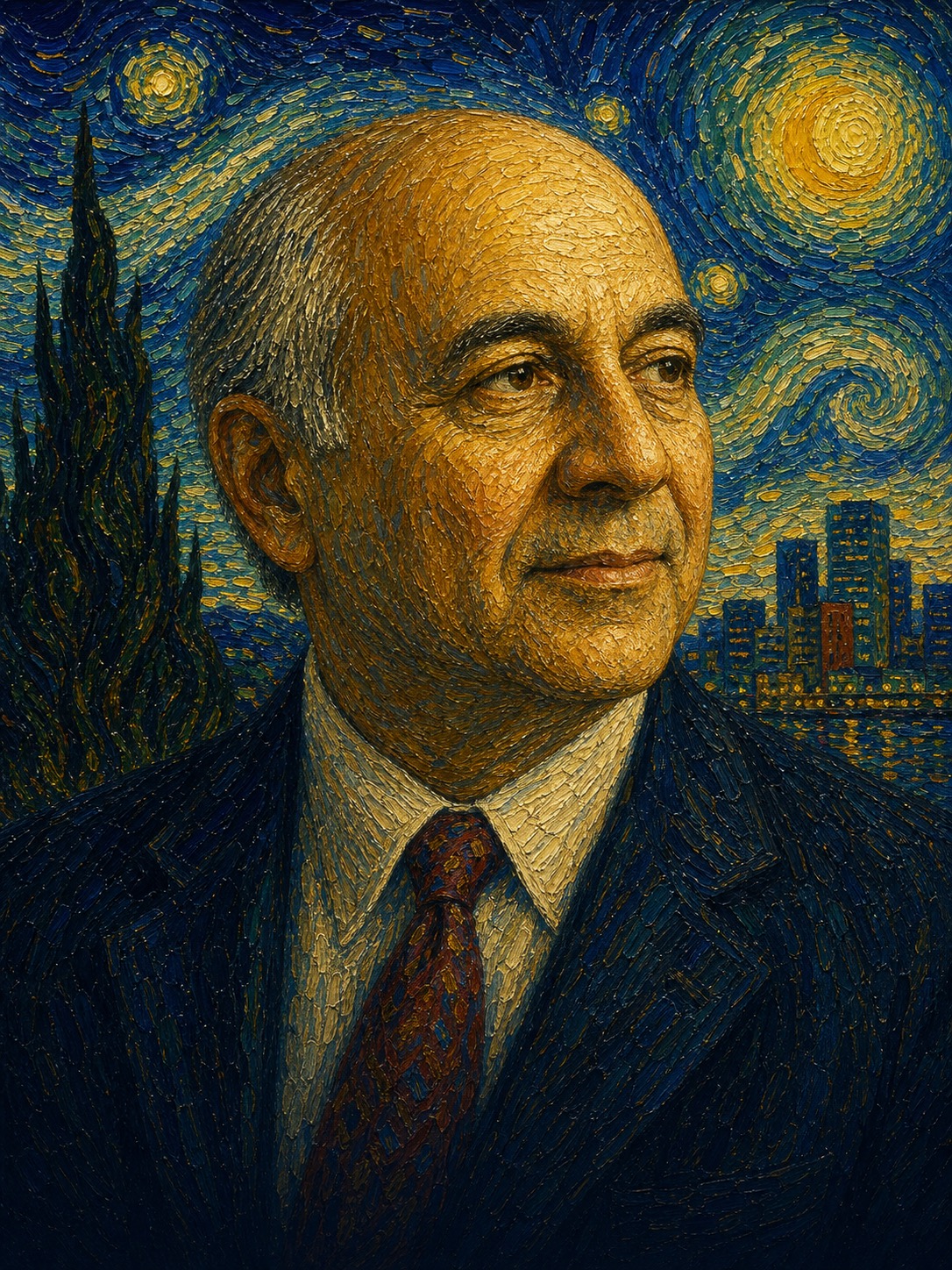
Prem Watsa
Built a controlled permanent-capital insurance compounder that pairs underwriting profit and low-cost float with Graham value, crisis liquidity, decentralized trust, and friendly acquisitions, while costly macro hedges, value traps, accounting complexity, and succession expose the limits of patience and founder control.
As of 2026-07-18, V. Prem Watsa is living and remains chairman and chief executive officer of Fairfax Financial Holdings. Fairfax's April 2026 shareholder vote re-elected him as a director, and he joined a filed Schedule 13D agreement dated June 16, 2026. The 2026 proxy identifies him as age 75, resident in Toronto, chairman and CEO since 1985, and vice-chairman of Hamblin Watsa Investment Counsel (HWIC) since 2019. No Fairfax filing names a CEO successor or handoff timetable, and Peter Clarke remains president and chief operating officer. Separately, a 2025 report drawn from an authorized-access biography says Watsa intends Benjamin Watsa eventually to become chairman; that is a stated intention, not a board-announced appointment or CEO succession plan (Fairfax 2026 proxy; Fairfax director-election result, 2026; SEC-filed joint-filing agreement, 2026; Economic Times, 2025; publisher provenance).
The legal record needs equally careful wording. A 2006 restatement and regulatory subpoenas concerned Fairfax and certain officers, including Watsa; a related U.S. shareholder action was later dismissed on repose, pleading, and standing grounds without a trial. Fairfax announced that Quebec's securities regulator closed a separate insider-trading/tipping investigation in 2018. A 2023 Indian securities settlement concerned Fairfax as an entity, not Watsa personally. Muddy Waters disclosed a short position and alleged in February 2024 that Fairfax had overstated book value; Fairfax denied the claims, and no public enforcement proceeding or judicial ruling arising from that report was located. These are distinct events, not one continuous personal case (Fairfax 2006 annual report; SEC-filed Fairfax disclosure, 2006; U.S. District Court dismissal, 2012; Fairfax AMF closure announcement, 2018; SEBI settlement order, 2023; Muddy Waters report, 2024; Fairfax response, 2024).
Snapshot
| Field | Details |
|---|---|
| Born | Born in Hyderabad, India, in August 1950. The UK registry supplies month and year but no day; this profile therefore does not elevate a widely repeated exact day from secondary sources (UK Companies House; Huron University biography). |
| Nationality | Indian-born Canadian citizen. SEC and UK registry records identify him as Canadian; they do not establish dual citizenship (SEC Schedule 13D/A, 2018; UK Companies House). |
| Main vehicles | Fairfax Financial Holdings; HWIC, its wholly owned investment manager; Fairfax India Holdings, a publicly traded subsidiary Watsa founded; and Sixty Two Investment Company, through which he retains voting control. The economic engine also includes decentralized property-and-casualty insurers, reinsurers, run-off operations, and non-insurance associates (Fairfax 2025 annual report; Fairfax 2026 proxy). |
| Years active | Professional investment career from 1974; HWIC from 1984; Watsa-led control and management of Fairfax from September 1985 to the present (Fairfax executive biography; Fairfax 2025 annual report). |
| Asset classes | Insurance and reinsurance float; government and corporate bonds; global public and private equities; associates and controlled companies; credit and equity derivatives; and opportunistic acquisitions. These are corporate portfolios and operating businesses, not a Watsa personal account (Fairfax 2025 annual report). |
| Style tags | Graham value, insurance-float compounding, decentralized operations, contrarian credit and equity, capital preservation, margin of safety, macro hedging, patient concentrated ownership, friendly acquisitions, India platform (Fairfax 2025 annual report). |
| Verified track record | Reproducible issuer-reported corporate record, not personal fund returns. [Single-source issuer series; raw math independently recomputed.] From the September 1985 management takeover through 2025, book value per basic share rose from US$1.52 to US$1,260.19, a displayed 18.3% CAGR excluding dividends; the closing share price rose from C$3.25 to C$2,615.89, a displayed 18.2% CAGR excluding dividends. Watsa's letter gives 18.7% and 19.5% including dividends [single-source, issuer-calculated; reinvestment/timing method undisclosed] (Fairfax 2025 annual report). |
| Peak AUM / latest scale | Fairfax does not disclose conventional firmwide third-party AUM or prove an all-time AUM peak. [Single-source issuer figures.] At March 31, 2026, latest disclosed total cash and investments net of derivative obligations were US$74.993 billion; this excluded US$1.566 billion of Eurolife Life portfolio assets classified as held for sale. At December 31, 2025, audited total assets were US$107.788 billion and common shareholders' equity was US$26.283 billion. These are corporate scale measures, not AUM substitutes (Fairfax Q1 2026 interim report; Fairfax 2025 annual report). |
Life & Career Timeline
1950-1974 - Hyderabad, Madras, and London, Ontario. Watsa was born in Hyderabad. He completed a first-class B.Tech. in chemical engineering at the Indian Institute of Technology Madras in 1971, then moved to Canada and earned an MBA from Western University's Ivey Business School in 1974. Controlled institutional origin stories agree that he arrived with very little money and sold air conditioners and furnaces while studying, but conflict on whether the cash was eight dollars or eight rupees; no precise amount is adopted here (IIT Madras alumnus profile; IIT Madras 2024 release; Ivey biography; Huron University biography; Horatio Alger profile).
1974-1984 - apprenticeship in institutional investing. Fairfax's current biography places Watsa at Confederation Life from 1974 through 1983, ultimately as vice-president of Confederation Life Investment Counsel, and at GW Asset Management as vice-president in 1983-1984. This decade matters because it joined insurance liabilities to investment practice before he controlled an insurer. It also created the working relationships behind HWIC: the 1992 Fairfax letter identifies Tony Hamblin, Roger Lace, Brian Bradstreet, Frances Burke, and Watsa as partners who had worked together for 18 years (Fairfax executive biography; Fairfax 1992 annual report).
1984-1987 - HWIC, control, then the Fairfax name. Watsa and Hamblin founded HWIC in 1984. [Single-source contemporaneous transaction figures; currency unlabeled.] In September 1985, a reported $9.1 million private placement recapitalized Markel Financial, parent of a small Canadian trucking insurer. Sixty Two—a consortium that included Watsa, Confederation Life, and Canadian businesspeople—supplied $5.0 million, acquired voting control, and installed Watsa as chairman. Fairfax's performance table uses September 1985 as the current-management base date. Yet the listed corporate shell was not newly incorporated: a filed corporate history says it was incorporated in Ontario in 1951 as Markel Service of Canada, became Markel Financial Holdings in 1984, and changed its name to Fairfax Financial Holdings in May 1987. The accurate formulation is therefore “Watsa-led Fairfax began in 1985,” not “the legal entity was incorporated in 1985” (Fairfax 1985 shareholder letter; SEC-filed corporate history; Fairfax 1987 shareholder letter).
1987-1992 - the model takes shape. “Fairfax” abbreviates “fair, friendly acquisitions,” an aspiration Watsa presented to shareholders while expanding from the original insurance base. HWIC initially sat outside the public company and managed both external and Fairfax money. Effective October 1, 1992, Fairfax bought HWIC for C$14 million in cash and shares after a process the annual letter says involved independent directors, Sir John Templeton, and contacted minority shareholders. HWIC then managed about C$1 billion in pension, corporate, individual, and insurance funds. That historical mix should not be projected onto today's business: the 2025 annual report describes HWIC as a wholly owned manager for Fairfax, its insurance and run-off operations, and Fairfax India (Fairfax 1987 shareholder letter; Fairfax 1992 annual report; Fairfax 2025 annual report).
1990s-2010s - insurance scale, crisis hedges, and global platforms. Fairfax expanded through insurers and reinsurers including Odyssey, Northbridge, Crum & Forster, Zenith, Brit, and Allied World, while leaving operating authority decentralized. Investment gains, underwriting float, acquisitions, and new share issuance all contributed to scale; the growth cannot be assigned to stock selection alone. The credit-default-swap portfolio was a defining success around the global financial crisis, but the longer public record also includes severe equity and book-value drawdowns, costly deflation hedges, and concentrated investments that took years to mature or disappointed. In a direct 2019 interview, Watsa credited Brian Bradstreet with the CDS idea and described roughly US$340 million of cost and US$2.4 billion of gains; that is manager testimony, not an independently reconstructed trade ledger (Fairfax corporate history; Fairfax 2025 annual report; Southeastern Asset Management transcript, 2019).
Watsa founded Fairfax India, whose shares began trading in 2015 to pursue Indian public and private investments. That vehicle reflects both personal familiarity with India and the Fairfax structure: a permanent-capital public company with advisory and administration links to the parent, not a conventional open-end fund. Watsa stepped down as Fairfax India's chairman in July 2024, when Benjamin Watsa became chairman, but remained a director; that subsidiary transition did not change Prem Watsa's roles at Fairfax Financial (Fairfax 2025 annual report; Fairfax India 2025 annual report; Fairfax India succession release, 2024).
2009-present - public service and recognition alongside control. Watsa served as the University of Waterloo's chancellor from 2009 to 2015 and became chancellor emeritus; Huron appointed him its first chancellor in 2017. Canada appointed him a Member of the Order of Canada for business, volunteer, and philanthropic contributions, and India's official 2020 awards notice listed him for the Padma Shri in trade and industry. IIT Madras announced a US$5 million gift in 2024 for brain research (University of Waterloo, 2014; Huron University biography; Governor General of Canada; Government of India Padma Awards notice, 2020; IIT Madras 2024 release).
2025-2026 - still active, with formal CEO succession unresolved publicly. [Single-source issuer figures.] Fairfax reported record 2025 net earnings of US$4.772 billion, US$74.860 billion of total cash and investments net of derivative obligations, and 20.5% dividend-adjusted book-value growth (rounded to 21% in the chairman's letter). At March 31, 2026, book value per basic share was US$1,250.14 and had increased 0.5% after adjusting for the US$15 dividend. Watsa was re-elected in April 2026, and Fairfax still describes him as chairman and CEO. The proxy says the board discusses succession at least annually but names no CEO successor or timetable. The biography-based report of Watsa's future-chair intent for Ben is not a formal issuer appointment (Fairfax 2025 results; Fairfax Q1 2026 results; Fairfax 2026 proxy; Economic Times, 2025).
Vehicles & Structure
Fairfax is first an insurance holding company. Its subsidiaries underwrite property-and-casualty insurance and reinsurance; premiums received before claims are paid create investable float. The corporate result therefore combines underwriting discipline, investment returns, operating-company acquisitions, financing, taxes, reserving, catastrophe exposure, and capital allocation. Calling Watsa simply a “fund manager” erases the liability side of the model (Fairfax 2025 annual report).
HWIC is the investment engine, but it is also a team. The formal 2025 MD&A says its investment committee, led by HWIC's president and chief investment officer, is responsible for investment decisions subject to regulatory constraints and oversight; Fairfax's CEO and one other corporate officer sit on it. Watsa's letter in the same report describes a less consensual operating reality: the small committee shares information and arguments while individual professionals retain authority. The filing names Wade Burton and Lawrence Chin among current leaders and describes a global professional staff. Results must therefore be attributed to Watsa, successive investment teams, insurance executives, and acquired-company leaders; the documents do not support trade-level authorship by default (Fairfax 2025 annual report).
The capital structure gives Watsa durable control disproportionate to cash-flow ownership. At the March 6, 2026 record date, Sixty Two held all 1,548,000 multiple-voting shares plus 50,620 subordinate shares, representing 41.9% of votes. Adding Watsa's directly beneficially owned and controlled shares brought the group to 43.3% of total votes. Those proxy counts equal about 9.64% of outstanding common shares [calculation from single-source proxy counts], sharply below the voting percentage. The multiple-vote arrangement has transfer protections and future shareholder-ratification triggers, including one within five years after Watsa is, for any reason, neither chairman nor CEO. This promotes long-horizon control but also creates governance and succession risk. The same proxy identifies his children Christine McLean and Benjamin Watsa as non-independent directors. The later biography-based future-chair intent for Ben does not establish a board appointment, date, or CEO outcome (Fairfax 2026 proxy; Economic Times, 2025).
A related-party transaction makes the governance trade-off concrete. In May 2024 Fairfax bought 275,000 subordinate shares from Watsa for about US$304.3 million, at a 3.7% discount to the prior close, for cancellation. Independent directors unanimously approved the purchase; Fairfax relied on exemptions from formal-valuation and minority-approval requirements because the transaction did not exceed 25% of market capitalization. It is a disclosed, procedurally managed conflict—not by itself evidence of abuse (Fairfax share-purchase announcement, 2024).
Fairfax India extends the model into an India-focused public vehicle with listed minority shareholders, separate governance, and its own net-asset record. Yet Fairfax consolidates it because of voting control: Fairfax India's 2025 report gives 95.3% voting control and a 43.6% equity interest, while Fairfax's parent report gives a 42.9% common-equity interest [same issuer ecosystem; unresolved perimeter difference]. Its results must not be treated as Watsa's personal record, nor double-counted as independent of Fairfax's consolidated investment total (Fairfax India 2025 annual report; Fairfax 2025 annual report).
Track Record Detail With Caveats
The cleanest long-run series is Fairfax's issuer-reported corporate-performance table, a management-presented supplementary measure rather than an audited fund-return series. [Single-source issuer series; raw math independently recomputed.] Between 1985 and 2025, book value per basic share increased from US$1.52 to US$1,260.19, reproducing the displayed 18.3% compound annual rate excluding dividends. The closing share price increased from C$3.25 to C$2,615.89, reproducing the displayed 18.2% rate excluding dividends. Watsa's letter gives 18.7% book-value and 19.5% share-price compounding including dividends [single-source, issuer-calculated; reinvestment/timing method undisclosed]. The pairs use different dividend conventions and mix currencies by design—book value in U.S. dollars and share price in Canadian dollars (Fairfax 2025 annual report).
Accounting regimes limit comparability. Fairfax used IFRS for 2010-2025 and Canadian GAAP for 2009 and earlier; before 2007, investments were generally recorded at cost or amortized cost rather than current fair value. The company restated January 1, 2022 book value and equity when it adopted IFRS 17 in 2023. The table is the company's official continuous presentation, but it is not a forty-year constant-accounting experiment (Fairfax 2025 annual report).
The path was volatile. [Calculations from a single issuer table.] Book value per share fell 24.8% from US$155.55 in 1999 to US$117.03 in 2001, declined in 2005, 2013, 2016, and 2018, and was roughly flat in 2020. The Canadian-dollar share price fell 77.6% from C$540 in 1998 to C$121.11 in 2002 and 28.8% from C$609.74 in 2019 to C$433.85 in 2020. These year-end endpoints exclude dividends and are not intrayear maximum drawdowns. Conversely, the five years through 2025 were exceptional: the annual report gives 22.5% compound book-value-per-share growth including dividends, a 93.6% average combined ratio, and a 6.8% average investment return for 2021-2025 [single-source issuer measures]. A favorable insurance pricing cycle and higher interest income helped, so it would be too simple to label the rebound pure security-selection skill (Fairfax 2025 annual report).
The scale figures also need two boundaries. [Single-source issuer figure.] The US$74.860 billion year-end figure is total cash and investments net of derivative obligations—consolidated corporate investment capital, largely supporting insurance liabilities; it is not Watsa's net worth and not standard third-party AUM. It excludes US$1.664 billion of Eurolife Life portfolio assets classified as held for sale. The annual letter sometimes discusses a wider group including non-consolidated insurers and gives larger rounded figures. A U.S. Form 13F covers only reportable U.S.-listed securities and likewise cannot stand in for total assets or AUM (Fairfax 2025 annual report; HWIC Form 13F notice, 2025).
Criticism, Legal Record, and Error Cases
In 2006 Fairfax restated 2001-2005 and first-quarter 2006 accounting, including certain finite-reinsurance and consolidation matters. A July estimate put the common-equity reduction at US$175-190 million; the final annual report showed a US$235.3 million reduction at March 31, 2006 and said more than half reflected a currency-translation correction, with no effect on cash flows. Fairfax and Watsa also received SEC subpoenas relating to the company's conference-call response and non-traditional insurance products. The SEC completed its investigation in June 2009 without recommending enforcement action against Fairfax (Fairfax restatement release, 2006; Fairfax 2006 annual report; SEC-filed Fairfax disclosure, 2006; U.S. District Court opinion, 2012).
A shareholder complaint later alleged securities-law violations. The federal court dismissed it in 2012 because repose periods had run and, independently, because the pleaded finite-reinsurance restatements were immaterial, broader accounting allegations did not adequately plead loss causation, and the Section 11 plaintiff could not trace shares to the challenged offerings. The court did not reach scienter and held no trial. Thus the decision rejected that complaint but did not adjudicate every historical accounting allegation (U.S. District Court opinion, 2012).
From 2014, Quebec's Autorité des marchés financiers investigated Fairfax, Watsa, and then-president Paul Rivett for possible insider trading or tipping connected with Resolute Forest Products' 2011 offer for Fibrek; Fairfax's disclosures specified that personal trading by the individuals was not involved. Fairfax announced that the AMF closed the investigation on December 5, 2018; no AMF-issued public closure notice was located, so the issuer's explanatory account should not be treated as a regulator endorsement. In 2023, Fairfax—not Watsa personally—settled a SEBI proceeding over delayed compliance with an Indian mutual-fund cross-holding/governance rule, without admitting or denying findings of fact or conclusions of law, for ₹2.925 million (Fairfax 2015 annual report; Fairfax AMF closure announcement, 2018; SEBI settlement order, 2023).
Muddy Waters' February 2024 short report alleged that transactions and accounting choices had overstated Fairfax's book value. Fairfax called the report false and misleading and disputed its treatment of asset sales, gains, and valuations. The report is an economically interested critic's allegation and the response is the issuer's rebuttal; neither alone is a neutral adjudication. Searches of public securities-regulator, court, and issuer sources found no enforcement proceeding or judicial ruling arising from the report through this profile date; that cannot exclude a confidential inquiry (Muddy Waters report, 2024; Fairfax response, 2024).
Investment mistakes supply a different criticism. Fairfax's own history shows the cost of protecting against deflation for too long, opportunity cost from equity hedges during a rising market, and company-specific errors such as BlackBerry; the company disclosed US$4.4 billion of cumulative net equity-hedging losses from 2010 through the 2016 exit, including US$2.6 billion recognized in 2016. Watsa later called BlackBerry a major error, and Fairfax's 2024 letter says it wrote off Farmers Edge after investing US$385 million over eight years. The record also shows the opposite danger: investments such as Eurobank looked poor for years before recovering. Later task files should separate a bad process from a long duration, and should reconstruct each case rather than treating eventual price recovery as proof that every original thesis was right (Fairfax 2016 annual report; Fairfax 2023 annual report; Fairfax 2024 shareholder letter; Fairfax 2025 annual report).
Finally, long-running litigation against alleged short sellers should not be inverted into misconduct by Fairfax. A November 2025 New York order records that Fairfax and Crum & Forster held an unsatisfied US$10.666 million 2024 judgment against Exis-related entities and sought post-judgment discovery. In that matter Fairfax is a plaintiff and judgment creditor. No later published order located through the profile date establishes whether the judgment has since been paid (New York Supreme Court order, 2025).
Why He Matters
Watsa matters because he fused a Graham-derived margin-of-safety discipline with permanent insurance capital. The model is not merely “buy cheap stocks.” It requires acceptable underwriting, patient liabilities, liquid reserves, decentralized operating talent, a willingness to hold cash, and a central capital allocator able to shift among bonds, equities, control investments, hedges, and acquisitions. Fairfax's survival through large catastrophes, investment drawdowns, and changing accounting regimes is part of the achievement, not background noise (Fairfax 2025 annual report).
The evidence also makes single-person hero attribution untenable. Fairfax bought operating companies, issued and repurchased shares, benefited from insurance cycles and interest rates, and relied on long-tenured underwriting and HWIC teams. Watsa selected people, set incentives and culture, controlled capital allocation, and retained voting control; those are real causal contributions. Yet corporate book value is a team-and-structure result, not a portfolio-manager time series. The fairest conclusion is that the duration, decentralized architecture, and willingness to be out of step are skills, while the timing and magnitude of catastrophe losses, hard insurance markets, interest-rate regimes, and individual security outcomes inject substantial luck.
His governance structure is also part of his significance. Multiple-vote shares helped preserve an unusually long horizon, but they concentrate authority and make succession consequential. That bargain—patient control in exchange for minority-shareholder dependence on one culture and one controller—is central to evaluating Fairfax rather than a footnote.
Open Questions for Later Tasks
- Which direct Watsa speeches and interviews best document the intellectual influence of Benjamin Graham, John Templeton, and Tony Hamblin?
- What portfolio-level rules distinguish HWIC's stated margin-of-safety process from generic value investing?
- How did Fairfax size, hedge, finance, and exit the credit-default-swap trade, and how much of the decision is attributable to Watsa versus the team?
- Which acquisitions produced the most value after accounting for purchase price, capital injections, and share issuance?
- What are the fully reconciled costs, realized losses, and opportunity costs of the equity and deflation hedges?
- Which BlackBerry, Resolute, Atlas Mara, Fairfax Africa, and other investments qualify as process mistakes rather than merely long holding periods?
- How should Fairfax's record be benchmarked against insurers, the S&P/TSX, and the S&P 500 using consistent currencies and dividend treatment?
- How much of 2021-2025 performance came from underwriting, the insurance pricing cycle, bond yields, associates, and security selection?
- What original contemporaneous documents resolve the final effects of the 2006 restatement and related regulatory inquiries?
- How should Watsa's stated future-chair intent for Ben be separated from formal board appointment and timing, and from the still-unknown CEO succession plan?
As of 2026-07-18, Prem Watsa's investment philosophy is best understood as an insurance-holding-company doctrine, not a stand-alone stock-picking style. Fairfax Financial Holdings aims to compound book value per share over very long periods by pairing disciplined property-and-casualty underwriting with centrally managed, value-oriented investing. Fairfax's current guiding principles still state a long-term objective of 15% annual book-value growth, a focus on long-term book value rather than quarterly earnings, sound financing, complete disclosure, decentralized operations, and a long-term value-oriented investment philosophy (Fairfax about page, 2026; Fairfax 2026 AGM presentation, 2026; Fairfax 2025 annual report, 2026).
Core worldview
Watsa's core worldview is that markets quote volatile prices for assets whose long-term business value changes more slowly, and that patient, owner-controlled capital can exploit that gap if it first survives. The stated ancestry is openly Graham-Buffett-Templeton: in a 2011 interview he described Hamblin Watsa's philosophy as value investing grounded in long-term asset values and protection against permanent loss, not short-term price fluctuation (GuruFocus interview, 2011). Fairfax's first annual letters already used the same language: buy financially sound companies at prices below long-term value, protect capital first, and expect results over time rather than through speculation (Fairfax 1985 shareholder letter).
The distinctive feature is that the value discipline sits inside an insurance float machine. Fairfax's long-term formula is underwriting discipline plus value investing: earn float at no cost or better, then invest that float for total return. In 2025, Fairfax reported average float of $37.36 billion, year-end consolidated float of $40.8 billion, underwriting profit of $1.82 billion, and a 4.9% benefit on the cost of float [single-source issuer figures] (Fairfax 2025 annual report, 2026). This is why Watsa cannot be assessed like a mutual-fund manager. His record is a corporate compounding record built from underwriting, reserves, acquisitions, bond income, equity gains, derivatives, taxes, capital issuance and repurchases, and the durability of the Fairfax culture (Fairfax 2025 annual report, 2026; Fairfax profile source map, 2026).
The culture is not decorative. Fairfax's current principles put honesty, integrity, decentralized presidents, share ownership, downside protection, learning from failure, and "never bet the company" alongside its investment objective (Fairfax 2026 AGM presentation, 2026). In Watsa's own recent phrasing, the long term is central; in the 2025 shareholder letter he warned against reaching for yield, kept emphasizing patience and flexibility, and described no-cost float as one of Fairfax's largest assets (Fairfax 2025 shareholder letter, 2026).
The edge - what markets misprice and why
Watsa believes markets misprice three things. First, they misprice securities when price action, liquidity pressure, or macro fear overwhelms business value. That is the classic Graham value claim: buy with a margin of safety when a security trades below intrinsic value, then wait for price and value to converge (GuruFocus interview, 2011; Fairfax 1985 shareholder letter).
Second, markets underprice patient liabilities and decentralized trust. Fairfax's float can be invested for years if underwriting remains disciplined, and its subsidiaries can run with local autonomy while capital allocation stays centralized. Fairfax says its companies are decentralized, while investments, acquisitions, and financing are done by or with Fairfax; Hamblin Watsa Investment Counsel manages investments for Fairfax, its insurance and run-off operations, and Fairfax India (Fairfax about page, 2026; Fairfax 2025 annual report, 2026).
Third, markets misprice reputation in friendly acquisitions and rescue situations. Fairfax's name itself was explained in early letters as "fair, friendly acquisitions," and Watsa has repeatedly emphasized doing deals without hostile tactics or last-minute renegotiation. The practical edge is that managers and families may prefer Fairfax's permanent, decentralized ownership to a buyer promising synergies, leverage, or rapid control changes (Fairfax 1986 shareholder letter; Fairfax 2012 shareholder letter; Google Books, The Fairfax Way, 2025).
The edge is not pure contrarianism. Fairfax must preserve ratings, liquidity, claims-paying ability, and minority-shareholder confidence while owning volatile assets. That constraint reduces some freedom but creates another advantage: many investors cannot endure years of mark-to-market pain, short-seller criticism, or illiquid private/associate exposure inside a public company. Fairfax can, provided the holding company remains soundly financed (Fairfax 2025 annual report, 2026; AM Best Fairfax affirmation, 2026).
Process: idea sourcing to research to valuation and entry to sizing to portfolio construction to sell discipline
Idea sourcing
Fairfax sources ideas across public equities, private companies, associates, insurance businesses, credit, bonds, India-focused investments, and derivatives rather than from a single screen. In a Southeastern Asset Management interview, Watsa described looking "wherever" opportunities appear and emphasized that the public/private distinction is secondary to price, business quality, and people; the interviewer was a Fairfax shareholder, so the source is friendly but still direct interview evidence (Southeastern transcript, 2019). Fairfax India's annual reports show the same pattern in India: Fairbridge sources and reviews public and private investments under the Fairfax philosophy, while the listed vehicle provides permanent capital for that market (Fairfax India 2025 annual report, 2026).
The investable universe is therefore opportunistic, but the operating filter is narrow. A potential investment has to fit a margin-of-safety discipline, management confidence, and Fairfax's reputation for fair dealing. The more operational or control-like the asset, the more the quality of people matters; the more liquid or security-like the asset, the more price and downside protection dominate (Fairfax 2025 annual report, 2026; Southeastern transcript, 2019).
Research
The research process is centralized through Hamblin Watsa, but it is team-based. The 2025 annual report describes an investment committee and a group of investment professionals, while the profile file already cautions that Fairfax results cannot be assigned trade by trade to Watsa alone (Fairfax 2025 annual report, 2026; Prem Watsa profile, 2026). Research is fundamental rather than factor-based: asset value, earning power, management quality, balance-sheet resilience, float economics, and the ability to withstand a bad scenario matter more than momentum or near-term earnings beats (GuruFocus interview, 2011).
For insurance acquisitions, research includes underwriting culture. Watsa's public lessons from Crum & Forster, TIG, and other insurance operations focus on combined ratios, reserving, and whether management will underwrite for profit rather than premium growth. Fairfax's recent record highlights combined ratios below 100%, underwriting profits, and reserving discipline as central operating evidence, not incidental statistics (Fairfax 2025 annual report, 2026; Southeastern transcript, 2019).
Valuation and entry
Fairfax's entry rule is best described as intrinsic value with a visible margin of safety. In public equities, that means buying at a discount to long-term asset value or earning power. In private/control-like situations, it means entering where the business, real assets, financing structure, or partner quality gives downside support. Watsa's interview example of Toys "R" Us Canada framed the opportunity around no debt, roughly $1 billion of revenue, about $100 million of EBITDA, a purchase price near $280 million, and owned real estate close to the purchase price [direct interview, single-source operating figures] (Southeastern transcript, 2019).
Book value is an important valuation anchor but not an absolute truth. Fairfax's own long-run objective is framed around book value per share, and its performance table centers book value, but private and associate investments require valuation judgments. This is why the 2024 Muddy Waters report matters to philosophy even if its allegations are disputed: it attacked whether Fairfax's accounting and transaction gains overstated asset value by about $4.5 billion or 18%, while Fairfax denied the allegations and said its reporting complied with applicable accounting principles (Muddy Waters report, 2024; Fairfax response to Muddy Waters, 2024).
Sizing
Sizing at Fairfax is easier to observe than to codify. The company can make very large individual commitments, but the total investment portfolio is diversified across cash, short-term investments, bonds, common stocks, associates, derivatives, and insurance-related assets. At year-end 2025, Fairfax reported $70.6 billion of portfolio investments: $6.6 billion cash, $2.4 billion short-term investments, $40.0 billion bonds, $9.2 billion common stocks, $8.4 billion associates, and $1.0 billion derivatives [single-source issuer figures] (Fairfax 2025 annual report, 2026).
The public-equity sleeve can be concentrated, but a Form 13F is a poor measure of Fairfax's full book because it omits many non-U.S., private, bond, derivative, insurance, and associate exposures. Fairfax's Q1 2026 13F cover showed 29 entries and roughly $1.94 billion of reported holdings, a small subset of the group investment base (SEC Fairfax 13F cover, 2026; SEC 13F information table, 2026).
Portfolio construction
The portfolio is barbell-like: a large base of bonds, cash, and short-term investments supports insurance liabilities and ratings, while selected equities, associates, private investments, and derivatives provide upside or protection. Bond positioning is active. Fairfax used long bonds and deflation protection during the post-crisis deflation-fear period, then shortened duration after 2016; in 2025, it said fixed-income yield declined partly because it reduced interest-rate exposure by emphasizing short-dated U.S. Treasuries and selling long-dated U.S. Treasuries (Fairfax 2016 shareholder letter, 2017; Fairfax 2025 shareholder letter, 2026).
That construction reflects a "survive first" doctrine. Cash and bonds are not idle if they preserve optionality and protect ratings. Equities and associates need patience and may look wrong for years. Derivatives are acceptable when Fairfax believes the payoff asymmetry protects against rare but severe outcomes, but the hedge era shows that protection must be judged against cost and duration (Fairfax 2015 shareholder letter, 2016; Fairfax 2016 annual report, 2017).
Sell discipline
Fairfax does not publish a simple sell checklist. The observed discipline has several forms: realize gains after dislocation-driven trades, sell or trim to stay within regulatory or control thresholds, recycle capital into better opportunities, repurchase Fairfax shares when they are attractive, and exit when the thesis or circle of competence has clearly failed. The 2025 annual report discusses realized gains and reductions in holdings such as Eurobank, while the 2023 and 2024 letters show explicit mistake recognition in BlackBerry and Farmers Edge (Fairfax 2025 annual report, 2026; Fairfax 2023 shareholder letter, 2024; Fairfax 2024 shareholder letter, 2025).
The weaker part of the sell discipline is the willingness to wait through deep value traps. Resolute was later partially monetized through Domtar's acquisition, but Watsa had described it in 2019 as a very poor investment with $745 million of net investment against about $200 million of carrying value [single-source Watsa letter figures]. BlackBerry was harsher: the 2023 letter called it a "horrendous investment," reported common shares bought at $17.16 and carried at $3.54, and concluded that technology was outside Watsa's preferred domain (Fairfax 2019 shareholder letter, 2020; Fairfax 2023 shareholder letter, 2024).
Risk management
Risk management begins with underwriting. Fairfax wants float only if the float is low cost or better; premium growth without underwriting profit would damage the engine. The company repeatedly emphasizes combined ratios below 100%, reserving discipline, catastrophe exposure, and decentralized underwriting accountability (Fairfax 2025 annual report, 2026; Fairfax 2026 AGM presentation, 2026).
The second layer is financial soundness. Fairfax's principles call for a soundly financed company, focus on long-term book value, complete disclosure, and never betting the company. At the holding-company level, that means maintaining liquidity, protecting ratings, avoiding forced asset sales, managing debt maturities, and keeping enough cash and bonds to meet claims and preserve optionality (Fairfax about page, 2026; Fairfax senior-note redemption release, 2026; AM Best Fairfax affirmation, 2026).
The third layer is macro protection, and this is the most controversial. Fairfax's 2007 credit-default-swap gains were an extreme example of paying for asymmetric protection before a credit crisis; Watsa wrote that Fairfax had bought more after the position was marked down heavily at year-end 2006 (Fairfax 2007 annual report, 2008). But the post-2010 equity hedges and CPI-linked derivatives show the danger of extending that logic too long. Fairfax disclosed $4.4 billion of cumulative net equity-hedging losses from 2010 through 2016, about $0.5 billion of losses primarily on deflation swaps, and the 2016 closing of $6.3506 billion notional equity index short swaps with a $2.6654 billion realized loss [single-source issuer figures] (Fairfax 2016 annual report, 2017).
The lesson is not that Watsa abandoned downside protection. It is that he learned the price of open-ended macro insurance can overwhelm the protection if the feared regime does not arrive. In 2019, he told Southeastern that Fairfax had not taken its own advice, kept hedging and long bonds too long, and should have focused more on value equities after long rates reached roughly 2.5% to 3% [friendly interview source] (Southeastern transcript, 2019).
The process change was already explicit in the 2018 shareholder letter. Watsa wrote that shorting had proved dangerous and too short-term for long-term value investing, estimated that shorting had cost Fairfax about $2 billion net of common-stock gains, and said future equity hedges would use finite-loss options if used at all [single-source issuer figures] (Fairfax 2018 shareholder letter, 2019).
Temperament and psychology
The temperament is patient, contrarian, reputation-sensitive, and unusually willing to endure public discomfort. Fairfax's letters show Watsa waiting through drawdowns, averaging down when intrinsic value seemed intact, and accepting years of criticism rather than optimize quarterly optics. The 2011 letter explained continued full hedging in terms of U.S., European, and Chinese macro concerns and the risk of a long stagnation or deflationary outcome, while admitting poor common-stock performance that year (Fairfax 2011 shareholder letter, 2012).
There is also a strong moral vocabulary: trust, fair dealing, humility, decentralized authority, no politics, no egos, and long-term ownership. This language can sound soft, but at Fairfax it is a capital-allocation tool. It allows subsidiaries to operate with autonomy, helps sellers trust Fairfax as an acquirer, and gives shareholders a repeated explanation for why the company will not chase short-term share-price approval (Fairfax 2012 shareholder letter; Fairfax 2024 shareholder letter, 2025; Fairfax 2026 AGM presentation, 2026).
The psychological hazard is the same as the strength: patience can become thesis inertia. Watsa is explicit about mistakes after the fact, but several mistakes were multi-year and capital-intensive. BlackBerry, Resolute, the 2010-2016 hedges, and Farmers Edge show that a high tolerance for looking wrong must be paired with a sharp rule for being wrong (Fairfax 2016 annual report, 2017; Fairfax 2019 shareholder letter, 2020; Fairfax 2023 shareholder letter, 2024; Fairfax 2024 shareholder letter, 2025).
Evolution over career
From 1985 through the early 1990s, the philosophy was a compact Graham-Buffett doctrine applied to a small insurance company: buy below value, protect capital, own managers, and do friendly acquisitions. The 1986 letter added the acquisition and decentralization idea, and the 1992 HWIC acquisition put the investment manager inside Fairfax (Fairfax 1985 shareholder letter; Fairfax 1986 shareholder letter; Fairfax 1992 annual report).
By the early 2000s, the philosophy had scaled down its numerical ambition. Fairfax moved from an early 20% return aspiration toward the now-familiar 15% long-term book-value objective as size increased and interest rates declined. This period also made macro protection more explicit: Fairfax bought hedges against rare but severe outcomes and presented risk as something to be faced analytically and honestly (Fairfax 2002 shareholder letter, 2003).
The 2007-2008 credit crisis validated the protection mindset, but the validation created a later trap. Fairfax's CDS gains became part of the legend, yet the company carried large equity hedges and deflation protection into a long bull market and low-rate period. The 2016 exit from economic equity hedging was the major philosophical pivot: Fairfax removed a costly macro overlay and returned more fully to underwriting, value investing, cash optionality, and bond duration management (Fairfax 2007 annual report, 2008; Fairfax 2016 annual report, 2017).
From 2020 through 2026, the dominant framing became institutionalization. The letters emphasize a 100-year Fairfax, decentralization, succession, no-cost float, not reaching for yield, and the "three Ts" of trust, transparency, and talent. Higher rates and a stronger insurance cycle helped the model's recent earnings, but Watsa's stated doctrine is not merely a rate call; it is a full operating system for keeping the company alive long enough to exploit dislocations (Fairfax 2020 shareholder letter, 2021; Fairfax 2024 shareholder letter, 2025; Fairfax 2025 shareholder letter, 2026).
What he explicitly rejects
Watsa rejects speculation, quarterly optics, and the idea that share-price volatility is the same as permanent capital loss. Early letters rejected buying for quick price movement and emphasized long-term value; later principles state that Fairfax will focus on long-term book value rather than quarterly earnings (Fairfax 1985 shareholder letter; Fairfax about page, 2026).
He rejects growth for its own sake. In insurance, that means premium growth without underwriting profit; in fixed income, it means reaching for yield; in acquisitions, it means hostile raids, bidding wars, and synergy fantasies that undermine a fair and friendly reputation. The latest annual letter's fixed-income discussion again stressed that Fairfax did not reach for yield, and the authorized 2025 biography's table of contents highlights the anti-corporate-raid and anti-synergy themes as part of the Fairfax playbook (Fairfax 2025 shareholder letter, 2026; Google Books, The Fairfax Way, 2025).
He also rejects buying insurance turnarounds merely because they look statistically cheap. In 2019, he described Crum & Forster and TIG as lessons in buying underwriting-profit-oriented insurers rather than projects requiring years of repair; after the hedge exit, he also rejected uncapped shorting as a normal value-investing tool (Southeastern transcript, 2019; Fairfax 2018 shareholder letter, 2019).
He also rejects centralized bureaucracy as an operating model. Fairfax centralizes capital allocation but decentralizes subsidiary management. That is not laissez-faire; it is a deliberate choice to align incentives, preserve entrepreneurial energy, and make Fairfax a preferred home for acquired businesses (Fairfax about page, 2026; Fairfax 2024 shareholder letter, 2025).
Regimes where it thrives vs. struggles
The model thrives in hard insurance markets, credit or equity dislocations, liquidity panics, and periods when high-quality bonds offer attractive yields. It also thrives when sellers value permanence and culture enough to transact with Fairfax on friendly terms. The 2007-2008 crisis, the post-2020 insurance hard market, and the 2021-2025 period of higher interest income all fit parts of that pattern, though each also involved team execution and favorable external conditions (Fairfax 2007 annual report, 2008; Fairfax 2025 annual report, 2026; AM Best Fairfax affirmation, 2026).
It struggles in momentum-led equity bull markets when hedges or cash drag suppress returns, in very low-rate regimes when bond income is thin, and in long cycles where deep-value investments become value traps. The 2010-2016 hedge losses are the clearest regime failure: the protection mindset was rational in stated purpose, but the cost and duration became damaging as equities rose and deflation did not arrive (Fairfax 2015 shareholder letter, 2016; Fairfax 2016 annual report, 2017).
It may also struggle under physical-climate and fossil-fuel-transition risk if underwriting, investing, and long-term downside protection are not aligned. Corporate Knights argued in 2025 that Fairfax's long-term investing rhetoric conflicts with fossil-fuel underwriting and investment exposure; that is an advocacy critique, not a regulatory finding, but it is directly relevant because Fairfax's philosophy claims to be centered on long-horizon risk control (Corporate Knights critique, 2025).
Tensions between stated philosophy and actual behavior
The first tension is value investing versus macro conviction. Watsa presents Fairfax as long-term, business-value-oriented, and skeptical of speculation, yet macro hedges became large enough to dominate reported results for years. The same temperament that enabled the CDS win also produced costly equity and deflation protection from 2010 through 2016. Fairfax's own disclosure and Watsa's later interview admission make this a real process tension, not a hindsight blogger complaint (Fairfax 2007 annual report, 2008; Fairfax 2016 annual report, 2017; Southeastern transcript, 2019).
The second tension is book value as scorecard versus accounting complexity. Fairfax asks shareholders to judge long-term book-value compounding, but its private investments, associates, derivatives, consolidations, insurance reserves, and transaction gains require complex accounting. Muddy Waters' 2024 short report and Fairfax's rebuttal show how this complexity can become an argument about whether book value is a clean proxy for intrinsic value; Morningstar separately argued in 2024 that Fairfax's structure was overly complicated and that the 15% book-value growth target looked unrealistic after the post-crisis period. The Morningstar view is analyst opinion, not an adjudicated fact, but it reinforces the trust-in-book-value problem (Muddy Waters report, 2024; Fairfax response to Muddy Waters, 2024; Fairfax 2025 annual report, 2026; Morningstar Canada, 2024).
The third tension is long-term patience versus sell discipline. BlackBerry, Resolute, and Farmers Edge show the danger of staying long because an asset appears statistically cheap or strategically important. Watsa's explicit admissions are valuable evidence of humility, but the capital stayed exposed for years before the lesson was visible (Fairfax 2019 shareholder letter, 2020; Fairfax 2023 shareholder letter, 2024; Fairfax 2024 shareholder letter, 2025).
The fourth tension is patient control versus minority-shareholder governance. Multiple-vote shares help preserve a long horizon and keep Fairfax from being forced into short-term behavior, but they also make succession and related-party governance consequential. The 2026 proxy's voting-control disclosures and the 2024 purchase of Watsa's shares for cancellation are not philosophy footnotes; they are part of the bargain that lets Watsa run a decades-long system (Fairfax 2026 proxy, 2026; Fairfax Watsa share-purchase release, 2024).
The fifth tension is culture versus conflict. Fairfax emphasizes the Golden Rule, trust, and fair dealing, but the record includes accounting restatements, regulatory subpoenas later closed without SEC enforcement, an AMF investigation Fairfax says was closed, a SEBI entity settlement without admission or denial, long short-seller litigation, and recurring adversarial reports. Those events do not prove Watsa's philosophy false; they show that a complex, controlled insurance holding company must keep earning trust with evidence rather than slogans (Fairfax 2006 annual report; U.S. District Court opinion, 2012; Fairfax AMF closure announcement, 2018; SEBI Fairfax settlement order, 2023; New York Supreme Court order, 2025).
The fairest summary is that Watsa's philosophy is a survival-and-compounding machine: underwriting profit, low-cost float, value investing, cash optionality, decentralized trust, and long control. Its failure mode is the same machinery pushed too far: macro protection that becomes market timing, patience that becomes inertia, book value that becomes too accounting-dependent, and culture that can be invoked faster than outsiders can verify it.
As of 2026-07-18, the best documented answer is Eurobank. Fairfax's 2025 shareholder letter calls it “by far” the best investment in the company's 40-year history. That label needs two qualifications: most of Eurobank's value remains unrealized, and every result below belongs to Fairfax, a subsidiary, or the Hamblin Watsa Investment Counsel (HWIC) team—not to a verified Prem Watsa personal account. Watsa set capital-allocation priorities and controlled Fairfax, but named colleagues frequently originated or operated the investments (Fairfax 2025 shareholder letter).
This case-study order favors materiality, reconstructable economics, difficulty of the path, and evidence of a repeatable decision over a merely large accounting gain. It is not a normalized return ranking: the set mixes securities, macro protection, associates, and controlled operating companies. “Gain” means only the measure stated in that row.
| Rank | Investment | Period | Status at research date | Best supported outcome |
|---|---|---|---|---|
| 1 | Eurobank | 2014-present | Partly realized; major stake retained | €0.5bn net cash invested and €4.6bn market value on February 27, 2026; issuer-calculated 15% annualized return |
| 2 | Credit-default swaps (CDS) | 2003-2009 | Substantially realized | US$2.118bn cumulative realized/unrealized gain on US$433.2m original cost at year-end 2009 |
| 3 | Odyssey Group (operating acquisition) | 1996-present | Operating subsidiary; 9.99% minority sold | US$1.2bn cumulative acquisition investment and US$9.8bn cumulative earnings through 2025; not an IRR or sale gain |
| 4 | Digit Insurance | 2017-present | Public underlying insurer; Fairfax stake retained | US$101m stated cost and US$2.039bn fair value at year-end 2025; issuer-calculated 41.5% annual return |
| 5 | First Capital (operating acquisition) | 2002-2017 | Exited, with quota-share relationship retained | US$1.683bn cash proceeds and US$1.019bn net after-tax gain |
| 6 | ICICI Lombard | 2000-2019 | Exited | US$1.638bn disclosed sale proceeds across 2017 and 2019; gains use different accounting bases |
| 7 | Poseidon / Atlas / Seaspan | 2018-present | Large partial sale completed May 2026 | US$1.91bn cash proceeds and US$837m pre-tax realized gain on the 2026 tranche; 22.2% common stake retained |
| 8 | Bank of Ireland | 2011-2017 | Exited | About US$806m realized-plus-unrealized gain when 85% had been sold; exact final standalone P&L undisclosed |
| 9 | Stelco | 2018-2024 | Exited for cash and shares | US$638.1m consideration and US$343.7m accounting gain; 29% issuer-calculated annual return |
| 10 | International Coal Group | 2006-2011 | Exited | US$152.3m cost, US$493.5m proceeds, US$341.2m realized gain |
All currencies are those used by the source. “Issuer-calculated” or “[single-source]” means the method or cost ledger has not been independently reproduced from transaction-level cash flows.
1. Eurobank - the Single Best, but Still Mostly a Market Value
Context and dates. Greece had endured a depression, a sovereign crisis, bank consolidation, and government recapitalization. In April 2014 Fairfax led an institutional group that bought €1.33 billion of Eurobank shares; Fairfax supplied €400 million at a split-adjusted €31 per share against €37 of book value. After capital controls and another European Central Bank stress test, it invested €350 million in November 2015 at a split-adjusted €1. In May 2019, 53%-Fairfax-owned Grivalia merged into Eurobank at an attributed €0.38 per share (Fairfax 2014 annual report; Fairfax 2015 annual report; Fairfax 2025 shareholder letter).
Thesis, discovery, size and structure. The thesis combined recapitalized solvency, unusually high private ownership among Greek banks, a discount to book, and eventual normalization of Greece. Fairfax explicitly credits Wade Burton's work, with Brad Martin supporting him; Wilbur Ross, Capital Group, Fidelity, and Mackenzie Cundill were among the original investor group. After all three steps, Fairfax owned 1.3 billion shares at an all-in €0.94 per share, €1.2 billion (US$1.5 billion) total cost. That is a strategic corporate associate, not a fund position with a disclosed portfolio percentage (Fairfax 2015 annual report; Fairfax 2025 shareholder letter).
Path, drawdown, exit and P&L. The shares reached €0.30 after a 100-for-one consolidation in early 2016, but the intervening recapitalization makes a single-tranche price comparison misleading. The audited whole-position measure at year-end 2016 was US$926.7 million cost versus US$246.1 million fair value, a 73.4% loss. The blended position was still underwater in 2020: €1.1 billion net cash invested, €0.7 billion market value, and a reported -7% annualized return. Dividends, buybacks, and sales—some undertaken to remain below a regulatory ownership threshold rather than as valuation calls—later reduced net cash invested to €0.5 billion. At February 27, 2026, the retained stake was worth €4.6 billion (US$5.4 billion); Fairfax reported €4.0 billion cumulative return and a 15% annualized inception return. These are [single-source issuer calculations], and “net cash invested” deducts distributions and sale proceeds. The position is not a completed €4 billion cash profit (Fairfax 2016 annual report; Fairfax 2025 shareholder letter).
The 2019 Grivalia leg deserves an adverse note. Muddy Waters alleged in 2024 that the related Eurobank-Grivalia transactions created inflated paper gains; Fairfax denied the report's broader accounting claims. Neither document is a neutral adjudication. The present Eurobank market value is observable, but the criticism reinforces why market value, equity-accounted earnings, and realized cash must remain separate (Muddy Waters, 2024; Fairfax response, 2024).
What it teaches. Patient capital mattered, but patience alone is not the lesson. Fairfax recapitalized a surviving franchise, averaged down only after new capital improved solvency, backed identifiable operators, and endured an extreme quoted loss. Greece's recovery and multiple expansion supplied substantial macro luck; BlackBerry shows that waiting is not itself a thesis.
2. Credit-Default Swaps - the Best Completed Crisis Trade
Context, thesis and discovery. From 2003 Fairfax bought protection on financial-sector issuers as structured-credit issuance, leverage, and apparently implausible AAA ratings expanded. Watsa's 2006 letter warned that securitization did not eliminate risk. In a direct 2019 interview he credited fixed-income partner Brian Bradstreet with the CDS idea and emphasized its asymmetric payoff; this was a HWIC team decision, not a solo Watsa trade (Fairfax 2006 annual report; Southeastern transcript, 2019).
Size, structure and path. By 2005 Fairfax had paid about US$250 million for protection with roughly 40 times that amount of underlying exposure. At year-end 2006, original investment was US$276 million and notional value US$13.1 billion, but the mark had fallen 74%; Fairfax then added protection. At year-end 2007 original cost was US$340 million, notional exposure US$18.539 billion, and fair value US$1.119 billion. The contracts were generally five to seven years, so fixed premium cost bought time as well as convexity. Collateral agreements reduced—but did not eliminate—counterparty risk (Fairfax 2005 annual report; Fairfax 2006 annual report; Fairfax 2007 annual report).
Exit and P&L. Fairfax sold US$15.638 billion notional through 2009. The sold contracts had US$318.4 million original cost, US$2.4796 billion proceeds, and US$2.1612 billion gain. Remaining contracts had US$114.8 million cost and US$71.6 million fair value. Thus the year-end ledger showed US$433.2 million total original cost and US$2.5512 billion of combined sale proceeds and remaining fair value, producing a US$2.118 billion cumulative gain—about 489% on cost [single-source issuer ledger]. Watsa's later shorthand of “about” US$340 million bought and US$2.4 billion gained uses different endpoints and should not replace the audited-note reconstruction (Fairfax 2009 annual report; Southeastern transcript, 2019).
What it teaches. The repeatable elements were identifying a system-level inconsistency, expressing it with limited premium at risk, securing collateral, accepting adverse marks, and selling in stages. The non-repeatable elements were crisis timing and the availability and pricing of those contracts. Later equity-hedge losses must not be netted into this separately measured win, but they prevent a general claim that Fairfax consistently timed macro hedges well.
3. Odyssey Group - the Strongest Operating Acquisition
Context, thesis, size and structure. Fairfax began assembling the reinsurance platform with Skandia America Re in 1996 and added TIG Re, Sphere Drake, and CTR Paris. It floated Odyssey in 2001 to raise capital, sold another tranche in 2006, then paid about US$1.0 billion for the outside 27.4% in 2009. The thesis was not a stock-price rerating: combine specialty underwriting franchises, retain strong operators, and compound insurance float inside Fairfax (Fairfax 2001 annual report; Fairfax 2009 annual report).
Path, exit and P&L. Fairfax's 2025 retrospective reports US$1.2 billion cumulative acquisition investment and US$9.8 billion cumulative Odyssey earnings. That is [single-source issuer operating data], not US$8.6 billion realized gain or an IRR; it omits the timing of capital, dividends, and retained value. In 2021 CPPIB and OMERS bought a structured 9.99% economic interest for US$900 million, while Fairfax retained control. No comparable position-level drawdown is disclosed because Odyssey is an operating subsidiary, not a continuously marked trade (Fairfax 2025 shareholder letter; Fairfax transaction release, 2021). Odyssey-related finite-reinsurance accounting also contributed to Fairfax's 2006 restatement; the SEC later issued a no-action letter, and a shareholder case ended on limitation and pleading grounds—not a merits finding that every allegation was false (U.S. District Court opinion, 2012).
What it teaches. Watsa's contribution was the capital architecture and willingness to reverse earlier public sales; the earnings belong equally to Andy Barnard, Brian Young, and Odyssey's underwriters. It demonstrates Fairfax's distinctive edge—permanent ownership of decentralized insurance talent—but cannot be compared arithmetically with a security sale.
4. Digit Insurance - a 20-Fold Mark, Not a 20-Fold Cash Exit
Context, thesis, size and structure. Kamesh Goyal, who had met Watsa in 2011, later proposed building a digital Indian insurer; Fairfax's Toronto and Fairbridge teams then conducted operating diligence. The thesis combined Goyal's underwriting record, low Indian insurance penetration, and simpler digital products—not an absence of diligence despite Watsa's later recollection that Goyal initially lacked a conventional business plan. Fairfax started Digit under Goyal in 2017 and invested through common shares and compulsory convertible preferred shares in Go Digit Infoworks, whose operating subsidiary is Go Digit General Insurance. Third-party rounds valued the insurer at about US$858 million in 2019 and US$3.5 billion in 2021; the operating company listed in May 2024 at roughly US$3 billion (YourStory joint interview, 2022; Economic Times interview, 2017; Fairfax 2021 annual report; SEBI Digit prospectus, 2024).
Path, drawdown, exit and P&L. The 2021 private valuation later proved volatile: Fairfax recorded a US$167.2 million unrealized loss in 2022, principally foreign exchange, and the 2024 IPO valuation was about 14% below the US$3.5 billion round. Muddy Waters separately criticized the timing and level of Fairfax's 2021 valuation gains; Fairfax rejected its allegations. At year-end 2025 Fairfax's India table reported US$101 million cost, US$2.039 billion fair value, and a 41.5% annual return [single-source issuer calculation]. The simple value multiple is 20.2 times, but Fairfax has not exited. A US$112.3 million 2024 dividend, IPO dilution, multiple instruments, and regulatory conversion conditions mean that US$101 million is not a complete transaction-level cash ledger (Fairfax 2024 annual report; Fairfax 2025 shareholder letter; Muddy Waters, 2024).
Digit's latest report supports genuine operating progress while preserving a risk signal: fiscal 2025-26 gross written premium was ₹112.94 billion and profit after tax ₹5.44 billion, but its IGAAP combined ratio remained 110.7%, above underwriting break-even (Digit FY2025-26 annual report).
The regulatory record is mixed: Digit's offer document says IRDAI imposed a ₹10 million penalty in May 2024 for non-disclosure of a material change in the conversion ratio of Fairfax-linked preferred shares; Digit paid it. That is a regulator finding, not merely a short-seller allegation (Digit red-herring prospectus, 2024).
What it teaches. Founder selection, regulatory structuring, and building rather than buying created the upside. Yet much of the result is a current public-market-linked mark, and underwriting profitability still matters. It is a great investment to date, not a completed cash return.
5. First Capital - Build, Operate, Sell
Context, thesis, size and structure. OdysseyRe acquired control of Singapore-based First Capital in 2002. Fairfax's later lifecycle summary says it supplied US$35 million and no further capital; the contemporaneous statement records US$17.8 million for the initial 56%, so US$35 million should be treated as management's later total-capital summary rather than the first purchase price. The thesis was to back Gobi Athappan and compound in an underpenetrated Asian insurance market (Fairfax 2002 annual report; Fairfax 2017 annual report).
Path, exit and P&L. No public position drawdown is available because First Capital was consolidated. Mitsui Sumitomo bought Fairfax's 97.7% in December 2017 for US$1.683 billion cash, 48.1 times the stated US$35 million supplied capital before considering taxes, retained earnings, or interim distributions. That ratio is not an accounting profit: Fairfax recorded a US$1.019 billion net after-tax gain and reported approximately 30% annual compounding over 15 years [single-source issuer calculation]. A quota-share relationship preserved some underwriting economics after the sale (Fairfax 2017 annual report).
What it teaches. This is an operator-selection win, not proof of market timing. The modest initial capital, long reinvestment runway, and clean strategic buyer produced the return; Athappan and his team created the operating value.
6. ICICI Lombard - Create the Franchise, Then Exit in Stages
Context, thesis, size and structure. After following Indian insurance liberalization for years, Fairfax and ICICI Bank formed ICICI Lombard in 2000. Fairfax began with a maximum 26% interest and repeatedly supplied capital. In 2016 it paid about US$234 million for another 9%, taking ownership to 34.6%; Watsa's 2015 letter put total investment at US$347 million and acknowledged the new tranche cost about five times book. The bet was on ICICI distribution, low insurance penetration, and the operating team—not a cheap final purchase multiple (Fairfax 2015 annual report; SEBI ICICI Lombard prospectus, 2017).
Path, exit and P&L. Because the company was private, a market drawdown cannot be reconstructed. In 2017 Fairfax sold 12.2% for US$376.3 million net and a US$223.3 million realized gain, then 12.1% in the IPO for US$532.2 million net and a US$372.3 million gain. Reclassifying the remaining 9.9% produced a separate US$334.5 million non-cash remeasurement gain. In 2019 Fairfax sold that residual interest for US$729.0 million gross and reported a US$311.2 million realized gain, US$71.2 million of which had been recognized previously; current-year net investment gain was US$240.0 million. The US$1.638 billion combined disclosed proceeds are real, but mixing net and gross amounts and incomplete dividend data preclude a precise lifecycle IRR. The 2017 and 2019 gains must not simply be added as though they share one accounting basis (Fairfax 2017 annual report; Fairfax 2019 annual report).
What it teaches. Fairfax created a scarce franchise with a capable local partner, accepted a high late-stage price to raise its stake, and monetized across private sales, an IPO, and a final public sale. Chandran Ratnaswami and a broader Fairfax team were central; calling it Watsa's solo trade erases the operating and partnership edge.
7. Poseidon / Atlas / Seaspan - Structured Capital and a Partial Harvest
Context, thesis, size and structure. Beginning in 2018, Fairfax financed Seaspan with two US$250 million 5.5% debenture tranches plus warrants, later exercised warrants with another US$500 million, exchanged debt for preferred securities, contributed APR Energy for shares, and joined the 2023 take-private into Poseidon. The thesis was to pair long-lived containership assets and contracted cash flows with David Sokol and Bing Chen's capital allocation. Initial cash investment was US$1.0 billion, but later contributions and exchanges make that an invalid denominator for the whole position (Fairfax 2018 annual report; Fairfax 2025 annual report).
Path, exit and P&L. Debt, preferreds, warrants, common shares, APR consideration, and equity-accounted earnings changed exposure repeatedly, so no defensible position-level drawdown or lifecycle return can be reconstructed from the public summaries. On May 29, 2026 Fairfax sold 67.6 million Poseidon shares, a 23.1% interest, at US$28.30 for US$1.91 billion cash and a US$837 million pre-tax realized gain. It retained 22.2% of the common shares plus preferred securities. The US$837 million is the realized gain on that sale tranche, not total profit since 2018 (Fairfax completion release, 2026). The 2023 take-private was a related-party consortium; Watsa's personal 678,021-share holding was later sold to Fairfax at the same US$15.50 tender price, a disclosed governance fact that should not be silently merged into the earlier corporate ledger (Atlas 2024 Form 20-F).
What it teaches. Negotiated securities can create downside protection and multiple paths to ownership, but complexity makes headline return claims easy to overstate. The operator partnership is the causal center; the current retained stake means the final result is still open.
8. Bank of Ireland - Recapitalization at the Point of Maximum Distrust
Context and discovery. During Ireland's banking crisis, Kennedy Wilson founder Bill McMorrow introduced Fairfax to Bank of Ireland CEO Richie Boucher. Fairfax and Canadian Western Bank reviewed the balance sheet, then Fairfax joined Wilbur Ross, Capital Research, Fidelity, and Kennedy Wilson in the 2011 recapitalization. Official Bank of Ireland reporting confirms that the investor group bought at €0.10 and helped reduce the state's fully diluted stake to 15.1%; the Central Bank's stress exercise had required unusually conservative capital buffers (Irish Times Watsa interview, 2011; Bank of Ireland 2011 Form 20-F; Central Bank of Ireland, 2011).
Size, path, exit and P&L. Fairfax bought 2.8 billion shares at €0.10; its annual report translates its share as US$387 million. At year-end 2011 the shares were €0.083, a 17% decline. By early 2017 Fairfax had sold 85% at an average €0.32 and reported about US$806 million of combined realized and unrealized gain [single-source issuer estimate]. It sold the remainder in 2017, but the final gain was pooled with other equity sales and is not separately disclosed. The 2022 letter calls Boucher Fairfax's first “billion-dollar man,” an approximate accolade rather than an audited final P&L (Fairfax 2011 annual report; Fairfax 2016 annual report).
What it teaches. Relationships sourced the idea, but independent balance-sheet work and new regulatory capital made it investable. The return mixed skill in selecting the survivor with luck from Ireland's recovery and lower sovereign yields.
Governance was not spotless during the holding period. In 2022 Ireland's central bank fined Bank of Ireland €100.52 million for 81 admitted tracker-mortgage breaches spanning 2004-2022. The overlap is relevant counter-evidence, not evidence that Fairfax caused the misconduct (Central Bank of Ireland enforcement action).
9. Stelco - Surviving an 80% Mark-to-Market Drawdown
Context, thesis, size and structure. In 2018 Fairfax bought 12.2 million Stelco shares, 13.7%, at C$20.50—C$250.1 million initial cost. Stelco had just emerged from bankruptcy, carried no debt, claimed a low-cost position in North American steel, and traded below five times earnings. Fairfax backed CEO Alan Kestenbaum and board partner Alan Goldberg (Fairfax 2018 annual report).
Path, exit and P&L. The shares ended 2018 at C$15.06 and touched about C$4 in March 2020, roughly 80.5% below Fairfax's initial price [single-source issuer price history]. Fairfax held while Stelco modernized plants, generated cash during the steel upswing, paid dividends, and repurchased shares, which raised Fairfax's percentage ownership. Cleveland-Cliffs acquired Stelco on November 1, 2024 for C$60 cash plus 0.454 Cliffs share per Stelco share, terms independently confirmed in Cliffs' filing. Fairfax received US$638.1 million total consideration and recorded a US$343.7 million realized accounting gain; management's shareholder letter gives a US$352 million gain and 29% annual compounding, likely reflecting a different presentation and distributions. Both versions are shown rather than forced to agree (Fairfax 2020 annual report; Fairfax 2024 annual report; Cleveland-Cliffs Form 8-K, 2024).
What it teaches. A clean balance sheet and low cost base made a cyclical drawdown survivable. Management execution and shareholder-friendly buybacks were skill; the steel-price boom and strategic bid were favorable external outcomes. Watsa later said Kestenbaum urged the C$70 sale while Watsa still hoped for C$140, useful direct evidence that the operator—not the capital allocator—made the decisive exit call (Fairfax 2026 AGM transcript).
10. International Coal Group - the Cleanest Smaller Round Trip
Context, thesis, size and structure. Sam Mitchell originated the idea, and Fairfax joined Wilbur Ross in International Coal. It bought 45.2 million shares from 2006 through 2009: US$6.4 million at US$4.58, US$86.3 million at US$4.39, US$16.5 million at US$1.81, and US$43.1 million at US$2.87. Mitchell joined the board in 2008. Total cost was US$152.3 million, or US$3.37 per share; no portfolio percentage was disclosed (Fairfax 2011 annual report).
Path, exit and P&L. The US$1.81 purchase price was 60.5% below the initial per-share cost, direct evidence of averaging down, though not necessarily the market bottom. Fairfax sold half in 2010 at US$7.26, then the rest after Arch Coal's US$14.60 cash bid in 2011. The acquirer filing confirms that bid price. Total proceeds were US$493.5 million, or US$10.93 per share; realized gain was US$341.2 million, 224% on cost and a 3.24-times gross multiple [single-source cost ledger, independently confirmed exit price] (Fairfax 2011 annual report; Arch Coal SEC filing, 2011).
What it teaches. Fairfax averaged down when evidence and board access supported the thesis, then averaged up on exit. Selling half before the takeover also shows the danger of converting a good outcome into a perfect-timing story.
The ethical record is material: ICG's Sago Mine explosion killed 12 miners on January 2, 2006. Fairfax's disclosed purchases began later in 2006, though its annual report gives no trade dates. The financial return is auditable; calling it an uncomplicated success would erase the human and safety context (U.S. Mine Safety and Health Administration Sago record).
Cross-Case Lessons and Selection Limits
Four patterns recur. First, Fairfax most often made exceptional returns after supplying scarce capital during stress: financial-system protection, Irish and Greek bank recapitalizations, post-bankruptcy steel, and shipping finance. Second, structure mattered—long-dated CDS, insurance float, converts, warrants, associates, and permanent subsidiaries created time. Third, named partners supplied the edge: Bradstreet, Burton, Athappan, Goyal, Boucher, Kestenbaum, Mitchell, Sokol, and Chen. Fourth, averaging down worked only when fresh capital or operating evidence improved survival odds.
The list is retrospectively selected, not a representative sample, hit rate, or estimate of average return on capital. It excludes BlackBerry, Farmers Edge, the 2010-2016 equity hedges, deflation swaps, and other losses that test the same claims about patience and contrarianism; those belong in mistakes-and-losses.md. It also excludes attractive but incomplete or less auditable cases such as Kennedy Wilson and Fairfax India's Bangalore airport investment. Pre-tax, after-tax, realized, unrealized, management-calculated, and cumulative-operating figures should not be summed. The most defensible conclusion is narrow: Eurobank is Fairfax's own best-investment designation, CDS is its clearest completed crisis trade, and Odyssey is its strongest claimed operating acquisition.
As of 2026-07-18T06:39:25Z. This note treats Prem Watsa's record through Fairfax Financial as a corporate and investment-team record, not as an audited personal account. Amounts are U.S. dollars unless another currency is stated. The best evidence for mistakes comes from Fairfax's own annual reports and shareholder letters, but those are management-authored sources; adversarial sources such as short-seller reports and shareholder-advocacy memos are used only to map disputed issues, not to establish findings.
Scope And Method
The cleanest mistakes in Watsa's public record are not the famous 2007-2008 credit-default-swap gains. They are the later occasions when the same risk-protection instinct, deep-value patience, and insurance-turnaround appetite imposed large opportunity costs, accounting-control damage, or reputational risk. This file emphasizes four categories: documented capital or mark-to-market losses; errors of omission; operating/underwriting near-death moments; and legal, control, and governance episodes that changed how Fairfax had to explain itself.
Two attribution cautions matter. First, Fairfax is decentralized, and many operating-company results belong to subsidiary managers as much as to Watsa. Second, several adverse legal or accounting episodes involve Fairfax entities, Fairfax subsidiaries, or Watsa as chairman/CEO in an inquiry, not necessarily a personal finding against him. The 2018 AMF/Fibrek matter, for example, was announced by Fairfax as closed and as not involving personal trading by Watsa or Paul Rivett; the 2023 SEBI order was a no-admission settlement by Fairfax over mutual-fund cross-holding/governance compliance; and the 2024 Muddy Waters report remains an economically interested short-seller allegation paired with Fairfax's denial, not a regulator or court finding (Fairfax AMF closure announcement, 2018; SEBI settlement order, 2023; Muddy Waters Fairfax report, 2024; Fairfax response, 2024).
Major Losses, Errors Of Omission, And Near-Death Moments
1. TIG and Crum & Forster: cheap insurance turnarounds that were much harder than they looked
Fairfax's late-1990s insurance acquisitions are the earliest large-scale mistakes that show up clearly in the primary record. In 1998, Fairfax agreed to acquire TIG for about $847 million against roughly $1.1 billion of book value. Watsa framed the deal as a discounted purchase, but he also disclosed the very problems that later hurt: reserve development, reinsurance recoverables, rapid growth, and a business model in which managing general agents could bind TIG to business (Fairfax 1998 annual report). The bargain-price lens was real, but so was the risk that a discounted insurance company was cheap because underwriting culture and reserves were broken.
By 2000 the miss was visible. Watsa wrote that he had been too optimistic. Fairfax had expected Crum & Forster and TIG to produce combined ratios near 106% and 105%, respectively; the actual 2000 combined ratios were 124.3% at Crum & Forster and 123.1% at TIG, with underwriting losses of $197.9 million and $345.9 million (Fairfax 2000 annual report). In 2001 Fairfax disclosed that fully developed 1999 accident-year combined ratios were running at 146% for Crum & Forster and 128% for TIG versus much lower expectations at purchase, and it booked gross reserve increases of $335 million at Crum & Forster and $200 million at TIG (Fairfax 2001 annual report).
TIG then became the clearest control mistake. In 2002 Fairfax strengthened TIG reserves again, took restructuring charges, arranged adverse-development protection, and put much of the problem business into runoff through what became the RiverStone/TRG apparatus (Fairfax 2002 annual report). Watsa later told Southeastern Asset Management that Fairfax's mistake was failing to understand that TIG's MGA model would not work for Fairfax, especially when one broker controlled a very large share of business. The lesson he drew was blunt: avoid turnarounds and avoid giving the underwriting "pen" away except in exceptional cases (Southeastern Asset Management Watsa transcript, 2019).
This episode was not a total permanent impairment. Crum & Forster later became a successful Fairfax platform. But as a mistake, it is still important because it exposed a classic Watsa risk: treating a low price and long time horizon as adequate protection against operating-culture failure. Insurance is not a passive security; bad underwriting authority can compound liabilities while the owner is waiting for value to surface.
2. 2005-2006: catastrophe losses, runoff charges, subpoenas, and a restatement
Fairfax had a genuine stress period around 2005-2006. In 2005, the company lost $497.9 million after $715.5 million of Katrina, Rita, and Wilma catastrophe losses and $465.5 million of runoff charges. Fairfax emphasized holding-company cash and maturity spacing, and the ongoing combined ratio excluding hurricanes was much better than the headline result, so this was partly an industry catastrophe year rather than a pure investment error (Fairfax February 2006 results release; Insurance Information Institute 2005 year-end review). Still, the cluster showed how quickly underwriting, runoff, investment, and holding-company liquidity can become one risk system.
The more durable mistake was financial-reporting control. Fairfax disclosed SEC subpoenas in 2006 connected with non-traditional insurance and reinsurance products, securities trading, and Watsa's answer to a question on a February 10, 2006 investor call. Subpoenas are not findings, but they show the burden that complex reinsurance and market controversy created for the organization (Fairfax March 2006 subpoena disclosure; OdysseyRe SEC filing, 2006).
The accounting miss became explicit when Fairfax restated 2001-2005 and first-quarter 2006 financial statements. The 2006 annual report quantified the reduction in March 31, 2006 shareholders' equity at $235.3 million and disclosed material weaknesses in internal control over financial reporting. Watsa called the restatement embarrassing and said cash flows and business fundamentals were not affected, but the damage was not just cosmetic: the company had to rebuild trust in a business model where book value is the central scorecard (Fairfax 2006 annual report; Fairfax November 2006 restatement release).
The later legal boundary is important. Fairfax announced in 2009 that SEC staff had completed the investigation and did not intend to recommend enforcement action, and Fairfax announced in 2012 that a U.S. class action had been dismissed with prejudice after an appeal was voluntarily dismissed. A separate district-court opinion dismissed claims on repose, pleading, and standing grounds, not after a trial finding that every disputed accounting fact favored Fairfax (Fairfax SEC closure release, 2009; Fairfax class-action dismissal release, 2012; U.S. District Court opinion, 2012). The established mistake is therefore control complexity and disclosure stress, not an adjudicated fraud finding.
3. The post-crisis macro hedge: Fairfax's largest documented investment mistake
The defining Watsa error after the financial crisis was the 2010-2016 equity-hedge and deflation-protection program. Fairfax's 2007-2008 CDS trade was a spectacular success: the 2012 letter shows CDS gains of $1.145 billion in 2007 and $1.290 billion in 2008, and Watsa later said Fairfax bought roughly $340 million of CDS and sold for about $2.4 billion of gains (Fairfax 2012 shareholder letter; Southeastern transcript, 2019). The success was real, but it likely reinforced the habit of looking for macro protection even when the later payoff distribution was much worse.
Fairfax's own 2016 annual report is the cleanest source. From 2010-2016, Fairfax reported $4.4 billion of losses on common-stock and individual-company hedges, offset by $2.7 billion of gains on common stocks, producing a $1.7 billion net stock loss over the period. CPI-linked and other derivative losses added about $0.5 billion, while bonds contributed $2.2 billion. Fairfax described the protection as very costly, and the scale is not a secondary reconstruction; it is Fairfax's own bridge (Fairfax 2016 annual report).
The 2016 capitulation was especially expensive. Fairfax closed $6.3506 billion notional of short equity and equity-index total-return swaps and recorded a $2.6654 billion realized loss, of which $1.7102 billion had been prior-year unrealized losses. In Q3 2016, just before the November 2016 hedge exit, Fairfax disclosed equity hedges equal to 112.7% of equity and equity-related holdings and quarterly losses of $532.3 million on equity hedges plus $77.3 million on CPI-linked derivatives (Fairfax 2016 annual report; Fairfax 2016 Q3 release).
This was an error of omission as much as a loss: Fairfax missed much of a long post-crisis equity bull market while trying to protect capital from deflation, China risk, overvaluation, and weak global growth. The 2019 shareholder letter shows the shareholder result. For 2011-2016, Fairfax reported book-value-per-share CAGR, including dividends, of only 2.1% and average investment returns of 2.3%; it estimated that without hedging, average investment return would have been 5.0% and book-value-per-share CAGR would have been 7.1% (Fairfax 2019 shareholder letter).
The shareholder experience bears that out. Fairfax's long-term record is strong, but year-end share-price tables show severe periods: the share price fell from C$540 in 1998 to C$168 in 2005, and from C$656.91 in 2015 to C$433.85 in 2020. These are year-end-to-year-end figures rather than peak-to-trough drawdowns, but they capture how long-term compounding can still include multi-year stretches of poor shareholder outcomes (Fairfax 2025 annual report).
4. Selling high-quality compounders and missing the FAANG/technology regime
The hedge mistake overlapped with a second error of omission: selling or avoiding large, high-quality compounders. In the 2017 letter, Watsa wrote that Fairfax realized $1.023 billion of gains by selling Johnson & Johnson, US Bancorp, Kraft, and Wells Fargo, but left $1.407 billion of later value on the table. The issue was not that taking gains is always wrong. It was that Fairfax's valuation and macro-risk framework could cause it to sell durable businesses too early in a low-rate, high-quality-growth regime (Fairfax 2017 shareholder letter).
BlackBerry is the issuer-admitted version of the same circle-of-competence problem. Fairfax began investing in BlackBerry in 2010, participated in a $1 billion 6% convertible-debenture financing in 2013 with an initial $250 million commitment and an option for another $250 million, and later refinanced through a 2020 convertible-debenture transaction (Fairfax BlackBerry debenture release, 2013; Fairfax BlackBerry debenture release, 2020). In the 2023 letter, Watsa called BlackBerry a major mea culpa and a horrendous investment. Fairfax said early-2014 exposure was $1.375 billion, including $500 million of convertibles and common stock acquired at $17.16 per share; by year-end 2023, the common stock was carried at $3.54 per share, while the convertibles had been repaid with about $200 million of interest (Fairfax 2023 shareholder letter).
The important nuance is that BlackBerry was not a $1.375 billion total loss: the debentures were repaid with interest. The mistake was the common equity, the opportunity cost, and Watsa's own admission that he had stepped outside his technology circle of competence. Fairfax stabilized an investee but did not capture the software-platform economics that defined the decade. In the same 2023 letter, Watsa contrasted BlackBerry with the missed opportunity in the FAANG stocks, which were exactly the businesses Fairfax did not own in size while the hedge program and value discipline were dragging returns (Fairfax 2023 shareholder letter).
5. Farmers Edge, Fairfax Africa/Atlas Mara, and other long-duration value traps
Farmers Edge is another explicit, current mistake. Fairfax's 2023 annual report carried Farmers Edge at zero and recorded Farmers Edge-related losses and impairments; the 2024 annual report and letter said Fairfax wrote the investment off after it cost $385 million over eight years. The public-market path shows how harsh the reset was: Farmers Edge priced its 2021 IPO at C$17 per share for C$125.001 million of gross proceeds, and Fairfax agreed in 2024 to take it private at C$0.35 per share (Fairfax 2023 annual report; Fairfax 2024 annual report; Farmers Edge IPO release, 2021; Farmers Edge take-private release, 2024).
The diagnosis is different from the hedge episode. Farmers Edge was not mainly macro overconfidence. It was a business-model adoption error: Fairfax underwrote digital agriculture and precision-farming adoption too optimistically, then endured years in which acreage and revenue growth did not materialize fast enough. The lesson is that patient capital does not fix weak unit economics or slow customer adoption by itself.
Fairfax Africa and Atlas Mara sit in the same family of mistakes, though attribution is less personal to Watsa. Fairfax Africa helped anchor a $200 million Atlas Mara financing in 2017. Atlas Mara later reported a 2019 loss to equity holders of $143.2 million, a $105.5 million IFRS 5 impairment, and a large expected UBN currency-translation hit after Nigeria foreign-exchange changes. In 2020, Fairfax Africa sold its 42.3% Atlas Mara stake to Fairfax Financial for $40 million, and Fairfax recorded a loss on the transaction after previous impairments (Slaughter and May Atlas Mara financing note; Atlas Mara 2019 results; Fairfax 2020 SEC note; Helios/Fairfax Africa transaction release, 2020).
Resolute and Eurobank deserve different labels. Fairfax recorded a $100.4 million non-cash impairment on Resolute in 2016, but the later Domtar/Paper Excellence transaction generated consideration and a realized gain for Fairfax, so the evidence does not support treating Resolute as a final permanent-loss mistake (Fairfax 2017 SEC filing; Fairfax 2023 annual report; Torys transaction note). Eurobank was a severe timing error after Fairfax invested before the Greek banking recapitalization and dilution, but by the 2024 and 2025 reports it had become a large unrealized gain, so it belongs in "painful path" more than "completed mistake" (Fairfax 2015 annual report; Fairfax 2024 annual report; Fairfax 2025 shareholder letter).
6. Book-value opacity, governance optics, and controlled-company risk
Fairfax's scorecard is book value, which makes accounting complexity a strategic risk. Muddy Waters disclosed in February 2024 that it was short Fairfax and alleged that book value should be adjusted down by about $4.5 billion, or 18%, across a series of transactions including Recipe, Quess, EXCO, Grivalia, RiverStone, GoDigit, IFRS 17, Farmers Edge, and Gulf. Fairfax denied the allegations and said its financial statements complied with applicable accounting principles. Morningstar's Brett Horn wrote that he did not broadly disagree with the high-level bear case about complexity and the 15% target, but that is analyst opinion rather than adjudication (Muddy Waters report, 2024; Fairfax short-seller response, 2024; Fairfax further response, 2024; Morningstar Canada, 2024).
The mistake category here is not "proven manipulation." It is opacity risk. Fairfax combines insurance accounting, IFRS transitions, associates, private holdings, investments carried at different bases, derivatives, runoff operations, and public subsidiaries. That architecture may be legitimate, but it increases the burden on disclosure and governance, especially when management's central performance promise is long-term book-value compounding. Fairfax's 2025 annual report still states the long-term objective of compounding mark-to-market book value per share by 15% annually, while the company's own 2024 response acknowledged that the objective had not been achieved over the prior five to ten years (Fairfax 2025 annual report; Fairfax further response, 2024).
Governance adds another non-investment mistake risk. Fairfax's multiple-vote structure preserved a 41.8% voting block in 2015, and the 2026 proxy shows Watsa and Sixty Two controlling 43.3% of the total votes as of March 6, 2026. The structure has minority-ratification triggers and equal-treatment protections, but it still concentrates control. Fairfax also repurchased 275,000 subordinate voting shares from Watsa in May 2024 for cancellation at C$1,512.89, or US$1,106.48, per share, for aggregate consideration of about US$304.3 million. The company disclosed independent-director approval and related-party exemptions under MI 61-101, but the optics are important because Fairfax is a controlled company built around trust in Watsa (Fairfax 2015 voting-share amendment filing; Fairfax 2026 proxy; Fairfax Watsa share-repurchase release, 2024).
What Watsa And Fairfax Said About Them
Watsa's strongest mistake admissions are unusually direct. On TIG and Crum & Forster, he later told Southeastern that Fairfax learned not to buy turnarounds and not to give away underwriting authority casually. In the 2000-2002 annual reports, the tone moved from optimistic turnaround to reserve strengthening, restructuring, runoff, and explicit repair actions (Fairfax 2000 annual report; Fairfax 2002 annual report; Southeastern transcript, 2019).
On the restatement, Fairfax said business fundamentals and cash flows were not affected, but Watsa acknowledged embarrassment and the company disclosed internal-control remediation. That is the right frame: not a cash impairment like a failed investment, but a trust impairment in the reporting machinery that supports book-value compounding (Fairfax 2006 annual report; Fairfax 2007 annual report).
On the macro hedge, Watsa first justified the hedges as capital protection against deflation and market risk. By 2016 the company had eliminated the equity hedges. By 2018, Watsa wrote that shorting was dangerous, too short-term, and had cost Fairfax roughly $2 billion net of common-stock gains; he said that uncapped shorting would not be repeated and that future hedging, if any, would likely use finite-loss options (Fairfax 2015 shareholder letter; Fairfax 2016 annual report; Fairfax 2018 shareholder letter).
The 2019 Southeastern interview adds the clearest process admission: Watsa said Fairfax did not take its own advice after recognizing that very low interest rates made long-term equities attractive. The issue was not merely that the hedge lost money; it was that the company retained a macro posture after its own long-term-equity logic had changed (Southeastern transcript, 2019).
On BlackBerry and Farmers Edge, the language is plainer still. In the 2023 letter, Watsa called BlackBerry a major mea culpa and contrasted the result with missed FAANG opportunity. In the 2024 report, Fairfax wrote off Farmers Edge and stated the eight-year cost. These are useful because they show a senior investor willing to name mistakes without hiding behind market volatility, but they also show a repeated willingness to keep capital in difficult turnarounds for many years (Fairfax 2023 shareholder letter; Fairfax 2024 annual report).
On legal and governance matters, Fairfax's tone is defensive but specific. It announced investigation closures, dismissals, no-admission settlements, and denials, and it described related-party and controlled-share arrangements with procedural protections. The discipline for this canon file is to preserve those categories: closure is not conviction, denial is not adjudication, and governance mitigation is not the same as absence of governance risk (Fairfax AMF closure, 2018; SEBI settlement order, 2023; Fairfax 2026 proxy).
Behavioral Root Causes
The first behavioral root cause is crisis-success anchoring. Fairfax's CDS gains during 2007-2008 were transformational and intellectually validating. They proved that a contrarian, macro-aware, insurance-float investor could make enormous money by protecting the balance sheet before a crash. The trap was that the next hedge was not the same as the last hedge. CDS bought before a credit collapse offered asymmetric payoff; open-ended equity shorts and huge CPI-linked derivative notional after the crisis imposed repeated mark-to-market and opportunity costs in a rising market (Fairfax 2012 shareholder letter; Fairfax 2016 annual report).
The second is overextension of the value-investor temperament. Watsa's best habits - patience, willingness to look wrong, interest in distressed or unloved assets, and loyalty to managers - can become liabilities when the asset is a value trap or the business model needs more than time. TIG, BlackBerry, Farmers Edge, and Atlas Mara all show versions of this problem. A low price, a strong balance sheet owner, or a long runway does not automatically repair broken underwriting control, technology decline, slow customer adoption, or multi-country banking complexity (Fairfax 1998 annual report; Fairfax 2023 shareholder letter; Fairfax 2024 annual report; Atlas Mara 2019 results).
The third is circle-of-competence drift. Watsa's public influences are Graham, Buffett, Templeton, insurance float, and long-term value. BlackBerry and Farmers Edge required far more sector-specific judgment about technology transitions, software ecosystems, device decline, precision-agriculture adoption, data monetization, and go-to-market execution. Watsa's own BlackBerry admission is powerful precisely because it recognizes that the obvious balance-sheet downside analysis was not enough (Fairfax 2023 shareholder letter).
The fourth is scorecard complexity. Fairfax's book-value target gives discipline, but a conglomerate of insurers, runoff operations, associates, private holdings, public subsidiaries, IFRS changes, and derivatives can make the scorecard hard for outsiders to audit intuitively. That can invite short-seller criticism and increase the cost of trust, even when many individual transactions are defensible. The 2006 restatement and the 2024 Muddy Waters controversy are separated by nearly two decades, but both cluster around the same vulnerability: complexity plus book-value centrality (Fairfax 2006 annual report; Muddy Waters report, 2024; Fairfax response, 2024).
The fifth is founder-control path dependence. Watsa's control has probably protected Fairfax from short-term pressure, unfriendly takeover logic, and forced asset sales. It also concentrates key-person, succession, and related-party-process risk. The 2026 proxy shows the voting structure still centered on Watsa and Sixty Two, while the 2024 related-party repurchase shows how personal estate planning can become a public-company governance event (Fairfax 2026 proxy; Fairfax Watsa share-repurchase release, 2024).
Process Changes Made After
The insurance-turnaround mistakes produced operating changes first. Fairfax re-underwrote business, strengthened reserves, moved claims handling and pricing control in-house, discontinued poor business, and put TIG's legacy exposures into runoff. The longer-term acquisition lesson, articulated later by Watsa, was to avoid turnarounds and acquire or back underwriting cultures that already work. Crum & Forster's later success does not erase the mistake; it shows that Fairfax learned to repair and institutionalize after a costly integration period (Fairfax 2000 annual report; Fairfax 2001 annual report; Fairfax 2002 annual report; Southeastern transcript, 2019).
The restatement produced control changes. Fairfax disclosed remediation plans, more accounting resources, audit-committee review, better communication and documentation, and stronger consolidation controls. By the 2007 annual report, Fairfax reported that internal control over financial reporting was effective. The practical lesson was that complex reinsurance, investments, and consolidation require institutional accounting capacity equal to the complexity of the economic model (Fairfax 2006 annual report; Fairfax 2007 annual report).
The hedge mistake produced a visible investment-process shift. Fairfax removed the broad equity hedges in Q4 2016 and reduced bond duration. In 2017, it also shifted investment leadership and responsibility toward Wade Burton and a broader Hamblin Watsa team. In 2018, Watsa said uncapped shorting would not be repeated and future equity hedging, if used, would more likely be via finite-loss options. Later Fairfax letters and annual reports describe investment-committee review of large investments, asset mix, regulatory requirements, and performance. The change was not a ban on derivatives or macro judgment; Fairfax still permits derivatives and monitors hedge effectiveness. But the old full-portfolio, open-ended equity-short posture was retired (Fairfax 2016 annual report; Fairfax 2017 shareholder letter; Fairfax 2018 shareholder letter; Fairfax 2021 shareholder letter; Fairfax 2025 annual report).
The value-trap mistakes produced more uneven process evidence. BlackBerry did not produce a public checklist change, but Watsa's 2023 admission explicitly marked technology as outside his domain, which should narrow the circle of competence for future capital allocation. Farmers Edge was taken private after public-market failure and written off, suggesting that Fairfax chose control and simplification after years of adoption shortfall. Fairfax Africa's Atlas Mara experience helped lead to a strategic transaction that brought Helios in as adviser and reshaped the platform. These are repair actions rather than proof that the future process cannot repeat the same pattern (Fairfax 2023 shareholder letter; Farmers Edge take-private release, 2024; Helios/Fairfax Africa transaction release, 2020).
The governance and reputational process changes are mostly disclosure-based rather than structural. Fairfax continues to disclose voting control, ratification triggers, related-party transactions, and board approvals; it denies disputed short-seller allegations; and it reports current ratings and risk factors. That is useful, but the remaining open risk is not merely disclosure. It is whether Fairfax can preserve founder-quality judgment and culture while reducing dependence on one founder's judgment, one complex book-value scorecard, and one controlled-vote structure (Fairfax 2026 proxy; Fairfax response, 2024; AM Best Fairfax affirmation, 2026).
What To Avoid Overstating
- Do not call the AMF/Fibrek matter a conviction or finding against Watsa. Fairfax says the investigation closed and did not involve personal trading by the named individuals (Fairfax AMF closure, 2018).
- Do not call BlackBerry a $1.375 billion total loss. Fairfax says the convertible investment was repaid with interest; the common stock and opportunity cost were the mistake (Fairfax 2023 shareholder letter).
- Do not treat Eurobank as a completed permanent loss on current evidence. It had a painful path and severe timing/dilution risk, but Fairfax later reported large market-value gains (Fairfax 2025 shareholder letter).
- Do not treat Muddy Waters' allegations as findings. Use the report as an adversarial map of opacity risk and pair it with Fairfax's denial and independent analyst context (Muddy Waters report, 2024; Fairfax response, 2024; Morningstar Canada, 2024).
- Do not describe the 15% objective as never achieved. The criticism is regime-specific: Fairfax's long-term record is much stronger than the post-GFC and 2011-2016 periods (Fairfax 2025 annual report; Fairfax 2019 shareholder letter).
Bottom Line
Watsa's mistakes are the inverse of his strengths. The same independence that made Fairfax willing to buy CDS before the crisis made it willing to over-hedge after the crisis. The same patience that lets Fairfax hold through fear can become stubbornness in technology, agriculture, or emerging-market banking turnarounds. The same founder control that protects the culture also concentrates succession and governance risk. The record is therefore not a simple fall-from-grace story. It is a case study in how an excellent investor's best habits must be periodically re-underwritten when the regime, scale, and business mix change.
Prem Watsa's archive is unusually rich: Fairfax publishes a signed chairman's letter for every year from 1985 through 2025, and several long-form interviews preserve his spoken answers. The 39 excerpts below are short by design. Every quotation is 25 words or fewer, every item names its source and year, and no source contributes more than 25 quoted words.
The attribution still needs care. A signed annual letter is strong evidence of Watsa's written voice, but may reflect editorial help; institutional “we” statements describe Fairfax or Hamblin Watsa rather than Watsa alone. Direct interviews are identified as such. Repeated sayings are used only at their earliest or most revealing verified occurrence. Lines Watsa explicitly borrowed from Graham, Buffett, Templeton, or others are excluded, as are quotation sites and unauthenticated social-media cards.
Value, price, and patience
“We expect to make money over time, not in the next month or two.” — 1985 shareholder letter, p. 1. The first Watsa-era letter defines time as part of the method, not a forecast horizon.
“Our focus is long term growth in book value per share and not quarterly earnings.” — 1991 shareholder letter, p. 1. This became Fairfax's recurring performance yardstick.
“Fair price, of course, like beauty, lies in the eyes of the beholder.” — 1993 shareholder letter, p. 1. Watsa was discussing the judgment involved in valuing shares used as acquisition currency.
“Patience is a virtue!” — 2004 shareholder letter, p. 7. The remark follows an explanation that no-cost float need not be invested merely because it is available.
“To find value investments, you must focus on price.” — Economic Times interview, 2014, answer beginning “To find value investments.” The direct Q&A ties risk compensation to entry price.
“But the long history of the stock market shows that value investing pays off. You have to be patient.” — Southeastern Price-to-Value transcript, 2019, p. 7, 16:54. Watsa said this while value was enduring a long relative drought.
“Additionally, remember, it is only in the long term that stock prices reflect underlying intrinsic values.” — 2020 annual report, p. 14. Market price and business value can diverge for years in his framework.
“Years of refusing to reach for yield by going long duration paid off for us in 2022” — 2022 shareholder letter, p. 1. Patience here means preserving reinvestment flexibility, not only holding equities.
Survival, underwriting, and risk
“If we have learned one thing about business, it is that too many companies fail because of excessive leverage.” — 1988 shareholder letter, p. 3. The statement came while Fairfax was urgently reducing its own debt.
“our company is run for the long term benefit of our shareholders which implies maintaining a very strong financial position” — 1997 shareholder letter, p. 2. In Watsa's formulation, duration is impossible without solvency.
“We have consistently looked to protect the downside and concentrated on creating options to ensure that we could meet our obligations.” — statement by Fairfax's chairman, 2003, p. 1. This is an authenticated alternative to the unsourced slogan often assigned to Watsa.
“We continue to be focused on withstanding the worst.” — 2009 shareholder letter, p. 4. The crisis-era record did not displace the survival-first rule.
“catastrophes happen, they are unpredictable and they can destroy companies.” — 2011 shareholder letter, p. 1. A record catastrophe year made the warning concrete.
“We judge our insurance companies by their profitability, not by the volume of business they write.” — Fairfax newsletter Q&A reproduced by GuruFocus, Winter 2011, underwriting answer. The original legacy Fairfax PDF is no longer live; this surviving reproduction preserves the direct Q&A.
“We have no growth target at all. We don't pay a dollar for growth. It's all about combined ratios, underwriting profit, and reserves.” — GuruFocus interview, 2011, answer to “How about growth?” Incentives should not reward underpriced premium volume.
“shorting is dangerous, very short term in nature and anathema to long term value investing.” — 2018 shareholder letter, p. 7. After large cumulative losses, Fairfax rejected uncapped short exposure and said any future hedge would use finite-loss options.
Opportunity and contrarian action
“We consider our stock as good as cash.” — 1986 shareholder letter, p. 2. The surrounding discussion demands cash-like discipline when issuing shares for acquisitions.
“We have no long term plans other than to react to opportunities on a day by day basis.” — 1987 shareholder letter, p. 4. Opportunism coexists with independently run operating companies.
“It was simply reacting to the opportunities that presented themselves to us” — 1996 shareholder letter, p. 1. Watsa again resisted describing a burst of acquisitions as execution of a grand plan.
“You need to look at it long term. I am really optimistic. India has huge potential.” — Economic Times interview, 2017, answer on India's ratings upgrade. The edited direct Q&A distinguishes temporary policy disruption from the long-run thesis.
“We don't look at sectors. We look at good companies with good people running it.” — Economic Times interview, 2019, answer on deploying capital. The edited Q&A makes management quality the first screen, not a sector forecast.
Culture, ownership, and continuity
“our customers, employees and shareholders – and others that we deal with – in a fair and friendly way.” — 1995 shareholder letter, p. 1. This is an early signed-letter occurrence of the conduct standard later embedded in Fairfax's culture.
“we do not want to succeed at the expense of our values.” — 1999 shareholder letter, p. 5. Values are expressed as a constraint on outcomes, not merely a source of advantage.
“These guiding principles have served us well over the past 25 years and are the rock on which our company is built.” — 2010 shareholder letter, p. 1. The principles attempt to make a founder-led culture transmissible.
“The glue that keeps our company together is trust and a long term focus.” — 2012 shareholder letter, p. 17. Trust substitutes for layers of central control in the decentralized model.
“I believe it is of paramount importance that we never abandon our decentralized approach!” — 2024 shareholder letter, p. 1. Watsa presents decentralization as an explicit instruction to later generations.
“The biggest moat in our company is our culture, and it's not on our balance sheet.” — 2026 Fairfax AGM audio and transcript, opening remarks. This is a speaker-labelled Quartr transcript paired with meeting audio; Fairfax independently confirms the event.
Mistakes, humility, and changed practice
“we failed miserably in Markel.” — 1989 shareholder letter, p. 1. Markel had accepted business at prices Fairfax had said it would reject.
“The investment banking losses were mainly due to your Chairman's bright ideas!” — 1990 shareholder letter, p. 4. Watsa followed the admission by renouncing venture-capital deals and becoming more wary of turnarounds.
“You may well be suspicious that we mistake frenetic activity for results!” — 1998 shareholder letter, p. 1. The line anticipates the proper challenge to a year of rapid acquisitions.
“here is where I have been too optimistic and very wrong!” — 2000 shareholder letter, p. 2. The personal admission concerns expected recovery at Crum & Forster and TIG.
“I sincerely apologize to you, our shareholders.” — 2001 annual report, p. 7. Fairfax had just reported what Watsa called its worst year.
“our big mistake at TIG was not recognizing that its MGA model would not work” — 2002 shareholder letter, p. 4. This identifies the failed operating model rather than merely lamenting the loss.
“The last seven years have been very disappointing to me personally” — 2005 shareholder letter, p. 1. It is a personal appraisal of the long 1999–2005 performance drought.
“the restatement was embarrassing for us, even though it reflected only honest mistakes” — 2006 shareholder letter, p. 2. The source is issuer-authored; “honest” records Watsa's characterization, not an independent adjudication.
“I have learned that the tech world is very difficult to predict and things change very quickly.” — 2014 annual report, p. 12. The comment comes from the evolving BlackBerry thesis.
“As it turned out, it was very costly protection!” — 2016 shareholder letter, p. 3. Fairfax had ended its broad equity hedges after years of carrying costs and losses.
“Last year I stated that Resolute has been a poor investment to date. I should have said, very poor!!” — 2019 shareholder letter, p. 17. The revision strengthens his prior negative verdict rather than moving the goalposts quietly.
“Another horrendous investment by your Chairman.” — 2023 shareholder letter, p. 6. Watsa assigns himself responsibility for BlackBerry and then states that technology investing is outside his competence.
Annotated index of primary materials
The Fairfax investor archive is the canonical starting point. It supplies annual chairman's letters from 1985 onward, annual reports, meeting materials, and the current AGM presentation. The selected route through that large archive is:
| Year | Material | Type and provenance | Why read it |
|---|---|---|---|
| 1985 | First Watsa-era letter | Official signed letter | Establishes the Graham/Buffett lineage, financially sound companies, capital preservation, and rejection of speculation. |
| 1989 | Shareholder letter | Official signed letter | Tests stated underwriting discipline against Markel's failure and explains the response without abandoning decentralization. |
| 1991 | Shareholder letter | Official signed letter | Codifies book-value growth, sound financing, and candid disclosure; its leverage warning is grounded in recent strain. |
| 1995 | Ten-year letter | Official signed letter | Connects the return objective with stakeholder conduct and introduces a durable fair-and-friendly formulation. |
| 1998 | Acquisition-cycle letter | Official signed letter | Pairs rapid growth through CFI, Skandia, and TIG with an explicit activity-versus-results challenge. |
| 2001 | Annual report | Official signed letter plus audited report | Covers the first loss, reserve problems, September 11 exposure, apology, and balance-sheet response. |
| 2002 | Shareholder letter | Official signed letter | Offers the clearest contemporary diagnosis of why TIG's managing-general-agent model failed. |
| 2006 | Shareholder letter | Official signed letter | Juxtaposes a restatement admission with housing and credit caution just before the financial crisis. |
| 2009 | Shareholder letter | Official signed letter | Shows how crisis gains, liquidity, underwriting, and preparedness were framed immediately after the CDS payoff. |
| 2011 | Shareholder letter | Official signed letter | Record catastrophes sharpen the tail-risk discussion while deflation concerns support continued hedging. |
| 2012 | Shareholder letter | Official signed letter | Best compact treatment of trust, decentralization, continuity, and a long time horizon. |
| 2016 | Shareholder letter | Official signed letter | Records the equity-hedge exit, shorter bond duration, and the cost of macro protection. |
| 2018 | Shareholder letter | Official signed letter | The cleanest post-mortem on why uncapped shorting conflicts with Fairfax's long-term method. |
| 2024 | Shareholder letter | Official signed letter | Treats decentralization, succession, and the “three Ts” as institutional design for the next century. |
| 2025 | Forty-year letter | Latest official signed letter | Current synthesis of insurance float, fixed income, major investments, patience, flexibility, and accumulated lessons. |
| 2011 | GuruFocus long-form interview | Direct one-hour Q&A | Strong spoken source on underwriting incentives, culture, flexibility, value discipline, and partnership screens. |
| 2011 | Fairfax newsletter Q&A reproduction | Direct Q&A; original legacy PDF unavailable | Covers permanent-loss risk, portfolio patience, decentralized operations, and underwriting profitability; retain the provenance caveat. |
| 2019 | Southeastern podcast page and publisher transcript | Recording plus page-and-timestamped transcript | Best single spoken retrospective on CDS attribution, later hedging errors, patience, turnaround acquisitions, culture, and management continuity. |
| 2014–2019 | 2014, 2017, and 2019 Economic Times interviews | Edited direct Q&As; recordings unavailable | Trace the India thesis from price and risk through managers, long-duration capital, and internal succession. |
| 2026 | Fairfax AGM audio and transcript and official presentation | Third-party speaker-labelled transcript with audio; official slides and event corroboration | Most current direct material on Peter Clarke, the management bench, culture, succession, and shareholder questions. |
Provenance boundaries
No stable, verbatim transcript was found for the 2017 Waterloo speech, so it is not quoted. A 2018 Bloomberg video is a useful audiovisual lead, but inaccessible authenticated captions prevented quotation. The Fairfax Way is an authorized biography by David Thomas, not a transcript of Watsa; it is therefore outside this primary-voice anthology.
Several popular “Watsa quotes” fail provenance checks. The patient-versus-active-market saying is generally assigned to Buffett; the crowd formulation is Templeton's; the 1929-survivor warning is credited by Watsa to Ben Graham; and “You can't predict. You can prepare.” belongs to Howard Marks's memo lineage. Fairfax's Golden Rule is genuine company usage, but not Watsa's original wording. These distinctions matter because an own-words collection should preserve authorship, not merely affinity.
As of: 2026-07-18T06:58:18Z
Task: T0483 | Investor: 060-prem-watsa | Code: F-key-writings
Bottom line
Prem Watsa does not appear to have written a standalone investment book. His practical "writings" are a corporate-owner corpus: the signed Fairfax Financial chairman's letters from 1985 through 2025, Fairfax's compact guiding-principles materials, special letters on control and governance, co-signed Fairfax India letters, and a small number of long direct interviews and speeches. The annual-letter archive is the spine: Fairfax hosts the full run of chairman's letters and annual reports, and the latest 2025 letter is still signed by V. Prem Watsa Fairfax investor archive Fairfax 2025 chairman's letter.
That corpus has a clear authorship caveat. The signed chairman's letters are Watsa's most direct public writing, but they are also issuer communications by a listed insurance holding company. The annual reports, MD&A, AGM slides, and guiding principles are Fairfax documents, not personal notebooks. The strongest book-length source about him is David Thomas's The Fairfax Way, published by Viking/Penguin Random House in 2025. It should be treated as a cooperating, access-rich corporate biography and business history, not as a Watsa-authored book and not as an adversarial investigation Penguin Random House Google Books author provenance page.
The best reading order is: first the 1985, 2002, 2008, 2015, 2018, 2024, and 2025 Fairfax letters; then the Fairfax guiding principles and 2026 AGM deck; then the Southeastern Asset Management transcript for Watsa's reflective oral explanation of float, underwriting, culture, hedging, and mistakes; then Thomas's The Fairfax Way with its provenance caveat; then the critical packet of Muddy Waters, Fairfax's response, Morningstar, Justia litigation opinions, Bloomberg's 2007 profile, and Corporate Knights' climate critique Fairfax 1985 letter Fairfax 2002 letter Fairfax 2008 letter Fairfax 2015 letter Fairfax 2018 letter Fairfax 2024 letter Fairfax 2025 letter Southeastern transcript Morningstar Corporate Knights.
Works by Watsa or closest direct corpus
1. Fairfax chairman's letters, 1985-2025
Classification: primary signed corporate letters. Fairfax's investor archive is the canonical index, and the direct PDFs should be cited year by year because upload filenames and page labels vary Fairfax investor archive.
Central thesis: Fairfax is a long-term insurance and investment compounder whose owner scorecard is book value per share and long-term share-price compounding, produced through disciplined underwriting, low- or no-cost float, value investing, decentralized operating companies, and conservative financing. The doctrine begins in the 1985 Markel Financial letter as Graham/Buffett value investing with capital protection, then expands into insurance float, acquisitions, decentralization, culture, crisis protection, and later self-correction Fairfax 1985 letter Fairfax 2025 chairman's letter.
Key ideas: first, Watsa measures progress over decades, not quarters; current Fairfax materials still emphasize a long-term book-value-per-share objective rather than near-term earnings smoothing Fairfax 2025 annual report. Second, the letters make float the bridge between insurance and investing: underwriting must at least preserve capital so the investment portfolio can compound. Third, Fairfax's recurring "complete disclosure" aspiration is itself part of the contract with shareholders, though the complexity of book value and fair-value marks means readers still need cross-checks with annual reports and filings SEC 2025 AIF. Fourth, the best letters admit important errors, especially the post-crisis equity-hedging program and later BlackBerry, Farmers Edge, and other stock-selection mistakes Fairfax 2018 letter Fairfax 2024 letter. Fifth, the letters show how deeply Watsa prizes people: operating leaders, entrepreneurial sellers, investment colleagues, Fairfax alumni, and family continuity appear repeatedly, not as decoration but as a source of underwriting and capital-allocation capacity. Sixth, they illustrate the danger of a crisis-trained mind: the 2008 victory from hedges and CDS made downside protection central, but the 2010-2016 hedge era turned protection into major opportunity cost. Seventh, the annual letters are corporate doctrine as much as personal voice; results belong to Fairfax, HWIC, operating-company managers, and investment colleagues, not Watsa alone.
Best sections and reading path: start with the 1985 letter for the founding covenant and early value doctrine; the 1986-1987 letters for "fair and friendly" acquisition language and subsidiary independence; the 2002 letter for post-underwriting-stress repair; the 2008 letter for the crisis-protection playbook; the 2014 letter for Fairfax India; the 2015 and 2018 letters for downside-protection tension and hedge-error learning; the 2020 letter for pandemic decentralization and no-cost float; and the 2024-2025 letters for mature doctrine, succession-era culture, recent mistakes, and the current 40-year framing Fairfax 1986 letter Fairfax 2014 letter Fairfax 2020 letter.
2. Fairfax guiding principles and AGM decks
Classification: issuer doctrine endorsed by Watsa. This is not prose authored solely by Watsa, but it is the clearest compact statement of the system Fairfax wants shareholders and employees to internalize Fairfax about/guiding principles Fairfax 2026 AGM presentation.
Central thesis: Fairfax's operating system is deliberately simple at headquarters and decentralized in the field: write insurance for an underwriting profit, invest the float and capital on a total-return value basis, keep financing sound, make friendly acquisitions, and protect the company from existential risk.
Key ideas: first, the 15% long-term book-value-per-share aspiration is the headline objective, but it is an aspiration and management measure, not a guaranteed return. Second, the operating companies are intended to be run by local presidents, with headquarters controlling financing, capital allocation, acquisitions, and investments. Third, the Golden Rule and no-ego language are governance tools as much as ethics claims: Fairfax uses them to attract sellers and retain decentralized operators. Fourth, the "never bet the company" language helps explain Watsa's willingness to bear option-like hedge costs, large bond duration swings, and high cash levels when he sees tail risk. Fifth, the guiding principles make the quarterly-earnings rejection explicit. Sixth, the AGM slides are useful because they turn 40 years of letters into a repeatable internal manual, but slides are less evidentiary than signed letters or filings.
Best sections: read the guiding-principles page first, then the 2026 AGM deck sections on long-term performance, culture, underwriting, investments, and downside protection. Use the SEC-filed AIF and annual report to triangulate structure, risk factors, voting control, and filing provenance SEC 2025 AIF.
3. Special letters on multiple voting shares and control
Classification: signed governance letters and related issuer filings. The key public source is the 2015 special-meeting letter package around multiple voting shares; archive labels are easy to misread, so cite the direct PDF and cross-check issuer filings Fairfax special letter SEC voting-share filing.
Central thesis: Watsa argues that Fairfax's culture, decentralized model, and long-term compounding require stable control, while minority shareholders require protective governance terms and fair treatment.
Key ideas: first, the letter reveals Watsa's fear that Fairfax could be broken up by activists or acquirers who misunderstand the compounding culture. Second, it makes explicit what the annual letters often imply: control is part of the strategy, not a neutral legal detail. Third, it presents continuity as a shareholder asset, especially for sellers who trust Fairfax to preserve their companies. Fourth, it creates a tension later readers must keep alive: control can protect a long-term institution, but it can also reduce ordinary shareholder influence. Fifth, it should be read beside the current 2026 proxy because voting control, family roles, and related-party transactions are live governance facts, not merely history Fairfax 2026 proxy.
Best sections: focus on Watsa's rationale for control continuity, minority protections, amendment triggers, and the connection between acquisition culture and family/stable control. Do not use this letter as proof that any specific future succession has occurred.
4. Fairfax India shareholder letters
Classification: related primary corpus with co-authorship and successor caveats. The 2015 and 2023 Fairfax India shareholder letters were co-signed by Chandran Ratnaswami and Watsa, while 2024-2025 letters are signed by later Fairfax India leadership and Benjamin P. Watsa, not Prem Watsa Fairfax India archive Fairfax India 2015 letter Fairfax India 2023 letter Fairfax India 2025 letter.
Central thesis: Fairfax India applies Fairfax's permanent-capital, partner-friendly, value-oriented model to a country Watsa views as a multi-decade compounding opportunity.
Key ideas: first, Fairfax India shows how Watsa converts a macro-country thesis into a separate listed permanent-capital vehicle. Second, the letters emphasize local partners, founders, and operating leaders more than index exposure. Third, they separate a regulated insurance balance sheet from a vehicle designed for Indian public and private investments. Fourth, the corpus is essential for reading Watsa's India enthusiasm without forcing it into Fairfax Financial's insurance-only frame. Fifth, the later letters are important continuity documents but should not be cited as Prem-authored text. Sixth, the vehicle's structure and valuations need issuer-report caveats because Fairfax India is controlled/consolidated by Fairfax Financial and contains private/associate positions Fairfax India 2025 annual report.
Best sections: read Fairfax Financial's 2014 letter alongside Fairfax India's 2015 inaugural letter, then use the 2023 letter as the last opened co-signed mature-period document. Use 2024-2025 only for doctrine continuity and leadership transition, not for Watsa's own voice.
5. Southeastern Asset Management Price-to-Value transcript
Classification: direct long-form interview transcript, published by a friendly Fairfax shareholder and partner. Use it for Watsa's voice, not as independent analysis Southeastern episode page Southeastern transcript.
Central thesis: Fairfax's edge is the combination of value investing, insurance underwriting, culture, long-term shareholders, decentralization, and survival through severe stress.
Key ideas: first, the interview adds oral attribution: Watsa discusses colleagues and operators in a way that softens a one-person narrative. Second, it is one of the best sources on the old short-seller attack and its psychological effect on Fairfax. Third, it gives Watsa's reflective explanation of the CDS trade and the later hedge mistake. Fourth, it explains why he sees active value investing as alive despite passive flows. Fifth, it is unusually useful on culture because the interviewer presses the link between values and compounding, not just stock picks. Sixth, it covers private-equity-style permanent capital, buybacks, India, and underwriting in one place. Seventh, because Southeastern disclosed Fairfax ownership, the transcript is more like a friendly oral history than a hostile cross-examination.
Best sections: underwriting and float; culture; short-seller attack; CDS and hedging; active versus passive; buybacks; India; and the discussion of mistakes. Quote sparingly and prefer paraphrase because the transcript is copyrighted and Watsa often repeats themes available in signed letters.
6. Ivey / Ben Graham Centre talks and other direct interviews
Classification: direct oral corpus, mostly video-only or edited media Q&A. The Ivey Ben Graham Centre video library lists Watsa as a 2007 intelligent-investing symposium speaker and a 2011 value-investing-class guest speaker Ivey video library. GuruFocus published a 2011 interview with Watsa; Moneycontrol published a 2022 India-focused interview; Canadian Club and Empire Club event pages document later public conversations, but clean official transcripts were not recovered in this run GuruFocus 2011 interview Moneycontrol 2022 interview Canadian Club 2017 event Empire Club 2024 Nation Builder event.
Central thesis: the interviews confirm the letter doctrine in a less formal register: long-term thinking, no quarterly guidance, underwriting profit, decentralization, humility about mistakes, and India as a long-run opportunity.
Key ideas: first, the 2007 Ivey talk is useful because it predates the global financial crisis and therefore tests whether the crisis posture was improvised or already present. Second, the 2011 Ivey/GuruFocus period shows Watsa after the CDS win but before the full cost of the hedge era was visible. Third, the GuruFocus interview is especially useful on decentralization, underwriting targets, and the rejection of top-line growth for its own sake. Fourth, the Moneycontrol interview adds direct India context and circle-of-competence language around areas like technology and crypto. Fifth, later public events are useful for current reputation and civic framing, but without transcripts they should be used for provenance and leads, not exact claims. Sixth, the oral sources help prevent over-reading polished annual letters as a complete psychological record.
Best sections: Ivey 2007 and 2011 videos for value-investing pedagogy; GuruFocus sections on long-term goals, decentralized underwriting, and macro views; Moneycontrol sections on India, backing leaders, and areas Watsa says he does not understand. Any exact wording from video-only sources should be timestamped before quotation.
7. Foreword and curated-letter appearances
Classification: short-form or edited corpus, not a major standalone Watsa work. Watsa wrote the foreword to Christopher Risso-Gill's There's Always Something to Do: The Peter Cundill Investment Approach, according to publisher/preview records; Lawrence Cunningham's Dear Shareholder includes Watsa/Fairfax among CEO-letter writers in a curated collection Pageplace preview Google Books - Dear Shareholder.
Central thesis: Watsa's short-form book-adjacent appearances place him in the Graham/Buffett/Templeton/Cundill tradition and validate Fairfax's letters as part of the shareholder-letter genre.
Key ideas: first, the Cundill foreword is useful because it connects Watsa to Canadian deep value and Cundill's discipline. Second, it should be page-checked in a licensed copy before any exact quotation. Third, Dear Shareholder is useful as external genre validation rather than as a new Watsa text. Fourth, these materials are secondary to the Fairfax letters because they are brief, edited, and not the main place Watsa developed doctrine. Fifth, they help a future researcher situate Watsa among shareholder-letter writers without relying on media shorthand like "Canadian Warren Buffett."
Best sections: for the Cundill foreword, read only the foreword and use it to map intellectual lineage; for Dear Shareholder, use the Fairfax/Watsa entry to compare letter style, shareholder-contract language, and disclosure norms.
Best works about Watsa and Fairfax, ranked
1. David Thomas, The Fairfax Way
Why it ranks first: this is the only major book-length Watsa/Fairfax work found in this run. Penguin Random House lists the 2025 Viking publication, and Google Books exposes a chapter map that moves from 1985 float acquisition through short-seller attacks, the financial-crisis bet, 2010-2016 hedging, 2017-2024 recovery, value thinking, the shareholder contract, acquisitions, culture, company case studies, and philanthropy Penguin Random House Google Books.
Central thesis: Fairfax's durable edge is not merely value investing plus insurance float; Thomas frames the moat as culture, decentralized leadership, fair and friendly acquisitions, downside protection, patient capital, and the Golden Rule.
Best chapters: "The Shareholder Contract," "Value Thinking in Watsaville," "Betting on Disaster," "Driving with the Brake On," "The Long Attack of the Shorts," "Say No to Corporate Raids, Bidding Wars, Revised Deal Terms and Synergies," "Managing the Moat," "The Company Case Studies," and "Doing Good by Doing Well."
Caveat: Thomas says Fairfax/Watsa opened up after 40 years, and related excerpts stress insider access. That access makes the book valuable but friendly. It should be paired with independent and critical sources author provenance page Canadian Family Offices excerpt.
2. Policy Magazine review and Canadian Family Offices excerpts
Why they rank second: these are useful reading guides to The Fairfax Way and help identify the book's structure, reception, and themes. Policy Magazine's review is especially useful for the idea that Watsa's shareholder letters are a central learning tool; Canadian Family Offices published Thomas-derived excerpts on philanthropy, people, patience, family control, corporate longevity, and "compassionate capitalism" Policy Magazine review Canadian Family Offices part 1 Canadian Family Offices part 2.
Central thesis: Fairfax is best understood as a values-and-control institution, not just a collection of investments.
Best use: use these as guides to what the Thomas book covers and as reception evidence. Do not let their celebratory tone stand alone; use them beside the critical packet below.
3. Muddy Waters, Fairfax rebuttals, Morningstar, and Ian's BNR
Why it ranks third: this is the most important modern adversarial packet about Fairfax's writings because it directly challenges the book-value scorecard that Watsa's letters ask shareholders to use. Muddy Waters disclosed a short position and alleged asset-value and income manipulation; Fairfax denied the allegations and defended its accounting, disclosure, and long-term record; Morningstar offered a more independent analyst view that did not endorse every short-seller claim but criticized Fairfax's complexity, underwriting, investment record, valuation, and 15% target; Ian's BNR is a detailed secondary rebuttal to the short report Muddy Waters landing page Muddy Waters report PDF Fairfax response Morningstar Ian's BNR.
Central thesis: the critical question is whether Fairfax's long-term book-value story is robust, comparable, and economically clean enough for the letters' owner-scorecard role.
Best sections: Muddy Waters' transaction case studies; Fairfax's Feb. 2024 rebuttals; Morningstar's analyst commentary; Ian's BNR's critique of whether the alleged book-value adjustments matter to earnings power and capital. Treat Muddy Waters and Fairfax as opposing interested sources, not adjudications.
4. Legal and historical short-seller conflict sources
Why it ranks fourth: Watsa's writings cannot be read properly without the older short-seller/litigation context. New Jersey appellate opinions provide primary legal records of Fairfax's allegations and the mixed procedural path; Bloomberg Markets' 2007 "hedge fund hit man" profile is a strong long-form narrative of the era; Citron-hosted National Post/Factiva material documents contemporaneous reserve and accounting skepticism Justia 2017 opinion Justia 2023 opinion Bloomberg Markets PDF Citron/National Post PDF.
Central thesis: Fairfax's distrust of shorts and emphasis on survival were not abstract. The company faced a long public battle over short-seller campaigns, reserve/accounting criticism, and litigation, though procedural outcomes and allegations must not be simplified into either full vindication or proven misconduct.
Best sections: Justia for procedural boundaries; Bloomberg for narrative context; Citron/National Post for contemporaneous adverse commentary. Use these to explain tone and risk perception in Watsa's letters.
5. Corporate Knights and advocacy critiques
Why it ranks fifth: Corporate Knights offers a modern non-accounting critique: Fairfax's long-term insurance philosophy may conflict with fossil-fuel underwriting, climate-risk exposure, and weak transition positioning. The ACLU letter to Watsa adds a separate values-and-investment critique around Fairfax's exposure to the for-profit bail industry Corporate Knights ACLU letter.
Central thesis: if Fairfax claims to be a long-term, downside-protection culture, critics can test that claim against climate, social, and insurance-risk externalities.
Best use: cite as advocacy/critique, not as neutral fact-finding. Pair climate claims with Fairfax filings and sustainability materials in future work if the critique becomes central.
6. Institutional profiles and event pages
Why they rank sixth: the Insurance Hall of Fame, Horatio Alger, Canadian Club, Empire Club, Ivey, and similar institutional pages are useful for biography, honors, and event provenance, but they are usually compressed and celebratory Insurance Hall of Fame Horatio Alger Ivey video library Empire Club 2024 Nation Builder event.
Central thesis: Watsa is publicly framed as a builder of a Canadian insurance institution and a civic/philanthropic leader.
Best use: use them to verify public appearances, honors, and compact descriptions, not to settle investment performance or controversy.
7. Practitioner summaries, podcasts, forums, and shareholder commentary
Why they rank lower: sources such as The Investor's Podcast, Compound & Fire, Corner of Berkshire & Fairfax, forum notes, and shareholder blogs can be excellent lead generators and useful evidence of investor reception, but they often recycle Fairfax letters, Thomas, or each other The Investor's Podcast Compound & Fire Corner of Berkshire & Fairfax book thread COBF 2024 AGM notes.
Central thesis: serious Fairfax shareholders read Watsa primarily through letters, annual meetings, and the new Thomas book, but the community is not a substitute for primary documents.
Best use: use as source-discovery and reception evidence. Avoid quote aggregators, pirated book mirrors, and unsourced "guru quote" pages.
Reading order for a new researcher
- Read the 1985, 2002, 2008, 2015, 2018, 2024, and 2025 Fairfax letters in full. These create the chronological arc from first principles to crisis protection to mature doctrine and mistake admission Fairfax investor archive.
- Read the guiding principles, 2025 annual report, 2025 AIF, 2026 proxy, and 2026 AGM deck to separate signed letter rhetoric from current legal structure, risk factors, voting control, and scorecard mechanics Fairfax about/guiding principles Fairfax 2025 annual report SEC 2025 AIF Fairfax 2026 proxy.
- Read Fairfax Financial's 2014 letter and Fairfax India's 2015 and 2023 co-signed letters to understand the India thesis and permanent-capital vehicle boundary Fairfax 2014 letter Fairfax India 2015 letter Fairfax India 2023 letter.
- Read the Southeastern transcript, then the GuruFocus and Moneycontrol interviews, to hear Watsa explain the same doctrine outside annual-letter prose Southeastern transcript GuruFocus 2011 interview Moneycontrol 2022 interview.
- Read The Fairfax Way as the main organized narrative, but annotate every chapter by source type: direct access, company framing, author interpretation, and independently checkable fact Penguin Random House Google Books.
- Finish with the critical packet: Muddy Waters, Fairfax's rebuttals, Morningstar, Justia, Bloomberg, Corporate Knights, and the ACLU letter. This prevents the annual letters and friendly biography from becoming the only interpretive frame Muddy Waters report PDF Fairfax response Morningstar Justia 2017 opinion Corporate Knights.
Evidence gaps and cautions
The largest gap is the absence of a standalone Watsa-authored book or public personal letter archive outside Fairfax. That means Task F should not pretend Watsa left a Warren Buffett-style essay corpus independent of his issuer role. The Fairfax letters are primary, but they are management communications and should be read beside filings, annual reports, proxy statements, and independent criticism.
The second gap is transcript access. The Southeastern interview has a full transcript and is therefore highly useful, while the Ivey, Canadian Club, Empire Club, Bloomberg, and some AGM materials are video-only, event-only, or third-party gated. Exact quotations from those sources need timestamping or licensed transcript access before use.
The third gap is book access. The Fairfax Way is the obvious best work about Watsa, but this run used publisher, Google Books, author, review, and excerpt pages rather than a complete page-by-page book copy. Chapter recommendations and provenance are reliable at the bibliographic level, but future canon work should page-check any detailed claim from the book.
The fourth gap is adversarial balance. Muddy Waters is economically interested; Fairfax is defending itself; Morningstar is independent but brief; Corporate Knights and ACLU are advocacy sources; shareholder blogs are often friendly. The right method is not to average them mechanically, but to preserve each source's incentive and evidentiary status.
Finally, never treat media labels such as "Canadian Warren Buffett" or "Berkshire Hathaway of Canada" as Watsa's own thesis. Watsa's own writings are narrower and more institutional: disciplined underwriting, long-term book-value growth, no-cost float, value investing, decentralized operations, fair and friendly acquisitions, culture, and capital preservation.
Evidence boundary. This chapter reconstructs a Watsa-led institutional system, not a private notebook or a solo investor's checklist. Direct Watsa means a signed letter or authenticated interview; Fairfax doctrine means an endorsed corporate principle; HWIC practice means a team process; adapted identifies a Graham, Buffett, Templeton, or Cundill lineage; and Canon reconstruction marks a rule inferred from conduct or failure rather than publicly claimed by Watsa. Historical numerical rules are dated because Fairfax has not published current replacements for all of them.
The Model in One Page
Prem Watsa's mental architecture starts with survival, not a forecast. Fairfax seeks sound financing, profitable underwriting, low-cost insurance float, securities below conservatively assessed value, capable operators, and enough liquidity to wait. Operations are decentralized; investments, financing, acquisitions, succession, and aggregate control remain centralized. The scorecard is long-term per-share value, not premium volume, transaction count, or a smooth quarterly result (Fairfax Guiding Principles, current; Fairfax, 1985; Fairfax, 2025).
That compact description can mislead. Insurance float is liability-backed funding, not free cash. Patience is useful only while the thesis survives. Culture cannot replace controls. A low price cannot repair a bad business, and a correct macro concern can still become a ruinous position if its carry, duration, or loss is unbounded. Fairfax's CDS success, later equity-hedge losses, TIG reserve problems, BlackBerry common equity, and Farmers Edge form a matched set: the same independence and endurance that create an edge can harden into thesis inertia (Fairfax, 2002; Fairfax, 2016; Fairfax, 2023; Fairfax, 2024).
The most faithful model is therefore a sequence:
- Protect the enterprise and its obligations.
- Earn the funding advantage rather than assume it.
- Preserve liquidity and flexibility until price and terms compensate for risk.
- Underwrite the asset, operator, incentives, liabilities, and regime—not the story alone.
- Size through the total balance sheet and use finite-loss protection.
- Delegate operations while centralizing capital, controls, and accountability.
- Re-underwrite after new evidence and convert mistakes into explicit constraints.
Named Heuristics and Frameworks
1. Survival first: never endanger the company
Fairfax doctrine. Financial soundness outranks a high prospective return. The governing boundary is that no project or acquisition may threaten the company; policyholders and other fixed obligations come before common-equity optimization. Fairfax's current catastrophe objective likewise limits modeled aggregate annual pre-tax net catastrophe loss to normalized one-year pre-tax earnings, although this is an insurer risk model rather than a personal portfolio rule (Fairfax Guiding Principles, current; Fairfax, 2025; Fairfax, 2026).
Fairfax has disclosed more specific historical guardrails, including a 1988 stress test of a simultaneous 50% common-stock decline and 20% preferred/convertible decline, and 2002 holding-company liquidity intended to cover several years without subsidiary dividends or market financing. These are evidence of the survival model, not current limits (Fairfax, 1988; Fairfax, 2002).
2. Margin of safety is both price and structure
Direct Watsa, adapted from Graham. The early rule was to buy financially sound companies below estimated long-term value while protecting against permanent loss. Quotation volatility is not itself impairment; weak solvency, eroding economics, dilution, adverse liabilities, or broken governance can be. Watsa later repeated the Cundill-derived image of buying a dollar for fifty cents, but Fairfax publishes no mandatory 50% discount, uniform DCF, or security-level hurdle (Fairfax, 1985; Fairfax Q&A reproduction, 2011).
HWIC practice. The current filing describes proprietary analysis, issuer financial strength, price relative to intrinsic value, portfolio context, and hedging where appropriate. That is an institutional framework, not proof that Watsa personally approves every security (Fairfax, 2025).
3. Earn the float before investing it
Direct Watsa/Fairfax doctrine. Float compounds value only when underwriting is profitable. A combined ratio below 100% means premiums exceeded claims and expenses before investment income; consistent underwriting profit can make the associated funding no-cost or better. Fairfax reported average 2025 property-and-casualty float of $37.362 billion and a 4.9% underwriting benefit [single-source issuer figures]—not a permanent cost of capital (Fairfax, 2025; Fairfax, 2025).
The operational corollary is no premium-growth target. Write more only when observed prices compensate for expected losses and capital; shrink when they do not. Combined ratio, reserve development, underwriting authority, catastrophe exposure, capital, ratings, and reinsurance matter more than revenue growth (GuruFocus interview, 2011; Southeastern transcript, 2019).
4. Cash is an option; do not reach for yield
Direct Watsa. When prospective returns are poor, not investing is a decision. Cash and short-duration, high-quality bonds protect obligations and preserve the ability to act after dislocation. Fairfax accepted substantial income drag through 2021 rather than extend duration or lower credit quality before rates rose (Fairfax, 2004; Fairfax, 2021; Fairfax, 2022).
This is not a claim that Watsa forecasts rates reliably. It is a balance-sheet option: accept a known carry cost rather than become a forced seller. An individual's analogue is an emergency reserve and sizing compatible with liabilities, not permanent market avoidance.
5. Opportunity over grand forecasts
Direct Watsa. Fairfax's early letters rejected a fixed long-term corporate plan beyond responding to opportunities while operating companies planned locally. The investment version searches across geographies and public, private, credit, and control situations; asset-class labels are secondary to price, structure, and competence (Fairfax, 1987; Fairfax, 1993; Southeastern transcript, 2019).
Flexibility has a boundary: Fairfax's 1985 rejection of options, commodities, futures, gold, and other short-term trading instruments did not survive its later use of CDS, swaps, options, and inflation derivatives. The durable principle is not an instrument blacklist; it is permanent-loss protection. Every numerical or categorical Watsa rule must therefore be dated rather than treated as timeless (Fairfax, 1985; Fairfax, 2007; Fairfax, 2016).
6. Selective decentralization
Direct Watsa/Fairfax doctrine. Local presidents run underwriting and operations; head office retains capital allocation and control. The 1987 version named performance evaluation, successor selection, acquisitions or strategy changes, and financing. Current doctrine names performance evaluation, succession planning, acquisitions, financing, and investments, alongside consolidated reporting and group risk (Fairfax, 1987; Fairfax Guiding Principles, current).
This is not laissez-faire. After unauthorized surety exposure helped produce a 133.6% Markel combined ratio in 1989, Fairfax tightened plans, sign-offs, supervision, and escalation. The 2006 restatement later demonstrated why trust still requires accounting talent, internal audit, consolidation, tax, actuarial, and investment-accounting controls (Fairfax, 1989; Fairfax, 2006).
7. Manager first; fair and friendly; Three Ts
Direct Watsa/Fairfax doctrine. The historical acquisition screen demanded capable management already in place, independent operation, attractive return on capital, and equal value received when Fairfax issued stock. The hurdle evolved from an early 20% aspiration to a 15% long-term corporate objective as scale and rates changed. Modern language adds friendly negotiation, continuity, and the Three Ts of trust, transparency, and talent (Fairfax, 1986; Fairfax, 2002; Fairfax, 2024).
The stock-as-cash rule is especially portable: judge issuance by per-share value surrendered, not by whether an acquisition increases size. Culture is an economic input because it affects who will sell to Fairfax and whether managers stay; it is not a waiver of financial, technical, or control diligence (Fairfax, 1986; Fairfax, 2024).
8. Avoid underwriting turnarounds
Direct Watsa, learned rule. Fairfax's TIG and Crum & Forster experience showed that discount to book cannot compensate for weak underwriting culture, delegated authority, and uncertain reserves. TIG's managing-general-agent structure let outside parties bind risk while Fairfax bore the liability. Watsa's later conclusion was to buy established insurers with good combined ratios and reserve development rather than assume culture can be repaired quickly (Fairfax, 1998; Fairfax, 2002; Southeastern transcript, 2019).
This does not ban every distressed security. It says an investor must distinguish a mispriced claim on an intact business from an operating repair whose culture, reserves, or product economics are unproven.
9. Per-share value, not activity
Direct Watsa/Fairfax doctrine. The long-run scorecard is growth in book value per share and, increasingly, a broader estimate of intrinsic value. Premiums, assets, earnings, and acquisitions can grow while shareholders lose through dilution, excessive leverage, weak reserves, or overpayment. Watsa's 1993 letter restated the 1986 rule that issuing stock should exchange equal or greater value; current letters use dividends and repurchases alongside acquisitions (Fairfax, 1993; Fairfax, 2025).
Book value is a scorecard, not a liquidation fact. Reserves, associates, private holdings, Level 3 valuations, changing accounting standards, and related-party transactions require a quality-of-book bridge. PwC issued unmodified 2025 financial-statement and internal-control opinions, but audit opinions do not eliminate estimation risk (Fairfax, 2025).
10. Committee debate with individual accountability
HWIC practice. Fairfax's small investment committee reviews large investments, asset mix, regulatory requirements, and performance, while individual investors retain responsibility. The 2025 filing assigns investment decisions institutionally to HWIC under its president/CIO and committee; the 2026 presentation identifies Watsa as committee chair and Wade Burton as president/CIO. This is discussion and information sharing, not evidence of compulsory consensus or sole-Watsa authorship (Fairfax, 2021; Fairfax, 2025; Fairfax, 2026).
The CDS case illustrates attribution. Brian Bradstreet originated the idea and Enza LaSelva helped implement it; Watsa and Fairfax supplied capital, governance, and endurance. A mental model should credit the system that surfaces dissent rather than convert every outcome into founder genius (Fairfax, 2007; Southeastern transcript, 2019).
11. Finite loss after the hedge error
Direct Watsa, process change. Fairfax's issuer record reports [single-source issuer calculation] about $4.4 billion of cumulative net equity-hedging losses from 2010 through 2016, plus roughly $0.5 billion of CPI-linked and other derivative losses. In 2018, Watsa rejected future uncapped shorting and suggested finite-loss options if equity protection were again required (Fairfax, 2016; Fairfax, 2018).
Canon reconstruction. The deeper rule is to budget premium or carry, define maximum loss and expiry, separate security evidence from a macro scenario, and prevent a previous crisis success from setting the next position. Fairfax still has authority to use derivatives; the reform is bounded exposure, not a blanket prohibition (Fairfax, 2016; Fairfax, 2018; Fairfax, 2025).
12. Build for one hundred years
Direct Watsa. The 2021 letter identifies four characteristics of enduring companies: sensitivity to customers and the environment; a strong identity and stewardship culture; decentralization; and conservative financing with spare cash. This converts long-termism from a holding-period slogan into institutional design (Fairfax, 2021).
Its tension is founder control. Fairfax reports Watsa and Sixty Two controlling approximately 43.3% of votes [issuer filing] and discloses key-person dependence without key-person insurance. Control can preserve horizon, but a hundred-year claim also needs an emergency succession map, independent related-party process, and authority that survives the founder (Fairfax, 2025; Fairfax proxy, 2026).
Reconstructed Operational Decision Checklist
This checklist is Canon reconstruction. It operationalizes the record without pretending Fairfax published a universal worksheet (Fairfax, 1985; Fairfax Guiding Principles, current; Fairfax, 2018).
Screen and underwrite
- Survival gate: Can the maximum funded loss, liquidity need, correlated exposures, and liability timing be absorbed without forced sale or impaired obligations? Reject if not.
- Competence gate: Explain the revenue engine, balance sheet, industry structure, technical change, regulation, accounting, and management incentives. Require outside domain review where the thesis depends on unfamiliar technology or law.
- Quality gate: Prefer sound financing, proven economics, capable and candid operators, and—within insurance—an established underwriting culture, sub-100 combined ratios through a cycle, and conservative reserve development.
- Value gate: Estimate normalized earning power and asset value under base and severe cases. Identify dilution, refinancing, currency, pension, tax, reserve, catastrophe, and off-balance-sheet claims. Demand a discount large enough for estimation error; do not substitute a low price-to-book ratio for the work.
- Structure gate: Prefer limited loss, sufficient duration, aligned control rights, and counterparties that survive the scenario. Treat common stock, debt, convertibles, derivatives, and board influence as different exposures.
Size and enter
- Size by permanent-loss capacity and common failure factors across the whole portfolio, not by confidence or nominal asset value. Include derivatives, guarantees, financing commitments, and board-led rescue capital.
- Keep enough liquid, high-quality assets for obligations and opportunity. An illiquid bargain is not safe if liabilities can force its sale.
- Add only after new evidence supports value and financing runway; a lower quote alone does not qualify. Record what changed since the prior purchase and seek an independent re-underwrite.
- For a macro hedge, precommit the maximum premium/carry, maximum loss, expiry, payoff condition, and evidence that would close it. Use finite-loss structures.
Fairfax discloses review of large investments and aggregate limits, but no universal public security-position cap was found. Its 1988 equity stress test, 2002 debt/liquidity ratios, and current catastrophe objective are context-specific, not templates to transplant mechanically (Fairfax, 1988; Fairfax, 2002; Fairfax, 2021; Fairfax, 2025).
Hold, sell, and repair
- Review operating milestones, financing runway, management behavior, valuation, and the original disconfirming evidence on dated intervals.
- Hold through price volatility only when current value and survival evidence remain intact. Patience is conditional, not a virtue by itself.
- Sell or resize when price materially exceeds conservative value, the thesis or operator fails, capital is needed for a superior risk-adjusted use, ownership breaches regulatory limits, or total exposure threatens survival. Fairfax has acknowledged value-based selling, but no mechanical stop-loss or deadline was found in the reviewed public record (Fairfax Q&A reproduction, 2011; Fairfax, 2025).
- After an error, identify the mechanism—not merely the outcome. Change a limit, authority, diligence requirement, instrument, or review trigger; assign an owner and test the repair.
Model-to-Case and Falsifier Audit
| Case | Model supported | What could falsify the model |
|---|---|---|
| Credit-default swaps, 2003–2009 | Independent research, finite premium, long duration, liquidity, team dissent | Bradstreet/LaSelva attribution and crisis timing prevent solo-Watsa credit; later macro hedging shows one asymmetric success is not a reusable forecast (Fairfax, 2007; Fairfax, 2009). |
| Odyssey and First Capital | Proven operators, permanent capital, selective decentralization, strategic exit | Cumulative operating earnings are not sale proceeds or IRRs, and underwriting teams/operators—not Watsa alone—created the result (Fairfax, 2017; Fairfax, 2025). |
| Eurobank | Capitalized survivor, new evidence before adding, operator partnership, long horizon | Greek normalization and rerating were material; most reported value was unrealized, so patience alone cannot explain the outcome (Fairfax, 2025). |
| TIG/Crum & Forster | Failure converted into the avoid-turnarounds rule | Cheap book value failed because reserves, delegated underwriting, and culture were worse than assumed (Fairfax, 2002). |
| BlackBerry common equity | Patient capital and operator support | Convertibles were repaid with interest, but common shares bought at $17.16 were carried at $3.54 at year-end 2023 [single-source issuer figures]; technology competence and growth-engine tests failed (Fairfax, 2023). |
| Farmers Edge | Long runway and founder backing | Eight years and a disclosed $385 million cumulative cost [single-source issuer figure] ended in write-off and take-private restructuring; adoption and cash economics did not validate the story (Fairfax, 2024). |
| Equity/deflation hedges, 2010–2016 | Downside awareness and mean-reversion reasoning | Unbounded carry, timing, and opportunity cost overwhelmed the concern; the finite-loss reform is the relevant surviving model (Fairfax, 2016; Fairfax, 2018). |
Failure Modes and Adverse Tests
- Patience becomes thesis inertia. BlackBerry and Farmers Edge show why every add needs current evidence, dated milestones, and a reviewer who did not sponsor the thesis (Fairfax, 2023; Fairfax, 2024).
- Crisis success creates macro anchoring. Security-specific, finite-premium CDS protection did not validate broad, long-lived equity and deflation hedges. Similar narrative does not mean similar payoff structure (Southeastern transcript, 2019; Fairfax, 2016).
- Float is mistaken for cash. Fairfax's 2025 catastrophe losses and adverse prior-year development show that float carries uncertain claims, regulatory capital, ratings, reinsurance, and liquidity obligations (Fairfax, 2025).
- Trust outruns controls. The 2006 restatement required control remediation. Current unmodified audit opinions are counter-evidence to saying the same weaknesses persist, but complex reserves and private valuations remain judgment-heavy (Fairfax, 2006; Fairfax, 2025).
- Book value becomes false precision. Muddy Waters alleged [disputed] roughly $4.5 billion of overstatement in 2024; Fairfax denied the thesis, and no cited regulator or court has adjudicated it. The decision rule is independent valuation and reconciliation—not presuming fraud or exoneration (Muddy Waters, 2024; Fairfax, 2024).
- Founder horizon becomes key-person risk. Voting control can insulate long-term decisions, yet the public record names no formal successor CEO or handoff date. Culture is not a succession plan (Fairfax proxy, 2026).
- Externalities escape the scorecard. Fairfax calls climate change a significant emerging insurance risk. A 2026 financed-emissions proposal failed with 19.69% aggregate support after Fairfax cited data and standards limitations; this is an unresolved transparency question, not a legal violation (Fairfax proxy filing, 2026; Fairfax voting result, 2026).
Legal categories also resist a single morality tale. SEC staff reported no enforcement recommendation in 2009; a related shareholder case was dismissed on repose, pleading, loss-causation, and standing grounds rather than after trial; and a 2023 SEBI entity settlement was without admission or denial. None is interchangeable with a merits finding for or against Watsa (Fairfax SEC release, 2009; U.S. District Court opinion, 2012; SEBI order, 2023).
Transferability: What an Individual Can and Cannot Copy
Portable: a survival budget; liquid reserves; conservative value ranges; balance-sheet and operator diligence; explicit disconfirming evidence; new-evidence requirements before averaging down; finite-loss hedges; dated milestones and kill criteria; per-share measurement; independent accounting and technical review; and post-mortems that change a rule or authority.
Not directly portable: insurance float; actuarial reserving; regulated leverage; subsidiary dividends; reinsurance and claims-paying ratings; permanent controlled-company capital; negotiated rescue securities; global investment and underwriting teams; board influence; and access created by a fair-and-friendly acquisition reputation. Fairfax can finance, restructure, negotiate, and wait in ways an individual usually cannot (Fairfax, 2025; Fairfax Guiding Principles, current).
The most dangerous imitation is therefore “average down and wait.” The portable version is: preserve survival, demand a price cushion, validate the operating thesis, define the financing runway, add only on evidence, and accept that a sale can be correct before the market vindicates the original estimate.
Evidence Boundaries and Open Questions
- No public universal equity position cap, current successor to the 1988 stress test, standardized valuation worksheet, averaging schedule, catalyst deadline, hedge ratio, stop-loss, or mechanical sell trigger was found in the reviewed primary corpus (Fairfax, 1988; Fairfax Q&A reproduction, 2011; Fairfax, 2025).
- Fairfax's investment committee is a current institutional process. Public evidence does not reveal complete debate records, individual votes, internal valuations, or trade-by-trade attribution (Fairfax, 2021; Fairfax, 2025).
- Historical 20% return ambitions and 2002 leverage/liquidity thresholds should not be presented as current policy. The corporate long-term objective is now 15%, while current security hurdles remain undisclosed (Fairfax, 1985; Fairfax, 2002; Fairfax Guiding Principles, current).
- The company record mixes underwriting, investing, acquisitions, financing, accounting, operating performance, and external regimes. It is not a Watsa personal-fund return series (Fairfax, 2025).
- The decisive unanswered process question is whether post-2016 committee review and finite-loss discipline now prevent another cherished crisis thesis or technology investment from surviving contrary evidence too long.
- The decisive governance question is how capital-allocation authority, voting control, and the chief-executive role transfer after Watsa.
Bottom Line
Watsa's most useful mental model is not contrarianism by itself. It is an institutional circuit: protect survival, earn low-cost funding through underwriting, preserve optionality, buy value with capable partners, decentralize execution, centralize capital and controls, and learn in mechanisms. Its recurrent bug is equally clear: independence becomes anchoring and patience becomes inertia. Copy the circuit breakers and evidence discipline; do not copy the duration, leverage, or confidence unless the liabilities, team, access, and governance also match.
Evidence boundary. This is a synthesis of Fairfax Financial's corporate record, not an audited personal-fund return series. Watsa is founder, chairman, chief executive, controlling voter, and a central capital allocator, but underwriting executives, Hamblin Watsa Investment Counsel, operating-company leaders, counterparties, and external regimes all contributed. Dollar amounts are U.S. dollars unless a source specifies otherwise.
Executive Brief
Prem Watsa's durable achievement is not a collection of isolated stock picks. It is the construction of a controlled insurance holding company in which disciplined underwriting can create low- or negative-cost float, a centralized investment team can deploy that float for total return, and decentralized operating companies can compound without a headquarters trying to run them day to day. Fairfax's stated objective has remained long-term growth in book value per share, supported by sound financing, candor, capital protection, and a rule never to endanger the company. The 1985–2025 issuer series reports book value per basic share rising from $1.52 to $1,260.19, an independently reproducible 18.3% annual rate before dividends; Fairfax calculates 18.7% with dividends, but does not disclose enough reinvestment detail to reproduce that version. It is a corporate outcome—not Watsa's personal portfolio return—and mixes underwriting, reserves, interest income, acquisitions, securities, taxes, issuance, and repurchases (1985 letter; 2025 annual report).
The repeatable engine has three linked edges. First, underwriting for profit rather than premium volume protects the funding source. Second, patient permanent capital can buy when forced sellers and short horizons depress prices. Third, Fairfax's reputation for friendly deals, local autonomy, and keeping incumbent managers can make it a preferred counterparty. In 2025, Fairfax reported $40.8 billion of year-end float and $1.82 billion of underwriting profit—economics an ordinary investor cannot directly reproduce. The best cases express different combinations: credit-default swaps monetized a deliberately limited crisis exposure; Odyssey, First Capital, and Allied World expanded useful insurance platforms; and Eurobank, Digit, Poseidon, and other long-duration partnerships paired capital with operators. Yet labels such as “best investment” remain management judgments, and Eurobank's large 2025 value was still substantially unrealized and dependent on Greece's recovery (2007 annual report; 2025 annual report; 2025 shareholder letter).
The failures are the inverse of the strengths. The success of pre-crisis protection encouraged broad equity and deflation hedges to persist into a rising market; Fairfax reports roughly $4.4 billion of equity-hedge losses and another $0.5 billion from CPI-linked and other derivatives over 2010–2016. Patience became thesis inertia in BlackBerry, Farmers Edge, and earlier insurance turnarounds. Accounting complexity and weaknesses in financial-reporting personnel, head-office consolidation, investment accounting, and tax accounting produced a 2006 restatement and still demand unusually strong reporting and controls. Founder control protects a long horizon but concentrates succession and related-party risk. Watsa's candid post-mortems matter only if they become ex-ante rules (2006 annual report; 2016 annual report; 2023 shareholder letter).
The transferable conclusion is narrower than the legend: protect survival, wait with liquidity, insist on price and capable partners, measure per-share value through a full cycle, and re-underwrite cherished beliefs when the regime changes. An individual cannot copy insurer float, permanent controlled capital, regulatory balance sheets, deal access, or Fairfax's team. The useful model is therefore a risk-first decision system—not a license to average down indefinitely or make large macro forecasts.
10 Transferable Lessons, Ranked
Protect survival before optimizing return. Define in advance how a position, portfolio, or liability can fail, and cap the loss so one thesis cannot force liquidation. Fairfax's principle of never risking the company and its emphasis on holding-company liquidity are more fundamental than any security-selection rule. The limit is that insurance solvency and ratings constraints require expertise and buffers an individual does not face (Fairfax principles; AM Best affirmation, 2026).
Demand a margin of safety in both price and structure. Estimate normalized earning power, asset value, liabilities, financing needs, and a severe downside; buy only when price leaves room for error. Where possible, use finite-loss structures rather than uncapped exposures. The CDS trade benefited from asymmetric pricing, while open-ended equity shorts later showed why a compelling macro story is not enough (2007 annual report; 2018 shareholder letter).
Keep liquidity when the opportunity set is poor. Cash and short-duration, high-quality bonds are options on future dislocation, not automatic performance failures. Do not reach for yield merely because capital is available; specify the minimum prospective return and balance-sheet quality required. This works only when the holder can tolerate visible cash drag and does not use “patience” to avoid making decisions (2004 letter; 2025 shareholder letter).
Separate volatility from impairment, then test impairment repeatedly. A falling quote is not itself new information about value, but deteriorating economics, dilution, broken incentives, or a changed legal regime are. Before adding, rewrite the thesis using only current evidence, identify what the market may know, and aggregate exposure to the same failure factor. BlackBerry and Farmers Edge show that emotional tolerance for a low price cannot substitute for validated economics (2023 shareholder letter; 2024 shareholder letter).
Pair patience with dated milestones and kill criteria. Write the expected value-realization path, observable operating milestones, financing runway, and a date for independent re-underwriting. Sell or resize when the thesis—not merely the price—fails. Fairfax publishes no simple sell checklist, and its multi-year value traps make this an improvement on the observed method, not a claim about an existing formal rule (2019 shareholder letter; 2023 shareholder letter).
Back proven operators and compatible incentives. Prefer managers with demonstrated underwriting, capital-allocation, and disclosure discipline; use culture as a diligence input rather than a slogan. Fairfax's hard lessons from TIG and Crum & Forster led Watsa to favor businesses already run by capable people over assumed turnarounds (2000 annual report; Southeastern transcript, 2019).
Measure per-share value through the cycle, not organizational scale. Track normalized earnings, book value quality, leverage, dilution, dividends, and repurchases on a per-share basis. For an insurer, premium growth is valuable only when pricing and reserves support an underwriting profit; for any company, acquisition growth is not compounding if it consumes more value than it creates. Fairfax's own long-run table is useful but remains an issuer-presented corporate measure (2025 annual report).
Decentralize decisions only with strong controls and comparable reporting. Local autonomy can preserve expertise, speed, and accountability, while central capital allocation prevents every subsidiary from building its own balance-sheet strategy. The 2006 restatement—reducing March 31, 2006 shareholders' equity by $235.3 million—and subsequent remediation show that trust does not replace consolidation controls, audit capacity, or transparent valuation (2006 annual report; 2007 annual report).
Turn mistakes into mechanisms, not stories. A useful post-mortem names the decision error, changes authority or limits, and tests whether the repair works. Fairfax closed the broad hedges, shortened bond duration, broadened investment responsibility, strengthened accounting controls, and later rejected uncapped shorting. Its value-trap corrections are less fully institutionalized, leaving a visible gap between candor and prevention (2016 annual report; 2018 shareholder letter).
Re-underwrite the habit that made you successful. A profitable crisis play can create anchoring just as readily as a losing trade. Separate security-level evidence from a macro scenario, assign base rates, price the carry, and define when protection expires. Fairfax's CDS success and 2010–2016 hedging losses are the paired case: independence and downside awareness were real skills, but their later expression was regime-mismatched (2009 shareholder letter; 2016 shareholder letter).
Style Taxonomy Tags
insurance-float value investor · contrarian and deep value · quality-at-a-price · long-horizon owner-operator · decentralized holding-company builder · friendly-acquisition permanent capital · crisis-liquidity optionality · team-based capital allocation · India and emerging-market platforms · historical macro hedging · founder-control and succession risk · accounting-complexity caveat
These tags describe a hybrid. Watsa is neither simply “Canada's Buffett” nor a personal hedge-fund manager. Fairfax combines insurance operations, fixed income, public and private equity, associates, control transactions, and platform investments. “Macro hedging” is historical rather than a current defining commitment: after the 2016 exit, Fairfax said it would not repeat uncapped equity shorting. “Team-based” is essential because the corporate record cannot be assigned trade by trade to Watsa (2018 shareholder letter; 2025 annual report).
Regime Dependence
| Regime | Expected fit | Mechanism and boundary |
|---|---|---|
| Hard property-and-casualty pricing with adequate reserving | Strong | Underwriting profit can make float low cost while premiums expand. Recent results benefited from this cycle, so they should not be extrapolated without testing pricing and catastrophe exposure (2025 annual report). |
| Soft insurance pricing or severe catastrophe years | Weak to mixed | Shrinking unprofitable volume protects value but slows float; adverse reserves or catastrophe losses can make funding expensive. Discipline is observable only when Fairfax refuses underpriced growth (2025 annual report). |
| Credit panic with liquid balance sheet and forced sellers | Potentially strong | Crisis optionality, negotiated capital, and distressed prices suit the model. CDS and Bank of Ireland illustrate opportunity, but timing, counterparties, public intervention, and recovery were material external variables (2009 annual report; Southeastern transcript, 2019). |
| High or rising bond yields after short duration | Strong | Reinvestment lifts interest income while short maturity limits mark-to-market damage. Fairfax's recent earnings benefited from higher rates, not security selection alone (2025 annual report). |
| Very low rates and expensive credit | Weak to mixed | Float produces little safe income and patience creates cash drag; reaching for yield would weaken the balance sheet. Selective equities can still work, but the funding advantage narrows (2016 annual report). |
| Deep-value recovery or emerging-market normalization | Strong but path-dependent | Low entry prices, capable local partners, and long duration can compound sharply. Eurobank also depended on Greek macro, regulatory, and valuation recovery; such outcomes are not purely portable skill (2025 shareholder letter). |
| Growth- and momentum-led equity boom | Often weak | Cash, deep-value lag, and macro hedges can trail. The 2010–2016 experience shows that defending against an unmaterialized tail can dominate otherwise sound operating results (2016 annual report). |
| Persistent deflation or systemic collapse | Ambiguous | Finite protection may preserve capital, but carry and timing can overwhelm the payoff. The relevant lesson is to bound the hedge, not to infer that the abandoned CPI trades would necessarily have worked eventually (2016 annual report). |
| Inflation with rapid insurance repricing | Mixed to strong | Premium repricing and higher reinvestment yields help; long-duration bonds, reserve inflation, and claims costs hurt. Asset and liability duration—not an inflation label—determines the net result (2025 annual report). |
| Funding, ratings, or regulatory-capital squeeze | Vulnerable | An insurer-holding-company system depends on confidence, liquidity, and claims-paying capacity. Complex cross-holdings and private valuations can reduce flexibility exactly when markets question reported capital (2025 annual report; AM Best affirmation, 2026). |
The most current quarter shows why regime claims need mechanisms rather than labels. Fairfax reported a 94.1% undiscounted combined ratio and $381.6 million of underwriting profit in Q1 2026, with the improvement driven principally by much lower catastrophe losses and growth. In the same quarter, modestly higher rates produced $363.9 million of bond mark-to-market losses. One quarter neither validates nor refutes the long-run system, but it demonstrates that underwriting luck, volume, rate income, and bond marks can move in different directions (Fairfax Q1 2026 results).
Closest and Most-Opposite Investors Already in the Repo
| Relationship | Investor | Why |
|---|---|---|
| Closest | Warren Buffett | Insurance float, decentralized operating companies, permanent capital, owner-oriented reporting, and per-share compounding are the clearest architectural parallel. Watsa used more explicit macro protection and has a different controlled-vote structure. |
| Closest | Shelby Cullom Davis | Both turn insurance-accounting and cycle knowledge into value investing. Davis was primarily a listed-insurance specialist; Watsa built and controls an underwriting-and-investment platform. |
| Closest | John Templeton | Global contrarianism, maximum-pessimism entries, patient capital, and willingness to look wrong overlap. Watsa adds float, operating control, and friendly acquisitions. |
| Closest | Peter Cundill | Canadian roots, global deep value, forensic balance-sheet work, and long realization periods align. Cundill's mutual-fund and special-situation vehicles lacked Fairfax's insurance engine and control-company permanence. |
| Most opposite | William O'Neil | O'Neil demands earnings and price-volume confirmation and cuts losses quickly; Watsa often buys unpopular assets before price confirmation and tolerates long drawdowns. |
| Most opposite | Ed Seykota | Seykota follows price through systematic trend rules and treats small stops as system costs. Watsa centers estimated business value, management, and negotiated structures. Both nevertheless insist survival comes first. |
| Most opposite | Marty Schwartz | Schwartz's short-horizon technical trading, daily feedback, and rapid liquidation contrast with permanent capital, fundamental underwriting, and multi-year holding periods. |
| Most opposite | Jim Chanos | Chanos institutionalized dedicated forensic short selling; Fairfax concluded that uncapped shorting conflicted with its long-term value method after large losses. Both treat accounting quality as investable evidence. |
Skill, Luck, Team, and Transferability
The strongest evidence of skill is architectural and repeated: Fairfax survived severe insurance and market cycles, learned to underwrite for profit, kept liquidity for dislocations, attracted operating partners, and altered processes after major failures. The 40-year per-share record is meaningful corporate evidence. It is not, however, an experiment that isolates Watsa's stock selection. Premium cycles, interest rates, catastrophe luck, tax and regulatory choices, strategic buyers, multiple expansion, government crisis responses, and the work of many named and unnamed colleagues affected results.
The celebrated trades need the same discipline. CDS gains required independent research and willingness to pay carry, but also the timing and scale of the financial crisis and solvent counterparties. Eurobank required patient recapitalization and partner judgment, but Greece's normalization and public-market rerating were essential; much of the reported gain remained a mark at year-end 2025. Insurance acquisitions mix Watsa's capital allocation with the operating records of Andy Barnard, Brian Young, Peter Clarke, and subsidiary teams. Fairfax's own 15% objective and counterfactual “without hedges” calculations are management measures, not audited proof of an alternate history (Southeastern transcript, 2019; 2025 shareholder letter).
The non-copyable advantages are decisive: tens of billions of insurance float, regulated subsidiaries, permanent controlled capital, ratings, a global investment and operating bench, access to private recapitalizations, and a reputation that can influence who calls. Individuals can copy a written downside case, liquidity discipline, per-share measurement, partner diligence, and post-mortems. They should not imitate insurer leverage, opaque private marks, concentrated control, or long holding periods without matching liabilities and governance.
Governance, Accounting, and Current Adverse Record
Founder control is both time-horizon protection and an unresolved agency risk. Fairfax's 2026 proxy reports that Watsa and Sixty Two Investment Company controlled 43.3% of total votes. Public discussion of Ben Watsa as a future chair must not be confused with a formal chief-executive succession plan; the 2024 letter and 2026 meeting material emphasize a management bench and institutional continuity, but key-person and control-transition questions remain (2026 proxy; 2026 AGM presentation). A 2024 repurchase of 275,000 subordinate-voting shares from Watsa for about $304.3 million was approved by independent directors and used disclosed related-party exemptions; those procedures do not eliminate the governance optics (Fairfax release). Separately, a Fairfax insurer invested $100.4 million in the Marval Guru Fund in 2024, in addition to $50.0 million invested in 2017. Under an investment-management contract with the holding company, Benjamin Watsa—a Fairfax director and the CEO, CIO and founder of Marval Capital—manages the fund's investments. This is a disclosed related-party investment, not evidence of wrongdoing, but it makes independent oversight and successor economics material questions (2024 annual report).
Adverse claims require symmetrical language. Muddy Waters alleged in 2024 that accounting and transactions overstated Fairfax's book value; Fairfax denied the claims, and no cited adjudication resolves that dispute (Muddy Waters report; Fairfax response; Morningstar context). The SEC staff's historic no-enforcement recommendation was not a merits ruling; a related shareholder complaint was dismissed on repose, pleading, and standing grounds rather than after trial (Fairfax SEC release, 2009; U.S. District Court opinion, 2012). Fairfax announced the AMF's Fibrek investigation closed and said it did not involve personal trading by Watsa; that is issuer characterization, not a general exoneration of every governance question (Fairfax AMF release, 2018). A 2023 SEBI no-admission settlement concerned a Fairfax entity, not a personal finding against Watsa (SEBI settlement order). These distinctions preserve useful skepticism without converting allegations, settlements, or procedural dispositions into convictions.
Unresolved Questions
- Can a complete, independently reproducible total-return series reconcile Fairfax's per-share book value, dividend timing, issuance, repurchases, currency, and a suitable insurance/conglomerate benchmark since 1985?
- How much of investment performance belongs to Watsa personally, Hamblin Watsa's committees and analysts, subsidiary executives, or outside partners?
- What return objective is realistic at Fairfax's present scale, and how should the long-standing 15% book-value goal be recalibrated for current rates and capital intensity?
- Who succeeds Watsa as chief executive and chief capital allocator, how will authority be divided, and how would the controlled vote evolve after him?
- What valuation bridge lets outsiders test private subsidiaries, associates, transaction gains, and book-value adjustments without relying mainly on management marks?
- Do the post-2016 committee, sizing, and finite-loss changes prevent another successful crisis thesis from becoming a long-lived macro anchor?
- What explicit milestones and exit rules now govern investments resembling BlackBerry, Farmers Edge, or other value traps?
- Can underwriting profitability and low-cost float persist through the next soft market, reserve deterioration, or clustered catastrophe cycle?
- How do climate-transition exposure, fossil-fuel underwriting or investments, and catastrophe risk fit Fairfax's stated downside-protection doctrine?
- What are the fully realized cash-flow internal rates of return—not selected market-value snapshots—for Eurobank, Digit, Poseidon, Odyssey, and other major cases, including a reconciliation of Digit's historical cash invested to its current table cost?
- How much of Fairfax India and Fairbridge's record reflects operating improvement versus currency, regulatory change, public-market rerating, and private valuation judgment?
- Has Fairfax's reported $10.666 million 2024 judgment against Exis-related entities been collected, and do later published orders change the assessment (New York Supreme Court order, 2025)?
Bottom Line
Watsa's most useful contribution is a joined-up system: profitable underwriting protects float; sound financing and liquidity preserve choice; value discipline supplies entries; decentralization attracts and retains operators; and permanent capital allows long horizons. Its failure mode is equally joined-up: confidence earned in one crisis can harden into macro conviction, patience can mask impairment, and founder-centered complexity can make reported value harder to test. Copy the survival rules, price discipline, partner selection, and willingness to institutionalize mistakes. Do not copy the leverage, control, or patience unless the funding, evidence, and governance truly match.
As of 2026-07-18. This source map supports Task A, profile.md. The 25 sources are ranked roughly by probative value for identity, chronology, structure, track record, scale, and adverse-record boundaries—not by how favorable they are to Watsa.
Task A - Profile (T0478)
Guiding questions
- Is Prem Watsa living, and what positions does he currently hold?
- Which dates describe the legal corporation, the Watsa-led takeover, the Fairfax name, and the acquisition of HWIC?
- Which performance figures are issuer-reported supplementary measures, and what currencies, dividend conventions, accounting regimes, and attribution limits apply?
- What does HWIC manage today, and which reported scale figures are not conventional AUM?
- Which achievements belong to Watsa, the investment team, the insurance companies, or acquired operations?
- Which legal events are allegations, settlements, pleading decisions, closed investigations, or findings—and which involve Fairfax rather than Watsa personally?
- What remains unknown about formal CEO succession, personal track record, and exact trade attribution?
Annotated source map
- Fairfax 2025 annual report - Core filed report for the issuer's management-presented 1985-2025 series, audited current financial statements, accounting conventions, group investment scale, HWIC mandate and team, operating structure, and self-disclosed errors.
- Fairfax 2026 management proxy circular - Best current source for age, offices, Sixty Two and direct holdings, voting control, family board relationships, related-party share repurchase, succession process, and multiple-vote ratification triggers.
- Fairfax 1985 shareholder letter - Contemporaneous source for the reported $9.1 million private placement, $5 million Sixty Two contribution, consortium character, control transfer, Watsa's chair role, and early value doctrine; the currency is unlabeled.
- Fairfax 1992 annual report - Contemporaneous source for HWIC's founders, C$1 billion historical mixed mandates, C$14 million acquisition, independent/minority process, and Sixty Two conflict disclosure.
- Fairfax 2025 Annual Information Form - Filed legal-entity and subsidiary source for 1951 incorporation, predecessor names, May 1987 rename, current ownership structure, and HWIC's wholly owned status.
- Fairfax Q1 2026 interim report - Latest financial filing opened for book value and total cash/investments net of derivative obligations, including its held-for-sale perimeter.
- Fairfax current executive biography - Current issuer chronology for Confederation Life, GW Asset Management, HWIC, Fairfax, Fairfax India, and public roles.
- UK Companies House officer record - Official registry support for the fuller name Vivian Prem Watsa, August 1950 birth month/year, and Canadian nationality.
- SEC Schedule 13D/A, 2018 - Primary filing that explicitly identifies Watsa as a Canadian citizen and documents control relationships.
- IIT Madras 2024 release - Institutional evidence for his 1971 first-class chemical-engineering degree, 1999 alumni honor, and current philanthropy.
- Ivey Business School biography - Institutional support for MBA '74 and later honors; its 1983 Fairfax date conflicts with contemporary filings and is not used.
- Governor General of Canada honors record - Government record for Watsa's Order of Canada appointment and cited business, volunteer, and philanthropic contribution.
- Government of India Padma Awards notice, 2020 - Official gazette evidence listing V. Prem Watsa, trade and industry, Canada, among the Padma recipients.
- Fairfax India 2025 annual report - Primary vehicle source for the listed India platform, separate record, voting/economic ownership, advisory arrangements, current officers, and consolidation boundary.
- Fairfax 2006 annual report - Final issuer record for the 2001-2005/first-quarter 2006 restatement, US$235.3 million March 2006 equity effect, composition, and no-cash-flow statement.
- SEC-filed OdysseyRe quarterly disclosure, 2006 - Primary filing for finite-reinsurance subpoenas, the conference-call question, Watsa's inclusion, and cooperation; subpoenas are not findings.
- U.S. District Court opinion, 2012 - Primary judicial source for repose, materiality/loss-causation pleading, Section 11 tracing, the SEC no-action date, and the boundary that no trial or scienter decision occurred.
- Fairfax AMF closure announcement, 2018 - Issuer announcement that the Quebec investigation closed; no regulator-issued public closure notice was located, so Fairfax's explanatory narrative is not an AMF endorsement.
- SEBI Fairfax settlement order, 2023 - Primary regulator source for the parent-entity mutual-fund cross-holding/governance settlement, ₹2.925 million payment, no-admission language, disposal, and reopening conditions.
- Muddy Waters Fairfax report, 2024 - Original disclosed-short thesis and accounting criticism; an economically interested allegation source, not a regulatory finding.
- Fairfax response to Muddy Waters, 2024 - Primary issuer rebuttal to the short report; also interested and not a neutral adjudication.
- Fairfax 2016 annual report - Primary issuer record for the size and exit of the 2010-2016 equity hedges, a necessary counterweight to headline compounding.
- Southeastern Asset Management Watsa transcript, 2019 - Direct edited interview for philosophy, CDS attribution to Brian Bradstreet, insurance-float influence, acquisition lessons, and admitted hedge error.
- Economic Times report on the pre-release biography, 2025 - Secondary report that Watsa intends Ben to become future chairman; not an issuer appointment, timetable, or CEO plan.
- Penguin Random House page for The Fairfax Way - Publisher provenance for David Thomas's authorized-access biography underlying the future-chair report.
Evidence limitations
- No audited personal-account or fund-return series was located. Fairfax's 40-year table and compound-growth measures are management-presented supplementary figures; the raw 18.3%/18.2% math reproduces, while the 18.7%/19.5% dividend method is not disclosed. Treat all four as single-source issuer series.
- Book value is in U.S. dollars and the share price in Canadian dollars. IFRS applies from 2010, Canadian GAAP before that, pre-2007 investment carrying values differed, and IFRS 17 restated 2021/2022.
- US$74.860 billion at year-end 2025 and US$74.993 billion at March 2026 are total cash and investments net of derivative obligations, not third-party AUM. The current figure excludes Eurolife Life portfolio assets held for sale.
- Fairfax's legal shell dates to 1951; the Watsa-led management era began in 1985; the Fairfax name arrived in 1987. “Founded in 1985” is management-era shorthand.
- Birth month/year and Canadian nationality are registry-supported, and Hyderabad is institutionally supported, but no opened primary identity record gives an exact birth day or dual citizenship.
- Fairfax consolidates Fairfax India because of voting control. Its 43.6% equity-interest disclosure and Fairfax's 42.9% common-equity disclosure have different apparent perimeters that were not reconciled.
- Fairfax announced the AMF closure; no regulator-issued public closure notice was found. The 2012 complaint ended on repose, pleading, and standing grounds without trial. Muddy Waters and Fairfax are opposing interested sources, and no public enforcement proceeding or judicial ruling arising from the report was located.
- Watsa's reported intent for Ben concerns a future chair role. No Fairfax filing names a CEO successor, appointment date, or handoff timetable; Peter Clarke's president/COO role does not establish that outcome.
- Historical HWIC sources include third-party mandates; current reporting describes mainly group mandates. Neither the group investment pool nor a limited Form 13F subset is standalone external AUM.
Task B - Investment Philosophy (T0479)
As of 2026-07-18. This source map supports investment-philosophy.md. It builds on the Task A profile map above and ranks the sources by usefulness for reconstructing Watsa's worldview, process, risk controls, evolution, and failure modes.
Guiding questions
- What does Watsa think Fairfax is trying to compound: share price, book value, float, culture, or all of them?
- What do Watsa and Fairfax believe markets misprice, and what edge does insurance float add to ordinary value investing?
- How do ideas move from sourcing to research, valuation, entry, sizing, portfolio construction, and sale?
- How does Fairfax define risk: permanent capital loss, underwriting loss, ratings/liquidity risk, macro tail risk, or accounting/reputation risk?
- Where has the philosophy evolved after success, scale, and mistakes?
- What does Watsa explicitly reject?
- Which regimes help or hurt the model?
- Where does actual behavior conflict with stated doctrine?
Annotated source map
- Fairfax 2025 annual report - Main current primary source for guiding principles, 15% book-value objective, float economics, portfolio composition, HWIC structure, underwriting discipline, investment risks, and 2025 financial context.
- Fairfax 2025 shareholder letter - Latest opened signed Watsa annual letter; useful for current voice on float, fixed-income positioning, not reaching for yield, patience, flexibility, and long-termism.
- Fairfax About / Guiding Principles - Compact official statement of the operating model: disciplined underwriting, value-oriented total-return investing, decentralization, central acquisitions/financing/investments, honesty, and fair/friendly acquisitions.
- Fairfax 2026 AGM presentation - Current slide-form version of the doctrine: 15% objective, downside protection, Golden Rule, no egos, learning from failure, and "never bet the company."
- Fairfax 1985 shareholder letter - First Watsa-era doctrine: Graham/Buffett value orientation, financially sound companies, long-term value, capital protection, and no speculation.
- Fairfax 1986 shareholder letter - Early source for fair/friendly acquisitions, independent subsidiary operations, management quality, capital-return aspirations, and aversion to indiscriminate stock issuance.
- Fairfax 1992 annual report - Primary source for bringing HWIC inside Fairfax and for the historic external/internal mandate mix behind the investment-management structure.
- Fairfax 2002 shareholder letter - Key transition source for scale effects, the shift toward the 15% long-term objective, and early framing of rare-event hedges.
- Fairfax 2007 annual report - Primary source for the CDS/hedging worldview when macro protection worked; useful but must not be generalized without the 2016 hedge-loss record.
- Fairfax 2011 shareholder letter - Direct evidence for full equity hedging, deflation/stagnation concerns, averaging down, and the tension between capital protection and opportunity cost.
- Fairfax 2015 shareholder letter - Primary source for deflation-protection logic, hedge-cost defenses, long-term portfolio framing, and early mistake admission.
- Fairfax 2016 annual report - Essential primary counterweight: discontinued equity-hedging strategy, $4.4 billion cumulative hedging losses, deflation-swap losses, and realized loss on closed short index swaps.
- Fairfax 2016 shareholder letter - Signed Watsa framing of the hedge exit, bond-duration reduction, and return to opportunity after a costly protection period.
- Fairfax 2020 shareholder letter - Pandemic-era source for decentralization, trust, no-cost float, bond optionality, and operating resilience.
- Fairfax 2024 shareholder letter - Strong source for succession-era institutionalization, the "three Ts," decentralization, culture, and recent mistake discussion.
- GuruFocus Prem Watsa interview - Direct interview evidence for Graham/Buffett/Templeton lineage, long-term asset-value focus, margin of safety, permanent loss, and sell discipline; secondary host caveat applies.
- Southeastern Asset Management transcript - Long-form direct interview on underwriting, culture, float, active value investing, public/private opportunity sourcing, CDS attribution, acquisition lessons, and admitted hedge error; friendly-shareholder source.
- Fairfax India 2025 annual report - Primary source for extending the Fairfax philosophy into a permanent-capital India vehicle and for Fairbridge sourcing/review process.
- SEC Fairfax Q1 2026 13F cover and information table - Current U.S.-listed public-equity disclosure; useful only as a partial sleeve because it excludes many foreign, private, bond, derivative, insurance, and associate holdings.
- AM Best Fairfax affirmation - Independent rating-agency context supporting current risk-adjusted capitalization, underwriting profit, investment gains, and interest/dividend income; not a philosophy source.
- Muddy Waters Fairfax report - Adversarial short thesis alleging book-value and income manipulation; important for the book-value/accounting-complexity tension, but economically interested and not an adjudicated finding.
- Fairfax response to Muddy Waters - Primary issuer rebuttal to the 2024 short report; also interested and not a neutral adjudication.
- Fairfax 2023 shareholder letter - Primary source for BlackBerry mea culpa and circle-of-competence tension.
- Fairfax 2019 shareholder letter - Primary source for Resolute admission and later-stage self-criticism around value traps.
- Corporate Knights climate critique - Adversarial/advocacy source arguing Fairfax's long-term downside-protection rhetoric conflicts with fossil-fuel underwriting and investment exposure; cite as critique, not fact finding.
- New Jersey Appellate Division Fairfax v. S.A.C. decision, 2023 appeal, and New York post-judgment order - Primary legal context for the short-seller litigation and Fairfax's plaintiff/judgment-creditor posture; distinguish allegations, procedural rulings, settlements, liability, and collection status.
- Fairfax AMF closure announcement - Issuer source for closure of the Quebec Resolute/Fibrek investigation; no regulator-issued closure notice was located.
- SEBI Fairfax settlement order - Primary regulator source for the Fairfax entity settlement, payment, no-admission language, disposal, and reopening conditions; not a Watsa personal finding.
- Google Books page for The Fairfax Way - Authorized-biography provenance and chapter-map evidence for culture, fair/friendly acquisition doctrine, and anti-raid/anti-synergy themes; friendly-access caveat applies.
- Fairfax 2018 shareholder letter - Primary source for Watsa's post-hedge learning: shorting as too short-term for long-term value investing, approximate cumulative shorting cost, and finite-loss options as the future hedge model if used.
- Morningstar Canada on Muddy Waters allegations - Independent analyst criticism of Fairfax's complexity, underwriting/investment quality, valuation, and 15% book-value target; opinion source, not adjudication.
Evidence limitations
- Philosophy evidence is unusually rich in Watsa/Fairfax primary materials, but those materials are management-authored and often blend doctrine with performance narrative.
- Fairfax's 40-year book-value and share-price record is a corporate record, not a personal-account or fund-return series. Attribution belongs to Watsa, HWIC, underwriting teams, acquired managers, insurance cycles, interest-rate regimes, and capital structure.
- Sell discipline is mostly inferred from transactions and mistake admissions. Fairfax does not publish a formal sell checklist comparable to its guiding principles.
- 13F disclosures are materially incomplete for Fairfax. They should support only narrow statements about U.S.-listed reportable securities.
- Muddy Waters, Corporate Knights, Morningstar, and Fairfax responses are all interested or opinionated sources in different ways. Use them to map disputes and tensions, not to settle disputed facts.
- The hedge-era evidence supports a nuanced conclusion: Watsa's downside-protection discipline produced the CDS success but also the costly 2010-2016 macro-overhedging period.
Task C - Greatest Trades (T0480)
As of 2026-07-18. This source map supports greatest-trades.md. It separates cash proceeds, realized gains, unrealized marks, accounting gains, and cumulative subsidiary earnings rather than treating them as one return measure.
Guiding questions
- Which investment is Fairfax's best by its own designation, and which is the strongest completed trade?
- Who originated and operated each idea, and what can fairly be attributed to Watsa rather than HWIC or subsidiary teams?
- What was the original thesis, capital committed, security structure, and disclosed portfolio or ownership weight?
- How severe was the adverse path, and did fresh evidence justify averaging down?
- What cash was actually realized, what value remains marked or retained, and which return measures are issuer-calculated?
- Which results depend on macro recovery, regulation, state support, commodity prices, or a strategic buyer?
- What contrary evidence, accounting dispute, or missing cash-flow detail limits each case?
Annotated source map
- Fairfax 2025 shareholder letter - Current signed reconstruction of Eurobank's three investment legs, net cash, market value, cumulative return, and “best investment” designation; also supplies issuer-calculated Digit, Odyssey, First Capital, and India-platform outcomes.
- Fairfax 2025 annual report - Audited current financial source for Eurobank, Digit, Poseidon, Odyssey, investment carrying values, ownership, and realization/accounting classifications.
- Fairfax 2024 annual report - Primary source for the Stelco consideration and accounting gain, Digit's cost/fair-value history and dividend, and current ownership structures.
- Fairfax 2021 annual report - Primary source for Digit's private financing marks and security structure before the IPO.
- Fairfax 2019 annual report - Primary source for the final ICICI Lombard sale, current-year versus previously recognized gain, and the Grivalia-Eurobank merger accounting.
- Fairfax 2018 annual report - Contemporaneous primary source for the original Seaspan debenture-and-warrant structure and Stelco entry thesis, price, size, and managers.
- Fairfax 2017 annual report - Primary ledger for ICICI Lombard's private sale, IPO sale, residual remeasurement, and First Capital's cash exit and after-tax gain.
- Fairfax 2016 annual report - Primary source for Eurobank's severe drawdown and Bank of Ireland's share count, sales, and approximate realized-plus-unrealized gain.
- Fairfax 2015 annual report - Contemporaneous source for Eurobank's second recapitalization, the initial tranche loss, and ICICI Lombard's accumulated capital and late-stage purchase price.
- Fairfax 2014 annual report - Contemporaneous source for Eurobank's first recapitalization, original investor group, price, book value, and initial thesis.
- Fairfax 2011 annual report - Primary cost-and-sale ledger for International Coal Group and entry carrying-value evidence for Bank of Ireland.
- Fairfax 2009 annual report - Audited-note reconstruction of CDS cost, notional sold, proceeds, realized gain, and remaining fair value; also records Odyssey's minority buyout.
- Fairfax 2007 annual report - Contemporaneous source for CDS cost, notional exposure, fair value, maturity structure, and early realization as the credit crisis began.
- Fairfax 2006 annual report - Contemporaneous CDS thesis, approximately 74% mark-to-market drawdown, added protection, and counterparty-collateral discussion.
- Fairfax 2005 annual report - Early primary disclosure of CDS premium cost and the scale of protected underlying exposure before the payoff.
- Fairfax 2001 annual report - Contemporary history of the Odyssey platform's assembled reinsurance assets and public offering.
- Fairfax completion of CPPIB/OMERS Odyssey investment, 2021 - Primary transaction evidence for the US$900 million structured minority investment and Fairfax's retained control.
- Fairfax Poseidon partial-sale completion, 2026 - Primary post-balance-sheet evidence for shares sold, price, cash proceeds, pre-tax realized gain, and retained common ownership.
- Southeastern Asset Management Watsa transcript, 2019 - Direct testimony crediting Brian Bradstreet with the CDS idea, describing the thesis and adverse mark, and acknowledging that the success encouraged later macro-hedging errors.
- Bank of Ireland 2011 Form 20-F - Filed primary record for the investor group's €0.10 recapitalization, ownership, and state-dilution mechanics.
- Central Bank of Ireland 2011 capital assessment remarks - Official context for the conservative stress exercise and public-system intervention that made the Bank of Ireland investment possible.
- SEBI ICICI Lombard prospectus, 2017 - Regulator-hosted primary transaction history for Fairfax and ICICI Bank's ownership, capital contributions, and IPO sale.
- SEBI Go Digit prospectus, 2024 and Digit red-herring prospectus - Offer documents for Digit's organization, instruments, ownership, operating history, risks, IPO, and the paid IRDAI penalty concerning preferred-share conversion disclosure.
- Go Digit FY2025-26 annual report - Latest underlying-company source for premium, profit, and combined ratio; the ratio preserves a current underwriting counter-signal.
- YourStory joint Watsa/Goyal interview, 2022 and Economic Times interview, 2017 - Direct testimony on Goyal's idea, manager-first thesis, early operating adversity, and Fairfax diligence; together prevent “no business plan” from becoming “no diligence.”
- Arch Coal transaction filing, 2011 and Cleveland-Cliffs Form 8-K, 2024 - Acquirer-side primary corroboration of the International Coal and Stelco exit terms.
- Fairfax 2026 AGM transcript - Third-party transcript of direct testimony that Kestenbaum urged the Stelco exit while Watsa wanted a higher price; useful attribution evidence but not an official transcript.
- Muddy Waters Fairfax report, 2024 and Fairfax rebuttal, 2024 - Opposing interested sources on Grivalia/Eurobank and Digit valuation/accounting; neither is a neutral adjudication.
- U.S. District Court Fairfax opinion, 2012 - Primary judicial source for the Odyssey-related restatement/investigation chronology and dismissal grounds; the disposition was not a trial finding on every underlying allegation.
- Atlas 2024 Form 20-F - Filed related-party and security-history context for Poseidon's take-private structure and Watsa's personal-share transaction with Fairfax.
- Central Bank of Ireland tracker-mortgage enforcement, 2022 - Primary regulator finding against Bank of Ireland for conduct overlapping Fairfax's holding period; no evidence attributes the breaches to Fairfax.
- U.S. Mine Safety and Health Administration Sago record - Official record of the January 2006 mine disaster; essential human and safety context for Fairfax's later-2006 International Coal purchases.
- Fairfax 2002 annual report - Contemporaneous source for First Capital's initial 56% purchase price, kept separate from Fairfax's later US$35 million lifecycle-capital summary.
- Fairfax 2020 annual report - Primary issuer price history for Stelco's March 2020 trough and operating response.
- Irish Times Watsa interview, 2011 - Contemporaneous direct testimony for McMorrow's introduction, Fairfax's diligence, the management thesis, intended horizon, and consortium structure.
Evidence limitations
- These are corporate and team outcomes, not a personal-account track record. Named colleagues and operating managers originated or executed many of the decisive actions.
- Eurobank and Digit remain mostly unrealized; Poseidon is a partial sale; Odyssey's cumulative earnings are neither sale proceeds nor an IRR. First Capital, Stelco, International Coal, and most of the CDS ledger are completed outcomes.
- Fairfax's annualized returns, cumulative operating earnings, and some lifecycle summaries are issuer calculations. Transaction-level cash flows are unavailable for an independent IRR in several cases.
- ICICI Lombard's disclosed proceeds mix net and gross amounts, and its 2017 remeasurement is non-cash. Bank of Ireland's final standalone P&L is not disclosed. Poseidon's debt, preferred, warrant, common, and contributed-asset ledger is too complex for a defensible public-summary lifecycle return.
- Private or consolidated investments lack continuous market drawdowns. Digit's US$101 million table cost does not reconcile every historical cash flow, instrument conversion, dividend, and dilution event.
- Greece's recovery, Ireland's state-supported bank recapitalization, steel and coal prices, shipping markets, regulation, strategic buyers, counterparties, and crisis liquidity all contributed alongside security selection and management judgment.
Task D - Mistakes and Losses (T0481)
As of 2026-07-18T06:39:25Z. This source map supports mistakes-and-losses.md. It ranks sources by usefulness for distinguishing realized losses, opportunity costs, operating/underwriting near-death moments, legal/control issues, and disputed allegations.
Guiding questions
- Which Watsa/Fairfax losses are established by primary sources rather than memory or legend?
- Which mistakes did Watsa or Fairfax explicitly admit, and which are inferred from impairments or adverse outcomes?
- Which episodes are investment mistakes, underwriting mistakes, accounting/control mistakes, governance risks, or legal allegations?
- What did Fairfax say contemporaneously, and how did later explanations change?
- What behavioral roots recur: crisis anchoring, patience becoming stubbornness, circle-of-competence drift, or scorecard complexity?
- What process changes followed, and which risks remain unresolved?
- Which claims must be dropped, caveated, or framed as disputed?
Annotated source map
- Fairfax 2016 annual report - Core source for the 2010-2016 macro-hedge mistake: $4.4 billion equity-hedging losses, $0.5 billion CPI-linked/other losses, 2016 hedge exit, and realized loss on short equity/index swaps.
- Fairfax 2016 Q3 release - Live pre-capitulation snapshot showing 112.7% equity-hedge ratio, Q3 hedge losses, first-nine-month hedge losses, and CPI-linked derivative exposure.
- Fairfax 2012 shareholder letter - Early cumulative evidence for equity-hedge and CPI-linked losses, plus the 2007-2008 CDS gains that likely reinforced the protection habit.
- Southeastern Asset Management Watsa transcript, 2019 - Direct Watsa interview for CDS attribution, hedge-process admission, TIG/Crum & Forster lessons, underwriting authority, and acquisition-turnaround caution.
- Fairfax 2018 shareholder letter - Best written admission that uncapped shorting was dangerous, too short-term, cost roughly $2 billion net of common-stock gains, and would not be repeated in the same form.
- Fairfax 2019 shareholder letter - Primary source for 2011-2016 underperformance, the no-hedge counterfactual, poor stock selection, BlackBerry/Exco reference, and investment-return bridge.
- Fairfax 2017 shareholder letter - Source for sold compounders and opportunity cost, 2017 catastrophe losses, Allied World stub-year stress, and investment-leadership/process shift.
- Fairfax 2021 shareholder letter - Later source for investment-committee review and institutionalization of the investment process.
- Fairfax 2025 annual report - Current source for 15% book-value objective, year-end share-price table, continuing derivative permissions, risk factors, and long-term scorecard.
- Fairfax 1998 annual report - Contemporaneous source for the TIG acquisition price, discount-to-book framing, historical combined ratio, and risks that later mattered.
- Fairfax 2000 annual report - Primary admission that Watsa was too optimistic about Crum & Forster/TIG; includes expected versus actual combined ratios and underwriting losses.
- Fairfax 2001 annual report - Source for reserve-strengthening evidence, fully developed accident-year combined ratios, and underwriting-turnaround miss.
- Fairfax 2002 annual report - Source for TIG reserve strengthening, restructuring charges, adverse-development cover, asset distribution, and runoff/repair structure.
- Fairfax February 2006 results release - Source for 2005 hurricane losses, runoff charges, annual loss, ongoing combined ratio, liquidity, and debt-maturity context.
- Insurance Information Institute 2005 year-end review - Independent industry context for record 2005 catastrophe losses; useful to avoid misclassifying industry cat losses as pure Watsa error.
- Fairfax March 2006 subpoena disclosure - Primary source for SEC subpoena scope involving non-traditional insurance/reinsurance, securities trading, and Watsa's investor-call answer; subpoenas are not findings.
- OdysseyRe SEC filing, 2006 - Primary subsidiary filing for finite-reinsurance documentation, subpoena cooperation, and risk-transfer-review context.
- Fairfax 2006 annual report - Core source for the 2001-2005/Q1 2006 restatement, $235.3 million equity reduction, internal-control weaknesses, and Watsa's framing.
- Fairfax November 2006 restatement release - Restatement announcement and management narrative around overstated net assets and periodic earnings errors.
- Fairfax 2007 annual report - Evidence for control remediation and later reported effectiveness.
- Fairfax SEC closure release, 2009 - Primary issuer announcement that SEC staff did not intend to recommend enforcement action; use as staff no-enforcement recommendation, not a merits ruling.
- U.S. District Court opinion, 2012 - Primary judicial source for dismissal boundaries: repose, materiality/loss causation, and tracing issues; no trial finding.
- Fairfax class-action dismissal release, 2012 - Fairfax announcement of dismissal with prejudice and no settlement/payment after appeal withdrawal.
- Fairfax BlackBerry debenture release, 2013 - Contemporaneous source for Fairfax's participation in BlackBerry convertible debentures.
- Fairfax BlackBerry debenture release, 2020 - Later refinancing source that helps separate debenture recovery from common-equity mistake.
- Fairfax 2023 shareholder letter - Primary source for Watsa's BlackBerry mea culpa, common-stock cost/carrying value, debenture repayment plus interest, and FAANG opportunity-cost framing.
- Fairfax 2023 annual report - Source for Farmers Edge carrying value/losses, Resolute outcome, Quess/Boat Rocker watchlist items, and current carrying-value evidence.
- Fairfax 2024 annual report - Primary source for Farmers Edge writeoff and $385 million cost, Eurobank fair value, Thomas Cook India fair value, and other investment outcomes.
- Fairfax 2024 shareholder letter - Signed Watsa source for recent mistake discussion, controlled-company/family-successor context, and Boat Rocker/Farmers Edge discussion.
- Farmers Edge IPO release, 2021 - Contemporaneous source for C$17 IPO pricing and gross proceeds.
- Farmers Edge take-private release, 2024 - Source for Fairfax's C$0.35 take-private price and public-market reset.
- Slaughter and May Atlas Mara financing note - Source for the 2017 Atlas Mara/Fairfax Africa financing.
- Atlas Mara 2019 results - Primary source for Atlas Mara losses, IFRS 5 impairment, and UBN/Nigeria FX hit.
- Fairfax 2020 SEC note - Source for Fairfax Africa's Atlas Mara sale to Fairfax Financial and recorded loss.
- Helios/Fairfax Africa transaction release, 2020 - Source for platform restructuring and Helios adviser role after Fairfax Africa underperformance.
- Fairfax 2017 SEC filing on Resolute - Source for Resolute impairment; useful for separating interim pain from final investment outcome.
- Torys Resolute transaction note - Transaction context for Resolute sale to Domtar/Paper Excellence; used with Fairfax annual report to avoid mislabeling Resolute as a completed loss.
- Fairfax 2015 annual report - Source for Eurobank investment timing, Greek banking recapitalization/dilution, and Watsa's contemporaneous conviction.
- Fairfax 2025 shareholder letter - Later source for Eurobank market value and current evidence that the painful path became an unrealized gain.
- Fairfax AMF closure announcement, 2018 - Source for closure of Fibrek/Resolute AMF investigation and no-personal-trading caveat.
- SEBI Fairfax settlement order, 2023 - Primary regulator source for no-admission Fairfax settlement, INR 29,25,000 payment, disposal, and reopening conditions.
- Muddy Waters Fairfax report, 2024 - Adversarial disclosed-short source for alleged book-value adjustment and accounting/valuation criticisms; not a finding.
- Fairfax short-seller response, 2024 - Initial issuer denial of Muddy Waters allegations.
- Fairfax further short-seller response, 2024 - Source for Watsa's rebuttal, not-Berkshire/not-GE framing, and acknowledgement of recent 15% target shortfall.
- Morningstar Canada on Muddy Waters, 2024 - Independent analyst opinion on Fairfax complexity and 15% target; opinion source, not adjudication.
- Fairfax 2015 voting-share amendment filing - Primary filing for multiple-vote share amendments, 41.8% voting block, minority-ratification triggers, and equal-treatment protections.
- Fairfax 2026 proxy - Current source for Watsa/Sixty Two voting control, board/family roles, related-party disclosures, and control structure.
- Fairfax Watsa share-repurchase release, 2024 - Source for 275,000-share related-party repurchase, price, aggregate consideration, discount, independent-director approval, and MI 61-101 exemptions.
- AM Best Fairfax affirmation, 2026 - Current independent rating-agency context: positive capitalization/underwriting view but useful only as current risk backdrop.
Evidence limitations
- Fairfax annual reports and Watsa letters are the strongest numerical sources but are management-authored. They are primary, not neutral.
- Hedge-loss figures are well documented by Fairfax but were not independently recalculated from every derivative schedule.
- Watsa attribution is strongest for the hedge exit, BlackBerry, Farmers Edge, and TIG/Crum & Forster lessons. Fairfax Africa/Atlas Mara, Quess, Boat Rocker, and operating-company outcomes involve broader teams and subsidiaries.
- BlackBerry should not be stated as a $1.375 billion total loss because the convertible exposure was repaid with interest. The mistake is common equity, opportunity cost, and circle-of-competence drift.
- Eurobank should be treated as a severe path/timing error, not a completed permanent loss, based on 2024-2025 reported market values.
- Resolute should be treated as an interim impairment and reputational/legal-process issue around Fibrek, not as a final permanent-loss mistake on current evidence.
- SEC subpoenas, AMF investigation, SEBI settlement, U.S. class-action dismissal, and Muddy Waters allegations are different legal categories. Do not collapse them into "fraud" or "exoneration" language.
- Muddy Waters, Fairfax, Morningstar, Corporate Knights, and climate-advocacy materials are interested or opinionated in different ways. Use them to map disputes and risks, not to settle disputed allegations.
- The 15% book-value objective has been achieved over some long historical windows and missed over others. The criticism is regime-specific, especially post-GFC and 2011-2016.
- No active Watsa-personal legal proceeding was found in the opened sources as of 2026-07-18, but this is a best-efforts public-source check, not legal advice.
Task F - Key Writings (T0483)
As of 2026-07-18T06:58:18Z. This source map supports key-writings.md. It ranks sources by usefulness for identifying Watsa-authored or near-direct writings, separating company/team authorship from Watsa's own voice, and balancing friendly sources with critical reception.
Guiding questions
- Which Fairfax letters are canonical Watsa writings rather than ordinary issuer updates?
- How did Watsa's written doctrine evolve from 1985 Graham/Buffett value investing to insurance float, decentralization, culture, and control continuity?
- Which letters best explain crisis periods: underwriting repair, CDS gains, post-GFC hedging losses, COVID, short-seller attacks, and governance/control?
- Which sources are Watsa-authored, co-signed, issuer-authored, edited interviews, or secondary works about him?
- Which source claims require filings or arithmetic cross-checks before being treated as facts?
- Which interviews add material not already visible in the signed letters?
- Which works about Watsa are access-rich but friendly, and which are independent, adversarial, or advocacy-oriented?
- What must remain caveated because a full book copy, transcript, or direct primary document was not recovered?
Annotated source map
- Fairfax investor archive - Canonical index for Fairfax Financial annual reports, chairman's letters from 1985 through 2025, AGM presentations, and recent financial reporting. Use as the backbone, but cite direct PDFs where possible because archive labels and upload filenames vary.
- Fairfax 1985 chairman's letter - Foundational Watsa-era written covenant under Markel Financial Holdings: value below long-term worth, financial soundness, no speculation in derivatives/commodities/gold, capital protection, and performance by after-tax return on common equity.
- Fairfax 1986 chairman's letter - Early source for "fair and friendly" acquisition doctrine, subsidiary independence, and the culture language that later becomes part of Fairfax's acquisition edge.
- Fairfax 2002 chairman's letter - Key repair-period letter after weak underwriting and acquisitions; useful for underwriting discipline, runoff, liquidity, investment gains, and the transition toward the 15% long-term book-value objective.
- Fairfax 2008 chairman's letter - Core crisis-protection letter; explains cash, government bonds, equity hedges, CDS gains, liquidity, the insurance cycle, reserving, and Appendix A guiding principles. Essential but must be read beside later hedge-loss letters.
- SEC mirror of Fairfax 2008 letter - Regulatory mirror for the 2008 chairman's letter, useful if the Fairfax PDF path changes.
- Fairfax 2014 chairman's letter - Primary Watsa source for Fairfax India creation, India opportunity framing, vehicle allocation boundaries, and IFRS mark-to-market caveats.
- SEC mirror of Fairfax 2014 letter - Filed mirror for the 2014 letter; useful cross-check for Fairfax India formation and official language.
- Fairfax 2015 chairman's letter - Best source for Watsa defending downside protection and deflation hedges before the full hedge capitulation. Use with 2016 annual report and 2018 letter to avoid one-sided interpretation.
- Fairfax 2018 chairman's letter - Key self-correction letter on uncapped shorting, hedge losses, short-termism, and future use of finite-loss options. Central to reading Watsa's willingness to admit mistakes.
- Fairfax 2020 chairman's letter - Pandemic-era decentralization and no-cost-float source; useful for trust, local operating authority, and fixed-income optionality under stress.
- Fairfax 2023 chairman's letter - Important for BlackBerry mea culpa, recent investment mistakes, and the mature voice of self-criticism within the annual-letter corpus.
- Fairfax 2024 chairman's letter - Current mature-doctrine letter on culture, succession-era institution building, recent record, and Farmers Edge/Boat Rocker-style mistake framing.
- Fairfax 2025 chairman's letter - Latest opened signed Watsa letter; central for 40-year framing, mature float/underwriting/investment doctrine, decentralization, and current shareholder-contract language.
- Fairfax 2025 annual report - Primary current annual report for guiding principles, financial-statement context, scorecard math, risk factors, and the separation between chairman's prose and audited issuer reporting.
- Fairfax 2025 Annual Information Form - Regulatory filing for legal structure, risk disclosures, securities, and provenance cross-checks. Use to triangulate annual-letter claims.
- Fairfax About / Guiding Principles - Compact issuer doctrine for 15% long-term book-value objective, decentralization, sound financing, underwriting, value investing, acquisitions, and Golden Rule culture. Endorsed corporate doctrine, not necessarily sole-authored Watsa prose.
- Fairfax 2026 AGM presentation - Current slide distillation of Fairfax doctrine and 40-year record. Useful as a summary artifact, less authoritative than signed letters and filings.
- Fairfax special multiple-voting-share letter - Direct governance/control letter; important for culture, long-term control, minority-protection argument, and stable-control tension. Archive metadata can be confusing; cite direct PDF.
- Fairfax 2015 voting-share SEC filing - Filing support for multiple-vote share amendments, voting block, minority-ratification triggers, and equal-treatment protections.
- Fairfax 2026 proxy circular - Current voting control, family/director role, related-party, and succession-process context. Essential caveat for governance letters.
- Fairfax India investor archive - Canonical index for Fairfax India letters and annual reports. Useful for India doctrine, but do not assume Watsa authored every Fairfax India letter.
- Fairfax India 2015 shareholder letter - Co-signed by Chandran Ratnaswami and Watsa; core source for the inaugural India vehicle, permanent capital, public/private investment approach, and partner/founder emphasis.
- Fairfax India 2023 shareholder letter - Co-signed mature-period Fairfax India letter; useful as a later direct/co-signed source.
- Fairfax India 2025 shareholder letter - Doctrine-continuity document, not Prem-authored; signed by the Fairfax India management team/Benjamin Watsa, with Prem invoked as founder/guide.
- Southeastern Asset Management podcast page and full transcript PDF - Best long direct interview transcript. Strong on underwriting, culture, short attacks, CDS attribution, hedging mistakes, active value, India, buybacks, and permanent capital. Friendly-shareholder source.
- Ivey Ben Graham Centre video library - Official institutional index for Watsa's 2007 and 2011 talks. Strong primary oral provenance, but no official transcript found; exact quotations require timestamping.
- GuruFocus 2011 Watsa interview - Direct Q&A source on long-term goals, no quarterly focus, decentralization, underwriting discipline, macro risk, and investment views; secondary host caveat applies.
- Moneycontrol 2022 Watsa interview - India-focused edited interview; useful for Watsa's country thesis, founder/leader backing, circle-of-competence, and crypto/technology valuation comments.
- Penguin Random House page for David Thomas, The Fairfax Way - Publisher bibliographic source for the best book-length work about Watsa/Fairfax; use for title, publisher, publication date, and edition details.
- Google Books page for The Fairfax Way - Chapter-map source for the book's structure: short attacks, GFC, hedging, value thinking, shareholder contract, acquisitions, case studies, and culture.
- David Thomas author provenance page - Useful for access/provenance caveat: Fairfax/Watsa opened up after 40 years and Thomas frames the book's purpose for future employees/leaders/directors.
- Policy Magazine review of The Fairfax Way - Strong review and source-discovery aid. Useful for the chairman's-letters-as-core-reading angle, but celebratory.
- Canadian Family Offices excerpt, part 1 and part 2 - Thomas-derived excerpts on culture, philanthropy, people, patience, family control, and corporate longevity. Treat as book-derived friendly material.
- Muddy Waters Fairfax short thesis and report PDF - Essential adversarial source on accounting, valuation, and book-value criticism. Economically interested disclosed-short source, not a finding.
- Fairfax response to Muddy Waters - Primary issuer rebuttal to the short report. Necessary pairing with Muddy Waters, but also interested.
- Morningstar Canada on Fairfax/Muddy Waters - Best concise independent analytical counterweight; useful on complexity, underwriting, investment record, valuation, and the 15% target. Opinion source, not adjudication.
- Ian's BNR rebuttal analysis - Detailed secondary critique of the Muddy Waters report. Useful to avoid over-weighting the short thesis; blog/source limitations apply.
- Justia 2017 Fairfax v. S.A.C. opinion and 2023 opinion - Primary legal context for historical short-seller litigation; distinguish allegations, procedural rulings, remand issues, and findings.
- Bloomberg Markets PDF, "The Case of the Hedge Fund Hit Man" - Strong 2007 long-form narrative of the old short-seller/accounting controversy. Hosted on author site, not Bloomberg's live archive.
- Citron-hosted National Post/Factiva PDF - Historical adverse commentary on reserves, liquidity, finite reinsurance, and parent-company cash access. Dated and interested context.
- Corporate Knights climate critique - Advocacy critique arguing that Fairfax's long-term/downside-protection philosophy conflicts with fossil-fuel underwriting and climate risk. Use as critique, not neutral fact-finding.
- ACLU letter to Watsa - Advocacy source urging divestment from the for-profit bail industry; useful for values/investment externality critique.
- Insurance Hall of Fame Watsa profile - Institutional profile for public reputation, insurance framing, and honors. Useful background, not a key writings source.
- The Investor's Podcast episode on Fairfax/Watsa - Practitioner summary and source-discovery lead. Transcript access limits mean it should not outrank primary letters or Thomas.
- Compound & Fire letter synthesis - Useful third-tier synthesis of shareholder-letter lessons; rely on direct letters for final claims.
- Corner of Berkshire & Fairfax book thread and 2024 AGM notes - Shareholder reception and lead-generation sources. Friendly forum; not a formal transcript or independent analysis.
- Google Books - Dear Shareholder - External validation that Watsa/Fairfax belongs in the CEO/shareholder-letter genre; not new Watsa-authored doctrine.
- Pageplace preview of There's Always Something to Do - Lead for Watsa's foreword to the Peter Cundill book. Page-check before quoting or relying on precise wording.
Evidence limitations
- No standalone Watsa-authored investment book was found. The main corpus is corporate: signed Fairfax letters, issuer doctrine, co-signed vehicle letters, and direct interviews.
- Fairfax letters and annual reports are primary but management-authored. They should be read beside filings, proxy disclosures, credit/legal sources, and adversarial commentary.
- Authorship varies by source: Watsa-signed Fairfax letters differ from MD&A, AGM decks, guiding principles, Fairfax India co-signed letters, 2024-2025 Fairfax India successor letters, and edited interviews.
- The Fairfax Way is the best book-length source but was not read cover-to-cover from a licensed full copy in this run. Bibliographic data, chapter map, author page, reviews, and excerpts were checked; future detailed claims should be page-verified.
- Video-only sources from Ivey, Canadian Club, Empire Club, Bloomberg, YouTube, and some AGM materials require timestamped transcript work before exact quotation.
- Muddy Waters, Fairfax, Morningstar, Ian's BNR, Corporate Knights, ACLU, and shareholder forums have different incentives and evidentiary status. Use them to map dispute and reception, not to settle every allegation.
- Media labels such as "Canadian Warren Buffett" and "Berkshire Hathaway of Canada" are shorthand, not Watsa's thesis.
- Quote aggregators, pirate book mirrors, inaccessible transcript fragments, and unverified forum quotations were excluded as citation anchors.
Task H - Synthesis (T0485)
As of 2026-07-18. This source map supports synthesis.md and the Prem Watsa row in the repository INDEX.md. The synthesis treats performance as a Watsa-led Fairfax corporate record, distinguishes realized cash outcomes from unrealized marks and cumulative operating earnings, and separates transferable decision rules from insurer-, team-, scale-, and control-specific advantages.
Guiding questions
- What is the smallest accurate description of Watsa's repeatable edge: stock selection, insurance float, institution building, crisis liquidity, operating partners, or their interaction?
- Which lessons can an individual or conventional fund implement without regulated float, ratings, permanent controlled capital, private deal access, or a global operating bench?
- Which celebrated outcomes reflect Watsa, Hamblin Watsa, named operating partners, or external regime recovery, and which remain substantially unrealized?
- Which failures are the inverse of the same habits that generated success?
- In which insurance, rate, credit, liquidity, value/growth, inflation, and regulatory regimes should the system thrive or struggle?
- Which investors already in the canon are structurally closest and procedurally most opposite?
- What accounting, governance, succession, related-party, legal, social, and environmental questions remain unresolved?
- Are current results consistent with the long-run thesis, and what contemporaneous observations could falsify a simple “good in crises” story?
Annotated source map
- Fairfax investor archive - Canonical index for the 1985-2025 chairman's-letter and annual-report corpus. Used to establish completeness and recover direct PDFs; archive labels are not substitutes for reading the underlying reports.
- Fairfax 1985 chairman's letter - Foundational Watsa-era statement of value investing, financial soundness, long-term measurement, capital protection, and anti-speculation. The corporate shell predates 1985, so this marks the Watsa-led era rather than Fairfax's legal formation.
- Fairfax 2004 chairman's letter - Primary evidence that no-cost float need not be invested when opportunities are poor; supports cash optionality and refusal to reach for yield.
- Fairfax 2006 annual report - Primary source for the multi-period restatement, $235.3 million March 31, 2006 shareholders' equity reduction, material-control weaknesses, and management response.
- Fairfax 2007 annual report - Contemporary CDS, liquidity, underwriting, and crisis-preparation evidence, plus later control-remediation status. Read beside the post-2010 hedge record to prevent outcome bias.
- Fairfax 2009 annual report and 2009 chairman's letter - Best completed ledger for the CDS portfolio and Watsa's immediate crisis interpretation. Brian Bradstreet and the broader team retain material attribution.
- Fairfax 2016 annual report and 2016 chairman's letter - Primary source for broad equity-hedge closure, CPI-linked losses, shorter bond duration, and multi-year performance damage.
- Fairfax 2018 chairman's letter - Explicit post-mortem rejecting uncapped shorting and indicating finite-loss options if future equity protection is used. Establishes that broad shorting is a historical overlay, not the current core method.
- Fairfax 2019 chairman's letter - Primary evidence for Fairfax's 2011-2016 with/without-hedges investment-return and book-value comparison, a long-duration value-trap admission, and the weaker edge of its sell discipline.
- Southeastern Asset Management interview transcript, 2019 - Best long direct spoken retrospective on CDS origination, later macro-hedge error, insurance turnarounds, culture, management continuity, and operator attribution. Friendly-shareholder interview source.
- Fairfax 2023 chairman's letter - Primary BlackBerry mea culpa, technology circle-of-competence boundary, and distinction between the common-stock error and repaid convertible exposure.
- Fairfax 2024 annual report - Primary source for Farmers Edge writeoff, current investment carrying values, related-party notes, and the additional $100.4 million Marval Guru Fund investment on top of $50.0 million invested in 2017.
- Fairfax 2024 chairman's letter - Signed source for institutional succession, decentralization, recent mistake discussion, and the mature trust/transparency/talent framing.
- Fairfax 2025 annual report - Core current corporate record: 1985-2025 per-share scorecard, float and underwriting economics, portfolio composition, risk factors, and team structure. Primary and partly audited, but still issuer-selected presentation.
- Fairfax 2025 chairman's letter - Latest forty-year management synthesis and source for Eurobank, Digit, insurance platforms, current cash/bond positioning, and operator credit. “Best investment” and included-dividend CAGRs are management measures.
- Fairfax 2026 proxy circular - Current source for 43.3% voting control, board and family relationships, related-party processes, and governance structure. It names no formal CEO successor or timetable.
- Fairfax 2026 AGM presentation - Current official distillation of principles, operating bench, capitalization, and reported record. Any associated transcript remains a third-party transcript and is not silently treated as issuer-authenticated prose.
- Fairfax Q1 2026 results - Current falsification check: 94.1% undiscounted combined ratio and $381.6 million underwriting profit, driven principally by lower catastrophe losses and growth, alongside $363.9 million of bond mark-to-market losses from higher rates.
- AM Best Fairfax affirmation, 2026 - Independent current ratings and capitalization context. A rating opinion supports claims-paying and balance-sheet assessment; it does not validate private marks, investment attribution, or the 15% objective.
- Fairfax SEC-investigation release, 2009 - Issuer announcement that SEC staff did not intend to recommend enforcement. This is a no-enforcement recommendation, not a merits ruling.
- U.S. District Court opinion, 2012 - Primary judicial source for dismissal of related shareholder claims on repose, pleading, loss-causation, and standing/tracing grounds without trial.
- Fairfax AMF closure announcement, 2018 - Fairfax's account that the Fibrek inquiry closed and did not involve personal trading by Watsa or Rivett. No regulator-issued public closure notice was located.
- SEBI Fairfax settlement order, 2023 - Primary regulator source for a no-admission entity settlement over cross-holding/governance compliance. It is not a personal finding against Watsa.
- Muddy Waters Fairfax report, 2024 - Disclosed-short adversarial thesis alleging roughly $4.5 billion/18% book-value overstatement. Use as a map of opacity and valuation risk, not as an adjudicated finding.
- Fairfax response to Muddy Waters, 2024 - Issuer rebuttal that must accompany the short thesis. It is interested primary response, not independent resolution.
- Morningstar Canada on the dispute, 2024 - Independent analyst opinion on accounting complexity, underwriting, valuation, and the long-term target. Access-controlled and not an adjudication.
- Fairfax Watsa share-repurchase release, 2024 - Primary source for the 275,000-share related-party purchase, approximate $304.3 million aggregate consideration, independent-director approval, and disclosed MI 61-101 exemptions.
- Corporate Knights climate critique - Advocacy argument that Fairfax's long-horizon/downside doctrine conflicts with fossil-fuel underwriting and investment exposure. Useful stakeholder evidence, not a regulator finding or complete current exposure inventory.
- New York Supreme Court Exis collection order, 2025 - Primary post-judgment collection record stating that Fairfax and Crum & Forster held a $10,666,228 judgment against Exis-related entities and that it remained unsatisfied at the time of the order. Fairfax is the plaintiff and judgment creditor; this is not a misconduct record against Fairfax.
- Warren Buffett synthesis, Shelby Cullom Davis synthesis, John Templeton synthesis, and Peter Cundill synthesis - Already-completed canon records used for structural, sector, temperament, and deep-value proximity. Comparison is qualitative, not a performance ranking.
- William O'Neil synthesis, Ed Seykota synthesis, Marty Schwartz synthesis, and Jim Chanos synthesis - Already-completed canon records used to contrast growth confirmation, systematic price response, short-horizon technical trading, and dedicated forensic short selling.
Evidence and transferability limitations
- The long-run return evidence is corporate, not a Watsa personal-account series. The reproducible 18.3% book-value and 18.2% share-price endpoint CAGRs exclude dividends; Fairfax's 18.7% and 19.5% included-dividend figures use an undisclosed reinvestment/timing method.
- Annual reports and chairman's letters are primary but management-authored. Audited statements do not make every non-GAAP measure, counterfactual, “best” label, or attribution independently verified.
- The greatest-investment cases mix realized exits, partial realizations, unrealized market values, accounting gains, and cumulative operating earnings. They cannot be ranked arithmetically as if each were a personal-trade IRR.
- CDS attribution includes Brian Bradstreet and crisis-market conditions; Eurobank includes Wade Burton, Fokion Karavias, Greek normalization, dilution, and a mostly unrealized mark; insurance-platform outcomes include named operators and underwriting teams.
- Fairfax's float, ratings, regulated balance sheets, permanent controlled capital, private access, and global bench are not portable to an individual. Transferable lessons are framed as decision rules, not instructions to reproduce insurer leverage or holding periods.
- Book value is central but imperfect across changing GAAP/IFRS regimes, private holdings, associates, reserves, derivatives, and related parties. The 2006 restatement and 2024 short-seller dispute justify scrutiny without establishing a current fraud finding.
- SEC, court, AMF, SEBI, and Muddy Waters events have different legal status. No-enforcement, procedural dismissal, issuer-announced closure, no-admission settlement, allegation, and denial are kept separate.
- Benjamin Watsa's possible future chair role is biography-derived intent, not a formal board appointment or CEO succession plan. The Marval investment is a disclosed related-party transaction, not evidence of wrongdoing.
- Current underwriting and rate observations are snapshots. The 2021-2025 record benefited from hard pricing and higher reinvestment yields; Q1 2026 demonstrates simultaneous underwriting gains and bond-mark sensitivity rather than a new full-cycle verdict.
- Climate and commercial-bail materials are advocacy evidence with incomplete or dated exposure inventories. They identify unresolved stakeholder questions, not adjudicated violations or a verified current group-wide exposure total.
Task E - In Their Own Words (T0482)
As of 2026-07-18. This source map supports in-their-own-words.md. The research retrieved all 41 official annual chairman's letters from 1985 through 2025, authenticated direct interviews against surviving transcripts or speaker-labelled recordings, and tested popular attributions before admitting them to the quotation corpus.
Selection and provenance rules
- Use signed Fairfax letters as Watsa's written voice while allowing for normal corporate editorial assistance; distinguish personal “I” from institutional “we.”
- Prefer publisher transcripts, recordings, official letters, and contemporaneous direct Q&As over biographies, profiles, and quotation sites.
- Keep each excerpt to 25 words or fewer and the aggregate quotation from any one source to no more than 25 words.
- Do not stitch fragments, silently modernize punctuation, or turn Watsa's quotation of another thinker into a Watsa original.
- Use recurring language once unless repetition itself is the point; label Fairfax principles as company usage rather than invented aphorisms.
Annotated source map
- Fairfax investor archive - Canonical index for annual chairman's letters, annual reports, shareholder communications, and AGM materials; used to resolve file identity and the misleading 2014 archive entry.
- Fairfax 1985 shareholder letter - First Watsa-era signed letter and the foundational primary source for patience, Graham/Buffett value investing, capital protection, and anti-speculation language.
- Fairfax 1986 shareholder letter - Early source for stock-issuance discipline, fair/friendly acquisitions, and the name and operating shape of Fairfax.
- Fairfax 1988 shareholder letter - Direct warning about excessive leverage, written while Fairfax was working to reduce its own debt.
- Fairfax 1989 shareholder letter - First unusually candid signed-letter admission that stated underwriting discipline had failed at Markel, followed by an operating response.
- Fairfax 1990 shareholder letter - Personal attribution of investment-banking losses and an explicit retreat from venture capital and turnaround situations.
- Fairfax 1991 shareholder letter - Codifies long-term book-value growth, sound financing, disclosure, and leverage awareness in compact form.
- Fairfax 1995 shareholder letter - Ten-year retrospective connecting financial aims to fair-and-friendly treatment of stakeholders.
- Fairfax 1998 shareholder letter - Contemporary source for the acquisition surge and Watsa's own activity-versus-results challenge.
- Fairfax 1999 shareholder letter - Strong signed evidence that values are intended as a constraint on success, not only a claimed competitive advantage.
- Fairfax 2001 annual report - Primary source for the first annual loss, reserve deficiencies, September 11 exposure, Watsa's apology, and the financial response.
- Fairfax 2002 shareholder letter - Specific diagnosis of TIG's managing-general-agent model failure; useful because it identifies a mechanism, not only an adverse result.
- Statement by Fairfax Chairman, 2003 - Authenticated downside-and-obligations formulation; a primary replacement for a popular but unverified slogan often assigned to Watsa.
- Fairfax 2004 shareholder letter - Links no-cost insurance float, sparse opportunity, and patience without implying that available capital must be deployed.
- Fairfax 2006 shareholder letter - Signed source for the restatement admission and pre-crisis caution about optimistic markets and neglected downside.
- Fairfax 2009 shareholder letter - Crisis-era framing of survival, liquidity, underwriting, CDS gains, and preparedness.
- Fairfax 2010 shareholder letter - Twenty-five-year culture retrospective presenting the Guiding Principles as institutional infrastructure.
- Fairfax 2011 shareholder letter - Direct tail-risk language after a record catastrophe year, alongside the continued deflation and hedge thesis.
- Fairfax 2012 shareholder letter - Best compact signed discussion of trust, decentralization, management continuity, and long-term focus.
- Fairfax 2014 annual report - Personal learning statement about technology and BlackBerry; also confirms that the similarly labelled archive file is not the annual letter.
- Fairfax 2016 shareholder letter - Signed admission about costly protection as Fairfax ended equity hedges and shortened bond duration.
- Fairfax 2018 shareholder letter - Clearest primary post-mortem on uncapped shorting, its incompatibility with long-term value investing, and the move to finite-loss hedges if needed.
- Fairfax 2019 shareholder letter - Personal revision of Watsa's already-negative assessment of Resolute; a strong self-critical primary source.
- Fairfax 2020 annual report - Signed-letter evidence on intrinsic value, price divergence, pandemic resilience, and the decentralized model under stress.
- Fairfax 2022 shareholder letter - Primary evidence for duration restraint and refusal to reach for yield before interest rates rose.
- Fairfax 2023 shareholder letter - Direct BlackBerry mea culpa and circle-of-competence statement in Watsa's signed personal voice.
- Fairfax 2024 shareholder letter - Current primary source for decentralization as a succession mandate, the “three Ts,” and recent mistake disclosure.
- Fairfax 2025 shareholder letter - Latest forty-year synthesis of float, flexibility, patience, major investments, and accumulated mistakes.
- Southeastern Price-to-Value podcast page and publisher transcript - Highest-grade long-form spoken source: a recording with page-and-timestamped transcript covering CDS attribution, hedging errors, patience, culture, and turnarounds.
- GuruFocus direct interview, 2011 - One-hour Q&A on underwriting incentives, downside protection, cultural fit, decentralization, and value discipline.
- Winter 2011 Fairfax newsletter Q&A reproduction - Surviving direct-text source on permanent capital loss, patience, and underwriting profitability; the original linked Fairfax PDF is dead, so the reproduction caveat is retained.
- Economic Times 2014, 2017, and 2019 interviews - Edited direct Q&As supporting price, risk, India, managers, long-duration capital, and internal succession; no recordings were located.
- Fairfax 2026 AGM audio and transcript and official presentation - Speaker-labelled Quartr transcript with meeting audio plus official slides; current source on culture, Peter Clarke, the management bench, and succession.
- Oaktree “You Can't Predict. You Can Prepare.” memo and Ivey Templeton program - Primary provenance controls demonstrating that two lines often placed on Watsa quote lists belong to other lineages.
- Penguin Random House page for The Fairfax Way - Confirms David Thomas as author; access to Watsa does not convert book-exclusive prose into primary Watsa speech.
Evidence limitations
- The quotation set captures public communication, not private investment-committee deliberation. Annual letters mix history, persuasion, culture-building, and accountability.
- “We” can encompass Watsa, Fairfax officers, Hamblin Watsa, underwriters, and operating-company managers. The anthology does not convert team actions into solo authorship.
- The 2011 newsletter interview survives as a reproduction, the Economic Times Q&As are edited, and the 2026 AGM transcript is third-party but paired with audio. These are labelled rather than silently treated as official transcripts.
- No stable verbatim transcript was located for the 2017 Waterloo speech. A 2018 Bloomberg video lacked accessible authenticated captions. Neither was quoted.
- Repeated company language such as fair-and-friendly conduct, trust and long-term focus, “we like lumpy,” and the Golden Rule should be read as recurring Fairfax usage, not proof that Watsa coined each phrase.
Task G - Mental Models (T0484)
As of 2026-07-18. This source map supports mental-models.md. It separates Watsa's signed or spoken statements from Fairfax doctrine, HWIC institutional practice, adapted value-investing concepts, and Canon-reconstructed safeguards. Historical numerical rules are not silently presented as current limits.
Guiding questions
- Which heuristics are named by Watsa, inherited from other investors, formal Fairfax doctrine, current HWIC process, or reconstruction from conduct?
- What screens, valuation gates, sizing limits, sell rules, and risk controls are actually public—and which are absent?
- Do cases support each model, or expose patience, culture, float, book value, and macro protection as failure modes?
- Which results belong to Watsa, named investment colleagues, underwriters, operators, or external regimes?
- What can an individual copy without insurance float, regulated leverage, control, deal access, or an institutional team?
- What current accounting, governance, climate, legal, and succession evidence could falsify a favorable account?
Annotated source map
- Fairfax 2025 annual report - Core current primary source for formal HWIC process, portfolio and derivative authority, float, catastrophe limits, liquidity, valuation hierarchy, controls, voting/key-person risk, climate risk, and PwC opinions.
- Fairfax 2025 shareholder letter - Latest signed Watsa source for no-cost float, current fixed-income optionality, per-share scorecard, capital allocation, major cases, and operator attribution; management-authored and not an audited personal record.
- Fairfax About / Guiding Principles - Current corporate doctrine for sound financing, the 15% long-term objective, decentralization, centralized head-office responsibilities, underwriting, investing, acquisitions, disclosure, and Golden Rule culture.
- Fairfax 2026 AGM presentation - Current official distillation of the survival rule, culture, scorecard, and investment leadership; summary slides rather than a full decision record.
- Fairfax 1985 shareholder letter - Foundational direct source for Graham-influenced value investing, financial soundness, long-term value, permanent-loss protection, original return objective, and historical instrument restrictions.
- Fairfax 1986 shareholder letter - Primary source for the four historical acquisition rules, management-first screen, independent operations, original 20% return aspiration, stock-as-cash discipline, and early bond-duration practice.
- Fairfax 1987 shareholder letter - Direct source for opportunity-led planning and the original four centralized exceptions to operating decentralization.
- Fairfax 1988 shareholder letter - Primary source for the historical 50% common-stock and 20% preferred/convertible simultaneous stress test; no current replacement threshold was found.
- Fairfax 1989 shareholder letter - Contemporaneous Markel underwriting-control failure and response, showing that decentralization requires plans, authority limits, supervision, and escalation.
- Fairfax 1993 shareholder letter - Direct restatement of the stock-as-cash rule and evidence for opportunity-led capital allocation and lumpy result expectations.
- Fairfax 1998 annual report - Contemporaneous TIG acquisition thesis, discount-to-book argument, and disclosed managing-general-agent and reserve risks that later defeated the screen.
- Fairfax 2002 shareholder letter - Key repair document for TIG, underwriting authority, reserves, liquidity, historical leverage constraints, and the shift from a 20% to 15% long-term objective.
- Fairfax 2004 shareholder letter - Direct evidence that attractive no-cost float need not be invested when the opportunity set is poor; supports cash optionality and refusal to reach for yield.
- Fairfax 2006 annual report - Primary record for the restatement, four material control weaknesses, and remediation; useful counterweight to culture-and-trust claims.
- Fairfax 2007 annual report - Primary CDS evidence and explicit Brian Bradstreet/Enza LaSelva attribution; also documents the severe interim mark decline and liquidity required to persist.
- Fairfax 2009 annual report - Issuer ledger for realized CDS sales and crisis-period insurance/investment context; outcome evidence rather than proof of a repeatable macro forecast.
- Fairfax 2016 annual report - Core adverse source for closing equity hedges, roughly $4.4 billion cumulative net equity-hedging losses, deflation/other derivative losses, and regime anchoring.
- Fairfax 2017 annual report - Primary source for First Capital's strategic sale, operator-led rationale, proceeds, retained quota-share economics, and issuer-defined return.
- Fairfax 2018 shareholder letter - Clearest direct process reform: rejection of uncapped shorting and preference for finite-loss options if equity hedging is used again.
- Fairfax 2021 shareholder letter - Primary source for the investment committee's discussion/accountability model, short-duration optionality, and Watsa's four characteristics of a hundred-year company.
- Fairfax 2022 shareholder letter - Direct retrospective on avoiding yield-chasing and retaining cash/short-duration bonds before rates rose.
- Fairfax 2023 shareholder letter - Primary BlackBerry mea culpa separating repaid convertibles from the common-equity and opportunity-cost failure; central to competence and patience tests.
- Fairfax 2024 annual report - Primary Farmers Edge write-off and cumulative-cost evidence; also current valuation and controlled-investment context.
- Fairfax 2024 shareholder letter - Signed Watsa source for trust, transparency, talent, local autonomy, accountability, succession-era institution building, and recent mistake framing.
- Fairfax 2026 proxy circular - Current primary governance source for voting control, family roles, related parties, and succession process; it identifies no formal CEO successor or handoff date.
- Southeastern Asset Management Watsa transcript - Long direct interview on sourcing, float, underwriting, culture, acquisition turnarounds, CDS attribution, reinsurance, hedging errors, and operator selection; friendly-shareholder host.
- GuruFocus direct interview, 2011 - Direct Q&A for no underwriting-growth target, management/cultural fit, decentralization, liquidity, currency matching, and opportunity-led investing; secondary-host caveat applies.
- Winter 2011 Fairfax Q&A reproduction - Surviving reproduction for the Cundill-attributed dollar-for-fifty-cents image, permanent loss, and value-based selling; original linked newsletter PDF was not recovered.
- Muddy Waters Fairfax report - Disclosed-short allegation of accounting and book-value overstatement; an economically interested adverse source, not an adjudicated finding.
- Fairfax response to Muddy Waters - Issuer denial paired with the short thesis; interested response rather than neutral resolution.
- Fairfax SEC-investigation release, 2009 - Issuer announcement that SEC staff did not intend to recommend enforcement; a no-enforcement decision, not a merits ruling.
- U.S. District Court opinion, 2012 - Primary judicial source for repose, materiality/loss-causation pleading, and standing/tracing dismissal grounds; no trial finding occurred.
- SEBI Fairfax settlement order, 2023 - Primary regulator source for the entity-level no-admission settlement and reopening conditions; not a personal finding against Watsa.
- Fairfax 2026 climate-proposal proxy filing - Filed proposal and Fairfax response on financed-emissions disclosure, data gaps, standards, and internal transition-risk work.
- Fairfax 2026 voting result - Filed result showing the financed-emissions proposal failed with 19.69% aggregate support; governance evidence, not an investment-performance source.
Evidence and transferability limitations
- No public universal position-size percentage, current equity stress threshold, standardized valuation formula, averaging schedule, catalyst deadline, stop-loss, hedge ratio, or mechanical sell trigger was found. The operational checklist labels its additions as Canon reconstruction.
- Fairfax's letters and reports are primary but management-authored. Audit opinions cover the financial statements and controls, not every intrinsic-value estimate, supplementary measure, counterfactual, or attribution.
- Watsa's personal influence is material, but CDS, underwriting, insurance-platform, and current investment decisions involve named specialists, committees, operators, and external regimes.
- The 1988 equity stress test and 2002 debt/liquidity limits are historical. Current catastrophe, regulatory, liquidity, and committee controls are institutional and cannot be converted into personal-portfolio percentages without judgment.
- BlackBerry's $1.375 billion early-2014 exposure was not a total loss: the convertibles were repaid with interest. Farmers Edge's $385 million was a disclosed cumulative cost and write-off, not a realized-recovery calculation.
- Float is claims-backed and subject to reserving, catastrophe, capital, rating, reinsurance, and liquidity constraints. An individual cannot reproduce it directly.
- Muddy Waters' allegations and Fairfax's denials remain opposing interested claims in the cited record. SEC no-enforcement, procedural court dismissal, and no-admission regulatory settlement are legally distinct.
- No formal Watsa successor CEO, appointment date, or handoff timetable was found. Climate evidence identifies a current risk and disclosure dispute, not an adjudicated violation.