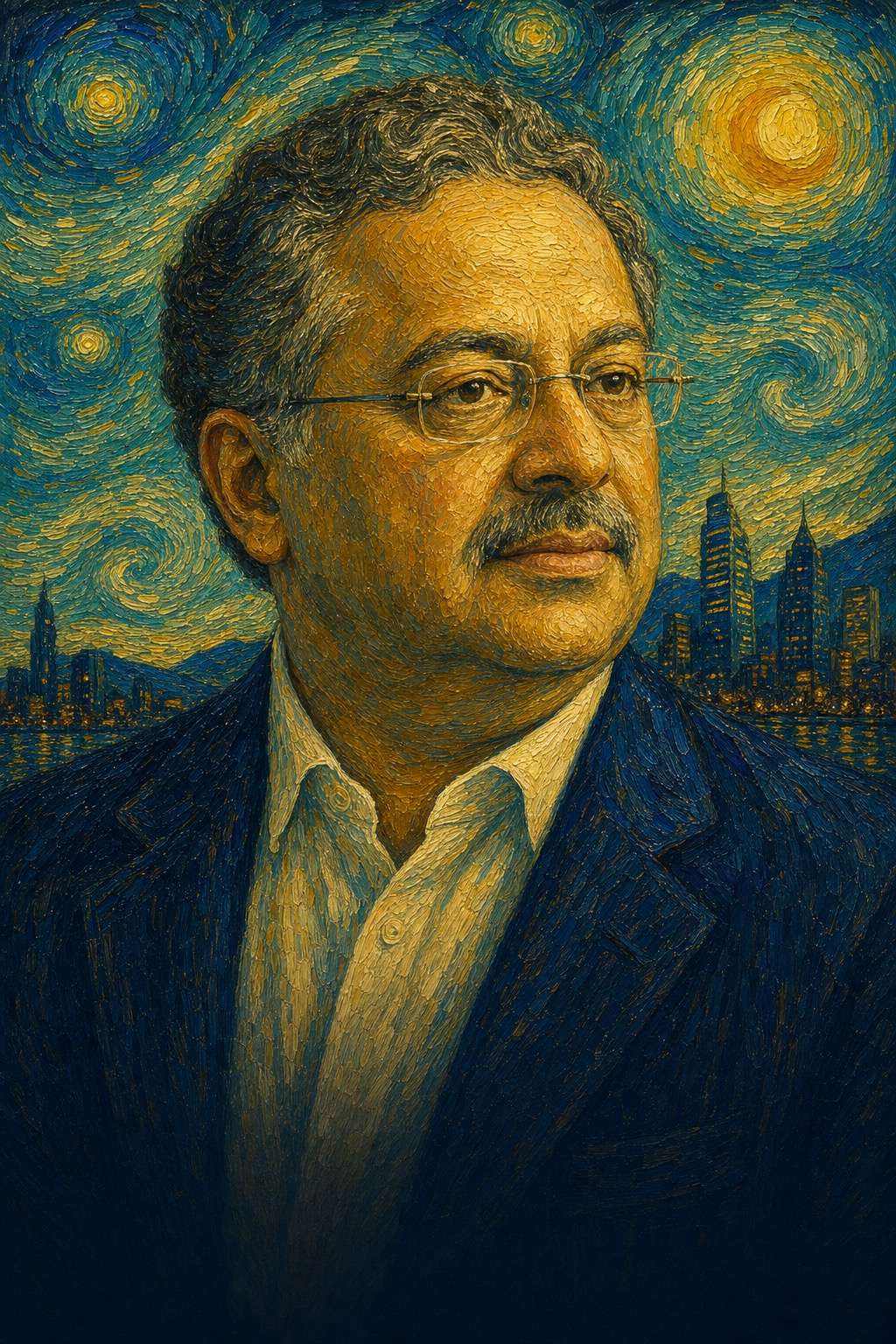
Rakesh Jhunjhunwala
Combined accounting discipline and management judgment with a structural India thesis, concentrating family capital in scalable businesses while a leverage-capable trading book exposed financing, governance, access, and regime limits.
As of 2026-08-01, Rakesh Jhunjhunwala is deceased. He died in Mumbai on 14 August 2022, aged 62. His widow, Rekha Jhunjhunwala, and the executors of his estate continue to appear in company filings, while the family has carried forward parts of his philanthropic program (Prime Minister of India, 2024). That continuing footprint should not be mistaken for an active post-2022 personal record. Nor should Rare Enterprises be described as a conventional fund manager: in a 2012 interview, Jhunjhunwala said Rare invested only his and his wife's money and that his wife was its only “client.” Public shareholding filings reveal important positions, but they do not reveal a complete portfolio, cash balances, leverage, derivatives, tax, or weighted purchase and sale prices (Reuters interview, 2012; Reuters obituary, 2022; Aptech estate filing).
Snapshot
| Field | Details |
|---|---|
| Born / died | Born 5 July 1960 in Hyderabad, India; moved to Mumbai at about age two; died 14 August 2022 in Mumbai. The exact birth date is supported here by a substantial secondary biography rather than a birth record, while his Hyderabad account is direct testimony (Indian Express biography; BCAJ interview, 2018; Reuters obituary, 2022). |
| Nationality | Indian (Reuters obituary, 2022). |
| Education | B.Com., Sydenham College; chartered accountant. In a direct 2009 interview he dated completion of the CA qualification to January 1985 (Ashoka University profile; Economic Times interview, 2009). |
| Years active | 1985-2022. This is a practical investing-career range, not a regulator-certified start date (Economic Times interview, 2009). |
| Main vehicles | Personal and family capital associated with Rare Enterprises; direct listed shareholdings; partnership and promoter holdings; private-company stakes; board and advisory roles. Rare was not presented as an outside-client fund (Reuters interview, 2012; Aptech offer document, 2005). |
| Asset classes | Predominantly Indian listed equities, plus private and pre-IPO equity and active trading exposures. Public evidence is insufficient to characterize a complete multi-asset allocation or derivatives history (BCAJ interview, 2018; Forbes profile). |
| Style tags | fundamental growth at a reasonable valuation, concentrated ownership, long holding periods, opportunistic trading, leverage, management judgment, India optimism, willingness to be contrarian. These labels combine his descriptions with observed holdings; they are not a mechanical ruleset (Reuters interview, 2012; BCAJ interview, 2018). |
| Verified track record | No audited personal return series located. A direct 2009 recollection says he began with ₹5,000 and earned ₹20-25 lakh in 1986-89 [single-source self-report]. Company filings verify selected ownership snapshots, not portfolio CAGR. A press reconstruction published on 14 August 2022 used June-quarter disclosures to value 32 stocks held by Jhunjhunwala and associates at ₹31,904.8 crore [single-source compiled estimate]. Neither endpoint supports a defensible compounded return (Economic Times interview, 2009; Economic Times portfolio snapshot, 2022). |
| Peak AUM / wealth | AUM: not applicable on the evidence found, because Rare described itself as family capital rather than an external fund. Dated wealth estimate: Forbes listed $5.8 billion on 5 April 2022 [single-source rich-list estimate]. This is not audited net asset value, and it should not be combined with the disclosed-stock snapshot as if their perimeters and dates matched (Reuters interview, 2012; Forbes profile). |
Life & Career Timeline
1960-1985 - household exposure, education, and a small starting base. Jhunjhunwala grew up in a family in which markets were discussed; his father was an income-tax official. In a 2009 direct interview, he said his father answered questions and encouraged newspaper reading but declined to provide stock-market capital. He completed his chartered-accountancy qualification in January 1985 and said he entered the market with ₹5,000. His father's employment and the family's home provided security, but that is different from an investable inheritance. The neat “₹5,000 to billions” arc is therefore directionally useful and narratively powerful, but it is not an account-level return series (Economic Times interview, 2009).
1985-1989 - trading, borrowed capital, and Sesa Goa. The early record rests heavily on later recollection. Jhunjhunwala said he persuaded family contacts to lend money on the promise of bank-deposit-like returns, used forward trading and other active trading, and made ₹20-25 lakh of profit between 1986 and 1989. He also recalled Tata Power helping take net worth to ₹50-55 lakh and a four-lakh-share forward position in Sesa Goa worth about ₹1 crore, parts of which he sold into large price increases. These figures are material because they show that leverage, trading, and access to financing preceded the celebrated long-term holdings. They remain [single-source self-report]: no broker statements, financing schedules, contemporaneous portfolio values, or tax records were located (Economic Times interview, 2009).
1990s-early 2000s - from trader to owner. Jhunjhunwala continued to trade around a growing investment book rather than converting into a pure buy-and-hold investor. Later interviews emphasize that trading generated capital and sharpened judgment while investments created most wealth. That separation is analytically important: a leveraged trading book can alter liquidity and drawdown risk even if the visible long book contains durable compounders. The public record does not permit attribution between trading profits, long-only appreciation, new capital, dividends, private deals, or taxes. His recurring optimism about India's development became a central part of the thesis, but the 1990s liberalization and subsequent domestic equity expansion were also powerful regime tailwinds (Reuters interview, 2012; BCAJ interview, 2018).
2002-2012 - Titan turns a holding into a public calling card. The strongest long-duration evidence is a sequence of issuer filings, not a remembered anecdote. Titan's 2004-05 annual report listed Rakesh with 1,959,750 shares, or 4.64%, and Rekha with 796,000 shares, or 1.88%, at 31 March 2005. The 2011-12 report, after stock splits and other capital changes, listed 66,629,100 shares, or 7.51%, for Rakesh and 22,116,120, or 2.49%, for Rekha. These snapshots verify scale and persistence. They do not disclose the initial purchase date, weighted basis, interim trades, dividends, financing, or realized profit, so a precise “Titan return” would exceed the evidence (Titan annual report, 2004-05; Titan annual report, 2011-12).
2005-2016 - investor, promoter, and director roles converge. His activity was not confined to passive minority stakes. A 2005 SEBI-filed Aptech offer document records Aptech Investments, a partnership constituted in July 2005, as acquirer in an offer at ₹67.50 a share. It also maps overlapping interests among Jhunjhunwala, Rekha, Rare, and Marganta Textiles. Aptech later described him as promoter and non-executive chairman. Its 2021-22 governance report records one meeting attended before he resigned from the board on 29 April 2021, after which he remained Chief Mentor. The combination of capital, board access, influence, and sometimes control can improve information flow and governance engagement, but makes comparison with a small outside shareholder imperfect (Aptech offer document, 2005; Aptech governance report, 2021-22).
2016-2021 - enforcement exposure and expansion into newer businesses. A 2018 SEBI order separately settled an adjudication concerning an alleged Geometric shareholding-disclosure violation; Jhunjhunwala paid ₹248,872, and the order disposed of the proceeding without a merits adjudication. SEBI's July 2021 settlement order concerned alleged insider trading in Aptech around information about its preschool business during 2016. It says the proceedings were settled without admission or denial of findings and records, for Jhunjhunwala, ₹9,50,85,704 as the settlement amount, ₹5,86,79,870 of disgorgement, and ₹3,10,79,431 of interest—₹18,48,45,005 in total [raw sum]. The order disposed of the specified proceedings while reserving SEBI's rights under stated conditions; it was not a criminal conviction. Separately, the 2005 Aptech offer document disclosed that proceedings under section 11B had been initiated against Jhunjhunwala and Rare. The bounded search did not locate a disposition for that older matter, so it is reported as unresolved rather than conflated with either settlement (SEBI Geometric settlement order, 2018; SEBI Aptech settlement order, 2021; Aptech offer document, 2005).
A 2025 Securities Appellate Tribunal judgment set aside a later SEBI order against Lashit and Neha Sanghvi after finding their access to the Aptech information unproved. The appellants were not Jhunjhunwala or his estate, and the judgment notes that Jhunjhunwala and family members had settled separately. It therefore did not overturn, reopen, convict, or exonerate Jhunjhunwala under the 2021 settlement (SAT judgment, 2025).
During the same period, the visible portfolio widened beyond mature listed holdings. Star Health's prospectus named Jhunjhunwala as a promoter; Metro Brands disclosed that Jhunjhunwala, relatives, and trusts held 14.50% and that he had agreed to provide advisory services for ₹1 per year for five years. Nazara Technologies reported his 3,294,310 shares as 10.10% at 31 March 2022. These positions show an ability to operate across private, promoter, and newly public settings. They also embed access, governance rights, lockups, illiquidity, and deal terms that a screen-based investor cannot automatically reproduce (Star Health prospectus, 2021; Metro Brands annual report, 2021-22; Nazara Technologies annual report, 2021-22).
2022 - concentration, aviation, and death. A press compilation published on 14 August used June-quarter disclosures to value 32 stocks held by Jhunjhunwala and associates at ₹31,904.8 crore [single-source]. Titan, Star Health, and Metro Brands accounted for ₹11,086.9 crore, ₹7,017.5 crore, and ₹3,348.8 crore respectively. Their sum, ₹21,453.2 crore, was 67.24% of the reported total [raw arithmetic]. The snapshot demonstrates concentration but omits undisclosed stakes, private assets, debt, cash, derivatives, and differences among family owners. Forbes separately estimated net worth at $5.8 billion on 5 April [single-source]. Jhunjhunwala was a founding financial backer of Akasa Air, which began operations shortly before his death. He died on 14 August 2022; a family statement reported through Reuters confirmed the death (Economic Times portfolio snapshot, 2022; Forbes profile; Reuters obituary, 2022).
2022-2026 - estate, succession, and public legacy. Rare stated after his death that a transition plan had been prepared, but a press-reported statement is not a full succession agreement. Later Aptech filings identify Rare as a partnership of Rekha and the estate and describe executor, trustee, and family relationships. Titan's 2022-23 filing listed Rekha with 46,945,970 shares, or 5.29%, at 31 March 2023. A Star Health filing for 31 March 2025 still listed 82,882,958 shares under “Late Rakesh Jhunjhunwala,” with Rekha identified as nominee and no encumbrance shown. These are estate and nominee records, not evidence that Rakesh made posthumous investment decisions (Rare transition report; Aptech estate filing; Titan filing, 2022-23; Star Health shareholding filing, 2025).
The Government of India awarded him a posthumous Padma Shri in 2023 for trade and industry. Ashoka University has held a memorial lecture and bears institutional traces of his support. In 2024, India's prime minister publicly credited the family with continuing the RJ Sankara Eye Hospital project and described Rekha's involvement. These sources establish an ongoing public and philanthropic legacy; they do not establish the size, legal terms, or investment performance of the estate (Padma Awards Gazette, 2023; Ashoka memorial lecture; Prime Minister of India, 2024).
Vehicles & Structure
Rare Enterprises is best understood as a family investment office and brand, not a mutual fund, hedge fund, or separately managed account business. In 2012 Jhunjhunwala described its capital as belonging to him and Rekha and said it had about a dozen employees. The name combined their first names. That structure relieved him of daily external redemptions and conventional client reporting, but public evidence does not prove that every asset or liability sat inside one legal entity. “Rare portfolio,” “Jhunjhunwala family holdings,” and securities registered personally to Rakesh or Rekha may overlap without being identical (Reuters interview, 2012; Forbes profile).
The ownership map was varied. Large listed stakes were registered to family members; promoter interests could run through partnerships and companies; private and pre-IPO deals had contractual rights; and Jhunjhunwala could sit on boards or advise issuers. The 2005 Aptech offer document is unusually useful because it shows Rare itself as a partnership of Rakesh and Rekha, while another acquiring entity and Marganta created additional layers. The contemporary estate filing shows that these arrangements evolved after death. A single number scraped from exchange filings therefore should not be labeled firm AUM (Aptech offer document, 2005; Aptech estate filing).
The capital base also enabled two modes to coexist. The investment book could hold concentrated positions for many years, while the trading book supplied liquidity, expressed shorter-term views, and used leverage. Jhunjhunwala explicitly defended leverage in 2012, subject to an ability to service it. This arrangement can turn market volatility into opportunity when financing remains available, but it also creates path dependence that end-of-quarter shareholding disclosures cannot show. There is no complete public schedule of gross exposure, margin requirements, financing counterparties, or worst drawdown (Reuters interview, 2012; BCAJ interview, 2018).
Track Record Detail and Caveats
There is strong evidence that Jhunjhunwala became extraordinarily wealthy through markets and company ownership. There is weak evidence for a conventional performance statistic. The starting-capital and early-profit figures come from his retrospective account. The later $5.8 billion figure is a rich-list estimate. Between them lie family ownership changes, borrowing, trading, private investments, dividends, consumption, philanthropy, and taxes. Computing CAGR from ₹5,000 in 1985 to a 2022 household wealth estimate would falsely treat the endpoints as comparable audited NAVs and assume no flows. This profile declines to do so (Economic Times interview, 2009; Forbes profile).
Titan provides the cleanest persistence test. Official filings show substantial family ownership in 2005, greater split-adjusted share counts in 2012, and a large Rekha holding after Rakesh's death. That is consistent with long-horizon conviction and an exceptional winner. It does not identify every purchase and sale or permit a money-weighted return. Similar point-in-time evidence for Star Health, Metro, and Nazara demonstrates scale and influence near 2022, while the three-position concentration in the press-compiled listed portfolio reveals how much outcome depended on a small number of holdings (Titan annual report, 2004-05; Titan annual report, 2011-12; Economic Times portfolio snapshot, 2022).
Benchmarking is impossible from the located record. There is no daily or monthly NAV series, no stable capital base, no audited composite, and no verified account of closed positions. The available sources overrepresent investments that became large enough to cross disclosure thresholds and stories Jhunjhunwala chose to retell. They underrepresent small losses, hedges, derivatives, short positions, and failed private deals. The correct result is therefore “not disclosed,” not a precise Sharpe ratio, hit rate, alpha, or maximum drawdown (Reuters interview, 2012; Economic Times interview, 2009; Economic Times portfolio snapshot, 2022).
Luck and skill are inseparable here, but not indistinguishable. Evidence consistent with skill includes obtaining financing from a small base, retaining exposure to Titan through long compounding, moving between trading and ownership, backing management teams, and using promoter or board positions to influence outcomes. Counterweights include a historic Indian bull market, survivorship in public anecdotes, concentrated exposure to a few winners, leverage, privileged deal access, governance rights unavailable to ordinary investors, and the absence of a full loss ledger. Jhunjhunwala himself said in 2009 that the Sensex's rise from roughly 150 to 17,500 had been among the largest contributors to his wealth [single-source self-assessment]. The 2021 Aptech settlement is also relevant to an assessment of process and conduct even though it was explicitly without admission or denial. A credible profile can admire the result without turning wealth into proof of audited risk-adjusted alpha (Economic Times interview, 2009; BCAJ interview, 2018; SEBI Aptech settlement order, 2021).
Why He Matters
Jhunjhunwala matters first because he joined two investing traditions that are often presented as opposites: aggressive trading to create and recycle capital, and patient ownership of a small number of operating businesses. The early Sesa Goa story and the long Titan record are not interchangeable. Together they show a career in which liquidity generation, financing, judgment of management, and the willingness to sit through volatility interacted (Economic Times interview, 2009; Titan annual report, 2004-05; Titan annual report, 2011-12).
Second, he became a highly visible expression of the India thesis. His public optimism was not merely macro commentary; it was implemented in consumer, education, health-insurance, footwear, gaming, and aviation businesses. The timing benefited from India's economic and capital-market development, but his willingness to concentrate ensured that selection mattered greatly. His example consequently teaches both the power and danger of allowing a winner to dominate household wealth (BCAJ interview, 2018; Aptech offer document, 2005; Star Health prospectus, 2021; Metro Brands annual report, 2021-22; Nazara Technologies annual report, 2021-22; Reuters obituary, 2022).
Third, his record exposes a recurring problem in investor biography. Shareholding disclosures can prove ownership; annual reports can prove governance roles; settlement orders can prove legal disposition; and rich lists can estimate wealth. None of them alone supplies fund performance. Treating Rare as a hedge fund and its founder's wealth as AUM erases the very structural advantage that made his strategy distinctive: family capital with no ordinary outside-client redemption cycle (Reuters interview, 2012; Forbes profile).
Finally, his transition from investor to promoter, director, and philanthropist widened the scope of capital allocation. It also made attribution harder. Star Health, Metro, Aptech, and Akasa involved institution building and access, not simply buying liquid shares. The posthumous continuation of estate holdings and philanthropy suggests deliberate succession planning, but the public documents do not reveal a complete mandate, governance constitution, or performance objective (Star Health prospectus, 2021; Rare transition report; Prime Minister of India, 2024).
Open Questions
- Can surviving broker, tax, or partnership records establish a continuous, net-of-fee and net-of-flow return series for any defined Jhunjhunwala account?
- What were the trading book's gross and net exposures, financing terms, margin calls, realized losses, and maximum drawdown across 1992, 2000, 2008, 2020, and other stress periods?
- How much of household wealth came from listed appreciation, active trading, private transactions, dividends, promoter economics, or new external borrowing?
- What was the final disposition of the section 11B proceedings disclosed in the 2005 Aptech offer document, and was it legally or factually connected to any later matter?
- What were the exact lot histories, split adjustments, dividends, pledges, and realized proceeds for Titan, Sesa Goa, Star Health, Metro Brands, Nazara, and Aptech?
- Which investment and governance decisions were made by Jhunjhunwala individually, by Rekha, by Rare employees, or with company boards and co-investors?
- What binding decision rights, liquidity rules, and succession provisions govern Rare, the estate, trusts, and nominee-held securities after 2022?
- Which losing and sub-disclosure positions are absent from the public winner narrative, and how would their inclusion change hit rate and risk-adjusted attribution?
The evidentiary boundary is the main conclusion: Rakesh Jhunjhunwala was a demonstrably consequential owner and an exceptionally wealthy market participant, but the public record located through 18 July 2026 does not support a fund-like personal return series. The durable lesson is not a mythical CAGR. It is the interaction of family capital, leverage, trading skill, concentrated ownership, access, management judgment, and an unusually favorable national growth regime—along with the governance and measurement risks those advantages created (Reuters interview, 2012; Economic Times interview, 2009; Titan annual report, 2004-05; Titan annual report, 2011-12; SEBI Aptech settlement order, 2021).
As of 2026-07-18, Rakesh Jhunjhunwala is deceased. This chapter reconstructs his philosophy from a first-person essay originally published in 2002, interviews, speeches, an early investor-conference transcript, company filings, and regulatory records. No shareholder-letter series, formal signed rulebook, complete trading ledger, audited personal return series, or fixed position-sizing policy was located. His interviews were often edited, sometimes promotional, and occasionally inconsistent; the recurring decision logic matters more than any isolated maxim.
Core worldview
Jhunjhunwala's starting point was ownership of India's economic expansion. He treated equities as claims on businesses that could compound alongside urbanization, rising consumption, financial deepening, and entrepreneurship. That secular optimism was not a claim that every Indian share or every price was attractive. He repeatedly separated the size of an opportunity from the ability of a particular company to capture it, and the quality of a company from the price paid for it (BCAJ, 2018; Economic Times, 2018).
His most stable business framework had four linked questions. Is the addressable opportunity large? Does the company have a defensible competitive ability? Can it scale without consuming disproportionate working capital or fixed capital? Is management capable and honest? The FLAME repository independently summarizes substantially the same opportunity-advantage-scalability-integrity sequence, while its lecture deck adds risk, discipline, flexibility, buy price, conviction, patience, and an exit decision independent of the investor's profit or loss (FLAME Investment Lab, n.d.; FLAME Investment Lab, 2009). The deck is institutional presentation material, not a signed personal constitution; one slide explicitly records associate Utpal Sheth's observations and should not be flattened into Jhunjhunwala's first-person testimony.
Price was the bridge between a good business and a good investment. In his 2002 essay he decomposed price into earnings per share and the multiple placed on those earnings, then directed attention to accounting policy, the cash quality and predictability of profit, return on capital, business economics, and the forces that could sustain the multiple (Man's World, 2002/2022). In 2018 he called the price-value relationship the critical issue and said what price could matter more than what company. Yet he did not define value as a permanently low multiple. Titan could remain expensive because brands, cash generation, return on equity, entry barriers, and growth raised its future worth (Economic Times, 2011). The philosophy was therefore neither mechanical deep value nor growth at any price. It was growth in economic value bought at a price that left a favorable, necessarily uncertain, risk-reward relationship.
He also acknowledged three forces that a tidy investment doctrine can obscure: regime, luck, and temperament. He credited his accounting training and curiosity, but also India's post-1991 setting, family influences, and fortune. He said learning never ends and rejected subjugating one's mind to a teacher or a fixed doctrine because markets change (BCAJ, 2018). This makes the philosophy best understood as experienced judgment inside a recurring framework, not an algorithm.
The edge - what he believed markets misprice and why
One recurring opportunity in the cited examples was mispriced duration: investors extrapolated current difficulty too far, demanded immediate proof, or failed to imagine how a scalable business could look after many years. This is a reconstruction rather than a ranked claim about his most common edge. His early Capital Ideas conference contribution emphasized large opportunities, ignored areas, and conditional contrarianism: an unpopular position was useful only when supported by analysis, not because disagreement itself was virtuous (FLAME Investment Lab, 2000).
A second source of mispricing was the gap between a reported business and its economic runway. The investor had to test market size, entry barriers, unit economics, reinvestment needs, management ambition, and whether reported growth could persist. His 2019 diagnosis of the mid-cap boom is particularly adverse evidence: investors, including him, had taken two years of profit growth and projected it over twenty without sufficiently testing demand, competitive barriers, margins, or the business model. He described success as temporary and something to hold with paranoia (Economic Times, 2019).
A third edge was qualitative judgment about people. Accounts could establish what a company had done; meetings could test what promoters wanted to do, how they treated minority owners, and whether their behavior matched their claims. He watched whether management traded its own shares and tried to infer attitude and purpose (BCAJ, 2018). This was potentially valuable in promoter-led Indian companies, but it was also fallible and difficult to reproduce. His later admissions about Bilcare, A2Z Maintenance, and Geometric show that perceived entrepreneur quality could be wrong (Moneycontrol, 2013).
The edge was not secret information. He said prices themselves convey information, warned that tips are hazardous, and argued that an investor cannot make money on borrowed knowledge (Outlook Business, 2015). Nor was it a simple India-beta claim. India's long expansion supplied the opportunity set, while selection, valuation, patience, access to management, and the financial ability to withstand error determined whether an investor captured it.
Process
Idea sourcing
Ideas came from reading, company observation, business contacts, market prices, presentations, and people in his network. In private investments, he said companies usually approached him; his team, including Rupal Bhansali and Amit Goela, also contributed, and the Zydus animal-health consortium was led by Renuka Ramnath rather than sourced solely by Jhunjhunwala (Moneycontrol, 2021). This record cautions against rewriting a team or partner idea as lone-genius discovery.
He did not begin with a rigid large-cap, mid-cap, or sector bucket. In 2011 he said his sector exposures had arisen largely by accident, and he preferred evaluating an opportunity on its economics rather than forcing it into a top-down allocation (Economic Times, 2011). The result was opportunistic but not random: large runway, a business able to capture it, and an intelligible path from investment to cash generation.
Research and management judgment
His stated research discipline was to read, observe, analyze, understand accounts, keep an open mind, and form an independent opinion. Chartered-accountancy training helped him interrogate balance sheets; curiosity drove the broader search. The 2002 essay explicitly tests whether reported profit is backed by cash, whether accounting choices flatter earnings, whether the business earns attractive returns on capital, and whether profit is predictable (Man's World, 2002/2022). Management analysis included competence, integrity, capital allocation, ambition, and treatment of shareholders (BCAJ, 2018). He sometimes avoided sectors or companies exposed to controversy or government discretion because unknown political and regulatory risks could overwhelm business analysis.
This was not always exhaustive research in the institutional sense. In 2012 he said some of his best investments followed very little research and that a presentation could lead to a decision within half an hour; in 2018 he described decisions within an hour and warned against overanalysis (Economic Times, 2012; Economic Times, 2018). The defensible reading is rapid synthesis built on accumulated pattern recognition, not an evidence-free hunch and not a replicable thirty-minute shortcut for beginners. Indeed, he advised nonprofessionals to use systematic investment plans or mutual funds because serious security selection required continuing attention.
Valuation and entry
No single public valuation formula survives the sources. Jhunjhunwala used different anchors for different businesses: earnings multiples and normalized earnings; book value or net asset value for asset-backed businesses; return on equity and cash conversion for compounders; rental income and debt for real estate; and EBITDA comparisons in a private animal-health transaction. A 2012 real-estate example combined stable assets, moderate debt, rental income, and a claimed price near one-third of estimated real value (Economic Times, 2012). In 2021 he compared animal-health transaction multiples with generic pharma, but that was a deal-specific direct account rather than a general valuation rule (Moneycontrol, 2021).
Entry depended on value plus available liquidity, not certainty. He acknowledged that one is uncertain when buying and that precise market timing is exceptionally hard. He invested across stages rather than waiting for a perfect bottom (Outlook Business, 2015). His warnings about extreme mid-cap multiples and richly marketed initial offerings show the negative screen: a plausible future did not justify any price (Economic Times, 2018; Economic Times, 2016).
Sizing
No stable percentage sizing policy was found. FLAME's report of his 2009 question-and-answer session describes gradual commitment in a CRISIL example and records his own distinction between a methodology and a fixed philosophy (FLAME Investment Lab, 2010). A 2015 interview says he initially put no more than 2-3% of wealth into an investment “at a time” [single-source], apparently describing staged commitment rather than a lifetime cap (Outlook Business, 2015). That cannot be reconciled into a universal rule with his own concentrated snapshots: in 2012 he said his top three holdings were roughly 50-55% of the portfolio and that he owned about 15-20 names [single-source] (Economic Times, 2012). In 2018 he described five listed holdings as about 60% of that book and three unlisted holdings as about 80% of the unlisted book [single-source] (Economic Times, 2018).
Company records establish persistent issuer ownership, not portfolio weight. Titan's annual reports disclose his ownership in 2004-05 and later disclose both Rakesh and Rekha Jhunjhunwala among shareholders holding more than 1% in 2011-12 (Titan, 2005; Titan, 2012). They do not reveal his total wealth, entry cost, hedges, or full household exposure. The interview snapshots, rather than the issuer filings, support the portfolio-concentration finding. Together the sources suggest starting smaller while uncertainty is high and allowing conviction and evidence to create concentration, but they do not supply a reproducible maximum-position rule.
Portfolio construction
He separated trading capital from long-term ownership. In 2015 he said Rare Enterprises conducted trading while longer-term investments were held personally or in his wife's name; he traded liquid securities with attention to momentum, leverage, and humility, and said he did not trade around investment holdings (Outlook Business, 2015). His 2000 conference comments made the same conceptual distinction: he could trade many things he would not own as investments (FLAME Investment Lab, 2000).
The investment book was relatively concentrated and often illiquid, with listed compounders, asset-backed opportunities, and later private-company stakes. Scale narrowed his feasible universe: minimum meaningful positions became large, liquidity constrained entry and exit, and promoter access could create opportunities unavailable to ordinary investors. The visible listed portfolio was also incomplete. A 2022 press reconstruction identified 32 public holdings worth roughly Rs 32,000 crore [single-source, partial snapshot], not an audited household balance sheet (Economic Times, 2022). His reported equity exposure could also exceed net worth: in 2010 he answered “200-300%” when asked if fully invested [single-source self-report], making borrowing central to any honest description of construction at that date (Economic Times, 2010).
Sell discipline
His clearest sell rule had three branches: earnings have peaked, the valuation multiple has peaked, or another opportunity offers better prospective return. Otherwise, growth and rising intrinsic value were reasons to hold rather than to sell merely because a stock had appreciated (Business Today, 2021). Other interviews add permanent impairment of the thesis, a need to reduce leverage, and extreme overvaluation.
This was a forward-looking comparison, not a profit target. In 2011 he rejected selling solely in the hope of buying back 20% cheaper and said exit value and time both change (Economic Times, 2011). By late 2012 he said he had become faster to leave after recognizing an error, whereas earlier he procrastinated (Economic Times, 2012). His regret over not selling more Lupin near its peak shows the opposite error: long holding can preserve a compounder or leave a large cyclical drawdown untrimmed, and the rule did not mechanically distinguish them (Economic Times, 2019).
Risk management
Across the record, his risk practice can be reconstructed around permanent loss caused by a wrong business, wrong people, excessive price, leverage, illiquidity, or an inability to wait; this six-part taxonomy is the Canon's synthesis, not his published definition (Man's World, 2002/2022; BCAJ, 2018; Outlook Business, 2015; Economic Times, 2010). He accepted mistakes if they were affordable and treated error as tuition rather than evidence that all risk should be avoided. His rapid-fire advice emphasized humility and admitting mistakes (Moneycontrol, 2017).
Leverage complicates the doctrine. He was an explicit advocate of leverage in a Reuters interview and described substantial early forward-market borrowing (Reuters, 2012; Economic Times, 2009). His 2010 claim of 200-300% equity exposure is much more aggressive than conventional capital-safety language (Economic Times, 2010). In 2019 he said debt was normally about 5% but had reached at least 40% in 2001-03 for a Great Eastern Shipping opportunity [single-source self-report] (Economic Times, 2019). In 2021 he said debt was at its highest and he did not want more (Moneycontrol, 2021). These are time-specific personal disclosures, not a safe leverage prescription, and the different denominators cannot be reconciled into a continuous series.
No public stop-loss system, maximum drawdown limit, correlation budget, stress-test procedure, or fixed leverage ceiling was located. FLAME's 2009-10 materials include capital safety, asset allocation, risk, and discipline, but those principles do not amount to disclosed quantitative limits (FLAME Investment Lab, 2010). Practical controls were compartmentalization, liquidity awareness, staged commitment, valuation discipline, business quality, and sufficient financial and emotional capacity to survive being early. The missing formal limits matter because concentration and borrowing can turn a correct long-term thesis into a forced short-term exit.
Temperament & psychology
The desired temperament combined conviction with corrigibility. Jhunjhunwala could sound dogmatic about India's future or a business thesis, yet he repeatedly said the market is supreme, that one must accept defeat, and that knowledge has no final destination. Conviction allowed him to hold an unpopular position; humility required revisiting the original reasoning when evidence changed (BCAJ, 2018; Outlook Business, 2015).
He regarded patience as active endurance, not inactivity. A holder had to tolerate uncertainty, volatility, boredom, and being publicly wrong while monitoring whether the business—not merely the quote—had deteriorated (BCAJ, 2018; Outlook Business, 2015). At the same time, his trading background made him attentive to trend, liquidity, and crowd behavior. The investment temperament and trading temperament were deliberately housed in separate compartments (Economic Times, 2010; Reuters, 2012).
Luck was part of his self-explanation. He credited the Indian regime, timing, and fortune alongside curiosity and judgment; he described himself as financially lucky during the pandemic (Moneycontrol, 2021). This is a useful check on survivor narratives: without an audited full record, neither admirers nor critics can reliably allocate his wealth among skill, leverage, concentration, access, and a historic national bull market.
Evolution over career
The early career was trading-led and highly leveraged. Jhunjhunwala described borrowing money, using the forward market, and learning through price action, while gradually converting gains into longer-duration ownership (Economic Times, 2009). By 2000, his public framework already separated trading from investing and emphasized opportunity, neglect, and conditional contrarianism (FLAME Investment Lab, 2000).
During the 2000s and early 2010s, long-term compounders and concentrated ownership became the public signature. Titan illustrates the shift, although annual reports prove holdings rather than his complete thesis or return. His 2011 and 2012 interviews show flexible valuation, an 18-24% long-term compounding aspiration rather than a verified record, and increasing awareness that scale and liquidity constrained construction (Economic Times, 2011; Economic Times, 2012).
By 2012 he described faster error correction; by 2018 he articulated a more compact business checklist and publicly directed ordinary savers toward professional vehicles. The 2018-19 mid-cap reversal then supplied an explicit lesson against extrapolation. By 2021, private businesses, consortiums, and promoter roles had become more visible, while his skepticism of immature, cash-burning technology coexisted with a long-held Nazara investment. The philosophy evolved by adding exceptions and sharper failure tests rather than by abandoning its core.
What he explicitly rejected
He rejected tips, borrowed conviction, and imitation. His own scale, access, time horizon, and tolerance for risk made copying his visible holdings especially hazardous. He rejected precise market timing as a dependable investment process, trading an investment thesis merely to exploit short moves, and selling a growing business only because its share price had risen (Outlook Business, 2015).
He rejected unexamined popularity: extreme mid-cap valuations, aggressively sold new issues, and earnings forecasts that converted a brief boom into decades of assumed growth. He was skeptical of businesses he could not understand, especially immature technology ventures requiring prolonged losses and intensive oversight, but Nazara shows this was not a timeless ban on technology (Moneycontrol, 2021). He also avoided some businesses exposed to government controversy, yet his views on sectors such as real estate changed with debt, cash flow, assets, and price. The rejections were conditional screens, not theological exclusions.
Regimes where it thrives vs. struggles
The philosophy should thrive when economic growth broadens the opportunity set; quality businesses can reinvest at high returns; public markets underappreciate duration; temporary fear creates liquidity; and family capital can wait without redemptions. It is particularly suited to promoter-led, underfollowed, scalable companies where accounting literacy and judgment about people add value. Concentration magnifies the benefit when a long runway, sound management, and a reasonable entry price coincide.
It should struggle when abundant liquidity pushes narratives beyond plausible economics; a short profit cycle is mistaken for a durable moat; leverage meets a market or credit shock; regulation or promoter conduct invalidates qualitative trust; or an illiquid position cannot be exited. It can also struggle in stagnant markets where India-wide growth no longer rescues selection errors, and in rapid technological transitions that punish a self-declared circle of competence. A concentrated family account has no outside redemptions, but it still faces household liquidity, financing, governance, and key-person risk.
Tensions between stated philosophy and actual behavior
First, independence and humility coexisted with forceful certainty. The intellectually useful synthesis is strong prior conviction plus willingness to update; the danger is that “the market is right” becomes a retrospective explanation only after losses (BCAJ, 2018; Outlook Business, 2015).
Second, he called investing complex enough to require professional monitoring but described major decisions taking 30-60 minutes (Economic Times, 2012; Economic Times, 2018). The detailed 2002 accounting checklist shows that “common sense” did not mean ignoring accounts (Man's World, 2002/2022). Long experience may permit rapid synthesis, but the public record does not turn that intuition into a teachable, falsifiable research protocol.
Relatedly, the official 2009 deck presents commandments and an exit checklist, while the 2010 newsletter records his insistence that he had a methodology rather than a fixed philosophy (FLAME Investment Lab, 2009; FLAME Investment Lab, 2010). The sensible reconciliation is a flexible framework, not evidence of a mechanical implementation system.
Third, the affordable-mistake principle sat beside substantial concentration and episodic leverage. His interview snapshots establish portfolio concentration, while Titan filings establish persistent issuer ownership rather than portfolio weight (Economic Times, 2012; Titan, 2005; Titan, 2012). Self-reported leverage episodes show that an error could have become more than tuition; no documented hard ceiling closes that gap (Economic Times, 2010; Economic Times, 2019).
Fourth, patience competed with sell discipline. He warned against interrupting compounding, regretted not selling more Lupin near its peak, and later said he had learned to exit mistakes faster (Economic Times, 2011; Economic Times, 2012; Economic Times, 2019). The correct action depends on distinguishing volatility from impairment—a judgment, not a formula.
Fifth, management integrity was central, yet he admitted mistakes in judging entrepreneurs. A 2021 Securities and Exchange Board of India order records settlement of alleged Aptech insider-trading violations without admission or denial of findings (SEBI, 2021). That is a legal and governance tension, not proof that his investment results were fabricated; it does show why promoter access and integrity claims require adverse evidence rather than reverence.
Finally, his success is not cleanly portable. He invested family capital, could use trading gains and leverage, accessed promoters and private transactions, held concentrated and illiquid positions, and operated during an exceptional period for Indian equities (Reuters, 2012; Economic Times, 2010; Moneycontrol, 2021). With no audited personal series, the honest conclusion is bounded: the record supports a coherent opportunity-advantage-scalability-integrity framework, adaptive valuation, patience, and independent judgment; it does not establish a reproducible formula or isolate skill from luck, regime, access, leverage, and survivorship.
As of 2026-07-18, no audited personal return series, complete Rare Enterprises ledger, tax record, or continuous household portfolio has been located. Jhunjhunwala invested family capital through several names and vehicles, traded as well as invested, borrowed at times, and accumulated or reduced positions over years. Issuer filings prove ownership on reporting dates; interviews provide cost, thesis, and result stories; neither alone establishes a complete trade-level return.
Executive finding
Titan is the single best-documented long-duration holding, because first-person interviews describe the thesis and adverse path, company filings establish large household ownership over many years, and a contemporaneous reconstruction documents a substantial partial sale. It is not called his highest verified return: adjusted and unadjusted price narratives are often mixed, the weighted basis and all purchases, sales, dividends, financing, taxes, and corporate actions are unavailable, and a large stake remained when he died.
The seven cases below are ranked by combined economic importance, explanatory value, and documentability—not by a fabricated league table of profit. A simple endpoint multiple is shown only when the same source supplies a stated cost and later value or sale price. Such arithmetic is not an internal rate of return and excludes dividends, financing, taxes, fees, interim transactions, and corporate actions unless stated otherwise.
Evidence key and ranking
| Rank | Case | Best-supported result | Evidence boundary |
|---|---|---|---|
| 1 | Titan, 2002/03 onward | Large multi-decade compounder; about Rs 1,092.76 crore reconstructed proceeds from a 2018 partial sale | Holdings and sale are documented; complete basis and lifetime P&L are not |
| 2 | Sesa Goa, 1988–1992 | Bulk allegedly sold near Rs 60 from Rs 27–28; tail allegedly sold at Rs 2,200 | First-person quantities conflict: 4 lakh, 5 lakh, and at least 10 lakh [disputed] |
| 3 | Great Eastern Shipping, 2002/04–2006/07 | Rs 25 to Rs 150, or 6x gross endpoint [single-source self-report] | Quantity, borrowing, dividends, and sale price come chiefly from one retrospective |
| 4 | Lupin, roughly 2003 onward | Major long-run compounder with partial sales; cost and peak claims are self-reported | Filing snapshots exist, but no complete basis, sale ledger, or lifetime P&L |
| 5 | CRISIL, 2001/02 onward | Rs 29.8375 crore implied tender proceeds versus later Rs 27 crore recollection [disputed] | Retained household ownership means no final exit |
| 6 | Metro Brands, 2007 onward | Rs 30.35 crore documented cost became a 39,333,600-share family block marked at Rs 1,966.68 crore at the IPO price | Primary records reconcile to 64.8x gross mark, but it was not realized |
| 7 | Nazara Technologies, 2017–2025 | Pre-IPO stake listed in 2021; family/estate exit completed in 2025 | Jhunjhunwala did not make the final exit; conflicting investment-cost descriptions remain |
1. Titan: the single best-documented long-duration holding
Context & dates
Jhunjhunwala began buying Titan in 2002–03, when watches dominated the public identity of a leveraged company and the jewellery opportunity was not yet reflected in its scale. A 2004–05 annual report lists Rakesh with 1,959,750 shares (4.64%) and Rekha with 796,000 (1.88%) at March 31, 2005. By March 31, 2012, the report lists 66,629,100 shares (7.51%) for Rakesh and 22,116,120 (2.49%) for Rekha after intervening capital actions (Titan, 2005; Titan, 2012). These are issuer stakes, not percentages of household wealth.
Thesis & how he found it
The origin story is not a pure research triumph. Friend Ramesh Damani recalled that a broker offered a block in 2003; Jhunjhunwala took the smallest proposed lot, then studied the company and added toward roughly 5% (Moneycontrol, 2022). Jhunjhunwala's later thesis emphasized an underpenetrated watch market, a far larger jewellery market, brands, distribution, cash generation, return on equity, and a runway for organized retail (Forbes India, 2014). Chance supplied the first look; repeated additions and continued monitoring made it a conviction investment.
Size & structure
Damani recalled a first lot of 10 lakh shares at Rs 40, with larger lots offered at lower prices [associate testimony]. Jhunjhunwala later gave an average entry near Rs 5 in an adjusted-price narrative [self-report]. Those figures are not directly comparable without a full capital-action bridge. The issuer filings are firmer on dated ownership, and a 2007 report citing a BSE disclosure put the persons-acting-in-concert holding at 10.045% after a 50,000-share purchase (Business Standard, 2007). No reliable initial or maximum percentage of total household capital is public.
Entry and the path — including drawdown endured
In 2014 Jhunjhunwala said an adjusted price rose from about Rs 5 to Rs 80 and then fell to Rs 30; he estimated the decline erased Rs 300 crore of paper value but said he did not sell because neither earnings nor the multiple had peaked and growth remained [single-source self-report] (Forbes India, 2014). This is evidence of a large adverse mark, not a verified maximum drawdown. Purchases at different dates and capital changes prevent conversion into a portfolio drawdown percentage.
Exit & P&L
An official 2018 disclosure records 12.5 million shares sold from May 22 through June 28 and the persons-acting-in-concert stake falling from 8.7803% to 7.3723% (Titan SAST filing, 2018). Fortune estimated proceeds at Rs 1,092.76 crore, but its comparisons with the entire June 2002 stake are not trade returns because quantities differ and adjusted bases are estimates (Fortune India, 2018). A 2023 filing shows Rekha with 46,945,970 shares (5.29%) after Rakesh's death, confirming continuity rather than his exit (Titan estate filing, 2023). Lifetime P&L remains unknown.
What it teaches
Titan combines luck in sourcing, staged conviction, tolerance of a severe paper loss, and refusal to confuse a higher quote with a completed thesis. It also demonstrates why a famous adjusted-price multiple can be less reliable than dated share registers and an actual partial-sale disclosure.
Sources
The ownership anchors are Titan's 2004–05 and 2011–12 reports, 2018 sale filing, and 2023 estate filing. Forbes India, Moneycontrol, Business Standard, and Fortune India bound the thesis and reconstruction.
2. Sesa Goa: the leveraged breakthrough with disputed quantities
Context & dates
In 1988, Jhunjhunwala had only recently accumulated meaningful capital and used India's forward market to create larger exposure. Sesa Goa was an iron-ore exporter when Brazilian suppliers and Japanese buyers negotiated the following year's global benchmark price in advance (Moneycontrol, 2015).
Thesis & how he found it
He saw an announced 18% global iron-ore price increase while Indian market participants remained short the stock. He expected earnings and the share price to respond, initially targeting Rs 60–65 from Rs 27–28 within a year. In his account, the price reached the target in about three months as a strategic buyer also bought shares (Moneycontrol, 2015).
Size & structure
The size is irreconcilable. He variously described 4 lakh shares bought forward, half a million shares, and at least 10 lakh shares [disputed first-person versions] (Economic Times, 2009; Moneycontrol, 2015; Economic Times, 2019). The exposure used forward financing, but margin, borrowing cost, and capital at risk are absent.
Entry and the path — including drawdown endured
The cited recollections give an entry near Rs 25–28 and rapid appreciation, but no adverse low or margin path. The real risk was structural: leverage and settlement obligations could have forced an exit even if the commodity thesis was eventually right. A smooth retrospective endpoint is not evidence that the holding path was smooth.
Exit & P&L
The most detailed version says the bulk of 500,000 shares was sold near Rs 60, 100,000 were retained, and the last 25,000 sold in 1992 at Rs 2,200; it links the episode to net worth reaching Rs 4 crore [single-source self-report] (Moneycontrol, 2015). Rs 60 divided by the Rs 27.50 entry midpoint is about 2.18x, or a 118% gross endpoint gain, for whatever shares fit that version. The dramatic tail cannot be called an 80x trade without resolving quantities, corporate actions, financing, and basis. No audited absolute P&L is available.
What it teaches
The edge was reading an observable industry price-setting mechanism before the local market incorporated it. The evidentiary lesson is equally important: repeated first-person retellings are not independent corroboration, and their conflicting quantities should not be averaged into false precision.
Sources
The transaction is described in a 2015 Moneycontrol/LSE transcript, a 2009 Economic Times career account, and a 2019 Economic Times interview. They are separate publications of recollection, not account records.
3. Great Eastern Shipping: asset value, yield, and patient leverage
Context & dates
Jhunjhunwala said he bought during 2002–04, after depressed shipping valuations and before a commodity and freight upswing, then sold in 2006–07. A contemporaneous interview shows him discussing Great Eastern around Rs 30, its Rs 4 dividend, and a later Rs 72 quote rather than reconstructing the idea only after the outcome (Capital Ideas Online, c. 2003).
Thesis & how he found it
His later account put book value at Rs 58, certified fleet value at Rs 88, the share near Rs 25, and dividend at Rs 3. The discount to assets and dividend yield created a margin of safety; limited investment in shipping capacity and rising Asian commodity demand supplied the upside (Economic Times, 2019).
Size & structure
He recalled buying 5 million shares near Rs 25 and carrying debt equal to at least 40% of his portfolio between September 2001 and September 2003, while borrowing around 9% [single-source self-report]. The debt percentage is not necessarily Great Eastern's individual weight, and its denominator is not disclosed. At the stated prices, the gross position cost would be Rs 12.5 crore, before financing.
Entry and the path — including drawdown endured
The interviews indicate a long period in which dividend carry mattered and price response was slow; they do not provide a reliable low or maximum drawdown. Borrowing at about 9% against a roughly 12% starting dividend yield left a narrow cash-carry cushion before dividend changes, taxes, and margin risk. Patience here depended on financing durability, not temperament alone.
Exit & P&L
Jhunjhunwala said he sold in 2006–07 around Rs 150 [single-source self-report] (Economic Times, 2019). The endpoints imply 6.0x gross and a 500% price gain. If—and only if—all five million shares were bought at Rs 25 and sold at Rs 150, illustrative proceeds would be Rs 75 crore and price gain Rs 62.5 crore. That is not net P&L: purchases and sales may have been staged, and dividends, interest, costs, and taxes are unknown.
What it teaches
The case joins three valuation anchors—book, independently assessed assets, and distributable cash—with a cyclical supply thesis. It also shows how leverage can turn a slow value realization into financing risk; a high eventual multiple does not retroactively make the structure safe.
Sources
The contemporaneous thesis appears in Capital Ideas Online; the quantity, financing, chronology, and exit are retrospective claims in the 2019 Economic Times interview.
4. Lupin: a pharmaceutical compounder and a missed-sale regret
Context & dates
Jhunjhunwala placed his base investment around 2003, accumulating it over roughly a fortnight; by 2014 he said he had held for eleven years. Lupin offered an Indian generic-drug platform with regulated-market manufacturing and product opportunities while its market value was still small (Forbes India, 2014).
Thesis & how he found it
He said he initially did not understand the regulatory acronyms, but recognized that a single generic product had generated large profit for Ranbaxy, while Lupin possessed an FDA-approved injectable cephalosporin plant in Asia, a single-filer opportunity in a large product, and an equity value around Rs 200 crore [single-source self-report] (Moneycontrol, 2015). A contemporaneous interview also records his broader thesis: Indian pharma had skilled, low-cost manufacturing and high barriers to developed markets, and Lupin was underresearched (Capital Ideas Online, c. 2003).
Size & structure
In 2012 he grouped Titan, Lupin, and CRISIL as 50–55% of his portfolio [single-source point-in-time aggregate, not Lupin weight] (Economic Times, 2012). He later said his Lupin position had peaked at 5 million shares and that his cost was Rs 8 [single-source adjusted-basis claim]. Lupin's 2016–17 annual report separately records 8,077,435 shares in Rakesh's name at the beginning of that year and subsequent transactions; capital actions and dates mean the two quantities should not be treated as contradictory without a full bridge (Lupin, 2017).
Entry and the path — including drawdown endured
He recalled the share stagnating around Rs 135–150 during 2006–09 yet held because the business potential remained. The adjusted-price basis is not fully explained, so this is evidence of time underperformance rather than a calculated drawdown (Forbes India, 2014). The later adverse path was clearer: he said a price around Rs 2,200 fell toward Rs 820 after he sold only 1.5 million of a peak 5 million shares.
Exit & P&L
Jhunjhunwala called his failure to sell more near the peak a mistake [single-source self-report] (Economic Times, 2019). The stated Rs 8 cost and Rs 2,200 peak would be a 275x paper endpoint, but it is not a realizable trade return: the cost may be adjusted, only part was sold, and weighted sale prices, dividends, actions, and remaining basis are absent. No defensible absolute or lifetime percentage P&L can be computed.
What it teaches
Lupin shows rapid recognition of an asymmetric business opportunity followed by years of patience. It also falsifies a simple “never sell a compounder” rule: thesis durability and valuation discipline can conflict, and a partial sale may still leave a large avoidable drawdown.
Sources
The initial product thesis is in Moneycontrol's 2015 transcript and the period thesis in Capital Ideas Online. Forbes India, Economic Times, and the Lupin annual report bound the path and holdings.
5. CRISIL: a sticky franchise and costly partial exit
Context & dates
Jhunjhunwala and Rekha accumulated CRISIL during 2001–02, when India's financial sector and rating market were much smaller. A contemporaneous report said they had bought for five or six months from roughly Rs 140–150 and crossed 1% together in May 2002, with a five-to-ten-year horizon (Economic Times, 2002).
Thesis & how he found it
At FLAME he said he bought from Rs 150 through Rs 350 because financial activity should grow faster than India's economy, ratings were sticky, cash flow was strong, entry barriers were high, and CRISIL led the market (FLAME Investment Lab, 2010). The price range and 20–25-times-earnings reference are first-person claims, not a transaction ledger.
Size & structure
The household held 908,000 shares, or 14.26%, at March 31, 2005. Rakesh then tendered 385,000 into S&P's open offer; CRISIL's annual report shows Rakesh and Rekha with 550,000 shares, or 8.64%, on May 26 (Rediff/Business Standard, 2005; CRISIL, 2005). The dates and quantities leave intervening activity unreconstructed, and none is a portfolio weight.
Entry and the path — including drawdown endured
No source located gives the position's maximum drawdown. Buying across Rs 150–350 establishes staged commitment, not the weighted basis. The absence matters because a smooth franchise narrative can hide multiple marks, sales, dividends, and capital actions.
Exit & P&L
The 385,000-share tender at the revised Rs 775 offer price implies Rs 29.8375 crore gross proceeds, while Jhunjhunwala later recalled selling Rs 27 crore of shares in 2005 to buy a Mumbai house [disputed] (Rediff/Business Standard, 2005; Forbes India, 2014). The difference may reflect a different lot, net proceeds, or imprecise recollection; it cannot be resolved here. He estimated the sold shares would have been worth Rs 700 crore in 2014 [counterfactual]. Proceeds are not profit, opportunity cost is not cash P&L, and retained household ownership means no final personal exit.
What it teaches
The thesis is a clean example of buying a toll-like information franchise ahead of financial deepening. The partial sale shows that even a correct long-duration idea competes with household liquidity needs; judging the house purchase only by a later stock mark ignores utility, risk, and information available in 2005.
Sources
The initial purchase is in the Economic Times, 2002, the thesis in the FLAME newsletter, the retained stake in CRISIL's annual report, and the tender and later counterfactual in Rediff/Business Standard and Forbes India.
6. Metro Brands: the strongest primary-document cost reconstruction
Context & dates
The Jhunjhunwala family invested in footwear retailer Metro Brands in 2007, long before its December 2021 public offering. Unlike most famous Jhunjhunwala positions, the prospectus supplies old-share quantities and prices and a corporate-action chain that can be reconciled to the disclosed family holding (Metro Brands prospectus, 2021).
Thesis & how he found it
The public record does not preserve a detailed first-person thesis. The structure suggests a patient private investment in an established branded retailer, followed by a long relationship with the promoters and a later nominal Rs 1-per-year advisory arrangement. That access and advisory role make it more than a passive screen-generated stock pick (Metro Brands, 2022).
Size & structure
The prospectus records 121,400 shares subscribed at Rs 1,300 and another 121,400 bought at Rs 1,200, for a cash cost of Rs 30.35 crore. Bonuses in 2008, 2012, and 2018 and a 2021 split create a cumulative 162-for-one factor; 242,800 old shares therefore become 39,333,600, exactly the family/trust block shown in the 2021–22 report. The primary documents reconcile quantity and actions, but not percentage of household wealth or financing.
Entry and the path — including drawdown endured
Private-company interim valuations, dividends, and maximum drawdown were not disclosed. The exact endpoint reconciliation must not be mistaken for a smooth holding path. The block also belonged across Rekha and children's trusts, so it is a family investment associated with Rakesh, not an exclusively personal account.
Exit & P&L
At the Rs 500 IPO price, 39,333,600 shares were worth Rs 1,966.68 crore. Relative to the documented Rs 30.35 crore cash cost, that is a 64.8x gross mark and Rs 1,936.33 crore gross appreciation, excluding dividends, tax, fees, and financing. The family did not sell this block in the offering, so neither number is realized P&L; the position remained open after Jhunjhunwala's death.
What it teaches
Metro shows the advantage of private-market access, long duration, and letting capital actions compound a fixed old-share block. It is the chapter's cleanest primary-document cost-to-mark reconstruction, yet Titan remains the single best overall holding because Metro's mark was unrealized and its first-person thesis and adverse path are largely absent.
Sources
The acquisition prices and corporate-action chain are in the Metro Brands prospectus; the reconciled family holding and advisory relationship appear in the 2021–22 annual report.
7. Nazara Technologies: pre-IPO asymmetry, with the exit made by the estate
Context & dates
Jhunjhunwala invested in gaming company Nazara before its March 2021 listing, an exception to his usual skepticism about immature technology valuations. Nazara's 2021–22 annual report records 3,294,310 shares, or 10.10%, in his name at March 31, 2022 (Nazara Technologies, 2022).
Thesis & how he found it
He said the only money he had injected was $5 million when Nazara held $15 million of cash, giving him downside comfort; he also acknowledged that partners Rupal Bhansali and Amit Goela worked with him on private investments [single-source self-report] (Moneycontrol, 2021). This was valuation-backed optionality, not evidence that he had a general technology edge.
Size & structure
The annual report proves the 2022 share count and issuer percentage, not original cost or household weight. Later reports place the first 2017 investment around Rs 180 crore, conflicting with the $5 million description [disputed]; the figures may refer to different rounds, currencies, or aggregation, but the record reviewed does not reconcile them (Times of India, 2025).
Entry and the path — including drawdown endured
The 2021 offer price was Rs 1,101 and the shares listed at Rs 1,990; contemporaneous reporting valued his then 10.82% holding near Rs 656 crore [single-source market mark, not proceeds] (Economic Times, 2021). The position was not sold in the offering. No defensible pre-IPO weighted basis, post-listing maximum drawdown, or personal cash return is public.
Exit & P&L
Jhunjhunwala died in August 2022 while the position remained open. In June 2025, the family/estate reportedly completed its exit; one block of 1.3 million shares sold for about Rs 159 crore at an average Rs 1,225.19, while a broader report put the final 2.72 million-share transaction near Rs 333.8 crore (Economic Times, 2025; Times of India, 2025). These are estate proceeds, not Rakesh's realized exit. Conflicting cost descriptions, rounds, and intervening transactions prevent reliable absolute or percentage P&L.
What it teaches
Nazara shows how cash backing and price can create an exception to a sector aversion. It also sets a hard attribution boundary: a founder's thesis and pre-death holding can be studied, but a later estate decision cannot be rewritten as his timing call.
Sources
Jhunjhunwala's thesis is in Moneycontrol, 2021; the holding in Nazara's annual report; the listing mark in Economic Times, 2021; and the estate exit in Economic Times and Times of India.
What was excluded and why
Star Health's prospectus documents a large promoter stake and acquisition cost, but the holding remained open when Jhunjhunwala died, so no personal exit or complete return exists (SEBI, 2021). Aptech combined ownership and governance involvement with a 2021 SEBI settlement of alleged insider-trading violations, without admission or denial; that legal record belongs in process and mistakes, not a celebration of an unverifiable winner (SEBI, 2021).
Karur Vysya Bank, public-sector stocks, Praj Industries, Bharat Electronics, Bharat Earth Movers, Tata Power, Telco, Tata Tea, United Breweries, and United Spirits appear in his recollections as profitable investments or trades. Karur Vysya's stated Rs 50 lakh-to-more-than-Rs 200 crore mark by 2012 is over 400x [single-source self-report], but no compatible share, action, dividend, or exit history was located (Economic Times, 2012). The others also lack enough evidence on entry, size, drawdown, exit, and P&L to meet this chapter's case standard. Exclusion means insufficient public documentation, not a finding that they lost money.
Cross-case assessment: skill, structure, luck, and survivorship
The recurring skill was not a single style. Sesa Goa and Great Eastern were price-and-cycle opportunities, Titan and Lupin were scalable compounders, CRISIL and Karur Vysya were financial-deepening franchises, and Nazara was cash-backed private-market optionality. Across them, Jhunjhunwala repeatedly recognized a large opportunity, accepted an imperfect first information set, built conviction through ownership, and tolerated time or volatility when the business thesis survived.
The enabling structure mattered. These were family-capital holdings without outside-client redemptions, sometimes supported by trading gains and borrowing, often large enough to obtain promoter access, and held through an exceptional period for Indian equities. Leverage improved early purchasing power but increased path risk; household liquidity caused at least one partial CRISIL exit; estate continuity extended several positions beyond his life. Associates, brokers, and teams also contributed to sourcing, so origin stories should not be reduced to solitary genius.
Luck and survivorship remain material. The Titan block arrived through a broker, India's post-1991 expansion enlarged every domestic runway, and celebrated winners are much better remembered than failed private investments or abandoned listed positions. Without the full ledger, one cannot calculate hit rate, benchmark-relative alpha, aggregate drawdown, or how much wealth came from investing versus trading, leverage, access, and the market regime.
The bounded conclusion is still substantive: Titan is the strongest documented example of his long-duration practice; Sesa Goa best displays his early leveraged opportunism; Great Eastern gives the cleanest stated completed endpoint; and Lupin supplies the clearest counterexample to effortless patience. None supports a precise personal CAGR or a copyable trade recipe.
As of 2026-07-18, no audited personal return series, complete Rare Enterprises ledger, tax record, or continuous household portfolio has been located. Public shareholding disclosures prove ownership only on reporting dates; interviews give selected costs, sales, regrets, and counterfactuals. This chapter therefore separates five things that are often collapsed in retellings: realized loss, adverse mark, profitable missed sale, forgone opportunity, and legal or governance cost.
Executive finding
A2Z Maintenance is the clearest documented realized investment catastrophe. Jhunjhunwala said an IPO shortfall led him to put in an additional Rs 70 crore around the Rs 400 issue price and that he later sold all his shares at Rs 10-11. If the entire additional amount bought at exactly Rs 400, it would represent 1.75 million shares and only Rs 1.75-1.925 crore of exit proceeds: an illustrative Rs 68.075-68.25 crore loss, or 97.25-97.50%, before costs and tax [single-source self-report]. That arithmetic must not be called lifetime A2Z P&L, because he had invested before the IPO, the offer involved existing holdings, and the allocation mechanics are not reconstructed (Outlook Business, 2015; A2Z prospectus, 2010).
Bilcare is a severe marked loss and admitted management error, but the public record does not establish Rakesh's realized exit or lifetime P&L. Geometric is an admitted mistake with an equally incomplete trade ledger. Lupin, CRISIL, and Axis Bank are opportunity-cost cases, not losses of invested principal. The 1990 Dandavate Budget position—which Jhunjhunwala later recalled as the 1989 Budget—is the strongest near-ruin leverage episode, yet it ended profitably overall. Regulatory settlements created real cash and reputation costs, but they are not investment returns or criminal convictions.
Classification table
| Case | Proper classification | Best-supported result | What remains unknown |
|---|---|---|---|
| A2Z Maintenance | Realized catastrophe plus management error | Additional IPO support allegedly exited near 2.5-2.75% of issue price | Complete pre-IPO-to-exit ledger and lifetime P&L |
| Bilcare | Admitted error and severe adverse mark | Rs 360 reported basis to Rs 72 in March 2013, or -80% | Rakesh's eventual sale proceeds, dividends, and lifetime P&L |
| Geometric | Admitted error; legal cost separate | Called a regret and earlier a disaster | Complete basis, sales, merger consideration, and P&L |
| DHFL | Averaging-down and collapse; terminal holding unproved | Large disclosed stake during crisis; old equity later extinguished | Whether he retained shares to cancellation; exact economic loss |
| Lupin | Profitable missed-sale regret | Rs 2,200 to Rs 820, a 62.7% peak-to-point decline | Weighted sale prices and lifetime P&L |
| CRISIL / Axis Bank | Opportunity cost / omission | Self-estimated CRISIL counterfactual; Axis not bought near Rs 50 | Realizable counterfactual return |
| 1990 Dandavate Budget, recalled as 1989 | Near-ruin leverage, profitable overall | At least Rs 2 crore lost while de-risking; next-day net worth allegedly Rs 20 crore | Full trade ledger and financing |
| 2001-03 debt | Sustained leverage extreme, not loss | Debt at least 40% of portfolio versus normal about 5% | Denominator, collateral path, and maximum drawdown |
| Private investments | Self-reported high failure rate | 10 of roughly 20 called dead and written off | Names, capital weights, recoveries, and aggregate P&L |
| SEBI matters | Compliance, cash, and reputation cost | Geometric settlement Rs 248,872; Aptech disclosed payment components | Investment P&L; merits were not adjudicated by settlement |
Major losses, errors, and near-death moments
1. A2Z: conviction became rescue capital
The error began before the public collapse. A contemporaneous account says Jhunjhunwala invested Rs 20 crore in 2006 for roughly 30% of A2Z and still held about 21% before the IPO; the prospectus records a large pre-issue block and a complex share history (Economic Times, 2010; A2Z prospectus, 2010). Those facts explain why the additional Rs 70 crore cannot stand in for his whole investment.
His own adverse account is unusually specific. A merchant banker warned that the Rs 400 issue would not subscribe. Jhunjhunwala rejected the warning, supplied the shortfall, and later said he sold everything at Rs 10-11 (Outlook Business, 2015). The sequence contains three errors: dismissing disconfirming evidence, treating subscription support as validation, and adding much more capital after the original thesis had become entangled with sponsorship.
The market path corroborates destruction without auditing his personal result. In March 2013, the Economic Times reported that A2Z had fallen 94% since listing, that his disclosed stake was 19.92%, and that he bought another 1.6 million shares after a 20% listing-day decline (Economic Times, 2013). The later business failure cannot be reduced to sentiment: the same report identified weak results, leverage, debt-service failures, and rating downgrades across the damaged mid-cap group, partly through analyst attribution. The clean conclusion is that management judgment and repeated capital commitment failed; the exact lifetime rupee loss remains unknown.
A2Z's 2014-15 annual report supplies a firmer exit boundary: Rakesh's disclosed personal holding fell from 7,425,106 shares (10.01%) at March 2014 to zero at March 2015 (A2Z annual report, 2015). That supports his statement that he exited, but not the price of each sale or Rekha's separate path. Even multiplying the whole opening block by Rs 10-11 would show only illustrative proceeds, not P&L.
2. Bilcare: a management error, not merely a falling quote
Bilcare demonstrates Jhunjhunwala's own definition of a mistake. In 2013 he named Bilcare, A2Z, and Geometric as regrets, while refusing to call Praj or NCC errors simply because their shares had fallen. He said poor governance or capital allocation—not a lower market price—made a decision regrettable (Moneycontrol, 2013). In 2015 he grouped Bilcare with A2Z as cases where he had misjudged the entrepreneur's quality and character and placed blind faith in management (Outlook Business, 2015).
The adverse mark was brutal. The Economic Times reconstructed an average entry near Rs 360 in June 2006, a peak of Rs 1,830 in January 2008, and a price of Rs 72 in March 2013. That is an 80% fall from reported basis and a 96.1% peak-to-point decline. It also reported his stake falling from about 11.6% at entry to 8.51% at that date (Economic Times, 2013). These are press-reconstructed price endpoints, not audited returns: purchases and reductions, dividends, capital actions, financing, and taxes are absent. Posthumous reporting shows Rekha selling Bilcare shares in January 2023, underscoring that estate action cannot be converted into an exit by Rakesh (Moneycontrol, 2023).
Bilcare's 2015-16 annual report corroborates business impairment rather than personal return: it lists Rakesh at 1,735,425 shares (7.37%) and Rekha separately at 267,500 (1.14%), alongside a Rs 147.87 crore standalone loss, loan defaults, and large write-offs (Bilcare annual report, 2016). The issuer's losses cannot be mapped one-for-one into a shareholder's realized loss, but they make a pure sentiment explanation untenable.
3. Geometric: admission did not supply a loss ledger
Jhunjhunwala called Geometric a disaster in a 2011 interview and again included it among his regrets in 2013 (Economic Times, 2011; Moneycontrol, 2013). That establishes his judgment, not an exact realized loss. Public share snapshots, subsequent purchases, and Geometric's later corporate combination do not yield a complete household cash-flow bridge.
The name also carries a separate compliance event. SEBI alleged a disclosure violation under the 1992 insider-trading regulations; Jhunjhunwala paid Rs 248,872 to settle, and the proceeding was disposed without adjudicating the merits (SEBI, 2018). The settlement is a real cash and governance cost. It does not prove that the investment thesis caused the disclosure issue, establish securities fraud, or quantify Geometric trade P&L.
4. DHFL: repeated exposure into collapse, with a terminal-evidence gap
DHFL is the strongest omitted candidate in simple lists of his mistakes, although he did not publicly admit it as one in the sources located. Contemporary reports put an October 2013 purchase of 2.5 million shares at Rs 135.32, then show him adding during the September 2018 collapse to reach 10 million shares (3.19%). He reduced in the December quarter and rebuilt to 10 million by March 2019 (NDTV Profit, 2013; Economic Times, 2018; Business Standard, 2019). This is strong evidence of averaging into a deteriorating lender, not a complete lot ledger.
The NCLT-approved resolution later cancelled and extinguished all old equity except shares issued to the successful resolution applicant (NCLT, 2021). But disappearance below a public-reporting threshold is not proof he held every remaining share to cancellation. The defensible finding is severe exposure during a governance and liquidity collapse; neither a 100% personal wipeout nor an exact rupee loss is proved.
5. Lupin: a profitable investment with a costly missed sale
At the peak, Jhunjhunwala said he held 5 million Lupin shares and sold 1.5 million. He then watched the price fall from about Rs 2,200 to Rs 820 and regretted not selling more; Rs 820 is 62.7% below Rs 2,200. Yet he also put his cost at Rs 8 and remained long-term bullish (Economic Times, 2019). This was a large erosion of unrealized wealth and a failed downside forecast—he had expected support around Rs 1,400-1,500—not a loss against his stated basis.
That distinction matters. A famous investor's missed top can look larger than a realized losing trade in rupees, but counterfactual peak value was never owned as cash. The adjusted Rs 8 basis, all sales, dividends, and capital actions cannot be reconciled into a lifetime return from his interview.
6. CRISIL and Axis Bank: errors without invested-capital losses
Jhunjhunwala said he sold Rs 27 crore of CRISIL in 2004 to buy a home later sold for Rs 48 crore. He estimated the foregone shares would eventually have become more than Rs 700 crore plus Rs 50 crore in dividends (Outlook Business, 2015). That is a self-reported opportunity-cost comparison across different dates, assets, and cash flows, not a Rs 702 crore loss. The home itself appreciated, and the securities counterfactual was never realized.
In 2013 he separately called not buying Axis Bank near Rs 50 a mistake (Moneycontrol, 2013). Nothing was purchased, so there was no capital loss. These cases expose a genuine limit—good ideas can be under-owned or omitted—but should not be added to a loss table.
7. The 1990 Dandavate Budget, recalled as 1989: closest to ruin, but not a losing episode overall
Jhunjhunwala recalled having about Rs 2.5 crore of net worth against Rs 25-30 crore of forward purchases before what he called the 1989 Budget: roughly 10-12 times gross exposure on the stated figures. The official record dates Finance Minister Madhu Dandavate's first Budget to 1990-91, so the chapter treats this as the 1990 episode while preserving his date conflict (Government of India Budget speech, 1990). Fearing an adverse result, he sold or squared about Rs 10 crore and lost at least Rs 2 crore on that reduction. The remaining position then surged; he put his next-day net worth near Rs 20 crore [single-source self-report] (Economic Times, 2019).
The lesson is not that leverage reliably creates fortunes. A wrong Budget read could have put settlement obligations far beyond his starting capital. The Rs 2 crore crystallized loss was about 80% of the stated pre-Budget net worth, yet it purchased survival and reduced exposure. Calling the episode a bankruptcy is unsupported; calling it prudent risk management from inception ignores how close the gross exposure came to dominating the outcome.
8. 2001-03, 2008, and COVID: leverage without a verified personal near-death
Jhunjhunwala said debt was normally about 5% of his portfolio but at least 40% from September 2001 through September 2003. He used some of it to buy Great Eastern Shipping around Rs 25 while borrowing near 9%, and later described a sale around Rs 150 (Economic Times, 2019). It was a sustained financing extreme with margin and liquidity risk, but the documented example was profitable. The percentages have different possible denominators and do not establish his maximum gross exposure.
The 2008 crash unquestionably damaged marks, but no audited personal drawdown, forced-sale ledger, or Grade-A exact rupee loss was located. Likewise, the widely repeated March 2013 Rs 1,000 crore number was a press estimate of erosion in a visible 29-stock subset: 21 holdings had fallen 20-70% that year while the Sensex fell 3.5% and the BSE Midcap index 15% (Economic Times, 2013). It was neither a complete portfolio nor realized P&L.
A more concrete financing failure came in June 2002. A later Moneycontrol remembrance of his televised account says he went heavily long with borrowed money on a false-bottom call, exited at a steep loss, and sold 25% of long-term holdings to repay the borrowing (Moneycontrol, 2023). No amount, prices, or holdings are supplied, so the article establishes forced liquidity stress—not bankruptcy or an exact drawdown. It also complicates the benign Great Eastern story: value may ultimately work while the financing book forces sales elsewhere.
COVID is another false bankruptcy narrative, but it did force material deleveraging. In a March 2021 interview he said that, during an unspecified March, he sold Rs 400 crore of shares in four trading days while leveraged and instructed his dealer to sell without a price limit (Economic Times, 2021). Separately, he described the pandemic period as lucky and said he bought near the April 2020 bottom; he also said his debt had reached its highest level and he would borrow no more (Moneycontrol, 2021). The combined record proves urgent liquidity management followed by profitable buying, not bankruptcy or a complete COVID P&L.
9. Private-investment write-offs: failure by count, not capital-weighted return
In 2021 Jhunjhunwala said that, of roughly 20 private equity investments, 10 were dead and written off, five did moderately well, and five did beautifully (Economic Times, 2021). That is a self-reported 50% failure rate by count, not by capital; he also said aggregate private returns remained strong. The admission is powerful survivorship evidence because a few winners can dominate many zeros.
He gave one anonymous Gurgaon example: Rs 12.5 crore invested, the business performed badly, and a promoter buyback discussion reached only Rs 20-25 lakh. He described about Rs 11.8 crore as gone, although that figure does not reconcile with the stated cost and offer (Moneycontrol, 2021). Since no completed sale is proved, the quoted buyback would imply about 1.6-2.0% recovery only as a prospective mark, not realized P&L.
10. Aptech: legal and reputation cost, not investment P&L
In 2021 SEBI settled proceedings concerning alleged communication and trading while in possession of unpublished price-sensitive information. The order says settlement occurred without admitting or denying the findings and conclusions. For Rakesh, it lists a Rs 9,50,85,704 settlement amount, Rs 5,86,79,870 disgorgement, and Rs 3,10,79,431 interest—a raw sum of Rs 18,48,45,005 (SEBI, 2021). This is a regulatory cash consequence and a contradiction the integrity-centered investment mythology must face. It is not a criminal conviction or an Aptech investment-loss calculation.
An Aptech offer document from 2005 had separately disclosed that section 11B proceedings were initiated against Rakesh and Rare Enterprises. Its no-prohibition statements applied to the acquirer, target, seller, and MTPL rather than expressly to Rakesh and Rare (Aptech offer document, 2005). No disposition of that older proceeding was located in this bounded search. It must not be merged with the later Geometric or Aptech settlements.
What he said the mistakes meant
His most precise distinction was ethical and operational: a falling price was not automatically regrettable; bad governance or capital allocation was. That is why he defended Praj and NCC while regretting Bilcare, A2Z, and Geometric (Moneycontrol, 2013). The A2Z account adds the cost of rejecting a merchant banker's warning, while the A2Z/Bilcare explanation names blind faith and faulty entrepreneur assessment (Outlook Business, 2015).
His broader diagnosis was extrapolation. He said investors projected two good years of mid-cap profit across twenty years without testing the business model, demand, barriers, or margin durability. His prescribed psychological response was not paralysis: learn from errors and make only mistakes affordable enough to leave another attempt (Economic Times, 2019).
Behavioral root causes
Blind faith in promoters. A2Z and Bilcare show relationship confidence substituting for continuous assessment of character, governance, and capital allocation (Outlook Business, 2015).
Escalation after disconfirmation. In A2Z he rejected the underwriter's subscription warning, supported the issue, and added again after the listing decline. The added capital made the original error more expensive (Outlook Business, 2015; Economic Times, 2013).
Extrapolation and incomplete business-model testing. The mid-cap error was not merely paying too much. It was projecting temporary earnings and margins without testing demand, barriers, reinvestment, leverage, and durability (Economic Times, 2019).
Speed as both edge and hazard. He openly promoted acting quickly and sometimes investigating after an initial purchase (Moneycontrol/LSE, 2015). That can capture a neglected opportunity, but in small companies it increases dependence on later diligence and willingness to reverse.
Procrastination after recognizing error. In 2012 he said he had previously delayed exiting after realizing an investment was wrong, but had become more willing to leave (Economic Times, 2012). Geometric's repeated regret illustrates the gap between recognition and a documented clean exit.
Leverage and overconfidence. The 1990 Budget gross exposure and 2001-03 debt made survival depend on path, financing, and liquidity as well as eventual valuation. Success in those episodes could reinforce a dangerous lesson if outcome replaced process appraisal (Economic Times, 2019).
Anchoring on a great business. Lupin's long success helped justify holding through a decline that violated his own downside expectation. A low cost protects capital but does not erase opportunity cost (Economic Times, 2019).
Process changes—and their limits
The clearest documented change was faster error correction. By December 2012, Jhunjhunwala said he was less prone to procrastinate after deciding an investment was wrong (Economic Times, 2012). He also made permanent impairment, excessive leverage, and a better opportunity explicit sell triggers, and called governance and capital allocation the proper tests of regret (Outlook Business, 2015; Moneycontrol, 2013).
Risk became a survival problem rather than an aspiration to avoid all error. In 2019 he framed the rule as making an affordable mistake so one could live to try again, and described normal debt near 5% after the earlier 40% extreme (Economic Times, 2019). COVID-era comments show that this did not become a permanent leverage ban.
The public evidence does not prove a formal promoter-background checklist, fixed initial-position cap, mandatory stop-loss, investment committee, leverage ceiling, or postmortem protocol. His 2015 interview is internally inconsistent: it pairs a claim that individual investments cost no more than Rs 2-3 million with the Rs 70 crore A2Z support disclosed moments later. It cannot establish a universal sizing rule. He also continued to advocate rapid initial action and remained willing to borrow. The durable change was a set of principles—management skepticism, business-model tests, faster exits, and survivable risk—not a demonstrated mechanical system.
Evidence boundaries
- Rare Enterprises invested family capital and did not publish an audited client-fund return series. Personal drawdown, bankruptcy, and lifetime P&L claims remain unverified unless tied to a direct bounded episode.
- No verified personal bankruptcy, Rare Enterprises insolvency or default, conventional outside-client fund failure, customer redemption failure, or fund closure was located. Rare was not presented as a conventional customer fund in the reviewed record.
- Issuer stake percentages are not portfolio weights. Public holdings omit private companies, cash, debt, derivatives, family accounts, and dispositions below reporting thresholds.
- A price decline is a mark, not necessarily a realized loss. A missed peak or omitted stock is opportunity cost, not lost principal.
- The Rs 1,000 crore 2013 estimate is a partial press reconstruction. The A2Z tranche arithmetic is illustrative self-report, and Bilcare endpoints are not a transaction ledger.
- DHFL's old equity was extinguished, but his terminal holding was not proved. Private write-offs are self-reported by count, without a capital-weighted return.
- SEBI settlements are legal and cash consequences under their stated terms. They are not criminal convictions, adjudicated merits findings, or investment P&L.
- Actions by Rekha, executors, trusts, or the estate after August 14, 2022 are not retroactively attributed to Rakesh.
Rakesh Jhunjhunwala left no public shareholder-letter series, autobiography, signed rulebook, or complete speech archive. His usable first-person record is instead distributed across three substantial solo-bylined works, one co-signed note, one co-authored essay, a named presentation, and two decades of interviews. The 37 excerpts below are short by design: every quotation is 3–20 words, every item names its source and year, and no underlying work contributes more than 25 quoted words.
Attribution is not flattened. A byline is stronger evidence of written voice than an edited Q&A, but may still reflect editorial help. The 2000 record calls itself a rush transcript; the FLAME materials are a named deck and edited event recap; Reuters and Forbes India preserve selected quotations rather than complete transcripts. Joint language remains joint. Headlines, parody, quote cards, stitched captions, borrowed aphorisms, and posthumous family or estate conduct are excluded.
Learning, independence, and humility
“Investing is a process of discovery.” — Capital Ideas investment-philosophy interview, 2001. The early Q&A presents value as something repeatedly tested rather than known with certainty; its date comes from publisher metadata because the PDF omits it.
“I found it very interesting and I got fascinated by stocks.” — Economic Times career interview, 2009. He is explaining how childhood curiosity about news and price movements became a vocation.
“Time has humbled me; it has taught me that I can be wrong.” — FLAME Monitor, 2009 event/2010 publication. This speaker-labelled answer names time as his best teacher; the source is an edited institutional recap.
“I do not think we can ever peak in life.” — ET Now interview, 2010. Ambition is framed as continued development, not a wealth target.
“I am more oriented towards being right rather than being wealthier.” — ET Now interview, 2011. He distinguishes satisfaction in judgment from marginal additions to wealth.
“The quest to learn is a journey and not a destination.” — Moneycontrol/CNBC-TV18 rapid-fire interview, 2017. The short format pairs learning with humility and accepting mistakes.
“have an open mind, experience, read, analyse, understand, have an independent opinion.” — Bombay Chartered Accountant Journal interview, 2018. This excerpt from his answer is a compact learning sequence, not a mechanical investment formula.
“I still have not mastered it.” — BCAJ interview, 2018. After describing nearly four decades of investing, he refuses a mastery claim.
“My failures are far less known than my successes” — Forbes India office profile, 2014. The admission is a direct warning about publicity and survivorship bias; the surrounding profile, not the quotation, supplies estimated wealth figures.
“I am my only investor. I question my mind every day.” — Moneycontrol private-equity interview, 2021. The rhetorical first sentence describes family-capital freedom, not a regulated outside-client fund or literally sole household ownership.
Business, value, and opportunity
“I learnt that markets disproportionately reward companies that are leaders, innovators, and performers.” — Man's World, “Education As An Investor”, 2002. The strongest authenticated solo essay connects earnings quality to business leadership; the publisher reproduced the April 2002 article in 2022.
“I also tend to invest in what the market tends to ignore.” — Capital Ideas investor round table, 2000. The earliest substantial speaker-labelled record found distinguishes neglected investment opportunities from his separate trading activity; it is expressly a rush transcript.
“no bull market can be born whether in a stock or a commodity unless the fundamentals support them.” — Capital Ideas interview, 2003. The lowercase opening follows the edited source; the point conditions optimism on business and commodity fundamentals.
“tips are hazardous to your financial health and you can’t make money on borrowed knowledge.” — Outlook Business/AIBI interview, 2015. The edited session rejects both stock tips and conviction borrowed from another investor.
“I had blind faith in both the companies.” — Outlook Business/AIBI interview, 2015. He is discussing A2Z and Bilcare after admitting that he misjudged their entrepreneurs; paired with the preceding excerpt, this work contributes 23 quoted words.
“We don’t have to participate in every party.” — Moneycontrol/LSE-associated interview, 2015. The remark rejects buying every fashionable valuation cycle; Moneycontrol calls the transcript verbatim, but no official LSE transcript was located and the text contains errors.
“You got to be very careful in what you buy.” — ET Now interview, 2017. He is warning about elevated valuations and froth in new issues, not rejecting equities as a class.
“while it is important what we buy, it is more important at what price we buy.” — ET Global Business Summit interview, 2018. The lowercase opening preserves an answer excerpt that places entry price above narrative category.
“faith is the basis of capitalism.” — BCAJ interview, 2018. The surrounding discussion links reliable accounting and audit assurance to capital formation; all three BCAJ excerpts total 24 words.
“the best opportunities lie in neglected areas of the market.” — Rotary Club of Bombay bulletin, 2019. The edited event record extends his neglect thesis beyond rigid market-cap categories.
“Leadership always emerges from the most beaten down stocks” — Moneycontrol/CNBC-TV18 Wizards of Dalal Street transcript, 2020. The publisher labels the interview verbatim; the claim remains a heuristic, not an empirical law.
Trading, risk, mistakes, and exits
“the sole reality being price.” — The Smart Manager, 2006. In the surrounding body prose, price is presented as the sole immediate anchor for trading decisions.
“Trading taught me to see the world as it is rather than as one would like it to be.” — The Smart Manager, 2006. This completes the premise; the two excerpts total 24 words from the ten-page article within the facsimile.
“Make exit an independent decision, not driven by profit or loss.” — FLAME presentation, 2009. The named deck places this instruction before a five-item exit checklist; it is presentation language, not necessarily a verbatim utterance.
“Do not try to time the markets” — ET Now interview, 2012. In context this is retail guidance to invest regularly, not a claim that valuation and risk never matter.
“I do not regret a decision because price has gone up or down.” — Moneycontrol/CNBC-TV18 interview, 2013. He distinguishes market movement from genuine mistakes in governance or allocation.
“the worst of the mistakes are made in the best of the times.” — ET Now live-event interview, 2017. The lowercase opening preserves his warning that success should increase vigilance.
“We extrapolated that profit of two years to the next 20 years without examining the business models.” — Economic Times/FIFA interview, 2019. He identifies a shared mid-cap error rather than blaming the market alone.
“some of the blood has also been mine” — Economic Times/FIFA interview, 2019. This unusually direct adverse admission brings that source's aggregate quotation to exactly 25 words.
“If earnings have peaked or the PE has peaked or I feel I can get a better investment.” — India Today Conclave event report, 2021. The contemporaneous report preserves three sell triggers but is not a full transcript.
India, luck, forecasts, and regret
“We invest in the future which is uncertain.” — Times of India profile/interview, 2011. The selected direct quotation places uncertainty inside the investment process rather than outside it.
“If the SENSEX had not gone up 100 times from when I started, I could not have been successful.” — Reuters office interview, 2012. He explicitly acknowledges regime and timing as contributors to the record; the figure is his self-assessment, not audited performance attribution.
“Markets are wiser than all of us, they bottom in the depths of despair.” — Economic Times market commentary, 2014. The solo-bylined essay uses the 2013 bottom to advance a dated macro-market forecast, not a timeless certainty.
“It is difficult to gauge the quantum of change, but it is not difficult to gauge the direction of change.” — Economic Times political commentary, 2014. This is joint language by Jhunjhunwala and Utpal Sheth and partisan political-economic advocacy, not solo investment doctrine.
“I made a mistake by not buying Axis Bank around Rs 50.” — Moneycontrol/CNBC-TV18 interview, 2013. This omission error and excerpt 26 together use exactly 25 words from the underlying interview.
“I learn by my mistakes and my experiences.” — Economic Times conversation, 2014. The statement appears during a discussion of probabilities and market humility.
“Life is going to go back to normal faster than you think.” — ET Now Covid-era interview, 2020. This confident normalization forecast belongs in a scorecard, not an anthology of automatically correct maxims.
Annotated index of primary materials
No public annual-letter or podcast series was located. The FLAME speaker repository is the best institutional discovery hub, but its celebratory curation is not independent authentication. The route below favors full text, clear speaker labels, and durable institutional or publisher custody.
| Year | Material | Type and provenance | Why read it |
|---|---|---|---|
| 2000 | Capital Ideas investor round table | Multi-speaker rush transcript preserved by FLAME | Earliest substantial record found; separates trading from investing and connects neglect, opportunity, company position, and risk–reward. |
| 2001 | Capital Ideas investment-philosophy interview | Edited direct Q&A; date from publisher metadata | Early treatment of discovery, valuation, capital safety, leverage, private equity, and exits. |
| 2002 | Man's World essay | Solo-bylined publisher reproduction of April 2002 article | Strongest authenticated authored work on EPS/PER, earnings quality, competition, and operating leverage. |
| 2002 | “Ask Rakesh” | Co-signed by Jhunjhunwala, Hiren Ved, and Amit Goela | Dated Alchemy market note whose joint authorship must not be converted into solo voice. |
| 2003 | Capital Ideas interview | Edited direct Q&A | Structural India case plus dated shipping, commodity, pharma, PSU, and software reasoning. |
| 2006 | The Smart Manager article | Ten-page bylined facsimile; mirror host | Longest verified treatment of trading, responsibility, selection, leverage, and exits. |
| 2006 | Business Standard interview | Reported lunch interview with selected quotations | Essential provenance check because he credits the base market–woman metaphor to John Templeton. |
| 2009 | ET Now career interview | Edited broadcast transcript | Best compact origin story and an early public distinction between trading and long-term investing. |
| 2009 | FLAME presentation | Institution-hosted named deck | Compact selection and exit framework; slide 23 is explicitly Utpal Sheth's assessment and not Jhunjhunwala first person. |
| 2009 | FLAME Monitor | Edited Q&A published in 2010 | Adds staged entry, mistakes, IPOs, PSUs, CRISIL, and market respect to the deck's framework. |
| 2010 | ET Now long interview | Edited full broadcast transcript | Covers leverage, portfolio exposure, ambition, family, philanthropy, and the India thesis. |
| 2011 | Times of India profile/interview | Reported profile with selected quotations | Useful on uncertainty, opportunity, mistakes, and the tension between control and response. |
| 2011 | ET Now interview | Edited broadcast transcript | Records macro conviction beside personal motivation and investment limits. |
| 2012 | Reuters office interview | Reported interview with selected direct quotations | Strongest near-primary counterweight on leverage, family capital, India-regime luck, errors, and public mythology. |
| 2012 | ET Now concentration interview | Edited broadcast transcript | Dated concentration, decision-speed, expected-return, and retail-investor evidence. |
| 2012 | ET Now year-end interview | Edited broadcast transcript | Another contemporaneous occurrence of the borrowed-knowledge warning and a scoreable market outlook. |
| 2013 | Moneycontrol/CNBC-TV18 interview | Edited Q&A with transcription defects | Valuable for regret, governance errors, omissions, and valuation; figures remain oral self-report. |
| 2014 | Economic Times market commentary | Solo-bylined essay | Scoreable post-election market and earnings thesis rather than a generic maxim list. |
| 2014 | Economic Times political commentary | Co-authored with Utpal Sheth | Political-economic advocacy whose joint authorship is explicit on the page. |
| 2014 | Forbes India office profile | Reported profile with selected quotations | Important on research practice, failure visibility, temperament, philanthropy, and his reluctance to write a book. |
| 2014 | Economic Times conversation | Edited direct Q&A | Connects probabilities, learning, mistakes, reform, and a long-duration bull case. |
| 2015 | Outlook Business/AIBI session | Edited excerpts from an hour-long event | Best compact source on independent knowledge, staging, leverage, A2Z, Bilcare, and sell logic. |
| 2015 | Moneycontrol/LSE-associated interview | Verbatim-labelled publisher transcript; institutional original unlocated | Useful on fast starter positions and trade recollections, but the text is too error-prone for unqualified quotation. |
| 2017 | ET Now new-issues interview | Edited broadcast transcript | Dated warning about primary-market froth, valuation, and selectivity. |
| 2017 | Moneycontrol rapid-fire interview | Short edited Q&A | Compact material on learning, humility, risk, health, and personal priorities. |
| 2017 | ET Now live-event interview | Edited event transcript | Strongest spoken formulation of affordable mistakes and success-period vigilance. |
| 2018 | ET Global Business Summit | Edited event Q&A | Price, concentration, private holdings, professional attention, and retail transferability. |
| 2018 | BCAJ interview | Edited professional-journal Q&A | Accounting, audit, management judgment, luck, curiosity, and independent thought. |
| 2019 | Economic Times/FIFA interview | Edited event transcript | Unusually adverse self-assessment on extrapolation, leverage, affordable errors, and missed exits. |
| 2019 | Rotary Club bulletin | Edited institutional event record | Neglect, informed ignorance, and affordable mistakes, with OCR and transcription caveats. |
| 2020 | ET Now Covid interview | Edited broadcast transcript | A scoreable example of a forceful macro and public-health forecast under uncertainty. |
| 2020 | Wizards of Dalal Street | Verbatim-labelled CNBC-TV18 transcript | Revisits the neglected-opportunity thesis and long-cycle reform case two decades after Capital Ideas. |
| 2021 | Moneycontrol private-equity interview | Edited direct Q&A | Fullest public treatment of private sourcing, partners, family-capital freedom, and approximate outcomes. |
| 2021 | India Today Conclave event report | Contemporaneous report with selected quotation | Clean compact evidence for earnings-peak, P/E-peak, and superior-opportunity exits. |
Provenance and current-status boundaries
The archive supports phrases Jhunjhunwala used, not necessarily phrases he coined. The market–woman metaphor was explicitly credited by him to John Templeton in the 2006 Business Standard interview. “Trend is your friend,” “buy right and hold tight,” and the Goethe-related boldness passage predate him. FLAME's “Utpal on Rakesh” slide is third-person assessment. The Secret Journal of Rakesh Jhunjhunwala was parody. Popular cards about emotional investment, going against the tide, chaos and growth, obsession, and unreasonable valuations were not used because no primary origin was established.
Jhunjhunwala died on 14 August 2022 (Reuters obituary). Later holdings, sales, votes, and remarks belong to the named family member, estate, trust, partnership, executor, or manager. A 2025 Aptech filing identifies Rekha Jhunjhunwala and the estate within Rare Enterprises and describes Vishal Gupta's executor, trustee, and estate-management roles.
The 2021 SEBI Aptech order resolved insider-trading allegations through settlement without admission or denial. It is neither a criminal conviction nor an exoneration. The 2025 SAT judgment set aside an order against different appellants; it recorded but did not reverse the Jhunjhunwala-family settlement.
The search reached saturation after authenticated authored, deck, interview, event, legal, current-status, and adverse materials were checked across more than 200 combined searches, retrievals, and exact-source tests. Later passes produced duplicates, incomplete clips, quote-card echoes, or false attribution rather than a new high-quality corpus.
As of 2026-07-18, no standalone investment book, shareholder-letter series, signed rulebook, public personal archive, or audited Rare Enterprises return history by Rakesh Jhunjhunwala was located. In a 2014 profile, he expressly said that he did not want to write books or articles on investing. The verified substantial authored corpus is consequently small: a 2002 Man's World essay, a 2006 Smart Manager article, and a 2014 Economic Times commentary. Around that core sit a co-signed 2002 market note, a 2009 presentation deck with an attribution complication, a co-authored 2014 political essay, and a much larger oral record of panels, interviews, and lectures (Forbes India, 2014).
That distinction matters. A byline is not the same as an edited answer; a deck bearing his name is not proof that every slide is his prose; and a biography assembled after his death is not an autobiography. The best reading sequence is the 2002 essay, the 2006 trading article, the 2009 FLAME deck, the 2000 round-table transcript, the 2002-03 Capital Ideas material, and then the later interviews. Read the two serious biographies afterward, with regulatory documents beside them.
Works by Jhunjhunwala or the closest direct corpus
1. “Rakesh Jhunjhunwala's Education As An Investor” (2002)
Classification: the strongest genuine authored work found. Man's World says Jhunjhunwala brought the article to its office in March 2002; it originally appeared in the April 2002 issue and was reproduced in full in 2022 (Man's World, 2002/2022).
Central thesis: share prices are the product of earnings and the multiple assigned to them, but useful forecasting requires understanding the quality of profit, the economics of the business, its opportunity, competitive ability, scalability, capital intensity, and management. Accounts begin the inquiry; they do not finish it.
Key ideas, paraphrased:
- Curiosity and linking news to price movements started a continuing education rather than a closed doctrine.
- Annual reports and accounts are necessary, yet reported reserves, net worth, and absolute profit do not determine value by themselves.
- Price can be decomposed into earnings per share and a price-earnings multiple; large gains can result when both rise.
- Earnings quality depends on accounting policy, conversion of profit into cash, and return on capital.
- The multiple reflects such factors as predictability, risk, growth opportunity, prior treatment of shareholders, and perceived management integrity.
- Leadership, innovation, and execution can deserve disproportionate market rewards.
- Forecasting earnings requires understanding demand, competitive ability, and operating leverage rather than extrapolating a spreadsheet.
Best sections: read “Differentiating quality from quantity,” “Differentiating ratios from rationale,” “Look for quality drivers,” “Future lies in realism,” and “Key success factors.” They are short, but together form the cleanest public bridge from accounting evidence to business judgment. The article ends abruptly after operating leverage, so it should not be treated as a complete investment manual.
2. “Trading is against human nature” (2006)
Classification: a ten-page article explicitly credited to Jhunjhunwala in The Smart Manager, volume 5, issue 6, October-November 2006, pages 41-50. The accessible source is an article facsimile preserving pages 41-50, bundled with an issue cover and hosted by Alpha Ideas rather than a current publisher archive (The Smart Manager, 2006). Retitled user uploads and “commandments” listicles are duplicates, not separate works.
Central thesis: successful trading demands behavior opposed to ordinary loss aversion—submission to price, early loss-taking, adaptable views, and controlled risk—while investing is a separate discipline centered on business quality, value, patience, and an exit decision independent of the purchase price.
Key ideas, paraphrased:
- Fear and greed create a damaging asymmetry unless losses are accepted and risk is set in advance.
- A trader must respond to price and trend rather than defend an opinion after evidence changes.
- Losing positions should be reduced, while a winning position may deserve additional capital.
- Trading supplied early investment capital, but trading and investing require different rules and time horizons.
- Independent judgment brings personal responsibility; borrowed conviction cannot absorb volatility.
- The investment screen joins opportunity, sustainable advantage, scalability and operating leverage, management quality and integrity, and valuation.
- Profit quality depends on accounting choices, cash behavior, and return on capital; forecasting the multiple is more judgmental than analyzing earnings.
- An exit should be decided without reference to whether the investor is currently showing a gain or loss.
- Success is temporary, so changing one's mind, continuing to learn, and remaining humble are process requirements.
Best sections: begin with the two “ten commandments” exhibits, then read the market-supremacy discussion, the business-selection framework, and the EPS/PER quality analysis. The rhetoric is compact and categorical; compare it with the later interviews, where actual sizing, leverage, and exits appear more contingent than a commandments format suggests.
3. FLAME presentation (14 November 2009)
Classification: the most complete contemporaneous presentation deck found. Its title page names Jhunjhunwala and Rare Enterprises, but it is not signed prose. One slide is explicitly identified as Utpal Sheth's assessment; those observations belong to Sheth, not to Jhunjhunwala. The FLAME repository is celebratory institutional curation, useful for discovery but not independent validation (FLAME presentation, 2009; FLAME speaker repository).
Central thesis: equity ownership can compound with India's economic development when the investor combines a large opportunity, durable competitive ability, scalability, management integrity, positive economic value, valuation discipline, patience, and an exit decision independent of historical profit or loss.
Key ideas, paraphrased:
- Capital markets finance risk-taking, separate ownership from management, and allocate capital; valuation can be delayed without being permanently denied.
- The India thesis rests on demographics, skills, entrepreneurship, savings, democracy, tolerance, and reform rather than on one market forecast.
- Earnings and equity values can grow with the economy, but the deck's dated macro tables and forward columns are not current forecasts.
- Asset allocation and consistent compounding matter before individual stock selection.
- The stock screen joins opportunity, competitive advantage, scalability and operating leverage, management quality and integrity, economic value added, and price-value divergence.
- Optimism must be bounded by realistic return expectations, risk, discipline, flexibility, and independent thought.
- Contrarianism is permitted but is neither compulsory nor sufficient.
- Exit should follow asset allocation, changed critical factors, a superior relative opportunity, peak earnings expectations, or an absurd multiple—not the investor's gain or loss alone.
- The career slides acknowledge learning, liquidity, de-leveraging, resisting temptations, organization building, and affordable mistakes rather than presenting uninterrupted mastery.
Best sections: begin with the slides on capital markets' role and structural growth, then read the asset-allocation, stock-selection, investing-rules, and exit sections. Finish with the career chronology and closing guidance, while keeping the Utpal-labeled slide separate. This is the best compact syllabus in the corpus, not evidence of a mechanical position cap, leverage ceiling, or audited outcome.
4. Capital Ideas Online Investor Round Table (29 January 2000)
Classification: a 27-page primary oral record, not an authored essay. Capital Ideas labels it a rush transcript of a three-hour panel moderated by Ramesh Damani and posted on 14 February 2000; transcription and editorial errors remain possible (Capital Ideas Online, 2000).
Central thesis: India's long-run opportunity can coexist with security-level selectivity, temporary global spillovers, valuation risk, and distinct trading and investment books.
Key ideas, paraphrased:
- Large opportunities often sit in neglected areas, but being contrary requires analysis rather than reflexive disagreement.
- Trading positions and investments answer different questions; an asset suitable for a trade need not qualify for ownership.
- A democratic process can slow reform while remaining an institution worth preserving.
- Public-sector, telecom, consumer, tea, shipping, and private-equity cases were evaluated through assets, customer access, restructuring, industry economics, and price—not a single style label.
- A global technology correction could hurt the then-leading Indian software sector even if the broader India thesis survived.
- His stated private-equity allocation of at least 5-7% of net worth was a point-in-time self-report, not a permanent allocation rule.
Best sections: read the opening India-and-reform exchange, the distinction between trading and investing, the MTNL/Tata Tea/Shipping Corporation cases, the global-correction discussion, and the private-equity allocation exchange. The dated security calls are most useful as falsifiable snapshots of reasoning, not as recommendations.
5. Capital Ideas' 2002-03 packet
“Investment Ideas From Money Masters - Ask Rakesh” (2002)
Classification: a co-signed market note from Jhunjhunwala, Hiren Ved, and Amit Goela on behalf of Alchemy Share & Stock Brokers. It is not a solo Rare Enterprises letter and should retain all three names (Capital Ideas Online, 2002).
Central thesis: after a decade without a sustained Indian bull market, equities offered long-run potential, but participation required measured commitments, continuing monitoring, and control of fear and greed.
Key ideas, paraphrased: the note places equities against other asset classes; calls selection, entry, exit, and monitoring professional disciplines; treats fear and greed as forces to be rationalized; argues that a recent rise need not exhaust opportunity; and asks readers to use a continuing question process rather than a one-time tip. Its strongest value is chronology: these propositions were recorded before the 2003-07 expansion.
Best sections: the opening description of the post-September-2001 rebound, the five propositions in the signatories' letter, and the invitation to question the presentation. Do not attribute the packet's every chart or sentence to Jhunjhunwala alone.
“Interview with Mr. Rakesh Jhunjhunwala, legendary proprietary investor” (2003)
Classification: an edited Capital Ideas interview posted 8 October 2003, not a bylined article (Capital Ideas Online, 2003).
Central thesis: a durable bull market needs fundamental support, and Jhunjhunwala believed liberalization, skills, tolerance, democracy, and corporate opportunity had put India at the start of structural growth.
Key ideas, paraphrased: market and economic behavior recur despite new technology; fundamentals ultimately constrain booms; Indian growth had historical, cultural, and political supports; second-line pharmaceuticals could benefit from global industry change; asset value, yield, and balance-sheet capacity could reveal neglected opportunities; security selection remained distinct from index optimism; and the interviewer disclosed that Jhunjhunwala could own securities discussed.
Best sections: the opening secular-growth case, the Indian pharmaceutical discussion, and the company cases that expose valuation logic. Read every prediction with its 2003 date and conflict disclosure attached.
6. The paired Economic Times essays (2014)
These opinion pieces were published on consecutive days after the 2014 election: the co-authored political essay on 26 May and the market essay on 27 May.
6a. “This is the mother of all bull markets, stay invested”
Classification: a market commentary carrying Jhunjhunwala's byline (Economic Times, 27 May 2014). It is a dated forecast and advocacy document, not neutral research or a timeless process statement.
Central thesis: the Indian market had bottomed amid the economic pessimism of August 2013 and was beginning a long bull phase in which policy change, corporate repair, falling rates, renewed capital expenditure, earnings recovery, and investment flows could reinforce one another.
Key ideas, paraphrased:
- Markets can turn before current economic data improve because prices anticipate changes in policy and earnings.
- Corporate restructuring and better governance during 2008-13 could create operating leverage when demand recovered.
- Lower inflation and interest rates were expected to support investment, profits, and valuation multiples.
- A new capital-expenditure cycle and fewer supply constraints could restart employment and savings growth.
- Foreign inflows and a reversal of domestic equity outflows could correct households' underexposure to shares.
- The authorship unit expected depressed earnings and polarized valuations to normalize, but its numerical forecasts remain claims to score against later evidence.
Best sections: read the dated 28 August 2013 starting point, the corporate-restructuring and earnings-normalization arguments, the proposed interest-rate and capital-expenditure cycle, and the expected reversal in domestic flows. Treat the multi-decade forecast as falsifiable rather than as doctrine.
6b. “With Narendra Modi government, time for 'empowered India' has come”
Classification: political-economic commentary displayed under Jhunjhunwala's byline and expressly credited as co-authored with Utpal Sheth (Economic Times, 26 May 2014). Its praise and predictions belong to both authors, not to Jhunjhunwala alone.
Central thesis: the election mandate could combine India's demographics, skills, aspirations, democracy, and market framework with more decisive government, producing a political and economic inflection point.
Key ideas, paraphrased:
- The authors treated the election as structural change rather than an ordinary transfer of power.
- Demographics, skills, and aspirations supplied the social side of their development thesis.
- A purposeful government with a clear mandate was expected to remove constraints and accelerate change.
- They argued that large-scale growth within a populous democracy and free-market framework would be historically unusual.
- Campaign execution was presented as evidence—rather than proof—of future governing capacity.
- Leadership, popular support, and a future-oriented approach were expected to turn difficult conditions into development opportunities.
Best sections: read the claimed confluence of social capacity and decisive government, the comparison between democratic India and other growth episodes, and the passage that treats the electoral mandate and campaign as evidence about execution. This is partisan advocacy; later readers should test every expectation rather than inherit its certainty.
The extended oral archive
The later interviews are more useful as a sequence than as isolated quotation sources:
- FLAME's 2009-event report (published 2010): an institutional Q&A on CRISIL, overvalued initial offerings, public-sector uncertainty, gradual commitment, independent thought, and learning from error. It records him calling his approach a methodology rather than a finished philosophy (FLAME Monitor, 2010).
- Association of Investment Bankers of India session (2015): edited excerpts from an hour-long exchange, strong on source independence, position entry, sell discipline, mistakes, leverage, and why Rare did not manage public client capital (Outlook Business, 2015).
- LSE-associated conference interview (2015): Moneycontrol describes this as a verbatim Ramesh Damani/N. Jayakumar transcript, but no official London School of Economics page was located and the text contains transcription errors. It is valuable on education, early trading capital, the Sesa Goa and Budget recollections, extreme-value entries, cash generation, and the danger of paying any price for quality (Moneycontrol, 2015).
- Bombay Chartered Accountant Journal interview (2018): the best profession-specific life and process interview, covering curiosity, accounting training, auditors, management judgment, valuation, luck, and learning. It is an edited journal interview, not a signed memoir (BCAJ, 2018).
- FIFA annual-meet interview (2019): unusually valuable adverse self-assessment of mid-cap extrapolation, Lupin, debt, the Budget episode, errors, and Great Eastern Shipping. Treat trade figures as self-report, not a ledger (Economic Times, 2019).
- Wizards of Dalal Street (2020): a verbatim transcript of Ramesh Damani's CNBC-TV18 interview, valuable for revisiting the neglected-opportunity thesis two decades after the 2000 panel (Moneycontrol, 2020).
- Private-equity interview (2021): the fullest direct discussion found of sourcing, partners, private-company losses, intuition, anonymous cases, and the freedom and limits of investing only family capital (Moneycontrol, 2021).
Best works about Jhunjhunwala, ranked
Nandini Vijayaraghavan, RARE: Investing the Rakesh Jhunjhunwala Way (Westland Business, 2025). This is the strongest current book-length treatment located: it combines company analysis, private investments, personal recollections, legacy, and later portfolio developments. A Bhaskar Bhat foreword and access to associates add value. Foyles records the original publication date as 1 October 2025, with 368 pages and ISBN 9789371972048; Motilal's page instead displays a 1 February 2026 retail/catalog availability date (Foyles bibliographic record; Motilal Books listing; Business Standard review, 2026; excerpt reproduced with publisher permission, 2026). It is posthumous and was not demonstrated to be an authorized family biography. Reconstructed returns and unlisted-company estimates are not audited personal or Rare NAVs.
Neil Borate, Aprajita Sharma, and Aditya Kondawar, The Big Bull of Dalal Street (Penguin Business, 2023). The strongest earlier book uses public records and interviews with market contemporaries, and covers leverage, winners, failures, and regulatory issues (Penguin). It is explicitly unauthorised, partly uses unnamed sources, and is thin on family influences, unlisted positions, and idea generation; even Penguin materials and reviews disagree on the page extent (Business Standard review, 2023).
Sourav Majumdar and Samar Srivastava, “The Intuitive Investor” (2014). The best substantial mid-career profile found, based on an office interview. It combines research practice, trading and investing, failures, philanthropy, temperament, and the important statement that he did not want to write an investing book. It remains a cooperative profile, and rich-list wealth is an estimate rather than performance evidence (Forbes India, 2014).
Reuters' 2012 interview/profile and 2022 obituary. The 2012 account is especially useful on leverage and on Rare as family capital rather than a conventional outside-client fund; it also reports a bound office collection of speeches, but no public catalog or copy was located (Reuters, 2012). The obituary adds political influence, Akasa, Tata holdings, and Jhunjhunwala's acknowledgment that India's post-liberalization expansion aided his result (Reuters, 2022). Both still depend partly on first-person recollection.
Independent posthumous interpretation packet. Sandeep Singh's Indian Express analysis is the best compact account of the investment narrative he helped popularize (Indian Express, 2022). Akash Prakash supplies a close investor's account of cross-asset flexibility, promoter judgment, trading, risk, and political optimism (Business Standard, 2022a). Debashis Basu is more skeptical about the absence of serious documentation, but his 65% lifetime-CAGR comparison is itself an unaudited endpoint calculation that omits cash flows, leverage, private valuations, and taxes (Business Standard, 2022b). Read the three together.
Primary legal record. SEBI's 2021 Aptech order records alleged insider-trading violations resolved by settlement without admission or denial; it is neither a conviction nor an exoneration (SEBI, 2021). In 2025 the Securities Appellate Tribunal set aside a later order against different appellants for insufficient nexus/evidence while recording the earlier Jhunjhunwala-family settlements; that later judgment did not undo them (SAT, 2025). Any biography should be checked against both.
Exclusions and provenance warnings
Angela Momandian's 2016 Rakesh Jhunjhunwala “The Indian Dream” is a CreateSpace title by Momandian, not a Jhunjhunwala autobiography; retailer language that implies otherwise is misleading (catalog record). Mahesh Dutt Sharma's promotional The Warren Buffett of India Rakesh Jhunjhunwala does not disclose a comparable archival or interview method and should not outrank the two serious biographies (Google Books). The Secret Journal of Rakesh Jhunjhunwala was parody, not testimony; its creator's later remembrance is useful only when that boundary remains explicit (Mint, 2022). Quote compilations, portfolio screeners, SEO biographies, and posthumous pages bearing his name cannot authenticate his words or decisions.
Recommended reading path
For one direct work, choose the 2002 Man's World essay. It is short, genuinely authored, and the least mediated statement of his analytical development. Read the 2006 Smart Manager article next for the explicit trading-versus-investing split, then pair it with the 2009 FLAME deck for the mature framework and exit checklist. Use the 2000 round table and 2002-03 Capital Ideas packet to observe ideas before the best-known compounders dominated retrospective accounts. Read the 2014 essays as dated, partisan macro forecasts. Finish the primary sequence with the 2015, 2018, 2019, 2020, and 2021 interviews to study evolution and contradiction.
Then read RARE for breadth and The Big Bull of Dalal Street for an earlier public-record reconstruction. Keep the critical reviews, issuer filings, and SEBI/SAT records open. No book substitutes for the unavailable trade ledger, household cash-flow record, or audited personal NAV.
Evidence and copyright limits
No audited personal or Rare Enterprises return series was found. The popular Rs 5,000-to-billions story omits later borrowed capital, leverage, trading, cash flows, promoter economics, and private-company valuation; it cannot support a lifetime CAGR. Direct interviews establish what Jhunjhunwala recalled, not account-level fact. Post-2022 holdings and sales belong to named family, estate, trust, or Rare entities and must not be made into his decisions.
This chapter paraphrases copyrighted works and reproduces no extended passage. Titles and section labels are used for identification and navigation. The source record is unusually prone to repetition, edited excerpts, posthumous mythology, political hagiography, and false autobiography; provenance is therefore part of the investment lesson.
As of 2026-07-18. Jhunjhunwala died in 2022, so this chapter reconstructs a historical decision process from authored work, presentation material, interviews, issuer records, and regulatory documents. It is not current Rare Enterprises policy, a complete household portfolio, or an audited investment system.
How to read this framework
Jhunjhunwala left useful questions but no public operations manual. His clearest authored essay decomposes price into earnings and valuation; his 2009 FLAME deck supplies a six-part investment screen and explicit exit prompts. Interviews add cases, qualifications, and contradictions. They do not disclose a stable position limit, leverage ceiling, drawdown budget, diversification floor, review cadence, valuation hurdle, or complete trade ledger (Man's World, 2002/2022; FLAME presentation, 2009).
The distinctions below prevent memorable advice from becoming false precision:
- Direct model: a framework Jhunjhunwala wrote, presented under his name, or stated in a contemporaneous interview.
- Canon reconstruction: a label or sequence synthesized from recurring direct evidence. It is operationally useful but was not his named formula.
- Canon safeguard: a modern control added where his public process is incomplete, contradictory, legally sensitive, or hard to transfer.
His 2000 self-description is an important warning: he called his process intuitive and disorganized even while articulating opportunity, company position, and risk–reward questions. The polished structure below is therefore a reconstruction, not proof that every historical decision followed a checklist (Capital Ideas round table, 2000).
The model stack
| Model | Provenance | Operational question | Main failure mode |
|---|---|---|---|
| EPS-quality × justified P/E | Direct | Are reported earnings real, durable, and deserving of the assumed multiple? | Forecasting both earnings and rerating optimistically |
| Opportunity-to-value funnel | Direct + Canon label | Is there demand, an advantaged and scalable company, sound management, positive economic value, and a price gap? | A good story substitutes for cash economics or valuation |
| Conditional contrarianism | Direct evidence + Canon qualifier | Is the crowd wrong for a demonstrable reason, or is unpopularity informative? | Treating disagreement itself as an edge |
| Management-integrity triangulation | Direct + Canon safeguard | Do behavior, documents, incentives, and capital allocation support the character judgment? | Personal access and charisma overwhelm adverse evidence |
| Staged commitment and earned concentration | Canon reconstruction | What new evidence justifies each increment, and can the loss remain survivable? | Averaging down because the quote fell |
| Two-book firewall | Direct principle + Canon control | Is this a trade or an investment, with genuinely separate capital and exit logic? | Trading losses force sales from the long-term book |
| Independent forward-looking exit | Direct | Would this asset still beat alternatives from today's price, regardless of cost basis? | Patience becomes anchoring |
| Anti-extrapolation durability test | Direct lesson + Canon label | Can demand, barriers, margins, and financing support the forecast beyond a brief boom? | Extending two good years across decades |
| Affordable-error survival budget | Direct principle + Canon control | What permanent loss and forced-sale path can the household survive? | Conviction or leverage makes one error terminal |
| India structural-confluence thesis | Direct macro thesis + Canon boundary | Which reforms, savings, skills, demographics, and enterprise trends can reach per-share value? | Mistaking regime beta and luck for stock-selection alpha |
1. Separate earnings from the multiple—and test both
Jhunjhunwala's strongest authored model starts with Price = EPS × P/E. EPS is not taken at face value: its quality depends on accounting policy, cash conversion, and return on capital. The justified multiple depends on shareholder treatment, predictability, risk, growth, and management integrity. Profitability in turn requires addressable demand, competitive ability, and operating leverage (Man's World).
The operational benefit is decomposition. A thesis should state separately:
- normalized revenue and margins;
- reinvestment, working capital, dilution, and cash conversion;
- normalized EPS rather than peak reported EPS; and
- a defensible exit multiple based on durability and risk.
The model is not a valuation algorithm. It supplies no accounting adjustments, forecast period, or acceptable multiple. Its most common abuse is a double optimism error: extrapolate unusually high earnings and also assume a higher terminal multiple. A modern analyst should therefore stress each engine independently and include a case in which earnings and the multiple contract together.
2. Run the opportunity-to-value funnel
The clearest direct company screen appears in the FLAME deck: attractive external opportunity; sustainable competitive advantage; scalability with operating leverage; management quality and integrity; positive economic value added over the investment horizon; and divergence between price and value. An earlier round table compressed the same logic into three questions: does an external opportunity exist, where is the company positioned, and what is the upside relative to downside (FLAME presentation; Capital Ideas round table).
The sequence matters. A large market is only potential demand. The company must capture it through cost, brand, distribution, switching costs, regulation, network effects, or another observable advantage. Growth must then create per-share value after working capital, capital expenditure, debt, and dilution. Management must allocate the proceeds for owners. Finally, price must leave room for error.
An undated early-2000s Capital Ideas interview described value as something discovered rather than known exactly and made an important asymmetry explicit: relative cheapness can help choose a purchase, but it cannot make an absolutely overvalued holding safe (Capital Ideas Q&A). That turns the screen into a gate, not a score. A wonderful company can fail at the final price test; a cheap security can fail every business-quality test.
3. Be conditionally contrarian
“Conditional contrarianism” is a Canon label for a tension in the direct record.
Neglect and hostility can be useful search signals because low expectations create room for surprise. Jhunjhunwala repeatedly looked in unfavoured areas, but his FLAME material did not require contrarianism, and he emphasized independent reasoning rather than reflexive opposition (FLAME Monitor, 2010; Moneycontrol/CNBC-TV18, 2020).
The usable process has four lines: what consensus expects, what price appears to imply, why the evidence differs, and what would prove the minority view wrong. Price is evidence, not an oracle. Unpopularity without balance-sheet survival, a catalyst, and price support is often a warning rather than an opportunity. Reuters recorded him using the generic market maxim “trend is your friend”; the record does not establish original authorship, so it should not be represented as his proprietary model (Reuters, 2012).
The related “invest first, investigate later” formulation is authenticated in direct records but is an exception protocol, not general retail advice. In context, it described taking an initial position where extreme and legible mispricing might close before exhaustive work. A Canon safeguard restricts it to a small, liquid, reversible starter position with a diligence deadline and predefined kill criteria (Moneycontrol/LSE interview, 2015).
4. Triangulate management; do not outsource judgment to access
Management quality and integrity enter both the earnings and multiple sides of the framework. Jhunjhunwala examined purpose and attitude, auditor conduct, and whether management traded in its own securities. Yet he also described the final judgment as intuitive. The public record supplies no repeatable management score (BCAJ interview, 2018).
His own adverse cases establish the limit. He said he misjudged the character or quality of the A2Z and Bilcare entrepreneurs. In A2Z, he ignored a merchant banker's warning, committed substantial additional capital around the IPO, and later exited at a small fraction of that price (Outlook Business, 2015). Bilcare's issuer report separately documents losses, defaults, write-offs, and his disclosed holding; it corroborates business impairment, not a complete personal P&L (Bilcare annual report, 2015–16).
The Canon safeguard replaces rapport with triangulation: capital allocation, related parties, pledges, auditor changes and qualifications, cash conversion, debt service, dilution, regulatory history, and candor during adversity. A meeting is one input. It must never override contrary filings or regulator records.
The legal boundary is equally important. SEBI's 2021 Aptech order resolved alleged possession, communication, and trading in unpublished price-sensitive information through settlement without admission or denial. It records substantial settlement, disgorgement, and interest components for Jhunjhunwala; it is neither a criminal conviction nor an adjudicated exoneration (SEBI settlement order, 2021). A 2025 tribunal decision set aside an order against different appellants for inadequate nexus and did not reverse the Jhunjhunwala-family settlement (SAT, Lashit Sanghvi v. SEBI, 2025). For modern investors, lawful-information controls are part of management access, not an optional compliance appendix.
5. Stage commitment; earn concentration
Jhunjhunwala advised against assuming perfect timing and against committing all capital on the first day. His practice included positions that became highly concentrated, but no stable sizing formula was located. The reported two-to-three-percent figure in one transcript conflicts with known larger additions and is best treated as a contextual or mistranscribed increment—not a maximum position rule. Point-in-time reports that three holdings were roughly half a portfolio or five were about 60% likewise describe exposure, not policy (Outlook Business; Economic Times, 2012).
The Canon reconstruction is: start with uncertainty-sized capital; add only when new business evidence improves the odds; and size the aggregate position from downside, liquidity, correlation, financing, and household exposure. A lower quote is not new evidence. Additions after default, governance, or solvency warnings require independent resolution of the warning, not renewed confidence.
This preserves the useful aspect of concentration—attention and material participation—without copying a wealthy family's risk capacity. Public shareholding disclosures are periodic, thresholded snapshots. They omit cost basis, hedges, private assets, debt, household liquidity, and trades below disclosure thresholds. Copying the visible position imports stale exposure without the original investor's information set or exit plan.
6. Keep trading and investing in different operating systems
Jhunjhunwala repeatedly distinguished trading from investing. The long-term book depended on business value and time; trading used price, trend, liquidity, leverage, and faster feedback. He described separate purposes and sometimes separate ownership structures (Capital Ideas round table; Economic Times interview, 2009).
Mental labels, however, are not a financial firewall. Borrowing or margin in one book can force liquidation in the other. Jhunjhunwala later described urgently selling about Rs 400 crore of shares while leveraged; his 2019 recollections also ranged from ordinary low debt to far higher exposure in stressful periods (Economic Times, 2021; Economic Times/FIFA interview, 2019).
A transferable firewall needs separate accounts, collateral, theses, horizons, loss budgets, and exit rules. A failed trade cannot be renamed an investment. The long-term book cannot replenish trading losses. For individuals, the defensible default is no leverage. SEBI's September 2024 study found that 93% of individual equity-derivatives traders lost money over FY2022–FY2024; its July 2025 follow-up found 91% lost in FY2025. These are base-rate evidence, not Jhunjhunwala's personal result (SEBI study, 2024; SEBI comparative study, 2025).
7. Make the exit independent of cost basis
The FLAME deck supplies the strongest direct exit model. Reasons include asset-allocation needs, changed critical factors, a superior relative opportunity, peak earnings or earnings expectations, and an absurd valuation multiple. Historical gain or loss is irrelevant. Outlook adds permanent impairment and leverage reduction; a later interview applies a forward-return hurdle after a large gain (FLAME presentation; Moneycontrol private-equity interview, 2021).
The reconstructed exit tree asks:
- Have demand, advantage, management, cash economics, or financing changed?
- Is normalized earnings power peaking or permanently impaired?
- Does the present valuation leave an acceptable forward return?
- Is there a materially better use of risk and liquidity?
- Does household allocation or leverage require reduction?
The framework is judgmental: “peak” and “absurd” have no published thresholds. The Lupin case is the falsifier for easy claims of perfect patience. Jhunjhunwala remained profitable relative to his stated cost but regretted not selling more after a major decline. A low cost basis and multibagger status did not answer the forward question (Economic Times/FIFA interview).
8. Apply the anti-extrapolation durability test
Jhunjhunwala's most useful model may be a lesson from acknowledged mistakes. He said investors had extended two favourable years of mid-cap profits across roughly two decades without testing business-model durability. The corrective questions were demand, barriers, sustainable margins, financing, and management execution (Economic Times/FIFA interview).
Before using a long growth period, the Canon version requires a cycle history, normalized unit economics, reinvestment and working-capital needs, competitive response, dilution risk, and a reason the terminal economics can persist. The thesis fails if it requires temporary margins, easy refinancing, or ever-higher multiples. This is a lesson learned from error, not evidence that every later investment consistently passed the test.
DHFL is the sharpest warning against combining fast entry with statistical cheapness. Contemporaneous reporting shows his disclosed holding rose from 2.8% to 3.19% during the September 2018 quarter, when the stock and its funding model were under severe pressure; the eventual approved resolution cancelled the old equity (Economic Times, 2018; NCLT DHFL resolution order, 2021). The public snapshots do not establish that Jhunjhunwala held his remaining shares until extinguishment, so no terminal personal P&L should be invented. The model-level conclusion is narrower: price-to-book, yield, or asset backing cannot substitute for funding, governance, and liquidity analysis.
9. Budget mistakes for survival
Jhunjhunwala explicitly treated error as inevitable and said the mistake must remain affordable. His recollections also show why the principle cannot be inferred from a slogan: leveraged episodes forced de-risking and sales, and his normal exposure was not a fixed ceiling (Economic Times/FIFA interview).
The survival budget is a Canon control: define permanent capital at risk, collateral calls under a severe shock, time to liquidate, debt maturity versus thesis horizon, and the effect on household obligations. Aggregate public, private, trading, pledged, and correlated exposures. Conviction may determine attention; it cannot repeal liquidity.
Private investments reinforce the power-law boundary. Jhunjhunwala's 2021 approximate account included many dead or principal-return outcomes and a smaller group of major winners. The counts varied across retellings, and no audited capital-weighted return was supplied (Moneycontrol private-equity interview). The transferable principle is portfolio survival across failures. Private deal access, governance rights, follow-on capital, and exit routes are not transferable merely because a later IPO reveals a successful name.
10. Treat the India thesis as context, not security proof
Jhunjhunwala's long India view combined democracy, entrepreneurship, skills, demographics, savings, and post-liberalization reform (FLAME presentation). It helped him remain exposed through repeated crises. But Reuters recorded him crediting the roughly hundredfold Sensex rise during his career, and BCAJ records his acknowledgment of country, training, and luck (Reuters; BCAJ).
A macro tailwind reaches shareholders only if the chosen business captures demand, finances growth, allocates capital well, and was not already priced for perfection. Country optimism cannot validate a weak balance sheet, a governance failure, or any purchase price. For individuals, diversified low-cost exposure may be the more faithful expression of a structural country view; Jhunjhunwala himself advised people without professional security-selection capacity to seek professional management (Economic Times, 2018).
Reconstructed decision checklist
This checklist is a Canon reconstruction, not a discovered Rare Enterprises form.
- Mandate: Can you understand and continuously monitor the security? If not, use diversified professional management.
- Opportunity: Define demand, duration, cyclicality, regulation, and penetration rather than extrapolating recent revenue.
- Advantage: Identify why this company captures value and what observable fact would erode that advantage.
- Scalability: Model incremental returns, working capital, capital expenditure, dilution, and operating leverage.
- Earnings quality: Reconcile accounting profit to cash, capital employed, balance-sheet change, and auditor evidence.
- Management: Triangulate incentives, capital allocation, related parties, debt, disclosure, regulatory history, and conduct under stress.
- Valuation: Separate normalized EPS from the justified multiple; stress both and demand price–value asymmetry.
- Independent thesis: Record consensus, your differentiated evidence, lawful information sources, and explicit falsifiers.
- Entry: Use a reversible starter position when timing is uncertain; complete diligence before meaningful scaling.
- Size: Base each increment on downside, liquidity, uncertainty, correlation, and household survivability—not a celebrity's snapshot.
- Firewall: Classify trade or investment before entry; separate capital, collateral, horizon, and exit logic.
- Monitor: Re-underwrite demand, advantage, cash economics, management, financing, valuation, and legal risk after material disclosures.
- Exit: Ignore cost basis; sell or reduce for impairment, inferior forward return, a better alternative, excessive valuation, or allocation/leverage need.
- Correct error: Do not let delay, pride, or a lower quote substitute for new evidence; preserve a written error log.
- Unknowns: Avoid or severely constrain opaque legal, accounting, funding, information-access, and liquidity risks.
Failure modes and falsifiers
| Failure mode | Evidence test | Canon response |
|---|---|---|
| Management intuition becomes blind faith | Filings, cash flow, debt, auditors, or counterparties contradict personal impressions | Give documentary red flags veto power; A2Z and Bilcare are the adverse cases |
| Cheapness becomes safety | Funding, governance, or asset recoverability deteriorates despite a low multiple | Underwrite liquidity and solvency separately; DHFL is the warning |
| Patience becomes anchoring | Original economics or opportunity cost changes, but cost basis drives the decision | Re-run the forward exit tree; Lupin shows a winner can still be held too long |
| Staged buying becomes averaging down | Adds follow price declines without new confirming business evidence | Require an increment memo and a precommitted aggregate loss budget |
| Concentration becomes fragility | One issuer, sector, factor, or illiquid asset can impair household survival | Aggregate all books and use an investor-specific cap; none can be attributed to Jhunjhunwala |
| Trading labels hide shared risk | Margin or debt in one book can force sales in another | Separate collateral and prohibit long-term capital from replenishing trading losses |
| Macro optimism becomes stock proof | GDP or reform does not translate into per-share cash value | Benchmark against a broad investable index and keep the company funnel intact |
| Access becomes information risk | A decision depends on non-public or improperly controlled information | Use public-source, restricted-list, wall-crossing, and clearance controls |
| Survivorship becomes a track record | Visible winners or endpoint wealth omit additions, leverage, failures, and cash flows | Do not calculate lifetime CAGR, win rate, or alpha without a complete audited ledger |
Transferability: what an individual can and cannot copy
Highly transferable: the opportunity–advantage–economics–management–valuation sequence; accounting and cash-flow work; conditional contrarian search; independent thesis and falsifiers; staged entry; forward-looking exits; anti-extrapolation; prompt error correction; and keeping potential mistakes affordable.
Conditional: concentration requires household-wide liquidity and factor analysis; trading requires a real capital firewall; rapid starter positions require simplicity, liquidity, a diligence deadline, and kill criteria. The public evidence supplies no numerical limit, so the individual must add one transparently.
Poorly or non-transferable: leverage, promoter access, private allocations, governance rights, proprietary deal flow, staff, financing relationships, family capital without redemptions, and the ability to carry or exit very large positions. The post-1991 Indian market regime, timing, and luck cannot be recreated by effort. Public holdings cannot transmit cost basis, conviction, hedges, legal constraints, or current intent.
The practical conclusion is to borrow Jhunjhunwala's questions, not his exposures. An individual can be more systematic than the public record by writing the thesis, setting explicit position and liquidity limits, using only lawful evidence, and benchmarking results. That is a Canon adaptation to the gaps his own successes and failures reveal—not a newly discovered Jhunjhunwala rulebook.
Evidence boundaries
- No audited personal or Rare Enterprises NAV series, complete transaction ledger, comprehensive household portfolio, or benchmarked return record was located.
- No stable public maximum position, leverage limit, cash floor, stop-loss, drawdown rule, correlation budget, minimum margin of safety, or review frequency was located. Point-in-time percentages and rupee amounts are not policy.
- Authored work, a named presentation, and direct interviews establish stated reasoning, not consistent implementation. Issuer and regulator records establish only their bounded facts.
- The 2021 Aptech settlement was without admission or denial; the 2025 SAT decision concerned different appellants and did not undo it. Post-14-August-2022 actions belong to the named family member, estate, trust, or entity unless evidence proves a prior instruction.
- Popular quote cards, parody, retrospective listicles, and generic market aphorisms do not establish original authorship. No exact quotation is needed to use the verified underlying models.
Executive Brief
Rakesh Jhunjhunwala's durable contribution is not a copyable portfolio or a verified lifetime return. No audited personal or Rare Enterprises NAV, complete transaction ledger, benchmarked series, household AUM bridge, or stable written risk policy was located. Rare invested family capital rather than running an ordinary outside-client fund, while the visible record omits debt, derivatives, private assets, sub-threshold holdings, and most exits (Reuters, 2012). The evidence instead supports a distinctive operating synthesis: accounting-aware business analysis, adaptive valuation, rapid judgment, concentrated long-duration ownership, opportunistic trading, and structural optimism about India. Family capital, leverage, staff, promoter and private-market access, and an exceptional post-liberalization equity regime belong in any assessment of that synthesis.
The most transferable analytical core has two layers. First, decompose price into earnings and the multiple: test accounting policy, cash conversion, return on capital, predictability, risk, growth, and treatment of shareholders. Second, pass the company through opportunity, competitive advantage, scalability, management integrity, economic-value creation, and price-value divergence (Man's World, 2002/2022; FLAME presentation, 2009). Titan best illustrates the process: luck may have introduced the first block, but disclosed ownership persisted and grew across years. That does not create a complete lifetime profit calculation (Titan, 2004-05; Titan, 2011-12). A2Z, Bilcare, Geometric, and DHFL show why the framework needs documentary falsifiers.
Several apparent contradictions become usable only after adding safeguards that he did not publicly codify. “Invest first, investigate later” can coexist with deep accounting work only when the first purchase is small, liquid, and reversible; meaningful scaling should follow completed diligence (Moneycontrol/LSE interview, 2015). Contextual starter-size language does not neutralize later concentration. “Affordable mistakes” must therefore be judged across the household, including leverage, liquidity, correlation, and private positions; no published cap closes that gap.
Trading and investing were conceptually separate: trading followed price, trend, and liquidity, while investing followed business value and time. Yet leverage connected the books economically. Forced sales of long-term holdings after a false bottom, and a later need to raise roughly Rs 400 crore within days, show why a modern investor needs separate collateral and loss budgets—and why no leverage is the defensible individual default (Moneycontrol remembrance, 2023; Economic Times, 2021).
Patience was conditional, not passive. Hold while earnings power and value compound; reduce when critical facts change, earnings or the multiple peak, another opportunity dominates, or financing requires it. Lupin exposes the cost of treating a winner as permanent; A2Z exposes delayed error correction (Economic Times/FIFA, 2019; Outlook Business, 2015). Finally, the India thesis was context, not security proof. Jhunjhunwala acknowledged regime and luck. The practical inheritance is a disciplined question set: verify the business, stress earnings and valuation separately, write falsifiers, size for survival, use lawful public information, and prefer diversified professional management when continuous security-level work is unavailable.
10 Transferable Lessons, Ranked
Protect survival and financing before expressing conviction. Jhunjhunwala's own history contains extraordinary leverage as well as forced de-risking. In one account, a 2002 false bottom forced the sale of 25% of long-term holdings; in another, a liquidity demand required about Rs 400 crore within four days (Moneycontrol remembrance, 2023; Economic Times, 2021). The transferable rule is not his leverage; it is that an error must remain affordable. Aggregate listed, private, trading, and household exposures, then stress correlated falls and unavailable funding. For an ordinary individual, default to no leverage. No public source establishes his stable leverage cap, cash floor, drawdown limit, margin buffer, or risk budget.
Run an opportunity-to-value funnel before discussing upside. His direct framework asks about opportunity, sustainable advantage, scalability or operating leverage, management quality and integrity, positive economic value creation, and a price-value gap (FLAME presentation, 2009). This is a screen, not proof that every holding passed it. A modern checklist should require evidence at each gate and name the falsifier: weakening demand, eroding advantage, excessive reinvestment, poor cash economics, governance defects, or no valuation gap. Titan supports the long-runway logic; A2Z shows that a story and a relationship can overwhelm the gates (A2Z prospectus, 2010).
Decompose price into normalized earnings and a justified multiple. The authored model
Price = EPS x P/Eis useful because its apparent simplicity forces two separate underwriting problems. EPS quality depends on accounting policy, cash conversion, return on capital, and durability; the multiple depends on growth, predictability, risk, and shareholder treatment (Man's World, 2002/2022). His later warning about extending two favorable years across twenty supplies the adverse test (Economic Times/FIFA, 2019). Reject a thesis that needs both peak earnings and peak valuation to persist. This lesson is highly transferable because audited filings, cash-flow statements, and scenario analysis—not personal access—can do most of the work.Be independently contrarian, never mechanically contrary. Neglect, fear, or contempt can identify a research candidate, but unpopularity is not a buy signal. Jhunjhunwala rejected borrowed knowledge and treated market price as information, while the early round table framed the task as comparing opportunity, company position, and risk-reward (Outlook Business, 2015; Capital Ideas round table, 2000). Write the consensus view, the differentiated evidence, and the events that would prove the thesis wrong. The lesson fails when the only argument is that price fell, a famous investor owns it, or the crowd is pessimistic.
Stage commitment and earn concentration through new evidence. The record contains gradual accumulation, rapid initial decisions, contextual starter-size language, and very concentrated snapshots. Three holdings reportedly represented about 50-55% at one point, but that historical disclosure is not a recommended cap (Economic Times, 2012). Reconcile the tension by making an initial position small and reversible, setting a diligence deadline, and adding only when a prewritten question is answered favorably. Concentration is earned only if downside, liquidity, correlation, governance, and household financing remain survivable. Family capital without outside redemptions could endure paths that a retail account or public fund cannot.
Triangulate management; let documents and regulators veto rapport. Management integrity was central doctrine, yet Jhunjhunwala admitted misjudging A2Z, Bilcare, and Geometric. Bilcare's issuer record documents losses, defaults, and write-offs; it does not supply a complete personal P&L (Bilcare annual report, 2015-16). Personal access should never override cash conversion, debt service, related-party transactions, auditor language, pledges, capital allocation, or regulatory records. The Aptech matter is an essential boundary: SEBI alleged UPSI-related violations and settled them without admission or denial (SEBI settlement order, 2021). A 2025 SAT judgment set aside an order against different appellants; it did not reverse the Jhunjhunwala-family settlement (SAT, 2025). That is neither a criminal conviction nor an exoneration.
Keep trading and investing economically separate. Jhunjhunwala described different disciplines: trading responded to price, trend, liquidity, and short-horizon risk; investing underwrote business economics and time (Capital Ideas round table, 2000). A label is insufficient. Use separate accounts, capital, collateral, horizons, permitted instruments, review rules, and exit criteria. Never convert a failed trade into an “investment,” and never allow margin in one book to force liquidation in the other. His experience may show that the activities can coexist for an expert; it does not establish that most individuals should trade. Continuous professional attention was his own stated prerequisite for security selection (Economic Times, 2018).
Hold on evidence and sell on forward economics, not cost. Direct exit triggers included changed critical factors, peak earnings or expectations, excessive valuation, a better opportunity, allocation, and leverage. The purchase price and accumulated profit should not decide whether the next rupee remains invested (FLAME presentation, 2009). CRISIL's filings verify a retained household stake after a tender, but not the full lifecycle return (CRISIL annual report, 2004-05). Lupin is the adverse lesson: patience became a missed-sale regret when the expected downside proved unreliable. Write sell conditions at entry and record why holding still dominates alternatives.
Turn mistakes into falsifiers, not slogans. A2Z tests management trust, Bilcare accounting and financing, DHFL statistical cheapness and funding, and Lupin anchoring on a great historic winner. The approved DHFL resolution canceled old equity, but it does not establish Jhunjhunwala's terminal ownership or realized loss (NCLT DHFL order, 2021). Use each failure to sharpen the next checklist: reconcile earnings to cash; test refinancing and legal structure; distinguish price decline from thesis deterioration; and set an error-correction deadline. “Buy first” is defensible only as a bounded claim on attention, never as permission to average into an opaque balance sheet.
Treat the India thesis as context; copy the questions, not the holdings. Democracy, demographics, skills, savings, entrepreneurship, and reform formed his opportunity-set thesis. They do not prove that a particular company's earnings will reach minority shareholders at an attractive price. The visible holdings record also cannot isolate skill from Indian equity beta, leverage, access, team contribution, private-market selection, survivorship, or luck. Rare was family capital, and its disclosed staff and vehicle structure are not a one-person retail process (Reuters, 2012). A 2022 press snapshot of 32 listed names is partial rather than household AUM or a recommendation (Economic Times, 2022). Copy the analytical questions, supply explicit personal risk limits, and use diversified professional management when continuous work is unavailable.
Style Taxonomy Tags
- India-focused public and private equities
- Quality growth at a valuation; price-aware compounding
- Concentrated long-duration ownership
- Opportunistic value, cyclicals, and asset-backed special situations
- Conditional contrarianism and independent judgment
- Accounting, cash-flow, and return-on-capital analysis
- Management and promoter assessment
- Staged commitment with discretionary conviction sizing
- Parallel discretionary trading and investing books
- Episodic leverage and financing-path risk
- Family/permanent capital without an ordinary redemption cycle
- Promoter, board, private-placement, and management access
- Team- and network-assisted research
- Flexible, benchmark-agnostic style
- No-audited-personal-record, survivorship, access, and regime caveats
- Posthumous estate-attribution and legal-boundary caveats
These tags describe an unusually broad hybrid. “Indian Warren Buffett” erases the trading, leverage, cyclicals, private-company exposure, family-office structure, and India-regime dependence; “trader” erases the accounting work and multi-year ownership.
Regime Dependence
| Regime | Expected fit | Why | Principal failure mode |
|---|---|---|---|
| Broad Indian growth, formalization, financial deepening, and rising consumption | Strong | A growing opportunity set rewards runway analysis, scalable businesses, operating leverage, and long ownership (Reuters, 2012). | Macro optimism substitutes for company cash economics, governance, or valuation. |
| Underfollowed, cash-generative company with durable advantage and reinvestment runway | Strong | This most closely matches the opportunity-advantage-scalability-management-price funnel and Titan/CRISIL logic (FLAME presentation, 2009). | Apparent quality is cyclical, accounting-driven, or already embedded in the multiple. |
| Fear or liquidity dislocation while company and investor financing remain sound | Potentially strong | Conditional contrarianism and staged buying can exploit a price-value gap (Outlook Business, 2015). | The investor mistakes a funding or governance failure for temporary sentiment, as DHFL warns. |
| Cyclical or asset-backed recovery | Mixed | Sesa Goa and Great Eastern show the potential payoff from normalized earnings or asset value (Economic Times, 2021). | Timing, commodity beta, debt, and forced-sale risk dominate fundamental value; recalled quantities and P&L remain incomplete. |
| Abundant liquidity and speculative froth | Mixed to weak | Rapid judgment and trading may find opportunities, but extrapolation and simultaneous peak EPS/peak multiples become acute (Economic Times/FIFA, 2019). | Success encourages leverage, weaker underwriting, and procrastination after the thesis turns. |
| Credit or liquidity shock with leveraged, concentrated, or private exposures | Weak | Family capital removes redemptions but not collateral calls, correlations, or illiquidity (Moneycontrol remembrance, 2023). | Trading losses or financing needs force sale of long-term compounders. |
| Governance, regulatory, or information-boundary failure | Weak | Management access ceases to be an analytical advantage when public evidence, minority rights, or lawful-information controls fail (SEBI settlement order, 2021). | Rapport overwhelms filings; legal risk becomes unbounded or incorrectly narrated. |
| Low-growth India, technological disruption, or crowded expensive quality | Weak to mixed | The structural country thesis and historic winners offer less protection when growth, business durability, or valuation changes (Man's World, 2002/2022). | A past compounder or national narrative is treated as permanent evidence. |
The regime conclusion is asymmetric. A favorable India cycle could amplify sound company selection, but the available record cannot quantify how much return came from selection rather than beta, leverage, access, or luck. A weak regime would also expose the missing public risk architecture more quickly.
Closest and Most-Opposite Investors Already in the Canon
No single comparison captures the combined owner, trader, family-capital, and India-specialist roles.
Closest: Philip Fisher. Both emphasize management, business quality, runway, qualitative judgment, concentration, and patient ownership. Fisher's method is more consistently company-research centered; Jhunjhunwala is more valuation-flexible, cyclical, trading-oriented, levered, and India-regime dependent.
Closest: Peter Lynch. Both are bottom-up, category-flexible, opportunity-set investors who can own growth, cyclicals, and neglected situations rather than defend one style box. Lynch operated a diversified, daily-valued public mutual fund with client flows; Jhunjhunwala used concentrated family capital, private positions, and a separate trading activity.
Closest quality-value cousin: Charlie Munger. Business quality, management integrity, long-duration compounding, and concentration overlap. Munger's public doctrine is more explicitly anti-leverage for ordinary investing and more closely tied to permanent corporate capital; Jhunjhunwala mixed trading, borrowing, and rapid entry with the quality framework.
Closest trading-side cousin: Stanley Druckenmiller. Flexible mandates, family-office capital, decisive sizing, reversal, and willingness to combine macro context with security judgment overlap on the trading half. Druckenmiller is fundamentally a liquid global-macro comparator, not a match for Jhunjhunwala's promoter-linked Indian compounders and private-company book.
Useful asymmetry cousin: Mohnish Pabrai. Concentration, value-price asymmetry, India familiarity, and explicit learning from mistakes overlap. Pabrai's cloning, checklist, outside-fund wrappers, and no-leverage emphasis differ materially from Jhunjhunwala's independent, access-heavy, dual-book practice.
Most opposite: Jack Bogle. Bogle gives ordinary investors diversified market beta, low cost, low activity, and structural humility. Jhunjhunwala pursued concentrated discretionary selection, trading, private deals, access, and leverage. Jhunjhunwala's own professional-management warning makes Bogle a practical counterweight, not merely an ideological foil.
Most opposite process: Jim Simons. Simons represents systematic, data-intensive, team-built statistical trading with formal research infrastructure. Jhunjhunwala's record is discretionary, intuitive, personality-centered, and without a public reproducible risk system.
Most opposite risk architecture: Walter Schloss. Schloss used diversified balance-sheet bargains, low leverage, limited management contact, and austere process. Jhunjhunwala used concentration, management judgment, access, growth and quality underwriting, private deals, trading, and episodic leverage.
Unresolved Questions
- Do estate, tax, broker, banking, partnership, or household records exist that could establish annual NAV, AUM, cash flows, leverage, benchmarks, drawdowns, hit rate, and complete trade-level P&L?
- What was the exact legal and economic perimeter of Rare Enterprises at each date, including personal, spousal, partnership, company, trust, nominee, private, trading, and estate accounts?
- How much of the observed outcome came from security selection rather than Indian market beta, leverage, privileged access, promoter economics, liquidity timing, staff, and survivorship?
- Can Titan's complete split-adjusted purchases, sales, dividends, financing, taxes, and household transfers be reconstructed without mixing Rakesh, Rekha, trusts, or the estate?
- Which Sesa Goa quantity account is correct, and can Great Eastern's leverage path and completed P&L be confirmed from contemporary records?
- What were the terminal personal outcomes in DHFL, A2Z, Bilcare, Geometric, Lupin, and the roughly half of private investments he described as failures?
- Did he maintain private numeric rules for position size, leverage, liquidity, cash, drawdown, correlations, stops, review cadence, and error correction that were never published?
- How were decisions and attribution divided among Jhunjhunwala, Rekha, Utpal Sheth, Amit Goela, brokers, advisers, operating partners, and private-investment consortiums?
- What governing documents control the current Rare partnerships, estate, trusts, and beneficial ownership? A 2025 Star Health filing still lists the deceased promoter line and Rekha as nominee, which proves continuity of a disclosed block—not a new decision by Rakesh (Star Health filing, 2025).
- Did the freshly claimed E-own-words task, whose chapter was absent when this synthesis closed, later add primary quotation provenance or materially different first-person evidence? If so, this synthesis requires a bounded refresh.
Verification Boundary
Jhunjhunwala died on 14 August 2022; later purchases, sales, votes, transfers, filings, and philanthropy belong to the named family member, estate, trust, partnership, or company unless a prior instruction is documented (Reuters obituary, 2022). A 2025 Aptech filing describes Rare as a partnership of Rekha and the estate, identifies Amit Goela with its research and investment team, and identifies Vishal Gupta as an executor and trustee; it establishes named current roles, not a complete mandate or attribution ledger (Aptech filing, 2025). Issuer filings establish holdings at dates, not cost, portfolio weight, hedges, financing, or return. Interview numbers are historical self-reports rather than policy. No audited personal/Rare return series, complete ledger, lifetime CAGR, alpha, AUM series, Sharpe ratio, hit rate, or maximum drawdown is claimed here. Nor does this synthesis invent a universal position limit, leverage cap, cash floor, stop loss, valuation hurdle, correlation budget, or review cadence.
The three substantial located bylined works—an essay, a co-authored management article, and a signed economic commentary—do not amount to a book, annual-letter archive, or written investment manual. The pending E-own-words chapter was not available for synthesis. The result is therefore an evidence-bounded reconstruction of questions and safeguards, not an official rulebook or recommendation to reproduce Jhunjhunwala's exposures.
Task A - Profile (T0503)
Guiding questions
- What can be verified about Jhunjhunwala's life, education, career, vehicles, and current estate rather than repeated from legend?
- Was Rare Enterprises an external-client manager, a family office, a partnership, or a label spanning several ownership structures?
- Which figures are audited returns, point-in-time holdings, self-reported profits, press portfolio estimates, or rich-list wealth estimates?
- What do the Titan and other issuer filings establish, and what cannot be inferred without transaction ledgers?
- How should leverage, access, promoter and board roles, survivorship, market regime, legal matters, and luck qualify skill attribution?
Annotated source map
- Reuters interview, 2012 - Contemporaneous direct interview and the central vehicle source. Jhunjhunwala says Rare invested only his and Rekha's capital, describes her as its only client, reports approximate staffing, rejects the Buffett-clone label, and discusses leverage. It is testimony, not an audited balance sheet.
- Reuters obituary, 2022 - Contemporaneous wire report confirming death, age, family statement, public reputation, and Akasa context. The wealth figure in the article is an estimate rather than estate accounting.
- Aptech estate filing - Primary issuer filing describing current Rare partnership, estate, executor/trustee, family, and transfer relationships. It illuminates succession but does not disclose the complete estate or Rare mandate.
- Indian Express biography - Substantial secondary biography used for the exact birth date and Hyderabad birthplace. No civil birth record was located, so the chapter identifies this evidentiary tier.
- Padma Awards Gazette, 2023 - Primary government notification recording the posthumous Padma Shri, field, state, and canonical full name.
- Ashoka University profile - Institutional biography supporting Sydenham, chartered-accountant training, Rare chairmanship, selected roles, and philanthropy. It is partly honorific and not independent performance evidence.
- Economic Times interview, 2009 - Direct retrospective account of family background, January 1985 CA completion, ₹5,000 start, borrowing, 1986-89 profits, Tata Power, and Sesa Goa. All transaction figures are labeled single-source self-report because no contemporaneous ledger was found.
- Aptech offer document, 2005 - Primary SEBI-filed transaction document. Supports acquisition price, partnership dates, ownership mapping among Rakesh, Rekha, Rare, Marganta, and Aptech Investments, and disclosure of then-pending section 11B proceedings. It does not provide the later disposition of those proceedings.
- BCAJ interview, 2018 - Long-form direct interview used for career philosophy, trading-versus-investing distinctions, management judgment, and India optimism. Retrospective claims are not treated as account statements.
- Forbes profile - Dated rich-list and biographical source reporting $5.8 billion on 5 April 2022 [single-source estimate], education, family, Rare naming, Titan, and Akasa. Wealth estimates are not audited NAV or AUM.
- Economic Times portfolio snapshot, 2022 - Press compilation published 14 August 2022 using June-quarter disclosures to identify 32 holdings and report their market values [single-source]. Used for a raw concentration calculation, not as a complete household portfolio or return series.
- Titan annual report, 2004-05 - Primary issuer evidence for Rakesh's and Rekha's shares and percentages at 31 March 2005. A point-in-time holding is not cost basis or P&L.
- Titan annual report, 2011-12 - Primary issuer evidence for the family's larger split-adjusted share counts and ownership percentages at 31 March 2012. Capital changes prevent naive share-count return calculations.
- Aptech governance report, 2021-22 - Primary issuer report supporting promoter, non-executive-chairman, board-meeting, and AGM-attendance details. Governance title is not proof that every operating or investment decision was his.
- SEBI Aptech settlement order, 2021 - Primary regulator order for alleged 2016 Aptech insider trading. Establishes the without-admission-or-denial settlement, printed payment components, disposal, and reserved rights; it should not be rewritten as a criminal conviction or merged with the older section 11B disclosure.
- Star Health prospectus, 2021 - Primary offering document naming Jhunjhunwala as promoter and describing his company role and shareholding context. Promoter economics and constraints differ from buying a liquid public share after listing.
- Metro Brands annual report, 2021-22 - Primary issuer record for the 14.50% family-and-trust holding and ₹1 annual advisory-services agreement. The grouped holding is not necessarily personal beneficial ownership in every share.
- Nazara Technologies annual report, 2021-22 - Primary issuer evidence for 3,294,310 shares and 10.10% ownership at 31 March 2022. It provides no weighted purchase price or lifecycle return.
- Rare transition report - Secondary reporting of Rare's statement that a smooth transition had been planned. Useful evidence of stated intent, but not a governing partnership agreement or proof that succession was frictionless.
- Titan filing, 2022-23 - Primary issuer filing for Rekha's 46,945,970 shares and 5.29% at 31 March 2023. It supports continuity after death, not Rakesh's posthumous decision-making.
- Star Health shareholding filing, 2025 - Primary exchange filing showing the deceased promoter line, Rekha as nominee, 82,882,958 shares, and no encumbrance at 31 March 2025. Nominee and beneficial ownership should not be presumed identical beyond the filing.
- Ashoka memorial lecture - Institutional record of the memorial lecture and university legacy. It supports continuing remembrance, not investment performance or estate value.
- Prime Minister of India, 2024 - Primary government speech supporting the current attribution of family and Rekha involvement in the eye-hospital project. Ceremonial praise is not independent measurement of philanthropic spending.
- SEBI Geometric settlement order, 2018 - Primary regulator order settling an alleged shareholding-disclosure violation for ₹248,872. The order disposed of adjudication and is not an insider-trading finding, criminal fine, or merits adjudication.
- SAT judgment, 2025 - Reproduction of the Securities Appellate Tribunal judgment setting aside a later order against Lashit and Neha Sanghvi. The appellants were not Jhunjhunwala or his estate, and the judgment records his separate settlement; it did not undo the 2021 order.
Evidence limitations
- No audited personal, family, or Rare Enterprises NAV series, GIPS composite, tax return, or complete transaction ledger was located. The chapter therefore reports no CAGR, alpha, Sharpe ratio, hit rate, or maximum drawdown.
- Rare's legal and economic perimeter changed over time and overlaps personal, spousal, partnership, company, trust, nominee, and estate interests. Public shareholding tables cannot be summed mechanically into personal AUM.
- Early profits and trades are retrospective self-reports. They are useful for chronology and process, but lack broker statements, financing documents, and contemporaneous valuation checkpoints.
- Issuer filings prove ownership at particular dates. They generally do not disclose weighted cost, interim purchases and sales, dividends, hedges, financing, taxes, or final proceeds.
- The 2022 portfolio snapshot is a press compilation of disclosed listed stakes; the Forbes number is a rich-list wealth estimate. Their dates, currencies, liabilities, family perimeters, and asset coverage differ.
- Winner-focused disclosure creates survivorship bias. Sub-threshold positions, shorts, derivatives, private losses, and closed trades are likely underrepresented.
- Board, promoter, advisory, and private-placement access may be part of the skill set, but it makes the record less reproducible for an ordinary minority investor.
- The 2021 SEBI matter was settled without admission or denial. The separate section 11B proceeding disclosed in 2005 remains unresolved in this bounded research and is not treated as the same case.
- The 2018 Geometric disclosure settlement and 2021 Aptech alleged-insider-trading settlement concern different conduct. The 2025 SAT judgment concerned different appellants and did not reopen Jhunjhunwala's settlement.
- Current checks establish an estate and philanthropic footprint after 2022, not active investment decisions by the deceased investor.
Task B - Investment Philosophy (T0504)
As of 2026-07-18. This source map contains the exact URLs cited in investment-philosophy.md. Interviews are treated as edited first-person evidence, not audited portfolio records. Figures described only by Jhunjhunwala or a single press reconstruction remain explicitly single-source in the chapter.
Annotated source map
- Bombay Chartered Accountants' Journal interview, 2018 - Extended direct interview on curiosity, accounting, management judgment, independent thought, uncertainty, luck, learning, and acceptance of error. Strongest all-round philosophy source, but still edited oral testimony.
- Outlook Business interview, 2015 - Direct edited interview on borrowed knowledge, price information, entry and exit, staged sizing, trading-investment separation, leverage, and humility. Its 2-3% statement is contextual and not a verified universal sizing rule.
- Economic Times/FIFA interview, 2019 - Direct adverse evidence on mid-cap extrapolation, business-model tests, affordable mistakes, Lupin regret, paranoia after success, and historical leverage. Leverage percentages are self-reported and single-source.
- Economic Times Global Business Summit interview, 2018 - Direct statement of the opportunity, competitive ability, scalability, capital needs, integrity, price, patience, and sell framework. Portfolio concentration figures are point-in-time self-reports.
- Economic Times interview, October 2012 - Direct evidence for rapid decisions, a real-estate valuation example, concentration, number of holdings, scale constraints, risk capacity, and an aspirational 18-24% return range. It is not a portfolio audit.
- Economic Times interview, 2011 - Direct Titan thesis, dynamic valuation and exit reasoning, return aspiration, and rejection of forced top-down sector construction.
- Economic Times interview, December 2012 - Direct evidence that he had evolved from procrastinating after recognizing an error toward faster exits.
- Business Today report of India Today Conclave comments, 2021 - Contemporaneous report of his three sell conditions: peak earnings, peak multiple, or a better opportunity. Short event report rather than a full transcript.
- Moneycontrol/CNBC-TV18 interview, 2021 - Direct evidence on private-deal sourcing, team and partner roles, animal-health valuation, return expectations, technology exceptions, debt, and luck. Deal figures are not independently audited here.
- FLAME Investment Lab speaker repository - Institutional retrospective summarizing his opportunity-advantage-scalability-integrity framework and trading-investment distinction. Useful corroboration, not first-person transcript evidence.
- FLAME Capital Ideas Online Investor Conference transcript, 2000 - Early direct philosophy evidence on opportunity size, neglected areas, conditional contrarianism, and separation of trading from investing.
- FLAME guest-lecture deck, 2009 - Institutional presentation material containing a ten-part investment framework. The deck also labels associate Utpal Sheth's observations, so not every slide is attributed to Jhunjhunwala personally.
- Reuters interview, 2012 - Direct evidence that he rejected the Buffett-clone label, advocated leverage, and invested family rather than outside-client capital.
- Economic Times career interview, 2009 - First-person account of early borrowing, forward trading, learning, India as regime, and luck. Career recollection, not transaction documentation.
- Moneycontrol interview, 2013 - Direct admission of mistakes in Bilcare, A2Z Maintenance, and Geometric; useful adverse evidence against infallible management judgment.
- Moneycontrol rapid-fire interview, 2017 - Short direct statements on humility, admitting error, and market primacy. It lacks the depth of the longer interviews.
- Economic Times on extreme mid-cap multiples, 2018 - Contemporaneous direct warning on valuation excess and market froth.
- Economic Times interview on initial-offering froth, 2016 - Direct warning that aggressively priced and distributed new issues can become a source of loss.
- Titan annual report, 2004-05 - Primary company filing that documents Jhunjhunwala's Titan ownership. It does not establish total-portfolio weight, purchase cost, or return.
- Titan annual report, 2011-12 - Primary company filing disclosing Rakesh and Rekha Jhunjhunwala among holders above 1%; supports persistence and household concentration, not a full position history.
- Economic Times public-holdings reconstruction, 2022 - Posthumous press snapshot of 32 visible listed holdings and approximate value. It is partial and single-source, not an audited household portfolio.
- SEBI settlement order concerning Aptech, 2021 - Primary regulatory record of alleged insider-trading violations settled without admission or denial. Relevant to the tension between integrity doctrine, access, and actual governance history; not performance evidence.
- Economic Times/ET Now full transcript, 2010 - Direct evidence for the opportunity-advantage-scalability-management-valuation sequence, trading-investing separation, portfolio liquidity, dynamic views, and a point-in-time claim of 200-300% equity exposure. The exposure figure is self-reported and its denominator is not audited.
- Jhunjhunwala, Man's World essay, originally 2002; republished 2022 - The only substantial located first-person authored essay. Supplies the accounting-quality, cash-profit, return-on-capital, earnings-predictability, opportunity, competition, and EPS-times-multiple framework; the page date reflects republication.
- FLAME Investment Lab newsletter, 2010 - Institutional report of his November 2009 presentation and question-and-answer session. Supports gradual commitment, capital safety, respect for unknown risk, and his methodology-not-fixed-philosophy distinction.
Verification boundaries
- No audited personal or Rare Enterprises return series, complete household balance sheet, trade ledger, benchmark, or written investment-policy statement was located.
- Portfolio and leverage percentages in interviews are self-reported point-in-time descriptions. The 2022 public-holdings reconstruction is partial; none is presented as a complete portfolio.
- Titan filings verify disclosed ownership at specified reporting dates, not entry price, total wealth, hedges, or investment return.
- The 18-24% figures are aspirations stated in interviews, not verified achieved compound returns.
- Rare Enterprises was family capital in the sources reviewed. The philosophy is not reconstructed as an outside-client fund process.
- Management access can help assess promoters but also creates governance and information risks. The SEBI Aptech order is classified precisely as a without-admission-or-denial settlement.
- No fixed public formula was found for valuation, initial size, maximum size, leverage, diversification, stop losses, drawdown control, or portfolio risk budgeting.
Task C - Greatest Trades (T0505)
As of 2026-07-18. These are the exact 27 URLs cited in greatest-trades.md. Issuer reports and offer documents verify ownership, capital actions, or transaction terms—not Jhunjhunwala's portfolio return. Direct interviews are treated as self-report; associate recollections, press estimates, disputed quantities, counterfactual values, and posthumous estate actions remain labeled in the chapter.
Annotated source map
- Titan annual report, 2004–05 - Primary issuer record of Rakesh and Rekha's separate March 2005 share counts and issuer percentages. It proves ownership, not cost or portfolio weight.
- Titan annual report, 2011–12 - Primary issuer record showing the named household at 10.00% after capital actions. It does not disclose household P&L.
- Titan SAST disclosure, 2018 - Primary disclosure of the 12.5-million-share partial sale and the persons-acting-in-concert stake before and after it.
- Titan estate filing, 2023 - Primary posthumous filing showing Rekha's 46,945,970 shares and 5.29% holding. Evidence of continuity, not Rakesh's exit decision.
- Forbes India direct interview, 2014 - First-person Titan, Lupin, and CRISIL path, thesis, paper-loss, partial-sale, and opportunity-cost claims. Prices and values are self-reported, not ledger evidence.
- Moneycontrol on Ramesh Damani's Titan account, 2022 - Close associate's recollection of the broker-offered first block and later additions. Useful origin evidence, but not first-person or audited.
- Business Standard on Titan stake increase, 2007 - Contemporaneous press account citing a BSE release for a 50,000-share purchase and 10.045% persons-acting-in-concert stake.
- Fortune India Titan reconstruction, 2018 - Press estimate of partial-sale proceeds and adjusted/unadjusted historical values. Its cross-quantity multiples are explicitly rejected as trade returns.
- Moneycontrol/LSE interview transcript, 2015 - Detailed first-person Sesa Goa entry, staged-sale, and Lupin product-thesis account. Sesa quantities conflict with other recollections.
- Economic Times career account, 2009 - Separate first-person Sesa Goa version with different quantities and net-worth endpoints; central evidence for the disputed label.
- Economic Times/FIFA interview, 2019 - Direct Great Eastern Shipping quantity, leverage, entry, exit, and Lupin missed-sale claims, plus a third incompatible Sesa quantity.
- Capital Ideas Online interview, c. 2003 - Contemporaneous Great Eastern yield and asset-value reasoning and broad Indian-pharma thesis. It does not establish later trade P&L.
- Economic Times interview, 2012 - Direct claims about his best investments, combined Titan/Lupin/CRISIL portfolio share, realized winners, Karur Vysya's marked value, and liquidity constraints.
- Lupin annual report, 2016–17 - Primary issuer report supplying a dated Rakesh share count and transaction path. It does not reconcile his adjusted cost or all household accounts.
- Economic Times on initial CRISIL purchases, 2002 - Contemporaneous account of buying from roughly Rs 140–150, a reported 1.09% acquisition event, and stated five-to-ten-year intent.
- FLAME Investment Lab newsletter, 2010 - Institutional event transcript of Jhunjhunwala's CRISIL opportunity, stickiness, cash-flow, entry-barrier, and Rs 150–350 accumulation thesis.
- CRISIL annual report, 2004–05 - Primary issuer record of the S&P offer and the household's retained 550,000 shares, or 8.64%, on May 26, 2005.
- Rediff/Business Standard on CRISIL tender, 2005 - Contemporaneous report of 385,000 shares tendered at the Rs 775 offer and pre-tender household ownership; supports gross-proceeds arithmetic.
- Metro Brands prospectus, 2021 - Primary offer document for old-share acquisitions and the bonus/split chain used in the cost-to-mark reconstruction.
- Metro Brands annual report, 2021–22 - Primary issuer record of the reconciled family/trust block and nominal advisory relationship. The block was not sold in the offering.
- Moneycontrol direct interview, 2021 - First-person Nazara $5 million/cash-backing claim and team context; its cost description conflicts with the later Rs 180 crore account.
- Nazara Technologies annual report, 2021–22 - Primary issuer record of 3,294,310 shares and 10.10% ownership at March 2022. It is not a portfolio weight or exit.
- Economic Times on Nazara listing, 2021 - Contemporaneous offer, listing-price, and stake-value mark; explicitly not realized proceeds.
- Economic Times on Nazara block deal, 2025 - Posthumous report of one estate/family sale block with shares, average price, and proceeds.
- Times of India on completed Nazara family exit, 2025 - Posthumous aggregate exit account and conflicting initial-investment description. The decision is not attributed to Rakesh.
- Star Health prospectus, 2021 - Primary offer document supporting the promoter holding and acquisition-cost record. The chapter excludes the open position from its ranked cases rather than calling an IPO mark profit.
- SEBI Aptech settlement order, 2021 - Primary regulatory record of alleged insider-trading violations settled without admission or denial. It is governance evidence, not a performance verdict.
Verification boundaries
- Titan is designated the single best overall holding, while Metro is the cleanest primary-document cost-to-mark reconstruction and Great Eastern the cleanest stated completed endpoint.
- No exact lifetime P&L is claimed for Titan, Lupin, CRISIL, Metro, or Nazara; these were partially sold, remained open at death, belonged across household/trust accounts, or were later handled by the estate.
- The Sesa Goa quantity and net-worth versions are disputed rather than averaged. Great Eastern and Karur Vysya economics remain single-source self-reports.
- The Rs 29.8375 crore CRISIL tender arithmetic is gross and conflicts with Jhunjhunwala's later Rs 27 crore recollection; neither is labeled profit.
- Adjusted and transaction-era prices are not mixed. Issuer ownership is never converted into portfolio weight, and paper marks are not called realized gains.
- Posthumous actions by Rekha, trusts, or the estate are described as such, not retroactively attributed to Rakesh.
Task D - Mistakes and Losses (T0506)
As of 2026-07-18. These are the exact URLs cited in mistakes-and-losses.md. Direct interviews establish what Jhunjhunwala said, not an audited household ledger. Issuer and regulatory documents establish their bounded facts; press price reconstructions, counterfactuals, leverage claims, and posthumous estate actions remain classified in the chapter.
Annotated source map
- Outlook Business interview, 2015 - Direct A2Z additional-capital and exit account; A2Z/Bilcare entrepreneur assessment; CRISIL counterfactual; sell triggers; and an internally inconsistent sizing claim that is rejected as a universal rule.
- A2Z prospectus, 2010 - Primary offer document establishing the pre-issue share history and why the additional IPO-support account cannot represent the complete A2Z investment.
- Economic Times on A2Z pre-IPO value, 2010 - Contemporaneous account of the 2006 investment and pre-IPO stake; useful for bounding, not auditing, lifetime P&L.
- Economic Times mid-cap portfolio reconstruction, 2013 - Partial public-holdings mark, A2Z and Bilcare prices/stakes, and business stress. Its Rs 1,000 crore figure is not a realized or complete personal loss.
- Moneycontrol direct interview, 2013 - Direct regret distinction among A2Z, Bilcare, Geometric, Praj, and NCC, plus the Axis Bank omission.
- Moneycontrol on Rekha's Bilcare sales, 2023 - Posthumous share sales used only to preserve the estate-action boundary.
- Economic Times direct interview, 2011 - Direct characterization of Geometric as a disaster; does not supply a cash-flow ledger.
- SEBI Geometric settlement order, 2018 - Primary alleged disclosure violation, Rs 248,872 settlement, disposal, and no-merits-adjudication boundary.
- Economic Times/FIFA interview, 2019 - Direct Lupin regret, Budget episode recalled as 1989, 2001-03 debt, Great Eastern outcome, mid-cap extrapolation diagnosis, and affordable-mistake principle.
- Moneycontrol on COVID-era purchases, 2021 - Directly attributed account of profitable pandemic buying and a reached debt boundary; not evidence of a COVID loss.
- SEBI Aptech settlement order, 2021 - Primary allegations, without-admission-or-denial terms, and Rakesh payment components. Classified as legal/cash cost, not investment P&L or criminal conviction.
- Aptech offer document, 2005 - Primary disclosure of an older section 11B proceeding and the then-current absence of a dealing prohibition; no disposition was located in the bounded search.
- Moneycontrol/LSE interview transcript, 2015 - Direct rapid-action and later-investigation formulation, plus a second telling of the early leveraged Budget episode.
- Economic Times direct interview, December 2012 - Direct evidence that he had become less willing to procrastinate after recognizing an investment error.
- A2Z annual report, 2014-15 - Primary issuer record showing Rakesh's disclosed 7,425,106-share personal block fall to zero; it does not give sale prices or Rekha's full exit path.
- Bilcare annual report, 2015-16 - Primary issuer record separating Rakesh and Rekha holdings and documenting company losses, defaults, and write-offs. Company impairment is not shareholder P&L.
- NDTV Profit on DHFL purchase, 2013 - Contemporaneous reported 2.5-million-share purchase with price and consideration; not a complete DHFL cost basis.
- Economic Times on DHFL addition, 2018 - Reported addition to 10 million personal shares during a 56.9% quarterly decline.
- Business Standard on DHFL addition, 2019 - Reported return to 10 million shares after a prior reduction; helps establish averaging, not terminal ownership.
- NCLT DHFL resolution-plan approval, 2021 - Primary order documenting cancellation and extinguishment of old equity. It does not prove Jhunjhunwala's holding at that terminal date.
- Moneycontrol remembrance of 2002 leverage loss, 2023 - Later report of his televised account of a false-bottom trade, steep loss, borrowing repayment, and sale of 25% of long-term holdings.
- Economic Times direct private-investment interview, 2021 - Direct self-report that 10 of roughly 20 private investments were dead and written off, with aggregate returns nevertheless strong.
- Moneycontrol direct private-investment interview, 2021 - Direct anonymous Gurgaon example with stated cost, prospective buyback, and an internally inconsistent loss estimate; no completed sale is proved.
- Government of India Budget speech, 1990-91 - Primary chronology resolving Jhunjhunwala's 1989 recollection to Finance Minister Madhu Dandavate's 1990-91 Budget; it does not verify his trade account.
Verification boundaries
- A2Z is the clearest realized catastrophe, but only the additional Rs 70 crore account supports illustrative arithmetic; complete lifetime P&L is unknown.
- Bilcare's Rs 360-to-Rs 72 and Rs 1,830-to-Rs 72 comparisons are adverse marks from one press reconstruction, not realized returns.
- Geometric is an admitted mistake without a complete trade ledger. Its settlement and the Aptech settlement are classified separately as legal/cash consequences.
- Lupin, CRISIL, and Axis Bank are missed-sale or omission cases, not invested-principal losses. The 1990 Dandavate Budget episode—recalled by Jhunjhunwala as 1989—and the 2001-03 debt period are leverage risks, not fabricated bankruptcies.
- No audited personal 2008 drawdown, complete Rare Enterprises return series, or fixed public risk-control system was located.
- DHFL's old equity was extinguished, but no terminal personal holding was established. The private-investment failure rate is by count, not capital.
- No verified personal bankruptcy, Rare Enterprises insolvency/default, conventional outside-client fund failure, customer redemption failure, or fund closure was located.
Task F - Key Writings (T0508)
As of 2026-07-18. These are the exact 33 URLs cited in key-writings.md. Publisher bylines establish public attribution, not an absence of editing. Interview figures remain self-report; books about Jhunjhunwala remain secondary; and no source below supplies an audited personal or Rare Enterprises NAV series.
Annotated source map
- Man's World, “Education As An Investor,” 2002/2022 - Strongest verified authored essay. The publisher says Jhunjhunwala brought it to the magazine in March 2002 and identifies the April 2002 original issue despite the 2022 web date.
- The Smart Manager, “Trading is against human nature,” 2006 - Article facsimile preserving pages 41-50 of volume 5, issue 6, plus an issue cover, explicitly bylined to Jhunjhunwala. The host is a mirror rather than a current publisher archive.
- FLAME presentation, 2009 - Official 34-page institutional deck covering markets, India, selection, exits, career and advice. The “Utpal on Rakesh” slide is third-party assessment, not Jhunjhunwala's prose.
- FLAME speaker repository - Official discovery page for interviews, articles, presentations and videos. It is celebratory curation, not an independent track-record source.
- Capital Ideas investor round table, 2000 - FLAME-preserved primary multi-speaker record of the 29 January 2000 event. It explicitly calls itself a rush transcript.
- Capital Ideas, “Ask Rakesh,” 2002 - Market note co-signed by Jhunjhunwala, Hiren Ved and Amit Goela for Alchemy. Not a solo Rare Enterprises letter.
- Capital Ideas interview, 2003 - Edited Q&A with dated macro, pharma, commodity and valuation cases and a security-interest disclosure.
- Economic Times, “This is the mother of all bull markets,” 2014 - Explicit Jhunjhunwala byline and a falsifiable 2014 macro-market thesis. Not a timeless process document.
- Economic Times, “Empowered India,” 2014 - Political-economic commentary whose page expressly records co-authorship with Utpal Sheth.
- FLAME Monitor, 2010 - Institutional edited Q&A from the November 2009 event. Companion evidence to the deck, not an independent work or raw transcript.
- Outlook Business/AIBI interview, 2015 - Edited excerpts from an hour-long session on independent judgment, entries, exits, leverage and mistakes; the live page now also shows a 2026 update.
- Moneycontrol/LSE-associated transcript, 2015 - Publisher-described verbatim conference interview with useful process and trade recollections. No official LSE transcript was located, and the text contains transcription errors.
- BCAJ interview, 2018 - Institutional professional-journal Q&A on accounting, auditors, management, curiosity, luck and independent thought. The introduction is admiring; the answers are first-person evidence.
- Economic Times/FIFA interview, 2019 - Edited Madhu Kela interview with unusually adverse self-assessment. Trade quantities and leverage remain oral self-report.
- Moneycontrol/CNBC-TV18 Wizards transcript, 2020 - Verbatim-labeled Ramesh Damani interview revisiting neglected opportunities, reform and long cycles.
- Moneycontrol private-equity interview, 2021 - Direct but edited discussion of private-company sourcing, partners, failures and family-capital freedom. Co-speaker Renuka Ramnath's remarks remain separate.
- Forbes India, “The Intuitive Investor,” 2014 - Best substantial mid-career profile found and the source for his stated reluctance to write investing books or articles. Wealth figures are estimates.
- Foyles bibliographic record for RARE - Records Westland Publications Limited, original publication on 1 October 2025, 368 pages and ISBN 9789371972048.
- Motilal Books retail/catalog record for RARE - Motilal Books' listing identifies Westland Publications Limited, 368 pages and ISBN 9789371972048, but its 1 February 2026 date is treated as retail/catalog availability rather than original publication. The book is not shown to be an authorized autobiography.
- Business Standard review of RARE, 2026 - Independent assessment confirming the book's breadth and research value while framing it as analysis rather than a tip manual.
- Scroll RARE excerpt reproduced with publisher permission, 2026 - Publisher-permitted excerpt useful for checking voice, scope and personal-access claims without reproducing the book or implying family authorization.
- Penguin, The Big Bull of Dalal Street, 2023 - Official publisher record, authors, ISBN and scope for the earlier unauthorised biography.
- Business Standard review of The Big Bull, 2023 - Critical review identifying public-domain and anonymous-source methods plus gaps in family, unlisted-company and idea-generation coverage.
- Reuters interview/profile, 2012 - Important near-primary counterweight on leverage, family capital, public mythology and an unlocated private bound speech collection.
- Reuters obituary, 2022 - Concise contemporaneous obituary balancing markets, politics, Akasa, holdings and the role of India's liberalization-era expansion.
- Indian Express analysis, 2022 - Independent compact explanation of the public investment narrative he helped establish.
- Akash Prakash tribute, 2022 - Close investor's account of cross-asset flexibility, promoter judgment, trading, risk and political optimism; affectionate rather than adversarial.
- Debashis Basu perspective, 2022 - Valuable criticism of the thin documentary record. Its 65% CAGR comparison is itself an unaudited endpoint calculation and is rejected as performance proof.
- SEBI Aptech settlement-order page, 2021 - Primary record of alleged insider-trading violations resolved without admission or denial. Neither conviction nor exoneration.
- SAT, Lashit Sanghvi v. SEBI, 2025 - Later judgment involving different appellants; it set their order aside for insufficient nexus while recording earlier settlements. It did not undo Jhunjhunwala's settlement.
- Catalog record for Momandian's The Indian Dream - Establishes the 2016 CreateSpace author and ISBN. It is not a Jhunjhunwala autobiography.
- Google Books record for Mahesh Dutt Sharma - Promotional secondary title without a demonstrated archival or interview method; excluded from the ranked core.
- Aditya Magal remembrance, 2022 - Useful only for identifying the Secret Journal as parody and reception history, not as Jhunjhunwala testimony.
Verification boundaries
- The verified substantial authored corpus is the 2002 Man's World essay, the 2006 Smart Manager article, and the 2014 Economic Times market commentary. Co-signed, co-authored, deck and interview material retains its exact editorial boundary.
- No public book, annual-letter archive, audited personal or Rare NAV series, complete trade ledger, or public catalog of the Reuters-reported bound speech collection was located.
- The Rs 5,000-to-billions story omits later capital, borrowing, leverage, trading, cash flows, promoter economics and private marks; no lifetime CAGR is inferred.
- RARE and The Big Bull of Dalal Street are secondary posthumous works, not autobiographies. Momandian, Sharma, quote compilations, fan sites, parody and screeners do not authenticate words or performance.
- The 2025 SAT judgment did not reverse the 2021 Jhunjhunwala-family settlement. Posthumous holdings and transactions remain actions of the named family, estate, trust or Rare entity.
Task G - Mental Models (T0509)
As of 2026-07-18. These are the exact 23 URLs cited in mental-models.md. Authored work, a named presentation, and interviews establish stated reasoning rather than consistent implementation. Issuer and regulatory records establish only their bounded facts; none supplies a complete investment-policy manual or audited personal ledger.
Annotated source map
- Man's World, “Education As An Investor,” 2002/2022 - Strongest authored source for the Price = EPS × P/E decomposition, earnings-quality drivers, multiple drivers, and the demand–competitive-ability–operating-leverage sequence.
- FLAME presentation, 2009 - Official named deck supplying the six-part selection screen, belief system, investing commandments, and explicit exit prompts. The separate Utpal Sheth slide is not treated as Jhunjhunwala's own model.
- Capital Ideas investor round table, 2000 - FLAME-preserved multi-speaker rush transcript for the opportunity–company-position–risk/reward triad, intuitive-process caveat, fast initial entry, and separation of trading from investing.
- Capital Ideas undated investment-philosophy Q&A - Direct early-2000s interview for price–value discovery and the asymmetry between relative purchase valuation and absolute sale valuation. The accessible PDF has no reliable publication date.
- FLAME Monitor, 2010 - Institutional edited Q&A supporting conditional contrarianism and company-economics analysis; companion evidence to the 2009 deck rather than an independent raw transcript.
- Moneycontrol/CNBC-TV18 Wizards transcript, 2020 - Verbatim-labeled interview supporting neglect and contempt as search signals, not automatic buy signals.
- Reuters interview/profile, 2012 - Near-primary counterweight on generic trend language, staff, leverage, exceptional Indian market conditions, and the role of timing. It does not supply an audited track record.
- Moneycontrol/LSE-associated interview, 2015 - Directly attributed fast-entry formulation and case recollections. No official LSE transcript was located, and the text contains transcription errors.
- BCAJ interview, 2018 - Professional-journal Q&A on accounting, auditors, management intuition, independent thought, country regime, training, and luck.
- Outlook Business/AIBI interview, 2015 - Direct A2Z and Bilcare management errors, sell logic, leverage reduction, and an internally inconsistent two-to-three-percent sizing statement rejected as a universal cap.
- Bilcare annual report, 2015–16 - Primary issuer record of losses, defaults, write-offs, and disclosed ownership. Company impairment is not a complete shareholder P&L.
- SEBI Aptech settlement order, 2021 - Primary alleged UPSI violations and settlement components, resolved without admission or denial. It is neither a criminal conviction nor an adjudicated exoneration.
- SAT, Lashit Sanghvi v. SEBI, 2025 - Later judgment for different appellants. Their order was set aside for insufficient nexus; the decision recorded but did not reverse the earlier Jhunjhunwala-family settlement.
- Economic Times concentration interview, 2012 - Point-in-time report that three holdings represented roughly 50–55%; used as historical exposure, not a recommended allocation formula.
- Economic Times career interview, 2009 - Direct corroboration for the different logics of trading and long-term investing.
- Economic Times India Economic Conclave interview, 2021 - Direct leverage and emergency-liquidity account, including rapid asset sales. It establishes path risk, not a stable leverage rule.
- Economic Times/FIFA interview, 2019 - Adverse self-assessment supporting anti-extrapolation, Lupin sell regret, changing leverage, and affordable-error survival.
- SEBI individual F&O study, 2024 - Three-year individual-trader base rate used as a modern caution, not evidence of Jhunjhunwala's result.
- Moneycontrol private-equity interview, 2021 - Direct but approximate private-outcome distribution and forward-looking exit reasoning. Counts vary across retellings and are not an audited portfolio return.
- NCLT DHFL resolution-plan approval, 2021 - Primary cancellation of old equity, used to test statistical cheapness and funding risk. It does not prove Jhunjhunwala's terminal ownership or realized P&L.
- Economic Times professional-investor advice, 2018 - Direct warning that security selection requires continuing professional attention; supports diversified professional management where that capacity is absent.
- SEBI comparative individual-trader study, 2025 - Current follow-up reporting a 91% loss incidence among individual traders in equity derivatives in FY2025. Used as base-rate evidence, not a personal result or leverage rule.
- Economic Times on DHFL addition, 2018 - Contemporaneous report that the disclosed holding rose from 2.8% to 3.19% during the stressed September quarter. It does not establish later realized P&L or terminal ownership.
Verification boundaries
- Direct models and direct lessons are separated from Canon labels and modern safeguards. No stable public position size, leverage cap, drawdown limit, cash floor, stop-loss, valuation hurdle, or review frequency was found.
- A2Z, Bilcare, DHFL, Lupin, and leverage episodes are falsifiers of unconditional slogans, not a fabricated complete return series. Point-in-time public holdings are not a portfolio ledger or recommendation.
- The India thesis includes regime, timing, and luck. It does not prove that any security, concentration, leverage policy, or private-market exposure is transferable.
- The Aptech disposition remains a without-admission-or-denial settlement. The 2025 SAT judgment for different appellants did not reverse it. Posthumous actions remain attributed to the named actor or entity.
Task H - Synthesis (T0510)
As of 2026-07-18. These are the exact 23 URLs cited in synthesis.md. The chapter synthesizes the completed A/B/C/D/F/G corpus; the freshly claimed E-own-words chapter was absent at close and is explicitly excluded. Direct testimony describes stated process, issuer and regulatory records establish bounded facts, and no source supplies an audited personal/Rare return series or complete risk rulebook.
Annotated source map
- Economic Times professional-investor advice, 2018 - Direct warning that individual security selection requires continuous professional attention; used to bound transferability, not to endorse a product.
- Economic Times/FIFA interview, 2019 - Direct adverse testimony on extrapolation, leverage, affordable errors, and the Lupin missed-sale regret. Figures remain self-reported.
- Economic Times public-holdings reconstruction, 2022 - Point-in-time press compilation of disclosed listed stakes. It is partial, thresholded, and not household AUM or a recommendation.
- Economic Times concentration interview, 2012 - Direct point-in-time concentration and decision-speed evidence. It does not create a universal sizing cap.
- SAT, Lashit Sanghvi v. SEBI, 2025 - Judgment setting aside an order against different appellants. It records but did not reverse the separate Jhunjhunwala-family settlement.
- Economic Times India Economic Conclave interview, 2021 - Direct account of leverage and an urgent roughly Rs 400 crore liquidity need. It demonstrates path risk rather than a stable policy.
- Reuters interview, 2012 - Central near-primary evidence for family capital, staff, leverage, India-regime context, and rejection of the Buffett-clone label. It is not an audited account statement.
- Star Health promoter filing, 2025 - Primary exchange filing that continues to name the deceased promoter line and Rekha as nominee. It proves a dated disclosed block, not a posthumous decision by Rakesh.
- Bilcare annual report, 2015-16 - Primary issuer evidence of losses, defaults, and write-offs. It does not establish the investor's complete realized P&L.
- CRISIL annual report, 2004-05 - Primary issuer record of the S&P offer and retained household stake; ownership and tender mechanics are not a full return series.
- Capital Ideas investor round table, 2000 - FLAME-preserved direct transcript supporting the opportunity-company-risk triad and trading-investing distinction.
- FLAME presentation, 2009 - Named institutional deck for the opportunity, advantage, scalability, management, EVA, price-value screen and exit prompts. A separate Utpal Sheth slide is not attributed to Jhunjhunwala.
- NCLT DHFL resolution-plan approval, 2021 - Primary order canceling old equity. It tests cheapness and funding risk but does not establish Jhunjhunwala's terminal ownership or loss.
- Reuters obituary, 2022 - Contemporaneous wire report establishing the 14 August 2022 death boundary. Its wealth figure is not estate accounting.
- Man's World, “Education As An Investor,” 2002/2022 - Strongest authored source for Price = EPS x P/E, earnings quality, cash conversion, return on capital, opportunity, competition, and operating leverage.
- Moneycontrol remembrance of the 2002 episode, 2023 - Posthumous associate account of the false bottom and forced sale of long-term holdings. Useful adverse evidence but not a ledger.
- Moneycontrol/LSE-associated interview, 2015 - Directly attributed fast-entry formulation. No official LSE transcript was located, so it is paired with a Canon safeguard rather than generalized.
- Outlook Business interview, 2015 - Direct evidence on independent judgment, staging, exit, leverage, and admitted A2Z/Bilcare management errors. Contextual percentages are not policy.
- A2Z Maintenance prospectus, 2010 - Primary issuer disclosure used to test management judgment and loss reconstruction. It does not supply every household transaction.
- SEBI Aptech settlement order, 2021 - Primary record of alleged UPSI-related violations settled without admission or denial. It is neither a criminal conviction nor an adjudicated exoneration.
- Titan annual report, 2004-05 - Primary dated ownership record. It does not establish cost, total household weight, leverage, or return.
- Titan annual report, 2011-12 - Primary evidence of later disclosed household ownership after capital actions; supports persistence, not lifetime P&L.
- Aptech estate and board-role filing, 2025 - Primary current filing describing Rare's Rekha/estate partnership, Amit Goela's research and investment role, and executor/trustee Vishal Gupta. It does not provide a complete governance mandate or performance attribution.
Verification boundaries
- No audited personal, household, or Rare NAV, AUM, benchmark, complete ledger, CAGR, alpha, Sharpe ratio, hit rate, or maximum drawdown is asserted.
- No fixed public position limit, leverage cap, cash floor, stop, margin buffer, correlation budget, valuation hurdle, or review cadence was located or invented.
- Family capital, staff, access, private deals, leverage, India-regime beta, and survivorship constrain comparison with outside-client managers and ordinary investors.
- Post-14-August-2022 actions belong to the named family member, estate, trust, partnership, or issuer unless a prior instruction is proved.
- The Aptech wording preserves allegation, settlement without admission or denial, and the distinct-appellants boundary of the 2025 SAT judgment.
- The E-own-words file was absent when H closed; H should be refreshed if that work later adds materially different primary evidence or quote provenance.
Task E - In His Own Words (T0507)
As of 2026-07-18. These are the exact 39 URLs cited in in-their-own-words.md. The chapter contains 37 excerpts of 3-20 words, with no underlying work contributing more than 25 quoted words. Solo prose, joint work, a named deck, rush and edited transcripts, reported quotations, and posthumous legal or estate records retain separate attribution boundaries.
Annotated source map
- Man's World, “Education As An Investor,” 2002/2022 - Strongest authenticated solo essay. The publisher says Jhunjhunwala brought it to the magazine in March 2002 and reproduces the April 2002 article on a 2022 page.
- The Smart Manager, “Trading is against human nature,” 2006 - Article spanning printed pages 41-50 and explicitly bylined to Jhunjhunwala within a 12-page facsimile. The host is a mirror, and the layout also names Meera Chavan, so editorial shaping remains possible.
- FLAME presentation, 2009 - Official institution-hosted named deck on India, selection, exits, career, and advice. Slide 23 is expressly Utpal Sheth's assessment and is not treated as Jhunjhunwala first person.
- Capital Ideas investor round table, 2000 - Earliest substantial speaker-labelled record located. The multi-speaker document explicitly calls itself a rush transcript.
- Capital Ideas investment-philosophy interview, 2001 - Early edited direct Q&A on discovery, valuation, capital safety, leverage, and exits. The visible PDF is undated; 31 August 2001 comes from publisher metadata.
- Capital Ideas, “Ask Rakesh,” 2002 - Dated market note co-signed by Jhunjhunwala, Hiren Ved, and Amit Goela for Alchemy. It is not a solo Rare Enterprises letter.
- Capital Ideas interview, 2003 - Edited direct Q&A on India and dated sector theses. Encoding and editorial artifacts remain visible on the legacy page.
- FLAME Monitor, 2010 - Institutional recap of the November 2009 event with speaker-labelled Q&A excerpts. It is edited and shares an event boundary with the deck.
- Economic Times career interview, 2009 - Edited ET Now broadcast transcript covering his origin story and the distinction between trading and investing.
- Economic Times long interview, 2010 - Edited full broadcast transcript on leverage, portfolio exposure, ambition, family, and India.
- Times of India profile/interview, 2011 - Reported profile containing selected direct quotations on uncertainty, opportunity, and mistakes rather than a full transcript.
- Economic Times interview, June 2011 - Edited ET Now excerpts juxtaposing macro conviction with his stated preference for being right over becoming wealthier.
- Reuters office interview, 2012 - Strongest near-primary counterweight on leverage, family capital, India-regime luck, mistakes, and public mythology. It preserves reporter-selected quotations, not a complete Q&A.
- Economic Times concentration interview, October 2012 - Edited broadcast transcript supplying point-in-time concentration, decision-speed, expected-return, and retail-investor evidence.
- Economic Times year-end interview, 2012 - Edited ET Now transcript with another contemporaneous borrowed-knowledge warning and scoreable market outlook.
- Moneycontrol/CNBC-TV18 interview, 2013 - Edited Q&A on regret, governance mistakes, valuation, and omissions. The page contains transcription defects and its figures remain self-report.
- Economic Times market commentary, 2014 - Verified solo-bylined market and earnings thesis with scoreable dated forecasts.
- Economic Times political commentary, 2014 - Political-economic advocacy explicitly co-authored by Jhunjhunwala and Utpal Sheth, not solo investment doctrine.
- Forbes India, “The Intuitive Investor,” 2014 - Substantial office profile with selected direct quotations on research, failure visibility, temperament, philanthropy, and writing. Wealth figures are editorial estimates.
- Economic Times conversation, October 2014 - Edited Q&A connecting probability, mistakes, reform, and a long-duration bull case.
- Outlook Business/AIBI interview, 2015 - Edited excerpts from an hour-long session on independent knowledge, leverage, staging, A2Z, Bilcare, and sell logic.
- Moneycontrol/LSE-associated interview, 2015 - Publisher-described verbatim conference interview. No official LSE transcript was located, and the surviving text contains errors.
- Economic Times new-issues interview, 2017 - Edited broadcast transcript with a dated primary-market-froth warning and valuation context.
- Moneycontrol/CNBC-TV18 rapid-fire interview, 2017 - Short edited Q&A on learning, humility, risk, health, and priorities; its headline is editorial.
- Economic Times live-event interview, 2017 - Edited event transcript supporting affordable-error and success-period-vigilance language, with visible transcription noise.
- Economic Times Global Business Summit interview, 2018 - Edited event Q&A on price, concentration, private holdings, professional attention, and transferability.
- Bombay Chartered Accountant Journal interview, 2018 - Professional-journal Q&A on accounting, audit, management judgment, luck, curiosity, and independent thought. Editing and transcription imperfections remain.
- Economic Times/FIFA interview, 2019 - Edited event transcript with unusually adverse self-assessment on extrapolation, leverage, affordable errors, and missed exits.
- Rotary Club of Bombay bulletin, 2019 - Edited institutional event record covering neglect and mistakes. It is not a verbatim transcript and contains OCR or typographical noise.
- Economic Times Covid-era interview, 2020 - Edited broadcast transcript preserved as a scoreable example of a forceful forecast under uncertainty.
- Moneycontrol/CNBC-TV18 Wizards transcript, 2020 - Verbatim-labelled interview revisiting neglected opportunities and long cycles. Punctuation and paragraphing remain editorial.
- Moneycontrol private-equity interview, 2021 - Edited Q&A on private sourcing, partners, family-capital freedom, and approximate outcomes.
- Business Today/India Today Conclave report, 2021 - Contemporaneous event report preserving selected sell-discipline language rather than a full transcript.
- FLAME speaker repository - Best institutional discovery hub for archived materials. It is celebratory curation rather than independent authentication.
- Business Standard lunch interview, 2006 - Essential provenance evidence because Jhunjhunwala credits the base market-woman metaphor to John Templeton.
- Reuters obituary, 2022 - Contemporaneous wire report establishing the 14 August 2022 death boundary; its wealth estimate is not estate accounting.
- SEBI Aptech settlement order, 2021 - Primary order resolving alleged insider-trading violations without admission or denial. It is neither a criminal conviction nor an exoneration.
- SAT, Lashit Sanghvi v. SEBI, 2025 - Judgment for different appellants whose order was set aside for insufficient nexus. It recorded but did not reverse the Jhunjhunwala-family settlement.
- Aptech estate and Rare filing, 2025 - Current primary filing identifying Rekha Jhunjhunwala and the estate within Rare and describing Vishal Gupta's executor, trustee, and estate-management roles.
Verification boundaries
- The 37 excerpts are 3-20 words each. The 2006 Smart Manager pair totals 24 words; FLAME's same-event deck and recap total 24; Outlook totals 23; BCAJ totals 24; the 2013 Moneycontrol pair and 2019 FIFA pair each total exactly 25.
- No public Jhunjhunwala shareholder-letter series, autobiography, standalone book, signed rulebook, podcast series, complete speech archive, audited Rare return publication, or public copy of Reuters' reported private bound speech collection was located.
- Parody, fan sites, quote cards, listicles, headlines, stitched captions, translations without an original, borrowed aphorisms presented as coinages, and posthumous conduct retroactively assigned to him are excluded.
- The Aptech disposition remains a without-admission-or-denial settlement. The 2025 SAT judgment involved different appellants and did not reverse it; post-death conduct remains attributed to the named family, estate, partnership, executor, trustee, or manager.