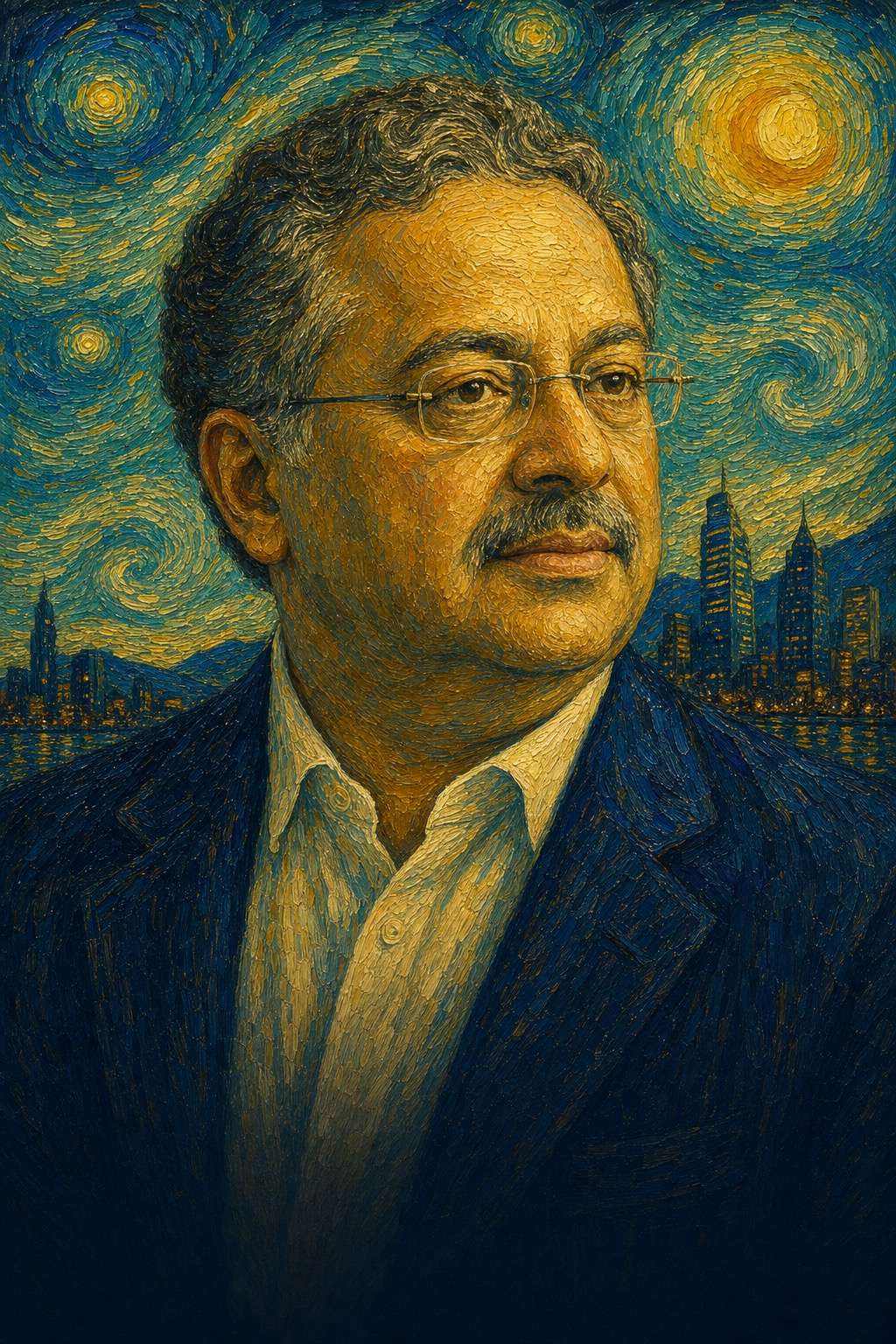
Rakesh Jhunjhunwala
Combined accounting discipline and management judgment with a structural India thesis, concentrating family capital in scalable businesses while a leverage-capable trading book exposed financing, governance, access, and regime limits.
As of 2026-07-18, Rakesh Jhunjhunwala is deceased. He died in Mumbai on 14 August 2022, aged 62. His widow, Rekha Jhunjhunwala, and the executors of his estate continue to appear in company filings, while the family has carried forward parts of his philanthropic program (Prime Minister of India, 2024). That continuing footprint should not be mistaken for an active post-2022 personal record. Nor should Rare Enterprises be described as a conventional fund manager: in a 2012 interview, Jhunjhunwala said Rare invested only his and his wife's money and that his wife was its only “client.” Public shareholding filings reveal important positions, but they do not reveal a complete portfolio, cash balances, leverage, derivatives, tax, or weighted purchase and sale prices (Reuters interview, 2012; Reuters obituary, 2022; Aptech estate filing).
Snapshot
| Field | Details |
|---|---|
| Born / died | Born 5 July 1960 in Hyderabad, India; moved to Mumbai at about age two; died 14 August 2022 in Mumbai. The exact birth date is supported here by a substantial secondary biography rather than a birth record, while his Hyderabad account is direct testimony (Indian Express biography; BCAJ interview, 2018; Reuters obituary, 2022). |
| Nationality | Indian (Reuters obituary, 2022). |
| Education | B.Com., Sydenham College; chartered accountant. In a direct 2009 interview he dated completion of the CA qualification to January 1985 (Ashoka University profile; Economic Times interview, 2009). |
| Years active | 1985-2022. This is a practical investing-career range, not a regulator-certified start date (Economic Times interview, 2009). |
| Main vehicles | Personal and family capital associated with Rare Enterprises; direct listed shareholdings; partnership and promoter holdings; private-company stakes; board and advisory roles. Rare was not presented as an outside-client fund (Reuters interview, 2012; Aptech offer document, 2005). |
| Asset classes | Predominantly Indian listed equities, plus private and pre-IPO equity and active trading exposures. Public evidence is insufficient to characterize a complete multi-asset allocation or derivatives history (BCAJ interview, 2018; Forbes profile). |
| Style tags | fundamental growth at a reasonable valuation, concentrated ownership, long holding periods, opportunistic trading, leverage, management judgment, India optimism, willingness to be contrarian. These labels combine his descriptions with observed holdings; they are not a mechanical ruleset (Reuters interview, 2012; BCAJ interview, 2018). |
| Verified track record | No audited personal return series located. A direct 2009 recollection says he began with ₹5,000 and earned ₹20-25 lakh in 1986-89 [single-source self-report]. Company filings verify selected ownership snapshots, not portfolio CAGR. A press reconstruction published on 14 August 2022 used June-quarter disclosures to value 32 stocks held by Jhunjhunwala and associates at ₹31,904.8 crore [single-source compiled estimate]. Neither endpoint supports a defensible compounded return (Economic Times interview, 2009; Economic Times portfolio snapshot, 2022). |
| Peak AUM / wealth | AUM: not applicable on the evidence found, because Rare described itself as family capital rather than an external fund. Dated wealth estimate: Forbes listed $5.8 billion on 5 April 2022 [single-source rich-list estimate]. This is not audited net asset value, and it should not be combined with the disclosed-stock snapshot as if their perimeters and dates matched (Reuters interview, 2012; Forbes profile). |
Life & Career Timeline
1960-1985 - household exposure, education, and a small starting base. Jhunjhunwala grew up in a family in which markets were discussed; his father was an income-tax official. In a 2009 direct interview, he said his father answered questions and encouraged newspaper reading but declined to provide stock-market capital. He completed his chartered-accountancy qualification in January 1985 and said he entered the market with ₹5,000. His father's employment and the family's home provided security, but that is different from an investable inheritance. The neat “₹5,000 to billions” arc is therefore directionally useful and narratively powerful, but it is not an account-level return series (Economic Times interview, 2009).
1985-1989 - trading, borrowed capital, and Sesa Goa. The early record rests heavily on later recollection. Jhunjhunwala said he persuaded family contacts to lend money on the promise of bank-deposit-like returns, used forward trading and other active trading, and made ₹20-25 lakh of profit between 1986 and 1989. He also recalled Tata Power helping take net worth to ₹50-55 lakh and a four-lakh-share forward position in Sesa Goa worth about ₹1 crore, parts of which he sold into large price increases. These figures are material because they show that leverage, trading, and access to financing preceded the celebrated long-term holdings. They remain [single-source self-report]: no broker statements, financing schedules, contemporaneous portfolio values, or tax records were located (Economic Times interview, 2009).
1990s-early 2000s - from trader to owner. Jhunjhunwala continued to trade around a growing investment book rather than converting into a pure buy-and-hold investor. Later interviews emphasize that trading generated capital and sharpened judgment while investments created most wealth. That separation is analytically important: a leveraged trading book can alter liquidity and drawdown risk even if the visible long book contains durable compounders. The public record does not permit attribution between trading profits, long-only appreciation, new capital, dividends, private deals, or taxes. His recurring optimism about India's development became a central part of the thesis, but the 1990s liberalization and subsequent domestic equity expansion were also powerful regime tailwinds (Reuters interview, 2012; BCAJ interview, 2018).
2002-2012 - Titan turns a holding into a public calling card. The strongest long-duration evidence is a sequence of issuer filings, not a remembered anecdote. Titan's 2004-05 annual report listed Rakesh with 1,959,750 shares, or 4.64%, and Rekha with 796,000 shares, or 1.88%, at 31 March 2005. The 2011-12 report, after stock splits and other capital changes, listed 66,629,100 shares, or 7.51%, for Rakesh and 22,116,120, or 2.49%, for Rekha. These snapshots verify scale and persistence. They do not disclose the initial purchase date, weighted basis, interim trades, dividends, financing, or realized profit, so a precise “Titan return” would exceed the evidence (Titan annual report, 2004-05; Titan annual report, 2011-12).
2005-2016 - investor, promoter, and director roles converge. His activity was not confined to passive minority stakes. A 2005 SEBI-filed Aptech offer document records Aptech Investments, a partnership constituted in July 2005, as acquirer in an offer at ₹67.50 a share. It also maps overlapping interests among Jhunjhunwala, Rekha, Rare, and Marganta Textiles. Aptech later described him as promoter and non-executive chairman. Its 2021-22 governance report records one meeting attended before he resigned from the board on 29 April 2021, after which he remained Chief Mentor. The combination of capital, board access, influence, and sometimes control can improve information flow and governance engagement, but makes comparison with a small outside shareholder imperfect (Aptech offer document, 2005; Aptech governance report, 2021-22).
2016-2021 - enforcement exposure and expansion into newer businesses. A 2018 SEBI order separately settled an adjudication concerning an alleged Geometric shareholding-disclosure violation; Jhunjhunwala paid ₹248,872, and the order disposed of the proceeding without a merits adjudication. SEBI's July 2021 settlement order concerned alleged insider trading in Aptech around information about its preschool business during 2016. It says the proceedings were settled without admission or denial of findings and records, for Jhunjhunwala, ₹9,50,85,704 as the settlement amount, ₹5,86,79,870 of disgorgement, and ₹3,10,79,431 of interest—₹18,48,45,005 in total [raw sum]. The order disposed of the specified proceedings while reserving SEBI's rights under stated conditions; it was not a criminal conviction. Separately, the 2005 Aptech offer document disclosed that proceedings under section 11B had been initiated against Jhunjhunwala and Rare. The bounded search did not locate a disposition for that older matter, so it is reported as unresolved rather than conflated with either settlement (SEBI Geometric settlement order, 2018; SEBI Aptech settlement order, 2021; Aptech offer document, 2005).
A 2025 Securities Appellate Tribunal judgment set aside a later SEBI order against Lashit and Neha Sanghvi after finding their access to the Aptech information unproved. The appellants were not Jhunjhunwala or his estate, and the judgment notes that Jhunjhunwala and family members had settled separately. It therefore did not overturn, reopen, convict, or exonerate Jhunjhunwala under the 2021 settlement (SAT judgment, 2025).
During the same period, the visible portfolio widened beyond mature listed holdings. Star Health's prospectus named Jhunjhunwala as a promoter; Metro Brands disclosed that Jhunjhunwala, relatives, and trusts held 14.50% and that he had agreed to provide advisory services for ₹1 per year for five years. Nazara Technologies reported his 3,294,310 shares as 10.10% at 31 March 2022. These positions show an ability to operate across private, promoter, and newly public settings. They also embed access, governance rights, lockups, illiquidity, and deal terms that a screen-based investor cannot automatically reproduce (Star Health prospectus, 2021; Metro Brands annual report, 2021-22; Nazara Technologies annual report, 2021-22).
2022 - concentration, aviation, and death. A press compilation published on 14 August used June-quarter disclosures to value 32 stocks held by Jhunjhunwala and associates at ₹31,904.8 crore [single-source]. Titan, Star Health, and Metro Brands accounted for ₹11,086.9 crore, ₹7,017.5 crore, and ₹3,348.8 crore respectively. Their sum, ₹21,453.2 crore, was 67.24% of the reported total [raw arithmetic]. The snapshot demonstrates concentration but omits undisclosed stakes, private assets, debt, cash, derivatives, and differences among family owners. Forbes separately estimated net worth at $5.8 billion on 5 April [single-source]. Jhunjhunwala was a founding financial backer of Akasa Air, which began operations shortly before his death. He died on 14 August 2022; a family statement reported through Reuters confirmed the death (Economic Times portfolio snapshot, 2022; Forbes profile; Reuters obituary, 2022).
2022-2026 - estate, succession, and public legacy. Rare stated after his death that a transition plan had been prepared, but a press-reported statement is not a full succession agreement. Later Aptech filings identify Rare as a partnership of Rekha and the estate and describe executor, trustee, and family relationships. Titan's 2022-23 filing listed Rekha with 46,945,970 shares, or 5.29%, at 31 March 2023. A Star Health filing for 31 March 2025 still listed 82,882,958 shares under “Late Rakesh Jhunjhunwala,” with Rekha identified as nominee and no encumbrance shown. These are estate and nominee records, not evidence that Rakesh made posthumous investment decisions (Rare transition report; Aptech estate filing; Titan filing, 2022-23; Star Health shareholding filing, 2025).
The Government of India awarded him a posthumous Padma Shri in 2023 for trade and industry. Ashoka University has held a memorial lecture and bears institutional traces of his support. In 2024, India's prime minister publicly credited the family with continuing the RJ Sankara Eye Hospital project and described Rekha's involvement. These sources establish an ongoing public and philanthropic legacy; they do not establish the size, legal terms, or investment performance of the estate (Padma Awards Gazette, 2023; Ashoka memorial lecture; Prime Minister of India, 2024).
Vehicles & Structure
Rare Enterprises is best understood as a family investment office and brand, not a mutual fund, hedge fund, or separately managed account business. In 2012 Jhunjhunwala described its capital as belonging to him and Rekha and said it had about a dozen employees. The name combined their first names. That structure relieved him of daily external redemptions and conventional client reporting, but public evidence does not prove that every asset or liability sat inside one legal entity. “Rare portfolio,” “Jhunjhunwala family holdings,” and securities registered personally to Rakesh or Rekha may overlap without being identical (Reuters interview, 2012; Forbes profile).
The ownership map was varied. Large listed stakes were registered to family members; promoter interests could run through partnerships and companies; private and pre-IPO deals had contractual rights; and Jhunjhunwala could sit on boards or advise issuers. The 2005 Aptech offer document is unusually useful because it shows Rare itself as a partnership of Rakesh and Rekha, while another acquiring entity and Marganta created additional layers. The contemporary estate filing shows that these arrangements evolved after death. A single number scraped from exchange filings therefore should not be labeled firm AUM (Aptech offer document, 2005; Aptech estate filing).
The capital base also enabled two modes to coexist. The investment book could hold concentrated positions for many years, while the trading book supplied liquidity, expressed shorter-term views, and used leverage. Jhunjhunwala explicitly defended leverage in 2012, subject to an ability to service it. This arrangement can turn market volatility into opportunity when financing remains available, but it also creates path dependence that end-of-quarter shareholding disclosures cannot show. There is no complete public schedule of gross exposure, margin requirements, financing counterparties, or worst drawdown (Reuters interview, 2012; BCAJ interview, 2018).
Track Record Detail and Caveats
There is strong evidence that Jhunjhunwala became extraordinarily wealthy through markets and company ownership. There is weak evidence for a conventional performance statistic. The starting-capital and early-profit figures come from his retrospective account. The later $5.8 billion figure is a rich-list estimate. Between them lie family ownership changes, borrowing, trading, private investments, dividends, consumption, philanthropy, and taxes. Computing CAGR from ₹5,000 in 1985 to a 2022 household wealth estimate would falsely treat the endpoints as comparable audited NAVs and assume no flows. This profile declines to do so (Economic Times interview, 2009; Forbes profile).
Titan provides the cleanest persistence test. Official filings show substantial family ownership in 2005, greater split-adjusted share counts in 2012, and a large Rekha holding after Rakesh's death. That is consistent with long-horizon conviction and an exceptional winner. It does not identify every purchase and sale or permit a money-weighted return. Similar point-in-time evidence for Star Health, Metro, and Nazara demonstrates scale and influence near 2022, while the three-position concentration in the press-compiled listed portfolio reveals how much outcome depended on a small number of holdings (Titan annual report, 2004-05; Titan annual report, 2011-12; Economic Times portfolio snapshot, 2022).
Benchmarking is impossible from the located record. There is no daily or monthly NAV series, no stable capital base, no audited composite, and no verified account of closed positions. The available sources overrepresent investments that became large enough to cross disclosure thresholds and stories Jhunjhunwala chose to retell. They underrepresent small losses, hedges, derivatives, short positions, and failed private deals. The correct result is therefore “not disclosed,” not a precise Sharpe ratio, hit rate, alpha, or maximum drawdown (Reuters interview, 2012; Economic Times interview, 2009; Economic Times portfolio snapshot, 2022).
Luck and skill are inseparable here, but not indistinguishable. Evidence consistent with skill includes obtaining financing from a small base, retaining exposure to Titan through long compounding, moving between trading and ownership, backing management teams, and using promoter or board positions to influence outcomes. Counterweights include a historic Indian bull market, survivorship in public anecdotes, concentrated exposure to a few winners, leverage, privileged deal access, governance rights unavailable to ordinary investors, and the absence of a full loss ledger. Jhunjhunwala himself said in 2009 that the Sensex's rise from roughly 150 to 17,500 had been among the largest contributors to his wealth [single-source self-assessment]. The 2021 Aptech settlement is also relevant to an assessment of process and conduct even though it was explicitly without admission or denial. A credible profile can admire the result without turning wealth into proof of audited risk-adjusted alpha (Economic Times interview, 2009; BCAJ interview, 2018; SEBI Aptech settlement order, 2021).
Why He Matters
Jhunjhunwala matters first because he joined two investing traditions that are often presented as opposites: aggressive trading to create and recycle capital, and patient ownership of a small number of operating businesses. The early Sesa Goa story and the long Titan record are not interchangeable. Together they show a career in which liquidity generation, financing, judgment of management, and the willingness to sit through volatility interacted (Economic Times interview, 2009; Titan annual report, 2004-05; Titan annual report, 2011-12).
Second, he became a highly visible expression of the India thesis. His public optimism was not merely macro commentary; it was implemented in consumer, education, health-insurance, footwear, gaming, and aviation businesses. The timing benefited from India's economic and capital-market development, but his willingness to concentrate ensured that selection mattered greatly. His example consequently teaches both the power and danger of allowing a winner to dominate household wealth (BCAJ interview, 2018; Aptech offer document, 2005; Star Health prospectus, 2021; Metro Brands annual report, 2021-22; Nazara Technologies annual report, 2021-22; Reuters obituary, 2022).
Third, his record exposes a recurring problem in investor biography. Shareholding disclosures can prove ownership; annual reports can prove governance roles; settlement orders can prove legal disposition; and rich lists can estimate wealth. None of them alone supplies fund performance. Treating Rare as a hedge fund and its founder's wealth as AUM erases the very structural advantage that made his strategy distinctive: family capital with no ordinary outside-client redemption cycle (Reuters interview, 2012; Forbes profile).
Finally, his transition from investor to promoter, director, and philanthropist widened the scope of capital allocation. It also made attribution harder. Star Health, Metro, Aptech, and Akasa involved institution building and access, not simply buying liquid shares. The posthumous continuation of estate holdings and philanthropy suggests deliberate succession planning, but the public documents do not reveal a complete mandate, governance constitution, or performance objective (Star Health prospectus, 2021; Rare transition report; Prime Minister of India, 2024).
Open Questions
- Can surviving broker, tax, or partnership records establish a continuous, net-of-fee and net-of-flow return series for any defined Jhunjhunwala account?
- What were the trading book's gross and net exposures, financing terms, margin calls, realized losses, and maximum drawdown across 1992, 2000, 2008, 2020, and other stress periods?
- How much of household wealth came from listed appreciation, active trading, private transactions, dividends, promoter economics, or new external borrowing?
- What was the final disposition of the section 11B proceedings disclosed in the 2005 Aptech offer document, and was it legally or factually connected to any later matter?
- What were the exact lot histories, split adjustments, dividends, pledges, and realized proceeds for Titan, Sesa Goa, Star Health, Metro Brands, Nazara, and Aptech?
- Which investment and governance decisions were made by Jhunjhunwala individually, by Rekha, by Rare employees, or with company boards and co-investors?
- What binding decision rights, liquidity rules, and succession provisions govern Rare, the estate, trusts, and nominee-held securities after 2022?
- Which losing and sub-disclosure positions are absent from the public winner narrative, and how would their inclusion change hit rate and risk-adjusted attribution?
The evidentiary boundary is the main conclusion: Rakesh Jhunjhunwala was a demonstrably consequential owner and an exceptionally wealthy market participant, but the public record located through 18 July 2026 does not support a fund-like personal return series. The durable lesson is not a mythical CAGR. It is the interaction of family capital, leverage, trading skill, concentrated ownership, access, management judgment, and an unusually favorable national growth regime—along with the governance and measurement risks those advantages created (Reuters interview, 2012; Economic Times interview, 2009; Titan annual report, 2004-05; Titan annual report, 2011-12; SEBI Aptech settlement order, 2021).
Task A - Profile (T0503)
Guiding questions
- What can be verified about Jhunjhunwala's life, education, career, vehicles, and current estate rather than repeated from legend?
- Was Rare Enterprises an external-client manager, a family office, a partnership, or a label spanning several ownership structures?
- Which figures are audited returns, point-in-time holdings, self-reported profits, press portfolio estimates, or rich-list wealth estimates?
- What do the Titan and other issuer filings establish, and what cannot be inferred without transaction ledgers?
- How should leverage, access, promoter and board roles, survivorship, market regime, legal matters, and luck qualify skill attribution?
Annotated source map
- Reuters interview, 2012 - Contemporaneous direct interview and the central vehicle source. Jhunjhunwala says Rare invested only his and Rekha's capital, describes her as its only client, reports approximate staffing, rejects the Buffett-clone label, and discusses leverage. It is testimony, not an audited balance sheet.
- Reuters obituary, 2022 - Contemporaneous wire report confirming death, age, family statement, public reputation, and Akasa context. The wealth figure in the article is an estimate rather than estate accounting.
- Aptech estate filing - Primary issuer filing describing current Rare partnership, estate, executor/trustee, family, and transfer relationships. It illuminates succession but does not disclose the complete estate or Rare mandate.
- Indian Express biography - Substantial secondary biography used for the exact birth date and Hyderabad birthplace. No civil birth record was located, so the chapter identifies this evidentiary tier.
- Padma Awards Gazette, 2023 - Primary government notification recording the posthumous Padma Shri, field, state, and canonical full name.
- Ashoka University profile - Institutional biography supporting Sydenham, chartered-accountant training, Rare chairmanship, selected roles, and philanthropy. It is partly honorific and not independent performance evidence.
- Economic Times interview, 2009 - Direct retrospective account of family background, January 1985 CA completion, ₹5,000 start, borrowing, 1986-89 profits, Tata Power, and Sesa Goa. All transaction figures are labeled single-source self-report because no contemporaneous ledger was found.
- Aptech offer document, 2005 - Primary SEBI-filed transaction document. Supports acquisition price, partnership dates, ownership mapping among Rakesh, Rekha, Rare, Marganta, and Aptech Investments, and disclosure of then-pending section 11B proceedings. It does not provide the later disposition of those proceedings.
- BCAJ interview, 2018 - Long-form direct interview used for career philosophy, trading-versus-investing distinctions, management judgment, and India optimism. Retrospective claims are not treated as account statements.
- Forbes profile - Dated rich-list and biographical source reporting $5.8 billion on 5 April 2022 [single-source estimate], education, family, Rare naming, Titan, and Akasa. Wealth estimates are not audited NAV or AUM.
- Economic Times portfolio snapshot, 2022 - Press compilation published 14 August 2022 using June-quarter disclosures to identify 32 holdings and report their market values [single-source]. Used for a raw concentration calculation, not as a complete household portfolio or return series.
- Titan annual report, 2004-05 - Primary issuer evidence for Rakesh's and Rekha's shares and percentages at 31 March 2005. A point-in-time holding is not cost basis or P&L.
- Titan annual report, 2011-12 - Primary issuer evidence for the family's larger split-adjusted share counts and ownership percentages at 31 March 2012. Capital changes prevent naive share-count return calculations.
- Aptech governance report, 2021-22 - Primary issuer report supporting promoter, non-executive-chairman, board-meeting, and AGM-attendance details. Governance title is not proof that every operating or investment decision was his.
- SEBI Aptech settlement order, 2021 - Primary regulator order for alleged 2016 Aptech insider trading. Establishes the without-admission-or-denial settlement, printed payment components, disposal, and reserved rights; it should not be rewritten as a criminal conviction or merged with the older section 11B disclosure.
- Star Health prospectus, 2021 - Primary offering document naming Jhunjhunwala as promoter and describing his company role and shareholding context. Promoter economics and constraints differ from buying a liquid public share after listing.
- Metro Brands annual report, 2021-22 - Primary issuer record for the 14.50% family-and-trust holding and ₹1 annual advisory-services agreement. The grouped holding is not necessarily personal beneficial ownership in every share.
- Nazara Technologies annual report, 2021-22 - Primary issuer evidence for 3,294,310 shares and 10.10% ownership at 31 March 2022. It provides no weighted purchase price or lifecycle return.
- Rare transition report - Secondary reporting of Rare's statement that a smooth transition had been planned. Useful evidence of stated intent, but not a governing partnership agreement or proof that succession was frictionless.
- Titan filing, 2022-23 - Primary issuer filing for Rekha's 46,945,970 shares and 5.29% at 31 March 2023. It supports continuity after death, not Rakesh's posthumous decision-making.
- Star Health shareholding filing, 2025 - Primary exchange filing showing the deceased promoter line, Rekha as nominee, 82,882,958 shares, and no encumbrance at 31 March 2025. Nominee and beneficial ownership should not be presumed identical beyond the filing.
- Ashoka memorial lecture - Institutional record of the memorial lecture and university legacy. It supports continuing remembrance, not investment performance or estate value.
- Prime Minister of India, 2024 - Primary government speech supporting the current attribution of family and Rekha involvement in the eye-hospital project. Ceremonial praise is not independent measurement of philanthropic spending.
- SEBI Geometric settlement order, 2018 - Primary regulator order settling an alleged shareholding-disclosure violation for ₹248,872. The order disposed of adjudication and is not an insider-trading finding, criminal fine, or merits adjudication.
- SAT judgment, 2025 - Reproduction of the Securities Appellate Tribunal judgment setting aside a later order against Lashit and Neha Sanghvi. The appellants were not Jhunjhunwala or his estate, and the judgment records his separate settlement; it did not undo the 2021 order.
Evidence limitations
- No audited personal, family, or Rare Enterprises NAV series, GIPS composite, tax return, or complete transaction ledger was located. The chapter therefore reports no CAGR, alpha, Sharpe ratio, hit rate, or maximum drawdown.
- Rare's legal and economic perimeter changed over time and overlaps personal, spousal, partnership, company, trust, nominee, and estate interests. Public shareholding tables cannot be summed mechanically into personal AUM.
- Early profits and trades are retrospective self-reports. They are useful for chronology and process, but lack broker statements, financing documents, and contemporaneous valuation checkpoints.
- Issuer filings prove ownership at particular dates. They generally do not disclose weighted cost, interim purchases and sales, dividends, hedges, financing, taxes, or final proceeds.
- The 2022 portfolio snapshot is a press compilation of disclosed listed stakes; the Forbes number is a rich-list wealth estimate. Their dates, currencies, liabilities, family perimeters, and asset coverage differ.
- Winner-focused disclosure creates survivorship bias. Sub-threshold positions, shorts, derivatives, private losses, and closed trades are likely underrepresented.
- Board, promoter, advisory, and private-placement access may be part of the skill set, but it makes the record less reproducible for an ordinary minority investor.
- The 2021 SEBI matter was settled without admission or denial. The separate section 11B proceeding disclosed in 2005 remains unresolved in this bounded research and is not treated as the same case.
- The 2018 Geometric disclosure settlement and 2021 Aptech alleged-insider-trading settlement concern different conduct. The 2025 SAT judgment concerned different appellants and did not reopen Jhunjhunwala's settlement.
- Current checks establish an estate and philanthropic footprint after 2022, not active investment decisions by the deceased investor.