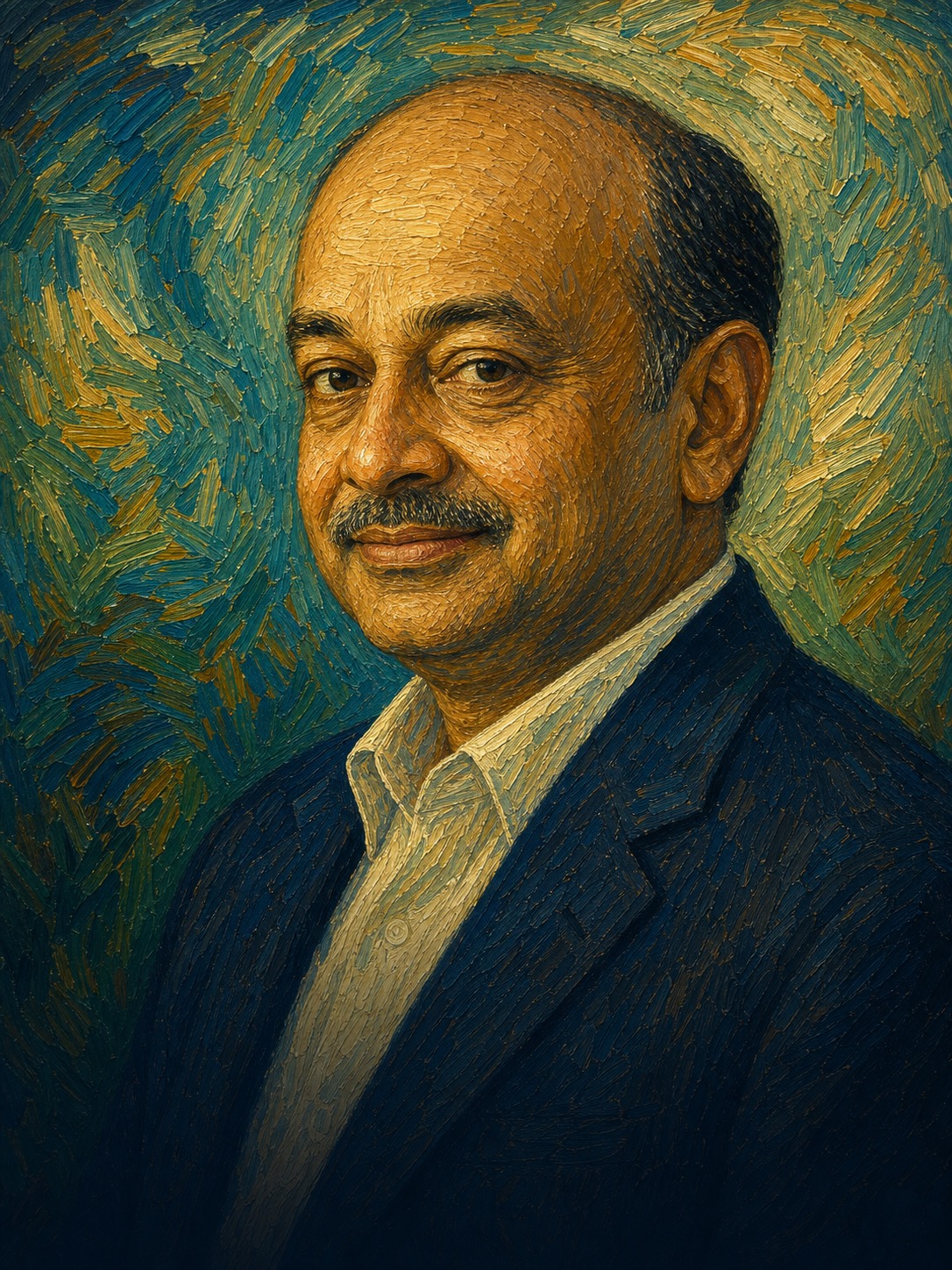
Radhakishan Damani
Combined price-conscious franchise investing, proprietary family capital, strategic blocks, and owner-operator execution to compound through VST and DMart, while legal-holder fragmentation, missing return and loss ledgers, team attribution, and retail disruption bound the legend.
As of 2026-07-18.
Radhakishan Shivkishan Damani is unusually difficult to profile because the public record mixes a proprietary investor, a family vehicle network, and the controlling founder of a listed retailer. This chapter keeps those perimeters separate. It treats filings as evidence of legal ownership, not proof that every family or promoter-group asset is his personal property, and it does not convert wealth estimates or selected winning positions into an invented investment record.
Snapshot
| Field | Detail |
|---|---|
| Full name | Radhakishan Shivkishan Damani; offer documents usually shorten this to Radhakishan S. Damani (Avenue FY2024-25 annual report). |
| Born / died | Born circa 1955; living as of this run. The exact date, year, and birthplace remain unverified. Avenue's March 2017 prospectus said he was 61 but supplied no date or place, so the year is an inference rather than a verified civil-record fact (Avenue Supermarts prospectus). |
| Nationality | Indian; the 2017 prospectus identifies him as a resident Indian national (Avenue Supermarts prospectus). |
| Main vehicles | Direct personal holdings; Bright Star Investments Private Limited; Damani Shares and Stock Brokers Private Limited historically; Derive Trading and Resorts Private Limited; Derive Investments; Damani Estates and Finance Private Limited; five private beneficiary trusts; and the promoter group controlling Avenue Supermarts/DMart. No public outside-capital flagship fund is documented in the reviewed record (Avenue Supermarts prospectus; VST FY2025-26 annual report). |
| Years active | Bright Star founded in 1989; SEBI stock-broker registration in 1992; corporate brokerage membership from 1997; retail diversification from 1999; strategic mentoring remains current under a contract effective in 2022 (Avenue Supermarts prospectus; Avenue FY2022-23 annual report). |
| Asset classes | Indian public equities, short-term trading historically, control/founder equity, and private-company stakes; group entities also include real estate-linked businesses (Economic Times, 2014; Avenue Supermarts prospectus). |
| Style tags | Proprietary value investing; consumer franchises; concentration; long holding periods; price discipline; owner-operator capital allocation; patient retail expansion; low public visibility. These are this chapter's synthesis of the documented record, not Damani's published taxonomy (Economic Times, 2014; Fortune India, 2025). |
| Verified track record + period | No audited personal or consolidated family-office return series is public. The strongest bounded datapoint is a March 2013 press reconstruction of 31 Bright Star listed positions with stated cost of Rs212 crore and market value of Rs1,731 crore, about 8.2 times cost [single-source]. It is a selected point-in-time subset, not a cash-flow-adjusted CAGR, NAV series, or total portfolio (Economic Times, 2014). |
| Peak AUM / capital | Not disclosed and not applicable to any documented outside-capital vehicle. Forbes wealth estimates, the market value of DMart promoter stakes, and portfolio-aggregator totals are neither AUM nor audited net asset value (Forbes current profile). |
| Current role | Founder and controlling promoter of Avenue Supermarts; strategic Chief Mentor under a five-year agreement effective October 16, 2022, for Rs1 per year. He is not Avenue's chair, CEO, or board director (Avenue FY2022-23 annual report). Kalpana Unadkat became chairperson effective April 1, 2026 (NSE-filed chairperson appointment). |
| Current-status anchor | A current Forbes profile identifies Damani as a living billionaire, while an IIHS board profile continues to identify his institutional association. Avenue's official first-quarter filing, approved July 11, 2026, separately confirms current company activity but is not proof of Damani's personal activity (Forbes current profile; IIHS board profile; NSE integrated filing). |
Life and Career Timeline
Circa 1955 - identity remains bounded. The prospectus is authoritative about his legal role, nationality, and age 61 at its March 2017 filing, but it does not prove a birth date or birthplace. “Born circa 1955” is therefore an inference; the popular exact date should not be repeated as fact without a primary civil or issuer record (Avenue Supermarts prospectus).
Before 1989 - ball bearings, then markets. Avenue's prospectus says Damani completed his first-year commerce examination at the University of Mumbai, began in the ball-bearing business, and then moved into stock trading. It does not say that he earned a BCom degree. Later accounts connect the move to his father's death and his brother Gopikishan's brokerage, but the timing and causality are secondary rather than filing-grade (Avenue Supermarts prospectus; Economic Times, 2017).
1989-1997 - formalizing proprietary investment activity. Damani founded Bright Star in 1989 to deal and invest in securities. He obtained SEBI stock-broker registration in 1992; in 1997 the membership became a corporate membership in Damani Shares and Stock Brokers. This is the clean official chronology (Avenue Supermarts prospectus). The familiar story that he made his reputation shorting Harshad Mehta-favored shares in 1992 is plausible market history but has no located personal trade ledger, position record, or audited P&L. A later long-form profile retells the episode, so it should be read as retrospective reporting, not transaction proof (Economic Times, 2017).
1997-2002 - learning retail. Accounts place an Apna Bazaar franchise experiment between 1997 and 1999. The prospectus says Damani diversified into retail through Koop Consumer Services in 1999, incorporated Avenue Supermarts on May 12, 2000, and opened the first DMart at Powai in 2002/FY2003 (Avenue Supermarts prospectus). Ashok Maheshwari says he helped shape and operate the early concept, while Avenue disputed his description as a co-promoter and the prospectus does not name him as one. He is best described as an early operating associate whose precise founding interest remains contested [disputed] (Maheshwari interview).
2002-2016 - deliberate operating scale. Avenue expanded slowly, using a cluster strategy, an everyday-low-price proposition, cost discipline, and an unusually patient store-opening cadence. The issuer says the first ten stores took eight years because the model was being tested for both profitability and scalability. This was not a solo achievement. The prospectus credits Ignatius Noronha, Ramakant Baheti, senior managers, and employee ownership alongside promoter vision (Avenue Supermarts prospectus); Noronha later described Damani as a guiding and mentoring force rather than the day-to-day operator (Noronha interview).
March 2017 - public-market validation, not a personal fund return. Avenue issued 62,541,806 new shares at Rs299, raising about Rs18.7 billion [single-source]. The IPO was a fresh issue, not an offer-for-sale cash-out by Damani; promoters moved from 91.34% before the issue to about 82.19% afterward [single-source] (Avenue Supermarts prospectus). Strong first-day trading and subsequent wealth creation made Damani a public symbol of profitable Indian retail, but issuer equity held from formation is not an audited investment-management composite. Contemporary coverage also warned that the stock listed at a demanding valuation amid e-commerce and execution risks (Forbes India, 2017).
2017-present - influence without executive office. Avenue appointed Damani Chief Mentor in October 2017, then entered a new five-year agreement effective October 16, 2022. The Rs1 annual fee and contract terms are issuer-reported [single-source]; they make the arrangement symbolic in compensation but explicit in governance, with strategic guidance provided while a professional board and executive team operate the company (Avenue FY2022-23 annual report). The FY2024-25 annual report lists him among shareholders exercising control and records the mentorship fee, but not as a director or KMP (Avenue FY2024-25 annual report).
2025-2026 - still active, still private. Avenue ended FY2024-25 with 415 stores and 17.2 million square feet of retail business area (Avenue FY2024-25 annual report). Its March 2026 exchange pattern reported 74.51% promoter/promoter-group ownership, versus 74.65% in the prior quarter [single-source]; denominator changes and employee issues mean a percentage change alone does not prove a promoter sale (NSE shareholding-pattern page). Fortune's recent description of him as the “phantom” of Dalal Street captures a real research constraint: there is still no regular letter, complete interview archive, or disclosed portfolio methodology (Fortune India, 2025).
Vehicles and Structure
Proprietary investing network
Bright Star is the central disclosed investment company. The prospectus says it was incorporated in September 1989 and, in 2017, was owned 54.00% by Radhakishan, 39.65% by Gopikishan, 5.08% by Shrikantadevi, and 1.27% by Kirandevi [single-source]. Those percentages are historical, not a current cap table. Derive Trading, Derive Investments, and Damani Estates also appear in issuer filings and transactions. None has published a consolidated audited family-office balance sheet in the reviewed record (Avenue Supermarts prospectus; VST FY2025-26 annual report).
This legal-holder discipline changes the interpretation of public “Damani portfolio” tables. At March 31, 2025, Radhakishan personally held 149,848,238 Avenue shares, 23.03%; Bright Star held 88,750,000, 13.64%; Gopikishan, other relatives, and five beneficiary trusts held further stakes. Avenue reported 74.646% for the whole promoter group [single-source] (Avenue FY2024-25 annual report). Adding all of these and calling the result Radhakishan's personal portfolio would erase separate companies, trustees, beneficiaries, relatives, and liabilities.
Avenue Supermarts and the trusts
At IPO, the five named trusts were Royal Palm, Bottle Palm, Mountain Glory, Gulmohar, and Karnikar. The prospectus establishes registered holders and joint trusteeship arrangements, not that Radhakishan personally owned every beneficial interest. It also records gifts and transfers into the trusts; those are ownership reorganizations, not investment gains (Avenue Supermarts prospectus).
Avenue is the most valuable observable artifact of Damani's capital allocation, but it is also an operating company with professional management, employees, suppliers, property decisions, and public shareholders. Business results should be attributed to that institution, not treated as a one-man brokerage account.
Selected external holdings and exits
VST Industries. VST's filing for the quarter ended December 31, 2025 shows Bright Star with 44,078,298 post-bonus shares, 25.95%, as a public/non-promoter holder (VST December 2025 shareholding filing). VST's FY2025-26 annual report independently confirms the same Bright Star holding at March 31, 2026 and identifies the related-party/person-acting-in-concert perimeter; it reports a grouped dividend total for entities holding 20% or more, including persons acting in concert, rather than a complete recipient-by-recipient portfolio return (VST FY2025-26 annual report). The evidence supports long-lived concentration and continuing influence, not a lifetime VST CAGR: the complete sequence of purchases, sales, transfers, dividends, taxes, and corporate actions is missing.
India Cements. A January 2025 offer document records UltraTech's June 2024 purchase of 70,564,656 shares, 22.77%, from six Damani-related legal sellers. The block was worth roughly Rs1,892 crore at the disclosed prices [single-source], but proceeds belonged to those six sellers, not solely to Radhakishan. Missing full cost bases make it a documented cash exit, not a verified profit or annualized return (SEBI-hosted India Cements letter of offer).
Private-company investing. A 2015 Cinestaan Entertainment joint-venture agreement identifies Derive Investments, represented by partner Radhakishan Damani, as the legal investor; an April 2026 tax decision reproduces the agreement and later cap tables [single-source]. The litigation concerned the investee's valuation, not misconduct by Damani (Cinestaan ITAT decision). In March 2026, an exchange filing said Bright Star and Derive Trading agreed together to acquire 9.90% of Infina Finance for about Rs413.35 crore, without disclosing the split between them [single-source] (Kotak Mahindra Bank filing). These are useful activity markers, not a consolidated portfolio.
Institutional and philanthropic perimeter
Damani remains associated with the Indian Institute for Human Settlements, whose profile calls him a value investor and retailer but does not publish a personal donation amount (IIHS board profile). Ashoka University identifies him as a founder represented by his daughter Madhu Chandak on its board of trustees (Ashoka University profile). D MART Foundation is Avenue's corporate CSR vehicle; family education entities and corporate CSR should not automatically be labeled his personal philanthropy (Avenue FY2024-25 annual report).
Track Record Detail and Caveats
The public record establishes successful outcomes, but not a complete record.
| Evidence | What it establishes | What it does not establish |
|---|---|---|
| March 2013 Bright Star subset: Rs212 crore cost, Rs1,731 crore market value [single-source] | A reporter reconstructed a concentrated set of 31 listed positions worth about 8.2 times stated cost (Economic Times, 2014). | Start dates, cash flows, realized losses, shorts, leverage, taxes, omitted holdings, total vehicle capital, benchmark, or annualized return. |
| DMart founder equity and 2017 IPO | Damani and related holders built and retained control of a valuable operating company; the IPO raised primary capital rather than selling their shares (Avenue Supermarts prospectus). | A personal investment-fund return, repeatable security-selection alpha, or a clean separation between founder labor and capital return. |
| Current VST ownership | Bright Star still holds a large, issuer-verified position (VST FY2025-26 annual report). | Complete cost basis, family beneficial ownership, or lifetime total return. |
| India Cements block sale [single-source] | Six legal sellers realized a large, precisely documented 2024 exit (SEBI-hosted India Cements letter of offer). | Profit, because their complete acquisition history is unavailable. |
| Forbes wealth rankings | A current market-based estimate of attributable wealth, dominated by listed founder equity (Forbes current profile). | Audited net worth, liquid capital, outside-client AUM, NAV, or portfolio performance. |
Damani's rare direct remarks are consistent with a long-duration consumer/value approach: in 2014 he told the Economic Times that his horizon was five to ten years and that commitment followed conviction (Economic Times, 2014). But his public record also includes trading, short-selling lore, control investing, founder equity, private placements, and family vehicles. Reducing that mix to “buy quality and hold forever” would be too neat.
Survivorship and selection biases are severe. The reviewed exchange shareholding reports cannot reveal a complete portfolio containing sub-threshold positions, shorts, closed losses, cash, debt, private holdings, or intra-family economics (NSE shareholding-pattern page). Retrospective media portfolio lists naturally emphasize surviving listed winners, while DMart founder equity dominates current public wealth estimates; changes in one listed share price can therefore be mistaken for changes in “portfolio skill” (Economic Times, 2014; Forbes current profile). A later task can reconstruct individual trades, but no responsible profile should publish a headline personal CAGR from the evidence presently available.
Legal, Regulatory, and Criticism Context
2007 broker censure, with manipulation allegations rejected. SEBI investigated the R.S. Damani group of three brokerages. It found no sufficient evidence of Infosys price manipulation, artificial volume, an improper link to the Jhunjhunwala group or Nirmal Bang, or material short-sale noncompliance. It did find delayed transfers from broker pool accounts to client beneficiary accounts and imposed the minor penalty of censure on the brokerages (SEBI 2007 full order). This was not a personal criminal conviction or a fraud finding against Damani.
IPO-era legacy matters. The prospectus disclosed old Companies Act recordkeeping and governance lapses at associated entities that were compounded or disposed, a pending duplicate-DIN show-cause notice against Damani, and an RBI notice/application history concerning Bright Star's possible NBFC status. It also warned that other promoter retail interests and related-party arrangements could create conflicts. These are material counterweights to an uncritical founder story, but their procedural status must be preserved (Avenue Supermarts prospectus).
2020-2022 Avenue disclosure case. SEBI imposed Rs3 lakh on Avenue and Rs1 lakh on its compliance officer for a delayed employee-trade disclosure (SEBI 2020 adjudication page). In 2022 the Securities Appellate Tribunal rejected SEBI's view that a bulky beneficiary-position report itself triggered awareness, but held that Avenue became aware through a later SEBI email; it therefore upheld the penalties on a different factual basis (SAT decision). Damani was not a noticee. The matter is company compliance context, not evidence of his insider trading.
Contested authorship and team attribution. Maheshwari's disputed early-founder claim and Noronha's account of professional execution both caution against the lone-genius narrative (Maheshwari interview; Noronha interview). DMart's outcome reflects founder judgment plus a long-serving team, vendor economics, Indian consumption growth, property strategy, market structure, and favorable access to patient capital (Avenue Supermarts prospectus; Forbes India, 2017).
Reputation testimony is not audited performance. Rakesh Jhunjhunwala called Damani his “real mentor” but immediately qualified that description: Damani was a best friend, “not a guide,” and Jhunjhunwala learned from him through observation (BCAJ interview). Business Standard's deep profile similarly relies on named and anonymous associates because Damani declined an interview (Business Standard, 2020). Such testimony supports influence and reputation; it cannot fill missing account statements.
Why They Matter
He joins investing and operating in a way few canonical investors do. Damani moved from trading and proprietary value investing into control ownership, then turned consumer-sector observations into a scaled retail institution. DMart is therefore both an operating achievement and a visible expression of his preference for price discipline, repeat demand, cash generation, and patient compounding (Avenue Supermarts prospectus; Economic Times, 2014).
He demonstrates the power of permanent, self-directed capital. No redemption cycle or public fund mandate is visible in the reviewed record. Family vehicles and founder ownership enabled long holding periods, concentrated positions, and slow retail expansion. The same privacy that creates flexibility also prevents outsiders from measuring risk-adjusted performance (Avenue Supermarts prospectus; Fortune India, 2025).
His influence travels through people as well as holdings. Jhunjhunwala's observation-based learning, Noronha's description of mentorship, and Avenue's formal Chief Mentor contract support an influence and governance legacy. The popular “guru” label should remain attributed to named observers rather than treated as a self-bestowed title (BCAJ interview; Noronha interview; Avenue FY2022-23 annual report).
He is a case study in attribution discipline for Indian markets. Promoter groups, family trusts, partnerships, private investment companies, and public-company control are frequently collapsed into one celebrity portfolio. Damani shows why analysts must name the legal holder, separate company results from investor returns, and distinguish net worth from AUM (Avenue FY2024-25 annual report; Cinestaan ITAT decision).
He also illustrates the limits of legend. “Mr White and White,” “retail king,” and the Harshad Mehta bear story are durable reputation markers, but precise biographical and performance claims remain thin. The most useful canon treatment is not hagiography; it is a map of what filings prove, what firsthand witnesses say, and what the public record cannot measure (Economic Times, 2014; Forbes current profile; Economic Times, 2017).
Open Questions for Later Tasks
- What are Damani's exact date and place of birth? A primary civil or issuer record is still needed.
- What was the name, ownership, and operating history of the ball-bearing business?
- Can exchange or brokerage records verify the positions, financing, losses, and profits attributed to his 1991-1992 Harshad Mehta-era shorts?
- What are the current ownership and liability structures of Bright Star, Derive Trading, Derive Investments, and Damani Estates?
- Who are the current beneficiaries and economic owners of the five private trusts, and how should their assets be attributed?
- Can a complete, cash-flow-aware record be reconstructed for VST, India Cements, Trent, and other disclosed investments, including sales, dividends, corporate actions, taxes, and closed losses?
- What legal or economic interest, if any, did Ashok Maheshwari retain in early DMart, and how should founder credit be divided among him, Damodar Mall, Damani, and the professional team?
- What are the current scope and renewal terms of Damani's Chief Mentor role after the five-year agreement effective in 2022?
- Which charitable activities were personally funded by Damani, which by family entities, and which through Avenue's statutory corporate CSR?
- Is there any non-public client capital, leverage, or consolidated risk system behind the family vehicle network? No public evidence located in this run establishes one.
As of 2026-07-18.
Damani has never published a partner letter, investment manual, model portfolio, or complete methodology. The most defensible reconstruction therefore has three layers: what he said in a rare direct interview; what named colleagues observed; and what filings show separate legal holders actually did. It is a philosophy, not a reproducible system. No public evidence located for this chapter establishes a valuation formula, target multiple, position-size ceiling, diversification rule, stop-loss, leverage cap, or universal sell trigger.
Core Worldview
Damani's clearest first-person statement is also the narrowest: “My philosophy is long term, with a horizon of five to 10 years.” In the same interview, he linked commitment to liking and believing in an investment. The reporters described a simultaneous preference for brands, cash flow, predictability, consumer businesses, and purchases at low valuations (Economic Times, 2014). These are useful anchors, but they do not prove that every position was held for that period or selected by one fixed screen.
The observed worldview is ownership-minded value investing: buy an understandable economic engine at an attractive price, accept concentration when conviction is high, and give the thesis time. Quality and price are complements, not substitutes. A later profile's “Peddar Road versus Dharavi” anecdote makes the point that a superior franchise need not be available at the absolute cheapest multiple, but it is reported market folklore, not a verified Damani transcript (Business Standard, 2017).
DMart is the operating expression of that worldview, not proof of every investing rule. Avenue says Damani spent years researching the Indian consumer, then tested profitability and scalability so cautiously that the first ten stores took eight years. Its institutional vocabulary—simplicity, focus, patience, conviction, financial fundamentals, and professional execution—closely resembles the traits attributed to his investing (Avenue annual report, 2025). The issuer is describing its founder and culture; that is primary company evidence, not an independently audited account of his personal process.
The Edge - What Markets Misprice and Why
The record supports four related hypotheses about Damani's edge.
First, markets can confuse low excitement with low quality. Consumer staples, tobacco, shaving products, groceries, and mature financial franchises can produce repeat demand, cash, pricing power, and long runways without a fashionable narrative. Bright Star's VST stake is the clearest primary artifact: in 2001 Radhakishan and Gopikishan Damani with Bright Star made a 30% open offer at Rs151 a share while Russell Credit offered Rs125 (SEBI open-offer record, 2001). Bright Star remained a 25.95% legal holder after the later bonus issue, according to VST's FY2025-26 filing (VST annual report, 2026). That longevity supports patience; it does not reveal the complete cash flows or prove why every share was retained.
Second, the market may underweight business durability because it overweights near-term price action. Damani explicitly framed value realization in years, while his reported portfolio mixed substantial positions in established businesses with active trading (Economic Times, 2014). The edge is not merely “buy cheap.” It is the willingness to wait when the business, cash economics, and price jointly support conviction.
Third, careful listening and field observation can surface information that is public or ordinary but poorly synthesized. Named associates describe Damani soliciting ideas without status anxiety, studying the consumer, and working directly on procurement and assortment. Fortune's 2025 profile is unusually rich in named testimony, but several trade examples and return multiples remain retrospective and unaudited; they are evidence of reputation and research habits, not a verified composite (Fortune India, 2025).
Fourth, self-directed capital can exploit horizons unavailable to a redemption-sensitive fund. The reviewed record shows proprietary and family vehicles, not a public outside-capital flagship. A broker familiar with Damani's activity described a core book held for years and a distinct trading book that used futures and options; this is retrospective testimony, not account-level evidence (Economic Times, 2017). That structure permits an unsuccessful consolidation effort to become a multi-decade holding, or a founder investment to compound through slow operating expansion. It also hides cash, liabilities, shorts, and closed losses, so flexibility must not be mistaken for measured risk-adjusted superiority.
Process
Idea sourcing
Damani appears to source ideas through familiar products and sectors, market relationships, legal disclosures, and close observation of businesses. The rare 2014 interview says consumer-company investing preceded his decision to build in the same sector (Economic Times, 2014). Named associate Rakesh Jhunjhunwala said he learned from Damani by observation rather than formal guidance, a useful warning against turning private conversations into a public checklist (BCAJ interview, 2018).
Research
The repeatable element is business research rather than price-screening alone: identify who pays, why demand recurs, how suppliers behave, where cash is tied up, and whether the model scales. Avenue's prospectus documents local assortment, direct sourcing, prompt supplier payment, daily inventory data, cluster economics, site payback analysis, and a low-inventory operating model (Avenue prospectus, 2017). These are company systems built by a team, not Damani's personal stock-research template. Still, they show the questions his capital helped institutionalize: price, quality, throughput, cash conversion, and repeatability.
Ashok Maheshwari's firsthand but contested founding account says the early team studied global discount formats, debated store economics, and divided responsibilities, with Damani concentrating on purchasing and merchandising. Avenue disputes Maheshwari's co-promoter label and the prospectus does not name him as one, so the testimony is best used for process detail rather than legal founder credit (Maheshwari interview, 2017).
Valuation and entry
The evidence supports price discipline but no formula. The 2014 profile connects Damani's early short selling and later investing to a notion of the “right price,” and describes most of a 31-position Bright Star subset as bought at low valuations (Economic Times, 2014). No located source supplies a required discount to intrinsic value, P/E ceiling, discounted-cash-flow assumptions, or hurdle rate. The reported Harshad Mehta-era shorts also lack a located trade ledger or audited P&L; they illustrate a valuation story, not a verified entry algorithm.
Observed entries can be strategic as well as passive. The VST open offer sought consolidation of holdings (SEBI open-offer record, 2001). In March 2026 Bright Star and Derive Trading agreed, subject to conditions, to acquire 9.90% of Infina together for about Rs413.35 crore; the filing did not disclose their split, Damani's personal economics, or completed transfer (Kotak/NSE filing, 2026). “Entry” may therefore mean a listed purchase, block, conditional negotiated deal, strategic consolidation, or founder capitalization; these are not interchangeable.
Sizing
Damani's record indicates conviction sizing, not a disclosed sizing rule. The 2014 Bright Star subset contained 31 companies and substantial blocks, with VST dominant (Economic Times, 2014). Current filings show large positions held by distinct companies and trusts, but the denominator—consolidated liquid capital—is unavailable. A 25.95% stake in an issuer is not 25.95% of a family portfolio, and Avenue promoter-group ownership is not Damani's personal position size. Any maximum-weight, averaging-down, or risk-budget claim would be invented.
Portfolio construction
The visible construction combines a concentrated core with a wider tail, consumer and financial franchises, control/founder equity, private investments, and historically a separate trading book (Economic Times, 2017). Permanent capital and no public benchmark appear central. Yet public shareholding data omit sub-threshold positions, cash, debt, derivatives, shorts, taxes, and sold losers. “Concentrated quality” is a fair style label; a complete sector allocation or correlation policy is not.
Legal-holder discipline is part of the process analysis. Bright Star, Derive entities, Radhakishan personally, relatives, trusts, the Avenue promoter group, and Avenue are separate perimeters. Their assets and actions should not be collapsed into a celebrity portfolio. The prospectus is the core source for those distinctions (Avenue prospectus, 2017).
Sell discipline
No explicit universal sell rule was located. Behavior suggests at least three possible exits: price or thesis invalidation in trading; a strategic buyer offering liquidity; or reallocation after a long holding. Only the transaction, not the internal rule, is observable. In June 2024 six Damani-related legal sellers transferred 70,564,656 India Cements shares to UltraTech at disclosed seller-specific prices. The filing proves a clean block exit but not complete acquisition cost, personal proceeds, or Damani's reason for selling (India Cements offer document, 2025). VST shows the opposite response: hold after an unsuccessful consolidation effort. The contrast argues for thesis-specific judgment, not the slogan “never sell.”
Risk Management
Damani's strongest visible defense is purchase discipline plus durable business economics. Predictable demand, cash generation, prompt supplier payment, high inventory turns, owned or very long-lease stores, cluster density, and historically limited operating leverage reduce certain business risks (Avenue prospectus, 2017). ICRA's 2025 review independently observed low leverage, strong liquidity, 20-22% return on capital employed, and 7-8% operating margins over five years, while also flagging real-estate availability, loss-making e-commerce, and intense quick-commerce competition (ICRA, 2025). Those are Avenue metrics, not proof of a personal portfolio risk limit.
The latest full-year operating evidence shows why patient expansion still needs falsification tests. Avenue reached 500 stores in FY2025-26, yet like-for-like growth eased to 8.1% from 24.2% three years earlier, revenue per square foot slipped from Rs33,896 to Rs33,422, and EBITDA margin narrowed to 7.8% from 8.2% in FY2021-22 (Avenue investor presentation, 2026). These figures do not refute the model, but they prevent “patient compounding” from becoming an unfalsifiable label.
Concentration, illiquidity, private-company opacity, regulation-sensitive tobacco exposure, and founder-company dependence remain real counterweights. A long horizon can absorb volatility but cannot cure permanent impairment. No public source shows personal drawdown limits, stress tests, hedging policy, gross or net exposure, financing terms, or a cash-reserve floor.
Regulatory evidence also resists a simple morality tale. In 2007 SEBI censured three R.S. Damani group brokerages for delayed transfers from pool to beneficiary accounts. The order rejected price-manipulation and artificial-volume charges, found no established link to the Jhunjhunwala or Nirmal Bang groups, and said short sales broadly complied with norms (SEBI order, 2007). A separate 2017 oral history printed an anonymous former market participant's accusation about historical rigging but supplied no ledger or regulatory finding (Economic Times, 2017). The minor censure is relevant process history; it is not a personal fraud conviction or evidence for a trading edge, while the Infosys disposition cannot adjudicate every differently framed market story.
Temperament and Psychology
The consistent testimony is patience, conviction, humility, listening, focus, and comfort with obscurity. ET described a person more willing to listen than speak; Fortune's named witnesses similarly emphasized his willingness to hear ideas regardless of the source (Economic Times, 2014; Fortune India, 2025). These traits can widen an information funnel and lengthen a holding period. They can also become a halo: silence lets outsiders project Buffett-like rules onto decisions they cannot observe.
Conviction is not passivity. The competing VST open offer, reported bear trading, business launch, and negotiated India Cements exit all required decisive action. Maheshwari instead highlighted risk appetite, timing, intuition, and learning speed (Maheshwari interview, 2017). That is firsthand opinion, not a measurable risk score. The most defensible synthesis is patient after commitment, but opportunistic before and around it.
Evolution over the Career
- Trader and valuation skeptic. Retrospective accounts depict a bear willing to short extreme valuations, but the absence of ledgers prevents exact profit, exposure, and drawdown claims (Business Standard, 2017).
- Long-horizon proprietary investor. Multinational and consumer franchises, substantial blocks, and the stated five-to-ten-year horizon became the public signature. Trading and investing nevertheless coexisted; later market-source reporting described distinct core and trading books, so the evolution was not a clean conversion (Economic Times, 2014; Economic Times, 2017).
- Investor as owner-operator. Consumer research became a retail hypothesis. Avenue's filing says the first ten stores took eight years because profitability and scalability were tested before acceleration (Avenue annual report, 2025).
- Owner as mentor and allocator. Damani left Avenue's board and professional managers ran daily operations. CEO Neville Noronha described Damani's role as mentoring, with particular passion for assortment, while stressing the large team's agency (Noronha interview, 2017). A later five-year Chief Mentor agreement effective October 16, 2022 formalized strategic guidance for Rs1 a year, not executive control (Avenue annual report, 2023).
What He Explicitly Rejects
The public record is too thin for a long rejection list. In investing, the strongest supported rejection is paying an irrational price merely because a market story is popular; even that is reconstructed from the “right price” reporting and bear history, not a published manifesto. Damani did not publicly reject all trading—ET said he still wore both trader and investor hats in 2014 (Economic Times, 2014).
In operating behavior, he rejected premature scale, unnecessary cost, and a retail model dependent on promotional spectacle. Maheshwari recalled Damani initially arguing for an extremely low-cost store; the final format was a negotiated compromise (Maheshwari interview, 2017). Avenue explicitly favors everyday low cost/everyday low price, cluster expansion, and continuous merchandise review over occasional discount events (Avenue prospectus, 2017). It would be unsafe to extrapolate these company choices into blanket personal prohibitions on debt, technology, cyclical stocks, or selling.
Regimes Where It Thrives versus Struggles
| Regime | Likely response and evidence boundary |
|---|---|
| Stable nominal growth and rising mass consumption | Repeat demand, brands, cash generation, and long reinvestment runways reward patient consumer-franchise ownership. DMart's essential-product mix and cluster economics fit this regime (ICRA, 2025). |
| Panic or neglect in an understandable business | Proprietary capital and price discipline can exploit forced selling or low expectations. VST is an observed long-duration example, though its complete return remains unavailable (SEBI open-offer record, 2001; VST annual report, 2026). |
| Inflation with procurement advantage | Scale, prompt payment, inventory control, and everyday pricing may protect customer value, but gross margins remain exposed if cost increases cannot be passed through (Avenue prospectus, 2017). |
| Speculative growth markets | Refusing excessive valuations protects capital but can lag while narrative and multiple expansion dominate. The record does not show a formal method for valuing intangible-heavy or pre-cash-flow businesses. |
| High rates or scarce real estate | Owned-store economics reduce rent risk after acquisition but require large upfront capital; expensive sites and funding can slow expansion (ICRA, 2025). |
| Rapid channel disruption | Quick commerce attacks convenience while DMart optimizes planned, high-volume baskets. ICRA called online competition intense and Avenue's e-commerce arm loss-making in 2025 (ICRA, 2025). |
| Regulation or governance shock | Concentrated tobacco, financial, or control positions can face discontinuous policy and reputation risk. Patience offers no protection if normalized economics permanently change. |
Tensions between Stated Philosophy and Actual Behavior
- Long-term investor versus active trader. The five-to-ten-year statement is explicit, yet contemporary and retrospective reporting says he continued to trade. Treat the books and risk processes as separate unless evidence proves otherwise (Economic Times, 2017).
- Low valuation versus high-quality franchise. Reported purchases were price-conscious, but the Peddar Road anecdote argues that quality deserves a premium. There is no public formula for resolving that tension (Business Standard, 2017).
- Patience versus event-driven action. VST was held for decades; India Cements was sold in a negotiated strategic block. Both can fit rational underwriting, but neither reveals a universal sell discipline.
- Financial conservatism versus concentration. Low operating leverage and cash generation can coexist with large single-company stakes. Business resilience does not eliminate portfolio concentration risk.
- Simplicity versus capital intensity. DMart's proposition is simple; owned real estate, distribution centers, inventory systems, and supply-chain execution are operationally and financially demanding (Avenue prospectus, 2017).
- Founder legend versus institutional achievement. Damani supplied capital, vision, and mentorship, but professional managers, employees, vendors, and early collaborators built and operated the system. Noronha explicitly assigns daily execution to the team (Noronha interview, 2017).
- Reputation versus reproducibility. Selected winners and wealth rankings create survivorship bias. Without closed positions, cash flows, leverage, and benchmarks, luck, favorable consumer growth, permanent capital, and skill cannot be cleanly separated.
- Privacy versus teachability. Silence may protect focus and optionality, but it leaves followers copying disclosed holdings after unknown entry prices. The appropriate lesson is evidence discipline, not imitation.
The core that survives these tensions is modest: understand the business, insist on economic quality and price discipline, listen widely, size conviction with capital that can wait, and let results compound. Everything more precise remains undocumented.
As of: 2026-07-18
Evidence Boundary and Ranking Method
Damani has not published trade confirmations, annual letters, an audited personal return series, or a consolidated family-office ledger. The public record instead mixes exchange filings for different legal holders, issuer reports, a rare direct interview, named and anonymous recollections, and market folklore. Accordingly, this chapter ranks seven identifiable investment campaigns by documentary strength and capital-allocation significance, not by a fictitious league table of profits. “Damani” below denotes the person only where a source does; Bright Star Investments, Derive entities, relatives, trusts, and persons acting in concert (PACs) remain separate holders.
The single best documented public-market investment is VST Industries. It combines a contemporaneous takeover record, a reproducible 2014 mark, and a holding trail still visible in 2026. Avenue Supermarts is the largest visible wealth-creation outcome but is founder equity built through entrepreneurship, not a conventional secondary-market trade. India Cements has the cleanest exit record but an incomplete cost ledger. HDFC Bank, Sundaram Finance, Gillette, and the Harshad-era shorts are included because they recur in serious profiles; their missing tickets, sizes, drawdowns, or exits are part of the finding.
The best portfolio-level checkpoint is also limited. Economic Times reconstructed a March 2013 subset of 31 Damani-linked positions at ₹212 crore cost and ₹1,731 crore market value—about 8.17x gross—but supplied neither individual cash flows nor an audit, so it is not a CAGR or a complete track record. Its graphic identifies only 15 positions and mixes legal holders such as Bright Star and Derive, making “Bright Star portfolio” too broad a label (Economic Times, 2014) [single-source].
1. VST Industries, 2001-present - The Single Best Documented Public-Market Investment
Context & dates. In early 2001, Bright Star accumulated about 15% of cigarette maker VST Industries and entered a competing-offer contest with Russell Credit, an ITC affiliate. SEBI's official table records the final Damani-group offer—R. S. Damani, G. S. Damani and Bright Star as PACs—for 4,632,576 shares, 30%, at ₹151, open from May 15 to June 13, 2001; Russell sought 20% at ₹125. SEBI classifies the Damani offer as consolidation of holdings, not change of control (SEBI open-offer table). A contemporaneous report captures the path before final terms: Bright Star first offered ₹112 for 20%, raised to ₹118, and had moved from 14.97% to 15.5% while both camps bought in the market (Business Standard, 2001). VST's FY2001-02 annual report supplies the decisive result: after the offers rose to ₹151 and ₹125, Bright Star acquired only 585,638 shares, 3.79%, through its offer, while Russell acquired 538,963, 3.49% (VST FY2001-02 annual report). Thus the ₹69.95 crore maximum offer size was not spent and the offer did not deliver 30% or control.
Thesis & how found. Damani did not publish a contemporaneous memo. His later direct explanation was a five-to-ten-year horizon and commitment to ideas he understood; the same profile describes a preference for durable multinational consumer franchises. VST offered a branded, cash-generative tobacco franchise with scarcity value, but that thesis is a reconstruction from his stated style and the asset—not his recorded 2001 words (Economic Times, 2014).
Size & structure. Economic Times reported that Bright Star's first 15% cost an average ₹88 per share; for the enlarged 2014 holding, its prose rounds cost to ₹51 crore while its graphic gives ₹51.7 crore and 4,007,118 shares [single-source]. VST's FY2013-14 annual report independently confirms only the rounded 40.07 lakh shares, 25.95%, and a ₹70 dividend per share that year (VST FY2013-14 annual report). The press count is arithmetically consistent with the later primary count—44,078,298 post-bonus shares divided by the 11x adjustment equals 4,007,118—but is not itself stated exactly in the 2013-14 filing. Neither press cost figure is independently confirmed. This is Bright Star's position, not Damani's personal portfolio weight.
Entry and path. The ₹88 initial average and later ₹51.7 crore graphic cost imply that subsequent accumulation occurred at different prices, but the full purchase ledger is absent. At the ₹1,700 price cited in March 2014, 4,007,118 shares equal ₹681.2 crore, reproducing the article's ₹681 crore mark and a 13.18x gross mark on its more precise graphic cost, before dividends, tax, financing, and transaction costs [single-source cost]. VST's FY2025-26 report shows the same 25.95% held by Bright Star as 44,078,298 shares after ten bonus shares were issued for each prior share—an 11x share-count adjustment, not a 10x one. It also reports a separate Damani/PAC perimeter and grouped dividends, which cannot be allocated into a complete return series (VST FY2025-26 annual report). A December 2025 exchange filing separately records Damani personally at 5,351,850 post-bonus shares, 3.151%, so those later personal shares must not be assigned Bright Star's 2001 entry cost (NSE shareholding pattern). No maximum drawdown from the actual blended cost was found.
Exit & P&L. There is no full exit: Bright Star still held 25.95% at March 31, 2026. The reproducible 2014 mark is unrealized and the lifetime dividends, purchases, taxes, and financing are incomplete, so neither realized profit nor IRR can be stated.
What it teaches. VST is the best Damani case not because it yields a precise headline CAGR, but because it shows strategic accumulation, willingness to bid publicly, and extreme holding duration. The issuer itself reports only 6.8% ten-year EPS CAGR and 4.6% dividend-per-share CAGR through FY2025-26, suggesting that low entry valuation, distributions, rerating, and influence mattered alongside operating growth. The case also demonstrates a recurring research trap: a correct market-value multiplication does not make an unverified cost basis audited.
2. Avenue Supermarts / DMart, 2000-present - The Greatest Capital-Creation Outcome, Not a Pure Trade
Context & dates. Avenue Supermarts was incorporated on May 12, 2000, and built the DMart retail chain before a March 2017 IPO. The prospectus records a fresh issue of 62,541,806 shares at ₹299, raising ₹18.70 billion; it was not a promoter offer for sale (SEBI prospectus).
Thesis & how found. This was an operating thesis—low prices, disciplined procurement, cluster expansion, owned or long-lease property, and patience during a long proof period—not a screen-generated security purchase. Damani supplied capital and strategic judgment, while executives, employees, suppliers, and India's consumption growth created the institution. Treating the result as solitary stock-picking alpha would erase the source of the value.
Size & structure. The prospectus provides unusually clean founder-level arithmetic. Damani directly held 245,930,000 shares before the IPO, 43.80% pre-issue and 39.41% post-issue, at a disclosed average acquisition cost of ₹10. That implies ₹245.93 crore of direct acquisition cost and ₹7,353.31 crore of value at the ₹299 issue price—29.9x gross paper value. The broader promoter group held 512,910,000 shares, 91.34% pre-issue and 82.19% post-issue; those relatives, Bright Star, and trusts cannot be collapsed into Damani personally (SEBI prospectus).
Entry and path. His direct build began with 100 memorandum shares at ₹10, then repeated allotments, an amalgamation, one small purchase at ₹10.52, and later gifts/transfers. The IPO diluted percentage ownership without selling his shares. Avenue closed its first listed day at ₹641, but even that 64.1x mark against average cost was unrealized and followed nearly 17 years of operating work (Business Standard, 2017). A security-style maximum drawdown from ₹10 is not meaningful for the long unlisted construction phase.
Exit & P&L. There was no promoter sale in the IPO and therefore no realized IPO profit. A later, partial realization is documented: in August 2019 Damani notified an intended personal sale of up to 6.23 million shares, 0.998%, to meet minimum-public-shareholding rules (Avenue/NSE filing). Completion reporting says all 6.23 million were sold, including a four-million-share bulk trade at ₹1,404.10, but does not establish a reliable weighted price for the entire sale (Moneycontrol, 2019) [single-source completion price]. Later transfers and ownership changes still require holder-by-holder treatment; current market capitalization is not personal proceeds.
What it teaches. DMart shows Damani's most consequential capital allocation: fund a repeat-purchase consumer format, validate it slowly, retain control, and use a fresh issue to capitalize the company rather than cash out. The luck component—Indian consumption, real estate, and a receptive 2017 market—matters alongside judgment and execution.
3. India Cements, at least 2013-2024 - The Best Documented Exit, but Not an Audited Profit
Context & dates. The earliest located transaction tied to a disclosed Damani vehicle was Derive Investments' purchase of 1,950,000 shares at ₹52.99 on July 25, 2013 (Moneycontrol, 2013). Derive bought another 2,071,580 shares at ₹86.61 on June 25, 2015 (Moneycontrol, 2015), then sold 1,950,000 shares at ₹85.92 on March 30, 2016 (Moneycontrol, 2016). The accumulation accelerated around the 2020 market break: Damani personally bought 1.6 million shares at ₹94.97 on March 25, while related holders had already raised their combined position (Economic Times, 2020). The company's FY2023-24 annual report shows six PAC holders with 70,564,834 shares, 22.77%, at March 31, 2024 (NSE-hosted India Cements annual report).
Thesis & how found. No direct thesis has surfaced. Asset value, cement-cycle recovery, and strategic scarcity are plausible ex-post interpretations, but not documented Damani statements. The correct record is observable behavior: multi-year accumulation, material concentration across six holders, buying during severe 2020 volatility, and eventual sale to an industry buyer.
Size & structure. A January 2025 SEBI-hosted letter of offer supplies the definitive seller table for UltraTech's June 27, 2024 block purchase of 70,564,656 shares, 22.77%: Damani 35,132,658; Gopikishan 25,116,325; Shrikantadevi 1,458,245; Kirandevi 1,933,399; Derive Trading 2,775,000; and Derive Investments 4,149,029 (SEBI letter of offer). These are six sellers, not one family-office ticket.
Entry and path. The record proves selected lots, not the complete cost base. Exchange-derived reports establish Derive's 2013 purchase, 2015 purchase, and 2016 sale, but the equal 1,950,000-share quantities in 2013 and 2016 do not identify the tax lot. Only if they were the same shares would the gross price delta be ₹6.42 crore, or 62.15%, before dividends, costs, and tax. India Cements' FY2019-20 report shows four then-disclosed PAC holders moving from 2,645,103 shares, 0.85%, to 62,091,714, 20.04%, through successive purchases from September 2019 through March 2020, net of one March 31 sale (India Cements FY2019-20 annual report). Other known-priced lots include Damani's 2020 bulk deal. Without every lot, sale, dividend, and corporate action, a weighted entry or maximum drawdown would be invented. The timing does show that some buying occurred during the COVID crash, when operational and balance-sheet uncertainty were high.
Exit & P&L. The 2013 purchase and equal-sized 2016 sale form only a possible matched pair; the conditional ₹6.42 crore and 62.15% gross price gain is not a verified realized return. UltraTech describes the June 2024 block as a 22.77% financial investment before its later, separate control transaction (UltraTech press release). The offer document reports seller-specific all-in prices from ₹265.41 to ₹283.69, including transaction costs, and a ₹268.10 weighted average. Multiplication gives an acquirer-side all-in transaction value of about ₹1,891.84 crore, including about ₹932.46 crore against Damani's shares; these are not necessarily seller net proceeds. Profit and return multiple remain unknown because most costs are missing.
What it teaches. This is the cleanest example of monetizing a concentrated disclosed stake into strategic liquidity. It is equally a lesson in forensic restraint: exact shares and exit values do not permit an exact P&L without the acquisition ledger.
4. HDFC Bank, from 1995 - A Celebrated Franchise Bet with No Public Ticket Ledger
Context & dates. HDFC Bank's own history says its March 1995 IPO sold 50 million shares at ₹10, was 55 times subscribed, and listed in May at ₹39.95 (HDFC Bank history). Business Standard later reported as market folklore that Damani was the largest individual shareholder after listing and kept accumulating (Business Standard, 2017) [single-source].
Thesis & how found. The repeated story is that he preferred a high-quality private bank even when alternatives looked statistically cheaper. That fits his later emphasis on predictable franchises and quality, but the famous Mumbai-neighborhood analogy is reported folklore, not a contemporaneous transcript.
Size & structure. No verified initial share count, holder name, portfolio percentage, or cash invested was found. A separate 2017 retrospective says he began acquiring when the bank's market capitalization was about ₹400 crore, but offers no ledger (Economic Times Retail, 2017) [single-source].
Entry and path. The issuer proves the ₹10 IPO and ₹39.95 listing, while Business Standard cites an adjusted ₹8 reference. Neither establishes Damani's blended cost. Long-run company appreciation is not automatically his return, and no holding-period drawdown can be reconstructed.
Exit & P&L. No verified sale date, proceeds, continuing position, or ticket-level profit was located. It is safest to call HDFC Bank an early franchise success repeatedly attributed to him—not a quantifiable trade.
What it teaches. The case expresses “quality before superficial cheapness,” but also shows how a good company history becomes a false personal-return calculation when investor cash flows are missing.
5. Sundaram Finance, documented by 2014 and still visible in 2024 - A Patient Holding with an Unproved Entry
Context & dates. Sundaram Finance's December 2014 shareholding pattern lists Bright Star with 2,630,434 shares, 2.37% (Sundaram Finance filing). Its FY2017-18 annual report shows the same count and no movement during that year (Sundaram Finance FY2017-18 annual report); the issuer's June 2024 presentation still reports Bright Star at 2.37% (Sundaram Finance Q1 FY2024-25 presentation).
Thesis & how found. The conservative vehicle-finance franchise fits the preference for trusted management, focused business models, and long compounding. But no direct Damani thesis, valuation memo, or discovery account was found.
Size & structure. The position belongs to Bright Star. Its weight within a complete portfolio is unknown. A widely repeated ₹270 “entry” actually comes from a 2017 article saying Damani advised a friend to buy at that price; it does not say Bright Star's shares were bought there (Economic Times Retail, 2017) [disputed as entry evidence].
Entry and path. The position is demonstrably unchanged at selected checkpoints over roughly a decade, but entry date, cost, additions before 2014, dividends received, and maximum drawdown are unavailable.
Exit & P&L. No exit is documented. Current price times shares would be a transient market mark, not profit; without cost and cash flows, no return multiple is stated.
What it teaches. Sundaram is strong evidence of patience and weak evidence of return. The distinction between a friend's recommendation and the investor's own cost basis is small linguistically and decisive analytically.
6. Gillette India - A Source-Network Success Known Mostly through Oral History
Context & dates. Serious 2017 profiles name Gillette India, then Indian Shaving Products, among Damani's successful multinational-company investments (Indian Express, 2017). The richer origin story comes from an anonymous broker: value investor Chandrakant Sampat brought Gillette to Damani's attention, after which Damani allegedly bought much more aggressively (Economic Times Retail, 2017) [single-source oral history].
Thesis & how found. PPFAS's memorial account independently establishes that Sampat owned Gillette for decades and favored high returns on capital, dividends, and limited capital expenditure; it also says his thinking influenced Damani (PPFAS, 2015). That corroborates the intellectual pathway, not Damani's transaction.
Size & structure. No reliable share count, legal holder, position weight, or cash commitment was found. The vivid “large purchase” anecdote is metaphor, not sizing evidence.
Entry and path. No date, price, drawdown, or sequence of purchases is public in the reviewed record.
Exit & P&L. No verified exit or profit was found. Gillette belongs in the canon as an attributed franchise winner, but it cannot be ranked numerically against VST or India Cements.
What it teaches. Investor networks can transfer an idea while temperament determines position size and holding period. It also shows why oral history should guide source discovery, not substitute for a ledger.
7. Harshad-Mehta-Era Bear Campaigns, 1992 and 1998 - Career-Making Legend, Unverifiable Trade Economics
Context & dates. Retrospective accounts place Damani and the “triple-R” bear group against Harshad Mehta in the 1992 boom and again around BPL, Videocon, and Sterlite in 1998. A 2007 reconstruction says Damani turned bearish after February 1992, doubled down as prices rose, and recovered when the securities scandal broke; it relies on an anonymous veteran broker and associates, not Damani or a ledger (Economic Times, 2007) [single-source]. The official record independently establishes the manipulated 1998 context: SEBI found Mehta-linked fronts cornered shares and drove prices, later debarring Mehta and sanctioning the companies (SEBI, 2001). That order does not identify or validate Damani's short book.
Thesis & how found. The reported thesis was that prices and financing had become unsustainable. Profiles say Damani kept shorting and endured severe pressure before the structures broke. This is retrospective narrative, not a dated research memo.
Size & structure. No broker statement, security-by-security short list, borrow record, margin, or capital base was found. The famous claim that he came close to ruin is anonymous hearsay in the 2017 reconstruction, not Damani's verified statement (Economic Times Retail, 2017) [single-source].
Entry and path. Exact entry dates and prices are absent; the adverse excursion may have been enormous, but cannot be measured. The same article also carries a retired market participant's allegation that the bear group itself pushed stocks to facilitate exits. No underlying adjudication or trade list was supplied, so this is a disputed accusation, not a finding.
Exit & P&L. No exact cover, gross profit, net profit, or percentage return is public. “Made a killing” is reputation language, not auditable P&L. A later 2007 SEBI order censured three Damani-group brokerages for delayed pool-account transfers while rejecting manipulation, artificial-volume, improper-link, and material-short-sale allegations in that different matter; it neither proves nor clears the 1990s campaigns (SEBI, 2007).
What it teaches. The campaign shows the potential payoff and existential path risk of being fundamentally right but early. More importantly, it separates three questions often blurred together: whether manipulation existed, whether Damani was short, and what he earned. Only the first has strong primary support here.
Necessary Counterexample - The Apollo Tyres Short
The same 2017 oral history that celebrates Damani's winners says an Apollo Tyres short squeezed Damani and other bears into large losses (Economic Times Retail, 2017) [single-source]. It gives no date, holder, size, entry, cover, or loss, so it is not ranked as an eighth reconstructable trade. Its inclusion still matters: the public archive is selected for survivors, and valuation conviction without sizing and financing discipline can fail before a thesis resolves.
Cross-Trade Conclusions
- Skill is clearest in selection, concentration, and time horizon; performance measurement is not. VST, DMart, and the disclosed long-lived holdings show unusual conviction. They do not yield a personal CAGR.
- The legal holder is part of the trade. Bright Star's VST and Sundaram shares, six India Cements sellers, and Damani's personal shares cannot share one cost basis merely because the names are related.
- DMart changes the meaning of “investment.” It combines security ownership with operating creation. Its enormous paper multiple includes founder labor, team execution, dilution, and macro tailwinds.
- Survivorship bias is severe. Public profiles celebrate winners; sub-threshold holdings, derivatives, shorts, cash, closed losses, taxes, and financing remain invisible.
- The most famous story is the least measurable. The Harshad-era shorts may have been career-making, but VST—not the bear campaign—is the defensible choice for Damani's single best documented trade.
As of 2026-07-19.
Radhakishan Damani has not published a loss ledger, postmortem series, audited personal return record, or consolidated account for Bright Star, Derive entities, relatives, trusts, and personal positions. The public archive is therefore unusually asymmetric: winners and surviving holdings are visible, while closed losses, shorts, financing, and sub-threshold positions are mostly not. This chapter separates realized loss, adverse path, profitable near-death episode, missed opportunity, unsuccessful strategic objective, company-level thesis stress, and legal or compliance cost.
Executive finding
The Apollo Tyres short is the clearest reported realized investment loss, but it is not measurable. A 2017 oral history says Damani's “triple-R” group repeatedly shorted the stock while Harshad Mehta kept funding the long side, then covered at a large loss. The account supplies no date, holder, position, entry, cover, financing terms, or rupee loss and relies on unnamed market participants. It is a credible lead and an essential survivorship-bias control, not an audited trade [single-source oral history] (Economic Times, 2017).
The famous 1992 short campaign is different. A 2007 reconstruction says Damani doubled short exposure as the rally accelerated and might have had to close his business had it lasted longer, but later recovered the adverse mark and finished profitably after the securities scam broke [single-source retrospective account] (Economic Times, 2007). Under-participating in the 2009 recovery was an opportunity cost, not lost principal. The VST offer did not obtain its maximum acceptance, but the investment remained valuable and long-lived. India Cements has an exact block exit but no complete cost basis. Avenue Supermarts' current operating pressures test a founder-associated thesis, not a personal realized loss.
Classification table
| Case | Proper classification | Best-supported result | What remains unknown |
|---|---|---|---|
| Apollo Tyres, before 1992 | Realized short loss; near-death claim | The group reportedly covered after a squeeze (Economic Times, 2017) | Every transaction term and loss amount |
| 1992 Mehta-era shorts | Extreme adverse path; profitable overall | Shorts reportedly recovered and ended in profit after the scam broke (Economic Times, 2007; Business Standard, 2020) | Securities, capital, leverage, maximum drawdown, and P&L |
| 1998 BPL/Videocon/Sterlite shorts | Initial realized losses before a later favorable price move; campaign net P&L unknown | Some early positions were covered at losses before later shorts benefited from a collapse (Economic Times, 2007) | Tickets, net result, financing, and Damani's exact role |
| 1999-2000 technology boom | Regime error / relative underperformance | Traditional value-and-short methods reportedly struggled (Economic Times, 2007) | Benchmark, book returns, and realized losses |
| 2009 recovery | Early exit / under-participation; opportunity cost | Contemporaneous reporting says he covered most shorts and bought into the rally, then sold much of the long position and waited (Economic Times, 2009) | Full trades, duration, and counterfactual return |
| VST Industries, 2001-present | Unmet offer-size/consolidation objective; continuing investment | Bright Star obtained 3.79% [single-source issuer filing] through the offer, not the 30% maximum, and still held 25.95% [single-source issuer filing] in 2026 (SEBI, 2001; VST, 2002; VST, 2026) | Full cash flows, strategic objective, opportunity cost, and total return |
| India Cements, 2024 exit | Documented monetization with unknown P&L | Six holders sold 70,564,656 shares in a strategic block [single-source official filing] (SEBI-hosted offer document, 2025) | Complete holder-level cost bases, financing, tax, and net proceeds |
| Avenue Supermarts, current | Live company-thesis stress, not personal loss | Like-for-like growth slowed again in Q1 FY2026-27, while sales density and margin improved; e-commerce and quick commerce remain execution risks (Avenue, 2026; ICRA, 2025) | Damani's private underwriting, promoter economics, and future outcome |
| Broker-pool and Avenue disclosure matters | Compliance and reputation cost at distinct entities | Three brokerages were censured in 2007; Avenue and its compliance officer were penalized, with those penalties upheld in 2022 (SEBI, 2007; SEBI, 2020; SAT, 2022) | Any indirect economic or reputation cost to Damani personally |
Major losses, omissions, and near-death moments
1. Apollo Tyres: terminal valuation may be right while the path is fatal
The 2017 reconstruction places Apollo Tyres at the first clash between Mehta and the triple-R group. The shorts objected to the valuation but did not understand the scale or durability of Mehta's funding. As the price rose, they continued shorting, bled daily, and eventually covered at a large loss. A later hearsay remark portrayed Damani as only days from ruin; because the article says merely that he was believed to have told friends, it cannot authenticate either the wording or the proximity to bankruptcy (Economic Times, 2017).
This is the chapter's strongest mistake because the causal chain is coherent even though the P&L is absent: valuation conviction substituted for a funding analysis; repeated shorting increased exposure while the adverse driver strengthened; and the trade required the path to cooperate before capital or margin ran out. Nothing in the source proves that the position belonged solely to Damani, that a later gain offset it, or that a formal rule changed afterward.
2. The 1992 campaign: the celebrated victory contains the more important risk lesson
The 2007 account says Damani turned bearish after February 1992, doubled shorts into a vertical rally, and became badly trapped. It then says the exposure recovered and produced a profit when the securities scandal was exposed. A later independent profile reports a similar adverse-to-profitable path in ACC but likewise supplies no tickets (Economic Times, 2007; Business Standard, 2020). That makes the campaign a profitable near-death episode, not a loss. The official record independently establishes that Mehta-linked manipulation later occurred in the 1998 BPL, Videocon, and Sterlite episode; it does not identify Damani's positions or certify his profit (SEBI, 2001).
Outcome bias reverses the lesson. A correct terminal view did not make doubling into an apparently unbounded financing machine safe. Without gross exposure, margin requirements, other assets, liabilities, and cover dates, the survival probability cannot be reconstructed. The episode supports a financing-and-path control, not imitation of heroic conviction.
3. The 1998 shorts and technology boom: the same style worked, then stopped working
The 2007 profile says early BPL, Videocon, and Sterlite shorts were covered at losses before Damani rebuilt exposure as financing weakened; prices then fell sharply. The same article says his classic long-cheap/short-expensive method struggled during the 1999-2000 technology boom, when familiar cement, automobile, and steel companies were out of favor and new-economy valuations detached from his framework (Economic Times, 2007). These remain anonymous market recollections without a ledger.
Together they show regime dependence. Covering initial shorts can be good loss control even if later re-entry works; shorting every apparent overvaluation without a funding catalyst can repeatedly consume capital. “Value eventually won” is not enough to measure whether the route beat cash, an index, or a less leveraged alternative.
4. Under-participating in the 2009 recovery: an omission, not a cash loss
A broker in the 2017 oral history said Damani had read the 2000 and 2008 market tops well but expected the decline to persist and failed to anticipate the 2009 recovery. Contemporaneous reporting is more precise and partly contradictory: by April 8, 2009, he had reportedly covered most shorts, built sizable Tata Motors and Century positions as the rally began, then sold a substantial part of the long book and waited (Economic Times, 2009; Economic Times, 2017).
The correct classification is early exit or under-participation, not complete absence and not loss of principal. Avoiding a crash and then reducing longs too early can be one continuous market-timing decision, but unrealized rebound gains were never cash. The root error, if the reports are accurate, was persistence of a cautious regime model after price and policy conditions changed. No counterfactual rupee figure is defensible because the holder, lots, sales, residual positions, and later re-entry are missing.
5. VST Industries: an undersubscribed consolidation offer is not failed investing
The Damani/Bright Star group ultimately offered Rs151 for up to 30% of VST. The regulator's table records the maximum sought, while VST's FY2001-02 annual report records the result: Bright Star acquired only 585,638 shares, 3.79%, through the offer [single-source issuer filing] (SEBI open-offer table, 2001; VST annual report, 2002). A writ temporarily disrupted the offer. The Andhra Pradesh High Court dismissed the petition, found the required investigation disclosures had been made, and found no specific new material disentitling Bright Star from acquiring shares. Allegations in the pleadings about funding, asset stripping, or market manipulation were allegations, not findings (M.V. Subramanyam v. Union of India, 2001).
The offer's maximum acceptance was not achieved, but loss does not follow. Bright Star still held 44,078,298 post-bonus shares, 25.95%, at March 31, 2026 [single-source issuer filing]. The issuer reported only 6.8% ten-year EPS CAGR and 4.6% dividend-per-share CAGR through FY2025-26, making opportunity cost a legitimate review question, not a proved mistake (VST annual report, 2026). Complete purchases, sales, dividends, taxes, financing, influence benefits, and strategic alternatives remain unavailable.
6. India Cements: exact exit value does not prove either success or error
In June 2024, six Damani-related legal holders sold 70,564,656 India Cements shares to UltraTech, supporting an aggregate transaction value of about Rs1,891.84 crore, including costs [single-source official filing; value derived from disclosed all-in prices] (SEBI-hosted India Cements letter of offer, 2025). It does not provide complete acquisition histories or seller net proceeds.
This is neither a documented loss nor a documented profit. A strategic buyer created liquidity for a concentrated block; without holder-specific cost bases, dividends, financing, taxes, and opportunity cost, the sale cannot be placed on a mistake scoreboard. Collapsing the six sellers into Damani personally would create an additional attribution error.
7. Avenue Supermarts: current pressure is a falsification test, not a postmortem
Avenue reached 500 stores in FY2025-26 and reported like-for-like growth of 8.1%, revenue per retail square foot of Rs33,422, and an EBITDA margin of 7.8% (Avenue FY2025-26 presentation). The July 11, 2026 first-quarter update is mixed rather than uniformly weaker: stores reached 503 and like-for-like growth slowed to 5.5% from 7.1% a year earlier, while quarterly revenue per retail square foot improved to Rs9,290 from Rs8,779 and EBITDA margin to 8.3% from 8.2% (Avenue Q1 FY2026-27 presentation). ICRA separately identified viable-site availability, capex and new-store breakeven, intense quick-commerce competition, and the loss-making e-commerce arm as monitorables while affirming low leverage and strong liquidity (ICRA, 2025).
These are live company risks, not evidence that Damani personally lost money or made a mistake. The business was built by a professional team and its promoter holdings sit across separate people, companies, and trusts. The transferable lesson is narrower: long duration and a celebrated historical outcome do not retire the need to monitor sales density, incremental returns, channel substitution, and capital payback.
Compliance and litigation: process errors without false personal attribution
The adverse chronology begins before the final order. A 2002 parliamentary report recorded SEBI's then-view that an “R.S. Damani Group” had engaged in concerted selling and said an enquiry reportedly involved R.S. Damani and associated entities; the same report said SEBI had not supplied conclusive evidence and recommended further investigation (Joint Parliamentary Committee, 2002). A later government action report said proceedings were initiated against three broker entities, not that a personal case against Damani reached a final order (Department of Economic Affairs action report). The sequence is adverse suspicion followed by a narrower entity disposition—not a personal fraud finding followed by universal exoneration.
In 2007, SEBI censured Damani Shares & Stock Brokers, Maheshwari Equity Brokers, and Avenue Stock Brokers for delayed transfers from broker pool accounts to client beneficiary accounts. The order found no mala fide or intentional misuse, rejected the reviewed manipulation and artificial-volume theories, found no established link to the Jhunjhunwala or Nirmal Bang groups, and said short sales broadly complied with norms (SEBI, 2007). The technical control failure and minor censure are real; they are not a personal fraud conviction or an investment P&L.
A separate Avenue matter concerned a store manager's 2018 share sale and delayed exchange disclosure. SEBI imposed penalties of Rs2 lakh on the employee, Rs3 lakh on Avenue, and Rs1 lakh on the compliance officer; Damani was not a noticee (SEBI, 2020). On January 17, 2022, the Securities Appellate Tribunal rejected SEBI's Benpos-report reasoning but held that Avenue and the compliance officer became aware through a July 2, 2019 email and still disclosed late, so it upheld their penalties (SAT, 2022). This is a company control lesson. Assigning the penalty to Damani personally would repeat the holder-and-entity confusion the record requires researchers to avoid.
What Damani actually said—and what he did not
No authenticated Damani postmortem for Apollo Tyres, the 1992 adverse path, the technology boom, or the missed 2009 recovery was located. The much-repeated near-bankruptcy remark is hearsay. A 2007 article attributes a surgical loss-cutting metaphor to him but supplies no original interview, recording, date, or witness; the phrase is not reliable enough to serve as direct doctrine (Economic Times, 2007).
The strongest direct controls are modest. In 2001, during a market inquiry, Damani said his group had stopped forward trading for the prior year and had no outstanding positions at that moment; this was a contemporaneous book-status statement, not a permanent ban (Reuters via Rediff, 2001). In 2014 he described a five-to-ten-year philosophy while the same profile said he still wore both trader and investor hats (Economic Times, 2014). Neither statement supplies loss limits, leverage ceilings, position caps, or sell triggers.
Behavioral root causes
Valuation certainty without funding analysis. Apollo and the 1992 path show that “overvalued” is not a complete short thesis. Borrow availability, counterparty financing, margin, crowding, and time can dominate terminal value.
Escalation under adverse evidence. Retrospective accounts say the shorts were increased while the rally intensified. A later profitable result cannot rehabilitate a position that might have exhausted capital first.
Regime persistence. Traditional valuation worked when financing broke in 1992 and 1998, struggled in the technology boom, and reportedly led Damani to reduce 2009 recovery exposure early. A process must distinguish a thesis under temporary pressure from a regime assumption that has expired.
Mandate ambiguity. The record spans trading, core investing, strategic blocks, founder capital, and family vehicles. Without an explicit mandate, a failed trade can be narrated later as a patient investment, while founder equity can be mistaken for security-selection performance.
Opacity and outcome bias. Success profiles preserve the trades that worked and colorful near-death stories, not the complete distribution of losses. Missing data should lower confidence, not be filled with favorable inference.
Legal-holder compression. Treating Bright Star, Derive entities, relatives, trusts, brokerages, Avenue, and Damani personally as one account creates false position sizes, returns, culpability, and lessons.
Process changes—and the evidence limit
The public record suggests evolution but does not prove a formal remediation program. An unnamed broker speculated that the 1992 scare helped shift Damani toward long-term investing; the 2001 direct statement shows at least a temporary retreat from forward positions; and the 2014 direct interview confirms a long horizon while preserving a trader/investor duality (Economic Times, 2017; Reuters via Rediff, 2001; Economic Times, 2014). Durgesh Shah separately recalled a mental division between investment and trading books, but supplied no numerical limits or causal link to a loss (Moneycontrol, 2015). Causality remains retrospective: no dated memo says Apollo or 1992 produced a particular rule.
The defensible Canon safeguards are therefore reconstructions, not recovered Damani policy:
- Declare whether each position is a trade, compounder, strategic/control campaign, or founder capital before entry.
- For shorts, underwrite financing, borrow, margin, adverse excursion, and time-to-catalyst separately from valuation.
- Set a survivability limit that remains valid if the thesis is early and the counterparty's funding lasts longer than expected.
- Write regime falsifiers and re-entry conditions so covering a bad path does not preclude a later, newly underwritten trade.
- Review opportunity cost without calling every missed rally or unsold peak a cash loss.
- Maintain a security-by-legal-holder ledger before calculating size, return, proceeds, or responsibility.
- Keep legal findings, allegations, company penalties, and personal conduct in separate evidence columns.
Evidence boundaries
- No audited personal or consolidated family-vehicle annual returns, AUM, benchmark, drawdown, leverage, short book, closed-loss archive, or bankruptcy record was found.
- Apollo Tyres, the 1992 and 1998 campaigns, technology-boom difficulty, and 2009 under-participation are press accounts, mostly using anonymous sources. None permits exact P&L; the contemporaneous 2009 report contradicts the later shorthand that he missed the recovery entirely.
- The official finding of manipulation in Mehta-linked 1998 stocks establishes market context, not Damani's positions, conduct, or profit.
- VST's offer maximum is not the accepted quantity. Its continuing position prevents a full realized-return calculation and does not prove that control remained the objective.
- India Cements' exact disposition value is not profit. Six sellers retain separate costs, liabilities, taxes, and proceeds.
- Avenue operating results belong to the listed company and its team. They are not Damani's personal portfolio record or proof of a completed error.
- The 2001 VST writ records petitioners' allegations and competing affidavits; dismissal is not a universal exoneration from every differently framed investigation.
- The 2007 censure applies to three brokerages. The 2020 order and 2022 appeal apply to Avenue, an employee, and/or the compliance officer as specified; Damani was not a noticee in the Avenue matter.
- No authenticated public loss manual, stop-loss rule, sizing formula, leverage ceiling, or postmortem process was located. The safeguards above are Canon controls.
Radhakishan Damani has no located memoir, investor-letter series, bylined essay archive, verified personal social account, or published transcript of an investing lecture. His public voice survives in a much smaller and less uniform record: one rare print interview, a short recorded tribute to Rakesh Jhunjhunwala, a contemporaneous Reuters remark, legal correspondence, and other people's recollections of private conversations. Official FLAME records confirm that he delivered investment-philosophy sessions in 2012, 2013, 2014, and 2018, but no public transcript, recording, or slides were located (FLAME 2017 programme; FLAME 2019 programme).
That scarcity makes provenance the subject, not a footnote. The 25 excerpts below meet the requested format, but they are not 25 equally verified quotations. Items 1-7 preserve direct on-record Damani speech; items 8-13 are signed or prepared documentary statements; items 14-22 are named-person recollections; items 23-25 are reporter-preserved oral history. Each excerpt is 25 words or fewer, and total quoted language from any one underlying work is also capped at 25 words. Original grammar is retained. A reader should not move a lower-tier sentence into the direct tier merely because quotation marks appear around it.
Investing, risk, and time
Direct public record
“Whatever I learnt in life is by investing.” — Damani in a rare direct interview, 2014 (Economic Times). This is his clearest compact statement that investing was his principal school.
“My philosophy is long term” — Damani, 2014 (same interview). This is his clearest public statement of orientation.
“with a horizon of five to 10 years.” — Damani completing the same 2014 sentence (Economic Times). It is a stated horizon, not proof that every trade, derivative, or disclosed holding followed it.
“We use to take risk but they were calculated risks.” — Damani discussing his and Jhunjhunwala's early years in the televised Rakesh at 50 programme, 2010 (Moneycontrol video; contemporaneous transcript). The surviving video is geo-restricted in some locations; the wording is also preserved by a contemporaneous transcript.
“The discipline was there from day one.” — Damani on Jhunjhunwala in the same 2010 programme (video; transcript). The subject is his friend's discipline, not a self-description.
“We have stopped forward trading for the last one year.” — Damani during a market-regulatory inquiry, 2001 (Reuters via Rediff). Reuters reported that officials visited his office and found no irregularities in the records they examined.
“we have no outstanding positions” — Damani in the same contemporaneous 2001 statement (Reuters via Rediff). This described his book at that moment; it is not a permanent rule against trading.
Ownership, compliance, and public duty
“our present holding (including holdings of persons acting in concert)” — reporter-preserved text from Damani's VST disclosure letter, 1998 (Business Standard). It defines the claim as an aggregate including persons acting in concert.
“is more than 5 per cent” — the letter's threshold assertion (Business Standard). VST disputed the immediately verifiable total, so the wording establishes Damani's disclosure, not the issuer's agreement.
“shall not buy any equity shares in the open market on the dates” — reporter-preserved Damani undertaking during Avenue's public-shareholding compliance process, 2018 (Business Standard). The original exchange attachment was not recovered in this run.
“I, Radhakishan Shivkishan Damani … shall not buy any equity shares in the open market” — Damani's signed undertaking for a later promoter sale, 2019 (NSE-hosted filing). This is primary documentary speech, but legal language should not be mistaken for an authored investment essay.
“India and the world are witnessing unprecedented times” — prepared public statement attributed directly to Damani, 2020 (NDTV). It frames the crisis collectively.
“following the spread of COVID-19” — the causal context in the same statement (NDTV). No signed original release was located, so both fragments remain reporter-preserved rather than primary.
Named recollections of private speech
“without that 5-10 paise, the other 90 paise would not come.” — Kalpraj Dharamshi recalling Damani's explanation of trading's contribution to wealth, published 2015 (Moneycontrol). This is a named witness's memory, not a recording.
“Ek baat samajhlo, Dharavi, Dharavi hota hai, Peddar Road, Peddar Road hota hai.” — Durgesh Shah recalling a 1986 Damani conversation, published 2015 (Moneycontrol). The analogy separates low-quality cheapness from a more expensive quality asset.
“char aane me Taj Mahal kabhi milta hai?” — Shah's second recollection from the same conversation (Moneycontrol). In context: an exceptional asset is unlikely to be available for a token price.
“The opportunity in the next 20 years will be far greater than those in the past 20 years.” — Ramesh Damani recalling Radhakishan Damani's 1990s India thesis, published 2018 (Moneycontrol). Ramesh is an unrelated investor and the witness here, not the speaker being profiled.
“I have no idea about the industry you’re in. I do not.” — Divyanshu Damani's 2026 video retelling of a private meeting (LinkedIn transcript). Divyanshu says they are not relatives and supplies no recording of the meeting; the value is the named, accountable recollection of intellectual candour.
“Trading is basically Momentum. Vadhare vadhare levanu.” — Rakesh Jhunjhunwala, in a surviving video clip, recounting advice from Damani (TV9 Marathi preservation, surfaced 2026). Jhunjhunwala is the recorded speaker; the original conversation and interview date remain unidentified.
Business focus and communication
“pick the two or three that mattered most” — Damodar Mall preserving Damani's private operating rule in Supermarketwala, excerpted 2017 (Moneycontrol). Mall was part of DMart's founding team; this is an edited book recollection, not a transcript.
“below average in the other seven things” — the same Mall-preserved statement, 2017 (Moneycontrol). The full thought argues for deliberate concentration on the few operating dimensions that create an edge.
“we’ll not need any marketing!” — Mall's book preserving Damani's view that customer savings could generate word of mouth, excerpted 2017 (Moneycontrol). The exclamation is specific to DMart's value proposition, not a universal rejection of marketing.
Lower-confidence oral-history preservation
“For me, price is god… price determines my view.” — an unnamed fund manager's recollection in a 2017 oral history assembled from nearly 30 market participants (Economic Times). It depicts a trading mindset and is not from a Damani interview.
“When am on the trading table my job is to make money.” — another privately reported Damani response in that 2017 oral history (Economic Times). The unnamed source and retrospective setting limit its authority.
“you can’t stay on Peddar Road at Dharavi’s rates.” — a 2017 report explicitly introduced as market folklore (Business Standard). A named Durgesh Shah recollection above preserves a related but different formulation; the variants are one oral tradition, not independent corroboration.
Annotated index of primary and near-primary materials
Interviews and recorded speech
- Economic Times direct interview, 25 March 2014 — The indispensable first-person source on learning through investing, consumer businesses, time allocation, family stewardship, commitment, and a five-to-ten-year horizon; still an edited profile, not a transcript.
- Moneycontrol/CNBC-TV18, Rakesh at 50, 2010 — The only located audiovisual work with clearly identifiable public Damani speech; it concerns Jhunjhunwala more than Damani's own method and can be geo-restricted.
- Contemporaneous Rakesh at 50 transcript, 2010 — Useful textual preservation and cross-check for the short Damani segment, but not an official broadcaster transcript.
- Reuters via Rediff, 5 March 2001 — Contemporaneous direct response about regulatory visits, forward trading, and outstanding positions; narrow in subject but stronger than later market lore.
Letters, undertakings, and prepared statements
- VST threshold correspondence, September 1998 — Contemporaneous report reproducing part of Damani's disclosure letters and VST's dispute; the original letters were not located.
- Avenue undertaking, May 2018 — Reporter-preserved promise not to repurchase shares during a compliance sale window.
- Avenue undertaking, August 2019 — Signed primary filing that names the speaker and supplies the exact legal commitment.
- COVID-19 relief statement, April 2020 — Prepared statement on collective crisis and relief funding, preserved by a news report rather than an identified signed release.
Speeches and teaching appearances
- FLAME programme retrospective, 2017 — Officially lists Damani's June 2012, 2013, and 2014 sessions under “My Investment Philosophy”; no public content from the sessions was located.
- FLAME programme retrospective, 2019 — Adds a July 2018 appearance but no title, transcript, slides, or recording.
Recollections worth preserving, with the downgrade attached
- Damodar Mall's Supermarketwala excerpt, 2017 — Named former colleague's preservation of Damani on prioritization and customer-led word of mouth.
- Kalpraj Dharamshi interview, 2015 — Named witness on the relationship between trading and longer-duration wealth creation.
- Durgesh Shah interview, 2015 — Named witness and earliest dated context for the Dharavi/Peddar Road quality analogy.
- Ramesh Damani interview, 2018 — Named associate's memory of a long-duration India opportunity thesis; the two Damanis are unrelated.
- Divyanshu Damani video retelling, 2026 — Accountable witness to a private meeting, useful for intellectual humility but not a contemporaneous recording.
No Damani-hosted or Damani-guest podcast, authored book, memoir, investor-letter series, bylined article, verified social archive, or full public speech transcript was located in the bounded searches for this task. The absence matters: company philosophy, the CEO's words, and an observer's reconstruction cannot be silently converted into the founder's first-person record.
Attribution traps and rejected quotations
- Ramesh is not Radhakishan. Avenue's 2021, 2022, and 2023 AGM transcripts identify Ramesh Damani as chairman and Neville Noronha as CEO; they do not preserve Radhakishan Damani speeches.
- The Harshad Mehta “begging bowl” line is only something Damani was “believed to have told” friends in the 2017 oral history. It is excluded rather than promoted from hearsay (Economic Times).
- “The best time to invest in India is today” has conflicting Ramesh/Radhakishan attributions and no located original recording or transcript; it is excluded.
- Neville Noronha's operational explanations, Ashok Maheshwari's founder account, Avenue annual-report prose, corporate mission statements, and Damodar Mall's analysis belong to their identified speakers or authors. Only Mall's passages explicitly presented as Damani speech enter the numbered ledger.
- Anonymous quote cards, aggregator lists, unverified social profiles, AI-written biographies, and the ubiquitous “cutting losses is like arm surgery” attribution lacked an origin strong enough for inclusion.
What the surviving voice does—and does not—show
The authenticated core supports only a modest synthesis. Damani publicly described investing as his principal education and stated a five-to-ten-year philosophy; he also spoke approvingly of calculated risk and discipline (Economic Times, 2014; Moneycontrol, 2010). His 2001 statement demonstrates that he was willing to answer a specific regulatory-market question, not that the later private investor had published a general risk manual (Reuters via Rediff).
The named recollections add plausible texture: distinguish quality from mere cheapness, concentrate effort on the few operating variables that matter, admit ignorance, and recognize that trading and long-term ownership can coexist. They remain testimony about Damani, not substitutes for his missing lecture transcripts or an audited decision journal. The anonymous recollections are useful only as clearly marked oral history.
The most faithful conclusion is therefore not a polished “Damani playbook.” It is a hierarchy of evidence. His choices and institutions are publicly visible; his explanatory corpus is not. Preserving that asymmetry is closer to his own record than filling the silence with market legend.
As of: 2026-07-18 Task: T0516 | Investor: 064-radhakishan-damani | Code: F-key-writings
Corpus verdict
No authenticated Damani-authored book, memoir, investing manual, bylined essay, newspaper column, shareholder-letter series, speech manuscript, presentation deck, research paper, affidavit, deposition, or verified personal social archive was located. This is a bounded result from catalog, archive, issuer, exchange, court, press, and exact-name searches, not proof that no private or unindexed document exists. The public record instead contains two short ownership/compliance text families, a two-sentence prepared relief statement, four documented presentations whose content is unavailable, and documents that merely name Damani as promoter, subscriber, seller, contract party, or represented-entity partner.
That distinction controls this chapter. A signature authenticates assent; it does not prove that the signer composed the prose. A presentation title proves an appearance; it does not reveal the presentation's ideas. A prospectus or annual report that describes a founder remains issuer and professional-adviser voice unless it carries a personal byline. The best practical canon is therefore mostly works about Damani, led by one rare direct interview, a book by an operating insider, and a market history by a reporter.
Formally attributable fragments, not a conventional canon
1. VST Industries threshold-disclosure correspondence (1998)
Classification and access. Business Standard preserves parts of a 4 September 1998 letter and describes a follow-up received on 8 September. The original letters and signatures were not recovered, so this is contemporaneous reporter-preserved correspondence rather than a page-verified primary scan (Business Standard, 1998).
Central thesis. Damani asserted that his VST holding, aggregated with persons acting in concert, had crossed the then-applicable 5% disclosure threshold.
Key ideas supported by the surviving account:
- The relevant ownership calculation was an aggregate, not Damani's personal registered holding alone.
- Persons acting in concert belonged inside that calculation.
- The claimed threshold-crossing date was 2 September 1998.
- Bright Star Investments and Damani Estate and Finance were included in the asserted group.
- The communication served a securities-law disclosure purpose; it did not disclose an investment thesis, valuation, expected return, or control plan.
Best sections. There are no chapters. The only usable passages are the reproduced threshold sentence and the report's description of the follow-up. VST disputed whether lodged shares actually exceeded 5% and said required details were missing. That dispute must travel with the fragment; neither side's letter supplies a philosophy of investing.
2. Avenue Supermarts minimum-public-shareholding undertakings (2018 and 2019)
Classification and access. A May 2018 undertaking survives in a reporter's reproduction; the original attachment was not recovered. The near-identical 6 August 2019 undertaking is a primary NSE-hosted scan bearing Damani's signature and issued for himself and other promoter-group members (Business Standard, 2018; Avenue/NSE, 2019). The signature is authenticated; personal drafting is not, and the language is regulatory.
Central thesis. Neither Damani nor a promoter-group member would buy Avenue shares in the open market on dates when his shares were being sold to satisfy minimum-public-shareholding requirements.
Key ideas across the two instruments:
- The contemplated disposals were open-market sales.
- Their stated purpose was regulatory public-float compliance, not a valuation call.
- Damani undertook not to make offsetting open-market purchases on the sale dates.
- The restriction extended to the promoter and promoter group.
- Avenue could submit the undertaking with its exchange notice.
Best sections. The 2019 scan's final-page Annexure contains the subject line, operative undertaking, purpose, and signature; there is no chapter structure. These one-sentence instruments are the strongest authenticated Damani-signed texts found, but they cannot support claims about why he chose a price, how he sized the sale, or whether his investment view changed.
3. FLAME Investment Lab appearances (2012-14 and 2018)
Classification and access. FLAME's official retrospective identifies Damani as presenter in June 2012, 2013, and 2014 under the topic My Investment Philosophy; a later retrospective adds July 2018. No transcript, slides, recording, session notes, or 2018 topic was located (FLAME University, 2017; FLAME University, 2019).
Central thesis, key ideas, and best sections. The title suggests an investing presentation, but no thesis or five-to-ten-idea summary can responsibly be reconstructed from a title. There are no public sections to rank. FLAME's general curriculum and other speakers' material cannot be migrated into Damani's session. These are authenticated oral works with unavailable content, not writings that have been read.
4. COVID-19 relief statement (2020)
Classification and access. NDTV preserves two prepared sentences directly attributed to Damani. No signed Bright Star, Avenue, PMO, or PIB release was found, so this is reporter-preserved prepared language rather than a personal publication (NDTV, 2020).
Central thesis. The pandemic was an exceptional public crisis; government action deserved support, while individuals also had obligations to their communities.
Key ideas:
- India and the wider world faced unprecedented conditions.
- Swift central-government action was supported.
- State and local action belonged in the same response.
- Those actions were directed toward protecting the public.
- Individuals should help protect communities and fellow citizens.
Best sections. The complete attributable corpus is two sentences, so there is nothing to rank. It documents civic posture, not investment or retail doctrine.
Documents that carry his name but are not his writings
- SEBI's 2001 open-offer register names Damani, Gopikishan Damani, and Bright Star in a VST consolidation offer. It is a regulator's transaction table, not Damani prose; the merchant banker prepared the formal offer materials (SEBI, 2001).
- Avenue's prospectus records incorporation, the Memorandum of Association subscription, promoter history, company strategy, risks, and ownership. It is issuer, counsel, auditor, and merchant-banker disclosure, not a founder memoir (SEBI/Avenue, 2017).
- A 2012 Ganon offer document reports Damani as seller under a share-purchase agreement. Party status does not establish authorship of a negotiated contract or the merchant banker's document (SEBI, 2012).
- A 2026 Income Tax Appellate Tribunal order reproduces parts of Cinestaan's joint-venture agreement and identifies Derive Investments as represented by partner Radhakishan Damani. The tribunal bench authored the order; representation is not a byline (ITAT, 2026).
- Avenue's FY2022-23 report describes the renewed five-year Chief Mentor agreement, strategic-advice scope, and Rs1 annual fee. The report and undisclosed agreement cannot be reassigned to the contracting mentor (Avenue Supermarts, 2023).
Best works about Damani, ranked
The ranking favors direct access, named firsthand proximity, source transparency, and durable research value. It does not equate length, praise, or recent publication with reliability.
Kala Vijayraghavan and Sagar Malviya, “Radhakishan Damani: Man with the Midas touch in the stock markets” (2014). This is the indispensable starting point because the reporters met Damani after repeated requests and combine his rare answers with named operator, supplier, executive, and competitor testimony. Its central account connects investing as practical education to consumer preference, a five-to-ten-year horizon, commitment, and DMart's customers-vendors-employees system. Read “Investor to Retailer,” “Business Values,” “Profits Over Growth,” and “The Value Investor.” The portfolio mark and Harshad-era narrative are press reconstructions, not an audited personal ledger. Access: open HTML (Economic Times, 2014).
Damodar Mall, Supermarketwala: Secrets to Winning Consumer India (2014). Mall was part of the early DMart effort, making the book's DMart passage the best operating-insider account. The work's larger subject is Indian consumer behavior, not Damani, and Mall is the sole author. Its DMart case explains observational learning, a small pilot, customer/vendor/employee constituencies, selective operational excellence, prompt supplier payment, self-service, frugality, and the challenge of preserving simplicity across regions. Start with the openly accessible authorized DMart excerpt; the publisher page supplies bibliographic scope, but the complete book requires purchase or library access (Penguin Random House India, 2014; Moneycontrol, 2017).
Santosh Nair, Bulls, Bears and Other Beasts: A Story of the Indian Stock Market (2016; fifth-anniversary edition 2021). Chapter 38, “Dalal Street's Finest All-rounder,” is the most substantial book section focused on Damani, especially the VST bid, dividends, price discipline, and the transition from investor to retailer. Nair brings decades of market reporting, but the book narrates market history through the fictional Lalchand Gupta. Its atmosphere and leads are valuable; its trade quantities, costs, motives, and allegations require checking against filings and contemporaneous records. The publisher record and limited Google Books preview are open, but the complete chapter requires purchase or library access (Pan Macmillan, 2021; Google Books, 2021).
Shailesh Menon, “Radhakishan Damani: His journey from Dalal Street punter, to long-term investor, to entrepreneur” (2017). The broadest market-history reconstruction draws on nearly 30 market participants and usefully separates Damani's reported core and trading books, conversational research, cycle judgments, consumer transition, and missed 2009 recovery. Its strength is breadth; its weakness is that many sources demanded confidentiality and several famous remarks are hearsay. An anonymous allegation of 1990s stock-rigging is testimony, not an adjudicated fact. Access: open HTML (Economic Times, 2017).
Avenue Supermarts Limited, Prospectus (2017). This is the best primary institutional work about Damani and the company at listing: promoter biography, legal-holder history, incorporation, retail entry, business model, governance, related parties, risks, and financial record. Read “Our Promoters and Promoter Group,” “History and Certain Corporate Matters,” “Our Business,” and “Risk Factors.” It is favorable and legally curated issuer disclosure, not an independent biography or Damani's personal explanation. Access: open official PDF (SEBI/Avenue, 2017).
Sujata Reddy/ET Bureau, “Avenue Supermarts' CEO Neville Noronha on promoter Radhakishan Damani's role as a guiding force” (2017). This short named-executive account is essential because it corrects lone-founder mythology. Noronha places Damani in assortment, mentoring, team development, and periodic guidance while rejecting stories that he scouted every site, handled HR, or ran daily operations. It is interested company-insider testimony, but its explicit division of labor makes it more useful than generic founder praise. Access: open HTML (Economic Times Retail, 2017).
Sachin P. Mampatta and Viveat Susan Pinto, “The rise of DMart's Radhakishan Damani, who got richer during lockdown” (2020). This is the strongest later long-form career synthesis, connecting the ball-bearing business, market evolution, private-bank thesis, changing trading edge, and the retail operating system. Damani declined the interview, so the article depends on named and anonymous associates. It is useful for triangulation, not a substitute for the 2014 direct encounter. Access: premium/access-controlled HTML (Business Standard, 2020).
Ambit Asset Management, Disruption Series (Vol 5) (2020). This DMart-focused institutional paper provides the best compact analytical map of the company's EDLC/EDLP system, store economics, assortment, supplier terms, private-label options, real estate, e-commerce, expansion, and disruption risks. “The Founder's Foundation” is a secondary biographical preface; the model and scenario sections are the real value. Ambit relied on public information, had investment-management interests, and warned that associated interests could affect objectivity. Access: open institutional PDF (Ambit, 2020).
V. Keshavdev, “India's Top 100 Billionaires: Why ace investor Radhakishan Damani is called the phantom of D-Street” (2025). The best recent named-witness profile frames Damani's silence as an evidence limitation and revisits listening, quality, procurement, and low-cost culture. Its recent date helps test whether the legend changed, but recalled trade multiples and personal anecdotes are still not audited. It confirms the absence of a publicly articulated full philosophy rather than filling that absence with new direct access. Access: open AMP full text (Fortune India, 2025).
Shailesh Menon, “Exiting a business one has nurtured is always painful, says former DMart co-promoter Ashok Maheshwari” (2017). This is the most important dissenting founder-credit source. Maheshwari describes Apna Bazaar, concept formation, low-cost debates, overseas store study, procurement, operations, and the first store. He claims founding-member and co-promoter status; Avenue officials denied the latter, and the prospectus omits him. Read it precisely because the conflict prevents a frictionless single-founder story. Access: open HTML (Economic Times, 2017).
Rakhi Thakur, DMart: Disrupting Food Retailing (2018). This 11-page Ivey case is the best teaching case for the strategic question created by listing: can a profitable, no-frills, limited-assortment, geographically disciplined retailer expand and build online capability without losing its edge? It is about DMart rather than Damani's personal investing and is designed for class discussion, not to certify effective management. Access: the product page is open, but the full case is paid (Ivey/HBR, 2018).
Ritu Mehta and Radhika Sriram, DMart: The Indian Walmart (2020). The open two-page IIM Calcutta preview supplies historical revenue, profit, sales-per-square-foot, same-store-growth, margin, peer, and global-retailer comparisons. It refers to exhibits that are not included in the preview; the full case is access-restricted. This is a company-performance teaching case whose opening uses a wealth milestone, not a biography or a Damani-authored operating manual, and every historical metric requires updating before current analysis (IIM Calcutta, 2020).
Vinita Bhatia, “Radhakishan Damani: The Slow And Steady Retail King” (2022; updated 2025). The clearest general-audience tour of cluster expansion, customer segmentation, owned stores, sales productivity, inventory turns, supplier payment, and profitability comes through named and unnamed industry observers. Its original 2022 operating figures are dated despite the updated page stamp, and Damani is not interviewed. Access: open HTML (Outlook Business, 2022/2025).
Parth Parikh, “The Damani playbook: How a reclusive investor built a Rs 2 lakh crore empire” (2025). This recent synthesis is accessible and well organized around quality, patience, compounding, and DMart, but it adds no new Damani interview or personal archive. Read it as a current teaching overview, then follow its claims back to the 2014 interview, filings, and contemporaneous trade records. Access: premium HTML (Indian Express, 2025).
Samar Srivastava, “DMart's founder Radhakishan Damani: The unlikely retail billionaire” (2017). This short listing-era Forbes India piece is valuable for contemporaneous market reception, scarcity, management, growth, extreme valuation, seasonality, and e-commerce risk. It is a useful skeptical snapshot, not a deep intellectual biography. Access: open HTML (Forbes India, 2017).
Bombay Chartered Accountants' Journal, “Interview: Rakesh Jhunjhunwala” (2018), interviewed by editor Raman Jokhakar and past editor Gautam Nayak. The unbylined institutional transcript is the best compact firsthand corrective to simplified “guru” language: Jhunjhunwala describes Damani as mentor and close friend but says learning came through observation rather than formal guidance. One transcript instance misstates Damani's first name, so identity must be checked against context and other sources. Access: open HTML (BCAJ, 2018).
Provenance traps and adverse reading controls
- Direct interview answers, reporter prose, named recollections, anonymous oral history, issuer narrative, and signed boilerplate are different evidence classes. They should not be blended into a synthetic Damani essay.
- Ramesh Damani is an unrelated investor and a former Avenue chairman. Avenue AGM and chairman language cannot be assigned to Radhakishan merely because a speaker header says “Damani.”
- Mall's and Nair's books are works by Mall and Nair. Damani's presence as subject, collaborator, or quoted speaker does not create coauthorship.
- Corporate success can evidence an implemented system, but it cannot establish who drafted company prose or prove that every team process was Damani's personal rule.
- Maheshwari's co-promoter claim and Avenue's denial should remain side by side. Noronha's role boundary prevents both founder erasure and founder omnipotence.
- The 2017 oral history's anonymous manipulation allegation must not be upgraded into a finding. In a separate 2007 matter, SEBI imposed minor censure on three brokerages for delayed pool-account transfers while finding insufficient evidence for manipulation, artificial volume, improper linkage, or materially noncompliant short selling. That disposition concerns the broker entities and does not adjudicate every 1990s story (SEBI, 2007).
- Later profiles often recycle the 2014 interview, 2017 oral history, company narrative, and visible surviving holdings. Publication recency does not create a new primary source or a complete performance record.
Recommended reading path
Begin with the 2014 Economic Times profile for the only substantial direct encounter. Read Mall's DMart excerpt next for operating proximity, then the Avenue prospectus to replace memory with legal and company facts. Pair Noronha and Maheshwari to see the disputed division of founder and operating credit. Use Nair and the 2017 oral history for market context only after learning their narrative and anonymity limits. Finish with the Ambit paper and two teaching cases for business-model stress tests, then the 2020 and 2025 profiles for later perspective.
The principal open archival targets are the complete 1998 VST correspondence, any FLAME transcript or deck, the original 2018 undertaking, and any authenticated private letter or board memorandum containing Damani's own substantive prose. Until one surfaces, the absence of a conventional authored canon is itself the correct bibliographic conclusion.
As of: 2026-07-18
Radhakishan Damani has not published a personal checklist, portfolio letter, sizing formula, or complete decision journal. The most defensible mental models are therefore Canon reconstructions, not authenticated names he gave them. They combine a rare direct encounter, speech preserved by named associates, official transaction records, and the operating record of Avenue Supermarts. These layers are not interchangeable. A DMart practice can test a principle attributed to its founder, but it cannot prove that he applies the same rule to every security; a family vehicle's filing does not disclose his personal portfolio denominator or private reasoning.
This chapter uses four evidence grades: direct for Damani's attributable public speech; named witness for a recollection by an identified associate; primary artifact for an issuer, exchange, or regulator record; and Canon control for a safeguard created here where the public record is silent. Market folklore is labeled and never allowed to set a rule by itself.
Named heuristics and frameworks
1. The quality–price matrix
The strongest cross-source investing model has two independent axes: the quality of the business and the price paid. Durgesh Shah recalled Damani using contrasting Mumbai-locality analogies to distinguish a strong asset at an acceptable price from a weak asset that remains unattractive despite apparent cheapness. A later profile preserves a folklore variant, while Damani's rare direct interview ties brands, cash generation, predictability, and a long horizon to his value-investing identity (Shah interview, 2015; Business Standard, 2017; Economic Times, 2014).
The matrix rejects both glamour and bargain-bin reflexes. A good company can be a poor investment at the wrong price; a low multiple cannot repair weak economics. The operational version is to score business durability and valuation separately, then state which evidence could change either score. Public sources disclose no required P/E, discount-to-value, DCF method, or hurdle rate. Any numerical “Damani valuation formula” is invented.
2. Selective excellence: find the few variables that carry the system
Damodar Mall, a member of DMart's founding team, preserves Damani's most explicit operating heuristic: of roughly ten things a business might do, choose the two or three that matter most and aim to beat the market there, accepting mediocrity elsewhere. DMart's early version prioritized customer savings, dependable merchandise, fast supplier payment, stocked shelves, and efficient checkout over ambience or elaborate service (Mall/Supermarketwala excerpt, 2017).
This is not permission to ignore safety, law, accounting, or balance-sheet risk. It is a resource-allocation model: identify the few causal variables that determine repeat demand and cash conversion; build a reinforcing system around them; treat everything else as a constraint rather than a prestige project. A Canon implementation forces the investor to name the three thesis variables before purchase and forbids a long narrative from compensating for weak evidence on those variables.
3. Observation before abstraction
The public record repeatedly depicts investing as an education and Damani as a listener. The early DMart team walked stores and watched shopping trolleys before scaling. The company began with a small pilot, built its view of customers, vendors, and employees, and took roughly eight years to open its first ten stores. Rakesh Jhunjhunwala later said Damani did not formally teach him; he learned through observation (Economic Times, 2014; Mall/Supermarketwala excerpt, 2017; Avenue annual report, 2025; BCAJ interview, 2018).
The model is field observation → small experiment → repeated operating evidence → scale, not “trust intuition.” Store visits, customer behavior, supplier terms, inventory movement, and competitor practice are hypothesis generators. Filings and unit economics must still test them. DMart's origin as a hunch is informative precisely because it was followed by prolonged learning rather than immediate national rollout.
4. Patient conviction with an evidence clock
Damani directly described a five-to-ten-year investing horizon in the 2014 encounter. Bright Star's VST campaign supplies a primary-artifact test: a group open offer sought consolidation in 2001, and Bright Star still held 25.95% after the later bonus issue at March 31, 2026 (Economic Times, 2014; SEBI open-offer table, 2001; VST annual report, 2026). DMart's cluster-led build supplies a parallel operating example, though a company expansion cycle is not a security holding rule.
Patience is conditional. Time is useful when durable economics can compound and evidence keeps confirming the thesis; it is harmful when it merely delays recognition of error. The Canon control is an evidence clock: write the expected operating milestones, review dates, and falsifiers before entry. Five to ten years is a reported orientation, not a minimum holding period, lockup, or excuse to ignore deteriorating facts.
5. Separate the trading book from the compounding book
The record describes Damani as both trader and value investor. A broad oral history says he treated a core book differently from a trading book; his 2001 market-inquiry response acknowledges prior forward trading while explicitly denying then-current outstanding positions. Named associates describe trading as an important source of capital, while later investing emphasized brands, cash flow, predictability, and time (Economic Times oral history, 2017; Reuters via Rediff, 2001; Dharamshi interview, 2015).
A 2025 ET Now report on a Kalpraj Dharamshi masterclass adds a named-witness distinction between an effectively permanent book and a “rain frog” category to be sold at early trouble; Dharamshi also described partial selling during euphoria or overvaluation. The original Damani conversations and a complete masterclass recording were not located, so these are reported recollections, not authenticated rules or exact triggers (ET Now, 2025).
The portable model is a mandate firewall. Before entry, label the position as trade, investment, control/strategic transaction, or founder capital. Give each a different thesis, horizon, review cadence, and exit logic. Do not let a failed trade become a “long-term investment,” or a compounding investment inherit a trader's price stop without a change in fundamentals. No reviewed source reveals Damani's actual book-level limits, leverage ceilings, or loss stops.
6. The three-constituency flywheel
Mall's account organizes retail around customers, vendors, and employees. Customer savings encourage trust, basket growth, and word of mouth. Prompt supplier payment can win availability, terms, and market intelligence. Simple roles and strong systems let employees keep shelves full and checkout reliable. The rare direct profile independently reports Damani's attention to these three constituencies and the cash logic of paying suppliers promptly (Mall/Supermarketwala excerpt, 2017; Economic Times, 2014).
For an investor, this becomes a stakeholder-and-cash-conversion map. Ask who funds working capital, who captures procurement gains, what causes repeat demand, and whether apparent margin is purchased by stressing suppliers or labor. Avenue's filings and ICRA's analysis support the observed operating system—EDLC/EDLP, owned stores, high inventory turnover, low leverage, and cluster expansion—but those are company outcomes produced by a team, not a personally disclosed stock screen (Avenue prospectus, 2017; ICRA, 2025).
7. Cluster, own, and earn the right to expand
Avenue describes a cluster-based expansion strategy and a predominantly company-owned store platform. Clustering can concentrate brand recognition, distribution, supervision, and local learning before the company enters a new geography; ownership can trade near-term capital intensity for control and lower recurring rent. The FY2025-26 presentation shows 500 stores, including one under reconstruction, while ICRA identifies new-store execution, viable real estate, online competition, and DMart Ready's losses as monitorables (Avenue FY2025-26 presentation; ICRA, 2025).
The general model is density before breadth and control before speed, but it is conditional on store-level returns and internally funded survival. The investor should track mature-store growth, sales density, inventory days, payables, margins, capital turnover, incremental return, and new-unit breakeven. In FY2025-26, Avenue reported 8.1% like-for-like growth, revenue per retail square foot below the prior year, and EBITDA margin of 7.8%; these are useful falsifiers against a frictionless-compounding story, not proof the model has failed (Avenue FY2025-26 presentation).
8. Strategic accumulation requires a legal-holder map
Some observed “entries” were not ordinary minority purchases. The VST campaign involved persons acting in concert and an open offer. The Avenue stake reflects founder capitalization and multiple promoter holders. The 2024 India Cements exit involved six distinct Damani-related sellers (SEBI open-offer table, 2001; Avenue prospectus, 2017; India Cements letter of offer, 2025).
The model has two parts. First, entry structure can alter information rights, influence, liquidity, regulation, and exit paths, so a block or control campaign cannot be analyzed like a small screen-based position. Second, the legal holder is part of the thesis. Bright Star, Derive entities, Damani personally, relatives, trusts, and the Avenue promoter group have separate shares, liabilities, taxes, and beneficiaries. Public databases that collapse them into a celebrity portfolio destroy the denominator needed for sizing and return claims.
9. Mentor the system; do not erase the team
CEO Neville Noronha described Damani as a mentor with particular interest in assortment while crediting a broad professional team for execution. Avenue later formalized a five-year Chief Mentor agreement for strategic guidance at a nominal annual fee. Ashok Maheshwari's dissenting account of DMart's origins also shows why founder mythology must be tested against the contributions and disputes of named colleagues (Noronha interview, 2017; Avenue annual report, 2023; Maheshwari interview, 2017).
The portable lesson is to build decision quality through listeners, operators, and contrary witnesses. The analytical control is attribution: identify which idea came from the allocator, which result came from the operating system, and who had decision rights. “Damani's DMart model” is convenient shorthand, not evidence that every policy or outcome was his personal act.
Reconstructed decision checklist
The checklist below operationalizes the evidence. Items marked Canon control fill disclosed gaps; they are not presented as Damani's private rules.
- Classify the evidence. Separate direct speech, named recollection, primary artifact, company outcome, anonymous account, and folklore. Do not let repetition upgrade provenance.
- Declare the mandate. Label the idea as trade, compounding investment, strategic/control transaction, or founder capital; record its intended horizon and exit logic.
- Resolve the legal perimeter. Identify the holder, beneficial-economic uncertainty, PACs, encumbrance, related parties, taxes, liquidity, and any disclosure or open-offer consequences.
- Define the few variables that matter. Name no more than three causal drivers of durable demand, cash generation, and competitive advantage, plus the constraints that cannot be allowed to fail.
- Observe the business. Use customer behavior, channel checks, suppliers, competitors, and operating data to form hypotheses; use filings and unit economics to test them.
- Score quality independently. Examine repeat demand, pricing/value proposition, cash conversion, balance sheet, management, capital intensity, governance, and reinvestment runway. As named-witness cross-checks rather than authenticated rules, Dharamshi's reported questions ask whether one would fund construction of the business and lend to its promoter (ET Now, 2025).
- Score price independently. Estimate value under base and adverse cases and state what expectations are embedded. Canon control: require a scenario-defined margin of safety; no public Damani threshold is known.
- Map the stakeholder flywheel. Determine who wins among customers, suppliers, employees, and owners, who finances working capital, and whether one constituency is being depleted.
- Choose the entry structure. Distinguish market purchase, block, open offer, founder capitalization, and negotiated strategic deal; record the rights and constraints each creates.
- Write the evidence clock. Set operating milestones, review dates, and falsifiers appropriate to the thesis. A long horizon is earned by confirmation, not granted by the calendar.
- Size for survivability — Canon control. Set issuer, factor, liquidity, and permanent-loss budgets using the investor's actual denominator. No public universal Damani sizing, concentration, leverage, or averaging rule was found.
- Keep the mandate firewall. Do not move positions between trading and investment books without a fresh written thesis, valuation, horizon, and approval.
- Monitor causal variables. For a DMart-like business, include like-for-like growth, sales density, inventory and payable days, margin, capital turnover, new-unit breakeven, debt, and competitive substitution—not share price alone.
- Prewrite exits — Canon control. Dharamshi's reported distinction supports early sale of tactical/cyclical “rain frog” positions at trouble and partial reduction during euphoria or overvaluation, but supplies no threshold (ET Now, 2025). Sell or reduce when the thesis is falsified, governance or holder assumptions change, price exhausts prospective return, the strategic objective is completed, liquidity needs alter survivability, or a superior opportunity clears all costs. No universal Damani sell formula is public.
- Audit attribution and errors. Separate personal from vehicle returns, realized from unrealized gains, company execution from founder influence, thesis quality from outcome, and missing evidence from zero.
Failure modes and case tests
| Failure mode | Evidence or case test | Control |
|---|---|---|
| Quality at any price | Damani's record supports quality plus right price, but no valuation formula. A famous owner or business can still embed implausible expectations. | Maintain separate quality and valuation scores; require adverse-case prospective returns. |
| Selective excellence becomes selective blindness | Prioritizing two or three variables worked as a resource model, but law, product safety, accounting, cyber risk, and leverage remain non-negotiable constraints. | Maintain a kill-condition checklist outside the three core drivers. |
| Patience becomes thesis drift | VST demonstrates unusual duration, not that every holding should survive for decades. Its FY2025-26 report shows modest ten-year EPS growth and lower ROCE than in FY2016-17, while complete purchases, reviews, and strategic motives remain unavailable (VST annual report, 2026). | Review capital efficiency and opportunity cost; never convert elapsed time into evidence. |
| Trading contaminates investing | The record spans shorts, forward trading, core holdings, strategic blocks, and founder capital. Dharamshi's two-category recollection helps but does not reveal allocations, leverage, or exact triggers. | Enforce the mandate firewall and attribute P&L by original thesis. |
| A sound terminal view fails on the path | Anonymous oral history says an Apollo Tyres short suffered a squeeze and large loss before the later market break; amounts and mechanics are unverified (Economic Times oral history, 2017). | Stress funding, borrow, liquidity, crowding, and maximum loss; valuation does not control the path. |
| A successful bearish model outlives its regime | Anonymous history says Damani expected post-2008 weakness to persist and missed the early 2009 recovery; no portfolio ledger quantifies the cost (Economic Times oral history, 2017). | Schedule regime resets, define re-entry evidence, and track opportunity cost without promoting anonymous history to fact. |
| Concentration without a denominator | The 2014 press reconstruction covers only a selected 31-position Bright Star subset; public issuer stakes cannot reveal portfolio weights or family leverage (Economic Times, 2014). | Size from the investor's own complete balance sheet; never copy a disclosed issuer percentage. |
| Founder attribution error | Noronha emphasizes team execution, while Maheshwari disputes parts of the simplified origin story. | Map decision rights and seek named contrary accounts before assigning causality. |
| Operating model meets a new channel | ICRA flags quick commerce and a loss-making online arm. FY2025-26 company data show 8.1% like-for-like growth and softer sales density and margins versus the prior year or earlier periods (ICRA, 2025; Avenue FY2025-26 presentation). | Treat convenience-led substitution, online economics, and mature-store productivity as live falsifiers. |
| Property ownership reduces flexibility | Owned stores can lower recurring rent and preserve control but increase capital intensity and exposure to location errors. ICRA identifies viable property and timely new-store breakeven as challenges (ICRA, 2025). | Track incremental return, payback, exit value, and cluster-level cannibalization, not store count alone. |
| Legal-holder collapse | Bright Star's VST stake, six India Cements sellers, personal holdings, relatives, and trusts are distinct legal records that cannot be combined into one celebrity portfolio (VST annual report, 2026; India Cements letter of offer, 2025; Avenue prospectus, 2017). | Build a security-by-holder ledger before calculating cost, proceeds, ownership, or returns. |
| Survivorship and opacity | No audited consolidated personal or family return series, loss archive, drawdown record, leverage history, or complete exited-position ledger was found. | Study documented campaigns as cases, not proof of a universal hit rate or reproducible alpha. |
| Adverse-record laundering | A 2007 SEBI order censured three brokerages for delayed pool-account transfers while rejecting more serious allegations on the record reviewed (SEBI order, 2007). | Report both the censure and rejected allegations precisely; neither erase the order nor inflate it into a manipulation finding. |
The largest unobservable is not an exotic insight but portfolio architecture. Without complete capital, cash, liabilities, shorts, taxes, related-party balances, and failed trades, outsiders cannot infer how Damani survived volatility or funded concentration. That makes copying positions especially hazardous.
Transferability
What an individual investor can replicate
- Grade every source and refuse to turn folklore into a rule.
- Separate business quality from purchase price and write adverse cases for both.
- Reduce a thesis to a few causal variables while preserving legal, leverage, accounting, and governance kill conditions.
- Observe customers, competitors, suppliers, and operations, then reconcile observations to audited filings.
- Use an evidence clock: milestones and falsifiers make patience conditional.
- Maintain separate trading, compounding, and strategic-deal mandates.
- Map the stakeholder and cash-conversion system, including the source of supplier and customer loyalty.
- Keep an exact legal-holder ledger and calculate position size only against one's own complete capital.
- Attribute company outcomes to the operating team and decision system rather than a celebrity narrative.
- Use low or no leverage and adequate liquidity when the thesis requires time. This is a Canon prudential control supported by Avenue's balance-sheet example, not a recovered personal Damani limit.
What an individual generally cannot replicate
- Family or permanent capital whose consolidated liabilities, taxes, liquidity needs, and investment-vehicle arrangements are private.
- Access to negotiated blocks, open offers, board-level relationships, private-company agreements, and control or influence positions.
- The market intelligence and networks accumulated across decades of broking, trading, investing, mentoring, and operating a national retailer.
- The liquidity and governance capacity to own very large stakes without changing the security's market, regulatory, or exit dynamics.
- Avenue's professional management, procurement scale, distribution network, supplier ecosystem, owned-store platform, and real-estate execution.
- Damani's undisclosed loss history, sizing judgment, financing, tax structure, and exact boundary between trading and investing.
The transferable edge is therefore a way of asking and bounding questions, not a shadow portfolio. An individual can demand quality and price, focus on the few variables that matter, learn from the field, wait while evidence compounds, and keep legal ownership and mandate straight. Copying a disclosed stake without the holder structure, capital base, influence, information network, and exit options that surround it preserves the visible conviction while discarding the invisible risk system.
As of 2026-07-18.
Executive Brief
Radhakishan Damani belongs in the Canon because he joined three normally separate activities: proprietary investing, strategic block ownership, and the patient construction of a listed operating company. The strongest version of his edge is not the market legend that he won by shorting the Harshad Mehta boom. No complete ledger verifies those trades. It is the quieter system visible across Bright Star, VST Industries, and Avenue Supermarts: judge quality and price separately, concentrate only where understanding and capital duration permit, learn from customers and operators, and let evidence—not a calendar—earn a long holding period. His rare direct interview describes investing as continuing education and uses a five-to-ten-year horizon, but it does not disclose a formula, risk budget, or complete portfolio (Economic Times, 2014).
The operating expression is more observable than the personal investing process. DMart grew by testing a discount format, clustering stores, emphasizing everyday low cost/everyday low price, paying suppliers promptly, and expanding only after the first stores demonstrated profitability and scalability. Yet founder shorthand must not erase other people: the prospectus credits executives and employees, Neville Noronha describes Damani as a guiding mentor rather than the daily operator, and Ashok Maheshwari supplies a disputed counter-account of the early partnership (Avenue prospectus, 2017; Noronha interview, 2017; Maheshwari interview, 2017). Damani is now founder, controlling promoter, and contracted Chief Mentor for Rs1 a year—not chair, CEO, or director. Kalpana Unadkat became chair on April 1, 2026 (Avenue FY2022-23 annual report; NSE chair appointment, 2026).
The best documented public-market case is VST, not DMart. In 2001 the Damani group offered to consolidate 30% at Rs151, but Bright Star acquired only 585,638 shares, or 3.79%, through that offer; it later built and retained 25.95%, now 44,078,298 shares after ten bonus shares were issued for each share held—an elevenfold resulting count (SEBI open-offer table, 2001; VST FY2001-02 annual report; VST FY2025-26 annual report). DMart is the greatest capital-creation outcome, but it combines founder equity, operating labor, governance, team execution, and public-market valuation. India Cements is a clean six-seller exit, not a clean profit because complete costs are missing (India Cements letter of offer, 2025).
The limits are therefore part of the conclusion. There is no audited personal or consolidated family-vehicle return series, complete loss book, AUM history, benchmark, drawdown record, leverage history, or transaction ledger. Damani personally, Bright Star, Derive entities, relatives, trusts, and persons acting in concert are distinct holders. The live operating test is also harder: FY2025-26 reached 500 stores, but like-for-like growth was 8.1% and sales density and margins softened, while ICRA flags quick commerce, loss-making e-commerce, real-estate availability, capex, and new-store breakeven (Avenue FY2025-26 presentation; ICRA, 2025). The July 2026 filing reported first-quarter consolidated revenue from operations of Rs18,794.53 crore and profit after tax of Rs860.44 crore; those are Avenue results, not a Damani return (NSE integrated filing, 2026). The transferable lesson is an evidence-bounded method, not a celebrity shadow portfolio.
10 Transferable Lessons, Ranked
Separate business quality from the price paid. Damani's most useful reported framework is not “buy quality” or “buy cheap”; it is to judge each axis independently. The 2014 profile describes a preference for brands, cash flow, and predictability; Dharamshi's named recollection adds explicit business-quality, valuation, and promoter-credit tests, while the direct record supplies no universal multiple or discount threshold (Economic Times, 2014; ET Now/Dharamshi, 2025). The portable rule is to score durability, governance, cash conversion, and reinvestment separately from expectations in the price; reject a thesis that requires both perfect execution and a richer future multiple.
Use observation to generate hypotheses, then make records adjudicate them. DMart's early process began with stores, customers, assortment, suppliers, and operating experiments rather than a spreadsheet alone. Damodar Mall's account is valuable evidence of this observation-first culture, but it is Mall's reconstruction, not Damani's authored manual (Supermarketwala excerpt, 2017). Channel work should therefore produce falsifiable questions—repeat demand, value proposition, stock turns, payment terms, and unit economics—and audited filings should decide whether the story survives.
Make patience conditional on an evidence clock. VST shows that patient capital can hold for decades, but duration alone is not evidence of wisdom. Bright Star's 25.95% stake is verified; a complete sequence of costs, dividends, sales, taxes, influence, and opportunity costs is not (VST FY2025-26 annual report). Before entry, specify which business variables must improve, which can merely fluctuate, and when the thesis will be reviewed. A five-to-ten-year horizon should create room for compounding, not immunity from falsification.
Treat the capital vehicle as part of the edge. Proprietary and family capital can endure illiquidity, inactivity, and unpopular concentration without an ordinary redemption clock. It can also conceal the denominator outsiders need to assess size, leverage, and drawdown. Bright Star and Derive Trading agreed to buy a combined 9.90% of Infina Finance; Kotak later reported that the sale completed and Infina ceased to be its associate on March 24, 2026, supporting transaction completion overall without allocating shares or economics between the buyers (Kotak/NSE sale filing, 2026; Kotak completion filing, 2026). Copy the balance-sheet discipline; do not assume the same holding capacity.
Declare the mandate before buying. The record spans short-term trading, long-duration minority holdings, strategic block campaigns, private stakes, and founder/control capital. These positions require different information, financing, legal rights, and exits. A 2001 contemporaneous comment confirms earlier forward trading but supplies no risk architecture; later oral history is broader but retrospective (Reuters via Rediff, 2001; Economic Times oral history, 2017). Maintain a mandate firewall so a failed trade cannot quietly become an “investment,” and a compounder is not sold by a trader's reflex without new evidence.
Map the legal holder before calculating conviction or return. VST involved persons acting in concert; Avenue ownership spans individuals, Bright Star, relatives, and five trusts; India Cements involved six legal sellers. The India Cements document verifies 70,564,656 shares sold for an acquirer transaction value of about Rs1,891.84 crore, but neither a sole beneficiary nor profit without complete cost bases (India Cements letter of offer, 2025). Build a security-by-holder ledger covering rights, liabilities, taxes, encumbrance, beneficial uncertainty, and proceeds before computing stake, weight, or performance.
Earn expansion through density and unit economics. Avenue's cluster strategy and predominantly owned-store model exchange speed and flexibility for logistics density, local learning, control, and lower recurring rent. The first ten stores took eight years to validate; FY2025-26 then reached 500 (Avenue FY2024-25 annual report; Avenue FY2025-26 presentation). The transferable rule is “earn the right to expand”: track mature-unit growth, sales density, inventory and payables, incremental capital return, cannibalization, and payback—not store count or revenue alone.
Underwrite the stakeholder flywheel, not just the reported margin. DMart's proposition links customer savings, supplier reliability, employee execution, inventory velocity, and owner returns. Paying suppliers promptly can improve availability and terms; sharing procurement gains can reinforce traffic. That system can be more durable than a temporarily high gross margin, but only if no constituency is being depleted (Supermarketwala excerpt, 2017; ICRA, 2025). Map who funds working capital, who captures scale benefits, and what would make each party leave.
Attribute outcomes to systems and teams, not a lone-founder myth. Damani's mentor role and patient capital mattered, but professional executives, buyers, store employees, suppliers, co-investors, and disputed early collaborators also shaped the result. Noronha's account and Maheshwari's dissent should sit beside the favorable issuer narrative, not be footnotes (Noronha interview, 2017; Maheshwari interview, 2017). Map decision rights and contribution before converting company performance into evidence of one allocator's repeatable skill.
Let opacity lower confidence, not raise mystique. The surviving first-person corpus is unusually thin: no book, letter series, audited fund history, published portfolio manual, or complete speech archive was located. Fortune's “phantom” framing describes a research constraint, not an investment advantage (Fortune India, 2025). Where public evidence stops, use ranges, labels, and unanswered questions. Do not fill missing loss, leverage, or sizing records with favorable inference.
Style Taxonomy Tags
- India-focused proprietary value investing
- Consumer-franchise and predictable-cash-flow orientation
- Quality and price assessed separately
- Concentrated long-duration public equities
- Strategic blocks and control optionality
- Founder and owner-operator capital allocation
- Proprietary/family capital without an ordinary fund-redemption cycle
- Observation-led and relationship-assisted business research
- Patient cluster expansion and stakeholder economics
- Historical dual trading and investing mandates
- Team- and network-assisted judgment
- Legal-holder and beneficial-ownership discipline
- No-audited-personal-record, attribution, and opacity caveats
These tags describe a hybrid, not an authenticated Damani vocabulary. “India's Warren Buffett” hides the trading history, strategic blocks, legal-holder network, and operating-company creation; “retailer” hides decades of proprietary investing; “stock picker” wrongly turns founder equity and team-built business value into a portfolio composite.
Regime Dependence
| Regime | Expected fit | Why | Principal failure mode |
|---|---|---|---|
| Formalizing Indian consumption with underpenetrated organized retail | Strong | Customer value, procurement scale, cluster density, owned sites, and internal cash generation can reinforce one another. | A country or consumption narrative substitutes for store economics, governance, or price discipline. |
| Underfollowed cash-generative franchise at a defensible price | Strong | This best matches the quality-price, predictability, and patient-ownership reconstruction visible in VST and associate testimony. | “Quality” is cyclical, regulated, disrupted, or fully capitalized in the valuation. |
| Negotiated block or strategic accumulation with patient capital | Potentially strong | Permanent capital, relationships, and legal structure can create influence and an unusually long realization path. | Illiquidity, regulation, minority-rights conflict, or an incomplete beneficial-holder map makes the apparent edge non-transferable. |
| Slow offline expansion with available real estate and stable channel economics | Strong to mixed | Clusters and owned stores can improve control and logistics while avoiding recurring rent. | Site scarcity, capital intensity, cannibalization, or slow breakeven lowers incremental returns. |
| Quick-commerce substitution and Avenue's currently loss-making e-commerce channel | Mixed to weak | Low prices and supply-chain discipline remain assets, but convenience changes the customer proposition and requires a different fulfillment model. | Offline sales density softens while online cash burn consumes capital; FY2026 and ICRA make this a live test (Avenue FY2025-26 presentation; ICRA, 2025). |
| Liquidity shock while capital and operating cash flow remain sound | Potentially strong | Patient capital can buy or hold when forced sellers create a price-value gap. | Unknown leverage, shorts, property commitments, or family liquidity needs can force action before value realizes. |
| Fast speculative boom or violent short squeeze | Weak for the transferable long-book model | The historical trading legend may have adapted, but no public loss limits, leverage cap, or complete ledger can be copied. | A correct terminal thesis fails on funding, borrow, timing, or crowding; the reported Apollo Tyres short is a low-confidence warning (Economic Times oral history, 2017). |
| Compliance or governance failure | Weak | Trust, access, and strategic ownership become liabilities when holder, disclosure, or client-asset controls fail. | Narrative inflation misstates either culpability or exoneration: the 2007 SEBI order censured three brokerages for delayed pool transfers while rejecting the more serious allegations reviewed (SEBI order, 2007). |
The regime verdict is asymmetric. Favorable Indian consumption, formalization, and capital-market development probably amplified genuine skill, but the missing consolidated record prevents separation of security selection from beta, founder economics, control, relationships, leverage, and luck. An adverse channel or liquidity regime would expose the undocumented risk architecture much faster.
Closest and Most-Opposite Investors Already in the Canon
No single peer combines Indian proprietary capital, an old trading book, strategic blocks, and a retailer built from formation.
Closest overall: Rakesh Jhunjhunwala. Both used India-focused proprietary/family capital, combined trading history with concentrated long-duration ownership, judged management and business runway, and left no audited consolidated personal record. The direction of influence matters: Jhunjhunwala called Damani his real mentor while saying he learned by observation rather than formal guidance (BCAJ interview, 2018). Jhunjhunwala was more public, macro-expressive, and visibly leverage-capable; Damani's defining differentiator is owner-operator execution through DMart.
Closest structural and quality analogue: Warren Buffett. Both connect price-aware franchise ownership, long capital duration, reputation, and operating-company capital allocation. Buffett, however, offers audited Berkshire results, extensive letters, insurance float, whole-company ownership, and a disclosed succession system. Damani's holder network and personal performance remain much less observable, and DMart is one company rather than a diversified permanent-capital conglomerate.
Closest business-system analogue: Nick Sleep. Sleep's destination analysis and scale economies shared with customers resemble DMart's customer-value and supplier flywheel. Sleep documented the logic in co-authored partnership letters; Damani did not. Nomad owned public businesses and eventually returned client capital, while Damani could influence or build businesses through family, strategic, and founder capital.
Most opposite default: Jack Bogle. Bogle made diversified, transparent, low-cost market ownership the rational answer when active edge is unproved. Damani pursued concentrated proprietary selection, blocks, private transactions, and control optionality through opaque vehicles. Bogle is therefore the practical burden of proof: without Damani's capital duration, access, holder structure, operating platform, and verified skill, ordinary investors should not infer that copying disclosed positions beats indexing.
Most opposite process: Jim Simons. Simons built a systematic, data-intensive, team-scientific process around many short-lived statistical edges. Damani's observable process is discretionary, qualitative, sparse, relationship- and business-system-oriented, with exceptionally little published methodology. Both are secretive, but the unit of evidence, holding period, and mechanism of realization are almost inverses.
Luck, Skill, and Attribution
The skill case is strongest where choices formed a coherent system before the outcome was fully known: a patient VST consolidation campaign; DMart's long validation period, cluster expansion, supplier discipline, and low-price proposition; and the use of permanent capital to keep influence and time on the investor's side. The 2017 IPO was a fresh issue rather than a promoter cash-out, so public capital strengthened Avenue while founders retained control (Avenue prospectus, 2017). Recent Avenue activity remains visible in its July 2026 first-quarter filing, but company activity is not proof of a personal trade or a new Damani decision (NSE integrated filing, 2026).
Luck and non-transferable structure are also substantial. Damani invested through a long Indian growth and formalization cycle; founder equity captured operating labor, employee contribution, supplier cooperation, property execution, and public-market re-rating. Family capital reduced redemption pressure. Relationships and block access changed the opportunity set. Survivorship-biased press profiles foreground VST, HDFC Bank, Gillette, Sundaram, India Cements, and DMart while the complete failed and exited book stays hidden. The record cannot quantify how much wealth came from repeatable selection rather than country beta, control, access, leverage, taxes, team execution, or an extraordinary founder outcome.
The most responsible conclusion is process-first. Damani's visible skill is the fit among thesis, holder, time horizon, and operating system. The unavailable denominator prevents a verified alpha claim.
Unresolved Questions
- Do broker, bank, tax, family-company, trust, or partnership records exist that could establish annual NAV, outside capital if any, cash flows, leverage, shorts, benchmarks, drawdowns, hit rate, and complete realized and unrealized P&L?
- What is the current ownership, liability, tax, and decision-right perimeter of Bright Star, Derive entities, Damani Estates, personal accounts, relatives, trusts, and persons acting in concert?
- Can VST's complete split- and bonus-adjusted purchase, transfer, sale, dividend, tax, financing, and opportunity-cost ledger be reconstructed holder by holder?
- How much of DMart's value creation belongs analytically to founder capital and mentoring, Ashok Maheshwari and other early contributors, Neville Noronha and the professional team, employees, suppliers, property gains, and public-market re-rating?
- What were the exact economics and terminal outcomes of the Harshad-era shorts, Apollo Tyres short, missed 2009 recovery, HDFC Bank, Gillette, Sundaram Finance, and other celebrated or adverse cases?
- Did Damani maintain private numeric rules for position size, leverage, liquidity, concentration, valuation, stops, review cadence, and sell discipline that the public corpus does not reveal?
- How were the completed Infina Finance transaction's shares, funding, rights, and economics allocated between Bright Star and Derive Trading?
- Can DMart preserve sales density and incremental return while adding stores quickly, owning property, funding e-commerce losses, and competing with quick commerce?
- What primary recordings, notes, decks, or transcripts survive from Damani's 2012, 2013, 2014, and 2018 FLAME appearances, and would they materially alter the reconstructed philosophy?
- Will the separately claimed T0514 mistakes-and-losses chapter add verified loss cases or change the ranking and safeguards here? This synthesis requires a bounded refresh if it does.
Verification Boundary
This chapter synthesizes the completed A/B/C/E/F/G chapters. mistakes-and-losses.md (T0514) was separately claimed and unavailable when this file was drafted; no missing Task D conclusion has been invented. Failure controls above use only adverse evidence already documented in the available corpus and independently rechecked sources.
Radhakishan Damani is living as of this run; the exact birth date and place remain unverified (Forbes current profile). Later company filings establish Avenue, VST, or another named entity's actions; they do not automatically establish his personal decision. Issuer holdings establish a legal holder at a date, not beneficial ownership, portfolio weight, cost basis, financing, hedges, or return. The Rs1 Chief Mentor agreement establishes strategic-advice scope, not daily executive control. No audited personal or consolidated family-vehicle CAGR, alpha, AUM series, Sharpe ratio, hit rate, maximum drawdown, complete loss archive, or universal sizing and leverage rule is claimed.
The legal record is also bounded. SEBI's 2007 order imposed a minor censure on three brokerages for delayed pool-account transfers, found no mala fide or intentional misuse, and did not sustain the manipulation, artificial-volume, improper-link, or material short-sale charges reviewed (SEBI order, 2007). Separately, SEBI penalized Avenue and named company personnel for delayed disclosure in 2020; the appellate tribunal corrected part of SEBI's reasoning but upheld the company and compliance-officer penalties on a later-awareness ground. Damani was not a noticee (SEBI Avenue order, 2020; SAT decision, 2022). These records neither establish a clean compliance history nor support a personal fraud conviction. The synthesis is an analytical reconstruction, not an authenticated Damani rulebook or a recommendation to reproduce his holdings.
Task A - Profile (T0511)
As of 2026-07-18. This source map is deliberately primary-first and preserves the distinction between Damani personally, separate family members, private companies, trusts, the Avenue Supermarts promoter group, and Avenue itself. Issuer claims establish what a company reports; they are not independent proof of investor skill.
Annotated source map
- SEBI - Avenue Supermarts prospectus, 14 March 2017 - Core primary source for resident Indian status, age without exact DOB, first-year commerce study, ball-bearing-to-broker chronology, Bright Star's 1989 formation and historical ownership, 1992 SEBI registration, 1997 corporate brokerage, retail entry, company incorporation, IPO structure, promoter/trust holdings, board composition, litigation, legacy compliance, and conflict disclosures.
- Avenue Supermarts - Annual Report FY2024-25 - Latest audited annual report available in this run for store scale, financial context, current control classification, legal-holder promoter counts, related parties, Rs1 mentorship fee, governance roster, and current litigation/penalty disclosures. Company results are not Damani's personal portfolio return.
- Avenue Supermarts - Annual Report FY2022-23 - Primary evidence for the new five-year Chief Mentor agreement effective October 16, 2022, strategic-advice scope, and Rs1 annual fee.
- NSE - Avenue Supermarts shareholding-pattern page - Current exchange page showing 74.51% promoter/promoter-group ownership at March 31, 2026 and prior-quarter comparisons. Percentage drift is not by itself proof of selling.
- Avenue/NSE - appointment of Kalpana Unadkat as chairperson - Primary current-role correction: Unadkat became chairperson effective April 1, 2026; Damani is not Avenue's chair.
- NSE - Avenue Supermarts integrated Q1 filing approved July 11, 2026 - Fresh official company-activity anchor used in the living/current-status check.
- NSE - VST Industries shareholding pattern, December 2025 - Primary legal-holder evidence for the quarter ended December 31, 2025: Bright Star's 44,078,298 shares, 25.95%, and absence of reported encumbrance.
- VST Industries - Annual Report FY2025-26 - Primary source confirming Bright Star's 44,078,298 shares, 25.95%, at March 31, 2026 and documenting post-bonus capital plus the related-party/person-acting-in-concert perimeter. Its dividend disclosure is grouped and does not provide a complete investment return series.
- SEBI - India Cements letter of offer, January 2025 - Primary transaction record for UltraTech's June 2024 purchase of 70,564,656 shares from six Damani-related sellers and seller-specific prices. It proves an exit, not profit without cost bases.
- Kotak Mahindra Bank/NSE - Infina Finance acquisition filing, March 2026 - Current primary evidence that Bright Star and Derive Trading jointly agreed to acquire 9.90% of Infina Finance for about Rs413.35 crore; the undisclosed split prevents personal or vehicle-level allocation.
- Economic Times - “Man with the Midas touch,” 2014 - Best rare-access profile and direct interview. Supports selected direct remarks, the 31-position Bright Star cost/market snapshot, associates' testimony, retail history, “White and White” provenance, and long-horizon language. The portfolio snapshot is press-reconstructed, not audited.
- Economic Times - investor-to-entrepreneur profile, 2017 - Secondary career narrative and source for the repeated Harshad Mehta-era account. No supporting trade ledger was found, so the chapter labels that story as retrospective market history.
- Forbes India - “The unlikely retail billionaire,” 2017 - Contemporaneous IPO profile for listing reception, management/team attribution, wealth estimates, demanding valuation, and retail/e-commerce risks. Wealth and valuation figures are estimates, not AUM.
- Economic Times Retail - Neville Noronha on Damani's guiding role, 2017 - Named executive testimony separating mentorship from day-to-day execution and correcting exaggerated stories about Damani personally performing operating tasks.
- Economic Times - Ashok Maheshwari interview, 2017 - Firsthand but disputed account of Apna Bazaar, early concept formation, the first store, division of responsibilities, and Maheshwari's claimed co-promoter role. Avenue denied that status, and the prospectus omits him.
- Business Standard - long-form Damani profile, 2020 - Independent secondary synthesis using named and anonymous associates after Damani declined interview; useful for reputation and secrecy, but weaker than filings for legal status and transactions.
- Forbes - current Radhakishan Damani profile - Current living/wealth-ranking anchor and “retail king” press label. Net worth is an estimated mark-to-market figure dominated by listed equity, not audited wealth or AUM.
- Fortune India - “phantom of D-Street,” 2025 - Recent independent profile documenting the absence of a fully articulated public philosophy and the limits secrecy places on performance reconstruction.
- Indian Institute for Human Settlements - Radhakishan S. Damani - Current institutional profile supporting full name, living board association, broad career identity, and civic involvement. Its favorable value-investor characterization is not independent performance verification.
- Ashoka University - RK Damani - Institutional source for founder association and representation by daughter Madhu Chandak. Its BCom shorthand conflicts with the prospectus's narrower education wording and is not followed.
- Bombay Chartered Accountants' Journal - Rakesh Jhunjhunwala interview - Firsthand associate testimony: Jhunjhunwala calls Damani his “real mentor” but also best friend, says he learned through observation, and explicitly says Damani was “not a guide.” The transcript misstates Damani's first name once, so identity is cross-checked elsewhere.
- SEBI - 2007 R.S. Damani group broker order - Full primary adverse order. It records minor censure for delayed pool-account transfers, rejects manipulation and improper-link allegations, and treats the sanction as applying to three brokerages rather than a personal fraud conviction.
- SEBI - 2020 Avenue Supermarts adjudication - Primary initial order imposing delayed-disclosure penalties on Avenue, an employee, and the compliance officer. Damani was not a noticee.
- Securities Appellate Tribunal - Avenue/Ashu Gupta v. SEBI, 2022 - Full appellate decision correcting the Benpos-report rationale but upholding the Avenue and compliance-officer penalties on later-awareness grounds. Essential for reporting disposition rather than only the initial order.
- ITAT - ACIT v. Cinestaan Entertainment, 24 April 2026 - Current judicial source reproducing the joint-venture agreement and cap tables. It identifies Derive Investments, represented by partner Radhakishan Damani, as the legal investor and confirms that the dispute concerned the investee's tax valuation, not misconduct by Damani.
Evidence limitations
- No public audited consolidated family-office or personal balance sheet was found, and no complete NAV, TWR, IRR, annual-return, benchmark, drawdown, leverage, or AUM series is available.
- Legal ownership is not the same as ultimate economic ownership. Bright Star, Derive entities, trusts, relatives, and Avenue's full promoter group are not interchangeable with Damani personally.
- Bright Star's ownership percentages in the 2017 prospectus are stale. They cannot be applied mechanically to 2026 assets or liabilities.
- Current shareholding reports omit sub-threshold holdings and do not disclose shorts, cash, private assets, closed positions, taxes, financing, or intra-family arrangements.
- DMart's founder equity combines capital return with entrepreneurship, management, employees, suppliers, property strategy, and Indian consumption growth. It is not a pure security-selection track record.
- Selected cost-versus-market snapshots embed unknown holding periods and cash flows. They cannot support a valid CAGR.
- Press wealth estimates fluctuate with market prices and may use inferred beneficial ownership. They are not AUM, audited net worth, or liquid capital.
- Targeted criticism, lawsuit, SEBI, SAT, court, and current-status searches found no basis in the reviewed record for calling Damani personally convicted of securities fraud, insider trading, or a criminal offense. This is a bounded search result, not proof that no differently indexed, private, or future matter exists.
Task B - Investment Philosophy (T0512)
As of 2026-07-18. This source map separates Damani's rare direct words, named firsthand testimony, company-reported operating systems, legal-holder actions, and later interpretation. It does not treat DMart's institutional process as a personal stock-picking checklist or selected disclosed holdings as a complete portfolio.
Annotated source map
- SEBI - Avenue Supermarts prospectus, 14 March 2017 - Core primary evidence for legal-holder boundaries and the operating expression of price discipline: EDLC/EDLP, cluster growth, site-payback factors, owned or long-lease stores, local assortment, prompt supplier payment, low inventory, data systems, cash generation, management depth, and disclosed risks. Company systems are not automatically Damani's personal investing rules.
- Avenue Supermarts - Annual Report FY2024-25 - Primary issuer account linking Damani's consumer research and investing values to simplicity, patience, conviction, financial fundamentals, professional execution, and the eight-year validation of the first ten stores. This is favorable company testimony, not independent verification.
- SEBI - open offers during FY2001-02 - Primary transaction record for the competing VST offers: the Damani/Bright Star group sought a 30% consolidation at Rs151 per share versus Russell Credit's 20% offer at Rs125. It establishes a strategic consolidation effort, not the full investment thesis or return.
- VST Industries - Annual Report FY2025-26 - Primary current legal-holder evidence that Bright Star retained 44,078,298 post-bonus shares, 25.95%, at March 31, 2026. It supports unusual holding duration but cannot supply complete purchases, sales, dividends, taxes, or family economics.
- SEBI - India Cements letter of offer, January 2025 - Primary record of six separate Damani-related sellers' June 2024 block exit to UltraTech, with shares and seller-specific prices. It proves an exit, not Damani's internal sell rule, sole proceeds, or profit without complete cost bases.
- Kotak Mahindra Bank/NSE - Infina Finance acquisition filing, 21 March 2026 - Primary evidence that Bright Star and Derive Trading agreed, subject to conditions, to acquire a private-company stake together, with completion then expected by March 31, 2026. The filing does not establish completion, and the undisclosed split prevents vehicle-level or personal allocation.
- SEBI - 2007 R.S. Damani group broker order - Primary adverse record: minor censure of three brokerages for delayed pool-account transfers, with manipulation, artificial-volume, improper-link, and material short-sale charges rejected. It informs process history without becoming a personal fraud finding.
- Avenue Supermarts - FY2025-26 investor presentation - Latest full-year primary operating evidence for 500 stores, continued clustering, slower like-for-like growth, slightly lower sales density, and margin compression. It supplies a current falsification test for the operating model, not Damani's personal return.
- Avenue Supermarts - Annual Report FY2022-23 - Primary evidence for the five-year Chief Mentor agreement effective October 16, 2022, its strategic-advice scope, and Rs1 annual fee. It formalizes mentorship but does not make Damani the daily operator.
- ICRA - Avenue Supermarts rating rationale, 10 September 2025 - Independent credit analysis of the operating model's strengths and failure regimes: procurement, EDLC/EDLP, store productivity, low leverage, liquidity and ROCE, offset by site availability, e-commerce losses, capex, and quick-commerce competition. Avenue evidence is not personal-portfolio evidence.
- Economic Times - “Man with the Midas touch,” 25 March 2014 - The indispensable rare direct interview for Damani's stated five-to-ten-year horizon, commitment, consumer preference, two-hat trader/investor identity, and named testimony on listening, focus, brands, cash flow, predictability, valuation, supplier economics, and temperament. Its portfolio reconstruction and market history are unaudited.
- Economic Times - Ashok Maheshwari interview, 9 May 2017 - Firsthand process evidence on discount-format research, low-cost debate, purchasing and merchandising, early scaling plans, risk appetite, intuition, and learning. Maheshwari's co-promoter status is disputed by Avenue and absent from the prospectus.
- Economic Times Retail - Neville Noronha on Damani's guiding role, 24 March 2017 - Named executive testimony that Damani emphasized assortment and mentorship, stepped back to strengthen professionalism, and did not run daily operations. Essential protection against lone-founder attribution.
- Bombay Chartered Accountants' Journal - Rakesh Jhunjhunwala interview, August 2018 - Firsthand associate testimony that Jhunjhunwala learned from Damani through observation rather than formal guidance. The transcript once misnames Damani, so identity is cross-checked with the context and other sources.
- Business Standard - “silent giant of stock markets,” 24 March 2017 - Contemporaneous secondary account of quality-versus-cheapness folklore, dual trading/investing behavior, long holding periods, customer listening, and the difficulty of copying a hidden book. Harshad-era details remain unverified without ledgers.
- Fortune India - “phantom of D-Street,” 19 August 2025 - Recent named-witness profile on listening, idea evaluation, business quality, procurement, customer choice, and deliberate low-cost culture. Retrospective trade multiples, anecdotes, and wealth estimates are not audited and are used only with explicit limits.
- Economic Times - investor-to-entrepreneur reconstruction, 18 April 2017 - Extensive retrospective market-history account and source for a broker's description of separate core and F&O trading books, self-directed conversational research, regime errors, and the incomplete trader-to-investor evolution. Its anonymous claims, hearsay quotations, Harshad-era stories, and price/P&L figures are not treated as verified ledgers.
Evidence limitations
- Damani has not published a public philosophy manual, investor letter series, valuation model, complete portfolio, or audited personal return record. The reconstruction cannot establish a required multiple, discount rate, margin of safety, position cap, sector cap, stop, hedge, leverage limit, cash floor, or universal sell trigger.
- Direct Damani evidence is concentrated in one rare 2014 interview. Later accounts rely heavily on associates, company narratives, anonymous insiders, market folklore, and disclosed survivors.
- Avenue's EDLC/EDLP, inventory, supply-chain, property, people, and capital systems are institutional achievements. They are evidence of observed owner-operator capital allocation, not proof that Damani used identical rules in securities accounts.
- Legal holders, ultimate beneficiaries, and portfolio denominators remain distinct or unknown. Issuer ownership percentages cannot be converted into family-portfolio weights.
- Public disclosures omit sub-threshold holdings, derivatives, shorts, cash, financing, taxes, closed losses, and internal deliberations. Selected winners create survivorship and reputation bias.
- Mandatory current, criticism, controversy, lawsuit, and regulatory searches were performed through the research date. The located 2007 order censured brokerages for a technical transfer violation while rejecting serious trading allegations; no evidence found in this bounded run supports a personal fraud or criminal-conviction claim.
Task C - Greatest Trades (T0513)
As of 2026-07-18. This map supports seven ranked investment campaigns while preserving the distinction among Damani personally, Bright Star, Derive entities, relatives, trusts, and PAC groups. “Greatest” is ranked by documentary strength and capital-allocation significance, not an invented personal return series.
Annotated source map
- SEBI - Avenue Supermarts prospectus, 14 March 2017 - Primary capitalization record for the fresh-only IPO, founder and promoter-group share build-ups, average acquisition costs, holder boundaries, pre/post-issue percentages, and issue price. It proves paper-value arithmetic, not realized founder profit or operating-only attribution.
- Avenue Supermarts/NSE - intended founder sale, 6 August 2019 - Primary notice that Damani intended to sell up to 6.23 million personal shares, 0.998%, to meet minimum-public-shareholding requirements. It does not provide the completed weighted price.
- SEBI - VST open-offer table, FY2001-02 - Primary final offer terms: Damani, Gopikishan and Bright Star as PACs sought 30% at Rs151 for consolidation, while Russell Credit sought 20% at Rs125. Maximum offer size is not accepted quantity or control.
- VST Industries - Annual Report FY2001-02 - Primary issuer account of the competing offers and their result. Bright Star acquired 585,638 shares, 3.79%, through its offer, not the 30% maximum; Russell acquired 538,963, 3.49%.
- VST Industries - Annual Report FY2013-14 - Primary cross-check for Bright Star's rounded 40.07 lakh shares, 25.95%, and the year's Rs70 dividend per share. The exact 4,007,118 count comes from the Economic Times reconstruction and is arithmetically consistent with the later post-bonus primary count divided by 11; this filing does not print it exactly.
- VST Industries - Annual Report FY2025-26 - Primary current evidence for 44,078,298 post-bonus Bright Star shares, 25.95%, unchanged during the year; the 10-for-1 bonus-adjusted capital; and grouped PAC dividends. Grouped cash flows cannot become Damani's personal return.
- NSE - VST shareholding pattern, December 2025 - Primary holder-level evidence that Damani personally held 5,351,850 post-bonus shares, 3.151%, separately from Bright Star and other PACs.
- India Cements - Annual Report FY2019-20 - Primary issuer chronology showing then-disclosed PAC holdings rising from 0.85% to 20.04% through successive 2019-20 purchases, net of a March 31 sale. The table does not provide prices for every lot.
- India Cements - Annual Report FY2023-24 - Primary pre-exit holder record for the six PAC positions aggregating about 22.77%. Small differences versus the later sold quantity reinforce the need to use the transaction document for the exit.
- SEBI - India Cements letter of offer, January 2025 - Definitive primary exit record: six sellers, exact shares, seller-specific all-in prices, 22.77% aggregate, and Rs268.10 weighted average. The figures include transaction costs and do not supply the sellers' complete acquisition bases or net proceeds.
- UltraTech Cement - acquisition press release, 28 July 2024 - Primary acquirer characterization of the June 22.77% block as a financial investment and the later promoter/control transaction as separate.
- HDFC Bank - corporate history - Primary issuer chronology for the 1995 Rs10 IPO, 50 million shares, 55-times subscription, and Rs39.95 BSE listing. It does not prove Damani's share count, entry, holding period, or return.
- Sundaram Finance - December 2014 shareholding pattern - Primary early checkpoint for Bright Star's 2,630,434 shares, 2.37%. It establishes the legal holder and count, not cost.
- Sundaram Finance - Annual Report FY2017-18 - Primary intermediate checkpoint showing the same Bright Star holding and no movement during the year.
- Sundaram Finance - Q1 FY2024-25 presentation - Primary later checkpoint still showing Bright Star at 2.37%. It supports patience over selected dates, not uninterrupted ownership from an unknown original entry.
- SEBI - action against Harshad Mehta, BPL, Videocon and Sterlite, 2001 - Primary evidence for the manipulated 1998 market context and official sanctions. It neither identifies Damani's short positions nor proves his profit.
- SEBI - R.S. Damani group broker order, 2007 - Primary adverse record in a different matter. It censures three brokerages for delayed pool transfers while rejecting manipulation, artificial-volume, improper-link and material-short-sale allegations; it does not adjudicate the 1990s campaigns.
- Economic Times - “Man with the Midas touch,” 25 March 2014 - Rare direct interview plus press reconstruction of a 31-position Damani-linked subset with mixed legal holders, VST's initial Rs88 average, conflicting rounded-prose Rs51 crore versus graphic Rs51.7 crore aggregate cost, and Rs681 crore 2014 mark. The direct horizon language is strong; cost and portfolio figures are single-source and unaudited.
- Business Standard - contemporaneous VST offer report, 22 May 2001 - Near-contemporaneous path evidence for initial offer prices, interim revisions, Bright Star's reported stake, and market purchases before final terms. The later issuer annual report controls accepted quantities.
- Business Standard - Avenue listing-day report, 22 March 2017 - Contemporaneous Rs641 closing-price and market-cap context. The listing mark was not promoter proceeds.
- Moneycontrol - Avenue founder-sale completion, 9 August 2019; updated 10 August - Secondary completion report for 6.23 million personal shares, including a four-million-share bulk lot at Rs1,404.10. It does not provide a reliable weighted price for the whole sale.
- Moneycontrol - Derive's India Cements purchase, 26 June 2015 - Contemporaneous exchange-derived evidence for exactly 2,071,580 Derive shares at Rs86.61. One identified lot is not the vehicle's full cost basis.
- Moneycontrol - Derive's India Cements purchase, 26 July 2013 - Contemporaneous NSE-derived record that Derive bought 1,950,000 shares at Rs52.99 on 25 July. It establishes a transaction, not the identity of shares later sold.
- Moneycontrol - Derive's India Cements sale, 31 March 2016 - Contemporaneous NSE-derived record that Derive sold 1,950,000 shares at Rs85.92 on 30 March. The equal quantity does not prove the 2013 shares were the tax lot; the Rs6.42 crore and 62.15% price gain is conditional, before dividends, costs, and tax.
- Economic Times - Damani's India Cements bulk purchase, 26 March 2020 - Contemporaneous BSE-derived report of Damani personally buying 1.6 million shares at Rs94.97 amid broader PAC accumulation. It is one lot only.
- Business Standard - Damani market profile, 24 March 2017 - Secondary HDFC Bank folklore: reported largest-individual-shareholder status, continued accumulation, quality-versus-cheapness analogy, and adjusted IPO reference. No holder ledger or exit was supplied.
- Economic Times Retail - investor-to-entrepreneur reconstruction, 18 April 2017 - Extensive but largely anonymous oral history for HDFC's reported market-cap entry, the Sundaram recommendation to a friend, the Sampat/Gillette idea path, and Harshad-era risk. None of those anecdotes supplies a complete trade ledger.
- Indian Express - listing-day Damani profile, 22 March 2017 - Contemporaneous attribution of Gillette, Crisil and VST as successful investments. It offers no Gillette share count, cost, holder, or exit.
- PPFAS - Chandrakant Sampat memorial account, 3 February 2015 - Independent support that Sampat influenced Damani and himself held Gillette for decades under a high-ROCE, dividends, low-capex framework. This corroborates an intellectual pathway, not Damani's transaction.
- Economic Times - “D-Street smart: The return of Mr White & White,” 7 September 2007 - Earlier retrospective reconstruction of Damani's 1992 bearish turn, doubling down, severe adverse path, and eventual recovery after the securities-scam break. It still relies on anonymous brokers and associates rather than trade records.
Evidence limitations
- No complete personal, Bright Star, Derive, family, or consolidated portfolio ledger was found. No defensible AUM, NAV, benchmark, time-weighted return, money-weighted return, annual series, leverage, cash, or maximum-drawdown record can be calculated.
- VST's exact 4,007,118-share 2014 count and market mark are press-reported but reproducible against the exact post-bonus primary count divided by 11; the FY2013-14 filing itself reports only rounded 40.07 lakh and 25.95%. The rounded Rs51 crore prose and Rs51.7 crore graphic costs remain press reconstructions. The 2001 offer acquired only 585,638 shares; its 30% maximum must never be reported as the result.
- Avenue's paper multiple includes founder labor, management, employees, suppliers, property strategy, public capital, and Indian consumption growth. Later compliance sales are partial realizations, not a pure thesis exit.
- India Cements has exact disposition arithmetic but incomplete purchases. Acquirer all-in values include costs and are not seller net proceeds or audited profits.
- HDFC Bank, Gillette, and Harshad-era narratives are principally retrospective. Company price appreciation and documented market manipulation cannot be converted into Damani's personal return without his tickets.
- Sundaram's disclosed holding belongs to Bright Star. A price at which Damani reportedly advised a friend is not Bright Star's acquisition cost.
- Criticism, controversy, lawsuit, and regulatory searches were performed through the research date. A disputed anonymous allegation about the 1990s bear group was located; no adjudication tying it to an identified Damani trade was found. The later 2007 order is reported in full and not used to prove or disprove a different era.
Task E - In His Own Words (T0515)
As of 2026-07-18. The public voice corpus is exceptionally thin. This source map separates directly observed public speech, signed or prepared documentary language, named recollections, anonymous oral history, and rejected attribution traps. Quotation marks do not erase those differences.
Annotated source map
- Economic Times - rare direct interview, 25 March 2014 - Strongest direct first-person source, covering investing as education and a five-to-ten-year horizon. Edited profile, not full transcript; aggregate use is 21 quoted words.
- Moneycontrol/CNBC-TV18 - Rakesh at 50, 2010 - Only located audiovisual work with identifiable public Damani speech, on calculated risk and Jhunjhunwala's discipline; geo-restricted in some locations.
- Rajeev Desai - contemporaneous Rakesh at 50 transcript, 2010 - Textual cross-check for the broadcaster video; useful but not an official transcript. Video-work aggregate is 17 quoted words.
- Reuters via Rediff - market inquiry response, 5 March 2001 - Contemporaneous direct remarks on forward trading and outstanding positions; aggregate use is 15 quoted words.
- Business Standard - VST threshold correspondence, 18 September 1998 - Reproduces part of Damani's ownership-disclosure letter and VST's contemporaneous dispute; aggregate use is 16 quoted words from the letter.
- Business Standard - Avenue sale undertaking, 18 May 2018 - Reporter-preserved signed undertaking not to repurchase shares during specified sale dates; original attachment not recovered; 13 quoted words.
- Avenue/NSE - signed sale undertaking, 6 August 2019 - Primary signed filing naming Damani and the exact legal commitment; 14 quoted words.
- NDTV - COVID-19 relief statement, 14 April 2020 - Prepared statement directly attributed to Damani but preserved by a report rather than a signed release; 13 quoted words.
- Moneycontrol - Kalpraj Dharamshi interview, 2015 - Named witness recalling Damani on trading's contribution to wealth; no recording; 11 quoted words.
- Moneycontrol - Durgesh Shah interview, 2015 - Named witness and earliest dated context for two quality-versus-price analogies; aggregate use is 21 quoted words.
- Moneycontrol - Ramesh Damani interview, 2018 - Named unrelated associate recalling Radhakishan's long-horizon India opportunity thesis; 18 quoted words.
- LinkedIn - Divyanshu Damani video retelling, 2026 - Named non-relative's account of a private meeting, including an admission of industry ignorance; not a meeting recording; 12 quoted words.
- TV9 Marathi - Rakesh Jhunjhunwala clip preservation, 2026 - Records Jhunjhunwala recounting Damani's momentum advice; Damani is not the recorded speaker and the original conversation date is unknown; 7 quoted words.
- Moneycontrol - Damodar Mall's Supermarketwala excerpt, 9 March 2017 - Named founding-team colleague preserving Damani speech on prioritization and customer word of mouth; aggregate use is 20 quoted words.
- Economic Times - multi-source oral history, 18 April 2017 - Nearly-30-source reconstruction preserving two anonymous private remarks used with an explicit downgrade; aggregate use is 21 quoted words. Its hearsay begging-bowl line is rejected.
- Business Standard - market-folklore profile, 24 March 2017 - Explicitly labels the Peddar Road/Dharavi wording as folklore; retained only to map the oral variant, not as independent corroboration; 9 quoted words.
- FLAME University - 2017 programme brochure - Official retrospective confirming “My Investment Philosophy” sessions in June 2012, 2013, and 2014; no transcript, slides, or recording located.
- FLAME University - 2019 programme brochure - Official retrospective adding a July 2018 Damani appearance; no content survives publicly in the reviewed record.
- Avenue Supermarts - 21st AGM transcript, 2021 - Attribution control showing Ramesh Damani, not Radhakishan, as chairman and speaker.
- Avenue Supermarts - 22nd AGM transcript, 2022 - Second name-collision check; not a source of Radhakishan speech.
- Avenue Supermarts - 23rd AGM transcript, 2023 - Third attribution control; excludes chairman and CEO remarks from Radhakishan's corpus.
Evidence limitations
- Seven numbered excerpts preserve direct on-record Damani speech. Six are signed or prepared documentary language, nine are named-person recollections, and three are lower-confidence oral-history preservation. The 25-item format must not be read as 25 verified direct quotations.
- No book, memoir, investor-letter series, bylined essay, verified personal social archive, guest podcast, full lecture transcript, slides, or published speech recording was found.
- FLAME confirms four appearances but supplies no public content. Event existence cannot authenticate viral quotations.
- Quoted use from each underlying work is capped at 25 aggregate words. Mirrors, retellings, and variant phrasings are not treated as new works.
- Ramesh Damani is an unrelated investor and former Avenue chairman. AGM and interview speaker headers must be resolved before any “Damani” statement is attributed.
- Company prose, CEO statements, observer analysis, legal boilerplate, and market folklore remain the words of their identified authors unless Damani speech is explicitly and credibly preserved.
Task F - Key Writings (T0516)
As of 2026-07-18. Ranked by role in the chapter, authorship confidence, and reading value. This map covers exactly the unique external URLs cited in key-writings.md. Personal authorship, formal signature, speaker status, contract-party status, and being the subject of a work are treated as separate evidence classes.
Annotated source map
- Economic Times - rare direct interview, 25 March 2014 - Best overall work about Damani and the only located substantial direct encounter; reporter-authored, with unaudited portfolio and market-history reconstruction.
- Penguin Random House India - Supermarketwala - Publisher metadata and scope for Damodar Mall's sole-authored 2014 book; establishes that the broader work concerns Indian consumers and retail rather than being a Damani biography.
- Moneycontrol - authorized Supermarketwala DMart excerpt - Best accessible operating-insider passage on DMart's observational learning, pilot, three constituencies, supplier economics, frugality, and selective excellence; Mall's prose, not Damani's.
- Pan Macmillan - Bulls, Bears and Other Beasts, fifth-anniversary edition - Open official publisher record for Santosh Nair's market history and its fictional Lalchand Gupta narrative device; the complete book requires purchase or library access.
- Google Books - Bulls, Bears and Other Beasts, 2021 edition - Limited bibliographic/contents preview supporting the relevant Damani-focused chapter and wider post-liberalization market context; not an open full-text chapter.
- Economic Times - investor-to-entrepreneur oral history, 18 April 2017 - Broadest reconstruction, based on nearly 30 market participants; valuable but heavily dependent on retrospective and anonymous testimony.
- SEBI - Avenue Supermarts prospectus, 14 March 2017 - Best primary institutional work about Damani and Avenue's listing-era history, ownership, business, governance, related parties, and risks; issuer and adviser voice, not Damani-authored prose.
- Economic Times Retail - Neville Noronha on Damani's guiding role, 24 March 2017 - Named executive evidence separating assortment, mentoring, and team development from site scouting, HR, and daily operations.
- Business Standard - long-form Damani profile, 24 April 2020 - Premium/access-controlled later career synthesis using named and anonymous associates after Damani declined an interview.
- Ambit Asset Management - Disruption Series (Vol 5), June 2020 - DMart-focused institutional map of EDLC/EDLP, store economics, assortment, supplier terms, expansion, e-commerce, and disruption risks; based on public sources and issued by an interested investment manager.
- Fortune India - “Phantom of D-Street,” 19 August 2025 - Open AMP full text of the best recent named-witness profile and explicit evidence that public silence still constrains reconstruction; retrospective trade figures remain unaudited.
- Economic Times - “Exiting a business one has nurtured is always painful, says former DMart co-promoter Ashok Maheshwari,” 9 May 2017 - Essential dissenting founder-credit account covering early research, low-cost debates, procurement, and operations; Maheshwari's co-promoter claim was denied by Avenue and is absent from the prospectus.
- Ivey/HBR - Rakhi Thakur, DMart: Disrupting Food Retailing, 2018 - Open product page for an 11-page teaching case on expansion and online capability; the full case is paid.
- IIM Calcutta - Ritu Mehta and Radhika Sriram, DMart: The Indian Walmart, 2020 - Open two-page preview with historical operating and peer-comparison figures; it refers to exhibits that are absent from the preview, and the full case is access-restricted.
- Outlook Business - “The Slow And Steady Retail King,” 2022/2025 - General-audience synthesis of cluster growth, owned stores, inventory turns, suppliers, and profitability; original 2022 figures remain dated despite the page update.
- Indian Express - “The Damani playbook: How a reclusive investor built a Rs 2 lakh crore empire,” 3 May 2025 - Premium teaching overview organized around quality, patience, and compounding; derivative of earlier evidence and not a new direct interview.
- Forbes India - “DMart's founder Radhakishan Damani: The unlikely retail billionaire,” 3 April 2017 - Contemporaneous listing snapshot balancing growth and scarcity with valuation, seasonality, and e-commerce risks.
- Bombay Chartered Accountants' Journal - “Interview: Rakesh Jhunjhunwala,” 2018 - Unbylined institutional transcript of an interview conducted by editor Raman Jokhakar and past editor Gautam Nayak; firsthand evidence that Damani's mentorship operated through observation rather than formal guidance, with one first-name error requiring contextual identity checking.
- Business Standard - VST threshold correspondence, 18 September 1998 - Contemporaneous preservation of Damani's aggregate-holding disclosure and VST's dispute; original letters and signatures were not recovered.
- Business Standard - Avenue sale undertaking, 18 May 2018 - Reporter-preserved signed undertaking not to repurchase on specified sale dates; original exchange attachment unavailable.
- Avenue/NSE - signed sale undertaking, 6 August 2019 - Strongest authenticated personally signed text, consisting of narrow regulatory language for minimum-public-shareholding compliance.
- FLAME University - 2017 programme retrospective - Official evidence of Damani's June 2012, 2013, and 2014 presentations under the topic My Investment Philosophy; no content located.
- FLAME University - 2019 programme retrospective - Official evidence adding a July 2018 appearance; no topic, transcript, deck, or recording located.
- NDTV - COVID-19 relief statement, 14 April 2020 - Two prepared sentences attributed to Damani on public action and individual duty; no signed original release found.
- SEBI - open offers during FY2001-02 - Regulator's transaction table for the Damani/Bright Star VST consolidation offer; evidence about the acquirer, not acquirer-authored prose.
- SEBI - Ganon draft letter of offer, 2012 - Merchant-banker document reporting Damani as seller under a share-purchase agreement; contract-party status is not authorship.
- ITAT - ACIT v. Cinestaan Entertainment, 24 April 2026 - Income Tax Appellate Tribunal bench order reproducing portions of a joint-venture agreement and identifying Derive Investments as represented by Damani; representation is not a personal byline.
- Avenue Supermarts - Annual Report FY2022-23 - Company disclosure of the Chief Mentor agreement, five-year term, strategic-advice scope, and Rs1 fee; not the agreement text or Damani prose.
- SEBI - R.S. Damani group broker order, 2 January 2007 - Primary adverse-reading control: minor censure of three brokerages for delayed pool transfers, with manipulation, artificial-volume, improper-link, and material short-sale allegations rejected; regulator-authored, not Damani writing.
Task F provenance and access controls
- No authenticated substantive Damani-authored work was found. The chapter preserves that negative result instead of inflating signatures, event titles, contracts, corporate descriptions, or subject appearances into personal authorship.
- The VST letters and 2018 undertaking survive only through contemporaneous reporting. The 2019 undertaking is authenticated, but its signature does not prove personal composition of regulatory boilerplate.
- FLAME proves four appearances but supplies no content. The title of three sessions cannot support an invented thesis, idea list, or section ranking.
- Mall's and Nair's books, all journalistic profiles, two teaching cases, the Ambit paper, the prospectus, tribunal records, and SEBI orders remain works by their stated authors or institutions.
- The ranking distinguishes works primarily about Damani from works primarily about DMart. Company evidence is included only where it materially illuminates his role or tests claims about it.
- The chapter uses paraphrase throughout and reproduces no substantive direct quotation.
Task G - Mental Models (T0517)
As of 2026-07-18. This map covers exactly the unique external URLs cited in mental-models.md. The chapter labels its model names and missing-rule safeguards as Canon reconstructions; source evidence is graded as direct speech, named-witness recollection, primary artifact, or company/team outcome.
Annotated source map
- Economic Times - rare direct interview, 25 March 2014 - Best direct encounter for the two investing/trading hats, brands, cash flow, predictability, investing as education, five-to-ten-year orientation, listening, the three retail constituencies, supplier-payment logic, and Damani's 2014 operating cadence. It is an edited profile, not a complete transcript or portfolio rulebook.
- Moneycontrol - Kalpraj Dharamshi interview, 2015 - Named-witness account of trading's contribution to investable capital and of Damani's influence. No recording of the underlying private conversations was located; the locality analogies belong to the separate Durgesh Shah account below.
- Business Standard - market-folklore profile, 24 March 2017 - Explicitly labels a Peddar Road/Dharavi formulation as market folklore; used to preserve provenance, not as independent confirmation of a Damani-authored maxim.
- Moneycontrol - authorized Supermarketwala excerpt, 9 March 2017 - Named founding-team evidence for observation before scale, the small pilot, three constituencies, supplier payment, selective excellence, customer savings, frugality, and systems. The prose is Damodar Mall's, with limited speech attributed to Damani.
- Bombay Chartered Accountants' Journal - Rakesh Jhunjhunwala interview, 2018 - Named firsthand evidence that Jhunjhunwala learned from Damani through observation rather than formal instruction. It does not reveal Damani's complete personal process.
- SEBI - VST open-offer table, FY2001-02 - Primary final terms for the Damani/Bright Star group effort to consolidate VST holdings. It proves a structured campaign, PAC perimeter, price, and maximum sought—not accepted quantity, complete thesis, position weight, or sell rule.
- VST Industries - Annual Report FY2025-26 - Primary current evidence that Bright Star retained 44,078,298 post-bonus shares, 25.95%, at March 31, 2026. It supports unusual duration and legal-holder discipline but cannot produce complete cash flows or a personal portfolio weight.
- Economic Times - investor-to-entrepreneur oral history, 18 April 2017 - Broad nearly-30-source reconstruction used for the reported core-versus-trading-book distinction. Its anonymous and retrospective claims remain downgraded.
- Reuters via Rediff - market-inquiry response, 5 March 2001 - Contemporaneous direct remarks acknowledging prior forward trading while explicitly denying then-current outstanding positions. It does not disclose strategy, historical leverage, stops, book allocation, or audited performance.
- ET Now - Kalpraj Dharamshi masterclass report, 1 April 2025 - Named-witness report of three investment tests, an evergreen-versus-“rain frog” distinction, early tactical selling, and partial reduction amid euphoria or overvaluation. The original private conversations and complete recording were not located; no numeric threshold is supplied.
- SEBI - Avenue Supermarts prospectus, 14 March 2017 - Primary source for founder, promoter, holder, governance, business-model, risk, store-ownership, and cluster-history evidence. Issuer/adviser disclosure is not Damani's personal stock screen.
- ICRA - Avenue Supermarts rating rationale, 10 September 2025 - Independent current analysis of EDLC/EDLP, procurement, inventory, cluster expansion, low leverage, liquidity, real-estate constraints, new-store breakeven, quick-commerce pressure, and loss-making online operations. It evaluates Avenue, not Damani's personal portfolio.
- Avenue Supermarts - FY2025-26 investor presentation - Primary current operating evidence for 500 stores, cluster continuation, 8.1% like-for-like growth, revenue per retail square foot, margins, working-capital days, leverage, and returns. These company outcomes are thesis tests, not a personal Damani checklist.
- SEBI - India Cements letter of offer, January 2025 - Definitive primary record of a strategic block exit by six separate Damani-related sellers. It supports structure and legal-holder analysis but not a universal sell rule or profit without complete cost bases.
- Economic Times Retail - Neville Noronha interview, 24 March 2017 - Named executive evidence separating Damani's mentoring and assortment interest from site scouting, HR, and professional-team execution.
- Avenue Supermarts - Annual Report FY2022-23 - Primary evidence for the five-year Chief Mentor agreement effective October 16, 2022, strategic-advice scope, and Rs1 annual fee. Formal mentorship is not daily executive control.
- Economic Times - Ashok Maheshwari interview, 9 May 2017 - Named dissenting founder-credit account covering early research, low-cost debate, procurement, and operating contributions. His co-promoter claim was denied by Avenue and is absent from the prospectus.
- SEBI - R.S. Damani group broker order, 2 January 2007 - Primary adverse-reading control: censure of three brokerages for delayed pool transfers, while manipulation, artificial-volume, improper-link, and material short-sale allegations were rejected. It supports a compliance lesson, not a personal-market-manipulation finding.
- Moneycontrol - Durgesh Shah interview, 2015 - Named associate's account preserving the two quality-versus-price locality analogies. No recording of the private Damani conversations was located; this source, not the separate Dharamshi interview, controls the attribution.
- Avenue Supermarts - Annual Report FY2024-25 - Primary issuer account that the first ten stores took eight years while profitability and scalability were tested. This is favorable company testimony about its founder and culture, not independent proof of a personal investment process.
Task G evidence and reconstruction limits
- No authenticated Damani-authored checklist, model taxonomy, valuation formula, sizing schedule, leverage ceiling, drawdown limit, averaging rule, or universal sell formula was found.
- The quality-price matrix, selective-excellence model, evidence clock, mandate firewall, stakeholder flywheel, cluster/control model, legal-holder map, and mentor-system framing are descriptive Canon reconstructions. They organize evidence; they are not names Damani published.
- Dharamshi's 2015 and 2025 accounts are named recollections. His reported three tests and sell categories are useful but do not provide exact thresholds, allocations, dates, or an original Damani record.
- VST, Avenue, and India Cements are transaction or company case tests. Their structures cannot be converted into universal personal rules, portfolio weights, or audited returns.
- Avenue's current operating metrics test a founder-associated system executed by a professional team. They must not be attributed wholly to Damani or treated as proof of a personal securities screen.
- Bright Star, Derive entities, Damani personally, relatives, trusts, and PACs remain separate legal holders. Aggregation for economic-risk analysis must not erase those exact records.
- The Canon adds explicit issuer/factor/liquidity budgets, scenario valuation, thesis falsifiers, mandate controls, prewritten exits, and low-leverage survivability because public evidence omits them. These are safeguards, not recovered Damani policy.
Task H - Synthesis (T0518)
Accessed 2026-07-18 unless otherwise noted. This map covers exactly the unique external URLs cited in synthesis.md.
Annotated source map
- Economic Times - rare direct interview, 25 March 2014 - Best direct evidence for investing as education, a five-to-ten-year horizon, quality, brands, cash flow, predictability, listening, and the trading-versus-investing distinction. The portfolio snapshot is press-reconstructed, not audited.
- SEBI - Avenue Supermarts prospectus, 14 March 2017 - Primary source for founder and promoter holders, fresh-only IPO terms, business model, cluster expansion, history, management attribution, legal perimeters, risks, and governance. Company results are not a personal investment composite.
- Economic Times Retail - Neville Noronha interview, 24 March 2017 - Named executive evidence that Damani was a mentor and assortment guide rather than the day-to-day operator; protects against lone-founder attribution.
- Economic Times - Ashok Maheshwari interview, 9 May 2017 - Named dissenting account of early concept, operations, and contribution. Avenue disputed Maheshwari's co-promoter label and the prospectus does not list him as one.
- Avenue Supermarts - Annual Report FY2022-23 - Primary evidence for the five-year Chief Mentor agreement effective October 16, 2022, strategic-advice scope, and Rs1 annual fee.
- Avenue/NSE - Kalpana Unadkat chairperson appointment, 14 March 2026 - Current primary correction that Unadkat became chair effective April 1, 2026; Damani is not Avenue's chair.
- SEBI - VST open-offer table, FY2001-02 - Primary terms for the Damani/Bright Star group effort to consolidate 30% at Rs151. Maximum offer size is not accepted quantity or investment return.
- VST Industries - Annual Report FY2001-02 - Primary issuer evidence that Bright Star acquired 585,638 shares, 3.79%, through the competing offer rather than the 30% maximum.
- VST Industries - Annual Report FY2025-26 - Primary current holder and corporate-action evidence for Bright Star's 44,078,298 post-bonus shares and 25.95% stake. It does not supply complete lifetime cash flows or personal economics.
- SEBI - India Cements letter of offer, January 2025 - Primary record of UltraTech's purchase of 70,564,656 shares from six Damani-related sellers and the approximately Rs1,891.84 crore acquirer transaction value. It proves an exit, not profit without full cost bases.
- Avenue Supermarts - FY2025-26 investor presentation - Primary current operating evidence for 500 stores, 8.1% like-for-like growth, sales density, margins, leverage, and returns. It tests the business thesis, not personal performance.
- ICRA - Avenue Supermarts rating rationale, 10 September 2025 - Independent operating analysis of EDLC/EDLP, procurement, liquidity, low leverage, property and breakeven risks, loss-making e-commerce, capex, and quick-commerce competition.
- ET Now - Kalpraj Dharamshi masterclass report, 1 April 2025 - Named-witness report of quality-price tests and sale distinctions. The underlying private conversations and complete recording were not located, so it is not treated as an authenticated Damani checklist.
- Moneycontrol - authorized Supermarketwala excerpt, 9 March 2017 - Damodar Mall's account of observation, pilot stores, selective excellence, customer value, supplier payments, employees, frugality, and systems. The prose is Mall's, not Damani's manual.
- Kotak Mahindra Bank/NSE - Infina Finance sale filing, 21 March 2026 - Current primary evidence for the agreement by Bright Star and Derive Trading to acquire 9.90% of Infina for about Rs413.35 crore. It does not split holdings or prove completion.
- Reuters via Rediff - market-inquiry response, 5 March 2001 - Contemporaneous direct remarks acknowledging prior forward trading while denying then-current positions; no strategy, leverage, stop, or return record is supplied.
- Economic Times - investor-to-entrepreneur oral history, 18 April 2017 - Extensive retrospective reconstruction for trading history, the Apollo Tyres story, and the missed-2009 account. Anonymous and hearsay elements remain downgraded and unquantified.
- Fortune India - “phantom of D-Street,” 19 August 2025 - Recent profile documenting the thin public doctrine and opacity constraint. Wealth and trade stories are not audited.
- Bombay Chartered Accountants' Journal - Rakesh Jhunjhunwala interview, 2018 - Named firsthand testimony that Jhunjhunwala called Damani his real mentor but learned through observation, not formal guidance.
- Avenue Supermarts - Annual Report FY2024-25 - Audited issuer evidence for the slow validation of the first ten stores, current promoter/holder context, mentorship fee, governance, and operating scale.
- NSE - Avenue Supermarts Q1 integrated filing approved 11 July 2026 - Fresh company-activity anchor. It establishes current Avenue reporting, not a personal Damani transaction.
- SEBI - R.S. Damani group broker order, 2 January 2007 - Primary adverse control: minor censure of three brokerages for delayed pool-account transfers, with no mala fide or intentional misuse found and more serious reviewed allegations not sustained. It is not a personal fraud conviction.
- Kotak Mahindra Bank - Infina completion filing, 24 March 2026 - Primary evidence that the stake sale completed on March 24, 2026 and Infina consequently ceased to be Kotak's associate. It supports completion overall but does not disclose the share or economics allocated between Bright Star and Derive Trading.
- SEBI - Avenue Supermarts adjudication order, 31 July 2020 - Primary initial delayed-disclosure order against Avenue and named company personnel. Damani was not a noticee.
- Securities Appellate Tribunal - Avenue/Ashu Gupta v. SEBI, 17 January 2022 - Appellate disposition correcting the Benpos-awareness theory while upholding the Avenue and compliance-officer penalties on a later-awareness basis. It is not a finding against Damani.
- Forbes - current Radhakishan Damani profile - Current secondary living-status anchor. Its wealth estimate is a market-based ranking, not audited net worth, AUM, or performance.
Task H evidence boundary
This source map supports a synthesis of completed Tasks A/B/C/E/F/G. Task D (T0514) was separately claimed and its output was absent at drafting, so no nonexistent mistakes chapter was treated as evidence. The synthesis does not claim an audited personal return series, complete loss archive, consolidated legal-holder ledger, universal sizing rule, or founder-only attribution for Avenue's results.
Task D - Mistakes and Losses (T0514)
Accessed 2026-07-19. This map covers exactly the unique external URLs cited in mistakes-and-losses.md. It keeps realized loss, adverse path, profitable near-death episode, omitted gain, unsuccessful strategic objective, company risk, and legal or compliance cost separate.
Annotated source map
- Economic Times - investor-to-entrepreneur oral history, 18 April 2017 - The only detailed source for the Apollo Tyres short loss and a later anonymous description of 2009 under-participation. Its nearly 30 market sources were often anonymous; no tickets, financing, loss amount, or authenticated Damani postmortem is supplied.
- Economic Times - “D-Street Smart,” 8 September 2007 - Earlier retrospective account of 1992 doubling and near-shutdown risk, initial 1998 short losses, technology-boom difficulty, and reported later loss-cutting. Anonymous testimony and an unsourced aphorism cannot become a ledger or direct rule.
- Business Standard - long-form Damani profile, 24 April 2020 - Independent secondary reconstruction of the adverse-to-profitable ACC short path. It supports direction, not exact exposure, drawdown, or P&L.
- SEBI - action against Harshad Mehta, BPL, Videocon and Sterlite, 19 April 2001 - Primary evidence for the manipulated 1998 market context. It does not identify Damani's positions, attribute the collapse to his shorts, or prove his profit.
- Economic Times - “In like a bear, out like a bull,” 8 April 2009 - Contemporaneous contradiction to the later claim that Damani completely missed the recovery: he reportedly covered most shorts, built Tata Motors and Century longs, then reduced them and waited. No P&L or complete book is disclosed.
- SEBI - VST open-offer table, FY2001-02 - Primary final terms for the Damani/Bright Star group offer for up to 30% at Rs151. The maximum sought is not the quantity accepted.
- VST Industries - Annual Report FY2001-02 - Primary issuer result: Bright Star acquired 585,638 shares, 3.79%, through the offer, not 30%. It supports an unmet consolidation objective without proving an investment loss.
- Andhra Pradesh High Court - M.V. Subramanyam v. Union of India, 6 July 2001 - Full judgment mirror for the VST writ, required investigation disclosures, the distinction among Bright Star, PACs, and broker entities, and dismissal. Petitioners' funding, asset-stripping, and manipulation allegations were not findings.
- VST Industries - Annual Report FY2025-26 - Primary current evidence for Bright Star's 44,078,298 post-bonus shares, 25.95%, and VST's ten-year operating CAGRs. Operating growth does not supply the holder's total return or opportunity cost.
- SEBI - India Cements letter of offer, January 2025 - Definitive primary record for six separate sellers, 70,564,656 shares, seller-specific all-in prices, and the June 2024 block exit. Exact disposition value is not profit without complete cost bases.
- Avenue Supermarts - FY2025-26 investor presentation - Primary current company evidence for 500 stores, 8.1% like-for-like growth, sales density, and EBITDA margin. These are live thesis tests, not personal realized losses.
- Avenue Supermarts/BSE - Q1 FY2026-27 investor presentation, 11 July 2026 - Fresh primary current evidence for 503 stores, 5.5% like-for-like growth, improved year-on-year quarterly sales density, and an 8.3% EBITDA margin. The mixed result narrows the current stress claim.
- ICRA - Avenue Supermarts rating rationale, 10 September 2025 - Independent operating-risk assessment covering low leverage and liquidity alongside viable-site, capex, breakeven, loss-making e-commerce, and quick-commerce risks. It evaluates Avenue, not Damani's personal portfolio.
- Joint Parliamentary Committee - stock-market scam report, 2002 - Official adverse context recording SEBI's then-suspicion concerning an R.S. Damani group while also stating that conclusive evidence had not been supplied and further investigation was needed.
- Department of Economic Affairs - JPC action-taken progress report - Official chronology saying proceedings were initiated against three broking entities. It does not establish a personal final order against Damani.
- SEBI - R.S. Damani group broker order, 2 January 2007 - Primary final entity disposition: minor censure of three brokerages for delayed pool transfers, with no mala fide or intentional misuse found and the reviewed manipulation, artificial-volume, linkage, and material short-sale theories not sustained.
- SEBI - Avenue Supermarts adjudication order, 31 July 2020 - Primary delayed-disclosure order against an employee, Avenue, and compliance officer Ashu Gupta, with specified penalties. Damani was not a noticee.
- Securities Appellate Tribunal - Avenue/Ashu Gupta v. SEBI, 17 January 2022 - Appellate disposition rejecting the Benpos theory but upholding the Avenue and compliance-officer penalties on a July 2019 awareness basis. Damani was not an appellant.
- Reuters via Rediff - market-inquiry response, 5 March 2001 - Contemporaneous direct remarks that forward trading had stopped for a year and no positions were then outstanding. The statement supplies neither a cause nor a permanent rule.
- Economic Times - rare direct interview, 25 March 2014 - Direct support for a five-to-ten-year investment horizon alongside the profile's trader/investor duality. It does not connect that horizon to a particular loss or disclose risk limits.
- Moneycontrol - Durgesh Shah interview, 2015 - Named retrospective observation of a mental division between investment and trading books. It supplies no authenticated Damani policy, numerical limit, or post-loss causal link.
Task D evidence boundary
- No complete personal, family-vehicle, or consolidated loss archive, return series, short ledger, financing record, leverage history, maximum drawdown, or bankruptcy record was located.
- Apollo Tyres is a reported group loss with no transaction economics. The 1992 campaign reportedly ended profitably; 1998 included early short losses but has no net P&L; 2009 was under-participation rather than a total miss.
- VST's accepted offer quantity was 3.79%, not the 30% maximum. Continuing ownership prevents a full realized-return calculation and does not make the undersubscribed consolidation offer a capital loss.
- India Cements' seller table proves disposition, not P&L. Avenue operating results and disclosure penalties belong to their specified legal entities and actors.
- JPC suspicion, pleadings, party submissions, court findings, regulatory noticees, and final dispositions remain separate evidence classes. No universal personal exoneration or personal fraud finding is claimed.
- The mandate firewall, short-financing controls, regime falsifiers, survivability limits, and legal-holder ledger proposed in the chapter are Canon safeguards, not authenticated Damani rules or documented process changes.