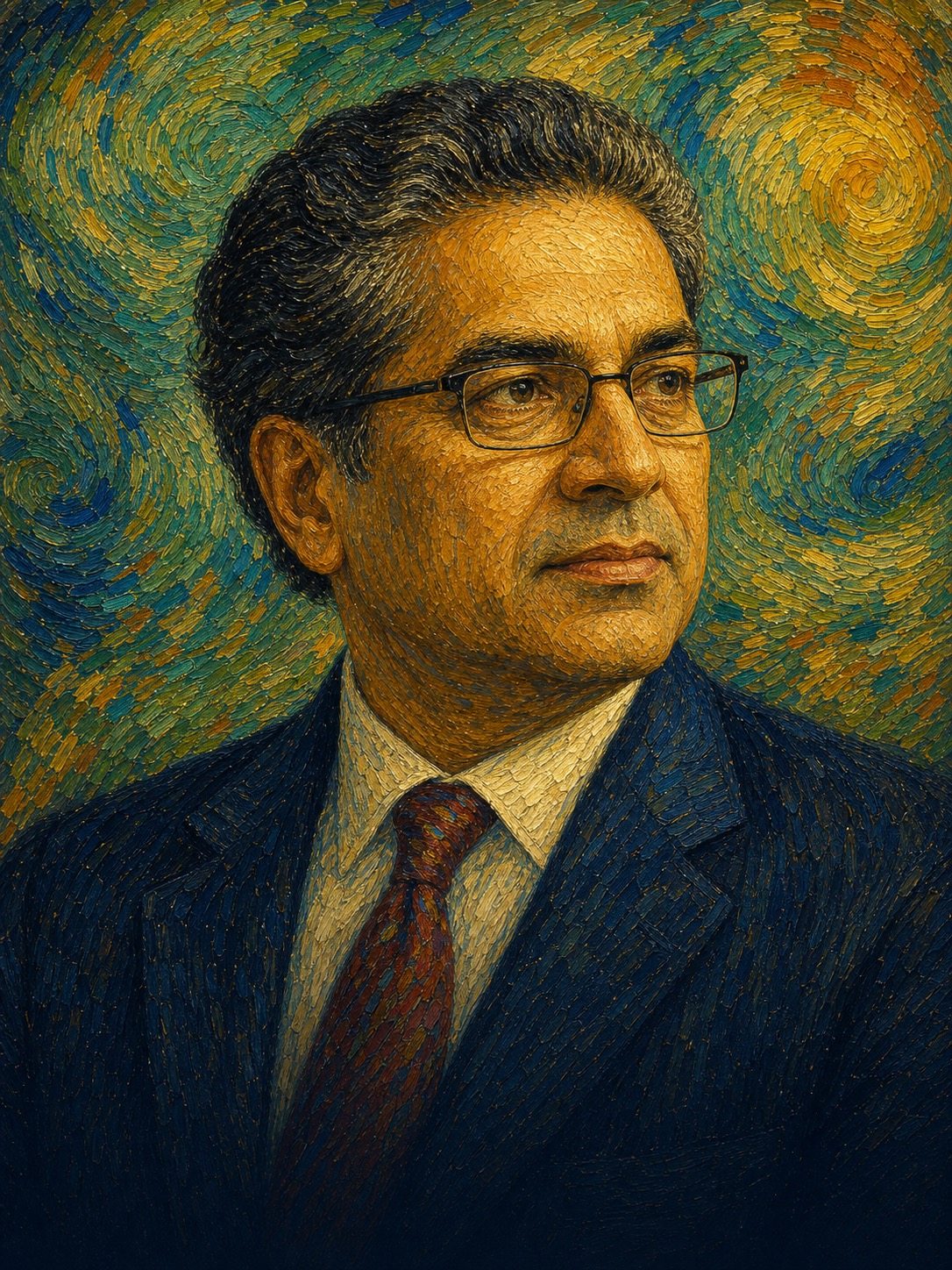
Raamdeo Agrawal
Turned accounting discipline, business quality, growth runway, longevity, valuation, and management integrity into the teachable QGLP system and a 30-study Indian research franchise, while incomplete personal ledgers, retrospective screens, product attribution, governance losses, and founder advantages bound the alpha claim.
As of 2026-07-19 UTC, Raamdeo Agrawal is living and publicly active as Non-Executive Chairman / Chairman and Co-founder of Motilal Oswal Financial Services Ltd. ("MOFSL"). The important legal-current caveat is that opened regulatory and court material in this pass concerned MOFSL, subsidiaries, PMS/AIF vehicles, authorized persons, settlement matters, or cyber operations; no opened primary source showed a personal enforcement proceeding or personal misconduct finding against Agrawal.
Snapshot
| Field | Detail |
|---|---|
| Born / died | Born c. 1957/1958 by official age evidence: the July 2025 Motilal Oswal Mutual Fund SAI listed him as age 67; exact date and birthplace remain open because primary proof was not located. Living as of 2026-07-19 UTC, with current official and 2026 press references to his MOFSL role (MOMF SAI, 2025; MOFSL Annual Report, FY2026; Business Today, 2026). |
| Nationality | Indian; public official profiles and company filings place his career and vehicles in India (MOFSL Speaker Profile; MOFSL Annual Report, FY2026). |
| Main vehicles | MOFSL listed financial-services group; Motilal Oswal Asset Management Company ("MOAMC") mutual funds, PMS, and AIF platforms; Motilal Oswal Wealth / private wealth; firm treasury/proprietary capital; Agrawal's personal and family public holdings; and the annual Motilal Oswal Wealth Creation Study research franchise (MOFSL Annual Report, FY2026; MOAMC About; Wealth Creation Study Archive). |
| Years active | Public-market involvement reported from 1983; MOFSL predecessor business founded with Motilal Oswal in 1987; Wealth Creation Study since 1996; profile remains current in 2026 (Forbes India, 2023; MOFSL Speaker Profile; Wealth Creation Study Archive). |
| Asset classes | Primarily Indian listed equities, equity mutual funds, discretionary PMS, Category III AIFs, public-company promoter equity, and corporate treasury investments; the group also operates broking, wealth, investment banking, private equity, and housing-finance businesses (MOFSL Annual Report, FY2026; MOAMC PMS Disclosure, 2025). |
| Style tags | QGLP, "Buy Right, Sit Tight," quality growth at reasonable price, long-duration compounding, research-led investing, Indian consumer/financial-services compounding, promoter-operator capital allocation, Buffett-influenced but India-localized (Motilal Oswal MF Author Profile; 25th Wealth Creation Study, 2020). |
| Verified track record + period | No audited personal Agrawal composite was found. Documented evidence is split across: company-building results at MOFSL; MOAMC/PMS product records; self-reported personal investment anecdotes; disclosed public holdings; and Wealth Creation Study research. Treat product returns as vehicle-level, not personal returns (MOFSL Investor Relations, 2026; MOAMC Value Migration Strategy; APMI Value Migration, 2026). |
| Peak AUM / AUA | Official FY2026 group Assets Under Advice were Rs 6.6 lakh crore; FY2026 asset-management AUM was Rs 1,55,449 crore, split across mutual fund Rs 1,24,786 crore, PMS Rs 12,354 crore, and AIF Rs 18,309 crore. MOAMC separately stated Rs 1,79,519 crore+ AUM as of 2026-04-27. These are group/platform figures, not Agrawal personal capital (MOFSL Investor Relations, 2026; MOFSL Annual Report, FY2026; MOAMC About). |
Life & Career Timeline
Agrawal's official biographical record is strong on education and public role, but weaker on exact birth details. The July 2025 SAI for Motilal Oswal Mutual Fund lists him as B.Com and ACA, age 67, and describes him as a co-founder of MOFSL and a value investor with more than three decades in financial services (MOMF SAI, 2025). Official Motilal Oswal profiles say he is a qualified chartered accountant and an Associate of the Institute of Chartered Accountants of India (MOFSL Speaker Profile; Motilal Oswal MF Author Profile).
By his own later telling in Forbes India, Agrawal became seriously interested in the stock market in the early 1980s and started in 1983 with little capital or network; he also credits Berkshire Hathaway material, first encountered in the 1990s, with helping move him from short-term opportunity seeking toward compounding and business-quality analysis (Forbes India, 2023). Before the Motilal Oswal franchise became a public-market institution, Agrawal co-authored Corporate Numbers Game with Ram K. Piparaiya in 1986, an early sign that accounting quality and reported-number skepticism were core interests before the QGLP vocabulary existed (WorldCat, 1986/1987; MOFSL Speaker Profile).
The business that became MOFSL began in 1987. MOFSL's FY2026 annual report places the starting point at Prudential Portfolio Services as a sub-broking outfit in 1987, followed by institutional equities and retail expansion, the first Wealth Creation Study in 1996, entry into private equity / investment banking / wealth in 2006, an IPO in 2007, mutual fund launch in 2010, and housing finance in 2013 (MOFSL Annual Report, FY2026). Forbes India's account of the partnership emphasizes that Motilal Oswal and Agrawal were both chartered accountants and evolved a division of labor in which Motilal drove execution and Agrawal drove research, strategy, and investment thinking (Forbes India, 2023).
The early 1990s bull market is part of the Agrawal legend but should be labeled as recollection rather than audited record. Forbes India reports the founders saying that a roughly Rs 15 lakh early base became about Rs 30 crore in around 20 months during the Harshad Mehta-era bull run; another 2023 Forbes India interview has Agrawal recalling that he had about Rs 8-10 crore by 1993 (Forbes India, 2017; Forbes India, 2023). These are useful for career shape but not sufficient to compute a verified personal CAGR.
In 1996, Agrawal launched the annual Wealth Creation Study. The first study covered 1991-1996 and argued that wealth-creating companies tended to have high ROE/ROCE, that mid caps could create wealth faster, that core-business focus mattered, and that market valuation patterns linked business quality and returns (1st Wealth Creation Study, 1996). By the 25th study in 2020, the public framework had been distilled into the QGLP checklist: quality, growth, longevity, and price as an integrated business-selection discipline (25th Wealth Creation Study, 2020). The 30th study, covering 2020-2025, shows the franchise still active and explicitly backward-looking, ranking five-year wealth creators from the Indian listed market (30th Wealth Creation Study, 2025).
The public-company era began with MOFSL's 2007 IPO. The group subsequently broadened from research-led broking into asset management, private wealth, investment banking, private equity, and housing finance (MOFSL Annual Report, FY2026). A Forbes India / MOFSL profile reports that the Value Strategy PMS began in 2003, that MOAMC struggled with an early ETF-heavy approach, and that the active-fund strategy shifted in 2013; the same source ties Agrawal's public persona to QGLP and "Buy Right, Sit Tight" (Forbes India / MOFSL mirror).
By FY2026, the founder role had changed from entrepreneurial operating build-out to governance, capital allocation, philosophy, and succession. The FY2026 annual report describes Agrawal as Chairman, Co-founder, promoter, and Non-Executive Chairman; it also records reappointment language and promoter-group reclassification in which continuing promoters were Motilal Oswal, Raamdeo Agrawal, and their family members (MOFSL Annual Report, FY2026). A July 2026 Business Today report describes a formal succession map in which Pratik Oswal and Agrawal's son Vaibhav Agrawal sit on the board, with Vaibhav overseeing more than Rs 36,000 crore across AIF/PMS platforms; the same report says the group manages or advises close to Rs 7 lakh crore (Business Today, 2026).
Vehicles & Structure
The first structural point is that Agrawal is not only an investor; he is a founder-promoter of a listed financial-services company. MOFSL is listed on the NSE and BSE, had more than 12,450 employees as of 2026-03-31, and reported a market capitalization above Rs 57,000 crore as of 2026-06-19 (MOFSL Annual Report, FY2026). MOFSL's FY2026 investor page reports Assets Under Advice of Rs 6.6 lakh crore, net worth of Rs 12,888 crore, revenue after intercompany of Rs 5,908 crore, operating PAT of Rs 2,360 crore, ROE of 24%, and 15.5+ million clients (MOFSL Investor Relations, 2026). These figures measure a diversified financial platform, not a fund run personally by Agrawal.
The asset-management vehicle is MOAMC, incorporated in 2008 and promoted / sponsored by MOFSL. MOAMC's public page says it is investment manager to Motilal Oswal Mutual Fund under an investment-management agreement dated 2009-05-21, and reports Rs 1,79,519 crore+ AUM and 1.07 crore+ client accounts as of 2026-04-27 (MOAMC About). The FY2026 annual report gives a lower, date- and definition-specific asset-management AUM of Rs 1,55,449 crore as of 2026-03-31, split into mutual fund, PMS, and AIF assets; the reconciliation risk is timing and scope, not necessarily contradiction (MOFSL Annual Report, FY2026).
The PMS and AIF structure matters because it prevents sloppy track-record attribution. The MOAMC PMS disclosure document lists PMS registration INP000000670 and says MOAMC acts as investment manager to Motilal Oswal Alternative Investment Trust, a Category III AIF; it also identifies Agrawal as an associate director / chairman and QGLP advocate, not as the sole portfolio manager of every strategy (MOAMC PMS Disclosure, 2025). Separate Motilal Oswal Wealth materials list another PMS registration for Motilal Oswal Wealth Ltd., showing that "Motilal Oswal" client capital sits across several regulated entities rather than one undifferentiated pool (Motilal Oswal Wealth Registration Details, 2024).
Agrawal also has a personal / family public-equity footprint. The official MOFSL shareholding pattern for the quarter ended 2025-12-31 lists Raamdeo Ramgopal Agrawal with 127,107,260 MOFSL shares, or 21.14% of nominal share capital, and the Raamdeo Agrawal HUF with 17,973,056 shares, or 2.99%; it also lists the broader promoter group at 406,490,452 shares, or 67.62% of nominal share capital (MOFSL Shareholding Pattern, Dec. 2025). Public ownership is central to his wealth, but a founder stake in a listed operating company is not the same as an independently verified stock-picking record.
Finally, the Wealth Creation Study is best understood as a research and pedagogy vehicle. It is Agrawal's most durable public intellectual product, but it is not client capital, audited portfolio performance, or a guarantee that the selected companies were held by Agrawal or MOAMC. The archive shows 30 annual studies, from the first 1991-1996 study to the 30th 2020-2025 study (Wealth Creation Study Archive).
Track Record Detail With Caveats
The conservative conclusion is: Agrawal has a large, well-documented record as a financial-services entrepreneur, promoter, research-franchise builder, and public investment thinker; he does not have a public audited personal composite comparable to a hedge-fund manager's audited return series.
There are four different records that often get blended. The first is the company-building record. MOFSL grew from a 1987 sub-broking / research-led start into a listed group with FY2026 AUA of Rs 6.6 lakh crore, 15.5+ million clients, and market capitalization above Rs 57,000 crore (MOFSL Investor Relations, 2026; MOFSL Annual Report, FY2026). This is an institutional operating-company outcome in which Agrawal's equity stake, research culture, and brand role are crucial.
The second record is personal investment lore. Forbes India has Agrawal recalling an early move from nothing to several crores by the early 1990s and public profiles point to long-held investments such as Hero Honda / Hero MotoCorp, Bosch, Bharti Airtel, Gruh Finance, and Infosys (Forbes India, 2023; Forbes India / MOFSL mirror). These are important leads for Task C, but they are interview/profile evidence, not a complete ledger with entry prices, sizes, dates, realized exits, taxes, and opportunity costs.
The third record is product-level performance. MOAMC's Value Migration Strategy page states a 2003 launch, 26 holdings, Rs 2,476 crore AUM, and since-inception return of 20.5% versus benchmark since-inception return of 18.6%; APMI independently identifies the strategy as launched on 2003-02-18 and reports Rs 3,236.09 crore AUM as of 2026-06-30, but does not expose a full text return table in the page opened here (MOAMC Value Migration Strategy; APMI Value Migration, 2026). A historical MOFSL Value Strategy deck showed a model-client CAGR of 25.67% versus Nifty 18.61% from March 2003 to 2013-06-30, but that is a firm sales document and explicitly not an audited personal Agrawal record (MO Value Strategy Deck, 2013). Later product records also show that QGLP-branded or Motilal Oswal-managed strategies can underperform in particular periods: the 2025 MOAMC PMS disclosure showed, for example, Next Trillion Dollar Opportunity at 0.31% versus 5.96% in FY2024-25 and -10.74% versus -0.91% in FY2022-23, and Hockey Stick Micro Cap at -42.53% versus -9.42% since its 2024 launch date in the displayed table (MOAMC PMS Disclosure, 2025). The record is real but product-specific and team-specific.
The fourth record is the Wealth Creation Study record. The WCS has been powerful because it turns Indian market history into repeatable questions about quality, growth, longevity, and price. But it is ex-post research, not a portfolio. The 30th study ranks wealth creators for 2020-2025 and starts from listed-company datasets; it helps identify patterns, but it does not prove that Agrawal owned the winners or that a client earned the study's computed returns (30th Wealth Creation Study, 2025).
Adverse evidence should be placed at the correct level. SEBI / exchange / disclosure materials show firm and vehicle issues, including a 2019 SEBI order involving Motilal Oswal Commodities Broker Pvt. Ltd. in the NSEL context, a 2025 Rs 3 lakh MOFSL penalty for authorized-person supervision issues, later disclosed penalties / settlement matters, and a 2024 LockBit-related cyber incident reported by business press and addressed by MOFSL as contained without business-operation impact (SEBI MOCBPL Order, 2019; ET LegalWorld, 2025; MOAMC Disciplinary History, 2025; Business Standard, 2024). None of those sources, as opened, makes Agrawal personally the charged actor. They do matter because a founder-promoter's legacy includes institution-level controls, not just investment doctrine.
Why They Matter
Agrawal matters first because he helped create a public Indian vocabulary for long-duration equity compounding. QGLP and "Buy Right, Sit Tight" are not original in the sense that Buffett, Graham, Fisher, and Phelps all echo through them; they are original in their Indian market packaging, annual repetition, and application to local listed-company history (Motilal Oswal MF Author Profile; 25th Wealth Creation Study, 2020).
He also matters as a hybrid figure: analyst, investor, educator, and financial-services entrepreneur. Many investors on the Canon have a fund vehicle first and a philosophy second. Agrawal's case is different. His wealth and influence are inseparable from the institution he co-built, the public research franchise he authored, the MOAMC/PMS/AIF ecosystem his group runs, and his personal reputation as a patient quality-growth investor (MOFSL Annual Report, FY2026; Wealth Creation Study Archive).
The best transferable lesson is not a stock tip, but a method: treat compounding as the joint product of business quality, growth runway, governance, and entry price, then stress the holding period against both drawdowns and boredom. The most important non-transferable edge is also clear: an individual investor cannot copy MOFSL's research distribution, brand access, operating-company economics, client platform, treasury scale, or promoter-control optionality.
Open Questions For Later Tasks
- Locate primary proof for exact date of birth, birthplace, early family background, and undergraduate institution. Current official evidence supports approximate age and professional qualification but not a complete vital-record profile.
- Separate Agrawal's personal portfolio from MOFSL treasury, MOAMC products, family/HUF holdings, and public promoter holdings. Later trade chapters should avoid turning profile anecdotes into a continuous audited record.
- Reconstruct the strongest documented personal trades or campaigns, especially Hero Honda / Hero MotoCorp, Bharti Airtel, Bosch, Gruh Finance, Infosys, and any documented missed or sold-too-early investments.
- Build a product-by-product return table for Value Strategy / Value Migration, Next Trillion Dollar Opportunity, Founders Portfolio, and other MOAMC PMS/AIF strategies, using APMI, disclosure documents, and contemporaneous decks.
- Verify the exact timing and governance meaning of Agrawal's move from executive role / joint managing director references to Non-Executive Chairman language.
- Trace the 1986 Corporate Numbers Game, The Art of Wealth Creation, and each major Wealth Creation Study to distinguish Agrawal-authored ideas from MOFSL team research and borrowed Buffett/Fisher/Phelps concepts.
- Follow current legal and regulatory matters involving MOFSL, MOAMC, MOAIT, and legacy commodities entities to final disposition, while preserving the entity-versus-person distinction.
- Test whether QGLP has predictive value outside the ex-post WCS studies by comparing named criteria with later realized returns, survivorship bias, valuation starting points, and underperforming Motilal Oswal product periods.
- Evaluate succession risk: how much of the franchise depends on Agrawal's personal credibility versus MOFSL's institutional process under Vaibhav Agrawal, Pratik Oswal, and the broader leadership team.
- Resolve source conflicts in public biographies, especially spelling variants (Agrawal / Agarawal / Agarwal), reported age, and lower-confidence birthplace/family claims.
As of 2026-07-19 UTC, Agrawal is living and is MOFSL's Non-Executive Chairman, not the named sole manager of every Motilal Oswal mutual fund, PMS, AIF, treasury account, or model portfolio (MOFSL Annual Report, FY2026). That perimeter matters. This chapter reconstructs three related but different things: Agrawal's first-person philosophy; the jointly authored Wealth Creation Study (WCS) framework; and observable institutional implementation. It does not treat a retrospective screen as a live portfolio or a current team-managed fund as his personal account. No audited personal composite or complete transaction ledger was found.
Core Worldview
Agrawal's organizing idea is QGLP: Quality of business and management, Growth in earnings, Longevity of both, and a reasonable Price. The order is deliberate. In his current formulation, QGL is the value of the business; P asks whether the quoted price leaves an adequate value-price gap. Thus “price comes last” means valuation follows business understanding, not that valuation is optional (Value Research, 2025; 30th WCS, 2025).
Quality is economic and human. A good business earns above its cost of capital, converts accounting profit into cash, operates in a favorable competitive structure, and can reinvest without destroying incremental returns. The 24th WCS defines quality as business quality multiplied by management quality, assesses the management leg through integrity, competence, and growth mindset, and treats the broader QGLP factors as multiplicative; a zero in any factor collapses the product (24th WCS, 2019). Growth without a moat is a temporary “growth trap,” while a moat without growth is a “quality trap.” The desired compounder has both a defensible advantage and room to deploy capital for a long time (22nd WCS, 2017).
The holding principle is “Buy Right, Sit Tight,” but the first half does most of the risk work. Time helps a company whose economics and stewardship remain sound and punishes one whose reported quality is false. The 25th WCS found that only 100 of the 500 largest listed companies in 1995 outperformed the Sensex through 2020. That is an interested, retrospective issuer study rather than an ex-ante success rate, but it captures the worldview: durable compounding is rare, so selection and patience must work together (25th WCS, 2020).
The Edge - What Markets Misprice and Why
The clearest statement of the alleged edge appears in the 18th WCS. It maps quality to the height of above-cost-of-capital profitability, growth to the breadth of capital that can be reinvested at high returns, and longevity to the years those conditions persist. It argues that markets struggle to assess all three dimensions together (18th WCS, 2013). In plain terms, the market may see today's earnings but misjudge the reinvestment runway and the duration of competitive advantage.
Why should that gap exist? Near-term news is vivid; future compounding is exponential and uncertain. Analysts may model a few years accurately yet underweight management's ability to extend the market, protect returns, or allocate capital. Conversely, a famous franchise can be overvalued when investors confuse past quality with future growth. This is an author inference from the studies' QGL and quality-trap/growth-trap models: QGLP attacks both underestimation of a still-expanding compounder and overpayment for a mature “quality” label (18th WCS, 2013; 22nd WCS, 2017).
Agrawal's preferred edge is analytical rather than informational. The focused-investing study says modern investors are unlikely to retain much information advantage; the repeatable edge is a better synthesis of industry structure, market size, management, channel evidence, forecasts, and valuation. Its compact rule is “no edge, no bet” (21st WCS, 2016). This edge is not proven by the WCS winners: those studies begin with historical outcomes and are vulnerable to hindsight, survivorship, classification, and starting-valuation effects.
Process
Idea sourcing
The published funnel is broad: annual reports and conference-call transcripts, broker research, media, screens, word of mouth, other investors, and changes in industries or companies. The 25th WCS explicitly warns that these sources generate leads, not purchases; every lead must still pass the checklist (25th WCS, 2020). Agrawal also looks for large structural tailwinds. His long-running India thesis favors sectors that can scale with income, consumption, savings, and financialization, but he has said different successful investors can own almost no stocks in common. The macro trend narrows the hunting ground; it does not replace bottom-up work (Economic Times, 2020).
Research
The operational checklist starts with history: what the company does, how it makes money, profitability, cash flow, terms of trade, cost structure, industry competition, regulation, and the source of its moat. Growth work then asks how large the addressable market is, what drives it, and whether management has a credible plan to capture it. Management work tests integrity and transparency before competence, then capital allocation, organizational depth, culture, succession, skin in the game, and promoter pledging. Price and risk come only after these questions (25th WCS, 2020).
Agrawal's first-person version is a two-stage funnel. A quick QGLP pass decides whether a company deserves interest; the deeper pass uses quarterly results, annual reports, conference calls, management meetings, and field evidence. He emphasizes both “business tailwind,” visible in the economics, and “management tailwind,” better judged through interaction and observation (NDTV Profit, 2023). The 21st WCS adds corroboration through competitors, dealers, customers, suppliers, and former employees (21st WCS, 2016).
This access is an advantage, but not a guarantee. In 2025 Agrawal described an unnamed mango-drink investment where extensive diligence and promoter access failed to expose two sets of books. He said he ignored warnings because high growth and reported ROE were seductive, losing roughly ₹100–150 crore personally and also harming mutual-fund investors [single-source, self-reported; company unnamed]. His conclusion was that “numbers alone can be misleading” (Value Research, 2025). The case turns management integrity from a slogan into a falsification rule: adverse character evidence must not be averaged away by attractive ratios.
Valuation and entry
The formal objective is to buy below intrinsic or expected value with a margin of safety. Published tools include a three-year or longer financial model, peer and historical multiples, an intrinsic P/E, PEG, and a proprietary five-year payback ratio. The 23rd WCS found favorable historical results below 1x PEG and below 1x payback, but it calculated future growth and profits with perfect foresight. Those results are descriptive backtests, not investible forecasts or hard personal limits (23rd WCS, 2018).
The thresholds also move. A 2017 personal presentation preferred PEG around 1x; the 2020 checklist used up to roughly 1.5x; the 2025 India MTD model admitted stocks below 2x trailing PEG. That latest model used a 12% ROE hurdle, 20% recent PAT growth, and explicit exceptions for unprofitable hypergrowth e-commerce companies (FLAME Investment Lab, 2017; 25th WCS, 2020; 30th WCS, 2025). These are study- or model-specific heuristics. The invariant is price relative to expected quality, growth, duration, and risk.
Entry need not occur at the first discovery. The 19th WCS argues that a future 100-bagger can still reward a late buyer if the small-company runway, quality, growth, longevity, and valuation remain intact (19th WCS, 2014). The practical implication is to wait for enough evidence of emergence rather than demand the exact low.
Sizing and portfolio construction
The public framework favors a focused portfolio because rare high-edge situations should matter. The 21st WCS suggests 15–20 stocks and a Confidence-Adjusted Payoff (CAP) ranking: estimated three- or five-year upside multiplied by a 0–100% confidence factor. It offers 3% minimum and 10% maximum weights as possible norms, not commandments, and explicitly says Kelly's mathematics has limited applicability because equity payoffs and probabilities are estimates (21st WCS, 2016).
Agrawal has separately described starting personal ideas around 2.5–3%, allowing winners to grow, and regretting 8–10% initial allocations that failed. He also said he remained fully invested and switched from one stock to another rather than trying to time the market (NDTV Profit, 2023). These are personal-practice statements, not mutual-fund mandates. In 2024 he acknowledged that his operating-company income and dividends make drawdowns easier to tolerate; investors dependent on portfolio withdrawals need fixed-income reserves (Economic Times, 2024).
The current studies demonstrate the perimeter problem. The 30th WCS built an equal-weighted 30-stock illustration, including MOFSL itself, and labeled it a quantitative model rather than investment advice (30th WCS, 2025). The May 2026 Motilal Oswal Focused Fund product note described a maximum-30-stock mandate and named an equity team other than Agrawal (MOAMC Focused Fund product note, May 2026 data). Neither portfolio proves his personal sizing rule.
Institutional implementation has also evolved away from a pure concentration slogan. In 2023 MOAMC described a house framework with more equal weighting, sector controls, profit booking, stop-loss discipline, and limits on top-ten weights relative to industry benchmarks. Those are firm-level risk overlays, not authenticated rules for Agrawal's personal account, but they show that “Buy Right, Sit Tight” is now mediated by product constraints and explicit loss controls (MOAMC, 2023).
Sell discipline
“Sit tight” is conditional monitoring, not sleep. The 21st WCS requires earnings estimates versus actuals, management contact, channel corroboration, plans for irrational price moves, and a continuing search for superior ideas. It warns against overstaying winners as well as losers (21st WCS, 2016). Agrawal has said he sells when an idea is not working or a clearly better one appears, while remaining invested overall; bad management warrants exit rather than patience (Value Research, 2022, part 1; Value Research, 2022, part 2).
The sell triggers that can be reconstructed are: broken integrity, deteriorating economics or growth, a shorter competitive-advantage period, irrational capital allocation, extreme price relative to value, portfolio-risk constraints, or a superior alternative. This is an author synthesis, not a published universal personal rulebook (21st WCS, 2016; 25th WCS, 2020). Cyclicals are a special exception: an older WCS lesson is that a supply squeeze can reward selling earlier than a secular compounder, so “sit tight” cannot be applied mechanically across business types (25th WCS, 2020).
Risk Management
QGLP treats permanent impairment, not price volatility, as the central risk. The checklist's final question is what can go wrong with both the narrative and the numbers: slowdown, disruption, regulation, capital allocation, key-person dependence, succession, liquidity, and management conduct. Position limits and diversification contain the cost of being wrong; active monitoring asks whether the original thesis still deserves capital (25th WCS, 2020).
Agrawal explicitly rejects speculation and leverage, linking both to market participants who were forced out. He contrasts quick-money trading with patient compounding and says portfolio activity is generally its enemy (Economic Times, 2024). His “100% invested” preference is asset allocation, not leverage, and rests on circumstances that many investors cannot copy (NDTV Profit, 2023). A long horizon absorbs volatility; it does not rescue fraud, disruption, or an overvalued business whose growth disappoints.
Temperament and Psychology
The desired temperament is patient, independent, curious, and comfortable with concentration, but willing to falsify conviction. Agrawal says discovering Buffett around 1994 forced him to unlearn an EPS/P-E-centered approach and prioritize ROE, business quality, and compounding. He describes each annual WCS as an incremental learning record rather than a finished doctrine (Value Research, 2025).
Patience has two jobs: let business value compound and avoid the tax, friction, and timing error of repeated exits. It also creates hazards. Ownership bias encourages overstaying; confirmation bias can turn research access into reassurance; overconfidence can inflate a promising idea; and loss aversion can protect a bad thesis. The focused-investing study names all four failure modes (21st WCS, 2016). The mango-drink failure is the sharpest actual-behavior counterexample: diligence and confidence did not overcome ignored warnings.
Evolution over the Career
- Pre-framework opportunism. Agrawal recalls an early focus on EPS, P/E, and a sprawling 225-stock portfolio. The claimed reduction to 15 stocks and subsequent doubling is self-reported and lacks a ledger (Value Research, 2025).
- Buffett and structured learning. From roughly 1994, Buffett's treatment of ROE, business economics, management, and compounding reshaped the approach; the WCS series began in 1996 (WCS Archive; Value Research, 2025).
- QGL and the route to QGLP. The 2013 study explicitly defined QGL; the December 2014 WCS used SQGLP for small potential 100-baggers; and by 2016 the focused-investing study used QGLP without the size prefix (18th WCS, 2013; 19th WCS, 2014; 21st WCS, 2016).
- Process expansion. Later studies added CAP/GAP longevity, valuation/payback evidence, management-integrity forensics, and the 25-question QGLP checklist (22nd WCS, 2017; 23rd WCS, 2018; 24th WCS, 2019; 25th WCS, 2020).
- Flexible modern application. The 2025 study retained the checklist but changed hurdles, allowed new-economy exceptions, used top-down sector selection, and produced an equal-weighted model. Its assertion that QGLP was “first presented” in 2020 conflicts with the earlier documentary trail; the narrowest reconciliation is that the comprehensive checklist was formalized in 2020, not that QGLP language began then (30th WCS, 2025).
What He Explicitly Rejects
The record supports rejection of speculation and leverage; market timing; weak or dishonest management; low-quality growth bought on narrative alone; quality without growth; excessive diversification that makes no idea matter; and purchasing before understanding the business. It does not support blanket bans on technology, small caps, cyclicals, selling, or temporarily unprofitable companies. The framework has admitted each when the economics, runway, price, or regime justified an exception (Economic Times, 2024; 22nd WCS, 2017; 30th WCS, 2025).
Regimes Where It Thrives versus Struggles
| Regime | Expected behavior and evidence boundary |
|---|---|
| Stable nominal growth with long consumer or financial runways | High returns on capital, pricing power, and reinvestment can compound for years; this is QGLP's natural habitat (30th WCS, 2025). |
| Panic in a still-sound compounder | Analytical conviction and a full-investment bias can exploit short-term irrationality, provided liquidity and integrity remain intact (Economic Times, 2016). |
| Scarce capital or rising rates | Author inference: long-duration growth values are sensitive to discount rates and terminal assumptions; high starting multiples can de-rate before earnings fail (23rd WCS, 2018). |
| Commodity or deep cyclical upswing | Secular-quality screens can lag low-quality operating leverage; the correct sell horizon is shorter because excess returns attract supply and mean reversion (25th WCS, 2020). |
| Speculative or pre-profit innovation boom | Profitability and valuation discipline may underparticipate; the 2025 model's exceptions improve reach but reduce the historical-accounting anchor (30th WCS, 2025). |
| Inflation or margin shock | Author inference: brands and pricing power can help, but reported growth can conceal working-capital stress and shrinking real economics (25th WCS, 2020). |
| Governance or disruption shock | Patience is harmful when integrity, competitive advantage, or relevance is permanently impaired; the mango-drink account is the clearest admitted example (Value Research, 2025). |
| Broad value rotation | Author inference: a concentrated quality-growth portfolio may lag cheaper cyclicals and state-owned businesses even if its long-run holdings remain sound (21st WCS, 2016; 23rd WCS, 2018). |
Tensions between Stated Philosophy and Actual Behavior
- Stable core, moving thresholds. PEG preferences, ROE hurdles, growth floors, and profitability exceptions change across studies. They are context-sensitive tools, not laws (FLAME Investment Lab, 2017; 25th WCS, 2020; 30th WCS, 2025).
- Price last, but not least. Long-run valuation effects may fade if growth is realized, yet overpayment lowers returns and magnifies duration risk. The doctrine contains both claims (23rd WCS, 2018; Value Research, 2025).
- Sit tight versus active replacement. The research advocates patience and low activity, but also continuous opportunity-cost ranking and selling when a superior idea appears (21st WCS, 2016; Value Research, 2022).
- Concentration versus institutional practice. The canonical focused portfolio is 15–20 names. The May 2026 Focused Fund had a maximum-30-stock mandate and a 1.8 turnover ratio; it trailed the Nifty 500 TRI over three, five, seven, and ten years and since inception while outperforming over one year. Those are official regular-plan product results, not Agrawal's personal record, but they show that the brand does not guarantee low churn or persistent alpha (MOAMC Focused Fund product note, May 2026 data).
- Management access versus integrity. The process prizes meeting management; the admitted fraud loss shows access can intensify confirmation bias rather than expose deception (Value Research, 2025).
- Fully invested versus survivability. Agrawal's personal circumstances include parallel operating income. Investors without that buffer cannot safely copy his equity allocation or tolerance for drawdowns (Economic Times, 2024).
- Framework evidence versus track record. WCS screens are valuable hypothesis generators but are mostly retrospective. They do not establish that the stocks were identified ex ante, bought at the modeled price, sized as suggested, or earned the reported return after fees and taxes (WCS Archive; 25th WCS, 2020).
- Skill versus favorable base rates. Author inference: research discipline, institution building, and long holding are real skills, while India's expanding economy, permanent founder capital, management access, survivorship in published examples, and a large operating-company stake are advantages that cannot be isolated in an audited personal return series (MOFSL Annual Report, FY2026; Value Research, 2025; WCS Archive).
- Integrity doctrine versus institutional controls. The FY2026 annual report discloses 2025 SEBI penalties of ₹3 lakh and ₹11 lakh and a ₹34.85 lakh settlement involving MOFSL matters. These are company/entity outcomes, not personal findings against Agrawal and not tests of a stock-selection model. They remain relevant to the gap between a non-negotiable integrity doctrine and the compliance record of the institution bearing his name (MOFSL Annual Report, FY2026).
The transferable core is narrower than the brand: understand the economics before the price, require trustworthy and capable stewardship, estimate both growth and its duration, pay less than conservatively assessed value, size only what can be monitored and survived, and sell when the evidence—not merely the quotation—breaks the thesis (25th WCS, 2020).
As of: 2026-07-19
Evidence Perimeter And Ranking
Raamdeo Agrawal calls Motilal Oswal Financial Services itself his best investment. This chapter excludes that founder stake from the trade ranking: building and retaining a promoter holding is economically important, but it is not comparable with buying a quoted security for an investment portfolio. No audited record establishing a unique best outside-security trade was located. The ordering is therefore editorial, based on reconstructability and teaching value. Under that rubric, Bharti Airtel is the single best public reconstruction and editorial number one because multiple first-person sources preserve the insight, entry, peak, exit, and approximate return on a reasonably consistent basis. Hero Honda, now Hero MotoCorp, is the most consequential long-duration case, Vysya Bank has the highest clearly claimed multiple, and Eicher Motors has the clearest disclosed team position size. No audited personal composite, complete trade blotter, or position-level tax record was located.
The vehicle boundary matters. Contemporary profiles describe a roughly $100 million proprietary book containing Agrawal's and Motilal Oswal's wealth. Agrawal also called the listed holdings “his portfolio as much as my portfolio” in 2011, direct evidence of a joint founder/proprietary pool rather than two clean personal ledgers (Economic Times, 2011). Other cases belong to an unnamed Motilal Oswal portfolio/team or later managed products. “Agrawal trade” below therefore means a decision publicly attributed to him or his investment team, not necessarily an asset held solely in his personal name. A percentage or multiple is labelled reported when it comes from an interview, presentation, or book excerpt and author arithmetic when calculated from disclosed inputs. These are not audited returns.
| Rank | Case | Best public outcome evidence | Attribution and confidence |
|---|---|---|---|
| 1 | Bharti Airtel | ₹25 to ₹650, or 26x gross value / about 2,500% profit, after a ₹1,180-1,200 peak | Joint founder/proprietary pool; high confidence in reported price points, low in size, basis, and exact dates |
| 2 | Hero Honda / Hero MotoCorp | About ₹30 to ₹2,600 over roughly 1995-2014/15, plus ₹3-4 crore annual dividends near exit; exact total return not reconstructable | Joint founder/proprietary wealth pool; high confidence in the episode, medium confidence in the numbers |
| 3 | Vysya Bank | Roughly 100x reported, from about ₹22 to ₹2,200-2,300 | Likely early founder-held capital; high confidence in broad result, medium in the precise path |
| 4 | Eicher Motors | ₹15 crore initial position; “sixty times” growth reported by 2020, with no disclosed full exit | Motilal Oswal portfolio/team; high confidence in entry size, medium in outcome basis |
| 5 | Calcutta Electric / CESC | ₹13-14 to a ₹120 sale after a ₹150 peak, or about 8.6-9.2x gross value | Holder and size unknown; medium confidence because the path has one direct retrospective source |
| 6 | Infosys | A 2.5% starting weight became an exceptionally large winner; sold in 2000 at a reported ₹8,000 | Self-described corpus/proprietary context; medium confidence because the edited transcript is incomplete |
Hero Honda / Hero MotoCorp - The Great Long-Duration Compounder
Context & Dates
Agrawal began the position in about 1995 at a reported ₹30 per share, just as reading Buffett was pushing him from bargain trading toward long-duration ownership. A Forbes India profile says he invested about ₹10 lakh and held for 20 years; another Forbes India article says he bought five lakh shares in 1995-96. Both put the sale in 2015 at about ₹2,600. Agrawal himself later dated the clean-up to “2014 or so.” The safest exit window is therefore 2014-15, not a fabricated single trade date (Forbes India; Forbes India on Hero; Economic Times interview).
Thesis & How Found
The thesis combined a structural consumer shift with unusually good unit economics. Agrawal's 2017 presentation framed the case around India's move toward two-wheelers, Honda's technology, the Munjal family's manufacturing and distribution, 28% return on equity, and a 25% payout. From 1995 to 2000, sales rose from ₹475 crore to ₹2,246 crore and profit after tax from ₹19 crore to ₹187 crore (FLAME Investment Lab presentation). Later, Agrawal emphasized zero debt, negative working capital, management commitment, and capital-light growth.
Size & Structure
This was in the joint founder/proprietary wealth perimeter, not evidence of a public fund trade or a position solely in Agrawal's legal name. The two main size claims do not reconcile on their face: “around ₹10 lakh” at ₹30 implies about 33,333 original shares, whereas five lakh original shares at ₹30 imply ₹1.5 crore. If five lakh instead means a later share count, dividing by ten implies 50,000 original shares and a ₹15 lakh cost; dividing by 12.5 implies 40,000 and ₹12 lakh. Both are much closer to the ₹10 lakh account, but the article never identifies the share-count basis. Neither number is an exact cost basis.
Entry And Path, Including Drawdown
Forbes reports that the stock traded around ₹170 between March 2000 and March 2001 while technology shares commanded attention, then reached ₹365 in March 2002. In December 2010 Honda agreed to sell its full 26% joint-venture stake to the Indian promoters, creating technology, brand, and market-share risk; Agrawal held through the separation. Honda confirms the stake sale, while Forbes records subsequent market-share pressure (Forbes India; Honda release; Forbes India on Hero). A maximum holding-period drawdown is not disclosed.
Corporate actions make the folklore arithmetic hazardous. Hero's official stock-facts page records a 1:4 bonus on February 7, 1995; filings record a 1:1 bonus in 1998 and a five-for-one split from ₹10 to ₹2 (Hero stock facts; Hero Honda 1998-99 annual report; Hero Honda 2000-01 annual report). Because the purchase is dated only “about 1995,” a holder through the later actions received either ten times or, if bought before the February bonus, 12.5 times as many shares. Thus ₹30 and ₹2,600 cannot safely be divided unless both quotes use a common basis. The repeated 86.7x is a raw comparison of two labels, not a verified shareholder return.
Exit & P&L
Forbes reports a sale near ₹2,600 and annual dividends of ₹3-4 crore immediately before exit. Agrawal says the sale resulted from collapsing individual holdings into mutual funds, not a negative company thesis. The proprietary book and corporate treasury were moved into Motilal Oswal funds by April 2015. The dividend is a useful reconciliation check: 33,333 original shares would become about 333,333-416,667 terminal shares, making ₹3-4 crore equivalent to roughly ₹72-120 per terminal share, a plausible distribution; without corporate actions it would require an implausible ₹9,000-12,000 per share. The reported figures therefore likely mix share bases or include later accumulation. If ₹30 and ₹2,600 are on a common adjusted basis, they imply 86.7x gross price appreciation and about 25.0% annual compounding over 20 years by author arithmetic. Absolute P&L remains unavailable. Hero is the most consequential long-duration outside-security episode located, not a provable unique best.
What It Teaches
Hero is a test of thesis-based patience, not passive permanence. Agrawal tolerated dull price periods and a joint-venture breakup because business economics and management quality remained acceptable. He eventually sold for portfolio-structure reasons, demonstrating that a great business can leave a portfolio without the thesis having failed.
Sources
Forbes India; Forbes India on Hero; Economic Times interview; FLAME presentation; Honda; Hero stock facts; 1998-99 annual report; 2000-01 annual report.
Eicher Motors - The Best-Sized Reported Team Trade
Context & Dates
The Motilal Oswal portfolio entered Eicher Motors in 2009, when the market capitalisation was reported near ₹2,000 crore and profit near ₹100 crore. This was after Eicher had placed its commercial-vehicle operations into a joint venture with Volvo and before Royal Enfield's Classic range made the motorcycle economics obvious. Agrawal still named Eicher among his rewarding investments in a January 2022 interview (Value Research).
Thesis & How Found
Agrawal initially liked the truck operation and treated Royal Enfield as downside protection: if trucks disappointed, the niche motorcycle brand could keep the investment from sinking. He asked Manish Sonthalia to investigate. A later book excerpt describes Sonthalia persisting after management initially declined a meeting, then mapping a large online search audience for 350cc motorcycles against very little affordable supply. The thesis evolved after purchase as evidence strengthened; it was not a fully formed Royal Enfield forecast at entry (Moneycontrol book excerpt; Economic Times interview).
Size & Structure
The book excerpt gives the cleanest team sizing disclosure in this chapter: an unnamed Motilal Oswal portfolio invested 5% of a ₹300 crore portfolio, or about ₹15 crore by author arithmetic, at ₹900 per share in 2009. This was a team process executed through Sonthalia under Agrawal, not a disclosed institutional fund. A separate 2016 first-person account describes research being complete near ₹1,800, Agrawal's first purchase at ₹2,100, and a planned 50,000-share order of which only 26,000 shares filled—about ₹5.46 crore by author arithmetic (Moneycontrol/CNBC transcript). That later fill is not merged with the 2009 team ledger.
Entry And Path, Including Drawdown
The 2009 group position “corrected significantly” immediately after purchase, but neither percentage nor trough price is disclosed, so entry confidence is medium-high, not absolute. In the later account, price moved to ₹2,700-2,800 before Agrawal could complete his desired order—an execution shortfall rather than a disclosed drawdown. Operational evidence then arrived quickly. Eicher's official 2013 annual report shows Royal Enfield volume rising from 52,576 motorcycles in 2009 to 178,121 in 2013; standalone profit after tax rose from ₹38 crore to ₹279 crore. An earlier official report shows how modest the base was: 38,528 Royal Enfield motorcycles in 2007-08 (Eicher 2008 annual report; Eicher 2013 annual report).
Exit & P&L
No full exit is established. In 2017 Agrawal said he had not sold a share of “my Eicher Motors investment,” while the 2020 book excerpt says the team investment had grown sixty times and Eicher remained about 5% of a portfolio exceeding ₹10,000 crore (NDTV Profit 2017). Sixty times ₹15 crore is about ₹900 crore. Five percent of a portfolio exceeding ₹10,000 crore is only a lower bound above ₹500 crore, not a contradiction: the portfolio could have been near ₹18,000 crore, or the statements could use different dates or purchases. Eicher also completed a ten-for-one split effective August 25, 2020, so later quote comparisons require adjustment (Eicher FY2020-21 annual report). The defensible conclusion is a very large, still-held gain by 2020, with exact realized P&L unknown.
What It Teaches
Eicher shows research as updating rather than prophecy. The initial truck thesis provided value support; persistent fieldwork uncovered Royal Enfield's demand-supply gap; later operating results justified adding conviction. It also shows why attribution discipline matters: this was a team and vehicle achievement, not a lone-investor legend.
Sources
Value Research; Moneycontrol 2016; Moneycontrol book excerpt; NDTV Profit 2017; Economic Times; Eicher 2008 annual report; Eicher 2013 annual report; Eicher FY2020-21 annual report.
Vysya Bank - The First Reported 100-Bagger
Context & Dates
Agrawal's most recent detailed retelling says he bought Vysya Bank in 1991 at about ₹22 as a bull market began, and sold roughly two to two-and-a-half years later around ₹2,200-2,300. A 2016 interview instead gives ₹20 to ₹2,000 over four to five years, while an older profile says ₹25 to ₹2,000 and places the origin in 1980. The 1991 account is both newer and repeated in two direct interviews, so it anchors the dossier; the older variations remain evidence of retrospective-memory risk (Forbes India Pathbreakers; Value Research 2022; Value Research 2016; Gulf News profile).
Thesis & How Found
The sources do not preserve a modern investment memo. Agrawal says a client identified the bank, while his own weekend practice was reading balance sheets and building fluency in production, costs, margins, and cash flow. The trade therefore combines idea-network luck with the accounting skill to recognize a bargain during an early-stage bull market.
Size & Structure
This was likely personal or early founder-held capital, apparently represented by physical certificates. Agrawal explicitly says he did not own many shares and that the absolute money made was small despite the roughly 100x result. No rupee cost, portfolio percentage, or legal holder is public.
Entry And Path, Including Drawdown
The older profile supplies a remarkable path absent from the newer interviews: the stock reached ₹2,000, fell to ₹300, and Agrawal tried to sell, but missing paper certificates prevented delivery. The 85% drawdown from ₹2,000 to ₹300 is author arithmetic. Replacement certificates took about eight months and reportedly cost ₹50 per share; the price recovered before he could complete the sale. Because that profile's entry year conflicts with later accounts, the drawdown belongs to a credible anecdotal path, not an audited chronology.
Exit & P&L
The latest retelling implies about 100x gross proceeds from ₹22 to ₹2,200, or up to 104.5x at ₹2,300. Earlier retellings imply 80x to 100x. Absolute profit, dividends, fees, and taxes are unknown. “Roughly 100x” is the proper conclusion, not false precision. The later corporate identity does not extend the trade chronology: ING Vysya merged into Kotak Mahindra Bank effective April 1, 2015, long after the reported sale (Kotak announcement).
What It Teaches
Agrawal calls the outcome partly luck. Lost certificates forced patience that his intended sale order did not. Vysya therefore should not be rewritten as pure temperament: analytical preparation mattered, but external idea sourcing, a bull market, and accidental inability to sell were material.
Sources
Forbes India Pathbreakers; Value Research 2022; Value Research 2016; Gulf News; Kotak.
Bharti Airtel - The Single Best Public Reconstruction
Context & Dates
Agrawal's 2017 presentation places the case in 2003, when Bharti had about ₹3,000 crore of sales, a ₹5,200 crore market value, and positive cash profit. In a separate first-person interview, he traced the spark to seeing someone use a mobile phone in the United States in 1996-97, then waiting until Bharti reported quarterly break-even in 2003. A 2026 retelling describes the investment as “about two decades ago,” but public sources do not disclose a precise final exit date. A 2011 interview says Bharti had almost doubled and “we have not sold,” so the ultimate sale may have followed Bharti's 2010 Africa expansion or occurred in multiple tranches; a neat pre-Africa chronology would be invented (NDTV Profit 2017; Economic Times, 2011).
Thesis & How Found
The insight was value migration from fixed-line to wireless communication. Bharti was the clear leader in a market with a long runway, yet early accounting profits were weak enough to deter investors. Agrawal's deck shows the ex-post operating validation from 2003 to 2008: sales rose from ₹3,050 crore to ₹27,012 crore and profit after tax from a ₹200 crore loss to ₹6,350 crore (FLAME Investment Lab presentation).
Size & Structure
No share count, cost, portfolio weight, exact account, or tranche ledger is public in the located sources. Forbes identifies Bharti among the proprietary book's successful investments, while Agrawal described listed holdings as joint with Motilal Oswal. The defensible attribution is therefore a joint founder/proprietary pool, not a solely personal account or later mutual-fund return (Forbes India).
Entry And Path, Including Drawdown
Agrawal reports buying at ₹25. The stock later reached ₹1,180-1,200 before he sold at ₹650. If all three reported quotes share a price basis, the peak was roughly 47-48x entry and the sale was 44.9-45.8% below peak by author arithmetic. That condition matters: Bharti officially subdivided each ₹10 share into two ₹5 shares in 2009 (Bharti Airtel AGM notice, corporate-actions table). His presentation also uses a ₹14 reference price and ₹413 end price for its 2003-08 “PUD” case study. These differing bases make the giveback an anecdotal path, not a verified adjusted-price series.
Exit & P&L
On a common basis, ₹25 to ₹650 is 26x gross value, equivalent to a 2,500% profit before dividends, fees, and taxes. In April 2026 Agrawal rounded this to a “25x profit” and said he exited after developments he did not like, without naming them (Value Research 2016; NDTV Profit 2026). Exact realized profit remains unknown because size, tranches, split basis, and exit date are missing.
What It Teaches
Bharti rebuts two tidy myths: a long-term investor need not hold forever, and a successful exit need not occur at the top. On the reported same-basis path, Agrawal surrendered nearly half the peak quote yet still captured about a 2,500% profit because the entry price and earnings migration had done the heavy lifting.
Sources
FLAME presentation; Forbes India; Value Research 2016; NDTV Profit 2017; NDTV Profit 2026; Economic Times 2011; Bharti Airtel AGM notice.
Calcutta Electric / CESC - The Rate-Cycle Contrarian
Context & Dates
In a May 2011 direct interview, Agrawal recalled buying Calcutta Electric, now CESC, five or six years earlier at about ₹13-14. He said the stock reached about ₹150 within two years and that he sold around ₹120. This is a coherent first-person reconstruction but rests on one retrospective source, so its dates and quotes remain approximate (Economic Times, 2011).
Thesis & How Found
The company was available at a reported market value near ₹90 crore despite a stable electricity-generation and distribution monopoly in Kolkata. Heavy leverage depressed reported profits. Agrawal compared interest cost with market value—interest was reportedly three to four times market capitalisation—and reasoned that falling rates from 13-14% toward 6-7% would release disproportionate earnings. The office looked unappealing and local contacts discouraged him, but regulated utility economics and the identifiable rate catalyst mattered more.
Size & Structure
No investment amount, share count, portfolio weight, account, or legal holder was located. The interview moves between “I” and “we,” so this chapter attributes the decision to Agrawal but does not classify it as solely personal or as a specific Motilal Oswal vehicle.
Entry And Path, Including Drawdown
The reported path is ₹13-14 to about ₹150 in roughly two years, an interim gross multiple of 10.7-11.5x by author arithmetic. No pre-peak drawdown or purchases after entry are disclosed. The thesis reportedly validated as falling interest expense caused marginal or negative profit to expand four to six times.
Exit & P&L
The reported ₹120 sale implies about 8.57-9.23x gross value, or a 757-823% gain before dividends, fees, and taxes. If the entire holding lasted exactly two years, the implied CAGR would be about 192.8-203.8%; the interview does not establish that exact interval, so this is a scenario, not a reported return. Agrawal said the stock later rose to ₹400-500. Absolute P&L remains unknown.
What It Teaches
CESC is a balance-sheet and macro-sensitivity lesson: a stable franchise can appear weak when financing costs consume operating profit, while a rate decline can release earnings. Selling after a retreat from ₹150 to ₹120 shows that a valid catalyst trade need not capture all later upside.
Sources
Infosys - A Transformative Winner With An Incomplete Ledger
Context & Dates
Agrawal says the investment began in 1997-98; a 2023 panel transcript says he bought a 2.5% position in 1998-99. The context was India's software-services export boom, before the dot-com peak. He later listed Infosys among several rewarding investments, but no complete trade statement is public (Economic Times 2019; NDTV Profit panel; Value Research 2022).
Thesis & How Found
Agrawal did not need to forecast frontier technology. He understood the early model as labour-cost arbitrage between Bangalore and Boston, reinforced by scale, skill, project implementation, and management capability. That framing kept the idea within his accounting-and-business circle of competence.
Size & Structure
He reports starting at 2.5% of his equity corpus. The wording indicates self-described corpus/proprietary context, but the exact account and legal holder are unknown. The edited 2023 transcript then says “both of them became 40% each” within about 24 months, but it does not preserve the other position's antecedent. It securely supports a small starting weight and exceptional portfolio impact; it does not justify a clean claim that Infosys alone ended at exactly 40%.
Entry And Path, Including Drawdown
No entry price or holding-period drawdown is disclosed in the strongest sources. Agrawal later said his aggregate technology exposure, including Infosys, NIIT, and Mastek, reached about 80% before the technology bust; that aggregate is not an Infosys position size (Value Research: The best time to buy). This is why the dossier ranks below the more reconstructable cases.
Exit & P&L
A profile written in clear 2010 market context, though the current page carries a 2018 update stamp, says Agrawal sold Infosys in 2000 at ₹8,000 per share and rolled the proceeds into an unnamed ₹400 stock that fell to ₹20 (Gulf News). In 2024 he clarified that he sold close to 80% near the top, then bought “junk” that went to zero; the retained Infosys recovered after about three years (Moneycontrol 2024). No cost basis, share count, adjusted-price series, or realized profit is given. Infosys was clearly transformative, but neither an absolute P&L nor a defensible multiple can be reconstructed.
What It Teaches
Infosys shows that “circle of competence” can expand through a simple economic model rather than technical mastery. It also contains a capital-allocation warning: a great exit does not protect wealth if proceeds immediately enter a low-quality business. The winner and the subsequent loss must be assessed as separate decisions.
Sources
Economic Times 2019; NDTV Profit panel; Value Research: The best time to buy; Value Research 2022; Gulf News; Moneycontrol 2024.
Named Winners Not Promoted To Dossiers
Forbes names Bosch and Gruh Finance alongside Hero, Bharti, and Infosys. Agrawal has separately described Bosch as an exceptional long-run compounder. For Gruh, his account says “we” bought when the company's market capitalisation was ₹200-300 crore and later observed it around ₹10,000 crore—about a 33.3-50x company-value increase, not invested capital or realized proceeds (Moneycontrol/CNBC). The located sources do not disclose a complete entry, size, vehicle, exit, and P&L ledger for Bosch or Gruh, so neither is promoted.
Bharat Wire Ropes is rejected as a trade legend for a different reason. Its prospectus traces the original holding through Passionate Investment Management and Visu Holdings, involving Motilal Oswal, Agrawal, and Passionate Investment Management (Bharat Wire Ropes prospectus). The ₹4.94 crore 2020 headlines described an inter-se transfer from founder-owned Osag Enterprises, not a fresh group investment, and no final exit or position return was located (Economic Times). Wrapper movement is not a qualifying greatest trade. Motilal Oswal Financial Services is also excluded because it is a founder/promoter stake. HDFC Bank belongs in mistakes: Agrawal bought 500,000-600,000 shares around ₹40 in 1995-96 and sold near ₹52 within two years, later calling the exit a major regret.
Cross-Case Lessons: Skill, Luck, And What The Record Cannot Prove
Three repeatable skills appear across the six cases. First, Agrawal translated a structural or macro shift into company economics: scooters to motorcycles, fixed lines to mobile, labour-cost arbitrage to software exports, latent premium-motorcycle demand, and falling rates into utility earnings. Second, he allowed evidence or appreciation to create concentration, but the record does not prove a consistent start-size rule. Where sizing exists, Infosys reportedly began near 2.5% and Eicher near 5% of their respective portfolios. Hero's cost conflicts, while Bharti, Vysya, and CESC lack reliable weights. Third, he separated a company thesis from a portfolio decision: Hero was sold for vehicle alignment, Bharti after adverse developments, CESC after the catalyst worked, and Eicher was held while the thesis improved.
Luck is equally visible. Agrawal says as much about Vysya; missing certificates prevented a panic sale. Hero's exact folklore benefits from retrospective price adjustment and incomplete ledgers. Eicher's Royal Enfield upside was initially backup rather than the primary forecast. Infosys proceeds then went into a severe loser. The record supports an exceptional investor and research organization, but it does not support an audited personal CAGR or a claim that every celebrated case was solely his decision.
As of 2026-07-19 UTC, the evidence supports a rigorous but bounded conclusion: Raamdeo Agrawal has publicly admitted several meaningful mistakes, including a large permanent-loss account in an unnamed mango-drink company, repeated errors in judging promoter integrity, over-diversification before his Buffett-influenced process matured, overconfidence in some allocations, over-staying some winners, and under-participating in or selling too early from several compounders. No opened primary or near-primary source in this run showed a personal SEBI/SAT enforcement finding against Agrawal. The regulatory record is real, but it is chiefly at the level of Motilal Oswal Financial Services Ltd. ("MOFSL"), Motilal Oswal Asset Management Company ("MOAMC"), Motilal Oswal Alternative Investment Trust ("MOAIT"), Motilal Oswal Commodities Broker Pvt. Ltd. ("MOCBPL"), products, systems, and authorized persons (MOAMC Disciplinary History, 2025; SEBI MOCBPL Order, 2019; SEBI MOFSL Adjudication, 2025).
The chapter therefore separates five things that are often blended: Agrawal's personal self-reported losses; public-client or mutual-fund harm tied to Motilal Oswal vehicles; opportunity-cost errors; product-level underperformance under the Motilal Oswal brand; and entity-level compliance/adverse events. It does not treat product returns as Agrawal's personal record, and it marks self-reported numbers as such because no complete audited personal ledger was found.
Evidence Map
| Case | Type | Best evidence | Attribution boundary |
|---|---|---|---|
| Unnamed mango-drink company, very likely the Manpasand episode | Permanent capital loss / fraud and integrity error | Direct 2025 Value Research interview, triangulated with 2019 ET comments, MF exposure reports, and later SEBI Manpasand orders | Agrawal personally self-reports Rs 100-150 crore loss; fund exposure was product-level; company is unnamed in the direct 2025 source |
| Financial Technologies | Governance/integrity error | 2019 ET direct-interview report plus public NSEL/FTIL price-collapse reports | Agrawal says he "burnt" himself, but no position size or personal P&L was found |
| Harshad Mehta-era drawdown and dot-com/IT concentration | Drawdown / regime and concentration risk | Value Research 2022 first-person history | Self-reported, no audited ledger |
| 225-stock pre-framework portfolio | Process error | Value Research 2022 and 2025 interviews | Self-reported; no loss number |
| HDFC Bank, Bharti Airtel, Titan, Bajaj Finance-style errors | Errors of omission / selling too early / undersizing | Moneycontrol 2025, ET 2022, NDTV Profit 2023 | Mostly opportunity cost, not realized loss |
| Zomato/new-age companies, Central Bank, Sterlite Technologies, Indigo | Style drift / allocation and hype-cycle errors | Business Today 2023, Moneycontrol 2023, NDTV Profit 2023 | Direct or near-direct comments; exact P&L mostly absent |
| MOAMC PMS and Focused Fund underperformance | Product-level evidence that framework branding is not alpha by itself | PMS disclosure and Focused Fund factsheet | Not Agrawal personal performance |
| SEBI/MOCBPL/MOFSL/MOAMC/MOAIT matters | Entity-level compliance and operational risk | SEBI orders, MOAMC disclosure, company filings/news | Not personal misconduct findings against Agrawal in opened sources |
Major Losses, Errors, and Near-Death Moments
1. The mango-drink integrity failure
The clearest permanent-loss case is Agrawal's first-person account of an investment, made roughly 10-12 years before a 2025 Value Research interview, in a popular North India mango-drink company. He says the research team conducted ground diligence, had access to the promoter, and saw an apparently attractive consumer runway. The investment failed because the company was allegedly running two sets of books. Agrawal says he ignored warnings about the promoter because the reported growth and ROE were seductive, personally lost roughly Rs 100-150 crore, and was more pained that the misjudgment hurt mutual-fund investors and the firm's reputation (Value Research, 2025).
The direct 2025 source does not name the company, so the exact name should be handled carefully. The best corroborating evidence points to Manpasand Beverages. In 2019, Agrawal told Economic Times that Manpasand lured him through the consumer opportunity, that he had gone wrong repeatedly in judging management integrity, and that the experience should have triggered a much stricter culture and lawsuit-history check (Economic Times, 2019; Economic Times, 2019). Mutual-fund exposure reporting from May 2018 also shows Motilal Oswal Mutual Fund was the largest reported mutual-fund holder after Deloitte's resignation hit the stock, with reports citing a 5.51% stake, 58 lakh shares in Most Focused Multicap 35, or Motilal Oswal holdings worth about Rs 256 crore before the crash, depending on source and date (Moneycontrol, 2018; Business Today, 2018).
The post-mortem became stronger as official material arrived. SEBI's 2024 Manpasand order concerned manipulation and misstatement of financial statements, and Business Standard's summary of the order describes 38 bogus/paper firms used to inflate turnover, inward and outward transactions of Rs 188.48 crore and Rs 691.30 crore, and penalties and market restrictions against Manpasand and its officials/directors (SEBI Manpasand Order, 2024; Business Standard, 2024). This does not independently verify Agrawal's exact personal loss, but it does validate the core lesson: reported growth can be manufactured, and "good business plus bad integrity" is not a compounder.
2. Financial Technologies as a repeat governance error
Agrawal's Manpasand remarks also named Financial Technologies as an earlier case where he had already burned himself on integrity or governance risk. The statement is important because it makes Manpasand less like a one-off and more like a repeated behavioral weakness: after one governance shock, he still let an exciting growth story override character doubts (Economic Times, 2019).
The missing piece is personal accounting. Public reports around the 2013 NSEL crisis document severe Financial Technologies share-price collapse, but opened sources did not show Agrawal's holding size, cost, sale date, or realized loss. This chapter therefore treats Financial Technologies as an admitted process and governance mistake, not as a quantified Agrawal trade P&L. The behavioral root is still clear: management-quality work cannot be satisfied by competence, passion, growth, or a large market; integrity must be a veto.
3. Harshad-era wealth whiplash and the dot-com/IT concentration
Agrawal's earliest large drawdowns appear in self-reported career accounts. In a 2022 Value Research interview, he described rebuilding after buying the exchange membership, reinvesting brokerage during the Harshad Mehta-era bull market, seeing a portfolio rise to about Rs 30 crore, and then seeing the market and his own portfolio fall by roughly 60-70%. He also said that by 1995 he had a 225-stock portfolio, and that in 1997 he became heavily exposed to IT names such as Infosys, NIIT, and Mastek; he described 80% of the portfolio becoming IT companies before the dot-com collapse (Value Research, 2022).
These are not "mistakes" in the same way that Manpasand was. The Harshad-era drawdown was a market crash; the IT exposure also included profitable names and a plausible business-quality thesis. But they reveal two hazards that recur in Agrawal's later process: the temptation to extrapolate a powerful theme, and the need to survive quoted drawdowns without leverage. In a separate 2022 Value Research interview, he framed the distinction between temporary mark-to-market losses and permanent losses, and said investors should be mentally ready to sustain 20-30% market losses while avoiding leverage (Value Research, 2022).
4. Over-diversification before the framework matured
The 225-stock portfolio is a different kind of loss: a loss of focus. Agrawal's later telling is that, before absorbing Buffett's letters and the logic of business-quality compounding, he had accumulated an unwieldy portfolio through bad deliveries and brokerage-era market practice. In 2025 he said that he and his wife sold 210 companies over about a year, cut the portfolio to 15, and that the focused portfolio doubled in value. The doubling claim is self-reported and should not be treated as an audited return, but the process lesson is central: a portfolio can fail even if many holdings are not disasters, simply because none is understood or sized well enough to matter (Value Research, 2025; Value Research, 2022).
That lesson became institutionalized in the 21st Wealth Creation Study, which made stock allocation a formal theme. The study argues that focused investing in 15-20 stocks can balance diversification and meaningful return magnification, but also shows that the same set of stocks can produce very different portfolio returns based only on allocation. It proposes QGLP for selection, CAP (Confidence-Adjusted Payoff) for sizing, and active monitoring for continuing ownership (21st Wealth Creation Study, 2016).
5. Allocation errors: too small when right, too large when not right enough
Agrawal's own comments make position sizing one of his most revealing mistake categories. At the 2023 India Opportunity summit, he said he usually started positions around 2.5-3% of corpus because a tiny position cannot change the portfolio, but he also admitted that overconfidence can lead to 8-10% initial allocations that do not work. He cited Indigo as an example where a large allocation did not make money, while also using Bajaj Finance as a missed sizing lesson: a very small position in a 20-40x winner would not have had enough impact (NDTV Profit, 2023).
The deeper lesson is asymmetric. A small starter in a rare compounder becomes a psychological regret because the investor "saw" it but did not own enough. A large starter in a thesis not yet falsified enough becomes overconfidence. The process answer in WCS21 is to size from edge, payoff, confidence, and downside rather than from excitement alone (21st Wealth Creation Study, 2016).
6. Overstaying winners: Hero MotoCorp and Bharti Airtel
"Buy Right, Sit Tight" is Agrawal's public slogan, but his own commentary shows the danger of sitting after the thesis matures or weakens. In the 2023 NDTV Profit discussion, he said he hates selling and therefore overstays, naming Hero MotoCorp and Bharti as positions he held longer than he should have. He described the result as a lower IRR, even after a stock had been a many-bagger (NDTV Profit, 2023).
The Bharti case is especially useful because another interview gives an earlier, trade-like outline. Agrawal said he noticed the telecom opportunity, bought Bharti after the company showed break-even around 2003, saw the stock go from Rs 25 to Rs 1,180, and eventually sold at Rs 650 in a later phase (NDTV Profit, 2017). A 2025 Moneycontrol event report adds a more explicit mistake frame: he sold part of the holding within a week after a move from about Rs 25 to Rs 33-35 and later sold when the 2G scandal caused a temporary fall (Moneycontrol, 2025). The trade was still highly profitable by his telling; the mistake was under-participating in the terminal value.
7. HDFC Bank, Titan, and the cost of getting the idea but not the duration
Several omission errors fit the same pattern. Moneycontrol reported Agrawal's account of buying HDFC Bank in 1995 around Rs 40, selling around Rs 52.50 after hearing concerning news about a partner bank, and never seeing the stock below that sale price again. The reported lesson was conviction and duration rather than initial identification (Moneycontrol, 2025).
Titan is a second version of the same failure, but seen through Rakesh Jhunjhunwala. In a 2022 ET report after Jhunjhunwala's death, Agrawal said Jhunjhunwala got Titan right while Motilal Oswal was probably selling the stock for institutional clients; he framed the common investor failure as buying around Rs 30-40 and walking out at Rs 100, 200, 300, or 500 rather than letting the business compound for decades (Economic Times, 2022). This is not a documented Agrawal personal loss, but it is one of his strongest public statements about the difference between being right briefly and being right at scale.
8. Zomato, Central Bank, Sterlite Technologies, and hype-cycle pressure
Agrawal has also admitted later style-drift and hype-cycle mistakes. In a 2023 Business Today report, he said he regretted buying Zomato in 2021 after fund-manager pressure, described getting sucked into Central Bank of India during the 2008 boom, and named Sterlite Technologies at its peak as another mid-cap mistake (Business Today, 2023). In a separate Moneycontrol interview, he said the firm got digital/new-age companies wrong in 2022 and paid a good price for being too optimistic (Moneycontrol, 2023).
These cases matter because they challenge the neatness of the QGLP brand. Zomato and the 2021-22 new-age basket were not traditional high-ROE, cash-generative compounders. They required belief in network effects, optionality, and future profitability. The 30th WCS later loosened some filters for new-economy models and admitted exceptions in its India multi-trillion-dollar-opportunity model, but it labeled the resulting list a quantitative methodology and not investment advice (30th Wealth Creation Study, 2025). The mistake is not merely "bought tech"; it is that institutional excitement can make a framework stretch faster than the evidence base.
9. Product-level underperformance under the Motilal Oswal brand
The product record is not Agrawal's personal record, but it belongs in a mistakes chapter because investors experience the brand through products. The 2025 MOAMC PMS disclosure shows benchmark-lagging or negative results in some strategies. For example, the profile chapter already noted Next Trillion Dollar Opportunity at 0.31% versus 5.96% in FY2024-25 and -10.74% versus roughly -1% in FY2022-23, and Hockey Stick Micro Cap at -42.53% versus -9.42% since its 2024 launch-period table. The disclosure names current strategy managers and product data; it does not make Agrawal the sole portfolio manager (MOAMC PMS Disclosure, 2025).
The May 2026 Focused Fund factsheet gives the same caution in mutual funds. The regular plan had a 12.5% since-inception headline, but trailed the Nifty 500 TRI over several longer horizons while also reporting a 1.8 turnover ratio and a named equity team separate from Agrawal (MOAMC Focused Fund Product Note, May 2026 data). This is not a personal failure. It is a useful anti-hagiographic check: QGLP language, focus, and a famous founder do not guarantee persistent product alpha.
10. Entity-level regulatory and operational issues
The legal/adverse record should be kept at the entity level unless a source says otherwise. In 2019, SEBI declared MOCBPL not fit and proper as a commodity derivatives broker in the NSEL context and rejected its registration applications; in 2022, after SAT set aside and remanded the earlier order, SEBI again rejected the application and barred a fresh registration application for a limited period or until EOW FIR disposal, whichever was earlier (SEBI MOCBPL Order, 2019; SEBI MOCBPL Order on Remand, 2022).
Later matters include a 2024 reported LockBit-related cyber incident that MOFSL said was contained with no business-operation impact; a 2025 Rs 3 lakh penalty related to authorized-person controls; a 2025 Rs 11 lakh SEBI adjudication order for broker compliance failures from a joint inspection; a 2025 Rs 34.85 lakh MOFSL settlement in a suspected front-running matter involving Chaturvedi Group entities, without admission or denial; and a 2026 Rs 38.76 lakh MOAIT/MOAMC AIF settlement, also without admission or denial (Business Standard, 2024; MOAMC Disciplinary History, 2025; SEBI MOFSL Adjudication, 2025; Business Standard, 2025; SEBI MOAIT/MOAMC Settlement, 2026).
These are not stock-selection losses. They are institution-building risks. A founder whose philosophy makes integrity the first test must also be judged by whether the institution bearing his name builds controls strong enough for broking, mutual funds, PMS, AIFs, authorized-person networks, algo platforms, cybersecurity, and client-order evidence.
What Agrawal Said About the Mistakes
Agrawal's most useful comments are unusually candid. In the mango-drink account, he says the loss was his misjudgment and that the client and reputational harm hurt more than his own money. In the 2019 integrity interview, he says that in India investors should check integrity first, not after competence and passion. In the 2022 Value Research interview, he says mistakes are inevitable, but the goal is to make fewer of them and let winners carry the portfolio (Value Research, 2025; Economic Times, 2019; Value Research, 2022).
His remarks also distinguish loss types. Market losses are survivable if the investor avoids leverage, understands the business, and can sit through volatility; permanent losses come from bad businesses, bad management, fraud, or violated assumptions. He told Value Research that if management is crooked, the stock and investor go down together; his advice is to avoid such managers and, if discovered after purchase, exit immediately (Value Research, 2022).
He is less absolute about selling. Public slogans can imply passivity, but his actual rule is conditional. He told Value Research that an investor can churn from one stock to another when a position is not working or a better idea appears, while maintaining permanent market exposure (Value Research, 2022). In 2024, he explicitly acknowledged that his own ability to stay fully invested rests partly on having operating-company income and dividends; investors without that buffer need fixed-income reserves for expenses and contingencies (Economic Times, 2024).
Behavioral Root Causes
Growth seduction. Manpasand, new-age stocks, Central Bank at the 2008 peak, and Sterlite at the top are different cases, but the same psychology recurs: a large addressable market and fast growth can make price, governance, and cash reality feel secondary (Value Research, 2025; Business Today, 2023).
Access-based overconfidence. The mango-drink case shows that promoter access and field visits can produce false comfort. Agrawal had access and still missed the alleged two-books problem. That led naturally to the 24th WCS emphasis on management integrity, stakeholder behavior, cash flow, and sharp-practice checks (24th Wealth Creation Study, 2019).
Theme extrapolation. The Harshad-era market, IT concentration, consumer brands, digital companies, and PSU-bank boom all show the danger of over-extending a true macro point into a stock-specific certainty. A theme is a hunting ground, not a margin of safety.
Action bias in selling and in not selling. Agrawal sold HDFC Bank and part of Bharti too early, but also says he overstayed Hero MotoCorp and Bharti too long later. The root is not simply impatience or stubbornness; it is the difficulty of refreshing terminal value as the facts change (Moneycontrol, 2025; NDTV Profit, 2023).
Institutional pressure. The Zomato admission points to pressure from internal fund managers, not just individual temptation. As Motilal Oswal's product platform grew, mistakes could arise from AUM scale, mandate fit, liquidity, competition, client flows, and brand expectations. Agrawal's 2026 comments on passive investing acknowledge that larger institutional money makes consistent outperformance harder and that many active funds underperform (Business Today, 2026).
Process Changes Made After
The main process change is the elevation of management integrity from one input to a veto. The 24th WCS describes management quality through integrity, competence, and growth mindset, and treats questioned integrity as a route toward zero rather than as a valuation discount. It also lists warning areas: cash-flow mismatch, related-party dealings, governance gaps, weak auditors, tax behavior, board checks, and sharp practices (24th Wealth Creation Study, 2019).
The second change is formalized checklists. The QGL idea in earlier studies evolved through SQGLP/QGLP and became the 25-question QGLP checklist in the 25th WCS. The checklist forces the analyst to ask not only what the company does and how large the opportunity is, but whether management is transparent, whether capital allocation is rational, whether promoter pledge or liquidity is a risk, and what can go wrong with the story and the numbers (25th Wealth Creation Study, 2020).
The third change is more disciplined sizing and monitoring. WCS21 gave allocation a formal framework: focus on 15-20 stocks, use QGLP for selection, CAP for sizing, and monitor continuously. This directly addresses the 225-stock problem, small-winner regret, excessive initial allocation, and the difficulty of deciding when to sell (21st Wealth Creation Study, 2016).
The fourth change is institutional risk overlay. MOAMC's 2023 explanation of its evolved investment framework describes equal-weighting tendencies, sector controls, profit booking, stop-loss measures, and top-ten weight discipline. Those controls are product-level and cannot be back-attributed to Agrawal's personal account, but they show that Motilal Oswal's modern implementation is not a pure "buy right, sit tight" slogan (MOAMC, 2023).
The fifth change is attribution humility. The 30th WCS is valuable as a research document, but it labels the India MTD portfolio as a quantitative methodology and not investment advice; the product disclosures name actual portfolio managers and show underperformance periods. That combination pushes the Canon's best reading of Agrawal: he built a powerful learning machine, not an infallible stock-picking formula (30th Wealth Creation Study, 2025; MOAMC PMS Disclosure, 2025).
Open Evidence Gaps
- The exact identity of the 2025 "mango drink company" remains formally unnamed in the first-person source, despite strong corroborating evidence that it refers to Manpasand Beverages. Future work should locate the original full video/transcript or a first-person source that names it directly.
- Agrawal's Rs 100-150 crore personal-loss figure is self-reported; no audited ledger, entry dates, ownership vehicle, exit dates, tax treatment, or position-size trail was found.
- Financial Technologies, Central Bank, Sterlite Technologies, Indigo, Zomato, HDFC Bank, Bharti, and Titan are public lessons, but most lack complete transaction data.
- Product-level underperformance should be tracked strategy by strategy through APMI, disclosure documents, factsheets, and manager changes rather than treated as one Agrawal record.
- Entity-level legal and regulatory matters should be followed to final disposition, especially pending settlement/disclosure matters, while preserving the distinction between person, listed company, broker, AMC, PMS, AIF, authorized person, and client-account dispute.
Raamdeo Agrawal has produced an unusually large public record, but not a clean personal-letter archive. His usable voice is dispersed across the annual Wealth Creation Study (WCS) series, named presentation decks, edited television and print interviews, and several book or compilation artifacts whose text is not freely available. The excerpts below are deliberately short. Each one is tied to a specific underlying work, and the combined quotation from any one interview, study, episode, deck, or book stays at or below 25 words.
Attribution matters because the archive changes character. Some early studies name Agrawal alone; others name coauthors, thank a research team, or speak in an institutional “we.” A named deck authenticates written presentation language, not necessarily a verbatim utterance. Edited interviews are strong evidence that he used the published words, but not stenographic transcripts unless the publisher says so. MOFSL marketing copy, questions, reporter paraphrase, and slogans borrowed from Warren Buffett, Philip Fisher, or Thomas Phelps are not converted into Agrawal quotations here.
Learning, luck, and market humility
“My greatest asset isn’t my net worth—it’s my CA degree.” — Value Research interview, 2025. He places the credential earned after repeated examination failures above the wealth it helped him build; the interview is an edited Q&A.
“I never thought the power of compounding had any connection with stock market” — BloombergQuint/NDTV Profit, “Power of Compounding”, 2017. The remark describes a learned connection, not a claim that he discovered compounding.
“Low skill, high luck” — FLAME Investment Lab, My Journey: 0 to 1,000 Crores, 2017, slide 4. His named deck classifies one early outcome this way; it is unusually direct evidence against a pure-skill retelling.
“Compounding is not intuitive; Long-term compounding needs imagination.” — FLAME Investment Lab, India at 75, 2023. The capitalization follows the deck; this is authored slide language rather than a verified transcript.
“See, timing the market is a very crazy thing, which we should avoid,” — Economic Times interview, 2014. The answer rejects a repeatable ability to jump in and out, not analysis of price or business cycles.
“short term markets are completely irrational.” — Economic Times interview, 2016. The lower-case opening preserves a clause from his published answer and makes patience necessary rather than forecasting easy.
Business quality, value, and the idea funnel
“Invest in a business you understand.” — Rediff interview, 2014. This is his first screen before studying economics and management, not permission to stop at familiarity.
“I understand businesses as input/output machines.” — Morningstar India conference extract, 2015. The published extract connects the metaphor to testing a franchise and moat; it is not the full conference recording.
“Economic moat is a very simple and effective tool when it comes to investing in equities.” — Business Standard interview, 2012. The source is an edited Q&A accompanying that year’s WCS rather than the study text itself.
“High ROCE/ROE companies merit higher P/E and P/BV multiples.” — 2nd Wealth Creation Study, 1998, cover. This is sole-named research language, not a claim that every high historical return deserves a premium.
“Stock prices are determined by 'marginal opinion' and not by 'majority opinion'” — 9th Wealth Creation Study, 2005, cover. This edition explicitly says “by Raamdeo Agrawal,” but it remains an institutional research artifact.
“Quality is non-negotiable.” — Economic Times joint-founder interview, 2016. The speaker-labelled turn places business and management quality ahead of an apparently cheap price.
“Growth adds positive value only when RoE is higher than the cost of equity.” — Economic Times interview, 2018. The condition prevents revenue growth financed at uneconomic returns from masquerading as wealth creation.
“Compounding will work only in good companies not in bad companies.” — Economic Times interview, 2019. Time is an amplifier of business economics, not an independent cure for a weak company.
“Investors need to chase value, not price.” — BloombergQuint/NDTV Profit, “Power of Focus”, 2017. The episode attributes this distinction to Agrawal; value still has to be estimated rather than observed.
“When the stock price comes down, don't look at the price, look at the value.” — BloombergQuint/NDTV Profit, “Power of Quality”, 2017. A drawdown is a prompt to retest business value, not automatic evidence of cheapness.
“The only game in town is to find out who will make money.” — BloombergQuint/NDTV Profit, “Power of Price”, 2017. In context, future earnings power precedes the valuation multiple.
“For me, the market is just a reference point for price, nothing else.” — Outlook Business interview, 2016. He separates a quotation on the screen from an investor’s independent appraisal of the business.
“If there is no margin of safety, you can never make money.” — Economic Times interview, 2015. The statement reconciles growth and value by requiring a gap between business value and purchase price.
“Good news and good prices they rarely come together.” — Economic Times interview, 2016. He is explaining why uncertainty can improve entry price, not claiming that all bad news creates value.
“Value is out of fashion right now, deeply out of fashion.” — BloombergQuint/NDTV Profit event report, 2020. This was a dated description of the market and belongs in a regime record, not a timeless law.
“The QGLP is a very flexible approach in a continuously changing market.” — Economic Times interview and recording, 2017. The edited sentence appears at about 02:15 in the linked broadcast and argues for a framework that survives changing opportunity sets.
“And I swear, when I am confused, I still go to QGLP.” — Economic Times interview, 2020. He presents QGLP as a recurring decision aid after decades of process evolution, not a formula that removes uncertainty.
“So, the investing strategy of unknown and unknowable is to put money where nobody is putting, but not mindlessly.” — Business Standard interview, 2010. The contrarian premise is explicitly conditioned on judgment rather than mere unpopularity.
Portfolio construction, action, and patience
“you have to think in terms of percentage of the portfolio” — Moneycontrol/CNBC-TV18 interview, 2016. Position impact, not merely whether an idea rises, is the relevant unit of success.
“Don’t bother too much about returns from individual shares.” — Business Today interview, 2025. He directs attention to the portfolio outcome; that does not excuse weak security-level post-mortems.
“Don’t bother about the market” — FLAME Investment Lab, My Journey: 0 to 1,000 Crores, 2017, slide 14. The deck’s practical-advice list shifts attention from index prediction toward the investor’s own process.
“When both (1) and (2) coincide, bet big” — FLAME Investment Lab, My Journey: 0 to 1,000 Crores, 2017, slide 24. Here “(1)” is asymmetric payoff and “(2)” an investment edge; with excerpt 3 and 27, the deck contributes 17 quoted words.
“The best time to buy is when you have the money;” — Value Research interview, part 1, interview conducted 2022. The full answer favors remaining invested and replacing weaker ideas rather than waiting indefinitely for a market-wide signal.
“I have neither the time nor energy nor competence.” — Economic Times interview, 2024. He is describing his inability to trade every political or market event, not a lack of investing competence.
“There is no quick and easy money in the market.” — Economic Times interview, 2024. The surrounding answer links quick-money expectations to speculation and leverage.
“The strategy works, but you need a lot more patience,” — Business Today interview, 2026. This current restatement preserves the holding principle while acknowledging a harder return environment.
Mistakes, management, and survival
“One will always commit mistakes in the market” — Value Research interview, part 2, interview conducted 2022. Error is treated as a permanent feature of equity investing, making sizing and survival part of the process.
“Never back a crook.” — Value Research interview, part 3, interview conducted 2022. This is his shortest management-quality rule. Together, excerpts 29, 33, and 34 use 23 words from the one multipart underlying interview.
“If there is no integrity, there is no point in having the first two.” — Economic Times interview, 2019. “The first two” refers to competence and energy in a management test; the answer makes integrity the non-compensable condition.
“Wealth Creation does not appear compatible with strategy of aggressive financial leveraging.” — 1st Wealth Creation Study, 1996, page 8. The sole-named study’s empirical conclusion predates his later spoken warnings about speculation and debt.
“Long-term investment doesn't mean you don't book profits,” — NDTV Profit Townhall report, 2026. The trailing comma follows the reporter-curated quotation, which continues into attribution; it qualifies “sit tight” when adverse developments emerge.
Understanding before action
“But don’t move till you understand.” — Blume Podcast transcript, 2023, about 20:16. The speaker-labelled answer extends circle-of-competence discipline beyond stocks to operating and capital-allocation decisions.
“Yeah, QGLP is nothing but this only, this four times.” — Blume Podcast transcript, 2023, about 20:33. He is referring to Buffett’s understandability, economics, management, and price sequence. Together the two Blume excerpts use 16 words from the underlying work.
Annotated index of primary materials
The official WCS archive is the backbone of the written record. “RA” below means Agrawal; the other internally credited researchers are Taher Badshah (TB), Abhay Kantak (AK), Anjali Shah Vora (ASV), Vishal Saraf (VS), and Shrinath Mithanthaya (SM). These credits matter. WCS1, WCS2, and WCS9 name only Agrawal; WCS10–12 say “BY RAAMDEO AGRAWAL” on the cover but also carry a second internal slash-credit/contact line; the remaining editions name another researcher internally. The study windows are backward-looking samples, not personal or fund performance periods.
| Published | Study, window, and internal credit | Why read it |
|---|---|---|
| 1996 | WCS1, A Study on Wealth Creation, 1991–96 — RA | Foundational work on ROE/ROCE, focus, leverage, mid-caps, and valuation. |
| 1998 | WCS2, A Study on Wealth Creation, 1992–97 — RA | Business leadership, management, asset turns, and valuation multiples. |
| 1999 | WCS3, wealth creators and destroyers, 1993–98 — RA/TB | Adds an explicit destroyer comparison and consumer-franchise evidence. |
| 2000 | WCS4, growth and its valuation, 1994–99 — RA/TB | Early treatment of earnings growth, information technology, and PEG. |
| 2001 | WCS5, New versus Old Economy, 1995–2000 — RA/AK | A dated technology-cycle record on multibaggers, rerating, and payback. |
| 2002 | WCS6, Three Components of Value, 1996–2001 — RA/AK | Incremental capital, franchise growth, and margin of safety. |
| 2003 | WCS7, Importance of Interest, 1997–2002 — RA/AK | Relates interest rates to equity valuation and compounding. |
| 2004 | WCS8, Multibaggers and Market Folly, 1998–2003 — RA/ASV | Distinguishes enduring from transitory multibaggers. |
| 2005 | WCS9, Back to Basics—The Era of Commodities, 1999–2004 — RA | Sole-named work on commodity cycles, marginal opinion, and entry price. |
| 2005 | WCS10, Consistent Wealth Creators, 2000–05 — RA/VS | Contrasts durable creation with the 2000 fad cycle. |
| 2007 | WCS11, Importance of Terms of Trade, 2001–06 — RA/VS | Industry economics and bargaining position. |
| 2007 | WCS12, India—The Next Trillion Dollar Opportunity, 2002–07 — RA/SM | Bargains, overpayment, business opportunity, and change. |
| 2008 | WCS13, The Great, the Good and the Gruesome, 2003–08 — RA/SM | Adapts Buffett’s business-economics classification to Indian evidence. |
| 2009 | WCS14, Winner Categories + Category Winners, 2004–09 — RA/SM | Category structure and company selection. |
| 2010 | WCS15, Unknown and Unknowable Investing, 2005–10 — RA/SM | Contrarian opportunity under genuine uncertainty. |
| 2011 | WCS16, Blue Chip Investing, 2006–11 — RA/SM | Dividends and blue-chip compounding. |
| 2012 | WCS17, Economic Moat, 2007–12 — RA/SM | The franchise-defense bridge to later QGLP language. |
| 2013 | WCS18, Uncommon Profits, 2008–13 — RA/SM | Emergence, endurance, and QGL. |
| 2014 | WCS19, 100x: The Power of Growth, 2009–14 — RA/SM | SQGLP and the retrospective anatomy of 100-baggers. |
| 2015 | WCS20, Mid-to-Mega, 2010–15 — RA/SM | Industry leadership as a route from mid-cap to mega-cap. |
| 2016 | WCS21, Focused Investing, 2011–16 — RA/SM | Allocation, edge, position sizing, monitoring, and behavioral failure. |
| 2017 | WCS22, CAP & GAP, 2012–17 — RA/SM | Longevity, quality traps, and growth traps. |
| 2018 | WCS23, Valuation Insights, 2013–18 — RA/SM | What works, what does not, and the cost-of-equity test. |
| 2019 | WCS24, Management Integrity, 2014–19 — RA/SM | Sharp accounting practices and the integrity/competence/growth-mindset screen. |
| 2020 | WCS25, The QGLP Checklist, 1995–2020 — RA/SM | The full 25-question, 25-framework codification. |
| 2021 | WCS26, Atoms to Bits, 2016–21 — RA/SM | Digital-era business models and value. |
| 2022 | WCS27, Consistents & Volatiles, 2017–22 — RA/SM | Two dimensions of wealth creation across business types. |
| 2023 | WCS28, Hockey-Stick Returns, 2018–23 — RA/SM | Economic profit and nonlinear returns. |
| 2024 | WCS29, Creating Wealth Through Bruised Blue Chips, 2019–24 — RA/SM | Recovery candidates, lows, and the danger of retrospective screening. |
| 2025 | WCS30, India—The Multi-Trillion Dollar Opportunity, 2020–25 — RA/SM | Current QGLP expression, new-economy exceptions, and a quantitative opportunity model. |
Books, decks, and signed chairman messages
| Year | Material and provenance | Why read it |
|---|---|---|
| 1986/87 | Corporate Numbers Game: The Truth Behind Annual Reports of 500 Companies, with Ram K. Piparaiya | OCLC 18741971 authenticates the rare print book; no ISBN or lawful open full text was found, so none is quoted. |
| 2015 | The Art of Wealth Creation catalog record and launch interview | A short WCS compendium launched in April 2015; edition, ISBN, and a legitimate open copy remain unverified. |
| 2017 | My Journey: 0 to 1,000 Crores | Named deck on learning, luck, case studies, concentration, and sizing. |
| 2020/21 | The QGLP Checklist / WCS25 | The book is derived from this study; count them as one underlying work absent a page-level comparison. |
| 2023 | India @ 75: Compounded Past, Compounded Future | Named 37-page deck on India, equity participation, and compounding. |
| 2024 | India’s Retail Equity Revolution | Named 19-page deck on retail flows, market depth, and participation. |
| FY2024 | MOFSL annual report, signed chairman message | Closest located equivalent to a shareholder letter; mixes personal framing with corporate reporting. |
| FY2025 | MOFSL annual report, signed chairman message | Written view on listing, group economics, and capital-market development. |
| FY2026 | MOFSL annual report, signed chairman message | Current written view and role context; this is edited corporate prose, not a personal annual-letter series. |
Major interviews, appearances, and recordings
The numbered excerpts above annotate the exact passages used. This shorter route map identifies the substantial underlying works and avoids double-counting article/video companions.
| Year | Material | Type and takeaway |
|---|---|---|
| 2010 | Business Standard WCS interview | Edited direct Q&A on unknown-and-unknowable investing. |
| 2012 | Business Standard economic-moat interview | Edited direct Q&A linking the annual study to his process. |
| 2014 | Rediff conversation | Broad direct Q&A on the business, economics, management sequence. |
| 2015 | Morningstar stock-picking conversation | Institutional extract from a conference discussion; the complete recording was not located. |
| 2016 | Moneycontrol/CNBC-TV18 transcript | Speaker-labelled discussion of position size, Eicher, Gruh, courage, and conviction. |
| 2017 | Focus, Compounding, Quality, and Price | Four distinct BloombergQuint/NDTV Profit episodes; treat each article and its video as one work. |
| 2017 | ET Now QGLP interview | Edited transcript with a matching recording; useful on idea scarcity, Eicher, and framework flexibility. |
| 2019 | Compounding interview and integrity interview | Separate ET Now works connecting business economics and management character to permanent loss. |
| 2020 | Investment-style interview and value-regime event report | Process evolution beside a scoreable, time-specific market view. |
| 2022 | Value Research, part 1, part 2, and part 3 | One interview published in three parts; the best compact source on buying, mistakes, management, and conviction. |
| 2024 | Anti-timing interview and anti-leverage interview | Separate edited interviews on patience, speculation, leverage, and portfolio activity. |
| 2025 | Value Research long Q&A and Business Today interview | Current first-person material on learning, QGLP, a major integrity error, and portfolio-level results. |
| 2026 | Business Today patience interview and NDTV Profit Townhall report | Current continuity and an explicit limit on mechanical buy-and-hold. |
Several longer recordings remain useful but require manual audio checks before exact quotation: the official 2010 Value Investing Forum part 1 and part 2, Zerodha’s 2017 value-investing talk, the 2023 Blume podcast and timestamped transcript, the 2024 Exploring Minds episode and Kushal Lodha interview, and the 2026 Thrive by Groww interview. FLAME’s speaker repository is the best institutional discovery hub, but it often points to edited media rather than archival transcripts.
Provenance and current-status boundaries
Agrawal is living and publicly active as of 19 July 2026. MOFSL’s FY2025–26 annual report gives the formal listed-company role as Non-Executive Chairman; older sources often call him managing director, chairman, or co-founder. “Raamdeo Agarwal,” “Ramdeo Agrawal,” and occasional “Agarawal” spellings are variants, not different people. Motilal Oswal’s remarks, other executives’ earnings-call turns, and group-entity regulatory disclosures remain separate voices.
No recurring standalone personal shareholder-letter series, autobiography, or personal podcast feed was located. The three signed chairman messages are the closest letter-like corpus, but they remain edited corporate documents. Corporate Numbers Game is a rare coauthored print book without accessible text; The Art of Wealth Creation appears to compile earlier studies; the later QGLP book derives from WCS25. None justifies an excerpt without edition- and page-level access.
The archive supports phrases Agrawal used or jointly published, not necessarily phrases he coined. He explicitly presents QGLP as an Indian adaptation of Buffett’s thinking. “Buy Right, Sit Tight” is authenticated as an adopted MOFSL philosophy, not as his proven coinage. Buffett’s fearful/greedy and never-lose-money rules, Fisher’s management weighting, Phelps’s vision/courage/patience language, and the dubious Einstein-compounding attribution are excluded. The WCS30 line about no upper limit to financial wealth is credited there to John Edmunds. “No edge, no bet,” generic MOFSL learning copy, reader questions, and interviewer setups are not authenticated personal speech.
The search reached practical saturation after all 30 official studies, three FLAME decks, three signed chairman messages, the identifiable books, more than 30 text-backed interviews, long-form recordings, podcasts, earnings-call materials, spelling variants, mirrors, and quote-card origins were checked. Later passes yielded duplicates, inaccessible audio, machine-caption defects, marketing copy, or borrowed aphorisms rather than a new high-quality personal corpus.
As of: 2026-07-19 Task: T0524 | Investor: 065-raamdeo-agrawal | Code: F-key-writings
Corpus verdict
Raamdeo Agrawal's canon is not a Berkshire-style personal-letter archive. Its backbone is Motilal Oswal's 30 Annual Wealth Creation Studies, beginning with the draft first study dated 18 June 1996 and running through the 2020-2025 study published in December 2025 (official archive; WCS1; WCS30). The archive brands the series around Agrawal and says he leads it, but individual PDFs carry changing credits. WCS1 names only Agrawal on its cover/contact line; WCS9 explicitly says “By Raamdeo Agrawal”; the selected WCS17-30 works below credit Agrawal with Shrinath Mithanthaya; and other editions name additional collaborators (WCS1; WCS9; WCS17; WCS30). “Led by Agrawal” is therefore accurate; “30 solo-authored studies” is not.
Each study uses a completed five-year period to identify more than 100 listed wealth creators, then adds a thematic investigation. That repeated design is valuable for vocabulary and pattern recognition, but it creates hindsight and survivorship hazards. The reports themselves describe the past as a guide to the future, not a prospective audited portfolio record (WCS17, methodology). Books, presentations, interviews, and signed chairman messages widen the corpus, but their authorship and access differ. No recurring public archive of Agrawal's personal shareholder letters or complete audited personal return series was located.
The principal reading spine below is selective, but the official series is complete in this source trail. The other editions are WCS2, WCS3, WCS4, WCS5, WCS6, WCS7, WCS8, WCS10, WCS11, WCS12, WCS13, WCS14, WCS15, WCS16, WCS20, WCS22, WCS26, WCS27, WCS28, and WCS29. Their inclusion here is bibliographic completeness, not an assertion that each deserves equal weight.
Principal works by or jointly credited to Agrawal
1. WCS17, Economic Moat: Fountainhead of Wealth Creation (2012)
Classification and credit. Institutional research jointly credited to Raamdeo Agrawal and Shrinath Mithanthaya; Dhruv Mehta is thanked for contribution (WCS17).
Central thesis. An economic moat protects profits and returns on capital from competition; its value depends on the duration of the competitive-advantage period, while a breach can destroy wealth (WCS17, pp. 16-36).
Key ideas:
- Persistent excess returns are evidence to investigate, not proof of a moat by themselves (WCS17, pp. 16-36).
- Industry structure and company strategy jointly determine competitive protection (WCS17, pp. 16-36).
- Competitive-advantage period matters because equal current earnings can have very different duration values (WCS17, pp. 16-36).
- Technology, regulation, or strategic error can breach an established moat (WCS17, pp. 16-36).
- Indian examples and a backtest translate the concept into an empirical screen, but do not establish future alpha (WCS17, pp. 16-36).
Best sections. Read the theme on study pages 16-36: definition and CAP first, then industry/strategy factors, cases, and the methodology/backtest (WCS17).
2. WCS18, Uncommon Profits: Emergence & Endurance (2013)
Classification and credit. Joint Agrawal/Mithanthaya institutional research, with Dhruv Mehta thanked (WCS18).
Central thesis. Uncommon stock-market wealth follows uncommon corporate profit, which requires both the emergence of a value creator and its endurance through a business lifecycle (WCS18, pp. 4-25).
Key ideas:
- Profit must exceed the cost of equity before growth creates economic value (WCS18, pp. 4-25).
- A strong corporate parent can improve the odds that a new, non-cyclical business emerges successfully (WCS18, pp. 4-25).
- Emergence and endurance are separate problems: finding a winner is not the same as sustaining it (WCS18, pp. 4-25).
- Disruptive innovation, competition, regulation, and capital misallocation threaten endurance (WCS18, pp. 4-25).
- The QGL formulation combines business and management quality, growth, and longevity rather than treating growth alone as sufficient (WCS18, pp. 4-25).
Best sections. The theme on pages 4-25 covers profit arithmetic, emergence/endurance, lifecycle screens, and common failure mechanisms (WCS18).
3. WCS19, 100x: The Power of Growth in Wealth Creation (2014)
Classification and credit. Joint Agrawal/Mithanthaya institutional research (WCS19).
Central thesis. A 100-fold outcome is rare and usually requires long-duration profitable growth; SQGLP—size, quality, growth, longevity, and price—is the proposed search framework (WCS19, pp. 4-23).
Key ideas:
- Starting size matters because a smaller economic base has more room to multiply (WCS19, pp. 4-23).
- Quality does not guarantee growth, so both economics and runway must be tested (WCS19, pp. 4-23).
- Longevity converts a high growth rate into a very large outcome; short bursts are inadequate (WCS19, pp. 4-23).
- Value migration can create more predictable scale opportunities than static market shares imply (WCS19, pp. 4-23).
- Price remains a gate: the business outcome and the shareholder return are not identical (WCS19, pp. 4-23).
- The survivor sample is a candidate-pattern study, not a repeatable 100-bagger formula (WCS19, pp. 4-23).
Best sections. Pages 4-23 contain the 100x evidence, value-migration argument, and SQGLP framework (WCS19).
4. WCS21, Focused Investing: Power of Allocation in Wealth Creation (2016)
Classification and credit. Joint Agrawal/Mithanthaya institutional research (WCS21).
Central thesis. Allocation can matter as much as selection; rare asymmetric opportunities justify a focused portfolio only when superior research, rational sizing, and active monitoring support conviction (WCS21, pp. 4-19).
Key ideas:
- Stock selection answers what to buy; allocation answers how much, and both determine portfolio results (WCS21, pp. 4-19).
- The study interprets Kelly as a sequence: seek asymmetric payoff, create an edge, then bet meaningfully (WCS21, pp. 4-19).
- Big-bet opportunities are uncommon, which argues against constant portfolio activity (WCS21, pp. 4-19).
- A clear objective and superior stock selection precede concentration (WCS21, pp. 4-19).
- Rational allocation and active monitoring are risk controls, not afterthoughts (WCS21, pp. 4-19).
- Concentration magnifies analytical error as well as insight; the historical examples are not sizing guarantees (WCS21, pp. 4-19).
Best sections. Read pages 4-19 for Kelly interpretation, the four keys to focus, allocation errors, and monitoring (WCS21).
5. WCS23, Valuation Insights: What Works, What Doesn't (2018)
Classification and credit. Joint Agrawal/Mithanthaya institutional research (WCS23).
Central thesis. Return on equity and earnings growth drive intrinsic value; starting valuation then determines how much of that business performance accrues to the investor (WCS23, pp. 4-31).
Key ideas:
- A company creates value only when return on equity exceeds its cost of equity (WCS23, pp. 4-31).
- Low-return businesses must improve returns; high-return businesses need growth that can absorb capital (WCS23, pp. 4-31).
- Sustaining both high returns and high growth is difficult, so extrapolation needs a durability test (WCS23, pp. 4-31).
- PEG and payback-period tests are heuristics for comparing price with growth, not universal laws (WCS23, pp. 4-31).
- Starting valuation materially affects realized return, but QGLP does not recommend weak businesses merely because they are cheap (WCS23, pp. 4-31).
- Market price embeds expectations; the investor must identify what outcome is already assumed (WCS23, pp. 4-31).
Best sections. Pages 4-31 cover value drivers, RoE/growth evidence, PEG and payback tests, and built-in expectations (WCS23).
6. WCS24, Management Integrity: Understanding Sharp Practices (2019)
Classification and credit. Joint Agrawal/Mithanthaya institutional research (WCS24).
Central thesis. Management integrity is a threshold investment condition; financial and non-financial “sharp practices” can invalidate otherwise attractive reported economics (WCS24, pp. 4-27).
Key ideas:
- The full model begins with integrity, competence, and growth mindset, then combines the latter two in a simplified grid (WCS24, pp. 4-27).
- Profit inflation and balance-sheet concealment require cash-flow and accounting reconciliation (WCS24, pp. 4-27).
- Related-party behavior and treatment of minority owners are evidence about incentives (WCS24, pp. 4-27).
- Auditors and financial-sector structures require special scrutiny because opacity can compound leverage (WCS24, pp. 4-27).
- Customers, employees, suppliers, and competitors can corroborate or contradict management's story (WCS24, pp. 4-27).
- A checklist reduces omission risk but cannot guarantee that deception will be detected (WCS24, pp. 4-27).
Best sections. Pages 4-27 progress from the integrity model to accounting, non-accounting, and financial-sector sharp practices (WCS24).
7. WCS25, The QGLP Checklist: 25 Questions, 25 Frameworks (2020)
Classification and credit. Joint Agrawal/Mithanthaya institutional research; a separately released 2021 book is a derivative edition of this underlying work (WCS25; book-release record).
Central thesis. A 25-question checklist can make quality, growth, longevity, price, and risk analysis explicit while remaining a starting point for an investor's own evolving process (WCS25, pp. 28-85).
Key ideas:
- Quality begins with demonstrated business economics and management behavior (WCS25, pp. 28-85).
- Growth needs both an addressable opportunity and a company capable of capturing it (WCS25, pp. 28-85).
- Longevity stress-tests competition, disruption, regulation, and reinvestment runway (WCS25, pp. 28-85).
- Price is assessed after business quality and growth, but remains a mandatory gate (WCS25, pp. 28-85).
- Explicit risk questions expose what a positive narrative may omit (WCS25, pp. 28-85).
- A checklist disciplines attention; it does not replace judgment or make estimates certain (WCS25, pp. 28-85).
Best sections. Read the 25-year findings on pages 2-16, “25 for 25” on pages 16-17, the main checklist theme on pages 28-85, and the prior-study synthesis on pages 106-113 (WCS25).
8. WCS30, India - The Multi-Trillion Dollar Opportunity: Compounding Economy, Compounding Stocks (2025)
Classification and credit. Joint Agrawal/Mithanthaya institutional research, with Dhruv Mehta thanked for contribution. MTD means “Multi-Trillion Dollar,” not “Megatrends, Themes and Disruption” (WCS30).
Central thesis. India could become a much larger economy through 2042, creating sector tailwinds; the report combines that top-down scenario with QGLP screening to propose a portfolio of potential compounders (WCS30, pp. 4-37).
Key ideas:
- The economic path is a scenario based on continued compounding, not a certain forecast (WCS30, pp. 4-37).
- Financials, capital-market businesses, and consumer-discretionary sectors are presented as likely beneficiaries (WCS30, pp. 4-37).
- Sector tailwinds narrow the field but do not substitute for company analysis (WCS30, pp. 4-37).
- QGLP remains the company-selection framework inside the macro thesis (WCS30, pp. 31-32).
- The proposed portfolio favors established compounders and includes explicit selection and allocation assumptions (WCS30, pp. 31-35).
- Perfect-hindsight and future-earnings estimation caveats materially limit the exercise (WCS30, pp. 34-35).
Best sections. Read the theme on pages 4-37, especially section 6 on QGLP; then the detailed 2020-25 findings on pages 38-52 and the estimation/non-advice caveats (WCS30).
Presentation works
9. My Journey: 0 to 1,000 Crores (FLAME, 2017)
Classification and credit. A 47-slide Agrawal presentation hosted by FLAME; named speaker material, not an audited account statement (FLAME deck).
Central thesis. Agrawal presents his career as an evolution from accounting-led security selection to Buffett-influenced business ownership, QGLP, focus, and long holding periods (FLAME deck).
Key ideas:
- Accounting training shaped his evidence habit (FLAME deck, slides 2-45).
- The Buffett encounter changed his conception of a stock from paper to business ownership (FLAME deck, slides 2-45).
- QGLP joined business judgment with price discipline (FLAME deck, slides 2-45).
- Focus made the few large winners matter to the whole portfolio (FLAME deck, slides 2-45).
- Patience allowed compounding to dominate activity (FLAME deck, slides 2-45).
Best sections. Slides 2-14 cover biography and QGLP; slides 16-45 cover focused investing and cases. Wealth figures in the title/deck are self-presented, not an audited personal composite (FLAME deck).
10. India @75 (FLAME, 2023)
Classification and credit. A 37-slide Agrawal presentation hosted by FLAME (FLAME deck).
Central thesis. Long-run economic and equity compounding makes India attractive, but the opportunity must be evaluated through growth drivers, market participation, valuation, and risk rather than patriotic narrative alone (FLAME deck).
Key ideas:
- Compounding is nonlinear over a long horizon (FLAME deck, slides 2-36).
- Nominal economic growth can expand corporate profit pools (FLAME deck, slides 2-36).
- Formal household participation in equities can widen (FLAME deck, slides 2-36).
- Long-term compounding is difficult to visualize, so a 25-year horizon requires deliberate imagination (FLAME deck, slides 23-36).
- Forecasts remain conditional on execution, risk, and valuation (FLAME deck, slides 2-36).
Best sections. Slides 2-13 explain compounding, 14-28 cover India's drivers and outlook, and 30-36 present opportunity and risks (FLAME deck).
11. India's Retail Equity Revolution (FLAME, 2024)
Classification and credit. A 19-slide Agrawal presentation hosted by FLAME (FLAME deck).
Central thesis. Demat accounts, systematic investing, digital access, and changing household allocation have structurally increased Indian retail participation, altering market flows and the investment-services opportunity (FLAME deck).
Key ideas:
- Participation evidence spans demat-account growth, retail trading turnover, and SIP flows (FLAME deck, slides 3-7).
- Systematic investment plans can stabilize recurring demand (FLAME deck, slides 3-18).
- Technology reduces access and transaction costs (FLAME deck, slides 3-18).
- Greater participation changes the opportunity for intermediaries and issuers (FLAME deck, slides 3-18).
- Extrapolating recent participation growth remains a forecast rather than a certainty (FLAME deck, slides 3-18).
Best sections. Slides 3-8 give participation evidence and proposed causes, 9-17 discuss market impact, and slide 18 summarizes (FLAME deck).
FLAME's repository is the institutional discovery hub for these three named decks; they are presentation primary sources, not audited performance records (FLAME repository).
Access-limited, derivative, and corporate corpus
Corporate Numbers Game: The Truth Behind Annual Reports of 500 Companies is bibliographically verified as a Ram K. Piparaiya/Raamdeo Agrawal book issued by Aridhi Investment Consultants in a 1987 printing with a 1986 copyright. WorldCat describes Indian public limited companies and foreign/NRI investor material, but no open text was inspected; no chapter thesis should be reconstructed from Agrawal's later work (WorldCat).
Wealth Creation Thoughts is a distinct 2012, 88-page compiled book of investment insights, ISBN 9788184301397. The available official and publisher descriptions make it a thought/quotation compendium, not evidence of a new systematic method (MOFSL asset-management page; publisher catalog).
The Art of Wealth Creation has unresolved edition chronology. A contemporary April 2015 launch interview describes a compilation of the first 19 studies; a current official profile calls it a compilation of 22. The sparse IISc record confirms Agrawal as author but supplies no date, ISBN, edition, or contents. Until a title/copyright page is inspected, the WCS PDFs should control concept-level claims (Business Standard launch interview; MOFSL speaker profile; IISc catalog). The separate 2021 QGLP Checklist book should likewise be treated as a derivative edition of WCS25, not independent evidence.
Agrawal's signed FY2023-24, FY2024-25, and FY2025-26 chairman messages are valid minor works, but they are edited corporate communications rather than a personal shareholder-letter series. The latest report identifies his formal listed-company role as Non-Executive Chairman (FY2023-24 report; FY2024-25 report; FY2025-26 report).
Best independent works about Agrawal and MOFSL, ranked
- T. Surendar, “Motilal Oswal: Street Smart” (2018). The strongest independent company-builder profile found, covering competition, diversification, luck, and joint-founder context. It is dated and still depends heavily on participant quotations (Fortune India).
- Pravin Palande, “Motilal Oswal: The Value Miners” (2016). Best for connecting QGLP, research culture, the proprietary book, productization, failed ETF experiments, and succession criticism. Product-period returns are not audited personal alpha (Forbes India).
- Pravin Palande, “The House That Raamdeo Agrawal and Motilal Oswal Built” (2017). Strong on division of labor, broking compression, failed initiatives, and favorable industry tailwinds; much of it is an edited joint Q&A rather than independent adjudication (Forbes India).
- Nupur Acharya and Tom Redmond, “Self-Made $900 Million Man...” (2017). Concise Bloomberg-reported personal and firm snapshot. Its wealth and return figures are point-in-time and now stale (LiveMint/Bloomberg).
- Forbes billionaire profile (updated 2026). Useful for current age, origin, role, and a recent wealth estimate; it is very short, access may be restricted, and wealth is volatile (Forbes).
- Samie Modak and Khushboo Tiwari, “Pursuit of Bruised Blue Chips” (2024). The most current substantial reported treatment of framework evolution and source-of-wealth context, but premium access limits inspection (Business Standard).
No authoritative standalone biography, academic study, or rigorous full-career critical profile was located. These six works form a composite, not a substitute biography.
First-person and institutional companions
Neha Bothra's two-part Forbes India Pathbreakers interview is the best compact oral-history companion: part one covers accounting habits, Buffett, Vysya Bank, and price versus value; part two covers setbacks, market exposure, institution building, and succession. Both remain edited self-report (part one; part two).
Value Research's 2025 Q&A is the best current direct explanation of why price comes after quality and growth in the analytical sequence (Value Research, 2025). Its three-part 2022 interview adds journey, mistakes, and conviction, but the parts are one underlying interview rather than three independent confirmations (part one; part two; part three).
Morningstar's 2015 page is an edited conference-session extract, not a full transcript, but it is strong on earning power, moat phases, disruption, and exits (Morningstar India). Blume's 2023 podcast is a primary interview with a timestamped transcript and is useful for translating public-equity concepts for venture investors; derivative recaps should not be counted as independent evidence (Blume).
Read Mistakes and Losses alongside the corpus. It tests management-integrity rhetoric, new-age-stock judgment, product outcomes, and person-versus-entity regulatory boundaries. The 2023 Zomato report is a narrow record of one admitted error, not a complete adverse assessment (Business Today).
Recommended reading path and authorship traps
Start with WCS17-19 for moat, QGL, and SQGLP; continue to WCS21 for sizing and WCS23-25 for valuation, integrity, and the operational checklist. Read WCS30 last so its India scenario cannot substitute for the bottom-up method. Use My Journey and the Pathbreakers interview for biography, then the independent profiles for institutional and adverse context.
Do not treat a cover/contact credit as proof of sole drafting, a WCS winner table as a contemporaneous recommendation, a signed corporate message as a personal letter, an interview as independent reporting, or a firm/product result as Agrawal's personal return. Likewise, do not infer chapters from catalog metadata or count the 2021 QGLP book as a new intellectual work when WCS25 is the inspectable source.
As of 2026-07-19, the safest reconstruction is a layered operating system, not a single slogan. Its backbone is the Annual Wealth Creation Study (WCS), an institutional series led by Agrawal but often jointly credited; later studies selected here credit Raamdeo Agrawal and Shrinath Mithanthaya. The models are research aids, not an audited personal rulebook or proof that a historical WCS winner was bought (official WCS archive; WCS25, study method and theme pp. 28-85).
Named heuristics and frameworks
1. The business as an input-output machine
Agrawal's first simplification is to understand how inputs become revenue, cash, and reinvestable profit before valuing the share. The early WCS precursor emphasized high ROE/ROCE, focus on the core business, and avoidance of aggressive leverage; his later “input/output machine” metaphor turns those accounting outputs into questions about the underlying franchise (WCS1, pp. 1-8; Morningstar conference extract, 2015). Reported ratios are clues, not the model itself: the analyst must explain customers, unit economics, terms of trade, capital needs, competition, and cash conversion.
2. Great, Good, and Gruesome business economics
WCS13 adapts Warren Buffett's classification rather than claiming an Agrawal coinage. A “great” business can earn high returns while requiring little incremental capital; a “good” one earns attractive returns but needs substantial reinvestment to grow; a “gruesome” one repeatedly consumes capital at inadequate returns. The investment rule is to avoid the last category and seek either a great business at a reasonable price or a good business at a bargain (WCS13, theme pp. 18-31). No exact “Great/Growth/Mega” or “GGM” model appeared in the 30-study WCS archive or existing A-F chapters inspected for T0525; that label would collapse three different frameworks (official WCS archive).
3. QGLP as a multiplicative quality-to-price sequence
QGLP asks for Quality of business and management, Growth in earnings, Longevity of both, and a favorable Price. “Price last” means analytical order, not low importance: QGL estimates business value before P tests the value-price gap (Value Research, 2025; WCS25, pp. 34-85). The system is multiplicative. Business quality multiplied by management quality means a zero for integrity cannot be repaired by faster growth or a lower multiple (WCS24, pp. 6-9).
The documentary evolution matters. WCS18 maps Quality, Growth, and Longevity to the height, breadth, and duration of economic profit; WCS19 adds a small starting base as SQGLP for potential 100-baggers; WCS20 uses **MQGLP—Mid-size, Quality, Growth, Longevity, and Price—**plus industry leadership for Mid-to-Mega candidates; WCS21 uses QGLP for focused selection; and WCS25 codifies the full 25-question checklist (WCS18, pp. 4-25; WCS19, pp. 4-23; WCS20, pp. 4-27; WCS21, pp. 4-19). Thus 2020 is the checklist's formalization, not QGLP's first appearance.
4. Moat, Competitive Advantage Period, Growth Advantage Period, and the trap matrix
An economic moat protects above-cost-of-capital returns. Its value depends on Competitive Advantage Period (CAP): how long industry structure and company strategy can preserve excess returns before technology, regulation, competition, or execution breaches the defense (WCS17, pp. 16-36). WCS22 pairs that duration with Growth Advantage Period (GAP). A moat without reinvestment runway is a quality trap; growth without a moat is a growth trap; weak moat and weak growth point toward destruction; only durable moat plus durable growth describes an enduring wealth creator (WCS22, pp. 4-37).
5. Value migration, Unknown-and-Unknowable, and Mid-to-Mega
Value migration looks for profit pools moving between technologies, formats, or business models. In the Unknown and Unknowable (UU) branch, uncertainty may suppress competition and price, but mere obscurity is not an edge. WCS15 requires asymmetric payoff, complementary skill, and a portfolio of such situations because many will fail (WCS15, pp. 18-35). SQGLP uses a small base and value migration to search for long-run 100x potential, while Mid-to-Mega seeks a more mature move from market-cap ranks 101-300 into the top 100, with industry leadership “inside” MQGLP (WCS19, pp. 4-23; WCS20, pp. 4-27). These are candidate-generation lenses, not forecast guarantees.
6. Margin of safety, PEG, and five-year payback
Valuation begins with expected cash generation and returns on equity above the cost of equity. PEG compares P/E with prospective earnings growth; Motilal Oswal's payback ratio divides current market capitalization by estimated aggregate profit over the next five years. Both compress a forecast into a comparable number (WCS23, pp. 4-31). Their historical results often use perfect knowledge of subsequent earnings, however, and WCS25 records the first period in which sub-1x payback did not deliver the highest return (WCS25, pp. 86-100). PEG ceilings and ROE hurdles have also moved across editions. They are scenario checks subordinate to conservative assumptions and margin of safety, not laws.
7. Focused investing and Confidence-Adjusted Payoff
WCS21 overloads the acronym CAP: here it means Confidence-Adjusted Payoff, not Competitive Advantage Period. The procedure ranks expected three- or five-year upside, discounts each estimate by a 0-100% confidence factor, then aligns weights with the adjusted ranking. A 15-20-stock cross-sector portfolio is proposed as a “golden mean”; 3% minimum and 10% maximum weights are examples of prudent norms, not proven personal commandments (WCS21, pp. 8-19). The sequence is asymmetric payoff, analytical edge, meaningful bet, and active monitoring. Agrawal's named FLAME deck restates that logic but is a presentation, not an account statement (FLAME, My Journey, slides 16-35).
8. The integrity-competence grid
WCS24 separates integrity from competence and growth mindset. High competence with weak integrity is a “competence trap”; high integrity with weak competence still need not create value. The investable quadrant requires both. Its forensic prompts include profit-to-cash reconciliation, related parties, auditor quality, minority treatment, pledging, tax behavior, stakeholder checks, and management's explanation of anomalies (WCS24, pp. 4-27). This is a veto framework and an omission-control device, not a fraud detector.
9. Buy Right, Sit Tight - conditionally
“Buy Right” bundles the prior models; “Sit Tight” allows value to compound while business evidence remains intact. It does not prohibit replacement or profit-taking. Agrawal says he stays invested by moving from a weaker idea to a better one, and his April 2026 formulation permits an early exit after negative developments (Value Research, 2022, part one; NDTV Profit, 2026). His June 2026 restatement asks for more patience amid noise, not blind permanence (Business Today, 2026).
Reconstructed operational decision checklist
This sequence is a Canon reconstruction from the WCS25 questions, WCS21 allocation process, and first-person practice. It is not a verbatim Agrawal checklist.
- Set the portfolio goal and survival constraint. Define horizon, benchmark, liquidity needs, and maximum tolerable permanent impairment before looking at a stock. Agrawal's full-investment preference rests partly on operating income and dividends; an investor funding living expenses needs a separate reserve (Economic Times, 2024).
- Generate leads, not automatic buys. Use reports, calls, screens, industry change, other investors, and structural value migration. Record why the idea might be mispriced and what evidence would disprove that view (WCS25, pp. 28-85).
- Explain the input-output machine. State how the company makes money, its customers, terms of trade, cost and margin structure, capital intensity, cash conversion, regulation, and cyclicality. If the model cannot be explained, stop (Morningstar, 2015; WCS25, pp. 37-52).
- Classify business quality. Reconcile ROE/ROCE with leverage, asset turns, margins, incremental capital, and free cash flow; decide whether the economics fit WCS13's great, good, or gruesome classification (WCS13, pp. 18-31).
- Apply the management veto. Test integrity and transparency before competence: capital allocation, related parties, pledges, auditors, stakeholder behavior, culture, depth, and succession. Corroborate management with customers, suppliers, competitors, and former employees. Unresolved integrity doubt blocks purchase or requires exit (WCS24, pp. 4-27; Value Research, 2022, part three).
- Map growth and value migration. Estimate addressable market, volume, price, mix, operating leverage, market share, and the reinvestment required. Separate a large industry from a company able to capture it (WCS25, pp. 53-57).
- Estimate duration, not only rate. Name the moat, its likely breach mechanisms, Competitive Advantage Period, Growth Advantage Period, and lifecycle stage. Run explicit quality-trap and growth-trap tests (WCS17, pp. 16-36; WCS22, pp. 4-37).
- Model price after the business. Build at least a three-year operating case, compare conservative value with market price, examine embedded expectations, liquidity, PEG, and payback, and insist on a margin of safety. Do not import a threshold from another WCS regime without re-underwriting it (WCS23, pp. 4-31; WCS25, pp. 77-83).
- Write the bear case. List what can break the narrative and the numbers: fraud, disruption, regulation, financing, dilution, working capital, succession, key-person risk, cyclicality, or overvaluation. Define observable falsifiers before ownership (WCS25, pp. 83-85).
- Rank edge, payoff, confidence, and downside. Distinguish informational access from analytical synthesis; quantify an expected range rather than one target. If confidence is too low, question inclusion rather than disguising uncertainty with a tiny position (WCS21, pp. 8-19).
- Construct for error. Size only after comparing all candidates, diversify idiosyncratic risk across sectors, avoid leverage, and ensure a single mistake cannot end the process. Agrawal's anti-leverage rule is explicit, while WCS weights are suggestions rather than universal personal limits (Economic Times, 2024; WCS21, pp. 8-19).
- Monitor the thesis and opportunity cost. Compare estimates with results, refresh channel evidence, retest integrity and capital allocation, and rerank against new ideas. Sell on integrity failure, broken economics or duration, unacceptable price/value asymmetry, portfolio constraint, or a clearly superior alternative—not merely because the quotation is volatile (WCS21, pp. 14-19; Value Research, 2022, part one; NDTV Profit, 2026).
No authenticated personal rule was found for a percentage stop loss, maximum drawdown, volatility target, mandatory sector cap, fixed rebalance band, minimum cash allocation, days-to-liquidate limit, or options hedge. WCS21's example weights and modern MOAMC's product controls should therefore be labeled institutional suggestions or mandate rules, not filled into a nonexistent personal risk manual (WCS21, pp. 8-19; MOAMC framework update, 2023).
Failure modes of the model
- Retrospective certainty. WCS samples begin with completed winners, and some PEG/payback tests know future profits. Survival, hindsight, classification, and corporate-action choices can turn pattern description into apparent prediction (WCS23, pp. 4-31; WCS30, pp. 31-35).
- Flexible thresholds and false precision. PEG preferences, cost-of-equity assumptions, growth floors, and new-economy exceptions change across editions. Adaptability is useful, but it can also rationalize a fashionable idea after the fact (WCS23, pp. 4-31; WCS25, pp. 77-83; WCS30, pp. 29-35).
- Access-based confirmation. Agrawal's unnamed mango-drink account says extensive diligence still missed two sets of books. The case is strongly associated in secondary reporting with Manpasand, but the cited first-person source does not name it. A checklist cannot make deception observable (Value Research, 2025).
- Concentration magnifies confidence error. Agrawal has described starting around 2.5-3% while regretting larger 8-10% starts that failed; these are self-reported personal-practice ranges, not mandates. Confidence-Adjusted Payoff can merely multiply an optimistic payoff by an optimistic confidence score (NDTV Profit, 2023).
- Patience can become ownership bias. Agrawal says he overstayed Hero and Bharti, while his current rule still permits exit after negative developments. The hard problem is updating terminal value, not choosing “hold” or “sell” as a permanent temperament (NDTV Profit, 2023; NDTV Profit, 2026).
- Theme pressure can stretch the framework. Agrawal regretted Zomato after internal pressure, and later said the firm was too optimistic about new-age companies. A true structural trend does not supply cash economics or price discipline (Business Today, 2023; Moneycontrol, 2023).
- Quality-growth regime risk. Canon inference from the duration, trap, and valuation models: higher discount rates can de-rate long-duration compounders, concentrated quality can lag cheaper cyclicals, and secular holding rules can misfit mean-reverting businesses. WCS30's pre-profit e-commerce exceptions broaden the opportunity set but weaken the historical-profit screen; none of these trade-offs disappears inside QGLP (WCS22, pp. 4-37; WCS23, pp. 4-31; WCS30, pp. 4-37).
- Brand is not personal implementation. Current Motilal Oswal products have named teams, mandate limits, turnover, and both strong and weak periods. Product returns cannot prove or disprove Agrawal's personal rulebook; they show that QGLP language does not guarantee alpha (MOAMC Focused Fund product note; MOAMC PMS disclosure). Firm-level equal weighting, sector controls, profit booking, and stop-loss measures are institutional overlays, not personal rules (MOAMC framework update, 2023).
- Skill cannot be isolated from luck and structure. Vysya's lost certificates reportedly prevented a panic sale, while permanent founder capital, management access, operating-company income, India's long expansion, and a research platform improve the ability to wait. No audited personal composite separates those advantages (Forbes India Pathbreakers, 2023).
Transferability to an individual investor
| Transferable with discipline | Cannot be copied safely or directly |
|---|---|
| Explain the business before opening a valuation model (WCS25, pp. 37-52). | Agrawal's management access, channel network, institutional research staff, and deal flow cannot be assumed by a retail investor (WCS25, pp. 37-79). |
| Use QGLP as a sequence and integrity as a veto (WCS24, pp. 6-9). | Do not treat historical WCS winner tables as prospective portfolios or audited recommendations (WCS25, study method). |
| Separate moat duration from growth duration and write breach conditions (WCS22, pp. 4-37). | Do not copy a reported personal full-equity allocation without equivalent operating income, liquidity reserves, and drawdown capacity (Economic Times, 2024). |
| Use PEG, payback, and Confidence-Adjusted Payoff as scenario comparisons with ranges (WCS21, pp. 8-19; WCS23, pp. 4-31). | Do not import one-point confidence estimates, fixed WCS thresholds, or 3%/10% weights without personal risk calibration (WCS21, pp. 8-19). |
| Keep a focused watchlist, document falsifiers, and rerank opportunity cost (WCS21, pp. 14-19). | Do not relabel Motilal Oswal product results, institutional stop losses, or mandate controls as Agrawal's personal practice (MOAMC framework update, 2023; Focused Fund product note). |
| Avoid leverage and size so fraud, error, or illiquidity remains survivable (Economic Times, 2024). | Do not justify concentration by reputation, access, macro conviction, or an attractive retrospective screen (WCS21, pp. 8-19; WCS30, pp. 31-35). |
The transferable core is therefore narrower than the brand: understand business economics, demand trustworthy stewardship, estimate both growth and its duration, pay less than conservative value, size for fallibility, and keep patience conditional on evidence. The best use of the models is to expose an omitted question; the worst is to turn their acronyms into certainty.
As of 2026-07-19, Raamdeo Agrawal is living and publicly active as MOFSL's Non-Executive Chairman. This synthesis distinguishes his personal statements, the jointly credited Wealth Creation Study research franchise, named MOAMC product teams, and the listed financial-services company. No audited personal return composite or complete transaction ledger was found (MOFSL FY2026 annual report).
500-Word Executive Brief
Raamdeo Agrawal's durable contribution is not a verified personal return series. It is an Indian operating language for long-duration equity compounding. QGLP asks four linked questions: Is the business and management high quality? Can earnings grow? How long can both advantages persist? Does the quoted price leave an adequate value gap? “Price last” describes analytical sequence, not permission to ignore valuation. The framework's best use is to expose an omitted question before capital is committed (25th Wealth Creation Study).
Agrawal's edge combines accounting fluency, business-model simplification, management and channel research, an India growth opportunity set, and patient founder capital. He learned to connect accounting outputs directly to company economics, then adapted Buffett, Fisher, Phelps, and Graham into annual studies of Indian listed companies. The studies progressed from returns on capital and leverage to moats, QGL, focused allocation, valuation, management integrity, and a 25-question checklist. The corpus mixes early sole-named or contact-credit editions with jointly credited later studies; all are retrospective research—not proof that the winners were identified, bought, sized, or held prospectively (Wealth Creation Study archive).
The practical system is coherent. Generate broad leads; explain economics and cash conversion; test management integrity before competence; estimate growth and the duration of competitive advantage; value the business conservatively; rank payoff by confidence; size so rare insights matter but errors remain survivable; avoid leverage; and hold while evidence, not merely price, supports the thesis. “Buy Right, Sit Tight” is conditional. Agrawal sells after integrity failure, broken economics, excessive valuation, portfolio constraints, or a clearly better opportunity (21st Wealth Creation Study; NDTV Profit, 2026).
The record is instructively untidy. Bharti Airtel, Hero Honda, Vysya Bank, Eicher Motors, CESC, and Infosys illustrate structural insight and patience, but incomplete ledgers, split-adjustment problems, joint-founder capital, team research, and self-report prevent a personal CAGR. Vysya's lost certificates created accidental patience. Eicher's motorcycle upside was initially backup to a truck thesis. Hero and Bharti were later overstayed. Luck and updating sit beside skill (FLAME; Forbes).
Failures reveal the framework's limits. Agrawal says an unnamed mango-drink company cost him roughly Rs 100–150 crore after growth and reported ROE overrode promoter warnings [single-source, self-reported]. A 2019 interview and later enforcement record make Manpasand a strong but indirect association; the direct loss source does not name it (Economic Times, 2019; SEBI Manpasand order, 2024). The former 225-stock portfolio and ignored warnings show recurring overdiversification, confirmation, and growth-seduction errors (Value Research, 2025).
The balanced verdict is high skill in research design, institution building, and teachable synthesis; uncertain measurement of personal alpha. India's expansion, operating-company income, management access, permanent capital, and a concentrated promoter stake are structural advantages. Survivorship and selective case publication limit measurement. Individuals can copy the questions, integrity veto, anti-leverage rule, falsifiers, and patient monitoring. They cannot safely copy full equity exposure, founder liquidity, institutional access, or retrospective winner tables. QGLP is a disciplined learning machine, not a certainty machine. The disciplined investor needs a contemporaneous evidence ledger that records thesis changes, sizing decisions, disconfirming facts, and exit reasoning (MOFSL; WCS25).
10 Transferable Lessons, Ranked
Understand the business before touching the multiple. Explain customers, unit economics, terms of trade, capital intensity, cash conversion, competition, and regulation in plain language. A spreadsheet cannot rescue an unexplained business. The original 1996 study already joined ROE/ROCE, core-business focus, and low leverage; later work turned this into the “input-output machine” test (1st Wealth Creation Study; Morningstar, 2015).
Treat integrity as a veto, not a discount. Reconcile profit with cash, inspect related parties, auditor changes, pledging, tax behavior, minority treatment, and stakeholder evidence. High competence plus weak integrity is a trap. The Manpasand-associated loss shows that site visits and promoter access can deepen confirmation bias instead of curing it (24th Wealth Creation Study; SEBI Manpasand order, 2024; Value Research, 2025).
Separate growth rate from growth duration. A moat without reinvestment runway is a quality trap; growth without a moat is a growth trap. Estimate both the Competitive Advantage Period and Growth Advantage Period, then name what could shorten each (22nd Wealth Creation Study).
Put price last in sequence, never last in importance. Model business economics first, then compare conservative value with market price and embedded expectations. PEG and five-year payback can organize scenarios, but their published historical tests often know later earnings and cannot be imported as universal thresholds (23rd Wealth Creation Study).
Size from edge, payoff, confidence, and downside. WCS21's Confidence-Adjusted Payoff formalizes the intuition that a rare insight must matter. Yet confidence is itself an estimate: Agrawal reports sensible 2.5–3% starters and regrets some 8–10% initial allocations that failed [single-source, self-reported]. Use ranges and portfolio loss limits, not reputation or excitement (NDTV Profit India Opportunity).
Make patience conditional on evidence. Low turnover lets earnings, tax deferral, and business value compound. It does not require holding through fraud, disruption, deteriorating capital allocation, exhausted runway, or an indefensible price. Agrawal's early HDFC Bank and Bharti sales show the cost of insufficient duration; his later Hero and Bharti comments show the cost of overstaying (Moneycontrol, 2025; NDTV Profit India Opportunity).
Avoid leverage and fund patience before demanding it. Agrawal's full-equity preference is supported by operating-company income and dividends. An investor who depends on portfolio withdrawals needs reserves. The transferable principle is to make volatility survivable without forced sales, not to copy his personal allocation (Economic Times on liquidity, 2024; Economic Times on leverage, 2024).
Use themes as hunting grounds, not proofs. Value migration from fixed lines to mobile, the rise of premium motorcycles, and India's formalization created real opportunity. New-age optimism and PSU-bank enthusiasm show the reverse: a large market does not prove company capture, cash economics, governance, or a safe entry price (30th Wealth Creation Study).
Keep an error ledger that changes the process. Agrawal's work evolved from a 225-stock portfolio to focus, from ratio attraction to management-integrity forensics, and from a slogan to explicit sizing and monitoring tools. The 30-study archive is valuable because it records revisions, not because every edition's threshold was timeless (30th Wealth Creation Study).
Do not confuse a thinker, a firm, a product, and a portfolio. MOAMC strategies have named managers, mandate rules, turnover, and both strong and weak periods. Their results neither prove nor disprove Agrawal's personal alpha. Likewise, Wealth Creation Study winner tables are research samples, and MOFSL's promoter wealth is an operating-company outcome (MOAMC PMS disclosure; MOAMC Focused Fund note, 2026).
Style Taxonomy Tags
- India-focused quality growth at a reasonable price
- QGLP: quality, growth, longevity, price
- Buffett/Fisher-influenced business ownership
- Accounting and cash-flow forensics
- Management-integrity screening and channel checks
- Structural value migration and long-run India thesis
- Focused, long-duration listed equities
- Confidence-adjusted sizing; anti-leverage
- Conditional low turnover and opportunity-cost replacement
- Founder/promoter permanent capital and operating-company income
- Institutional research franchise; team/product attribution caveats
- Retrospective-study, unaudited-personal-record, and succession caveats
Regime Dependence
The table is Canon inference from the completed A–G corpus, not a regime model published by Agrawal.
| Regime | Expected fit | Why | Principal failure mode |
|---|---|---|---|
| Stable nominal growth, formalization, and expanding Indian consumption or savings | Strong | Quality businesses can reinvest above their cost of capital into long runways; operating leverage and value migration reinforce compounding. | The macro story can conceal company-level governance, competition, or overpayment. |
| Panic in a financially sound compounder | Strong if liquidity is secure | Independent valuation and permanent capital can turn temporary quotation stress into better prospective returns. | A governance or disruption shock may be mistaken for temporary volatility. |
| Falling rates and abundant capital | Often favorable | Long-duration earnings and high-return franchises can rerate; CESC illustrates a separate rate-sensitive balance-sheet catalyst. | Multiple expansion may be confused with durable operating improvement. |
| Rising real rates or scarce capital | Challenging | Distant cash flows are discounted more heavily and expensive compounders can de-rate before earnings fail. | “Price last” can become a rationalization for excessive duration risk. |
| Commodity or deep-cyclical upswings | Mixed to weak | Low-quality operating leverage and asset scarcity may outperform secular quality screens. | Sit-tight discipline can overstay a mean-reverting profit peak. |
| Speculative, pre-profit innovation boom | Mixed | QGLP may avoid fragile stories; newer WCS exceptions widen participation. | Flexible exceptions can weaken the cash-profit anchor and invite theme pressure. |
| Broad value rotation | Challenging relative performance | Concentrated quality-growth portfolios can lag cheap cyclicals, banks, or state-owned firms while their theses remain intact. | Style pain can trigger process drift or premature replacement. |
| Fraud, cyber, regulatory, or promoter shock | Adverse | Access and accounting ratios cannot guarantee truth; concentrated ownership magnifies permanent impairment. | Confidence and institutional affiliation may delay falsification. |
The regime conclusion is conditional. India's long expansion enlarged the opportunity set, but a country tailwind is not a stock thesis and no audited personal composite isolates security-selection alpha from beta, promoter economics, operating income, or access.
Closest and Most-Opposite Investors Already in the Canon
Closest: Philip Fisher. Both emphasize scuttlebutt, management quality, product runway, concentrated ownership, and patience. Fisher is more purely qualitative and company-research centered; Agrawal adds accounting ratios, explicit valuation/payback tools, an India macro opportunity set, and an annual institutional research series.
Closest: Warren Buffett. Agrawal explicitly credits Buffett with shifting him from P/E and EPS trading toward business economics, ROE, moats, management, and compounding. Buffett's insurance float, control acquisitions, public audited corporate record, and decentralized operating empire are materially different from Agrawal's MOFSL promoter stake, private anecdotes, and product ecosystem.
Closest India-market cousin: Rakesh Jhunjhunwala. Both combine accounting, management judgment, structural India growth, concentrated family capital, and flexible valuation. Jhunjhunwala maintained a more visible trading side and used leverage episodically; Agrawal's public doctrine is more anti-leverage, checklist-driven, and institutionalized through WCS.
Most opposite process: Ed Seykota. Seykota follows price through systematic trend rules, stops, portfolio heat, and futures risk. Agrawal tries to ignore market timing, explain business value, and let fundamentals compound. Both nevertheless insist that sizing and survival precede upside.
Most opposite horizon: Marty Schwartz. Schwartz depends on short-horizon technical timing, daily preparation, liquid execution, and rapid loss cutting. Agrawal emphasizes business ownership, low activity, long duration, and thesis-based exits. The shared discipline is psychological self-awareness; the evidence processed is opposite.
Most opposite default: Jack Bogle. Bogle treats low-cost diversified market exposure as the rational default when active edge is scarce. Agrawal argues that focused discretionary selection can win through QGLP. Agrawal's 2026 acknowledgment that passive investing will gain ground makes Bogle a practical boundary on the transferability of star-investor doctrine (Business Today, 2026).
Skill, Luck, and Transferability
The strongest skill claim concerns process design, not a calculable personal CAGR. Agrawal turned accounting training and decades of Indian-company observation into a vocabulary that links business quality, growth, duration, price, sizing, and integrity. The sequence is internally coherent and visibly evolved after mistakes. He also co-built a listed financial institution and research culture capable of producing 30 annual studies. Hero, Bharti, Eicher, and CESC show the ability to connect structural change to company economics; the 1986 Corporate Numbers Game and the later WCS corpus show unusual persistence in public research (FLAME, My Journey; Forbes India Pathbreakers).
Luck and structural advantage remain material. Agrawal labels an early outcome “low skill, high luck.” Vysya's missing certificates prevented a panic sale. Eicher's eventual motorcycle engine was not the initial principal thesis (FLAME; Forbes). India's economic expansion, market deepening, and financialization supplied favorable base rates. MOFSL produced income, information networks, management access, research staff, permanent capital, and promoter-control optionality. Published examples select memorable winners more readily than ordinary holdings, while corporate actions and joint-founder vehicles frustrate clean return arithmetic (MOFSL FY2026 annual report; WCS archive).
The record also contains evidence against infallibility. The mango-drink loss survived extensive diligence; Financial Technologies repeated an integrity weakness (Value Research, 2025; Economic Times, 2019). Zomato reflected internal theme pressure (Business Today, 2023). Long-horizon product performance can lag despite QGLP branding (MOAMC PMS disclosure; MOAMC Focused Fund note). Current MOAMC institutional overlays—equal weighting, sector controls, profit booking, and stop-loss measures—show that a scalable client product needs constraints beyond a founder's slogan (MOAMC framework update, 2023).
For an individual, the transferable unit is a disciplined sequence: understand economics, corroborate management, estimate runway, value conservatively, write falsifiers, size for error, avoid leverage, and monitor opportunity cost. The non-transferable units are founder liquidity, a permanent operating-company income stream, institutional access, proprietary staff, product infrastructure, and the emotional capacity to remain fully invested without needing withdrawals. A low-cost index can be the sounder default for anyone unable to perform and sustain the work.
The final attribution boundary is legal as well as economic. Current official material keeps Agrawal in a non-executive chairman/promoter role, and current reporting describes succession through the next generation (Business Today succession report, 2026). Current firm disclosure lists a defendant named “Ramdev Agarwal” in two pending Bombay High Court commercial suits; the corpus has not established that this is Raamdeo Agrawal, and pending allegations are not findings (MOAMC disciplinary history, through 2025-12-31). The bounded regulatory search found selected, non-exhaustive entity-level matters involving MOFSL, MOAMC, MOAIT, MOCBPL, products, systems, and authorized persons, but no personal SEBI enforcement finding against Agrawal. That narrower result is not proof of universal absence; sealed, private, foreign, and unindexed matters remain outside it.
Unresolved Questions
- How should the NSE governance filing's 1 July 1956 birth date be reconciled with official age disclosures implying later birth years, and can primary records establish his birthplace and early education beyond the CA qualification (NSE governance filing)?
- Can personal holdings be separated from MOFSL treasury, the joint founder/proprietary pool, family/HUF accounts, mutual funds, PMS, AIFs, and public promoter holdings?
- Is there an audited or tax-record-supported personal return series, even for a fixed subperiod, that would permit alpha, drawdown, and factor analysis?
- Can Hero Honda's conflicting cost/share-count claims be reconciled through contract notes and all corporate actions?
- What were the exact vehicles, sizes, tranches, adjusted prices, and exits for Bharti, Vysya, CESC, Infosys, Bosch, and Gruh?
- Can the unnamed mango-drink company be identified in a direct first-person primary source, and can the reported Rs 100–150 crore personal loss be reconciled to public holdings and fund exposure?
- What complete positions and losses underlay the Financial Technologies, Central Bank, Sterlite Technologies, Indigo, and Zomato admissions?
- Do QGLP screens have prospective predictive power after controlling for survivorship, look-ahead earnings, valuation, sector, size, and corporate actions?
- What is the product-by-product performance of Value Migration, NTDO, Founders Portfolio, Focused Fund, and newer AIF strategies across manager and mandate changes?
- Which WCS concepts were drafted by Agrawal, Shrinath Mithanthaya, other credited researchers, or the broader MOFSL team?
- How did institutional allocation rules change after Manpasand and the 2021–22 new-age losses, and which controls are independently verifiable rather than marketing descriptions?
- How much does the current investment process depend on Agrawal personally versus Vaibhav Agrawal, Pratik Oswal, named CIOs, and product managers?
- How will the separation of promoter governance, treasury capital, asset-management products, and client fiduciary obligations evolve through succession?
- What is the final disposition of current entity-level regulatory, settlement, cyber, and authorized-person matters, and is the “Ramdev Agarwal” named in two disclosed commercial suits in fact Raamdeo Agrawal?
- Can an independent scholar reproduce all 30 WCS samples and quantify hindsight, delisting, merger, data-cleaning, and benchmark biases?
Task A - Profile Source Map
- MOFSL Annual Report FY2025-26 - Tier 1. Best single source for current role, promoter status, FY2026 business scale, timeline, asset-management AUM split, market cap, and reappointment language.
- MOFSL Investor Relations - Tier 1. Official current source for FY2026 Assets Under Advice, clients, net worth, revenue, PAT, ROE, registrations, and annual-report archive.
- MOFSL Speaker Profile: Raamdeo Agrawal - Tier 1. Official biography for Chairman / Co-founder identity, CA qualification, four-decade investing description, books, Wealth Creation Study, and honors.
- Motilal Oswal MF Author Profile - Tier 1. Official source tying Agrawal to QGLP, "Buy Right, Sit Tight," MOAMC, WCS authorship, ICAI status, and CII committee work.
- Motilal Oswal MF Statement of Additional Information - Tier 1. Supports B.Com / ACA, age 67 in July 2025, and official role wording, while showing role labels can lag later annual-report language.
- MOAMC About - Tier 1. Establishes MOAMC incorporation, investment-manager role, MOFSL sponsorship, client accounts, and Rs 1,79,519 crore+ AUM as of 2026-04-27.
- MOAMC PMS Disclosure Document - Tier 1. Defines PMS/AIF registrations, Agrawal's formal role boundary, strategy data, fees, and underperformance examples.
- Motilal Oswal Wealth Registration Details - Tier 1. Confirms separate private-wealth PMS/AIF registrations and prevents treating all Motilal Oswal capital as one vehicle.
- MOFSL Shareholding Pattern, quarter ended 2025-12-31 - Tier 1. Official source for Agrawal's public promoter stake, HUF stake, and overall promoter-group ownership.
- MOAMC Value Migration Strategy - Tier 1 firm / product source. Current sales page for Value Migration AUM, launch date, holdings, and since-inception return disclosure; use with sales-page caveat.
- APMI Value Migration Strategy - Tier 1 industry source. Independent PMS industry page confirming Value Migration inception, AUM, age, manager, and turnover details.
- Motilal Oswal Wealth Creation Study Archive - Tier 1. Official archive proving the WCS franchise from the first 1991-1996 study through the 30th 2020-2025 study.
- 1st Wealth Creation Study - Tier 1. Primary 1996 study showing the early empirical roots: ROE/ROCE, mid caps, core focus, and valuation-return links.
- 25th Wealth Creation Study: The QGLP Checklist - Tier 1. Best primary source for the formal QGLP checklist and the 25 questions / 25 frameworks structure.
- 30th Wealth Creation Study - Tier 1. Latest WCS source for 2020-2025 rankings and the caution that WCS is backward-looking research, not portfolio performance.
- MO Value Strategy July 2013 Deck - Tier 1 firm historical source. Useful for early Value Strategy return claims and model-client caveats.
- Forbes India: The house that Raamdeo Agrawal and Motilal Oswal built - Tier 2. Long-form business profile covering the 1987 start, research-led culture, FY2017 scale, and self-reported early bull-market wealth.
- Forbes India / MOFSL mirror: The value miners - Tier 2. Strong source for Value Strategy, QGLP, active-fund shift, personal-portfolio anecdotes, and succession / one-man-risk criticism.
- Forbes India Pathbreakers: Agrawal's investing tips - Tier 2. Direct profile/interview evidence for 1983 market start, Vysya Bank anecdote, Berkshire influence, and long-run philosophy evolution.
- Forbes India: Only smoke, no fire - Tier 2. Important for founder-partnership context, public rebuttal of rift rumors, and division of labor.
- Value Research: Conviction on your own investment philosophy is the key - Tier 1/Tier 2 interview. Useful direct-interview source for personal investment lessons, mistakes, and temperament.
- Value Research: Price comes last - Tier 1/Tier 2 interview. Current direct-interview source for QGLP evolution, concentration, errors, and valuation discipline.
- Business Today: succession and 10x profit goal - Tier 2. Current 2026 source for living/current status, succession, Vaibhav Agrawal's platform role, treasury, and group scale.
- MOAMC / MOFSL Disciplinary History - Tier 1 company disclosure. Best consolidated source for firm/vehicle-level regulatory history, penalties, settlement matters, and status caveats.
- Business Standard: MOFSL cyber incident follow-up - Tier 2. Relevant adverse-operational source for the 2024 LockBit-related incident and company response.
Task B - Investment Philosophy Source Map
- MOFSL Annual Report FY2025-26 - Primary current source for Agrawal's Non-Executive Chairman boundary and entity-level 2025 regulatory disclosures.
- Motilal Oswal Wealth Creation Study Archive - Primary archive establishing the annual research series and the difference between authored research and a live portfolio.
- 18th Wealth Creation Study - Primary December 2013 artifact defining QGL, uncommon profit, and the claimed three-dimensional market mispricing.
- 19th Wealth Creation Study - Primary December 2014 artifact defining SQGLP for potential 100-baggers and permitting later entry if the runway remains.
- 21st Wealth Creation Study - Primary source for standalone QGLP, focused portfolios, CAP sizing, monitoring, and behavioral failure modes.
- 22nd Wealth Creation Study - Primary source for CAP/GAP longevity and the quality-trap versus growth-trap distinction.
- 23rd Wealth Creation Study - Primary valuation study for margin of safety, PEG, payback, and the essential perfect-foresight limitation.
- 24th Wealth Creation Study - Primary source for the integrity, competence, and growth-mindset management test.
- 25th Wealth Creation Study - Primary source for the 25-question checklist, broad idea funnel, three-year model, liquidity, and final risk question.
- 30th Wealth Creation Study - Latest primary study for current QGLP, changing model thresholds, exceptions, and the disputed 2020 origin wording.
- FLAME Investment Lab presentation - Direct 2017 deck for personal learning chronology, focused-investing framing, and a period-specific PEG preference.
- Economic Times: short-term irrationality - Direct 2016 interview for quality-growth selection, a focused stock count, volatility tolerance, and reasonable price.
- Economic Times: finding an investment style - Direct 2020 interview for the long evolution of QGLP and the claim that different successful styles can coexist.
- NDTV Profit: The India Opportunity - Direct 2023 discussion of personal starting weights, management research, full investment, selling, and admitted allocation errors.
- Economic Times: Buy Right, Sit Tight - Direct 2024 interview for market-timing rejection and the non-transferable role of Agrawal's parallel operating income.
- Economic Times: speculation and leverage - Direct 2024 interview supporting explicit rejection of speculation, leverage, and excessive portfolio activity.
- Value Research: Price comes last - Direct 2025 interview for QGLP sequencing, Buffett influence, the self-reported concentration story, and the mango-drink failure.
- Value Research: The best time to buy - Direct 2022 interview for buying, replacement, and remaining invested rather than holding every security forever.
- Value Research: Conviction on philosophy - Direct 2022 interview for management-quality exits, patience, and personal process evolution.
- MOAMC Focused Fund product note, May 2026 data - Primary product disclosure for the maximum-30-stock mandate, named managers, 1.8 turnover, and horizon-specific benchmark results; not a personal record.
- MOAMC evolved investment framework - Primary 2023 firm source for equal weighting, sector controls, profit booking, and stop-loss overlays in institutional implementation.
Task D - Mistakes and Losses Source Map
- Value Research: Price comes last - Direct 2025 interview for the mango-drink failure, self-reported Rs 100-150 crore loss range, QGLP sequencing, and "no compromise on quality" language.
- MOAMC disciplinary history disclosure - Primary/firm disclosure collecting pending civil suits, SAT matter, and SEBI/disciplinary history relevant to entity-level risk framing.
- SEBI 2019 order: Motilal Oswal Commodities Broker - Primary regulatory source for the NSEL fit-and-proper proceeding against MOCBPL and the 2019 outcome.
- SEBI 2025 adjudication order: Motilal Oswal Financial Services - Primary order for the Hemant Ghai-related entity-level penalty and compliance characterization.
- Economic Times: integrity first interview - Direct 2019 interview for Agrawal's Financial Technologies "burnt fingers" admission and integrity-first postmortem.
- Economic Times: finding quality names is tough - Direct 2019 interview for applying personal mistakes to fund process and distinguishing quality definition from execution.
- Moneycontrol: Manpasand slide hits mutual funds - Market report documenting Manpasand's 2018 price collapse and institutional holder exposure after Deloitte's resignation.
- Business Today: Manpasand stock crash - Market report for the scale and immediate trigger of Manpasand's 2018 collapse.
- SEBI 2024 Manpasand order - Primary enforcement source for Manpasand accounting/GST misconduct, used to support the integrity-failure classification.
- Business Standard: Manpasand scam explainer - Secondary explainer of SEBI's Manpasand findings and timeline.
- Value Research: The best time to buy - Direct 2022 interview for staying invested, replacement behavior, and the preference to avoid unnecessary cash calls.
- Value Research: One will always commit mistakes - Direct 2022 interview for permanent error inevitability and the idea that process must absorb mistakes.
- 21st Wealth Creation Study - Primary 2016 study for focused portfolios, CAP sizing, and behavioral/process cautions.
- NDTV Profit: The India Opportunity - Direct 2023 discussion for allocation mistakes, management research, full-investment preference, and sell discipline.
- NDTV Profit: Power of price - Direct 2024 interview for the HDFC Bank/SBI allocation hindsight and valuation discipline.
- Moneycontrol: biggest investment misses - Direct/near-direct 2026 report on McDowell, HDFC Bank, Global Trust Bank, Vysya Bank, and Hero Honda/Bharti lessons.
- Economic Times: Titan hindsight - Direct 2022 interview for Titan as a duration/concentration miss.
- Business Today: Zomato regret - Direct/near-direct 2023 report for Agrawal's Zomato regret and fund-manager pressure context.
- Moneycontrol: new-age companies still not cheap - Direct 2023 interview for reluctance toward loss-making digital stocks and later price discipline.
- 30th Wealth Creation Study - Primary 2025 study for current QGLP expression and updated durability/valuation thinking.
- MOAMC PMS disclosure document - Primary PMS disclosure for institutional risk controls, warnings, and service/provider boundaries.
- MOAMC Focused Fund product note, May 2026 data - Primary product disclosure for concentrated strategy, named managers, turnover, benchmark comparisons, and product-not-person attribution.
- SEBI 2022 MOCBPL order - Primary appellate-order follow-up on the MOCBPL/NSEL matter.
- Business Standard: Motilal Oswal cyber incident - Entity-level adverse-event source for the February 2024 cyber/data-breach disclosure.
- Business Standard: front-running settlement - Entity-level settlement report for the September 2025 front-running-related matter.
- SEBI 2026 MOAIT/MOAMC settlement order - Primary settlement source for the April 2026 AIF/regulatory-history update.
- Value Research: Conviction on philosophy - Direct 2022 interview for management-quality exits and philosophical persistence after mistakes.
- Economic Times: Buy Right, Sit Tight - Direct 2024 interview for anti-timing stance and fully-invested temperament.
- 24th Wealth Creation Study - Primary 2019 study for management integrity, competence, and growth-mindset filters.
- Business Today: passive investing will gain ground - Direct/near-direct 2026 report for Agrawal's active-management humility and benchmark-aware framing.
- 25th Wealth Creation Study - Primary 2020 study for the 25-question checklist and broad idea-to-concentration process.
- MOAMC: evolved high-quality high-growth framework - Primary 2023 firm article for equal weighting, sector controls, profit booking, and stop-loss overlays in institutional implementation.
Task C - Greatest Trades Source Map
- FLAME Investment Lab: My Journey 0 to 1000 Crores - Tier 1 first-person deck. Best primary reconstruction of the 1995 Hero and 2003 Bharti theses, contemporaneous operating inputs, and self-reported portfolio-period returns; the PUD examples are case studies rather than audited personal trade ledgers.
- Hero MotoCorp stock facts - Tier 1 company page, “Historical corporate events” table. Records the February 7, 1995 1:4 bonus, 1998 1:1 bonus, and later subdivision needed to bound the possible share multiplier.
- Hero Honda 1998-99 annual report - Tier 1 company filing. Establishes the 1:1 bonus and prevents a naive comparison of unadjusted entry and exit prices.
- Hero Honda 2000-01 annual report - Tier 1 company filing. Establishes the five-for-one share split from ₹10 to ₹2 face value.
- Honda: Hero Honda joint-venture dissolution - Tier 1 contemporaneous company release. Confirms Honda's December 2010 agreement to sell its full 26% stake to the Indian promoters.
- Bharti Airtel 2022 AGM notice - Tier 1 company filing, corporate-actions table. Records the 2009 subdivision from ₹10 to ₹5 and makes same-basis treatment of the reported price path conditional.
- Eicher Motors 2008 annual report - Tier 1 company filing. Documents the small pre-thesis Royal Enfield sales base and the Volvo commercial-vehicle transaction context.
- Eicher Motors 2013 annual report - Tier 1 company filing. Provides the 2009-13 Royal Enfield volume and standalone-profit path that validated the trade.
- Eicher Motors FY2020-21 annual report - Tier 1 company filing, share-capital section. Records the ten-for-one subdivision effective August 25, 2020.
- Kotak Mahindra Bank: ING Vysya merger shares list - Tier 1 bank announcement. Establishes the April 1, 2015 merger effective date and prevents the later corporate identity from being folded into Agrawal's much earlier reported trade.
- Value Research: Conviction on your own investment philosophy - Tier 1/Tier 2 direct January 2022 interview. Best compact source for Vysya's ₹22-to-₹2,200 outcome, small size, and Agrawal's own list of rewarding investments.
- Value Research / Mint: Education from a veteran - Tier 1/Tier 2 direct 2016 interview. Supplies Vysya's luck and lost-certificate account, Bharti's ₹25/₹1,200/₹650 path, and the excluded HDFC Bank error.
- Value Research: The best time to buy - Tier 1/Tier 2 direct 2022 interview. Supports the joint-founder early capital boundary and the aggregate 80% technology exposure across Infosys, NIIT, and Mastek before the bust.
- Forbes India Pathbreakers: First multibagger - Tier 2 direct 2023 profile/interview. Strong recent retelling of Vysya's 1991 entry, two-to-two-and-a-half-year holding period, and roughly 100x exit.
- Forbes India: The value miners - Tier 2 original long-form profile. Core source for the proprietary-book perimeter, ₹10 lakh Hero claim, plateau, dividend income, named winners, and April 2015 book-to-funds migration.
- Forbes India: Hero after the Honda split - Tier 2 company profile. Confirms holding through the JV break and the 2015 sale, while introducing a five-lakh-share claim that conflicts with other size evidence.
- Economic Times: Next 40 years - Tier 1/Tier 2 direct 2022 interview. First-person evidence for Hero's ₹30 entry and 2014-or-so portfolio-cleanup exit rather than a broken company thesis.
- Economic Times: A joint founder portfolio - Tier 1/Tier 2 direct October 2011 interview. Agrawal calls Motilal Oswal's portfolio equally his own and says Bharti had almost doubled but had not been sold, constraining vehicle attribution and exit chronology.
- Economic Times: Calcutta Electric contrarian trade - Tier 1/Tier 2 direct May 2011 interview, “Has contra investing worked for you?” section. Sole located first-person source for the ₹13-14 entry, ₹150 peak, ₹120 sale, rate thesis, and approximate two-year path.
- Economic Times: Eicher downside protection - Tier 1/Tier 2 direct 2017 interview. Original interview source for the truck-led thesis, Royal Enfield downside protection, ₹2,000 crore market value, and initial downside/upside framing.
- NDTV Profit: The Power of Price - Tier 1/Tier 2 direct 2017 interview. Best first-person chronology for Bharti's U.S. mobile-phone spark, 2003 break-even trigger, ₹25 entry, ₹1,180 peak, and ₹650 exit; also supplies the then-unrealized Eicher statement.
- NDTV Profit: Long-term does not mean no profit booking - Tier 1/Tier 2 direct April 2026 interview. Current first-person confirmation of Bharti's rounded “25x profit” and adverse-development exit logic.
- NDTV Profit: The India Opportunity panel - Tier 1/Tier 2 direct 2023 transcript. Supports Infosys's 2.5% starting weight and exceptional portfolio impact, with an edited antecedent ambiguity that prevents exact ending-weight attribution.
- Economic Times: Compounding works only in good companies - Tier 1/Tier 2 direct 2019 interview. Establishes Agrawal's 1997-98 Infosys thesis as labour-cost arbitrage rather than frontier-technology forecasting.
- Gulf News: There is still a margin of safety - Tier 2 direct profile in clear 2010 market context, although the page now shows a 2018 update. Supplies the Vysya drawdown/certificate path and reported Infosys exit at ₹8,000 followed by an unnamed severe loss.
- Moneycontrol: Selling Infosys and buying junk - Tier 1/Tier 2 direct 2024 interview. Clarifies that Agrawal sold close to 80% of Infosys near the top, reinvested in securities that went to zero, and retained an Infosys remainder that recovered.
- Moneycontrol/CNBC: Courage and conviction - Tier 1/Tier 2 direct 2016 transcript. Supplies the separate ₹2,100 Eicher fill and 26,000-share execution, plus Gruh's company-market-cap path rather than position P&L.
- Moneycontrol: Indian Icon book excerpt - Tier 2 published book excerpt with named participant testimony. Best source for Eicher research chronology, 5% of ₹300 crore sizing, ₹900 entry, immediate correction, and reported sixty-times growth.
- Bharat Wire Ropes prospectus - Tier 1 offer document, promoter/share-capital history. Traces the original wrapper holding through Passionate Investment Management and Visu Holdings and identifies the involved partners; it is legal ownership evidence, not a return record.
- Economic Times: Bharat Wire Ropes inter-se transfer - Tier 2 contemporaneous 2020 report. Shows the ₹4.94 crore headline concerned a transfer from founder-owned Osag Enterprises rather than a fresh outside-security purchase.
Task E - In Their Own Words Source Map
- Value Research: Price comes last - Direct edited 2025 Q&A and companion recording for learning, QGLP, concentration, and the mango-drink error.
- NDTV Profit/BloombergQuint: Power of Compounding - Edited 2017 episode excerpt; one work with its underlying video.
- FLAME: My Journey 0 to 1,000 Crores - Named 2017 deck and primary written source for learning, luck, case studies, and sizing.
- FLAME: India at 75 - Named 2023 deck on compounding, Indian growth, and equity participation.
- Economic Times: Buy Right, Sit Tight - Edited 2014 direct interview for market-timing language.
- Economic Times: short-term irrationality - Edited 2016 interview on volatility, quality, price, and concentration.
- Rediff: Be smart with your money - Direct 2014 Q&A on the business, economics, and management research sequence.
- Morningstar India: How Raamdeo Agrawal picks stocks - Institutional extract from a 2015 conference conversation; full recording unlocated.
- Business Standard: economic moat interview - Edited 2012 direct Q&A accompanying WCS17.
- 2nd Wealth Creation Study - Sole-named 1998 research on leadership, returns on capital, and valuation.
- 9th Wealth Creation Study - Explicitly sole-authored 2005 research on commodities, marginal opinion, and price discipline.
- Economic Times: wealth and values - Speaker-labelled joint-founder interview with Agrawal's quality language.
- Economic Times: growth, RoE, and cost of equity - Edited 2018 direct interview on growth and valuation.
- Economic Times: compounding works in good companies - Edited 2019 interview on business quality and compounding.
- NDTV Profit/BloombergQuint: Power of Focus - First of four distinct 2017 investment-series episodes.
- NDTV Profit/BloombergQuint: Power of Quality - Third 2017 episode; article and companion video are one underlying work.
- NDTV Profit/BloombergQuint: Power of Price - Fourth 2017 episode on value, earnings power, and price.
- Outlook Business: market as a price reference - Edited 2016 first-person page on price versus value.
- Economic Times: margin of safety - Direct 2015 interview reconciling growth and value.
- Economic Times: uncertainty and good prices - Edited 2016 interview on uncertainty and entry conditions.
- NDTV Profit/BloombergQuint: value out of fashion - Reporter-curated 2020 event material for a time-specific regime view.
- Economic Times: QGLP and idea scarcity - Edited 2017 transcript with a matching recording and timestamp check.
- Economic Times: finding an investment style - Direct 2020 interview on the evolution and continuing use of QGLP.
- Business Standard: unknown and unknowable - Edited 2010 direct Q&A accompanying WCS15.
- Moneycontrol/CNBC-TV18: courage and conviction - Speaker-labelled 2016 transcript on sizing and investment cases.
- Business Today: portfolio-level returns - Direct edited 2025 Q&A on valuation and portfolio outcomes.
- Value Research: The best time to buy - Part one of a single January 2022 interview published in three parts.
- Economic Times: anti-timing and Buy Right, Sit Tight - Edited July 2024 interview on long-horizon behavior.
- Economic Times: speculation and leverage - Edited September 2024 interview on quick-money expectations and portfolio activity.
- Business Today: patience and Buy Right, Sit Tight - Current June 2026 direct/near-direct interview.
- Value Research: One will always commit mistakes - Part two of the January 2022 underlying interview.
- Value Research: Conviction on philosophy - Part three of the January 2022 underlying interview; management and error material.
- Economic Times: integrity first - Edited 2019 direct interview on management character and Financial Technologies.
- 1st Wealth Creation Study - Sole-named 1996 foundational study on ROE/ROCE, focus, leverage, and valuation.
- NDTV Profit Townhall: profit booking - Reporter-curated direct quotation from April 2026; not a full transcript.
- Official Wealth Creation Study archive - First-party discovery page for all 30 sequential editions.
- 3rd Wealth Creation Study - Joint RA/Taher Badshah research on creators and destroyers.
- 4th Wealth Creation Study - Joint RA/Taher Badshah research on growth and valuation.
- 5th Wealth Creation Study - Joint RA/Abhay Kantak New Economy and multibagger study.
- 6th Wealth Creation Study - Joint RA/Abhay Kantak work on value components and wealth-creation forces.
- 7th Wealth Creation Study - Joint RA/Abhay Kantak study of interest rates and equity value.
- 8th Wealth Creation Study - Joint RA/Anjali Shah Vora research on multibaggers and market folly.
- 10th Wealth Creation Study - Cover-bylined to Agrawal with Vishal Saraf on a separate internal slash-credit/contact line; consistent creators and fads.
- 11th Wealth Creation Study - Cover-bylined to Agrawal with Vishal Saraf on a separate internal slash-credit/contact line; terms of trade.
- 12th Wealth Creation Study - Cover-bylined to Agrawal with Shrinath Mithanthaya on a separate internal slash-credit/contact line; bargains and India opportunity.
- 13th Wealth Creation Study - Joint Great/Good/Gruesome business study.
- 14th Wealth Creation Study - Joint winner-category and category-winner study.
- 15th Wealth Creation Study - Joint Unknown and Unknowable investing study.
- 16th Wealth Creation Study - Joint blue-chip and dividend study.
- 17th Wealth Creation Study - Joint economic-moat study.
- 18th Wealth Creation Study - Joint Uncommon Profits work and early QGL formulation.
- 19th Wealth Creation Study - Joint 100x and SQGLP research.
- 20th Wealth Creation Study - Joint Mid-to-Mega industry-leadership study.
- 21st Wealth Creation Study - Joint focused-investing, allocation, and monitoring study.
- 22nd Wealth Creation Study - Joint CAP/GAP longevity study.
- 23rd Wealth Creation Study - Joint valuation-insights study.
- 24th Wealth Creation Study - Joint management-integrity and sharp-practices study.
- 25th Wealth Creation Study - Joint QGLP Checklist source and underlying work for the later book.
- 26th Wealth Creation Study - Joint Atoms to Bits digital-era study.
- 27th Wealth Creation Study - Joint Consistents & Volatiles study.
- 28th Wealth Creation Study - Joint Hockey-Stick Returns and economic-profit study.
- 29th Wealth Creation Study - Joint Bruised Blue Chips study.
- 30th Wealth Creation Study - Latest joint MTD-opportunity and current-QGLP study.
- WorldCat: Corporate Numbers Game - Bibliographic authentication for the 1986/87 coauthored rare print book; no ISBN or open text found.
- IISc catalog: The Art of Wealth Creation - Sparse catalog evidence for the short WCS compendium; edition and ISBN unresolved.
- Business Standard: Art of Wealth Creation launch interview - Launch-era edited Q&A fixing the April 2015 context.
- FLAME: India's Retail Equity Revolution - Named June 2024 deck on retail participation and market impact.
- MOFSL Annual Report FY2023-24 - First of three located signed chairman messages; edited corporate written voice.
- MOFSL Annual Report FY2024-25 - Signed chairman message on listing and group economics.
- MOFSL Annual Report FY2025-26 - Current signed chairman message and formal-role source.
- 2010 Value Investing Forum, part 1 - Official MOFSL recording; machine captions require audio verification.
- 2010 Value Investing Forum, part 2 - Second segment of the same underlying forum work.
- Zerodha: Best practices of value investing - Long-form 2017 talk; no human transcript located.
- Blume Podcast: Raamdeo Agrawal - 2023 guest appearance with embedded audio and timestamped transcript.
- Exploring Minds: Power of Compounding - Long-form 2024 guest episode; no publisher transcript.
- Kushal Lodha interview - Long-form 2024 recording; captions require manual authentication.
- Thrive by Groww interview - 2026 recording with machine captions and no human transcript found.
- FLAME Raamdeo Agrawal repository - Institutional discovery hub for three named decks and legacy media links.
Task F - Key Writings Source Map
Official Annual Wealth Creation Study archive - First-party discovery page for all 30 studies and evidence that the institutional series is led and branded around Agrawal.
1st Annual Wealth Creation Study - Draft copy dated 18 June 1996; the origin point for the 30-study corpus and its retrospective method.
30th Annual Wealth Creation Study - Joint Agrawal/Mithanthaya primary source for the exact Multi-Trillion Dollar title, 2020-25 findings, QGLP recap, portfolio construction, and forecast caveats.
9th Annual Wealth Creation Study - Strongest explicit solo attribution in the series because its cover states “By Raamdeo Agrawal.”
17th Annual Wealth Creation Study - Joint primary study on economic moat, competitive-advantage period, breach risk, cases, and backtest limits.
18th Annual Wealth Creation Study - Joint primary study on uncommon profit, emergence, endurance, lifecycle threats, and QGL.
19th Annual Wealth Creation Study - Joint primary 100x study introducing the SQGLP search framework.
21st Annual Wealth Creation Study - Joint primary work on allocation, Kelly interpretation, focused investing, and monitoring.
23rd Annual Wealth Creation Study - Joint primary valuation study on RoE, growth, PEG/payback heuristics, and embedded expectations.
24th Annual Wealth Creation Study - Joint primary management-integrity and sharp-practices study.
25th Annual Wealth Creation Study - Joint primary source for the 25-question QGLP checklist, 25-year findings, and retrospective study synthesis.
2021 QGLP Checklist book-release record - Authentication for the separately issued derivative book; WCS25 remains the inspectable underlying intellectual work.
FLAME, My Journey: 0 to 1,000 Crores - Agrawal presentation primary source for biography, Buffett influence, QGLP, focus, and case material.
FLAME, India @75 - Agrawal deck on compounding, economic drivers, equity participation, opportunity, and risk.
FLAME, India's Retail Equity Revolution - Agrawal deck on demat/SIP participation, digital access, flows, and market impact.
FLAME Agrawal repository - Institutional discovery and provenance hub for the three named presentation works.
WorldCat, Corporate Numbers Game - Bibliographic control for authors, publisher, 1986/87 chronology, and broad subject; no chapter-level text was inspected.
MOFSL asset-management page - Official evidence that Wealth Creation Thoughts is a compiled book of Agrawal's investing insights.
Prabhat publisher catalog - Publisher metadata for Wealth Creation Thoughts: 2012, 88 pages, ISBN 9788184301397.
Business Standard launch interview for The Art of Wealth Creation - Contemporary April 2015 evidence describing a compilation of the first 19 studies.
Official MOFSL speaker profile - Institutional role and bibliography anchor; its 22-study book description exposes unresolved edition chronology.
IISc catalog, The Art of Wealth Creation - Sparse bibliographic authentication for Agrawal authorship; date, ISBN, edition, and contents remain unresolved.
MOFSL Annual Report FY2023-24 - First of three located signed chairman messages; edited corporate voice rather than a personal letter.
MOFSL Annual Report FY2024-25 - Second authenticated signed chairman message.
MOFSL Annual Report FY2025-26 - Current signed message and primary source for Agrawal's Non-Executive Chairman role.
Fortune India, “Motilal Oswal: Street Smart” - Strongest independent company-builder profile located; dated and participant-quote dependent.
Forbes India, “Motilal Oswal: The Value Miners” - Canonical independent profile connecting philosophy, productization, research culture, failed initiatives, and succession.
Forbes India, “The House That Raamdeo Agrawal and Motilal Oswal Built” - Mixed reported profile and joint Q&A on division of labor, compression, failures, and tailwinds.
LiveMint/Bloomberg, “Self-Made $900 Million Man...” - Independently reported 2017 personal/firm snapshot; financial estimates are stale point-in-time figures.
Forbes billionaire profile - Brief current biographical and wealth snapshot; access and wealth volatility limit it.
Business Standard, “Pursuit of Bruised Blue Chips” - Recent reported framework-evolution and wealth-source context; premium access is a limitation.
Forbes India Pathbreakers, part one - Neha Bothra's edited 2023 interview on accounting, Buffett, Vysya Bank, and price versus value.
Forbes India Pathbreakers, part two - Companion edited interview on setbacks, firm building, continuous exposure, and succession.
Value Research, “Price Comes Last” (2025) - Current direct Q&A on the sequencing and meaning of QGLP; first-person evidence, not independent reporting.
Value Research interview, part one (2022) - First part of one January 2022 interview on journey and market participation.
Value Research interview, part two (2022) - Second part of the same underlying interview on errors and learning.
Value Research interview, part three (2022) - Third part on conviction and management judgment; not an independent confirmation.
Morningstar India conference extract (2015) - Edited session material on earning power, moat phases, disruption, and exits; not a full transcript.
Blume podcast with Agrawal (2023) - Primary recorded interview with timestamps/transcript for translating the framework to venture contexts.
Business Today on Agrawal's Zomato regret (2023) - Narrow adverse/event record for an admitted new-age-stock mistake, not a complete critical profile.
2nd Annual Wealth Creation Study - Early edition on market leadership, returns on capital, and valuation.
3rd Annual Wealth Creation Study - Agrawal/Taher Badshah credited study of wealth creators and destroyers.
4th Annual Wealth Creation Study - Agrawal/Badshah credited growth and valuation study.
5th Annual Wealth Creation Study - Agrawal/Abhay Kantak credited New Economy and multibagger study.
6th Annual Wealth Creation Study - Agrawal/Kantak credited work on value components and wealth-creation forces.
7th Annual Wealth Creation Study - Agrawal/Kantak credited study of interest rates and equity value.
8th Annual Wealth Creation Study - Agrawal/Anjali Shah Vora credited multibagger and market-folly study.
10th Annual Wealth Creation Study - Agrawal cover byline with Vishal Saraf internal credit; consistent creators and fads.
11th Annual Wealth Creation Study - Agrawal cover byline with Saraf internal credit; terms-of-trade theme.
12th Annual Wealth Creation Study - Agrawal cover byline with Mithanthaya internal credit; bargains and India opportunity.
13th Annual Wealth Creation Study - Joint Great, Good, and Gruesome business study.
14th Annual Wealth Creation Study - Joint winner-category and category-winner study.
15th Annual Wealth Creation Study - Joint Unknown and Unknowable investing study.
16th Annual Wealth Creation Study - Joint blue-chip and dividend study.
20th Annual Wealth Creation Study - Joint Mid-to-Mega industry-leadership study.
22nd Annual Wealth Creation Study - Joint CAP/GAP longevity study.
26th Annual Wealth Creation Study - Joint Atoms-to-Bits digital-era study.
27th Annual Wealth Creation Study - Joint Consistents & Volatiles study.
28th Annual Wealth Creation Study - Joint Hockey-Stick Returns and economic-profit study.
29th Annual Wealth Creation Study - Joint Bruised Blue Chips study.
Task F evidence limitations
The WCS archive is retrospective institutional research with edition-specific coauthor credits, not a solo personal letter series or audited portfolio record. Catalog-only books are not summarized beyond verified metadata, and the 2021 QGLP book is treated as derivative of WCS25. Interviews preserve first-person evidence but are separated from independent reporting; signed chairman messages remain edited corporate voice. Firm, entity, and product outcomes are not attributed to Agrawal personally without direct evidence.
Task G - Mental Models Source Map
Official Annual Wealth Creation Study archive - First-party corpus and chronology anchor; archive branding does not override edition-specific collaborator credits.
1st Annual Wealth Creation Study - Early sole-contact framework precursors on ROE/ROCE, core-business focus, valuation, and leverage.
13th Annual Wealth Creation Study - Primary Great/Good/Gruesome business-economics classification adapted from Buffett.
15th Annual Wealth Creation Study - Primary Unknown-and-Unknowable framework for asymmetric payoff, complementary skill, and portfolio treatment.
17th Annual Wealth Creation Study - Primary economic-moat and Competitive Advantage Period framework.
18th Annual Wealth Creation Study - Primary QGL and uncommon-profit model mapping quality, growth, and longevity to economic profit.
19th Annual Wealth Creation Study - Primary 100x/SQGLP and value-migration framework.
20th Annual Wealth Creation Study - Primary Mid-to-Mega model, Mid-size, Quality, Growth, Longevity, and Price (MQGLP) framework, and market-cap-rank definitions.
21st Annual Wealth Creation Study - Primary focused-investing, Confidence-Adjusted Payoff sizing, behavioral-bias, and monitoring framework.
22nd Annual Wealth Creation Study - Primary Competitive Advantage Period (CAP) / Growth Advantage Period (GAP) duration model and quality-trap/growth-trap matrix.
23rd Annual Wealth Creation Study - Primary valuation model for ROE, growth, PEG, payback, embedded expectations, and perfect-foresight caveats.
24th Annual Wealth Creation Study - Primary integrity-competence grid, multiplicative QGLP logic, and sharp-practice tests.
25th Annual Wealth Creation Study - Primary 25-question operating checklist and retrospective synthesis of earlier models.
30th Annual Wealth Creation Study - Current Multi-Trillion Dollar scenario, QGLP application, threshold changes, exceptions, and methodology caveats.
FLAME, My Journey: 0 to 1,000 Crores - Named Agrawal deck connecting QGLP, asymmetric payoff, edge, focus, and patience; not an audited ledger.
Morningstar India conference extract - Edited first-person material for the input-output-machine metaphor, moat phases, and exits.
Value Research, “Price Comes Last” (2025) - Current direct QGLP sequencing plus the unnamed mango-drink integrity failure and self-reported loss.
NDTV Profit India Opportunity discussion (2023) - First-person starting-weight, concentration-error, full-investment, and holding-practice evidence.
NDTV Profit Townhall (2026) - Current clarification that long-term ownership permits exit after adverse developments.
Value Research interview, part one (2022) - First-person evidence for continuous exposure and replacement of weaker ideas.
Value Research interview, part three (2022) - First-person integrity veto and conditional sell discipline.
Economic Times on fully invested practice (2024) - First-person liquidity and outside-income boundary for copying Agrawal's equity allocation.
Economic Times on leverage and activity (2024) - Direct anti-leverage and low-activity evidence.
MOAMC Focused Fund product note - Official product-level mandate, turnover, manager, and performance boundary; not a personal Agrawal record.
MOAMC PMS disclosure - Official strategy-level performance and manager evidence showing vehicle variability.
MOAMC framework update (2023) - First-party institutional overlays including weighting, sector, profit-taking, and stop-loss controls.
Business Today on Zomato regret (2023) - Directly attributed style-drift and institutional-pressure counterexample.
Moneycontrol on new-age companies (2023) - First-person admission that excessive optimism in digital companies caused losses.
Forbes India Pathbreakers, part one (2023) - Edited oral history on accounting skill, Buffett, Vysya, luck, and price-versus-value practice.
Business Today on patience (2026) - Current direct restatement of Buy Right, Sit Tight under a noisy regime.
Task G evidence limitations
The WCS models are institutional and often jointly credited, retrospective, and periodically revised. The Task G block expands collision-prone acronyms because CAP has two meanings; inherited A-F annotations remain outside this task's edit scope. Thresholds and portfolio norms remain edition- or vehicle-specific; interviews are self-report; product results belong to named teams and mandates. No audited personal composite or complete rule-adherence ledger was located, and the unnamed mango-drink account is not converted into a formally named Manpasand position.
Task H - Synthesis Source Map
- MOFSL Annual Report FY2025-26 - Primary current role, promoter, group, capital, and entity-disclosure source. Company results and regulatory events are not personal portfolio returns or personal findings.
- 25th Wealth Creation Study - Primary joint research source for the 25-question QGLP checklist and retrospective 25-year synthesis.
- Official Wealth Creation Study archive - Primary chronology and discovery source for all 30 editions; archive branding does not override edition-specific coauthor credits.
- 21st Wealth Creation Study - Primary joint work on focused allocation, Confidence-Adjusted Payoff, monitoring, and behavioral failure modes.
- NDTV Profit Townhall, 2026 - Current direct/near-direct clarification that long-term ownership permits profit booking and adverse-development exits.
- FLAME, My Journey: 0 to 1,000 Crores - Named first-person deck for career evolution, luck labels, QGLP, focus, sizing, and case material; not an audited ledger.
- Forbes India Pathbreakers, 2023 - Edited oral history on accounting, Buffett, Vysya, luck, price, and value.
- Economic Times integrity interview, 2019 - Direct/near-direct evidence associating Agrawal's integrity postmortem with Manpasand; it does not verify the later self-reported personal loss.
- SEBI Manpasand order, 2024 - Primary regulatory corroboration of Manpasand misconduct; it does not identify Agrawal's unnamed account or verify his personal P&L.
- Value Research, “Price Comes Last,” 2025 - Current first-person QGLP explanation and unnamed mango-drink loss account. The exact loss is self-reported and the company remains unnamed in this source.
- 1st Wealth Creation Study - Early sole-contact primary work on ROE/ROCE, core-business focus, leverage, and valuation.
- Morningstar India conference extract, 2015 - Edited first-person material for the input-output-machine metaphor; the full conference recording was not located.
- 24th Wealth Creation Study - Primary joint research on management integrity, competence, growth mindset, accounting forensics, and sharp practices.
- 22nd Wealth Creation Study - Primary joint framework for Competitive Advantage Period, Growth Advantage Period, and quality/growth traps.
- 23rd Wealth Creation Study - Primary joint valuation work on ROE, growth, PEG, payback, embedded expectations, and perfect-foresight limits.
- NDTV Profit India Opportunity discussion, 2023 - First-person sizing, concentration-error, full-investment, holding, and sell-practice evidence; the exact size figures are self-reported and single-source.
- Moneycontrol on investment misses, 2025 - Direct/near-direct account of early HDFC Bank and Bharti sales and later holding-period lessons; transaction arithmetic remains incomplete.
- Economic Times on liquidity, 2024 - Direct evidence that operating-company income and dividends support Agrawal's full-equity preference and that withdrawal-dependent investors need reserves.
- Economic Times on leverage and activity, 2024 - Direct anti-leverage, anti-speculation, and low-activity evidence.
- 30th Wealth Creation Study - Latest joint study for current QGLP, India scenario, new-economy exceptions, changed thresholds, and retrospective methodology caveats.
- MOAMC PMS disclosure - Primary product-level evidence for named managers, registrations, risks, and variable performance; not an Agrawal personal composite.
- MOAMC Focused Fund note, May 2026 data - Primary current fund mandate, manager, turnover, and horizon-return evidence; product results remain separate from founder attribution.
- Business Today on passive investing, 2026 - Current direct/near-direct evidence of active-management humility and a transferability boundary.
- Business Today on Zomato regret, 2023 - Direct/near-direct evidence for Agrawal's Zomato regret and reported internal theme pressure; exact position P&L remains unavailable.
- MOAMC framework update, 2023 - First-party description of institutional equal-weight, sector, profit-booking, and stop-loss overlays; marketing evidence rather than an independently audited rulebook.
- Business Today succession report, 2026 - Current secondary source for living status, next-generation roles, and succession framing. Future targets and scale figures remain reported, not assured.
- MOAMC disciplinary history, through December 2025 - Current official entity disclosure listing “Ramdev Agarwal” in two pending commercial suits; identity with Raamdeo Agrawal remains unconfirmed and pending allegations are not findings.
- NSE integrated governance filing - Primary company filing reporting a 1 July 1956 birth date; official age disclosures elsewhere conflict and require reconciliation.
Task H evidence limitations
- No audited personal return composite, complete trade ledger, or unified personal-portfolio history was located. MOFSL corporate results, promoter wealth, MOAMC product returns, WCS winner tables, and anecdotes remain separate records.
- The WCS corpus is retrospective institutional research with edition-specific collaborators. Its screens are hypothesis generators, not proof of prospective portfolio alpha.
- The unnamed mango-drink loss is self-reported and not formally named in the direct source. Manpasand is strongly corroborated but remains an association rather than a converted first-person identification.
- Regime, skill-versus-luck, and peer comparisons are Canon synthesis from the completed A-G corpus. They are labeled analytical conclusions rather than Agrawal statements.
- The bounded legal search covered public SEBI, SAT, MOFSL/MOAMC disclosures, and indexed news. Current firm disclosure appears to name “Ramdev Agarwal” in two pending civil suits; spelling-based identity remains unconfirmed, allegations are not findings, and no personal SEBI enforcement finding was located. The search cannot prove the absence of sealed, private, foreign, or unindexed matters, and entity outcomes are not personal findings without direct evidence.
- The NSE governance filing reports a 1 July 1956 birth date, while official age disclosures imply later birth years. Task H preserves the conflict rather than silently choosing a date.